By Alex McPherson

Sharp, spare, and icy to the touch, director Radu Jude’s latest indictment of modern society, “Kontinental ‘25” confronts complicity and learned helplessness within a crumbling world.

Jude’s film, which takes place in modern-day Cluj-Napoca in Northwest Romania, opens in a forested park exhibit featuring animatronic dinosaurs. The unhoused Ion (Gabriel Spahiu) scrounges for scraps of food, muttering obscenities.

Wandering around the rapidly gentrifying city looking for work, and largely being met with disdain from the populace, Ion (who used to be a famous Romanian Olympic athlete before becoming injured) is losing hope. He has been squatting in the boiler room of a building that’s slated to be torn down and replaced with a hotel called the Kontinental Boutique.

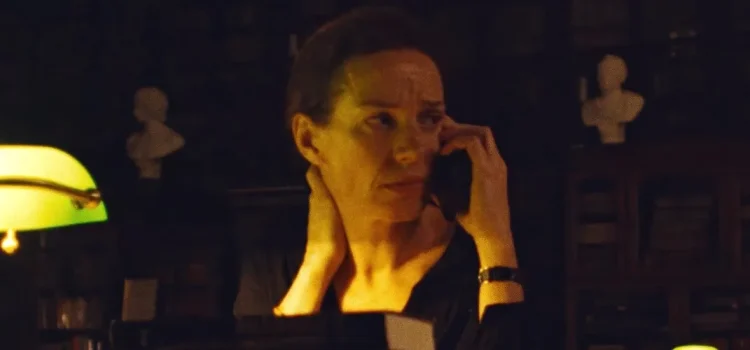
Orsolya (Eszter Tompa) is well-off, married-with-children, and working as a bailiff — she’s also Hungarian, which brings with it a bunch of cultural baggage. She is set to evict Ion from the premises with the help of her ready-for-action “ninja turtles” gendarmes.

Clearly enjoying the power she has over Ion as she informs him of his imminent eviction, she gives him 20 minutes to pack his things. Ion then kills himself. Orsolya is shocked. 

Even though she constantly reminds herself and everyone she talks to that she didn’t do anything “illegal,” Orsolya feels responsible for Ion’s death. She’s forced to face reality head-on, or, at least, mope around Cluj-Napoka looking for reassurance from coworkers, friends, and family while her husband and children go on vacation.

It’s a bleak premise, rendered in darkly comic fashion, with a lead character who’s equal parts maddening and relatable as she grows increasingly desperate to soothe her guilty conscience. Thanks to Jude’s characteristically provocative and gutting eye, “Kontinental ‘25” takes aim at not only Orsolya’s hypocrisies but also our own. A

fter all, Jude posits, we are inhabitants of this doomed planet, going about our days distracting ourselves from horrors many believe are out of our control.

These are happy days, indeed, brought to life as Orsolya’s psychological wounds are papered over with self-serving arguments that prize comfort over actual reflection. Meanwhile, gentrification, economic inequality, and deep-seated prejudice run rampant throughout Cluj-Napoca. History is rewritten by the “victors,” as wars rage across the globe.

Jude, whose previous films include “Dracula,” “Do Not Expect Too Much From the End of the World,” and “Bad Luck Banging or Loony Porn,” is unafraid to go for it and lean into his indulgences to show just how crazy modern life has become. “Kontinental ‘25” is no less fierce and biting at its core, but Jude takes a more social-realist approach this time around. 

Jude eschews stylistic extravagance for a stark approach that refuses to give Orsolya a heroic arc or distract from the main ideas at play — his anger and judgment practically seep off the screen. “Kontinental ‘25” is still full of acerbic wit and I-can’t-believe-they-just-said-that surprise, but the overall effect is a feeling of “tragedy of cruelty,” of how the status quo persists as time marches on.

That’s not to say the film isn’t also funny in a squirm-inducing way. “Kontinental ‘25” finds blunt ridiculousness in the matter-of-fact detachment of Orsolya’s interactions; each illuminates different ways of coping with her guilt and feelings of powerlessness.

The screenplay here is biting, harsh, and deadpan, with most conversations filmed in long-takes that let us marinate in uncomfortable silences and give us ample time to put ourselves in Orsolya’s shoes and reflect on our own place in the world. 

Do we donate to organizations about causes we care about in order to feel better about ourselves, or to actually make a difference? Do we let our prejudices and religious beliefs excuse happenings as inevitable? Do we indulge in drugs and alcohol to distract ourselves from our problems and avoid accountability? These are all questions that Orsolya grapples with, yet she is  never quite able to assuage her existential dread or “redeem” herself.

In Orsolya’s state of perpetual stasis, “Kontinental ‘25” can sometimes feel as if it’s spinning its gears along with her. The film is less a forward-moving narrative than a series of vignettes building towards, fittingly, not much at all in terms of her character. 

But Jude knows what really matters here, spending the first 20 minutes of the film solely with Ion, and ending with a heartbreaking montage of the transformation of Cluj-Napoka’s landscape. It’s the ever-present march of “development” at the expense of the vulnerable; an increasingly fragmented community that still resides under the same flag. This quietly powerful conclusion stands in contrast to the mostly empty language of the rest of the film, wordlessly conveying tragedy that will take large-scale action to reform.

Jude’s film is still definitely not for everyone; the mixture of nihilism and humanism is unusual, to say the least. It’s still a rich, confrontational text that leaves a nasty sting.

“Kontinental ’25” is a 2025 comedy drama from Romania, directed by Radu Jude and starring Eszter Tompa, Gabriel Spahiu, Adonis Tanta, Oana Mardare, and Annamaria Biluska. It is 1 hour, 49 minutes long. It was released in the U.S. on April 3. The film will play at the Webster University Film Series April 17-19. Alex’s Grade: A-.

Facebook Comments

Professional Actress Amy Holland Pennell Will Host

John K. Mefford to posthumously receive the Lifetime Achievement Award

Clayton Community Theatre leads all community theater groups with 22 nominations for this year’s 11th annual Theatre Mask Awards, followed by Kirkwood Theatre Guild with 17, Monroe Actors Stage Company in Waterloo, Ill., with 14, and O’Fallon Theatre Works” with 10.

Sponsored by the non-profit organization Arts For Life, the TMAs will take place starting at 11 a.m. on Saturday, April 25, at the Royale Orleans banquet center, 2801 Telegraph Road, St. Louis, Mo. 63125. Doors open at 10:30 a.m.

The Theatre Mask Awards, which began in 2015, honors comedies and dramas produced by local community theatre companies. Awards will be presented in 17 categories in production, performance and creative design.

Among the 2025 plays garnering the most nominations are CCT’s “Who Killed Aunt Caroline?” with 11 and “The Graduate” with 9; KTG’s “Into the Breeches” with 8 and “God of Carnage” with 7; OTW’s “The Complete Works of William Shakespeare Abridged” with 9; and MASC’s “Outside Mullingar” with 8 and “Crimes of the Heart” with 5.

Goshen Theatre Project in Collinsville’s production of ‘The Lion, The Witch and The Wardrobe” earned six nominations. Other theater companies participating in AFL include Act Two Theatre, Alfresco Productions, Hawthorne Players, KTK Productions and Theatre Guild of Webster Groves.

Nominations are listed at artsforlife.org

This year’s master of ceremonies is award-winning actress Amy Holland Pennell, and the Lifetime Achievement Award winner is John K. Mefford, who died in January after supporting community theater as a performer, volunteer and patron throughout adulthood.

Amy Holland Pennell

A native of Granite City, Ill., Pennell is a professional actress who has appeared in movies, television shows and on stage in plays and musicals.

Amy Holland Pennell

She earned Bachelor of Arts degrees in theatre and communication at Saint Louis University, honored as the outstanding graduate for performance and academic excellence. During her days here, she was a captain of the NFL St. Louis Rams Cheerleaders.

She has had recurring and guest-starring roles on HBO’s “The Newsroom,” Nickelodeon’s “Instant Mom,” Disney’s “Mighty Med,” CBS’s “NCIS: Los Angeles” and “How I Met Your Mother,” FX’s “It’s Always Sunny in Philadelphia” and ABC’s “Scandal.”

Her movie roles include “I Am,” “The Importance of Doubting Tom,” “Game Day” and “Exorcist House of Evil.”

On stage, she has played such iconic characters as Eliza Doolittle in “My Fair Lady,” Abigail in “The Crucible,” and Annie Sullivan in “The Miracle Worker.”.

Pennell said she remains deeply grateful for her faith, family, and friends, and continues to bring passion, heart, and humor to everything she does—onstage, on camera, and in life.

.John K. Mefford

John K. Mefford

Mefford, a lifelong resident of southern Illinois and longtime Granite City resident, passed away on Jan. 31, 2026, leaving behind a legacy of storytelling, service, and unforgettable characters—both on and off the stage.

 For 25 years, John served the Six Mile Regional Library District, where generations came to know him fondly as “the bookmobile guy.” He considered libraries were living places—vehicles of imagination, history, and connection—and he brought books, curiosity, and kindness to every stop he made.

 A lifelong lover of history, John immersed himself fully in the past. He was a dedicated historical reenactor with the Milice de Ste. Famille, a member of the Victorian Mourning Society of St. Louis.

That same passion for embodiment and storytelling carried naturally onto the stage. An accomplished actor who performed with Masquers, Summerstage, Alfresco Productions, and many others.

In recent years, John became a beloved part of St. Charles Christmas Traditions, portraying Clement Moore, author of “A Visit from St. Nicholas.” His readings of “’Twas the Night Before Christmas” enchanted audiences with warmth and humor.

Among his favorite roles were in “1776,” “The Rocky Horror Show” and “Alice in Wonderland.”

He was a cherished father, grandfather, husband, brother, friend and colleague who will be remembered for his generosity, creativity, and unmistakable spirit.

Tickets for Sale

Combination tickets for both TMAs and BPAs are available for $50 with a $2 service fee but must be purchased by April 10. After that, each event is $30 plus the $2 service fees.

Tickets are available at: https://arts-for-life-2.square.site/. Table seating is available at 10 per table. Cocktail attire is suggested. A buffet meal will be served, and a cash/card bar will be available.

The menu includes top round of beef with special LaFitte sauce, chicken parmesan, home-style green beans, pasta primavera, potatoes royale, salad and fresh bakery bread with butter. Special cupcakes from the Blue Owl Restaurant and Bakery in Kimmswick, Mo., are dessert.

Arts For Life is a local not-for-profit arts organization dedicated to the healing power of the arts through its work with youth, the underserved, and the community, with its goal of “Making a Dramatic Difference.”

AFL is dedicated to promoting public awareness of local community theatre, encouraging excellence in the arts, and acknowledging the incredible people who are a part of it.

For more information, email [email protected] or visit the website.

Facebook Comments

By CB Adams

There is a particular intelligence in how the St. Louis Symphony Orchestra has shaped its “Playlist: Symphony Happy Hour” series, and it has less to do with programming than with invitation. These one-hour concerts feel calibrated for the way people actually live now, attentive to time, to curiosity, and to the social dimension of music that often gets sidelined in more formal settings.

This “Playlist: Symphony Happy Hour — John Williams” evening, led by Stéphane Denève, offered the expected pleasures, iconic themes, gleaming orchestration, a shared recognition that rippled easily through the hall. Yet one of the most engaging elements arrived before the downbeat.

Denève’s brief, lucid introductions opened a window into Williams’ compositional thinking, drawing connections across scores and highlighting how closely related some of these themes are in their construction.

They carried the same quiet pleasure as a poet stepping forward to frame a work before reading it, offering just enough origin and intention to deepen what follows without overdetermining it. His explanation of the “Lydian” quality in Williams’ writing, that lifted, slightly otherworldly brightness created by a raised fourth, gave listeners a way into the sound itself.

Stephane Deneve

Paired with his observation about the kinship between the musical DNA of “Star Wars” and “E.T.,” the effect was cumulative, sharpening the ear and turning what might be passive recognition into active listening. It is a small intervention with an outsized effect.

The more lasting impression, though, came from the frame around the music. The option to enjoy a drink, a concise set of insights, and the easy permeability between audience and musicians before and after the performance created something closer to a salon than a concert. It is a format that lowers the threshold without lowering the standard.

The series understands that access is not dilution. It is design. By compressing the program into a single, purposeful hour, Playlist concerts sharpen attention and invite newcomers without asking them to decode tradition first.

For seasoned listeners, there is a different reward, the chance to hear familiar repertoire reframed, and to experience the orchestra as a living, social organism.

If there is a drawback, it is a telling one. This Playlist made a compelling case for itself, and in doing so, it sparked a quiet regret at not being able to take in the orchestra’s full weekend program. A smart entry point that leaves you wanting the deeper dive.

The SLSO’s “Playlist: Symphony Happy Hour — John Williams” was presented March 19 at Powell Hall.

Deneve conducts the SLSO during a rehearsal for a Playlist.

Photos provided by the St. Louis Symphony Orchestra.

Facebook Comments

By Lynn Venhaus
Clever, funny and heart-tugging – all the crucial qualities for a crowd-pleasing movie – are abundant in “Project Hail Mary,” an unlikely epic space opera that feels intimate with a smart script that isn’t dumbed down for mass appeal but comprehensible nonetheless.

Science teacher Ryland Grace (Ryan Gosling) wakes up on a spaceship light years from home with no recollection of who he is or how he got there. As his memory returns, he begins to uncover his mission: solve the riddle of the mysterious substance causing the sun to die out.

He must call on his scientific knowledge and unorthodox ideas to save everything on Earth from extinction — but an unexpected friendship means he may not have to do it alone.

Savvy minds, rejoice! Respectfully silly at times and eager to please in one of the year’s most entertaining offerings, wildly creative directors Phil Lord and Christopher Miller take us on a journey that never loses sight of what connects us as earthlings and in the universe.


Oscar winners for the 2018 best animated feature, “Spider-Man: Into the Spider-Verse,” Miller and Lord have a track record of turning films like “The Lego Movie” and “The Mitchells vs. The Machines” not only into innovative works but surprising emotionally rich stories too.

“Project Hail Mary” is the perfect vehicle to showcase their strengths, combining scientific theory with solid storytelling. They found the heartbeat in Andy Weir’s best-selling 2021 sci-fi novel by casting Ryan Gosling as Ryland Grace, a lovable middle school science teacher who is clearly capable of pushing boundaries with his molecular biologist research.

Grace is tapped by a task force to help uncover why the Sun is dimming, leading to the formation of a dim infrared line from the sun to Venus dubbed the Petrova line, which would cause a catastrophic ice age within 30 years.

Asked to study a sample from the Petrova line, he discovers it is made up of single-celled organisms that consume electromagnetic radiation. He calls it ‘astrophage,’ and it breeds by absorbing energy from the Sun and carbon dioxide from Venus.


Without getting too much into the weeds, this astrophage is infecting stars, too, and a nearby star, Tau Ceti, is where the “Hail Mary” spaceship is bound. Grace is reluctant to participate in this space probe, which likely means he may not make it back home, but Eva Stratt, superbly played by Sandra Huller, is persistent.

Drew Goddard’s nimble screenplay adaptation makes it all understandable, while Gosling does the heavy lifting. With his megawatt charm, quick wit, and agility to immerse himself in any character, Gosling slam-dunks the Everyman-turned-superhero role.

If he is the soul, then the alien Rocky is the heart. Emphasizing empathy, the movie turns into an affectionate buddy relationship after Grace emerges 13 years later aboard the Hail Mary. Once he figures out things, he discovers he is not alone.

Enter an alien being, which he dubs Rocky. To communicate with this eyeless, spider-like five-legged creature, he develops a system, and Rocky, a skilled engineer, is trying to save his star home too, so they collaborate. And thus, the beginning of a beautiful friendship. James Ortiz voices the creature.


Hooray for the creators who resisted having a strictly CGI creature, but instead, puppeteers maneuvered this “Rocky.” We like our aliens lovable (“E.T.: The Extra-Terrestrial” being the prime example), and Rocky strikes a common chord, as homesick as E.T. and as logical as half-Vulcan Mr. Spock on “Star Trek.”

For its celestial atmosphere, cinematographer Greig Fraser, Oscar winner for “Dune,” blends digital technology with practical realism, and expertly crafts shadows and light. Composer Daniel Pemberton ingeniously uses organic matter, like glass and a squeaky water tap, and percussive sounds, to flavor his interesting score. He also uses choirs for a grand effect.

The use of Harry Styles’ 2017 song, “Sign of the Times,” in a karaoke scene, is a standout, beautifully underscoring the film’s themes.

The movie’s supporting players include Lionel Boyce, Emmy nominee as pastry chef Marcus on “The Bear,” as a government security guy, and Ken Leung and Milana Vayntrub as astronauts.


Goddard, an Oscar nominee for “The Martian,” another Weir novel, deftly delivers the contrast in big ideas and caring for others. Weir’s characters are indelible on the page, and Goddard makes them as memorable on the big screen.

Yes, it’s a long film, at 2 hours, 36 minutes, but it never loses momentum.

A thrilling triumph, “Project Hail Mary” is both classic in themes and far-reaching in scope, proving there is an audience for high-stakes storytelling that hits all the feels in a visually stunning cinematic experience.

“Project Hail Mary” is a 2026 space sci-fi thriller directed by Phil Lord and Christopher Miller and starring Ryan Gosling, Sandra Huller, Lionel Boyce, Ken Leung and Milana Vayntrub, It is rated PG-13 for some thematic material and suggestive references and the run time is 2 hours, 36 minutes. Opens March 20 in theaters. Lynn’s Grade: A-

Facebook Comments

By Lynn Venhaus

Mesmerizing and masterful, “The Enigmatist” is a mind-blowing, brain-teasing, cleverly constructed blend of magic, puzzles, cryptology, and history.

This indelible one-man show by big-brained mastermind David Kwong engages through his razor-sharp wit and a theatrical flair for surprise. Clues abound and it felt like a communal game night with fun, smart people.

In the final stretch of The Rep’s season of “Daring Imagination,” this latest gem in the Steve Woolf Studio Series ignited an exhilarating adventure that left me awestruck and feeling as if my brain had undertaken a stimulating workout.

Before he even introduced himself, Kwong had us intrigued at the Puzzle Garden, an appetizing array of four brainteasers in The Rep’s lobby that serves as a prelude to his immersive experience below in the Emerson Studio Theatre.

The Puzzle Garden is ready to explore before the show and during intermission. Photo by Jon Gitchoff.

Highly recommended is arriving early so you can spend 30 minutes trying to figure them out – with small and large hints accessible. This interactive warm-up sets the stage for a shared feeling of togetherness that made the event so memorable. And you can return at intermission.

Most impressive is Kwong’s showmanship – in both his storytelling and audience interaction. He’s a charming ‘cruciverbalist’ who writes New York Times crossword puzzles, which accounts for his astounding verbal dexterity, but he has an easy-going, self-deprecating sense of humor that instantly engages the audience.

He’ll tell you about the gap between what you see and what you believe, and you’re immediately hooked. The thrill of code-breaking soon follows. The audience gets to guess, answer and be a part of the presentation. You may think that Kwong is the smartest man in the room, but you may be surprised by the brilliant minds sitting near you.

A dapper, slender man in a suit-and-tie, Kwong’s professorial demeanor doesn’t need the enhancement of a flamboyant Vegas-type spectacle for his imaginative tricks, and in his seamless style, keeps the show moving with astonishing ‘math magic’ and a fascinating tale involving intelligent heroes and stingy villains.

An audience member interacts with David Kwong. Photo by Jon Gitchoff.

Yes, math and science figure into his show, and so do history and wordplay. Fellow nerds and brainiacs are in heaven, but you don’t have to be a card-carrying Mensa member to enjoy. Just bring your curiosity and put on your thinking cap.

Suffice it to say you’ll never look at a kiwi fruit the same way again, and you’ll want to dig out your Scrabble board once you’re at home. The thrill of discovery is a major part of this intricately concocted excursion. (And we reciprocated by introducing him to Imo’s Pizza when someone suggested Imo’s for a crossword puzzle.)

His current playground is a cozy study setting, resembling what might have been at 221B Baker Street in London, Sherlock Holmes’ fictional address, or a well-traveled academic’s sanctuary. A few cabaret tables are scattered for patrons, giving it a small basement club vibe too.

Production Designer Brett J. Banakis and Lighting Designer Sean Gleason effectively keep the focus on Kwong’s illusions while Video Designer Joshua Higgason’s treasure trove of historical research helps us understand George Fabyan, who is a central figure in this enigmatic presentation.

A veteran New York Times crossword puzzle constructionist, Kwong shows how it’s done. Photo provided.

Fabyan, an eccentric business tycoon whose Riverbank estate along the Fox River in Geneva, Illinois, became home to experts in science, agriculture, literature and more as a private research laboratory. Known for pioneering modern cryptology in early 20th century, Fabyan is recognized as a forerunner of the National Security Administration.

Just as fascinating is the backstory of William and Elizabeth Smith Friedman, two of his employees who married and became experts in code breaking. They introduced mathematical/scientific methods to codebreaking during World War I, broke Japanese codes (including PURPLE) in World War II, and developed the theory of secure, one-time-pad communication.

Kwon weaves their stories into his script, and the history lesson is noteworthy. The visuals are not only those tidbits, but we watch Kwong construct Scrabble words — including three 8-letter ‘Bingos’ — and a crossword puzzle with an incredible verbal virtuosity that must be unrivaled.

The son of history and biochemistry professors, Kwong credits his “really smart” parents for sparking his curious intellect. A Harvard graduate who has become a renowned puzzle maker, TED Talk favorite and author, he has written “Spellbound: Seven Principles of Illusion to Captivate Audiences and Unlock the Secrets of Success,” and the children’s book “How to Fool Your Parents.”

Kwong surprises another audience member. Photo by Jon Gitchoff.

He also caught the attention of Hollywood and has been a consultant on the “Now You See Me” movies, “Mission: Impossible – Rogue Nation,” “The Imitation Game” and the television series “Blindspot.”

Produced by Erica Fee and Jason Seabright, the show has wowed sell-out crowds in New York, Los Angeles, Chicago, Washington D.C., Toronto and London since its debut in 2019.

With its unmistakable new worlds of wonder, “The Enigmatist” is a delightful evening, where loud gasps, chuckles, and exclamations ripple throughout the audience, sparking applause and jaws dropping in equal measure.

No rabbits are pulled out of hats and there is no escape hatch, but you may be giddy if you find calculations appealing. You get the hocus pocus of card tricks and mystifying sleight-of-hand (best left unspoiled), and creative problem-solving that is stunning. And that’s entertaining on multiple levels.

Kwong about to reveal something that will stun the audience. Photo by Jon Gitchoff.

The Repertory Theatre of St. Louis presents “The Enigmatist” March 7 – April 5 as the final installment of The Rep’s 2025-26 Steve Woolf Studio Series in the Emerson Studio Theatre, located in the Loretto-Hilton Center on the Webster University campus, 130 Edgar Road, Webster Groves.

The show is recommended for those ages 6 and up. Including a 15-minute intermission, the show is about 2 hours. Merchandise is available for purchase, including magic books and playing cards from David Kwong,

Tickets for are general admission. Audiences can elevate their experience by upgrading to a Studio VIP Subscription, which includes reserved seating, parking in Lot K, and exclusive behindthescenes content and interactive experiences. Tickets are available at repstl.org or by calling The Rep Box Office at (314) 9684925.

Who knew Scrabble tiles could be so entertaining? Photo provided.
Facebook Comments

By Alex McPherson

Playful and excoriating in equal measure, director Igor Bezinović’s documentary “Fiume o Morte!” (Fiume or Death!) examines the absurdity, horror, and sobering legacy of fascism, presenting an irreverent reframing of place and history that gives power back to the people.

Bezinović’s film takes place in his hometown of Rijeka, Croatia, a port on the Adriatic about 50 miles from Italy, with a tumultuous history. The city, once known as Fiume, was ruled by the Hapsburgs during World War I. After the War ended, it was left under the control of Yugoslavia, not Italy. This surprised many, including the vainglorious Italian aristocrat, poet, drug addict, womanizer, and army officer Gabriele D’Annunzio (a friend and inspiration for the young Benito Mussolini). 

In 1919, fueled by vanity and nationalism, D’Annunzio led an insurgency with 186 unemployed and hate-filled “legionaries” to occupy the city and claim it as an independent, pro-Italy city-state with himself as its supreme ruler. D’Annunzio’s leadership didn’t last long; he was forced out of power by none other than Italy itself in 1920. 

Bezinović aims to reckon with D’Annunzio’s complicated legacy on both sides of the Italo-Croatian border with “Fiume o Morte!” He also, just as importantly, cuts the failed despot down to size. 

Walking through a vibrant farmer’s market in present-day Rijeka, Bezinović asks passers-by whether they know who the man was — some have no idea, others are quick to label D’Annunzio a fascist, and others aren’t willing to make such sweeping statements, noting that he was also a “great poet and lover.” 

Bezinović reveals that he’s making a film about D’Annunzio’s coup, and he hires non-actor residents of Rijeka (including plumbers, musicians, and professors, some recruited directly from that farmers market, and at least one pet dog) to play every role and provide the film’s dry-humored narration, with several bald men recruited to play the (in)famously hairless D’Annunzio.

The historical reenactments themselves (which take up the bulk of “Fiume o Morte!”) treat D’Annunzio with the respect he deserves – that is, none at all. Performed with period-accurate costumes, keen attention to framing (Gregor Božič’s cinematography is beautiful), and a limited budget encouraging bucketloads of mocking comedy, Bezinović replicates scenes and tableaus from thousands of photographs and video footage documenting D’Annunzio’s “heroic” coup with a winking, anachronistic twist.

“Fiume o Morte!” jumps back-and-forth between these “grandiose” historical documents and a considerably less impressive present. The goofy yet faithful reenactments (in the same locations) seem out of place within the colorful hustle and bustle of modern-day Rijeka.

A photo of D’Annunzio speechifying before hundreds of onlookers turns into an aged non-actor revealed (via a slow zoom-out) to be speaking to an audience of two family members. A high-stakes meeting between generals concludes with D’Annunzio walking uphill to play rock music with his band as trucks leisurely drive by on their way to storm the city.

Some photos and videos — like a sword-wielding D’Annunzio posing naked draped with the Fiume flag, or homoerotic revelry on the beach with his unemployed legionaries — barely need exaggeration at all in the present-day. Sometimes onlookers stop to take pictures, others essentially ask “What the Hell are you doing?”

The reenactments are absurd and satisfyingly savage, emphasizing the ridiculousness of D’Annunzio’s occupation and putting his story in the hands of the community he attempted to suppress; a violent past juxtaposed by a resilient present that has endured and, as Bezinović keenly points out, is still grappling with D’Annunzio’s legacy and broader society’s continued cozying up to his fascist ideals.

Indeed, although “Fiume o Morte!” is often a breezy, immensely enjoyable viewing experience (particularly charming when narration highlights the backgrounds of each featured member of the ensemble), Bezinović never loses sight of the barbarity of D’Annunzio’s self-imposed mission, and the consequences of his violently prejudiced enterprise that helped pave the way for Kristallnacht. 

Bezinović is selective about what he chooses to recreate, in certain moments relying entirely on historical artifacts instead of reenactments to drive home the oppressiveness of D’Annunzio’s rule and the tragic consequences for the (especially non-Italian) citizenry, as well as painting clear parallels between then and now.

Not only do we get a clear picture of D’Annunzio’s hubris and failures, but also a spirited portrait of Rijeka and its diversity, and caustic reminders of how his memory lives (and, in terms of younger generations, dies) among the populace. Just nearby in the Italian city of Trieste, for example, statues are continuing to be erected of the bald buffoon to this day, more celebratory than critical.

“Fiume o Morte!,” then, works as an irreverent history lesson, a reclamation of storytelling by the community he claimed he conquered, and an example of how nationalism and pride distort the truth. And that art, liberating in its creative freedom, has the ability to both entertain and educate, empowering those whose stories were brushed over by forces of evil. 

This is a masterful documentary that’s enlightening and downright ingenious – an absolute must-watch that stands tall among the year’s best films thus far.

“Fiume o Morte!” Is a 2025 documentary directed by Igor Bezinovic. It was the official submission of Croatia for the ‘Best International Feature Film’ category of the 98th Academy Awards in 2026. It is 1 hour and 52 minutes run time. It can be seen at the Webster Film Series on March 8. Alex’s Grade: A+

Facebook Comments

By CB Adams

Opera succeeds when theater, singing, and orchestra move together. Winter Opera St. Louis brought those forces into satisfying alignment with Charles Gounod’s “Roméo et Juliette,” closing its season with a production that carried Shakespeare’s familiar tragedy with immediacy and emotional force.

Gounod’s 1867 opera, with a libretto by Jules Barbier and Michel Carré, keeps its focus firmly on the young lovers rather than the feud that surrounds them. That emphasis places unusual weight on the title roles, and Winter Opera delivered with a compelling pair.

Tenor Taylor Comstock sang Roméo with youthful ardor and a clear, lyrical tenor that expanded in power as the music climbed into the upper register. Opposite him, soprano Megan Barrera offered a Juliette of brightness, agility, and growing emotional depth.

Her “Je veux vivre” waltz sparkled with buoyant phrasing and easy coloratura, and she navigated the role’s demanding succession of arias and duets with clarity of tone and precise French diction.

Taylor-Comstock-Nathan-Whitson-Megan-Barrera. Photo by Dan Donovan.

Together they projected the impulsive youth at the heart of the story, allowing Gounod’s long love duets to unfold with warmth and urgency.

Director John Stephens guided the drama with clarity and focus. The turning point arrived in the duel between Mercutio and Tybalt, staged with sharp dramatic energy as Roméo’s intervention sealed the opera’s tragic course.

The final scene, shaped with intimate restraint, carried the emotional weight of the evening.

The supporting cast added vivid character and vocal strength. Baritone Kenneth Stavert filled Mercutio with swagger, wit, and striking physical vitality, relishing the playful brilliance of the Queen Mab scene.

Marc Schapman’s Tybalt burned with fierce intensity, while Jacob Lassetter brought warmth and authority to Capulet. Raphaella Medina charmed as Stéphano, and Emily Moore animated the role of Gertrude with lively presence. The ensemble throughout sang and acted with admirable cohesion.

In the pit, conductor Edward Benyas shaped the score with sensitivity to its lyrical sweep, balancing orchestra and voices so that Gounod’s melodic lines could bloom freely.

The chorus, prepared by Scott Schoonover, sang with clarity and strength, particularly in the somber lament that follows the duel.

Taylor Comstock and Marc Schapman as Romeo and Tybalt. Dan Donovan photo.

Scott Loebl’s flexible scenic design and Jen Blum-Tatara’s richly colored costumes reinforced the divided world of the rival houses while allowing the drama to move fluidly from celebration to tragedy.

The result proved deeply affecting and a fitting close to Winter Opera’s season. Performances at this level make a persuasive case for opera at an intimate scale, where music, voices, and story meet the audience directly.

Winter Opera’s “Roméo et Juliette” was performed on Feb. 27 and March 1 at the Kirkwood Performing Arts Center.

Megan Barrera as Juliette and Emily Moore as Gertrude. Photo by Dan Donovan.
Facebook Comments

By Alex McPherson

Far less lively than its premise promises, director John Patton Ford’s “How to Make a Killing” has a sturdy dramatic framework but forgets to have much fun along the way — it’s an Eat-the-Rich satire that commits the unfortunate sin of being dull.

Inspired by the 1949 film “Kind Hearts and Coronets,” “How to Make a Killing” centers around Becket Redfellow (Glen Powell), a man on death row with four hours until execution who relays his life story to a priest (Sean C. Michael). The film, guided, er, dictated, by Becket’s narration, jumps back and forth in time.

Becket, with a wry smile, insists that his story is a “tragedy,” as he reveals that his family has a 28 billion dollar fortune that he was willing to kill his seven other relatives to acquire. For Becket, it’s personal.

His mother was banished from the family by the mysterious patriarch Whitelaw (Ed Harris) after becoming pregnant with Becket as a teenager with a man of “lower class,” who quickly disappeared from the scene.

She raised Becket in a working class New Jersey neighborhood, occasionally immersing him in rich-adjacent activities like archery (featuring Chekhov’s bow and arrow), and, until her dying day, insisting that Becket has a legal claim to the Redfellow fortune and that he “deserves” it. 

It’s at one of these functions that a young Becket meets the uber-wealthy Julia Steinway (later played by Margaret Qualley). The two are drawn to each other, although they drift apart as they grow up in different social spheres.

In present-day New York City (before his arrest), Becket works at a men’s suit store and runs into Julia, who strikes up a flirtation (even though she’s engaged), and reminds him that he is a Redfellow.

After being abruptly demoted, and recognizing the sad unfairness of his current non-uber-wealthy living situation, Becket decides to take action, setting out to eliminate his relatives and do away with most of his morality. 

The group includes party boy Taylor (Raff Law), smug goofball artist Noah (Zach Woods), “philanthropist” Cassandra (Bianca Amato), Richard-Branson-esque McArthur (Alexander Hanson), rock star megachurch pastor Stephen (Topher Grace), and Becket’s surprisingly kind uncle Warren (Bill Camp) who hires Becket to work at his brokerage firm, plus the intimidatingly shady Whitelaw (Harris).

Quite a few folks to get through, but Becket’s greed and hunger for retribution motivate him, to the detriment of his personal relationships and sanity.

There’s a recipe for a crackling, twisted little thriller here, but Ford’s film is frustratingly milquetoast, possessing the skeleton of a strong narrative without putting in the work to give its story poignancy, momentum, or memorably crazy set pieces.

“How to Make a Killing” feels restrained as Becket flies further off the deep end, taking the easy way out instead of leaning into the lunacy, with derivative social commentary and subplots clunkily smashed together. It’s a shame, because the foundation is there. Powell remains an appealing leading man who brings charisma in spades.

Still, he feels underutilized, as Ford’s screenplay jumps through time erratically and often resorts to blatant exposition dumps (via Becket’s prison-set narration) that attempt to streamline the film while robbing it of textural detail.

Powell’s performance is sturdy enough on its own merits, particularly when the film slows down to briefly highlight his twisted satisfaction at his various killing schemes (which occur, puzzlingly, mostly off-screen) and to develop his relationship with the beautiful Ruth (Jessica Henwick), who is first attached to Noah.

Henwick and Powell have great chemistry, yet Ford treats their dynamic as more of a plot device than anything else — the tension between happiness/comfort and the pesky pull of greed and revenge.

It’s a conflict rendered too schematic to pack much emotional punch, worsened by dialogue that spells out Becket’s “choice” in eye-rollingly obvious fashion.

Qualley, to her credit, understands the assignment more than most of the ensemble, leaning into her character’s femme-fatale cartoonishness, periodically appearing to encourage Becket to continue his murderous mission and attempt to seduce him (for love or for the money?).

f only the rest of “How to Make a Killing” was as committed to the bit as Qualley who, regardless of whether you love or hate her performance, is definitely making choices and helping to momentarily excavate the film from generic territory.

Perhaps the biggest issues with Ford’s film revolve around its “tell, don’t show” philosophy. We don’t really feel Becket’s inner turmoil, nor do we fully buy why he feels compelled to push forward even when his life seems pretty damn good, all things considered. Nor do we get any flashy moments of R-rated violence, odd considering that the film is indeed called “How to Make a Killing.”

 Ford’s film does have eye-catching production design and stylistic use of light and shadow. But its conclusions are largely standard, a morality tale with a clearly telegraphed destination, and a laissez-faire approach to distinctive storytelling.

“How to Make a Killing” is a 2026 dark comedy-psychological thriller directed by John Patton Ford and starring Glen Powell, Margaret Qualley, Ed Harris, Bill Camp, Jessica Henwick, Zaff Law, Zach Woods, Bianca Amato, Topher Grace, and Alexander Hanson. It’s run time is 1 hour, 45 minutes, and it is rated R for language and some violence/bloody images. It opened in theatres on Feb. 20. Alex’s rating: C.

Facebook Comments

By Alex McPherson

Furious and scattershot, director Gore Verbinski’s madcap sci-fi parable “Good Luck, Have Fun, Don’t Die” has numerous incisive ideas about humanity’s dependence on technology but muddles them with a heavy dosage of smug humor.

One cannot accuse Verbinski of not being ambitious, though, with his latest effort bringing to mind a range of films including “Groundhog Day,” “The Terminator,” and “Everything Everywhere All At Once.” The film takes place in a near-future in which humanity’s addiction to technology has created a society of apathetic, homogenous-seeming beings doing nothing to stop society’s descent into tech company servitude. 

We open with an extended sequence featuring a disheveled, sardonic Man From the Future (Sam Rockwell) bursting into Norm’s Diner in Los Angeles in search of people to join him on an epic quest to prevent the AI apocalypse. He claims to have a bomb strapped beneath his transparent raincoat and launches into a speech about how technology has ruined modern life, insisting that time is of the absolute essence. 

This isn’t the Man’s first rodeo, though; it’s actually his 117th attempt with this same batch of disbelieving patrons. All of his previous 116 attempts have ended in death for everyone involved (except him), with the Man “resetting” and trying to find the right combination of people necessary to complete his mission. This time could be different, though. 

The group the Man pseudo-forces to participate includes Mark (Michael Peña) and Janet (Zazie Beetz), a couple going through a rough patch who recently started new jobs as high school teachers. They are increasingly disturbed by their students’ obsession with their smartphones and cynical detachment from the outside world, even during a school shooting, which is treated like “just another day.”

There’s also Susan (Juno Temple), a mother who lost her son in that same shooting and whose grief is brushed away — there is, as a squad of local mothers tells her, a company that specializes in creating clones of children who died in school shootings. Yikes. 

There’s Ingrid (Haley Lu Richardson), a severely depressed woman wearing an off-brand Disney princess costume who is literally allergic to Wi-Fi and smartphones. Along with a few other people who aren’t given much meaningful character development, the Man and his team embark on an increasingly loony journey.

Mixing madcap sci-fi action with a decidedly nihilistic streak, “Good Luck, Have Fun, Don’t Die” is alternately amusing and exhausting over its 135-minute runtime. For all of Verbinski and screenwriter Matthew Robinson’s sharp thoughts on our technological hellscape (did you see how many SuperBowl ads were about AI?), there’s a shakiness to the film that draws you in and subsequently pushes you away. 

The film mines plentiful deadpan humor from the populace’s matter-of-fact reactions, whether it be judgy, entitled high schoolers glued to their phones, or Susan’s newly-cloned kid who is “ad-supported,” all while nobody is taking action to turn things around.

Even so, the film can’t decide between championing these idiosyncratic, reluctant heroes and reveling in the tech-addicted nastiness that surrounds them. Poignant moments are offset by edgelord, shock-value humor that is deeply proud of itself and leaves a cold aftertaste.

Rockwell is the perfect choice to play this snarky antihero. He’s goofy and sometimes callous but strong in his convictions, with an increasing desperation creeping in as he nears closer to finally stopping the horrors of an AI-controlled future.

The rest of the cast aren’t anywhere near as dynamic to watch as Rockwell, but they get the job done, effectively emphasizing their feelings of displacement with an environment that refuses to recognize their empathy and, indeed, their humanity.

Verbinski and Robinson take ample time to provide backstory for the “core group,” structured in “Black Mirror” -esque flashbacks that periodically break up the immediate action of the Man and co. escaping from Norm’s and venturing to their next objectives.

This vignette structure works well enough (albeit padding the runtime to an excessive degree), and helps illuminate the personal costs of living in this reality that’s not all that dissimilar from our own. Less impactful are the labyrinthine multiversal shenanigans that arise in the finale, difficult to follow and messy in a decidedly hand-made way.

“Good Luck, Have Fun, Don’t Die,” then, is a rickety experience that’s still impossible to discount. Verbinski and Robinson take rightful aim at the devices and companies that are hijacking our attention and transforming us into passive, homogenous consumers rather than informed people with agency over our own lives.

The crafts, too, are noteworthy, especially James Whitaker’s energetic cinematography and a techno score by Geoff Zanelli that pulses with rambunctious life.

Verbinski and Robinson are clearly interested in sounding a 5-alarm fire about doing something now rather than waiting until all hope is lost. The messiness of living in the real world, the film says, is worth fighting for, even when the digital one offers an illusion of safety and happiness.

There’s definitely merit to that message in 2026, although “Good Luck, Have Fun, Don’t Die” is ultimately a mildly entertaining, pitch-black yell at the Cloud.

“Good Luck, Don’t Die, Have Fun” is a 2025 sci-fi action-adventure horror comedy directed by Gore Verbinski and starring Sam Rockwell, Juno Temple, Haley Lu Richardson, Michael Pena, Zazie Beetz, Georgia Goodman, and Asim Chaudhry. It is rated R for pervasive language, violence, some grisly images and brief sexual content and runs 2 hours, 14 minutes. Opens in theatres Feb. 13. Alex’s Grade: B-.

Facebook Comments

By Lynn Venhaus

Visually stunning but emotionally empty, “Wuthering Heights” is an abomination for fans of the classic gothic romance, a disservice to Emily Bronte’s dark source material about eternal love, longing, hurtful pride and ruthless revenge.

The 1847 novel took place on the harsh Yorkshire moors. The impoverished, abused Heathcliff, adopted into the affluent Earnshaw family around 1771, works manual labor, and forges a special bond with the privileged, petulant Catherine.

However, writer-director Emerald Fennell claims it’s not an adaptation, but a bold and sexy interpretation of how the book made her feel when she read it at age 14. Maybe she could have changed the title to avoid less-than-flattering comparisons?

Fennell’s spin is edgy excess as she favors kinky bodice-ripping sexual compulsion over the book’s spiritual obsession that lingers long after reading. The emotional heft that the novel delivered for 180 years is lacking,

Australians Margot Robbie and Jacob Elordi are pretty people who are magnetic on screen and talented Oscar-nominated actors.

Although Robbie, at 35, is too old for her character, and Elordi’s modern casting is controversial because he’s not a person of color, they display a spark as the doomed lovers — refined, selfish Catherine and rough, tormented Heathcliff.

In this salacious version, the heavy lifting required for such complicated characters in what would be considered a toxic and manipulative relationship in today’s world isn’t important.

Treated as an outcast, Heathcliff is described by Bronte as a “dark-skinned gypsy in aspect” and “dirty, ragged, black-haired,” so speculation that he was black or brown-skinned continues.

Playing the young roles, Brits Owen Cooper (Emmy winner for “Adolescence”) and Charlotte Mellington, excel at establishing the characters’ demeanors.

 In previous screen portrayals of grown-up Heathcliff – Laurence Olivier in 1939, Timothy Dalton in 1970, and Ralph Fiennes in 1992, with Richard Burton in a 90-minute DuPont Show of the Month in 1958 and Tom Hardy in a two-part series on Masterpiece Theatre in 2009 — all were white.

Only one – James Howson, a black actor, portrayed the brooding anti-hero in a 2011 film by director Andrea Arnold. So, the debate continues.

The tone is troubling too – Elordi is never savage or a brute to Robbie, and she’s not nearly as wild as the book depicts Cathy. Their relationship, so-called “forbidden,” was thwarted because of societal constraints in the Victorian Era.

Fennell gussied up the look with ready-for-influencers’ glossiness that is distracting and merely decorative — and at times, not period-appropriate.

The shiny surface spotlights the crafts over substance, foregoing the book’s deeper meaning about twisted, destructive intergenerational consequences because Fennell cut out the second half.

She has reduced this timeless tale to a tedious 2 hours, 16 minutes of fan fiction, with too many scenes reminiscent of 1990s perfume ads, complete with.artsy shadows and peculiar attitudes.

Costume designer Jacqueline Durran goes increasingly over-the-top with Catherine’s opulent, outlandish outfits – including an iridescent cellophane dress accented with a large pink bow, as if she’s a gift for her new husband. How meta!

She and production designer Suzie Davis get carried away with a color palette emphasizing red and pink. An odd collection of leeches on the wall of Catherine’s palatial dainty pink-and-freckled bedroom is a ridiculous misuse of the era’s medical customs.

Oscar-winning cinematographer Linus Sandgren (“La La Land”) emphasizes unrelenting weather elements to convey the windy, rainy and foggy conditions of the rugged moors, employing impressionistic lighting and sweeping long takes to heighten the gritty geographic-specific realism.

When Cathy marries aristocratic Edgar Linton (Shazad Latif) of neighboring estate Thrushcross Grange for financial stability, as her gambling drunkard father (Martin Clunes) has frittered away their fortune, a devastated Heathcliff feels betrayed and leaves, only to come back five years later a rich man.

After he buys Wuthering Heights, Heathcliff later seeks revenge on everyone who has wronged him (although the film misses the mark here by not continuing that storyline). As soulmates, he and Catherine maintain an intense and tumultuous relationship, more sexually explicit here than the 18th-century book.

Spitefully, he marries Edgar’s sheltered, child-like sister Isabella (a terrific Alison Oliver). This sadistic-masochistic relationship is the film’s most troubling insertion, next to the shocking hanging scene that opens the film as a sexually arousing public event (things you can’t unsee).

Known for her provocative, twisted takes on relationships (“Promising Young Woman,” “Saltburn”), Fennell has established herself as someone with a fresh, unique vision. In this strange misfire, the mood is more important than the message, and her tinkering has cut out some crucial characters or revised them in ways that don’t make sense.

She eliminated Catherine’s bully brother Hindley, who was cruel to Heathcliff while the dad was kind, changed the parents’ narratives, and dropped the second half of the book, among other puzzlers.

Therefore, characters aren’t haunted by the tragic past, and the supernatural elements aren’t brought up. That’s a huge part of this story. Fennell didn’t want to go the distance, and because of that, the character development is scattered.

Fennell has made Nelly Dean, the maid who is more of a Heathcliff ally in the book, the villain here, and is slyly played by the superb Oscar-nominated actress Hong Chau as someone wounded and lashing out (Mrs. Danvers, anyone?). It’s another confusing element.

In her Oscar-winning screenplay for “Promising Young Woman,” Fennell presented an original view on gender disparity, and “Saltburn” was an intriguing class clash, a twisty take on “The Talented Mr. Ripley,” both ramping up shocks and dropping jaws — effective contemporary pieces that kickstarted conversations (and brisk business for the novelty candle “Jacob Elordi’s Bathwater”).

The frenzy/firestorm continues here with a polarizing work, but this time it’s rooted in a beloved book. Does the original intent come through for the uninitiated, who aren’t familiar with the star-crossed lovers’ tragedy that continues to fascinate?

What will be the lasting impressions? It seems disposable, save for.bizarre images of dog collars, messy broken eggs, mountains of gin bottles, scarred flesh, pig’s blood, voyeurism, eccentric dolls, and lots of ribbons.

To add to its surreal aesthetic, Charli XCX, a pop star known for her synth-electro beats, has created a modern techno soundtrack.  

In its favor, Fennell kept some of the most revered quotes in: “Whatever our souls are made of, his and mine are the same,” “I cannot live without my life! I cannot live without my soul!” and “I have not broken your heart—you have broken it; and in breaking it, you have broken mine.”

If an adaptation – say Baz Luhrmann’s “Romeo + Juliet” and “The Great Gatsby” — brings a dynamic energy to the moral complexities of a moment in time – then we can accept the changes, but when one ignores the psychology in favor of spectacle, it’s merely a parade of ‘strike-a-pose’ cosplay scenes.
Call me a romantic traditionalist, but this ‘loosely based’ adaptation is cringy, turgid, unnecessary and interminable.

“Wuthering Heights” is a 2026 period drama romance directed by Emerald Fennell and starring Margot Robbie, Jacob Elordi, Hong Chau, Shazad Latif, Alison Oliver, Martin Clunes, Owen Cooper and Charlotte Mellington. It is rated R for sexual content, some violent content and language and runs 2 hours, 16 minutes. It opens in theaters Feb. 13. Lynn’s Grade: D.

Facebook Comments