

By Lynn Venhaus
With a vivacious cast of relatable relatives, The Black Rep delivers a sassy, spirited and sometimes silly “Fat Ham,” which is a modern humorous reinterpretation of Shakespeare’s “Hamlet.”
Surprising in its fresh spin of the play’s universal themes, the 2022 Pulitzer Prize-winner by James Ijames replaces royal revenge with a look at black masculinity, queer identity and cycles of generational trauma — but flips it as a comedy, not tragedy.
This production, deftly directed by Geovanday Jones, focuses on unpredictable storytelling. Jones brought out the playfulness of the performers, who sometimes mirror the Bard’s iconic roles, but mostly differ in humorous delivery and make them broader in body language.
Set at a backyard barbecue in the American South, the key points of Hamlet’s torment, confusion and the weight of heritage play heavily on the mind of gay college student Juicy, who is visited by his deceased father’s ghost. Pap seeks revenge, Juicy wrestles with that directive.
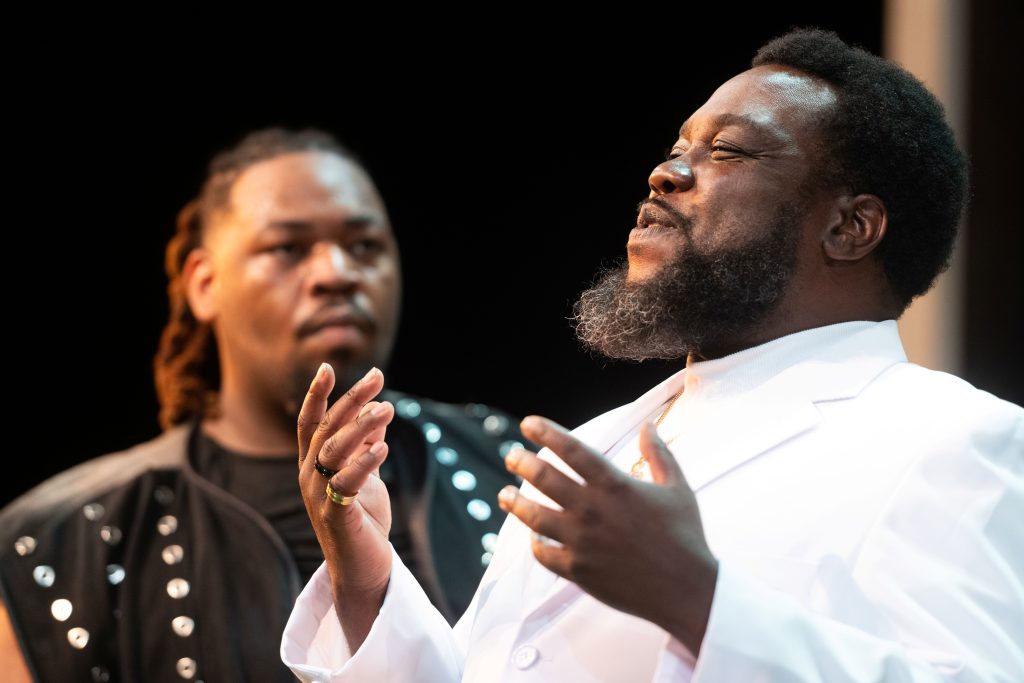
Pap (Enoch King) was murdered in prison and reveals to his son that his brother Rev (King, in a dual role) arranged the hit. The Rev quickly married Juicy’s livewire mother Tedra (firecracker Angela Wildflower), and disturbed Juicy sorts out a tangled web of betrayal, anger and legacy.
Blustery King capably plays two sides of the coin – the hot-tempered wronged brother Pap and the entitled, selfish bully Rev., whose toxicity signals danger.
But sweet, sensitive Juicy, masterfully portrayed by Marshall W. Mabry IV as an old soul, isn’t keen on vengeance. He summons an inner strength, shows how mature he is, and opts out.
Despite her questionable choices, his Gertrude-like mother relies on him to be steady – “You don’t get to go crazy,” she says when everything seems topsy-turvy.
Juicy breaks the fourth wall to comment on what we’re seeing and what expectations we might have, which is another departure from tradition.
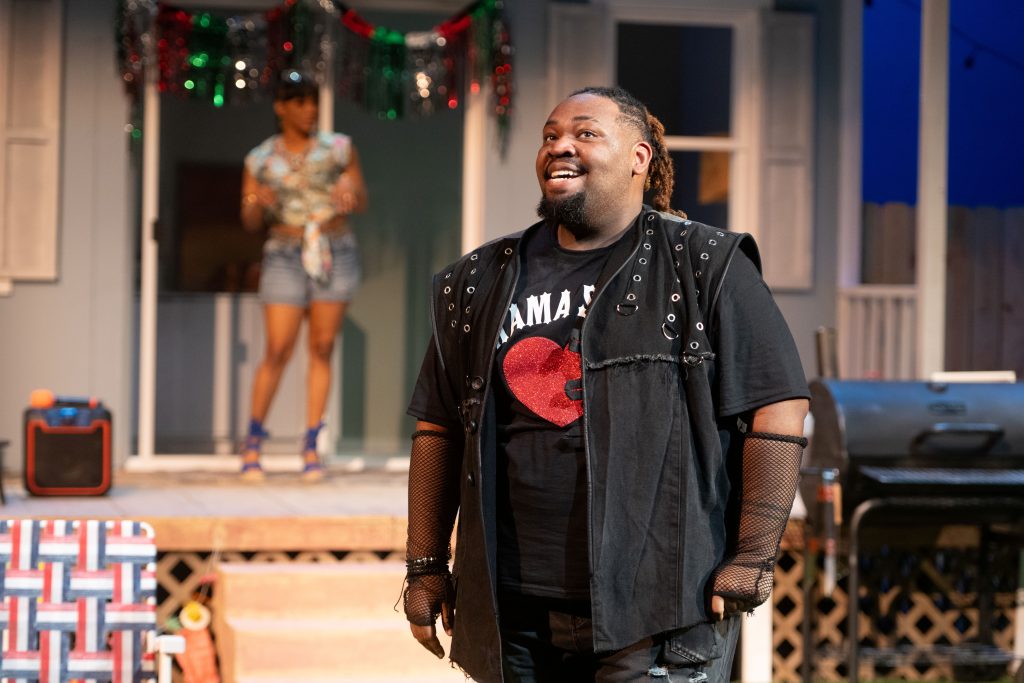
Friends and neighbors come to the party with their own baggage. The only real tragedy is that the characters are types who have never been allowed to be themselves. Tension escalates between the mean-dog uncle/stepfather and Juicy can’t relax and be true to himself.
Pass the potato salad as insights are revealed and the core group question their choices. Nods to the Bard’s great tragedy are in the form of a clever game of charades instead of an elaborate wedding banquet entertainment.
Patrick Huber’s scenic design is a marvel of form and function, creating a porch and yard with nooks and crannies for action – an adjacent shed, lawn chairs for tete a tetes, picnic tables to dance on top of while using a karaoke machine.
Huber’s crisp lighting design boosted key transitions while Tre’von Griffith’s sound design punctuated the action. Music is a key component in the presentation, and Heather Himes’ choreography brings out the show’s celebratory themes.
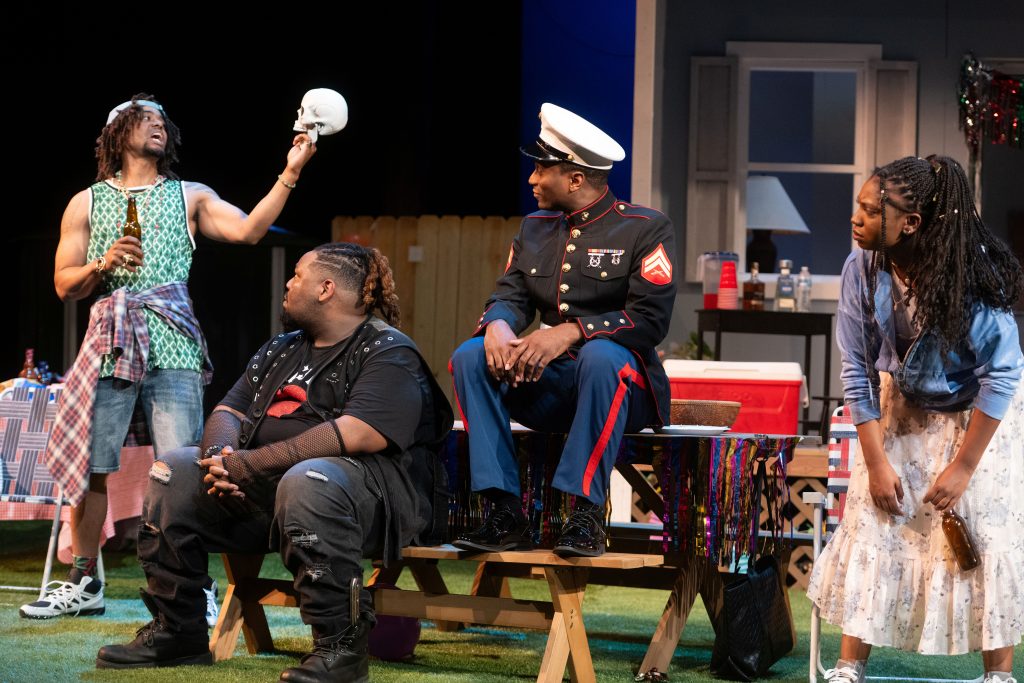
Two other stagecraft veterans added oomph, too – Andre Harrington’s costumes smartly conveyed characters and Mikhail Lynn’s props accented the social interactions.
An undercurrent simmers as more truths are exposed – Larry and Opal (aka Laertes and Ophelia) are the children of Rabby, a stylish but bossy busybody version of Polonius, who pushes her children to succeed. In another feisty role, Margery Handy lays it on thick as a boisterous social butterfly while her children are reluctant to fit into polite society.
Brian McKinley is misleading as the rigid, reserved Larry, a Marine in uniform, who needs to break free from societal expectations. He’s the epitome of duty, honor, service. As a fierce Opal, Raevyn Ferguson is mopey, forced to wear a dress, but lets loose as a lesbian who gets louder and prouder. Opal has nothing in common with Shakespeare’s Ophelia, and proclaims: “I ain’t dying for nobody.”
These siblings are the most obvious characters subverting expectations. But the major source of comic relief is naturalistic actor Olajuwon Davis as Tio, a chatty, porn-addicted stoner who serves as Juicy’s unfiltered best friend, like the Bard’s Horatio.
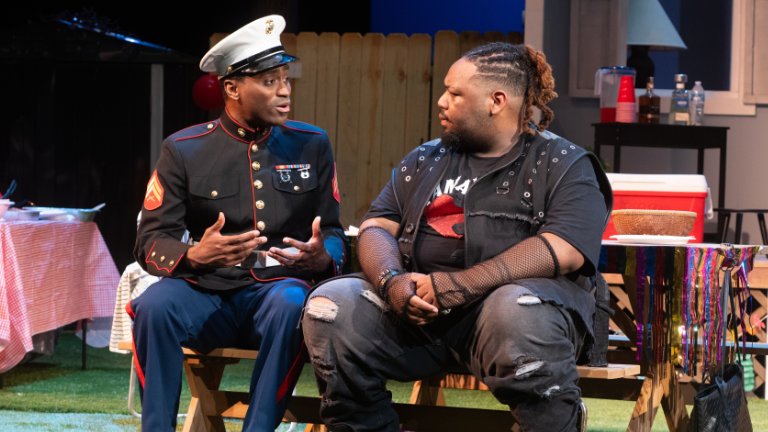
Observing Juicy’s melancholy, he remarks: “Your Pop went to jail, his Pop went to jail, his Pop went to jail, his Pop went to jail and what’s before that? Slavery.”
While action gets heated, don’t expect a bloodbath or even tragic deaths. Even with the tamped-down violence, the legacy between fathers and sons’ bristles, as it should for effect.
Hamlet (Juicy) isn’t home from college but attends an online school instead, majoring in human resources, and he is mocked for his goals.
What might life be like if we chose pleasure over harm? That’s the core of Ijames’ work. The younger generation wants to break the cycles of violence and trauma, opting for emancipation and joy.
The ensemble leans into these timeless elements, finding their voices and defying stereotypes. Juicy would rather live his truth out loud and doesn’t need to conform. The best thing about this twist? We are allowed to revel in his hard-fought victory — and in other characters’ liberations as well.
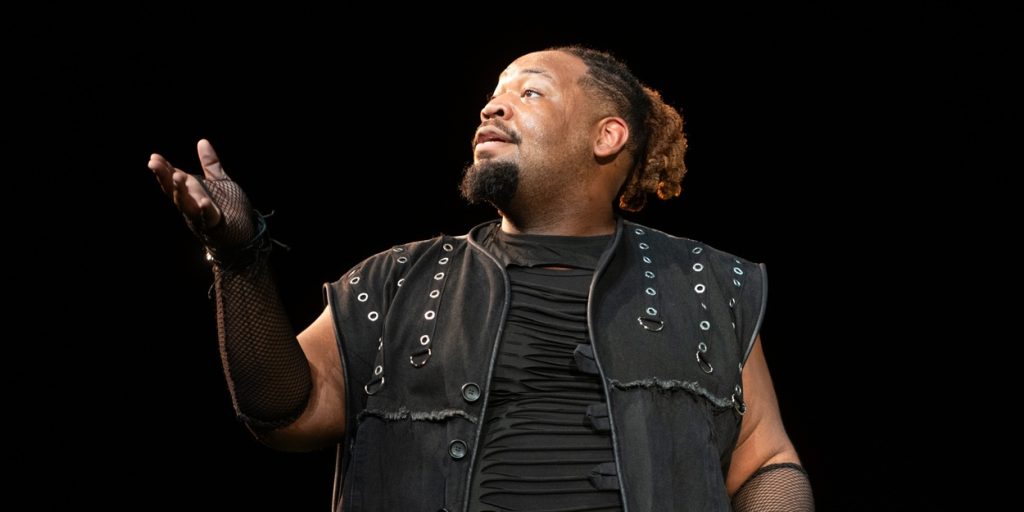
The St. Louis Black Repertory Company presents “Fat Ham” from May 20 through June 7 at The Edison Theatre on the campus of Washington University in St. Louis. The play is 1 hour and 45 minutes, without intermission. This production concludes the 49thseason. Tickets and information for performances are available at theblackrep.org or through the Box Office at 314-534-3807. Reduced pricing is available for seniors, educators, museum staff, students, and groups of 12 or more
.

Lynn (Zipfel) Venhaus has had a continuous byline in St. Louis metro region publications since 1978. She writes features and news for Belleville News-Democrat and contributes to St. Louis magazine and other publications.
She is a Rotten Tomatoes-approved film critic, currently reviews films for Webster-Kirkwood Times and KTRS Radio, covers entertainment for PopLifeSTL.com and co-hosts podcast PopLifeSTL.com…Presents.
She is a member of Critics Choice Association, where she serves on the women’s and marketing committees; Alliance of Women Film Journalists; and on the board of the St. Louis Film Critics Association. She is a founding and board member of the St. Louis Theater Circle.
She is retired from teaching journalism/media as an adjunct college instructor.