
By Lynn Venhaus

With a vivacious cast of relatable relatives, The Black Rep delivers a sassy, spirited and sometimes silly “Fat Ham,” which is a modern humorous reinterpretation of Shakespeare’s “Hamlet.”

Surprising in its fresh spin of the play’s universal themes, the 2022 Pulitzer Prize-winner by James Ijames replaces royal revenge with a look at black masculinity, queer identity and cycles of generational trauma — but flips it as a comedy, not tragedy.

This production, deftly directed by Geovanday Jones, focuses on unpredictable storytelling. Jones brought out the playfulness of the performers, who sometimes mirror the Bard’s iconic roles, but mostly differ in humorous delivery and make them broader in body language.

Set at a backyard barbecue in the American South, the key points of Hamlet’s torment, confusion and the weight of heritage play heavily on the mind of gay college student Juicy, who is visited by his deceased father’s ghost. Pap seeks revenge, Juicy wrestles with that directive.
Enoch King as the ghost of Pap, with Marshall W. Mabry IV as Juicy. Photo by Howard Ash.

Pap (Enoch King) was murdered in prison and reveals to his son that his brother Rev (King, in a dual role) arranged the hit. The Rev quickly married Juicy’s livewire mother Tedra (firecracker Angela Wildflower), and disturbed Juicy sorts out a tangled web of betrayal, anger and legacy.

Blustery King capably plays two sides of the coin – the hot-tempered wronged brother Pap and the entitled, selfish bully Rev., whose toxicity signals danger.

But sweet, sensitive Juicy, masterfully portrayed by Marshall W. Mabry IV as an old soul, isn’t keen on vengeance. He summons an inner strength, shows how mature he is, and opts out.

Despite her questionable choices, his Gertrude-like mother relies on him to be steady – “You don’t get to go crazy,” she says when everything seems topsy-turvy.

Juicy breaks the fourth wall to comment on what we’re seeing and what expectations we might have, which is another departure from tradition.

Marshall W. Mabry IV as Juicy, now dressed for the party, with Angela Wildflower as Tedra on the porch. Photo by Howard Ash.

Friends and neighbors come to the party with their own baggage. The only real tragedy is that the characters are types who have never been allowed to be themselves. Tension escalates between the mean-dog uncle/stepfather and Juicy can’t relax and be true to himself.

Pass the potato salad as insights are revealed and the core group question their choices. Nods to the Bard’s great tragedy are in the form of a clever game of charades instead of an elaborate wedding banquet entertainment.

Patrick Huber’s scenic design is a marvel of form and function, creating a porch and yard with nooks and crannies for action – an adjacent shed, lawn chairs for tete a tetes, picnic tables to dance on top of while using a karaoke machine.

Huber’s crisp lighting design boosted key transitions while Tre’von Griffith’s sound design punctuated the action. Music is a key component in the presentation, and Heather Himes’ choreography brings out the show’s celebratory themes.

Olajuwon Davis as Tio, Mabry, Brian McKinley as Larry and Raevyn Ferguson as Opal. Photo by Howard Ash.

Two other stagecraft veterans added oomph, too – Andre Harrington’s costumes smartly conveyed characters and Mikhail Lynn’s props accented the social interactions.

An undercurrent simmers as more truths are exposed – Larry and Opal (aka Laertes and Ophelia) are the children of Rabby, a stylish but bossy busybody version of Polonius, who pushes her children to succeed. In another feisty role, Margery Handy lays it on thick as a boisterous social butterfly while her children are reluctant to fit into polite society.

Brian McKinley is misleading as the rigid, reserved Larry, a Marine in uniform, who needs to break free from societal expectations. He’s the epitome of duty, honor, service. As a fierce Opal, Raevyn Ferguson is mopey, forced to wear a dress, but lets loose as a lesbian who gets louder and prouder. Opal has nothing in common with Shakespeare’s Ophelia, and proclaims: “I ain’t dying for nobody.”

These siblings are the most obvious characters subverting expectations. But the major source of comic relief is naturalistic actor Olajuwon Davis as Tio, a chatty, porn-addicted stoner who serves as Juicy’s unfiltered best friend, like the Bard’s Horatio.

Fat Ham Black Rep. Photo by Howard Ash.

Observing Juicy’s melancholy, he remarks: “Your Pop went to jail, his Pop went to jail, his Pop went to jail, his Pop went to jail and what’s before that? Slavery.”

While action gets heated, don’t expect a bloodbath or even tragic deaths. Even with the tamped-down violence, the legacy between fathers and sons’ bristles, as it should for effect.

Hamlet (Juicy) isn’t home from college but attends an online school instead, majoring in human resources, and he is mocked for his goals.

What might life be like if we chose pleasure over harm? That’s the core of Ijames’ work. The younger generation wants to break the cycles of violence and trauma, opting for emancipation and joy.

The ensemble leans into these timeless elements, finding their voices and defying stereotypes. Juicy would rather live his truth out loud and doesn’t need to conform. The best thing about this twist? We are allowed to revel in his hard-fought victory — and in other characters’ liberations as well.

Mabry in the Hamlet role as Juicy. Photo by Howard Ash.

The St. Louis Black Repertory Company presents “Fat Ham” from May 20 through June 7 at The Edison Theatre on the campus of Washington University in St. Louis. The play is 1 hour and 45 minutes, without intermission. This production concludes the 49thseason. Tickets and information for performances are available at theblackrep.org or through the Box Office at 314-534-3807. Reduced pricing is available for seniors, educators, museum staff, students, and groups of 12 or more

.

By Lynn Venhaus

If your family is prone to putting the ‘fun’ in dysfunctional, you’ll be able to relate to the crowd-pleasing hijinks of “Chicken and Biscuits,” an amiable comfort-food style comedy served with a salty side of sass by the Black Rep.

Wackiness ensues when three generations of an African American family gather for the funeral of their patriarch, Bernard, who was a beloved pastor at a popular church in New Haven, Conn.

The relationships are typically complicated, starting with his two bickering daughters, prim and bossy Baneatta (Denise Thimes) and raucous and unfiltered Beverly (Paulette Dawn). The night-and-day siblings are a surefire recipe for tussling, as Baneatta has an unmistakable air of superiority and disapproval when it comes to her more flamboyant colorful sister. Played by the elegant Denise Thimes, she says a lot with a withering look or a well-delivered quip.

Thimes, an internationally renowned jazz singer, is a welcome presence on the Edison Theatre stage, and was impressive in a dramatic role in “King Hedley II” last summer. She proves her comedic skills here, and has delightful chemistry with A.C. Smith, as her husband. Of course, she bosses him around when he’s trying to be in charge.

Smith, another Black Rep veteran whose crisp timing enlivens his interactions, is zesty as the well-meaning Reginald Mabry, who will be taking over as the church’s pastor, so he feels he has a lot to prove presiding over the funeral service.

But clearly, he can’t foresee the simmering resentments that will erupt when everyone gathers.

Kaylyn McCoy and Paulette Dawn as mother and daughter. Photo by Keshon Campbell.

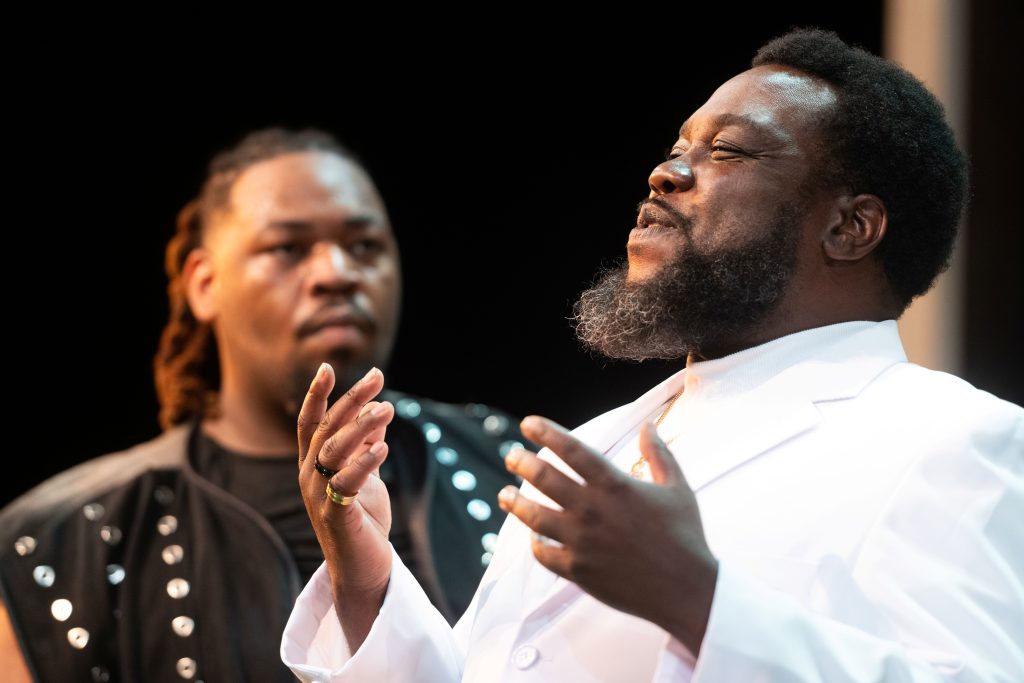
Beverly, a bona fide drama queen, is played with cheeky bravado by Paulette Dawn, who makes her Black Rep debut but has portrayed the over-the-top character before, in her native Kansas City.

As she gripes about wearing traditional black, Beverly has decided to honor her daddy’s penchant for bright colors with a purple plunging neckline cocktail dress that she wears with a push-up bra to enhance her amble bosom. She has no qualms about showing off her attributes.

Beverly has brought along her Gen Z daughter La’Trice Franklin, played with expected attitude by Kaylyn McCoy. She doesn’t have as much history with her relatives and is written as more of an observer.

Baneatta also has a daughter, Simone, who has a big chip on her shoulder. Dumped by her fiancé for a white woman, and Alex Jay plays her as a grump, quick to argue with anyone.

She is at odds with her gay brother Kenny, who brings his boyfriend Logan Leibowitz with him. Their interracial and interfaith relationship adds a layer of complexity that isn’t explored more deeply, but Cameron Jamarr Davis and Jacob Schmidt are compelling enough actors that they give the roles more nuance than indicated (and it would have been nice for that to happen).

A few relatives are more accepting than others, which is an ongoing conflict, especially with Kenny’s mom Baneatta, who is rude and dismissive of Logan, second only to Simone’s exasperation. As written, these issues are stereotypical and not amusing, an outdated quick way to get cheap laughs.

At far right, Jacob Schmidt and Cameron Jamarr Davis. Photo by Keshon Campbell.

This Jenkins family feud follows a familiar format not unlike sitcoms and other broad comedies where secrets are revealed, characters express their concerns, and disagreements are neatly resolved in a light-hearted way.

Don’t expect anything more from actor-turned-playwright Doug Lyons’ 2020 effort, which is designed to be a sunny reminder of the ties that bind, and how we share more similarities than differences in troubling times.

(It did, after all, open on Broadway Feb. 28, 2020, right before the coronavirus pandemic hit, causing widespread shutdowns, and the run was short-lived. However, there was a reboot in 2021.)

Director Ron Himes has selected a cast that gels, who work together well, and flavor this exercise with feel-good vibes. You can tell how much fun they are having as an ensemble.

Also, part of the plot is a mysterious guest, Brianna, who shows up at the funeral to deliver a eulogy that others may not like to hear. The late second act addition is played by Delisa Richardson, who makes the most of her stage time.

Photo by Keshon Campbell.

Another running gag is church soloist Mother Jones, whose interpretation of “Amazing Grace” receives mixed reviews but is hilarious as a comedic bit. Jermaine Manor is the musician offstage, and sound designer Kareem Deanes has fun with this element.

The set is minimal, designed by Tim Jones, which moves action between a bedroom, hotel room, church, reception gathering spot and commercial kitchen, featuring efficient lighting design by Ethan Steimel.

Costume Designer Andre Harrington has gathered an attractive selection of tasteful black dresses and striking fancy hats for the women whose last names aren’t Franklin, and outfitted the men in suitable attire. Mikhail Lynn assembled the appropriate props.

If you’re seeking a pleasant piece in these precarious times and dismal winter, “Chicken and Biscuits” is a recipe that can hit the spot. This ensemble puts the ‘fun’ in funeral as they tickle funny bones.

The St. Louis Black Repertory Company presents “Chicken and Biscuits” from Jan. 8 to Jan. 26 at the Edison Theatre on the campus of Washington University in St. Louis. Tickets are available at theblackrep.org or through the Box Office at 314-534-3807. Reduced pricing is available for seniors, educators, museum staff, students, and groups of 12 or more.

Paulette Dawn and Alex Jay. Photo by Keshon Campbell.

By Lynn Venhaus

Bigotry is an ugly thing to witness, even in the context of 1821. It’s expected, but always unsettling, no matter what period.

So, when the first scene of “The African Company Presents Richard III” opens with a condescending and arrogant white supremist shutting down a competing Shakespearean production, that sets the tone for a battle between right and might.

As Stephen Price, the haughty and cruel producer at the Park Theatre, Eric Dean White will make your skin crawl. He is threatened by their success and will use his influence to get the powers-at-be to make it hard on them.

While our sympathies lie with the performers in The African Company, they are having their own conflicts to deal with from within that threatens their existence too.

This 1994 play within a play by Carlyle Brown is a provocative showcase for compelling artists in The Black Rep’s latest riveting work. And opens the Black Rep’s 46th season in fine fashion.

Based on a true story, Brown’s drama is set in pre-Civil War New York when two productions of Shakespeare’s “Richard III” are vying for audiences. Slavery was not outlawed yet, but there were more free blacks living there.

Shakespeare famously said, “The play is the thing,” and The African Company, through the Black Rep’s hard-hitting production, shows you why art can break barriers, and all the challenges are worth it.

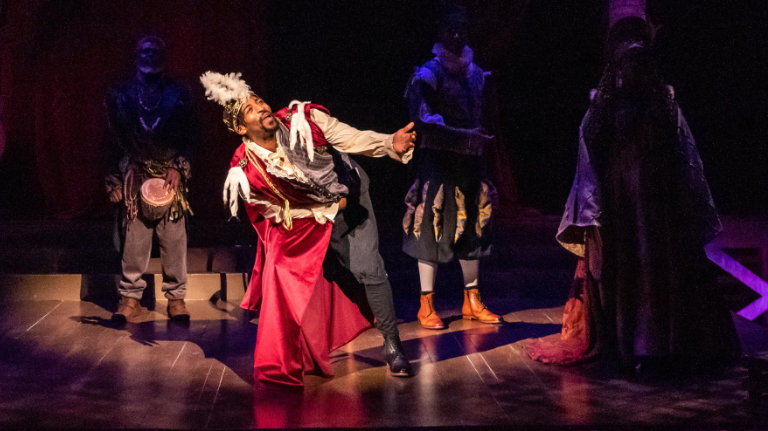
Cameron Jamarr Davis as James Hewlett as Richard III. Photo by Phillip Hamer.

The first black theatre in the U.S., The African Company of New York was a downtown theater growing in popularity with not only black audiences, but white audiences too. Their satires drew crowds, particularly when it was about the status quo white society. And the unenlightened were outraged those blacks had a voice. How dare they tackle the Shakespeare and other British classics!

William Henry “Billy” Brown had turned his home’s backyard into The African Grove, where blacks could socialize as society became increasingly segregated, then he expanded to theater, founding The African Company.

Price’s company has paid a renowned British actor, Junius Brutus Booth (father of John Wilkes Booth), a pretty penny and a sweet contract promising a full house, so they want a return on the investment, more revenue, and will not play nice.

The black theater doesn’t have the luxuries afforded the other theater, and most of the actors work as domestic servants or as laborers or in other roles.

“We all charade one great role of the happy, obedient Negro,” says character James Hewlett, the first black Shakespearean actor in U.S., and is playing the lead role.

Some of the cast is worried about the police shutting them down. What if they are taken to jail?

Director Ron Himes keeps the tension simmering both in racial friction and the tussling actors. He ensures that the company’s commitment to art is a focal point, while he laces this distinctive history lesson with humor and music.

As Hewlett, Cameron Jamarr Davis is passionate about the work, and doubles-down on his conviction, despite mounting odds – and a complicated romantic entanglement.

Ann Johnson, the actress playing Lady Anne, is exhausted by her day job and feelings that don’t seem to be reciprocated in equal measure. She is confused by the part and the play’s action, and not afraid to say so. Coda Boyce gives a fierce performance as someone speaking up for herself, and not compromising in a world that expects her to be subservient.

Alex Jay is a strong Sarah, who tries to keep things going smoothly, and is an accomplished seamstress. Costume designer Andre Harrington has beautifully captured the period and the royal costumes.

Olajuwon Davis is tough and tenacious in his portrayal as the dedicated, steadfast promoter Brown, who tries to not let what he calls “silly” views of white people grind him down. He channels his anger into action.

In real life, Brown wrote “The Drama of King Shotaway,” which is considered the first play by an African American and was about the black Caribbean war of 1796 against white settlers. Somehow, it’s been lost. However, what he did for blacks in theater will never be forgotten.

Papa Shakespeare is trying hard to keep them together. He’s quite a storyteller, a repository of history and wisdom – and colorful, as played by Wali Jamal Abdull. As the racist constable, Dustin Petrillo is a despicable meanie.

The simple set, designed by Jamie Bullins, doubles as a rehearsal hall and a theatrical stage, well-accented by Jasmine Williams’ lighting design.

This well-acted, well-staged play is a noteworthy moment in time that will resonate with modern audiences, for its power is timeless.

The Black Rep presents “The African Company Presents Richard III” Sept. through Sept. 25 at the Edison Theatre on the campus of Washington University. For more information, visit www.theblackrep.org

Photos by Phillip Hamer