
By CB Adams
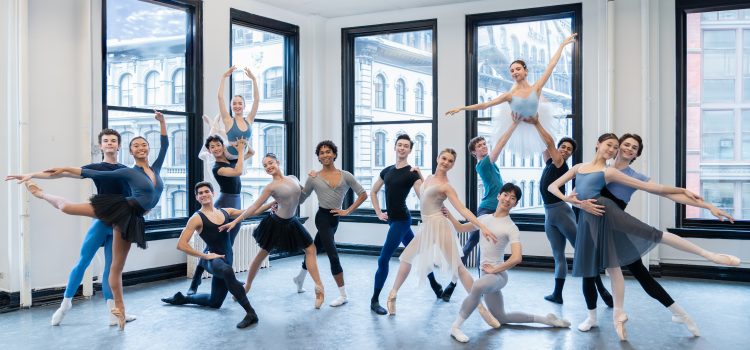
There is a particular clarity that comes from watching dancers at the moment their stage identities begin to take shape. Dance St. Louis opened its 60th anniversary season with that sense of emergence fully present, offering an evening with the ABT Studio Company that placed the focus not on promise alone but on preparedness, discipline and artistic intent. This may be the “junior” company of American Ballet Theatre, yet nothing about the performance suggested a diminutive form. These were young dancers stepping forward with conviction.
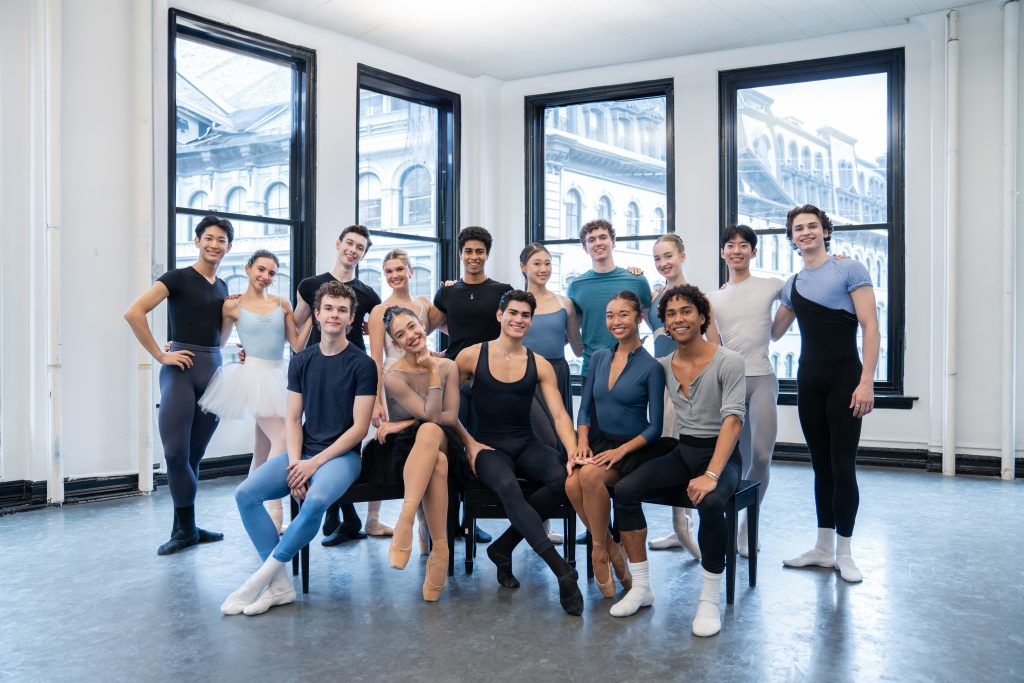
ABT Studio Company functions as the bridge between advanced training and the demands of a professional career. Its dancers, typically between 17 and 21, rehearse and tour as a unified ensemble, moving through a repertory that spans classical, neoclassical and contemporary work. The result is a rare opportunity for audiences to see dancers becoming themselves in real time — the mind, ear and body aligning in ways that cannot be rehearsed into existence.
Sascha Radetsky, former ABT soloist and the Studio Company’s artistic director, shaped the evening with an eye toward what this roster could carry. His own background, which blends Bolshoi training, long service with ABT and Dutch National Ballet, and the pop-cultural recognizability of “Center Stage” and “Flesh and Bone,” gives him a wide-angle understanding of what young artists require and what audiences intuitively absorb.
The program he assembled reflected that breadth: classical cornerstones that test line and placement, contemporary pieces that ask for nuance and stamina, and neoclassical works built for speed, musicality and ensemble cohesion. With the company currently weighted toward men, the selections were matched to the dancers’ strengths while still nudging them toward new edges.
Radetsky also situated the company within a longer tradition of generational transmission. Dance history is threaded with these handovers — Balanchine shaping dancers like Farrell and Villella, Martha Graham passing her technique through artists such as Terese Capucilli — moments when one generation prepares the next. By programming classical foundations, neoclassical challenges and contemporary commissions, Radetsky placed these dancers not simply as inheritors but as active participants in that lineage.
The evening opened with “La Bayadère (Pas d’Action),” after Marius Petipa, danced by Delfina Nelson-Todd, Audrey Tovar-Dunster, Matteo Curley Bynoe and Younjae ParkThe dancers approached the choreography with respect for its precision: Nelson-Todd shaped her épaulement with quiet assurance, and Tovar-Dunster’s port de bras carried rhythmic confidence.
Curley Bynoe brought crisp batterie and clean landings, while Park partnered with an unforced steadiness that allowed the phrases to expand. Their collective unison — sharp, clear, centered — set an early tone of readiness.
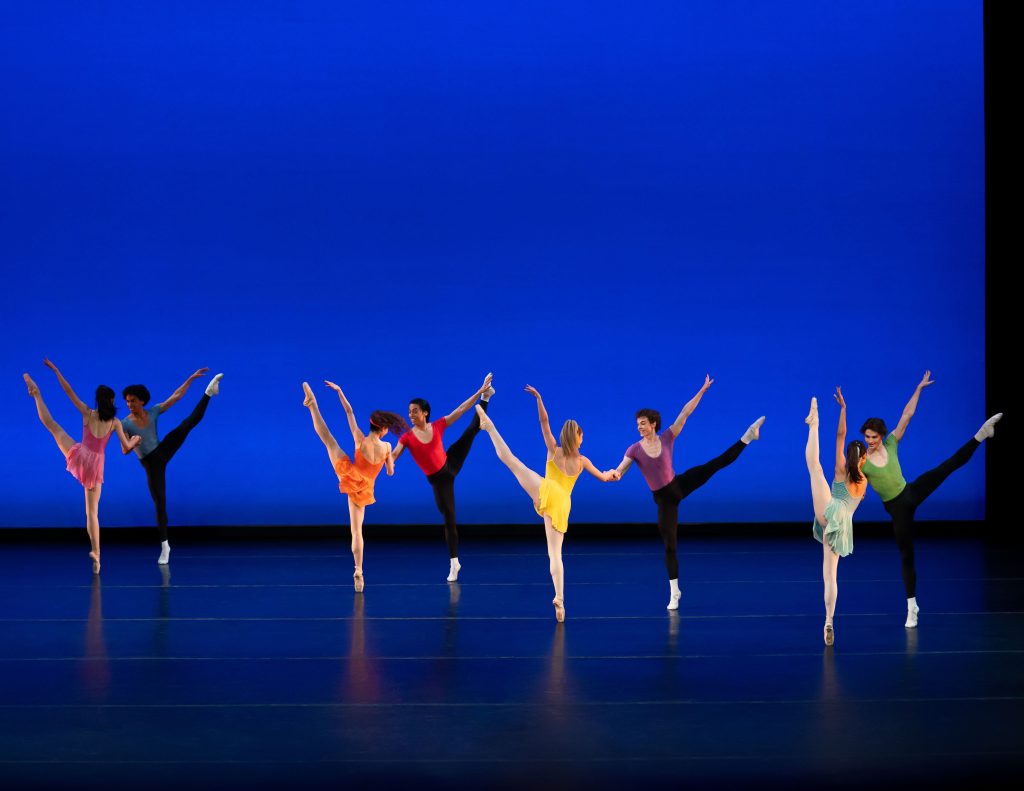
“Cornbread,” by Twyla Tharp and danced by Kayla Mak and Elijah Geolina, supplied one of the evening’s most engaging and warmly alive moments. Mak, shaped by Juilliard training and Princess Grace recognition, moved with a grounded musicality that met Tharp’s rhythmic intricacies head-on. Geolina, whose background includes competitive ballroom and television appearances, brought buoyant elevation and unerring rhythmic instinct. The Carolina Chocolate Drops score amplified the work’s earthy humor and drive. Together they created a performance that felt fully inhabited.
“Beyond Silence,” choreographed by Brady Farrar and danced by YeonSeo Choi and Maximilian Catazaro, offered a shift inward. Choi’s long, patient phrasing and Catazaro’s measured partnering gave the duet a contemplative stillness. Their suspended lines and cleanly delivered shapes created a center of quiet in a varied program.
In “Variations for Three,” by Tiler Peck, Geonhee Park, Younjae Park and Xavier Xué handled the brisk tempo and bright neoclassical coloration with an easy assurance. Geonhee articulated with precision, Younjae found lift in his jumps and Xué provided the stabilizing presence needed to keep the trio’s exchanges aligned. The result was a compact, clearly drawn demonstration of musical and technical rapport.
Xavier Xué returned to the stage for “Saudade,” by Katie Currier — one of the evening’s standout works. Commissioned by ABT Studio Company, the piece asks for a kind of emotional translucence rather than overt display, and Xué delivered. His phrasing moved with quiet elasticity, and the upper-body expressiveness — a soft back ripple, suspended arms, a held inhale before release — gave the work its atmospheric charge. It landed with a lingering gravity.
“Grand Pas Classique,” after Victor Gsovsky, brought Sooha Park and Daniel Guzmán together in a test of clarity, balance and poise. Park’s technique was finely calibrated, with balances that arrived without strain and unfolded with calm intention. Guzmán met the variation’s demands with strong elevation and steady landings. In partnering, he provided the clean frame that allowed Park’s line to extend without interruption. Their performance gave the work its intended sheen.
The evening closed with Jerome Robbins’ “Interplay,” shaped as a four-part suite — Free Play, Horseplay, Byplay and Team Play — performed by the full ensemble in various configurations: Maximilian Catazaro, YeonSeo Choi, Ptolemy Gidney, Paloma Livellara, Delfina Nelson-Todd, Geonhee Park, Younjae Park and Audrey Tovar-Dunster among them.
Robbins draws dancers into a buoyant mix of classical line and Broadway-inflected rhythm, and the company leaned into the blend. Free Play moved with bright rhythmic exchanges and quick-snap timing; Horseplay gave Geonhee Park room to show easy lift; Byplay found relaxed rapport among Choi, Catazaro and the company; and Team Play brought the full ensemble forward in a playful, confident finish.
The repertory itself carried notable stakes. In the pre-performance Q&A, Radetsky mentioned that Tharp had long resisted releasing “Cornbread” to dancers this young, believing the piece too demanding. Her eventual agreement, and the way the dancers met the challenge, spoke to the company’s current level.
Throughout the evening, small traces of effort surfaced — a pirouette that adjusted before settling, a landing that softened into place, an arabesque that breathed once before arriving, an ensemble line that wavered before finding its symmetry, a partnering exchange approached with a hint of caution. These were not shortcomings but moments where the dancers’ reach became visible, the line between training and profession momentarily illuminated.
Presenting the Studio Company also reaffirmed the legacy of Dance St. Louis itself — a cultural institution now in its sixth decade. Since its founding in 1966, it has brought more than 30,000 artists, 500 companies and over 150 world premieres to local audiences. As one of only four nonprofit organizations in the United States devoted solely to presenting dance, it stands as a rare survivor and a vital part of the city’s artistic landscape. Evenings like this underscore its role not simply as a presenter of great works but as a home where dance lives, evolves and continues to matter.
Dance St. Louis presented ABT Studio Company November 14-15 at the Touhill Performing Arts Center.
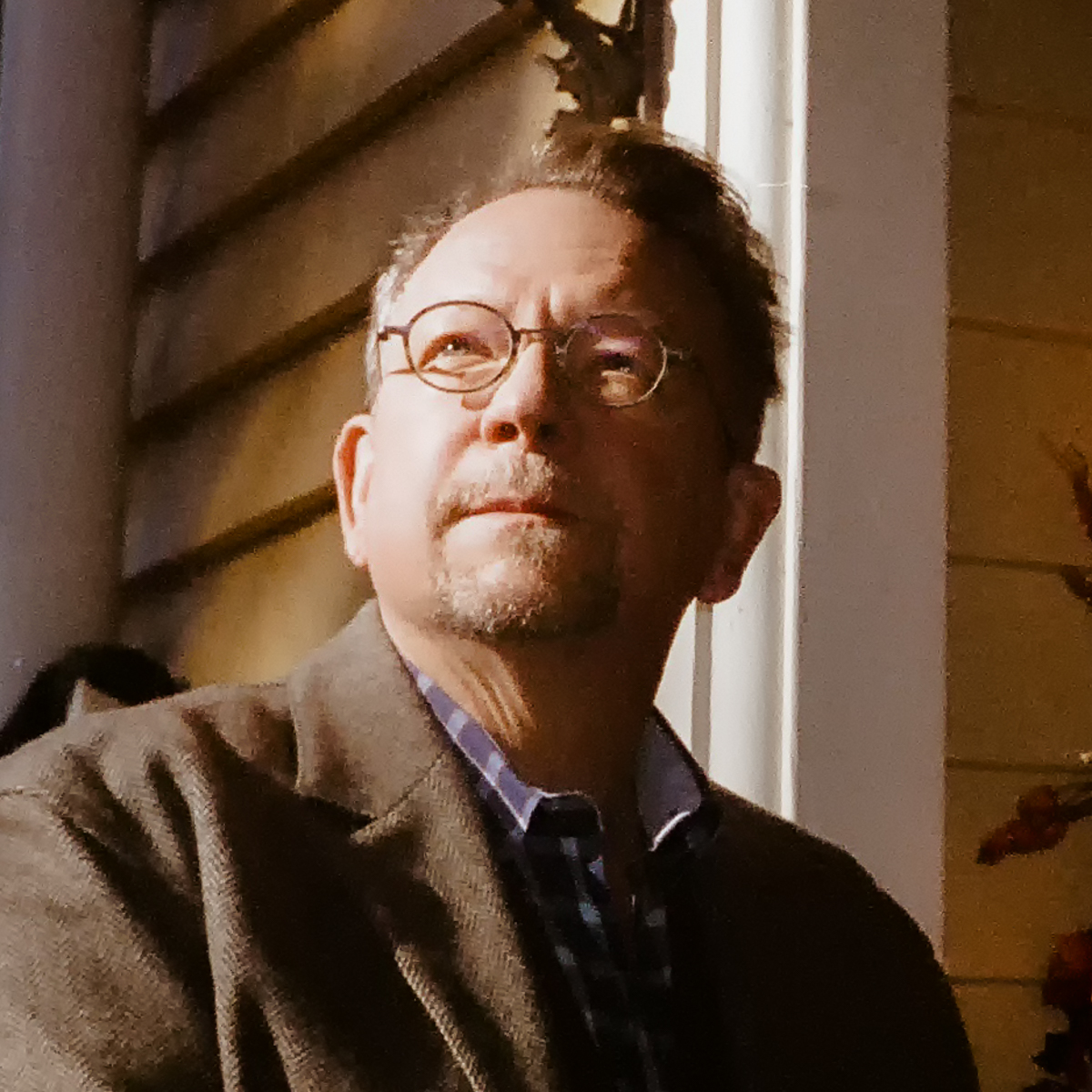
CB Adams is an award-winning fiction writer and photographer based in the Greater St. Louis area. A former music/arts editor and feature writer for the St. Louis Globe-Democrat, his non-fiction has been published in local, regional and national publications. His literary short stories have been published in more than a dozen literary journals and his fine art photography has been exhibited in more than 40 galley shows nationwide. Adams is the recipient of the Missouri Arts Council’s highest writing awards: the Writers’ Biennial and Missouri Writing!. The Riverfront Times named him, “St. Louis’ Most Under-Appreciated Writer” in 1996.