By Lynn Venhaus

“Beau Is Afraid” is an unwatchable exercise in excess.

This absurdist black comedy-drama-horror about an anxiety-riddled man-child going through personal crises makes a mockery of the real psychological issues on display, Why is any of this funny when it should be a tragedy?

Writer-director Ari Aster has created a self-indulgent, meandering narrative that straddles reality and fantasy in a very bizarre way, designed to shock like his other works – “Midsommar” and “Hereditary.” These two polarizing films were disturbing with extreme horrific violence.

The rambling story follows the sudden death of Beau’s mother, which sets off a chain of events, as he embarks on a Kafkaesque odyssey back home that manifests his darkest fears. It appears to be a sequence of nightmares strung together in such an incoherent fever-dream way that the film becomes unbearable during its ridiculous 2 hours, 59 minutes runtime. It is no clearer at the end than it was in the beginning.

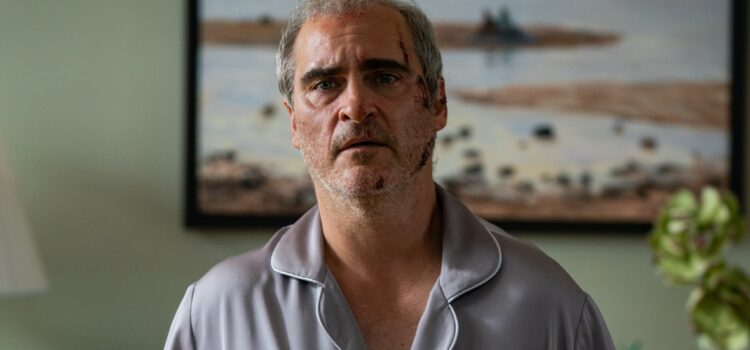
Joaquin Phoenix is hardly at his best in this ill-suited role as the arrested development afraid-of -his-own-shadow recluse, Beau, who is in serious mental distress and is either in a catatonic stupor or having major panic attacks and meltdowns in public places.

And neither are the actors playing the peculiar-agenda grown-ups – the normally dandy Nathan Lane and Amy Ryan as affluent strangers who rescue him during an assault, and their chic home is where he recuperates in a captive-like situation. Their Good Samaritan effort seems tinged with menace, but they are no Annie Wilken in “Misery.” However, their Fun House is anything but, particularly with their deranged daughter Toni (Kylie Rogers) and a soldier suffering from PTSD, Jeeves (Denis Pinochet).

Not unlike Lewis Carroll’s whacked-out writing in “Alice in Wonderland,” Aster strings us along with poorly drawn characters attempting to make sense of a script that has no point except to be weird for weirds sake.

However, Armen Nahapetian is fine as the sad and confused teenage Beau, who is schooled about life by a forward girl, Elaine, during a summer vacation – and so is Julia Antonelli as Beau’s first crush. As his young over-sharing histrionic control freak mother, Zoe Lister-Jones is Mona then. Patty LuPone is his monstrous, neurotic mother later in life.

In minor roles are Bill Hader as a UPS guy, Parker Posey as Elaine Bray, who works for his mom, Stephen McKinley Henderson as a therapist, and Richard Kind as a doctor.

The random bursts of violence are upsetting and the shouting, screaming and the maniacal behavior unsettling. Imagined demons roam, Beau is either terrified or trembling, and the paranoia is rampant.
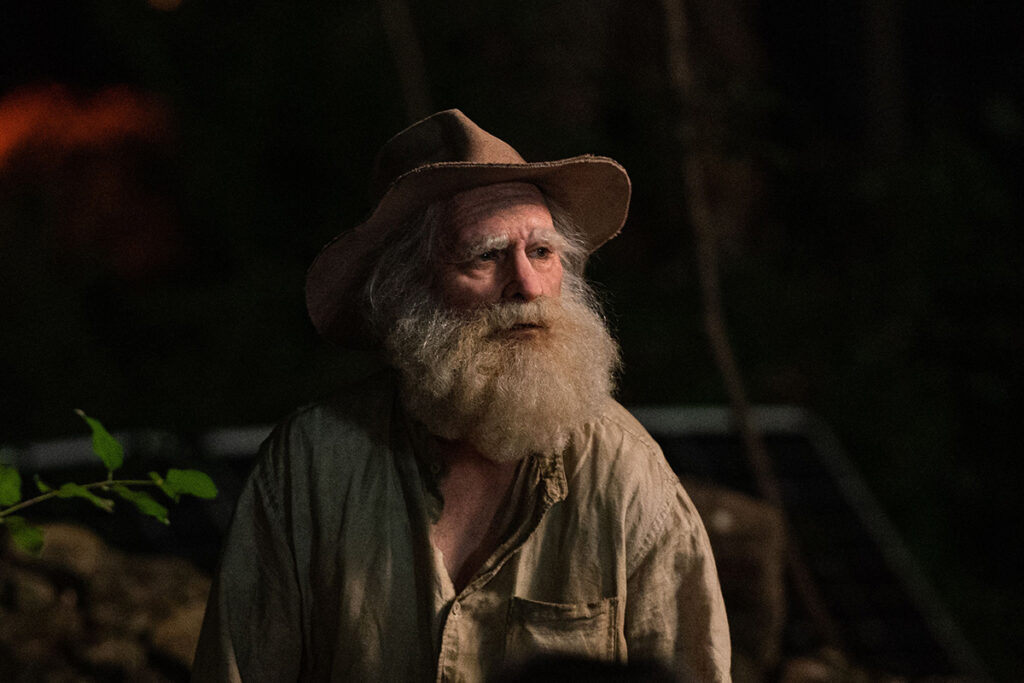
We’ve seen a wide array of movies where people spiral out of control because of their less-then-normal upbringing or society’s pressures, but this scenario is not cohesive in the least and mostly incoherent.

In Aster’s world, rules of form, function and ordinary behavior are thrown out the window in favor of a provocateur making a meal out of what’s in the fridge. This is jump-out-of-the-closet scares and off-the-charts anxiety that can actually trigger viewers.

This is someone’s therapy session that we should not be eavesdropping on, and all the mommy and daddy issues raised won’t be solved any time soon. Why should anyone care about these people?

“Beau Is Afraid” is a 2023 comedy-drama-horror film written and directed by Ari Aster and starring Joaquin Phoenix, Nathan Lane, Amy Ryan, Parker Posey, Stephen McKinley Henderson, Kylie Rogers, and Patti LuPone. It is rated R for strong violent content, sexual content, graphic nudity, drug use and language. Its runtime is 2 hours, 59 minutes. It opened in theatres on April 21, is available video on demand and DVD, and began streaming Dec 1 on Showtime/Paramount+. Lynn’s grade: F.


By Lynn Venhaus

Geniuses are complicated; therefore, the life of America’s first superstar conductor and composer Leonard Bernstein is explored in an uncommon yet charismatic way in “Maestro.”

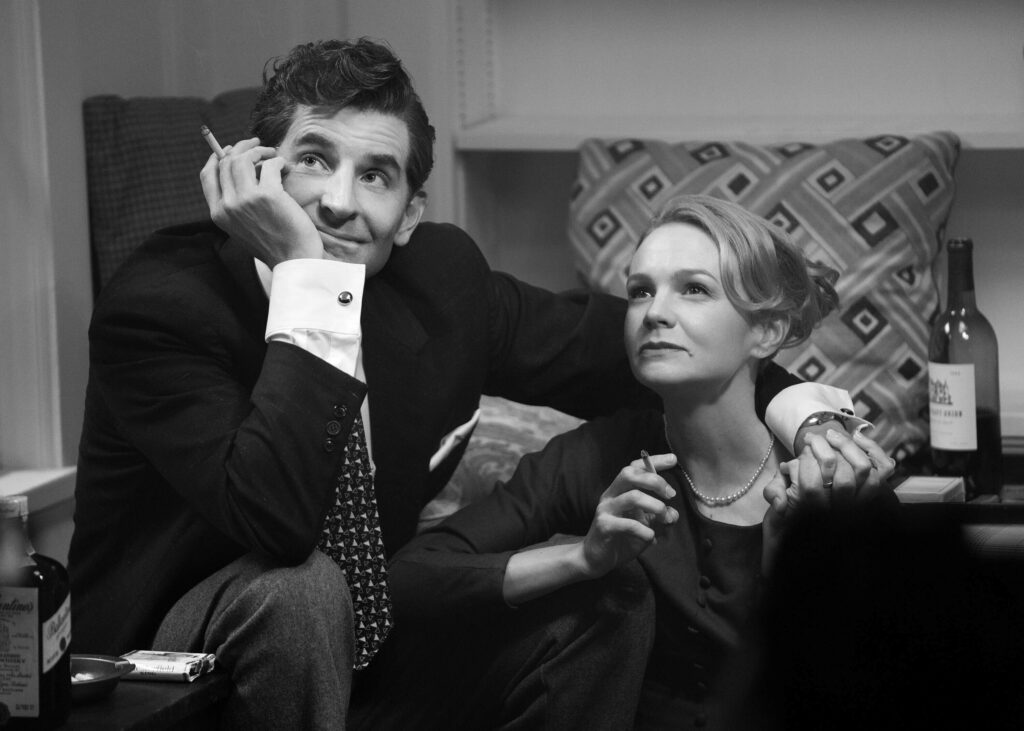
“Maestro” chronicles the complex 30-year relationship between Leonard Bernstein (Bradley Cooper) and actress Felicia Montealegre Cohn (Carey Mulligan) in an intricate portrait of art and love.

At their career-best are Bradley Cooper and Carey Mulligan who eloquently capture the passion of two people experiencing the highs and lows of an artistic life in the spotlight. They’re terrific together, and they throw themselves into these roles with a heartfelt and powerful intensity that’s mesmerizing throughout this unconventional 30-year love story.

As director, co-writer and star, Cooper masterfully conveys a larger-than-life cultural icon from his first conducting opportunity at Carnegie Hall when he was 25 to his later years after Felicia’s death in 1978. But he doesn’t gloss over his flaws, particularly as an often selfish, self-absorbed artist accustomed to attention.

The dynamic between the couple is the film’s biggest strength. And in crafting indelible portraits, they both are flawless executing the speech cadences of their characters. Mulligan, in particular, adds emotional depth to Felicia’s steely resolve and confused feelings.

Maestro. (L to R) Bradley Cooper as Leonard Bernstein (Director/Writer/Producer) and Carey Mulligan as Felicia Montealegre in Maestro. Cr. Jason McDonald/Netflix © 2023.

The movie isn’t your typical linear womb-to-tomb biopic, and Cooper made the decision to concentrate on the married couple’s mercurial yet unbreakable union that produced three children despite the tangled nature of Bernstein’s sexuality.

His open affairs with men are more implied than delved into, however, with Matt Bomer miniscule as early lover David Oppenheim and Gideon Glick as later lover Tommy Cothran. In real life, Bernstein separated from Felicia to live with Cothran, and then returned when she became terminally ill, but that’s not specifically mentioned – only surmised.

Cooper and Josh Singer, Oscar winner for “Spotlight” who worked with producer Steven Spielberg on “The Post,” focused more on the family situation, with career highlights woven into an intriguing life tapestry.

Bernstein’s zest for living was contagious, and he dreamed big. He achieved unparalleled success in music – both conducting the New York Philharmonic Orchestra and for his legendary compositions and was the first American conductor to get international acclaim.

I remember his “Young People’s Concerts” (1958-1972) on television on Sunday afternoons. He was the first conductor to share and explore classical music to a mass audience that way.

His range was vast, and he won seven Emmys, two Tonys, and 16 Grammys during his lifetime.

One drawback is that if you aren’t familiar with Bernstein’s epic body of work, you may be lost, for there are no date stamps and sometimes only a quick reference to the material. The music score features Bernstein’s most famous compositions, re-recorded for the film.

If you didn’t know about his Broadway musical theater works “On the Town” in 1944 and “West Side Story” in 1957, both choreographed by Jerome Robbins, you’ll not be further enlightened unless you do your own research, for you only hear snippets here.

His supple compositions for “West Side Story,” arguably the greatest musical theater score of all-time with lyricist Stephen Sondheim, are barely a footnote. His propulsive Oscar-nominated score for the 1954 Best Picture winner “On the Waterfront” is another masterpiece getting only a brief mention.

Some of his massive choral pieces “Candide” and “Mass” are presented in rehearsal and performance, but again, without a timeline, one may not recognize their significance. That must be frustrating to those who didn’t grow up with his music, which I did – and recognize there are gaps for a modern audience.

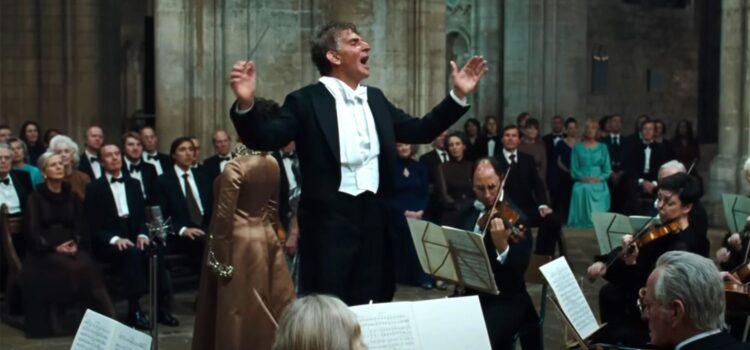
The film’s best scene is Bernstein vigorously conducting the London Symphony Orchestra in Mahler’s Second Symphony (“Resurrection”) performed at the Ely Cathedral in 1973. It’s an incredible show-stopper – but without knowing what or when. Still, that scene is stunning, revealing his musical virtuosity and innate theatricality for six and a half minutes – and resulted in the New York Film Festival audience bursting into thunderous applause and cheers. It was as if we witnessed Bernstein become the music.

Credit must go to conducting consultant Yannick Nézet-Séguin, whose expertise helped Cooper feel the music, and it’s thrilling. He is currently conducts the Metropolitan Opera at Lincoln Center.

The look of the film is luxe, especially the sumptuous black-and-white cinematography by Matthew Libatique that depicts a dazzling magical time for young artists in Manhattan in the ‘40s and ‘50s.

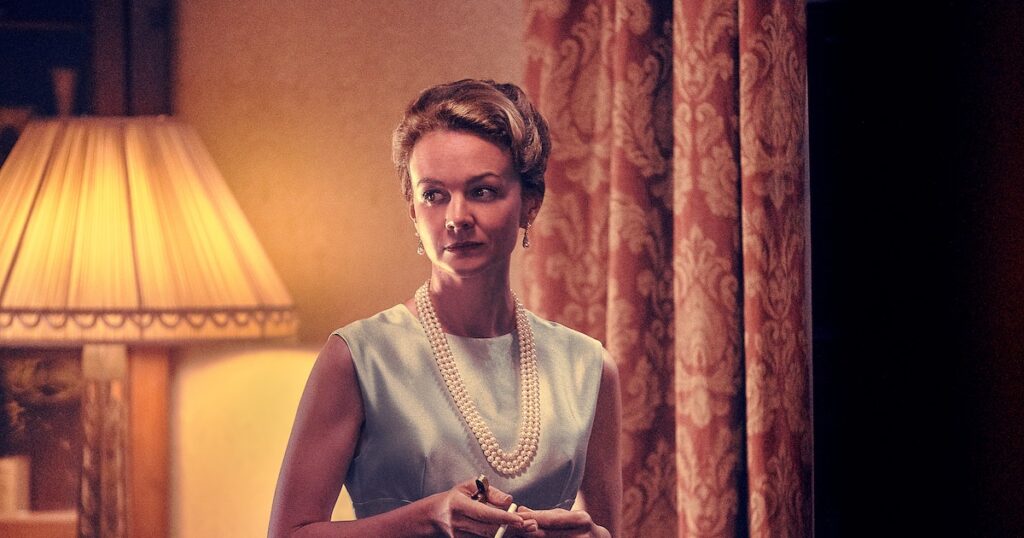
The costumes designed by Mark Bridges are also swoon-worthy, with Mulligan’s outfits not only representing Felicia’s class and grace, but also their rising fortunes. Bridges is a two-time Oscar winner for “The Artist” and “Phantom Thread,” and has a keen eye for textures and detail. The scene where Felicia wears a Chanel suit to get bad news from her doctor is a small, but memorable, character element.

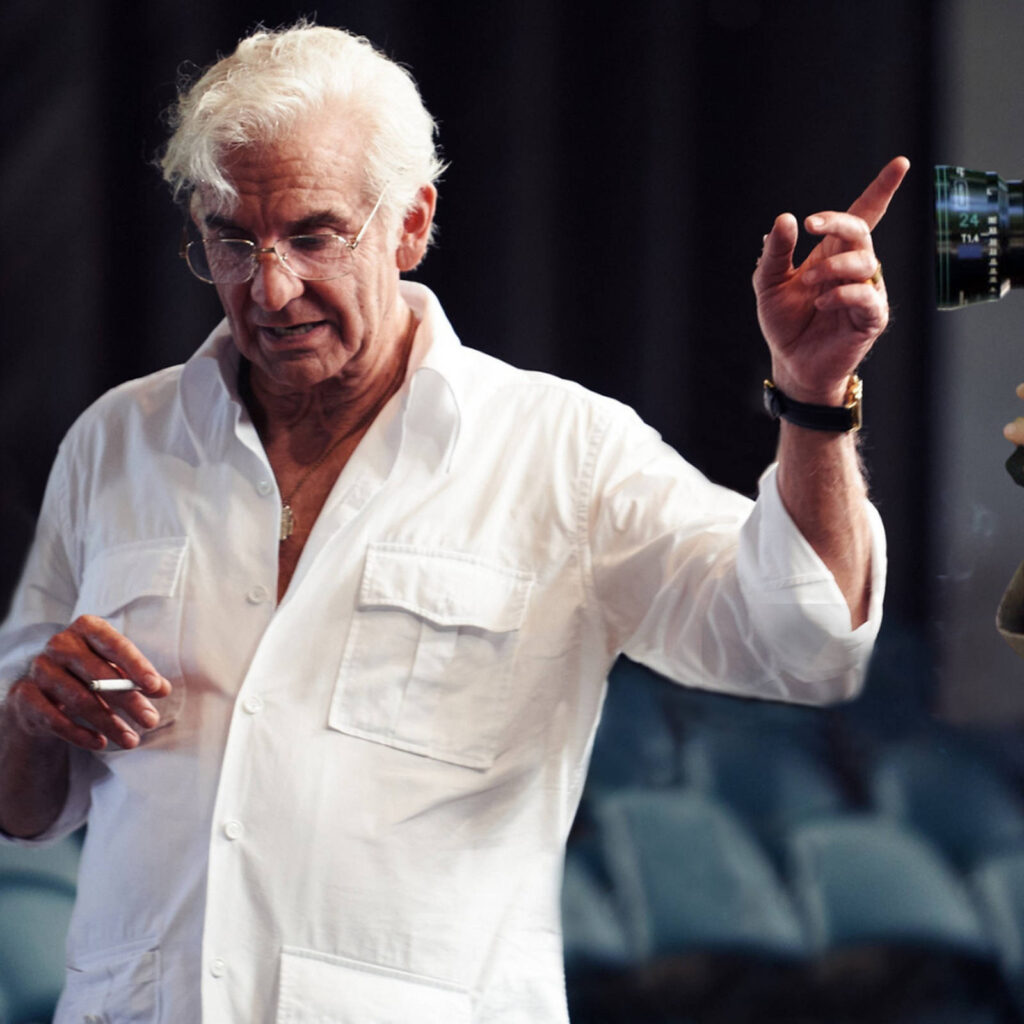
Special make-up effects artist Kazu Hiro’s seamless transformation of a 48-year-old Cooper into Bernstein at different ages is stunning, with the prosthetics lifelike. He has won two previous Oscars, for “Bombshell” and “The Darkest Hour,” transforming Gary Oldman into Winston Churchill.

Production designer Kevin Thompson’s affinity for details is striking, from the concert halls to the private residences, particularly Bernstein’s’ idyllic country home in Connecticut and a lavish apartment in the historic Dakota building. Thompson’s previous work includes “Birdman or (The Unexpected Virtue of Ignorance)” and “Ad Astra.”

The sound mixing and editing is astonishing in aural quality and should be recognized with year-end awards. That level of excellence is not just reserved for big blockbuster visual effects extravaganzas.

Even by narrowing the focus, the movie still spans decades of remarkable achievements while offering a warm portrait of a comfortable family life, with the three Bernstein children surrounded by love and affection. Maya Hawke portrays eldest daughter Jamie as a teenager with questions, Sam Nivola is son Alexander and Alexa Swinton is daughter Nina.

Another key supporting performance in this tableau is Sarah Silverman as Lennie’s sister Shirley. Bernstein’s lifelong friend Aaron Copeland (Brian Klugman) doesn’t get much screen time.

The movie packs many details in its 2 hours, 9 minutes run time, and perhaps would have been clearer in a limited series, like “Fosse-Verdon.” However, a second viewing produced far more nuance and narrowed attention.

The majestic grandeur came through on a large screen, and because the scope is ambitious, I hope it is not lost on the smaller screen.

But those bravura performances will linger no matter what format.

“Maestro” is a 2023 drama, biography directed by Bradley Cooper and starring Cooper, Bradley Cooper, Carey Mulligan, Matt Bomer, Maya Hawke, Sarah Silverman, and Gideon Glick. It is rated R for language and some drug use and it’s runtime is 2 hours, 11 minutes. In select local theaters Dec. 8 (St. Louis area) and streaming on Netflix Dec. 20. Lynn’s Grade: A-

By Lynn Venhaus

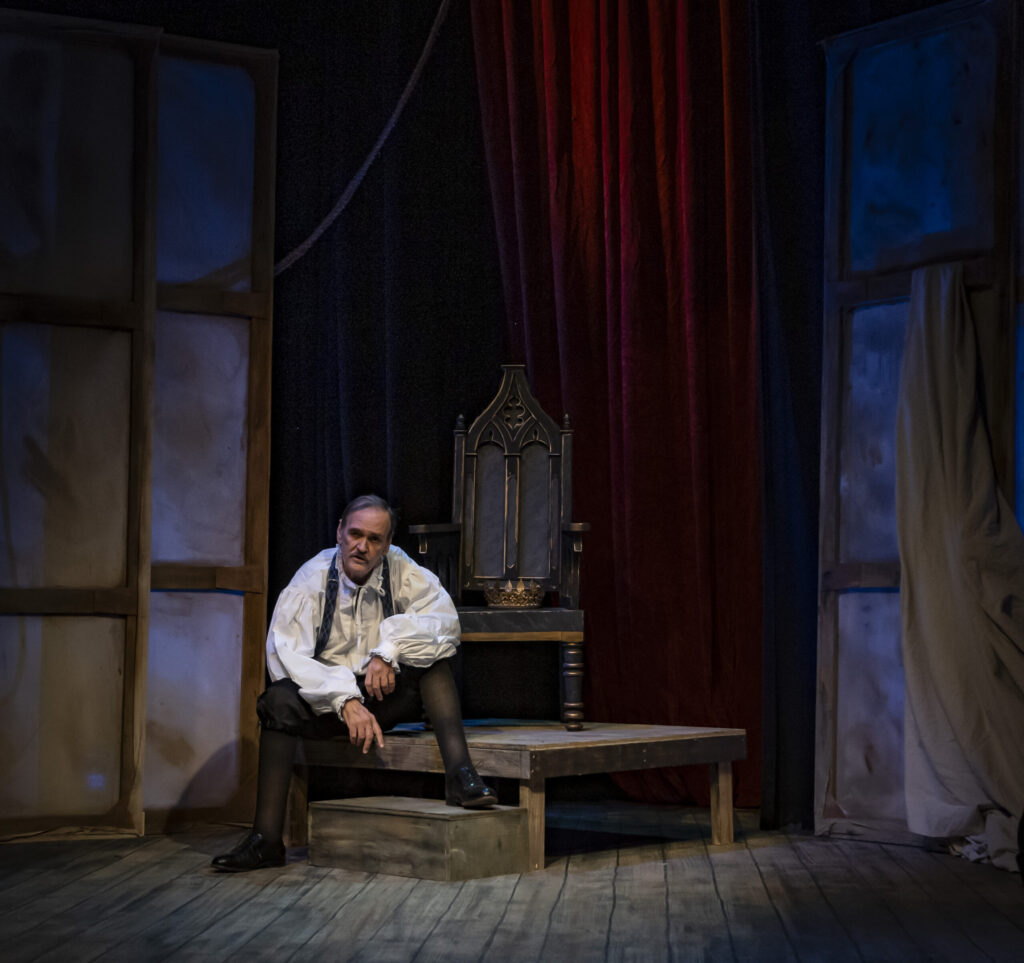
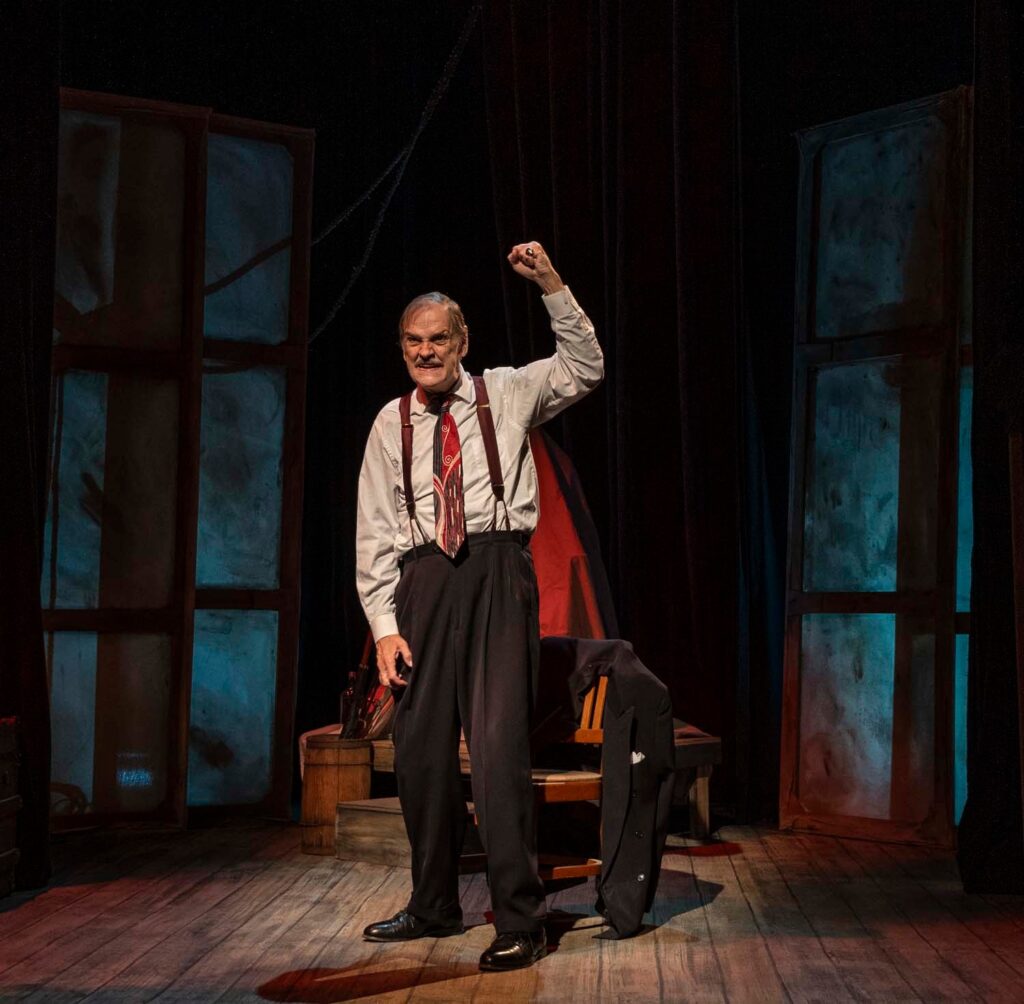
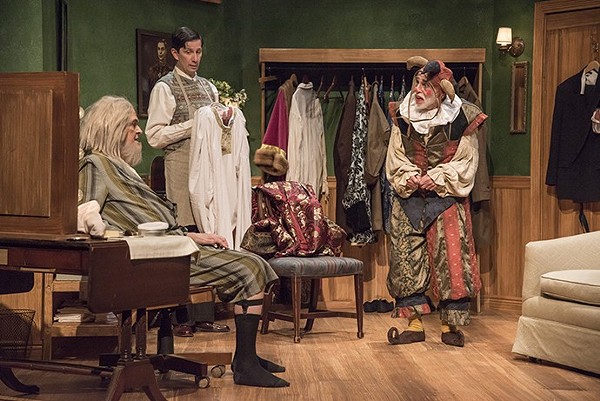
Local treasure John Contini is at his best in a vibrant, vigorous portrayal of legendary actor John Barrymore that is both funny and sad at the same time, but never sags or lags for a second.

It’s a remarkable tour-de-force for a seasoned pro used to delivering classic portrayals of Shakespeare, Albee, Miller, Mamet and more during a career that has spanned over 40 years.

Barrymore came to prominence for his stage work, notably an acclaimed “Hamlet” in 1922, and went on to become one of the most influential and idolized actors of that era. His movies included “Grand Hotel,” “Beau Brummel,” “Dinner at Eight,” “Twentieth Century” and “Svengali.”

He died at age 60 in 1942, and by then, his sordid personal life had eclipsed his professional accomplishments.  

But even with the title “Barrymore,” it’s not a one-man show. One of the most surprising aspects of this captivating work is that it’s a two-hander, and sparring with an offstage prompter, Frank the stage manager, offers insight into the actor’s twilight years.

Frank is voiced by Alexander Huber, and his shifting moods come through loud and clear –exasperated and stern as he pleads and cajoles with the once-great but in serious decline star to get his act together and complete the tasks at hand, which is rehearsing for his comeback as “Richard III.”

The famous actor is, by turns, insufferable, mean, vainglorious, rueful, flamboyant, distressed, ribald and pitiable, and Contini is seamless as he swiftly moves in and out of Barrymore’s many moods.

Playwright William Luce depicts Barrymore a few months before his death as he is rehearsing the Shakespeare tragedy which would be a revival of his 1920 Broadway triumph. This is fiction, of course.

The setting is a small stage that he has rented to prepare for what he hopes will be his comeback. But he is too far gone, ravaged by alcoholism and hard living. But he sure has hilarious stories to share.

In two acts, he jokes with the audience, breaking the fourth wall, imitates his siblings Lionel and Ethel, both legendary actors themselves, and reminisces about better times. He had been married four times and is candid in sharing sexual exploits and off-color jokes.

Luce’s play was produced on Broadway in 1997, with Christopher Plummer in the title role. He won the Tony Award for his performance and reprised the role in a 2011 film adaptation.

Contini has portrayed the superstar thespian before, for the former Avalon Theatre Company at the ArtSpace at Crestwood Court in 2009 and won a Kevin Kline Award for Outstanding Lead Actor in a Play.

While Contini commands attention from start to finish, what is also noteworthy is Erin Kelley’s supple direction. Kelley co-founded the Avalon Theatre Company and served as its managing artistic director for seven years. However, this is a fresh interpretation of that show.

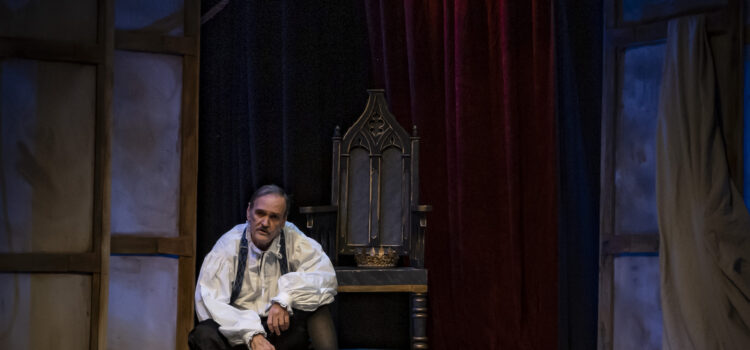
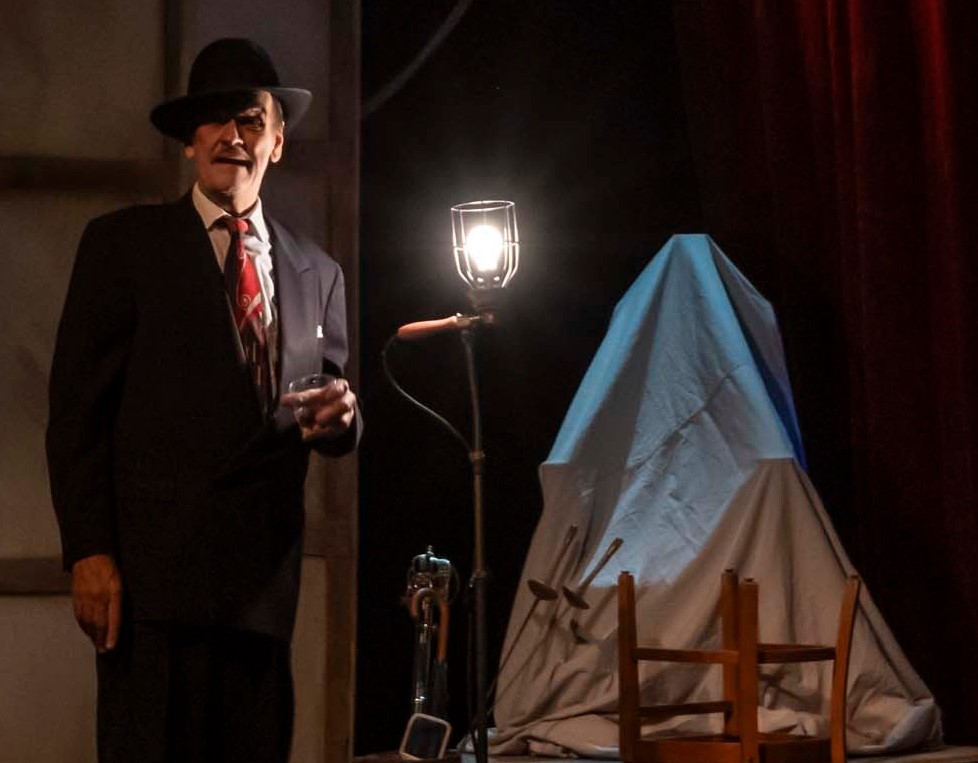
Also lending their talents to this superb collaboration is scenery and lighting designer Patrick Huber, bathing the stage with a ghost light and minimal illumination for a forlorn effect, and costume designer Teresa Doggett, whose wise sartorial choices dress Barrymore in a dapper suit for the first act and in a well-worn regal outfit for King Richard III in the second act.

Emma Glose’s prop designs create a bygone era’s theatrical tools and provide a few of the actor’s possessions. Kristi Gunther, production manager, and Amy Paige, stage manager, keep things moving at a swift clip.

A witty and wise work, “Barrymore” showcases artistry while offering both comedy and pathos in a virtuosic production.

The St. Louis Actors’ Studio presents “Barrymore” in a limited engagement Dec. 1 -10 at the Gaslight Theatre, 360 N. Boyle. Performances are Friday through Sunday Dec. 1-3, and Tuesday through Sunday, Dec. 5-10, at 8 p.m. except for Sundays, which are at 3 p.m. General admission tickets are $40 each plus fees, $35 each plus fees for students with valid ID and seniors 65+, available via Ticketmaster or at the theater box office one hour before showtime. For more information, visit stlas.org or email [email protected].

By Alex McPherson

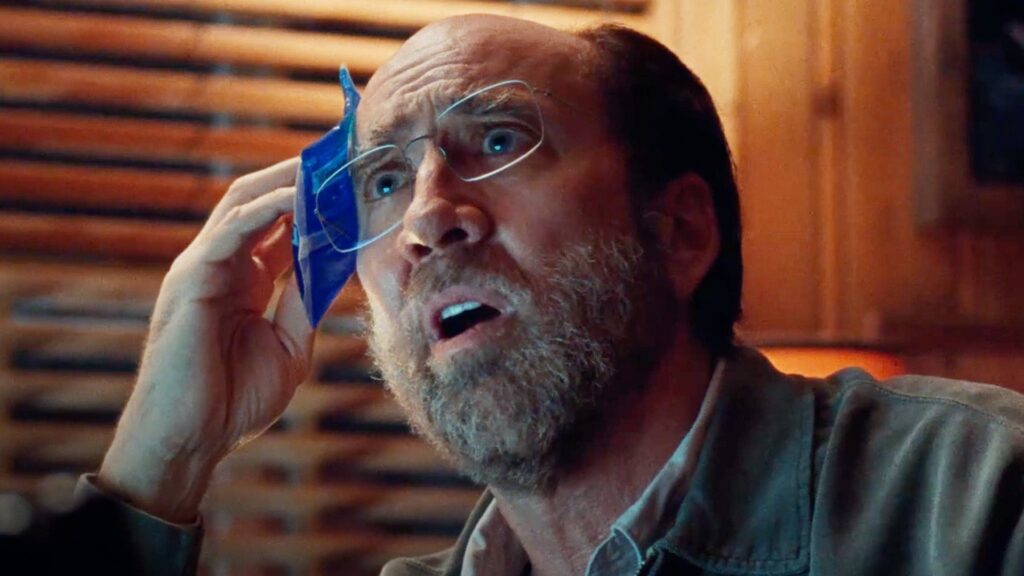
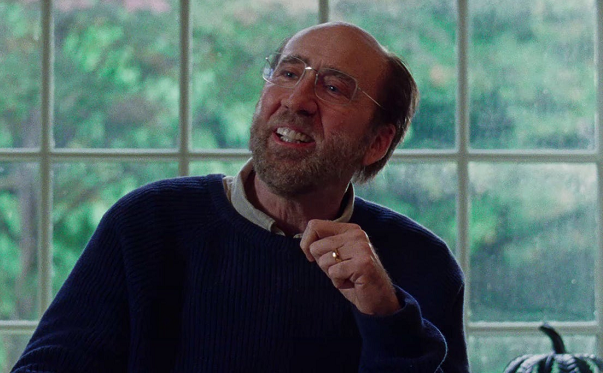
A creative, darkly comic story of self-destructive ego and fame’s dehumanizing effects, director Kristoffer Borgli’s “Dream Scenario” is never less than engaging — with an outstanding Nicolas Cage performance — but can’t meld its timely ideas into a fully cohesive whole.

Borgli’s film follows Paul Matthews (Cage), a tenured university professor teaching evolutionary biology to disinterested students — he’s unfulfilled professionally and seeking recognition in his field. Paul wants to publish a book on his research and fumes that a former colleague (that he hasn’t seen in 30 years) beats him to the punch, allegedly stealing his theory of “Ant-elligence” for her own writing venture. It’s a critical blow to his ego.

At home, Paul has a loving wife, Janet (Julianne Nicholson), and two daughters, Sophie (Lily Bird) and Hannah (Jessica Clement). By most accounts, Paul has a pretty privileged life, but he seeks more — quietly experiencing a midlife crisis within his self-loathing headspace. His seemingly simple yearnings belie a misguided sense of entitlement and ungratefulness.

Out of the blue, Paul appears in Sophie’s dream: he casually observes as random objects crash onto their outdoor patio and Sophie is lifted into the sky, making no effort to rescue her. Randomly, old connections, students, and, eventually, people all over the country he’s never met start seeing Paul in their dreams as well. Just like with Sophie, Paul awkwardly (and humorously) observes in the background as the dreamer experiences some dramatic event — such as crocodile infestation, tooth extraction, or a not-so-friendly neighborhood demon.

Paul is initially thrilled by the attention, albeit disappointed at his “inadequacy” within the situations themselves. He’s on the news, students line up to take selfies with him, and his family sees him in a new light. Janet, especially, sees glimmers of the confident man she fell in love with, yet grows increasingly jealous, since Paul doesn’t appear in her own dreams.

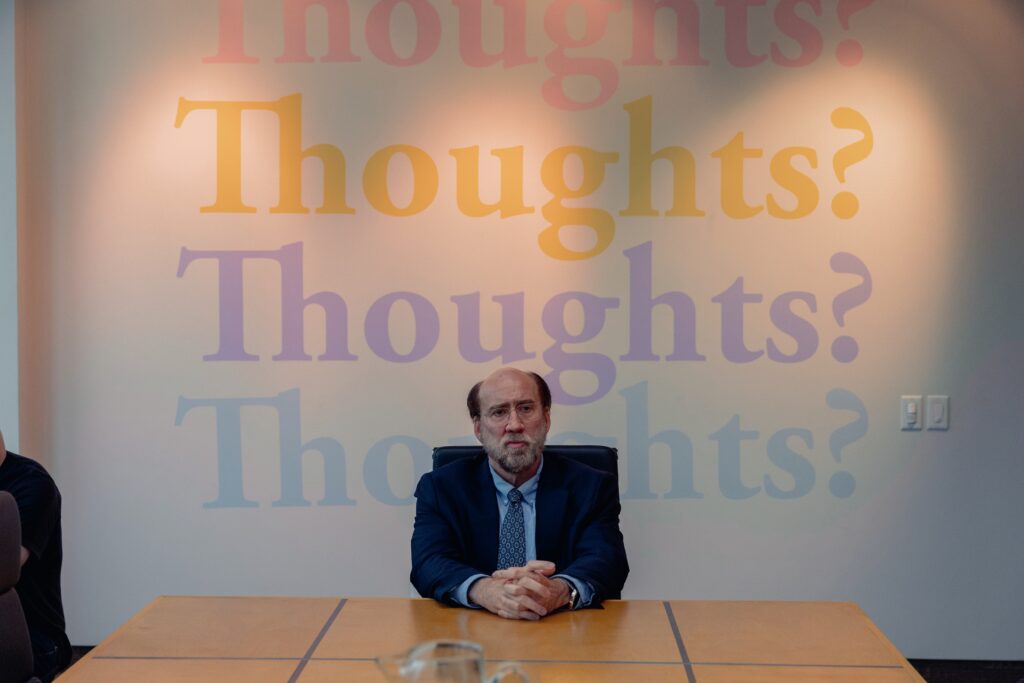
Paul is even contacted by a PR group (called “Thoughts?”), led by Trent (Michael Cera), who wants Paul to sponsor big brands so he can “dreamfluence” people in their slumber. At the end of the day, all Paul wants to do is get a book published on his scholarship, which he hasn’t actually started writing yet, and maybe get invited to dinner by a wealthy colleague.

Before long, Paul’s narcissism grows. His dream-world persona suddenly takes on a more nefarious role in peoples’ sleep states; he’s now a monster haunting with gleefully violent abandon. Thus begins Paul’s descent into the throes of Cancel Culture, digging his own grave as society ostracizes him — initially for forces beyond his control — reckoning with celebrity and his own self-absorption as his previously stable lifestyle falls apart.

Indeed, “Dream Scenario” certainly has a lot on its mind. Although the film doesn’t hit bullseyes on all its targets, Borgli crafts a trenchant commentary on society’s mindlessness — oscillating between hilarity, horror, and pathos that keeps viewers on their toes. And there’s no more fitting person than Cage to lead the way, in a role that gives him space to showcase his considerable range as a performer.

Cage — himself a celebrity who’s been “memeified” by the masses as an over-the-top cartoon character — lends both humanity and zaniness to his portrayal. He renders Paul (balding, with a nasally whine of a voice) a character that’s easy to poke fun at, but also to empathize with. Cage successfully portrays Paul as an irritating, sympathetic, fragile person, going effectively bonkers in the frightening and at-times shockingly violent nightmares. Whether unhinged or grounded, Cage clearly relishes the role as an opportunity to reject being pigeonholed into one acting style. Borgli, too, refuses to paint Paul in black-and-white absolutes.

Borgli’s screenplay encourages viewers not to root for or against Paul as the collateral damage piles up. Nor does Borgli vilify the masses who launch Paul into stardom and, subsequently, the cultural garbage bin. Rather, “Dream Scenario” depicts a world that abuses the idea of celebrity, simultaneously punishing Paul’s dependence on being seen and admired without taking responsibility for his own happiness. 

It’s also quite funny, containing one of the best cinematic farts to ever grace the silver screen. This tonal imbalance can be distracting, for sure, though maybe that’s the point, reflecting Paul’s separation from his modest beginnings. Paul’s world is crumbling before his eyes — the public plays satirical whack-a-mole with his feelings. This brings comedy and tragedy to the table, making laughs catch in viewers’ throats.

Additionally, by matter-of-factly depicting the film’s nightmare sequences, “Dream Scenario” dares viewers to separate the monstrous incarnation of Paul from his true self. As viewers weave in and out of “lived experience” (jumping into victims’ dreams, which cinematographer Benjamin Loeb frames as slightly-heightened reality), perhaps, the film says, we cannot. 

Overall, “Dream Scenario” reveals itself as an absurdist take on human folly that shares similarities with director Ari Aster’s  “Beau is Afraid” in manifesting its protagonist’s worst fears (Aster’s a producer on “Dream Scenario”) and punishing them for their cowardice and lack of accountability. 

The film’s fatalism, however, is a double-edged sword. Borgli sends Paul down a path with no easy exit or opportunities for redemption (throwing in on-the-nose cultural references meant to provoke). To its credit, what plays out seems plausibly true-to-life in terms of Paul’s reactions and how society treats him. This predictability also breeds hopelessness and lack of resolution, becoming less involving due to its inevitabilities. Once Paul’s life has been suitably demolished, the film seems unsure what to do with him — reflecting Paul’s own sad aimlessness, yet remaining incomplete as a story. 

Besides Paul, supporting characters of varying complexity are brought to life by an ensemble committed to the craziness. Nicholson brings warmth, sass, and heartbreak to her role as Janet, dealing first-hand with the fallout of Paul’s declining mental state and selfishness. Cera is excellent at delivering his dryly comedic dialogue, as are Kate Berlant and an uncomfortably hilarious Dylan Gelula as his associates. Tim Meadows steals scenes as Paul’s department head reconciling his friendship with Paul with the pariah he becomes.

Altogether, “Dream Scenario” is a bizarre, unconventionally compelling watch — calling out people like Paul and our social-media-obsessed, consumerist society at large — content to unsettle and leave threads dangling. Third-act clunkiness notwithstanding, it’s a one-of-a-kind work difficult to forget.

“Dream Scenario” is a 2023 comedy written, directed and edited by Kristoffer Borgli and starring Nicolas Cage, Julianne Nicholson, Tim Meadows, Michael Cera and Dylan Gelula. It is Rated R for language, violence and some sexual content. and its run time is1 hour, 43 minutes. It opens in theatres Dec. 1.Alex’s Grade: B+.

By Lynn Venhaus

Transformative in the very best of ways, both heartbreaking and heartwarming, “American Symphony” is an ode to believing in art, hope, and love.

It’s a portrait of two artists, musician Jon Batiste and writer Suleika Jaouad, at a crossroads in life, and how their devotion to each other, and their creative expression become their survival mechanism.

The longtime couple are two remarkable and talented human beings whose hearts beat as one. What started as a documentary detailing Batiste putting together an ambitious and genre-jumping symphony became something different when they found out Suleika’s leukemia had returned after 10 years in remission.

It was the same week in November 2021 that Jon became the most celebrated artist of the year with 11 Grammy nominations. For the next seven months, they share their intimate journey as they experience the highest of highs and the lowest of lows.

Directed with keen insight and empathetic sensitivity by Matthew Heineman, Oscar nominee for “Cartel Land” in 2016, this film is not only one of the best feature documentaries of the year, but also one of my favorite films of the year.

Jon Batiste in concert

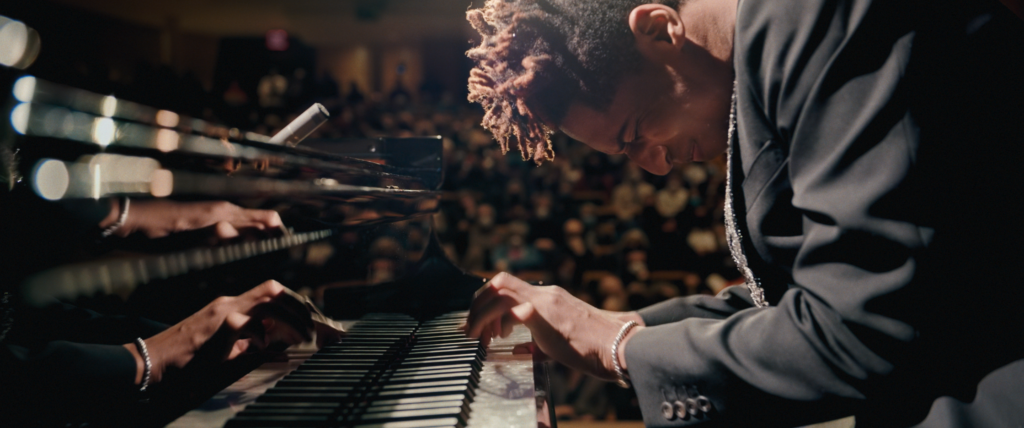
When he is not composing and rehearsing “American Symphony,” an original work that reimagined the traditions of the classical form, bringing together an inclusive cultural group for a one-night-only performance at Carnegie Hall on Sept. 22, 2022, he is at his wife’s hospital bedside while she recovers from a bone-marrow transplant.

Batiste, Oscar winner for the music score to “Soul” (along with Trent Reznor and Atticus Ross), and five-time Grammy winner, including Album of the Year for “We Are,” is likely most known as the bandleader of “Late Show with Stephen Colbert” from 2015 to 2021. He left that job to help care for his wife.

Jaouad is a best-selling author whose book “Between Two Kingdoms: A Memoir of a Life Interrupted” was about how she began again after her first four-year battle with cancer – a diagnosis she had received post-college graduation, at age 22. She writes The Isolation Journals, which has developed an online community.

Suleika Jaouad

Now 35 and 37, they met at a summer band camp when she was 12 and he was 14, and they’ve been in a relationship since 2014.

The love song that plays over the end credits, “It Never Went Away,” is one of many lullabies that he wrote Suleika during her cancer treatment. He composed the song, “Butterfly,” that is included on his “World Music Radio” album, in her hospital room and it is now nominated for a Grammy for Song of the Year.

Gayle King once described Batiste as “walking joy,” and he exudes that performing. But here, he’s open about his grappling with the weight of Suleika’s treatment on his mental health.

During a concert performance, he dedicates his last song to Suleika, but frozen with raw emotion, he must ‘compartmentalize’ his feelings to push forward. It’s these genuine moments that define the film.

Suleika and Jon at Memorial Sloane Kettering Cancer Center

Just like their bodies of work soothe the soul, they have collaborated on a touching chronicle of their tremendous courage, resilience, and deep love for each other. 

They trusted Heinemann, and consented to have cameras present during some of their most vulnerable moments, and their willingness to be honest about their struggles deepens our connection.

“American Symphony” is a testament to the human spirit, and will be able to reach a lot of people who need that assurance.

“American Symphony” is a 2023 documentary directed by Matthew Heineman. It is rated PG-13 for strong language and runs 1 hour, 43 minutes. It streams on Netflix beginning Nov. 29. Lynn’s Grade: A.

(Note: I am a paid subscriber to Suleika’s Isolation Journals and highly recommend signing up for her Sunday writings – free or fee, for anyone, but especially those who have loved ones or themselves who have undergone serious illness, a loss, or setbacks out of our control.)

Jon Batiste conducting “American Symphony”

By Lynn Venhaus

Even the most mean-spirited holiday-hater won’t be muttering “Bah! Humbug” after sampling the jolly high-octane hip-hop musical remix of Charles Dickens’ classic because “Q Brothers Christmas Carol” will make them laugh instead.

This unique 80-minute variation makes it easy to be swept up in the merriment, a welcome antidote to the ongoing misery in a turbulent world.

With the recognizable imprimatur of the incredibly talented Q Brothers Collective, those unconventional creatives from the Chicago Shakespeare Theatre, this joyous boogie beat mashes reggae, rap, and epic rock ballads together.

Dickens’ novella was published in 1843 and there have been numerous interpretations in the 180 years since, including Muppets and Disney movies, a rom com with Matthew McConaughey, and musical comedy with Will Ferrell and Ryan Reynolds, not to mention TV shows and specials, and countless stage versions.

This modern madcap romp is a special presentation by the St. Louis Shakespeare Festival in a festively decorated nook of the National Blues Museum downtown. Performances take place from Wednesday through Saturday at 8 p.m. and Saturday at 3 p.m. too, from Nov. 24 to Dec. 23.

Written and directed by GQ, JQ, Jax and Pos of the Q Brothers Collective, they proclaim they make art that rhymes, and they are not slackers in that department, following through with impressively snappy lyrics. Not a ninny-muggins among them.

They bring the same level of rat-a-tat-tat quick-change artistry that characterized their two-hander “Dress the Part” here in the Grove in early 2020. That was locally produced by the Shakespeare fest folks and won several St. Louis Theater Circle Awards when we resumed honoring regional theater post-pandemic in 2022.

If you attended that show, then you know you are in for a special treat.

This don’t-miss variation was developed with Rick Boyton and the music composition is by JQ. It’s such a spirited blend of dance, dubstep, and DJ-spun beats that it has become a holiday tradition on Chicago’s Navy Pier.

Photo by Phillip Hamer.

Spreading goodwill with the rhythms and rhymes, the cast includes Victor Musoni as Jacob Marley, Lil Tim and others; Maya Vinice Prentiss as Bob Cratchit, Ghosts of Past and Present, and others; and Mo Shipley as Oliver, Fred, and others.

Garrett Young, memorable in the aforementioned “Dress the Part,” feigns crotchety as a scowling Scrooge (who can remarkably bust a move). The fleet-footed quartet seem to be in constant motion and grooves in sync to Steph Paul’s kinetic choreography. Perhaps you recall her outstanding designed movements in “The Royale” at the Repertory Theatre of St. Louis in 2017. Mel Bady keeps the jingle jangling as DJ Stank.

The performers are all superb entertainers, with crisp comic timing and engaging personalities. As nimble as a skilled improvisational troupe, you’ll marvel at their energy.

The story follows the familiar tropes of Dickens’ story about a horribly selfish, mean jerk who is redeemed after visits from four ghosts enlighten him on the error of his ways. This script leans into the humor and the heart to connect with an eager-for-adventure crowd.

A delightful surprise is that this supple presentation includes many references to contemporary Christmas movies, songs, and pop culture shorthand. They might not pull out a Red Ryder BB gun, but someone’s tongue is going to wind up on a frozen pole.

The sparkly scenic design by William Attaway is evocative of the Dickensian settings, enhanced by lighting designer Jesse Klug’s moody illumination. Costume designer Erika McClellan, a St. Louis native, has fashioned outfits more street savvy than Victorian era. And Stephen Ptacek’s expert sound design keeps the flow percolating.

Stage Manager Kathryn Ballard, who worked on “Dress the Part,” and assistant Patrick Siler are veterans who know how to keep things fluid, and there isn’t a minute wasted, no draggy middle whatsoever. The show runs without an intermission.

The engaging troupe exudes warmth and a playful attitude. However, if you’re seeking an old-fashioned family-friendly cup of cozy Hallmark comfort, this show is not that. Nor will any phrase be needlepointed onto a throw pillow. The material includes mature themes and adult language, so it’s best enjoyed by ages 12 and up.

For more information, tips on parking and what seasonal cocktails are available at the pop-up bar Club Fezzy: https://stlshakes.org/production/carol.

By Lynn Venhaus

Back in his day, John Barrymore was considered one of the most influential and idolized actors of stage and screen. He died at age 60 in 1942, and by then, his personal life — four divorces, alcohol abuse — had overshadowed his professional career. However, his glorious stage work, particularly his “Hamlet” in 1922, drew rave reviews for his tragic portrayals, and his body of work has been a testament to his legendary impact.

So, it seems fitting that John Contini, one of St. Louis’ most respected and tenacious actors, would assume the title role for a new production at the St. Louis Actors’ Studio in a limited engagement Dec. 1 -10 at the Gaslight Theatre, 360 N. Boyle. Performances are Friday through Sunday Dec. 1-3, and Tuesday through Sunday, Dec. 5-10, at 8 p.m. except for Sundays, which are at 3 p.m. For more information, visit: www.stlas.org

John Contini as “Barrymore.” Photo by Patrick Huber

The two-person play “Barrymore” by William Luce depicts the famous actor a few months before his death as he is rehearsing “Richard III,” which would be a revival of his 1920 Broadway triumph. Each act begins with a grand entrance onto the stage that he has rented to prepare for his comeback performance. He jokes with the audience, spars with the offstage prompter, reminisces about better times, and does delicious imitations of his siblings Lionel and Ethel. Frank, the stage manager that can be heard over the theatre’s loudspeaker, is voiced by Alexander Huber. The play is directed by Erin Kelley.

Produced on Broadway in 1997, Christopher Plummer won the Tony Award for Best Performance by a Leading Actors in a Play, and reprised the role in a 2011 film adaptation.

Contini, who describes the actor as fascinating, has portrayed the larger-than-life thespian before, for the Avalon Theatre Company at the ArtSpace at Crestwood Court, both no longer in existence, in the summer of 2009. For that effort, he won a Kevin Kline Award for Outstanding Lead Actor in a Play.

“I am grateful I get to revisit and revive John Barrymore,” he said.

His award-winning performance as Willy Loman in “Death of a Salesman” in 2014.

He has been an Equity and SAG/AFTRA actor for more than 40 years, and has performed in over 300 productions across the country. He has been in shows at the St. Louis Repertory Theatre, The Black Repertory Theatre, New Jewish Theatre, and The Muny in St. Louis, as well as the Fox in Atlanta, Starlight Theatre in Kansas City, August Wilson Theatre in New York City, Ozark Actors’ Theatre in Rolla, Mo., Maples Repertory Theatre in Macon, Mo., and the Bluff City Theatre in Hannibal, Mo., among others.

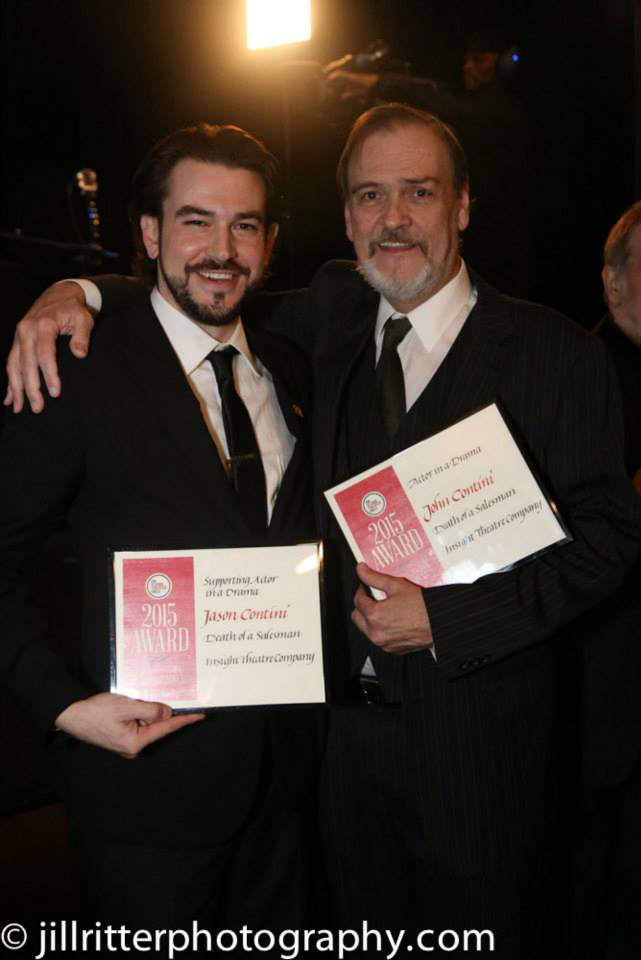
He won a St. Louis Theater Circle Award for Outstanding Actor in a Drama for his portrayal of Willy Loman in Insight Theater’s “Death of a Salesman” in 2014. For his “King Lear” at St. Louis Actors’ Studio, he received the GO Magazine Award as Best Actor. Other favorite roles include Tevye in “Fiddler on the Roof,” Norman Thayer in “On Golden Pond” and Henry Drummond in “Inherit the Wind.” He’s appeared in the film “Four Color Eulogy” with his son Jason Contini, who is also an actor.


He has also directed over 60 productions, including “Who’s Afraid of Virginia Woolf”: at St. Louis Actors’ Studio, for which he won Outstanding Director from the St. Louis Theater Circle. Other credits include “The Gin Game,” “American Buffalo,” “Tuesdays with Morrie,” “Deathtrap” and “I Do! I Do!”

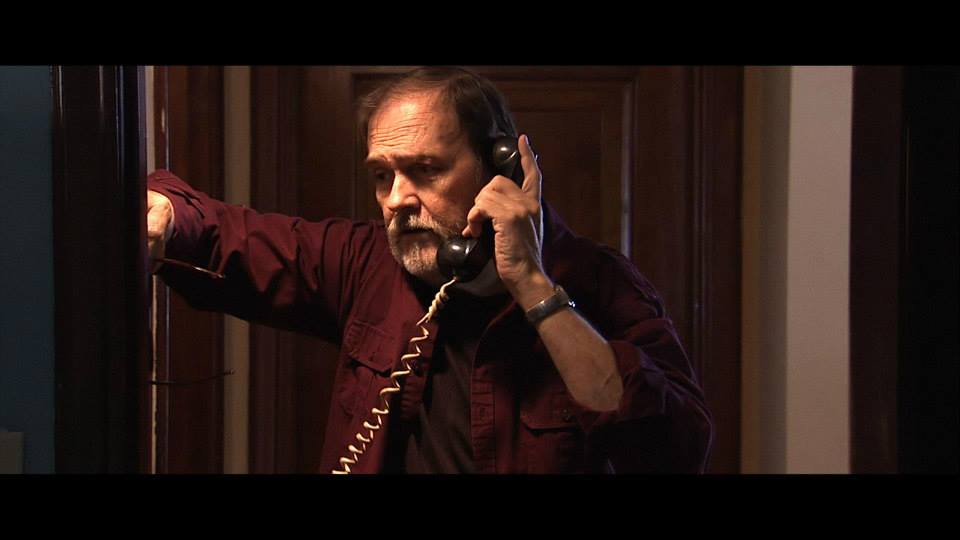
John Contini in the movie “Four Color Eulogy”


Take Ten Q &A with John Contini:

1. What is special about your latest project?

 I like that I get to revisit and revive John Barrymore, who I find fascinating.

2. Why did you choose your profession/pursue the arts?


I could never see myself doing anything other than something in the Arts.  The arts are the windows to our culture.

3. How would your friends describe you?

Loyal, dependable and dedicated…I hope

4. How do you like to spend your spare time? 

Watching old movies, researching movies and writing and drawing.

5. What is your current obsession?

 Godzilla movies and drawing at the moment

6. What would people be surprised to find out about you? 

That I am a comic book collector, writer and artist.

7. Can you share one of your most defining moments in life? 

Professionally : the first time I appeared on stage at the age of 18. I just knew that this is what I had to do for the rest of my life.

8. Who do you admire most?

I have always admired the actor and the man Vincent Price and how he handled his life and his career.

9. What is at the top of your bucket list? 

I’m pretty easy.  Go to the Oscars or the Tonys LIVE would be fun.

10. How were you affected by the pandemic years, and anything you would like to share about what got you through and any lesson learned during the isolation periods? Any reflections on how the arts were affected? And what it means to move forward?

Father and son awards

The Covid years gave me a chance to finish the book I was writing and soon publishing, and to spend more time at home also to make plans for the future when things could open up again. It gave me time to reflect on what was important to me and how I wanted to spend the time I have left.  As for how Covid effected the Arts, I would say that the Arts became more private and personal because of the isolation. 


11. What is your favorite thing to do in St. Louis?

Walking in different parks

12. What’s next? 

I am working on a small independent film with my son Jason and promoting my book.

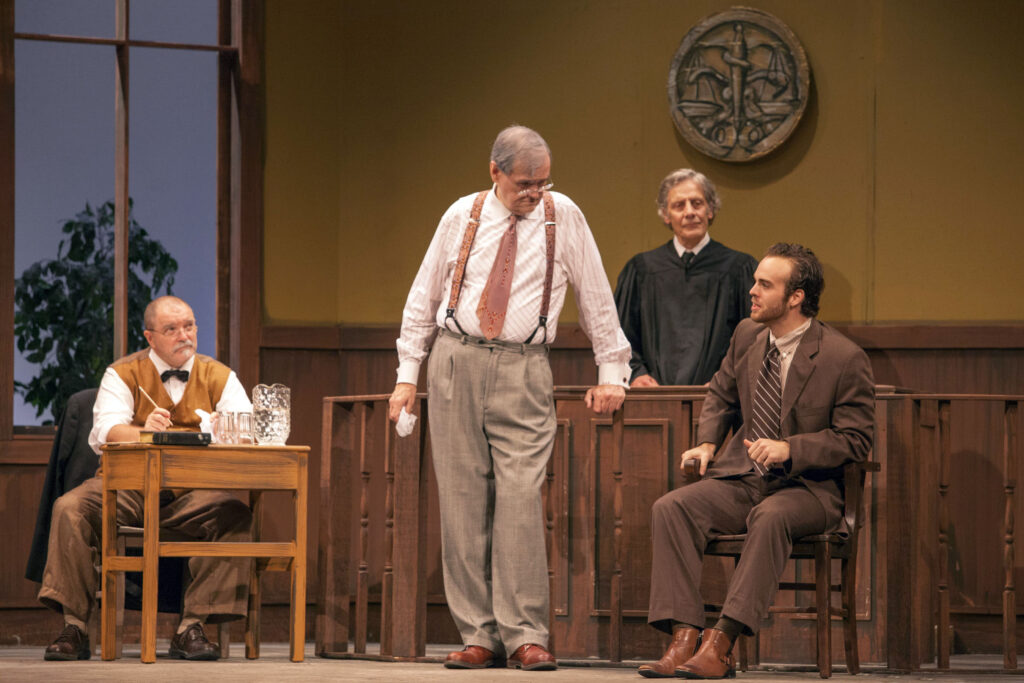
Inherit the Wind

More About John Contini
Birthplace: St Louis
Current location: St Louis
Family: wife Sharon, sons Jason and Nathan, daughter-in-law Danielle
Education: highest level Master in Theatre Arts from St. Louis University
Day job: retired
First job: Bagger at South Public Market
First movie you were involved in or made: Escape From New York
Favorite jobs/roles/plays or work in your medium? Tevye in Fiddler on the Roof, Wily Loman in Death Of A Salesman, Barrymore, directing: classic dramas like Who’s Afraid of Virginia Wolff
Dream job/opportunity: Work for Spielberg
Awards/Honors/Achievements: Go Magazine Award Best Actor for King Lear, Kevin Kline award Best Actor for Barrymore, St Louis Theatre Circle awards: Best Actor for Wily Loman (Death of a Salesman) and Best Director for Who’s Afraid of Virginia Wolff
Favorite quote/words to live by: Love the ART in yourself, not yourself in the ART.
A song that makes you happy: “Comedy Tonight” from “A Funny Thing Happened on the Way to a Forum

Bobby Miller and John Contini in “King Lear”

“Barrymore” is a limited engagement Dec. 1- 10, with shows performed Thursday through Saturday at 8 p.m. and Sunday at 3 p.m., with special performances Tuesday, Dec. 5 and Wednesday, Dec. 6. General admission tickets are $40 each plus fees, $35 each plus fees for students with valid ID and seniors 65+, available via Ticketmaster or at the theater box office one hour before showtime. For more information, visit stlas.org or email [email protected].

About St. Louis Actors’ Studio

St. Louis Actors’ Studio was founded to bring a fresh vision to theatre in St. Louis. Housed in The Gaslight Theater in historic Gaslight Square, STLAS is committed to bringing engaging theatrical experiences to our community of actors, writers, producers, filmmakers and all patrons of the arts; and to provide a strong ensemble environment to foster learning and artistic expression. St. Louis Actors’ Studio, through the use of ensemble work, will explore the endless facets and various themes of the human condition by producing existing and original collaborative theatre. For more information, visit stlas.org.


See the trailer for “Barrymore”: https://youtu.be/3h-7-XfS13k?si=__jG3lsqRCMFCNkV

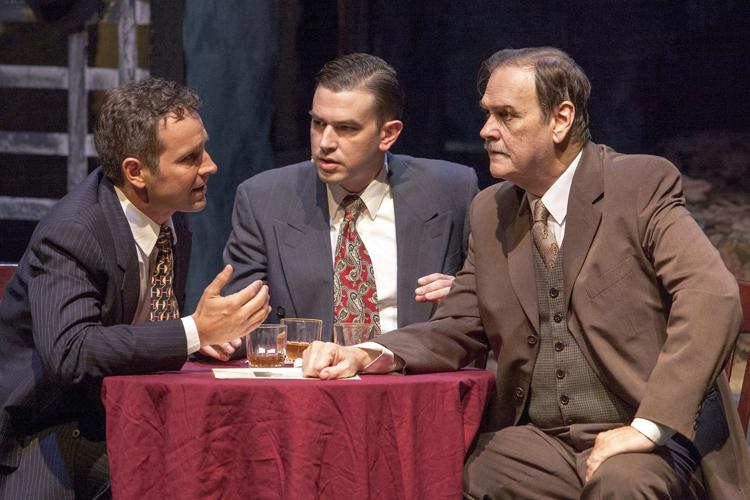
John Contini, David Wassilak, Richard Lewis in “The Dresser” in 2018 at STLAS, directed by Bobby Miller.

SATE is seeking submissions for Directors and Writers for the Eighth Annual Aphra Behn Festival, which will be presented March 29-31, 2024. The theme for the 2024 Festival is “Transformations”. 

When established in 2017, a goal of the Aphra Behn Festival was to give women interested in directing and writing for theatre an opportunity to get more experience, try out ideas, experiment, and hone their craft. SATE now looks to make the Festival a more inclusive space for transgender and non-binary artists, as well.

The Aphra Behn Festival is named for the fascinating poet, translator, and spy, Aphra Behn, who is widely considered to be the first English woman to make her living as a playwright. SATE produced a play about her, “Or,” by Liz Duffy Adams, in February 2015 and collaborated with Prison Performing Arts to adapt Behn’s play, “The Rover”, for the artists at the Women’s Eastern Reception, Diagnostic, and Correctional Center in Vandalia to perform. “The Rover” was also the text shared by the directors in the 2020 Festival. SATE feels very much a part of Aphra’s legacy. 

For artists interested in applying to be a director, email [email protected] by December 11, 2023 with a personal experience that inspired your interest in directing for theatre. SATE’s co-producers, Rachel Tibbetts and Ellie Schwetye, will contact applicants for a further interview.

For artists interested in submitting a play, email it to [email protected] by December 11, 2023. The play must contain the following ingredients:

  • Theme: Transformations
  • 3 characters max
  • Must be no longer than 20 minutes
  • A reference to a fairytale/childhood story or character
  • A mention of a Shakespeare play or character
  • A magic trick
  • One element (air, water, fire, earth) used in excess
  • A moment of music using one of the following songs:
    • Change or Telling Stories by Tracy Chapman
    • White Rabbit by Jefferson Airplane
    • Changes by David Bowie
    • Heads will Roll by the Yeah Yeah Yeahs
  • Utilize text created by the Spoken Word Artists

SATE is partnering with Prison Performing Arts (PPA) and their Spoken Word artists in Vandalia, MO, who have written poems following the season theme and inspired by fairy tales and children’s stories. Click the link above or here to read these poems.

The Eighth Annual Aphra Behn Festival will be performed at the Chapel (6238 Alexander Drive, 63105), across from Forest Park, March 29-31, 2024. Rehearsals will begin the first week of March 2024.

SATE will be hiring three directors and three writers for the 2023 Aphra Behn Festival. Artists of all ethnicities, races, ages, abilities, and backgrounds are encouraged to apply. Submissions from applicant directors and writers will be reviewed by members of SATE’s Artistic Advisory Ensemble.

SATE is grateful for the support of the St. Louis Regional Arts Commission, the Missouri Arts Council, the Steve Nelson Memorial Playwright’s Fund, and the Siteman Family Charitable Fund for making the Eighth Annual Aphra Behn Festival possible.

By Lynn Venhaus
The idealist in me wants to believe in Disney magic, of good triumphing over evil, of the power of community, and memorable moments, often with hopeful songs, that “Wish” embodies. 

Nevertheless, the cynic in me wonders if Disney’s reliance on their formula, just in time for the holidays, to endear a whole new line of toys to their loyal fans, makes the film lack the luster that “Frozen” and “Encanto” did.

Because the leading lady Asha’s pet goat Valentino, voiced by Disney regular Alan Tudyk, is certain to fly off the shelves, with its lovable demeanor and snappy dialogue. And the cosmic force that changes the plot’s trajectory, a Star, is drawn as a golden ball of energy. Cha-ching.

But we should be used to this, especially after the Disney Renaissance of the 1990s, where the Disney princesses became icons and prestige was bestowed with many awards for the animated musicals’ songs and scores. The bar was raised.

However, in recent years, the Disney output has been a mixed bag of highs and lows. For every “Zootopia,” there’s a “Strange World.” And I’m not even going to mention the live action remakes.

For all its good intentions to celebrate the Walt Disney Studios’ centennial, “Wish,” which is supposed to be the musical origin story for the “Wishing Star” that Disney is famous for, feels like a cut-and-paste tribute. 

Co-written  by the “Frozen” team of Chris Buck and Jennifer Lee, along with Allison Moore, “Wish” follows a young girl named Asha who attempts to save the fantastical Kingdom of Rosas from darkness. She wishes on a star and that trouble-making beacon comes down from the sky to join her because King Magnifico, a sorcerer, isn’t all that he seems to be.

Asha has seven friends who are grumpy, dopey, sneezy, and so forth – wink, wink. Sure, plenty of Easter eggs, but the homages are often nods to better efforts, and are missing the magic they are trying so hard to create.

The plucky heroine, a compassionate and smart peasant girl, rallies her beloved community because the cunning ruler, King Magnifico, voiced by a first-rate Chris Pine as both unctuous and ruthless, becomes a megalomaniac before our eyes. The whole wish symbolism gets a little muddled if you think about what all that means — putting your hopes and dreams into an omnipotent ruler.

As Asha, Ariana DeBose is a powerhouse vocalist, and the animators wisely capture her lithe dancing style, plus she can emotionally connect as the character.

While female empowerment is always worthy, with positive portrayals to propel this musical comedy, the other message is a noble one, and actually a little daring with its cautionary tale on authoritarianism and fascism. (Real world headlines intrude!)

The vocal work is fine – among the recognizable names, Victor Garber is a sympathetic grandfather Sabino, Evan Peters is Simon, one of Asha’s friends, and Ramy Youssef is Safi.

But the script is rather slight, and the music doesn’t seem to have a break-out original song like the “Encanto” or “Moana” songbook. Nevertheless, “This Wish” and “Knowing What I Know Now” are catchy – just not earworms like “Let It Go” or the Menken-Ashman canon. 

Stay for the credits because they will include every Disney animated feature in artwork, and there is a bonus scene with an iconic Disney song.

“Wish” is pleasant enough – just not as endearing as we’ve come to expect from the Mouse House. But its statement, perhaps aimed at a certain governor of the state where Disney World is based, is funny in a sly master stroke way. The movie’s message: Be careful what you wish for.

“Wish” is a 2023 animated musical fantasy directed by Chris Buck and Fawn Veerasunthorn and starring Ariana DeBose, Chris Pine, VIctor Garber, Alan Tudyk, Angelique Cabral, Evan Peters and Ramy Youssef. It is rated PG for thematic elements and mild action, and the run time is 1 hour, 35 minutes. It opened in theatres Nov. 22. Lynn’s Grade: B-.

By Lynn Venhaus

Think a second tier “Ted Lasso” meets a “Cool Runnings” vibe in this rough-around-the-edges underdog sports comedy-drama that is based on a true story.

The now infamous American Samoa soccer team, known for a historically brutal 2001 FIFA match they lost 31-0 to Australia, seeks redemption — and a goal — in 2014 or they’ll be booted out of the football federation.

Aimed at the heart with emphasis on quirky, director and co-writer Taika Waititi focuses on the likability of the Pacific Islanders involved with the soccer team, and the colorful inhabitants of American Samoa, a U.S. territory in the South Pacific Ocean.

It’s a mixed result. Waititi and co-screenwriter Aian Morris follow the template of the 2014 documentary of the same name, but naturally embellished for a narrative. 

Set in 2014, many people still have not gotten over the 2001 humiliation and are doubtful about the next World Cup qualifying match as the team hasn’t scored a goal since. Football Federation President Tavita, wonderfully played by charmer Oscar Kightley, is determined to get the team across that hurdle, so he hires a hothead Dutch-born coach Thomas Rongen (Michael Fassbender), who has been fired for egregious behavior, four weeks away from the game.

Naturally, he’s a fish out of water – faced with the ultimatum to leave or take the American Samoan job. His surly demeanor is at odds with the happy-go-lucky islanders, and does he even like soccer? He drinks too much, yells too much, and cares far too little. 

Following the familiar beats of goodness triumphing over meanness, like every true-story sports movie, “Next Goal Wins” is a crowd-pleaser but average paint-by-numbers movie.

New Zealander Waititi is known for his offbeat work in “What We Do in the Shadows” and “Hunt for the Wilderpeople” won an Oscar for “JoJo Rabbit,” and has directed a couple mega budget “Thor” movies.

Michael Fassbender and Jaiyah

Most surprising is seeing the intense Michael Fassbender cast as the down-on-his-luck maverick coach Thomas Rongen, who is tasked with turning the world’s worst soccer team around as World Cup Qualifiers approach. American Samoa is ranked last, and if they do not win, will be booted.

Fassbender, two-time Oscar nominee for “Steve Jobs” and “12 Years a Slave,” is known for serious roles. He is an odd choice, but this rage-aholic coach is a high-strung guy, so playing cantankerous, screaming so much his veins stand out, is within his specific set of skills. 

The character is designed to be redeemed, of course, and he gets his big speech, although throws a couple curves in, to explain some of his behavior. Fassbender is never going to be warm and fuzzy, or funny, for that matter, but you do root for him to get out of his own way.

In the spirit of “The Mighty Ducks” and “Bad News Bears,” the team players espouse the ‘old college try’ philosophy, and fit the kooky mold Waititi was going for, along with providing a strong sense of community. 

The likable Jaiyah, a transgender player, portrayed by a winsome Kaimana, is horribly disrespected by Rongen, and that relationship development is a focus of the plot, but the others aren’t given much to work with – Beulah Koale as Tavita’s son, Semu Filipo as police officer Rambo, and Uli Latukefu as the former goalie Nicky Salapu stand out.

Armani, the kid helping Rongen, is another source of comic relief, and Waititi uses the young actor Armani Makaiwa wisely. 

In supporting roles are Elisabeth Moss as Rongen’s divorce-headed wife, Will Arnett, who replaced Armie Hammer, as football federation board’s Alex Magnussen, and Rachel House as Tavita’s wife Ruth.

Showcasing the natural beauty of the island makes for a pleasant backdrop, with beaches, reefs and stunning cliff outlooks. And the characters’ relaxed way of life adds to the authentic depiction.

If you’re looking for heartwarming, you can find it here. However, if you are seeking a rousing underdog sports film that’s a cut above the usual, seek out the Oscar-winning documentary “Undefeated.”

“Next Goal Wins” is a 2023 Sports Comedy directed by Taika Waititi and starring Michael Fassbender, Elisabeth Moss, Will Arnett, Oscar Kightley, Kaimana, and David Fane. It’s rated: PG-13 for some strong language and crude material and runs 1 hour, 43 minutes. It opens in theatres Nov. 17. Lynn’s Grade: C.