By Lynn Venhaus Four retired guys sitting around talking and drinking coffee at a Chicago McDonald’s is intriguing food for thought –a delectable slice-of-life scenario that immediately draws us in to the play “Coconut Cake.”
Playwright Melda Beaty’s flair for dialogue, humor and seamlessly integrating social commentary in her dramedy is irresistible in a compelling and thoughtful presentation in The Black Rep’s intimate A.E. Hotchner Studio Theatre at Washington University.
Because of the caliber of its five-male cast, this character-driven work makes a swift and memorable connection. Their nimble delivery and interactions under the skilled direction of Geovonday Jones enhances their personal relationships as their struggles are revealed over the course of the two-act 2-hour show.
As they explore issues of manhood, racism, mental health and offer advice over games of chess, they show genuine affection — and aggravation — with each other but offer convincing immersive characterizations and realistic camaraderie. It’s set in the summer of 2010.
A fifth character, an unhoused man they call Gotdamnit, interrupts their mornings asking for money and offering his philosophical and spiritual words of wisdom. He’s considered a pest, but there is a surprising backstory and as suspected, more to the guy than his appearance indicates. Lawrence Evans is riveting as a marginalized man.
While the women in their lives are discussed, not seen, vivid portraits of the female characters emerge as they factor into the men’s disparate demeanors. Two characters in particular – a classy, attractive woman that has caught their eye, whom they watch as she walks to work from the Mickey D’s window, and property owner Joe’s mysterious new tenant, Ms. Brulee, who is a baker that makes a divine coconut cake, which happens to be Eddie’s nostalgic childhood favorite.
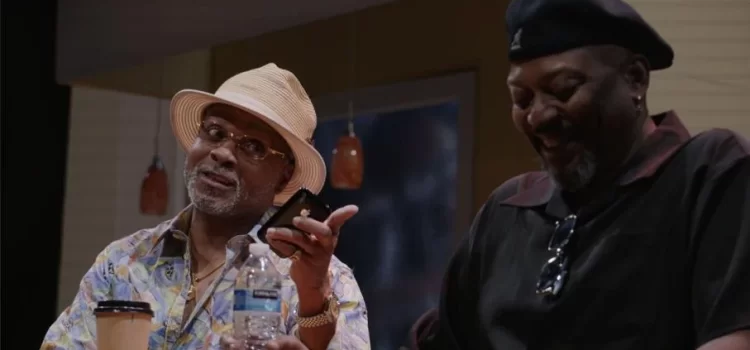
Richard E. Waits and Joe Hanrahan listen to Duane Foster. Photo by Keshon Campbell
Eddie Lee, a handyman, is the most agitated guy – upset about his wife’s escalating threatening behavior and discloses personal details about his troubled marriage. Everyone knows he has not been faithful, and that complicates matters. Duane Foster is strong as a guy whose life is falling apart but he’s not taking responsibility for the reasons why.
Marty is often the voice of reason, and his faith has kept him grounded. He’s a deacon in his church and devoted to his family, friends and congregation. As Marty, Richard E. Waits is firm, but measured, in the advice he gives, and it’s not always welcome.
The characters show different sides of them as husbands, fathers, sons and friends. Their individual stories mesh well, and the play offers unexpected twists and turns that add poignancy.
Each man has a significant emotional journey, and their textured portrayals give us richer story arcs as they bring up cherished memories and confide secrets.
Marty has brought along his brother-in-law Hank, a white guy who was married to his sister, who died a year ago. As played warmly by Joe Hanrahan, the widowed Hank is lonely and comes along for companionship and something to do. He’s learning chess, and he beams talking about his family, as his daughters and granddaughters try to keep him busy.
The outspoken Joe likes to needle Hank, calling him “Republican,” and increases his pot shots and cruel jabs. Richard Harris is a feisty live wire as the loud, swaggering Joe, a flashy blowhard who brags about his money and conquests. He’s never married but has a couple baby mamas.
Richard Harris is the outspoken Joe. Photo by Keshon Campbell.
As the very opinionated Joe, Harris can change his mood quickly. His accusations get heated and personal, especially if the other guys give him some lip about his boasts. His colorful wardrobe, often referred to as ‘fly’ in urban slang, is an indicator of his perceived status (kudos to costume designer Brandin Vaughn for the stylin’ attire).
Because Joe’s disposition can turn on a dime, his pointed barbs take on a hostile, accusatory tone in the second act, after he endures some setbacks.
All accomplished actors, the five bring nuance and shades of gray to our assumptions and give us deeper insight into these complicated men. They eventually must grapple with the consequences of their choices during their lifetimes.
Scenic designer Tammy Honesty has presented elements of a typical nook at a 2010-era McDonald’s, well-lit by designer Tony Anselmo, that allows Jones to move the action to wherever the guys are sitting.
When Joe struts in, he commands attention by seemingly holding court. Eddie is too restless to sit down most of the time, and Marty and Hank are often hunched over their chess board.
Lawrence Evans as Gotdamnit and Joe Hanrahan as Hank. Photo by Keshon Campbell.
Sound designer Alan Phillips incorporated people chattering at times and assembled an appealing soundtrack of catchy pop hits. Christian Kitchens was an assured technical director, and Mikhail Lynn provided the minimal props.
This isn’t the first time The Black Rep has presented the play, because during the pandemic in September 2020, they made a virtual Zoom reading available from The Ensemble Theatre in Houston, which featured founder Ron Himes as a major character, Eddie Lee.
In 2022, Beaty received the second annual Sylvia Sprinkle-Hamlin Rolling Premiere Award by the International Black Theatre Festival. Because of that, this play is being produced by five theaters, including the Black Rep. It is a welcome return.
With its engaging cast, a captivating funny-sad bittersweet narrative, and noteworthy technical know-how, “Coconut Cake” is a satisfying production to savor.
(At intermission, a coconut cream cheese pound cake is available for purchase too, along with other snacks. Just sayin’, if you get a hankering for a sweet treat.)
Richard Waits and Joe Hanrahan are brothers-in-law playing chess. Photo by Keshon Campbell.
The Black Rep presents “Coconut Cake” Feb. 5 – March 2 in the AE Hotchner Studio Theatre at Washington University. For tickets and more information, visit www.theblackrep.org
The Jack C. Taylor Music Center opens following a two-year, $140 million expansion and renovation, transforming the audience and artist experience
Music Director Stéphane Denève leads a reopening performance for the venue’s neighbors and community and an opening weekend celebration with mezzo-soprano Joyce DiDonato;venue welcomes entire region for community open house in November
World premieres of three SLSO commissions: Nathalie Joachim’sFamily (composed for the SLSO IN UNISON® Chorus), James Lee III’sFanfare for Universal Hope, and Kevin Puts’House of Tomorrow (song cycle with JoyceDiDonato and members of the St. Louis Symphony Chorus); SLSO co-commissions and St. Louis premieres of Carlos Simon’s Double Concerto with violinist Hilary Hahn and cellist Seth Parker Woods and a new work by Jasmine Guo
Commitment to music of today, with 40 percent of pieces on classical programs by living composers, including four pieces by Kevin Puts, who will serve as composer in residence
Denève conducts pillars of the symphonic repertoire, including Richard Strauss’ Ein Heldenleben; Sergei Rachmaninoff’s Symphony No. 2; Benjamin Britten’s War Requiem; Igor Stravinsky’s complete score to the ballet, The Firebird; W.A. Mozart’s The Magic Flute in its entirety; Gustav Mahler’s Symphony No. 5; Maurice Ravel’s complete Daphnis and Chloé; and Igor Stravinsky’s Pulcinella Suite with dancers from Saint Louis Dance Theatre
New chamber music series, featuring two programs curated by and performed with visiting artists, violinist Augustin Hadelich and pianist Orli Shaham
Introduction of recital series, with performances by acclaimed pianists Víkingur Ólafsson and Isata Kanneh-Mason
Denève welcomes his predecessors, David Robertson (Music Director 2005-2018) and SLSO Conductor Laureate Leonard Slatkin (Music Director 1979-1996), alongside returning conductors Hannu Lintu, Nicholas McGegan, John Storgårds, and Xian Zhang; plus returning pianists Emanuel Ax, Stewart Goodyear, Víkingur Ólafsson, Orli Shaham, Jean-Yves Thibaudet, and Joyce Yang; violinists Augustin Hadelich, Hilary Hahn, Leila Josefowicz, and Nikolaj Szeps-Znaider; vocalists Christine Goerke, John Matthew Myers, Sherezade Panthaki, and Philippe Sly; and ensembles The St. Louis Children’s Choirs and Saint Louis Dance Theatre
Artists new to the SLSO include conductors Ryan Bancroft, Tabita Berglund, Kevin John Edusei, Dima Slobodeniouk, and Anna Sułkowska-Migoń; pianists Isata Kanneh-Mason, Jan Lisiecki, and Gabriela Montero; cellists Seth Parker Woods and Kian Soltani; vocalists Ben Bliss, Ian Bostridge, Sara Couden, Joyce DiDonato, Rainelle Krause, and Roderick Williams; trio Time for Three; saxophonist Steven Banks; and sheng player Wu Wei
More concerts to be announced, including chamber music at the Pulitzer Arts Foundation and The Sheldon; happy hour concerts; Concerts for Kids; and additional specials
The St. Louis Symphony Orchestra (SLSO) and Stéphane Denève, The Joseph and Emily Rauh Pulitzer Music Director, announced programming for the orchestra’s 2025/2026 season, the orchestra’s 146th and Denève’s seventh as Music Director. This celebratory season welcomes the community back to the SLSO’s concert venue following two years of construction. The Jack C. Taylor Music Center includes a complete renovation of Powell Hall—the historic venue built in the 1920s that has served as the orchestra’s home since 1968—and a 64,000-square-foot expansion. Designed with community service at its forefront, the project preserves the civic treasure for generations to come, transforms the audience and artist experience, and makes music more accessible.
Stéphane Denève, The Joseph and Emily Rauh Pulitzer Music Director of the SLSO, said,
“From the celebratory first notes of Aaron Copland’s Fanfare for the Common Man to the world premiere of Nathalie Joachim’s all-embracing Family to close our season, I dreamed of a festive musical journey that will serve and unite our entire community through the joy of music, resonating again in our wonderfully restored Powell Hall. This new season is filled with vibrant, compelling, and diverse repertoire, accelerating our belief that our home—this ‘House of Tomorrow’ as our composer in residence Kevin Puts calls it in his monumental new piece— is for everybody. Our musical offering looks towards the future but will also commemorate important moments in history—the 80th anniversary of the end of World War II and America’s 250th birthday. I cannot wait to feel the momentum of this new era with our immensely talented musicians, chorus members, and outstanding guest artists.”
Marie-Hélène Bernard, SLSO President and CEO, said,“The 25/26 season realizes our vision of an expanded concert venue that welcomes the community wholeheartedly, supports the immense talents of our orchestra musicians and choruses, and centers music as a catalyst to gather, learn, and celebrate. Stéphane and our team have crafted a season that showcases the vitality of symphonic music, welcoming an outstanding roster of guest artists, performing treasured classics, and building on our history of fostering the future of our art form. We anticipate with excitement sharing meaningful experiences with our audiences both at the renovated Powell Hall and throughout the region.”
Bjorn Ranheim and Chris Tantillo, co-chairs of the SLSO Musicians’ Council, said, “The musicians of the St. Louis Symphony Orchestra are thrilled to return to our beloved Powell Hall for a season full of orchestral fireworks. Celebrating the past, present, and future of the organization will be an incredibly powerful experience in our beautifully restored and revitalized home. We look forward to welcoming the community back and continuing our mission of enriching people’s lives through the power of music.”
Curated and Compose Your Own Subscriptions are on sale now. Single tickets go on sale later in 2025. Visit slso.org/season or call the Box Office at 314-534-1700 for more information.
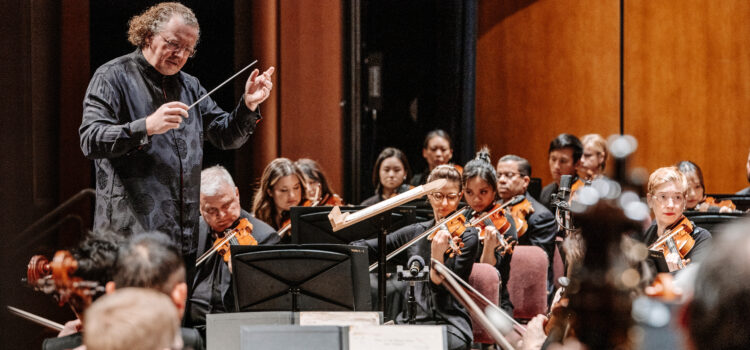
St. Louis Symphony Orchestra performs during a projection of Harry Potter and the Deathly Hallows™ in Concert Saturday, April 16, 2022 at Powell Hall in St. Louis. (Photo by Whitney Curtis)
REOPENING THE SLSO’S HOME
The 146th season welcomes audiences to experience the Jack C. Taylor Music Center, for the first time since the completion of a transformational expansion and renovation project. The $140 million project, designed by the internationally acclaimed architecture firm Snøhetta, centers the SLSO’s priorities on artistic excellence, community engagement, and education leadership. The project provides new and improved amenities for audiences and artists, while preserving and enhancing the internationally recognized acoustics and aesthetics of the concert hall. A new Education and Learning Center provides additional space for the SLSO’s two resident choruses, its Youth Orchestra, and a robust portfolio of education and community programs.
A season-long celebration of Powell Hall’s reopening, programming showcases the virtuosity and nimbleness of the orchestra musicians and guest artists, and includes a wide variety of music, responding to the community’s diverse tastes and interests. Pillars of orchestral repertoire share programs with music by composers of today with 40 percent of pieces on classical concerts by living composers. While looking to today’s and tomorrow’s musical voices, Denève and the SLSO also honor important moments in history, notably the 80th anniversary of the conclusion of World War II through performances of war-time and war-inspired pieces, and the 250th anniversary of the founding of the United States, building on the SLSO’s long-held priority of elevating music by American voices. Broadening the definition of what a symphonic organization can achieve, programming also includes films with scores performed live, cross-genre collaborations and presentations, chamber music in multiple settings, holiday commemorations, happy hour concerts, and a new recital series.
On September 19, Denève leads the orchestra for the first time in the renovated Powell Hall, inaugurating the Jack C. Taylor Music Center with a ceremonial ribbon cutting and special performance for the venue’s neighbors and community partners.
On September 26-28, Denève opens the season with a triumphant trio of fanfares by Aaron Copland, Joan Tower, and a world premiere by James Lee III, and leads the world premiere of Kevin Puts’ House of Tomorrow, written for and featuring acclaimed mezzo-soprano Joyce DiDonato and members of the St. Louis Symphony Chorus on a text adapted from the poet Kahlil Gibran. Richard Strauss’ Ein Heldenleben closes the program.
On November 8, the SLSO will welcome the community to a free day of music. Additional details about this and other reopening events will be shared later.
SEASON HIGHLIGHTS WITH DENÈVE
Denève opens the season with the celebratory free community concert on Art Hill in Forest Park, an annual tradition that draws tens of thousands of people and serves as the ceremonial start of the SLSO’s season, performed in memory of longtime SLSO supporter Mary Ann Lee (September 17).
Denève welcomes a roster of internationally recognized guest artists to St. Louis, including violinist Nikolaj Szeps-Znaider for a program that pairs two iconic Romantic pieces: Pyotr Ilyich Tchaikovsky’s Violin Concerto and Sergei Rachmaninoff’s Symphony No. 2 (November 1-2). On November 7 and 9, the SLSO commemorates the 80th anniversary of the conclusion of World War II with performances of Benjamin Britten’s monumental War Requiem, with the St. Louis Symphony Chorus, The St. Louis Children’s Choirs, and a stellar cast of vocalists: soprano Christine Goerke, tenor Ian Bostridge, and baritone Roderick Williams.
Denève leads a rare complete performance of Igor Stravinsky’s score to the ballet, The Firebird, and his close friend and collaborator, Jean-Yves Thibaudet, joins for Aram Khachaturian’s Piano Concerto (November 21-22). The New Year’s Eve concert features pianist Stewart Goodyear in George Gershwin’s Rhapsody in Blue in a French and American-themed musical celebration led by Denève (December 31).
Furthering Denève’s interest in artistic collaborations, Saint Louis Dance Theatre dancers perform original choreography by Kirven Douthit-Boyd alongside the orchestra for Igor Stravinsky’s Pulcinella Suite (January 10-11). The program also includes signature Denève programming with music by Claude Debussy and Albert Roussel.
For the first time on the Powell Hall stage, the orchestra performs Mozart’s complete concert version of the opera, The Magic Flute,with Denève, the St. Louis Symphony Chorus, and The St. Louis Children’s Choirs, and a cast of vocalists including tenor Ben Bliss as Tamino and coloratura soprano Rainelle Krause as The Queen of the Night(February 20 and 22), advancing Denève’s commitment to large-scale choral and operatic performances.
Denève shares his lifelong respect and admiration for his personal friend, prolific film composer John Williams, in a program that includes excerpts from Williams’ scores to Close Encounters of the Third Kind, Star Wars, and E.T. alongside the first SLSO performances of Kevin Puts’ Contact, a triple concerto performed by trio Time for Three (March 20 and 22).
Welcoming back the acclaimed pianist and former SLSO touring partner Víkingur Ólafsson, Denève leads Beethoven’s Emperor Piano Concerto, a new SLSO co-commission by Jasmine Guo as part of the Virginia B. Toulmin Foundation Orchestral Commission program, and Kevin Puts’ Concerto for Orchestra, premiered by the SLSO in 2023 (March 27-28). Denève leads another SLSO co-commissioned work, Carlos Simon’s Double Concerto with star violinist Hilary Hahn and cellist Seth Parker Woods, alongside Gustav Mahler’s massive Symphony No. 5 (April 10-12).
Denève brings the entire SLSO roster of musicians together for the final symphonic concert of the season. The SLSO IN UNISON® Chorus, with the unique mission of performing and preserving music from the African diaspora, gives the world premiere of Family, composed by Nathalie Joachim following many conversations with chorus members. The concert opens with SLSO’s previously commissioned work, Kevin Puts’ Virelai. The St. Louis Symphony Chorus joins the orchestra for Maurice Ravel’s Daphnis and Chloé.
Emanuel Ax
RETURNING ARTISTS AND SLSO ENSEMBLES
Many of the world’s leading conductors return to the SLSO. David Robertson, who served as the 12th SLSO Music Director from 2005-2018, returns in a program that features music by Steve Mackey and Sarah Kirkland Snider, and pianist Orli Shaham on Robertson’s own piano concerto, and Leonard Bernstein’s Symphony No. 2, “The Age of Anxiety” (March 6-7). Conductor Laureate Leonard Slatkin leads the second week of classical concerts, welcoming back his friend, pianist Emanuel Ax, for Mozart’s Piano Concerto No. 25, Edward Elgar’s Symphony No. 1, and his own Schubertiade: An Orchestral Fantasy (October 11-12).
Additional returning conductors include John Storgårds, in a program anchored by Dmitri Shostakovich’s Symphony No. 15 (December 5-6); Nicholas McGegan, leading G.F. Handel’s Messiah (December 12-14); Xian Zhang conducting Billy Childs’ Diaspora (Saxophone Concerto) and Sergei Prokofiev’s Symphony No. 5 (February 6-7); and Hannu Lintu leading a program of works by Richard Wagner, W.A. Mozart, Samy Moussa, and Ottorino Respighi’s rarely performed Church Windows (April 18-19).
Pianists making their SLSO returns include Jean-Yves Thibaudet on Aram Khachaturian’s Piano Concerto (November 21-22); Joyce Yang on Sergei Rachmaninoff’s Rhapsody on a Theme of Paganini (November 29-30); Stewart Goodyear on George Gershwin’s Rhapsody in Blue (December 31); and Víkingur Ólafsson on Ludwig van Beethoven’s Piano Concerto No. 5, “Emperor” (March 27-28) and in recital (March 26). Returning violinists include Augustin Hadelich on Sergei Prokofiev’s Violin Concerto No. 2 (October 24-25) and in a program of chamber music with SLSO musicians (October 26); Nikolaj Szeps-Znaider on Tchaikovsky’s Violin Concerto (November 1-2); Leila Josefowicz on Alban Berg’s Violin Concerto (March 14-15); and Hilary Hahn on Carlos Simon’s Double Concerto (April 10-12).
Soprano Christine Goerke, in Benjamin Britten’s War Requiem (November 7 and 9), as well as most of the vocal cast for Handel’s Messiah: soprano Sherezade Panthaki, tenor John Matthew Myers, and baritone Philippe Sly (December 12-14) also return.
The St. Louis Symphony Chorus, which has performed repertoire from the entire choral-orchestral canon to critical acclaim since its formation in the 1976/1977 season, performs alongside the SLSO under the direction of Erin Freeman. In the 25/26 season, the chorus performs Kevin Puts’ House of Tomorrow (September 26-28); Benjamin Britten’s War Requiem (November 7 and 9); G.F. Handel’s Messiah (December 12-14); W.A. Mozart’s The Magic Flute (February 20 and 22); Maurice Ravel’s Daphnis and Chloé (May 8-10).
The St. Louis Symphony IN UNISON® Chorus, which preserves and performs music from the African diaspora and is directed by Kevin McBeth in his 15th season, returns for its annual holiday-time soulful celebration: IN UNISON® Christmas (December 19). The chorus performs its annual Lift Every Voice: Celebrating Black History Month concert, also under McBeth’s direction and featuring vocalist Rosephanye Dunn Powell (February 27). The chorus joins the SLSO in the final classical concerts of the season, performing the world premiere of Nathalie Joachim’s Family (May 8-10).
The St. Louis Symphony Youth Orchestra, the region’s premiere training orchestra for young musicians aged 12-22, will present three concerts in its 56th season. Concert details will be announced later.
Sherezade Panthaki
ARTIST DEBUTS
Throughout the 25/26 season, many acclaimed artists will make their SLSO debut.
Five conductors make their debuts on symphonic programs, including Tabita Berglund in a program of Russian and Scandinavian music (October 24-25); Kevin John Edusei with Beethoven’s Symphony No. 7 (November 29-30); Dima Slobodeniouk leading a concerto for sheng and Tchaikovsky’s Symphony No. 4 (January 24-25); Anna Sułkowska-Migoń in a program with Polish connections, alongside Rimsky-Korskov’s Scheherazade (March 14-15); and Ryan Bancroft leading Copland’s Symphony No. 3 (April 24-25).
Instrumentalists making their SLSO debuts include: pianists Jan Lisiecki performing Mozart’s Piano Concerto No. 9, “Jeunehomme” (April 18-19), Gabriela Montero performing Prokofiev’s Piano Concerto No. 3 (April 24-25), and Isata Kanneh-Mason in a recital with music by Beethoven, Ravel, and Tabakova (May 14); cellists Kian Soltani on Haydn’s Cello Concerto in C major (December 5-6), and Seth Parker Woods in Carlos Simon’s Double Concerto (April 10-12); sheng player Wu Wei on Jukka Tiensuu’s Teoton, a concerto for sheng (January 24-25); and saxophonist Steven Banks, an international ambassador for his instrument, who performs Billy Childs’ Diaspora (February 6-7).
Time for Three—a trio consisting of violinists Nick Kendall and Charles Yang, and double bassist Ranaan Meyer—debut on Kevin Puts’ Contact (March 20 and 22).
Vocalists making their debuts include mezzo-soprano Joyce DiDonato singing the world premiere of Kevin Puts’ House of Tomorrow (September 25-27); tenor Ian Bostridge and baritone Roderick Williams in Britten’s War Requiem (November 7 and 9); contralto Sara Couden in Handel’s Messiah (December 12-14); and tenor Ben Bliss and soprano Rainelle Krause in Mozart’s The Magic Flute (February 20 and 22).
WORLD PREMIERES, COMMISSIONS, AND FIRST SLSO PERFORMANCES
More than 20 pieces enter the SLSO’s repertoire during the 2025/2026 season, including 15 works by living composers. In addition to world premieres by Nathalie Joachim, James Lee III, and Kevin Puts, the SLSO performs works by living composers including Billy Childs, Guillaume Connesson, Reena Esmail, Samy Moussa, David Robertson, Leonard Slatkin, Sarah Kirkland Snider, Jukka Tiensuu, and Joan Tower. Nearly 40 percent of the pieces on symphonic programs are by living composers.
World premieres
Kian Soltani Cellist
Photographer: Marco Borggreve
all rights reserved/no third commercial parties
James Lee III’s Fanfare for Universal Hope builds on the composer’s relationship with Denève and the orchestra as one of the SLSO’s most-performed composers in recent years. Since 2019, the SLSO has performed four of Lee’s pieces, including the 2023 world premiere of the SLSO-commissioned Visions of Cahokia, inspired by the indigenous civilization near present-day St. Louis.
Kevin Puts’ House of Tomorrow is a new song cycle based on texts by Kahlil Gibran, the writer, poet, and artist. Mezzo-soprano Joyce DiDonato delivers the world premiere performance alongside the SLSO and members of the St. Louis Symphony Chorus. Puts serves as composer in residence during the SLSO’s 25/26 season, and the orchestra will play three additional pieces by him: Contact, Concerto for Orchestra, and Virelai. The latter two were SLSO commissions premiered in 2023 and 2019 respectively.
Nathalie Joachim’s Family takes inspiration from the St. Louis Symphony IN UNISON® Chorus, a resident chorus with the unique mission to perform and preserve music from the African diaspora. Joachim logged many conversations with IN UNISON® Chorus singers, utilizing their words as the text for her piece.
SLSO Co-commissions
A new work by Jasmine Guo is part of the Virginia B. Toulmin Foundation Orchestral Commission program of the League of American Orchestras, connecting female composers with orchestras to commission new work. The SLSO previously participated in the program as the lead commissioner of Stacy Garrop’s Goddess Triptych, premiered in March 2022.
Carlos Simon’s Double Concerto will receive its Midwest premiere with the SLSO and violinist Hilary Hahn and cellist Seth Parker Woods.
Leonard Slatkin
First SLSO performances
Joan TowerFanfare for the Uncommon Woman No. 1 (September 26-28)
Leonard Slatkin Schubertiade: An Orchestral Fantasy (October 11-12)
Harald SæverudThe Ballad of Revolt (October 24-25)
Guillaume ConnessonMaslenitsa (November 21-22)
Clara Wieck Schumann (orch. de Murashkin) Three Romances (December 5-6)
Jukka TiensuuTeoton (Concerto for Sheng and Orchestra) (January 24-25)
Reena Esmail RE|Member(February 6-7)
Billy ChildsDiaspora (Concerto for Saxophone and Orchestra) (February 6-7)
David RobertsonLight forming, A Piano Concerto(March 6-7)
Sarah Kirkland Snider Something for the Dark (March 6-7)
Grażyna Bacewicz Overture (March 14-15)
Kevin Puts Contact (March 20 & 22)
Samy MoussaElysium (April 18-19)
Chamber music and recitals
In a two-concert series, the SLSO presents acclaimed guest artists in chamber music concerts they curate, collaborating with orchestra musicians in a more intimate setting. Violinist Augustin Hadelich curates the October 26 program and pianist Orli Shaham leads the March 8 concert.
The SLSO introduces a new two-concert recital series, presenting acclaimed musicians in solo works on Powell Hall’s stage. Inaugural artists in this series include pianists Víkingur Ólafsson, performing Beethoven’s final three piano sonatas (March 26), and Isata Kanneh-Mason, presenting Beethoven’s famous “Moonlight” sonata alongside works by Maurice Ravel and Dobrinka Tabakova (May 14).
Additional information about the SLSO’s Live at the Pulitzer (chamber music exploring the intersection of visual and aural art by composers of today, performed at the Pulitzer Arts Foundation) and Live at The Sheldon (music from the entire chamber music library curated and performed by SLSO musicians at The Sheldon) will be announced later.
Films with live score
The Wizard of Oz
The SLSO continues its popular film series, performing acclaimed scores live while the movie plays overhead. Films in the 25/26 season include Harry Potter and the Sorcerer’s StoneTM(October 3-5), The Lion King (November 15-16), Home Alone (December 27-28), and The Wizard of Oz (January 30-February 1). The SLSO presents Marvel Infinity Saga in Concert, a cross-film journey through Marvel’s most exciting moments (May 1-3).
Holiday and special programming
Broadening the definition of a symphony concert, the SLSO plans several special events to respond to patrons’ diverse tastes.
The SLSO pays tribute to the memory of St. Louis icon Chuck Berry in a brand new program celebrating the rock legend’s 100th birthday and in collaboration with the Chuck Berry estate (October 17-18). Curated and arranged by prolific composer Carlos Simon, the SLSO explores the legacy of jazz great John Coltrane, led by Edwin Outwater and featuring saxophonist Joe Lovano (February 28).
Holiday concerts include the popular IN UNISON® Christmas concert, previously known as Gospel Christmas (December 19), which features the IN UNISON® Chorus led by Kevin McBeth. The Mercy Holiday Celebration presents five concerts of beloved holiday music with conductor Stuart Malina at Powell Hall (December 20-21 and 23). Denève leads the annual New Year’s Eve Celebration Concert, featuring pianist Stewart Goodyear and music by Leonard Bernstein, Georges Bizet, and George Gershwin (December 31). The SLSO also performs its annual Lift Every Voice: Celebrating Black History Month concert with the IN UNISON® Chorus and vocalist Rosephanye Dunn Powell (February 27).
Additional special concerts, happy hour concerts, and Concerts for Kids, will be announced later.
Kevin McBeth
OPERA THEATRE OF SAINT LOUIS
The SLSO will conclude its season as the resident orchestra of Opera Theatre of Saint Louis (OTSL), the 49th year of this partnership. The 2026 Festival Season runs May 23–June 28, 2026. Programming for OTSL’s 2026 Festival Season will be announced later this summer. The current 2025 Festival Season takes place this May and June, marking the occasion of OTSL’s 50th anniversary; tickets and more information can be found at ExperienceOpera.org.
About the St. Louis Symphony Orchestra
Celebrated as one of today’s most exciting and enduring orchestras, the St. Louis Symphony Orchestra is the second-oldest orchestra in the country, marking its 145th year with the 2024/2025 season and its sixth with Stéphane Denève, The Joseph and Emily Rauh Pulitzer Music Director. Widely considered one of the leading American orchestras, the Grammy® Award-winning SLSO maintains its commitment to artistic excellence, educational impact, and community collaborations—all in service to its mission of enriching lives through the power of music.
The core of the SLSO’s artistic foundation is its dynamic partnership with Denève, whose energetic musicianship, visionary storytelling, and collaborative spirit have created stronger connections with local and visiting artists, as well as advanced the SLSO’s role as a leader in music education. The SLSO musical family also includes two resident choruses: the St. Louis Symphony Chorus, founded in 1976, performs choral-orchestral music from the Baroque era to today; and the St. Louis Symphony IN UNISON® Chorus, founded in 1994, focuses on the performance and preservation of music from the African diaspora. The St. Louis Symphony Youth Orchestra, founded by Conductor Laureate Leonard Slatkin in 1970, is the region’s premiere training orchestra for high school and college students.
In March 2023, the SLSO broke ground on a 65,000-square foot expansion and renovation of the orchestra’s home, Powell Hall—the first major renovation project at the historic Grand Center building since it became the SLSO’s permanent home in 1968. Led by the internationally acclaimed architecture firm Snøhetta, the project will transform the audience and artistic experience while protecting Powell Hall’s historic character and celebrated acoustics, creating a state-of-the art center for community, innovation, and powerful music experiences. While construction is underway, the SLSO will perform throughout the community. The revitalized Powell Hall will open in September 2025, coinciding with the building’s centennial.
An integral part of the vibrant St. Louis community, the SLSO enjoys a long history of robust and enduring artistic collaborations with individuals and organizations locally and around the world. Orchestra musicians share dozens of education and community performances throughout the region each year at medical facilities, places of worship, community centers, and schools. For 20 years, the St. Louis Symphony Orchestra: Live at the Pulitzerseries has highlighted today’s leading musical voices through innovative performances in collaboration with, and reaction to the exhibitions at, the Pulitzer Arts Foundation. The SLSO has served as the resident orchestra for Opera Theatre of Saint Louis for more than 45 years. The orchestra also continues to foster impactful artistic collaborations, including a chamber music series with The Sheldon, as well as regular partnerships with The Muny, Saint Louis Dance Theatre, the Saint Louis Art Museum, and others. Beyond the St. Louis region, the SLSO’s impact is realized through Saturday night concert broadcasts on St. Louis Public Radio and Classic 107.3, acclaimed recordings, regular touring activity, and a digital portfolio that includes a robust online education platform with curriculum materials, interactive programs, activities, and learning opportunities for all ages.
Since the arrival of Marie-Hélène Bernard as President and CEO in 2015, the SLSO has aligned its mission to make music more accessible, while fostering a culture welcoming to all. Building on its momentum, the SLSO serves as a convener of individuals, creators, and ideas, and is committed to building community through compelling and inclusive musical experiences. As it continues its longstanding focus on equity, diversity, inclusion, and access, the SLSO embraces its strengths as a responsive, nimble organization, while investing in partnerships locally and elevating its presence globally. For more information, visit slso.org.
The Midnight Company announces two shows for its 2025 Season. In July at The Chapel, Midnight will present the World Premiere of PRIDE AND JOY, co-produced with playwright Colin McLaughlin. And October at Greenfinch will bring a revival of Conor McPherson’s ST. NICHOLAS.
McLaughlin’s PRIDE AND JOY, which was seen in a one performance reading at the 2024 St. Louis Fringe Festival, reveals a family gathering for an intervention for one of its members. But confusion reigns as the family tries to figure out just who this intervention is meant for. Carl Overly Jr. will direct. Carl won a Theatre Critics Circle award for Outstanding Supporting Actor/Comedy for Midnight’s 2021 show IT IS MAGIC. The cast includes Summer Baer, who’s performed in Midnight shows RODNEY’S WIFE and THE YEARS; Lavonne Byers, who last year won a Critics Circle award for Outstanding Actress for Midnight’s THE LION IN WINTER; Lize Lewy, who as a playwright is nominated this year for a Critics Circle award for Outstanding New Play for her script LONGING; Jacob Schmidt, who this year is nominated as Outstanding Supporting Actor/Comedy for his role in TRAYF at New Jewish Theatre; and Joe Hanrahan, Midnight’s Artistic Director. PRIDE AND JOY will run July 10-26 at The Chapel.
And kicking off the Halloween season will be ST. NICHOLAS, the eerie story of a Dublin theatre critic (portrayed by Joe Hanrahan) who, on a wayward trip to London, encounters a band of vampires and faces a turning point in his life. Midnight has presented this show before, with performances at McGurks Irish pub, the late great Herbie’s Wine Room, and at Carrie Houk’s HH Studio. For these, critics cited the production’s “terrifying realism”, and called Hanrahan’s performance “stunning” and “brilliant.” (Hanrahan shared that Outstanding Actor award with Overly in a tie for IT IS MAGIC, and this year will receive a Lifetime Achievement award at the Critics Circle ceremony.) ST. NICHOLAS will be directed by Bradley Rohlf, who previously won an Outstanding Director award for his direction of the musical ASSASSINS from Fly North. The show will run October 2-5 at Greenfinch.
More details, including when tickets will go on sale, and invitations to these will be forthcoming. For more information on the Company, visit MidnightCompany.com.
(These shows will follow Midnight Cabaret Theatre productions at The Blue Strawberry: March 22 (with more to be announced) will be JUST ONE LOOK, Midnight’s Linda Ronstadt show, entering its third year of sold out performances. And April 11 & 18 will be the Premiere of IT WILL BE, The Spirit and Soul of Natalie Cole. Tickets for these shows are on sale now at BlueStrawberrySTL.com)
With its genre mash-up of science fiction, horror, action-adventure and romance, the most surprising of all is that the romance is the most satisfying aspect of “The Gorge.” And that’s because of the sparks flying between charismatic co-stars Anya Taylor-Joy and Miles Teller.
While this mysterious thriller has intriguing menacing elements, it does take a while to get going, but once the creature danger plotline is revealed, it doesn’t take a biochemist to explain it all to us (although that does help) – so then what follows is entirely predictable and borders on the ridiculous at times.
But the pair’s coupling is worth sticking out the extra-long runtime of 2 hours, 7 minutes, because these lost souls are clearly meant to be together. As two lone wolves, they discover not only do they have their line of work in common, but so much more. Tenderly, though, they bond through poetry and music, which is a sweet, thoughtful touch.
Both are hired guns – she’s a Lithuanian assassin whose dad was a KGB agent, and he’s a former U.S. Marine who takes on sniper assignments, used to a solitary existence. They’ve accepted a vague year-long assignment to be guards at an undisclosed location.
They are told they are protecting the world from the present evil in this misty gorge, with eerie noises and a foreboding terrain. The enemy is unseen, but it’s only a matter of time until the threat is disclosed.
Teller’s Levi Kane is in the West Tower while Taylor-Joy’s Drasa is in the East Tower, super-secret representatives of a government pact made during the Cold War, during the tail end of World War II.
Levi, a reader, discovers a wall inscribed with sayings from all the previous guards, hidden behind a bookcase. He’s given a training lesson from his British counterpart who’s about to return to civilization after 365 days. As JD, Sope Dirisu alludes to the “Hollow Men,” a reference to the T.S. Eliot poem that Levi is familiar with, so that’s a tipoff.
Levi is told not to have contact with ‘the other side,’ although it’s unclear why not. The watchtower is self-sufficient with a garden, rainwater system, solar power, and he must perform a radio check every 30 days. Lots o’ firepower for protection as well.
Drasa may not have gotten the same memo, so she fires the first shot – they begin writing messages to each other, visible in their panoramic windows. It doesn’t take long before they’re playing long-distance chess and feeling a strong connection. What develops is fun and joyful, because it all makes sense in a swashbuckling scenario.
The screenplay by Zach Dean, while clever, has limitations because once we figure out who the real threat is, we’re faced with an onslaught of increasingly icky gross ‘things’ that crawl, some form of zombified human-plant-insect hybrids. They are relentless in trying to climb the steep walls of their ‘hell.”
Among other higher profile projects, Dean wrote one of my favorite guilty pleasures, “Deadfall,” so I admire his intentions. Yet, he did write “Fast X,” not chimps, which is what I suspected.
After repeated gnarly attacks, it doesn’t take a nuclear physicist to figure out that some sort of chemical warfare experiments have gone wrong (but of course, there is more to that discovery).
Our heroes now must team up for their survival, and the gauntlet is a disgusting maze of natural and man-made disasters. Director Scott Derrickson, who has crafted some well-received horror movies, including “The Black Phone,” and the mega-blockbuster “Doctor Strange,” has laid out a booby-trapped road map that benefits from cinematographer Dan Laustsen, who is known primarily for his work with Guillermo del Toro and “John Wick” chapters 2-4.
Lausten makes the environment a terrifying living, breathing world for this resourceful and smart couple to navigate, with plenty of tension and threats of bodily harm. Their final attempt to escape is quite an inventive piece of derring-do.
The score is a dandy spooky synth-driven composition by Trent Reznor and Atticus Ross that adds to the creepy atmosphere, and Drasa’s musical taste unearths some alt-rock favorites like the Yeah Yeah Yeah’s “Spitting Off the Edge of the World.”
This is best to enjoy with as few expectations as possible. Come for the romance and stay for the thrills.
“The Gorge” is an action-adventure sci-fi horror thriller romance directed by Scott Derrickson and starring Miles Teller and Anya Taylor-Joy. Rated PG-13 for intense sequences of violence and action, brief strong language, some suggestive material and thematic elements, its run time is 2 hours, 7 minutes. It began streaming on Apple TV+ on Feb. 14. Lynn’s Grade: B.
By Lynn Venhaus The awful truths of a dysfunctional family dealing with addiction and a lifetime of blame games is presented, unvarnished, in Eugene O’Neill’s potent semi-autobiographical masterwork, “Long Day’s Journey into Night.”
St. Louis Actors’ Studio has bravely tackled this challenging behemoth with ambition, dedication and determination, but with an interpretation that isn’t always as hard-hitting as one expected. Perhaps the subtlety sneaks up on us with a final emotional wallop at that sorrowful ending.
For those familiar with the clinical aspects of addiction psychology, the play is nearly a textbook example of how people in a family are affected by years of resentment, bickering, excuses, and unhealthy confrontations. And this is at an unenlightened time.
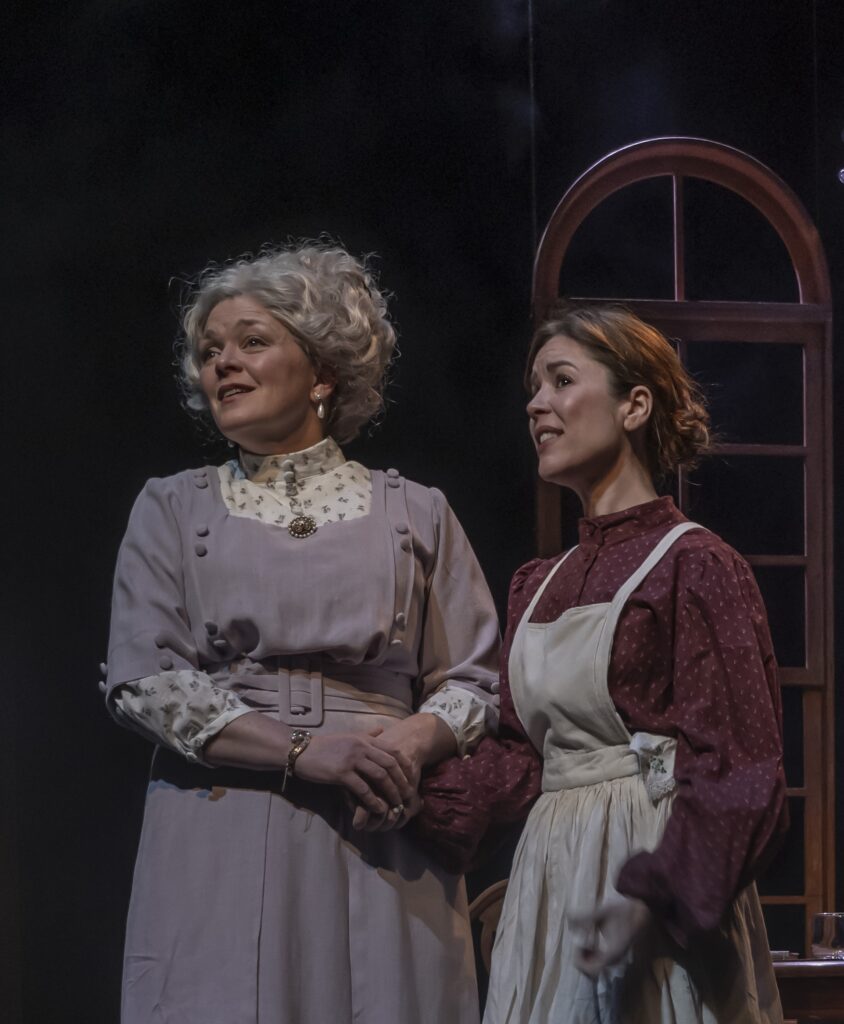
Mary Tyrone (Meghan Baker) has returned home after a sanitarium stay for her morphine addiction, which she blames on her rheumatoid arthritic pain, and her difficult pregnancy with her second son, Edmund. She fusses about her appearance, and frets about the family’s misfortunes.
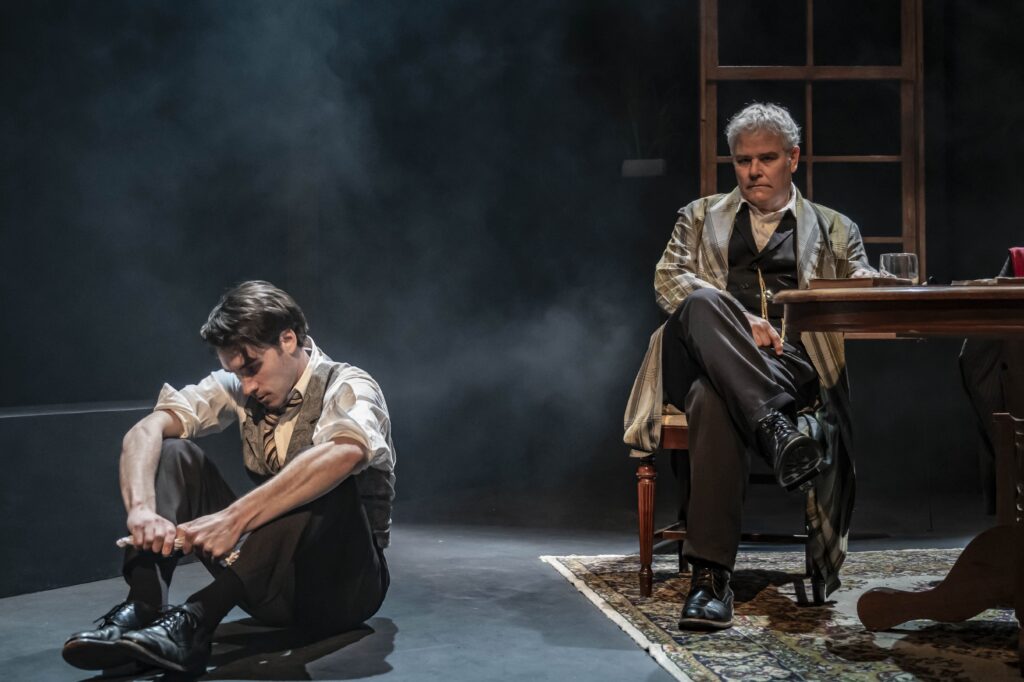
Dustin Petrillo as Edmund and William Roth as James. Photo by Patrick Huber.
Her obsessive husband James (William Roth) is a once-famous stage actor who had a prosperous career, but is a notorious penny-pincher, haunted by his poor Irish immigrant upbringing. He is often chastising his sons for wasteful spending and not living up to their potential. He and the boys are heavy drinkers, likely he and Jamie are alcoholics, which they don’t acknowledge but keep enabling.
Oldest son Jamie (Joel Moses) is also an actor, not as successful, while Edmund (Dustin Petrillo) is a writer and poet, working for the local newspaper. He is also in ill health, likely consumption (tuberculosis). They are used to their flawed and stingy father finding fault with them, already beaten down by life.
Mary’s family is welcoming, but worried, afraid that she will slide back into use. Given the family’s penchant for blaming each other for their shortcomings and failings, it doesn’t take long to return to those bad habits.
They lack coping skills, and it’s obvious how deep the grudges go. It’s a sad, but inevitable dark trajectory, and unfortunately, a familiar one to many. Hence, the universal theme that remains recognizable.
Set in August 1912, over the course of one day, O’Neill wrote the play between 1939-1941, but it wasn’t staged until 1956, after the writer’s death in 1953. He posthumously won the Pulitzer Prize for Drama in 1957, and it is considered one of the great plays of the 20th century. Of course, these days, one can admit the exposition is lengthy, and the penchant for narrating memories is overused, but that was O’Neill’s style.
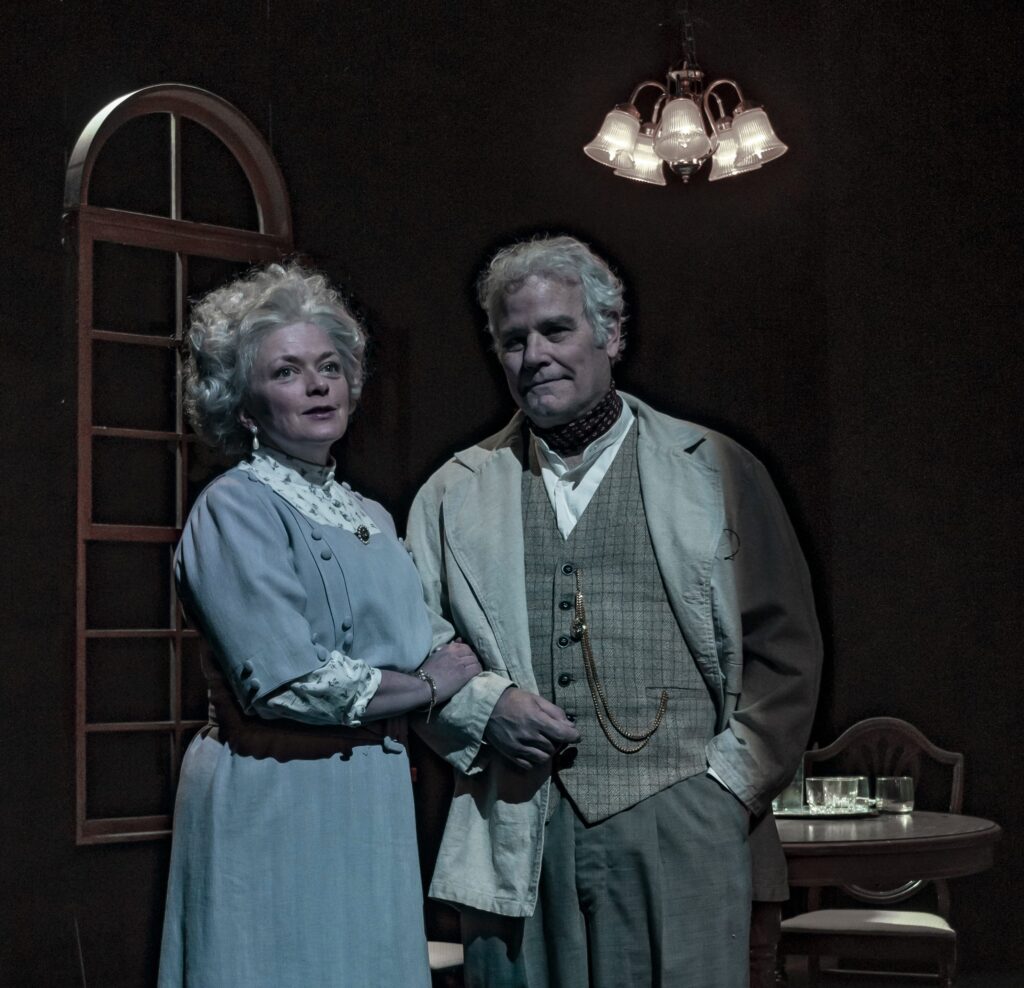
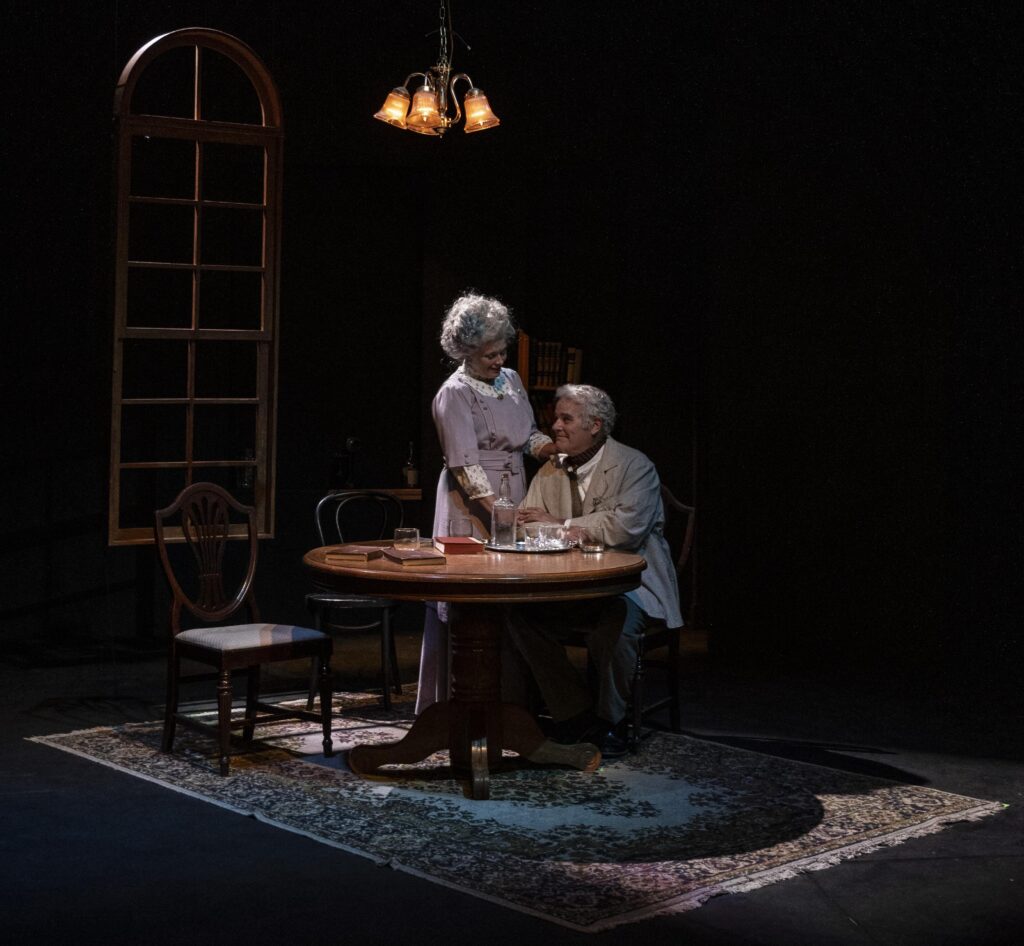
Meghan Baker and William Roth as Mary and James Tyrone. Photo by Patrick Huber.
As characters tiptoe around their deeply felt animosity, they recite their laundry lists of grievances, and each of the four acts explores a toxic atmosphere of bitterness despite a foundation of familial love, although broken.
The gloomy setting is their seaside summer home in Connecticut, and the tech crew has incorporated mist rolling in and sounds of the sea, which is a nice atmosphere in contrast to the claustrophobic drawing room where most of the action, well heated conversations, take place.
Everyone excuses their behaviors, and as Mary, in serious denial, becomes increasingly miserable and delusional, no amount of numbing themselves through whiskey matters.
The assignment is to bring out each character’s humanity and that is a tough one. Director Austin Pendleton has taken a measured approach, and the pace does not sag. While at times, the parents seem to be talking at each other, not with each other, they hint at the inescapable conflicted feelings that make them unavailable emotionally for each other. However, Roth and Baker exhibit a tenderness towards each other at times.
Most impressive are the brothers, Moses and Petrillo, who are dynamic scene partners, conveying an unbreakable brotherhood bond even when they lash out at each other.
Petrillo’s performance as the brooding, seemingly doomed brother, is the right amount of fear, confusion, and conflict. He’s closest to his mother, and therefore crestfallen when he fears a relapse. He earns the most sympathy.
Jamie could just be a caricature of an insensitive jerk unable to break a cycle of irresponsibility and anger, but Moses has found the right shift in tone, the character’s inability to break his abusive cycle. He’s the more pitiable character.
The elder James is too stubborn and intolerant, which is to his detriment, so Roth’s performance is an unwavering one-note in judginess.. He can’t understand his family’s falling apart because it would mean he has to shoulder some of the blame, and he lacks that capability. I thought, because his background is old-timey stage-acting, he’d offer more grandstanding, but it’s a stern tone throughout. at times rushed.
As the most tragic Mary, Baker appeared to be too young for the emotional heft of the role, but perhaps she didn’t project her desperation enough. The haunted Mary has spent a lifetime of disappointment looking back and never dealing with the present issues at hand. She has become irrelevant and a bystander in her own life, which is incredibly morose. Nevertheless, her longing is palpable.
Meghan Baker and Bridgette Bassa. Photo by Patrick Huber.
While the melancholy play is a mixture of fire and ice, it can appear tedious, but the celebrated Pendleton kept the action conventional, where the actors stay focused in the moment on the oppressive dysfunction. Amy J. Paige, longtime stage manager, is a master at calling a show, too.
Bridget Bassa, as the Irish maid Cathleen, engages in moments of levity, which are nice comic relief.
“Long Day’s Journey into Night” has strong technical work from scenic designer Patrick Huber, always a treat, who also designed the outstanding lighting. Costume designer Teresa Doggett’s period appropriate garb established the family’s positions, although Baker’s wig seems overwhelming. Noteworthy were Kristi Gunther’s crisp sound work, Chuck Winning’s technical direction, and Emma Glose’s props. Shawn Sheley’s work on the fight choreography was also convincing.
While a painful glimpse into one American family’s addiction ordeal, the fact that O’Neill was candid enough to recognize his trauma wasn’t unique, and lays bare fragile episodes we can identify with, and grow from (hopefully).
For anyone wondering if “Long Day’s Journey into Night” remains relevant, yes it does, and St. Louis Actors’ Studio’s effort is commendable because of the depth and difficulty required.
St. Louis Actors’ Studio presents “Long Day’s Journey into Night” from Feb. 10 to Feb. 23, Thursdays through Saturdays at 8 p.m., and Sundays at 3 p.m. at the Gaslight Theatre. The play is about 3 hours, with a 15-minute intermission. For tickets, visit www.Ticketmaster.com. They are also on sale at the box office an hour before showtime.
Meghan Baker and William Roth. Photo by Patrick Huber.
When is a sandwich not just our daily bread, but a symbol of an American Dream and the sustenance we need for nourishment? When it’s the specialty of the house at “Clyde’s.”
Lynn Nottage’s pungent work thrives as food for the soul – as in redemption, second chances and the power of food as community. It is surprising in its depth of flavors and the power in its connection.
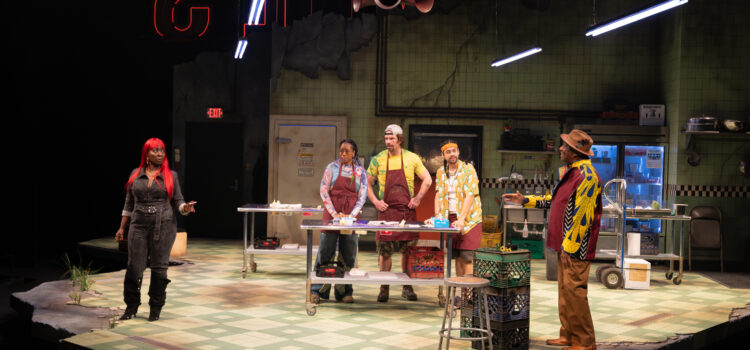
Starting out as gray and bleak as the winter weather, “Clyde’s” combines zesty, peppery comedy and tough-as-nails drama led by an exceptionally sinewy, robust ensemble.
As they convincingly weave tales of dashed dreams and delayed hope, many layers reveal themselves slowly once we embrace this hub — a grungy truck stop diner in the struggling Rust Belt city of Reading, Penn.
The gritty location is important, because it ties into Nottage’s Pulitzer-Prize winning 2015 play “Sweat,” about what happens when the town’s economic center, Olstead’s Steel Tubing plant, goes on strike. Most of that play’s main characters work there, as have their families, for generations.
Ron Himes as Montrellous. Photo by Jon Gitchoff.
The town’s manufacturing industry decline, resulting in high unemployment and abandoned factories, is represented by the withdrawn character Jason, who is a part of both scenarios. In “Sweat,” he goes to prison for badly beating a Columbian busboy. In “Clyde’s,” he is on parole and desperate to outrun his past. You feel Brendan D. Hickey’s anguish.
Clyde hires ex-cons, as she is one herself. But in her cruel tirades and harassment, she reminds them that she gave them a second chance when no one else would. As played by Phyllis Yvonne Stickney, Clyde is as fiery as her red-haired wig and mean in a nasty irredeemable way.
Despair is heavy in the air, for the ragtag staff seeking a glimmer of hope and a brighter day. They are between a rock and a hard place, trying to earn a living as they keep paying their debt to society. The stakes are high for them not to mess up again and return to prison.
They eventually become each other’s lifelines.
Rafael (Alfredo Antillion) wears his heart on his sleeve. The master of the grill and the fryer, he tries to be a cheery coworker. Now clean and sober, he served time for robbing a bank with a BB gun when he was high, to buy his girlfriend a pedigree dog.
Phyllis Yvonne Stickney as Clyde. Photo by Jon Gitchoff.
He is sweet on his co-worker, Letitia (Essence Anisa Tyler), known as “Tish,” who has a disabled daughter and a worthless baby daddy. She served time for stealing prescription drugs from a local pharmacy. She knows her options are limited. She likes to project a tough exterior, but she is not hardened – yet.
As Montrellous, Ron Himes is the heart and soul of this operation. As Rafael says “He’s like Buddha, if he grew up in the hood.” It’s a sturdy, grounding performance to marvel at, makes you believe in the goodness of people.
A wise sage whose selflessness is remarkable, Montrellous believes in the power we have in ourselves to create opportunities. He is an artist in the kitchen too, crafting delicious blends of bread, meats, cheeses, condiments and garnishes. He calls his creations “sublime,” and his belief wins the staff over.
They soon collaborate by describing various flavor combinations. If your mouth doesn’t water as they imagine appetizing versions, then you may have no taste buds.
His zeal is contagious, and soon his co-workers’ creativity is in overdrive. Their efforts get noticed by a local food writer, but Clyde doesn’t care. Through this invigorating endeavor, the staff feel worthy, and they display a renewed sense of purpose. They work together as a team, and in the motivational word of Ted Lasso: “Believe” – especially when their boss wants to beat them down.
Alfredo Antillion as Rafael and Brendan D. Hickey as Jason. Photo by Jon Gitchoff.
Even though Nottage wrote “Clyde’s” in 2021, before “The Bear” premiered as a television series, it shares that unmistakable sense of time and place, of found families, and what “family dinner” means — that food is love, food is community.
“Clyde’s” kitchen characters renew a faith in their contributions, that they could do something worthwhile. For people trying to make a fresh start, someone’s belief in them could be a catalyst, could make that difference.
With the guidance of Prison Performing Arts organization’s staff, they have brought insight and meaning to the difficulties of the former incarcerated trying to navigate re-entry with roadblocks in their way.
Josiah Davis directs with a full heart and a sharp eye for human comedy, and this vibrant cast comes together through rocky journeys and believable transformations. With Davis’ empathy and grace, they don’t make a false step.
The technical aspects are also first-rate, with a realistic restaurant kitchen by set designer Jean Kim, and working/casual attire that suits the characters’ personalities, designed by costumer Haydee Zelideth and wig designer Shevare Perry. Lighting designer Christina Watanabe uses a mystical approach and works in sync with sound designer Michael Costagliola.
At times, Nottage’s plot is shaggy, but the ensemble’s authenticity – in both the bitter and the sweet – pierces our hearts for an indelible impression.
Hickey, Essence Anisa Tyler, Antillion and Himes. Photo by Jon Gitchoff.
The Repertory Theatre of St. Louis presents “Clyde’s” Feb. 5 – March 2 at the Loretto-Hilton Center on the campus of Webster University. The runtime is 105 minutes without intermission. Tickets can be purchased online at www.repstl.org or by phone at 314-968-4925. The box office is also open on Tuesdays and Wednesdays from 10:30 a.m. to 5 p.m. and two hours before the curtain.
Rush Tickets: Available for students, seniors, educators, and theatre professionals by calling the Box Office at 314-968-4925, 1 – 2 hours prior to curtain time.
Student Tickets: Students can purchase $20 tickets available by calling the Box Office at 314-986-4925
A RepresentSTL talkback following the performance on Feb.15 will further engage audiences in meaningful dialogue.
The Rep has also partnered with Laughing Bear Bakery, which supports re-entry opportunities for formerly incarcerated individuals, and will have their goods available at concessions during the run of the show.
To discuss Opera Theatre of Saint Louis’ New Works Collective in 2025 is to engage with a program that is, at once, an artistic initiative, a social experiment and a statement of intent.
The project, now in its third year, represents a quiet but deliberate recalibration of the operatic landscape, a gesture toward a more inclusive and participatory model of commissioning and production.
If Peter Gelb, General Manager of the Metropolitan Opera, is correct in asserting that “the future of opera lies in the creation of new works that speak to contemporary audiences,” then OTSL’s New Works Collective is both a response and a challenge to that claim. The initiative does more than merely generate new operas because it also interrogates the mechanisms by which they come into being.
The Collective’s methodology is notable: rather than relying on the insular world of opera professionals to dictate artistic output, it assembles a committee of St. Louis-based artists, advocates and local leaders to guide its commissions. The result is an inherently communal aesthetic, one that seeks to reflect the multiplicity of voices within its reach.
Black Coffee, with Taylor-Alexis DuPont and Paul Chwe Minchul An). Photo by Philip Hamer.
The productions have explored a diverse array of themes and settings, including explorations of female empowerment, free speech, Black queer joy, and neurodiversity.
This year’s cohort—three short operas bound by the thematic thread of parent-child relationships—extends the program’s tradition of eclecticism and social engagement.
The evening opened with Black Coffee, a collaboration between librettist Alicia Revé Like. At its core, the opera is a meditation on displacement and belonging, following Makena, a young woman newly arrived in St. Louis, as she navigates the nebulous terrain of community and self-definition. Taylor-Alexis DuPont’s portrayal of Makena was imbued with a light, airy lyricism that lent warmth to the character’s uncertainties.
The supporting cast, including Martin Luther Clark as Makena’s father and Emilie Kealani in dual roles as Blake and Allegra, demonstrated impressive versatility, particularly in a score that demanded an interplay of humor and poignancy. Concert Black’s music, characterized by its understated charm, was complemented by a nimble use of projections, evoking the shifting spaces of bookstores and cafés with a disarming sense of whimsy.
Makena ITaylor-Alexis DuPont) meets Allegra (Emilee Kealani) in ‘Black Coffee.” Philip Hamer photo.
The second opera, Family Style, offered a tonal shift. Librettist Melisa Tien and composer Meilina Tsui construct a world in which familial duty and personal aspiration collide with an almost operatic inevitability.
Mia, played with luminous sensitivity by Emilie Kealani, finds herself at an impasse: her father, Ping (Paul Chwe Minchul An), dreams of opening a Taiwanese restaurant, while she wrestles with the financial and emotional weight of her own ambitions.
Tsui’s score, laced with Chinese tonalities and instrumentation, shaped the opera’s emotional contours with an evocative depth.
A moment of levity—an exuberant ode to broccoli, featuring dancing vegetable stalks—was an unexpected delight, evidence of the production’s ability to balance gravity with playfulness. The chemistry between Kealani and An was particularly affecting, their voices intertwining in moments of shared longing and resignation.
Family-Style. Photo by Philip Hamer.
The evening concluded with Kandake, perhaps the most traditionally operatic of the three in scope and subject matter. Written by librettist Jarrod Lee and composer Tim Amukele, Kandake recounts the true story of Amanirenas, the warrior queen of Kush who defied the Roman Empire. Cierra Byrd, in the title role, delivered a performance of striking authority, her rich, full-bodied voice channeling both the grandeur and vulnerability of Amanirenas.
The opera’s climactic moment—a visual and musical spectacle in which Amanirenas, clad in Angelique Newbauer’s resplendent gold costume, ascends to her final triumph amidst a cascade of shimmering confetti—was among the evening’s most indelible images. If any of the works on offer seemed poised for expansion into full-length form, Kandake was the clear candidate, its narrative ambition and dramatic breadth demanding a longer canvas.
Kandake. Photo by Philip Hamer.
Under the assured musical direction of Darwin Aquino and the deft staging of Richard Gammon, the 2025 New Works Collective was executed with a coherence that belied its tripartite structure.
Yuki Izumihara’s scenic and projection designs, Newbauer’s costumes, Kaitlyn Breen’s lighting, Brandon Fink’s choreography, and Kelley Jordan’s wig and makeup design all contributed to a production that felt polished and deeply considered.
Three years into its existence, the New Works Collective has carved out a space that is at once generative and disruptive, honoring opera’s traditions while challenging its insular tendencies. It has become a platform not only for emerging composers and librettists but for an evolving vision of what opera can and should be.
Whether it continues beyond this cycle remains to be seen, but if the 2025 performances are any indication, the project is far from exhausted. One can only hope for its continuation, as a program and as a provocation to the wider operatic world: who gets to create opera, and for whom is it created?
A sweet and tender-hearted foray into found families, “The Curious Savage” is brought to vivid life with warmth by an eclectic cast of 11 characters.
Reminiscent at times of the screwball antics of “You Can’t Take It with You,” this 1950 amiable comedy by playwright John Patrick kicks off Stray Dog Theatre’s season with a heartwarming effort.
Set in a live-in psychiatric center called The Cloisters, Ethel Savage has been placed there by her three awful stepchildren. Greedy, self-centered and rude, the trio are cartoonish villains played in over-the-top characterizations by seasoned pros Matt Anderson, Sarajane Clark and Joseph Garner, who have great fun being despicable.
Anderson is a condescending senator, Clark is a vain actress who has been married six times, and Garner is a haughty judge. All display degrees of entitlement and indignation, for they think their father’s second wife is mentally unstable. She inherited $10 million and wants to give it to people who want to pursue their dreams.
The bratty kids want the money for themselves, therefore, wreak havoc at the sanitarium by badgering her, bullying the staff and disrupting the fragile ecosystem among the patients.
Tyson Cole, Liz Mischel, Gansner and Lindsey Grojean. Photo by John Lamb.
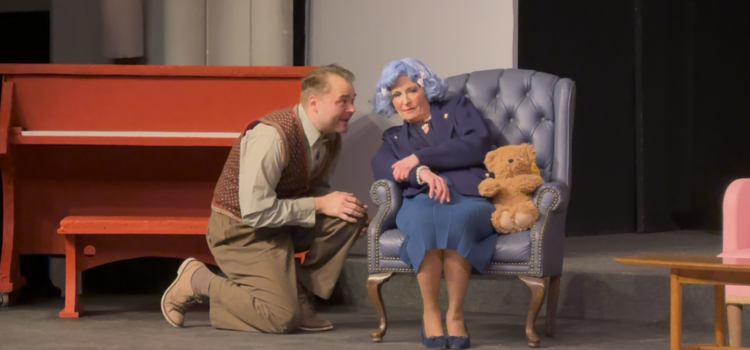
In an amusing performance, Liz Mischel excels as a crazy-like-a-fox senior citizen, whose compassion and kindness is in stark contrast to her stepchildren’s demanding threats.
Ethel quickly ingratiates herself with the staff and the residents, and bonds form with the damaged/broken people whose mental trauma resulted in a sanitarium stay.
Director Gary F. Bell deftly directed this piece to bring out The Cloisters’ characters’ goodness and dignity, and the staff’s humanity. While what they say is often funny, they are not punchlines to any cruel jokes and are treated as individuals. The well-cast performers are convincing in portraying their characters’ issues, and they all gel as a satisfying ensemble.
Lindsey Grojean is delightful as the childlike Fairy May, who is unfiltered and funny, while Anne Vega is a caring mother, Florence, whose loss of her infant son caused a breakdown. She believes John Thomas is still alive.
Camille Fensterman is tormented Mrs. Paddy who professes to “hate everything” and delivers laundry lists of things she dislikes, but she doesn’t speak other than those litanies, only painting seascapes in a corner.
Tyler Cole plays a skittish World War II veteran Jeffrey, who was a pilot who survived a crash while all his men perished. He’s convinced he has a horrible facial scar and holds his hand to his face hiding it.
Gansner is helpful statistician Hannibal, who lost his job to an electronic calculator. He plays the violin, badly. The characters have personal quirks, such as Miss Paddy who gave up electricity for Lent, and is turning off the lights at inopportune times.
David Wassilak is Dr. Emmett, the matter-of-fact and fair doctor-administrator, while Claire Coffey is pleasant Miss Willie, who helps with patients. She also shares a secret.
Over the course of three acts, we are charmed by this smart, intuitive ensemble, portraying lovable characters with a great deal of heart, and the bad guys who are at their grumpiest and at times, histrionic. The joke is often on them.
Lz Mischel, David Wassilak, Anne Vega, Joseph Garner, Matt Anderson and Sarajane Clark. Photo by John Lamb.
The playwright has become a favorite of community and school theaters, and the most famous of his works is “The Teahouse of the August Moon,” which won a Pulitzer Prize for drama and a Tony Award for best play in 1954.
The only drawback to presenting a 75-year-old play is its outdated views on mental illness and mental health but does make strong points about the insanity on the outside that wields ugly power in society.
Think of it as a period piece, like the classic “Harvey” and other old chestnuts. Costumer Colleen Michelson has gathered frocks and casual attire from the 50s era, while dressing Lily Bell in scarlet dresses. As Ethel, Liz wears a dandy gaudy hat.
As is customary, Bell, as scenic designer, created a cozy interior on stage, while lighting designer Tyler Duenow and sound designer Justin Been enhanced the atmosphere.
A thoughtful and enjoyable approach to a heart-warming comedy, “The Curious Savage” is a comical kiss to kindness elevated by captivating performances.
Camille Fensterman, Lindsey Grojean, David Wassilak. Photo by John Lamb
Stray Dog Theatre presents “The Curious Savage” Thursdays through Saturdays at 8 p.m., Feb. 6-Feb. 22, with additional performances at 2 p.m. Sunday, Feb. 16, at Tower Grove Abbey, 2336 Tennessee Avenue, St. Louis. There are two 10-minute intermissions. For more information: www.straydogtheatre.org.
Tickets on sale for Theatre Mask Awards April 26 and BPAs June 29
Lifetime Achievement Awards to Nancy Crouse and Karen Mason
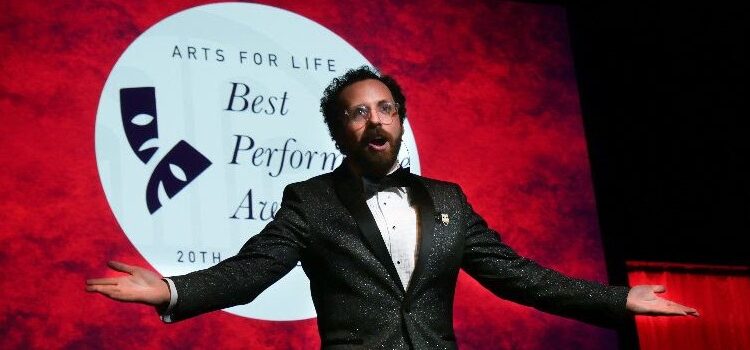
Ryan Cooper, local performer, producer, and past Best Performance Awards recipient, will return to host the 25th BPAs for a record sixth time.
“I’m a big Arts for Life fan. I’m excited. As a lifelong St. Louisan, I grew up working with many of the wonderful companies that make up the vibrant St. Louis community theatre scene,” he said.
In recent years, he has been seen wearing a variety of hats (literally) with Stages St. Louis in roles such as the Mad Hatter in “Alice in Wonderland,” Seussical’s Cat in the Hat, and The Barber in “Man of La Mancha.”
Out of town, he spent several seasons at the Walt Disney World Resort in Orlando, Florida, performing in the long-running Hoop-Dee-Doo Musical Revue and short-lived Storybook Circus Giggle Gang shows.
A proud member of Actor’s Equity Association, by day Ryan is the Signature Event Producer for the Main Street Historic District in Saint Charles, Mo., where for 20 years he has been involved with their annual Saint Charles Christmas Traditions festival, in addition to creating new programming for Halloween and Valentine’s Day with the Legends & Lanterns and Once Upon a Valentine festivals.
Tickets are now available for the Arts For Life annual awards ceremonies for community theater recognition – the Theatre Mask Awards on April 26 and the Best Performance Awards June 29.
Nancy Crouse
Lifetime Achievement Awards
Nancy Crouse,a legend in local community theater,and Karen Mason, a musical theatre actress and cabaret singer who grew up in St. Louis, will both be honored with Lifetime Achievements Awards at the BPAs on June 29.
After an impressive career in both theater education and theater administration, Crouse moved to St. Louis in 1999 and has kept busier than ever working for several theater companies as a performer, director, set designer and costume designer. Hawthorne Players is her home base, and she won Best Director for her “The Color Purple” production last year, which also won best large ensemble musical.
Growing up in Indiana, she received a master’s degree in theatre from Ball State University. She taught English and Theatre for 33 years, and spent many years as the Managing Artistic Director for Muncie Civic Theatre
Karen Mason
Mason originated the role of Tanya in the Broadway production of “Mamma Mia!” in 2001, performed as Madame Giry in the North American tour of “Love Never Dies” and was Glenn Close’s standby as Norma Desmond in the Los Angeles production of “Sunset Boulevard.”
She was in “White Christmas” at the Muny Opera and has appeared on stages across the country.
She won an Outer Critics Circle Award for her performance in the off-Broadway Kander and Ebb review “And the World Goes Round.”
A renowned cabaret singer, she is the most lauded vocalist in MAC Awards history, with 13, which honors the best of Manhattan cabaret. She has performed locally with the St. Louis Symphony Orchestra and at the Sheldon Concert Hall.
Awards Ceremonies
The Theatre Mask Awards have honored drama and comedy plays since 2015.
This year’s 10th annual TMAs will take place starting at 11 a.m. on Saturday, April 26, at the Royale Orleans banquet center, 2801 Telegraph Road, St. Louis, Mo. 63125. Doors open at 10:30 a.m.
Awards will be presented in 17 categories as lunch is served. Cocktail attire is suggested. Tickets to the event are $30 + $2 service fee. Table seating is available at 10 per table. A full meal will be served, and a cash/card bar will be available.
Clayton Community Theatre topped all TMA nominations with 22, with a production-leading 11 for “The Play That Goes Wrong,” 8 for “Twelfth Night,” and 4 for “Night of the Iguana.”
Act Two Theatre followed with 17 overall, 10 for “Over the River and Through the Woods” and 7 for “The Play That Goes Wrong,” and so did Hawthorne Players with 17, 10 for “All My Sons” and 7 for “for colored girls who have considered suicide when the rainbow is enuf.”
Other groups receiving TMA nominations included Kirkwood Theatre Guild, Monroe Actors Stage Company and Theatre Guild of Webster Groves.
Mark Lull
Mark Lull returns as the master of ceremonies after hosting in 2022 and 2024. An 11-time AFL nominee, he won Best Performance by a Comedic Actor as Uncle Fester in Alfresco Productions’ “The Addams Family” in 2015.
A retired school principal, he has performed at Worlds of Fun in Kansas City, The Muny, and with other theater companies in the St. Louis metropolitan area. He is currently teaching early childhood education at St. Louis Community College and serves as vice president on the AFL board of directors.
Tickets are available online with a service fee of $2 added: https://arts-for-life-2.square.site/.
A combination ticket for both TMAs and Best Performance Awards, at a discounted price of $50 with a $2 service fee, is available, but must be purchased by April 11.
The BPAs have honored musical theater in community and youth productions for 25 years. The awards ceremony will take place on Sunday, June 29, at 2 p.m. at the Keating Theater at Kirkwood High School. Formal attire is requested, and the event will be reserved-style seating. Soft drinks and snacks will be available in the lobby. Doors open at 1:30 p.m.
The event will include performances from the top musicals nominated in the three Best Musical Production categories. Tickets to the show are $30+ a $2service fee per ticket. Seating is reserved seating.
Special Youth Awards will be presented to Bella Crank, for Best Youth Musical Performance Award, as Nancy in “Oliver!” at Gateway Center for the Performing Arts, and Alyssa Sayuk for Best Youth Featured Dancer Award, as Odette in “Anastasia” at the Stages Performing Arts Academy.
Take Two Productions led with 16 nominations, 8 for “Merrily We Roll Along,” 6 for “Head Over Heels” and 2 for “The Prom.” Kirkwood Theatre Guild’s “Anything Goes” received the most production nominations, with 15, while Hawthorne Players earned 14 for “Bright Star” and Goshen Theatre Project had 11 for “The Hunchback of Notre Dame” with 9 and “The Trail to Oregon” with 2.
Other groups receiving BPA nominations included Act Two Productions, Alpha Players, Curtain’s Up Theater Company, and Monroe Actors Stage Company.
In the Youth Performance Awards categories, Gateway Center for the Performing Arts received a total of 31 nominations, 16 for “Alice By Heart,’ 7 for “Ragtime” and 8 for “Oliver!” Young People’s Theatre followed with 17 – 9 for “Seussical” and 8 for “Anastasia: The Musical.” Stages Performing Arts Academy received 8 nominations for “Anastasia: The Musical.”
Arts For Life is a local not-for-profit arts organization dedicated to the healing power of the arts through its work with youth, the underserved, and the community, with its goal of “Making a Dramatic Difference.”
AFL is dedicated to promoting public awareness of local community theatre, encouraging excellence in the arts, and acknowledging the incredible people who are a part of it.
Packed with impressively choreographed action sequences and featuring another lovable performance from Ke Huy Quan, director Jonathan Eusebio’s “Love Hurts” delivers schmaltzy Valentine’s Day beats with a side of cartoonishly excessive violence.
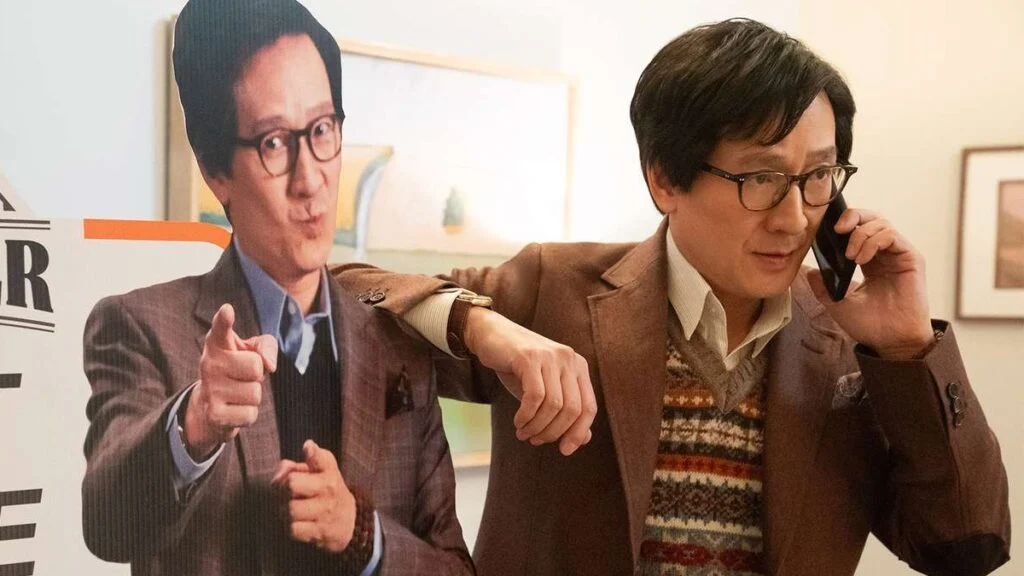
Marvin (Quan) is a successful realtor who goes about his days with a smile on his face and a sense of true contentment. His depressed and jaded assistant, Ashley (Lio Tipton), on the other hand, threatens to leave her job, but can’t bring herself to actually quit. Marvin’s boss and BFF, Cliff (Sean Astin), awards Marvin a coveted Employee of the Month certificate.
Everything seems dandy for Marvin for the time being (Marvin’s inner monologue frequently reminds us that he loves his life), but, as it happens, Marvin’s history as an assassin just ain’t done with him yet.
After being ambushed in his workplace office by The Raven (Mustafa Shakir), a killer with a taste for bad poetry, Marvin makes use of his dormant skill set.. Marvin KOs The Raven with the help of, among other things, a freshly-sharpened #2 pencil — reassuring Ashley that he’s doing “high intensity yoga” when she hears the ruckus from the lobby and knocks on the door.
The Raven was sent by Marvin’s crime lord brother, Alvin a.k.a. Knuckles (Daniel Wu), to find the whereabouts of Rose (Ariana DeBose), Alvin’s former right-hand who stole money from him and, along with that, stole Marvin’s heart. Long ago, when working as an assassin for his brother, Marvin was ordered to eliminate Rose, but he spared her life.
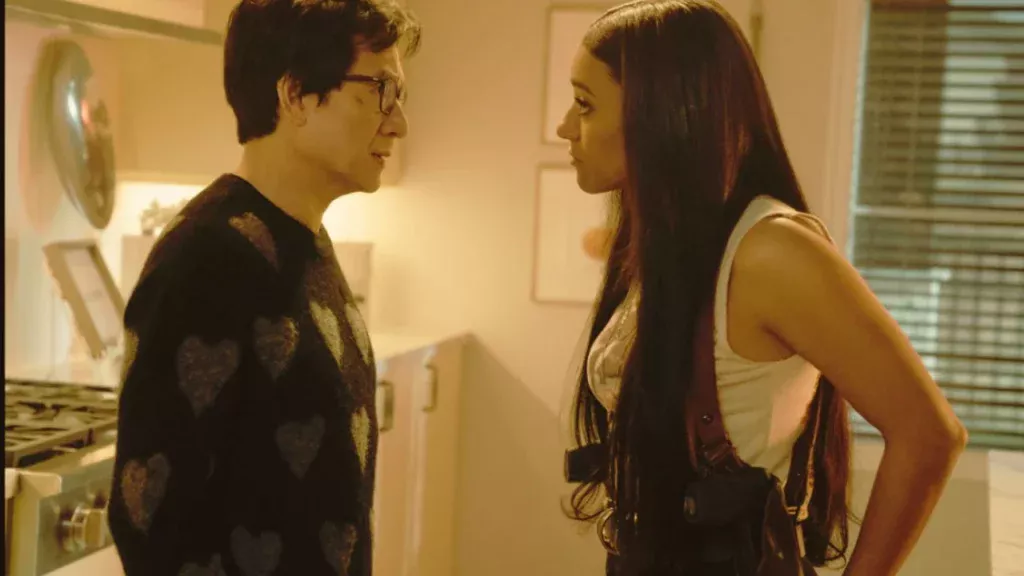
André Eriksen, Ke Huy Quan) and Marshawn “Beastmode” Lynch, star in a scene from the movie “Love Hurts.” The OSV News classification, A-III — adults. Motion Picture Association rating, R — restricted. Under 17 requires accompanying parent or adult guardian. (OSV News photo/Universal Pictures)
The badass Rose, previously in hiding, has returned to take down Knuckles once and for all, while also luring Marvin into his old ways — not-so-subtly nudging him to embrace the love he still has for her.
She soon gets in touch with Marvin directly (by tasing him, as one does), and Marvin reluctantly joins forces with her to end Alvin’s criminal reign. They’re also pursued by goons King (Marshawn “Beastmode” Lynch) and Otis (André Eriksen), who are working for Renny (Cam Gigandet), the current second-in-command at Knuckles’ criminal enterprise.
They all have absolutely no idea who they’re dealing with. Over-the-top violence, double-crosses, and copious exposition dumps ensue, as the innocent-looking Marvin confronts his violent past and maybe embraces his true love along the way.
Suffice to say, viewers going into “Love Hurts” expecting a masterfully crafted action extravaganza à la “Monkey Man,” “Nobody,” or the “John Wick” franchise won’t be blown away. Longtime stunt coordinator Eusebio’s film, his feature directorial debut, is neither slick nor particularly clever, ultimately doing little with its now-familiar premise.
But what “Love Hurts” does have, in spades, is charm, thanks in large part to Quan, who more than holds his own as an action star even when the script lets him down.
Indeed, as demonstrated recently in his Oscar-nominated turn in “Everything Everywhere All At Once,” Quan has an inherent likability that’s easy to become attached to. Here, in “Love Hurts,” that persona is initially dialed up to 11, with Marvin embracing his job as a realtor seemingly caring only about helping his customers find their perfect homes.
It’s a natural fit for Quan, and Luke Passmore’s screenplay finds humorously nutty contrasts between the normal-ish appearance Quan puts on at the beginning and the cutthroat carnage he’s willing to dish out if provoked.
Less successful are the film’s inner monologues (not just applicable to Marvin), which outright tell us what Marvin feels at any given moment, undermining Quan’s obvious skills as an actor to show rather than tell.
Quan shines over the rest of the ensemble, which, like him, aren’t supported by strong characterizations. DeBose slides into the role of the “cool,” seductive Rose a bit too easily, not given much to work with on her own thanks to the screenplay’s rushed exposition; Rose functions more as a vessel for Marvin’s arc than anything else.
Gigandet and Wu don’t bring much to the table, besides some dangerously-sharp boba tea straws, but Eriksen and, especially, Lynch (who showed his comedic chops in 2023’s “Bottoms”) are hilarious and well-cast as two henchmen in a bromance.
Shakir is also entertainingly deadpan as The Raven, who strikes up an unexpected romance with Tipton’s Ashley. Astin (a long way from “The Lord of the Rings”) seemingly has more romantic chemistry with Quan than DeBose does. Rhys Darby, sans most of his teeth, also pops in for a brief but memorable appearance as a back-stabbing bad guy.
From a storytelling perspective, “Love Hurts” is clumsy, packing in a surprisingly dense amount of exposition during its 83-minute (wow!) runtime that Eusebio doesn’t weave into the proceedings with any sort of elegance.
But that’s okay when the action is so relentless, creative, and, above all else, fun — creating an entertainingly unhinged juxtaposition between the film’s cheesy, lovey-dovey character arcs and R-rated beatdowns.
Bridger Nielson’s cinematography puts viewers right in the thick of it, in which characters use anything and everything at their disposal to dish out maximum pain. Like the best of Jackie Chan, “Love Hurts” excels when showing violent set-ups and payoffs amid its fisticuffs and gun-fu-adjacent set-pieces; they’re perfect to watch with a crowd, where the carnage on display provides more comedy than anything in the film’s script.
And that’s what “Love Hurts” delivers — excellent action with a likable lead let down by a decidedly less-than-excellent narrative that, despite its ample flaws, remains agreeably pure at the end of the day. Quan and DeBose, especially, deserve meatier roles than this, but “Love Hurts” is a perfectly enjoyable, blood-spattered action film that doesn’t overstay its welcome.
“Love Hurts” is a 2025 action-comedy directed by Jonathan Eusebio and starring Ke Huy Quan, Ariana DeBose, Sean Astin, Cam Gigandet, Mustafa Shakir, Marshawn Lynch, Lio Tipton, Daniel Wu, and Andre Eriksen. It is rated R for strong/bloody violence and language throughout. and the runtime is 1 hour, 23 minutes. It opened in theaters Feb. 7. Alex’s Grade: B.