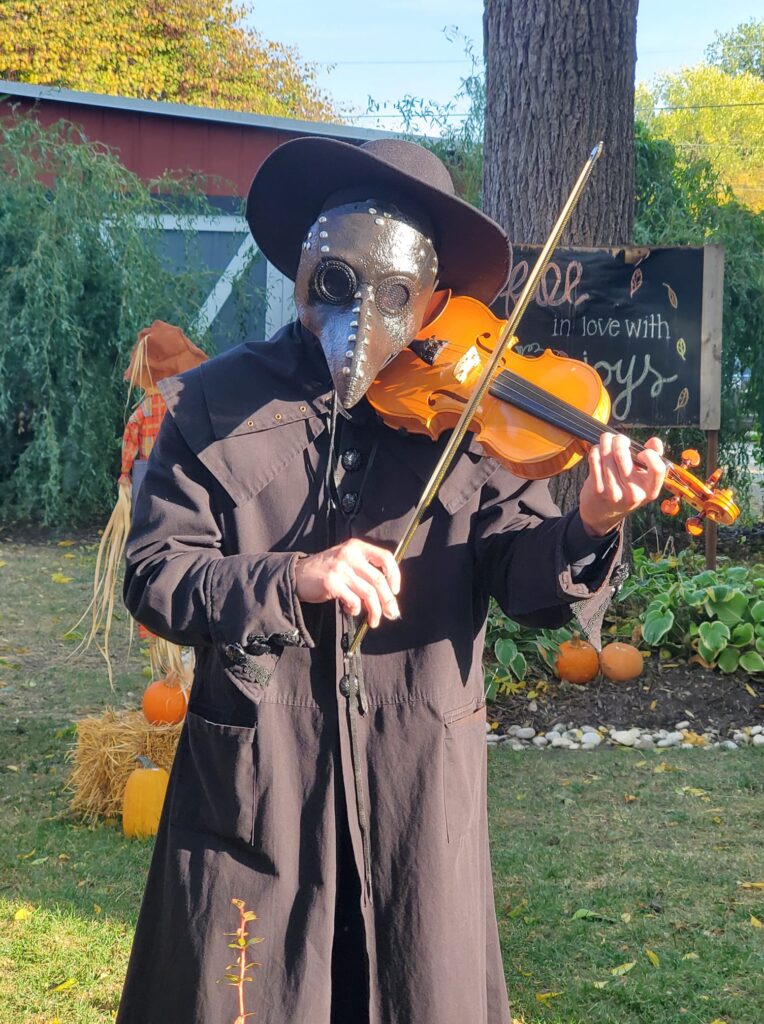
For an exhilarating third time, USDish is looking for one brave soul to participate in the third annual Stephen King Scream Job: Chapter 3! They are hiring a horror movie enthusiast to record their heart rate while they watch 13 of the most chilling Stephen King films for $1,300 and a Fitbit

After all, all work and no play makes Jack a dull boy. 

How to Apply

Applications will be accepted now until September 16, 2022, at 12 PM MST. Visit the official page for the application form and more information: https://www.usdish.com/news/get-paid-to-watch-stephen-king-movies

To apply, applicants must share why they want to be frightened this way in less than 200 words. For bonus points, they can include a video of why this is the scream job for them. 

Why Chapter 3?

Since 2019 when we first launched this campaign, NPR and so many more have jumped on the opportunity to share this with their following and we have received over 600,000 applications

Last year brought in many second-time applicants and we’re looking to give these adrenaline junkies another go to tell us which Stephen King villain is the scariest. 

Last year’s winner, Ashley LaBossiere found that It (2017) was the scariest Stephen King movie followed by Misery (1990). 

What Will the Heart Rate Analyst Get?

Whoever wins this scream job will not only get $1,300 to make up for all the nightmares, but will also receive a swag bag valued at $350 that includes the latest Fitbit. Movie tickets will also be provided to see the new Salem’s Lot, premiering in 2023. We’ve also prepared a Stephen King Watch Guide that any scaredy cat can follow. 

Facebook Comments

Nine PBS will air the documentary, The Places Music Has Taken Me: An Unfinished Story of Sarah Bryan Miller, Sunday, Sept. 18, at 3:30 pm, and in primetime Saturday, September 24, at 7 pm. It will also be available to stream anytime on ninepbs.org and the PBS Video App. 

Sarah Bryan Miller, or “Bryan” as she was known to friends and family, was the classical music critic for the St. Louis Post-Dispatch for more than 20 years until her untimely death in November 2020. Before her death, Bryan’s editor at the St. Louis Post-Dispatch asked that she write a final retrospective about her career which she planned to be entitled: “The Places Music Has Taken Me.” 

Unfortunately, she was unable to complete her column but thanks to friend and local video documentarian Miran Halen, her legacy as a tough but fair-minded journalist and music critic is preserved in a film about her important role in the arts and the lives she touched.  

Hosted by internationally acclaimed conductor Leonard Slatkin, artistic leaders, colleagues, and friends throughout the country pay tribute to Bryan and the importance of the role of classical music reviewer plays in cultural life, particularly today. 

“I’d known Bryan for over two decades as a music critic for the St. Louis Post Dispatch,” says Halen. “When she was honored as a Media Persons of the Year by St. Louis Press Club in 2019, I was one of the honorary chairs and had the opportunity to work closely with her for six months. In doing so, I got to know more about her personal side and how much she truly loved the community. 

“Prior to Bryan’s passing, I talked with Bryan about what a music critic is all about. To her, it was much more than covering one evening’s performance; it was about providing a public service by educating the public about the arts. She believed in this so strongly that even when her health was failing, she was still writing and finding ways to provide accurate information to her readers.”  

Following Bryan’s death, Halen continued her research to create a retrospective  about her legacy and overarching feelings about intergenerational connectivity that music provides to audiences. 

The documentary promises to deliver on the goal to educate viewers on the important role a music critic plays in the arts. In addition to Bryan’s impressive accomplishments and legacy, she left generous gifts to a number of St. Louis community arts organizations, including the Saint Louis Symphony Orchestra, Opera Theatre Saint Louis, and the Men and Women’s Choir. The St. Louis Press Club established a scholarship fund in Sarah Bryan Miller’s name for students interested in pursuing a career in music-related communications. 

Bryan was a member of the St. Louis Theater Circle, which annually awards excellence in regional professional theater and opera.

About Nine PBS  

As an essential community institution, Nine PBS magnifies and deepens understanding of our community to help our region flourish. We tell stories that move us. We meet people where they are the most comfortable consuming content. Nine PBS’s platforms include four distinct broadcast channels (Nine PBS, Nine PBS KIDS®, Nine PBS World, and Nine PBS Create), ninepbs.org, social media, the free PBS Video App, streaming services, live and virtual events, and the Public Media Commons. Since 1954, Nine PBS has accepted the community’s invitation into their homes, schools, and businesses. Follow Nine PBS on TwitterFacebookInstagramLinkedIn, and TikTok

Facebook Comments

By Alex McPherson

Sharp and cynical with plenty on its mind, director Halina Reijn’s “Bodies Bodies Bodies” delivers an unpredictable, ruthless, and highly entertaining experience.

Taking place in today’s age of Twitter and TikTok, the film centers around a “hurricane party” that goes dreadfully wrong. Sophie (Amandla Stenberg), a recovering addict who doesn’t text much in the all-powerful group chat, brings along her new boo, Bee (Maria Bakalova), a soft-spoken immigrant who’s less financially well-off than the rest of the gang. They’re heading to a mansion owned by the parents of David (Pete Davidson), who is trying desperately to seem manly.

Also present are David’s insecure-actor-girlfriend, Emma (Chase Sui Wonders), gregarious and “woke” podcaster Alice (Rachel Sennott), Alice’s much-older boyfriend, Greg (Lee Pace), and the enigmatic Jordan (Myha’la Herrold), whose snide remarks invite suspicion early on. David, Emma, Alice, and Jordan — most with their own fraught history with Sophie — are weirded out that Sophie decided to show up to the party at all, setting the stage for plenty of tea to be spilled.

After most of the lot is sufficiently drunk and coked-up, the music blares, the storm rages, and Sophie suggests they play “Bodies Bodies Bodies.” First, everyone sits in a circle, takes a shot, and punches the person to their left — which, unsurprisingly, becomes emotionally charged, despite frequent reminders that they’re just doing it for funsies.

Then, they play a variation on the Murder in the Dark formula where a “killer” is selected, the lights go out, someone is tagged, and the players regroup to debate who did it. Unfortunately, the real bodies soon start piling up. With the wi-fi out, the Gen-Zers — plus 40-year-old Greg — revert to their dangerously self-absorbed tendencies, amplifying their petty conflicts into life-and-death stakes as they try to locate the true killer.

“Bodies Bodies Bodies” might not be for everyone, especially older folks, but Reijin’s suspenseful, layered, and memorable film expertly threads a needle where humor intertwines with tragedy. It doesn’t hurt that the entire cast absolutely nails their respective roles, bringing pathos to characters who often make narcissistic decisions to mask their insecurities. 

Indeed, “Bodies Bodies Bodies” doesn’t paint flattering portraits of any of them, but portrays them as lost souls so wrapped up in privilege and self-centeredness that strong communication is thrown to the wayside. Their dialogue — pervasively deploying topical buzzwords like “woke,” “ally,” “triggered,” “gaslight,” and more — provides plenty of laughs, but operates on a deeper metaphorical level as well.

Their exaggerated personalities represent a distillation of social media’s anti-social repercussions and their shelteredness from the outside world. They lack the skills, willingness, and intelligence necessary to evaluate the situation rationally, at the same time twisting those aforementioned buzzwords to apply to themselves, zapping them from meaning, and blowing up their “drama” so much that it turns to downright animalism.

That the film is still often hilarious is an achievement in itself, thanks to Sarah DeLappe’s screenplay and the whole cast. Sennott, memorable in “Shiva Baby,” once again shows her knack for comedic timing in several tirades that are simultaneously eye-rolling, gut-bustingly funny, and concerning, as this pressure cooker of a film continues to gain steam.

Davidson brings his usual off-kilter shtick with some genuinely uncomfortable moments sprinkled in, exemplifying the film’s tonal shifts from ridiculous to shocking. Pace is also great as Greg, a Gen-Xer more separated from the others’ worldviews.

Bakalova, who was so good in “Borat Subsequent Moviefilm,” brings an air of mystery and maybe-innocence to the character of Bee, from whose perspective the film largely takes place. Bee, the odd one out, is essentially trapped with a bunch of crazy people, but has her own secrets nevertheless that paint a target on her back.

Wonders, as Emma, effectively conveys her cattiness and fragility. Stenberg gives a stellar performance, rendering Sophie one of the more multifaceted partygoers, her naivete creating more issues than solutions. Herrold is perhaps the standout of them all, lending a stern calculation to Jordan’s actions largely fueled by economic and romantic anxieties.

As the chaos ensues, Jasper Wolf’s claustrophobic, handheld cinematography, with many scenes lit by glow-sticks and smartphone flashlights, fits the proceedings like a glove, underlining the long-held resentments between the “friends.” The electronic-sounding score, by Disasterpiece, is fittingly paranoid and jumpy, reflecting the digital sphere turning into a figurative warzone. The soundtrack, including a track by Charlie XCX, is laced with irony. 

No spoilers here, but the final reveal is perfect, reframing everything that came before in new light that should benefit repeat viewings. Taken as a whole, “Bodies Bodies Bodies” is far more than a mere cringe-comedy or a seen-it-before slasher movie. Rather, this is a satire with real bite, demonstrating a thesis that resonates in our increasingly divided reality.

“Bodies Bodies Bodies” is a 2022 horror comedy thriller directed by Halina Reijin and starring Rachel Sennott, Maria Bakalova, Pete Davidson, Lee Pace, Myha’la Herrold, Amanda Stenberg and Chase Sui Wonders. Rated R for violence, bloody images, drug use, sexual references and pervasive language, its run time is 1 hour, 34 minutes. It opened in theaters Aug. 5. Alex’s Grade: A 

Facebook Comments

By Lynn Venhaus
Emphasizing romantic symbolism along with its operatic life and death themes, an unconventional production of Tennessee Williams’ “The Rose Tattoo” is cleverly staged inside a Big Top ring, re-imagined as an Italian circus — complete with aerialists, animals, singers, musicians, and clowns.

The 1951 play is this year’s centerpiece for the seventh annual Tennessee Williams Festival St. Louis, one of my favorite not-to-be-missed events since 2016.

The Mississippi-born playwright, who spent his formative years in St. Louis, came to prominence in the 1940s, and in the decades following, cemented his place as one of the most significant playwrights of the 20th century. The festival celebrates his influence and art through his enduring works and early writings.

Always a detailed retrospective with speakers, education components, readings, films, tours and more, the fest’s fresh looks have a way of bringing out further insights during its 10-day schedule.

A bold and risky move, the exaggerated flourishes — while cinematic and reminiscent of Fellini fantasies — aren’t necessary to convey the heart of the matter, which is love in a time of chaos and the push-pull of grief, desire, and hope.

While the amusing accoutrements add to the production’s overall uniqueness, Williams’ poetic flair remains at center stage.

The nimble ensemble slips into the colorful characters that are part of an Italian immigrant community on the Mississippi gulf coast.

Williams’ play, which premiered in Chicago in 1950, became his fourth New York produced piece in 1951 after “The Glass Menagerie,” “A Streetcar Named Desire” and “Summer and Smoke.” It is his only one to win a Tony Award for Best Play.

Williams adapted the three acts for the movie in 1955, perhaps best known as the vehicle for which Anna Magnani won an Academy Award. The film was nominated for eight Oscars, also winning for cinematography and art direction.

Magnani, once described as the “volcanic earth mother of Italian cinema,” was a friend of the playwright. He wrote the part for her, considered her “the most explosive emotional actress of her generation.” But, thinking her English wasn’t up for the stage, she declined – and four years later, it was her first English language film role.

The earthy Serafina Delle Rose is an indelible heroine – suffering but not silent. Maureen Stapleton originated the role on Broadway, and Maria Tucci (1966), Mercedes Ruehl (1995) and Marisa Tomei (2019) played the tempestuous widow in subsequent revivals.

Under the Big Top, professional actress and academic Rayme Cornell commands the space as the fiery Sicilian seamstress.

Let’s face it, as written, both she and love interest Alvaro could be construed as antiquated over-the-top ethnic stereotypes. Chalk it up to dated material from 70 years ago. So, she and Bradley J. Tejeda walk a tightrope in dialect delivery.

Serafina is a complicated woman. Williams knows how to set up pain and passion, that’s for sure. Happily married to virile truck driver Rosario, Serafina discloses she is pregnant with her second child and that a rose tattoo appeared on her breast the night of conception, albeit temporary.

We never see Rosario but learn he ran black-market cargo for the mob underneath bananas and cheated with the delectably-named Estelle Hohengarten (Rachael Fox, on horseback). His life ends badly – shot, then his 10-ton truck crashes and bursts into flames.

Plunged into mourning, miscarriage, and misery, Cornell glowers, wails, and rages. In a well-worn pink slip, she deteriorates as a bitter recluse, refusing to face reality. A shrine to the Blessed Virgin Mary gives her sustenance.

You can’t tell by intermission, but “The Rose Tattoo” is a departure from Williams’ signature dramas. Considered more light-hearted, it still has his emotional whiplash.

Deep sorrow eventually yields to comedic interplay when a chance flirtatious encounter is life-changing.

That’s when the charming Tejeda swoops in as Alvaro Mangiacavallo, a buffoonish truck driver, and the play blossoms in his presence.

Tejeda, a New York-based actor and Yale School of Drama alum, has made his mark on local stages – first at St. Louis Shakespeare Festival in “Love’s Labour’s Lost” in 2019 and then the radio plays when the festival pivoted in 2020.

Last year, he brought both a sweetness and restlessness to Tom Wingfield, an extraordinary performance in the triumphant production of “The Glass Menagerie” outside at the Central West End apartment where Williams once lived.

Bradley J Tejeda as Alvaro. Photo by Suzy Gorman.

As Alvaro, he demonstrates his prowess in physical comedy, channeling Charlie Chaplin in looks and expressions, acrobatic in slapstick and darting around the set. It’s a splendid performance, injecting the play with a needed boost of vitality.

He easily won over the audience, especially when he joked that his last name Mangiacavallo means “eat a horse.”

“It’s a comical name, I know. Maybe two thousand and seventy years ago one of my grandfathers got so hungry that he ate up a horse. That ain’t my fault,” he said, eliciting laughter.

Serafina describes him as having a clown’s face on her late husband’s body. Even with their skilled performances, Cornell and Tejeda do not spark any sensuality.

But the young couple revealing an attraction that blooms into love does. Valentina Silva, memorable in Metro Theater Company’s “Last Stop on Market Street” last winter, plays Serafina’s smart, sheltered, and neglected 15-year-old daughter, Rosa Delle Rose, with youthful elan.

Stifled by her mother during the three years since her father’s accident, Rosa rebels, wanting to go out and have some fun. You feel her yearning for freedom, eager to take flight.

She is infatuated with a wholesome sailor, Jack Hunter, who was immediately smitten with the vivacious teen at a school dance. Oliver Bacus, who is quickly making a name for himself on local stages, seen last month in The Midnight Company’s seismic “Rodney’s Wife,” eloquently delivers Williams’ distinct dialogue.

Their innocent love story is a catalyst for Serafina to change, to let go, and that is illustrated by aerialists Annika Capellupo, Natalie Bednarski, Sage McGhee and Maggie McGinness of On the Fly Productions, with choreography by owner Jason Whicker. It is a lovely, graceful sight — but does this illuminate or distract?

The aerialists use satiny scarlet ribbons of fabric, which is the shade of a shirt Serafina is sewing, requested by her husband’s mistress to give her “wild like a gypsy” beau on their one-year anniversary, which is the last day he’s alive.

So much of Williams’ writing deals with symbols – consider the rose itself, with red buds a sign of romance, love, beauty, and courage. Here, it is a symbol of new beginnings too.

Understanding Williams’ dreams and desires has always been part of the fest, and the focus on Italy explores how visiting the country, soon after his first wave of success, was restorative to his psyche.

Giddy with fleeting joy and discovery of his new happy place, Williams dedicated his “love-play to the world” to his partner, Frank Merlo, an Italian American from New Jersey who served in the U.S. Navy during World War II: “To Frankie in Return for Sicily.” They met in 1948 in Provincetown, Mass., and spent 15 years together. Merlo died of lung cancer at age 43 in 1963 while Williams lived to age 71, passing in 1983.

The supporting cast captures the local flavor, and the quirky people he immortalized on paper.

Assunta, Serafina’s friend with psychic abilities, is played by Carmen Garcia with an air of mystery. She senses that “something wild is in the air.” Holly Maffitt is the “Strega,” considered a traditional witch, because the fates are part of this narrative.

Tyler White, a lively presence whenever on The Black Rep’s stage, is delightful as part of the neighborhood’s gossipy hens, as is Julia Crump as perky busybody Bessie.

Harry Weber is both teacher Miss Yorke and Father De Leo, the community’s strict moral gatekeeper.

The always fun to watch Mitchell Henry-Eagles enlivens the proceedings as an accordion-playing salesman and a doctor. Tony Viviano occasionally pops up to sing.

They serve as a Greek chorus of sorts, observing, moving in and out. Director David Kaplan likes to keep the players in motion, engaging the audience, and breaking the fourth wall.

Kaplan is well-versed in Williams’ aesthetic as one of the preeminent interpreters of his works. He is the curator and co-founder of the Provincetown Tennessee Williams Festival, now in its 17th year.

St. Louis experienced his perceptive vision in the dynamic “The Rooming House Plays,” four short plays he staged in the Stockton House, a local Victorian mansion, for the 2016 inaugural fest.

Williams’ works on longing and loss always move me more when we are in close quarters or exposed to a different canvas, so that I can feel the lyricism, make a specific connection. So, the cavernous Big Top was a challenge, but the cast’s immersion helped considerably.

James Wolk’s innovative set brought out an entirely new dimension, using multiple frames and shutters to stand in for doors and windows. The versatility punctuated the scenes, and the cast, adept at quick changes, did not lose a beat. Obviously, well-rehearsed, and efficient work by all.

The sound, however, had some issues Friday but was worked out. Designer Nick Hime engineered the sound and operated the board.

Jess Alford’s lighting design made use of dusky twilight in the early evening. Michele Friedman Siler’s thoughtful costume design differentiated the characters, and she effectively mixed textures.

This daring production has many moving parts, including four goats and a horse, which is difficult to pull off smoothly, and the esprit de corps is apparent. Stage Manager J.M. Bock and assistant stage manager J. Myles Hesse kept it flowing smoothly.

Williams was fascinated by the ebb and flow of time, which is a major component here. Between 1948 and 1959, he had seven plays produced on Broadway. This early one, however, is one of the few happy endings – because they found love in a hopeless place.

The Tennessee Williams Festival St. Louis presents “The Rose Tattoo” Thursdays through Saturdays at 7:30 p.m. and Sundays at 3 p.m. through Aug. 28 at The Big Top in Grand Center, 3401 Washington Avenue. For more information and tickets, visit www.twstl.org, and for a complete schedule of events.

The schedule includes a free showing of “The Roman Spring of Mrs. Stone,” based on Williams’ novel which he adapted for the screen in 1961, starring Vivien Leigh and Warren Beatty. It will take place at 8 p.m. on Wednesday, Aug. 24, at St. Ambrose Church on the Hill, 5130 Wilson Avenue.     

A Bocce Tournament starts at noon on Saturday, Aug. 27, at the Italia-America Bocce Club, 2210 Marconi Avenue.                          

Facebook Comments

By CB Adams

It’s been a bit of a “Sondheim Summer” here in St. Louis, bookended by Far North Theatricals’ “Assassins,” The Muny’s “Sweeney Todd” and Union Avenue Opera’s festival-ending “A Little Night Music,” with performances remaining Aug. 26-27. Extending that bookend will be Stray Dog Theatre’s production of  “A Little Night Music” this October.

There seems to be more Sondheim in the air since his death last November, and these local stagings have provided an interesting juxtaposition considering that “Sweeney Todd” is generally considered the more operatic and “Night Music” as more operatta-ish.

No matter. As soon as the off-stage chorus, the Quintet, projected their voices onto the sumptuous Union Avenue Act I set, such nomenclatures were rendered unnecessary…and perhaps irrelevant. Afterall, the first three revivals of “Night Music” in New York were all operatic rather than theatrical, so this production is a good fit for Union Avenue’s strengths and direction.

James Stevens, Leann Scheuring, Eric J. McConnell, Jordan Wolk, Teresa Doggett. Photo by Dan Donovan

Isn’t It Bliss?

If there are still tickets left for the final performances of “A Little Night Music,” reserve your seats. That’s the quick review of this production. Don’t miss it. It is indeed bliss.

Hal Prince, producer of this musical’s debut in 1973, called it “whipped cream with knives.” If Prince meant knives as in sharp knives out, then Annamaria Pileggi’s direction has softened it to butter knives out.  It’s a pleasure and perhaps a much-needed respite to engage so fully into this nuanced romantic farce based on Ingmar Bergman’s 1955 film “Smiles of a Summer Night.”

Debby Lennon as Desiree. Photo by Dan Donovan

Isn’t It Rich?

Of Union Avenue’s three productions in this year’s festival, the sets of “Night Music” by C. Otis Sweezey are the best, especially in Act I. The back set consisted of three columnar structures that conveyed the frets of a stringed instrument entwined with swan-like figures and backed with the richest of burgundies.

These elements avoid flaunting their presence and instead provide the right sense of place and privilege of the genteel characters.

During the intermission, as Act II’s back set of trees were moved onto the stage, their colors seemed out of place for the “Weekend In the Country,” presaged by that song at the end of Act I.

But those colors were transformed by the lighting choices of Patrick Huber. Thanks to lighting, fluorescent outlines became comfortable, dusky accents for the rest of the musical.

Peter Kendall Clark and Brooklyn Snow. Photo by Dan Donovan.

Are We A Pair?

 At the risk of being unfair to a overall strong cast from the leads to the Quintet, the center of this rueful, bittersweet, Ibsenish tale from Sondheim and playwright Hugh Wheeler is the pair of Fredrik Egerman, sung powerfully by Peter Kendall Clark and Desirée Armfeldt, sung by Debby Lennon. There are multiple, circuitous story lines, but they all dodge and weave around and toward the ultimate (re)union of Fredrik and Desirée.

And at the center of their relationship is (a now-standard) “Send in the Clowns.” As a hit song by Judy Collins back in the day and as rendered into near-Muzak ubiquity, “Send in the Clowns” needs the context of the surrounding story in the musical itself to reach its fullest, layered, exquisitely painful sense of yearning. It also needs the skills and talents of Lennon to ensure it is the show-stopper it was composed to be. Lennon gave the song its due – and more. You couldn’t hear a pin drop during her performance – to use a cliché.

The other extra-noteworthy “pair” in Union Avenue’s production was Count Carl-Magnus Malcolm and grande dame Madame Armfeldt. Both are broad characters that require a careful interpretation to avoid becoming cartoonish foils. Teresa Doggett performed the wheelchair-bound Madame with a delicious – and sometimes hilarious – imperiousness that evolves into a touching sagacity. As sung by Eric J. McConnell, the peacocky Count Carl-Magus fared less well and often crossed into buffoonery.

James Stevens, Arielle Pedersen. Photo by Dan Donovan.

But Where Are the Clowns?

To borrow a line attributed to the showman’s showman P. T. Barnum, Union Avenue’s choice of “Night Music” to conclude their 2022 festival, was the perfect choice to “always leave ‘em wanting more.” Given the rich experience provided by this production, “Night Music” will leave us wanting more…well, maybe next year? The only clowns therefore are those who didn’t reserve a ticket this year.

Union Avenue Opera Union presents “A Little Night Music” August 19, 20, 26, 27 at 8 p.m. at Union Avenue Christian Church. For more information, visit www.unionavenueopera.org

Leann Scheuring, Kay Love, Eric J. McConnell. Photo by Dan Donovan.
Joel Rogier, Sarah Price, Phil Touchette, Gracy Yukiko Fisher and Gina Malone. Photo by Dan Donovan
Facebook Comments

By Lynn Venhaus

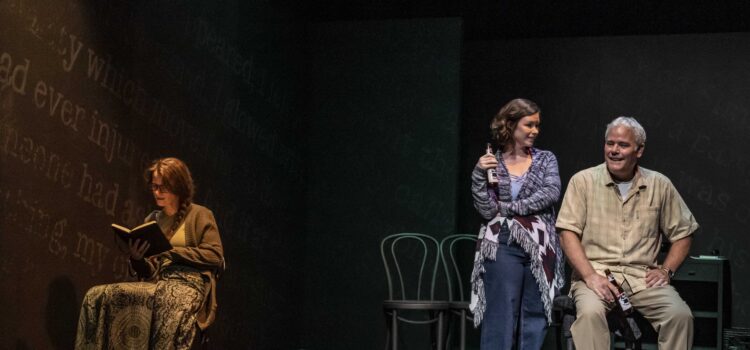
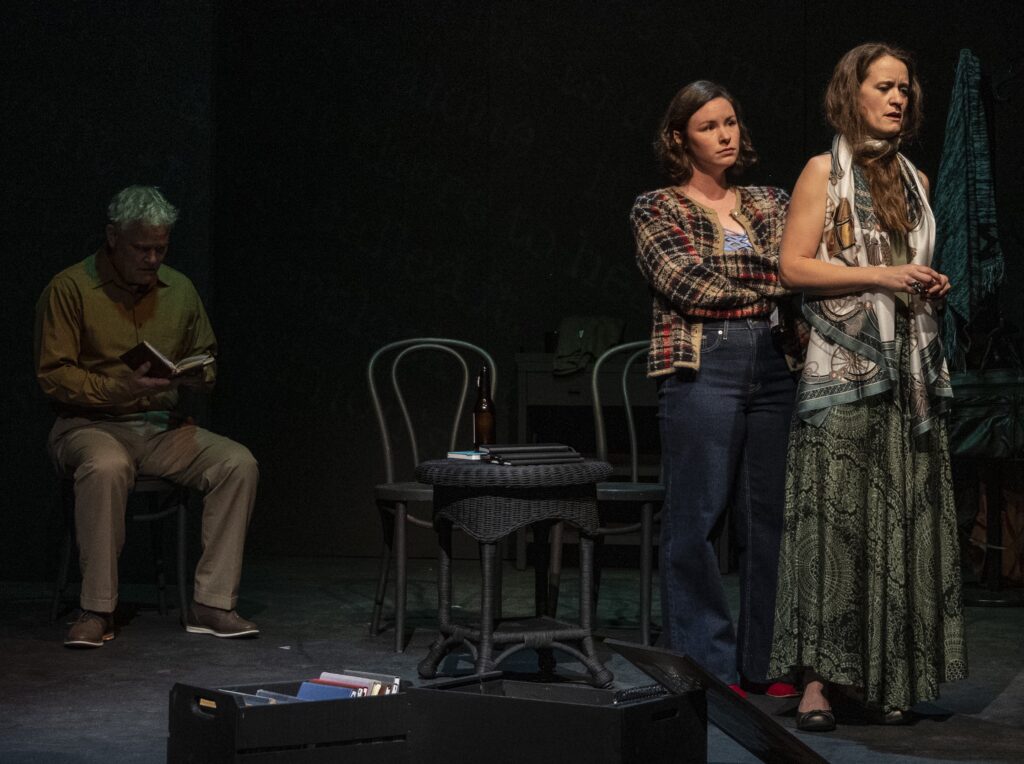
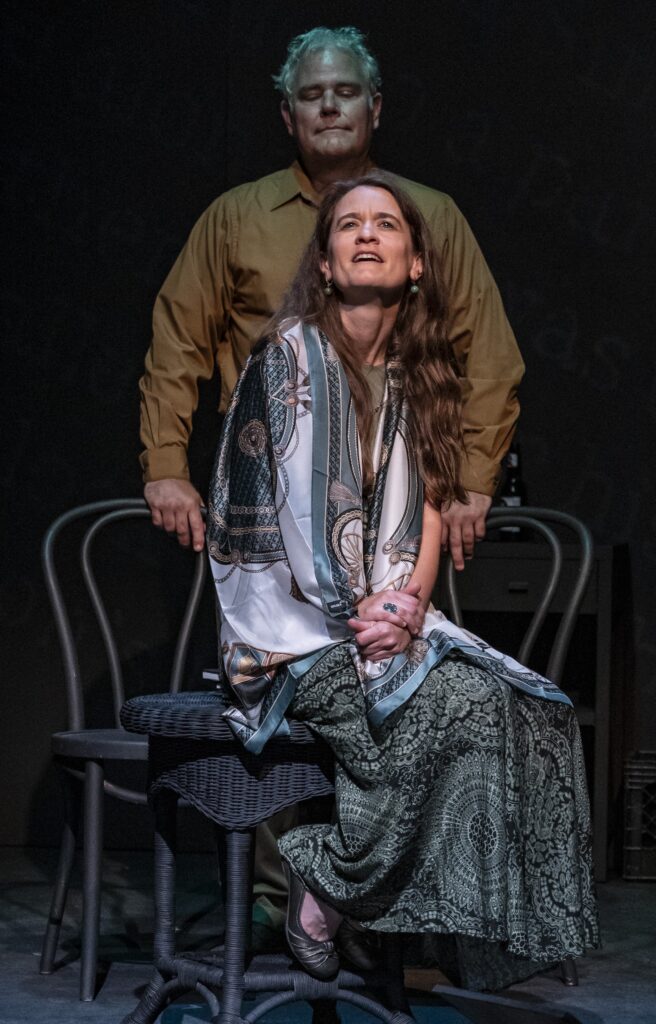
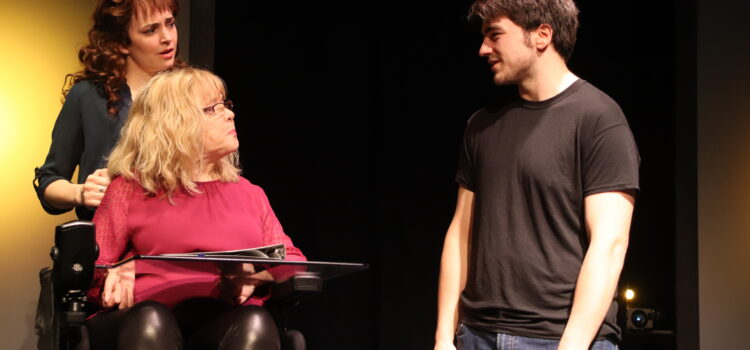
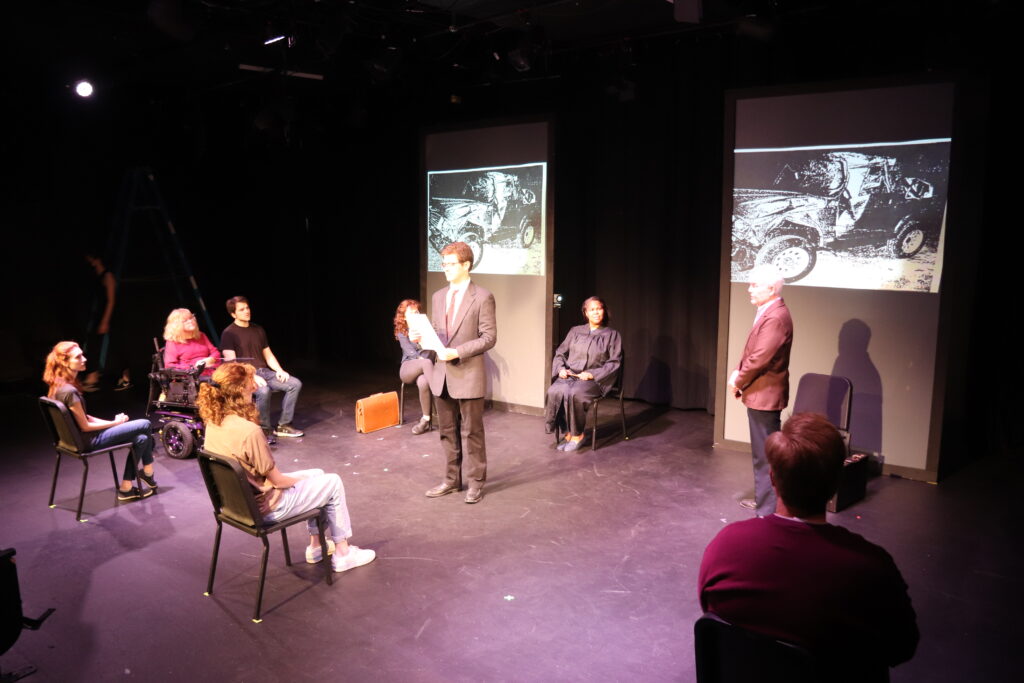
A strong ensemble cast acts naturally in an unnatural setting in “Locked Ward,” a world premiere mystery-drama by Chicago-based playwright Amy Crider.

Now in its 19th season specializing in producing new works, First Run Theatre effectively realizes Crider’s play, which was inspired by her own journey with bipolar disorder, with sensitivity and compassion.

Crider’s care and concern regarding her characters, which were based on people she met while hospitalized in 1993, is obvious. And director Phil Gill follows through by ensuring a human face has been placed on the internal and external conflicts.

Crider has been on effective medication since 1994, and has been almost entirely in remission ever since, she wrote in the program notes. Her large body of work includes the topic of mental illness, and reflects not only her personal experience, but her desire to educate and make people aware of disorders.

“Locked Ward” is first and foremost a passion project, and it succeeds on its earnestness. While it has humorous elements to lighten interaction, it is serious in its intentions. Do not think of this as “One Flew Over the Cuckoo’s Nest” light.

As Crider does, Gill strives to address the stigma hanging over those living with mental illness. And that is an important aspect of this presentation. In his program notes, he said he hopes it “encourages you all as our audience to see through the labels and instead see the humans that exist” behind the diagnosis.

While it could be heavy-handed in conveying the playwright’s noble intentions, First Run does not lecture, but lets the actors believably develop their familiar characters. The cast makes sure we feel their connections while shading the disparate personalities in an identifiable way.

In life, Crider may crusade, but on the page, she doesn’t preach. She has incorporated information within the framework of a murder mystery, which is a surprising component.

The story takes place in 2003 in a psychiatric ward. When the body of a nurse is found on the floor in the ‘locked ward,’ patients become amateur sleuths, united in their shock and grief. That helps them bond, but also shows their limits as their own personal issues come to the forefront.

For instance, the sweet Eleanor, affectingly portrayed by Uche Ijei, has a manic episode while the group is preparing dinner. Her escalating paranoia puts others at risk when she wields a knife (used to cut vegetables) and must be put in restraints. They smoothly diffuse the situation.

Because the actors demonstrate skill in bringing their characters to life, we get to know them beyond their ‘types’ throughout the two acts.

Duncan Phillips is impressive as Franklin, the rigid obsessive-compulsive whose daily routine of “Star Trek” episodes and the evening news is disrupted when the floor’s television set is removed. You know that character. Smart, sincere, and awkward, Phillips grabs onto solving the mystery like a lifeboat.

In a heartfelt performance, Ethan Isaac is Glen, a troubled ex-cop dealing with post-traumatic stress syndrome, who must work through a tragedy. He also provides investigative know-how as the group ascertains how their floor nurse died.

Jalani “Tamia” Hale is sympathetic as Jill, whose memory is erased with her electric shock therapy. She is heartbreaking as she walks around in a zombie-like state sometimes and has grown an unrealistic attachment to the doctor treating her.

As Vladimir, a rebel-rousing dissident who doesn’t play by the rules, Stephen Thompson maintains a convincing Russian accent. An intelligent guy that sometimes condescends, Vlad’s hostility softens as he works together with the group on a common cause.

Treating these patients is Dr. Blumenthal, and Jaz Tucker keeps us guessing about this guy – is he trustworthy or is he hiding secrets? He does a good job giving the benevolent doctor some layers.

Because of COVID-19, Lillie Weber could not play the health care professional Linda, who takes over from the ‘victim’ the patients were attached to. But stage manager Gwynneth Rausch capably filled in. Because they must adjust anyway to an ‘outsider,’ her insertion worked well as a latecomer, not missing a beat. She also provided some context to the deceased nurse’s private life.

Scenic designer Brad Slavik’s use of weathered second-hand furniture and distinct institutional props fitting such a locale’s layout adds to the production’s lived-in quality. Tony Anselmo’s lighting design enhances the moods and the characters’ emotional states, and technical director Jenn Ciavarella’s sound design is efficient and fluid.

The play is well-staged in the Kranzberg black box theatre so that each character has their moment to shine.

Without simple solutions, the play zigs when you think it will zag, so you are kept somewhat off-guard, avoiding predictability.

While the conclusion seems anticlimactic, and the path towards the resolution gets a little clunky in its exposition, the ensemble’s likability smooths the rough edges.

Overall, the actors’ grow as they share their stories, bridging some of the hurdles perceived in mental health.

Crider does not offer quick fixes, and it would be irresponsible to do so anyway. Because of the way the character’s progress, in the end, the message lands on how much more insight we need on mental illness.

Through First Run, this fiction can be a starting point to learn more.

The St. Louis chapter of the National Alliance on Mental Illness, which serves St. Louis city and county plus the counties of St. Charles, Lincoln, Warren and Jefferson, has provided the company with resources that they have placed in the lobby of the Kranzberg Arts Center. NAMI is an organization of families, friends and individuals whose lives have been affected by mental illness

Crider has also written a mystery novel about her experience with mental illness, “Disorder,” which is available from bookstores, Kindle, and audio.

Crider wrote the play, “Charlie Johnson Reads All of Proust,” that the Midnight Company presented here in May 2019.

You can follow her career, including winning the Tennessee Williams One Act Play contest, on www.amycrider.com.

Jaz Tucker, Ethan Isaac

First Run Theatre presents “Locked Ward” Aug. 12-14 and 19-21 at the Kranzberg Black Box Theatre, 501 N. Grand Blvd., St. Louis. For tickets and information, visit www.firstruntheatre.org.

Facebook Comments

By Lynn Venhaus

Sometimes, those who lose are more inspiring than those who win. Take Maurice Flitcroft, for example, who became known as the Worst Golfer in the World. He wound up having the last laugh, though.

That’s the takeaway from “The Phantom of the Open,” a kooky and charming real-life story that celebrates ordinary joes who never give up. During his well-documented remarkable life, Flitcroft achieved an unlikely more-than-15-minutes of fame.

A shipyards crane operator in Barrow-in-Furness in northern England, Flitcroft, at age 46, went after a dream with uncommon verve and an unfailing work ethic. In 1976, he managed to gain entry to The British Open Golf Championship Qualifying and subsequently shot the worst round in Open history, 121, but became a folk hero in the process.

While it did not pan out, people still remember his name. Imagine the mindset to take a risk like he did — an inexperienced golfer who played his first round ever in the 1976 British Open. He turned the stuffy pro establishment on its ear – and Rhys Ifans is hilariously condescending as gatekeeper Keith Mackenzie. The more horrified they are, the more this unrelenting optimist keeps plugging away.

Director Craig Roberts treats Flitcroft with utmost respect, even if those around him do not. The brilliant Mark Rylance anchors this film that’s populated with eccentric characters, and the ensemble is integral to winning us over.

Rylance is joined by fellow British treasure Sally Hawkins as his wife Jean, in yet another poignant role. They make a sweet couple, and Hawkins always delivers a nuanced take. She covers Jean’s heartaches well.

In fine support are Mark Lewis Jones as his best friend Cliff and Ash Tandon as a reporter who tells his story.

Even though their sons are more caricature-like here, Jake Davies is his embarrassed stepson Michael, and twins Christian and Jonah Lees are very funny as the hyper disco-dancing duo Gene and James. The retro ‘70s needle drops are terrific additions to the score.

A real actor’s actor, Rylance, Oscar winner for “Bridge of Spies” who has three Tony Awards and a couple BAFTAs, has a knack for disappearing into a role, and this is no exception. As the earnest Maurice, he will tug at your heartstrings and tickle your funny bone at the same time.

In adapting his own 2010 book, co-written with Scott Murray, screenwriter Simon Farnaby has brought out the quirky details to make the story amusing but never mocks Maurice, and gives it some emotional gravitas in the dramatic turns so that we care about the outcome at every juncture.

Farnaby, who wrote the screenplay for the beloved “Paddington 2,” knows how to mix humor and heart, and Roberts adds warmth. While parts of this story seem incredulous, we find out what seems the most outlandish is true.

Uplifting and sincere, “The Phantom of the Open” is a little gem that aims for the stars and glitters like diamonds in the sky.

Mark Rylance as Maurice Flitcroft

“The Phantom of the Open” is a 2021 comedy-drama that is directed by Craig Roberts and stars Mark Rylance, Sally Hawkins, Rhys Ifans, Jonah Lees, Christian Lees, Jake Davies, It is rated PG-13 for some strong language and smoking, and runs 105 minutes. It opened in select theaters earlier in 2022 and is now available on digital and will be on DVD Aug. 30. Lynn’s Grade: B+

Facebook Comments

By Lynn Venhaus

Even an actor as good as Idris Elba can’t save this overblown and half-baked adventure-thriller.

When poachers slaughter a pride of lions, ticking off a big cat who goes rogue and becomes a killing machine, this coincides with a doctor’s visit taking his two daughters to their mother’s homeland in South Africa for a getaway safari. But their dream vacation turns into a nightmare instead in yet another movie called “Beast.”

Dr. Nate Samuels (Idris Elba) was separated from his wife at the time of her death from cancer, and this has led to friction with the oldest grieving daughter, Meredith “Mere” (Iyana Halley). They are staying with the mom’s childhood friend, Martin (Sharlto Copley), who oversees an animal preserve, protecting all the creatures on the savanna.

While it starts out promisingly enough, with stunning scenic backdrops and sweeping shots of galloping giraffes, “Beast” quickly falls apart when it becomes “Cujo” and the ticked off apex predator hunts down all humans in sight – except when he/she doesn’t.

The maulings are intense and gruesome, obviously – did they not ever heed ‘it’s not nice to fool Mother Nature?’ and the cast illogically puts themselves in harm’s way.

Characters make a series of decisions that go from bad to worse, so that they seem as dense as people in slasher films. The youngest daughter, Norah (Leah Jeffries), has a penchant for wandering at the worst times. (But is it ever a good thing in unfamiliar territory?).

While I’m not skilled in the laws of the jungle, I’m pretty sure screenwriter Ryan Engle ignores most of them.

Engle takes a video game approach, just as he did in “Rampage” and run-of-the-mill Liam Neeson movies “Commuter” and “Non-Stop,” and the action doesn’t match the characters, who are poorly drawn in the broadest cliches. For a supposedly smart man, Elba’s Dr. Samuels has little common sense.

Then there are the standard tropes. We have the angry daughter lashing out at busy doctor dad who wasn’t around. Oh, that’s original. Scenes of unrealistic peril ensue, even for an animals-attack plot.

By the end, you just want everyone to be put out of their misery after what seems to be an interminable amount of pummeling. The film’s saving grace is its short runtime of 93 minutes — yet, the ending is ludicrous.

It’s not a good sign that the audience seemed to lose patience midway, and laughter grew. Would you willingly smash a walkie-talkie when that is your only lifeline?

As their friend Martin, Sharlto Copley does what he can with a role that mostly dispenses information as he gives them a tour, which goes horribly wrong. Copley, who showed so much promise in “District 9” in 2009, doesn’t have an opportunity here to stand out, and he’s better than the material..

Jeffries and Halley are natural enough as sisters. While paralyzed with fear, they still display survival skills and actually help dad when he needs it. Elba’s character owns up to his failings, so you expect the squabbles given the circumstances. But the end game is that they bond.

However, the characters are soon boxed in, and not just in the vehicle — and the conveniences become contrivances. Whatever goodwill we had for the characters evaporates and interest wanes, so that the conclusion seems anticlimactic.

Elba shows a physical side again, but this time as a flawed hero, not menacing like in “The Harder They Fall,” “Suicide Squad,” and his brief appearances in the Marvel Cinematic Universe as Heimdall. Dramatically, in film, he has yet to surpass his work in “Beasts of No Nation” in 2015, although he is best known for his television work in “Luther” and “The Wire.”

Director Baltasar Kormakur’s style is very busy, with quick cuts, and his longshots lack focus — especially as the characters’ overlapping dialogue becomes hard to understand, and it is more difficult than it should be to hear what the actors are saying.

While one can appreciate his intensity in man vs. nature conflicts, he fares better when it’s a war against the elements, unlike here, dealing with a hulking CGI beast of a lion. In “Adrift” in 2018, he gave a riveting account of Hurricane Raymond survivor Tami Oldman (Shailene Woodley) at sea, while in “Everest” he methodically delivered a procedural on the 1996 disaster on the world’s highest mountain that got bogged down with melodrama.

Still, “Beast” is a lot to unpack. Hampered by not only poor sound but also sloppy computer-generated graphic images that don’t seem realistic, the film becomes a merciless slog.

Disingenuous and dissatisfying, “Beast” is ultimately forgettable soon after exiting the theater.

Idris Elba, Sharlto Copley, Iyana Halley in “Beast”

“Beast” is an action-thriller directed by Baltasar Kormákur and stars Idris Elba, Sharlto Copley, Leah Jeffries and Iyana Halley. It’s rated R for violent content, bloody images and some language and run time is 1 hour, 33 minutes. It opens in theaters on Aug. 19. Lynn’s Grade: D.

Facebook Comments

STAGES St. Louis has announced that current Associate Producer, Andrew Kuhlman, will succeed Jack Lane as Executive Producer beginning January 2023.

“I cannot think of anyone more fully prepared to assume the position of Executive Producer of STAGES St. Louis. Andrew will no doubt continue to build upon the legacy of STAGES for many years to come,” Mosbacher Family Executive Producer Jack Lane said.

Kuhlman started with the organization as an intern in 2012, gradually attaining more responsibilities and eventually joining the three person leadership team that included founders Jack Lane and Michael Hamilton.

“It was very important that we choose an individual who will honor and respect the legacy of Jack and Michael while keeping STAGES St. Louis moving forward for the benefit of performing arts in the St. Louis region,” Board President David White said. “Andrew is professional, an excellent communicator, and a strategic thinker who, along with our new Artistic Director Gayle Seay, will continue to grow STAGES as an arts institution.”

Kuhlman will assume the Executive Producer role effective January 1, 2023. Lane will transition into a consulting role in the organization while also pursuing new projects in New York and beyond.

“I consider myself equal parts lucky and honored to take on the role of Executive Producer at STAGES St. Louis following in the incredible footsteps of Jack Lane. I believe in STAGES, its mission and programs, and most importantly the amazing people that make the work of this organization possible,” Kuhlman said.

“I am looking forward to leading STAGES into this new era with Gayle as we ensure that this wonderful company continues to play an integral role in the St. Louis and national arts communities.”

In 2022, STAGES St. Louis proudly presented the Pre-Broadway World Premiere of THE KARATE KID – The Musical and is currently presenting Lin-Manuel Miranda’s Tony Award-Winning Best Musical, IN THE HEIGHTS. Beginning September 9, the grand finale of the STAGES 2022 Season, A CHORUS LINE, will begin performances.

The 2023 Season is expected to be announced in early September.

#

STAGES St. Louis performs in The Ross Family Theatre at the Kirkwood Performing Arts Center. Tickets are on sale now online at StagesStLouis.org or by phone at 314.821.2407. For more information, please follow STAGES on Facebook and Instagram or visit StagesStLouis.org.

Facebook Comments

By Lynn Venhaus
As frothy as a cappuccino and sweet as cotton candy, “Joseph and the Amazing Technicolor Dreamcoat” took hold of The Muny stage as a swirling kaleidoscope of color, a glittery burst of cheer from a youthful ensemble that brings it home.

In the first full season after the challenging post-pandemic years 2020-2021, The Muny wraps up a groundbreaking summer with this beloved big, splashy musical that has been here six times. Last produced in 2012, the show first arrived in 1986 and returned in 1997, 2002 and 2007.

With its technical razzle-dazzle matched by the effervescent Muny Kids and Teens in the youth ensemble and children’s choir, the entire company looked like they were at the happiest place on earth.

That engaged the crowd, and the charismatic principals Jason Gotay as golden child Joseph, Jessica Vosk as the regal Narrator, and Mykal Kilgore as the swaggering Pharoah elevated the wispy material, delivering knock-out performances.

Narrator and Potiphar. Photo by Phillip Hamer.

However, the show is not without heartache and adversity – with a turnaround because of strength, perseverance, and blessings, for it is based on the Old Testament Book of Genesis tale of Jacob, his favorite son Joseph, his 11 other sons, and that famous coat of many colors.  

After Joseph’s jealous brothers sell him into slavery, he impresses the Egyptian noble Potiphar, but then rejects his wife’s amorous advances, and is thrown in jail. While locked up, Joseph’s talent for interpreting dreams is put to good use. He ingratiates himself with the Pharoah because he offers a solution to the country’s famine, and that stroke of fortune results in Joseph becoming the Pharoah’s right-hand man. He is eventually reunited with his family.

In the stylized re-imagining by composer Andrew Lloyd Webber and lyricist Tim Rice, the story is told through song and dance.

Considered innovative in the 1970s, the musical comedy has expanded over time, and is now regarded as a family-friendly favorite staged by thousands of schools and groups in the U.S. and across the pond. 

The EGOT duo began this journey collaborating for the second time in 1968. Commissioned by a music teacher who was a family friend of Webber’s, their 15-minute pop cantata was performed at the Colet Court School in London. After more tinkering, it was recorded by Decca Records in 1969.

When their next piece, the rock opera “Jesus Christ Superstar,” skyrocketed them to fame in 1971, the earlier musical was stretched to 35 minutes for the Edinburgh International Festival the next year. More modifications followed, and the modern format was staged in 1974. It was mounted on Broadway in 1982 and nominated for seven Tony Awards. Revivals, tours and a 1999 direct-to-video film starred Donny Osmond followed.

Like the other pop Biblical musical of that era, Stephen Schwartz’s “Godspell,” it is re-interpreted for every presentation. Consider this the theme park ride version, with the youngsters displaying as much energy as those attending summer cheerleading camps.

Photo by Phillip Hamer.

It’s a swell dance party, briskly performed in several celebratory scenes and elaborate pastiches – including countrified “One More Angel in Heaven/Hoedown,” the French-inspired lament “Those Canaan Days,” island-flavored “Benjamin Calypso” and the grandmaster flashy finale “Megamix.”

The pleasant pop-py tunes “Any Dream Will Do” and “Go, Go, Go Joseph.” are certain to be hummable on your way home.

Music director Charlie Alterman, who won last year’s St Louis Theater Circle Award for “Chicago,” is adept at lively shows with many moving parts and his orchestras are a treat to listen to — and he’s aware of the Muny’s pit challenges this season.

Of course, a show directed and choreographed by Josh Rhodes would seize the day. Rhodes, who is known for his athletic and acrobatic dances, returns after successes helming “Jersey Boys,” “Paint Your Wagon” and that stunning tap number to “Putting on the Ritz” in 2016’s “Young Frankenstein.”

This is a show that requires a special set of skills, and Rhodes’ crisp and snappy choreography is flat-out fun. He was aided by associate choreographer Lee Wilkins and dance captain Emilie Renier.

In its last national tour in 2014, the ingenious three-time Tony Award winner Andy Blankenbuehler directed and choreographed a fresh interpretation that ran at the Fox Theatre that spring. That show featured American Idol finalist Ace Young as Joseph and his wife, fellow finalist Diana DeGarmo, as the Narrator.

The role of Joseph is often filled by a pop star – and teen heartthrobs David Cassidy, Andy Gibb and Donny Osmond have played the lead before. (And first American Idol runner-up Justin Guarini, who has played various roles at the Muny, was Joseph in 2012.)

At the Muny, Jason Gotay has won over hearts as a charming leading man, appearing as Prince Eric in “The Little Mermaid,” Prince Topher in “Rodgers + Hammerstein’s Cinderella” and as Jack in “Into the Woods.”

His strong velvety vocals emphasize he is no lightweight, heart-tugging in “Close Every Door.”  He commands the stage confidently, capably leading the large cast in the group numbers.

Mykal Kilgore as the Pharoah. Photo by Phillip Hamer.

However, the showstopper in this production is Mykal Kilgore.

One of my favorites since I saw him at the Muny Magic concert at the Sheldon in 2017, the affable Kilgore slays as the megawatt Pharoah. It’s as if James Brown and Little Richard had a baby.

 In a departure from the previous Elvis-like personas, Kilgore reaches back to his R&B roots for “Song of the King,” bringing the house down. The Pharoah’s stage time is brief, but his impact is mighty.

Jessica Vosk makes her Muny debut, playing a hands-on narrator who just doesn’t just observe the action from the sidelines, but propels it along. Here, she is a surrogate mother hen to the youngsters as she tells the tale.

Vosk has the powerful pipes to fill an arena and is well-suited for this grand production. She has played the role before, in the 50th anniversary show at the Lincoln Center, and is remarkably assured while the action bubbles up around her.

Other noteworthy debuts are multi-hyphenate Eric Jordan Young in the dual role of well-meaning Jacob and flamboyant Potiphar, and Darron Hayes as playful Judah, who takes the lead in “Benjamin Calypso.”

The adult choir is chock-full of Muny regulars, and some familiar castmates are playing brothers. Dynamic Harris Milgrim, a standout as Benjamin in last year’s “Seven Brides for Seven Brothers,” is again as Reuben in “One More Angel.”

Sean Ewing, in his third season at the Muny, is second son Simeon, amusing in “Old Canaan Days.”

Not all the hijinks work, for the mashups often are silly, and the gaudy pageantry can easily slide into trivial frivolity, but that’s the problem with the show itself. As the years ago on, they keep gilding the lily, adding more to an already over-the-top show. But it remains a huge crowd-pleaser.

And the joyous look on those kids’ faces on stage said it all. (I counted 40 in the youth ensemble and 14 in the children’s choir, in addition to the 19 in ensemble, not to mention principals.)

Photo by Phillip Hamer.

Edward E. Haynes Jr., the award-winning scenic designer for “Smokey Joe’s Café” last year, combines glitz, a Skittles rainbow of bold colors, and Egyptian symbols for the second act, in a whimsical set reminiscent of Tim Burton and the Marvel superheroes’ cinematic universe.

In a stunning backdrop, he references King Tutankhamen’s gold headdress in a giant piece anchoring a fancy staircase with neon piping..

Video designer Greg Emetaz is in sync with Haynes’ vision, and an extension of the gold-plated theme uniting the looks is on the LED screens.

Costume designer Leon Dobkowski references Vegas showgirls, exotic images and B.C. looks to create sparkly outfits and a sunny vibe. His elaborate headdresses are something special to see. The different gold fabrics stand out in garments, and kudos to wig designer Kelly Jordan for the Pharoah’s massive ‘do.

Jason Lyons’ lighting design capitalizes on the wonder and magical parts, and smartly ascertains between the dreamy sequences and the dark times.

It’s fitting that The Muny focused on home, family, relying on each other and connection for the last show of the 104th season, particularly after what they endured from mid-June to now with the double-whammy of back-to-back floods, extreme heat – even by St. Louis standards (oh you layered Edwardian Londoners in “Mary Poppins”!), and a new strain of COVID-19 on the rise in the region (but thanks to understudies and swings, the shows went on).

In his annual farewell address, Mike Isaacson, executive producer and artistic director since 2011, joked that the season was ‘biblical,’ and who could argue?

Known for its fizzy fun, “Joseph” delivered a spectacle to end the season on a high-spirited note.

If you think of the Muny in terms of a summer vacation, “Chicago” was nightlife fun, “Camelot” was a Renaissance Faire, “Mary Poppins” was a trip to the Magic House, “Legally Blonde” was a class reunion, “Sweeney Todd” was visiting the Louvre, “The Color Purple” was the Smithsonian and “Joseph and the Amazing Technicolor Dreamcoat” was a trip to Disneyland.

Until we meet again under the stars in Forest Park, here’s raising a glass to a summer tradition that I am grateful for, and will never ever take for granted.

Cast of ‘Joseph.’ Photo by Phillip Hamer.

The Muny presents the musical “Joseph and The Amazing Technicolor Dreamcoat” Aug.13-18 at 8:15 pm. Performances take place on the outdoor stage in Forest Park. For more information, visit www. muny.org.

Eric Jordan Young. Photo by Phillip Hamer.
Facebook Comments