By Lynn Venhaus
With extra oomph in every song and dance number, Stages St. Louis delivers a festive confection in “Guys and Dolls.”
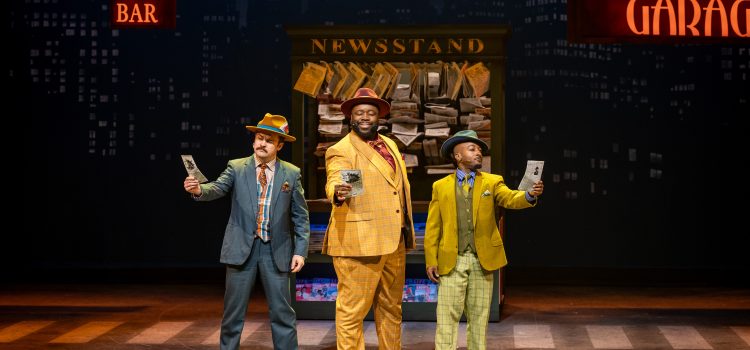
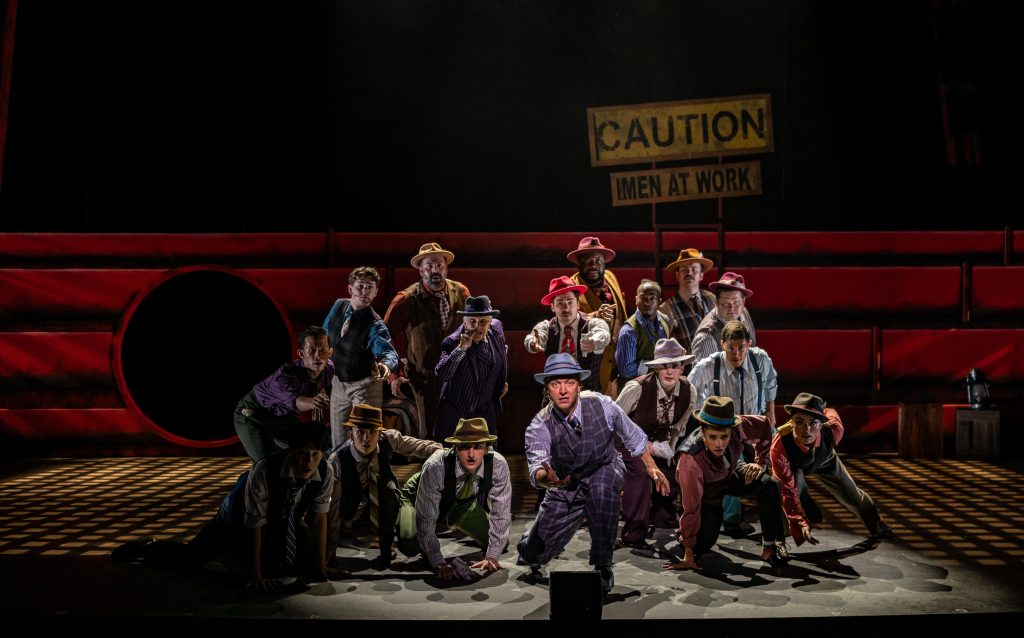
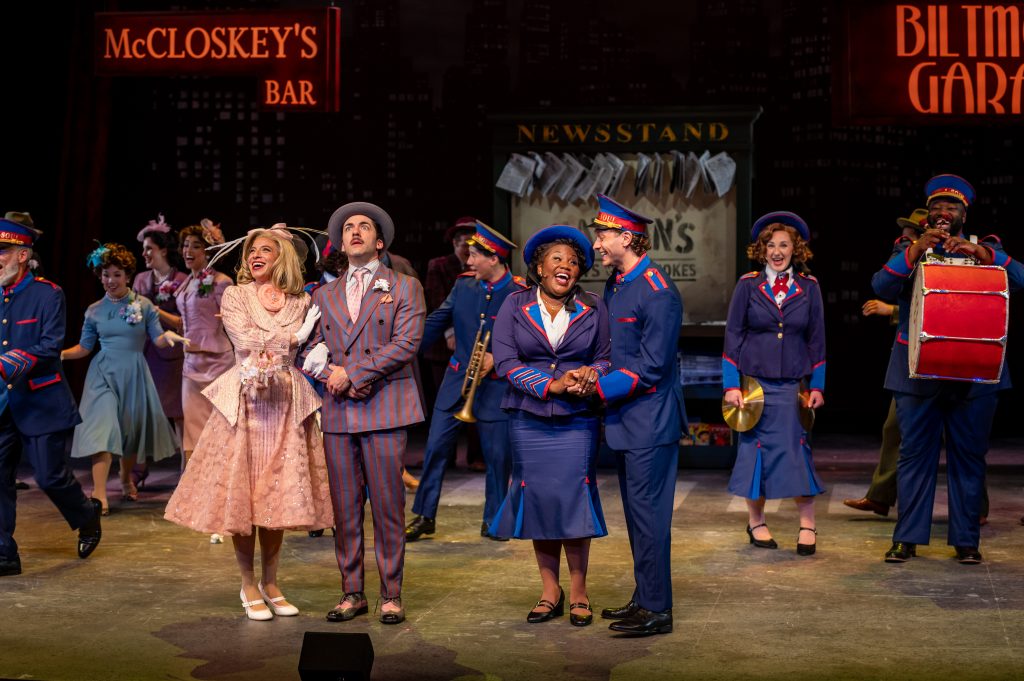
The snazzily attired ensemble looks like they’ve walked out of an idyllic vintage postcard of 1950s Times Square, bringing to life the exciting rhythms and zip of New York City. The colorful characters move in synchronized fashion, striking poses as this mix of pickpockets, cops, tourists, card sharks, and evangelists breeze by.
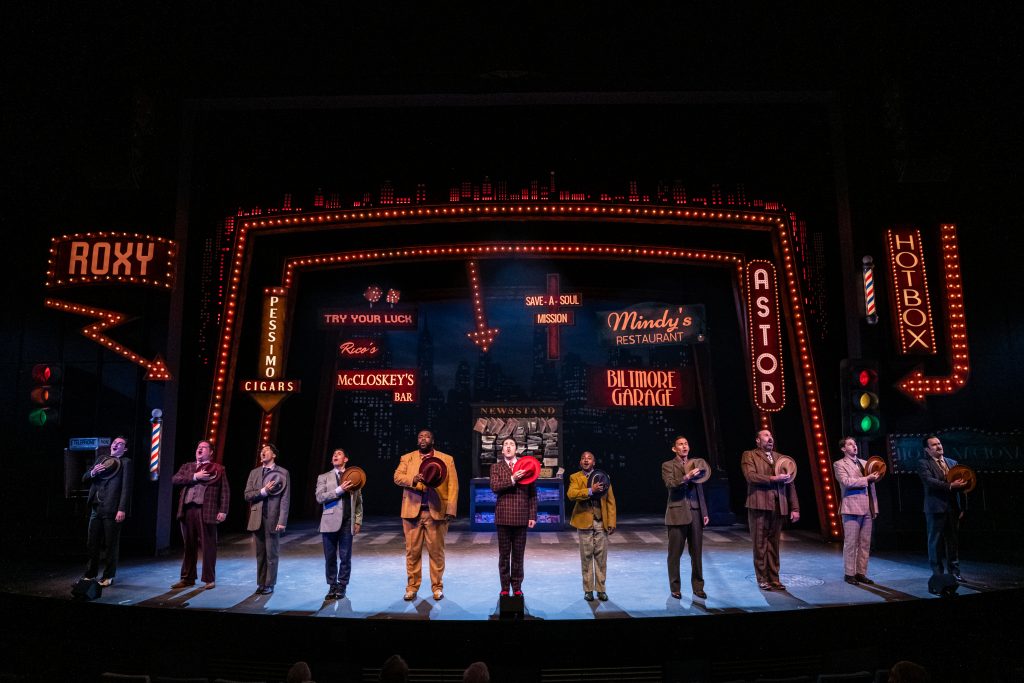
The look of “Runyonland” transports us to the bustling energy of midtown Manhattan and signals that we’re in store for one of the best musicals from the golden age. Ann Beyersdorfer’s resplendent scenic design, in tandem with lighting designer Sean Savoie’s bright neon lights, makes the skyline glow.
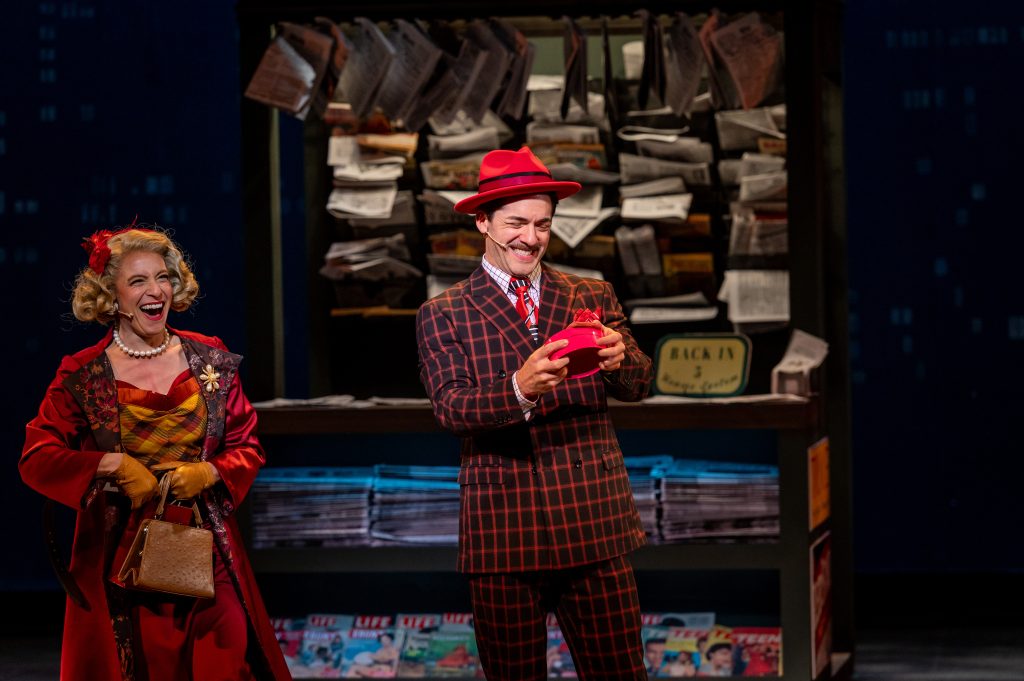
Costume designer Tim Kent’s stunning work is an integral element of this show, with outfits that dazzle in the Hot Box numbers – eye-popping elegance in “Take Back Your Mink” and glitzy in the fizzy “A Bushel and a Peck,” and boost the wise-guys pizzazz. Even every accessory, including outstanding hats and pocketbooks, are a marvel to see. Kent, a former designer of over 40 musicals at Stages from 1990-1997, has returned with an unmistakable flair.
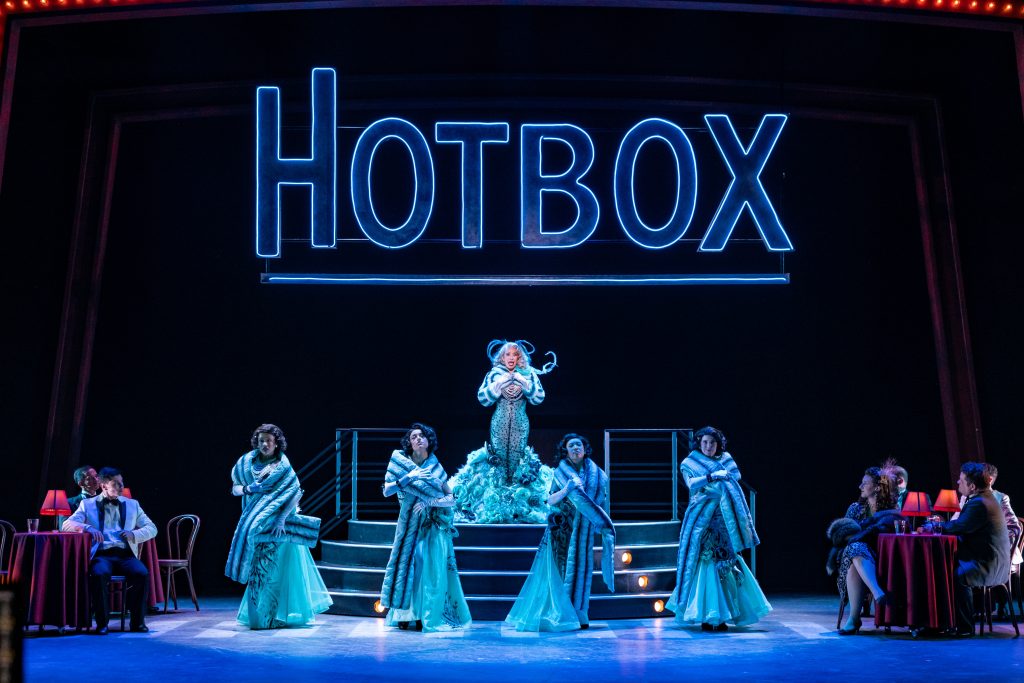
Once we hear that unforgettable score, with muscular music and lyrics by Frank Loesser, we’re off to the races with the overlapping witty banter of “Fugue for Tinhorns,” and the robust ensemble piece “The Oldest Established” soon follows.
The entertaining book by Jo Swerling and Abe Burrows, based on journalist Damon Runyon’s short stories, features these gamblers, hustlers and gangsters in their Prohibition era habitat. This romanticized ‘underworld’ is taken from Runyon’s “The Idyll of Miss Sarah Brown,” “Blood Pressure,” and “Pick the Winner.”
They have names like Nathan Detroit (Matthew Schatz), Benny Southstreet (a sensational Wesley J. Barnes), Big Jule (Zoe Vonder Haar), Rusty Charlie (Reagan Pender), Harry the Horse (Aaron Fried) and Angie the Ox (Patrick Blindauer). The performers have mastered the distinctive slang called Runyonese, and director James Monroe Iglehart has defined this theatrical and funny production with an exaggerated chaotic kinetic energy.
Iglehart’s brisk guidance, and the collaborations to evoke this bygone era’s sentimental atmosphere, are key to this show’s appeal. Through a superb fusion of modern dance, jazz and ballet, choreographer Lindsay Joy Lancaster has created a style that gives this “Guys and Dolls” revival its signature. Pulsing with musicality, Lancaster’s dance moves in ‘Havana” and “Crapshooters Ballet” are the show’s MVP.
The storytelling remains sweet and funny, especially the long-engaged dancer Miss Adelaide (Katerina Papacostas), who is tired of fiancé Nathan’s stalling, and yearns for a stable life. Papacostas is a rare find and steals the show with her feisty take on the iconic role. She takes charge in “Adelaide’s Lament” and comically bickers with her betrothed in “Sue Me.”
With those pre-feminism roles of the ‘50s, the female leads of that era have been mainly “need a man to take care of me” but Adelaide is no pushover, and it’s refreshing. Neither she nor Sarah are passive this time around. We’re just going to ignore the sexist tropes of that day here (you know, dolls and dames).
As Nathan, Schatz affably embodies the fast-talking, good-natured con man, and he and Papacostas, despite his commitment phobia, have a winning chemistry. He just values his illegal dice game more.
Unfortunately, the other principal pair, Sky Masterson (Sam Harvey) and Sarah Brown (Lindsay Roberts Greene), do not have any spark with their forced connection. High-roller Sky tries to woo the uptight, idealistic sergeant at the Save-a-Soul Mission because of a bet, but then they wind up falling for each other. That aspect proves that cool cat Sky can’t control love, and neither can Sarah.
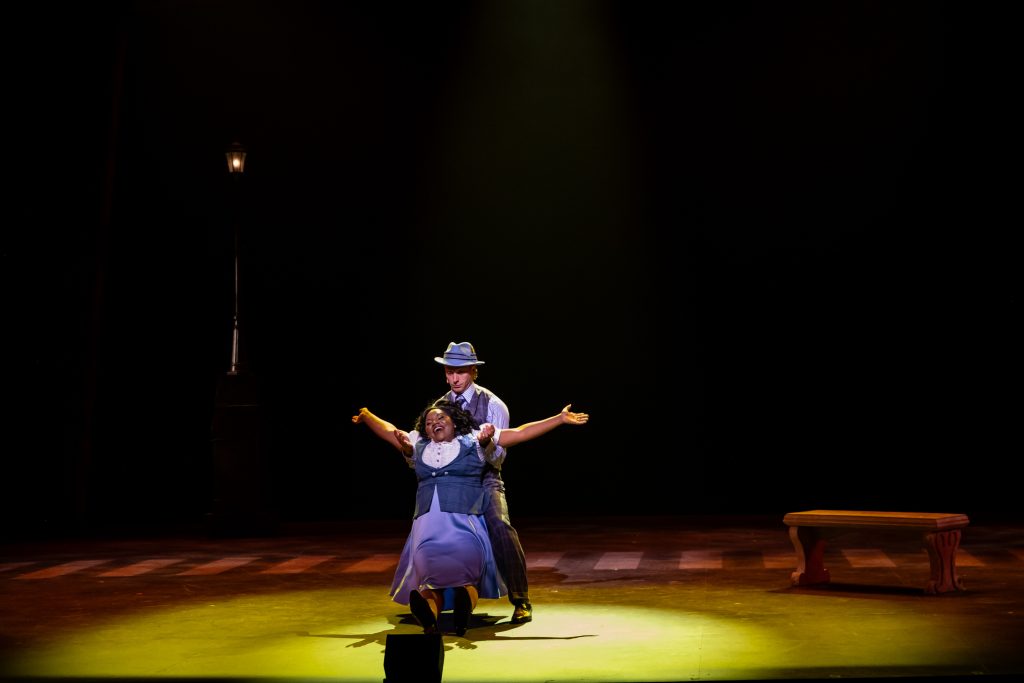
Seen at Stages as the slick Danny Zuko in “Grease” in 2019, Harvey delivers smooth vocals as the suave Masterson, especially city love letter “My Time of Day” and the swinging splashy “Luck Be a Lady” in the high-stakes crap game that takes place in the city’s sewer.
Greene has a beautiful voice and sings her solos “I’ll Know” and “If I Were a Bell” with aplomb. But she and Harvey are mismatched in “I’ve Never Been in Love Before,” and do not click vocally.
The cast’s harmony comes together in the showstopping “Sit Down, You’re Rockin’ the Boat,” one of the all-time great ensemble pieces, and this high-spirited cast raises the roof. It’s Tamar Green’s time to shine as the cheerful Nicely-Nicely Johnson, Nathan’s loyal sidekick.
A welcome presence, Greene is a natural force whose expressive, rich tenor has made him a standout as George Washington in “Hamilton” on Broadway, and a tower of strength as Coalhouse Walker in Stages St. Louis’ “Ragtime,” for which he won the St. Louis Theater Circle Award in 2025.
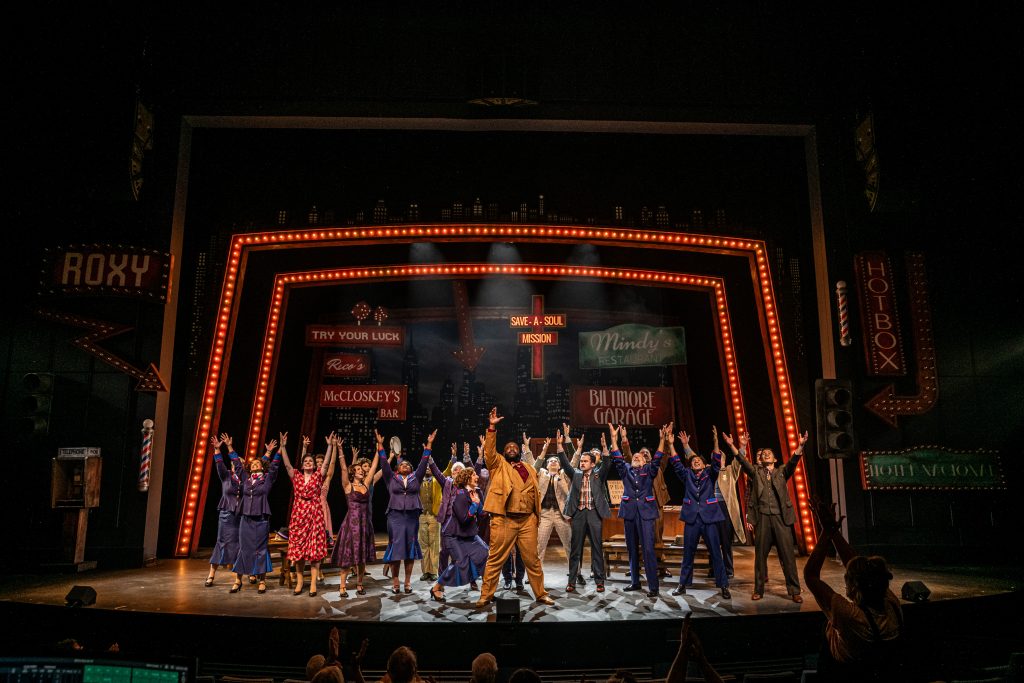
The ‘Sit Down’ foot-stomping, hand-clapping revival-style number always brings down the house so that “Marry the Man” duet between Sarah and Adelaide that follows always feels like an after-thought, but it leads to the inevitable happy ending.
Supporting characters of note include St. Louisan John Flack, an ideal fit as Arvide Abernathy, the kindly loving grandfather of Sarah Brown, and the bass drum player in the mission band. His warm, heart-tugging ballad “More I Cannot Wish You” is one of the show’s highlights.
Another high point is local treasure Zoe Vonder Haar as Chicago high roller Big Jule – what fun! Other veteran local performers who grace the stage include Steve Isom as gruff Lt. Brannigan, Pam Reckamp as no-nonsense General Cartwright, and Blindauer as a comical Angie the Ox.
The swaggering guys (previously not mentioned) include Paul Giarratano, Josiah Gundersen, Philly Kang, Connor Kelly-Wright, and Jack David Mullen, while the sprightly dolls were Teah Juliette Bell, Anna Chin, Marjorie Failoni, Cara Palombo and Maya Santiago. Swings include Aubrey Aldag, James Caposito and Mason Hensley. They find the sweet spot, not too seedy or campy, as the saints and sinners.
Musical director Dolores Duran-Cefalu buoyantly leads an orchestra that includes Jonathan M. Taylor on drums and percussion, Adam Anello on bass, George Manning on trombone, Chris Miller and Dan Smith on trumpets, Lea Gerdes, Joseph Hendricks and JD Tolman on reeds, Fiona Brickey on violin, and Mark Maher and Duran-Cefalu on keyboards.
Other contributions include terrific wig and hair design by Paige Stewart, clear sound design by Breanna Fais, and sharp stage managing by E. Sara Barnes.
Let’s face it, this musical comedy fable is such a staple in school and community theater that you’d be hard-pressed to find someone who hasn’t seen it, been on a crew or acted in it. Nearly everyone who has a connection to the play looks back on it fondly, as you just can’t find fault with those peppy numbers, no matter how times have changed.
The Tony-winning musical premiered on Broadway on Nov. 24, 1950, and ran for 1,200 performances. It has been revived numerous times – 1955, 1965, 1976, 2009, and most notably, the 1992 revival that won four Tony Awards and ran for 1,143 performances. And there was that 1955 movie starring Marlon Brando and Frank Sinatra.
Laced with nostalgia, Iglehart’s delightfully crisp and snappy production comes alive with intention and demonstrates why this quintessentially American musical has staying power and a devoted audience.
Stages St. Louis presents “Guys and Dolls” July 24 through Aug. 23, with performances daily except for Mondays, at the Kirkwood Performing Arts Center, 210 E. Monroe Ave. For more information: stagesstlouis.org

Lynn (Zipfel) Venhaus has had a continuous byline in St. Louis metro region publications since 1978. She writes features and news for Belleville News-Democrat and contributes to St. Louis magazine and other publications.
She is a Rotten Tomatoes-approved film critic, currently reviews films for Webster-Kirkwood Times and KTRS Radio, covers entertainment for PopLifeSTL.com and co-hosts podcast PopLifeSTL.com…Presents.
She is a member of Critics Choice Association, where she serves on the women’s and marketing committees; Alliance of Women Film Journalists; and on the board of the St. Louis Film Critics Association. She is a founding and board member of the St. Louis Theater Circle.
She is retired from teaching journalism/media as an adjunct college instructor.