Patricia Racette’s production finds operatic scale, emotional truth and remarkable balance in Williams’s enduring tragedy.
By CB Adams
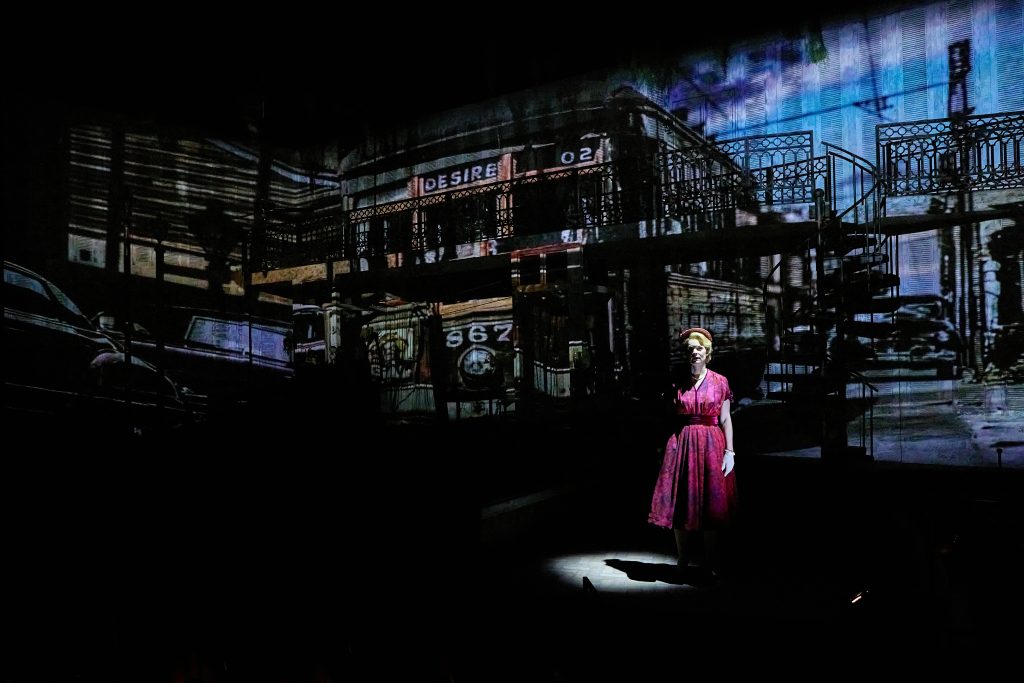
Andrew Boyce’s scenic design announces Opera Theatre of Saint Louis’s intentions before a note is sung. Towering walls of weathered white shutters dominate the stage, instantly evoking New Orleans while suggesting something more confining.
Projected across those walls, a black-and-white montage culminates in a huge streetcar lumbering toward the audience with the slow, inexorable force of a locomotive.
It is a striking image and an honest one. We know where this story is headed. Racette and Boyce embrace that inevitability from the outset. There is no attempt to disguise the destination. Some productions try to improve the classics. This one trusts one.
André Previn’s opera, with a libretto by Philip Littell, remains remarkably faithful to Williams’s play. Racette embraces that faithfulness as an artistic choice. She trusts Williams’s characters, conflicts and hard-earned understanding of human weakness. The result never feels preserved under glass.
Daniela Candillari leads the St. Louis Symphony Orchestra with equal command. Previn’s score moves beneath the action like an unseen current, deepening tension and longing without overwhelming the drama unfolding onstage. Candillari maintains an ideal balance between pit and stage. The orchestra remains firmly in service to the story.
The production’s dramatic engine is the ongoing contest between Sara Gartland’s Blanche DuBois and David Adam Moore’s Stanley Kowalski. They spar like star pugilists across Williams’s language and Previn’s score, each encounter carrying as much psychological force as vocal power.
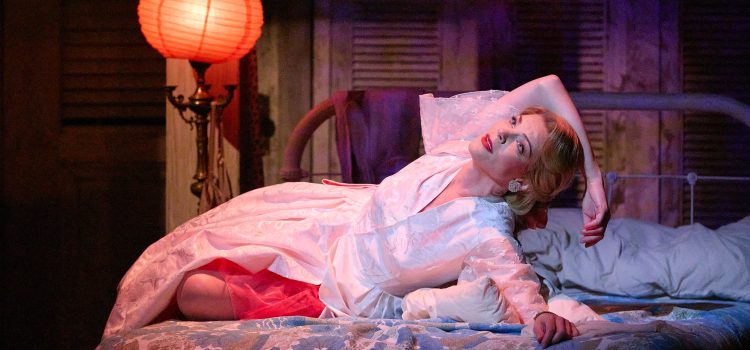
Gartland captures Blanche’s contradictions without simplifying them. Under Racette’s careful guidance, her Blanche remains vain, vulnerable, manipulative, frightened, self-aware and self-deluding, often simultaneously.
Moore faces the equally difficult task of making Stanley more than a brute. He succeeds. Stanley’s eventual victory remains disturbing, but Moore preserves enough magnetism and humanity to make it believable.
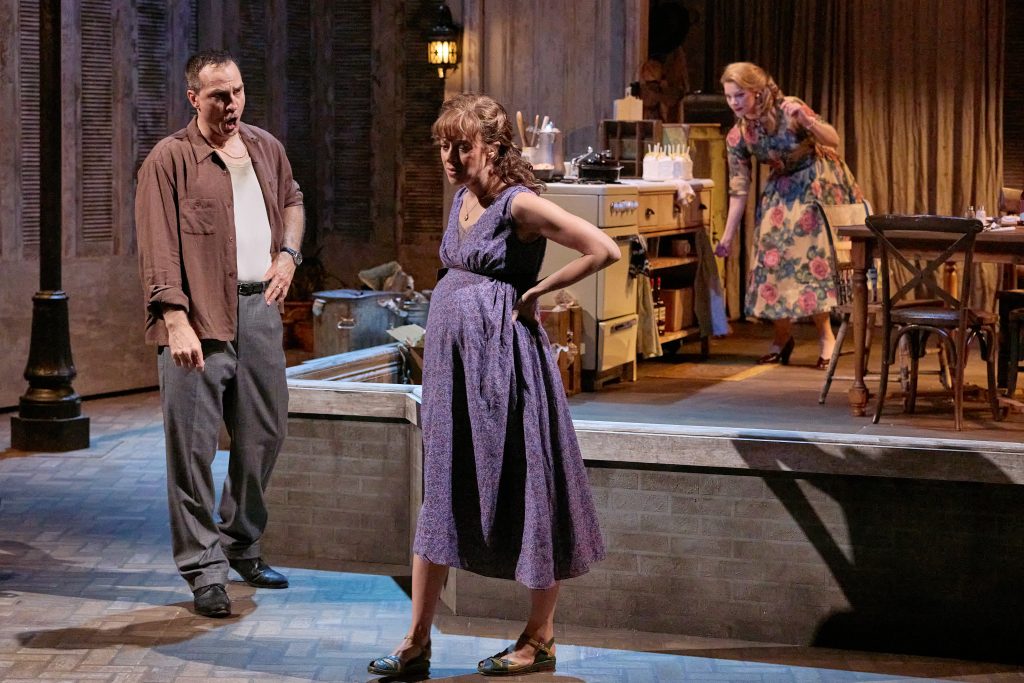
Racette allows Stanley’s appeal to remain visible even when his behavior becomes reprehensible. His spoken dialogue, used sparingly throughout the opera, sharpens the realism of the surrounding music rather than interrupting it.
Just as important is Lauren Snouffer’s Stella. More than a participant in Blanche and Stanley’s struggle, she becomes the emotional fulcrum of the evening, giving equal weight to Stella’s love for Blanche, desire for Stanley and determination to survive the impossible position in which she finds herself.
The relationship between the sisters is rendered with uncommon care, while Stella’s marriage to Stanley remains equally persuasive. Those relationships feel lived-in rather than merely dramatic.
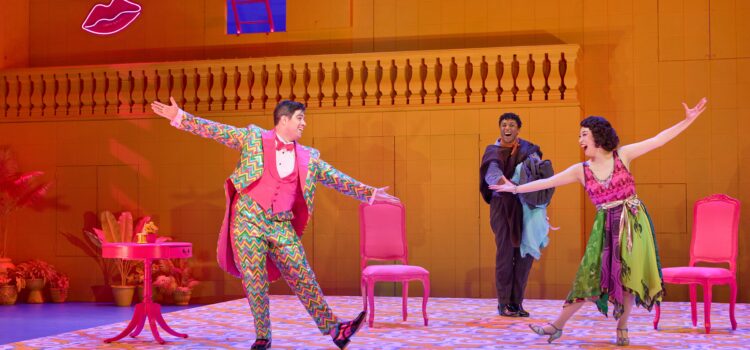
Boyce’s towering shutter walls evoke New Orleans architecture while functioning as a kind of emotional enclosure. At times they resemble prison bars, at others the walls of memory closing around Blanche. Their scale is distinctly operatic, creating a world far larger than the cast occupying it.
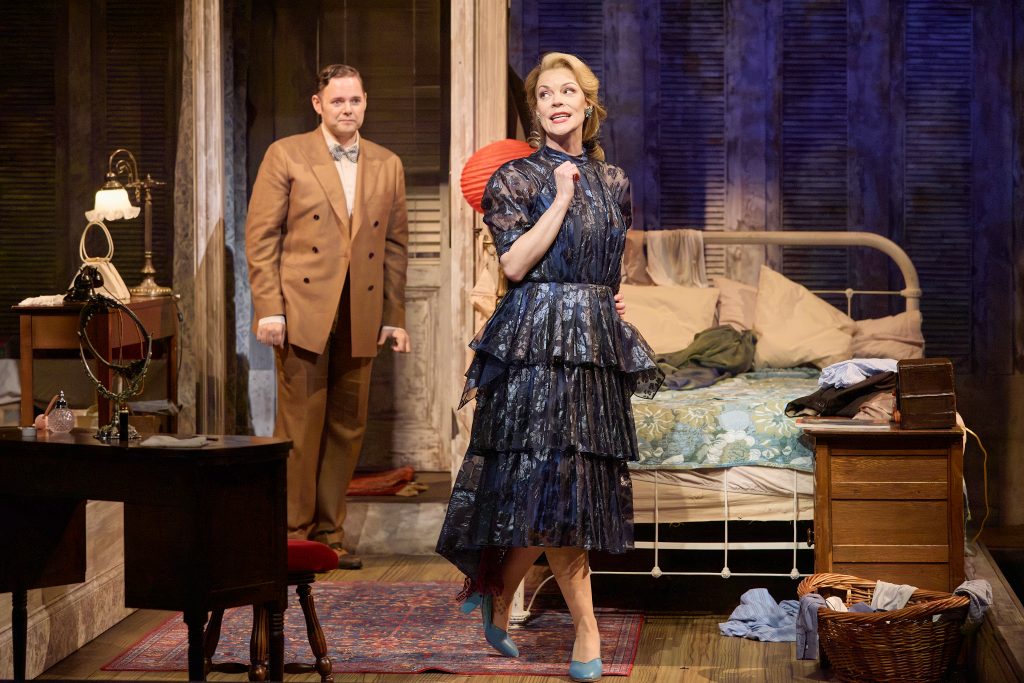
Yet Gartland, Moore, Snouffer and their colleagues fill that space through voice, presence and sharply defined characterizations. They do not merely survive the set. They complete it. In a production with relatively few principals, there is nowhere to hide. Every performer must command the space. They do.
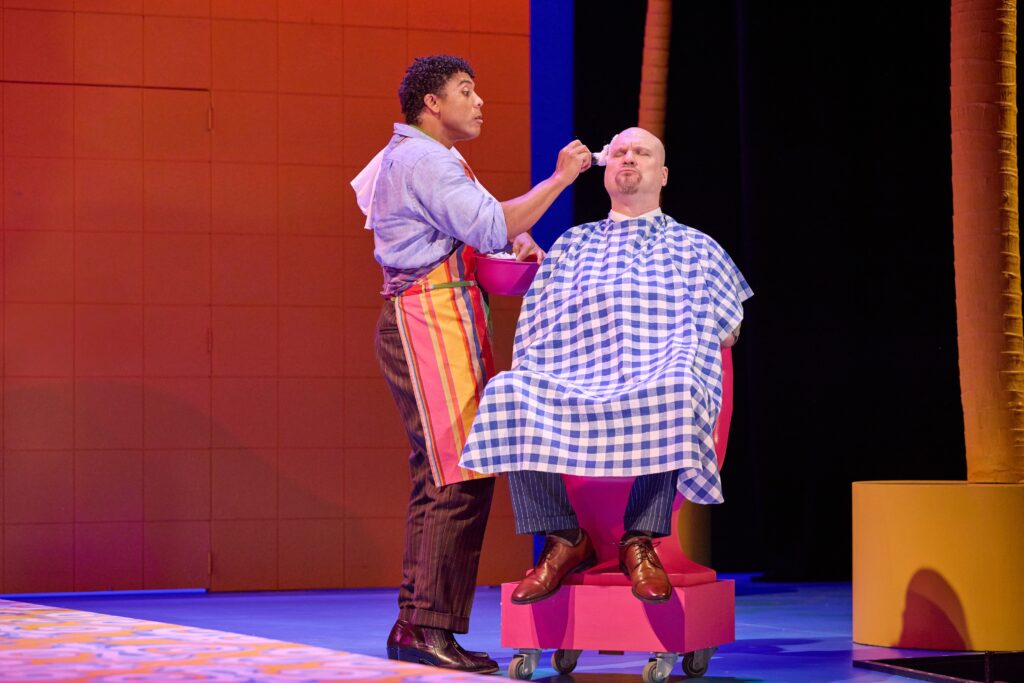
The supporting cast contributes significantly to that achievement. Bille Bruley’s Harold Mitchell brings warmth and humanity to the role, while Ashlyn Brown’s Eunice provides an earthy, clear-eyed counterpoint to Blanche’s unraveling. Her nurturing support of Stella reinforces one of the production’s central relationships and helps ground the emotional reality of Elysian Fields.
The ensemble consistently strengthens Williams’s world. Kim Stanish is especially memorable as the Nurse in the final scene. Her prolonged struggle to restrain Blanche avoids melodrama and instead underscores the heartbreaking finality of the character’s collapse, a moment Racette allows to linger rather than rush past.
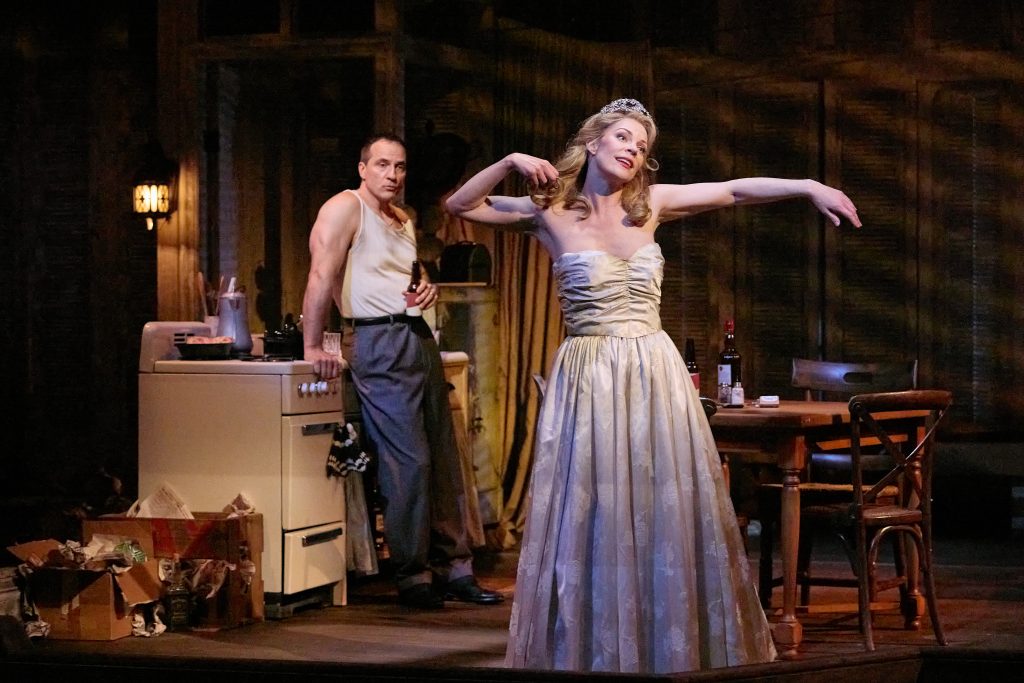
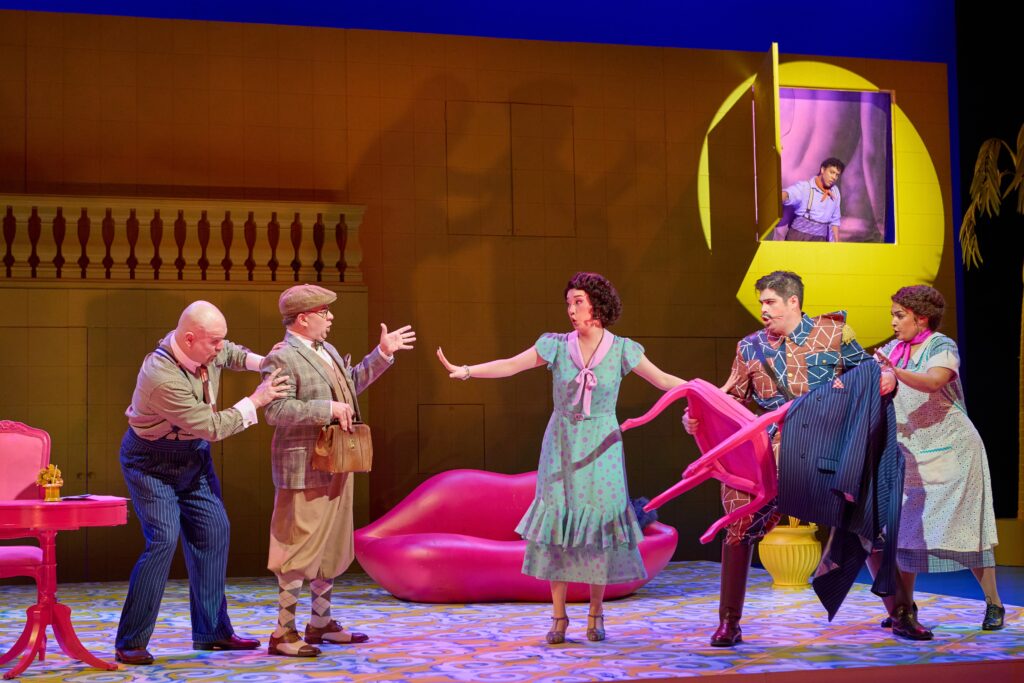
The production’s scenes of violence and sexual assault are staged with careful restraint. Racette, intimacy coordinator Delaney Piggins and fight choreographer Shaun Sheley convey the ugliness of Stanley’s actions with just enough physical detail to communicate their impact without lapsing into sensationalism.
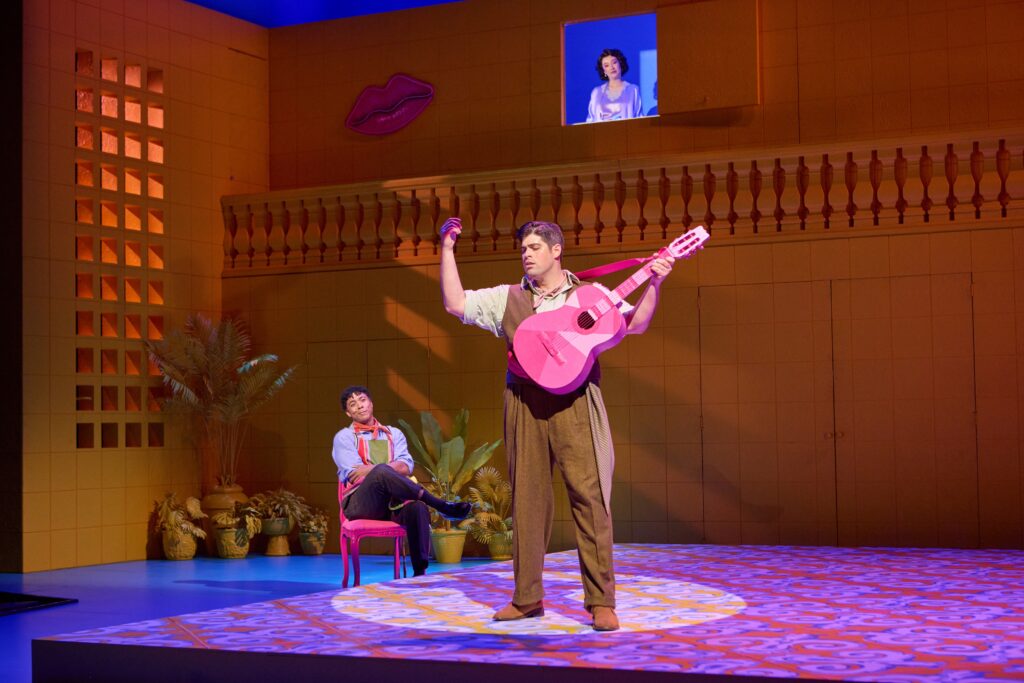
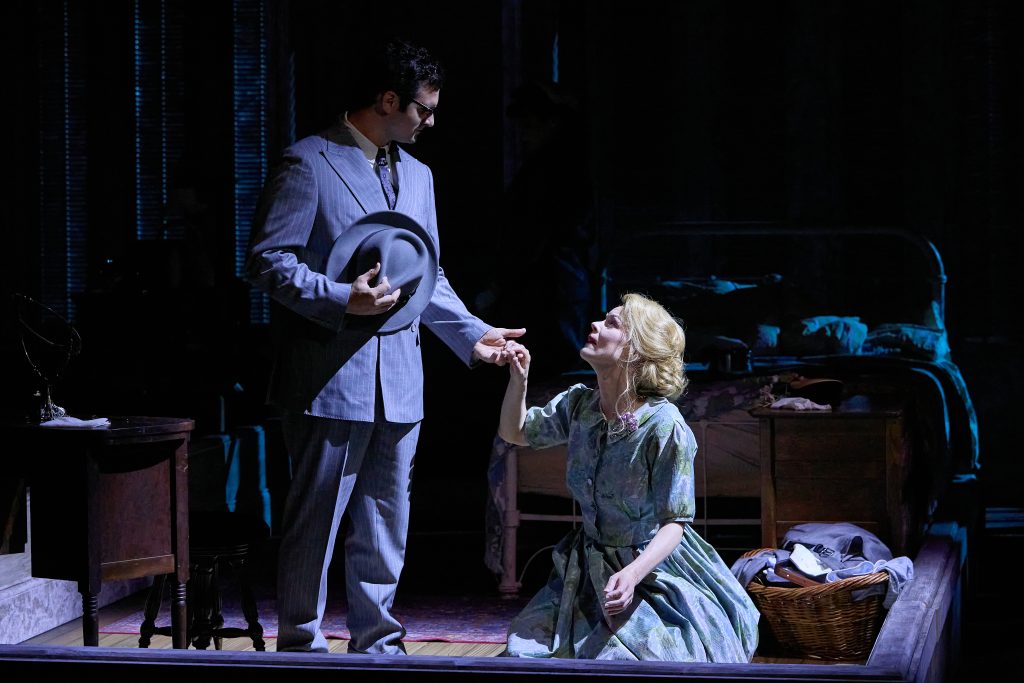
The projections prove equally effective throughout the evening. Most haunting is the appearance of Blanche’s young husband, whose portrait looms over the stage just as relentlessly as his memory looms over her life.
Throughout the evening, projections become another actor in the drama, carrying memory and desire across Boyce’s towering walls. By the time Blanche reaches her final music, Gartland and the production have earned every note of it.
“A Streetcar Named Desire” continues at Opera Theatre of Saint Louis through June 26 at the Loretto-Hilton Center on the Webster University campus as part of OTSL’s 2026 Festival Season. Ticket information, performance schedules and additional production details are available on the Opera Theatre of Saint Louis website.
CB Adams is an award-winning fiction writer and photographer based in the Greater St. Louis area. A former music/arts editor and feature writer for the St. Louis Globe-Democrat, his non-fiction has been published in local, regional and national publications. His literary short stories have been published in more than a dozen literary journals and his fine art photography has been exhibited in more than 40 galley shows nationwide. Adams is the recipient of the Missouri Arts Council’s highest writing awards: the Writers’ Biennial and Missouri Writing!. The Riverfront Times named him, “St. Louis’ Most Under-Appreciated Writer” in 1996.