
By CB Adams
Winter Opera St. Louis’ “Un Ballo in Maschera” succeeds through design. Dianna Higbee approaches Verdi’s tragedy as an architectural problem — how to assemble inevitability — and solves it with patience, proportion, and a clear understanding of where the drama must turn.
The result is an evening of quiet authority, its pressure accumulating through the deliberate arrival and consequence of Verdi’s great confessional arias, and supported by three solid, intelligent performances at its core.
This is Verdi at the height of his dramatic powers, writing in liberated form, where arias reorganize the action and reshape the moral terrain. Higbee honors that maturity by spacing those moments as structural pillars, allowing each confession to alter the dramatic balance. Tragedy unfolds by design, threshold by threshold, until the final masked ball arrives as the natural release of long preparation.
Beneath that design, the orchestra, under Andy Anderson’s direction, sustains the evening with clarity and proportion. Anderson shapes Verdi’s score with rhythmic lift and supple balance, allowing the architecture of the arias to emerge with natural ease rather than orchestral insistence.
Owing to the postponed performance and inclement weather, the harp part was realized at the piano and a bass was absent from the ensemble, adjustments that passed almost unnoticed in playing of such refinement.
Textures remained transparent, transitions breathed freely, and climaxes rose from accumulated pressure rather than display. The result gave Higbee’s pacing its continuous pulse while leaving the psychological weight squarely with the singers.
At the foundation of that design stands Isaac Hurtado’s Riccardo, the lighthearted governor whose charm quietly initiates the ruin to come. Hurtado sings “La rivedrò nell’estasi” with easy lyric brightness, establishing authority and allure without courting display.
Desire enters the drama gently here, almost casually, and that very ease becomes dangerous. Hurtado’s Riccardo remains humane throughout, a leader whose discipline delays catastrophe without preventing it.
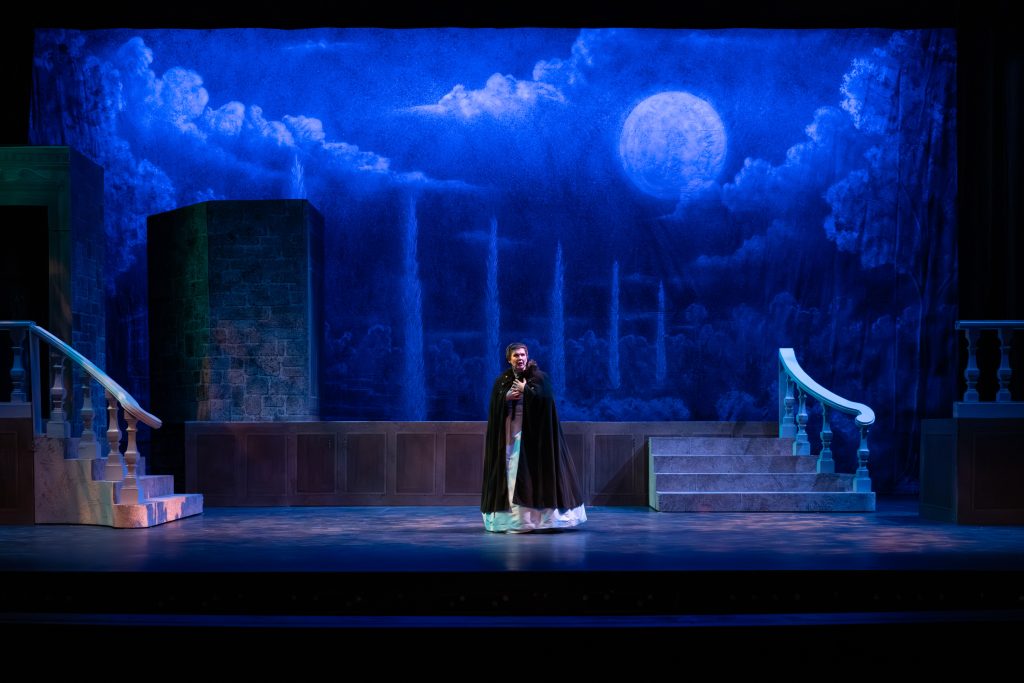
Liz Baldwin’s Amelia forms the opera’s moral center, and her performance anchors the evening with a rare balance of power and vulnerability. In “Morro, ma prima in grazia,” Baldwin shapes the line as an interior reckoning, the voice carrying fear, longing, and resolve in equal measure. This becomes the threshold where tragedy turns irreversible. After her confession, the emotional landscape shifts, and the opera’s remaining possibilities quietly contract.
The final structural pillar arrives with Joseph Gansert’s Renato. His transformation from loyal secretary to assassin unfolds with grim clarity, and in “Eri tu” Gansert delivers the evening’s defining rupture.
The aria rises as psychological collapse rather than bravura, the baritone’s force shaped by anguish rather than fury. Here the architecture locks into place. After this moment, the opera contains no alternatives, only ritual.
Verdi’s tragedy rests on the slow destruction of three people who love one another, and Higbee allows that triangle to emerge with uncommon coherence. Riccardo’s charm, Amelia’s conscience, and Renato’s wounded loyalty form a geometry that builds its own ruin, confession by confession, until fate requires only a public stage.
Around that core, the production finds its colors with intelligence. Ola Rafalo’s Ulrica delivers prophecy with impassive authority, her restraint giving fate the calm weight of certainty — a discipline owed as much to Higbee’s direction as to the mezzo’s control.
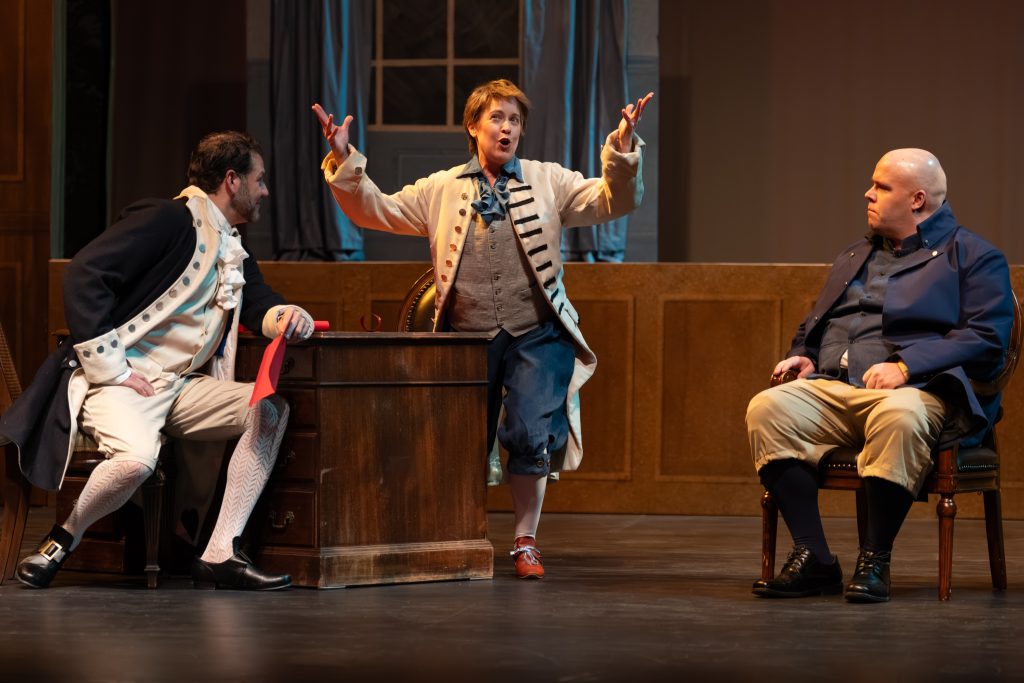
At the opposite pole, Leann Schuering’s Oscar, one of opera’s classic “pants” roles, emerges as sprightly, puckish, almost Chaplinesque, her physical wit and bright tone preserving humanity inside gathering darkness.
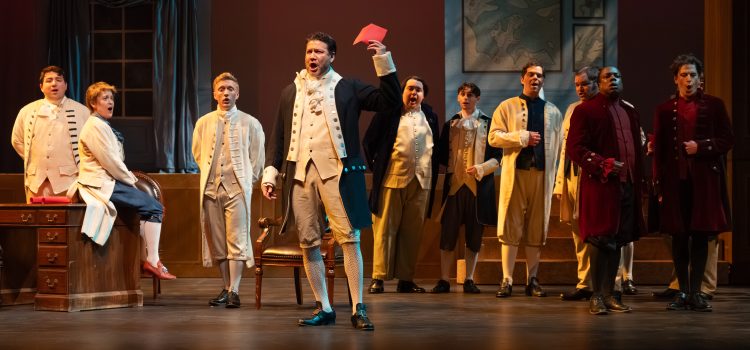
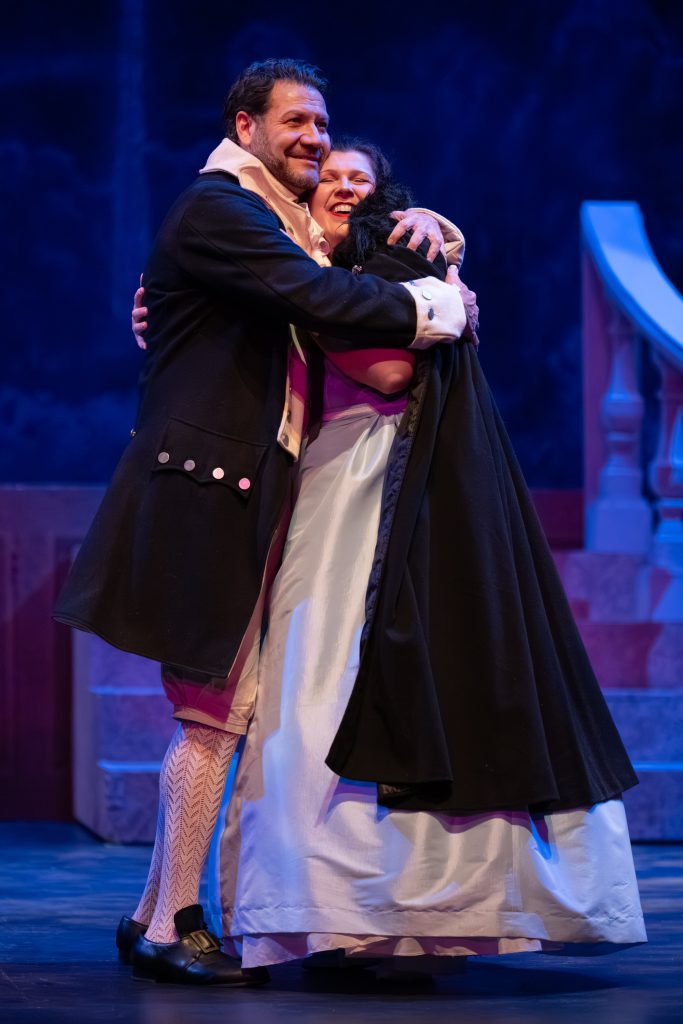
The visual world reinforces that architecture with quiet intelligence. Drawing on the Boston setting and the approaching 250th anniversary of the American Revolution, Higbee frames the drama in a clear chromatic language, Americans in blue set against the red of their British adversaries, the evening moving steadily toward a Fourth of July finale shadowed by catastrophe.
Jen Blum-Tatara’s costumes clarify status and psychology while lending the masked ball its necessary ceremony, sharpening the sense of ritual that governs the final act.
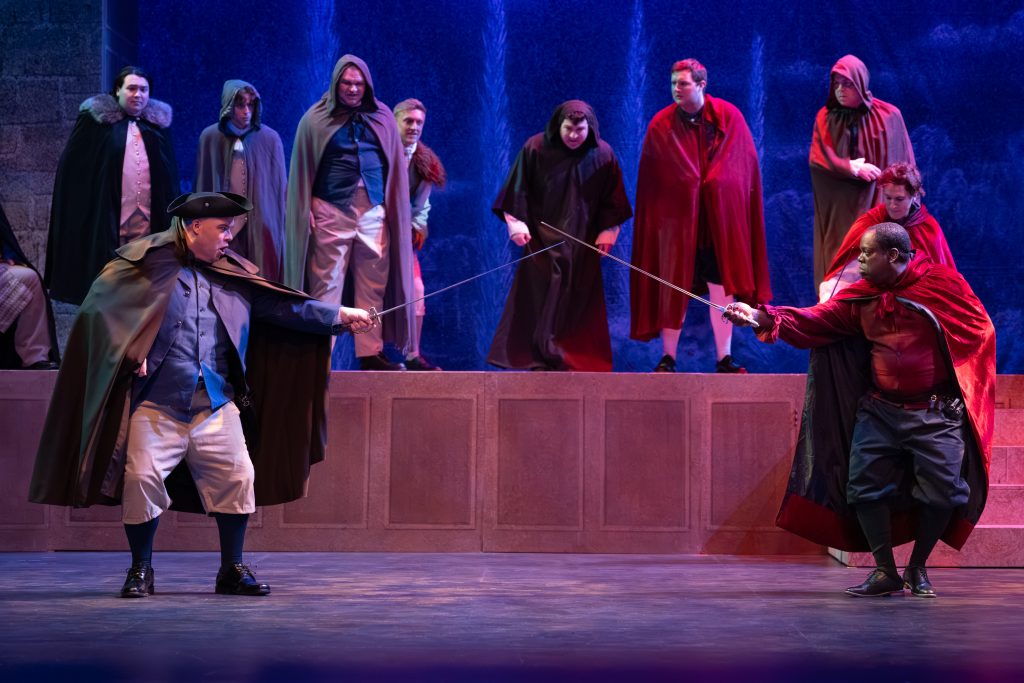
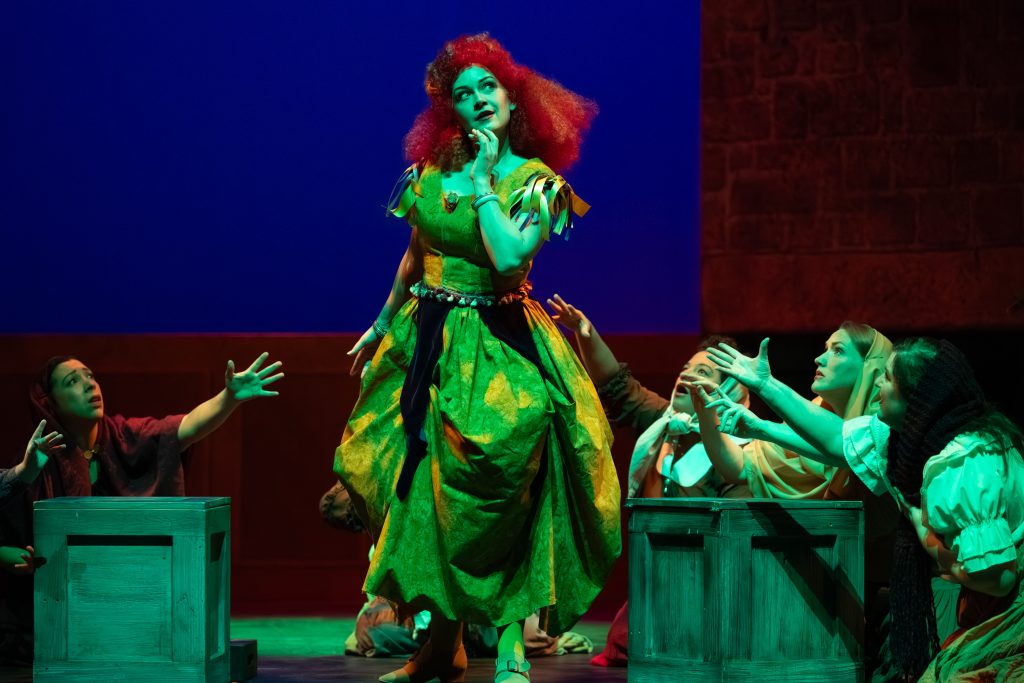
Dennis Milam Bensie’s wigs, exuberant and faintly surreal, introduce flashes of visual fantasy — a hint of Oz in their theatrical whimsy, a touch of “Barry Lyndon” in their powdered hauteur, and the occasional echo of Lynch’s “Dune” in their ceremonial strangeness — reminding us that disguise here belongs as much to dream and ritual as to history.
This “Ballo” makes its case through proportion rather than display. Higbee’s design vindicates Verdi’s mature craftsmanship, allowing voices, confession, and consequence to assemble a tragedy that unfolds with discipline and grace. The memory it leaves is not of a single high note, but of a long arc patiently carried, voice by voice, into ruin.
Winter Opera St. Louis presented “Un Ballo in Maschera” at the Kirkwood Performing Arts Center. The production originally ran Jan. 23–26, 2026.
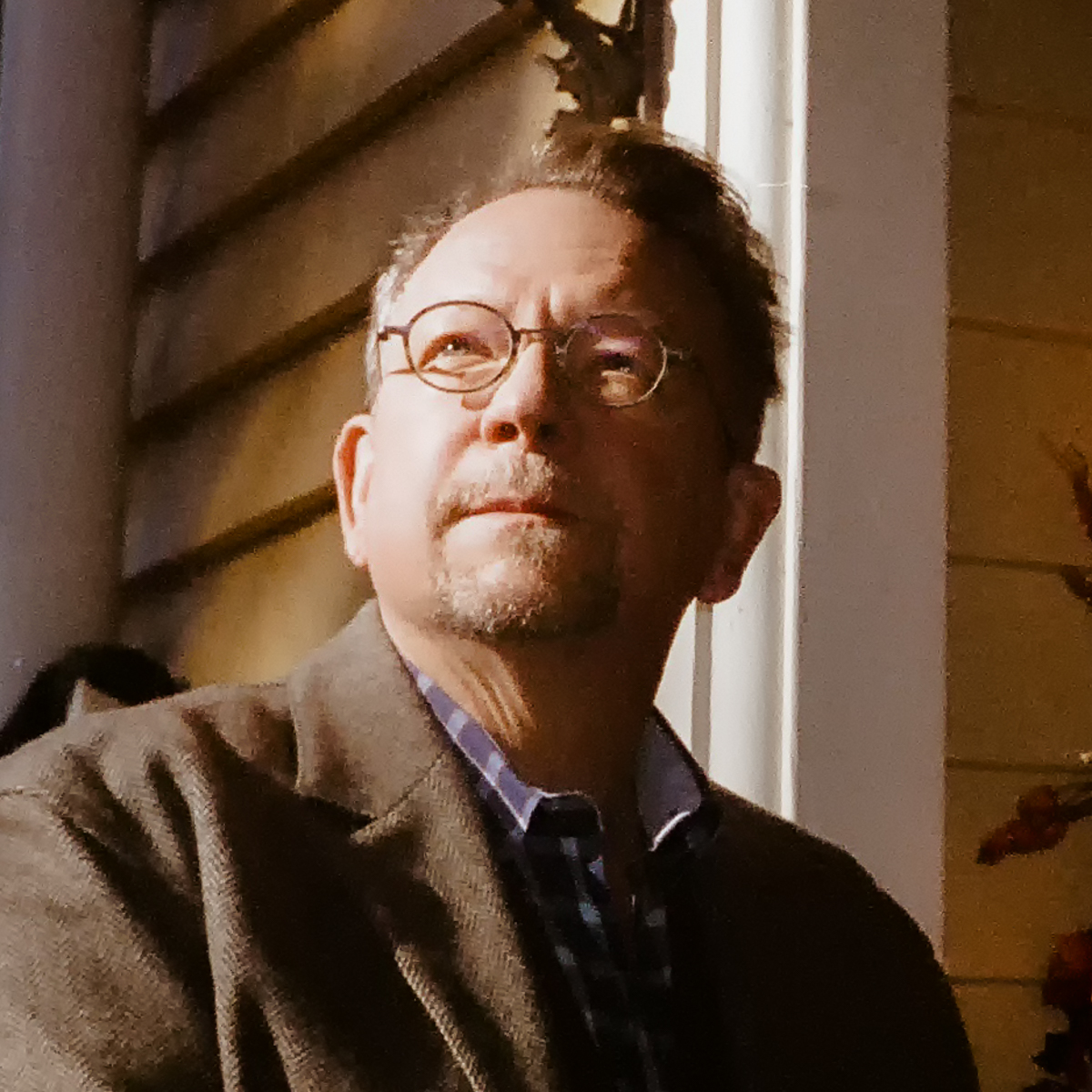
CB Adams is an award-winning fiction writer and photographer based in the Greater St. Louis area. A former music/arts editor and feature writer for the St. Louis Globe-Democrat, his non-fiction has been published in local, regional and national publications. His literary short stories have been published in more than a dozen literary journals and his fine art photography has been exhibited in more than 40 galley shows nationwide. Adams is the recipient of the Missouri Arts Council’s highest writing awards: the Writers’ Biennial and Missouri Writing!. The Riverfront Times named him, “St. Louis’ Most Under-Appreciated Writer” in 1996.