By Alex McPherson

Director Matt Johnson’s “Tony” is an excellently acted mini-biopic that goes beyond  familiar plot beats to paint a textured portrait of a fascinating, troubled soul.

Adapted from a few chapters of Bourdain’s 2000 memoir, Kitchen Confidential: Adventures in the Culinary Underbelly, “Tony” takes place over the summer of 1975, when 19-year-old Anthony Bourdain (Dominic Sessa), a cocky student at Vassar College, dreams of becoming the next Great American novelist.

He’s super confident he’ll receive a grant from the school’s Fellowship Committee — too confident, actually. He even works up the courage to chat up Nancy (Emilia Jones), a high school crush, and learns she’s headed to Provincetown for summer break. 

He’s rejected for the grant, but Bourdain will be damned if he admits to anyone he didn’t get it, especially his judgmental mother (Dagmara Dominczyk). He tells his family he got the fellowship and travels to Provincetown to track Nancy down. He finds her, but discovers she has a boyfriend. 

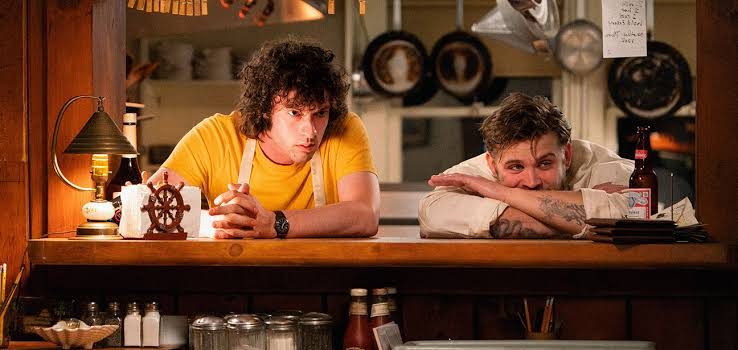
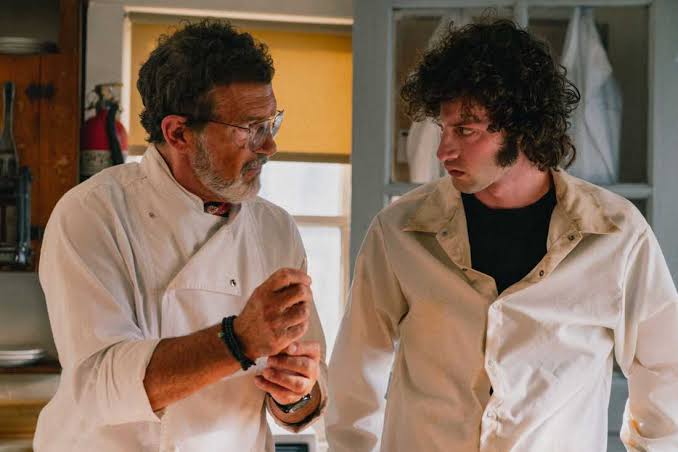
A drunken Bourdain is beaten up shortly afterwards at a local bar, The Flagship, and is thrown out on the street. He later finds himself (without his wallet) in a beachside hammock on a residence owned by The Flagship’s head “Chef” (Antonio Banderas). Chef takes pity on down-on-his-luck Bourdain and offers him a job as a dishwasher.
Through reluctantly accepting this new gig, Bourdain becomes immersed in the culinary world in all its messiness and joys, and we catch glimpses of the influential chef he’ll ultimately become. 

With a premise like this, “Tony” seems like it’ll follow a conventional trajectory, and, generally, it does. But one mustn’t underestimate the directorial verve of Johnson (director of “Nirvanna the Band the Show the Movie” and “BlackBerry”), who finds humor, pathos, and surprising authenticity between the lines.

Nuance abounds in “Tony,” which examines its central subject without sanding down his idiosyncratic brilliance or the darkness and self-destructiveness lurking beneath his confident façade. It doesn’t depend on previous knowledge of Bourdain to succeed as a coming-of-age story in its own right.

The film’s lived-in charms are supported by filmmaking that builds a deep, sun-tinged sense of place. Johnson captures the trauma-bonded camaraderie and undeniable thrill of working in restaurant kitchens, and recreates 1975 Provincetown with striking attention to detail.

Numerous outdoor shots are draped in a wistful, golden hour glow beautifully filmed by cinematographer Michael Bauman and soundtracked to a collection of pitch-perfect needle drops. He also conveys Bourdain’s loneliness and alienation, by initially having him drift through bustling places like an invisible outcast.

Sessa is downright magnetic as Bourdain, capturing his charisma and bravado along with his self-pity and deep-seated feelings of inadequacy, lending even the film’s more outright comedic moments a sense of melancholy. This is especially effective if you know the struggles of Bourdain’s later years.

Bourdain, as written by Johnson, Todd Bartels, Lou Howe, and Matthew Miller, struggles to reconcile the person he wants to become (a writer who we never actually see write anything) with who he actually is.

He’s unable to admit to himself and to others (particularly Nancy) that his life is following a different trajectory than what he had initially planned. He’s adrift, searching for a sense of direction, and his experiences at The Flagship present different paths he could head down.

Bourdain strikes up a friendship with Sal (an outstandingly live-wire Leo Woodall), a hard-partying, womanizing, rebellious coworker who helps bring him out of his slump while tempting him with numerous vices.

But it’s really “Chef” who truly connects; Banderas brings a deep sense of wisdom and tough love that helps unlock Bourdain’s eventual passion for food, even if he takes too much joy in splashing a bucket of ocean water on Bourdain’s face every morning before work. 

Both Sal and Chef (created as amalgamations of various people Bourdain met throughout his career) are vividly realized with a naturalism and dry wit that feels real and decidedly un-Hollywood.

Each provides Bourdain with different paths he could follow, if he’s willing to finally grow up. The supporting cast, including Stavros Halkias, Michael Jibrin, and Monica Raymond, is fantastic; frankly, they’re just a fun group to hang out with.

Emilia Jones as Nancy is given far less to work with here, and it’s clear that “Tony” doesn’t quite know what to do with her besides make her an object of Bourdain’s obsession and eventual growth. At several points, the camera seems to linger creepily over Jones — whether or not we’re supposed to be viewing Nancy through Bourdain’s eyes, it’s off-putting and distracting.

When “Tony” nears its conclusion, though, the more generic aspects of the narrative fall away to leave us with surprising poignancy. The film reminds us to live in the moment and not confine ourselves to expectations. It becomes a more truthful tribute to the real Bourdain (and a fuller  meal) than any hagiographic biopic could ever be.

“Tony” is a 2026 biopic directed by Matt Johnson and starring Dominic Sessa, Antonio Banderas, Emilia Jones, Leo Woodall, Stavros Halkias, Dagmara Dominczyk, Michael Jibrin, Monica Raymund and Rich Sommer. It is Rated R for pervasive language, drug use, and sexual content/nudity and is 1 hour, 46 minutes. It opened in theatres Aug. 21. Alex’s Grade: A-

By Alex McPherson 

A darkly comedic story of game-changing technology and capitalism’s fateful hand, director Matt Johnson’s “BlackBerry” is a sublimely well-acted, bittersweet film that’s both laugh-out-loud funny and emotionally raw.

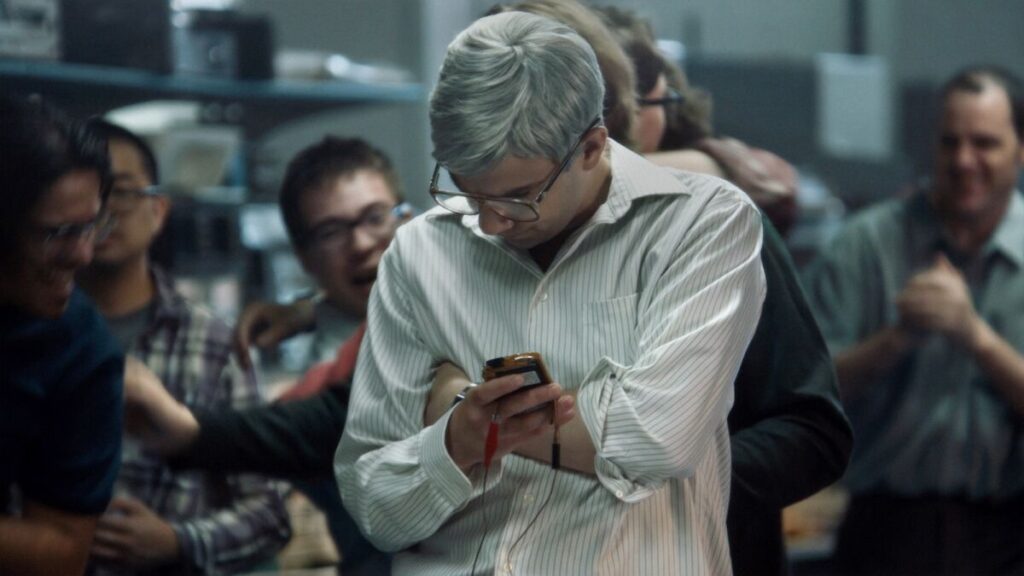
Based on the book Losing the Signal: The Untold Story Behind the Extraordinary Rise and Fall of BlackBerry by Jacquie McNish and Sean Silcoff, the film begins in 1996 in Waterloo, Ontario, at a small company called Research in Motion (RIM) — founded by two pioneering tech/pop culture geeks, the soft-spoken Mike Lazaridis (Jay Baruchel) and his boisterous, morale-boosting BFF, Doug Fregin (Johnson). They’ve made a breakthrough: a product combining a cellphone, email device, and pager all-in-one.

Mike, Doug, and their team are passionate and exude a sense of innocence, separated from the gloom of corporate bureaucracy. Their cluttered office, full of nerds whose technical skills are matched only by their knowledge of all things movies and video games, is lively and laid-back, but they lack the “marketing expertise” (and maybe the maturity) necessary to make a name for themselves. They remain millions of dollars in debt due to a terminated contract for a modem they constructed.

Fortunately, or unfortunately, they attract the attention of corporate shark Jim Balsillie (Glenn Howerton, of “It’s Always Sunny in Philadelphia” fame), freshly fired from a company that Mike and Doug clumsily pitched to. Jim sells himself as someone who could make their product (originally called the “Pocketlink”) a best seller, if he gets 50% of the company, he’s made co-CEO, and they change its name.

Mike hires him (much to Doug’s disapproval), and Jim helps launch their company into the stratosphere, leaving scruples firmly in the dust. With a vicious ego, penchant for manipulation, and aggressive marketing instincts, Jim’s “help” proves to be a blessing and a curse, as BlackBerry emerges as the world’s first smartphone and essentially changes the lives of everyone on the planet.

This image released by IFC Films shows actor and director Matt Johnson on the set of “BlackBerry.” (IFC Films via AP)

With strong performances, kinetic direction, and a screenplay that masterfully balances hilarity and wistful sorrow, “BlackBerry” is a timely story of dreams, greed, repercussions, and fractured relationships. Johnson’s film isn’t merely a eulogy for a company slain by progress, but a harsh reminder of the risks intermingled with success, and what can be lost in the pursuit of greatness.

“BlackBerry” begins as a droll comedy, as Mike and Doug — two instantly likable dudes — bumble around trying to get their initial product off the ground. Mike is non-assertive and mild-mannered, a perfectionist who’s more focused on the minutiae of the products themselves than handling business dealings with investors. Similarly, the headband-wearing Doug is a lovable goofball, just as concerned with weekly office movie nights as meeting deadlines.

Johnson mines Mike and Doug’s “ineptitude” (which could also be viewed as happy-go-lucky purity) to deliciously comedic effect. Cinematographer Jared Raab’s camera captures the action with jittery, fly-on-the-wall framing that zeroes in on awkward pauses and cringe comedy, particularly in juxtaposing their amiability with Jim, who slings a never-ending supply of expletives that Howerton delivers with scenery-chewing delight. Jay McCarrol’s pulsating electronic score accentuates moments of panic among the team, at one point mirroring Mike’s increasing heart rates to memorable effect. 

Jim has a lot at stake, gambling his mortgage to pay RIM’s employees, and “BlackBerry” emphasizes the ways his dogged, aggressive approach benefits the company and zaps the humanity, camaraderie, and playfulness that was critical to the team’s dynamic. Jim’s more concerned with his own “status” than that of BlackBerry itself, willing to browbeat employees and yell nonstop to get what he wants (including, for example, owning part of the NHL — he is Canadian, after all). The vast collection of masks in his office reflect the elaborate performance he’s putting on to ensure his credibility.

Without dumbing down the technical side of things, the screenplay (by Johnson and Matthew Miller) mines comedic gold out of juxtaposing Jim’s monstrousness with Mike and Doug’s far different approaches to life and work, while also focusing on the small-scale connections (forged and broken) that form the backbone of BlackBerry’s tragic story. Indeed, it’s interesting to learn about Mike’s innovations and Jim’s promotional expertise, resulting in BlackBerry at one point owning 45% of the cellphone market. Johnson’s film, however, makes a lasting impact through its focus on the people at its center, and the personal fallout that can result from sky-high success.

Baruchel expertly embodies Mike’s innocence and gradual de-evolution: a person who’s instantly endearing, yet swept up in his own hubris and competitiveness as the company grows and is eventually derailed by the release of the iPhone. Mike’s timidity is replaced by sternness, leading to saddening moments of conflict with Doug, to whom Johnson brings a warmth that’s extinguished by others’ greed and lack of integrity.

Howerton is the standout by far, though, bringing to life a real piece of work that’s never less than entertaining to watch, even when wincing at his wildly over-the-top outbursts and financial dealings that (hopefully, at least) will come back to bite him in the ass. Michael Ironside, Saul Rubinek, Cary Elwes, Rich Sommer, and SungWon Cho make the most of small-yet-notable supporting roles. 

“BlackBerry” unfolds at a brisk pace, presenting a ground-level view of the team’s growth and decline that doesn’t paint its central players in black-and-white absolutes. If there’s a true villain in “BlackBerry,” it’s the capitalistic system that drives people like Mike over-the-edge, rewards cutthroat competitiveness above attention to detail, and saps compassion from even the most good-natured souls. 

This isn’t necessarily a “new” message, mind you, but Johnson’s film (far more so than the other crop of brand-focused films “Air” and “Tetris”) is a slyly powerful meditation on creativity and teamwork by its disheartening conclusion. Knowing what happens from the outset lessens suspense to a certain degree, but there’s still a dark thrill in seeing personal values ebb and flow as proceedings get increasingly out of control, and whether or not consequences are wrought upon the appropriate parties. This renders the rushed dénoument somewhat anticlimactic, revealing information through text that would have been compelling to watch through Johnson’s lens instead.

“BlackBerry” remains a gripping watch all the same, an empathetic view into the thorny weeds of business, and a cautionary tale about the human condition.

Jay Baruchel as Mike Lazaridis in “BlackBerry”

“BlackBerry” is a 2023 comedy-drama-biopic directed by Matt Johnson and starring Johnson, Jay Baruchel, Glenn Howerton, Rich Sommer, Cary Elwes, Saul Rubinek, SungWon Cho, and Michael Ironside. It is rated R for language throughout and run time is 2 hours. It opened in theatres May 12. Alex’s Grade: A-.