
By Alex McPherson
Director Matt Johnson’s “Tony” is an excellently acted mini-biopic that goes beyond familiar plot beats to paint a textured portrait of a fascinating, troubled soul.
Adapted from a few chapters of Bourdain’s 2000 memoir, Kitchen Confidential: Adventures in the Culinary Underbelly, “Tony” takes place over the summer of 1975, when 19-year-old Anthony Bourdain (Dominic Sessa), a cocky student at Vassar College, dreams of becoming the next Great American novelist.
He’s super confident he’ll receive a grant from the school’s Fellowship Committee — too confident, actually. He even works up the courage to chat up Nancy (Emilia Jones), a high school crush, and learns she’s headed to Provincetown for summer break.
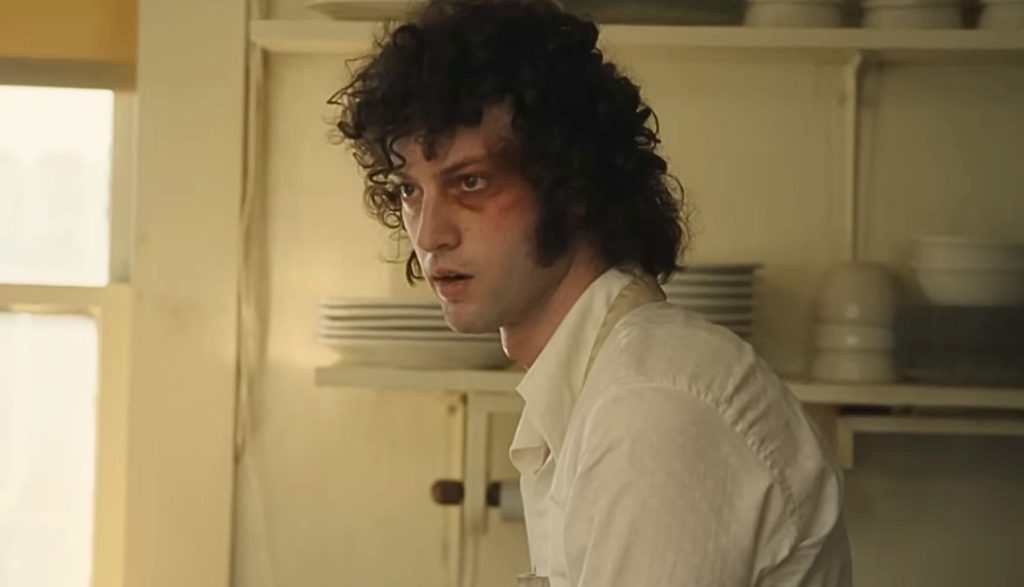
He’s rejected for the grant, but Bourdain will be damned if he admits to anyone he didn’t get it, especially his judgmental mother (Dagmara Dominczyk). He tells his family he got the fellowship and travels to Provincetown to track Nancy down. He finds her, but discovers she has a boyfriend.
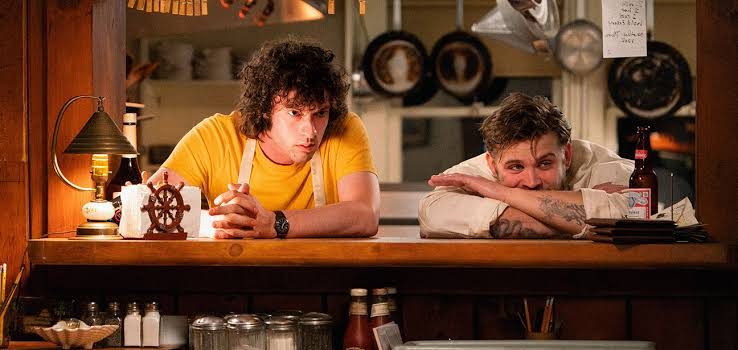
A drunken Bourdain is beaten up shortly afterwards at a local bar, The Flagship, and is thrown out on the street. He later finds himself (without his wallet) in a beachside hammock on a residence owned by The Flagship’s head “Chef” (Antonio Banderas). Chef takes pity on down-on-his-luck Bourdain and offers him a job as a dishwasher.
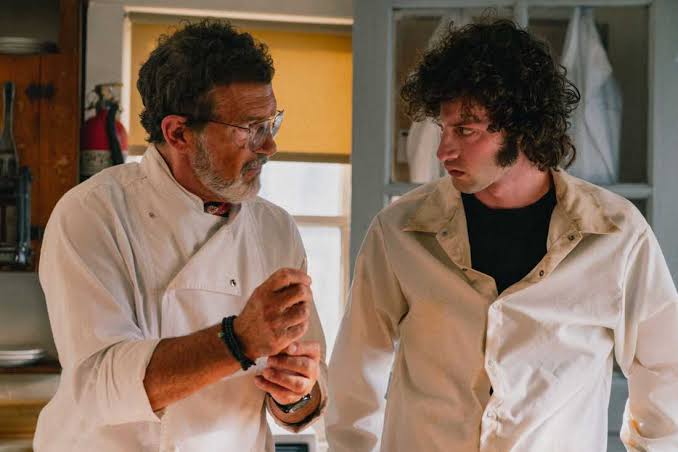
Through reluctantly accepting this new gig, Bourdain becomes immersed in the culinary world in all its messiness and joys, and we catch glimpses of the influential chef he’ll ultimately become.
With a premise like this, “Tony” seems like it’ll follow a conventional trajectory, and, generally, it does. But one mustn’t underestimate the directorial verve of Johnson (director of “Nirvanna the Band the Show the Movie” and “BlackBerry”), who finds humor, pathos, and surprising authenticity between the lines.
Nuance abounds in “Tony,” which examines its central subject without sanding down his idiosyncratic brilliance or the darkness and self-destructiveness lurking beneath his confident façade. It doesn’t depend on previous knowledge of Bourdain to succeed as a coming-of-age story in its own right.
The film’s lived-in charms are supported by filmmaking that builds a deep, sun-tinged sense of place. Johnson captures the trauma-bonded camaraderie and undeniable thrill of working in restaurant kitchens, and recreates 1975 Provincetown with striking attention to detail.
Numerous outdoor shots are draped in a wistful, golden hour glow beautifully filmed by cinematographer Michael Bauman and soundtracked to a collection of pitch-perfect needle drops. He also conveys Bourdain’s loneliness and alienation, by initially having him drift through bustling places like an invisible outcast.
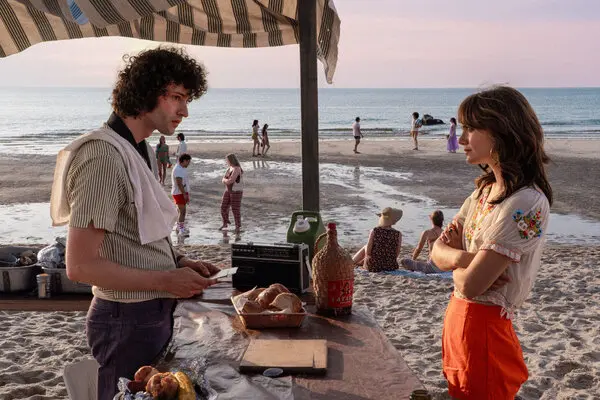
Sessa is downright magnetic as Bourdain, capturing his charisma and bravado along with his self-pity and deep-seated feelings of inadequacy, lending even the film’s more outright comedic moments a sense of melancholy. This is especially effective if you know the struggles of Bourdain’s later years.
Bourdain, as written by Johnson, Todd Bartels, Lou Howe, and Matthew Miller, struggles to reconcile the person he wants to become (a writer who we never actually see write anything) with who he actually is.
He’s unable to admit to himself and to others (particularly Nancy) that his life is following a different trajectory than what he had initially planned. He’s adrift, searching for a sense of direction, and his experiences at The Flagship present different paths he could head down.
Bourdain strikes up a friendship with Sal (an outstandingly live-wire Leo Woodall), a hard-partying, womanizing, rebellious coworker who helps bring him out of his slump while tempting him with numerous vices.
But it’s really “Chef” who truly connects; Banderas brings a deep sense of wisdom and tough love that helps unlock Bourdain’s eventual passion for food, even if he takes too much joy in splashing a bucket of ocean water on Bourdain’s face every morning before work.
Both Sal and Chef (created as amalgamations of various people Bourdain met throughout his career) are vividly realized with a naturalism and dry wit that feels real and decidedly un-Hollywood.
Each provides Bourdain with different paths he could follow, if he’s willing to finally grow up. The supporting cast, including Stavros Halkias, Michael Jibrin, and Monica Raymond, is fantastic; frankly, they’re just a fun group to hang out with.

Emilia Jones as Nancy is given far less to work with here, and it’s clear that “Tony” doesn’t quite know what to do with her besides make her an object of Bourdain’s obsession and eventual growth. At several points, the camera seems to linger creepily over Jones — whether or not we’re supposed to be viewing Nancy through Bourdain’s eyes, it’s off-putting and distracting.
When “Tony” nears its conclusion, though, the more generic aspects of the narrative fall away to leave us with surprising poignancy. The film reminds us to live in the moment and not confine ourselves to expectations. It becomes a more truthful tribute to the real Bourdain (and a fuller meal) than any hagiographic biopic could ever be.
“Tony” is a 2026 biopic directed by Matt Johnson and starring Dominic Sessa, Antonio Banderas, Emilia Jones, Leo Woodall, Stavros Halkias, Dagmara Dominczyk, Michael Jibrin, Monica Raymund and Rich Sommer. It is Rated R for pervasive language, drug use, and sexual content/nudity and is 1 hour, 46 minutes. It opened in theatres Aug. 21. Alex’s Grade: A-

Alex McPherson is an unabashed pop culture nerd and a member of the St. Louis Film Critics Association.
