Gaetano Donizetti’s “L’elisir d’amore” (“The Elixir of Love”) has delighted audiences for nearly two centuries. Union Avenue Opera’s current production, directed by Jon Truitt, captures the qualities that have given the opera its enduring appeal, never letting the comedy outrun the romance while unfolding the story in a warmly inhabited world where laughter and love spring from the same shared ground.
The story follows the shy Nemorino as he turns to a fake love potion in hopes of winning the independent Adina. Truitt never loses sight of the relationship at the story’s center, allowing it to deepen patiently until its conclusion feels earned.
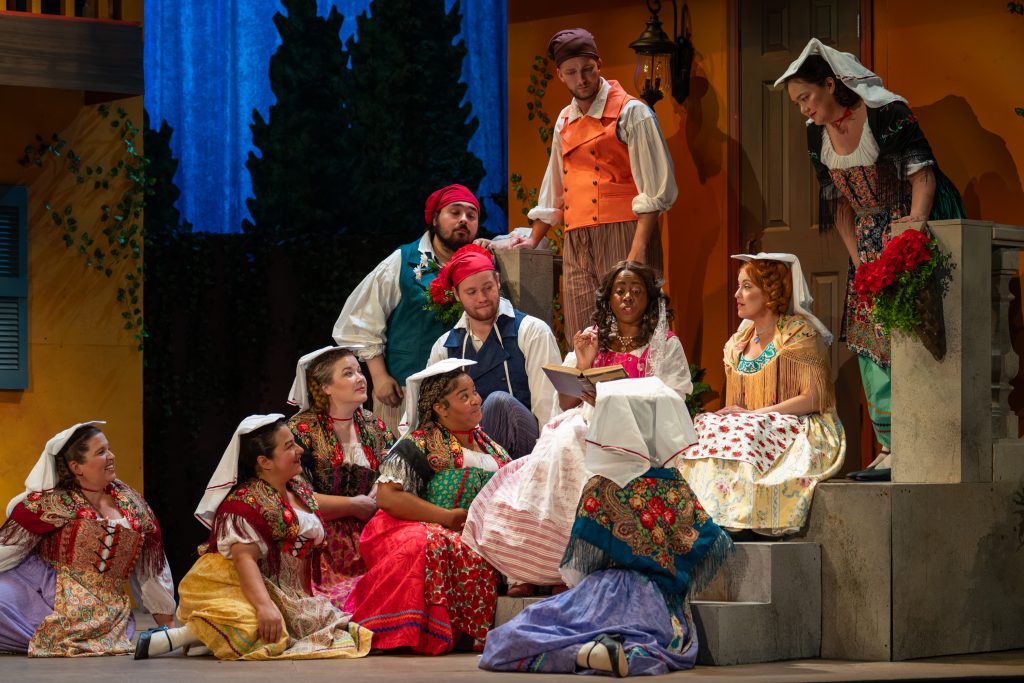
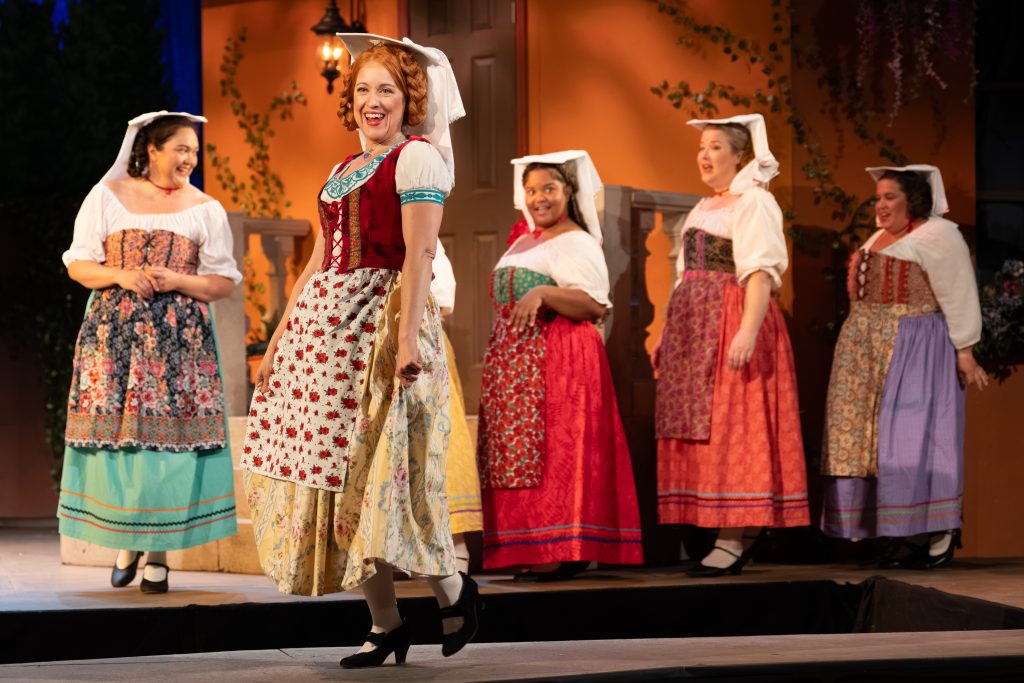
Laura Skroska’s scenic design gives the Basque village the patina of a place where life has been unfolding long before the audience arrived. Patrick Huber’s lighting, Teresa Doggett’s costumes and Truitt’s fluid staging become the visual equivalent of bel canto itself. Nothing calls attention to itself because everything belongs.
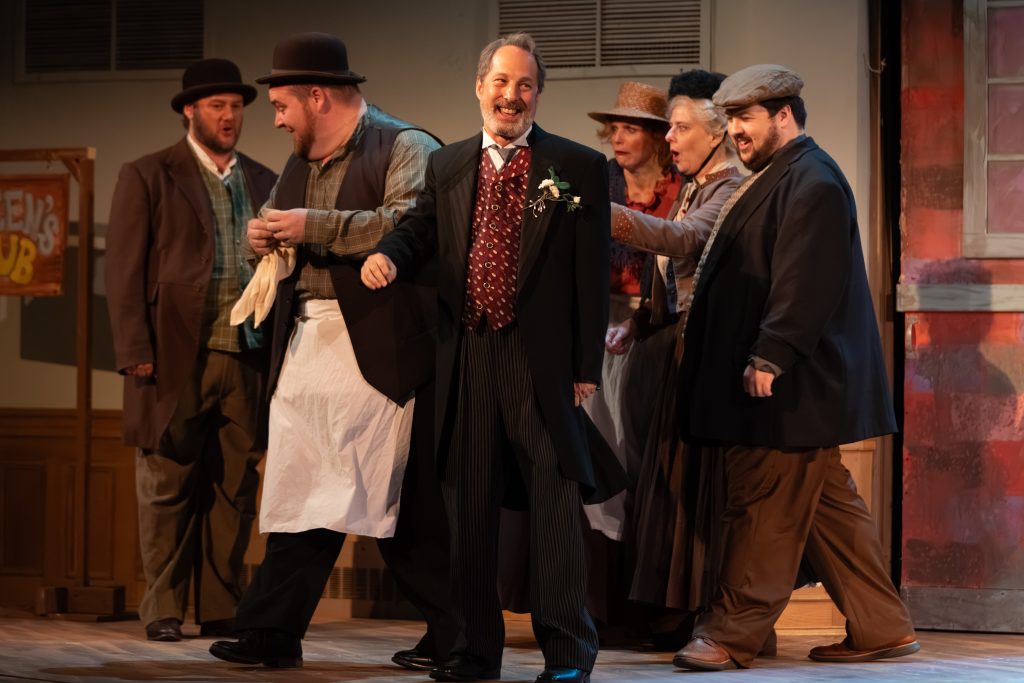
Union Avenue Opera cast. Dan Donovan Photography.
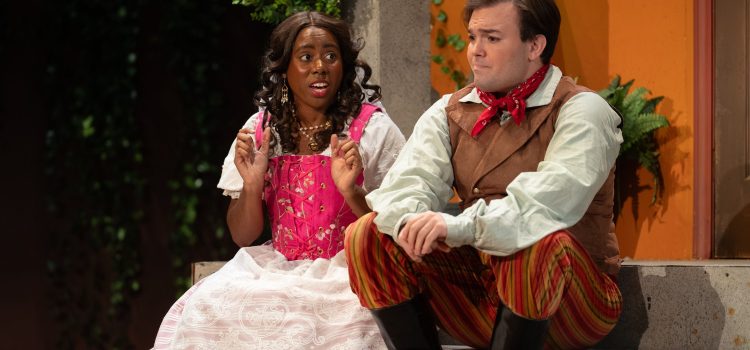
Charles Calotta gives Nemorino an unaffected sincerity that makes his innocence touching rather than naïve. Kyaunnee Richardson preserves Adina’s independence, allowing confidence to yield gradually to recognition. Their relationship emerges through accumulated moments rather than grand declarations.
That sense of place extends beyond the scenery. The chorus never fades into the background. It remains part of the village’s daily life, so the world Truitt creates continues even when the audience’s attention belongs elsewhere.
Then there are the voices.
One of the evening’s pleasures comes from hearing Charles Calotta, John Robert Green and Junhan Choi let their unamplified voices bloom. From Union Avenue Opera’s relatively small stage, those voices seem to take on a life of their own as they move through the theater, creating the exhilarating illusion that they are still expanding long after they leave the singers.
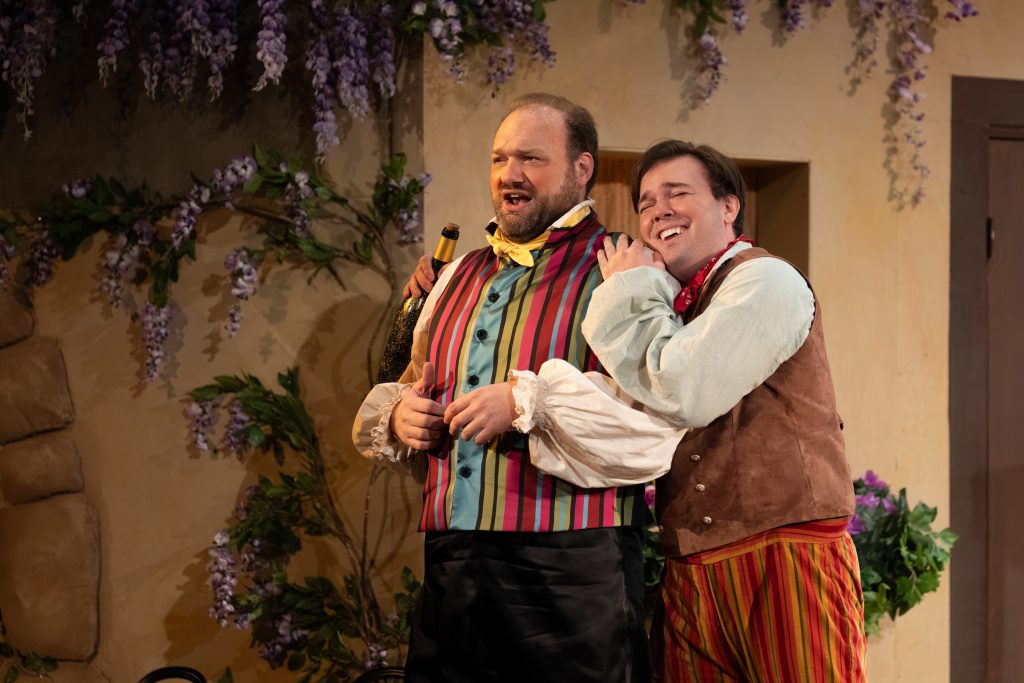
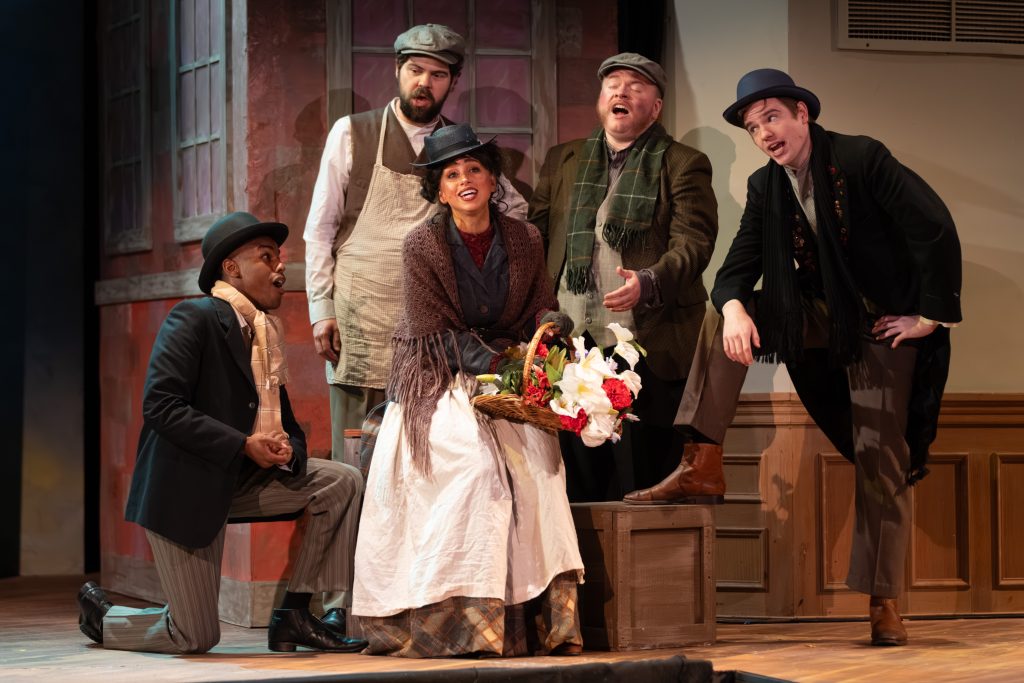
John Robert Green as Dulcamara and Charles Calotta as Nemorino in UAO’s L’elsir d’amore. Dan Donovan Photography.
Just as impressive, Kyaunnee Richardson belongs in that company. As Adina, she matches their warmth, assurance and presence while remaining unmistakably herself.
Calotta’s unaffected sincerity culminates in a beautifully judged “Una furtiva lagrima,” sung with warmth, restraint and quiet wonder as Nemorino realizes Adina has loved him all along. Green’s Doctor Dulcamara arrives knowing every crowd wants to believe the impossible.
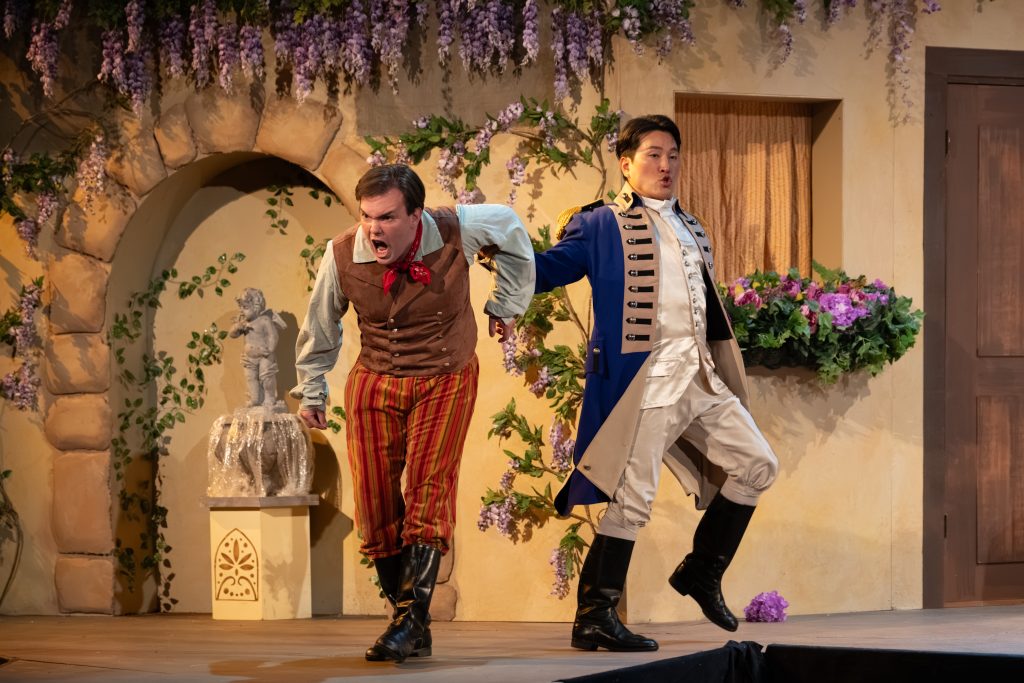
Truitt occasionally nudges the comedy toward “The Pirates of Penzance,” though Green’s confidence is so complete that believing him almost seems reasonable. Choi gives Sergeant Belcore enough swagger and vocal authority to become a genuine rival rather than merely a comic obstacle, while Leann Schuering’s bright, observant Giannetta quietly binds the principals to the life of the village around them.
Charles Calotta as Nemorino and Junhan Choi as Belcore in UAO’s L’elsir d’amore.Dan Donovan Photography.
Music director and conductor Cara Chowning shapes Donizetti’s score with an unforced sense of flow, allowing it to sparkle without rushing its quieter moments. Throughout the evening, orchestra and stage breathe together, sustaining the warmth and humanity that make Union Avenue Opera’s “L’elisir d’amore” so satisfying.
Union Avenue Opera’s production of “L’elisir d’amore” was performed July 24-26, and July 31, Aug. 1, 2026, at Union Avenue Christian Church in St. Louis.
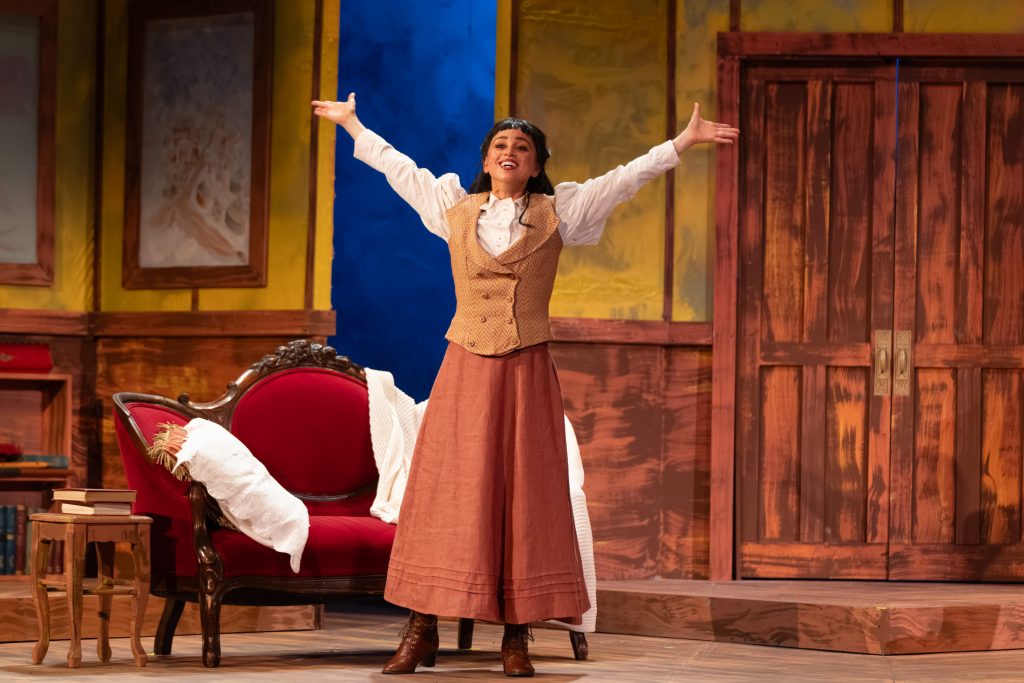
Leann Schuering as Giannetta in UAO’s L’elsir d’amore. Dan Donovan Photography.
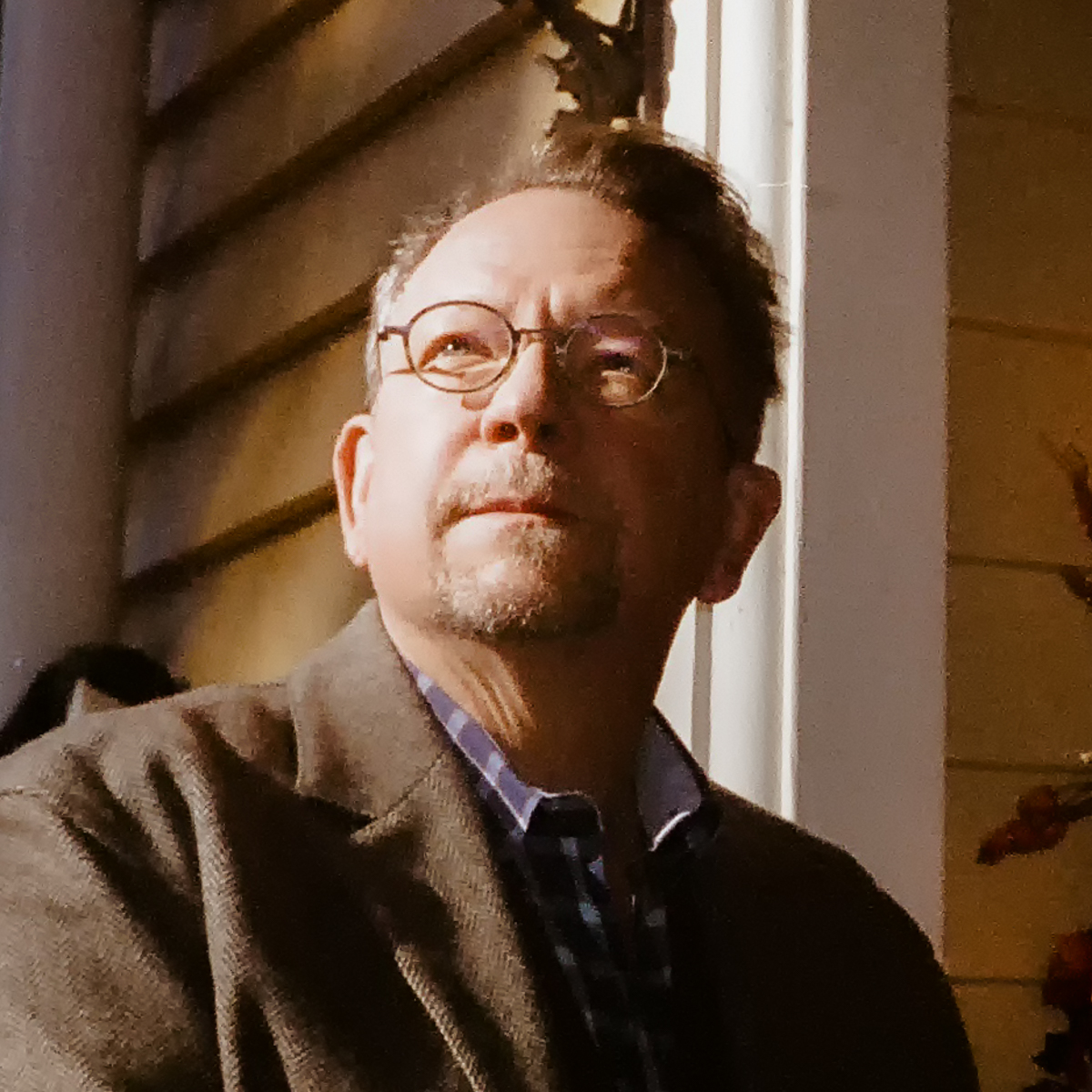
CB Adams is an award-winning fiction writer and photographer based in the Greater St. Louis area. A former music/arts editor and feature writer for the St. Louis Globe-Democrat, his non-fiction has been published in local, regional and national publications. His literary short stories have been published in more than a dozen literary journals and his fine art photography has been exhibited in more than 40 galley shows nationwide. Adams is the recipient of the Missouri Arts Council’s highest writing awards: the Writers’ Biennial and Missouri Writing!. The Riverfront Times named him, “St. Louis’ Most Under-Appreciated Writer” in 1996.
Once considered the sacred domain of soaring arias and tragic finales, the modern opera house has become an increasingly hospitable venue for the American musical. As audiences diversify and box offices face familiar headwinds, opera companies on both sides of the Atlantic are redrawing the boundary lines between Puccini and Porter, Mozart and Lerner & Loewe. These incursions into Broadway territory are not merely pragmatic gestures toward sustainability — though the allure of fresh demographics and fuller houses certainly plays its part. They also reflect a shift in artistic priorities: a recalibration of high and low, serious and popular, in which mid-century musicals once dismissed as cultural confections are now approached with curatorial seriousness and full orchestral forces.
The result is a kind of genre détente, one that invites reconsideration of works like “Carousel,” “West Side Story” and “My Fair Lady” for their melodic richness as well as for their dramatic substance. Yet this recontextualization brings with it inevitable tensions. Operatic grandeur can deepen a musical’s emotional resonance, but it can just as easily flatten the vernacular texture that gives it heart. When the scale tilts too far toward vocal opulence, the quicksilver wit of a lyric or the intimacy of a book scene can dissipate into the rafters.
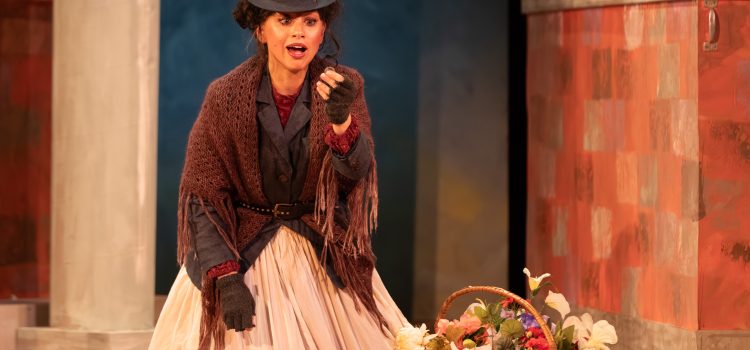
Dress rehearsal on July 2, 2025 for Union Avenue Opera’s production of My Fair Lady.
Union Avenue Opera’s “My Fair Lady” steps confidently into this evolving conversation — not as novelty or gimmick but as a fully realized statement of intent. Directed with restraint and elegance by Annamaria Pileggi, the production embraces the vocal and orchestral might of the opera house without losing sight of the musical’s theatrical spine. Unlike the heavily amplified Broadway revivals of recent decades, this staging offers an unamplified vocal experience, restoring a kind of sonic intimacy that harkens back to the musical’s 1956 premiere.
In the resonant acoustics of the opera house, spoken scenes and sung lines alike are given a natural immediacy — less glossy perhaps but more present, more human. The staging honors the show’s Edwardian polish while allowing its class-conscious undercurrents to simmer beneath the surface, even though some of the lines are lost (thank goodness for the supertitles!).
Much depends, of course, on the cast’s ability to navigate the delicate terrain between speech and song, between character and caricature. Here, the company largely succeeds, with performers who favor nuance over bombast and clarity over excess. The result is a “My Fair Lady” that reads not as a nostalgic nod to a bygone era but as a reclamation — of the work’s musical sophistication, certainly, but also of its enduring cultural bite, the proof of which may be the capacity audience at the July 6 matinee that I attended.
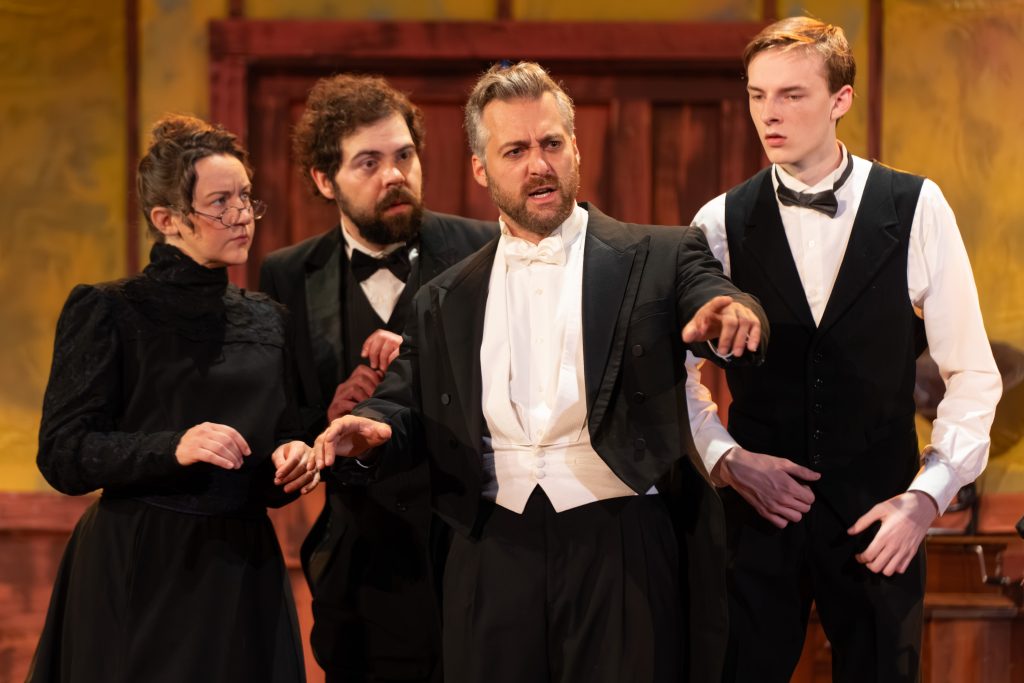
Dress rehearsal on July 2, 2025 for Union Avenue Opera’s production of My Fair Lady.
Musically, this “My Fair Lady” rests on a solid and sensitive orchestral foundation, conducted with finesse by Scott Schoonover, who also serves as UAO’s artistic director. Under his baton, the orchestra delivers Loewe’s lush, deceptively intricate score with clarity and warmth, never overwhelming the singers but instead supporting them with a rhythmic and emotional pliancy that elevates each number. It’s in the music — and in the vocal performances — that this production finds its center of gravity.
Freed from amplification, the voices bloom naturally in the hall, allowing phrasing, diction and dynamic shading to emerge with expressive immediacy. The decision to emphasize vocal and musical integrity over spectacle and fashion show proves a wise one. Though the scenic and visual design elements — Patrice J. Nelms’s versatile set, Teresa Doggett’s handsome period costumes, Patrick Huber’s unobtrusively evocative lighting and Melissa Wohlwend’s hats for Eliza — are all executed with polish, they serve as framing devices rather than focal points. This is a “My Fair Lady” that trusts the power of the human voice and live orchestra to carry the story — and earns that trust measure by measure.
At the heart of the production is Brooklyn Snow’s Eliza Doolittle, sung with a bright, ringing soprano and acted with a keen sense of Eliza’s evolving dignity. Snow navigates the character’s transformation with nuance, never sacrificing vocal precision for theatrical flourish. Her Eliza is neither overly precious nor overly hardened — a young woman who claims her own space in both Covent Garden and Embassy ballroom with equal conviction.
As Freddy Eynsford-Hill, Charles Calotta brings a youthful sincerity and a lyric tenor well-suited to “On the Street Where You Live,” which he delivers with a blend of open-hearted charm and vocal finesse. Calotta’s performance of this signature song is one of the highlights in this production.
Dress rehearsal on July 2, 2025 for Union Avenue Opera’s production of My Fair Lady.
Both Calotta and Trevor Martin, as the irascibly brilliant Henry Higgins, make impressive UAO debuts, as does veteran performer Steve Isom as the affably genteel Colonel Pickering. Martin’s Higgins is crisply articulated and appropriately cantankerous, yet avoids caricature. He finds flashes of vulnerability without softening the character’s harder edges. Isom brings warmth and ease to Pickering, serving as a steady counterbalance to Higgins’ intellectual bluster.
The supporting cast adds welcome texture and levity to the production, with several notable debuts. Paul Houghtaling makes a robust UAO entrance as Alfred P. Doolittle, Eliza’s roguish father. His affable bluster and rhythmic command enliven both of his big numbers — “With a Little Bit of Luck” and “Get Me to the Church on Time” — infusing them with energy and comic timing without tipping into excess.
Jennifer Theby-Quinn brings a crisp, clear-eyed presence to Mrs. Pearce, Higgins’ housekeeper, offering gentle authority that grounds the increasingly absurd domestic dynamics. And in scene-stealing turn, Donna Weinsting makes her company debut as Mrs. Higgins, Henry’s long-suffering mother. With pitch-perfect timing and a dry delivery that cuts like a well-honed butter knife, Weinsting elicits some of the evening’s most well-earned laughs. Together, these performers enhance the production’s character-driven approach, ensuring that even the secondary roles feel finely drawn and fully inhabited.
Dress rehearsal on July 2, 2025 for Union Avenue Opera’s production of My Fair Lady.
With “My Fair Lady,” Union Avenue Opera continues to demonstrate how a company rooted in traditional opera can expand its artistic reach without diluting its core identity. This production doesn’t chase Broadway spectacle or attempt to reinvent the musical; instead, it honors the integrity of the score and text while allowing the company’s operatic strengths — vocal rigor, live orchestration and musical detail — to illuminate the work anew. In doing so, UAO joins a growing chorus of opera houses exploring how canonical musicals can thrive in an acoustic, classically inflected setting.
If this “My Fair Lady” is any indication, such ventures are viable additions to the repertoire and not mere programming novelties. At a time when both opera and musical theater are searching for sustainable futures, productions like this one remind us that the border between genres is not a line to be guarded but a threshold to be crossed.
Union Avenue Opera’s “My Fair Lady” runs July 6-7 and 11-12 at the Union Avenue Christian Church. For more information: https://unionavenueopera.org.
Dress rehearsal on July 2, 2025 for Union Avenue Opera’s production of My Fair Lady.
CB Adams is an award-winning fiction writer and photographer based in the Greater St. Louis area. A former music/arts editor and feature writer for the St. Louis Globe-Democrat, his non-fiction has been published in local, regional and national publications. His literary short stories have been published in more than a dozen literary journals and his fine art photography has been exhibited in more than 40 galley shows nationwide. Adams is the recipient of the Missouri Arts Council’s highest writing awards: the Writers’ Biennial and Missouri Writing!. The Riverfront Times named him, “St. Louis’ Most Under-Appreciated Writer” in 1996.