By Alex McPherson

A masterpiece of experiential filmmaking that mines palm-sweating anticipation from what’s lurking around the next corner, director Kane Parsons’ “Backrooms” is an ambiguous yet utterly engrossing horror film for those willing to tune into its otherworldly frequency.

The film is based on 20-year-old Parsons’ YouTube series of the same name, which was inspired by the online liminal space “creepypasta” post on 4Chan from 2019. This newest iteration takes place in 1990 and focuses on Clark (Chiwetel Ejiofor), a failed-architect-turned-furniture-store-owner and alcoholic struggling after a recent divorce.

His ex-wife got the house, so Clark has taken up residence at the store. He’s seemingly resigned to a sad life running a defunct business and making embarrassing TV commercials where he’s dressed up like a pirate. 

He regularly has sessions with his therapist and self-help-book-author Mary (Renate Reinsve), who encourages Clark to reflect on his actions and break obsessive thought patterns. Mary is also a lonely soul who’s processing her own grief from a troubled childhood. She often zones out as haunted memories come flooding back.
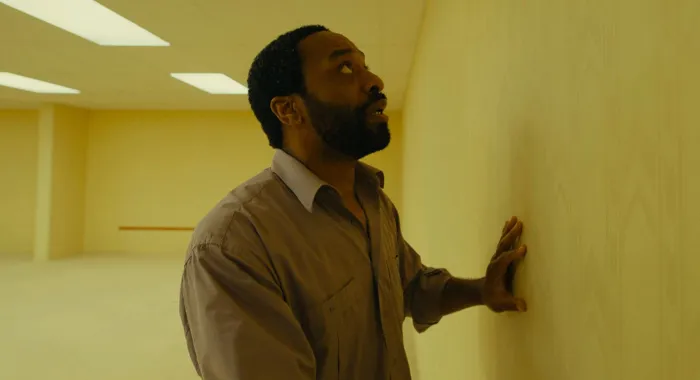
Clark notices some strange electrical issues at the store, which eventually leads him to the basement where he finds a hidden entrance to the titular Backrooms — an alternate dimension residing in the uncomfortably uncanny valley. 

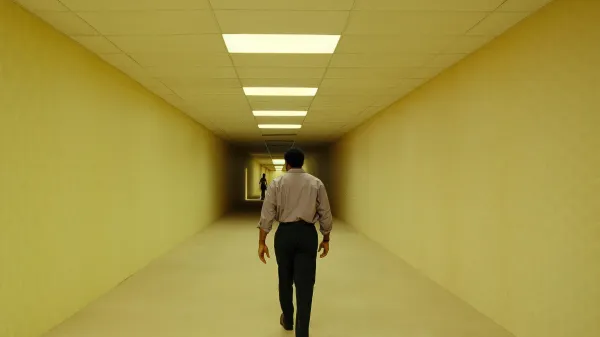
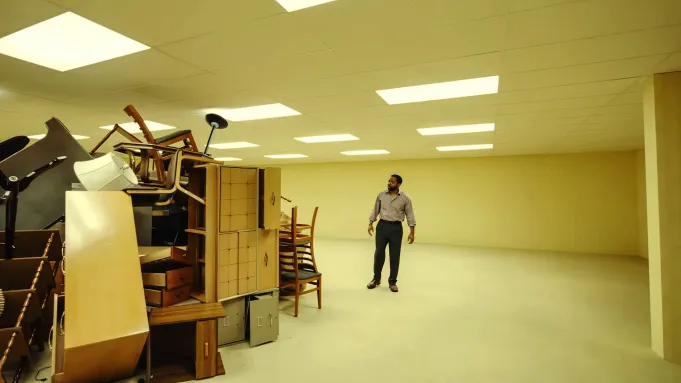
Claustrophobic, labyrinthine hallways and office spaces stretch on endlessly, enclosed by walls painted sickly yellow, lit with fluorescent lights, and littered with jumbled piles of furniture like some twisted contemporary art exhibit made by glitched-out AI software. A strange presence also stalks the premises that clearly doesn’t take kindly to visitors. 

Clark, and by extension us as viewers, are immediately thrown off kilter, but Clark becomes fascinated with this alternate universe and makes it his goal to unearth its mysteries.

Suffice it to say, dangers abound. Clark (and eventually Mary) find themselves way over their heads, becoming trapped in a place that can easily lead its inhabitants into spirals of insanity.
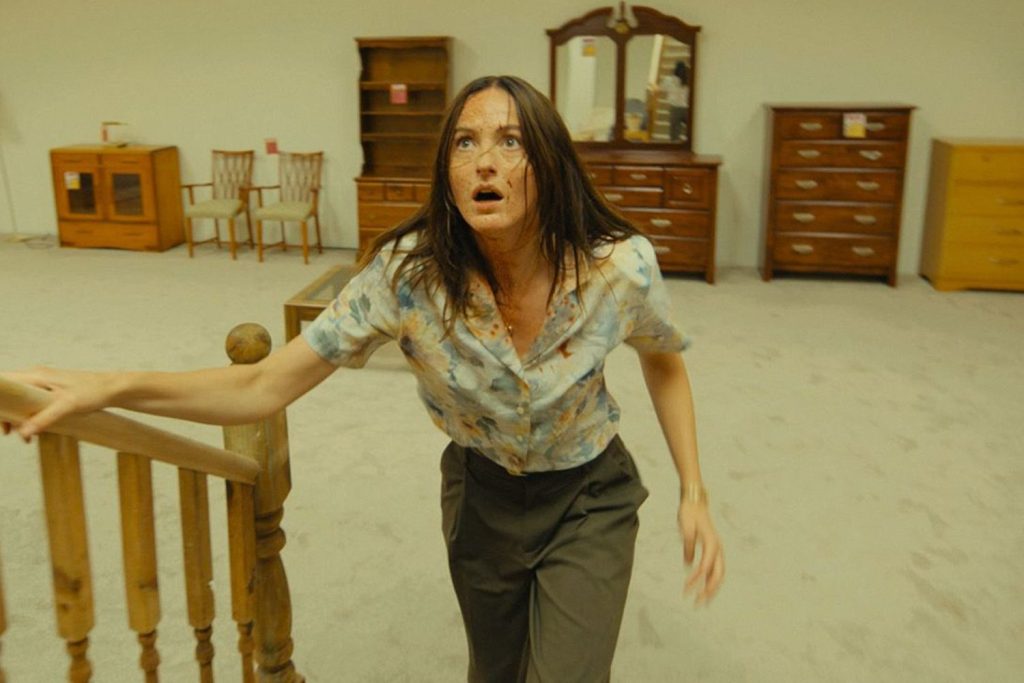
It might not have the most elegantly told story, but “Backrooms” is a relentlessly disorienting film, rich in oppressive atmosphere and dark absurdity, that prides itself on putting viewers in the shoes of its characters and letting the nightmarish world speak for itself.

Familiarity with Parsons’ web series isn’t needed to appreciate this film — above all else, “Backrooms” is a vibe, so stylistically assured that it conjures a universal, intoxicating sense of uneasiness.

Through a mixture of “found footage” camerawork and shots that keep us in lockstep with the characters, Parsons lets us feel the winding unknown and the relentless pressure of being chased through an unfamiliar environment without a clear exit. Although the camera generally adopts an omniscient viewpoint, we don’t jump ahead of the characters; we witness each new sight along with them.

And although Parsons does dole out some (rather cliché) themes, he keeps specific explanations vague, emphasizing the fact that this hidden world cannot be reasoned with. 
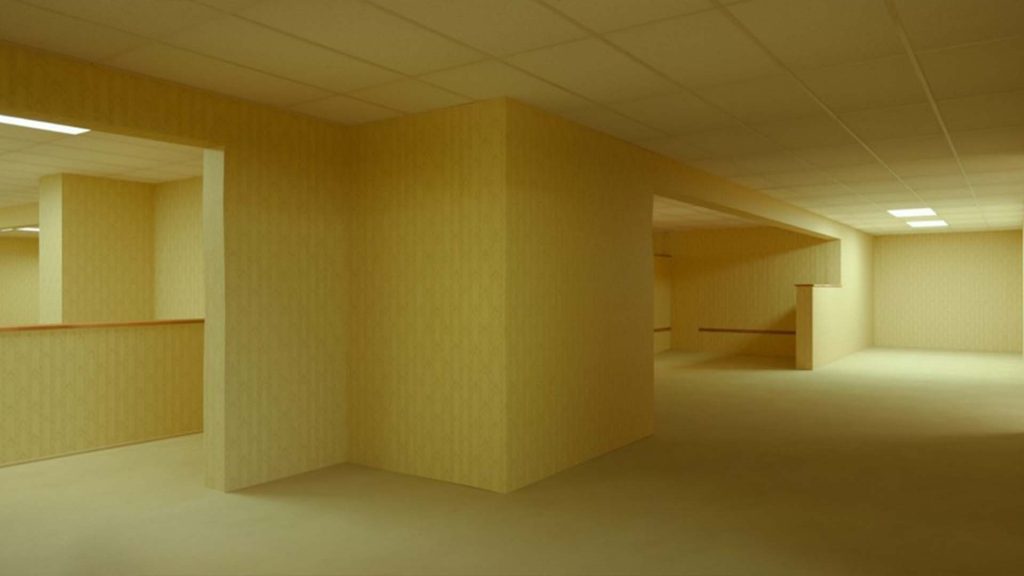
This approach, not unlike 2023’s horrifying “Skinamarink” (also made by a YouTuber turned feature film director), will prove alienating for viewers seeking a traditional narrative or characters that are easy to rally behind. 

The always reliable Ejiofor and Reinsve bring pathos and intensity to dialogue that rings intermittently too obvious and repetitive. Mary’s constant referencing of behavioral loops is an on-the-nose metaphor here, but the way Parsons brings in the existential weight of consumerism and the false promises of the American Dream are compelling threads left slightly underdeveloped.

The world and the filmmaking itself are the real stars of the show here, though — difficult to describe but viscerally felt: scenes patiently and deliberately build suspense before exploding in edge-of-your-seat set-pieces that cinematographer Jeremy Cox frames with frantic energy.

Parsons and Edo Van Breeman’s music is ingeniously woven into each sequence, feeling inextricably linked to the backrooms themselves in its rumbling, alien-like rhythms.
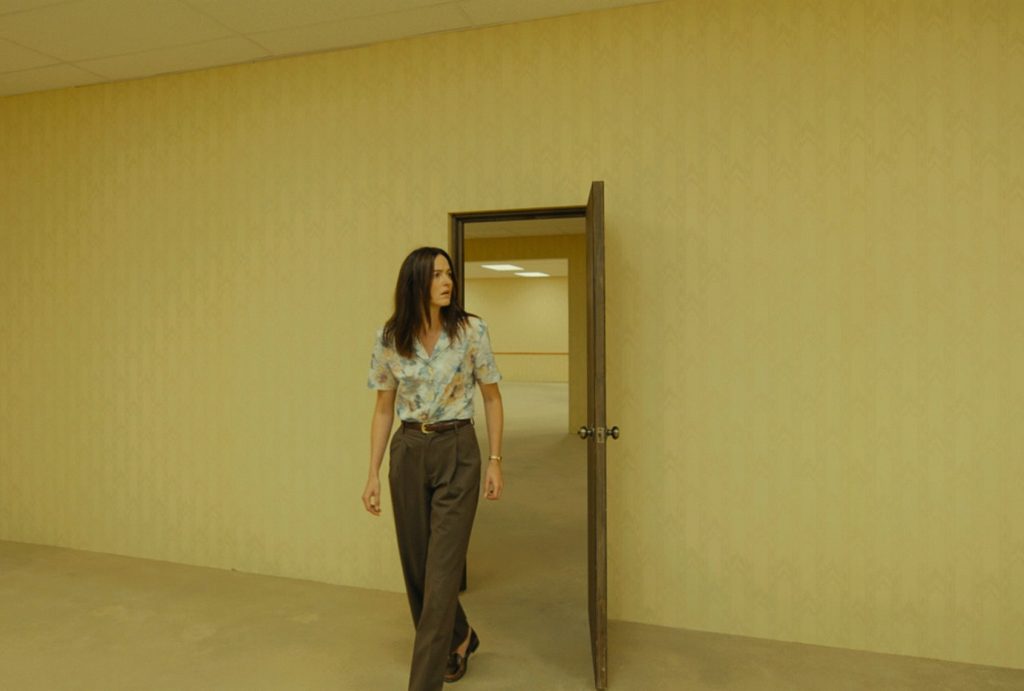
Sure, the film’s more traditional narrative elements feel undercooked, partly due to a rushed passage of time that feels at odds with the more deliberate approach Parsons takes in-the-moment. “Backrooms” shines in its unknowability and stumbles in the few moments when it panders to the masses, not committing to the bit quite as much as its forbears. 

Still, the feelings it conjures are indelible and specific — best experienced in a theater for maximum immersion. I can’t wait to dive back into “Backrooms” time and time again, and no, boomers, that’s not just because I’m Gen-Z.

“Backrooms” is a 2026 psychological horror film directed by Kane Parsons and starring Chiwetol Ejiofor and Renate Reinsve. It is rated R for language and some violent content/bloody images and runtime is 1 hour, 50 minutes. It opened in theaters May 29. Alex’s Grade: A.
By Alex McPherson

Overflowing with self-importance that threatens to drown out its several competent elements, director Mike Flanagan’s “The Life of Chuck” is neither as profound nor as poignant as it thinks it is — a film so carefully-composed that genuine, earned emotion is ultimately left as an afterthought.

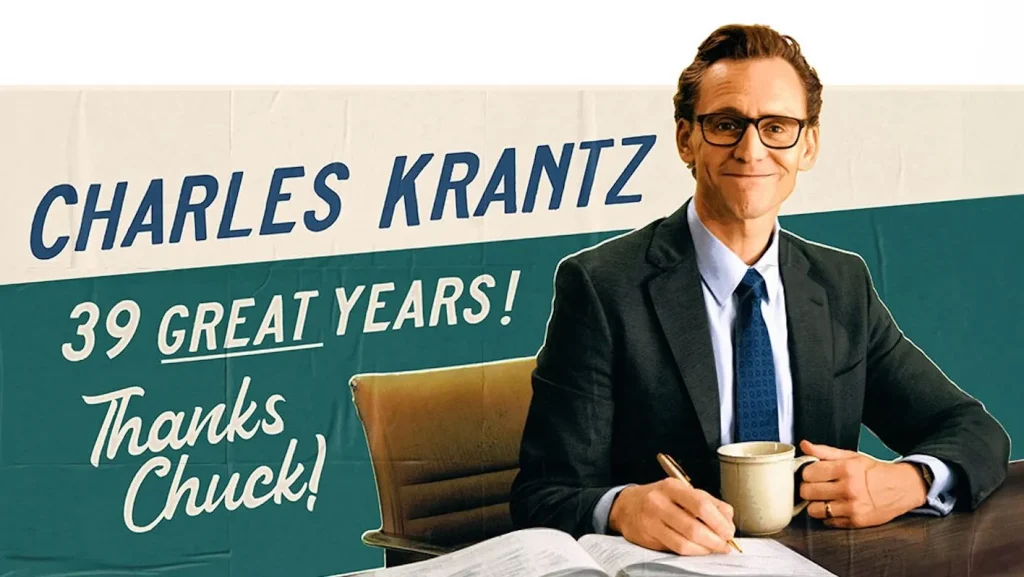
Based on the Steven King novella of the same name, Flanagan’s latest begins with the horror-inflected Act 3: the end of the universe as we know it. Chunks of California are breaking off into the ocean, Florida is underwater, fires engulf the Midwest, and the Internet is out. Posters and advertisements are plastered everywhere thanking a sharply-dressed Chuck Krantz (Tom Hiddleston) for “39 great years!” Nobody has a clue who Chuck is. 

We follow Marty Anderson (a typically soulful Chiwetel Ejiofor), a devoted but increasingly exhausted middle school social studies teacher and fan of Carl Sagan. Marty is a cool-headed, empathetic person unwilling to accept that it’s the actual “end of the world.”

At parent-teacher conferences — as attendance continues to decline in school — he helps console anxious parents who aren’t sure what to do amid it all; one of them (David Dastmalchian) bemoans the loss of PornHub. Humanity, more generally, seems to be on a slow walk towards Armageddon, with the majority resigned to their fate.

Marty reconnects with his ex-wife, Felicia Gordon (Karen Gillan), an overworked ER nurse whose department has become known as “The Suicide Squad.” Marty and Felicia see a last chance to bond before the universe is snuffed out; not even Marty’s hopeful view of Sagan’s cosmic calendar can dissuade him from preparing for The End.

Mia Sara, Mark Hamill and Cody Flanagan.

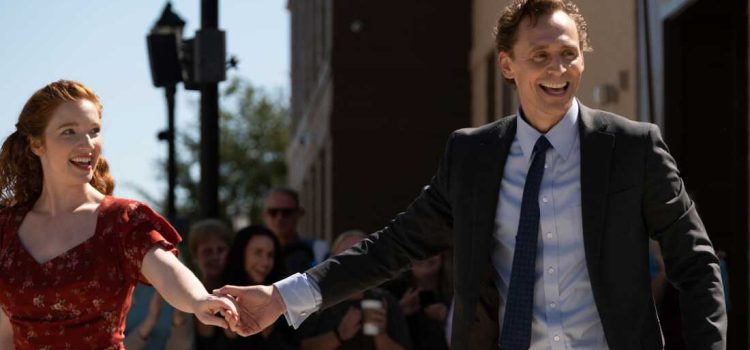
Jump to Act 2. Adult Chuck is a jaded accountant on a business trip in downtown Boston. While walking down a bustling street, Chuck sees a talented but underappreciated busker (real-life drummer Taylor Gordon a.k.a. The Pocket Queen) and gets to dancing — Chuck has quite the moves. 

A crowd gathers to watch and gawk at Chuck/Hiddleston, including Janice (Annalise Basso), a woman whose boyfriend broke up with her moments earlier through text. She starts dancing with Chuck, and, for a brief time, they’re both able to escape their demons and live in the moment.

Afterwards, Chuck looks wistfully off into the distance, reminiscing about his life and, as narration from Nick Offerman reminds us, his fleeting remaining time alive.

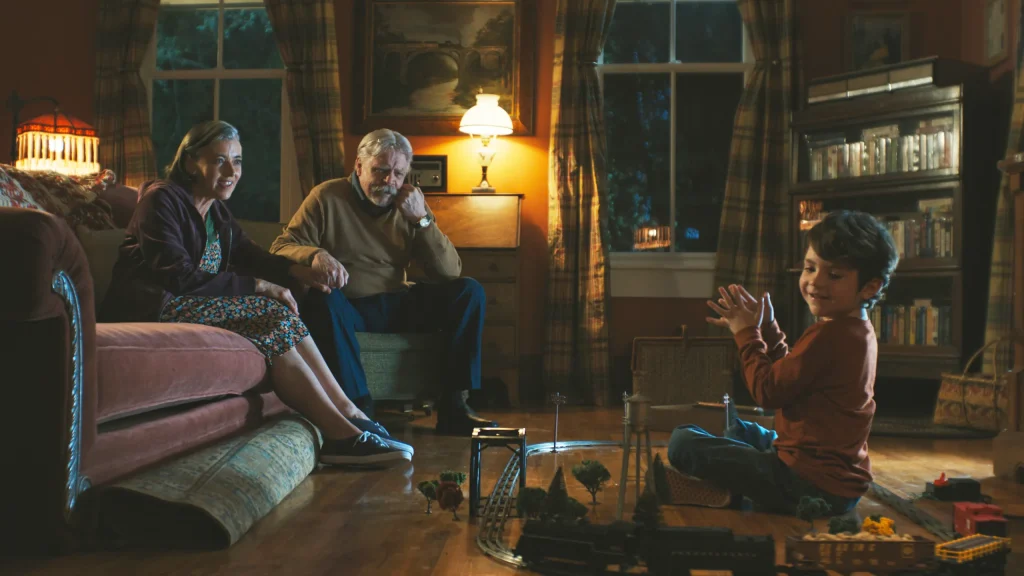
Act 1 takes us back to Chuck’s childhood — he’s portrayed by Cody Flanagan, Benjamin Pajak, and Jacob Tremblay. Chuck experiences family tragedy and life’s ups-and-downs with his grandparents Albie and Sarah (Mia Sara and Mark Hamill).

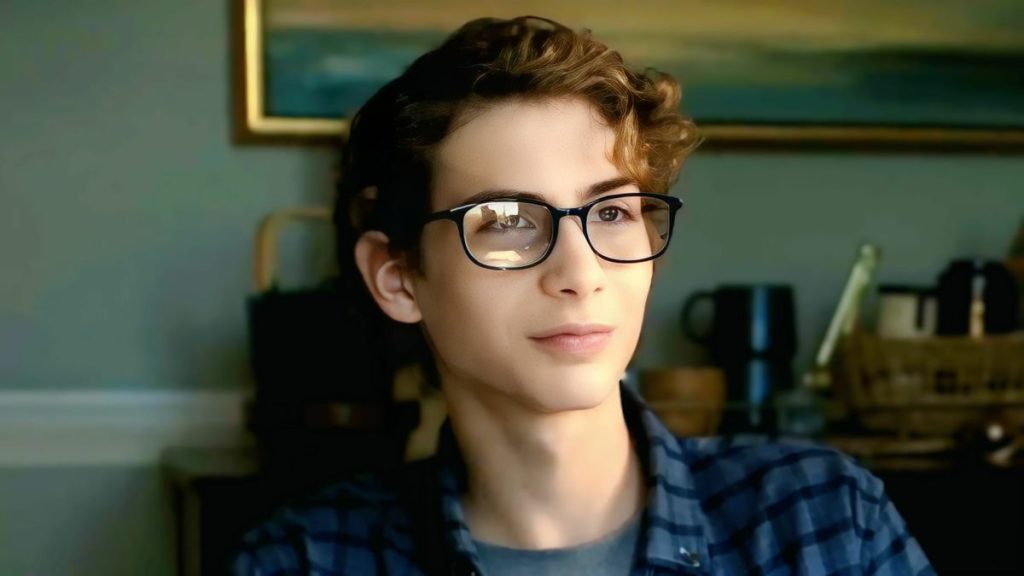
Benjamin Pajak as schoolboy Chuck.

He also discovers his love of dance while grappling with a rushed transition into adulthood, becoming fascinated with the strange “ghost” in the locked room upstairs that deeply frightens Albie.

Needless to say, there’s a lot going on in these three chapters, but, at the same, there’s not much to chew on. Individual scenes and performances break through the prevailing schmaltz, but for a story ostensibly about the importance of spontaneity and of living in the moment, “The Life of Chuck” paints a canvas both messy and overwrought, remaining thoroughly full of itself from start to finish. Several characters like to spout a phrase coined by Walt Whitman: “I contain multitudes” — the same, it must be noted, does not apply to this film.

It starts off strongly enough, though. Flanagan’s roots as a horror director shine through in Act 3 — establishing an eerie tone from the get-go with darkly comedic dialogue and an atmosphere of existential malaise and hopelessness. It’s a bit hokey, sure, but intriguing, with its end-of-the-world happenings not seeming all that implausible.

The conclusion is surprisingly dark, too, especially given distributor Neon’s saccharine marketing campaign. Flanagan’s directing is precise, carefully-composed, and efficient, knowing how to play us for sudden jolts of fear and bursts of unexpected (R-rated) humor.

There’s also real truth to how “The Life of Chuck” depicts humanity’s fatigue and fatalism given today’s horrors off-screen. If only the film committed more to the mystery: Acts 1 and 2 excise most of the story’s compellingly dark and off-kilter threads to embrace sentimentality and ponderous storytelling.

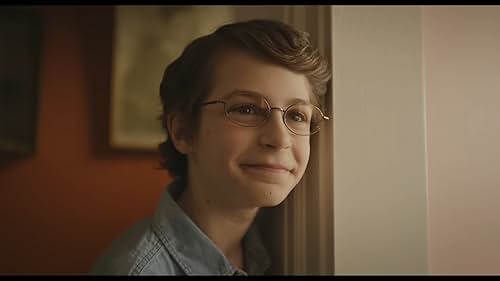
Jacob Tremblay as older teenage Chuck.

Indeed, much like Chuck and Janice’s exuberant dancing — which Flanagan and cinematographer Eben Bolter present with toe-tapping, quick-cut pizazz — the rest of “The Life of Chuck” feels too precious, too precisely-tailored to tug at the heart strings, and oddly-structured, content to explain rather than let viewers put the pieces together themselves.

And, in the end, “The Life of Chuck” is far from revelatory in its views on “the universe contained within us all,” leaning into directorial showmanship to conventional ends.  

Hallmark-card-worthy sentiments are rendered in faux-Spielbergian fashion, with hints of supernatural suspense, supported by a warmly inspirational score from The Newton Brothers and an ensemble that breathes warmth, if not necessarily depth, to characters slotting into Flanagan’s film like cogs in a well-oiled machine. 

Narration from Nick Offerman — presumably reading direct passages of King’s text — interrupts scenes to explain characters’ thoughts and navigate the story’s various time jumps. While this choice helps create a storybook feel, it’s limiting, given the story’s segmented structure (focusing on “big moments” in Chuck’s life).

Nuance is swapped for clarity and brevity — cutting out seemingly crucial connective tissue between Acts 1 and 2 — plus a near-worshipping of King’s source material: a short story expanded to feature length.

Hiddleston is great as usual, albeit not given all that much screen time, adding a sense of mournful reflection to Chuck’s later years as he’s made aware of the small joys in life once again. The younger actors portraying Chuck in Act 1 effectively convey both Chuck’s youthful naivete and gradual coming-of-age.

Sara and Hamill give the film’s most convincing, lived-in performances, with Hamill in particular getting the chance to engage in some Oscar-friendly speechifying, as the alcoholic, superstitious Albie counters young Chuck’s idealism around dance/the arts with a more pragmatic view on what lies ahead.

This excellent ensemble — including other notable turns from Matthew Lillard, Carl Lumbly, and Samantha Sloyan — coupled with Flanagan’s meticulous style of framing and sharp (but not organic) dialogue boosts the film above mediocrity. So long as one doesn’t think too hard about its existential musings, “The Life of Chuck” goes down easy enough.

But despite a compellingly unusual beginning and a handful of well-crafted sequences scattered throughout, it never fully takes flight. At the end of the day, it’s all trying too hard: irritatingly manufactured and only fitfully involving.

“The Life of Chuck” is a 2024 science fiction-fantasy-drama directed by Mike Flanagan and starring Tom Hiddleston, Mark Hamill, Mia Sara, Benjamin Pasak, Jacob Tremblay, Cody Flanagan, Karen Gillan, Chiwetel Ejiofor, and Matthew Lillard. Its run time is 1 hour, 51 minutes, and it is rated R for language. It opened in theatres June 6. Alex’s Grade: C+.