By Lynn Venhaus

A personality-powered gem, “The 25th Annual Putnam County Spelling Bee” is a rambunctious musical comedy that celebrates American meritocracy, eccentric nerds and freak flag waving.

Produced with extra oomph by Stages St. Louis, a sagaciously cast sextet has nimbly mastered wordplay and improvisations in this offbeat musical that’s as accessible to logophiles as it is to class clowns.

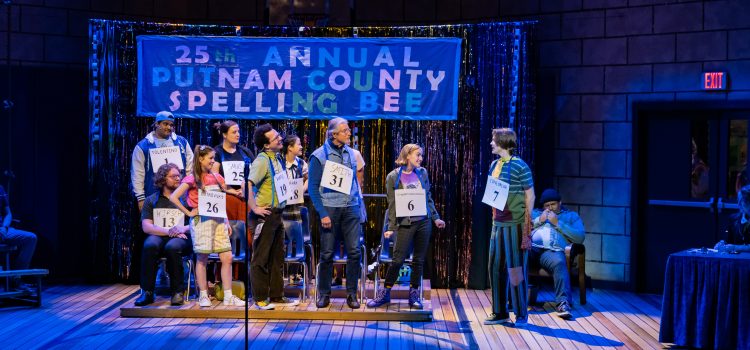
Inside a typical middle school gymnasium, dweeby sixth graders compete for a $200 savings bond, a shot at the national bee, and a towering trophy.

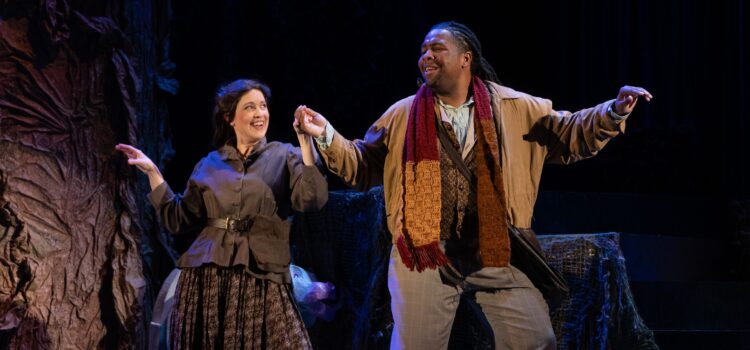
All triple threats, this enthusiastic cast has got game – showing heart, humor and humanity. The boys are Michael Schimmele as returning champ Charlito “Chip” Tolentino, who is struggling with puberty; Matthew Cox as Leaf Coneybear, the wide-eyed home-schooled son of hippies; and Bryce A. Miller as showboating misfit William Morris Barfee.
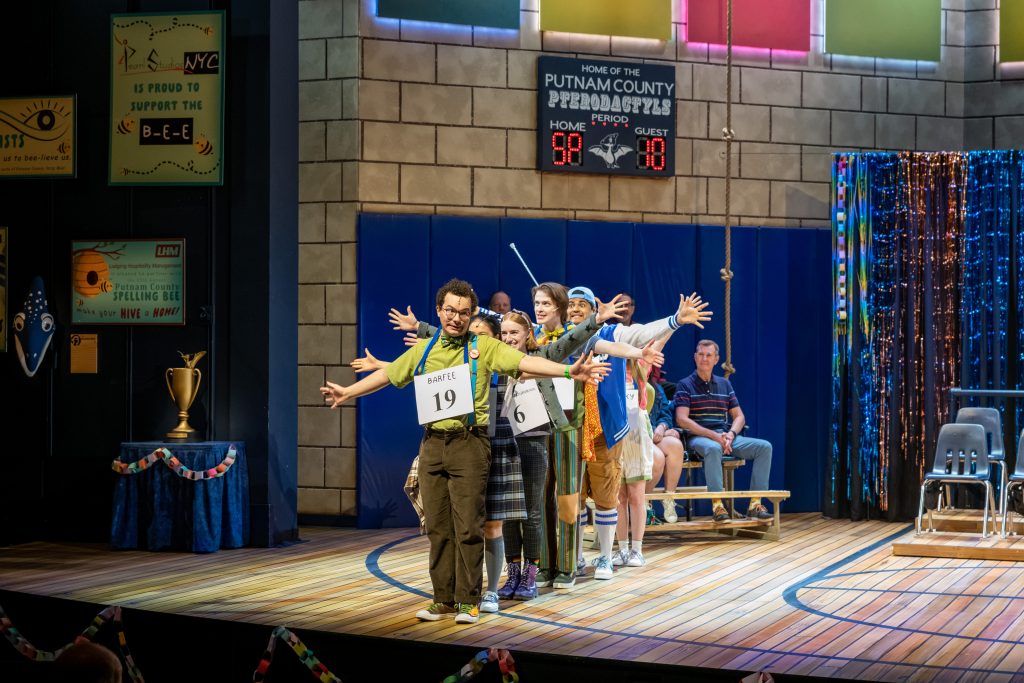
The Spellers are ready to rock. Photo by Phillip Hamer.

A running gag is the constant mispronunciation of Bar-Fay, because of an accent aigu, and not Bar-Fee.

The girls are Abigail Isom as high-strung Logainne SchwartzandGrubenierre, a positive political activist pushed by her two dads to be best; Alexis Kinney as exuberant wordsmith Olive Ostrosky, whose mom is in India and dad is always working; and Sarah Wilkinson as pedantic Marcy Park, an over-achieving transfer student.

The annual event is a big deal in the town, with three adults in charge – ‘comfort counselor’ Mitch Mahoney (Omega Jones), an ex-con who gives the eliminated contestants a juice box and a hug; former champ and returning moderator Rona Lisa Peretti (Jennifer Theby-Quinn), a successful realtor who enjoys reliving her glory days; and Vice Principal Douglas Panch (Christopher Hickey), who has returned as a judge after personal time off to work out some ‘things.’

Their innuendos and double entendres elicit laughs – and the show’s mature content is aimed for a PG-13 audience.
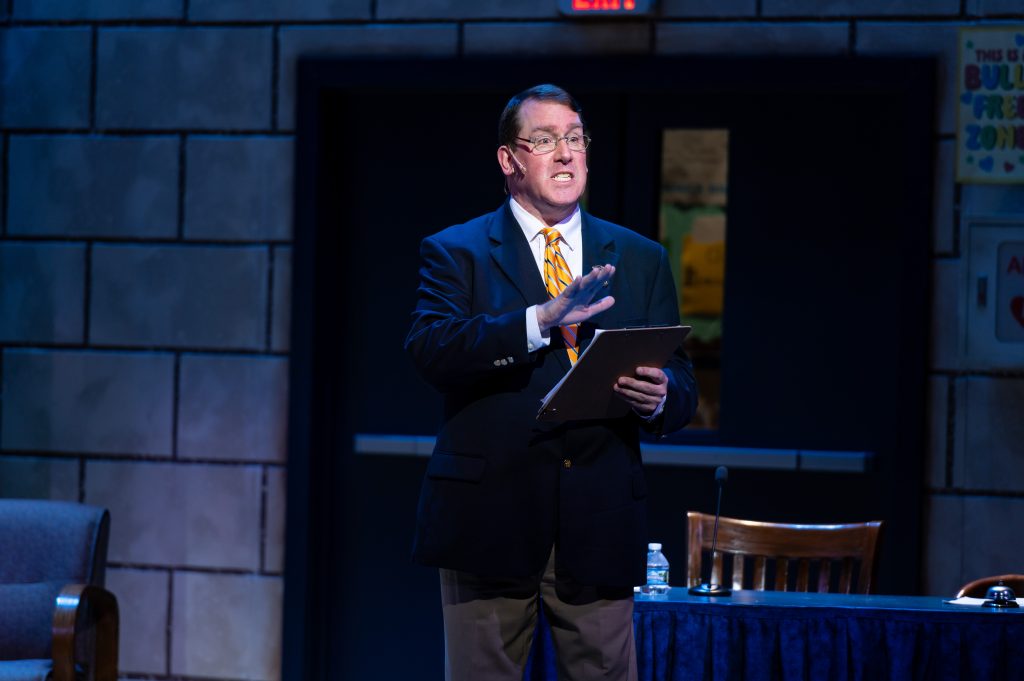
Christopher Hickey as vice-principal. Photo by Phillip Hamer.

The catchy music and lyrics by William Finn, of “Falsettos” and “A New Brain,” give each character their moment to shine and explain their character’s drive or idiosyncrasies.

Their signature songs are Leaf: “I’m Not That Smart.” Olive: “My Friend, The Dictionary.” Marcy: “I Speak Six Languages.” Logainne: “Woe Is Me” and Chip: “Chip’s Lament.”

The coming-of-age stories about their home lives are poignantly delivered, and they perform the funny parts with gusto. The spellers have crafted realistic kids – not to mock but to enjoy their characteristics and identify with their emotions, and you root for them to stay golden.

Barfee, unfortunately hampered by one working nostril, has a peculiar way of spelling out the words – with his “Magic Foot.” (Fun fact: Dan Fogler, of “Fantastic Beasts,” won a Tony Award for originating the role).
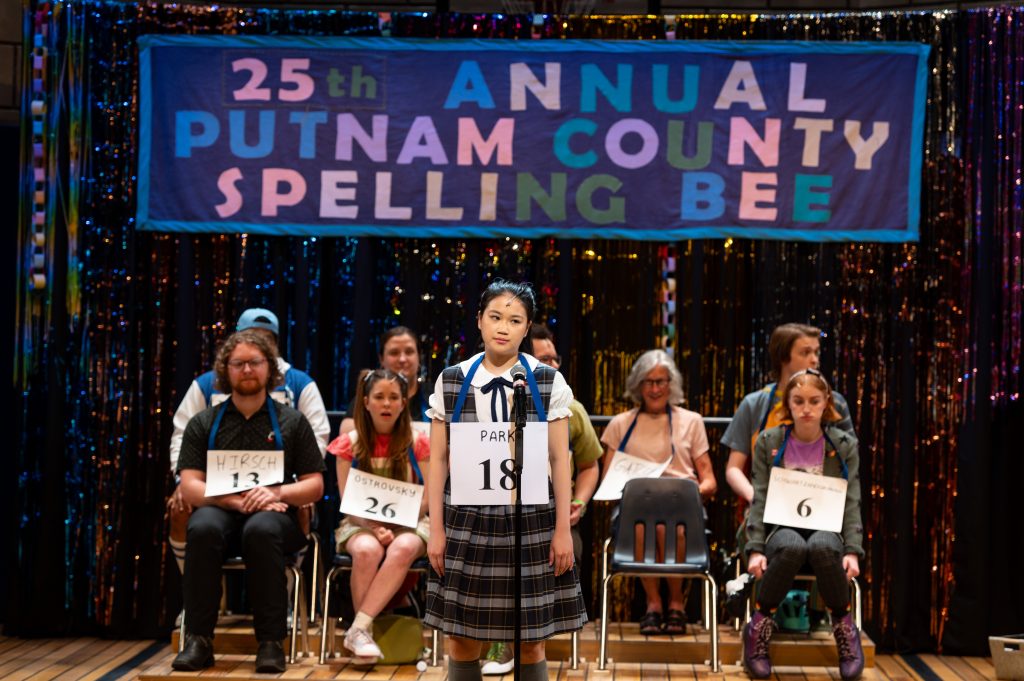
Sarah Wilkinson as Marcy Park. Photo by Phillip Hamer.

The convivial show, workshopped into an off-Broadway hit, transferred to Broadway in 2005 – and was nominated for six Tony Awards, winning two (book by Rachel Sheinkin, featured actor). It was originally conceived by Rebecca Feldman and based upon “C-R-E-P-U-S-C-U-L-E,” a play by her improv collective, The Farm. Additional material was supplied by Jay Reiss.

The fluid script allows producing companies to insert topical and local references. It also includes audience participation, and patrons can fill out a slip in the lobby before the show.

Four names are drawn backstage, so no one is tipped off in advance, and they join the spellers to take their turn at the microphone. All good sports, this is a key element to the fun, producing good-natured laughter from the audience. No special treatment – they might get to spell “Cow” or a consonant heavy four-syllable word.

The crowd’s perspicacity was evident on opening night June 3 and embraced the experience. The ingenious construction keeps it fresh, and that spontaneity is appealing.
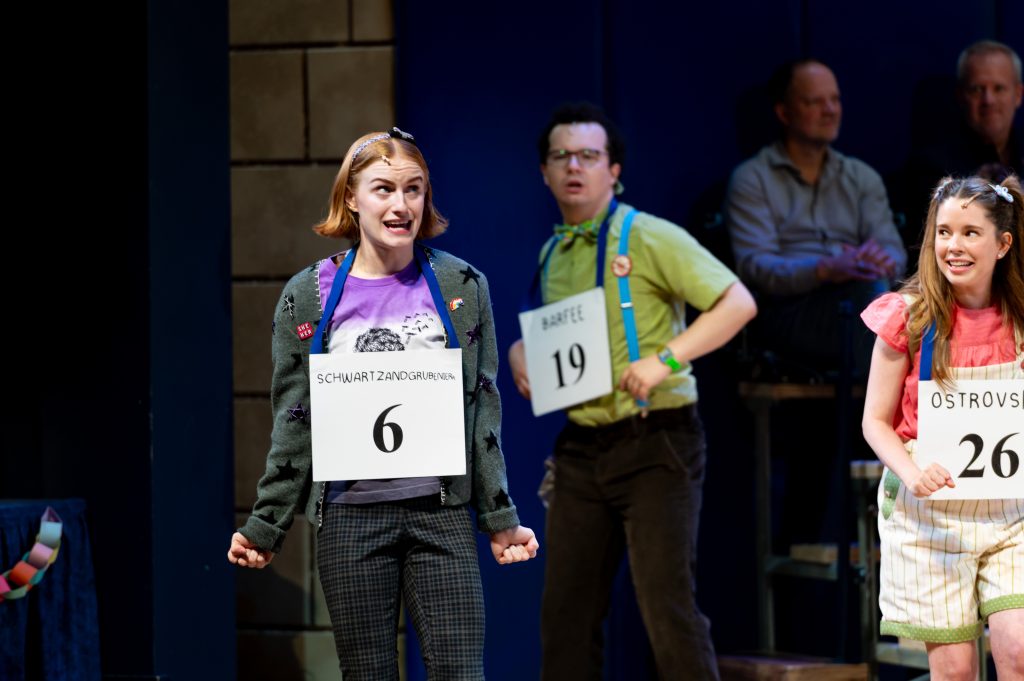
Abigail Isom, Bryce A. Miller and Alexis Kinney. Photo by Phillip Hamer.

Detail-oriented co-directors Ron Gibbs and Gayle Seay also co-choreographed the show, achieving a terrific level of energy. The upbeat title song introduces the characters, and “The Spelling Rules” brings out their quirks and “Pandemonium” is just that.

In stand-out moments, dynamic Wilkinson showcases her gymnastic skills in her peppy number “I Speak Six Languages” and her prayer for change, “Jesus,” while gifted comic actors Miller and Kinney display charming chemistry leading up to and including their duet “Second.”

Another highlight is the tender ballad “The I Love You Song” that heart-tugging Kinney sings with her parents – as the absentee mom, Jennifer Theby-Quinn’s strong mezzo-soprano is in lovely harmony with workaholic dad Omega Jones’s warm vocals.

As Rona, Theby-Quinn confidently commands the stage in “My Favorite Moment of the Bee,” and in two reprises. As Mitch, Jones demonstrates expressive vocals in “The Prayer of the Comfort Counselor” and in “Woe Is Me” reprise with the vivacious Isom.
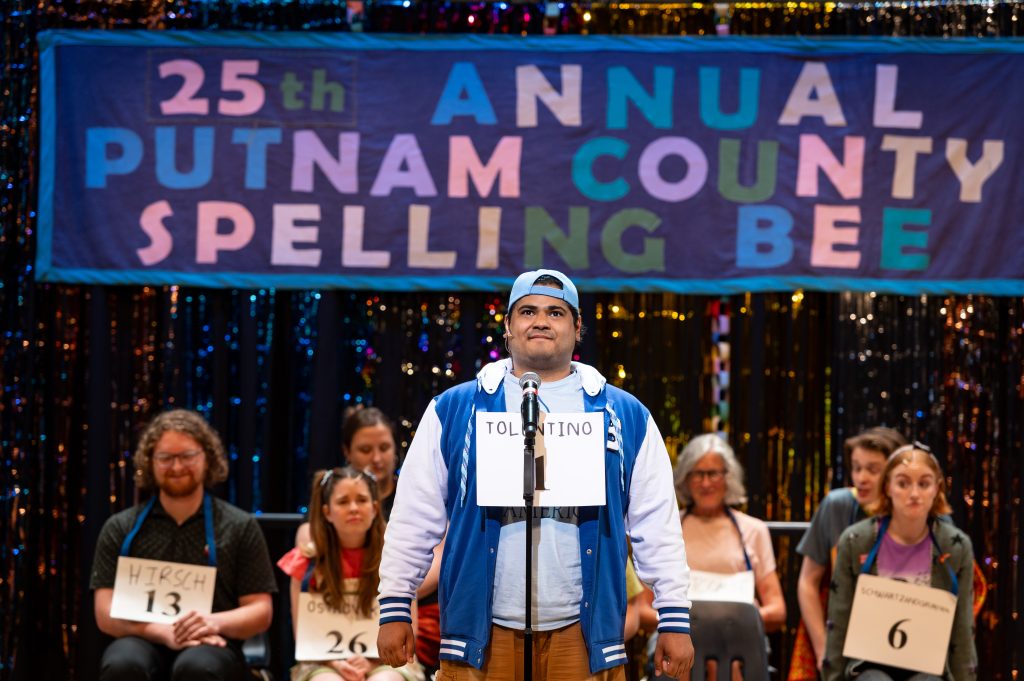
Michael Schimmele as Chip. Photo by Phillip Hamer.

And Schimmele is a trouper with his sudden onset of a puberty issue, and feigning discomfort in his public humiliation. If you know, you know. (Refer to mature rating).

The junior high vibes are boosted by scenic designer Rachel Seabaugh’s school gymnasium set that is a nifty flashback to every community event ever, with sly nods to the civic organizations and school sports teams that are delightful to notice.

Lighting Designer Sean M. Savoie’s expertise is apparent in the harsh gym glare, which shifts to the warm intimate interaction moments. Sound designer Hankyu Lee’s work is remarkably crisp, without any dead spots in the KPAC’s Ross Family Theatre.

Costume Designer Cat Lovejoy has jauntily defined every character through their distinct outfits, and the addition of a makeshift cape and roller-sneakers for Leaf Coneybear is inspired. Cox gives his movements extra flair with those accessories.
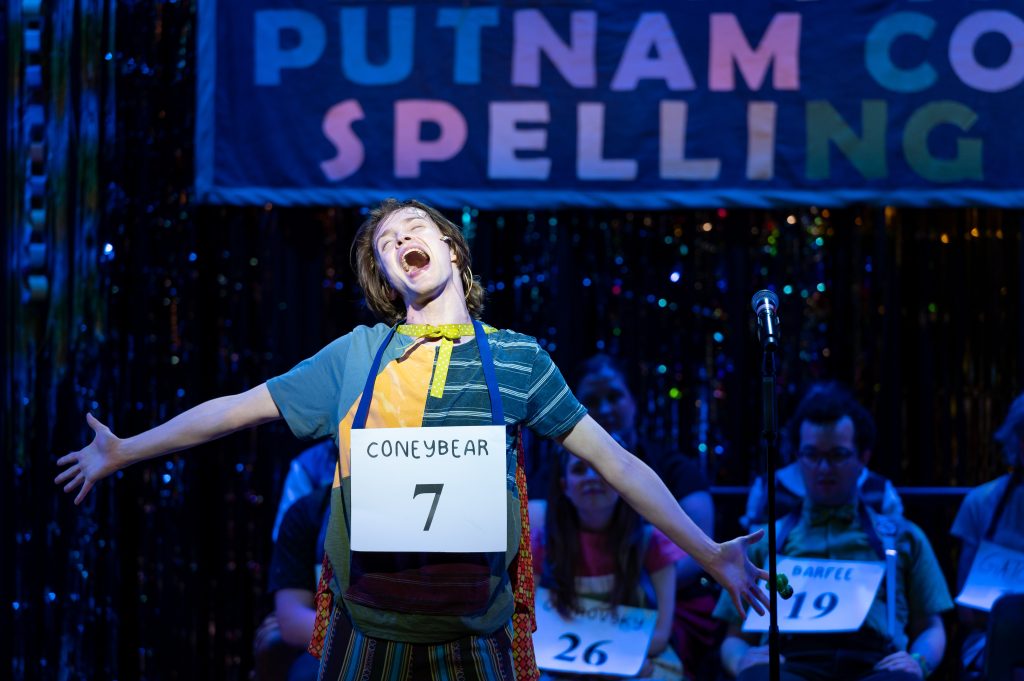
Matthew Cox as the free-spirited Leaf Coneybear. Photo by Phillip Hamer.

Music Director Michael Kaish smoothly kept the tempo on track, and is on one keyboard, joined by Randon Lane on a second keyboard, Lea Gerdes on reeds, Marcia Erwin on cello and Jonathan M. Taylor on percussion.

The Bee is a buzzy, playful communal experience, one that celebrates smart kids without any stigma – a proud revenge of the nerds, and the relatable rituals of youth. To be a part of the glee expressed by cast and crowd alike will lift spirits of any age.

Note: Understudies include Julie Hanson, Lillie Self-Miller, Bradford Rolen and Connor Kelly-Wright.

Stages St. Louis presents the musical “The 25th Annual Putnam County Spelling Bee” through June 28. Performances take place at the Kirkwood Performing Arts Center, 210 E. Monroe Ave. For more information: stagesstlouis.org.
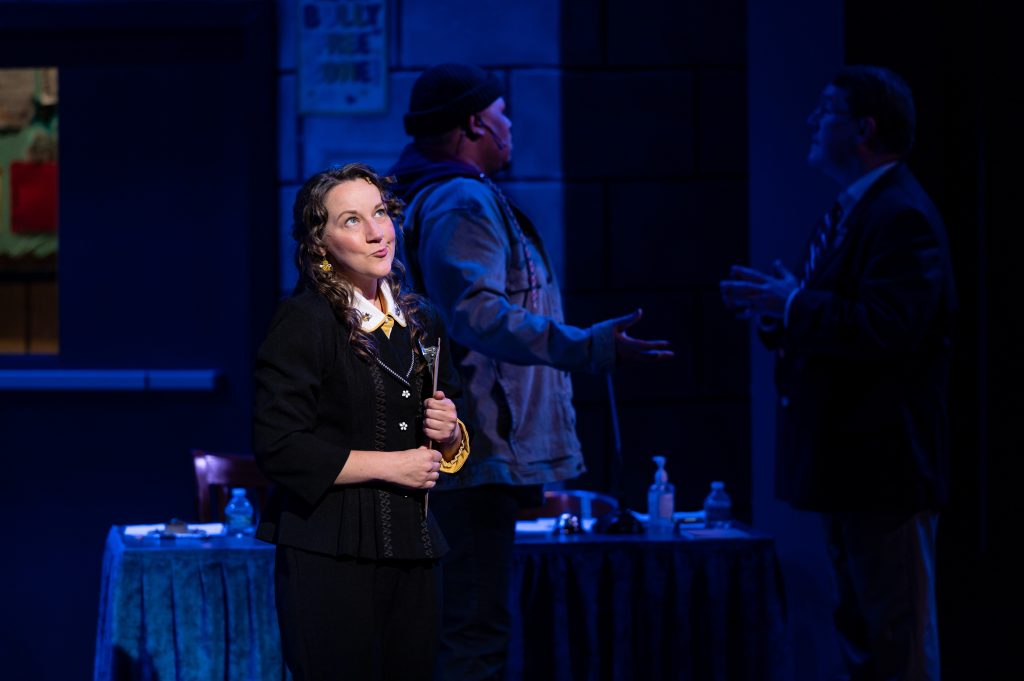
Jennifer Theby-Quinn as Rona, with Omega Jones as Mitch in background. Photo by Phillip Hamer.

By CB Adams
Union Avenue Opera’s production of “Into The Woods,” stage directed by Jennifer Wintzer, is a rich tapestry. From the set design through the final song, you (figuratively) want to run your hands over the texture and enjoy its quality.

Stephen Sondheim and James Lapine are the weft and weave, but it’s way UAO finely stitches the musical’s balance of humor and humanity with death and disillusionment that delivers a sumptuous and reassuring tapestry – like a Bayreux or Unicorn come to life.

UAO earns these accolades for its season-ending production of “Into the Woods” with excellence in all the theatrical components: direction, staging and set design, costumes and cast performance. If you’re a Sondheim fan but have never attended a UAO performance, don’t let the word opera scare you off. They deliver a traditional interpretation of this classic without any elaborate or ornamental operatic embellishments.

If you’re an opera fan, UAO always ends its season with an operetta or musical. Last year, they concluded the season with a fine production of “Ragtime.” Many opera companies do this, such as the storied New York City Opera, and it’s a way to demonstrate how opera set the stage for subsequent musical theater iterations. It’s also a way to fill the seats.

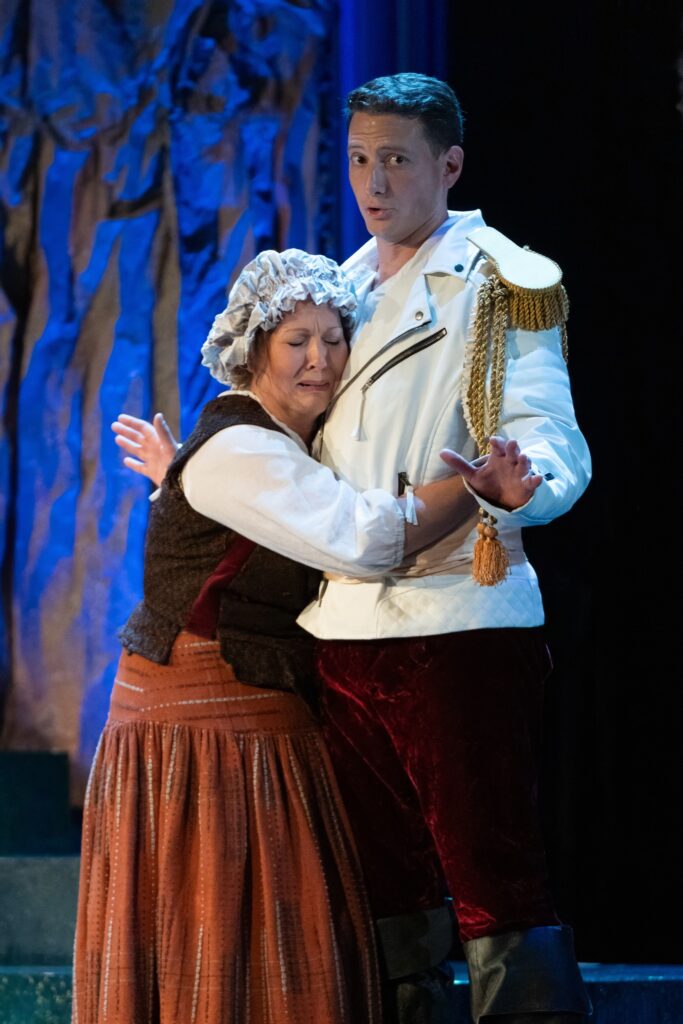
 Stephanie Tennill as Jack’s Mother and Matthew Greenblatt as Cinderella’s Prince, Photo by Dan Donovan.

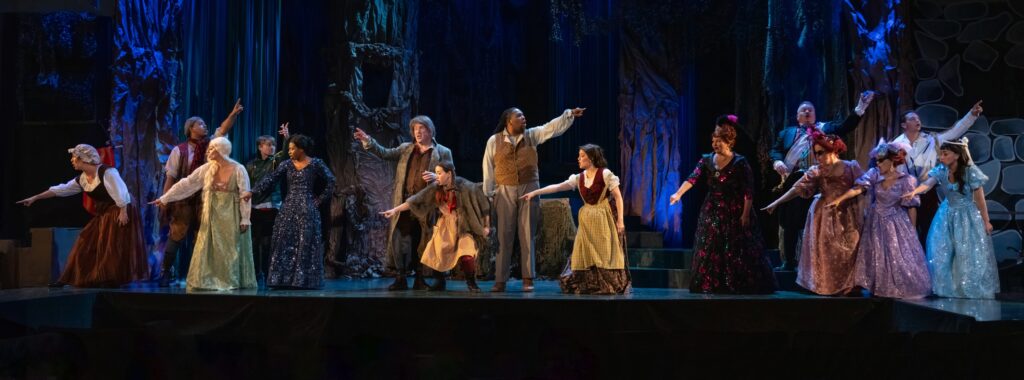
The first – and one of the most impressive – aspects of this “Into The Woods” is the stage design by Laura Skroska, whose work on UAO’s production of the moody, atmospheric “Turn of the Screw” set was one of last year’s best. For “Into The Woods,” Skroska’s vision evoked the magical and eerie atmosphere of this fairytale world.

She, along with scenic artist Lacey Meschede and set decorator Cameron Tesson,  maximized the use of the Union Avenue Church’s modest stage by filling it with mossy tree trunks that serve as posts to multiple, rising platforms. The set extended into the sanctuary with the balcony festooned with moss and other elements from the main stage. The balcony also served as Rapunzel’s tower and the home of the heard-but-not-seen giants of Jack and Beanstalk fame.

Before the show began, the set created the ideal visual preparation for the rest of the performance. Skroska’s design elements  — expertly and effectively illuminated by Patrick Huber – underscore the timeless and complex nature of Sondheim’s work, ensuring that the woods felt both enchanting and foreboding, perfectly complementing the story’s themes.

Further enhancing the production are the outstanding costumes by Teresa Doggett. Appropriately tatty and fairytail-ish, Doggett’s costumes play a pivotal role in elevating “Into The Woods” by enhancing the visual storytelling and deepening the understanding of each character’s journey through the intertwined storylines. They reflect the dark, whimsical aspects of the show while paying homage to the traditional fairytale origins.

The movie adaptation of “Into the Woods” could use Disney magic to conjure the special effects. On stage, it’s a bit more challenging. UAO’s production makes fine use of the talents of puppeteer Jacob Kujath to portray Milky White, the emaciated cow, and a flock of birds. The use of these puppets adds a whimsical and imaginative element to the production. Kujath brings them to life through expressive manipulation and playful interactions that seamlessly integrate with the live action.

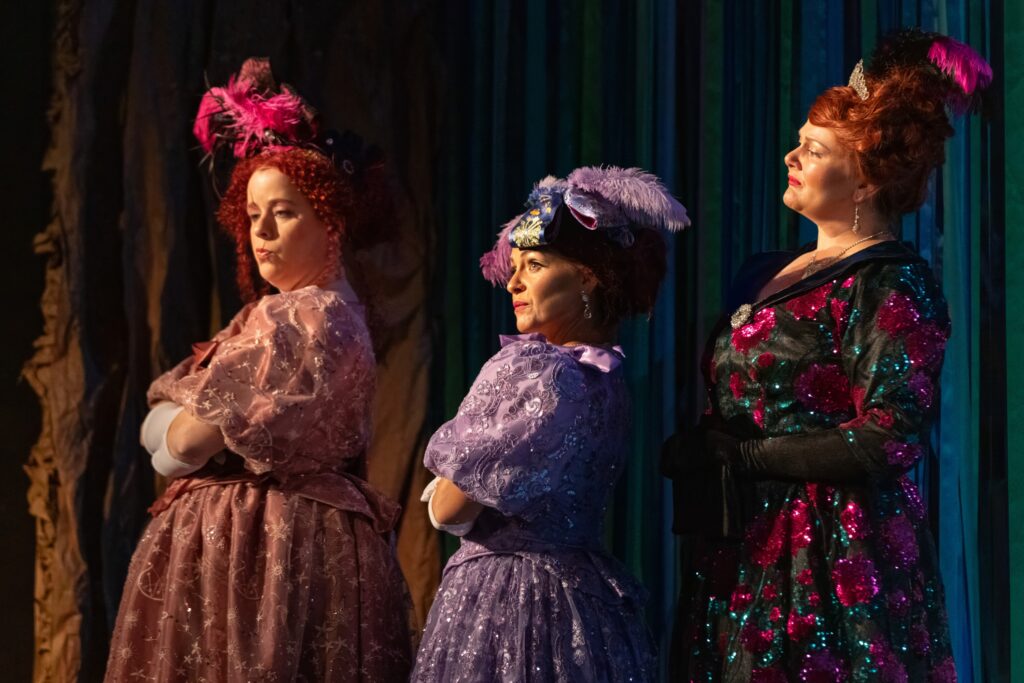
Rebecca Hatlelid as Lucinda, Gina Malone as Florinda, Debra Hillabrand as Cinderella’s Stepmother. Photo by Dan Donovan.

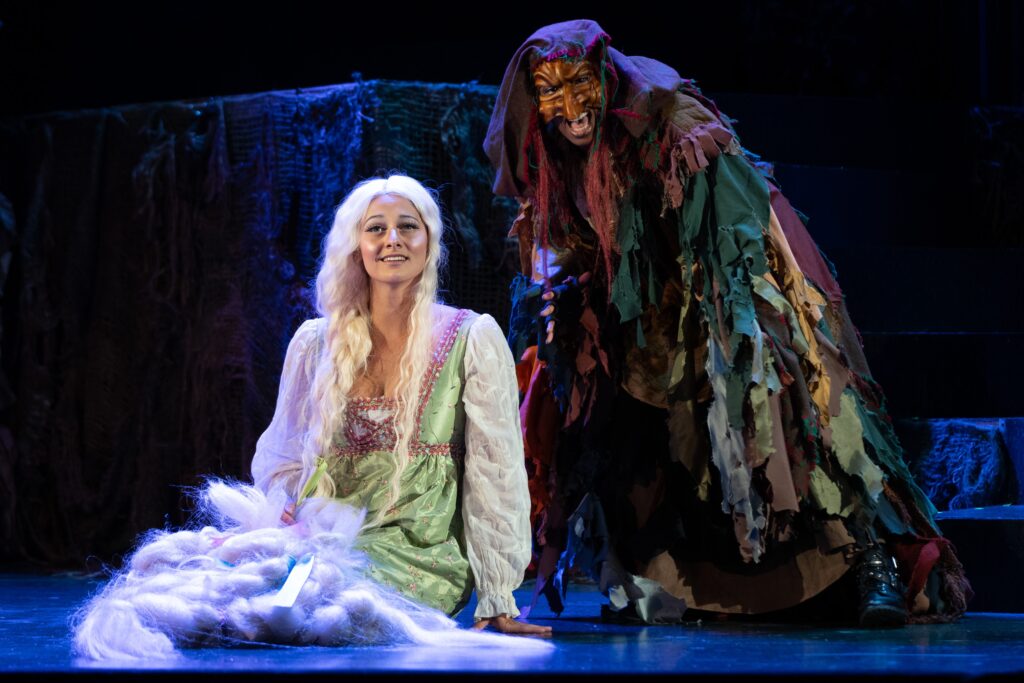
The cast of 21 showcases the depth and versatility across the roles with performances that rise from solidly good to exceptional. That latter response is earned by mezzo-soprano Taylor-Alexis Dupont for her Witch. Clad in a wickedly good mask, which is almost a character unto itself, Dupont intensely inhabits the character of the Witch and delivers an impressive performance.

It is a sheer delight witnessing Dupont – through powerful song and acting – deliver a full transformation of the Witch, exemplifying the duality of her character. Her believable duality turns “Children Will Listen” into an emotional, cautionary swan song delivered by a once-menacing – but now tragic – figure.

“Into The Woods” isn’t all serious and dark. At the other end of the spectrum from the Witch are Rapunzel’s and Cinderella’s respective, rather vacuous princes, played by tenors James Stevens and Matthew Greenblatt. Their duet “Agony” is usually one of the top-three most favorited songs, and Stevens and Greenblatt do not disappoint in their delivery of this biting, satirical tune.

Sidenote: “Into the Woods” debuted in 1986, and Cinderella’s dum-dum prince with his “I was raised to be charming, not sincere” attitude is definitely a precursor, if not the model, for the Ken character in the recent “Barbie” movie.

Soprano Brooklyn Snow’s portrayal of Cinderella her vulnerability with a growing strength, effectively conveying her journey from innocence to self-awareness through both subtle acting and dynamic vocals. Likewise, soprano Leann Schuering’s Baker’s Wife successfully merges the character’s fairy-tale origins with the weight of her decisions.

Lauren Nash Silberstein as Rapunzel and Taylor-Alexis DuPont as the Witch. Photo by Dan Donovan.

Schuering’s performance is marked by its depth and emotional resonance. Soprano Laura Corina Sanders performance of Little Red Ridinghood [sic] captures the character’s innocence and curiosity and skillfully transforms from naive cheerfulness to a deeper understanding of the dangers and complexities of the world.

Baritone Brandon Bell bakes into his performance as the Baker a balance of warmth with emotional complexity. Like the Witch, he too undergoes a transformation. Bell’s expressive acting and strong vocals make transition from reluctant hero to a more self-assured character both relatable and compelling.

Another baritone – a base baritone – Eric McConnell, delivers another highlight performance as the Wolf, with a blend of seductive charm and menacing undertones. McConnell’s deep voice projects exceptionally well into the sanctuary and masterfully balances the Wolf’s allure and danger with “Hello Little Girls” – a song that could come off as “pervey” with a less skilled performance.

Christopher Hickey plays both the Narrator and the Mysterious Man. Perhaps because the demands of each character are different, the Mysterious Man is the better of Hickey’s performances because there is more opportunity for him to inhabit the character, which he does by subtly weaving together intrigue and depth to create a profound and haunting presence.

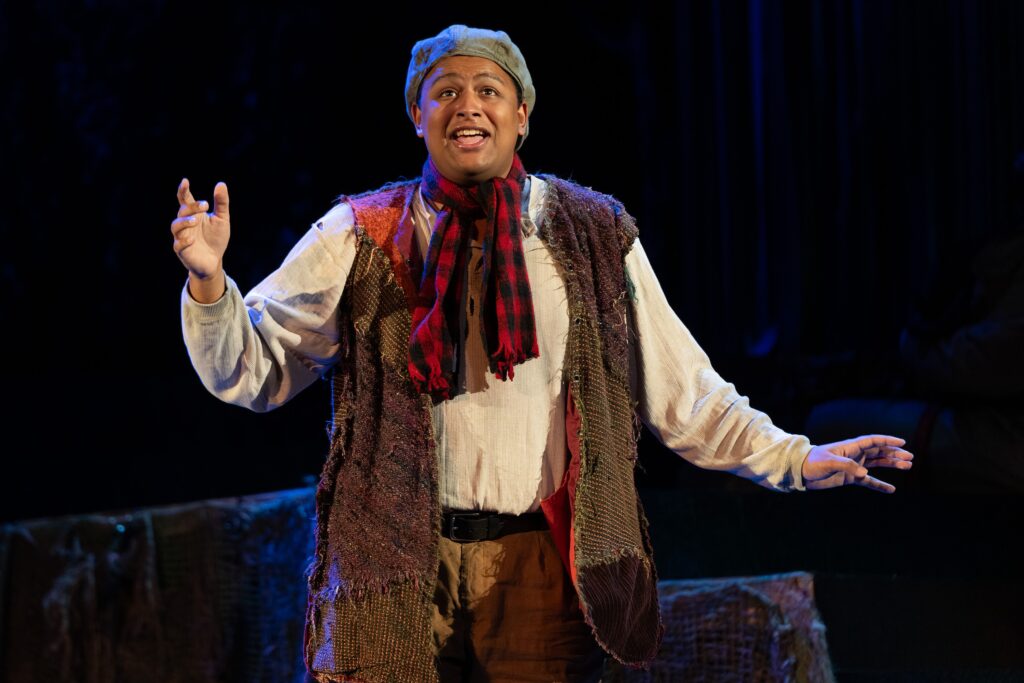
Cameron Tyler as Jack. Photo by Dan Donovan.

On opening night, the weakest element of this otherwise satisfying performance was the imbalance of the sound, especially during the first half. The unamplified voices, especially those of the female performers, were repeatedly overwhelmed by the orchestra.

This performance includes supertitles, but with a musical in English, they shouldn’t be necessary to hear what’s going on. This made for a frustrating experience, leaving one wishing to “turn up” their volume a click or two to better enjoy the quality of the singing and dialogue.

This feeling was further exacerbated because the orchestra, under the direction Scott Schoonover, superbly performed the score. It would have been a shame to miss a single note. Perhaps because adjustments were made during the intermission, the sound issue was almost eliminated in the second half.

Another side note: From Greek myths to Joseph Campbell’s “The Hero’s Journey,” Carl Jung’s psychology and the fairytales of the Brothers Grimm, the “dark woods” are often inhabited by archetypal patters and are a place of confusion, danger or the unknown where the hero or heroes confront trials and their shadow selves.

Sondheim and Lapine created a masterful musical that hews closely to the cautionary purpose that fairytales were designed to convey. This cannot be a musical with an empty, happily-ever-after ending. UAO’s production effectively – and accurately – delivers an ending that should leave the audience feeling reflective, with a palpable poignancy that underscores the idea that while fairy tales may end, the journey of growth and understanding continues. It takes two acts and a lot of songs to reach that point.

Union Avenue Opera’s “Into The Woods” plays August 16-24. Visit unionavenueopera.org for more information.

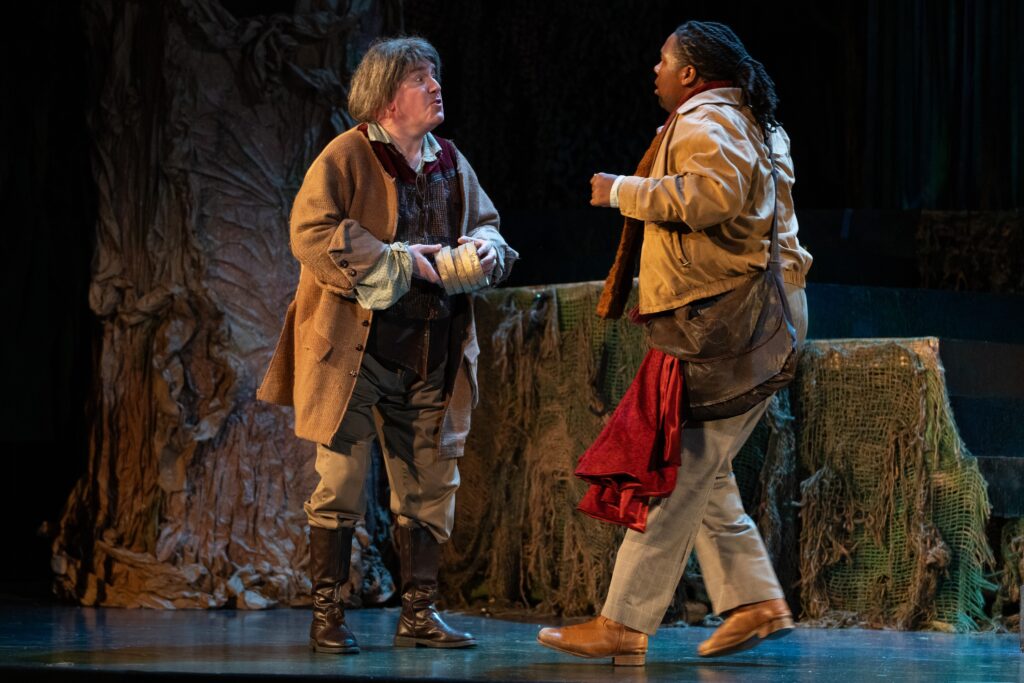
Christopher-Hickey-as-the-Narrator-and-Brandon-Bell-as-the-Baker. Photo by Dan Donovan.

 
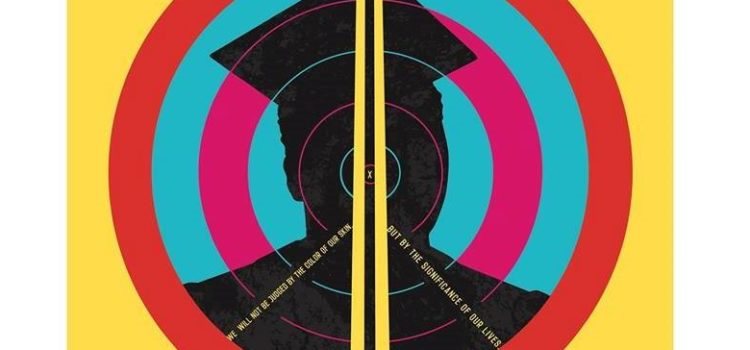
In this World Premiere production, two high-powered news reporters from across the aisle are thrown together during a ratings frenzy in Ferguson, Mo., following the shooting of unarmed teenager Michael Brown. As they untangle the real cause of Brown’s death, they struggle to keep their own secrets out of the spotlight. Created from diverse interviews of people from around the corner and around the world, “Canfield Drive” shines a light of hope as it wrestles with the greatest questions of our age.
“Canfield Drive,” written by Kristen Adele Calhoun and Michael Thomas Walker, is a National Performance Network (NPN) Creation & Development Fund Project co-commissioned by 651 Arts in partnership with The St. Louis Black Repertory Company, and NPN.  The Creation & Development Fund is supported by the Doris Duke Charitable Foundation, the Andrew W. Mellon Foundation, and the National Endowment for the Arts (a federal agency). For more information: www.npnweb.org.
Producing Director Ron Himes says “We have worked on this script with Michael Thomas Walker and Kristen Adele Calhoun for four years, with workshops at Brooklyn Academy of Music in Brooklyn, Denver, Hartford, and St. Louis.  We are so excited to premiere this work here in St Louis for our community.”
Playwright Michael Thomas Walker says “If ‘riot is the language of the unheard’, this play aims to understand the killing of Michael Brown, the Ferguson protests and the subsequent #BlackLivesMatter movement by hearing the unheard voices and amplifying those stories.  We hope this play will serve as a platform for the necessary conversations about race, culture, privilege, history, and healing.”
The cast of “Canfield Drive” includes Kristen Adele recent credits include Corduroy (Denver Center of Performing Arts), Bump (Ensemble Studio Theatre), and Skeleton Crew (Premiere Stages); Christopher Hickey, with The Black Rep credits include Oak & Ivy and Relativity; Amy Loui with The Black Rep credits include A Midsummer Night’s Dream and Three Ways Home, and Eric Connors with The Black Rep credits include Ms Julie, Clarissa & John, Anne & Emmett, Oak & Ivy, and Jitney .
“Canfield Drive” is directed by Producing Director Ron Himes, with scenic design by Peter and Margery Spack, lighting design by Jim Burwinkel; costumes by Marissa Perry, and sound design by Kareem Deanes, and Tracy D. Holliway-Wiggins is the stage manager.
The production will run January 9-27 at the Edison Theatre at Washington University. Tickets are available at www.theblackrep.org, 314-534-3807, or pick them up at our box office located at 6662 Olive Blvd, St. Louis, MO 63130.
 

By Andrea Braun
Contributing Writer“Last night I had the strangest dream I ever had before. I dreamed that men had all agreed to put an end to war.” –Chad Mitchell Trio
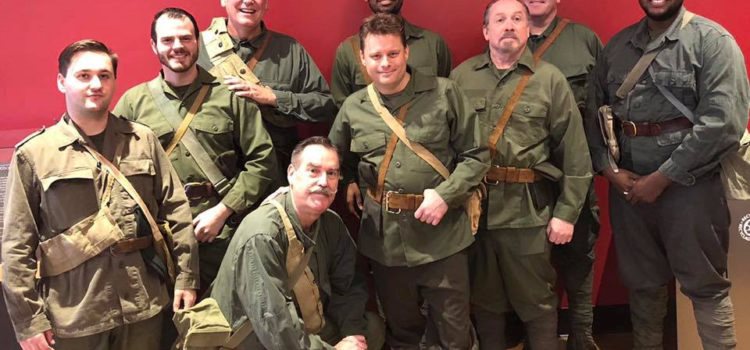
Entering Kyra Bishop’s set feels much like walking onto a battlefield. It is dark and dreary, no color to speak of, just browns and grays all around. There are rolls of copper wire, downed trees, and a backdrop so primitive it is held up by rope. Then, in the distance a man is singing a traditional Scottish ballad, “Will ye go to Flanders?” Gradually other voices join him and nine soldiers enter. It is 1914 at Christmas, and these guys are already tired of the fighting and their voices reflect that sense of weariness, of hopelessness.
But what they also demonstrate is a remarkable ability to sing solo, in ensembles or all together. This is the fourth production of “All Is Calm”  that Mustard Seed has mounted since its premiere in 2012, the third one I’ve seen, and the strongest yet.

The ensemble changes, though five of the cast members have appeared in the show at least a couple of other times. What is remarkable is that whoever is in front of us is fully believable, invested in the roles, and able to bring off every single number in the show from the sublime to the silly.
I couldn’t single out any cast members because they were all so good; here they are in alphabetical order: Kent Coffel, Anthony Heinmann, Christopher Hickey, Greg Lhamon, Gerry Love, Michael Lowe, Sean Michael, Abraham Shaw, Jeff Wright
The center of the story is a real event. On a memorable night in the first year of World War I, the British and Irish and the Germans stopped fighting. Just like that. They had been in mortal combat for days, perhaps weeks, and while they don’t exactly beat their swords into plowshares, they spend a night burying their dead together, playing soccer with each other, decorating a tiny Christmas tree, and most of all, singing the holiday songs of their cultures.
Besides song, the men recite quotations from soldiers’ letters, from the Pope and Winston Churchill, and most moving, two of the so-called “War Poets,” Wilfred Owen and Siegfried Sassoon. These young men created a body of literature about the war experience, and there is nothing romantic about it, nothing “sweet and right” about dying for one’s country, as Owen expresses in his ironically  titled “Dulce et Decorum est,” about a slow and horrible death from mustard gas. All these statements give the audience a sense of how the troops from the lowliest private to the prime minister were feeling about the job at hand. So, why did they do it?
Because they were called to duty. Because patriotism motivates both sides in war. And, probably not least because they could be hanged for treason if they ran away. But there is also a sense of real camaraderie here, not only on one’s own side, but among all the men—perhaps more accurately boys—who have been called to kill the other side who look just like them. The Royal Family is 100 percent German, for example. They just changed their names from Saxe, Coburg and Gotha to Windsor. Done and dusted. It wasn’t so easy for the young men who had to take sides, however.
Lighting design is a character too. Generally, the lighting designer does the job by not being particularly notable, but here, the light literally brings life, especially in the Christmas tree scene wherein “Silent Night” begins in a minor key when the tree comes out, then as the lights gradually go up, the song becomes harmonic. Credit goes to Michael Sullivan.
Jane Sullivan and Zoe Sullivan handle costumes and sound respectively and with their usual expertise. Director Deanna Jent and Musical Director Joe Schoen keep everything moving, and in its fifth production, the show works like a well-oiled machine.
“All Is Calm” is by Peter Rothstein, with musical arrangements by Erick Lichte and Timothy C. Takach. Its history is fascinating, having had its public debut on Minnesota Public Radio. Jent notes that: “While not shying away from the horrors of war, it presents a moment of hope that seems to have been transformative for the men involved in the event.”
In only six years since All Is Calm was first presented, our country seems to have gone to war with itself. May the peace among a group of people whose immediate “job” is to kill the “enemy,” serve as an example of the way we might all treat each other and perhaps even someday agree “to put an end to war.”
“All Is Calm” will run through Dec. 16 at the Fontbonne University Fine Arts Theatre. Details are available at www.mustardseedtheatre.com.