By CB Adams

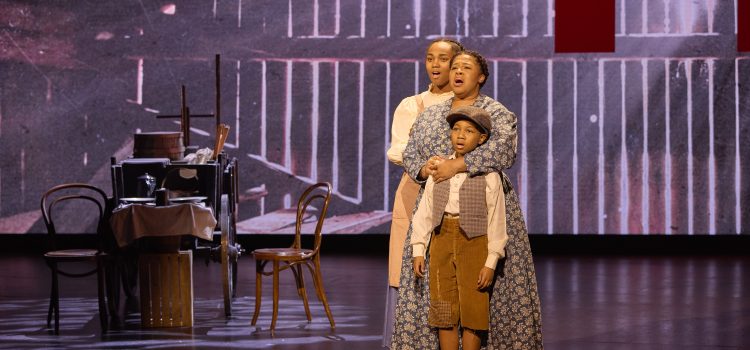
There’s swagger aplenty in “Joshua’s Boots,” along with a cattle stampede, a lynching and the complicated business of growing up Black in the American West of 1878. After a white mob murders his father in Tennessee, young Joshua heads west, hoping to make a life among the cowboys.

Director Adam Flores knows the size of these ingredients and, more importantly, their proportions. Working with Adolphus Hailstork’s music and Susan Kander’s deft libretto, he gives this hourlong opera its humor, heartbreak and historical weight, all governed by an admirable sense of restraint.

Michael Breaux plays Joshua with unwavering conviction, giving the young man’s journey a believable emotional center. His singing and acting possess an assurance that makes Joshua’s determination palpable.

Angel Love is a heartbreaker as Joshua’s Mama, then gives Sally Fingers a knowing blend of Miss Kitty from “Gunsmoke” and Joanie Stubbs from HBO’s “Deadwood.” She has the former’s poise, the latter’s worldly edge and the good sense to know what sort of men she’s dealing with.
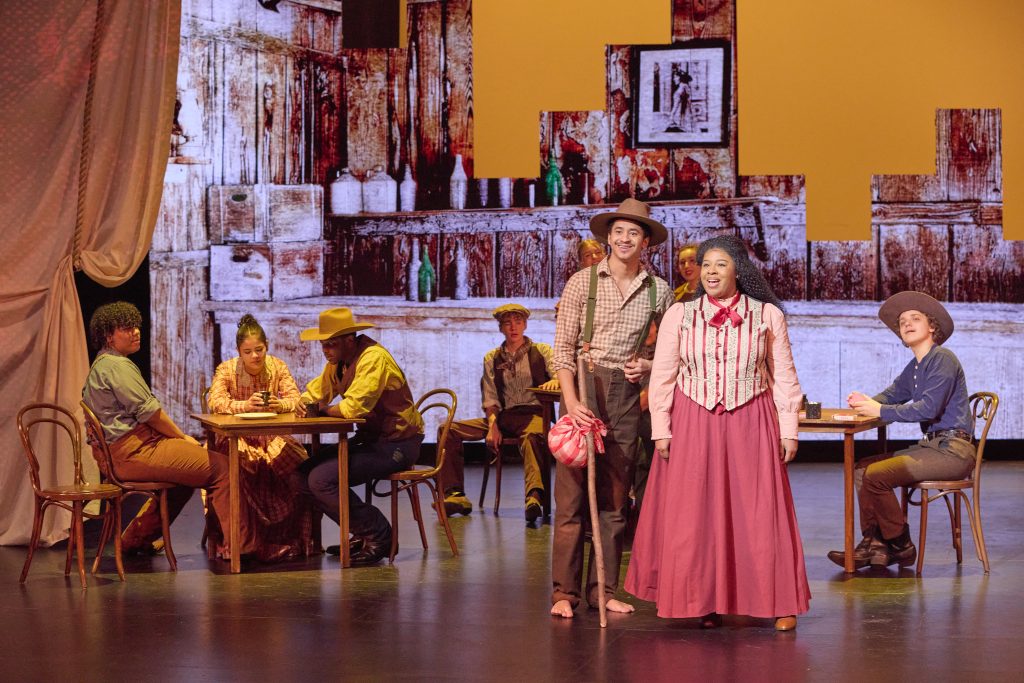
Joshua (Michael Breaux) meets tavern keeper Sally (Angel Love) in Dodge City. Photo by Eric Woolsey

Sam Hawkins plays Frederick, the prejudiced trail boss who hires Joshua and treats him with open contempt. Hawkins makes that prejudice so convincing, so deeply ingrained in the man, that Frederick’s eventual change of heart after Joshua saves his life during a stampede strains credibility. Hawkins may have done his job a little too well for the libretto’s own good.

James Stevens handles four roles—Geezer, Frank, Captain Pershing and Cookie—with the unruffled ease of a man changing hats. Ricco Martin Jr. gives Natty Green, a cowboy Joshua encounters on his journey, his full allotment of swagger, then reins it in enough to reveal the man beneath the mannerisms.

One of the opera’s loveliest moments comes beside a campfire, where a solitary figure listens as Kayden Brooks sings from offstage. His voice meets Hailstork’s music and Kander’s words at precisely the right emotional temperature. A lovely bit of theatrical alchemy.

There are more performers onstage than musicians in the pit, though you’d never know it from the sound. Stephen Mager draws a remarkably full-bodied performance from his chamber orchestra, seemingly anticipating the singers’ every move. One hopes the young artists appreciate just how good they’ve got it.
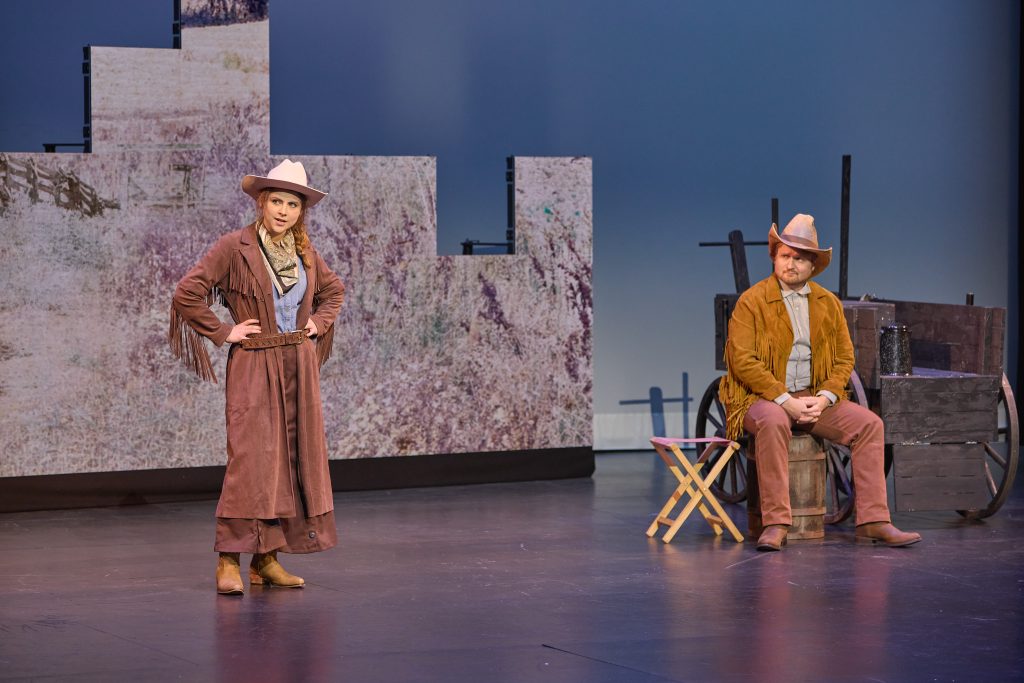
Lucinda (Anna Edwards) complains to Cooke (James Stevens) that girls aren’t allowed to become cowboys, too. Photo by Eric Woolsey

Can a puff of smoke in a projected Tennessee holler be fraught with meaning? It can in the hands of video designers David Sajewich and Kylee Loera. That ominous detail signals Joshua’s father’s lynching.

Elsewhere, their projections establish the changing landscape of Joshua’s journey and, during the cattle stampede, join Giac Noelle’s choreography in sending bodies and images into convincing commotion. Suggestion and spectacle, each in its proper place.

The partnership among Opera Theatre of Saint Louis, COCA and its Artists in Training program gives emerging performers the opportunity to work alongside seasoned professionals, with the same artistic expectations. “Joshua’s Boots” makes a persuasive case for that collaboration and for the future of opera in St. Louis.

“Joshua’s Boots” was presented October 21–24 at COCA’s Catherine B. Berges Theatre.
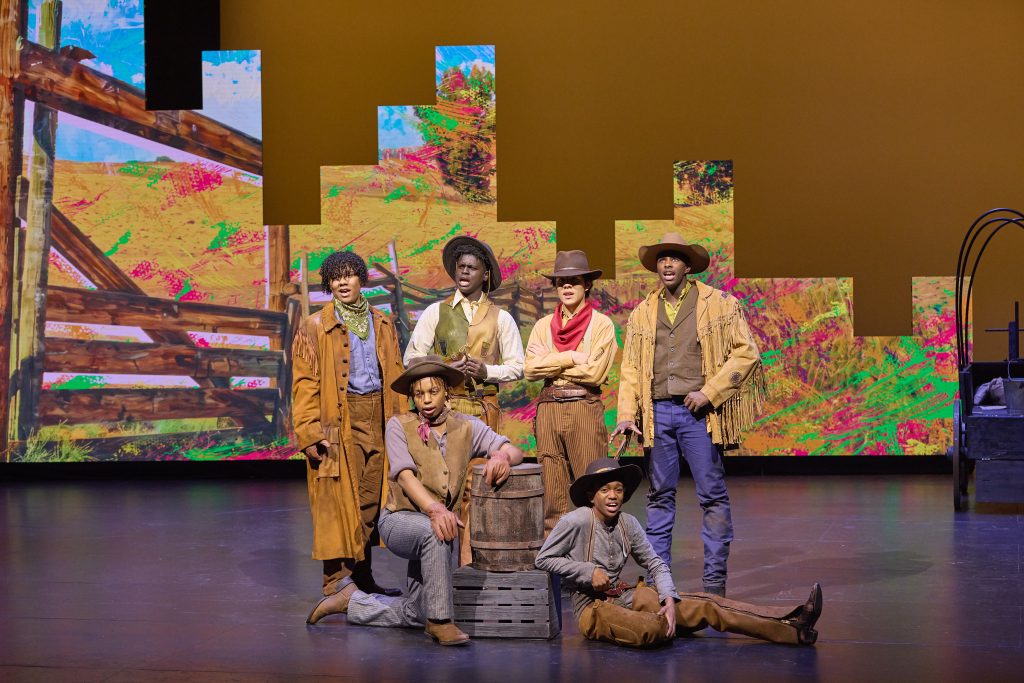
(L to R) Kayden Brooks, Thomas Chatman, Ricco Martin Jr., Éamon Ewing, Cameron Hadley, and Kameron Henry as cowboys in “Joshua’s Boots.” Photo by Eric Woolsey

By Lynn Venhaus
Managing Editor
The game-changing musical “Oklahoma!” is celebrating its 75th anniversary, and Stages St. Louis has honored that legacy with a rollicking hoedown. Their colorful collaboration burns bright with vivid characterizations.
The ensemble’s good cheer emanates. Based on Lynn Riggs’ 1931 play, “Green Grow the Lilacs,” the first book musical by Oscar Hammerstein II and Richard Rodgers focuses on romantic conflicts — between Laurey and her two suitors, Curly and Jud, and Ado Annie and two men she’s drawn to Ali Hakim and Will Parker.
Set on the Oklahoma territory in 1906, the musical reflects both its innocent time and the rugged pioneer spirit, the hands that built America. Director Michael Hamilton conveys a strong sense of community throughout, and the cast does its part, creating dynamic interactions in a small prairie town.

The cast infuses the old-fashioned characters with plenty of personality, making them appealing to a modern audience. The characters don’t remotely resemble any contemporary archetypes, so they remain quaint caricatures, and the ensemble plays them broadly.
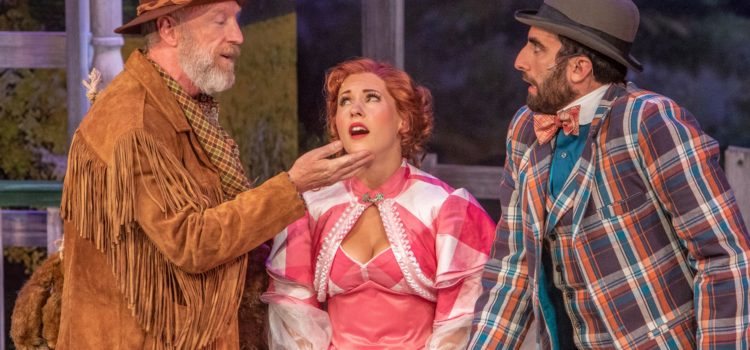
Blake Price, Sarah Ellis and Zoe Vonder Haar in “Oklahoma!”As Curly and Laurey, Blake Price and Sarah Ellis have a playful chemistry together as they tussle, clearly meant for each other, and their vocal ease is a high point of the show.
Price sets the tone with “Oh What a Beautiful Morning” and is a convincing charmer in “The Surrey with the Fringe on Top.” Their “People Will Say We’re in Love” is a superb rendition as they project yearning.
Ellis showcases a satiny soprano, outstanding on “Out of My Dreams” with the girls, and flawless both “People Will Say We’re in Love” and reprise.
But then there’s hired hand Jud (versatile David Sajewich), whose undercurrent of menace has some others on edge. Today, he’s viewed as a tragic figure who boils over in frustration and anger, misunderstood. You do feel sympathy for Jud, especially when Sajewich sings “Lonely Room.”
Sparks fly with the comical love triangle between lively Ado Annie, cowboy Will Parker and peddler Ali Hakim, who play their characters strictly for laughs.
Con O’Shea-Creal, with a winning smile and jaunty demeanor as Will, is convivial in “Kansas City,” an ebullient dance number unleashing rodeo spirit!
Newcomer Lucy Moon is the spunky boy-crazy lass Ado Annie and animated Matthew Curiano, with crackerjack comic timing, had the crowd on his side as the charming peddler stuck in the middle.
Zoe Vonder Haar, who has been part of Stages St. Louis for 31 of its 32 years, crackles as Aunt Eller. Her spunky delivery is another bright spot.
Stages’ veterans Leah Berry stood out as Gertie Cummings, with her distinctive laughter, while John Flack as crusty Andrew Carnes and Steve Isom as the lawman Cord Elam capably crafted lived-in characters. In Flack’s case, his shotgun-daddy character is a real “character” – he was straight out of Yosemite Sam’s playbook.
With their first collaboration, the legendary songwriting duo of Rodgers and Hammerstein set the gold standard with their innovations in 1943, seamlessly integrating music, dance, drama and comedy. They changed musical history and won a special Pulitzer Prize for their efforts.
The music effortlessly flows, and each number is crisply delivered and smooth as corn silk. Stuart M. Elmore handled the orchestral design while Lisa Campbell Albert oversaw the music direction.
The robust rendition of the title song brings out the community pride at being settlers in this new land. Since I learned it in fourth grade music class, it has always been one of my favorites, especially with the exquisite harmony and the modulated delivery.
Agnes DeMille’s landmark original choreography is honored by choreographer Dana Lewis. While the Dream Ballet is a beautiful component of this show, it’s a wee bit jarring when the Dancing Curly is a different guy – primo ballet dancer Nicholas De La Vega (who stood out in The Muny’s “Jerome Robbins’ Broadway” this summer) when Dancing Laurey is ballet-trained Ellis. Effortless nonetheless.
With the cast’s vitality shining through, the dance sequences fit the stage well. Costume designer Brad Musgrove has made eye-popping homespun costumes that stand out too.
The intimate staging at the Robert G. Reim Theatre works well for the large ensemble. Scenic Designer James Wolk’s work is stunning. His scrim and set evoked early American paintings and breathtaking vistas of what motivated pioneers to embark on an adventure. Sean Savoie’s exquisite lighting design accented every scene beautifully.
Steeped in Americana, this vigorous “Oklahoma!” honors our country’s love of the land, and our hard-working ancestors who believed in the American Dream and most definitely, the pursuit of happiness.
What a fitting way to end Stages’ 32nd season.
Photos by Tom Sakiyama