Patricia Racette’s production finds operatic scale, emotional truth and remarkable balance in Williams’s enduring tragedy.

By CB Adams

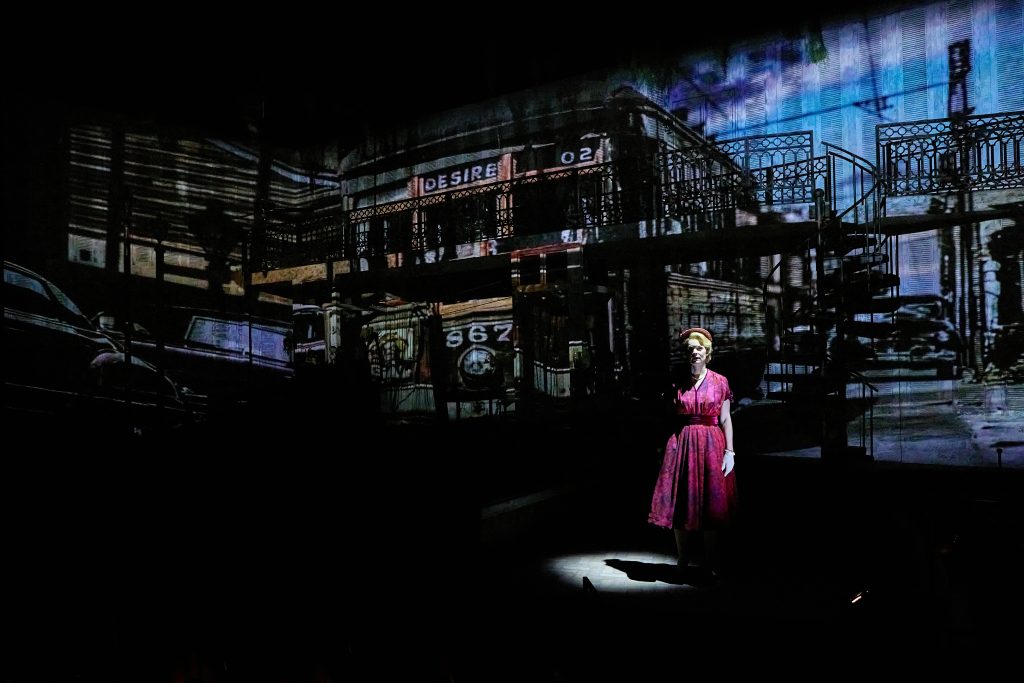
Andrew Boyce’s scenic design announces Opera Theatre of Saint Louis’s intentions before a note is sung. Towering walls of weathered white shutters dominate the stage, instantly evoking New Orleans while suggesting something more confining.

Projected across those walls, a black-and-white montage culminates in a huge streetcar lumbering toward the audience with the slow, inexorable force of a locomotive.

It is a striking image and an honest one. We know where this story is headed. Racette and Boyce embrace that inevitability from the outset. There is no attempt to disguise the destination. Some productions try to improve the classics. This one trusts one.

André Previn’s opera, with a libretto by Philip Littell, remains remarkably faithful to Williams’s play. Racette embraces that faithfulness as an artistic choice. She trusts Williams’s characters, conflicts and hard-earned understanding of human weakness. The result never feels preserved under glass.

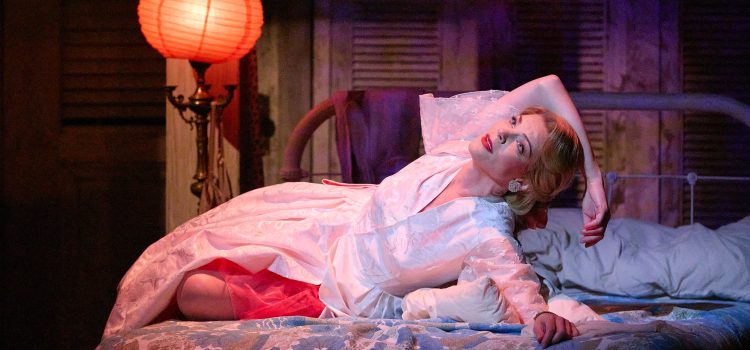
Blanche DuBois (Sara Gartland) arrives in New Orleans. Photo by Eric Woolsey.

Daniela Candillari leads the St. Louis Symphony Orchestra with equal command. Previn’s score moves beneath the action like an unseen current, deepening tension and longing without overwhelming the drama unfolding onstage. Candillari maintains an ideal balance between pit and stage. The orchestra remains firmly in service to the story.

The production’s dramatic engine is the ongoing contest between Sara Gartland’s Blanche DuBois and David Adam Moore’s Stanley Kowalski. They spar like star pugilists across Williams’s language and Previn’s score, each encounter carrying as much psychological force as vocal power.

Gartland captures Blanche’s contradictions without simplifying them. Under Racette’s careful guidance, her Blanche remains vain, vulnerable, manipulative, frightened, self-aware and self-deluding, often simultaneously.

Moore faces the equally difficult task of making Stanley more than a brute. He succeeds. Stanley’s eventual victory remains disturbing, but Moore preserves enough magnetism and humanity to make it believable.

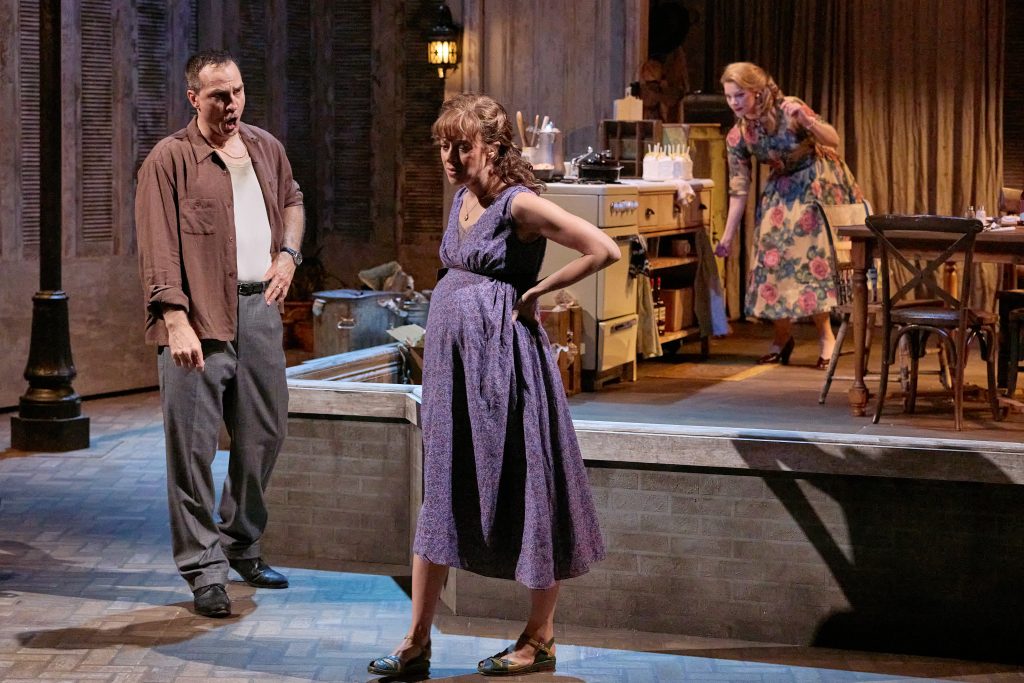
(L to R) David Adam Moore as Stanley, Lauren Snouffer as Stella, and Sara Gartland as Blanche in “A Streetcar Named Desire.” Photo by Eric Woolsey.

Racette allows Stanley’s appeal to remain visible even when his behavior becomes reprehensible. His spoken dialogue, used sparingly throughout the opera, sharpens the realism of the surrounding music rather than interrupting it.

Just as important is Lauren Snouffer’s Stella. More than a participant in Blanche and Stanley’s struggle, she becomes the emotional fulcrum of the evening, giving equal weight to Stella’s love for Blanche, desire for Stanley and determination to survive the impossible position in which she finds herself.

The relationship between the sisters is rendered with uncommon care, while Stella’s marriage to Stanley remains equally persuasive. Those relationships feel lived-in rather than merely dramatic.

Boyce’s towering shutter walls evoke New Orleans architecture while functioning as a kind of emotional enclosure. At times they resemble prison bars, at others the walls of memory closing around Blanche. Their scale is distinctly operatic, creating a world far larger than the cast occupying it.

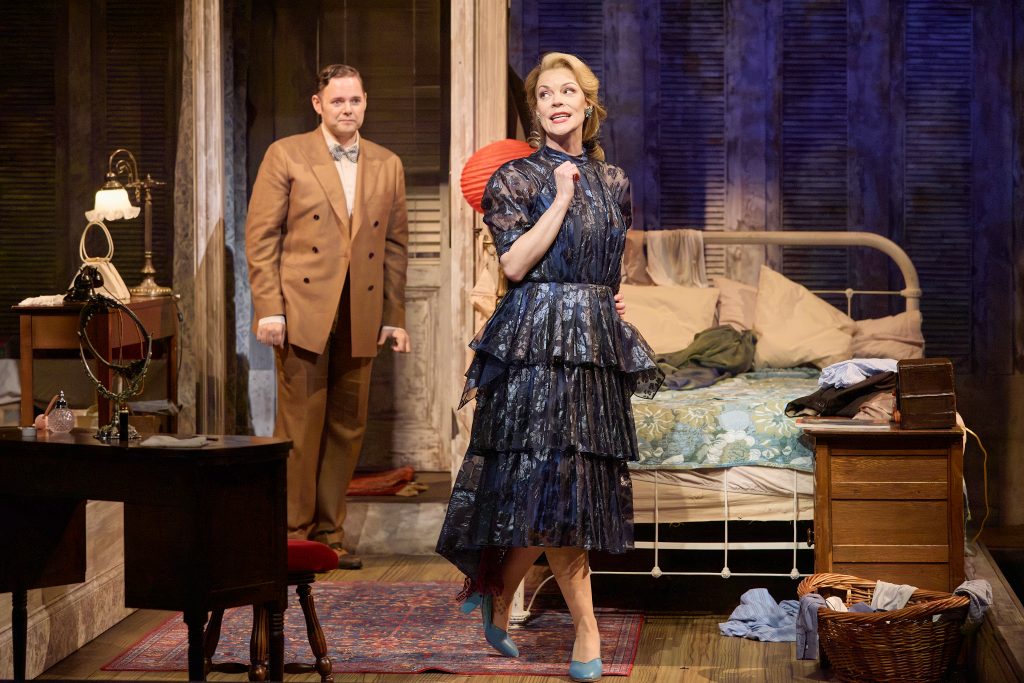
Blanche (Sara Gartland) flirts with the smitten Harold “Mitch” Mitchell. Photoby Eric Woolsey.

Yet Gartland, Moore, Snouffer and their colleagues fill that space through voice, presence and sharply defined characterizations. They do not merely survive the set. They complete it. In a production with relatively few principals, there is nowhere to hide. Every performer must command the space. They do.

The supporting cast contributes significantly to that achievement. Bille Bruley’s Harold Mitchell brings warmth and humanity to the role, while Ashlyn Brown’s Eunice provides an earthy, clear-eyed counterpoint to Blanche’s unraveling. Her nurturing support of Stella reinforces one of the production’s central relationships and helps ground the emotional reality of Elysian Fields.

The ensemble consistently strengthens Williams’s world. Kim Stanish is especially memorable as the Nurse in the final scene. Her prolonged struggle to restrain Blanche avoids melodrama and instead underscores the heartbreaking finality of the character’s collapse, a moment Racette allows to linger rather than rush past.

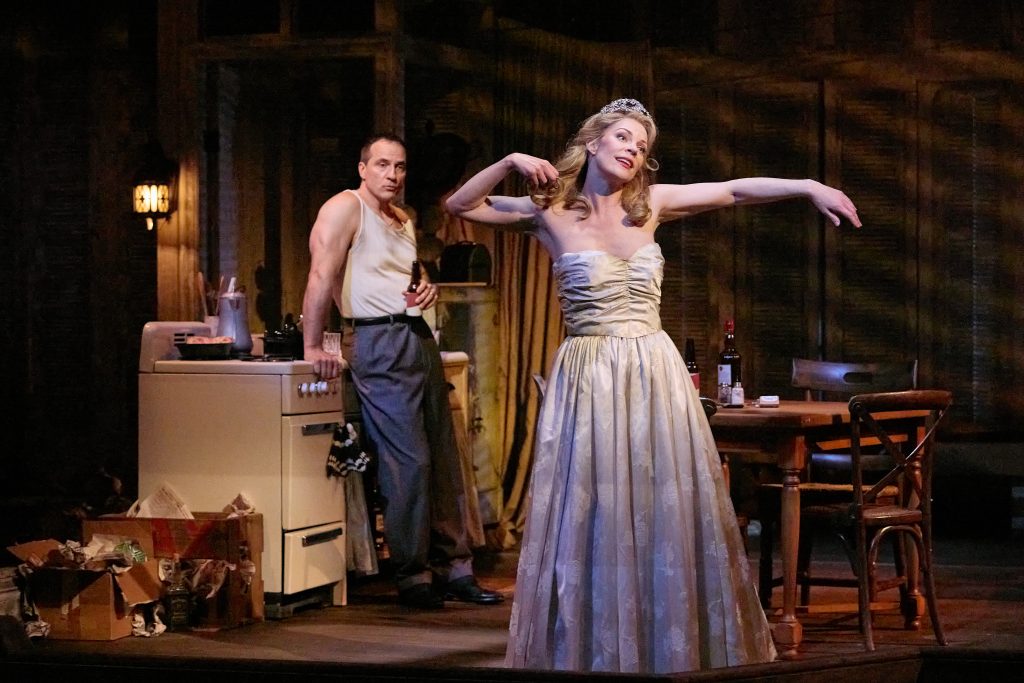
Blanche (Sara Gartland) begins to unravel under Stanley’s (David Adam Moore) menacing presence. Photo by Eric Woolsey.

The production’s scenes of violence and sexual assault are staged with careful restraint. Racette, intimacy coordinator Delaney Piggins and fight choreographer Shaun Sheley convey the ugliness of Stanley’s actions with just enough physical detail to communicate their impact without lapsing into sensationalism.

The projections prove equally effective throughout the evening. Most haunting is the appearance of Blanche’s young husband, whose portrait looms over the stage just as relentlessly as his memory looms over her life.

Throughout the evening, projections become another actor in the drama, carrying memory and desire across Boyce’s towering walls. By the time Blanche reaches her final music, Gartland and the production have earned every note of it.

“A Streetcar Named Desire” continues at Opera Theatre of Saint Louis through June 26 at the Loretto-Hilton Center on the Webster University campus as part of OTSL’s 2026 Festival Season. Ticket information, performance schedules and additional production details are available on the Opera Theatre of Saint Louis website.

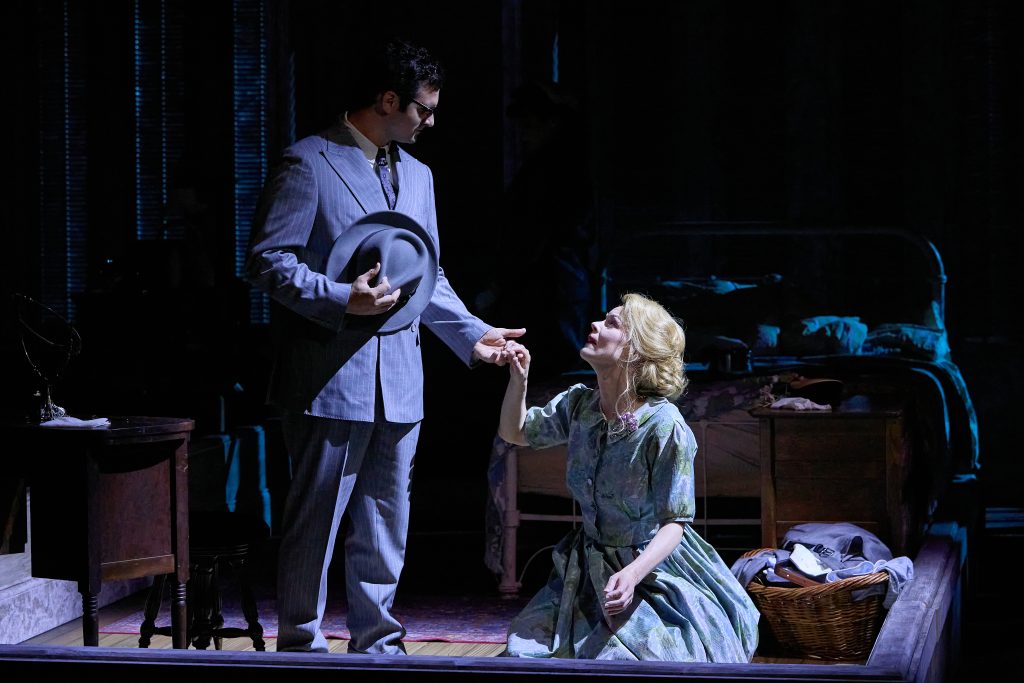
A shattered Blanche (Sara Gartland) is gently led away by a doctor (Erik DeMario). Photo by Eric Wooley.

By Lynn Venhaus

Sidesplitting hijinks ensue as a marital merry-go-round farce, “The Cottage,” spills the tea and twists a Noel Coward-esque comedy of manners for a female-forward finish.

Now playing through Sept. 28 on the Repertory Theatre of St. Louis’ mainstage, a splendid sextet puts the roar in this Roaring Twenties romp as they gamely carry on in a sophisticated upper-crust British setting.

They deftly deliver standard King’s English dialect – all those ‘darlings,’ ‘indeeds’ and ‘rathers’ – in crisp witty, and a tad cynical, manner (special shout-out to dialect coach Lauren Roth).

Sandy Rustin’s jaunty play effectively depicts complicated relationships among polite society, and the cast’s Swiss-watch timing and nimble silliness combine for a sparkling collaboration that shows off their verbal and physical dexterity. Their flair for slapstick is impressive, as is their limber body language.

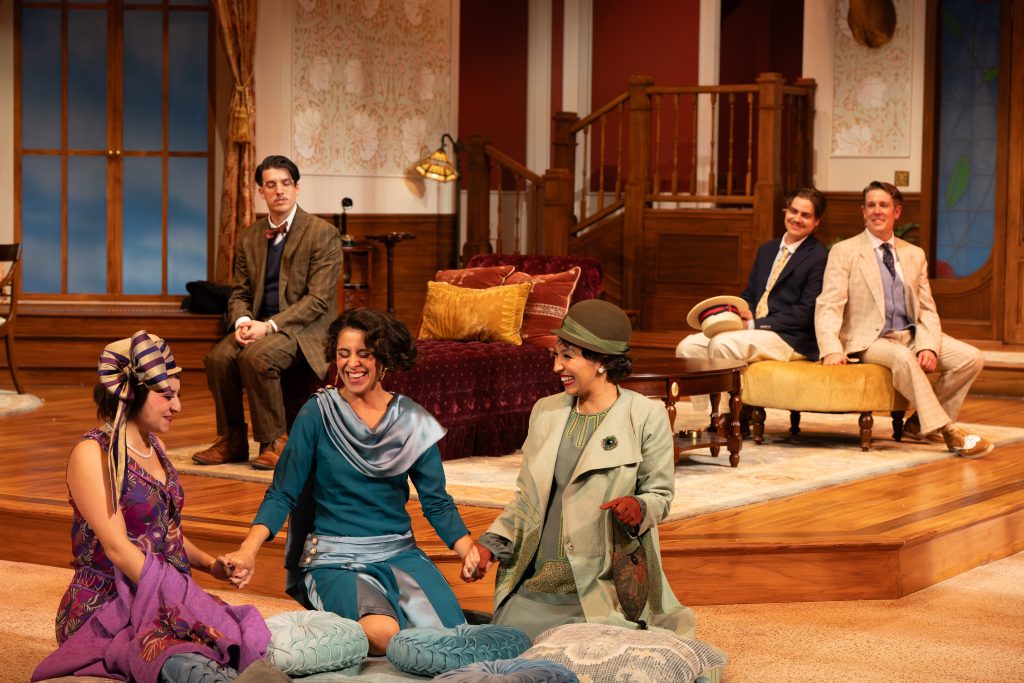
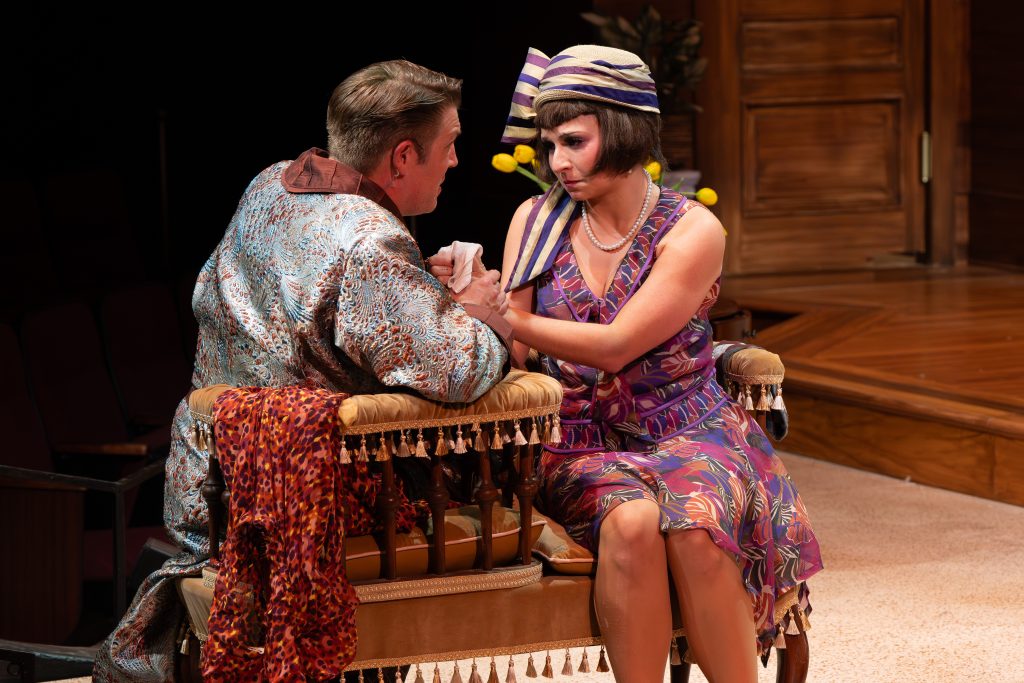
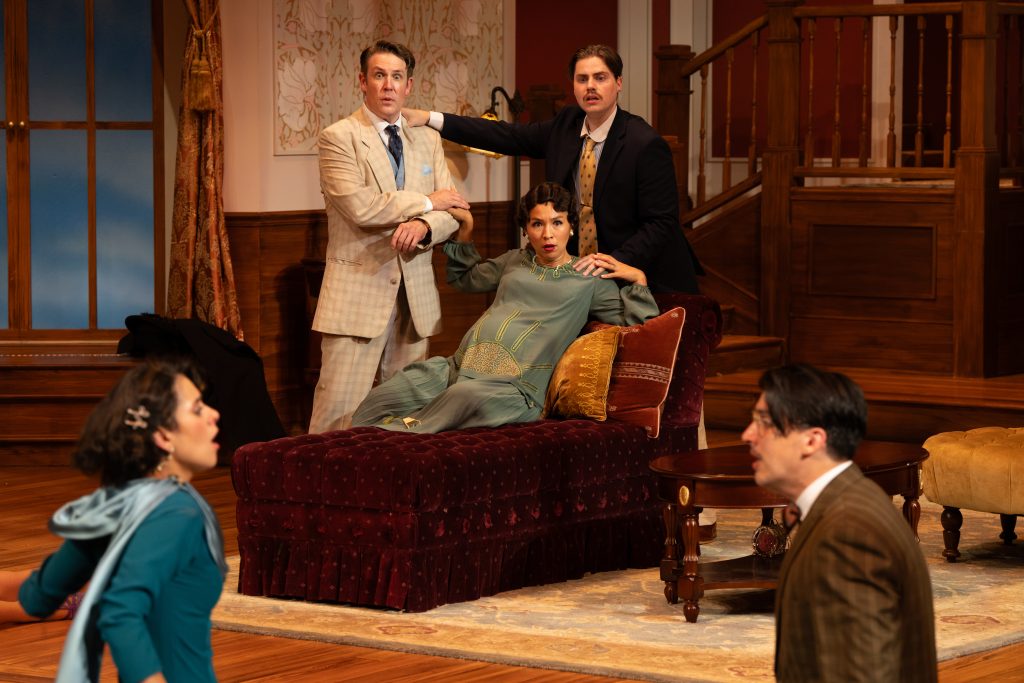
The company of “The Cottage.” Photo by Jon Gitchoff.

It all begins one sunny Monday morning in June 1923 at the Van Kipness matriarch’s tony countryside cottage, about 90 minutes outside of London. For seven years, Sylvia and Beau have enjoyed an annual tryst there.

Sylvia happens to be married to Beau’s stuffed-shirt brother Clarke. A hopeless romantic, she has impulsively told Clarke and Beau’s wife Marjorie of their affair so she can get her happily ever after.

That sets off a chain reaction where shocking truths are revealed, more characters are introduced, and doors lead to unexpected entrances and exits. These denizens of the smart set find their private lives upended, along with their carefully cultivated identities.

With this fashionable group, let’s just say love and marriage don’t go together like a horse and carriage, and things are not what they seem. As Coward famously said: “It’s discouraging to think how many people are shocked by honesty and how few by deceit.”

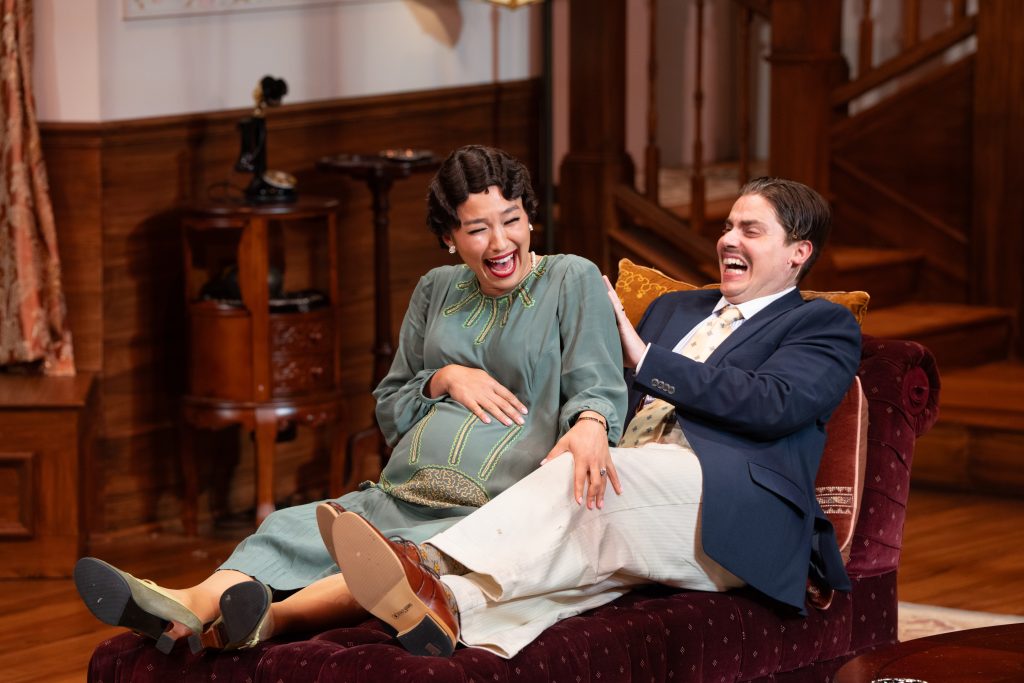
Jihan Haddad and Jack Dryden get frisky as Marjorie and Clarke. Photo by Jon Gitchoff.

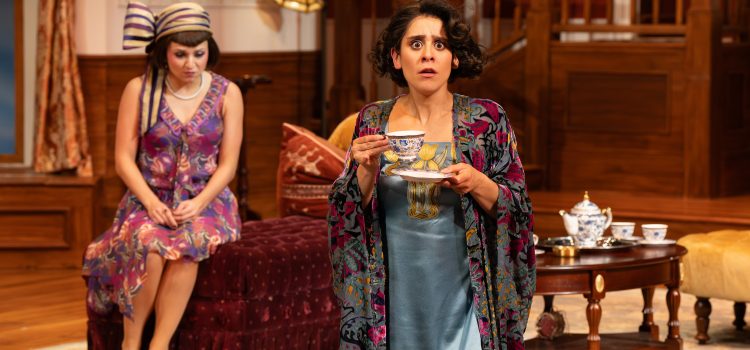
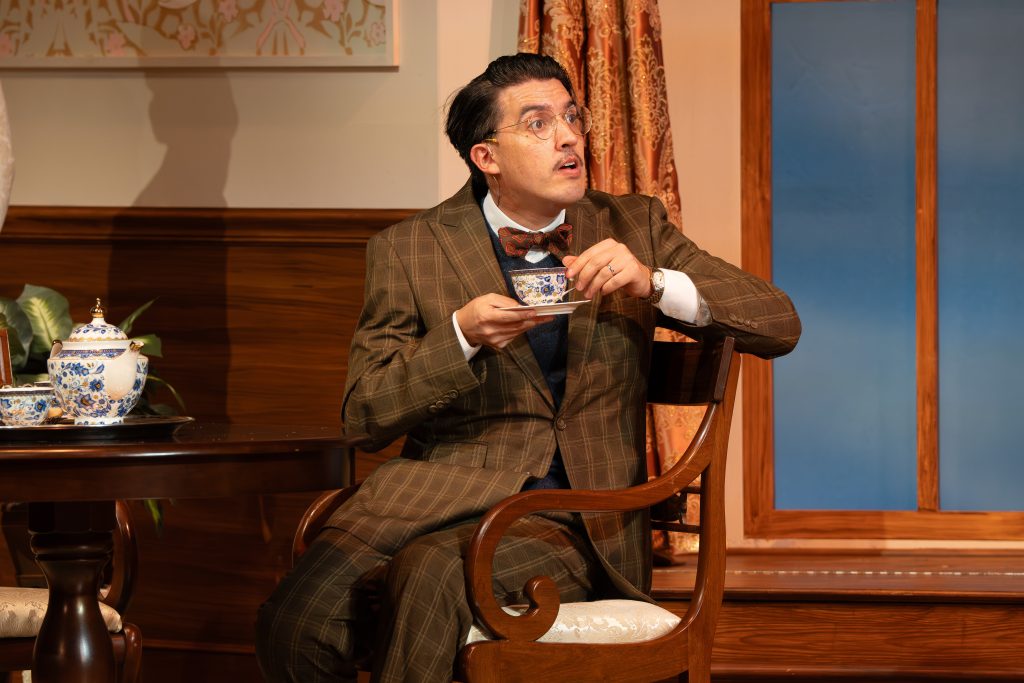
The remarkable ease with which this cast achieves synergy is a credit to the talents of Andrea San Miguel as the spirited and stylish Sylvia; Jordan Coughtry as the handsome but caddish Beau; Jihan Haddad as the ladylike Marjorie; St. Louis native Jack Dryden as buffoonish Clarke; Isa Venere as ditzy Dierdre; and Andres Enriquez as Richard, best described as a loose cannon.

Rustin, who wrote the hilarious play adaptation of the murder-mystery-comedy “Clue” based on the 1985 movie, is faithful to the British style of drawing-room comedies that skewered the manners and morals of high society – but only up to a point.

In a refreshing move, she has flipped the script on women only being in service to men in these throwback shows. You see the women emerge, speaking about their wants and desires, ultimately taking charge of their own lives.

It has more of a modern sense and sensibility – and most importantly, they get the last laugh. A charming live wire, San Miguel is the perfect embodiment for an awakening, a transformative journey for Sylvia, an intelligent woman stuck in stereotypes of the time.

However, besides her own stamp on Coward’s celebrated writing, Rustin injected the story with more than a month’s worth of soap opera confessions – and those juicy tidbits keep on coming. Must not forget Sam Matthews’ brief appearance as the gardener.

San Miguel and Coughtry as a passionate couple. Photo by Jon Gitchoff.

It’s best not to spoil more of the twisty turns the plot took as it unraveled, all at a swift pace. As details unfolded, anxiety ramped up, and rarely was anyone calm, cool and collected – all the better for zaniness.

Director Risa Brainin fluidly directed the chaos, making sure the action had a rhythm, and the well-cast ensemble maintained a pleasing tempo throughout. (Notable nod to casting director Delaney Piggins for assembling this finely tuned machine).

To emphasize their eccentric personalities, Brainin breezily blended them into the well-appointed set and ensured they each stood out when they were the focus.

One inspired segment involved Venere’s exaggerated acrobatic moves as an unconscious Dierdre is awkwardly handled by the others, reminiscent of classic Carol Burnett and Molly Shannon’s zesty physicality.

And this piggybacks on good-sport Haddad handling classy 8-months-pregnant Marjorie’s untimely gas-passing for more goofiness, which she managed with terrific finesse. (And loud guffaws and shrieks from the audience.)

Coughtry, San Miguel, Verare, Dryden and Haddad. Photo by Jon Gitchoff.

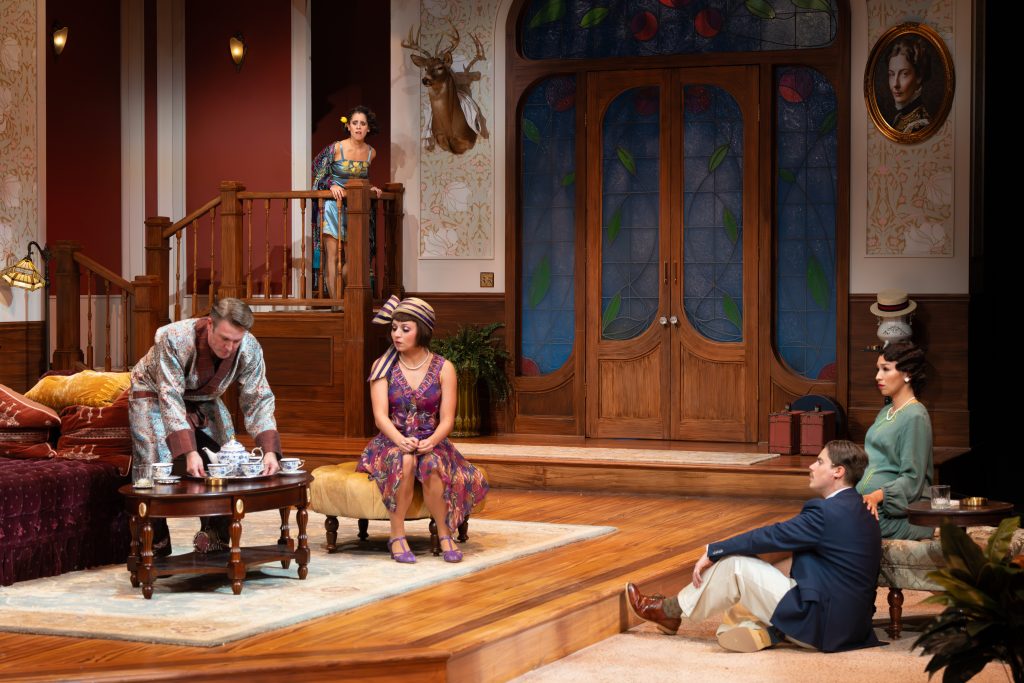
Brainin and scenic designer Robert Mark Morgan, ever mindful of architectural harmony, worked out a floor plan for maximum effect, as characters moved back and forth from the kitchen, the stairs leading to the bedrooms, and the guest room that was offstage, for the main action is in the elegant drawing room.

A focal point is a grand-scale front door with faux stained glass to complement the luxurious setting. Morgan’s exquisitely detailed set is the bee’s knees with its bespoke touches. Michael Klaers’ lighting design illuminates the bright space, with special attention to spotlighting Mama Van Kipness’ stern portrait hung in a prominent place.

Renee Garcia’s posh period costume designs are the cat’s pajamas, with sumptuous fabrics, fancy bathrobes, chic graceful designs, flattering colors, and tasteful tailored menswear and overcoats.  

The wig and makeup design by Dennis Milam Bensie is attractive in vogue styles, well-suited to the characters.

Coughtry, Verare. Photo by Jon Gitchoff.

Amanda Werre’s exemplary sound design is a necessary mix of victrola music, shower sounds, a weapon discharge – and loud flatulence.

Noteworthy nods to fight director Paul Steger and intimacy director Jamie McKittrick, and to production stage manager Evangeline Rose Whitlock for their astute contributions

As delightful as the performers are and the production’s flawless execution, the running time could be shaved, at least 10 minutes in each act, so that Rustin’s points don’t seem as repetitive. It would help maintain the bubbly mood as the urbane story gets increasingly absurd.

The play is 2 hours, 15 minutes, including a 15-minute intermission.

Andres Enriquez as Richard. Photo by Jon Gitchoff.

First produced in 2013 before regional productions, the play had a 2023 debut on Broadway directed by Jason Alexander that starred Eric McCormack, Laura Bell Bundy, Alex Moffat, Lilli Cooper, Dana Steingold and Nehal Joshi in a limited engagement for 111 performances.

The current cast appeared to be having a blast, so it’s easy to imagine how difficult it was to not crack up and keep their composure on stage and during rehearsal, let alone acquire the fleet moves and effortlessly deliver acerbic dialogue in a highly theatrical manner that reflected that era.

If madcap mischief and light-hearted entertainment are your cup of tea, you should plan a getaway to the Loretto-Hilton Center. Scandals are usually never this fun.

The Repertory Theatre of St. Louis presents “The Cottage” Sept. 3-Sept. 28 at the Loretto-Hilton Center on the campus of Webster University, 130 Edgar Road. For tickets or more information, visit www.repstl.org. The box office is available by calling 314-968-4925 and opens two hours prior to curtain time.

Post-show discussions follow the Sunday matinee at 2 p.m. Sept. 14 and the Wednesday matinee Sept. 18.

San Miguel, Coughtry, Haddad, Dryden and Enriquez. Photo by Jon Gitchoff.

SATE presents Project Verse: Creativity in the Time of Quarantine  
in collaboration with COCA and Prison Performing Arts,  Featuring two new plays —  Quatrains in Quarantine by e.k. doolin and Dream On, Black Girl: Reflections in Quarantine by Maxine du Maine  Premiering online Aug. 28, 2020 at 7 p.m.(CST) Presented free of charge on SATE’s website (slightlyoff.org), Facebook page (facebook.com/satestl), Instagram @satestl. 

Maxine du Maine

 SATE presents the culminating week of Project Verse, a three-week collaboration with COCA and Prison Performing Arts (PPA) as education and engagement partners. COCA presented the artist talks on their Facebook page to celebrate the creativity of those who are caregivers and artists.

Artist talks included poetry with jessica Care moore and King Thomas Moore on August 12 and visual arts with Maxine du Maine on August 19. The final week’s offering on August 26 was dance and poetry with Delaney Piggins and Norah Brozio.  Quatrains in Quarantine was written by e.k. doolin in response to a call for scripts based in the Zoom platform. The call was issued by COCA (Center of Creative Arts).

The COCAwrites program seeks to produce works that are intended for a multi-generational audience. Cara is a young poet, trying to process the unprecedented time she is living through in the best way she knows how – her verse. Nicole is her mother, trying to survive another day of uncertainty and working/parenting simultaneously from home. Mimi is her friend, seemingly winning at all things. JJ is her brother, absent in more ways than one. 

Quatrains in Quarantine is directed by Ellie Schwetye and features Rachel Tibbetts and Clayton High School students Claudia Taylor, Anna Lawrence, and Tommy Karandjeff.  Dream On, Black Girl: Reflections in Quarantine, written and directed by Maxine du Maine, focuses on a writing teacher guiding two young ladies through a poetry class on Zoom.

Both students share poems that reflect on the tragedies that continue to plague their community during the quarantine. The poems in the play are inspired by the young black children that were quarantined before COVID-19. They spent their time in a juvenile detention center reflecting on their lives, experiences and emotions through powerful art and writing.  Young black youth are tomorrow’s leaders and deserve a platform to represent themselves accurately in the media and have their voice heard. 

Dream On, Black Girl: Reflections in Quarantine is their platform. The performing ensemble includes Maxine du Maine, Gabby Eubanks, and Alana Wilson. 


 Please call (314) 827-5760, email [email protected], or visit the SATE website at slightlyoff.org for more information.  Project Verse is made possible by funding from COCA, Prison Performing Arts, Regional Arts Commission, and SATE.

By Lynn Venhaus

Several visionary local artists proved that fortune does favor the bold through their efforts to present a gift to a theater-starved community.

This precious lifeline was “Mute: A Play for Zoom” on Sunday, April 5. We experienced an original 5-person 30-minute play on the internet with a hundred other people that Sunday night, boldly going where no one had gone before.

This absurdist apocalyptic academic farce was a burst of creativity and a jolt of connectivity like the sun coming out on a cloudy day.

A maiden voyage by playwright Nancy Bell, director Lucy Cashion and production manager Spencer Lawton explored our strange new world of making art during a quarantine. It starts out as a video conference call among colleagues at a university. For these academics, there is confusion, and eventually fire – and a hamster.

A recording of last week’s live Zoom performance was shown during a Facebook Watch Party April 12. It is now on Vimeo for all to see: https://vimeo.com/405178212?fbclid=IwAR2hkRVBGu78QK8rLQWmb6pY-e7fynRixVlGxky1vvhWNxyN3kKY8PrCP0s

How it all came together was truly remarkable — ignited a spark, a surge of energy that took us out of our stay-at-home melancholia and made us appreciate authentic art and true talent.

It was like I was on a new adventure without leaving my couch.

The five-person cast included several lauded veterans and standout newcomers as colleagues. St. Louis Theater Circle Award winners Michelle Hand (a very nervous Maria), Michael James Reed (agitated Trent), Keating (trying to hang on Fiona) and Sophia Brown (mysterious Lila and Man Ray) performed with their customary immersion into character as well as Delaney Piggins, so good at New Jewish Theatre’s “I Now Pronounce,” as confused Heather and Jakob Hulten as assistant Dustin trying to herd the cats and keep normalcy.

They all connected in a believable way, providing distinctive portraits in a very short amount of time as what the new normal is quickly erodes into a disturbing situation. Reed mastered delivery of a barrage of new vocabulary among his monologues, unleashing a torrent of new words among his distain for the circumstances. He did it with a complete command of the twisty dialogue.

Worried about technical difficulties, it actually went off without a hitch, and ended abruptly according the script. Just be patient. Zoom is a terrific tool for bringing us all together, and the technical gurus behind this production did a fantastic job.

I have always been grateful we have the brilliance of Nancy Bell as a playwright and an actress and the visionary viewpoint of Lucy Cashion, who is never deterred by convention or obstacles, and noticed them right away as I began reviewing more regional professional theater in 2012.

And “Mute: A Play for Zoom” confirms how lucky we are to have them producing art in St. Louis.

This is just a thrilling testament to the possibilities of how to create art in unconventional ways under difficult circumstances.

While this view is indeed apocalyptic, the way it was executed was also life-affirming and uplifting in a bracing way – and to be able to appreciate how we can still connect through storytelling was indeed a lovely surprise gift.

Bravo to everyone involved.

Here is what the cast bios said on their event page:

CAST

Delaney Piggins [Heather] is a St. Louis Actor/Playwright/Producer, who is excited to do her first “pants optional” play.

Jakob Hultén [Dustin] is a SLU senior graduating with a BA in Theatre and History.

Michelle Hand [Maria] is an STL born and bred professional actor who, in her twenty years at work, has never quite done something like this.

Sophia Brown [Lila/Man Ray] is thrilled to be joining Mute! She is a local theatre artist, most recently seen with the Imaginary Theatre Company.

Keating [Fiona] is a kick-ass theatre artist who is madly in love with STL, co-artistic director of Poor Monsters.

Michael James Reed [Trent] used to enjoy doing a play or two. He now spends good portions of his day in a cardigan and Crocks.

They took a risk and it paid off.

Note: MUTE: A play for Zoom WATCH PARTY this Sunday, APRIL 12th at 7PM. DETAILS TBA. https://facebook.com/events/s/mute-a-play-for-zoom-watch-par/159436718663052/?ti=icl

Join us for the watch party!!! Here’s the page where you can get all the details coming soon.