By CB Adams

Opera succeeds when theater, singing, and orchestra move together. Winter Opera St. Louis brought those forces into satisfying alignment with Charles Gounod’s “Roméo et Juliette,” closing its season with a production that carried Shakespeare’s familiar tragedy with immediacy and emotional force.

Gounod’s 1867 opera, with a libretto by Jules Barbier and Michel Carré, keeps its focus firmly on the young lovers rather than the feud that surrounds them. That emphasis places unusual weight on the title roles, and Winter Opera delivered with a compelling pair.

Tenor Taylor Comstock sang Roméo with youthful ardor and a clear, lyrical tenor that expanded in power as the music climbed into the upper register. Opposite him, soprano Megan Barrera offered a Juliette of brightness, agility, and growing emotional depth.

Her “Je veux vivre” waltz sparkled with buoyant phrasing and easy coloratura, and she navigated the role’s demanding succession of arias and duets with clarity of tone and precise French diction.

Taylor-Comstock-Nathan-Whitson-Megan-Barrera. Photo by Dan Donovan.

Together they projected the impulsive youth at the heart of the story, allowing Gounod’s long love duets to unfold with warmth and urgency.

Director John Stephens guided the drama with clarity and focus. The turning point arrived in the duel between Mercutio and Tybalt, staged with sharp dramatic energy as Roméo’s intervention sealed the opera’s tragic course.

The final scene, shaped with intimate restraint, carried the emotional weight of the evening.

The supporting cast added vivid character and vocal strength. Baritone Kenneth Stavert filled Mercutio with swagger, wit, and striking physical vitality, relishing the playful brilliance of the Queen Mab scene.

Marc Schapman’s Tybalt burned with fierce intensity, while Jacob Lassetter brought warmth and authority to Capulet. Raphaella Medina charmed as Stéphano, and Emily Moore animated the role of Gertrude with lively presence. The ensemble throughout sang and acted with admirable cohesion.

In the pit, conductor Edward Benyas shaped the score with sensitivity to its lyrical sweep, balancing orchestra and voices so that Gounod’s melodic lines could bloom freely.

The chorus, prepared by Scott Schoonover, sang with clarity and strength, particularly in the somber lament that follows the duel.

Taylor Comstock and Marc Schapman as Romeo and Tybalt. Dan Donovan photo.

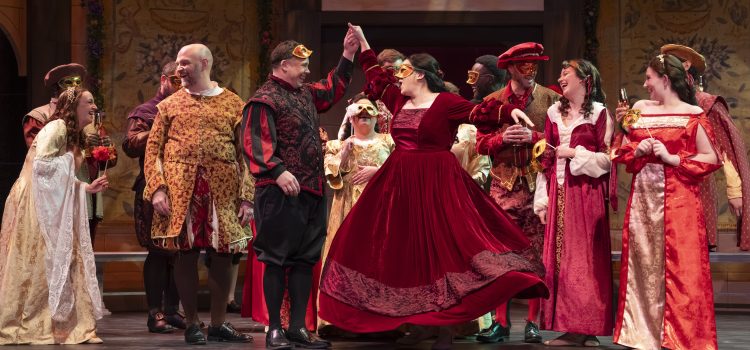
Scott Loebl’s flexible scenic design and Jen Blum-Tatara’s richly colored costumes reinforced the divided world of the rival houses while allowing the drama to move fluidly from celebration to tragedy.

The result proved deeply affecting and a fitting close to Winter Opera’s season. Performances at this level make a persuasive case for opera at an intimate scale, where music, voices, and story meet the audience directly.

Winter Opera’s “Roméo et Juliette” was performed on Feb. 27 and March 1 at the Kirkwood Performing Arts Center.


Megan Barrera as Juliette and Emily Moore as Gertrude. Photo by Dan Donovan.

By CB Adams

Mozart’s “The Magic Flute” balances fairy-tale whimsy with deeper allegory, and Winter Opera’s production embraces that duality with refreshing sincerity. Without gimmicks, forced interpretations or distracting modern flourishes, it trusts the material, the creative team and the performers to deliver warmth, humor and a thoroughly satisfying experience. It’s just Mozart’s music and Emmanuel Schikaneder’s libretto—presented with clarity and respect.

The story unfolds in a mythical realm where beasts lurk, magic reigns and two young lovers—Prince Tamino and Princess Pamina—are ensnared in a cosmic struggle between the vengeful Queen of the Night and Sarastro, the High Priest of the Sun.

Schikaneder’s libretto is layered with the unmistakable symbolism of Freemasonry (and not a small amount of mumbo jumbo). Winter Opera’s production, however, softens the esoteric elements. Although sung in the original German, the dialogue is delivered in English (including some modern vernacular) making for a more accessible production.

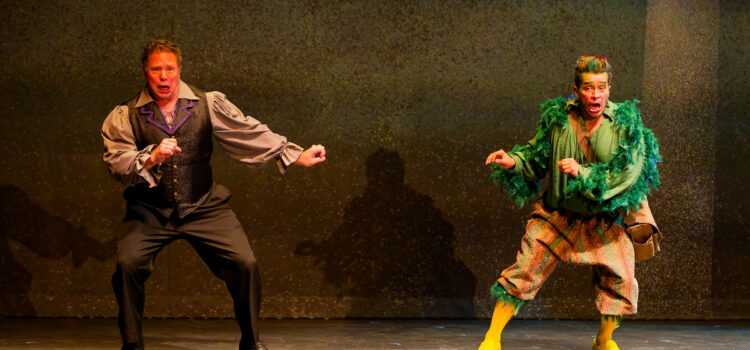
Winter Opera assembled a fine cast that balances local vocal prowess and theatrical charm. Tenor Alexander Scheuermann embodies Tamino with the kind of heroic presence that makes the role (and his voice) soar. As Papageno, bass-baritone Steve Valenzuela balances comedy and warmth, never overplaying his good-natured buffoonery.

Leeann Schuering, Steve Valenzuela. Photo by Peter Wochniak.

Soprano Maggie Kinabrew delivers a formidable Queen of the Night, her coloratura razor-sharp, slicing through the air with precision in her Act II aria. Bass Bert Johnson’s Sarastro exudes gravity, his deep obsidian tones lending the character an air of tangible authority.

Elena Galván’s Pamina is as spirited as she is sweet-voiced. Her performance delivers dramatic depth and vocal elegance. Leann Schuering charms as Papagena and baritone Joel Rogier lends a commanding presence as the Spokesman of the Temple.

Marc Schapman’s Monostatos, though lecherous in intent, plays more as comic relief—his comedic timing enhancing rather than detracting from his vocal performance.

The supporting cast is equally well-assembled. Karen Kanakis, Brittany Moleski and Emily Moore—playing the Queen’s Three Ladies—are visually striking in jewel-toned costumes, each creating her own distinct character.

The Three Spirits, performed by Anna Edwards, Chloe Haynes and Calista Goldwasser, bring a graceful presence to their ethereal roles.

Rounding out the fine casting is the chorus. Even two guards enjoy a satisfying, if small, moment in the second act—exemplifying the overall quality of the production. Under Mark Ferrell’s light baton, the small orchestra delivers a full and at times powerful performance of Mozart’s beautiful score. The extended overture was one of the many enjoyable moments in this production.

Maggie Kinabrew, Elena Galvan. Photo by Peter Wochniak.

Jen Blum-Tatara’s 18th century-inspired costumes are as period-appropriate as they are, at times, opulent. Scott Loebl’s minimal-but-evocative set design provides just the right amount of atmosphere without calling too much attention to itself. Loebl’s set and Michael Sullivan’s lighting design deliver another of this production’s best moments.

Late in the second act, Tamino plays his flute and he and Pamina pass through fire and water. To convey their journey, they pass behind a patterned screen (red for fire and blue for water) in a shadow play that stretches the width of the stage. The approach works well for this turning point in the opera.

“The Magic Flute” is a fitting end to Winter Opera’s 24-25 season (their 18th) and sets a good precedent for next season.

Karen Kanakiss Emily Moleski, Alex Scheuermann; and Steve Valenzuela. Photo by Peter Wochniak.

Winter Opera’s “The Magic Flute” was presented at Kirkwood Community Center Feb. 28 through March 2.