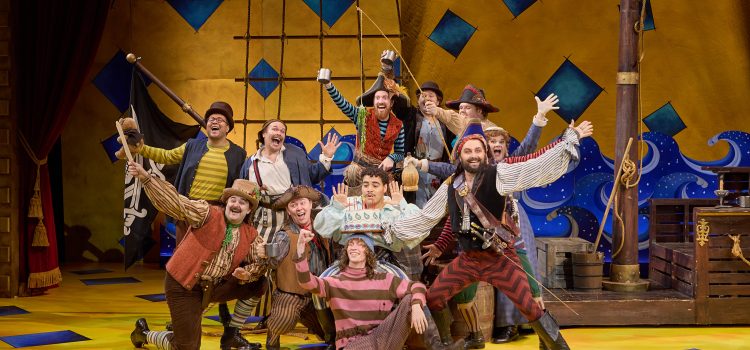
The performing arts do love a new label, especially for an old idea. Take “poperetta,” a recent coinage for musical theater that mixes high and low, sophistication and popular appeal. Gilbert and Sullivan might reasonably ask what took us so long. Nearly 150 years after “The Pirates of Penzance” first set sail, Opera Theatre of Saint Louis’ exuberant revival finds this Victorian confection still afloat, still tuneful and still very funny. Apparently, nobody told it that it was old.
Director and choreographer Seán Curran knows precisely what keeps this gloriously improbable work moving. His production, first staged at OTSL in 2013, has since been mounted by opera companies across the country. Back where it began, the production remains fresh and remarkably sure of itself. The stage is rarely still. Gesture, rhythm and split-second timing accumulate into comedy, grounded by characters who treat every ridiculous circumstance with complete seriousness.
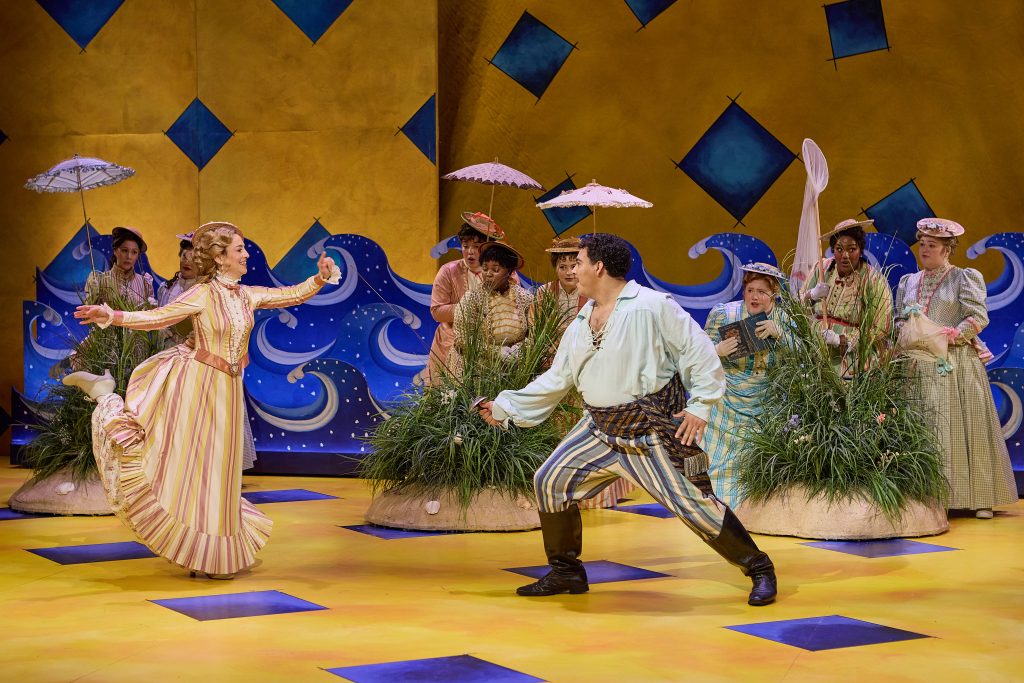
James Schuette’s sets and costumes announce the game before Sullivan’s score gets underway. A grand gilt Victorian proscenium, crowned by a skull and crossed swords, frames the thrust stage. Red curtains, vivid painted backdrops and a pirate ship cheerfully wheeled into place suggest a pop-up book sprung to life. The machinery shows. That’s part of the point.
Daniel Luis Espinal gives Frederic a bright, ardent tenor and a winning innocence. Jana McIntyre’s Mabel brings character and wit to the role’s coloratura demands. Their romantic sincerity gives the surrounding lunacy something firm to bounce against.
Jana McIntyre and Daniel Luis Espinal, Photo by Eric Woolsey.
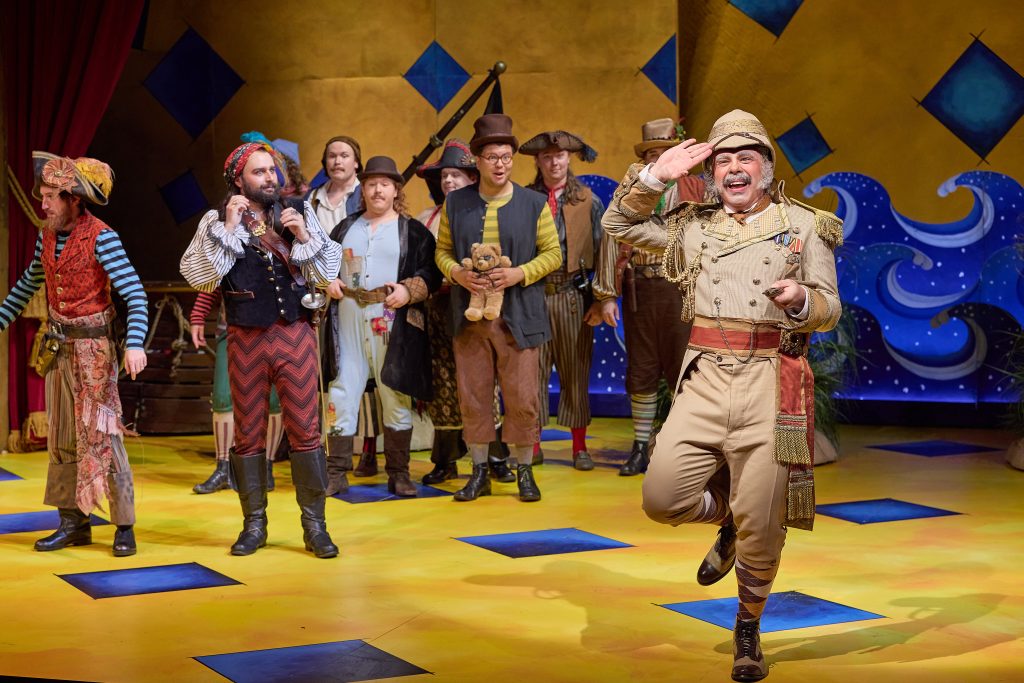
The production has comic talent to spare. William Socolof’s Pirate King swaggers and blusters with comic authority, while Meredith Arwady brings a formidable contralto and deft comic timing to Ruth. Robert Mellon makes Major-General Stanley a beaming monument to cheerful foolishness, dispatching the famous patter song with impressive clarity. Shyheim Selvan Hinnant makes the Sergeant of Police one of the evening’s comic highlights, leading his hapless constables through some of Curran’s funniest physical comedy.
George Manahan conducts members of the St. Louis Symphony Orchestra with equal attention to Sullivan’s melodic beauty and the propulsion that keeps Curran’s production moving. The chorus, prepared by Andrew Whitfield, contributes power, verbal clarity and distinct comic character.
After nearly 150 years, “The Pirates of Penzance” has nothing to prove. Curran and company trust the music, sharpen the comedy and keep the whole improbable contraption moving. The old thing sails beautifully.
Opera Theatre of Saint Louis’ production of “The Pirates of Penzance” was performed May 23 through June 27 as part of the company’s 2026 Festival Season.
Robert Mellon as the Major General. Photo by Eric Woolsey.
CB Adams is an award-winning fiction writer and photographer based in the Greater St. Louis area. A former music/arts editor and feature writer for the St. Louis Globe-Democrat, his non-fiction has been published in local, regional and national publications. His literary short stories have been published in more than a dozen literary journals and his fine art photography has been exhibited in more than 40 galley shows nationwide. Adams is the recipient of the Missouri Arts Council’s highest writing awards: the Writers’ Biennial and Missouri Writing!. The Riverfront Times named him, “St. Louis’ Most Under-Appreciated Writer” in 1996.
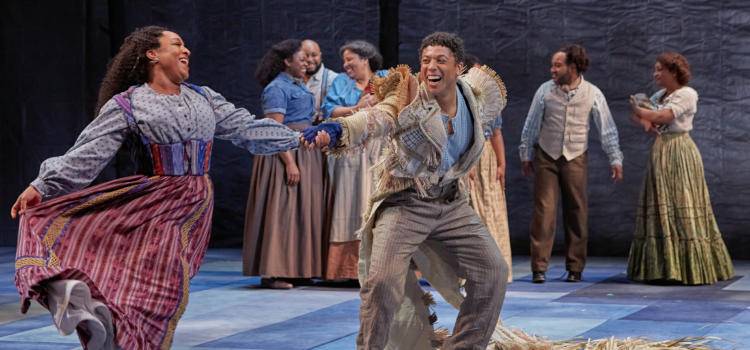
Opera Theatre of St. Louis’ season opener of a reimagined-yet-respectful version of Scott Joplin’s Treemonisha by composer Damien Sneed and librettist Karen Chilton is a transformative experience that beautifully balances theatrical spirit with artistic integrity.
It is an example of the power of art in general and opera in particular to serve as a “moral instrument” (borrowing from Constantin Stanislavski) that ennobles the mind and spirit. My top take-away: It deserves sold-out status audiences for its entire run – no seat left behind.
This production of Treemonisha, occurs at a pitch-perfect moment in the St. Louis zeitgeist. The citywide triennial exhibit, Counterpublic, is weaving contemporary art into the life of St. Louis for three months to “reimagine civic infrastructures towards generational change.” In his introduction to the 285-page Counterpublic catalog, James McAnally (executive and artistic director and founder of St. Louis-based artist space The Luminary) explains that he envisions an exhibit that allies “itself with generational, cultural, economic, and civic change; a post-pandemic, post-uprising exhibition demanding that we, as arts workers and artists, do more to repair our broken world.”
Counterpublic seeks to help initiate “concrete change” of the sort that Joplin was exploring more than a century ago in his original Treemonisha, a hybridized classical/ragtime opera that reveals a Wagnerian influence while also presaging George Gershwin’s “Porgy and Bess.” But Treemonisha, especially with this new version, proves the old Latin phrase true: “Art is long, life is short.” Joplin died too young at age 48 in 1917.
Treemonisha did not receive a real premiere until a 1972 production by the Afro-American Music Workshop of Morehouse College (though a New York Times piece states that it was performed at a theater in Bayonne, N.J. in 1913. Either way, it was a tragedy that Joplin didn’t get to see his magnum opus, his hoped-for recognition of ragtime as a new, American form of classical music.
Opera Theatre staged a successful production of this opera 23 years ago. I didn’t see that production, but this current iteration of Treemonisha stands as an engaging, exuberant example of what opera can achieve when all of its elements – direction, staging, casting, acting, singing passion – align. Such alignment is a rarity.
It’s the bane of my reviewing existence: why can’t it all be this good? The obvious answer makes this production all the sweeter. It brings to mind something the novelist Julian Barnes wrote in “Levels of Life,” his memoir: “Opera cuts to the chase—as death does . . . [it is] an art which seeks, more obviously than any other form, to break your heart.”
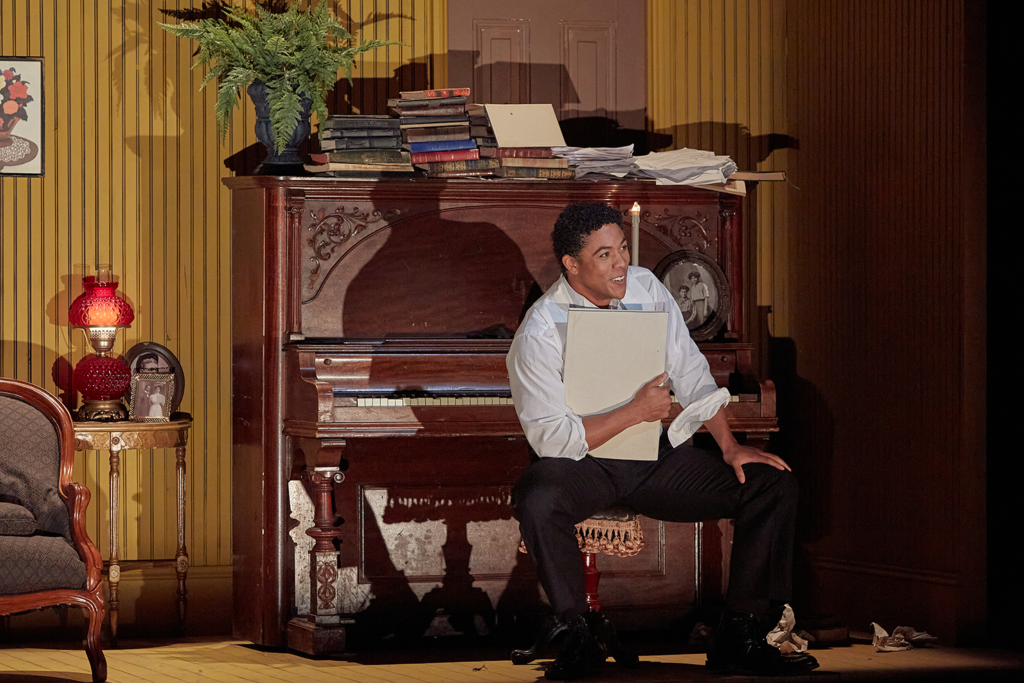
My heart was broken, especially during Act V, during which the aging Scott Joplin character, sung with naked, wrenching emotion by baritone Justin Austin (who also plays Remus), reveals his frustration about his artistic legacy. Austin’s inspired performance proves how difficult it is to both sing with perfection while acting with authenticity – and how marvelous when achieved. To best describe Austin’s artistic feat, I rely on a quote by Marina Abramović in “Last Days of the Opera” by the Viennese critic Karl Kraus: “You can go so deep into a performance that you become one with the character and create a charismatic state of unity with the public.”
Austin’s so-deep achievement is matched nearly across the board by the rest of the cast, and especially by soprano Brandie Inez Sutton (making her Opera Theatre debut) as both Freddie Alexander Joplin and Tremonisha (look for the moment when the origin of her name is revealed). As Act II (and the original opera itself) begins, it’s clear that this is really the eponymous Treemonisha’s story about an educated Black woman who guides her fellow small-town citizens, (persecuted by endemic racism and poverty) away from ignorance and superstition and toward an enlightened self-worth and self-reliance. With considerable stage presence, Sutton reveals her heroic character as sweet but strong, simple but literate, and humble but exalted – all while proving she can sing!
Balancing the deep characters of Remus and Treemonisha, are the conjurer Zodzetrick, played imposingly and malevolently by Phillip Bullock (making his OTSL debut), and Parson Alltalk, played by entertainingly by Markel Reed. Zodzetrick and Alltalk are not as three-dimensional (they can’t all be) as Remus and Treemonisha, but as performed with the adroitness of Bullock and Reed, they are nonetheless essential to Joplin’s story and his use of many musical styles.
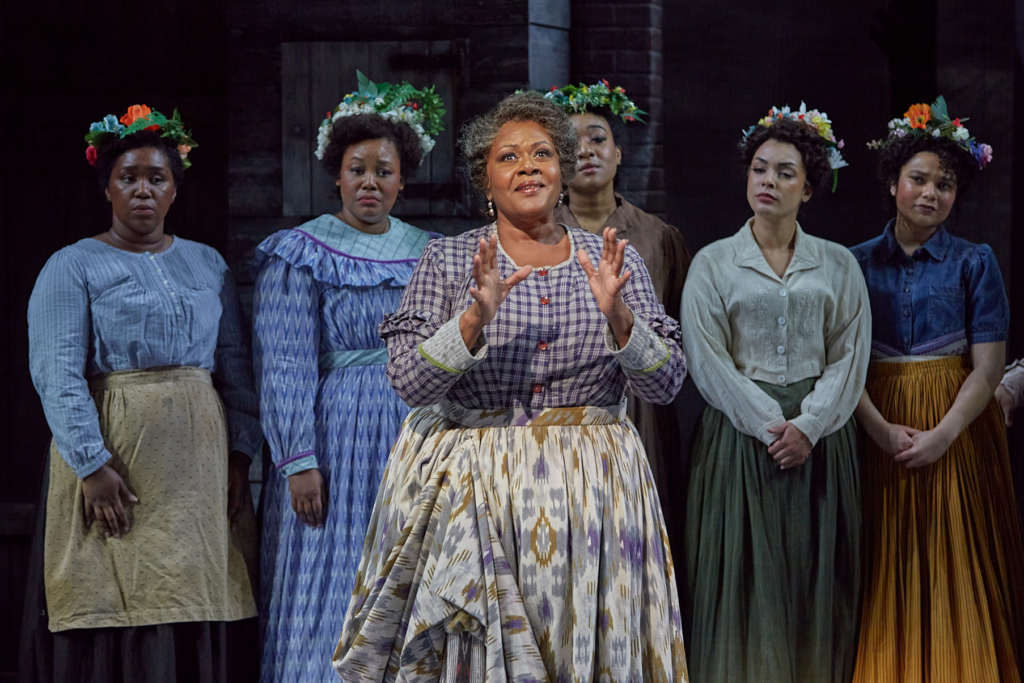
Deserving equal bill are the performances by Amani Cole-Felder as Lovie Alexander and Lucy, KS. Tichina Vaughn as Monisha and Normal Garrett as Ned – the latter two also making their OTSL debuts.
Maestro George Manahan directs the orchestra, composed of members of the St. Louis Symphony Orchestra, and delivers a deft, lively musical underpinning that adheres to the spirit of Joplin’s unique, profoundly expressive score. As serious as Treemonisha may seem in terms of story and subject matter, it beautifully and seamlessly integrates an appealing group of influences ranging from ragtime to spirituals, fiddle tunes and hymns, among others. The appeal of these influences is like what comedian Steve Martin has observed about banjo playing: “The banjo is such a happy instrument–you can’t play a sad song on the banjo – it always comes out so cheerful.” The same can be said for ragtime, and Treemonisha is the better for it.
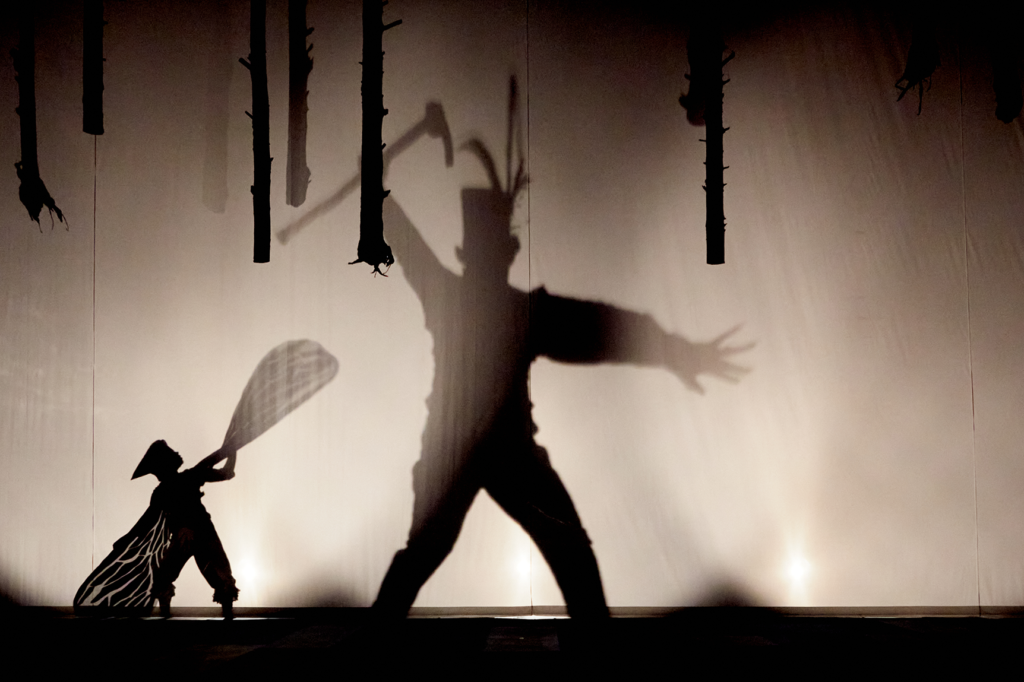
The set design by Marsha Ginsberg is also noteworthy. It’s common for an opera to begin with a musical overture, but this production improves upon that with a visual overture. Against a gauzy scrim backdrop, there’s a shadow play that’s a visual highlight reel for the upcoming performance – and it’s brilliant. It established the right tone while setting a high bar for the rest of the performance.
I also admired the Ginsberg’s use of black-painted barren tree trunks that bookend the performance, suspended above the stage. During intermission, the trees are lowered onto the stage. This “black forest” of trunks serves as a clever, subtle and effective scorched-earth metaphor for the post-Civil War, Reconstruction-era South in which this opera is set (and as written by an African American man who lived through it).
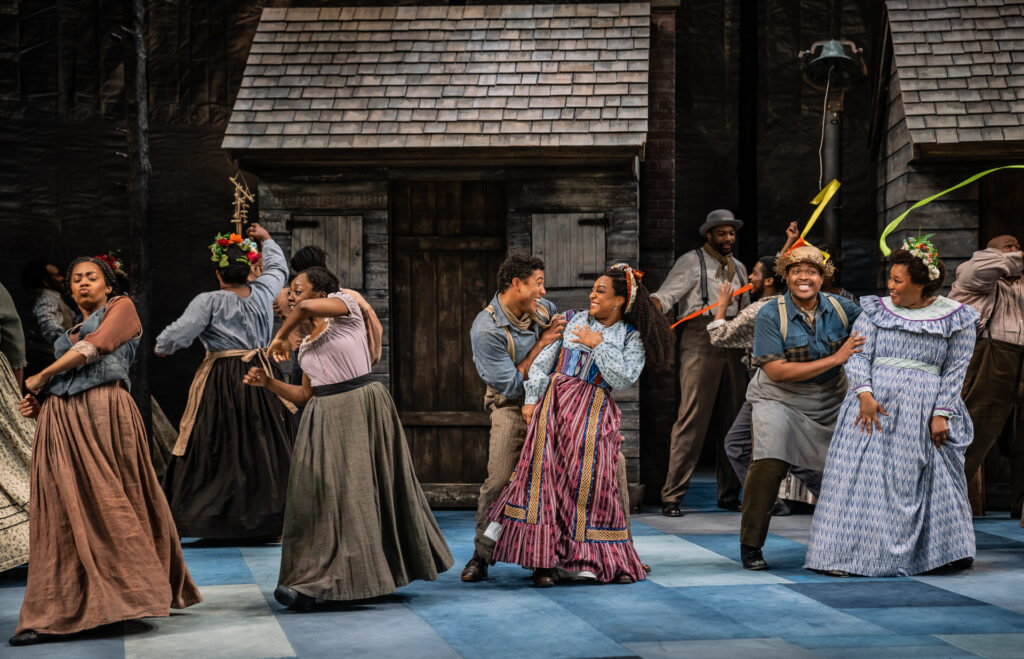
There’s so much going for Treemonisha, and that includes the choreography (blending traditional and modern dance) by Maleek Washington. The dance elements are woven into the scenes and, though noteworthy, never overtly call attention to themselves, with the exception of a perplexing, show-offy “frolic of the bears” in Act II , which pulled me out of the scene.
An opera, no matter how passionately conceived, is like a discarded memory, an empty platform, merely marks on a manuscript. To bring it to life – or to give it continued life – requires production. With a commission by OTSL, Sneed, Chilton, stage director Rajendra Ramoon-Maharaj, the cast and all the other talents have taken Joplin’s platform (wrapping ragtime’s irresistible catchiness around his rage against time), extended it beyond a fine performance and ascended to theatrical art.
Can an opera change the world? Let this production of Treemonisha inspire you to walk out of the Loretto Hilton Theater and begin to try, even if only in the “backyard” of St. Louis.
Opera Theatre’s Treemonisha continues at the Loretto-Hilton Center through June 24. For ticket information, visit opera-stl.org. For more information about Counterpublic 2023 civic exhibition, visit counterpublic.org
This review also appears on the KDHX website by mutual agreement.
CB Adams is an award-winning fiction writer and photographer based in the Greater St. Louis area. A former music/arts editor and feature writer for the St. Louis Globe-Democrat, his non-fiction has been published in local, regional and national publications. His literary short stories have been published in more than a dozen literary journals and his fine art photography has been exhibited in more than 40 galley shows nationwide. Adams is the recipient of the Missouri Arts Council’s highest writing awards: the Writers’ Biennial and Missouri Writing!. The Riverfront Times named him, “St. Louis’ Most Under-Appreciated Writer” in 1996.