By Lynn Venhaus

With its pitch-black tale of love, murder, revenge and obsession, Stephen Sondheim’s singular “Sweeney Todd: The Demon Barber of Fleet Street” remains an ambitious, wildly popular musical that is a challenge to produce and even harder to satisfy high expectations, no matter whether the interpretation is traditional or innovative.

Such is Sondheim’s reputation as the most important figure in 20th century musical theater and the macabre masterpiece’s passionate fan base around the globe. For Sondheim enthusiasts, any opportunity to hear that majestic score is welcome – that is why it’s often adapted into a concert presentation or an opera.

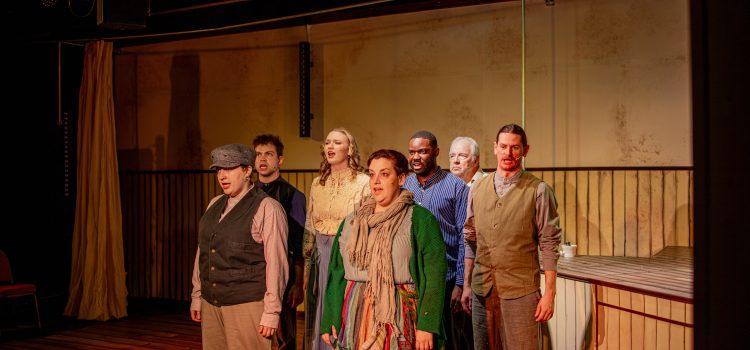
For their second official foray into Sondheim’s daunting catalogue – after their award-winning and critically acclaimed “Assassins” in 2022 at the .Zack, Fly North Theatricals presents a thoughtfully staged and deeply committed 12-member cast for this demanding show.

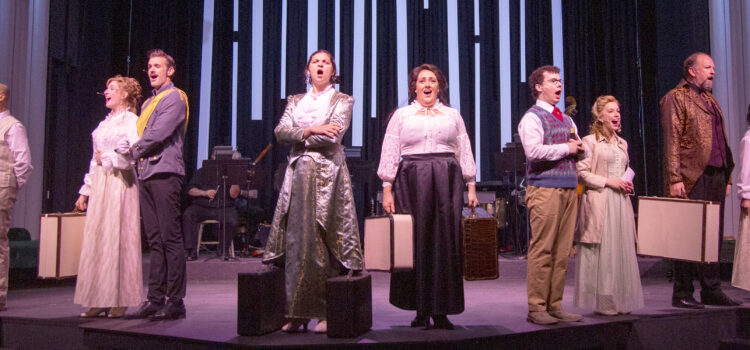
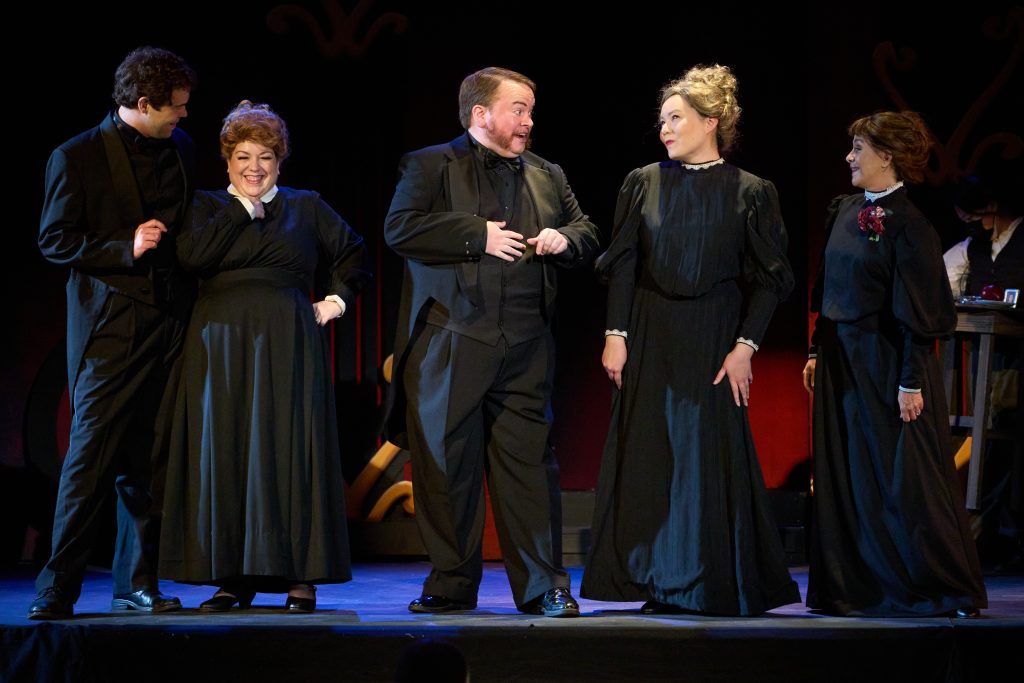
Attention must be paid as the ensemble raises firm, emphatic voices to grab hold in the opening “The Ballad of Sweeney Todd: ‘Attend the Tale of Sweeney Todd” and stresses the dramatic stakes in the reprises, acting like a Greek chorus.
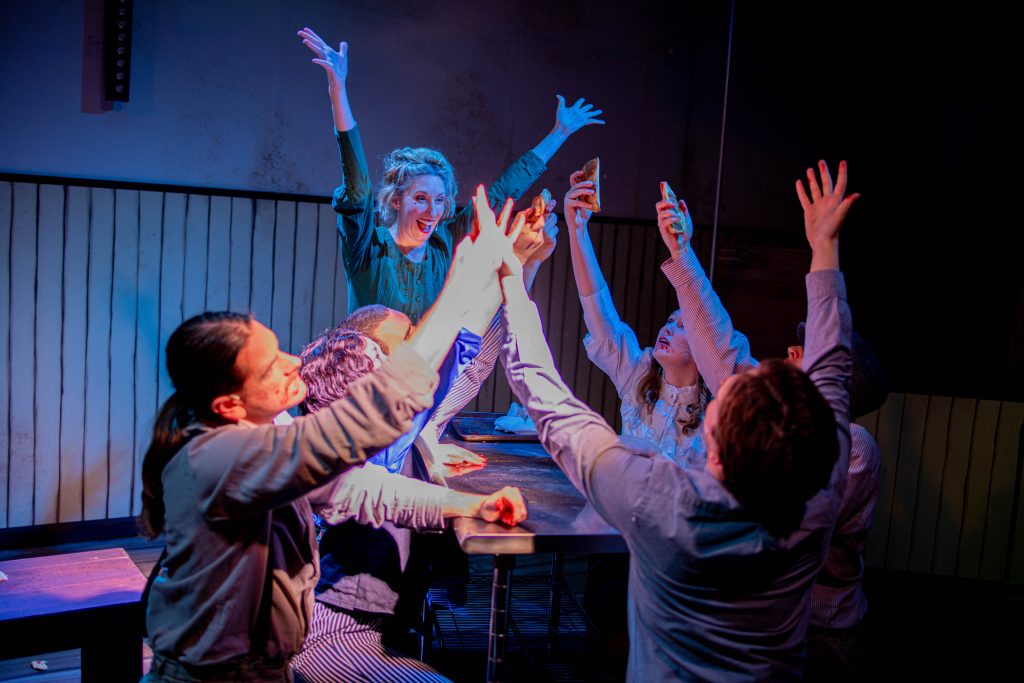
“God That’s Good!” Photo by Julie Merkle

Parker Miller, principal bass; Margaret Beekman, principal soprano; Mia Millican, principal alto; and Nathan Hakenewerth, Matt Ingram, Dereis Lambert, Crispin Shininger, Rachel Bailey, and Isobel Ramsey robustly raise their voices in unison.

They roar with energy in “God, That’s Good!” and are the mighty backbone of this grand, grim musical that is about 80% music.

Director Colin Healy has been strongly influenced by Sondheim throughout his career – and has a mural painting of Steve on the wall of the Greenfinch Theater & Dive Bar that he co-owns with technical wizard Bradley Rohlf, so his understanding of the material is never in doubt.

(Fun Fact: The bar is even named after one of Sondheim’s songs (“Green Finch and Linnet Bird”).

Healy dives into this monumental work with the intense drive of Hal Prince and the minimalistic eye of John Doyle, two legendary interpreters of Sondheim’s shows. (Prince directed the original mammoth 1979 Tony-winning Broadway show while Doyle reimagined an austere asylum-set 2005 revival).
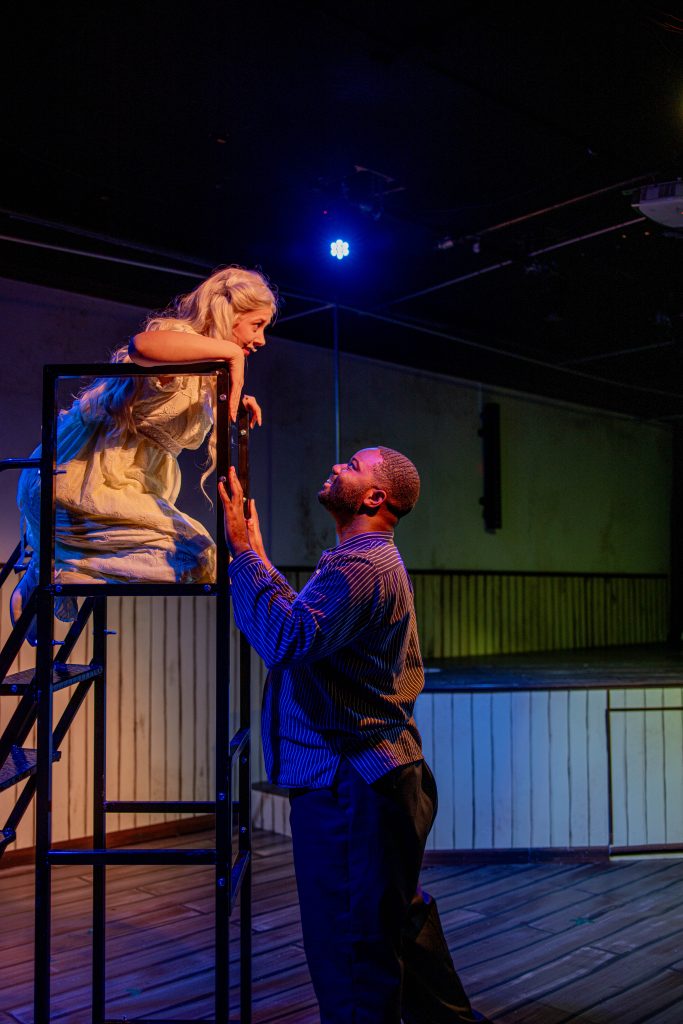
Isobel Ramsey and Dereis Lambert. Photo by Julie Merkle.

To create an intimate production in the cozy confines of the Greenfinch theater space, Healy focused on the character-driven narrative, stripping it down to a few immersive set pieces and counting on the audience’s imagination. The 19th century Victorian London setting is more of a suggestion, which is fine.

Clever lighting co-designed by Healy and Lauren Perry and nimble stagehands/cast led by stage manager Dizzy Funke help create a foreboding atmosphere. Rohlf lends his considerable skills as technical director.

Fly North’s resourcefulness with a tiny budget is laudable. And the efficient staging of the murders and body disposal benefits from everyone’s dedicated timing. Now, fresh ‘blood’ is splattered on some audience members, but those sitting at other angles don’t get that special effect, nor do they see it.

The heart-rending book by Hugh Wheeler, Tony winner for this, “A Little Night Music” and “Candide,” shocks and awes – blending terrifying psychological horror with deliciously wicked flickers of humor, some of it campy, while the music chills and thrills.

The disturbing gothic narrative was adapted from Christopher Bond’s 1970 play “Sweeney Todd,” which featured motivation for the barber’s lurid crimes. He imagined Todd as the victim of a corrupt, lecherous judge, who exiled him to a penal colony in Australia and ravaged his wife.

Bond had used a 1847 ‘penny dreadful’ (popular Victorian pulp fiction) – “The String of Pearls,” which sensationalized the demon barber of Fleet Street as a killer who baked his victims into meat pies.

Sondheim’s music made it feel larger in scope, and Prince decided the downside of the Industrial Revolution was that it turned out soulless, defeated, and hopeless people. That outlook, combined with Sondheim’s flair for emotional depth — nobody could tinge lyrics with melancholy, regret, and revulsion quite like he could.
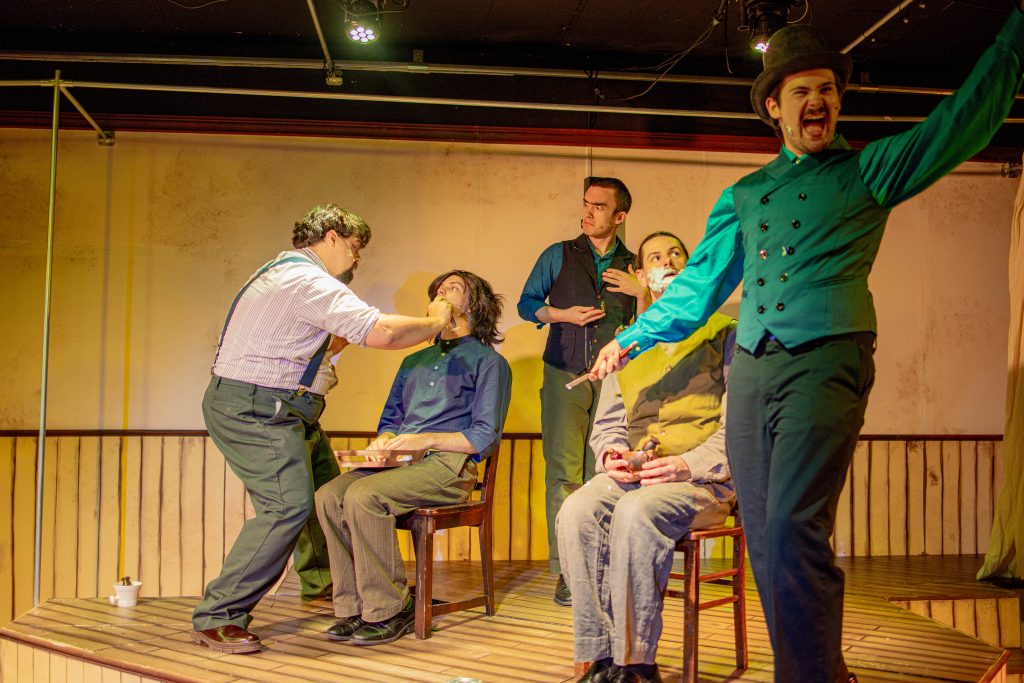
“The Contest.” Photo by Julie Merkle.

Because Healy is such a Sondheim zealot, the ensemble’s enunciation was commendable on the razor-sharp lyrics and rhythmically complex songs. He isn’t the music director for this show, his usual role, but he and music director Stephen Schermitzler created the sound. Greenfinch’s orchestra pit is in the basement.

Chandler Spradling appears as an imposing anti-hero as Todd, a man pushed into nefarious deeds because of his life’s circumstances, thwarted by depraved men. He has a strong bass-baritone on such numbers as the battle cry “Epiphany” and chilling “My Friends.”

He and Lambert establish their relationship with the hopeful “No Place Like London,” and he shares his piteous tale “The Barber and His Wife.” Todd sets his diabolical plan in motion.

He meets a chatty Mrs. Lovett at her failing pie shop and opens a barber practice located above. Their meeting of the minds results in a thrifty use of a ghastly ingredient that makes her meat pies so tasty.
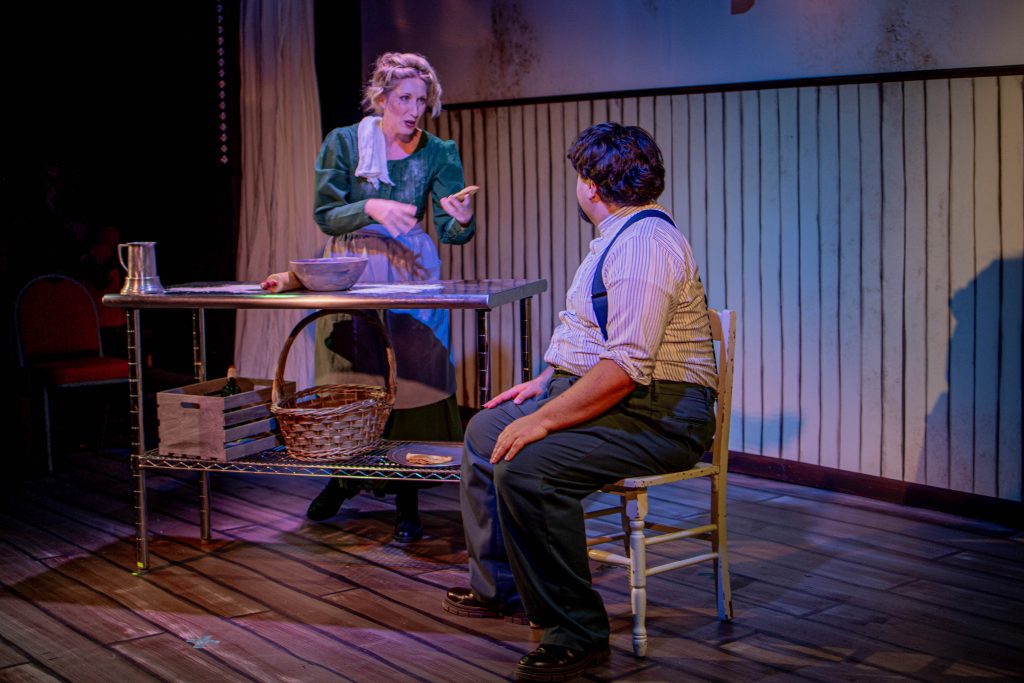
“The Worst Pies in London.” Photo by Julie Merkle.

Multi-faceted Jennelle Gilreath Owens is everything one can expect in an earthy Mrs. Lovett – she engages immediately in her “The Worst Pies in London,” showing off her finely attuned comedic skills and superb timing, not to mention an impeccable Cockney accent. She’s more ditzy than blowzy, more Lucille Ball than Ethel Merman.

Owens has always been a gem on local stages and shines in this iconic role. (At Stray Dog Theatre, she was a fierce Witch in Sondheim’s “Into the Woods”). She excelled at the patter song “A Little Priest” and was wistful in the duet “By the Sea.”

Perhaps the taxing nature of the intricate rhymes and complex musicality of the score was so arduous that some character development was lacking – because there should be more to some of these roles than broad strokes.

Spradling displayed the anguish, reinforced by a hollow gaze, but was less convincing as he descended into madness. Todd’s all-consuming grief and simmering rage must be palpable. His twisted partnership worked with Mrs. Lovett – until it tragically doesn’t. That downfall in the devastating second act felt a tad rushed – we should feel the sorrow.
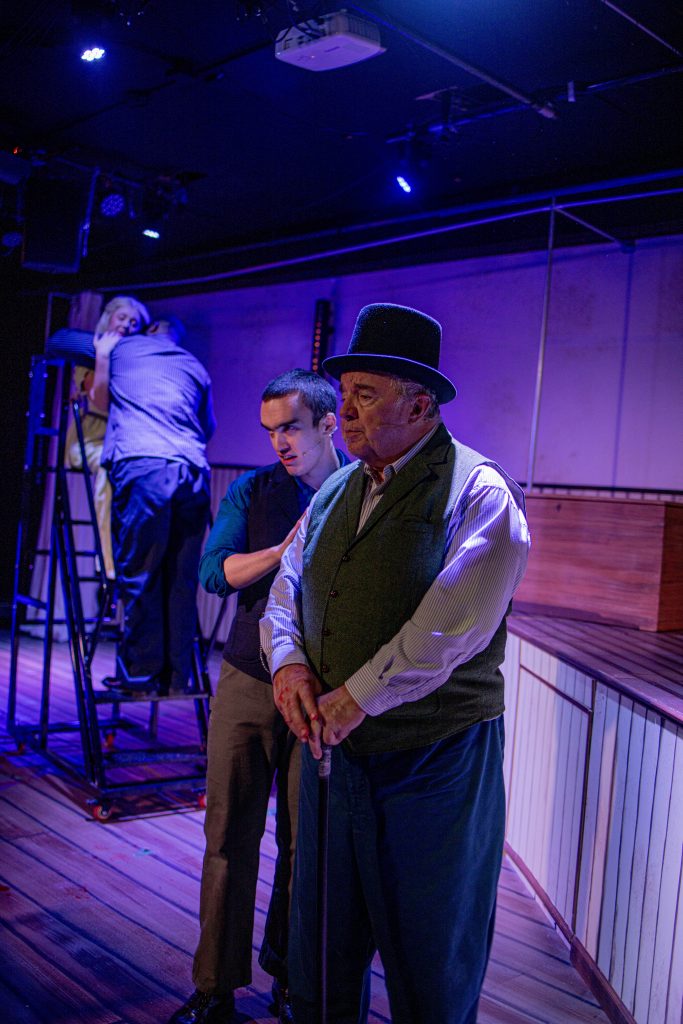
Judge Turpin. Photo by Julie Merkle.

Haller wasn’t a cruel Judge Turpin but rather a self-righteous, controlling authority figure where his possessive nature turns creepy when he lashes himself over his desires about his young ward. He could have been nastier and more intentional because he’s duplicitous.

Most disappointing was “Pretty Women.” Had the vocal prowess and the psychological depth met the moment, the beautiful song would have been haunting and unnerving.

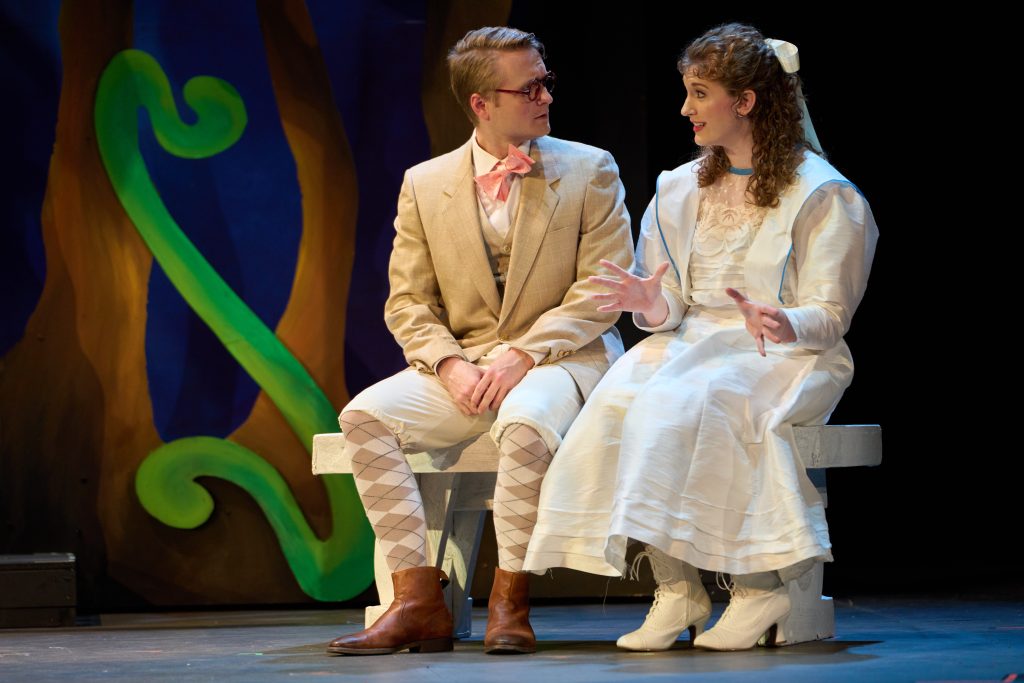
The star-crossed lovers, Anthony Hope and Johanna Barker, seem doomed, and for the audience, they can cheer on the couple, despite Johanna being imprisoned and forced to marry the Judge (so cringy). Dereis Lambert and Isobel Ramsey are youthful in their ardor and have a lot at stake here in their songs. Lambert’s immediately smitten in “Ah, Miss” and blends romantic yearning in “Johanna.”

For the most part, Healy avoided cartoonish evil when things all start going sideways, and that meat grinder gets a workout. But pile on the menace! With the help of white curtains, shadows and light, they make the ominous asylum scene work, and the chaos grows in a wobbly “City on Fire!”

Matt Ingram as Beadle Bamford and Crispin Shininger as Tobias Ragg were compelling as these integral characters. Ingram, with a bold, strong voice and credible dialect, had to straddle the fine lines of pomposity with politeness, cruelty with complicities and his own sense of self-importance and broad humor. Ingram did so admirably, particularly in “Parlor Songs.” Nobody mourned his fate.
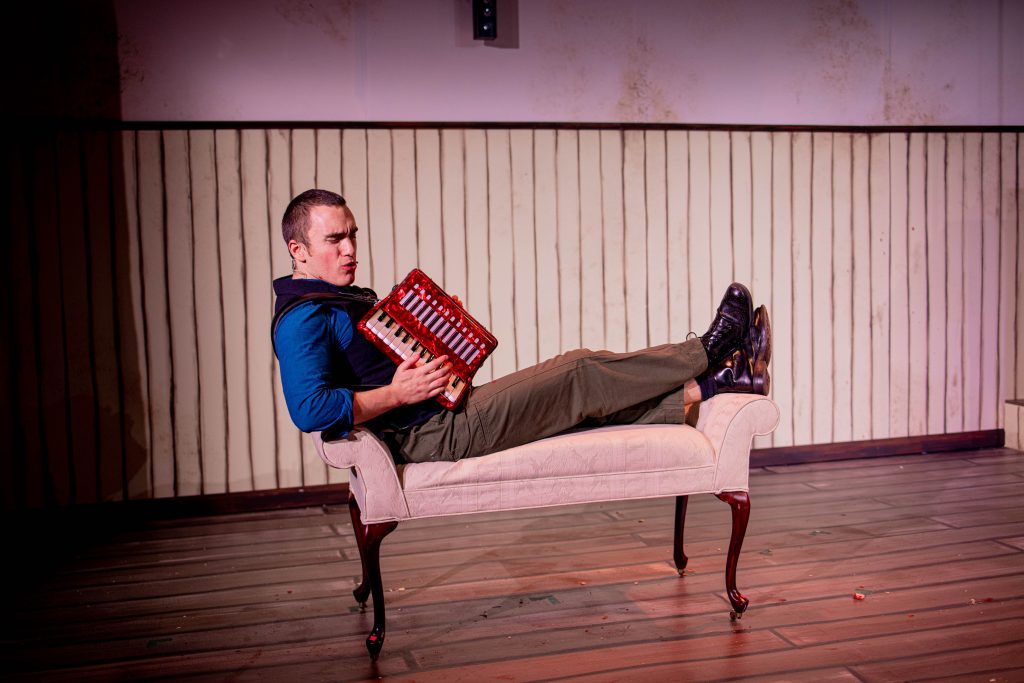
Matt Ingram. Photo by Julie Merkel.

However, the naïve Tobias must transition from comic relief to tragic figure, starting out as loyal assistant to the charlatan Pirelli then becoming protective of Mrs. Lovett as a maternal figure.

Shininger is heart-breaking in one of the show’s best songs, “Not While I’m Around,” and his inevitable mental breakdown. His trauma was believable, after he figures out Todd and Mrs. Lovett are murderers, but the blocking could have been more decisive.
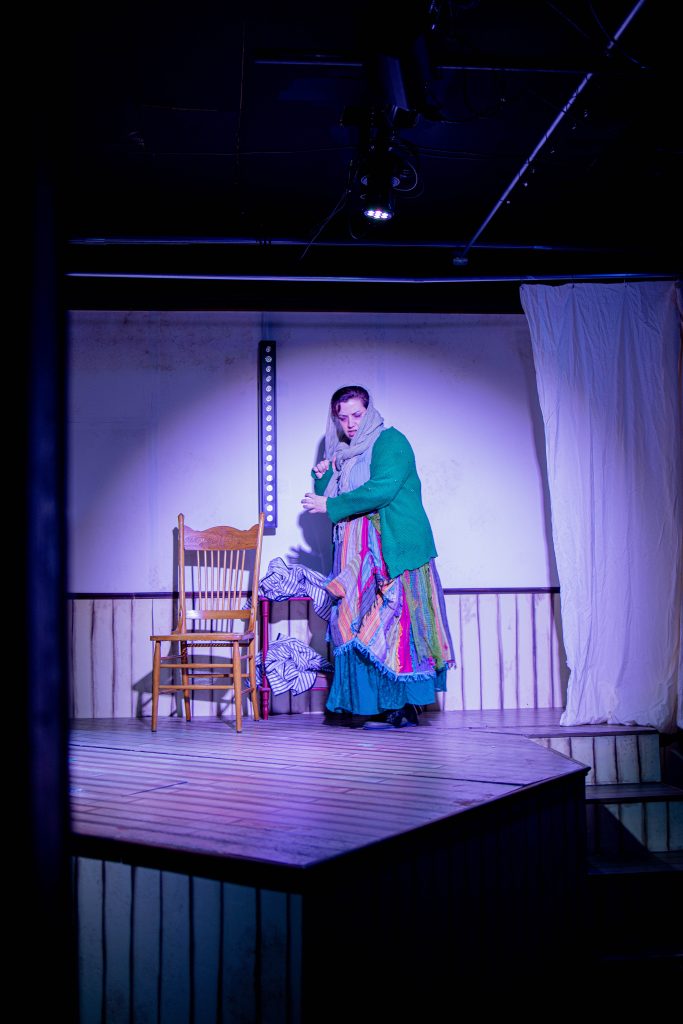
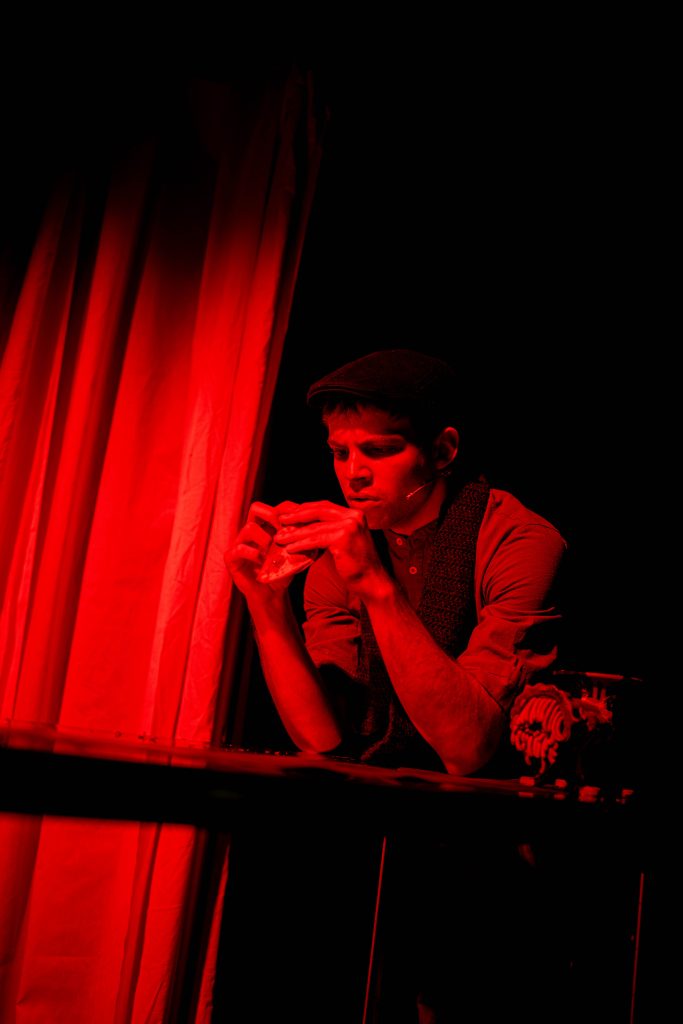
Rachel Bailey. Photo by Julie Merkle.
Crispin Shininger. Photo by Julie Merkle.

Ever reliable Rachel Bailey is persuasive as a mysterious Beggar Woman, and her “Beggar Woman’s Lullaby” regrettably seals her fate.

Hakenewerth is effective as the fraudulent Pirelli who tries to blackmail Todd, which sets off the murder spree.

And sadly, the Demon Barber of Fleet Street must come to its inevitably tumultuous gut-wrenching finale. Whether you’ve watched Tim Burton’s 2007 Oscar-nominated film or can’t get enough of the 2023 Broadway revival album, “Sweeney Todd” has many intricate layers to discover and Fly North has taken us in their own unusual distinctive way to its dark side.

Fly North Theatricals presents “Sweeney Todd: The Demon Barber of Fleet Street” from July 17 to Aug. 9 at the Greenfinch Theater and Dive Bar, 2525 S. Jefferson Avenue. The show’s runtime is 2 hours, 30 minutes, with a 15-minute intermission. Content warning: this show contains mature themes, including murder and self-harm. For more information, visit www.flynorth.org

Full disclosure: My maternal grandmother and Matt Ingram’s maternal great-grandmother were sisters, therefore we are cousins.

By Lynn Venhaus

Infused with humor and a breezy charm, Stray Dog Theatre’s enchanting interpretation of Stephen Sondheim’s “A Little Night Music” brings out starlit summer imagery, the glory and glimmer of love, and the best in a resplendent cast.

On opening night, nature supplied a full moon on a crisp autumn evening outside the Tower Grove Abbey, a serendipitous touch. Imagine the golden glow of a warm, fragrant moonlit midsummer night – and you’ll easily slip into the mood for this sophisticated romp.

Set in Sweden at the turn of the 20th century, “A Little Night Music” concerns several pairs in various stages of romance or uncoupling – and what entanglements transpire during a summer sojourn in the country.

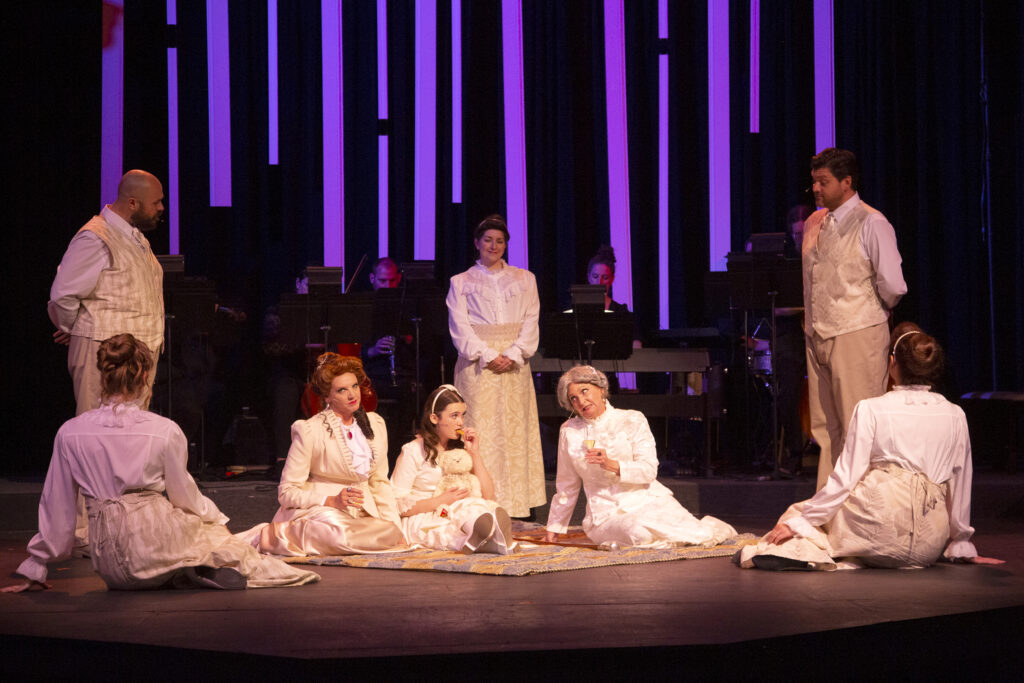
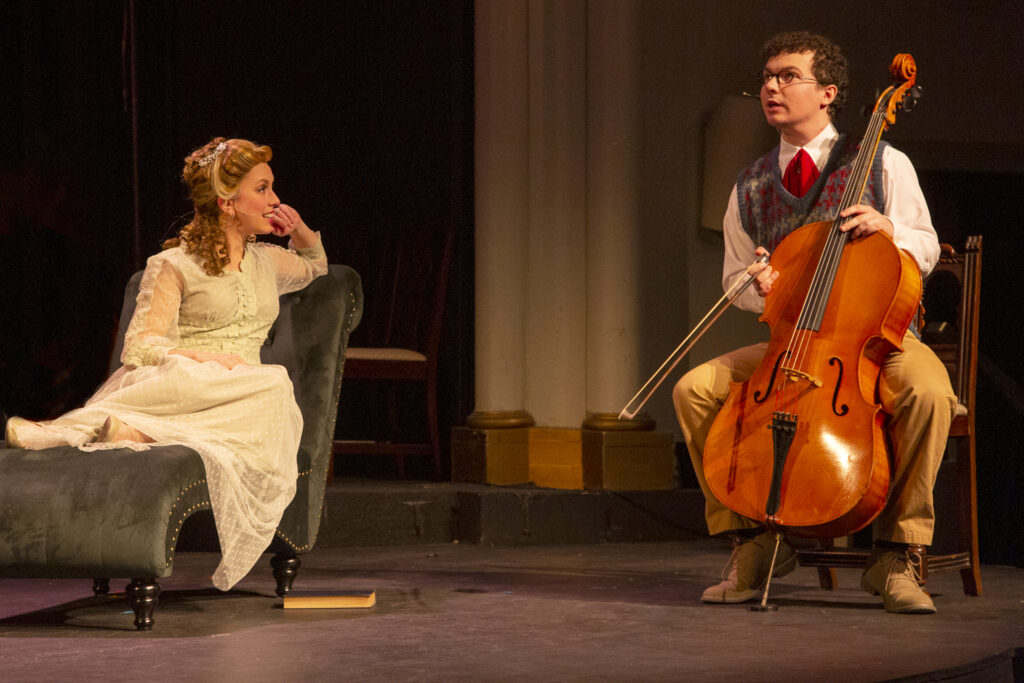
Liz Mischel is amusingly sarcastic as the unfiltered Madame Leonora Armfeldt, a wealthy matriarch who had colorful liaisons as a courtesan. She is schooling her innocent granddaughter Fredrika (a sweet and assured Adeline Perry) on the ways of the world – and men. She tells her the summer night ‘smiles’ three times: first on the young, second on fools, and third on the old.

The Armfeldts and servants picnicking. Photo by John Lamb

Madame’s daughter, the alluring, touring stage actress Desiree Armfeldt (Paula Stoff Dean) is a force of nature known for not playing by the rules. Her old lover, attorney Fredrik Egerman (Jon Hey), married a naïve young woman Anne (Eileen Engel) about 30 years his junior 11 months ago, and their union has not been consummated (her issues).

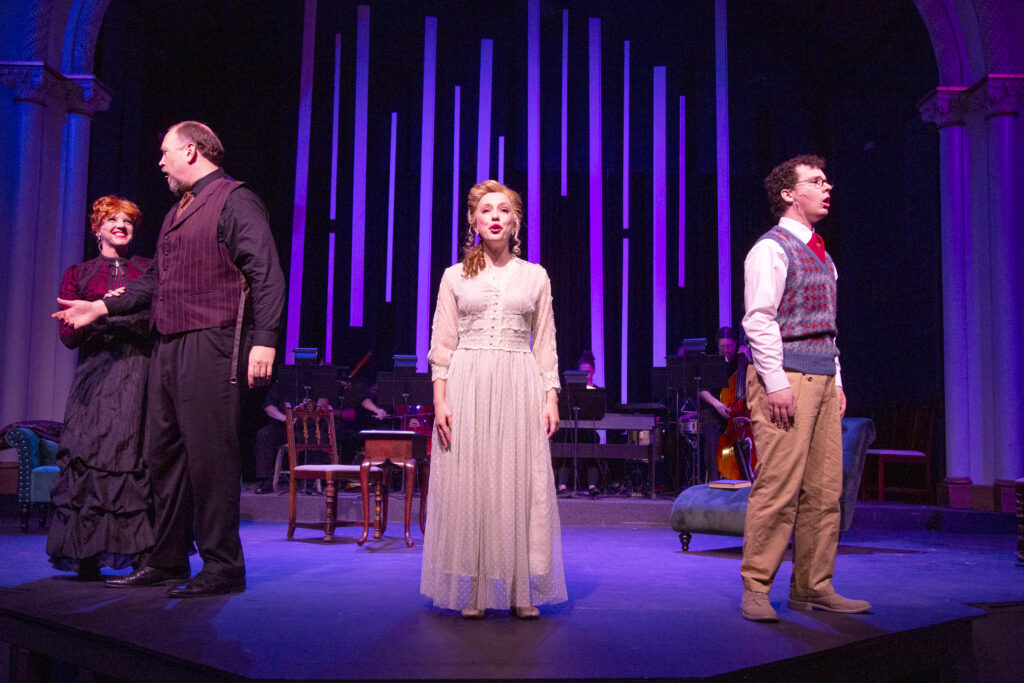
The coquettish but inexperienced wife teases her serious husband’s awkward son, Henrik (Bryce A. Miller), by his late first wife, who is studying for the ministry but has feelings for her, his stepmother. Although clumsy, he is not impervious to desire and has a dalliance with her maid, an older and wiser Petra (a brassy Sarah Gene Dowling making her character’s worldliness obvious).

Miller has to demonstrate the widest emotional range as the confused and ready-to-explode Henrik, and he effectively finesses the fine line between the melodramatic and the comedic to distinguish himself in a cast of veterans.

Desiree is currently the mistress of self-absorbed Count Carl-Magnus Malcolm (Scott Degitz-Fries), a buffoon whose jealous wife, Countess Charlotte (Madeline Black), is in on the charade. Degitz-Fries plays the military royal as an obnoxious, arrogant chauvinist who is not used to ‘no.’ Black channels her rage into a scheme – you know the adage about women scorned – but keeps her character’s refinement intact.

They all circle around and back to each other. Fredrik has taken Anne to see Desiree’s latest play, which eventually leads to an invitation for a country excursion. The complications culminate in the anticipation, flirting, fighting, and fleeing that takes place in the second act. Does love win in the end?

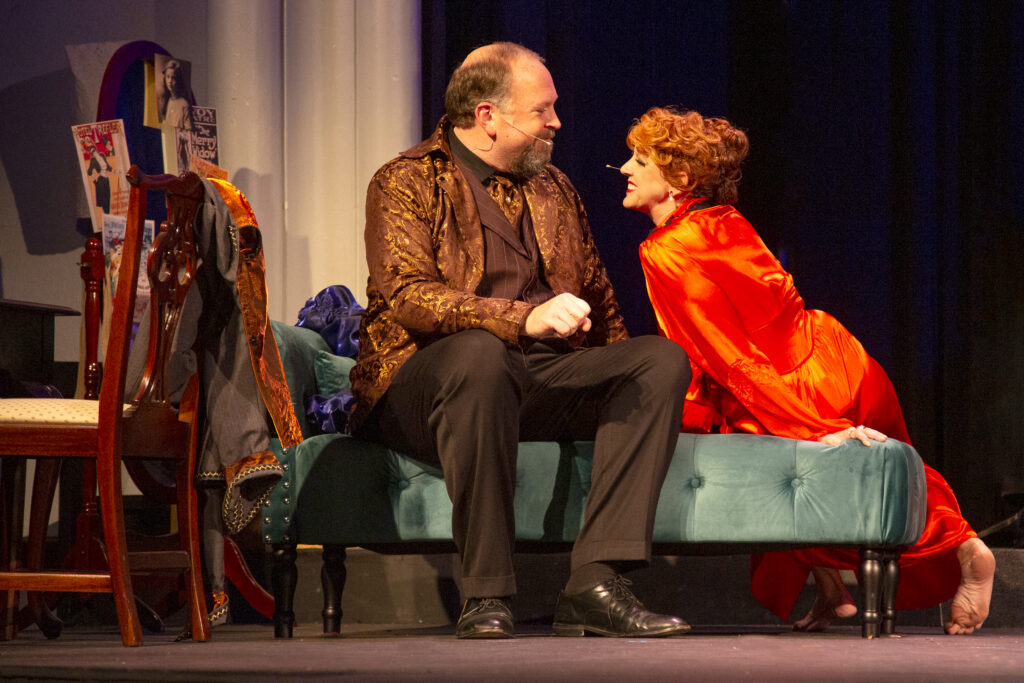
Hey, Dean. Photo by John Lamb.

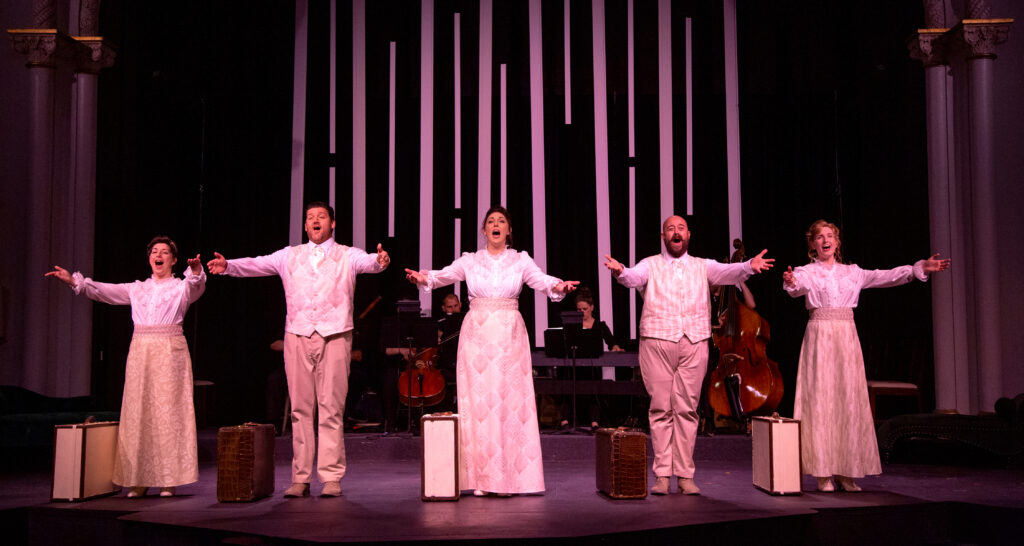
One look at the waltzing quintet in their summer whites that starts this elegant show, and you’re transported back to a different era. Splendidly delivering “Night Waltz,” Cory Anthony, Shannon Lampkin Campbell, Jess McCawley, Kevin O’ Brien and Dawn Schmid glide across the stage as the Liebeslieder Singers, astutely controlling the tempo.

They act like a Greek chorus, and their lush harmonies soar in “The Glamorous Life,” “Remember?” and “The Sun Won’t Set.”

The entire cast’s strong vocal prowess is noteworthy throughout, but a masterfully arranged “Weekend in the Country” is a triumph.

Dean has decided to belt the signature song, “Send in the Clowns,” instead of reciting nearly all of it, as others have done, and it’s a fine rendition. Another highpoint is Dowling’s “The Miller’s Son,” emphatically sung as a mix of longing and reflection.

Whether they are singing solo or in duets, or at the same time with different songs (“Now” by Fredrik, “Later” by Henrik and “Soon” by Anne), you’ll marvel at how seamless the numbers are performed.

Black and Engel lament together on infidelity, smoothly combining in “Every Day a Little Death,” and Degitz-Fries has his moment with “In Praise of Women.”

Photo by John Lamb

Employing the beautiful orchestrations of Jonathan Tunick, Music Director Leah Schultz uses three string players that elevate the sumptuous sound. The orchestra is prominently placed on stage, and their work is exquisite.

Schultz, also playing piano, expertly conducts the seven-piece orchestra that includes a cello (Michaela Kuba), a violin (Steve Frisbee) and a bass (M. Joshua Ryan), along with Ian Hayden and David Metzger on reeds and Joe Winters on percussion.

The way director Justin Been has shaken off the stodginess and stuffiness of a high society period piece is impressive. He’s embraced the farcical aspect of revolving romantic hook-ups, sleekly moving the characters through a country estate, the grounds, and an adjacent forest

Looking at the book by Hugh Wheeler with a fresh set of eyes gave it needed oomph, and the ensemble, nimble in comedy, conveys a playfulness that endears. Been has brilliantly adapted the very theatrical and somewhat operetta-ish work for the small stage.

The original 1973 Broadway production won six Tony Awards, including Best Musical, book, and score, and has had revivals in London’s West End and Broadway, adapted into a 1977 film starring Elizabeth Taylor, and has been performed by opera companies around the world – including this summer’s traditional format at Union Avenue Opera in St. Louis.

Anne and Henrik. Photo by John Lamb

With a minimum of set pieces, Been has depicted the states of different affairs well. He designed modern Scandinavian impressionistic slats that hang above the orchestra, perhaps as a nod to magic realism. Jacob Baxley’s sound design and Tyler Duenow’s lighting design add to the imagery.

The creators claim the musical was suggested by Ingmar Bergman’s romantic comedy, “Smiles of a Summer Night,” which premiered in 1955, and is a staple at film retrospectives.

You might not think of Bergman as a merry sort of guy, particularly if you’ve seen his critically acclaimed classics “The Seventh Seal,” “Persona,” “Cries and Whispers,” and “Through a Glass Darkly.” But he mixed sugar and spice to come up with a confection that’s been ‘borrowed’ more than a few times. (Woody Allen’s 1982 “A Midsummer Night’s Sex Comedy,” to name one, which also references Shakespeare’s “A Midsummer Night’s Dream.”).

But this Bergman-inspired fantasia is much lighter, and Been has brought out the laughter, easy on the melancholy – yet has middle-agers expressing regrets.

Dean, Hey. Photo by John Lamb

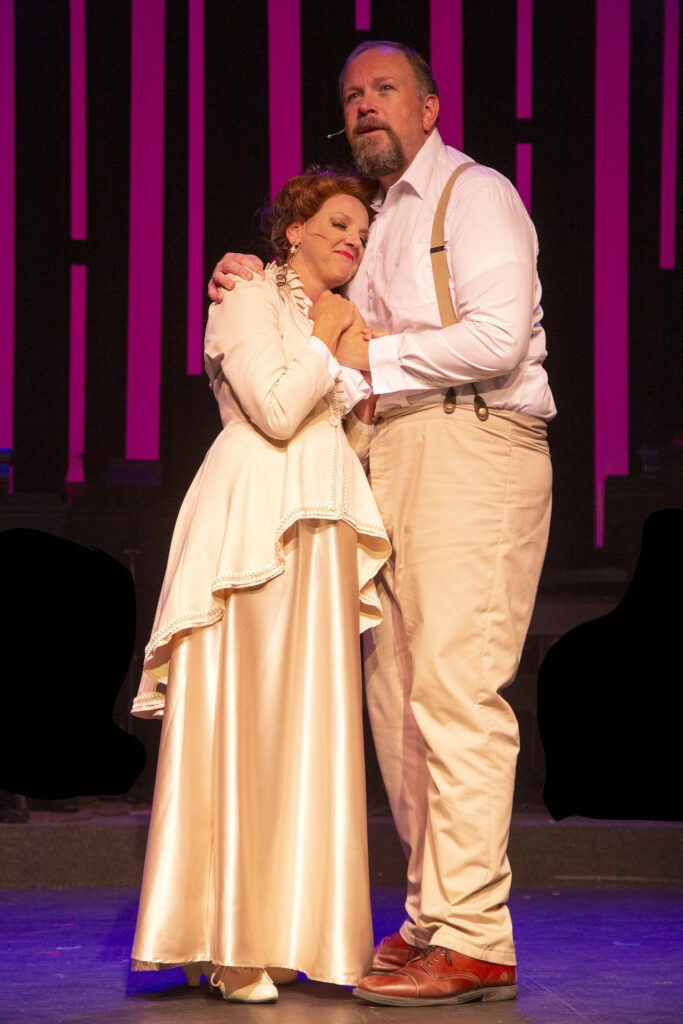
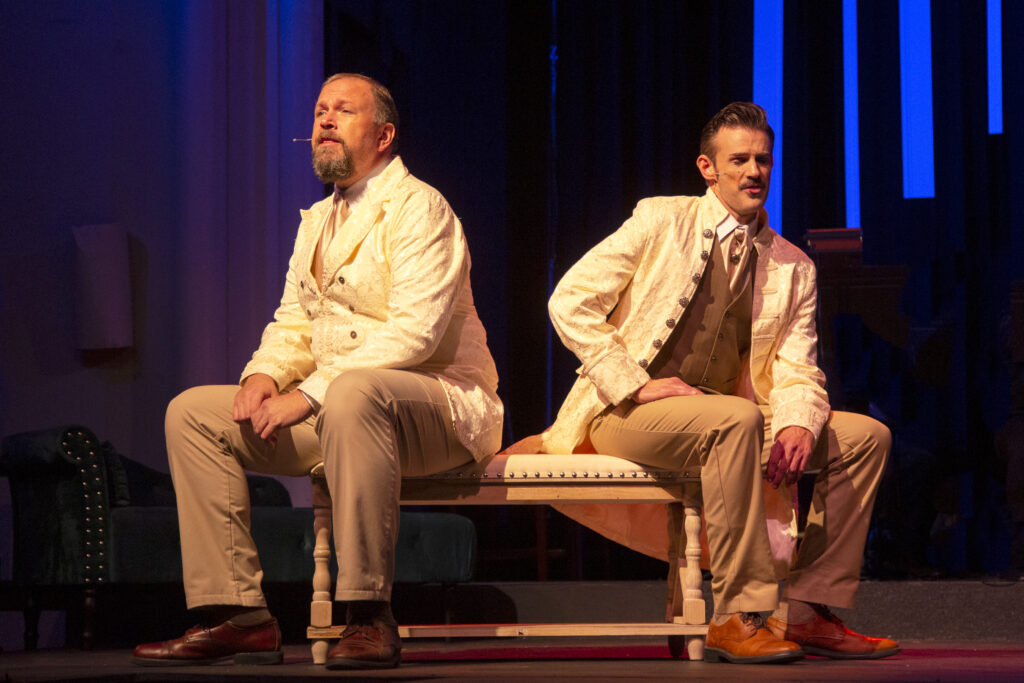
Hey, as Fredrik, and Dean, as Desiree, portray a rueful pair, looking back wistfully and rediscovering their spark. The accomplished actors display a natural rhythm with each other, especially in “You Must Meet My Wife.”

Like the music, the dance numbers are polished, choreographed by Michael Hodges with an emphasis on regal posture — although, at first, notice how awkward the pairings are – it’s on purpose, ahem).

Engel, who is delightful as the conflicted Anne, designed the costumes – and they are a mix of ethereal and chic, conveying the social status of each character. The hair and wig design by Dowling suitably complimented the looks.

Hey and Engel were part of Stray Dog’s “Sweeney Todd” in spring 2017, he in the title role and she as daughter Johanna, and know the challenges Sondheim presents, and their experience serves them well.

Sondheim’s work is getting a lot of posthumous attention – but that’s a good thing, never enough Sondheim done well. Like the recently revived “Into the Woods,” some of his musicals take on richer, more contemplative meaning as one ages and revisits them again.

Stray Dog’s superb “A Little Night Music” is worth the immersion, featuring a triple-threat cast in fine form and an inspired creative team.

The Liebeslieder Singers. Photo by John Lamb.

Stray Dog Theatre presents the Stephen Sondheim’s “A Little Night Music” at 8 p.m. Thursdays through Saturdays through Oct. 22, with additional performances at 2 pm Sunday, Oct. 16 and 8 pm Wednesday Oct.19. Performances take place at Tower Grove Abbey, 2336 Tennessee in Tower Grove East. Tickets are only offered in physically distanced groups of two or four. For more information: www.straydogtheatre.org

Hey and Degitz “It Would Have Been Wonderful.” Photo by John Lamb

By CB Adams

It’s been a bit of a “Sondheim Summer” here in St. Louis, bookended by Far North Theatricals’ “Assassins,” The Muny’s “Sweeney Todd” and Union Avenue Opera’s festival-ending “A Little Night Music,” with performances remaining Aug. 26-27. Extending that bookend will be Stray Dog Theatre’s production of  “A Little Night Music” this October.

There seems to be more Sondheim in the air since his death last November, and these local stagings have provided an interesting juxtaposition considering that “Sweeney Todd” is generally considered the more operatic and “Night Music” as more operatta-ish.

No matter. As soon as the off-stage chorus, the Quintet, projected their voices onto the sumptuous Union Avenue Act I set, such nomenclatures were rendered unnecessary…and perhaps irrelevant. Afterall, the first three revivals of “Night Music” in New York were all operatic rather than theatrical, so this production is a good fit for Union Avenue’s strengths and direction.

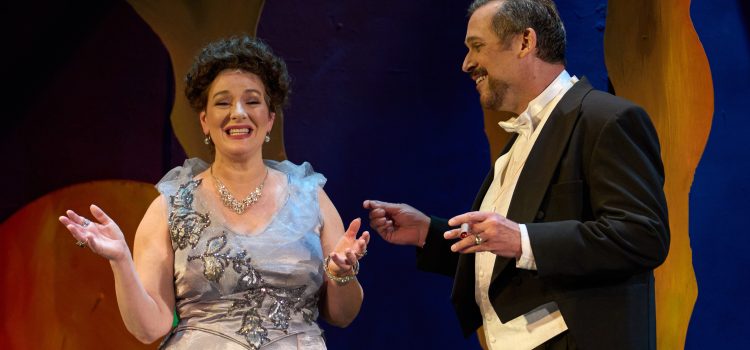
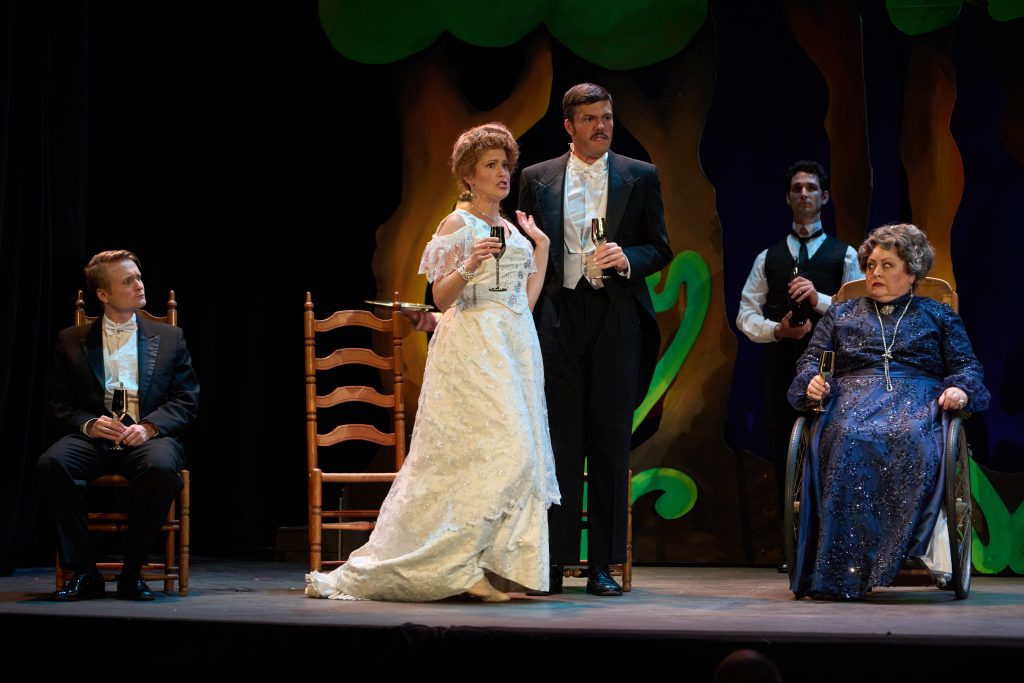
James Stevens, Leann Scheuring, Eric J. McConnell, Jordan Wolk, Teresa Doggett. Photo by Dan Donovan

Isn’t It Bliss?

If there are still tickets left for the final performances of “A Little Night Music,” reserve your seats. That’s the quick review of this production. Don’t miss it. It is indeed bliss.

Hal Prince, producer of this musical’s debut in 1973, called it “whipped cream with knives.” If Prince meant knives as in sharp knives out, then Annamaria Pileggi’s direction has softened it to butter knives out.  It’s a pleasure and perhaps a much-needed respite to engage so fully into this nuanced romantic farce based on Ingmar Bergman’s 1955 film “Smiles of a Summer Night.”

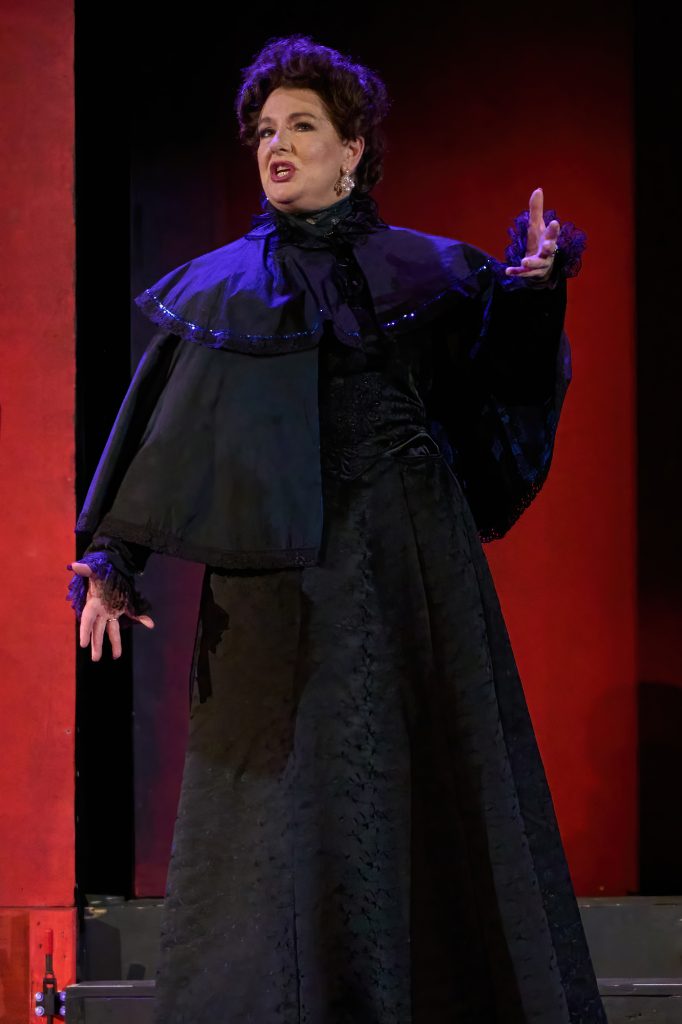
Debby Lennon as Desiree. Photo by Dan Donovan

Isn’t It Rich?

Of Union Avenue’s three productions in this year’s festival, the sets of “Night Music” by C. Otis Sweezey are the best, especially in Act I. The back set consisted of three columnar structures that conveyed the frets of a stringed instrument entwined with swan-like figures and backed with the richest of burgundies.

These elements avoid flaunting their presence and instead provide the right sense of place and privilege of the genteel characters.

During the intermission, as Act II’s back set of trees were moved onto the stage, their colors seemed out of place for the “Weekend In the Country,” presaged by that song at the end of Act I.

But those colors were transformed by the lighting choices of Patrick Huber. Thanks to lighting, fluorescent outlines became comfortable, dusky accents for the rest of the musical.

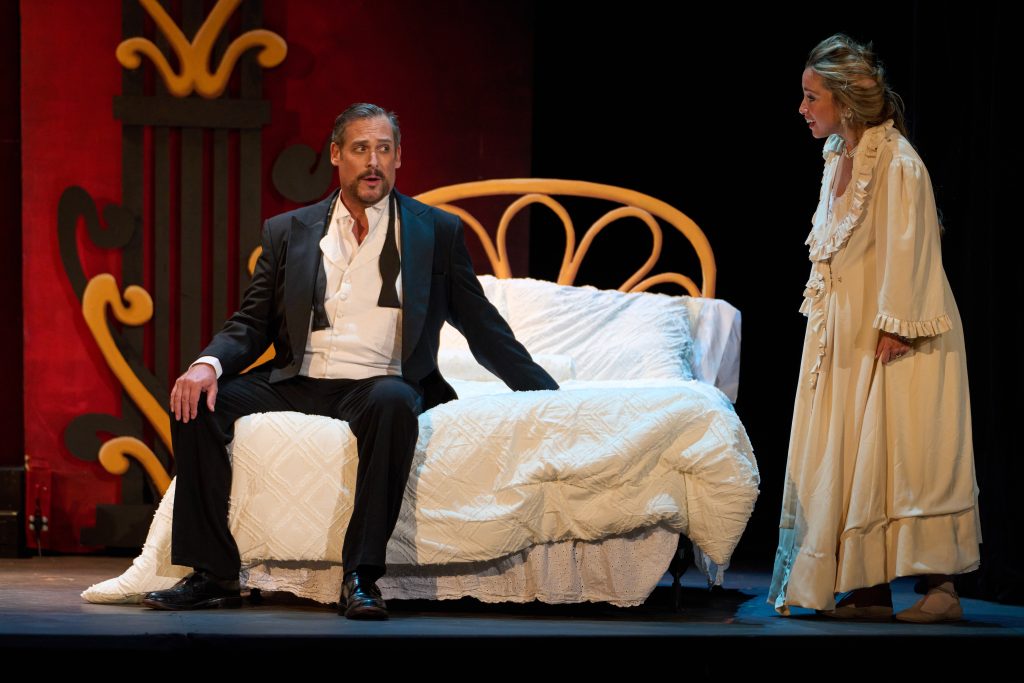
Peter Kendall Clark and Brooklyn Snow. Photo by Dan Donovan.

Are We A Pair?

 At the risk of being unfair to a overall strong cast from the leads to the Quintet, the center of this rueful, bittersweet, Ibsenish tale from Sondheim and playwright Hugh Wheeler is the pair of Fredrik Egerman, sung powerfully by Peter Kendall Clark and Desirée Armfeldt, sung by Debby Lennon. There are multiple, circuitous story lines, but they all dodge and weave around and toward the ultimate (re)union of Fredrik and Desirée.

And at the center of their relationship is (a now-standard) “Send in the Clowns.” As a hit song by Judy Collins back in the day and as rendered into near-Muzak ubiquity, “Send in the Clowns” needs the context of the surrounding story in the musical itself to reach its fullest, layered, exquisitely painful sense of yearning. It also needs the skills and talents of Lennon to ensure it is the show-stopper it was composed to be. Lennon gave the song its due – and more. You couldn’t hear a pin drop during her performance – to use a cliché.

The other extra-noteworthy “pair” in Union Avenue’s production was Count Carl-Magnus Malcolm and grande dame Madame Armfeldt. Both are broad characters that require a careful interpretation to avoid becoming cartoonish foils. Teresa Doggett performed the wheelchair-bound Madame with a delicious – and sometimes hilarious – imperiousness that evolves into a touching sagacity. As sung by Eric J. McConnell, the peacocky Count Carl-Magus fared less well and often crossed into buffoonery.

James Stevens, Arielle Pedersen. Photo by Dan Donovan.

But Where Are the Clowns?

To borrow a line attributed to the showman’s showman P. T. Barnum, Union Avenue’s choice of “Night Music” to conclude their 2022 festival, was the perfect choice to “always leave ‘em wanting more.” Given the rich experience provided by this production, “Night Music” will leave us wanting more…well, maybe next year? The only clowns therefore are those who didn’t reserve a ticket this year.

Union Avenue Opera Union presents “A Little Night Music” August 19, 20, 26, 27 at 8 p.m. at Union Avenue Christian Church. For more information, visit www.unionavenueopera.org

Leann Scheuring, Kay Love, Eric J. McConnell. Photo by Dan Donovan.
Joel Rogier, Sarah Price, Phil Touchette, Gracy Yukiko Fisher and Gina Malone. Photo by Dan Donovan