
By Lynn Venhaus
“After the Hunt” is a horrible movie about despicable people that attempts to tackle cancel culture, identity politics and a so-called female generation gap in 2019, which is strategically set during the #MeToo movement.
Ambiguous, pretentious and overlong, the psychological drama is a tedious watch because several lead characters are smug narcissistic liars who are morally bankrupt and intellectual know-it-alls.
These insufferable types are part of the insular world of Ivy League academia, in the philosophy department at Yale. Whether action is in a high-stakes classroom, a snooty Yale Club or a swanky dinner party, these caricatures are either going to pontificate or act out.
Directed by provocateur Luca Guadagnino, who is frustratingly vague about the points he’s trying to convey, meanders more than usual and boxes himself into a corner with Nora Garrett’s baffling screenplay.
Apparently not a fan of political correctness, Guadagnino really does a disservice to victims of sexual abuse who deserve to be seen and heard. It’s an insult to anyone who has had the courage to come forward, at the risk of damage to their reputation. #MeToo needed to happen and should have much sooner.
While the A-list cast is given juicy, complex roles, the irredeemable parts lack connection and emotional truth.
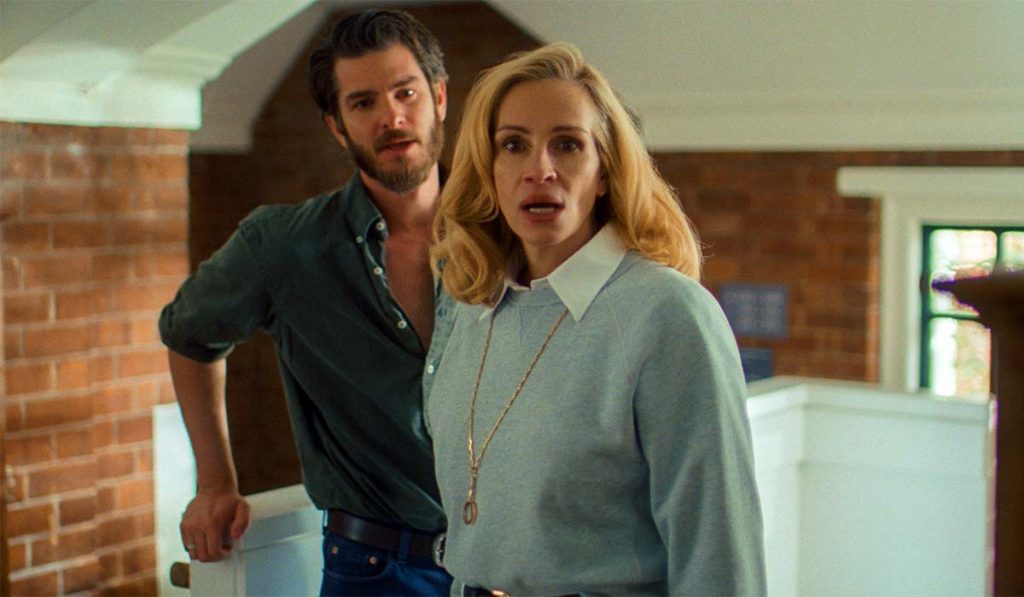
Julia Roberts, at her most unlikable, plays haughty, viperous professor Alma Imhoff, whose fancy-schmancy lifestyle with her lapdog husband Frederik is built on secrets and lies.
Truly egregious is that Michael Stuhlbarg is wasted in an utterly ridiculous role as an attentive partner who gets little respect. Chances are odd-man-out Frederik will get fooled again, and again.
As this rotten character, Roberts doesn’t elicit one iota of sympathy. She recklessly drinks too much. She has severe abdominal pain and violent vomiting episodes, but instead of going to a doctor she abuses painkillers, which she downs by fistfuls.
She treats students cavalierly and acts superior to her peers. Not exactly role model material. Chloe Sevigny is also wasted as Dr. Kim Sayers in a too brief role as a psychiatric counselor that factors in to yet another subplot thread.
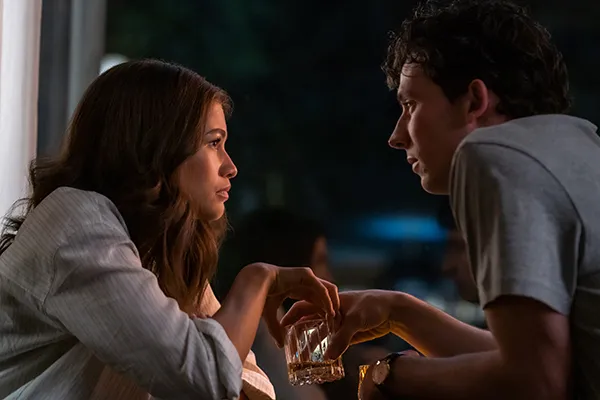
Alma is graduate student Maggie’s thesis advisor, and she attends her mentor’s dinner party. An inebriated Hank Gibson, a cocky professor played by Andrew Garfield, walks Maggie home.
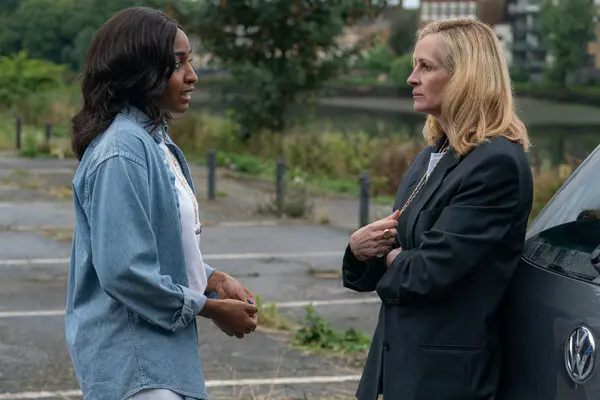
As the star pupil, Ayo Edebiri is miscast as a character that is as nebulous as Garfield is repellent.
Later, a distraught Maggie confides in Alma that Hank, who was in her apartment for a nightcap, sexually assaulted her.
He denies it. She reports it. He’s fired and makes a lot of noise publicly. He was up for tenure, as is Alma, who has conveniently distanced herself from the situation. Or has she?
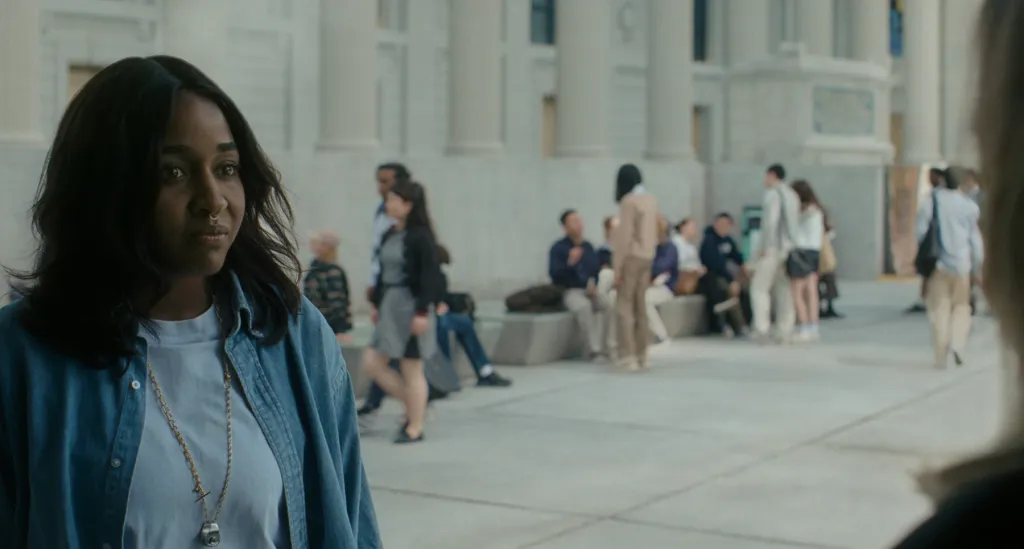
It quickly gets very ugly. Maggie views it as a betrayal. Understandably, the Gen Z students rally around her. She is quite vocal in the press, while Alma becomes very vicious in response, showing a cold and calculating side to her bewildering personality.
Garfield is so off-putting as the swaggering Hank that it would be difficult to conjure up a smidgeon of sympathy over his career in tatters if that is what the film leans towards.
Don’t expect any relatability to these self-important characters. The academia snake pit comes across like an unappealing morass. These are selfish people who have such an inflated opinion of themselves that they think everything is about them.
Doesn’t it matter that Hank’s behavior is troubling and dangerous? In some sort of alternative universe, Maggie is now the subject of derision because her wealthy, influential parents are Yale’s biggest donors. Wait, what?
Is it a witch hunt? Hank’s version accuses Maggie of plagiarism. Oh, as if that’s not enough, they must unravel Alma’s past. There are too many plot points, and none satisfactorily resolved.
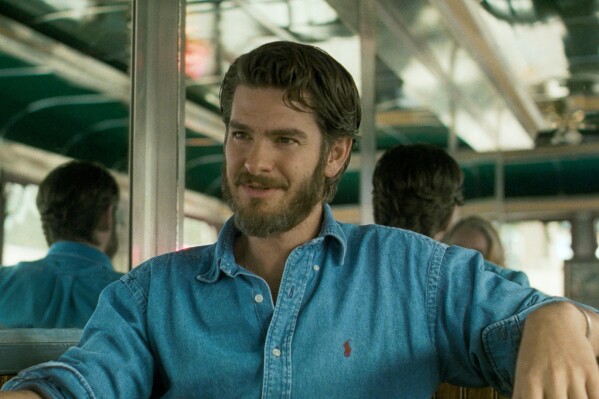
This supercilious debate about morality, ambition and ‘woke’ ideology fails to resonate. Is it an unwise battle between trailblazing women who broke glass ceilings and the entitled Gen Z’ers whose lives of privilege have handed them multiple gold-plated opportunities?
Contrivances abound as the plot goes in circles. Hank, longtime friend of Alma’s, perhaps had a sexual relationship with her, or did they just flirt a lot? She’d rather drink at a bar with him than go home to her psychoanalyst husband’s cassoulet.
And Maggie is purposely drawn to be unformed. She is in a relationship that lacks details. Her trans romantic partner and roommate is away when the Hank incident supposedly took place.
Cinematographer Malik Hassen Sayeed makes the hallowed halls of a prestigious university gleam with historic seriousness and the tony Imhoff home cultured and cavernous. The annoying contemporary score by Trent Reznor and Atticus Ross is uncharacteristically too obtrusive.
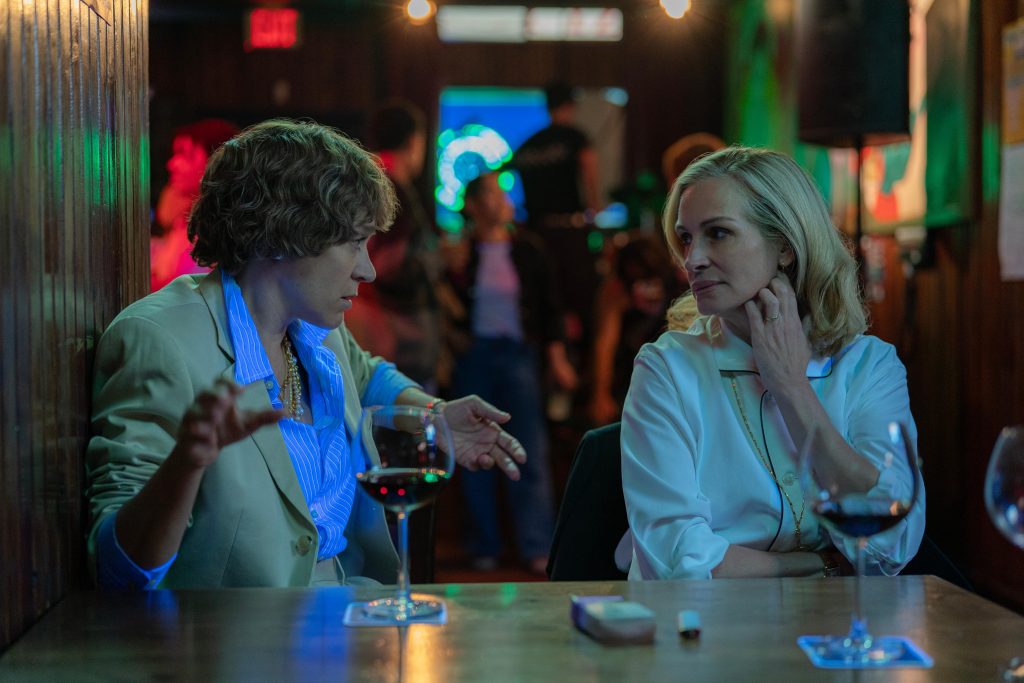
Guadagnino is a polarizing director, with detractors saying his style is too murky on substance. His sumptuous locations look beautiful, and the films often superficially and uncomfortably deal with desire – “I Am Love,” “The Bigger Splash,” “Call Me by Your Name,” “Challengers” and “Queer.” Characters often are complicated and meant to be stimulating but lack clear identities.
A better film on this subject, an authentic one set in a college town, is “Sorry, Baby.”
What is “After the Hunt” trying to say, and why does it try too hard to get our attention when there really is no point? We are tasked with the heavy lifting of deciphering the storytelling.
After more than 2 hours, the preposterous conclusion feels like cheating, ending in a very self-indulgent way.
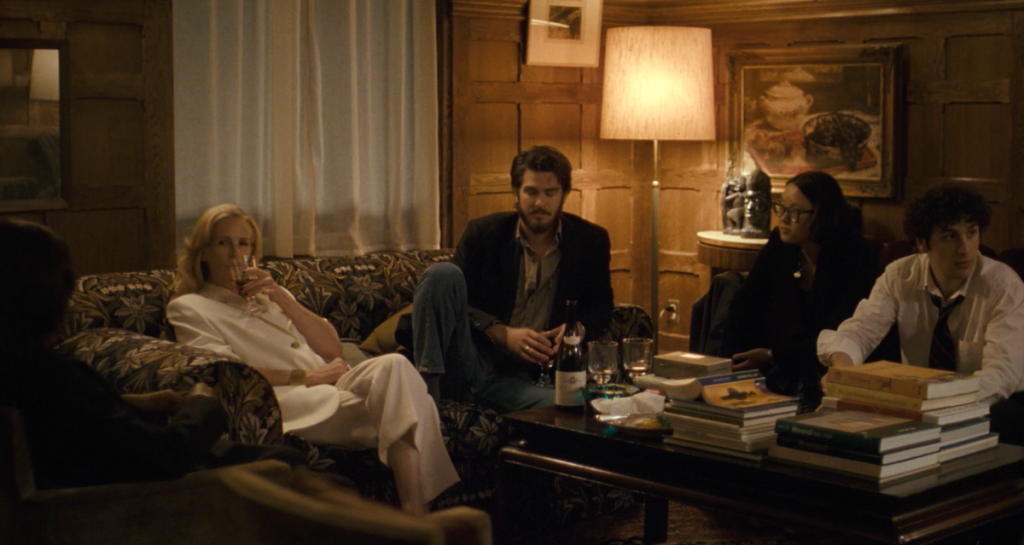
“After the Hunt” is a 2025 psychological drama directed by Luca Guadagnino and starring Julia Roberts, Andrew Garfield, Ayo Edebiri, Michael Stuhlbarg and Chloe Sevigny. It is Rated R for language and some sexual content and the run time is 2 hours, 19 minutes. Opens Oct. 17 in theatres. Lynn’s Grade: F.

Lynn (Zipfel) Venhaus has had a continuous byline in St. Louis metro region publications since 1978. She writes features and news for Belleville News-Democrat and contributes to St. Louis magazine and other publications.
She is a Rotten Tomatoes-approved film critic, currently reviews films for Webster-Kirkwood Times and KTRS Radio, covers entertainment for PopLifeSTL.com and co-hosts podcast PopLifeSTL.com…Presents.
She is a member of Critics Choice Association, where she serves on the women’s and marketing committees; Alliance of Women Film Journalists; and on the board of the St. Louis Film Critics Association. She is a founding and board member of the St. Louis Theater Circle.
She is retired from teaching journalism/media as an adjunct college instructor.