By Lynn Venhaus
A good-looking film with a kicky soundtrack, “The Harder They Fall” comes across as a bloody western shot like a music video.

It’s no surprise, because first-time director Jeymes Samuel, a music producer and singer-songwriter known as The Bullitts, is a protégé of Jay-Z and worked with him on “The Great Gatsby” soundtrack for director Baz Luhrmann. Under his real name, Shawn Carter, Jay-Z is one of the film’s producers.

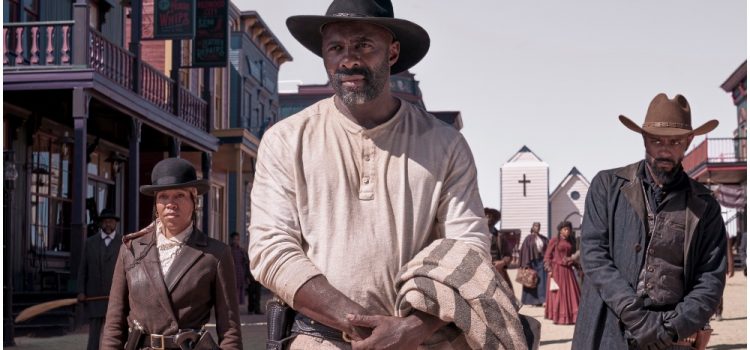
Samuel demonstrates an appealing slick style, but sadly the well-worn story lacks substance. Co-written by veteran screenwriter Boaz Yakin and Samuel as a tale of revenge and robbery, it’s merely ordinary – without much character development, squanders the talents of its extraordinary cast that includes solid-gold Idris Elba, Regina King and Delroy Lindo, with rising stars Jonathan Majors, Zazie Beetz and LaKeith Stanfield, who just gets better with every role.

The lethal shoot-outs and blood-spurting showdowns, an integral part of the western genre, are repetitive and do little to advance a gripping story. Overall, the plot is run-of-the-mill, mostly predictable, except for the third act revelation.

It’s unfortunate because you want to root for this type of new western that spotlights black cowboys. Supposedly, on the western frontier, one in four cowboys were black, and they haven’t been given proper due in America’s history on ‘go west’ and the great migration.

In the beginning, the director states that the story is fiction, but the people existed. Most of the action takes place in Redwood City, which was a primarily black community.

Faring well in this film are emerging stars Danielle Deadwyler as Cuffee, who identifies as him and would like a career in law enforcement, and Edi Gathegi as Bill Pickett, a young trigger-happy hotshot.

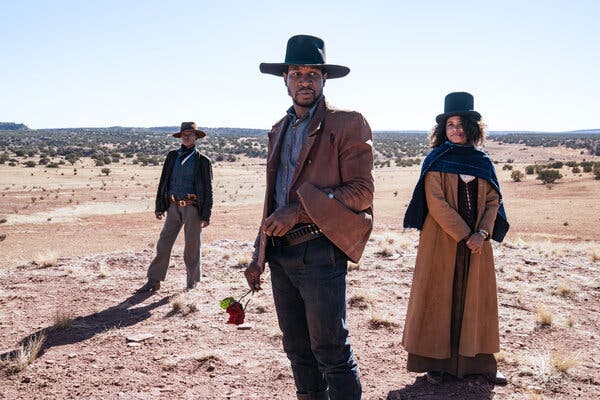
RJ Cyler has a solid turn as sharpshooter Jim Beckworth as does Deon Cole as Wiley Escoe, but it is Majors’ film. His outlaw Nat Love, no matter how many times he’s intimidated or dismissed, is driven and relentless.

Playing a man of few words who acts quickly, Elba’s physicality is felt throughout, a foreboding presence from the opening scene where he takes down a family, to breaking out of chains in prison stripes, and then as a feared frontier gang leader.

An interesting twist is how fierce the women are – Regina King as “Treacherous Trudy” and Zazie Beetz as Stagecoach Mary. They take the bullets out of their guns and use their fists and hand-held weapons for a rip-roaring knock-down drag-out brutal fight.

With its attractive production elements, the movie benefits from cinematographer Mihai Malaimare Jr.            ‘s framing of these newly constructed towns, showcasing the period production design by Martin Whist, with editing by Tom Eagles. The violence is graphic – a blown-off arm here, an exploding head there.

Amid the dusty outdoors and bullet-ripped clothes, Antoinette Messam’s costume design features a wide range of interesting vintage hats and lived-in frontier wear, with a few striking dusters and coats adding to the characters’ stature. You can always pick out Nat Love because of his jaunty red kerchief.

Not to be confused with a 1956 movie of the same name starring Humphrey Bogart, “The Harder They Fall” unfortunately lacks staying power because it preferred style over substance.

“The Harder They Fall” is a 2021 western directed by Jaymes Samuel and stars Idris Elba, Jonathan Majors, Regina King, Zazie Beets, LaKeith Stanfield, Delroy Lindo and Danielle Deadwyler. Rated R for strong violence and language, the run time is 2 hours and 16 minutes. In theaters Oct. 22 and streaming on Netflix on Nov. 3. Lynn’s Grade: C+

By Lynn Venhaus
As far as big-budget cosmic spectacles go, “Dune” is impressive at filling the screen with wonder.

Directed by visionary Denis Villeneuve, who frames everything with meticulous care, as he did with “Arrival,” his only Oscar nomination, and “Blade Runner 2049” – the film is a technical marvel, with visually stunning panoramas and innovative flying machines.

A mythic hero’s journey, “Dune” is the big-screen adaptation of Frank Herbert’s seminal 1965 bestseller about a feudal interstellar society in a galaxy far, far away, which is set in a distant future.

It’s the story of Paul Atreides, a gifted young man born into a great destiny beyond his understanding. As part of the noble house of Atreides, he must travel to Arrakis, the most dangerous planet in the universe for the future of his family and people.

The desert wasteland planet has an exclusive supply of “mélange,” aka “the spice,” a drug that extends life and enhances mental abilities. As it is the most precious resource in existence, malevolent forces are at work to prevent this, and only those who can conquer their fear will survive.

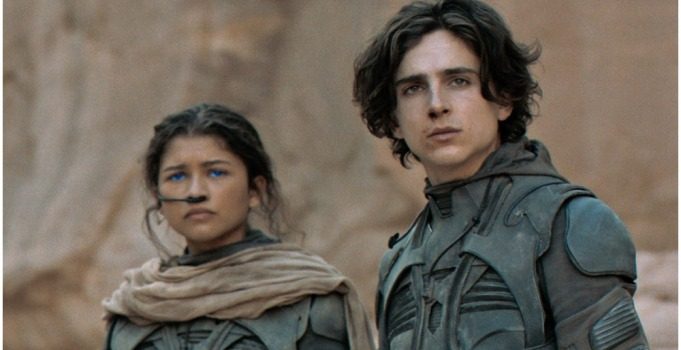
Yet are these characters engaging enough? How much do we care about what happens to these political dynasties? They prefer to whisper in cavernous spaces, and while mesmerizing Zendaya’s narration helps, the project’s mythology on such an epic scale tends to weigh it down with “importance.”

Our hero’s journey is a very long one and we spend 2 hours and 35 minutes leading up to a next chapter. This is only Part One. We are warned at the end, when one character says to Paul: “You’re just getting started.” The payoff isn’t quite there – so when is Part Two?

We have just invested time on an extended prologue. Oh dear. Will only fans of the book be able to appreciate this saga? And isn’t that the true test? As is always the case, those not familiar with the source material will be at a disadvantage trying to keep up with the warring factions.

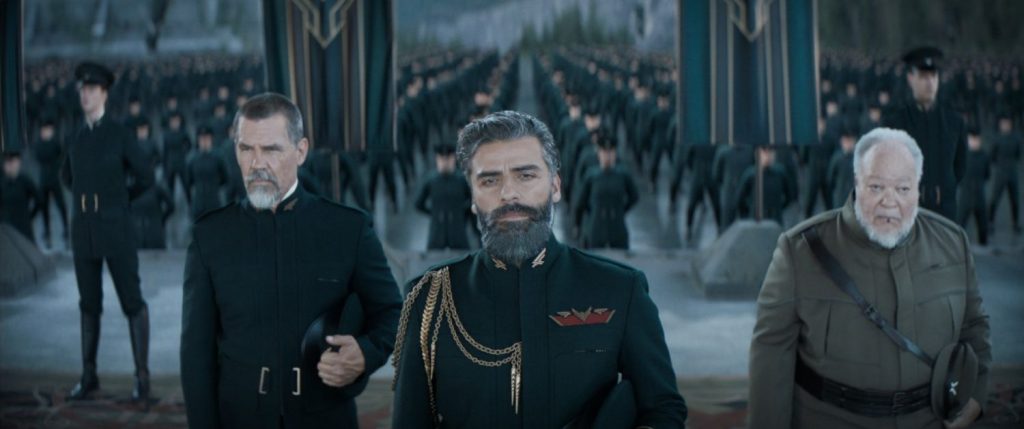
Josh Brolin, Oscar Isaac and Stephen McKinley Henderson

Considered the best-selling science fiction novel of all-time, “Dune” is gigantic in scope, and the 1965 cult classic touches on themes involving politics, religion, ecology, technology, and human emotion, threading them all together in space.

The empire’s other planets want control of Arrakis for its spice, which is also necessary for space navigation because of its multidimensional awareness and foresight.

“Dune” is only the first in a series, followed by Herbert’s five sequels: Dune Messiah, Children of Dune, God Emperor of Dune, Heretics of Dune, and Chapterhouse: Dune. After his death, others have kept the franchise going.

Its devoted fan base inspired filmmaker Alejandro Jodorowsky to attempt a film adaptation in the 1970s but it was cancelled after three years in development. Along came David Lynch’s complex adaptation in 1984, which was a harshly received misguided mess, and there was a Sci-Fi Channel miniseries in 2000.

While light years ahead of the 37-year-old film, “Dune” does seem to have the same problem about adapting something so unwieldy – that the character development suffers.

It’s difficult to figure out the planetary relationships and who’s who among the different groups, even with a strong cast that attempts to make everything as lucid as possible.

This one does attempt to over-correct in a tedious way, with a screenplay by director Villeneuve, Jon Spaihts (“Doctor Strange,” “Prometheus”) and Eric Roth, Oscar winner for “Forrest Gump,” that still is lacking in explanations.

Paul is played with youthful elan by Timothee Chalamet, who seems to be working non-stop. His character, burdened by birthright, is actually the least interesting of the massive ensemble – but the camera loves him, and he looks good standing in many shots of wind and blowing sands, contemplating.

Chalamet has genuine interactions with his father, an authoritative but loving Duke Leto Atreides, well-played by the always captivating Oscar Isaac. With warm fatherly advice, Isaac tells him: “A great man doesn’t seek to lead; he’s called to it.”

It’s not his fault that Paul is a blank slate. He is being groomed to take over, and while at times reluctant and confused, he ultimately accepts his duties. His mother, all-serious Lady Jessica, is a tough taskmaster, and subtly played by Rebecca Ferguson, they have a protective relationship.

Far more compelling is Jason Momoa as the fierce warrior Duncan Idaho. He brings some oomph to the fighter’s bravado and his fists of fury are legitimate. Momoa and Chalamet warmly convey a loyal long standing friendship.

Not given much to do is Josh Brolin as Gurney Halleck, the duke’s right-hand man, and Dave Bautista as antagonist Beast Rabben Harkonnen – along with Momoa, they are the recognizable fighters.

A barely there Javier Bardem is Stilgar, a leader of a desert tribe. An unrecognizable Stellen Skarsgard appears, Jabba the Hut-like, as the disgusting despot Baron Vladimir Harkonnen. The Harkonnens are the evil not-to-be-trusted bad guys.

The first hour is full of awe. But why do movies about the future tend to mix medieval and “Star Wars” knock offs in production design and costumes, similar to the “Game of Thrones”? The color palette is deary shades of gray, beige and black.

While that gets wearisome, the cinematography of Greig Fraser is dazzling. An Emmy winner for “The Mandalorian” and Oscar nominee for “Lion,” he expresses the grandeur of the planets’ landscapes as well as the more intimate moments in various degrees of light.

He worked on “Rogue One: A Star Wars Story” and the upcoming “The Batman,” so tackling sandworms and spaceships is natural for him. His majestic work is one of the pleasures of seeing this in IMAX.

Hans Zimmer’s score is a stirring mix projecting danger and derring-do in dissonant chords, setting an urgent tone for action.

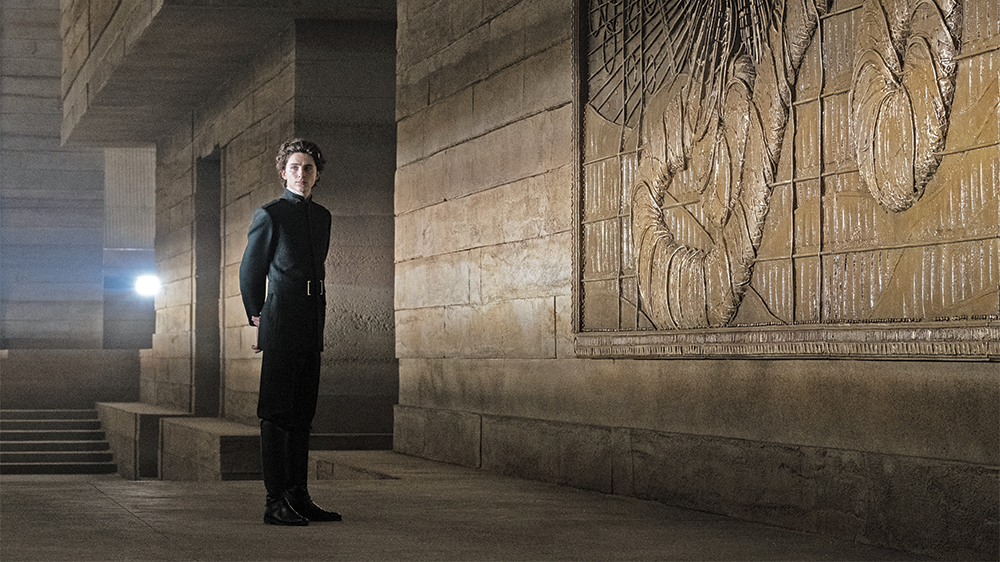
Dune (2021).TIMOTHEE CHALAMET.Credit: Chia Bella James/Warner Bros.

Despite its storytelling flaws, “Dune” is such a monumental example of state-of-the-art filmmaking that its cinematic universe deserves to be seen on the big screen.

“Dune” is a 2021 science-fiction action adventure directed by Denis Villeneuve. It stars Timothee Chalamet, Rebecca Ferguson
, Zendaya, Oscar Isaac, Josh Brolin, Jason Momoa, Dave Bautista, Stellan Skarsgard, and Javier Bardem. Rated PG-13 for sequences of strong violence, some disturbing images and suggestive material, its run time is 2 hours, 35 minutes. It opened in theaters Oct. 22 and is streaming on HBO Max for 31 days. Lynn’s Grade: B.

By Lynn Venhaus

Oh, what a night! Any time you can be joyfully swept up by the catchy hooks and upbeat sounds of the Four Seasons catalog is a good day.

Although the music is the big draw, the personal stories of bandmates Frankie Valli, Nick Massi, Bob Gaudio and Tommy DeVito combine for the irresistible musical “Jersey Boys.” The four lads from New Jersey’s rough-and-tumble journey through the music business is a fascinating rags-to-riches story, the quintessential American Dream tale.

In its Stages St. Louis premiere, the Tony Award winner comes alive in the Kirkwood Performing Arts Center’s intimate staging in the Ross Family Theater. The show runs through Oct. 24.

This can’t-miss combination overflows with energy and charm – and 30 songs, including their chart-topping hits “Sherry” in 1962, “Big Girls Don’t Cry,” “Who Loves You” and their last number one from 1976, “December 1963: Oh! What a Night!” The group sold 175 million records.

Directed with verve by Stages’ mainstay Michael Hamilton, with input from associate director Gayle Seay and assistant director Christopher Kale Jones, each number is vibrantly staged. Dana Lewis’ choreography is snappy and stylized.

The addition of live music at Stages, with the band perched atop of James Wolk’s grid set design, is a major plus. Music director Jeremy Jacobs kept up a peppy infectious beat with a tight band.

Wolk has efficiently used the space to set up different nooks conveying time and place, from recording studios to Las Vegas, with Sean M. Savoie’s savvy lighting choices expertly enhancing the designs, starting with streetlamps, and moving on to glitzy showbiz venues.

After it opened on Broadway in 2005, the musical became a juggernaut, winning four Tony Awards, including Best Musical, Actor, Featured Actor and Lighting Design in 2006, and ran until 2017, with multiple resident companies in the U.S. and abroad, in addition to several national tours pleasing crowds for years.

“Jersey Boys” is currently the 12th longest-running Broadway show (4,642 performances in 11 years).

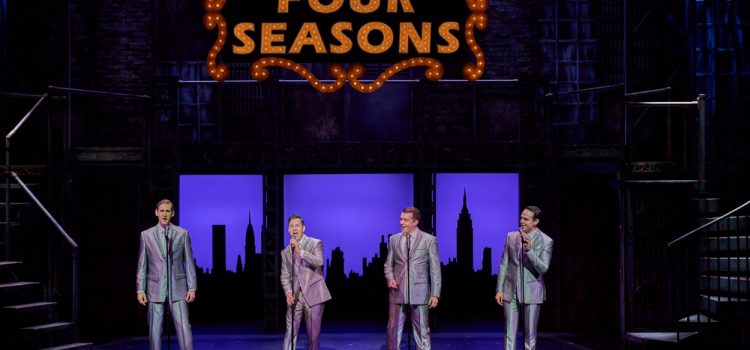
Stages has assembled a very capable quartet of smooth operators who mesh as a group –singing actors Christopher Kale Jones, Brent Michael DiRoma, Jason Michael Evans and Ryan Jesse are funny, appealing, good singers whose harmonizing brings a strong dynamic to the show.

Jones, as indefatigable lead singer Frankie Valli, pours his heart and soul into the role, with a comfortable falsetto and a passionate delivery. His rendition of “Can’t Take My Eyes Off You,” one of the show’s biggest moments, will give you goosebumps. He played Frankie on the first national tour.

Jason Michael Evans is an amusing Nick Massi, the quirky bass player, and he pulls off the deadpan delivery and crisp comic timing required of the role. Brent Michael DiRoma, who was so strong as Jerry in Stages’ “The Full Monty,” brings out the complexities of the swaggering troublemaker guitarist Tommy DeVito. He also had national tour experience, but in other roles.

The songwriting talents and keyboard prowess of young musical genius Bob Gaudio is charismatically portrayed by Ryan Jesse, who performed the role on Broadway and on tour.

Stages’ ensemble adroitly fills in the supporting roles: Edward Juvier is Bob Crewe and others, while Dereis Lambert, Jenna Coker-Jones, Nic Thompson, Brady Miller, Sarah Ellis, Donna Louden, Steve Isom, John Flack, Dena Digiacinto, Trevor James Berger, and Erik Keiser fluidly move the story along. The entire production has a close-knit feel.

They journey through backstage drama, in-fighting, inside show-business wheeling and dealing, and unsavory parts of personal and professional relationships.

Clever book writers Rick Elice and Oscar-winning screenwriter Marshall Brickman presented different points of view and broke the Fourth Wall, where characters talk directly to the audience. It’s a masterful touch.

The vintage outfits from several decades are crafted with flair by resident costume designer Brad Musgrove, who knows how to go way back into the time machine of early rock ‘n roll and sharply dress performers.

Because it resonates so well, “Jersey Boys” remains a blissful experience, a delightful jukebox musical with a smartly constructed book that features humor and heartache – not to mention it’s based on a remarkable true story. And those songs!

It was thrilling to be back together in a theater where you could feel the electric jolt on stage – and in the audience. I’ve seen this show, I think, seven times, and it is always a home run. Performers may be better than others, but such pizzazz. It never gets old.

Show features adult content, so viewer discretion.

“Jersey Boys” runs from Sept. 24 to Oct. 24. For information and tickets, visit www.stagesstlouis.org or call 314-821-2407.

.

The daring rescue of 12 boys and their soccer coach from deep inside a flooded cave in Northern Thailand captured the headlines in 2018, and now in an enthralling and inspiring documentary, “The Rescue,” our hearts as well.

Filmmakers Jimmy Chin and Elizabeth Chai Vasarhelyi, Oscar winners for “Free Solo” accessed never-before-seen material and included exclusive interviews to spotlight the risky world of cave diving and to convey the enormous outpouring of caring and compassion from the international community.

Even though we know the outcome, dubbed the “Miracle in the Cave” by the global news media, this documentary is a remarkable story of survival, determination, and ingenuity in the face of daunting odds and natural elements.

It’s a story we knew from the news, but not so much the harrowing details, which unfold like an edge-of-your-seat thriller. It’s a race against time that took two weeks to complete, and we feel the clock ticking and the mounting danger, especially as monsoon season nears.

To refresh, after a soccer practice, the boys went on an outing to explore a nearby elaborate system of caves and became trapped. While anxious parents awaited their rescue and fate, the Thai Navy, U.S. Navy Seals, and renowned cave divers combined their know-how for a daring rescue. Along with the Thai government and international leaders, we see the teamwork and plans in this life-or-death scenario.

Many people helped save the boys, and the courage they showed in such a perilous journey is astounding. But the two cave divers who first spotted the boys after 10 days, Rick Stanton and John Volanthen, are true heroes, as they give first-hand accounts of what happened.

It’s a lump-in-your-throat moment when the gaunt-looking youngsters say heartfelt “Thank you” and attempt to keep their spirits up, even though they are hungry and scared.

The film recently won the People’s Choice Award at the Toronto International Film Festival.

It’s certain to make an impact as a contender we near the annual awards season. But more importantly, it’s a rare success story and an extraordinary account of what humans are capable of in the face of overwhelming adversity.


The Rescue” is a 2021 documentary directed by Jimmy Chin and Elizabeth Chai Vasarhelyi. It is rated PG for thematic material involving peril and some language, and the run time is 1 hour, 47 minutes. In select theaters Oct. 15 and will eventually be on the National Geographic Channel (Disney Plus).

By Lynn Venhaus
Typically, movies about time travel make my head hurt because I overthink things and raise too many questions as I try to figure out the logic.

No need to waste precious brain cells on determining what’s going on in “Needle in a Timestack” because most of it doesn’t make any sense anyway.

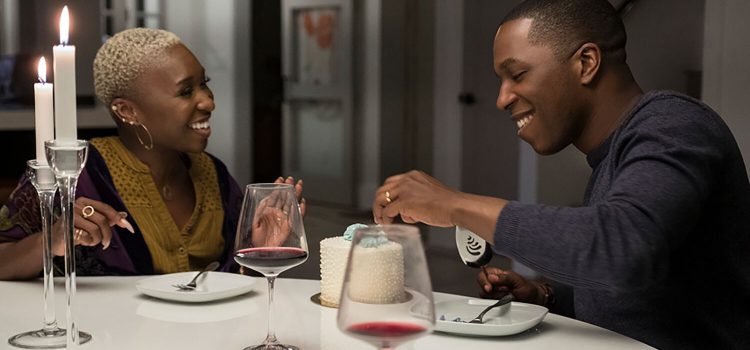
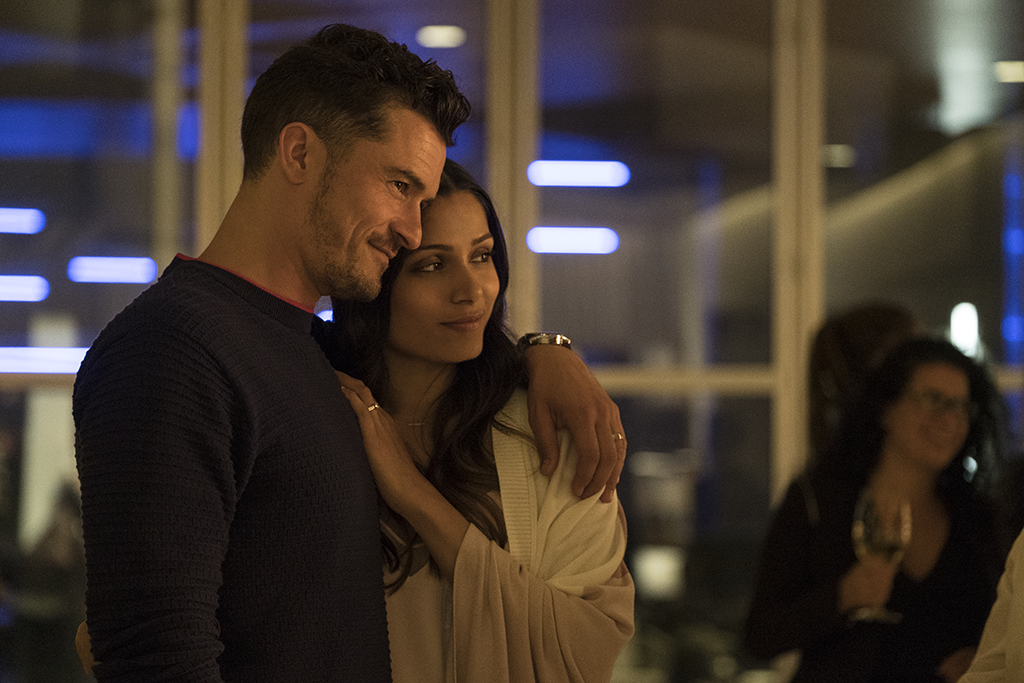
In the ‘near future,’ time “jaunting” has become a luxury afforded the wealthy in this sci-fi romance, where architect Nick (Leslie Odom Jr.) is worried that his soulmate wife Janine (Cynthia Erivo) won’t be in his memories because of her ex-husband and his former friend Tommy (Orlando Bloom) messing with altering events in time, which is called “phasing,” and is disruptive in multiple facets of life. Can he stop it or manipulate time to make sure she is in his life?

And that’s a shame because the cast is full of likable performers that you usually want to root for, but their characters are vapid and spout ridiculous psychobabble about love. The two couples are such ciphers lacking much personality and possess all the trappings of comfortable modern life, so what’s the problem? Or, for that matter, the point?

Based on a short story by Robert Silverberg that was first published in the June 1983 issue of Playboy, he had previously published a collection of ten short stories under the same title in 1966 and decided to reuse the title for this story.

Let’s count the ways this project screams ‘misguided.’ For starters, John Ridley, Oscar winner for the adapted screenplay of “12 Years a Slave,” squandered energy on rewriting a story that does not translate well nearly 40 years later, given how there is such a gap between the 1 percenters and the “have-nots” – it smacks of privilege and one more thing to resent the “haves” about.

Surprisingly tone-deaf, the script is superficial in its portrait of married couple Nick and Janine as well as their prior significant others Tommy (Orlando Bloom) and Alex (Freida Pinto).

For all the talk of forever love, Nick and Janine sure don’t look happy. He’s an architect and she’s a photographer, and they live in an airy, ultra-modern home straight out of Architectural Digest.

Nick is consumed by thinking Tommy is trying to snare Janine, but Nick is quite a glum malcontent – and we get generic shots of him not looking happy.

And when a big phasing happens, whoa – he’s back with his beautiful girlfriend Alex – and she seems miserable because he’s such a mopey guy.

Tony winners Leslie Odom Jr. and Cynthia Erivo – he for “Hamilton” and she for “The Color Purple,” are much in demand after Oscar nominations – he for “One Night in Miami” and she for “Harriet.”

However, two premier vocalists do not even team up for a song post credits.

Orlando Bloom’s character is underwritten and puzzling. One phase has him behaving like an entitled rich guy and the second wave turning him to benevolent best bud following his bliss by pursuing his dream, being with the girl of his dreams and concern about his pal Nick.

And wouldn’t these phasings that alter people’s lives cause tremendous chaos in the real world?

Nick’s sister Zoey – a marvelous turn by Jadyn Wong, a bright spot, pays a lot of money to tamper by switching a friend’s tragic loss, but consequences, while threatened, appear to be random or non-existent.

And where are we? We are in a never-mentioned big city, and as the film was made in British Columbia, I assume it is Vancouver, but why assume? It just seems to be plastic and slick without a reason to stay engaged.

Trying to explain this is indeed a head-scratcher. Love is a circle. Let’s move on.

“Needle in a Timestack” is a 2021 science-fiction romance directed by John Ridley and starring Leslie Odom Jr., Cynthia Erivo, Orlando Bloom and Freida Pinto. It is rated R for some language and its run time is 1 hour, 51 minutes. It opened in theaters and was available on digital Oct. 15; and on DVD, Oct. 19. Lynn’s Grade: D.


By Lynn Venhaus
An enticing sense of wonder and palpable joy in nature can be felt in “Beyond Van Gogh: The Immersive Experience,” now available in St. Louis.

Irresistible and imaginative, it is: “magnificent.”

Art lovers will swoon looking at the walls with a 22-foot ceiling, technology enthusiasts will marvel at the cutting-edge three-dimensional world, and all will be exhilarated by the moving digital light show that breathes new life into Vincent van Gogh’s life work.

One must experience this unique multimedia presentation first-hand to understand just what the ‘immersive’ aspect truly means.

The limited engagement which opened Oct. 1, runs through Nov. 21 and is open from 10 a.m. to 10 p.m. Sundays through Thursdays and 10 a.m. to 11 p.m. Fridays and Saturdays. Four entry times are available each hour and tickets are sold online at www.vangoghstlouis.com

The installation is in the Starry Night Pavilion on the grounds of the Saint Louis Galleria, near the Macy’s side. Upon entry of the gigantic white tent, you will be educated about the legendary Dutch painter – his thoughts recorded in letters to his brother Theo, his dreams and own words about his life and work.

 After the introduction, a second room, referred to as a “portal,” prepares visitors for the visuals by having them get used to the moving images – comparing it a dreamlike experience.

The work comes alive in the ‘immersion’ room, the third – and largest – space. then we become acclimated to the visuals of his works, through wall projections and finally, able to partake in stunning colors that swirl, dance and refocus into flowers, cafes and landscapes that operate on a 30-minute loop.

Overall, there are about 300 paintings representing his vast body of work. He had a fondness for portraits of peasants and still life of nature settings, and is known for a multitude of self-portraits.

His instantly recognizable masterpieces “The Starry Night,” “Sunflowers” and “Café Terrace at Night” come to life, no longer in frames, and you can see the details. The numerous shades of blue he used to depict night skies is remarkable – and vibrant.

The music score is symphonic and cinematic, and yes, you can hear snippets of Don McLean, along with Paul Simon, Miles Davis and other modern composers.

Whether you are familiar about the tortured artist or not, you can’t help but have a new appreciation for his work and understanding of the 19th century world he attempted to cope with in his all-too-brief, difficult life.

Sadly, he was more famous in death than in life. He was born in 1853 in Zundert, Netherlands. He didn’t take up painting until he was 28 years old. After bouts with depression, cutting off nearly his entire ear, confined to an asylum for a year – he painted nearly a work a day – he shot himself in the chest in 1890 and died two years later of infection in Auvers-sur-Oise, France. He was 37 years old.

His brother, Theo, an art dealer, died of syphilis six months later, and his widow, Jo, is credited for getting the word out about Vincent, and his paintings into the public eye.

In later years, medical experts have concluded that he likely had depression, bipolar disorder and a borderline personality disorder. Because of his poverty, poor diet, sleeping habits, drinking and smoking, he did not help his health either.

Immersion Room. Provided Photo.

For those interested in exploring more about Van Gogh, four of his paintings are on display at the St. Louis Art Museum in Forest Park, including “Stairway at Auvers” and “Head of a Peasant Woman,” seen in the immersive projections.

For those wondering where others are, “Arles Sunflowers” and “Wheat Fields with Cypresses” are at the Metropolitan Museum of Art in New York City, “The Starry Night” is at the Museum of Modern Art in New York City, and “Starry Night Over the Rhone” is in the Musee D’Orsay in Paris.

“Café Terrace at Night” is at the Kröller-Müller Museum in Otterlo, the Netherlands. For that work, he set up an easel in the Place du Forum, a public square in Arles, and painted it en plein air.

“Irises” is at the J. Paul Getty Museum in Los Angeles and “Haystacks” is at the Philadelphia Museum of Art.

At the Van Gogh Museum in Amsterdam, you will find “Bedroom in Arles,” “The Yellow House,” and “The Potato Eaters.”

The Normal Studio, which has accomplished these shows with other artists, too, is known for pushing the boundaries of performing arts, entertainment, and public installations. Founded in 2009, they fuse physical and technological elements to transform spaces into multimedia magic, telling stories in new and different ways.

It is indeed a one-of-a-kind triumph in the St. Louis region, an experience not to be missed.

The St. Louis exhibit also has a gift shop. For a special, Schlafly has introduced a beer, Swirling Sky IPA, at its various locations. 

Provided photo.

The exhibition is open from 10 a.m. to 10 p.m. Sundays through Thursdays and 10 a.m. to 11 p.m. Fridays and Saturdays in the Starry Night Pavilion on the grounds of the Saint Louis Galleria, Richmond Heights. Four entry times will be available each hour.  They recommend that the exhibit takes one hour to view.

Prices start at $36.99 for adults, with VIP and premium passes available up to $93, and $24.99 for children ages 5 to 15, with children under 5 are free. Tickets are sold online at www.vangoghstlouis.com

Beyond Van Gogh is following all St. Louis County Health Department guidelines in place during the exhibition’s run. Parking is free at the Saint Louis Galleria. Group tickets are available for eight or more.

For more information, visit www.vangoghstlouis.com.

Provided photos.

By Lynn Venhaus

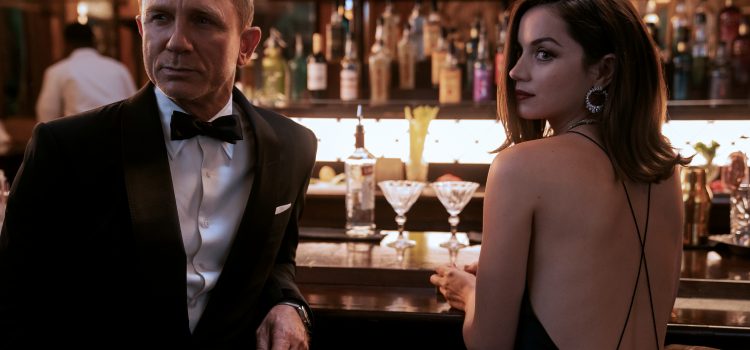
“No Time to Die” is everything you want in a Bond movie, a super-spy thrill ride elevated by director Cary Joji Fukunaga’s flair for assembling dynamic action sequences and his attention to details.

And in a welcome surprise – assertive women show up in an impressive triumvirate of Ana de Armas, Lashana Lynch and Lea Seydoux.

For the fifth and final entry in the Daniel Craig era as the suave James Bond, our very human hero has left active service at M16 and is enjoying a tranquil life of retirement in Jamaica. However, his peace is short-lived when his old friend Felix Leiter (Jeffrey Wright) from the CIA asks for help in rescuing a kidnapped scientist. The mission turns out to be far more treacherous than expected and leads Bond onto the trail of a mysterious villain (Rami Malek) armed with dangerous new technology.

Fukunaga’s keen eye is well-documented in his unflinching 2015 film “Beasts of No Nation,” in which he was also cinematographer, and his masterful first season of the dark, hypnotic “True Detective” in 2014, for which he won an Emmy Award for directing.

He excels at moving this intriguing spy story along and the globe-trotting camerawork by Linus Sandgren, Oscar winner for “La La Land,” is dazzling. Even at 2 hours and 43 minutes, this slick yet gritty adventure keeps our attention, and satisfyingly wraps up Craig’s story arc as the British icon.

While most other Bond films can stand on their own, some 25 and counting over six decades, the five in the Daniel Craig era are connected. “No Time to Die” relies on viewers knowing that Vesper Lind was Bond’s first wife in the 2006 “Casino Royale” reboot and that tragic backstory, as well as familiarity with what happened in the last one, “Spectre” in 2015 – especially about his girlfriend Dr. Madeleine Swann, daughter of nemesis Mr. White, and sinister mastermind Blofeld (Christoph Waltz), Swann’s dad’s boss.

The script by Neal Purvis and Robert Wade, as well as Fukunaga, is noticeably impacted by the contributions of screenwriter Phoebe Waller-Bridge (heralded creator of “Fleabag”), who brings a refreshing female perspective to the well-documented male patriarchy of the Bond franchise.

This entry is far more female-forward than previous Bond installments – and there is a new 007, Nomi, and she is a feisty, ferocious machine, with Lashana Lynch in a dandy performance, the first black British agent in the film’s 58-year history. No, he may be legendary, but they did not retire Bond’s number, 007.

The iconic ID has been around since Ian Fleming’s first novel, “Casino Royale,” in 1953, and he went on to write 11 novels and two short story collections. Other authors have carried on Bond’s missions.

What direction the Bond franchise goes after Craig’s swan song is anyone’s guess – but post-credits, producers are emphatic: Bond will return in 2022. Debate rages over the possibility of Idris Elba or Rege-Jean Page, or even a female agent. Hmmm…anticipation grows.

In the meantime, Craig fans will enjoy his final emotionally charged performance. He’s been a fine Bond, one of the best, displaying an intensity about dedication to duty, a wily intelligence and a tiny chink in his reserved demeanor about feelings, which is endearing. His orphan roots and lovers’ betrayals have exposed his internal wounds.

While he might not be as memorable as some previous villains, Rami Malek is an interesting adversary as mad genius Lyutsifer Safin, warped by his father’s zeal for using chemicals as weapons.

As the other Bond villain, Blofeld, Christoph Waltz is far better here in one confrontation than he was in the entire “Spectre,” which was a disappointing film after the extraordinary “Skyfall” in 2012.

Not everyone is sold about French actress Lea Seydoux playing the love interest, a rare second appearance for a girlfriend, but it deepened the Craig finale.

This foray features a solid cast, with the always-exceptional Ralph Fiennes returning as a conflicted M, Ben Whishaw as tech whiz Q, Naomie Harris as loyal assistant Eve Moneypenny, Rory Kinnear as government wonk Tanner and this time around, Jeffrey Wright compelling as CIA pal Felix.

Besides a take-notice turn by Lynch, Ana de Armas is sensational as a rookie CIA operative helping Bond in Cuba. She is not given as much screen time as she deserved, and her captivating sequence had viewers wanting more, ushering in a new type of “Bond girl” in a changing era.

Bond may be a relic from a distant past, but the fact that filmmakers acknowledge that change is necessary, makes for a fascinating future.

The franchise, known for stylish escapism, may be forced to adapt to keep relevant in a brave new world, but viewers will always want engaging stories of right triumphing over might – no matter if it’s good girls AND guys.

And wow, are those car chases fun to watch.

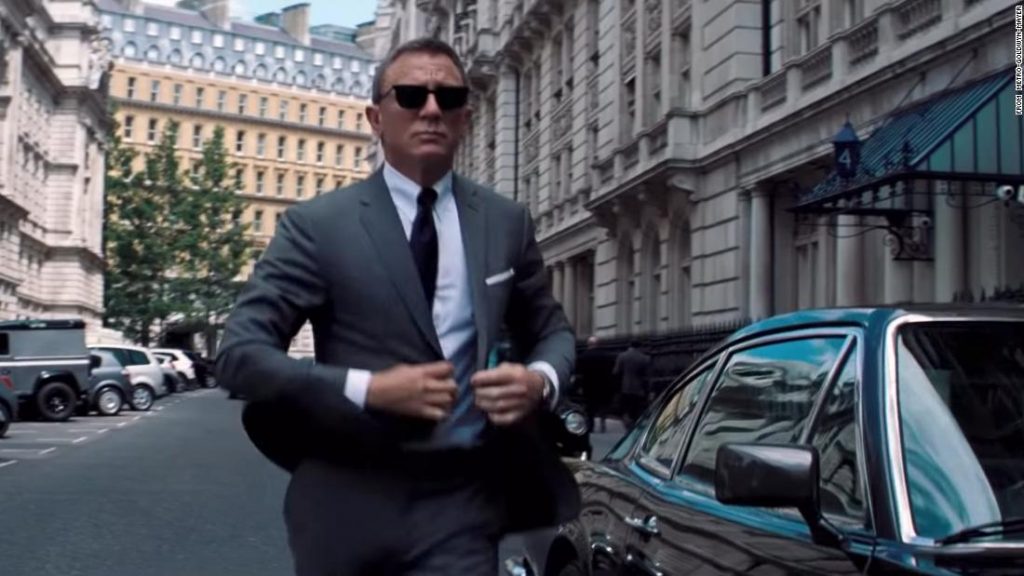
Daniel Craig as James Bond in “No Time to Die”

No Time to Die” is an action-adventure directed by Cary Joji Fukunaga and stars Daniel Craig, Rami Malek, Lea Seydoux, Lashana Lynch, Ben Whishaw, Naomi Harris, Christoph Waltz, Ralph Fiennes, Jeffrey Wright, BIlly Magnussen and Ana de Armas. It is Rated: PG-13 for sequences of violence and action, some disturbing images, brief strong language, and some suggestive material. Its run time is 2 hours, 43 minutes. It is in theaters on Oct. 8. Lynn’s Grade: A


By Lynn Venhaus

Friendship is indeed one of life’s blessings, especially those lasting ones through the ebb and flows of the years. The French novelist Francois Mauriac once wrote that “No love, no friendship, can cross the path of our destiny without leaving some mark on it forever.” And this little musical theater gem, “The Story of My Life,” illustrates that theme beautifully.

New Line Theatre kicks off its 30th season with this deceptively simple yet poignant and profound work, an intimate and thoughtful reflection on the special people who change our lives. It runs Sept. 30 through Oct. 23, Thursdays through Saturdays at 8 p.m. at the Marcelle Theater.

It particularly strikes a chord after what we’ve been through during the past 18 months, dealing with a coronavirus pandemic and periods of lockdown and quarantine during the public health crisis. The appreciation of and craving for connection has become an exclamation point.

“The Story of My Life” opened on Broadway in 2009 after earlier productions in Toronto and the Goodspeed Opera House. It was nominated for four Drama Desk Awards, including best musical.

With a keenly observed book written by Brian Hill and heartfelt music and lyrics by Neil Bartram, “The Story of My Life” follows the friendship of Alvin Kelby and Thomas Weaver, two lifelong friends since age 6 who grew up in a small town. Once inseparable, they are reunited after Alvin’s mysterious death.

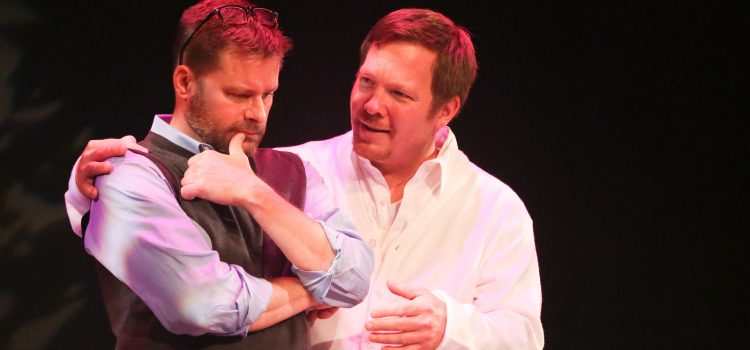
Jeffrey M Wright as Thomas, Chris Kernan as Alvin. Photo by Jill Ritter Lindberg

While Thomas, a successful author, struggles to write Alvin’s eulogy, his deceased pal appears from the afterlife, and they take a sentimental journey, revealing moments big and small from their intertwined lives.

Alvin goes through the manuscripts and short stories in Thomas’ mind, some which found their way to being published and receiving acclaim.

The adage “write what you know” is what guides Thomas as he sums up his best friend. During the process, he finds his own story and comes to terms with his past.

New Line veterans Chris Kernan as Alvin and Jeffrey M. Wright as Thomas make for an appealing pair, ardently portraying the lifetime friends who chronicle their journey in vignettes – their story is told through stories.

And the two actors punctuate each other’s remembrances. Pouring their hearts and souls into the demanding roles, Kernan and Wright are passionate about making these two guys memorable.

With a deft touch, Scott Miller accompanies the pair on keyboard. He also directed the show with a smart no-frills approach that never feels static.

The score finds the magic in special moments that friends share during lengthy relationships – and addresses rough patches, too. There are four parts to “Saying Goodbye,” and each one is real.

Kernan and Wright meet the challenge of being on stage the entire 70 minutes, without an intermission, breathing life into these roles with insight and charm  

Tom’s book report, “1876” and a song after something Alvin said, “The Butterfly,” are just two highlights.

These parts are unlike anything else they have ever done, with Wright known for classic leading men roles like Nathan Detroit in “Guys and Dolls” and Nicky Arnstein in “Funny Girl,” and Kernan often supporting and humorous roles, like one of the dads in “Heathers” and St. Jimmy in “American Idiot,” and his award-winning Snoopy in “You’re a Good Man, Charlie Brown.”

As the likable kids, who bond over their annual Christmas movie tradition “It’s a Wonderful Life,” they resonate at every turn in their lives.

Alvin, a cheerful sort despite being dealt a few George Bailey-like blows during his life, lost his mom at an early age. When his father begins ailing, he takes over running the bookstore instead of going off to college and adventures.

Thomas, a driven guy who communicates better on paper, is the one who grabs the opportunities afforded him and leaves town, rarely returning.

Alvin stays rooted in their town, running the treasure trove that is his father’s bookstore, “The Writers Block,” and misses his buddy, who is off to other crossroads. Nobody “gets” him like Thomas did. “You’re Amazing, Tom” Alvin sings.

As Thomas is off living a life he imagined, does he feel the same about how special their friendship has been?

Redolent with tender and touching moments, “The Story of My Life” includes many warm humorous bits too – starting with Alvin’s reminisce about their teacher, “Mrs. Remington.”

The show’s rich emotional depth effectively builds to a heart-tugging conclusion, ending with “Angels in the Snow.” Moist-eye alert – bring a tissue.

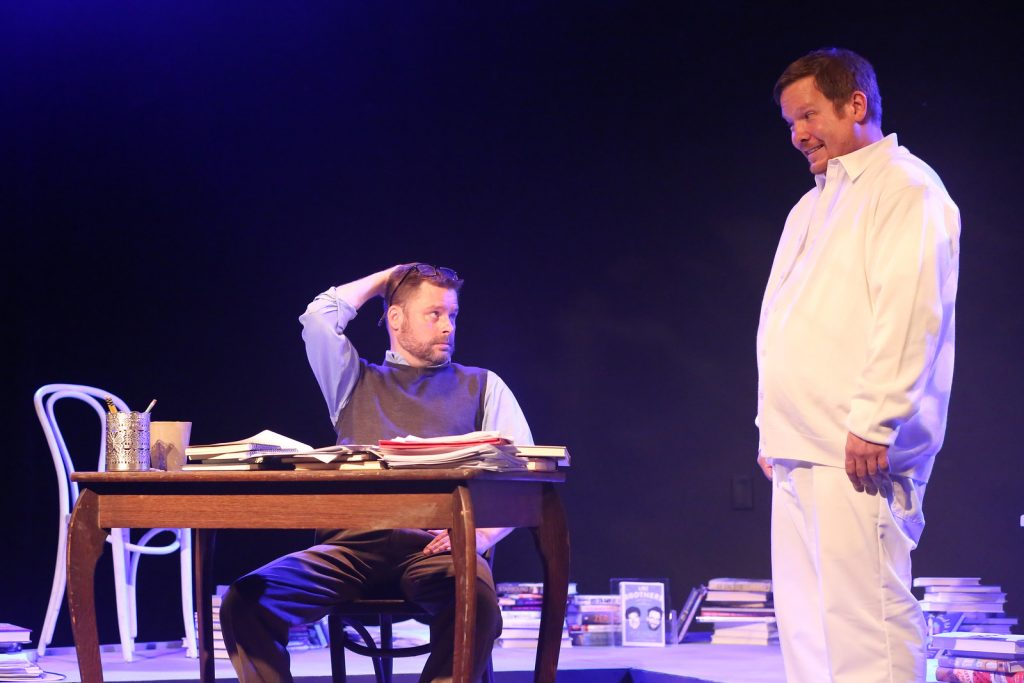
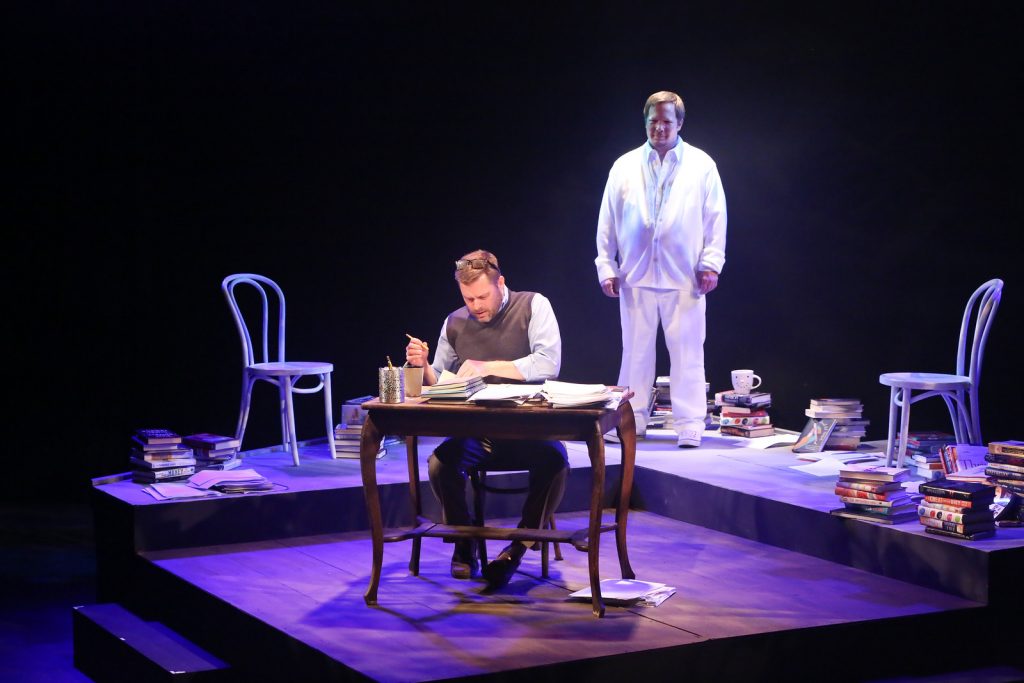
Scenic designer Rob Lippert’s minimalist set – full of books and the written word – and Kenneth Zinkl’s modest lighting design are impressive accents for a show that stands out without any bells and whistles.

An outstanding collaboration by all involved, “The Story of My Life” has a lot to say, and you’ll be glad you spent time getting to know Alvin and Thomas. Maybe you will recognize your own friends and your experiences along the way, like I did.

After all, George Bailey wisely learned: “Remember, no man is a failure who has friends.”

Holiday time or not, this show is a gift to theatergoers eager to feel “the feels” that only live theater can provide. And a reminder about humanity in a time of great uncertainty and division. It could not be more timely – and timeless.

Jeffrey M Wright, Chris Kernan. Photo by Jill Ritter Lindberg.

“The Story of My Life” runs through Oct. 23, Thursdays, Fridays and Saturdays at 8 p.m. at the Marcelle Theater, 3310 Samuel Shepard Drive, three blocks east of Grand, in the Grand Center Arts District. For more information, visit www.newlinetheatre.com.

Tickets are $25 for adults and $20 for students/seniors on Thursdays; and $30 for adults and $25 for students/seniors on Fridays and Saturdays. To charge tickets by phone, call MetroTix at 314-534-1111 or visit the Fox Theatre box office or the MetroTix website.

COVID-19 POLICY

All patrons will be required to wear masks in the lobby and theatre. The stage area will be safely distanced from the audience. In addition, the Kranzberg Arts Foundation now requires all patrons 12 years or older to show proof of their full COVID-19 vaccination or negative COVID-19 test upon entry for all ticketed events at all KAF indoor performance venues, including the Marcelle Theater.  

Photos by Jill Ritter Lindberg.

By Lynn Venhaus
An American remake that is as tense and gripping as the 2018 Danish original, “The Guilty” will surprise with its carefully crafted twists in a story you think you have figured out – but assumptions are a dangerous tool.

“The Guilty” takes place over the course of a single morning in a 911 dispatch call center. Call operator Joe Baylor (Jake Gyllenhaal) tries to save an emergency caller in grave danger, but he soon discovers that nothing is as it seems, and facing the truth is the only way out.

Gyllenhaal bought the rights to the acclaimed foreign language film, which won the Audience Award at the Sundance Film Festival in 2018 and was Denmark’s entry for the Oscars (not nominated; “Roma” won) three years ago. (The original is currently streaming on Hulu.)

As a producer, he cast himself as the lead, a demoted police officer working as a 911 dispatcher, and assembled a crackerjack team.

The creative crew – including screenwriter Nic Pizzolatto, of HBO’s “True Detective,” has not changed much, but moved the location from Copenhagen to Los Angeles, where the public safety personnel are involved in quelling wildfires. The call center displays horrific scenes of fire ravaging the landscape on its multi-screens.

Original screenwriters Gustav Moeller, who also directed the 2018 film, and Emile Nygaard Albertsen, had written such a compelling script that it really didn’t need much embellishment. It’s a brilliant example of building tension in a contained area in a race against time.

Above all, the source material illustrated that a rush to judgment is often counterproductive. The takeaway is that one should not jump to conclusions before all the details are available.

One change is the temperament of Baylor. Whereas in the original, Swedish actor Jakob Cedergren played the conflicted police officer with a more stoic demeanor, they both are frustrated by the petty calls clogging up the system and show little patience.

Gyllenhaal is a more intense actor, so he plays Joe with pent-up rage. While he answers routine calls, he seems a little more on edge, his inhaler present. Turns out he has a trial set for the next day, but the charges are not revealed right away. Through his conversations with others, we piece it together.

Emily, a mother of two who is in the process of getting a divorce, calls 911, whispers for help, and Joe soon gets involved in a complicated case. She is frantically voiced by Riley Keough.

Gyllenhaal’s ferocity will sometimes get in the way of cool, calm decision making under pressure. He will say and do things that further heighten a dangerous scenario.

Clearly, his conscience is wrestling with some other issues. As a beat cop, he’s trying to be a hero – is this a means of redemption?

Director Antoine Fuqua knows a thing or two about shooting action films – his collaborations with Denzel Washington include the Equalizer reboot and its sequel, the “Magnificent Seven” remake and Washington’s Oscar winner “Training Day.” He directed Gyllenhaal in “Southpaw.”

Fuqua makes a fairly stagnant situation bristle with adrenaline and anxiety. What kind of peril is Emily in? As the film unfolds, we will be able to see the bigger picture.

The voice work is stellar, as one would expect from the supporting players. Besides Keough being the distraught victim on the other end of the phone, Peter Sarsgaard (Gyllenhaal’s brother-in-law in real life) plays her husband Henry, who is living separately from their family.

Ethan Hawke, an Oscar nominee for “Training Day,” is a police sergeant whose work banter with Joe indicates familiarity. Paul Dano, who directed Gyllenhaal in the underrated “Wildlife,” plays a VIP who is mugged while visiting the City of Angels.

The editing by Jason Ballantine is impressive, and the music score by Brazilian composer Marcelo Zarvos conveys an urgency that increases the helpless feelings coming through the phones.

At a 90-minute runtime, Fuqua keeps it taut, and Gyllenhaal displays the effects of compromised morality that’s a necessary ingredient. While this may not be better than the original – they did this tale first after all, so there is a lack of surprise if you have seen it – but for American audiences experiencing it as new material, this puts the thrill in thriller.

“The Guilty” is a thriller directed by Antoine Fuqua and stars Jake Gyllenhaal. Voice work is by Riley Keough, Peter Sarsgaard, Ethan Hawke and Paul Dano. It is Rated R for language throughout and is 90 minutes. In theatres Sept. 24 and streaming on Netflix Oct. 1.
Lynn’s Grade: B+

By Lynn Venhaus
By the numbers: 2 one-act plays, 2 renowned 20th century playwrights, 2 professional actors, a 97-seat black box — with COVID-19 protocols in place — and one professional theater company restarting its 14th season.

The more things change, the more they remain the same. One thing is for certain – the awards magnet St. Louis Actors’ Studio has re-opened with the edgy, gritty dramadies that it specializes in, re-emerging with an acting showcase on stage at The Gaslight Theatre.

After being dark during the public health crisis of 2020 and 2021, pre-vaccine, these early 1959 works by two iconic individual voices, “The Zoo Story” by Edward Albee and “The Dumb Waiter” by Harold Pinter, are vivid and evocative some 60 years later

It’s all the ingredients necessary to create a mesmerizing live theatrical experience.

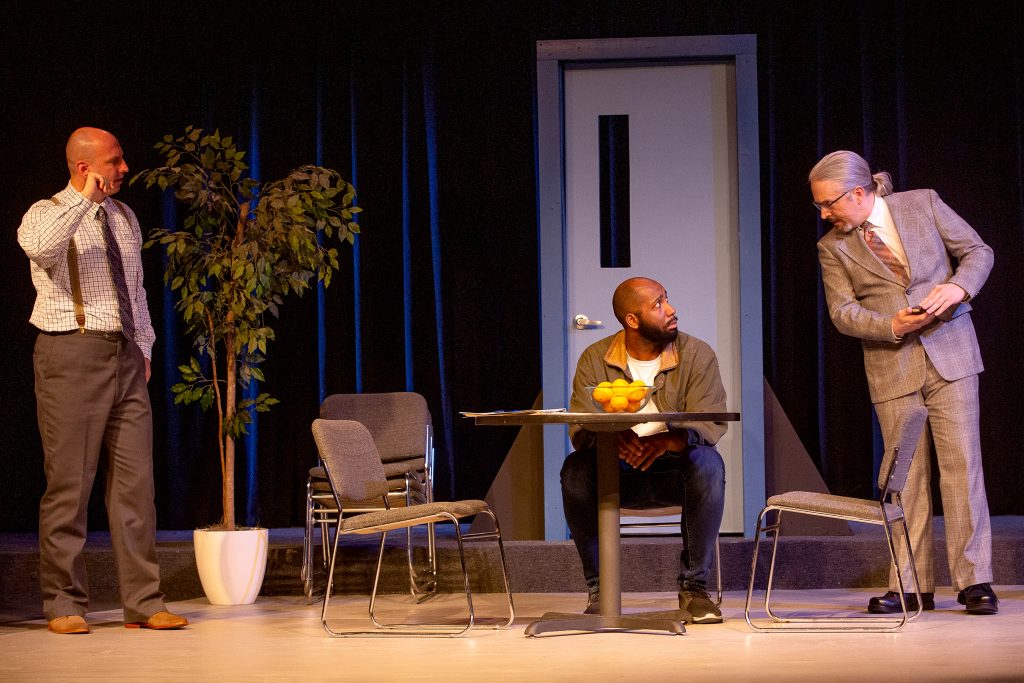
Newcomer Joel Moses announces his arrival in St. Louis with two masterful portraits, holding his own with veteran William Roth, who is also the company’s artistic director. The original 14th season was called “Two to Tango,” and their pas de deux is a master class in duet acting.

William Roth as Peter and Joel Moses as Jerry in “The Zoo Story.” Photo by Patrick Huber

Starting with Edward Albee’s first play, “The Zoo Story,” it’s immediately apparent that we are in for something special. The one-act, written in 1958, is where Albee, a rebellious youth with wealthy adoptive parents, crafted a work by using themes we’d become more familiar with as he explored dark societal issues.

He won three Pulitzer Prizes for Drama, and his 1962 masterpiece “Who’s Afraid of Virginia Woolf?” won the Tony Award. “The Zoo Story” is where it all began, thus creating a sea change in American postwar theater, and won the 1960 Obie Award.

As powerful today as when it first appeared in regional theater (rejected by New York status quo), “The Zoo Story” is about isolation, loneliness, class and economic disparities, dehumanization of marginalized people, and the pitfalls of living in a material world.

All of that is brought to life in finely tuned performances by Roth and Moses as Peter and Jerry. They meet on a park bench in Central Park one sunny Sunday afternoon.

Peter, as is his custom, is reading a book in solitude. A married publisher of some means has two daughters, two cats and two parakeets.

He intrigues Jerry, who engages Peter in conversation. As is immediately obvious, Jerry has issues – lonely, disconnected, desperate, he craves companionship. He has no filter and no boundaries, a lost soul.

It’s apparent who is the have-not in this twosome. Jerry’s façade cracks early, and his behavior becomes increasingly alarming. As unsettled as Peter is, his manners allow him a sense of decorum, until the situation escalates.

What was disturbing back in 1960, when the play was first produced off-Broadway with William Daniels and George Maharis as Peter and Jerry, remains distressing today – but for different reasons. Back then, such unstable behavior hadn’t been normalized by society – it was shocking. Sadly, we can see what’s coming by looking through the rear-view mirror of 2021. This is what happens, Albee says, when people are discarded as worthless by society.

Albee’s trademark biting dialogue is handled with seamless agility by Roth and Moses, under the thoughtful direction of Wayne Salomon.

A legendary local theater artist, Salomon’s skill is expected – and the finesse attended to this production is admirable. He has polished both plays until they gleam, like the genuine gems they are.

The setting benefits from Patrick Huber’s panoramic view of Central Park as a serene oasis in the bustling city – and further illustrates the differences between the two characters.

This sharp, savvy production is , hard-hitting and though-provoking theater as it was intended. It’s exhilarating to experience.

Joel Moses as Gus and William Roth as Ben in “The Dumb Waiter.” Photo by Patrick Huber

After a welcome intermission, as we’re processing the brilliance of the first act, we’re treated to one of Huber’s stunning set changes. How did he do that between shows? It’s a grimy, dingy basement somewhere in England, where two hitmen are awaiting their orders.

This is a fun change-of-pace. Just as absurd as “The Zoo Story,” and also a comedy with dramatic overtones, the British playwright and Nobel Prize-winning Harold Pinter’s early work from 1957 is indicative of his later much-heralded plays, like the menacing “The Birthday Party” and “The Homecoming.”

Moses, in another tour-de-force, is the impatient and somewhat dim-witted Gus, who seems to have grown weary of his routine, monoytonous life waiting for “the call” and killing time on assignment. Without so much as a needed cup of refreshing tea, he’s antsy, bored and hungry.

His companion, Ben, a man resigned to his lot in life, is keenly played by Roth, who becomes aggravated by Gus’ incessant chatter. He’s the teacher to the pupil.

Both actors adopt working-class English accents, and they give out a little information here and there, shaping their characters and how they operate.

They are taken aback when a dumb waiter opens with a slip of paper indicating a food order. The small kitchen’s stove is inoperable, so they can’t even light the kettle for tea. And here orders are coming in with a variety of restaurant dishes listed, expecting to be prepared. A few biscuits, a warm bottle of milk, a stale tea cake and some crisps are all that Gus has brought. They send that up, not knowing what to expect.

The exchange is comical – and involves a whistle and some sort of horn in which to communicate.

Ah, Pinter. A stuffy, claustrophobic setting? Check. Mundane but witty dialogue? Check. Hidden meanings? Check.

The actors get into an appealing rhythm that sadly must end, because well, the play ends. “The Dumb Waiter” leaves you wanting more – dialogue, funny bits, threatening in a mysterious way, and actors having fun — but that is a good thing, not a drawback.

Both plays are humorous, ironic, and suspenseful in their own ways, and it’s interesting to watch the accomplished actors switch gears. Roth and Moses make a dynamic duo – and best of all, this won’t be the end of them working together, at least I hope not.

The two one-acts continue its final weekend, Oct. 1-3, with Friday and Saturday at 8 p.m. and Sunday at 3 p.m. at The Gaslight Theatre in the Central West End, 358 N. Boyle Ave. Tickets are available through Ticketmaster or you can arrive at the box office within an hour of the show. For more information, visit stlas.org or call 314-458-2978.                                                                                                          ,