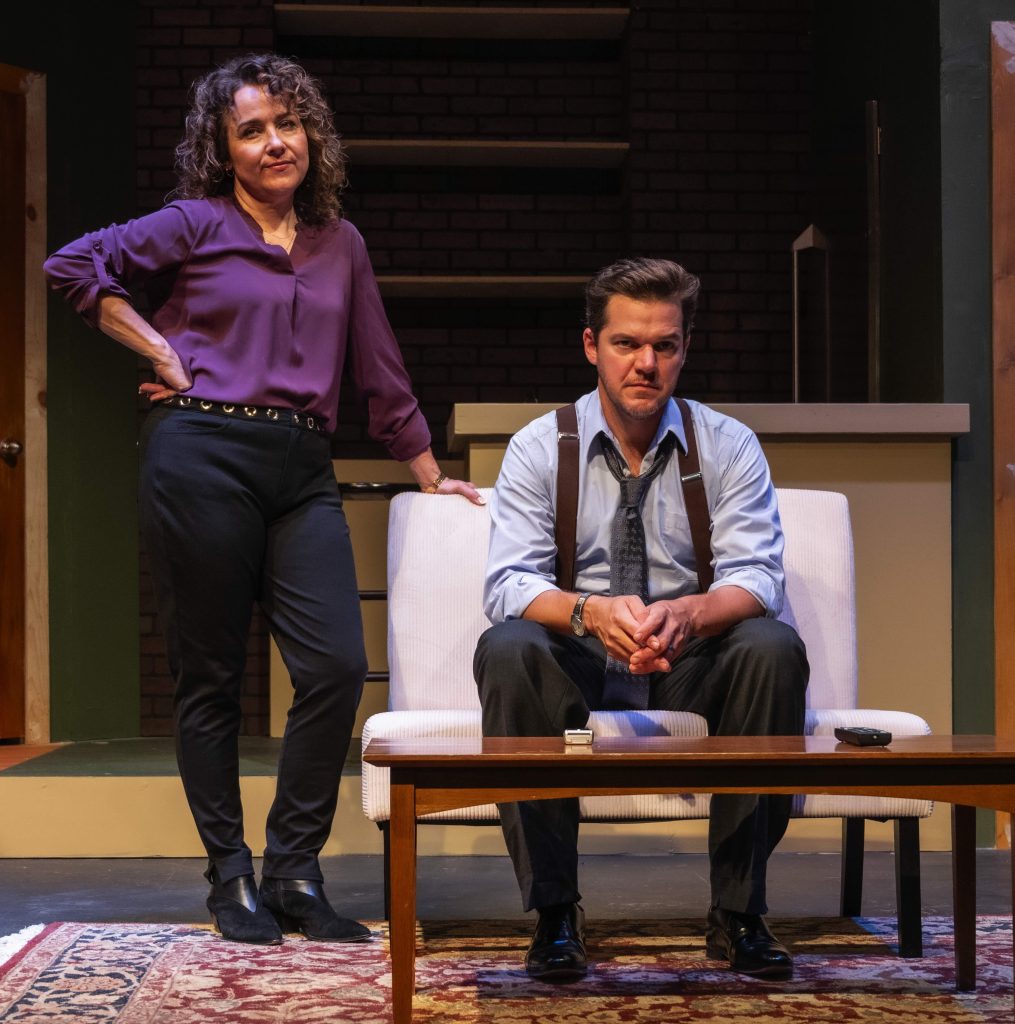
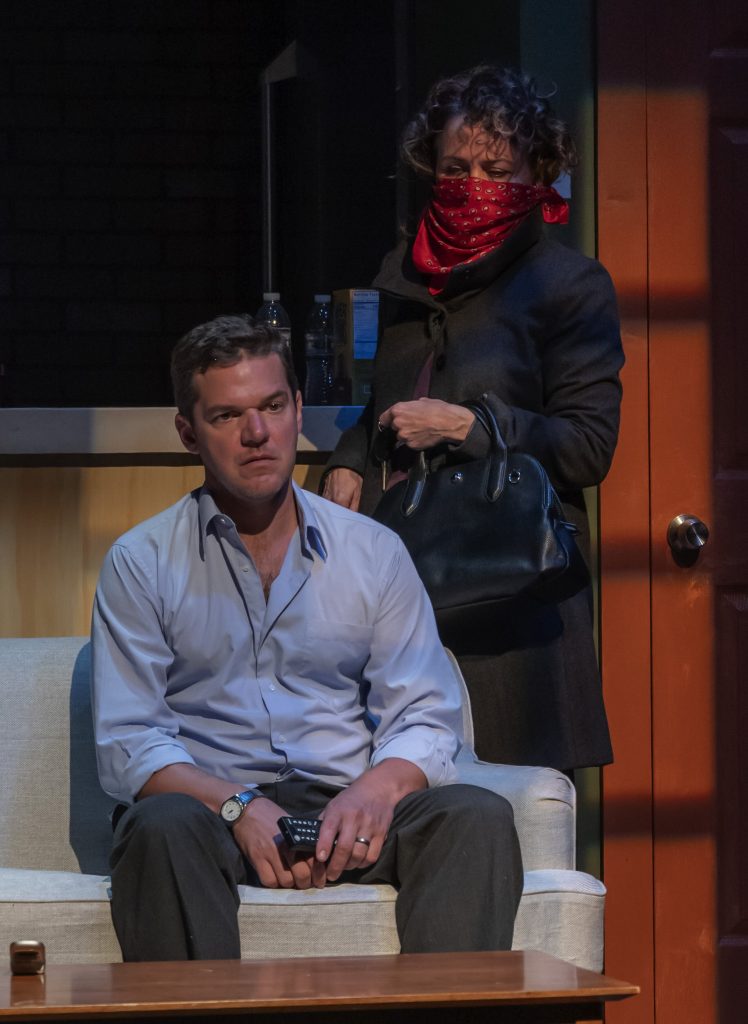
A virtuoso performance by Jacob Flekier elevates funny and fearless comic Alex Edelman’s remarkable gift for storytelling to engage, charm, amuse and frighten in equal measure in New Jewish Theatre’s timely “Just for Us.”
What prompted this show’s development was Edelman’s real response to an antisemitic tweet aimed at him in 2018. With utmost seriousness, he decided to take it farther and attended a meeting of White Nationalists in Queens.
Although it’s the play’s centerpiece, the undercover experience is not the only nugget. Edelman vividly discloses the surreal details of that encounter, adding much self-deprecating humor.
He also has a flair for weaving different stories together – sharing about his family, his Jewish upbringing, his modern Millennial humor and pop culture shorthand. Flekier delivers the hilarity with Swiss-watch timing.
Jacob Flekier as Alex Edelman in “Just for Us.” Photo by Jon Gitchoff.
Sure, the Queens gathering is intense because he sees people no longer hiding behind their keyboards, but instead in the flesh. It’s unsettling to see hate up close, and an impassioned Flekier makes us feel what Edelman is feeling every step of the journey – that discomfort, the potential danger, and yes – even the humor.
Director Alan Knoll, a veteran behind the scenes and in front of an audience, cleverly unfolds this thought-provoking exploration of antisemitism, faith and identity. How far can empathy extend?
The director and actor have struck comic gold, with Flekier confidently embracing Edelman’s quick wit and quirks. The precisely-constructed narrative isn’t merely telling jokes but revealing a young man’s journey in an energetic style. We know these people he meets..
Flekier is that rare talent whose body language and vocal inflections seamlessly bring various characters to life. Now based in New York, the Webster University graduate has never failed to impress on stages in St. Louis.
Jacob Flekier as Alex Edelman. Photo by Jon Gitchoff.
Knoll knows how to bring out the best in him. They are kindred spirits who collaborate well — first in “Brighton Beach Memoirs” in 2019, which won the St. Louis Theater Circle Award for Outstanding Production of a Comedy, and in the acclaimed “Broadway Bound,” which received six nominations and one win.
In both NJT shows, Flekier masterfully played the Eugene Jerome character, which is playwright Neil Simon’s semi-autobiographical alter ego and the central narrator across his famous trilogy.
Flekier also played the Neil Simon character, fledgling comedy writer Lucas Brickman, in “Laughter on the 23rd Floor” at both NJT, directed by Edward Coffield, and the Lyceum Theatre in Arrow Rock, Mo., directed by Knoll.
“Just for Us” is intimately staged in the Wool Studio to make it appear as a nightclub, and benefits from a resourceful set designed by Jayson Lawshee-Gress, who also expertly designed the warm lighting. Ethan Foss admirably navigated the sound.
Jacob Flekier. Jon Gitchoff photo.
You’ll never hear the phrase, “Can you believe it?” without thinking of this show. In 2021, Edelman turned his experience into a deeply personal one-man show, staged off-Broadway, then in both London and on Broadway, which was filmed for an HBO special.
He won a special Tony for the stage show and an Emmy Award for Outstanding Writing for a Variety Special. The cable TV special is currently streaming on HBO Max. Edelman, now 37, has been performing stand-up comedy since he was 15.
His relatable themes, repeated here, seem to strike a universal chord. Don’t we all want to fit in, in some way? We’ve also been in cringy spaces. The
Hearing Edelman’s captivating story is time well-spent, and seeing Flekier command the stage is 90 minutes of outstanding theater. An unexpected delight, “Just for Us” isn’t afraid to present different perspectives that broaden our world, make us squirm in our seats, and laugh in unison.
Jacob Flekier delivers Alex Edelman’s “Just for Us” at New Jewish. Photo by Jon Gitchoff.
New Jewish Theatre presents the St. Louis premiere of Alex Edelman’s “Just for Us” from Oct. 1 to 18 at the J’s Wool Studio Theatre (2 Millstone Campus Drive, St. Louis, MO 63146) October 1-18. Performances are Thursdays, Saturdays, and Sundays. Tickets are available by phone at 314.442.3283 or online at jccstl.com/njt.
Lynn (Zipfel) Venhaus has had a continuous byline in St. Louis metro region publications since 1978. She writes features and news for Belleville News-Democrat and contributes to St. Louis magazine and other publications.
She is a Rotten Tomatoes-approved film critic, currently reviews films for Webster-Kirkwood Times and KTRS Radio, covers entertainment for PopLifeSTL.com and co-hosts podcast PopLifeSTL.com…Presents.
She is a member of Critics Choice Association, where she serves on the women’s and marketing committees; Alliance of Women Film Journalists; and on the board of the St. Louis Film Critics Association. She is a founding and board member of the St. Louis Theater Circle.
She is retired from teaching journalism/media as an adjunct college instructor.
Beware the unreliable narrator(s). Not giving any spoilers away, but “Verity” is turgid trash, and toys with truth, trust and too many twists to be a satisfying psychological thriller.
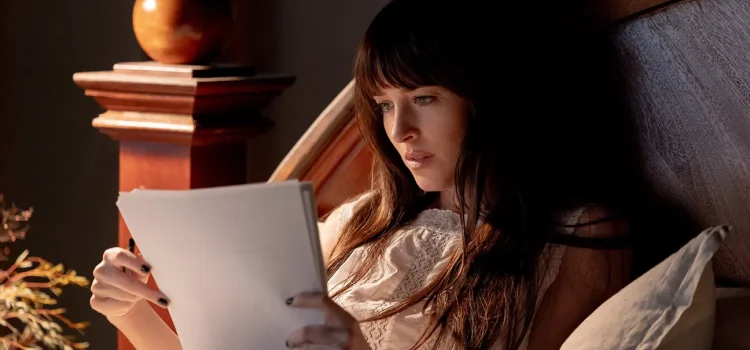
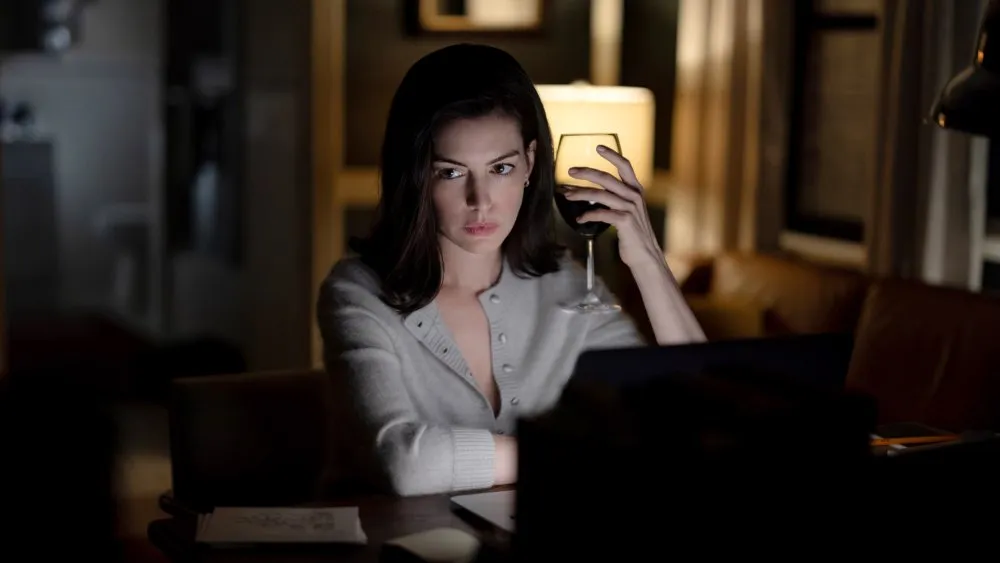
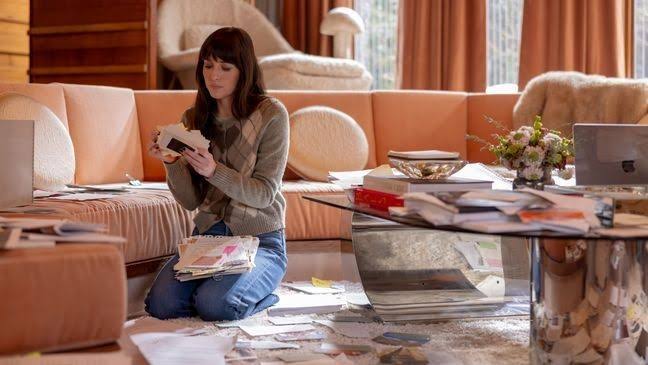
Lowen Ashleigh (Dakota Johnson), hired to ghostwrite for wildly successful thriller novelist Verity Crawford (Anne Hathaway), uncovers what appears to be Verity’s autobiographical notes. She wrestles with the confessions about Verity’s husband Jeremy (Josh Hartnett) and finds that separating fiction from reality is challenging.
Adapted by screenwriter Nick Antosca from simplistic novelist Colleen Hoover’s manipulative 2018 best-selling sensation, the movie has that same unconvincing plot formula with cliched characters and a left-field rushed conclusion. With a 1 hour, 58-minute run time, it is also slow and dull.
Most egregious is its hollow heroine Lowen, straining credibility because she is played by the blandest leading lady in Hollywood, Dakota Johnson (winner of not one, but two Golden Raspberry “Razzie” Awards for worst actress – “Madame Web” and “Fifty Shades of Grey”).
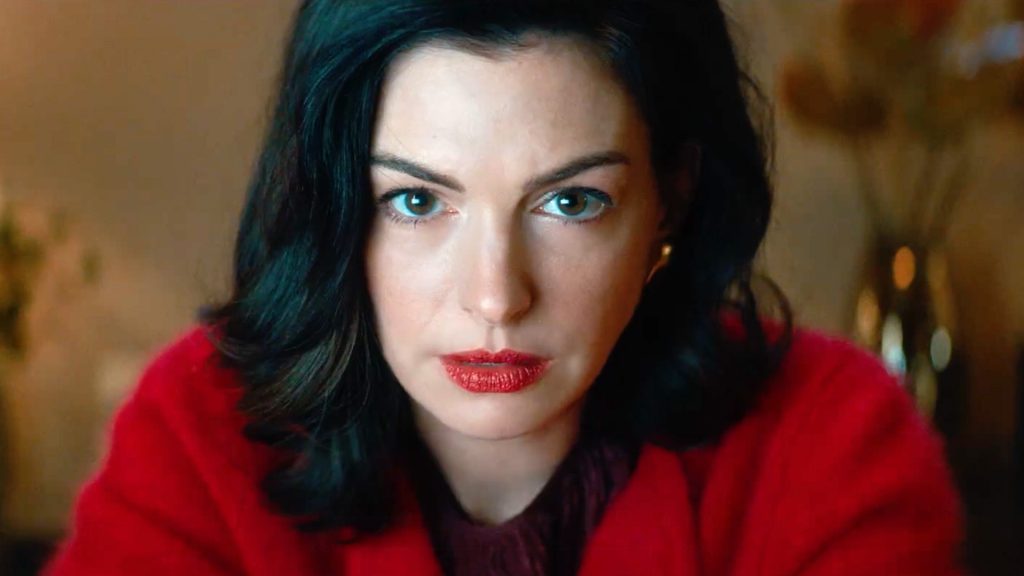
Anne Hathaway, in flashback, as successful thriller writer Verity Crawford.
A nepo baby – her parents are Don Johnson and Melanie Griffith, she has made some strong indies (“Peanut Butter Falcon” and “Cha Cha Real Smooth” succeeded because she could be lowkey in them). But her deadpan delivery is hard to warm up to, particularly in a supposedly sizzling affair.
Johnson’s monotone indifference is annoying because Lowen is a serious writer (sure, let’s believe this), who is good enough to be published but not read or known. She’s waiting in the wings, eager for her big break, and she has a backstory that’s never fully addressed.
When Lowen is conveniently at an intimate birthday dinner with her employer’s husband, she admits to having “resting bored face.” That’s not a stretch, but most of the dialogue is. And the logic throughout is absurd.
Thrown together, because we must have a forbidden love angle while the catatonic wife, in a wheelchair and bed-ridden, creates an overly emotional detour between Lowen and the handsome man of the house – you see that coming from the ‘meet-grisly-cute.’
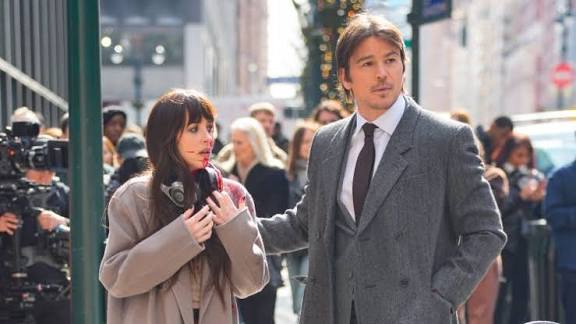
Dakota Johnson and Josh Hartnett as strangers who meet through tragedy.
Oh, how bizarre. But blood, especially tawdry and titillating, is a recurring motif. So are bite marks. No vampires, however, were harmed in the making of this howl at the moon. We keep hearing about Verity’s vile villains she concocts in her lurid fiction – but in reality, her real-life is more disturbing. Or is it?
Hoover and company, desperately emulating “Gone Girl” with a touch of wannabe Daphne du Maurier, focuses on dark and sinister through characters’ ridiculous whispering and superficial seductiveness.
Despite having Oscar winner Volker Bertelmann compose the score, the histrionic strings are so on-the-nose with ‘dun-dun-dun’ beats every time something is about to be revealed that it evokes laughter.
Unfortunately, this high-gloss schlock isn’t even a good way to have fun with pretty people being plastic, or a ‘hate-watch,’ with like-minded pals who enjoy snickering over faux raciness.
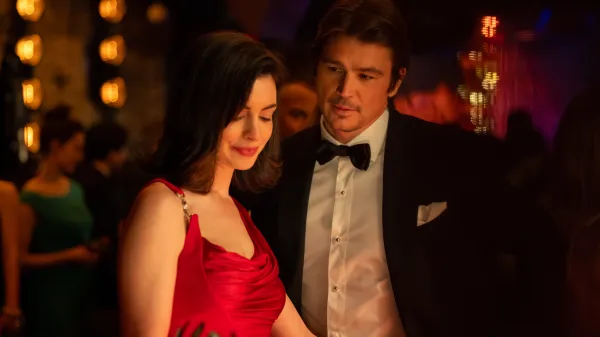
Verity and Jeremy meet.
Appearing grounded and unfailingly polite, Hartnett does what he can as family man Jeremy Crawford in a thoroughly thankless role. Now that he’s had a career resurgence, with “Trap,” “Oppenheimer,” and “The Bear,” it’s nice to see him play a hunky and caring dad, no matter how much he’s secretly hiding. Because aren’t all male characters in Hoover’s novels not what they appear to be? Dun-dun-dun!
After the disingenuous “It Ends with Us” in 2024, in which Hoover did survivors of domestic abuse no favors by triggering, without any warning, and trivializing toxic relationships, I was furious.
So, loath to try another one of her film adaptations, I changed my mind just to see if I was missing something. Oh no. My first impressions are correct about terrible writing.
Are studio’s this desperate for content? Apparently so, because she sells a ton of books and movie tickets. Her “Regretting You” and “Reminders of Him” were box office hits. Are these forgettable airport/beach reads?
Ghostwriter Lowen Ashleigh in Verity’s office.
Director Michael Showalter, who directed Anne Hathaway’s charming, breezy romantic comedy “The Idea of You,” Jessica Chastain to an Oscar in “The Eyes of Tammy Faye,” and the superb Oscar-nominated “The Big Sick,” is at the helm, so what happened?
Did he convince himself he could pull a Paul Feig and hit gold with “A Simple Favor” like success? Perhaps the twisted thriller genre isn’t a good fit, unlike his wildly popular comedies and ‘women’ pictures. Not only are the actions of all involved mostly ludicrous, but the shock values are insincere, especially the ending.
Nevertheless, Hathaway acquits herself by taking the campy route. Looking all glamorous in slinky red outfits and wearing fiery red lipstick, she ramps up the sex appeal as America’s most alluring novelist of popular pulp fiction. Oh look how fun she is on talk shows – and eating chicken wings on “The Hot Ones”!
She lowers her voice a husky register when she’s doing voice-overs of her unnerving autobiography that she left on a USB flash drive hidden in a cigarette box in her desk. Oh, Kathleen Turner in “Body Heat” has nothing on Hathaway here – or Barbara Stanwyck in “Double Indemnity.”
Incapacitated Verity (Anne Hathaway) outdoors in Vermont.
Fully committed as this mystery woman, Hathaway chews the scenery with menace in ‘before’ scenes while looking wan and lifeless, incapacitated by a car accident in ‘after’ scenes, to give a viable contrast. Remember her 15-minute Oscar-winning role as impoverished Fantine in “Les Miserables”?
She may be over-exposed this year in “The Odyssey,” “The End of Oak Street,” and “The Devil Wears Prada 2,” but she’s doing her best Miranda Priestly here in the sole portrayal that works (even if it’s not a shred realistic).
Now, she is bankable. So that’s the one saving grace in the “Verity” sad misfire that has too many unresolved issues and too little to recommend.
“Verity” is a 2026 psychological thriller directed by Michael Showalter and starring Dakota Johnson, Anne Hathaway, and Josh Hartnett. It is Rated R for sexual content, some nudity, language, violence and bloody images, and the run time is 1 hour, 58-minutes. It opens in theatres Oct. 2. Lynn’s Grade: D.
Lynn (Zipfel) Venhaus has had a continuous byline in St. Louis metro region publications since 1978. She writes features and news for Belleville News-Democrat and contributes to St. Louis magazine and other publications.
She is a Rotten Tomatoes-approved film critic, currently reviews films for Webster-Kirkwood Times and KTRS Radio, covers entertainment for PopLifeSTL.com and co-hosts podcast PopLifeSTL.com…Presents.
She is a member of Critics Choice Association, where she serves on the women’s and marketing committees; Alliance of Women Film Journalists; and on the board of the St. Louis Film Critics Association. She is a founding and board member of the St. Louis Theater Circle.
She is retired from teaching journalism/media as an adjunct college instructor.
A heart-tugging unbreakable bond between a man and his best friend, a German Shepherd, gives “Heart of the Beast” its sincere emotional center while the pair struggles to survive brutal conditions.
The well-crafted action-adventure’s intensity never lets up, nor do the tender feelings – be prepared with tissues. Odin (real name Uber) steals the movie as James’ loyal combat-trained buddy.
In real life, Uber is a search and rescue dog discovered in New Zealand by trainer Andrew Simpson. He’s one camera-ready canine that will swiftly melt your heart.
In Cameron Alexander’s original screenplay, both have been traumatized by war, and now retired, spend time enjoying a simple life. Their trust, their desire to keep each other safe, and their affection for each other are extraordinary, and always can be seen and felt.
Military buddies James and Odin.
In a strong, silent soldier role, Brad Pitt’s character, Special Forces officer James Belmont, is an expert in military preparation, survival training, and working closely with a dog. He must find a way out as the plane crash has left them stranded in the Alaskan wilderness.
With only minimal supplies and physically damaged, they endure non-stop hardships. The natural elements and the dangers of lurking animals create obstacles.
Both man and dog are up for depicting the challenges. Calm and cool Pitt is adept at physically demanding roles, as he demonstrated in his top-grossing 2025 film ‘F1 The Movie” as Formula 1 driver Sonny Hayes, and in his 2019 Oscar-winning performance as stuntman Cliff Booth in “Once Upon a Time in Hollywood” (which he’ll reprise in David Fincher’s sequel this holiday season).
Director David Ayer, who worked with Pitt before on the gritty World War II film “Fury,” emphasizes the psychological and the physical toll of their predicament, and the distinct chemistry between actor and animal that propels the nearly silent storytelling.
Finding their way stranded in Alaska.
J.K. Simmons has a brief scene as a kindly, wise explorer-adventurer who wanders into Pitt’s campground, and he’s the only human in their territory until much later. Anna Lambe plays a local woman.
Cinematographer Mauro Fiore, who won an Oscar for “Avatar,” does impeccable work here, capturing both the beauty of nature and the fight against it in sweeping panoramic views. So does editor Dody Dorn, effective at portraying both the isolation and the grandeur of the rugged terrain.
Composer Jared Michael Fry’s earthy, ethereal music score complements the beautifully shot film. He has worked with Fry on several Jason Statham films “The Beekeeper” and “A Working Man,” and paints an interesting portrait through soundscapes. He meshes indigenous roots music with cinematic sounds – using Inuit group Pamyua and choral ensemble London Voices.
A grounded story about companionship and healing that keeps moving for 101 minutes, “Heart of the Beast” delivers a dramatic punch without being maudlin. This is a film you can’t put on cruise control – one must invest, and then, the vast scale has suddenly become an intimate, heartfelt piece.
“Heart of the Beast” is a 2026 action-adventure thriller directed by David Ayer starring Brad Pitt, J.K. Simmons, Anna Lambe and Uber the German Shepherd. It is rated: PG-13 for violence, peril, bloody/injury images and some language and runs 1 hour, 41 minutes. It opens in theatres Sept. 25. Lynn’s Grade: B+
Lynn (Zipfel) Venhaus has had a continuous byline in St. Louis metro region publications since 1978. She writes features and news for Belleville News-Democrat and contributes to St. Louis magazine and other publications.
She is a Rotten Tomatoes-approved film critic, currently reviews films for Webster-Kirkwood Times and KTRS Radio, covers entertainment for PopLifeSTL.com and co-hosts podcast PopLifeSTL.com…Presents.
She is a member of Critics Choice Association, where she serves on the women’s and marketing committees; Alliance of Women Film Journalists; and on the board of the St. Louis Film Critics Association. She is a founding and board member of the St. Louis Theater Circle.
She is retired from teaching journalism/media as an adjunct college instructor.
With its complex characters, fractured family dynamic and multi-layered storyline, Branden Jacobs-Jenkins’ explosive drama “Appropriate” has much to unpack.
At their peak, a powerhouse local cast takes us on an unsettling, unforgettable journey, for their characters aren’t prepared for all the emotional baggage that will spill out. Well-cast and well-rehearsed, this production showcases intense immediate realism.
Dark secrets will be revealed, forever shaking the family. Think of it like a bandage being ripped off an open wound – repeatedly. The atmosphere is combustible – a marvel of sight, sound, imagery and tension under Benny Sato Ambush’s direction.
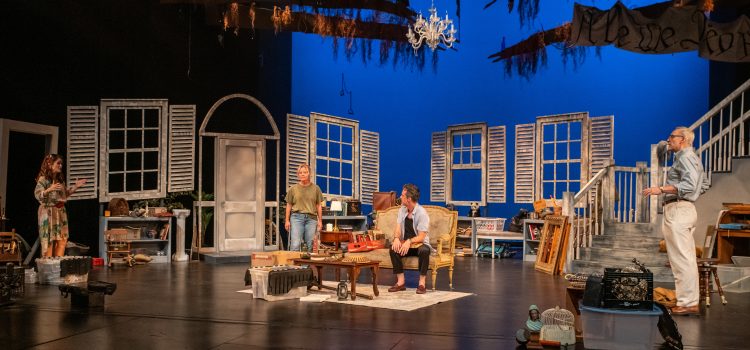
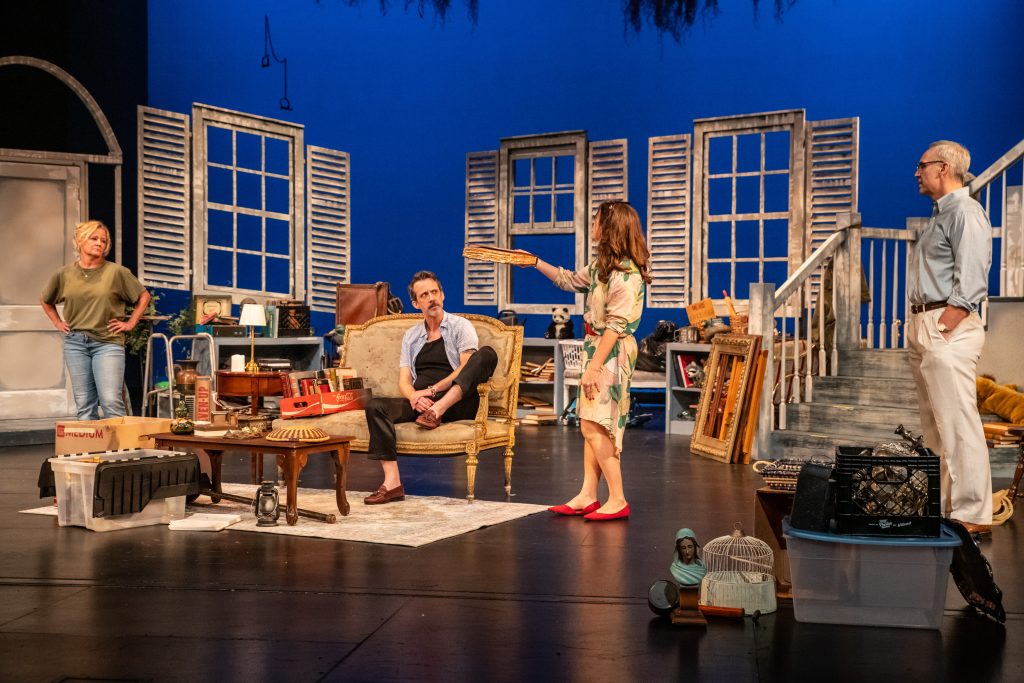
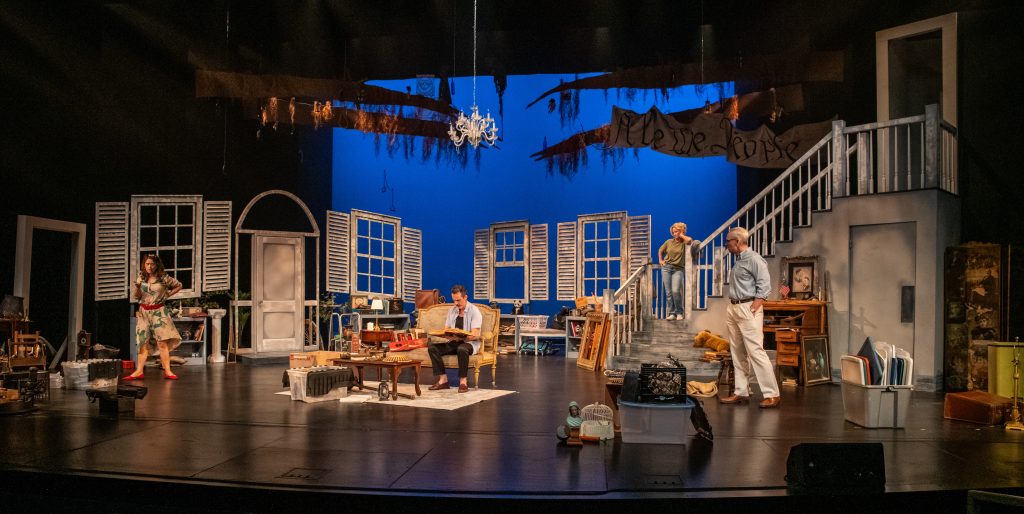
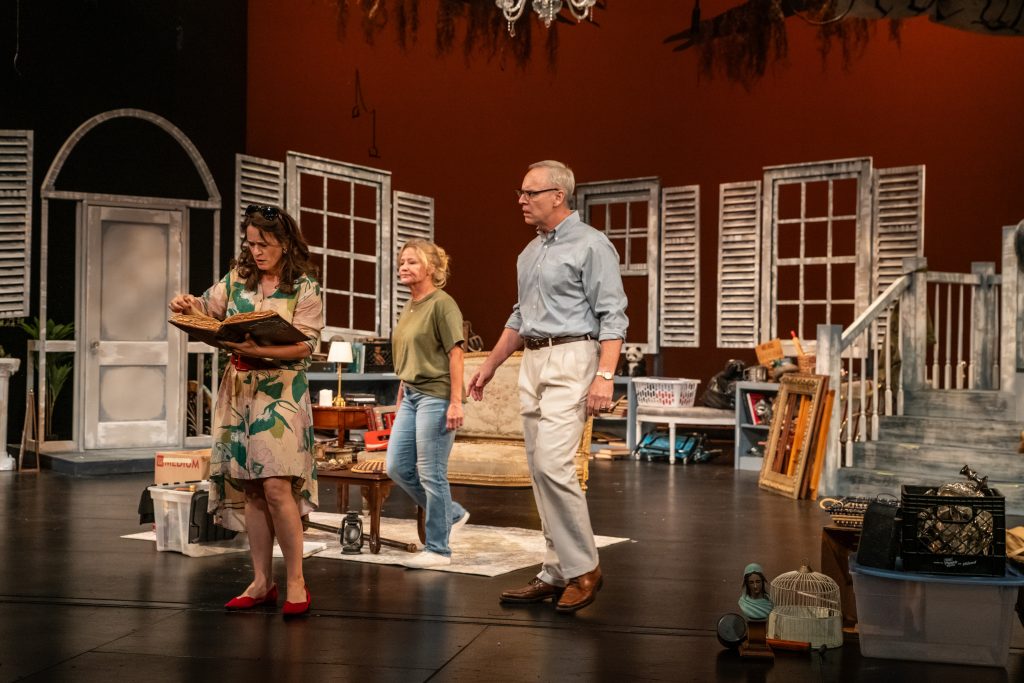
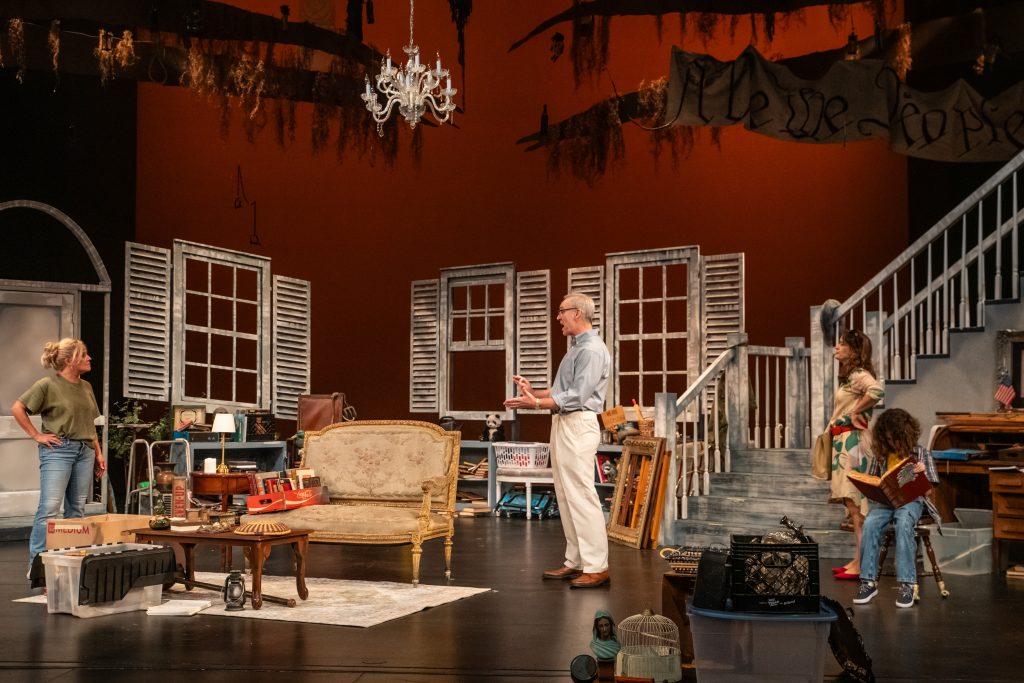
The cicadas are loudly buzzing on a hot, muggy summer night in rural southeast Arkansas when three Lafayette siblings converge to settle their late father’s estate. The clutter in the decaying plantation home is as profound as the anxiety as they prepare for an estate sale.
This is not a warm family reunion – interactions are awkward, bitter and contentious. This play, first performed in 2013 and then off-Broadway a year later, was revived in 2023 to much acclaim. Its power is intact, reminding us of systemic racism and unconscious bias when it’s hard to confront as legacy.
The Lafayette siblings – Jilanne Marie Barnes, Joel Moses, and Michael James Reed, with Lizi Watt holding photo album.
Wayward son Francois “Frank” (Joel Moses), who now calls himself “Franz,” is seeking redemption after years of addiction and bad behavior. He drove there from Portland with his eccentric young fiancé, River (Maggie Newstead-Adams).
Stressed-out eldest sister Antoinette “Toni” (Jilanne Marie Barnes) considers him toxic and won’t extend an olive branch. Brother Beauregard “Bo” (Michael James Reed), an attorney like their father, is expecting to take charge like he always does, but Toni is the executor. They all bicker incessantly.
Bo’s wife, Rachael (Lizi Watt), and their two precocious children, Cassidy (Ainsley Hammond) and Ainsley (Aviv Giancola-Poremba), came from New York City, thinking of this as an educational trip. Toni’s troubled son Rhys (Braden Phillips) is present. These are flawed relatives with enough intergenerational trauma for an eight-episode limited series.
“Appropriate,” with all the intentional meanings of that word, will delve into race, identity, and historical legacy. As the patriarch’s despicable past is discovered, the evidence can’t be ignored or denied. How family members deal with a photo album of graphic lynchings and other disgusting emblems of a vicious white supremist adds to the uncomfortable territory.
The playwright, who has won two Tony Awards, a Pulitzer Prize for Drama, and an Obie Award, has a natural command of how people interact and converse. His dense dialogue combines caustic wit with raw pain and sharp contemporary insight – and yes, phrases will shock.
Not a fun family reunion.
Joel Moses’ Franz is this deeply vulnerable bundle of insecurities, trying to show the better person he has become, but his siblings can’t let go of their hurtful memories about his decadent past and their resentful feelings. Unlocking a pitiable black sheep as only he can, Frank is another masterful performance by one of St. Louis’ finest actors.
Joining him in top-tier reliability is Michael James Reed, who is, without fail, always at the top of his game. He provides interesting layers to the complicated Bo, Ivy League-educated and successful.
At first, it feels like Bo checked out of caring about his family a long time ago. His main concern is the corporate ladder, and he appears to be the family “fixer.” Money-centered, he’d monetize the dad’s hateful artifacts in a heartbeat. But he’d love to distance himself from this tarnished past; he just wants to recoup all the funds he spent caring for dear old dad and get back to Manhattan.
Jilanne Barnes’ Toni is tired. Exhausted by life, her short straw, and trying to fix broken things that can’t be repaired, she is unpleasant for 95% of her stage time. That is heavy for an actress, and Barnes’ meets the challenge. Toni sacrificed and deeply cared for her father. She refuses to sully his memory.
Shrill and spiteful, she has alienated most everyone there, especially Bo’s Jewish wife Rachael. First impressions on the sister-in-law are that she’s a typical affluent status-conscious mother, trying to control the outside world’s influence on her children.
Estate sale preparation not going smoothly.
Lizi Watt displays Rachael’s buttons that Toni keeps pushing, with antisemitic name-calling, and it gets ugly — “August: Osage County” nasty. Fight choreographer Shaun Sheley’s work is noteworthy.
Most surprising is Maggie Newstead-Adams’ nuanced portrait of River. She presents herself as New Age and is derided for her ‘hippy-dippy’ qualities. Assuming she’s a stereotype, she proves herself to be wise beyond her 23 years and compassionate. Newstead-Adams’ poise among all the other acclaimed talent is impressive.
Spiritually, she is most attuned to the ghosts haunting this old plantation. Mary Robinson’s impeccable sound design announces the spirits’ eerie presence, as the family talks about the two graveyards on the property – one white, one with black slaves (without headstones).
When the third generation finds disturbing relics of their bigoted grandfather, the sins of the past erupt. As the program points out: “Walls remember what a family chooses to forget.”
By society’s standards, Daddy — Ray Lafayette — was a highly successful, highly educated man. He lived in Washington D.C. for a time, during a lauded legal career, and chose to return to the ancestral homestead, with thoughts of turning it into a bed-and-breakfast.
What secrets does Daddy have in that photo album?
Toni and Frank both refer to his mental deterioration, but the moral decay is something the family is loathe to address. But they start to peel back time, remembering behaviors. An all-white cast, dealing with the reality of historical racism, examines how the past haunts the present, and the bigger picture that it represents.
The outstanding artisans connected with this complicated production have crafted a stunning, crumbling Southern Gothic setting. The ambience is immediate, and so are the bad vibes. Matthew McCarthy’s richly appointed set design, complimented by Mikhail Lynn’s meticulous prop design, plunges us into this dilapidated structure, with the family’s despair emanating from every junk-filled corner.
McCarthy also designed effective lighting, and Ethan Dudenhoeffer was a wizard as technical director. Abby Pastorello’s costume design captured every character’s personality with terrific verve.
To reduce commentary about “Appropriate” can point out the obvious — a dysfunctional family in deep denial, which could stamp Tennessee Williams’ “The Glass Menagerie” and other landmark plays in the same way. That is why it’s not hard to see this connection that the Tennessee Williams St. Louis Festival chose to pivot with — “The Tennessee Effect” as this 11th year’s theme. It’s, well, appropriate.
Big brother will man-splain.
The takeaways are plentiful. We can only try to do better when we know better. If we aren’t willing to have discussions, where does society go?
In “Appropriate,” there is no tidy ending, no way to wrap up with a soothing bromide or suppress this legacy. The two-act dark drama is raw, unflinching, and damning of white fragility.
Some inheritance. They should be hot and bothered. And so should we.
The Tennessee Williams Festival presents the St. Louis premiere of “Appropriate” Sept. 17-27. Performances take place at the Berges Theatre at COCA in University City. For more information: twstl.org
Lynn (Zipfel) Venhaus has had a continuous byline in St. Louis metro region publications since 1978. She writes features and news for Belleville News-Democrat and contributes to St. Louis magazine and other publications.
She is a Rotten Tomatoes-approved film critic, currently reviews films for Webster-Kirkwood Times and KTRS Radio, covers entertainment for PopLifeSTL.com and co-hosts podcast PopLifeSTL.com…Presents.
She is a member of Critics Choice Association, where she serves on the women’s and marketing committees; Alliance of Women Film Journalists; and on the board of the St. Louis Film Critics Association. She is a founding and board member of the St. Louis Theater Circle.
She is retired from teaching journalism/media as an adjunct college instructor.
A story of uncommon courage and grace while facing deeply rooted cruelty and oppression, “The Color Purple” is a momentous achievement for the Black Rep.
Through Celie’s harrowing emotional journey, a stunning Angela Wildflower leads a passionate ensemble who gives it all through the musical’s sorrows, love, pain and ultimately, triumph.
In a tour de force performance, Wildflower is the heart and soul of this deeply felt production, directed with considerable flair and impact by Daniel Bryant.
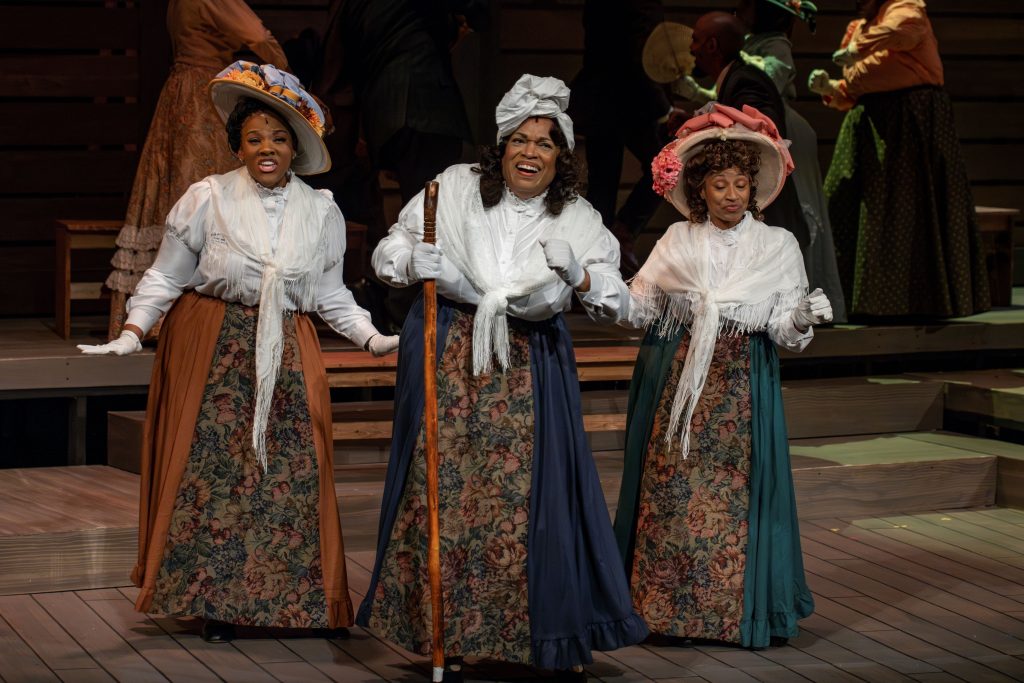
In the St. Louis Black Repertory Theatre’s premier that opened its landmark 50th season, the affection for the storytelling was palpable between the audience and the artists. The spirited cast’s voices soared, starting with powerhouse Anita Jackson and the other two ebullient Church Ladies Amber Rose and Olivia Neal with the opening.
The vibrant, roots-infused score includes gospel, jazz, ragtime, blues, and African beats, with songs by Brenda Russell, Allee Willis, and Stephen Bray that bring out the purpose and yearnings.
The Church Ladies Amber Rose, Anita Jackson, Olivia Neale. Photo by Arieona Phillips
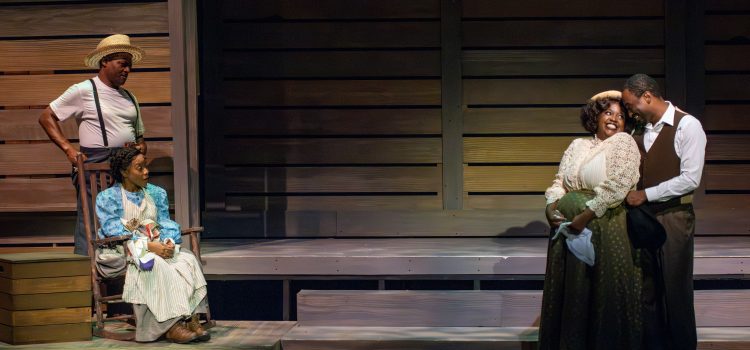
In 1909, Celie, 14, is a humble, hard-working poor black girl living in rural Georgia, who has delivered two babies whose father is her father, and Pa (J. Samuel Davis) has taken them away.
Several years later, he makes a deal to give Celie to Albert “Mister” Johnson (sturdy Kelvin Roston Jr.), an emotionally and physically abusive widower and farmer, to care for his unruly children and serve him.
By her sacrifice, she spared her sister, Nettie (a tender Morgan Taylor), so that she could follow her dream of being a teacher. Unbeknownst to Celie, for many years, the compassionate Nettie winds up with a missionary family in Africa. When Morgan and Angela sing together, it’s magical, especially “Our Prayer.”
Celie has gone from one house of horror to another. But her faith sees her through, as do the people who raise her up. That community will return her kindness.
Push Da Button. Photo by Arieona Phillips
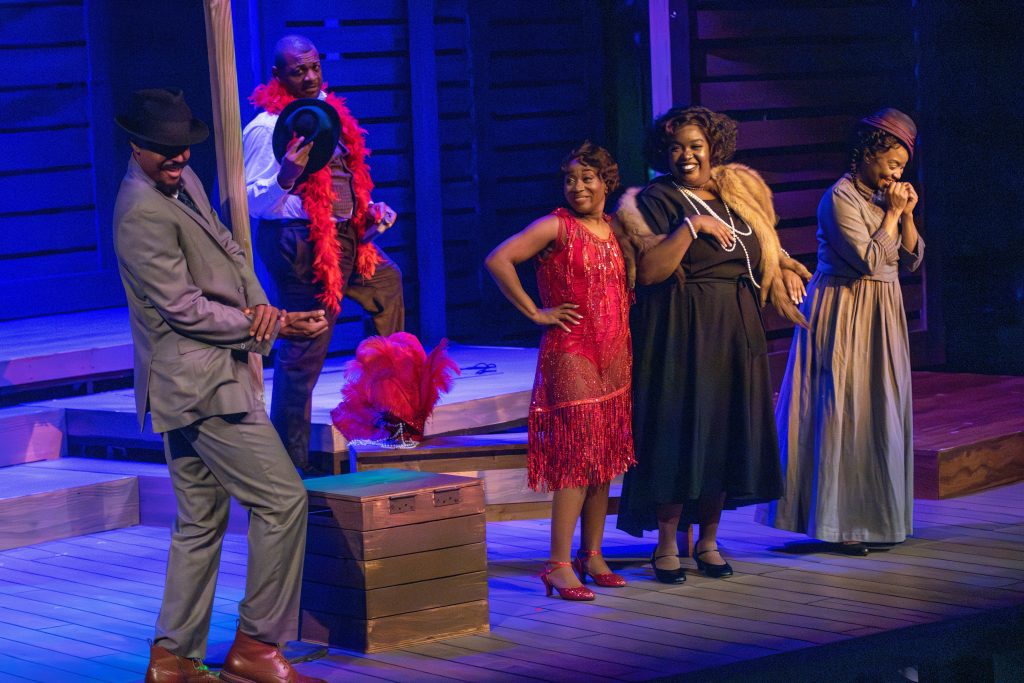
While taking care of Mister’s home, the nurturing Celie meets the glamorous and worldly nightclub chanteuse Shug Avery (dynamic Alexis J. Roston). They share romance and a deep bond.
Wearing a snazzy red outfit, Roston sashays with confidence in “Push Da Button” and she shines in “Too Beautiful for Words” and “What About Love?”
One of Mister’s grown children, Harpo (versatile Brian McKinley), marries Sofia (powerhouse Adrienne Spann). Spann, impressive in her Black Rep debut, is strong as the feisty free spirit, known for her independence and speaking her mind. She stands out with her phrase (and song) “Hell, no!”
Tyler White is comical as the irrepressible Squeak and Olajuwon Davis, Dajuan Davis and Samantha Madison are well-rounded, adaptable ensemble members.
Marsha Norman wrote this musical adaptation of Alice Walker’s Pulitzer Prize-winning touchstone novel, a National Book Award winner in 1982. It debuted on Broadway in 2005 and then was revived in 2015.
Photo by Arieona Phillips
In the two film adaptations, first in 1985 by Steven Spielberg, which garnered 11 Academy Award nominations, and then a 2023 musical version, they brought out the dignity and virtues of a trauma survivor.
Wildflower brought down the house with “I’m Here” – which was interrupted three times by applause, a goosebump moment.
With this stellar cast, the finale, reprising “The Color Purple,” is heartfelt and affecting, reminding us of the mighty power of love, healing and resilience.
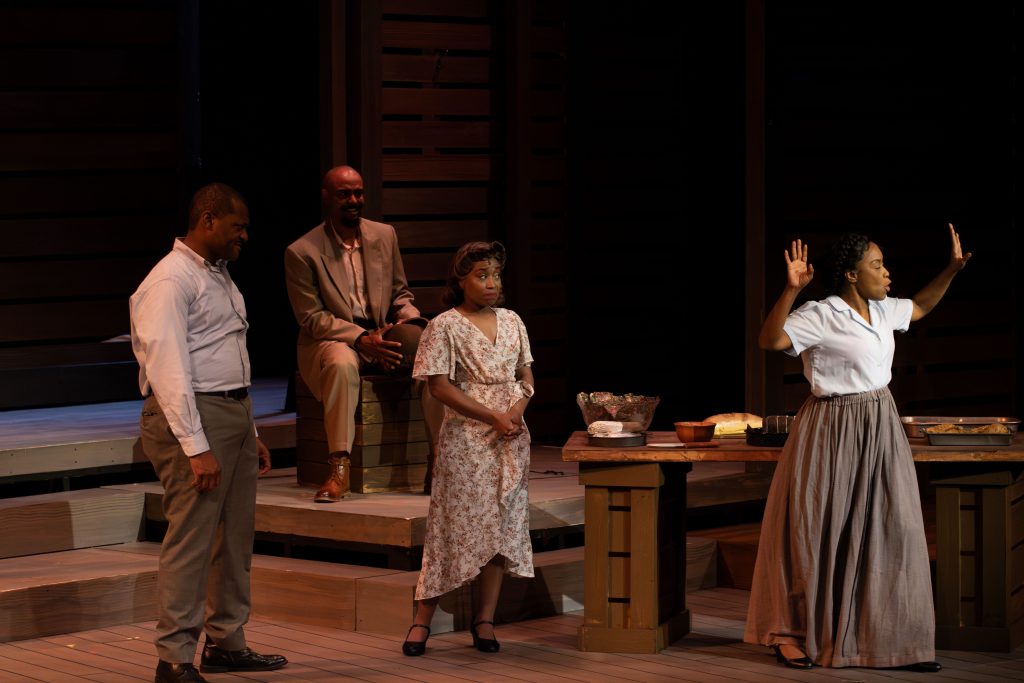
The staging is simple and Heather Beal’s choreography is supple, well-suited for this nimble ensemble. They have fun with the juke joint dance – and ‘Uh Oh.” Special mention to fight choreographer Paul Steger. The energetic African dance number is an ideal way to open the second act.
Photo by Arieona Phillips
Using cultural soundscapes beautifully, Music Director Jermaine Manor fluidly leads an eight-piece orchestra, with Zach Neumann on keyboards, Stan Coleman and Alex Macke on reeds, Dennis Brock on guitar, Willem von Hombracht on bass, Des Jones on drums, Gerald “Babtunde” Williams on percussion, and Manor on keyboards, too.
Resourceful scenic designer Tim Jones’ flexible scenic design uses an ancestral tree as a backdrop focal point, with nods to 20 Century South and Africa, and lighting designer Michael Sullivan created atmospheric notes, as did Justin Schmitz’ sound design. Mikhail Lynn did his customary excellent work on props.
With a story spanning 40 years, costume designer Jarrod Barnes’s stylish vintage wear reflects the periods and the economic level of the characters, with Sunday best church clothes and fancier juke joint attire. Nettie’s gorgeous white Victorian dress rivals Shug’s dazzling pieces, and all the trousers are fun for “In Miss Celie’s Pants.”
African Dance. Photo by Arieona Phillips
Of note, purple symbolizes strength, transformation, power, wisdom, bravery — and all meanings can be applied here.
What is most personal is also the most universal, and it shows in The Black Rep’s expertly produced, very moving musical.
The Black Rep presents “The Color Purple” Sept. 9 – 27 at The Edison Theatre at Washington University in St. Louis. For tickets, visit The Black Rep’s website, www.theblackrep.org.
Lynn (Zipfel) Venhaus has had a continuous byline in St. Louis metro region publications since 1978. She writes features and news for Belleville News-Democrat and contributes to St. Louis magazine and other publications.
She is a Rotten Tomatoes-approved film critic, currently reviews films for Webster-Kirkwood Times and KTRS Radio, covers entertainment for PopLifeSTL.com and co-hosts podcast PopLifeSTL.com…Presents.
She is a member of Critics Choice Association, where she serves on the women’s and marketing committees; Alliance of Women Film Journalists; and on the board of the St. Louis Film Critics Association. She is a founding and board member of the St. Louis Theater Circle.
She is retired from teaching journalism/media as an adjunct college instructor.
Messy and unflinching, “The Mercy Seat” is a complicated relationship play between two New Yorkers in the immediate aftermath of Sept. 11, 2001. At the time of a monumental national tragedy, lovers Ben Harcourt and Abby Prescott are preoccupied with their own lives, not the missing and dead as those numbers climb.
In the Neil LaBute two-hander, first staged in 2002, the thorny dynamic between these two is difficult because the characters are morally bankrupt. And the uncomfortable setting is often claustrophobic, as intended.
After the 25th anniversary commemorating the lives lost that day on Friday, anyone seeking reflection or comfort may be shocked by this unexpected selfish take, for this doesn’t reflect mourning or any insight into universal 9-11 grief, or commentary on national unity.
But those familiar with LaBute’s signature edgy plays won’t be surprised by this brutal battle of the sexes as they sort out or attempt to make sense of being together. Because of the unprecedented attack on the nearby World Trade Center the day before, right at their doorstep, the world has changed overnight.
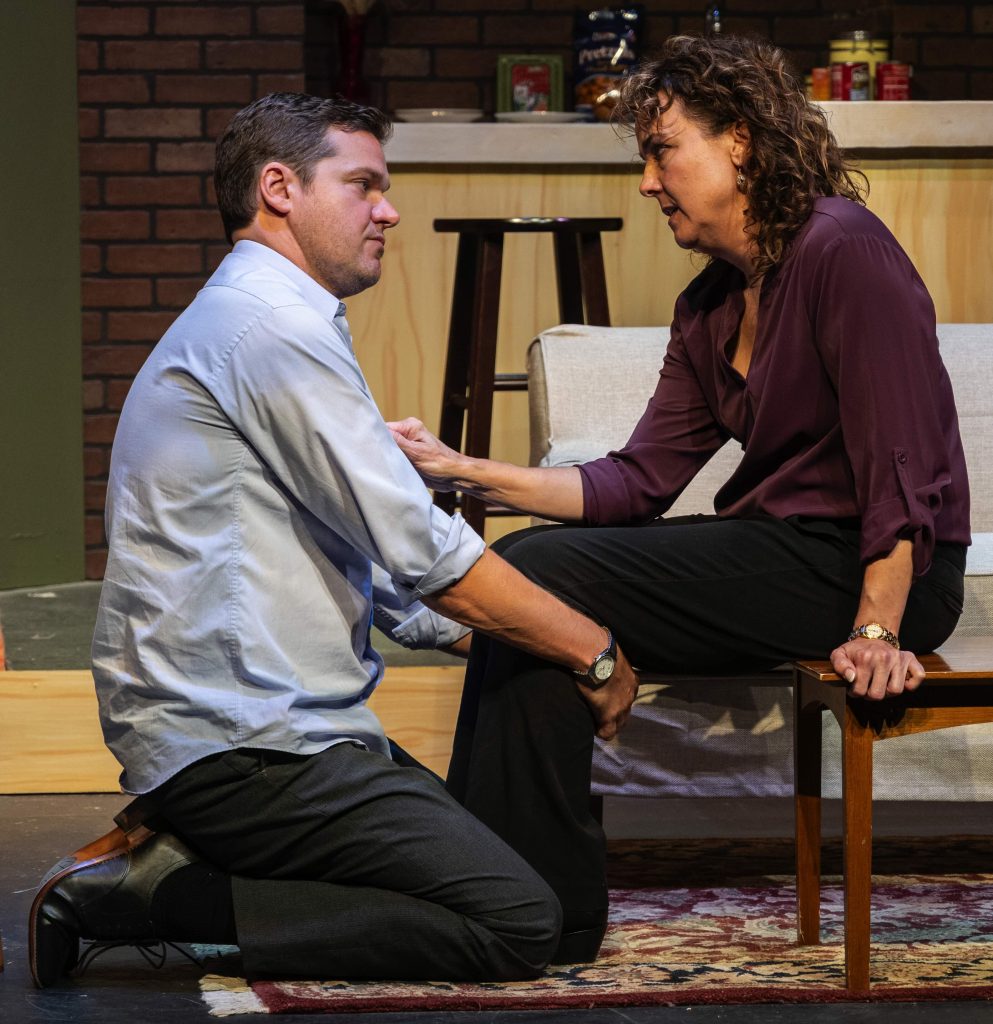
Franklin Killian as Ben and Kelly Schnider as Abby. Photo by Patrick Huber.
This pair, once in a thorny situation, may have more options available because of everyone’s disrupted lives. But how opportunistic are these thoughts and ideas? And how awful are they to even think of a convenient solution?
Franklin Killian and Kelly Schnider, making their St. Louis Actors’ Studio debut, are remarkably adept at the playwright’s rapid-fire dialogue, which creates a certain kind of rhythm that is emphasized in John Pierson’s direction.
Pierson’s nimble staging makes the most of the Gaslight Theatre’s intimate black-box space. The conversation is a power struggle that features frank sex talk and explicit language. Ben is cynical, Abby is bitter– and vice versa.
She is his superior, and older. He is married with children. In the Old Testament, “The Mercy Seat” carries the idea of the removal of sin. But they’re not getting off easy here.
The rawness of the bruised feelings, the surprise – and anguish – of what the other is thinking, and saying out loud, is apparent in the emotional interactions. Nothing is important and everything matters; such is the way LaBute creates the ebb and flow between two strong personalities flailing about on a day after the nation went numb.
Abby and Ben bicker in “The Mercy Seat,” featuring Kelly Schnider and Franklin Killian. Photo by Patrick Huber.
In momentary panic, each blurts out thoughtless remarks at each other, capitalizing on what they view as character flaws. What is it that they ever liked about each other – is it only sexual desire? And how self-absorbed is that? Are they both manipulating each other?
In the new upside-down interrupted world, is it worth maintaining their affair, breaking off or making a deeper commitment? Endgame questions that seek immediate answers. The wordplay is intense, and even in a twisty finish, prioritizes themselves.
Set and lighting designer Patrick Huber has created an efficient apartment setting without any windows on the world – but there is a door where a neighbor in need knocks. As the couple navigates between the kitchen and living room, the walls appear to close in on them.
Pierson also designed the sound, and the outside world intrudes through sounds of sirens and an occasionally ringing cellphone that Ben never picks up. Abby has ventured out to a store, which is no longer a simple task. Casual costumes provided by Teresa Doggett.
Kline and Killian fearlessly operate at a high level of verbal volleying, shifting tones throughout with this discomforting dialogue. LaBute intends to make us squirm – he maintains that clever, cavalier approach, and you’re either appalled or questioning your own impulses.
A couple at crossroads in “The Mercy Seat.” Photo by Patrick Huber.
The characters aren’t sympathetic, and those involved in the production are fully aware of the ugliness of human nature and how emotionally draining this work is. But LaBute has made a career of subverting people’s expectations (“The Shape of Things,” “Fat Pig,” “Reasons to be Pretty”).
“The Mercy Seat” premiered Off-Broadway at the Acorn Theatre in an MCC Theater production on Dec. 18, 2002, and closed on Jan. 15, 2003. Directed by LaBute, it starred Liev Schreiber and Sigourney Weaver
Because of his longstanding relationship with St. Louis Actors’ Studio since the creation of the LaBute New Theater Festival in 2013, which features curated short plays, he premieres a one-act every summer.
STLAS has also performed his full-length shows, including “Comfort” in 2022 and “The Way We Get By” in 2017, and his short plays have had lasting impact: “The Possible,” “Here We Go ‘Round the Mulberry Bush,” “Kandahar,” “Hate Crime,” “The Fourth Reich,” “Great Negro Works of Art,” “Unlikely Japan,” “Who’s on First,” and “Brunch” among them.
At 95-minutes without intermission, this unsettling confrontation in a lower Manhattan apartment is an often-fascinating narrative that at times is repetitive, and the sheer verbosity can be tedious.
One can’t shake the feeling that outside, on the ash-covered streets, traumatized New Yorkers are looking for the missing and answers. But inside, this self-centered couple bypasses universal selflessness and collective grief by thinking only of soothing their disillusioned selves.
St. Louis Actors’ Studio presents “The Mercy Seat” by Neil LaBute, Sept. 11-27 at The Gaslight Theater. Performances are on Thursday (second and third week), Friday and Saturday evenings at 8 p.m. and on Sundays at 3 p.m. For more information or to purchase general admission tickets, visit stlas.org or email [email protected].
Lynn (Zipfel) Venhaus has had a continuous byline in St. Louis metro region publications since 1978. She writes features and news for Belleville News-Democrat and contributes to St. Louis magazine and other publications.
She is a Rotten Tomatoes-approved film critic, currently reviews films for Webster-Kirkwood Times and KTRS Radio, covers entertainment for PopLifeSTL.com and co-hosts podcast PopLifeSTL.com…Presents.
She is a member of Critics Choice Association, where she serves on the women’s and marketing committees; Alliance of Women Film Journalists; and on the board of the St. Louis Film Critics Association. She is a founding and board member of the St. Louis Theater Circle.
She is retired from teaching journalism/media as an adjunct college instructor.
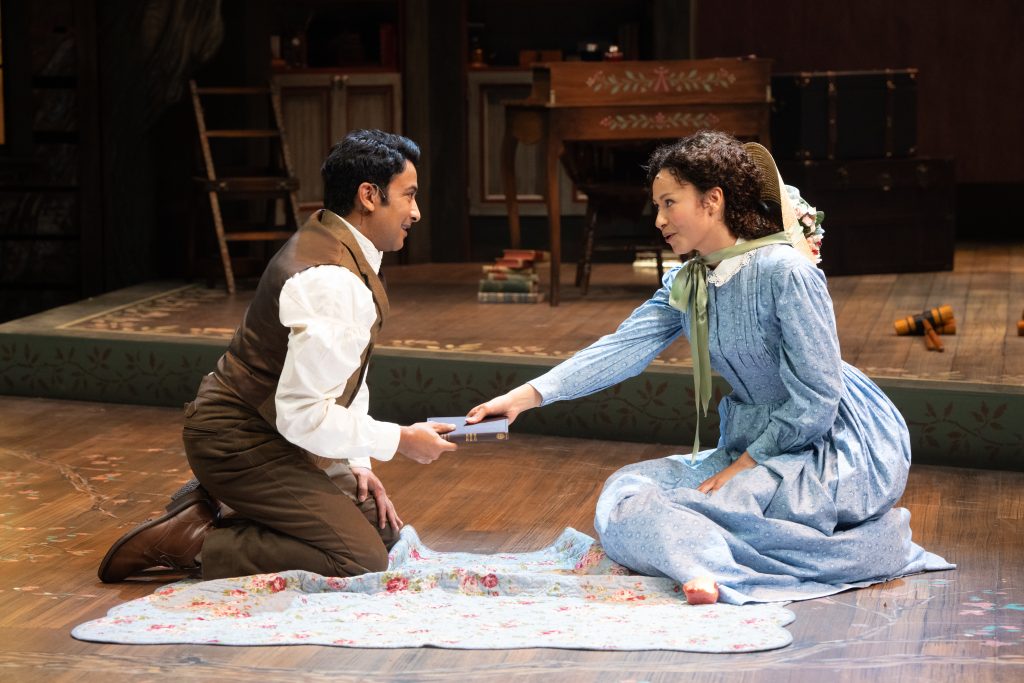
In the warm glow of the cozy March parlor, a singular author wins us over with her exuberant family portrait while a modern playwright interprets the timeless work “Little Women” by sharing these relatable lives less ordinary.
Together, this exceptional ensemble of women depicts how love makes the poorest soul thrive, how dreams fuel ambitions, how comforting sisterhood is, and that gumption matters at any age and era.
Louisa May Alcott coaxed generations of women to dream. No doubt playwright Lauren Gunderson was one of them. How their worlds intertwine has created a fascinating dynamic that feels both modern and sentimental, lively and lovely.
Alcott’s most famous work, published in two volumes in 1868 and 1869, was eventually combined in 1880, and ever since, “Little Women” has never been out of print.
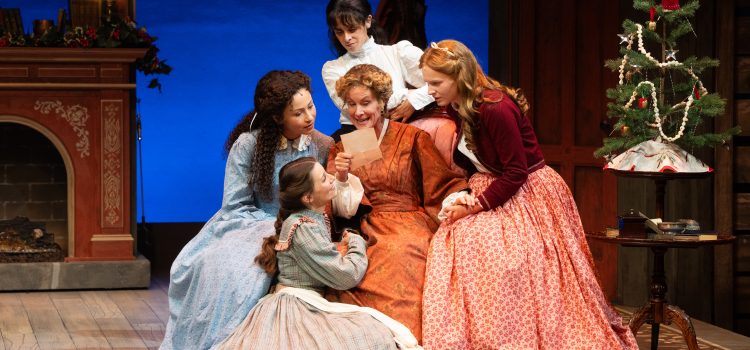
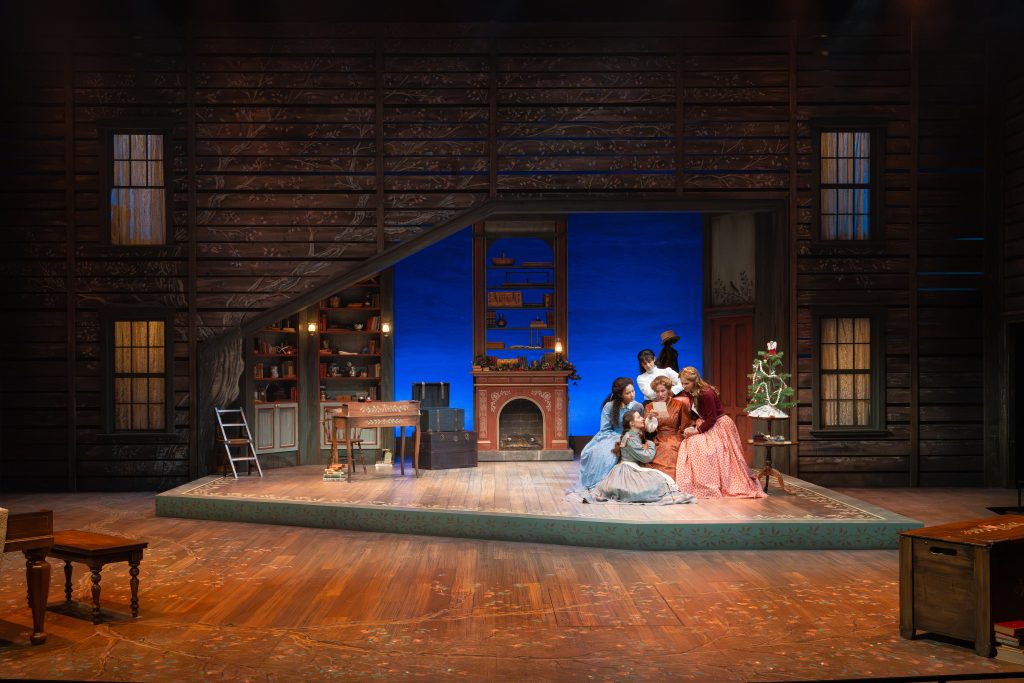
Addison Foote, Andrea San Miguel, Kristen Lindvedt, Marcia Pizzo and Amira Danan as the March women. Photo by Jon Gitchoff.
Gunderson, one of the world’s most produced playwrights, shares the same gift for honest writing that resonates. Through her fresh framing and frequent use of contemporary dialogue, the twin story unfolds, with dual roles of Lou and Jo played by the same actress. She also incorporated direct narration from Alcott’s writing, which adds authenticity.
In Civil War era Massachusetts, the fictional March family tends to the business of living while their father is away fighting for the Union Army. They endure traditional 19th century society struggles, especially financial – and love stories they refreshingly shape in their own way.
In 2024, director Delaney Piggins saw Gunderson’s adaptation during its rolling world premiere at the Northlight Theatre in Chicago, participating with three other theater companies. As associate artistic director, she lobbied for its inclusion in The Rep’s 60th season and is now making her triumphant directorial debut.
Her astute understanding of the characters and clever, inventive staging propels this charmer. Through her clear vision, she has gathered top-tier women creatives as designers — scenic designer Ann Beyersdorfer, costume designer Kotryna Hilko, lighting designer Paige Seber, and sound designer Amanda Werre. Choreographer Sam Gaitsch, intimacy director Frankie Ferrari, and dialect coach Lauren Roth all made noteworthy contributions, as did Paul Steger as fight director and Will Vicari as wig designer.
Photo by Jon Gitchoff.
Piggins has assembled a strong quartet of lovable multi-faceted March sisters – Amira Danan as dutiful and devoted Meg, the oldest; Andrea San Miguel as fiercely independent Josephine “Jo”; Kristen Lindvedt as kind and gentle Elizabeth “Beth”; and Addison Foote as melodramatic and spoiled Amy, the youngest.
For those of us who grew up with a strong mother, Marmee rings true – and so does the passionate affection of the sisters and the memories they evoke.
Marcia Pizzo is a calm moral compass as the matriarch, guiding her girls about what’s important — especially self-respect and inner character. Warm and wise, she tells them she’d rather see them happy and poor instead of marrying only for money or social status.
She notices that Meg and Amy are more concerned with social status and luxury and tries to lower those expectations. She confides in Jo that she’s learned to control her temper instead of it controlling her.
As the young women go after what they want, the big female energy on stage and in the audience was palpable – and glorious. The production’s rebel spirit reflected Jo’s empowering and enduring aspirations.
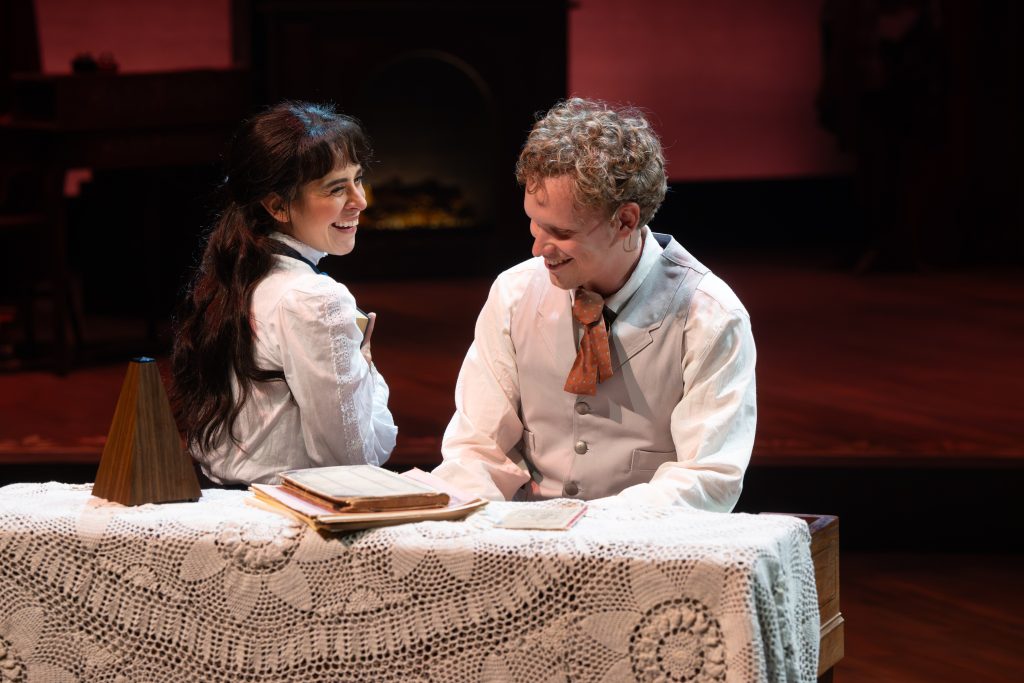
Andrea San Miguel and Jack Lancaster as Jo and Laurie. Photo by Jon Gitchoff.
Andrea San Miguel is a major force as feisty Jo, leaning into her tomboy side, sometimes with an over-emphasis on humor. She strongly interprets a confident Jo and stubborn Louisa. San Miguel, who won the St. Louis Theater Circle for Best Performance in a Comedy, Female or Non-Binary Role, for her masterful madcap mischief in “The Cottage” last year, displays the same ease with the robust performers here.
Amira Danan is a strong loyal and nurturing Meg, who ultimately marries for love over money. Kristen Lindvedt excellently embodies the shy peacemaker Beth, who provides such joy playing music for her family. Lindvedt, also the music supervisor, plays the stage piano.
Addison Foote must grow the most as her character Amy, at first selfish and dramatic, but eventually becomes a worldly sophisticate who marries Laurie (Jack Lancaster), aka Theodore “Teddy” Laurence, their playful childhood pal now sensible adult.
The energetic Lancaster is ideally suited as Laurie, starting off as a lonely, sheltered rich boy next door who becomes a regular fun-loving fixture in the March sisters’ lives. As a confidante and best friends with Jo, he and San Miguel have an effortless chemistry together.
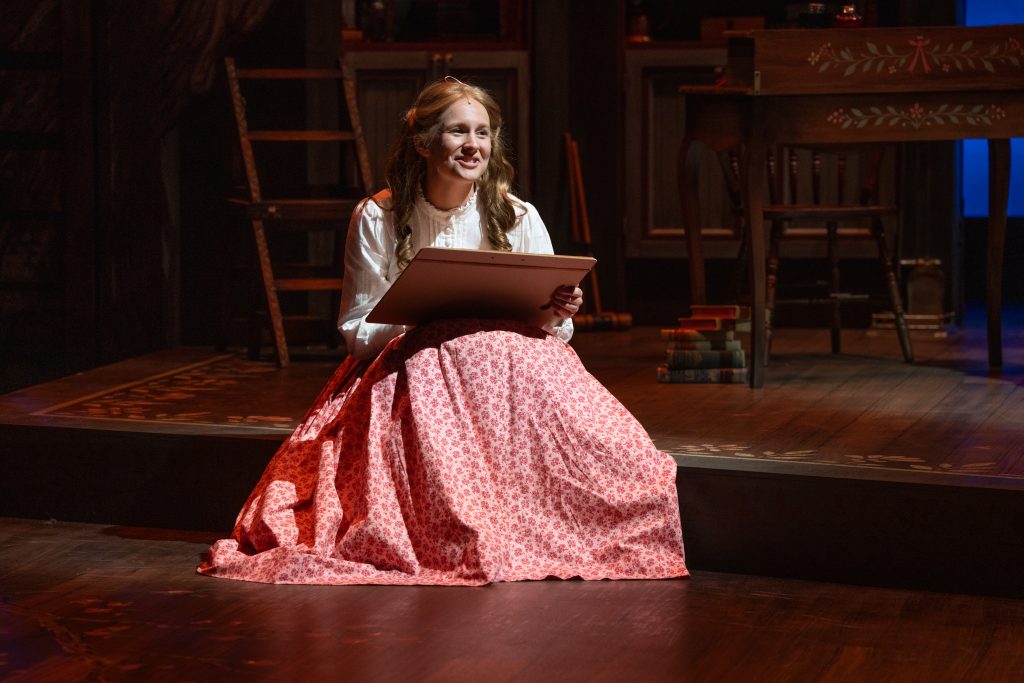
Addison Foote as Amy in “Little Women.” Photo by Jon Gitchoff.
They are such kindred spirits that when Laurie mistakes platonic compatibility for romantic feelings, Jo firmly rejects him, causing a rift. He flees to Europe, where he runs into Amy, who is studying art and painting while traveling with wealthy but cantankerous Aunt March (Marcia Pizzo in a dual role).
Eager for new horizons to fuel her literary ambitions, Jo travels to New York City, where she works as a governess and sells stories to publications. At her boarding house, she meets the kind and highly educated Professor Bhaer, who shares her passion for literature. He’s mature, respectful and hard-working. The spark is there; he and Jo will eventually share a wonderful life together, letting love in (“Little Men,” “Jo’s Boys”).
Adam Poss capably plays both Meg and Jo’s future good-guy husbands – earnest John Brooke and honorable Friedrich Bhaer. He’s first seen as Laurie’s tutor Mr. Brooke, who falls in love with Meg, then he enters late in the second act as the older German professor. He seamlessly transitions to each part and has a comfortable, steady presence on stage. He also briefly appears as the March patriarch.
Piggins’ fluid direction easily moves characters through the home, which scenic designer Ann Beyersdorfer has filled with books, mementoes, functional furniture and a small piano for Beth. The modest, lived-in New England aesthetic includes an outdoor area – for playing on the ice, dancing, and conversations. A second-floor window indicates the Laurence home. Lighting designer Paige Seber has shifted moods and seasons with her lighting choices that complement the set.
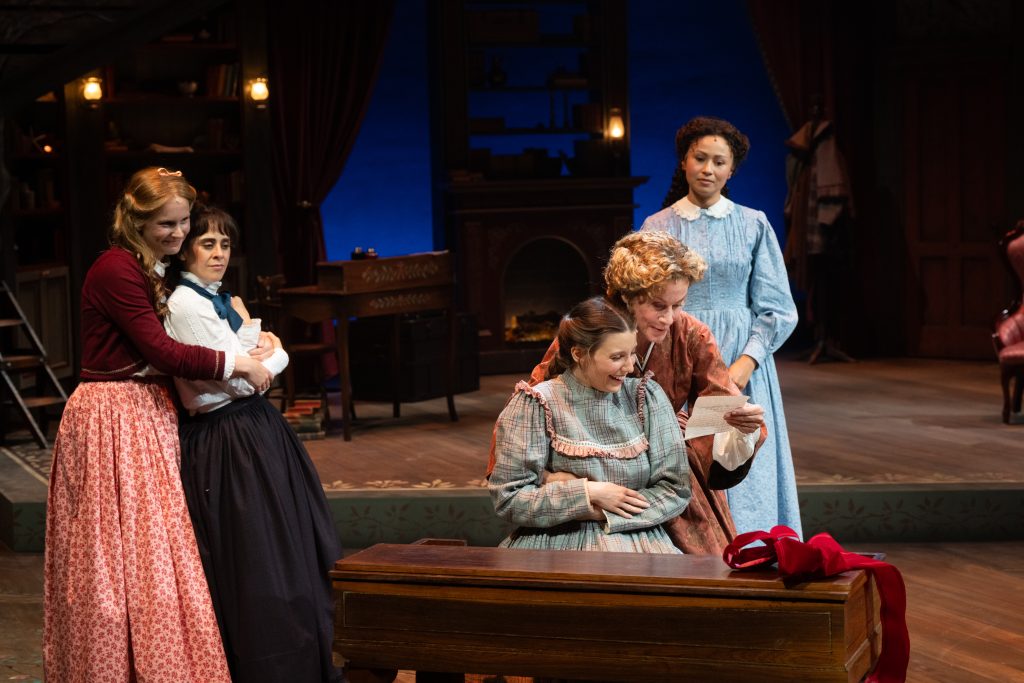
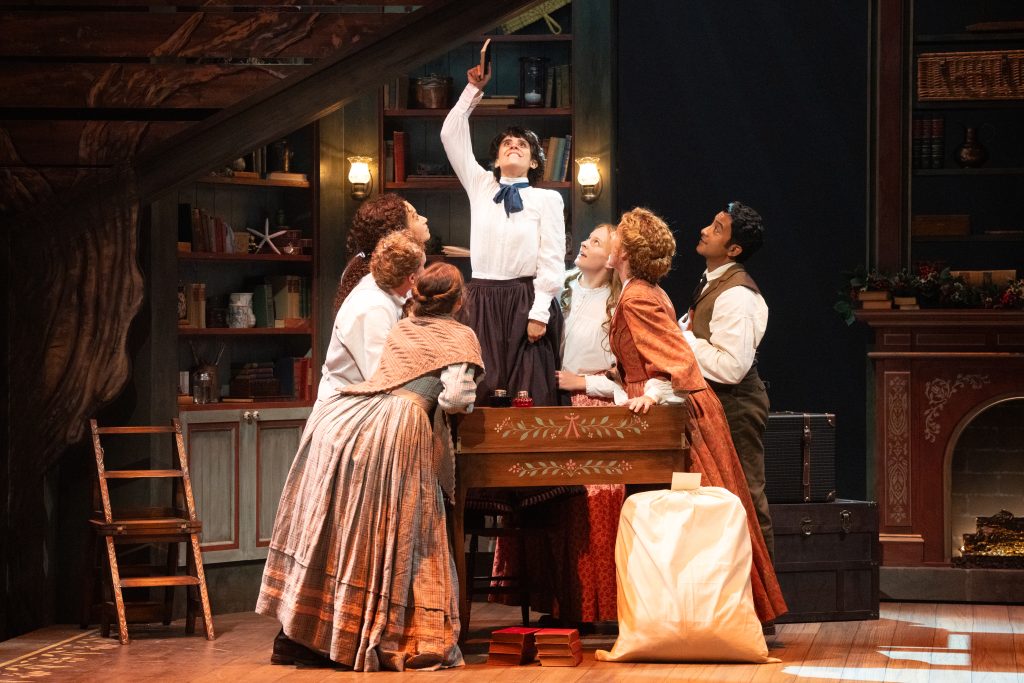
“Little Women.” Photo by Jon Gitchoff.
The costumes that Kotryna Hilko designed not only fit the period and economic status of the characters, but don’t bog down the performers in their active scenes, flowing well in movement, even with shawls and coats. With a few changes in jackets, Poss becomes three different characters.
To be in a theater alive with an effusive audience who believes in the deep value of female independence and creativity was meaningful Friday, a feeling I have carried – well, re-ignited, since that night. Those female voices, once found, carry.
Infused with Gunderson’s vitality and showcasing appealing performers, the Rep’s “Little Women” demonstrated that Louisa May Alcott’s populist work is timeless, sisterhood is a necessary emotional component in our lives, and women seizing their own journey with gusto is reason enough to stand up and cheer loudly.
The Repertory Theatre of St. Louis presents “Little Women” from Sept. 9 to Sept. 27 on the mainstage Browning Theatre in the Loretto-Hilton Center on the Webster University campus. For more information on tickets, call the box office at 314-968-3925 or visit www.repstl.org. For ticket deals, be sure to check out: www.repstl.org/ways-to-save
Adam Poss and Amira Danan as John and Meg. Photo by Jon Gitchoff.
Lynn (Zipfel) Venhaus has had a continuous byline in St. Louis metro region publications since 1978. She writes features and news for Belleville News-Democrat and contributes to St. Louis magazine and other publications.
She is a Rotten Tomatoes-approved film critic, currently reviews films for Webster-Kirkwood Times and KTRS Radio, covers entertainment for PopLifeSTL.com and co-hosts podcast PopLifeSTL.com…Presents.
She is a member of Critics Choice Association, where she serves on the women’s and marketing committees; Alliance of Women Film Journalists; and on the board of the St. Louis Film Critics Association. She is a founding and board member of the St. Louis Theater Circle.
She is retired from teaching journalism/media as an adjunct college instructor.
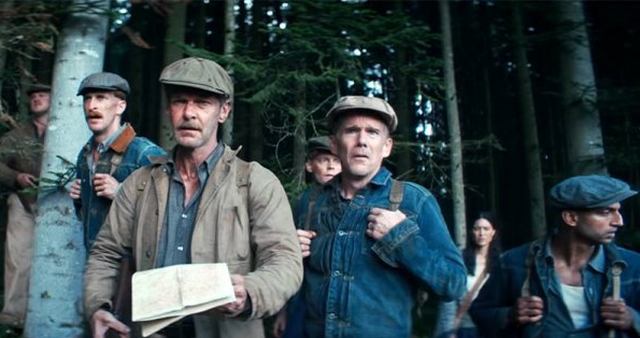
A grueling and gritty crime-action drama set during the 1930s, “The Weight” benefits from a superb Ethan Hawke performance – both physically and emotionally – with a sly turn from Russell Crowe as a cagey opportunist.
Reminiscent of survival-driven suspense movies like ‘70s throwbacks “Deliverance” in the South and William Friedkin’s “Sorcerer” in South America, and more recently, Spike Lee’s “Da Five Bloods” in Vietnam, this is a slow-burn tale about tough people in tough times involving a heist scheme.
Four years into the Great Depression, Samuel Murphy (Ethan Hawke), a battle-scarred veteran of World War I and single father, is an honorable man of few words but strong in love for his young daughter Penny (an adorable Avy Berry). His mechanical and military skills barely keep them afloat, and they are evicted from their apartment.
While they seek an affordable place to live, he scuffles with corrupt cops, in self-defense, but he’s sent to prison. Working on a road gang, the resourceful Murphy catches the eye of shady warden Clancy — Crowe in fine form — who offers him a deal: early release for hauling a fortune in stolen gold bars across 100 miles of wilderness. If he doesn’t, Penny may be adopted by the time he gets out.
Russell Crowe is the unscrupulous warden Clancy.
Why the secret assignment? Another crooked lawman, Taggert (Alec Newman), has concocted a way to transport gold, because FDR is shutting mines down to use the gold for the federal government. What’s a half ton of gold bricks conveniently taken when no one’s looking? The weighty loads are to be dropped off at a pickup point, then Clancy will sign their release papers. What could go wrong?
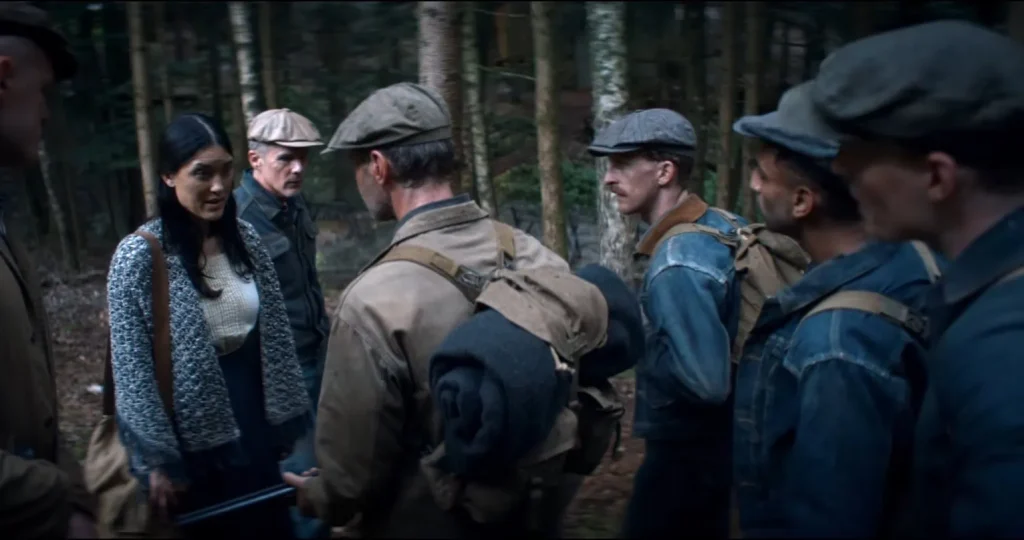
Hawke does the heavy lifting here as a smart problem-solver who becomes the de facto leader of the prison workers, enlisting his fellow convicts Singh (Avi Nash), Olson (Lucus Lynggaard Tonnesen), and sketchy Rankin (Austin Amelio) as part of the courier crew. These downtrodden guys evoke the dire depressive times, and you feel their desperation and pain. And they’re wary of each other.
Padraic McKinley, who is making his feature film debut as a director, has worked as a producer and editor before, including the 2020 TV limited series “The Good Lord Bird,” featuring Hawke, and in the 2019 TV limited series “The Loudest Voice,” with Crowe as Roger Ailes.
McKinley takes his time setting up the mission, and there are uneven pacing issues throughout. The story itself is compelling – although not as satisfying as it could have been. Co-writers Matthew Booi, Shelby Gaines and Leo Scherman build tension and relationships through the endangered men.
Guard Sam Hazeldine leads the prisoners through the rugged terrain.
The six-day journey, under the watchful eye of compromised gun-toting prison guards Amis (Sam Hazeldine) and thuggish Letender (George Burgess) is arduous – physically demanding and nerve-wracking.
Nature is hazardous enough, but a rickety bridge over a deep gorge, a harrowing shootout with locals, and a perilous river crossing ratchets up the intensity. That leads to stronger bonds with these scrappy guys. Actors Amelio and Nash, both veterans of “The Walking Dead,” eventually become helpful partners.
Along the way they meet Anna (Julia Jones), an Indigenous woman who has escaped from a cruel situation. She is enlisted to cook and help them navigate the rough terrain, becoming their secret weapon multiple times despite some degrading treatment. Even though her part is slim, Jones shows how Anna can hold her own in a white man’s world.
As Murphy faces every setback as a challenge to the freedom endgame, Hawke, 55, grounds the film with his integrity and desire to get back to his daughter. Oscar acting nominee for “Training Day,” “Boyhood” and “Blue Moon,” he continues to show his diverse range and versatility among genres. Acting since he was 14, his physicality here is remarkable and his emotional journey is telegraphed naturally. His weathered, bruised and battered face tells you everything.
Julia Jones is an escaped native woman Anna.
Cinematographer Matteo Cocco vividly captures the Pacific Northwest while composers Latham Gaines, along with his brother and co-screenwriter Shelby Gaines, enhance the atmosphere with an industrial score, especially as the suspense tightens. Both costume designer Esther Walz and production designer Cora Pratz impeccably depict the period.
The film premiered at this year’s earlier Sundance Film Festival. Its final act is thrilling, so much so that it almost makes up for the story’s shortcomings. But it’s Hawke’s standout performance that will linger long after “The Weight” ends.
“The Weight” is a 2026 crime-action period drama directed by Padraic McKinley and starring Ethan Hawke, Russell Crowe, Austin Amelio, Avi Nash, Julia Jones, Lucus Lynggaard Tonnesen, Avy Berry, Sam Hazeldine, George Burgess and Alec Newman. The runtime is 1 hour, 55 minutes, and it’s rated R for language and some violence/bloody images. It opens in theaters Sept. 18. Lynn’s Grade: B-
Lynn (Zipfel) Venhaus has had a continuous byline in St. Louis metro region publications since 1978. She writes features and news for Belleville News-Democrat and contributes to St. Louis magazine and other publications.
She is a Rotten Tomatoes-approved film critic, currently reviews films for Webster-Kirkwood Times and KTRS Radio, covers entertainment for PopLifeSTL.com and co-hosts podcast PopLifeSTL.com…Presents.
She is a member of Critics Choice Association, where she serves on the women’s and marketing committees; Alliance of Women Film Journalists; and on the board of the St. Louis Film Critics Association. She is a founding and board member of the St. Louis Theater Circle.
She is retired from teaching journalism/media as an adjunct college instructor.
By Lynn Venhaus Will it be “The Pitt” or “Pluribus”? “DTF St. Louis” or “Beef”? “Hacks or Widow’s Bay”? The 78th Annual Emmy Awards are on Monday on NBC starting at 7 p.m.
Mariska Hargitay will be the host. Expert a tribute to Dolly Parton. Nineteen awards will be presented. The night could have surprises, so it’s never easy to predict.
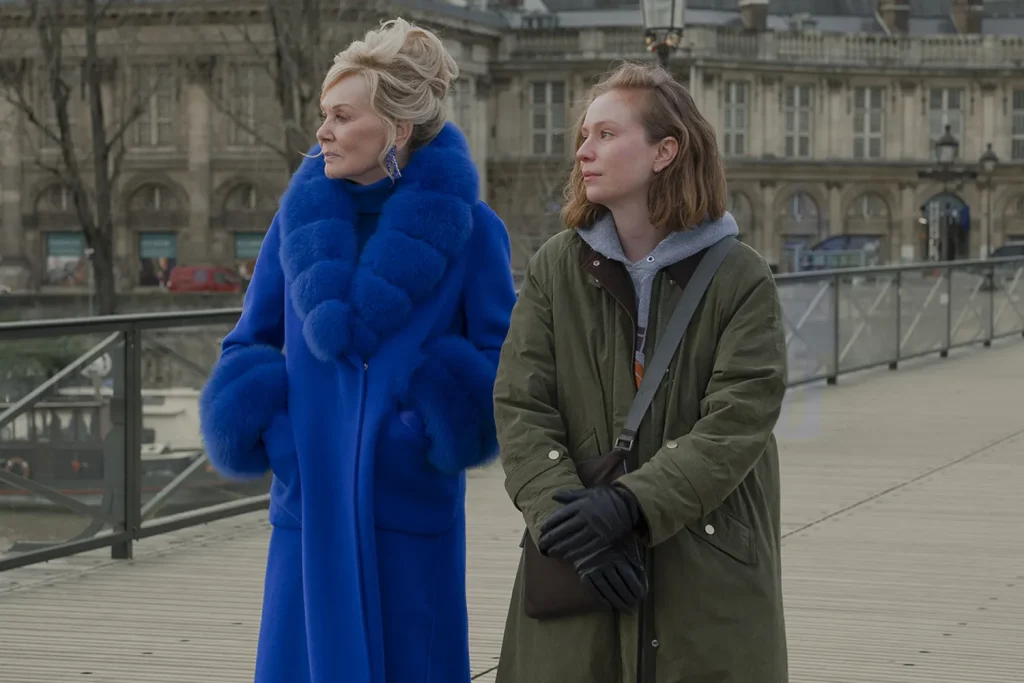
Among the records that could be broken, Jean Smart (“Hacks”) or Alison Janney (“The Diplomat”) could tie the all-time record for the most Emmys won by a performer (8 wins), which is jointly held by Cloris Leachman and Julia Louis-Dreyfus.
Smart could also set a record by winning the Lead Actress In A Comedy Series for every season of her show – first perfect 5-for-5 ever.
Zendaya (“Euphoria”) could set a record as the youngest actress, and the first Black actress, to win three Emmys in the Outstanding Lead Actress In A Drama Series category.
“The Pitt” has 25 nominations, and has already won 4 – including Ernest Harden Jr., who was wonderful as frequent patient Louie Cloverfield, as Guest Actor in a Drama.
“Paradise” star Shailene Woodley won for guest actress in a drama series. Her storyline was terrific. “Paradise” is up for 7, including St. Louis’ own Sterling K. Brown.
In the previous Emmy ceremonies last weekend, previously known as the Creative Awards Emmys, “Widow’s Bay,” Apple TV’s freshman show, won 8 – including Betty Gilpin in the origin story as Guest Actress in a Comedy. The show also picked up casting for a comedy series, music supervision, cinematography for a series (half hour), sound mixing for a comedy or drama series (half hour) and animation, sound editing for a comedy or drama series (half hour) and animation, music composition for a series (original dramatic score) and production design for a narrative program (half hour). Whew!
What about Kate O’Flynn supporting actress? What a great cast. If Stephen Root wins – or his competition Harrison Ford for “Shrinking” – they will break Henry Winkler’s record for oldest winner in supporting actor in comedy – Ford is 84 and Root is 74, and Winkler was 72 in 2018 (for his wonderful portrayal of the acting teacher on “Barry.”)
“Widow’s Bay” could break the record for the most wins by a comedy series in a single year at the Emmys as well as the record for the most wins by a comedy series for its first season — the current record is held by “The Studio” (with 13 wins in 2025).
Hiro Murai (“Widow’s Bay”) could become the first Asian director to win in the Outstanding Directing For A Comedy Series category.
Other big hauls for Apple included “Pluribus” with four wins.
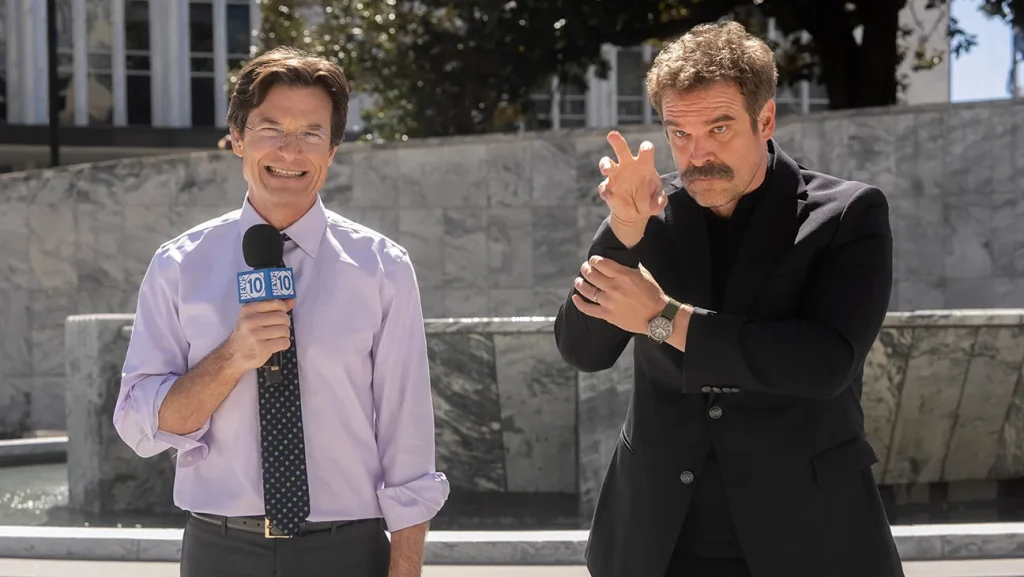
In the limited series category, “DTF St. Louis” has won six already – for directing, writing and supporting performances by David Harbour and Linda Cardellini as the Smerniches.
Wonder if they will mention the most emotional moment of the evening last week when the late Rob Reiner won the comedy guest actor Emmy, posthumously, for his role on “The Bear”?
“The Apple Music Super Bowl LX Halftime Show Starring Bad Bunny” won 7, including a win for the singer, outstanding choreography for variety or reality programming, outstanding production design for a variety special Bruce Rodgers), outstanding music direction and outstanding variety special (live).
It may be a big night for Stephen Colbert. His “Late Show” has already won 5 – for writing and for the finale.
As expected, “Margo’s Got Money Troubles” for hair, makeup and costumes. Will Michelle Pfeiffer win as Elle Fanning’s mom? She was not nominated for “The Madison” (I thought she would.)
Host Hargitay’s moving documentary about her mother, actress Jayne Mansfield, “My Mom Jayne,” won two – for outstanding documentary and direction.
Late-night talk show host Jimmy Kimmel won Best Game Show Host for , who won for “Who Wants to Be a Millionaire?”). “
Sabrina Carpenter is now halfway to EGOT winning an Emmy in the outstanding variety special (pre-recorded) for “The Muppet Show.” Carpenter is created as an executive producer and performer for the series. Seth Rogen also took home his fifth Emmy award for his work as an executive producer.
Again, “The Traitors” dominated in the reality category. Alan Cumming won his fifth Emmy for outstanding host for a reality or reality competition program. Oscar winner Octavia Spencer won for outstanding narration for the docuseries “Lost Women of Alaska” (HBO Max). And Netflix’s “Love on a Spectrum” took home three Emmys.
Julie Andrews won her fourth Emmy, landing the award in the character voice-over performance category. This was her second win in the category. The first time around, Andrews made history as the oldest woman ever to win at age 89, and now she’s 90.
Comedy Central’s “South Park” won the animated program Emmy for the first time since 2013, thanks to its episode “Sermon On The ‘Mount.”
Prime Video’s “Spider-Noir” took home five Emmys just days after learning that the show had been canceled and wouldn’t return for a second season. Despite that unfortunate news, the series won for stunt performance, sound editing for a comedy or drama series (one hour), title design, special visual effects in a single episode and cinematography for a series (one hour).
More possible records: Julianne Nicholson (“Paradise”) could become only the third actress to ever win acting Emmys in drama, comedy & limited series/TV movie categories, joining Merrit Wever and Cloris Leachman.
RuPaul could extend his record as the Black artist with the most Emmys won — he has won 14 Emmys and he is nominated for one more award in 2026 as a producer of “RuPaul’s Drag Race” in the Outstanding Reality Competition Program category.
Sally Field (“Remarkably Bright Creatures”) could become the oldest winner in the Outstanding Lead Actress In A Limited Series Or Anthology Series Or TV Movie category. The record is currently held by Jessica Tandy, who was 79 years, 2 months old when she won in 1988 for “Foxfire”; Field will be 79 years, 10 months old at the time of the 2026 Emmys ceremony.
Here are the categories tonight: 1. Outstanding Comedy Series 2. Outstanding Directing For A Comedy Series 3. Outstanding Directing For A Drama Series 4. Outstanding Drama Series 5. Outstanding Lead Actor In A Comedy Series 6. Outstanding Lead Actor In A Drama Series 7. Outstanding Lead Actor In A Limited Or Anthology Series Or Movie 8. Outstanding Lead Actress In A Comedy Series 9. Outstanding Lead Actress In A Drama Series 10. Outstanding Lead Actress In A Limited Or Anthology Series Or Movie 11. Outstanding Limited Or Anthology Series 12. Outstanding Reality Competition Program 13. Outstanding Supporting Actor In A Comedy Series 14. Outstanding Supporting Actor In A Drama Series 15. Outstanding Supporting Actress In A Comedy Series 16. Outstanding Supporting Actress In A Drama Series 17. Outstanding Variety Series 18. Outstanding Writing For A Comedy Series 19. Outstanding Writing For A Drama Series
And if you ponder to the Emmys drive audiences for viewership of nominated shows? Yes, yes, it does.
According to a Roku study, after last year’s Emmys, search for the 2025 winners in comedy, drama and limited series bumped up 330% in the week after the ceremony.
“The way people discover television has changed dramatically, but award recognition continues to have a meaningful influence on what viewers seek out,” said Roku head of analytics and insights Jon Merkin, who shares his results in a blog post out today. “That impact extends far beyond the ceremony itself. A nomination or win – dubbed the ‘Emmy Effect’ – can give a show an entirely new moment, helping viewers discover great television they may have otherwise missed when it premiered.”
This year, the 2026 Emmy noms triggered a 56% increase in search volume for limited/anthology titles (naturally, the biggest increase since those are all new programs), a 23% search bump for drama nominees and 19% jump for comedies.
Among specific titles, Netflix’s “The Beast In Me” and Peacock’s “All Her Fault” saw search increase by 76%. That was followed by HBO Max’s “Hacks” (up 65%), Netflix’s “Beef” (up 54%) and Netflix’s “The Diplomat” (up 53%).
Wins can help even more: Roku reports that after their 2025 wins, Netflix’s “Adolescence” saw searches increase 14x, while Apple TV’s “The Studio” grew 5.7x and HBO Max’s “The Pitt” increased 2.8x. Roku looked especially at how “The Studio” received what it essentially deems a “second premiere event” after the win, as search for the show in the week after its win was 81% higher than what it was the week of its original premiere.
Also, Roku notes that search changed by region after the Emmy success of a show like “Adolescence,” which saw search grow in Midwestern and Southeastern states after it won limited/anthology series last year.
As for this year’s nominated series, for a full year’s Roku search volume between September 2025 and August 2026, ABC’s “Abbott Elementary” led in comedy, followed by Hulu’s “Only Murders in the Building” and FX’s “The Bear.”
In drama, HBO Max’s “The Pitt” led in searches, followed by Hulu’s “Paradise” and Apple TV’s “Pluribus.” And in limited/anthology, Peacock’s “All Her Fault” led, followed by FX’s “Love Story: John F. Kennedy Jr. & Carolyn Bessette” and then HBO Max’s “DTF St. Louis.”
“Awards season remains an important discovery moment because it gives viewers a decisive signal of quality as they navigate an enormous amount of great television,” Merkin said. “The ceremony may be one night, but its influence plays out in proactive discovery long after the awards are handed out.”
Lynn (Zipfel) Venhaus has had a continuous byline in St. Louis metro region publications since 1978. She writes features and news for Belleville News-Democrat and contributes to St. Louis magazine and other publications.
She is a Rotten Tomatoes-approved film critic, currently reviews films for Webster-Kirkwood Times and KTRS Radio, covers entertainment for PopLifeSTL.com and co-hosts podcast PopLifeSTL.com…Presents.
She is a member of Critics Choice Association, where she serves on the women’s and marketing committees; Alliance of Women Film Journalists; and on the board of the St. Louis Film Critics Association. She is a founding and board member of the St. Louis Theater Circle.
She is retired from teaching journalism/media as an adjunct college instructor.
By Lynn Venhaus Letting our inner child out for an adult Looney Tunes excursion is a splendid way to cap off summer. When it’s as clever and sharp as “Coyote vs. Acme,” the joys are many.
Perennial underdog Wile E. Coyote faces an even bigger challenge than that pesky speedy Road Runner when he lawyers up and sues corporate monopoly Acme over faulty products. After all, he’s experienced decades of explosive misfortunes, so why not a class-action lawsuit?
In the inventive style of groundbreaking 1988 film “Who Framed Roger Rabbit?” and Emmy-winning 2022 film “Chip ‘n Dale: Rescue Rangers,” this live-action animated hybrid comedy is remarkably on point as a satire, but the nostalgia is elevated, too, respecting those merry melodies.
Founded in 1930 and nurtured during the golden age of animation, Looney Tunes specialized in wild slapstick comedy, dandy wordplay, funny visual gags and topical humor. A staple of Warner Brothers, first as shorts before movies, then on television: “That’s all, folks!”
As a nod to the legacy, the film honors directors Chuck Jones and Tex Avery and writer Michael Maltese (co-creator of Wile E. Coyote and Road Runner) with the law firm Jones, Avery and Maltese. The lawyers include Kevin Avery (Will Forte), Dottie Jones (Martha Kelly), Sal Maltese (Tone Bell), and Kevin’s niece Paige Avery, a go-getter intern played by the spirited Lana Condor.
The gang’s all here too – hapless Porky Pig, high-strung Daffy Duck, sly Bugs Bunny, flustered Elmer Fudd, resourceful Tweety, impatient Sylvester, hot-tempered Yosemite Sam, fast-talking trickster Foghorn Leghorn, wild and ferocious Tasmanian Devil – and Granny.
Most anamorphic animal characters are voiced by the uncanny Eric Bauza, a voice actor considered the successor to Looney Tunes legend Mel Blanc. Bauza has won three Emmys for his cartoon performances.
The ingenious story pits blustery small-time attorney Forte against slick corporate counsel John Cena as Buddy Crane, who clash often about consumer rights. Wile E. seeks compensation for all those catastrophes. But the profit-obsessed conglomerate has things to hide and its victims more to say.
The original story, by St. Louisan James Gunn, Jeremy Slater and Samy Burch, with screenplay by Oscar nominee Burch (“May December”), tackles corporate greed and parodies philosopher Albert Camus on our self-destructive absurdities – “The Myth of Sisyphus.” Their courtroom concept was inspired by a 1990 New Yorker article by Ian Frazier.
You know that hungry, determined coyote is never going to stop rolling that boulder up a hill, no matter how many times it will mow him down. There is dignity in his futility, rather Shakespearean at times.
Director Dave Green maintains the cartoon’s chaotic wackiness, and the visuals are bright, fresh and funny. Coyote’s struggles mirror our lives – the fight we keep fighting, no matter if it’s detrimental for us. Because that’s how we roll.
The film is chock-full of Easter eggs and ingenious nods. The playful score by Steven Price includes a “Meep Meep Road Runner Choir” that enhances Tchaikovsky’s1812 Overture.
The never-say-die story has taken on special meaning because of the backstory involving Warner Brothers Discovery CEO David Zaslav, who decided to ditch the movie as a tax write-off after post-production in 2022. Folks found out at the 2023 San Diego Comic Con, and that fueled a vocal fan response.
And unlike that coyote, persistence and resilience won the day here, for another distributor, Ketchup Entertainment, is now releasing the film. And it’s worth rallying around not just because it’s a cause célèbres, but because it’s a darn fine movie. (And now Warner is in the process of a merger with Paramount Skydance.)
At the end of the closing credits there is a dedication: “To everyone who posted, shared, held up signs, and spoke out when it counted. This film made it to the big screen because of you.”
“Coyote vs. Acme” is an entertaining triumph for the filmmakers and a testament to the little guy to never give up.
“Coyote vs. Acme” is a 2026 animated live action hybrid comedy directed by Dave Green and starring Will Forte, John Cena, Lana Condor, Martha Kelly, and Tone Bell. It is rated PG and runtime is 1 hour, 41 minutes. It opened in theatres Aug. 28. Lynn’s Grade: B+.
Lynn (Zipfel) Venhaus has had a continuous byline in St. Louis metro region publications since 1978. She writes features and news for Belleville News-Democrat and contributes to St. Louis magazine and other publications.
She is a Rotten Tomatoes-approved film critic, currently reviews films for Webster-Kirkwood Times and KTRS Radio, covers entertainment for PopLifeSTL.com and co-hosts podcast PopLifeSTL.com…Presents.
She is a member of Critics Choice Association, where she serves on the women’s and marketing committees; Alliance of Women Film Journalists; and on the board of the St. Louis Film Critics Association. She is a founding and board member of the St. Louis Theater Circle.
She is retired from teaching journalism/media as an adjunct college instructor.