
By CB Adams
To appreciate the exceptional experience of “Color Into Form Into Sound” — the clarity, intimacy and high-caliber artistry within the Pulitzer Arts Foundation’s concrete calm — it helps to understand the why behind the evening.
Curated by Christopher Stark, composer and professor at Washington University in St. Louis, the program invited listeners to consider how music, space and visual art illuminate one another. Inside Tadao Ando’s serene geometry, four musicians from the St. Louis Symphony Orchestra shaped an evening where sound behaved like form, breath became structure and attention felt like devotion.
As Stark shared in his opening remarks, the program grew directly from Jennie C. Jones’ listening life. Jones lives with contemporary classical music in her studio, especially works by pioneering Black composers who bridge classical lineage with improvisational energy, and she offered Stark the pieces and voices that inform her world. He spoke with admiration for how intuitively her surfaces and these sonic landscapes connect — tone, texture and resonance moving easily between gallery and score.
He also noted acoustic affinities between Jones’ layered materials, which recall studio treatments designed to address sound, and the Pulitzer’s concrete hush. A quiet echo of Miles Davis hovered in that framing — his belief that “a painting is music you can see, and music is a painting you can hear” felt beautifully at home. With that sensibility, Stark curated solo and small-ensemble works that met the room, the art and our listening with clarity and presence.
Jones’ exhibition and the Pulitzer’s tranquil architecture created a receptive space where breath and resonance felt almost architectural. Against this backdrop, the program brought together four groundbreaking voices — Carlos Simon, Alvin Singleton, George Lewis and Pauline Oliveros — each offering a distinct approach to line, rhythm and listening. Simon, Singleton and Lewis stand among the pioneering Black composers who have shaped contemporary classical and improvisational music, and Oliveros offered a complementary Deep Listening dimension rooted in awareness and breath. Heard inside Jones’ world of tuned surfaces and charged quiet, the works formed a sonic exhibition, each piece focused and individually framed, inviting the audience to lean in and listen with care.
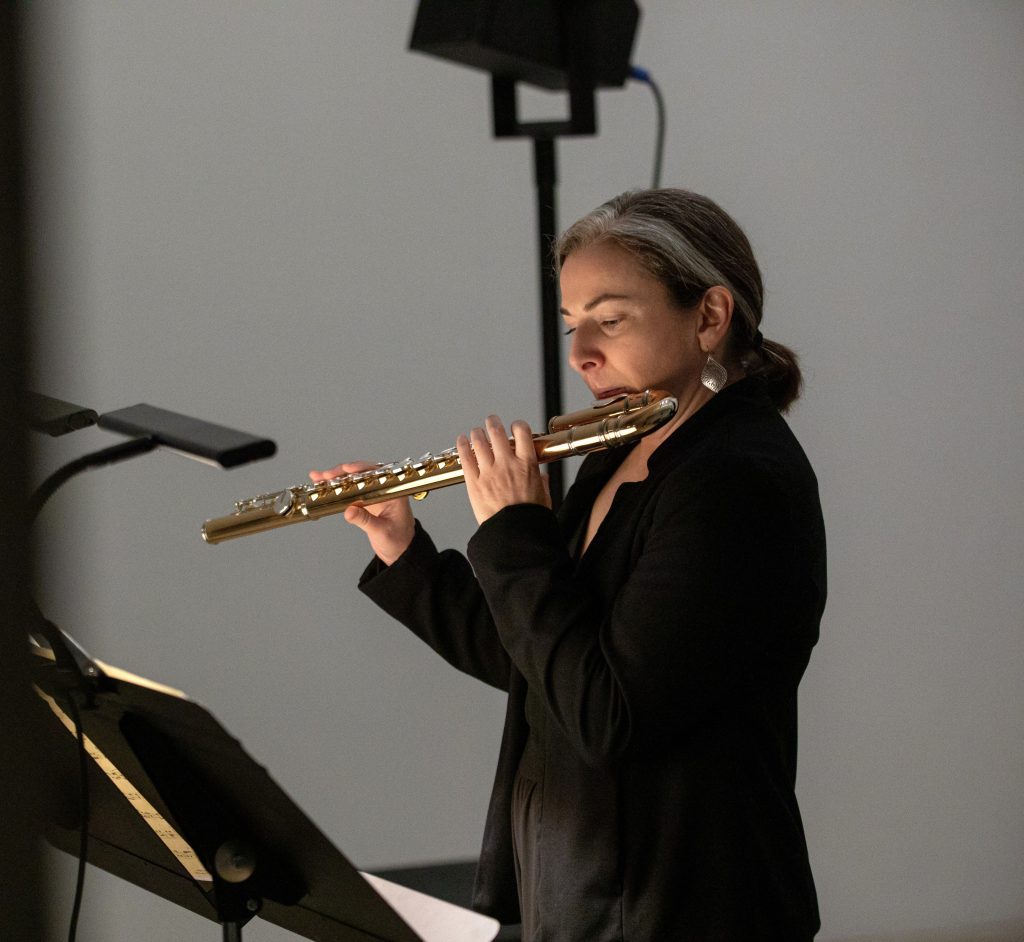
Simon’s “Silence,” performed by cellist Bjorn Ranheim, and “Move It,” played by flutist Andrea Kaplan on alto flute, revealed the physical and expressive demands of his writing. The musicians approached these works like elite athletes at peak form, shaping tone and breath with clarity and vigor. Kaplan drove through “Move It” with a stamina that felt architectural in its discipline, while Ranheim revealed taut strength beneath “Silence,” each bow stroke carrying sculptural intention. In “Between Worlds,” double bassist David DeRiso extended Simon’s sense of grounded lyricism, giving the instrument weight, lift and presence.
Singleton’s “In My Own Skin,” performed by Peter Henderson, offered a vivid demonstration of musical command — a flourishing traversal through a score that carried the room with it, idea by idea. Kaplan returned for Singleton’s “Argoru III,” shaping sound and silence with poised clarity, each gesture finely articulated.
In Lewis’ “Endless Shout,” Henderson again proved a compelling guide, allowing musical thought to move with conversational ease, alert to both structure and spontaneous color.
Oliveros’ “Horse Sings From Cloud,” performed by Kaplan, Ranheim, DeRiso and Henderson, asked performers and listeners to treat tone, breath, silence and space as equal materials. This performance felt quietly luminous, meditative and humming, the result of disciplined listening and collective trust. Silence breathed differently here, less like absence than a living medium in which sound appeared and receded. The effect was gently sublime, delivering a moment of stillness that settled the room into a deeper register of experience.
The connection between Jones’ work and these sounds lived in sensibility rather than illustration. Stark’s framing centered Jones’ listening — an invitation to imagine her in the studio with these composers sounding around her, much as one imagines Basquiat painting with Parker or Gillespie in the air. Music and art infused, each informing the other as parallel commitments to color, energy and imagination.
The gallery was full, and the audience listened with a calm, steady attentiveness that felt in tune with the room and the music — a presence that reflected both the strength of the SLSO community and St. Louis enthusiasm for programs where contemporary music and visual art meet in shared focus. Cross-disciplinary evenings like this affirm how vividly the arts speak to one another when we move among galleries, stages and concert halls, embracing perspectives shaped by diverse voices and modern compositional language.
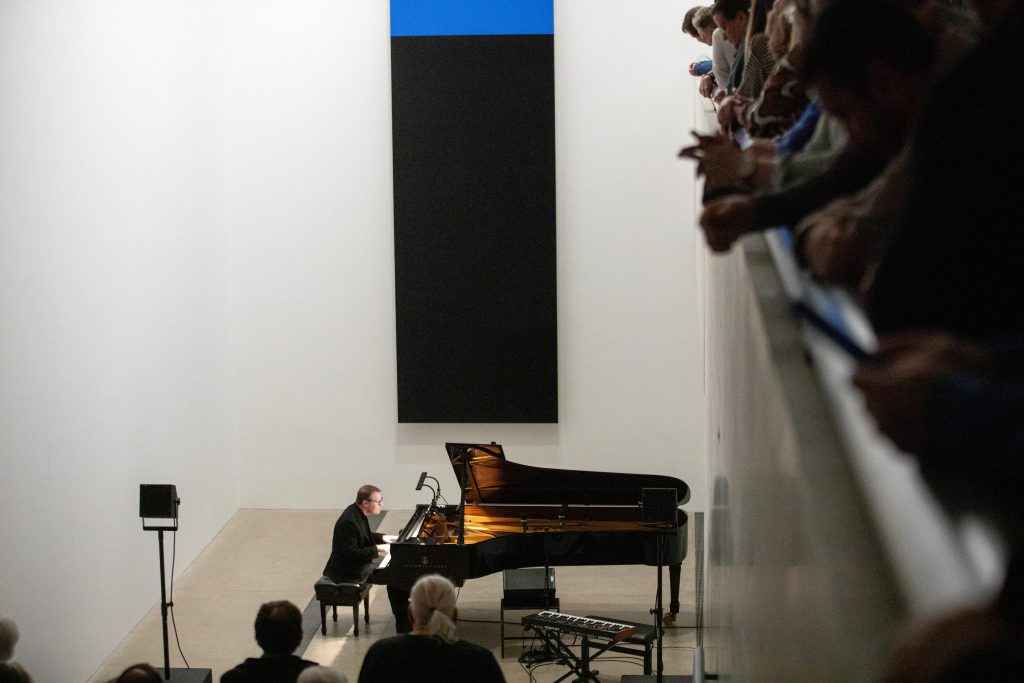
The evening also affirmed the value of the St. Louis Symphony Orchestra’s Live at the Pulitzer series, which brings adventurous programming into conversation with contemporary art and architecture. As the final tones settled, the space held a gentle afterglow, as though the music had entered the walls as quietly and surely as Jones’ works inhabit them.
Her pieces remain on view, and the evening’s sounds may still hover in the gallery air — a testament to curation grounded in discernment and performances shaped by devotion, the kind of experience that lingers and encourages us toward the fullness of artistic experience across forms.
St. Louis Symphony Orchestra: Live at the Pulitzer performed “Color Into Form Into Sound” on Nov. 4 at the Pulitzer Arts Foundation.
Photo Credit: Courtesy of the Pulitzer Arts Foundation. Photography by Chris Bauer.
CB Adams is an award-winning fiction writer and photographer based in the Greater St. Louis area. A former music/arts editor and feature writer for the St. Louis Globe-Democrat, his non-fiction has been published in local, regional and national publications. His literary short stories have been published in more than a dozen literary journals and his fine art photography has been exhibited in more than 40 galley shows nationwide. Adams is the recipient of the Missouri Arts Council’s highest writing awards: the Writers’ Biennial and Missouri Writing!. The Riverfront Times named him, “St. Louis’ Most Under-Appreciated Writer” in 1996.