By Lynn Venhaus

With its pitch-black tale of love, murder, revenge and obsession, Stephen Sondheim’s singular “Sweeney Todd: The Demon Barber of Fleet Street” remains an ambitious, wildly popular musical that is a challenge to produce and even harder to satisfy high expectations, no matter whether the interpretation is traditional or innovative.

Such is Sondheim’s reputation as the most important figure in 20th century musical theater and the macabre masterpiece’s passionate fan base around the globe. For Sondheim enthusiasts, any opportunity to hear that majestic score is welcome – that is why it’s often adapted into a concert presentation or an opera.

For their second official foray into Sondheim’s daunting catalogue – after their award-winning and critically acclaimed “Assassins” in 2022 at the .Zack, Fly North Theatricals presents a thoughtfully staged and deeply committed 12-member cast for this demanding show.

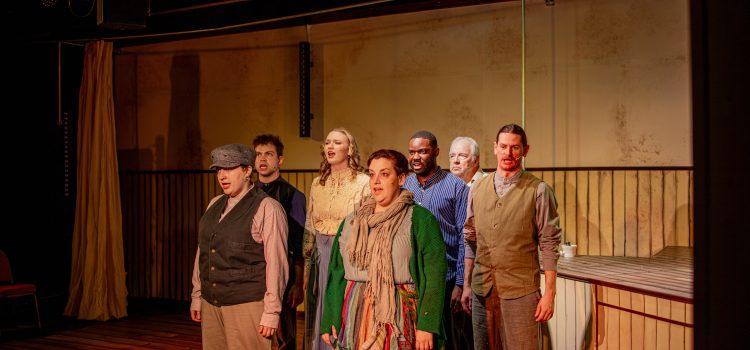
Attention must be paid as the ensemble raises firm, emphatic voices to grab hold in the opening “The Ballad of Sweeney Todd: ‘Attend the Tale of Sweeney Todd” and stresses the dramatic stakes in the reprises, acting like a Greek chorus.
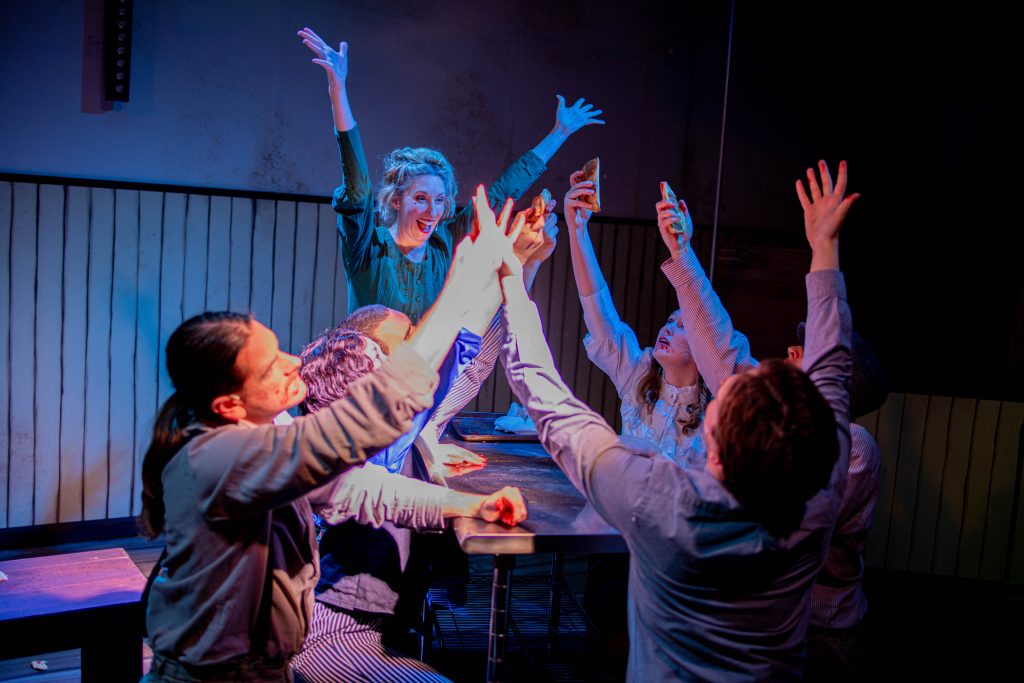
“God That’s Good!” Photo by Julie Merkle

Parker Miller, principal bass; Margaret Beekman, principal soprano; Mia Millican, principal alto; and Nathan Hakenewerth, Matt Ingram, Dereis Lambert, Crispin Shininger, Rachel Bailey, and Isobel Ramsey robustly raise their voices in unison.

They roar with energy in “God, That’s Good!” and are the mighty backbone of this grand, grim musical that is about 80% music.

Director Colin Healy has been strongly influenced by Sondheim throughout his career – and has a mural painting of Steve on the wall of the Greenfinch Theater & Dive Bar that he co-owns with technical wizard Bradley Rohlf, so his understanding of the material is never in doubt.

(Fun Fact: The bar is even named after one of Sondheim’s songs (“Green Finch and Linnet Bird”).

Healy dives into this monumental work with the intense drive of Hal Prince and the minimalistic eye of John Doyle, two legendary interpreters of Sondheim’s shows. (Prince directed the original mammoth 1979 Tony-winning Broadway show while Doyle reimagined an austere asylum-set 2005 revival).
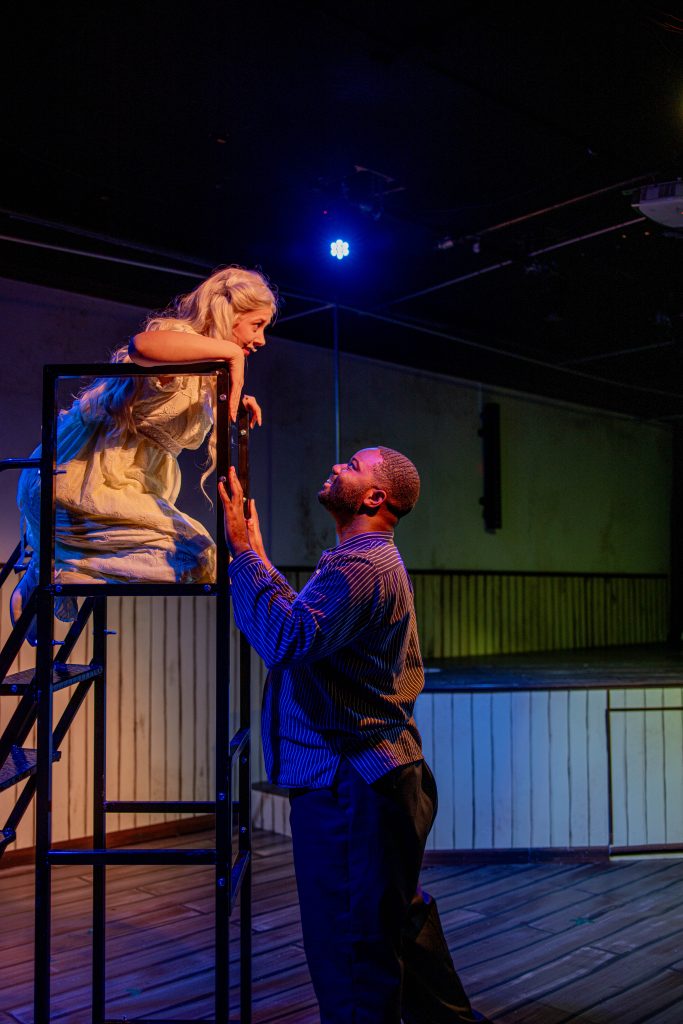
Isobel Ramsey and Dereis Lambert. Photo by Julie Merkle.

To create an intimate production in the cozy confines of the Greenfinch theater space, Healy focused on the character-driven narrative, stripping it down to a few immersive set pieces and counting on the audience’s imagination. The 19th century Victorian London setting is more of a suggestion, which is fine.

Clever lighting co-designed by Healy and Lauren Perry and nimble stagehands/cast led by stage manager Dizzy Funke help create a foreboding atmosphere. Rohlf lends his considerable skills as technical director.

Fly North’s resourcefulness with a tiny budget is laudable. And the efficient staging of the murders and body disposal benefits from everyone’s dedicated timing. Now, fresh ‘blood’ is splattered on some audience members, but those sitting at other angles don’t get that special effect, nor do they see it.

The heart-rending book by Hugh Wheeler, Tony winner for this, “A Little Night Music” and “Candide,” shocks and awes – blending terrifying psychological horror with deliciously wicked flickers of humor, some of it campy, while the music chills and thrills.

The disturbing gothic narrative was adapted from Christopher Bond’s 1970 play “Sweeney Todd,” which featured motivation for the barber’s lurid crimes. He imagined Todd as the victim of a corrupt, lecherous judge, who exiled him to a penal colony in Australia and ravaged his wife.

Bond had used a 1847 ‘penny dreadful’ (popular Victorian pulp fiction) – “The String of Pearls,” which sensationalized the demon barber of Fleet Street as a killer who baked his victims into meat pies.

Sondheim’s music made it feel larger in scope, and Prince decided the downside of the Industrial Revolution was that it turned out soulless, defeated, and hopeless people. That outlook, combined with Sondheim’s flair for emotional depth — nobody could tinge lyrics with melancholy, regret, and revulsion quite like he could.
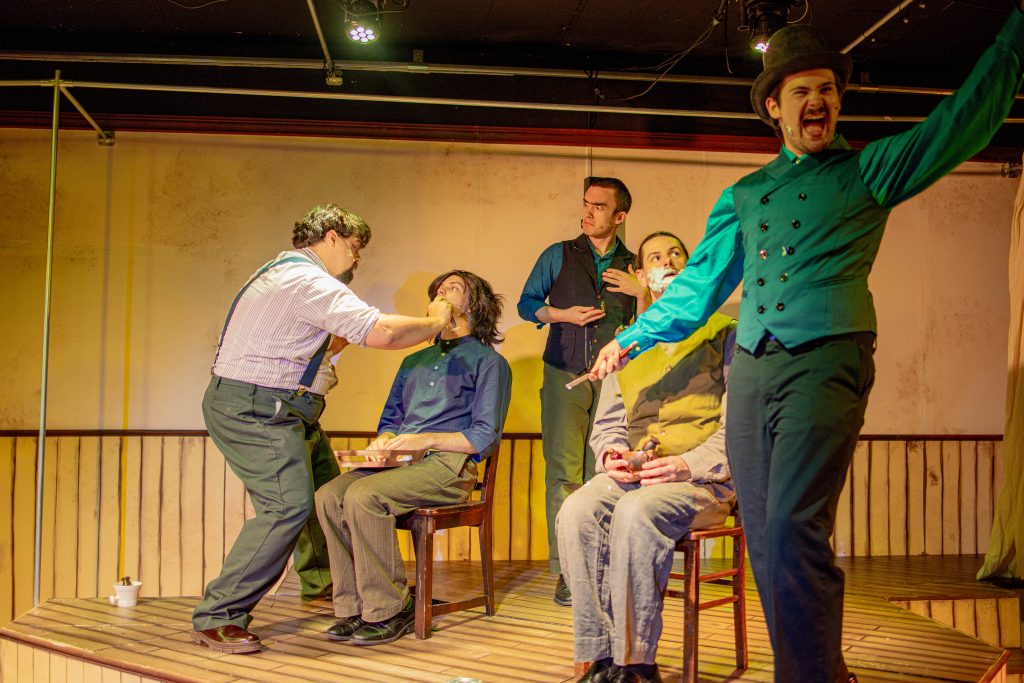
“The Contest.” Photo by Julie Merkle.

Because Healy is such a Sondheim zealot, the ensemble’s enunciation was commendable on the razor-sharp lyrics and rhythmically complex songs. He isn’t the music director for this show, his usual role, but he and music director Stephen Schermitzler created the sound. Greenfinch’s orchestra pit is in the basement.

Chandler Spradling appears as an imposing anti-hero as Todd, a man pushed into nefarious deeds because of his life’s circumstances, thwarted by depraved men. He has a strong bass-baritone on such numbers as the battle cry “Epiphany” and chilling “My Friends.”

He and Lambert establish their relationship with the hopeful “No Place Like London,” and he shares his piteous tale “The Barber and His Wife.” Todd sets his diabolical plan in motion.

He meets a chatty Mrs. Lovett at her failing pie shop and opens a barber practice located above. Their meeting of the minds results in a thrifty use of a ghastly ingredient that makes her meat pies so tasty.
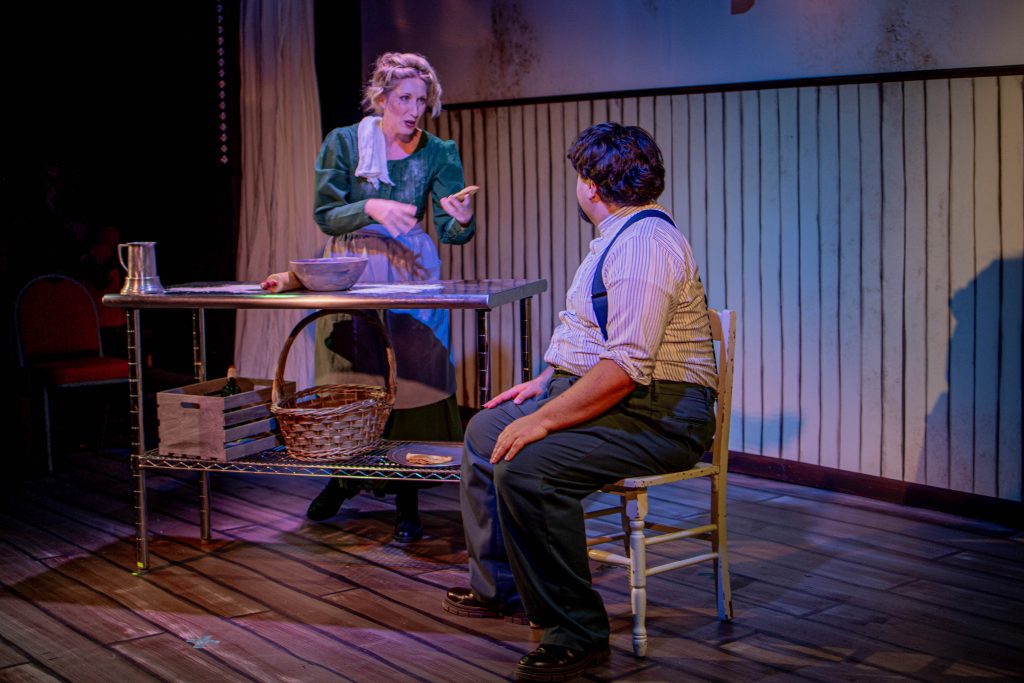
“The Worst Pies in London.” Photo by Julie Merkle.

Multi-faceted Jennelle Gilreath Owens is everything one can expect in an earthy Mrs. Lovett – she engages immediately in her “The Worst Pies in London,” showing off her finely attuned comedic skills and superb timing, not to mention an impeccable Cockney accent. She’s more ditzy than blowzy, more Lucille Ball than Ethel Merman.

Owens has always been a gem on local stages and shines in this iconic role. (At Stray Dog Theatre, she was a fierce Witch in Sondheim’s “Into the Woods”). She excelled at the patter song “A Little Priest” and was wistful in the duet “By the Sea.”

Perhaps the taxing nature of the intricate rhymes and complex musicality of the score was so arduous that some character development was lacking – because there should be more to some of these roles than broad strokes.

Spradling displayed the anguish, reinforced by a hollow gaze, but was less convincing as he descended into madness. Todd’s all-consuming grief and simmering rage must be palpable. His twisted partnership worked with Mrs. Lovett – until it tragically doesn’t. That downfall in the devastating second act felt a tad rushed – we should feel the sorrow.
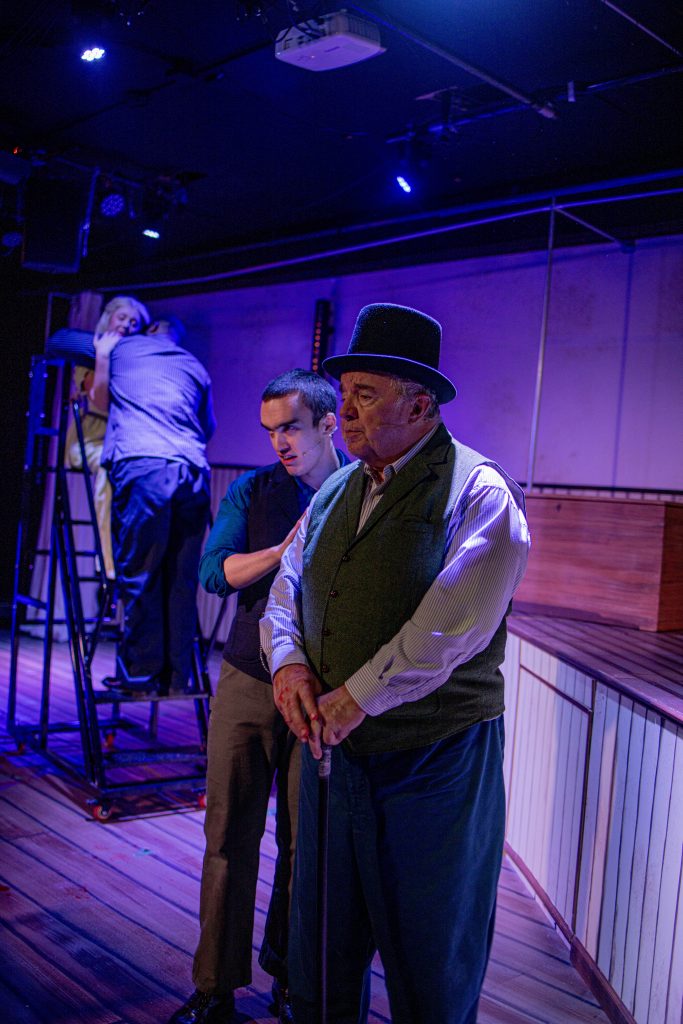
Judge Turpin. Photo by Julie Merkle.

Haller wasn’t a cruel Judge Turpin but rather a self-righteous, controlling authority figure where his possessive nature turns creepy when he lashes himself over his desires about his young ward. He could have been nastier and more intentional because he’s duplicitous.

Most disappointing was “Pretty Women.” Had the vocal prowess and the psychological depth met the moment, the beautiful song would have been haunting and unnerving.

The star-crossed lovers, Anthony Hope and Johanna Barker, seem doomed, and for the audience, they can cheer on the couple, despite Johanna being imprisoned and forced to marry the Judge (so cringy). Dereis Lambert and Isobel Ramsey are youthful in their ardor and have a lot at stake here in their songs. Lambert’s immediately smitten in “Ah, Miss” and blends romantic yearning in “Johanna.”

For the most part, Healy avoided cartoonish evil when things all start going sideways, and that meat grinder gets a workout. But pile on the menace! With the help of white curtains, shadows and light, they make the ominous asylum scene work, and the chaos grows in a wobbly “City on Fire!”

Matt Ingram as Beadle Bamford and Crispin Shininger as Tobias Ragg were compelling as these integral characters. Ingram, with a bold, strong voice and credible dialect, had to straddle the fine lines of pomposity with politeness, cruelty with complicities and his own sense of self-importance and broad humor. Ingram did so admirably, particularly in “Parlor Songs.” Nobody mourned his fate.
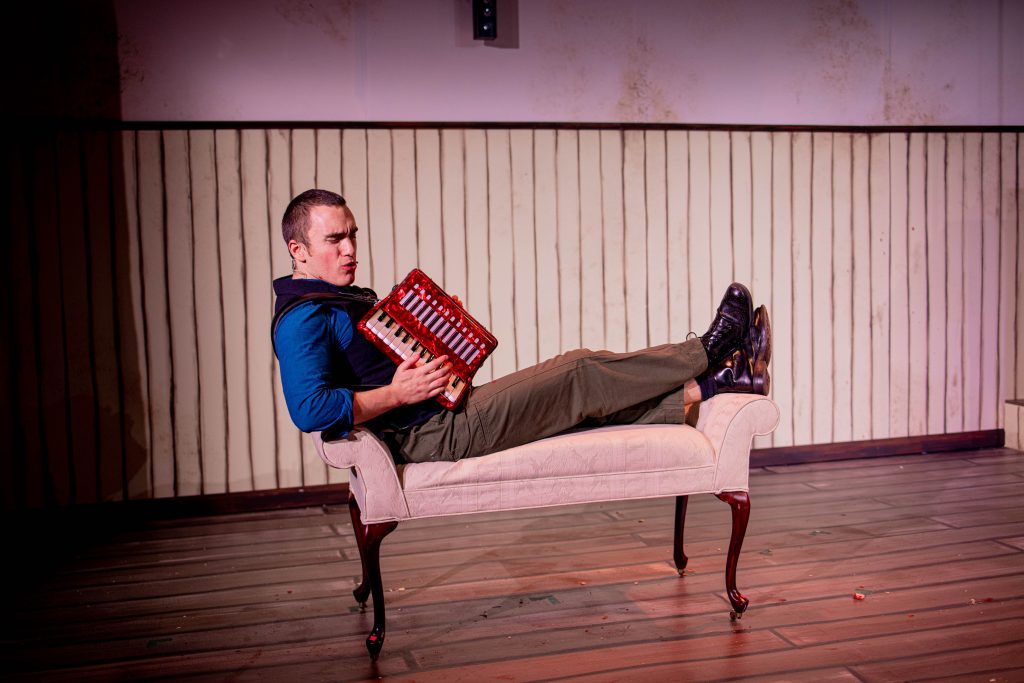
Matt Ingram. Photo by Julie Merkel.

However, the naïve Tobias must transition from comic relief to tragic figure, starting out as loyal assistant to the charlatan Pirelli then becoming protective of Mrs. Lovett as a maternal figure.

Shininger is heart-breaking in one of the show’s best songs, “Not While I’m Around,” and his inevitable mental breakdown. His trauma was believable, after he figures out Todd and Mrs. Lovett are murderers, but the blocking could have been more decisive.
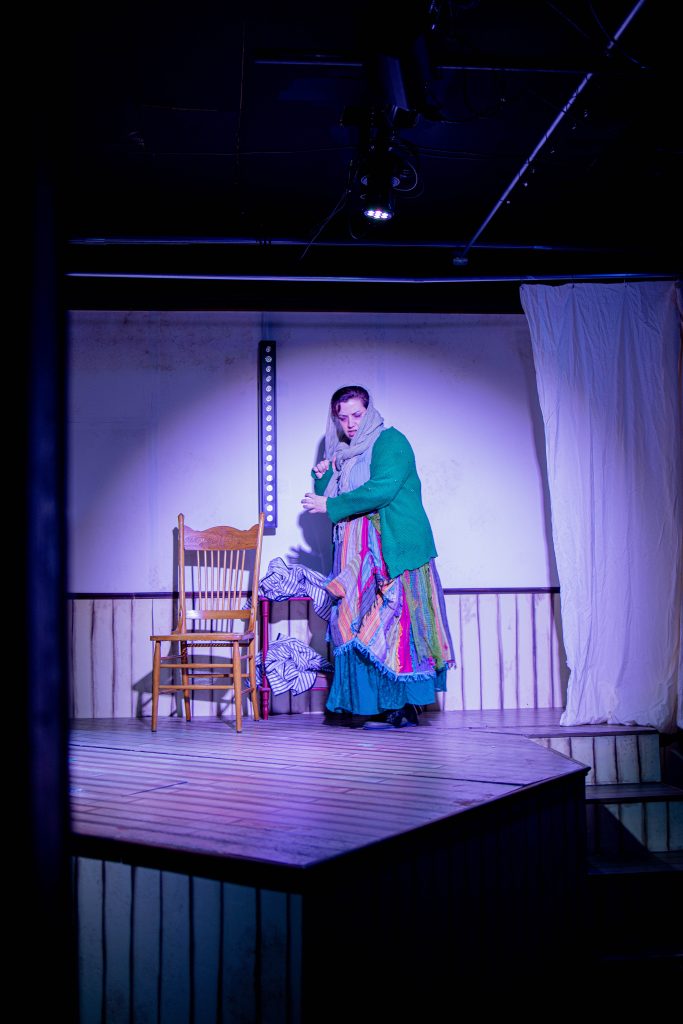
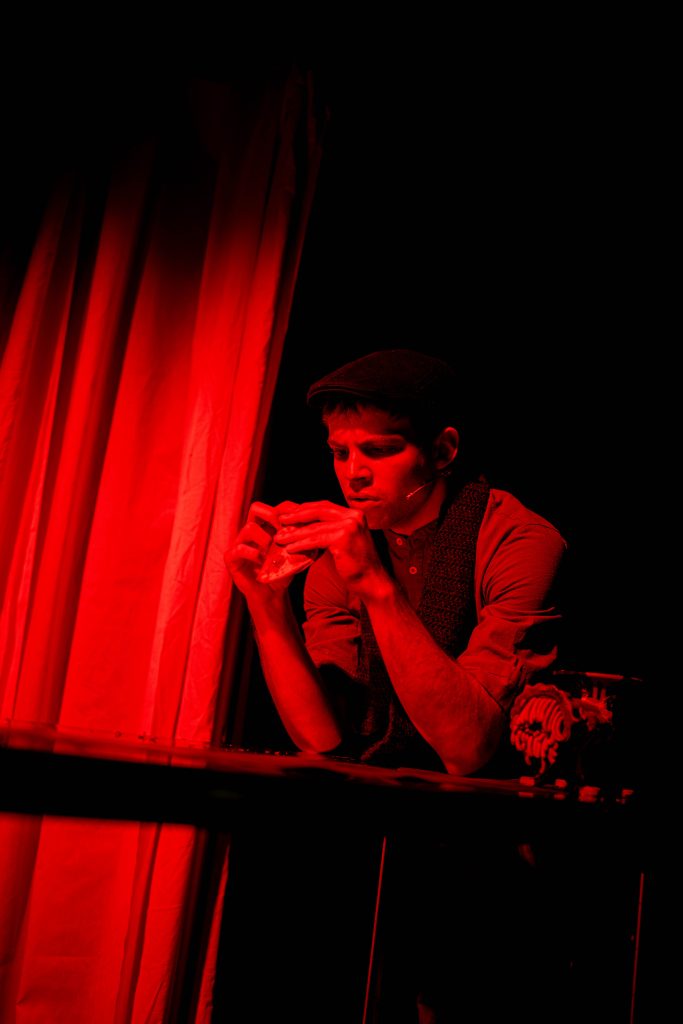
Rachel Bailey. Photo by Julie Merkle.
Crispin Shininger. Photo by Julie Merkle.

Ever reliable Rachel Bailey is persuasive as a mysterious Beggar Woman, and her “Beggar Woman’s Lullaby” regrettably seals her fate.

Hakenewerth is effective as the fraudulent Pirelli who tries to blackmail Todd, which sets off the murder spree.

And sadly, the Demon Barber of Fleet Street must come to its inevitably tumultuous gut-wrenching finale. Whether you’ve watched Tim Burton’s 2007 Oscar-nominated film or can’t get enough of the 2023 Broadway revival album, “Sweeney Todd” has many intricate layers to discover and Fly North has taken us in their own unusual distinctive way to its dark side.

Fly North Theatricals presents “Sweeney Todd: The Demon Barber of Fleet Street” from July 17 to Aug. 9 at the Greenfinch Theater and Dive Bar, 2525 S. Jefferson Avenue. The show’s runtime is 2 hours, 30 minutes, with a 15-minute intermission. Content warning: this show contains mature themes, including murder and self-harm. For more information, visit www.flynorth.org

Full disclosure: My maternal grandmother and Matt Ingram’s maternal great-grandmother were sisters, therefore we are cousins.
By Lynn Venhaus
Looking at female agency through the prism of mothers, daughters and sisters, “Am I Dangerous?” is an earthy, sensual exploration written by a perceptive local playwright and performed by a quartet of instinctive actresses, directed by a shrewd Tress Kursym.

With such authentic credentials, the play’s perspective is set in the past, albeit a mythical framework, but resembles a modern coming-of-age tale.

Committed to fresh voices, Contraband Theatre presents this world premiere Wednesday through Sunday, Oct. 9 through Oct. 26, at The Chapel.

Playwright e.k. doolin asks: “If everything you knew burnt to the ground, what would you risk to discover who you are?”

It’s a thought-provoking entry into how females understand womanhood, whether based on observing behaviors or being schooled by elders on customs and culture – their wisdom hard-won.

The heroine’s journey begins with Philoten, 16, who appears to be a typical ‘good girl’ teenager trying hard not to be ‘dangerous.’ As played by Allison Sexton, she is a young woman trying to find her way. She’s been warned about those who are different and don’t follow the rules, those women who flaunt their bodies. But then, life – and death – happens, and chaos ensues.

Doolin has used a minor Shakespeare character in “Pericles, Prince of Tyre,” circa 1609, as her vessel to question patriarchy.

Zahria Moore and Jade Cash, with Allison Sexton in the background. Photo by Jennifer A. Lin

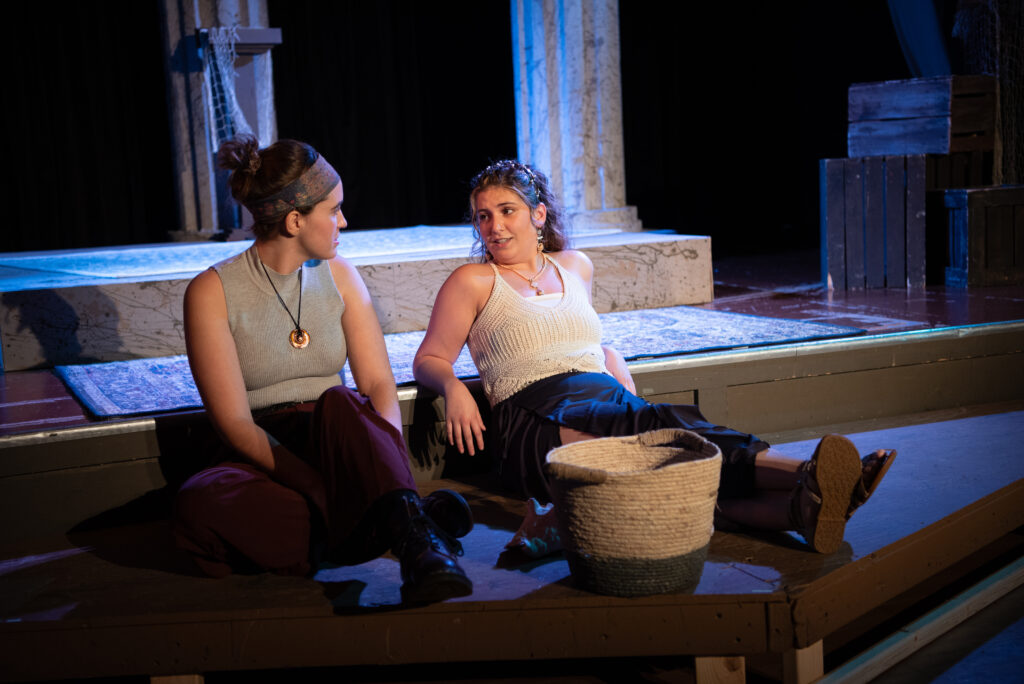
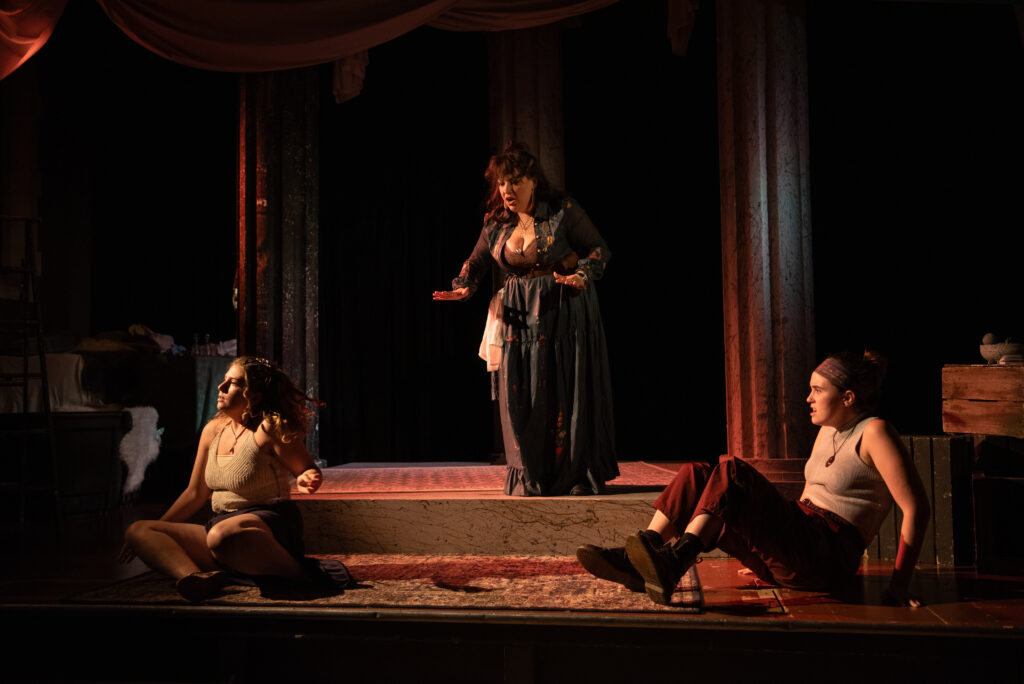
Dionyza (Zahria Moore) is her mother, who is also in charge of Pericles’s daughter, Marina (Jade Cash). They view each other more as enemies than friends. The fourth woman, Lychorida (Rachel Bailey), is a nurse who could be described as chief nurturer.

They share somewhat complicated connections and are not reticent in expressing their emotions. The focus is to confront and contrast facets of women at various stages. (They have all gone through some things!). Basically, they can run, but they can’t hide, no matter how they try to control their fates.

The dialogue appears to be a mixture of old and new styles, rooted in classic drama but with a contemporary edge. At times, the content seems like it’s translated from centuries-old text, while in other passages that establish characters’ motives, it appears to be modern musings.

Doolin has also incorporated the senses and the elements into her action, which adds an interesting texture. Kursym’s well-rehearsed ensemble are earnest in establishing their purpose, making sure they are heard as well as seen.

The actresses quickly convey their characters’ distinct personality traits. Sexton seamlessly conveys her doubts and anxieties as she questions if she is a danger because of how she views her life. Feeling like an outsider, she challenges the old-guard ways, which Dionyza is resistant to – and wants to control.

It is Sexton’s St. Louis professional acting debut, and she’s impressive. The other accomplished actresses are equally compelling.

Moore adds a haughtiness to the imperial-acting Dionyza, content to wait for the men to return home and steer their lives. She may smile, but there are motives behind the grin.

Allison Sexton and Jade Cash. Photo by Jennifer A. Lin

Marina and Philoten are oil and water, chafe at association, and accuse each other like they are teenagers grumpily thrown together. Cash is a live wire as the spunkier, more impetuous and sexually active young woman.

Bailey is convincing as a quintessential Earth Mother, and as always, commands the stage in whatever role she plays.

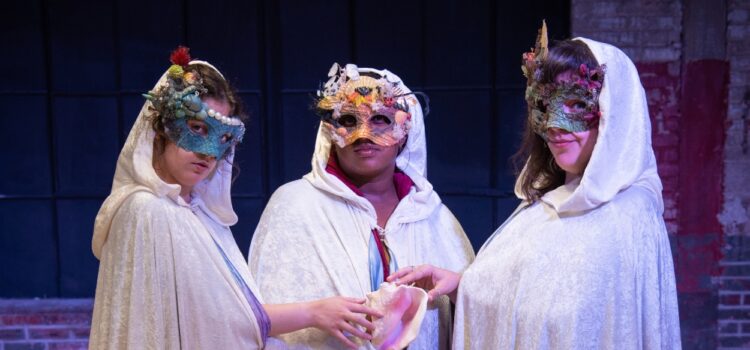
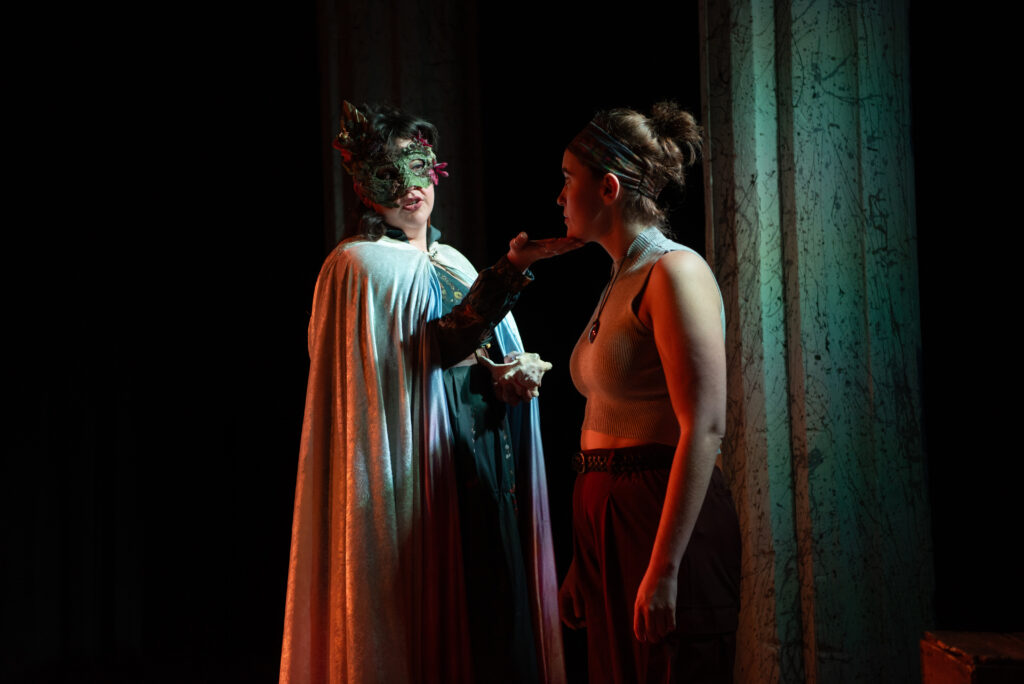
Three of the women are in dual roles as the gods that guard the Temple of the Sacred Sky, Sea and Earth, aka “The Watchers.”  They are tasked with judgment. Then we view flashbacks to see how the four women interact – relating joys, sorrows, desires and wistful memories.

The ancient setting, blending fantasy and reality, is imagined through astute atmospheric lighting design from Theresa Comstock, De’Janna Hand’s intriguing expressive sound design that has an ethereal quality. Erik Kuhn’s illustrates a simple coastal tableau in scenic design suited for the small stage, and director Tress Kursym’s costume design reflects the ages and status of the characters.

The play runs 90 minutes without an intermission.

Doolin has used the past to explore the present and raise concern about the future. It’s a topic worthy of continued conversations. Providing new perspectives and creating fem-tagonist opportunities is refreshing, and certainly welcome here.

Jade Cash, Rachel Bailey and Allison Sexton. Photo by Jennifer A. Lin

Note: On Thursday, Oct. 17, a post-show discussion on “Stealing from Shakespeare” will feature guest panelists Bryn McLaughlin, an independent director and scholar, and Hannah Baartman, a St. Louis theatre educator and performer with a deep well of inspiration in Shakespeare.

Part of the St. Louis theater community, they have performed on such local stages as The Muny, Metro Theater Company, St. Louis Shakespeare Festival, St. Louis Actors’ Studio and New Jewish Theatre. They will discuss the connection between the source text of “Pericles” and e.k. doolin’s script.

Contraband Theatre presents “Am I Dangerous?” Wednesday through Saturday at The Chapel, 6238 Alexander Drive, St. Louis. Performances are at 7:30 p.m. For more information, visit: https: contrabandtheatre.org

All tickets are pay-what-you-wish, from $0 to $30. Reserve your spot at https://events.humanitix.com/am-i-dangerous

By Lynn Venhaus

A personality-driven low-key charmer, the musical ‘[title of show]’ offers a fresh perspective with its vivacious gender-bending cast.

And what’s not to love about a 20-year-old original musical that is unapologetically OK with being “nine people’s favorite thing than a hundred people’s ninth favorite thing”?

In a world of “Cake Boss” and “The Great British Bake Off,” why not choose to be a Rice Krispie Treat? (Nothing wrong with that – and you can have one at intermission, too).

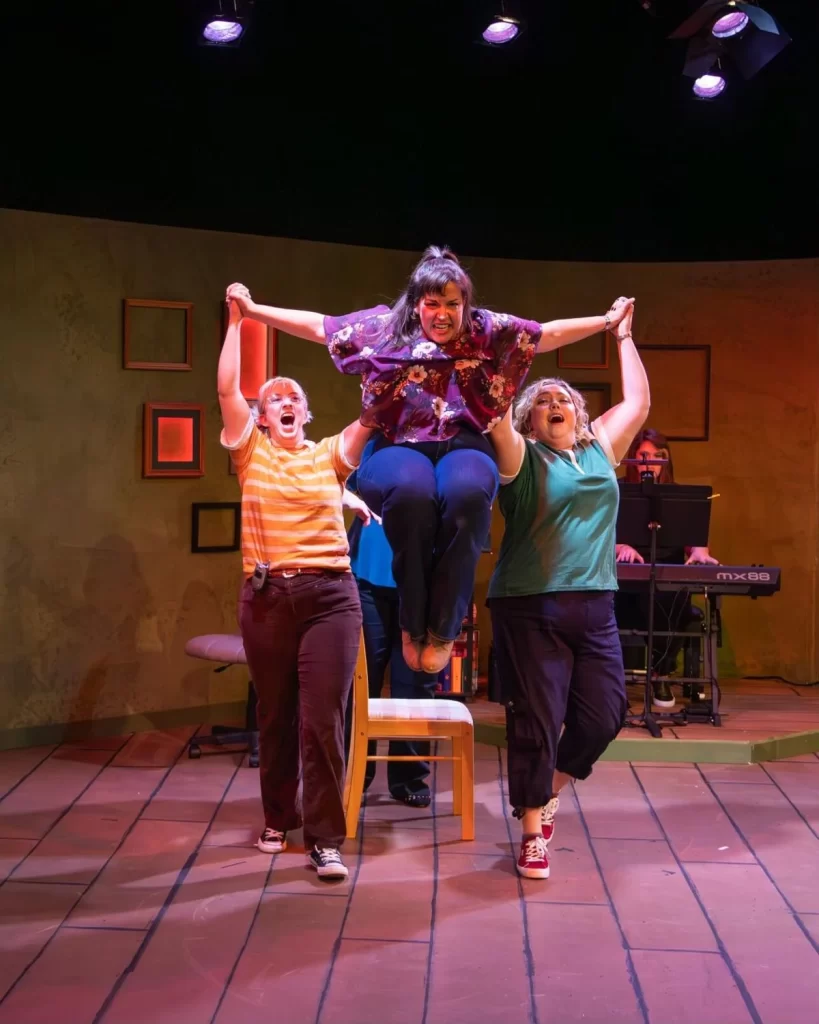
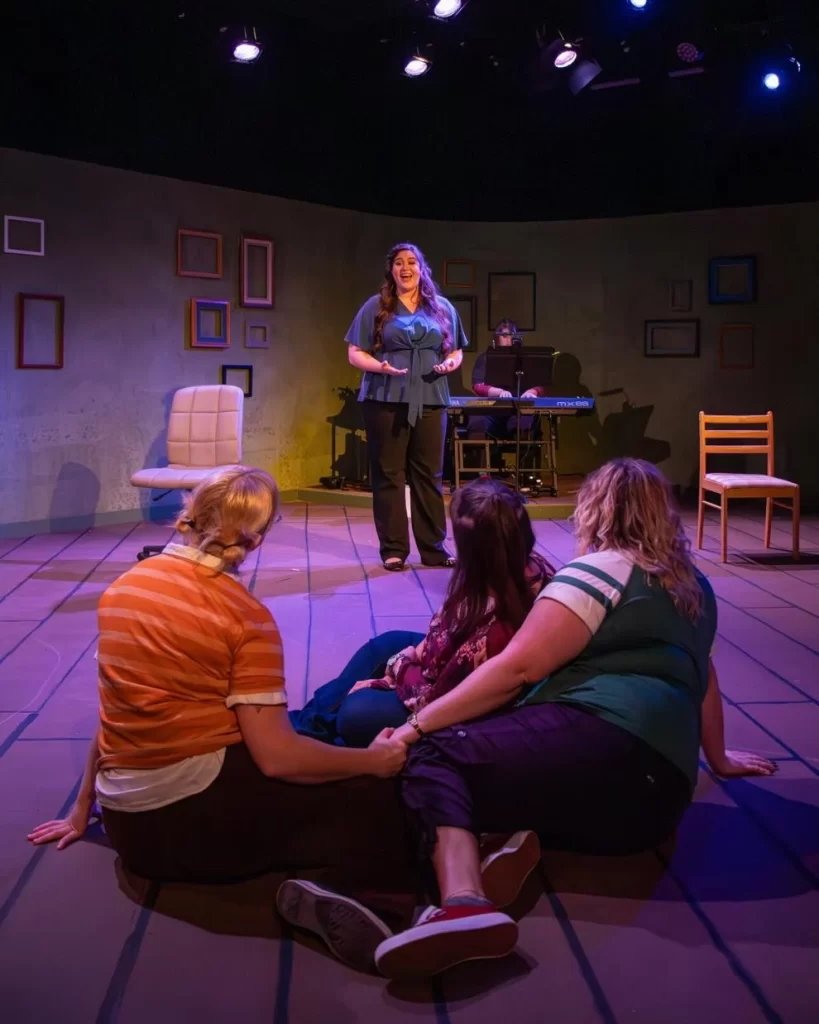
Prism Theatre Company is presenting this enjoyable modest production in two acts with a disarming all-femme quartet of performers and one expert musician accompanying them on keyboard.

Mallory Golden serves as the music director, and they are called “Larry.” They have an occasional spoken line of dialogue and comical in their timing.

They have guy names because Prism did not change those characters when they cast women. The musical’s creators – Jeff Bowen wrote the music and lyrics, Hunter Bell the book – are called Jeff and Hunter, and played by a spunky pair, Katie Orr and Jaelyn Hawkins.

It really doesn’t make a difference – it’s entertaining from this point of view because it is brimming with sly theatrical references and features a classic struggle about pursuing your dreams, no matter what obstacles. Their ambition resonates.

It’s also a tale of friendship, those pals who get you through tough times, who encourage and collaborate – and work through tension and chaos. The four principal actresses project the camaraderie that is necessary to make this show work, under the adroit direction of Sam Hayes.

Being gender-fluid doesn’t change how meta this musical is, because they are two friends who are theater artists writing a musical about writing a musical. Their first goal together is to send in an original work to the inaugural New York Musical Theatre Festival – only its deadline is three weeks away.

Their frantic, fraught creative process, with their real-life obstacles, are what makes the show unique to them. The time and place are New York City, 2004. Starving artists whose endgame is Broadway have their own sets of issues, which factors into the show – all driven by the mindset “If you can make it here, you can make it anywhere.”

And from there, their goals get bigger, their challenges more daunting, and their exasperations and aspirations escalate. It’s clever and funny in a very natural, authentic way.

Rounding out the cast are their two friends they cast in their show. Rachel Bailey is sassy, snarky Susan, a comic actress whose day job is an office worker, and Savannah Fernelius is assertive Heidi, a polished performer who wonders if she is doing the right thing hitching her wagon to this project. They are based on Susan Blackwell and Heidi Blickenstaff, who not only were in the show, but were part of the process.

It is a wild rollercoaster ride of emotions for the quirky characters, all who have skin in the game. They yearn for fame and recognition. They persist. They want to matter, find their place in the world.

The creative team may be “Two Nobodies from New York” but they want to be “Part of It All.” Why not dream big? (“The Tony Award Song”).

The two writers are imaginative and capable. Their progress is chronicled in such witty ditties as “An Original Musical” (with the proverbial blank piece of paper) and “Filling Out the Form.”

Their brainstorming techniques are hilarious in “Monkeys and Playbills.” The second act’s stakes are captured in “Montage Part 1: September Song,” “Montage Part 2: Secondary Characters” and “Montage Part 3: Development Medley.”

The four are not only nimble at comedy, but can crisply sell a showtune with strong melodic voices.

Katie Orr, Rachel Bailey and Jaelyn Hawkins. Photo by Cady Bailey.

The Susan-led “Die, Vampire, Die!” is an ingenious way to vanquish demons and doubts, and Bailey is good at animated delivery.

In her professional debut, Fernelius makes quite an impact with silky-smooth vocals, and powerfully delivers a stunning “A Way Back to Then.” She has been standing out in college and community theater and is indeed ready for her close-up.

The show’s offbeat approach obviously differentiates from fairy tale-fiction in a land of enchantment (“Into the Woods” references abound, by the way). The quartet are more self-aware than naïve, more jaded and cynical about the highs and lows in life yet wear their hearts on their sleeves and they wish.

Their strengths and weaknesses are fully on display, not unlike those four unfiltered millennials in the HBO television series “Girls” that ran for five seasons. Raw and real, they aggravate each other and express their feelings.

Hunter fires off torrents of profanity, easily upset and distracted. (You can imagine him/her erupting at the neighborhood association meeting). Hawkins is funny in her no-holds-barred character’s tendency to go to DEF-CON 1.

Like many well-meaning longtime friends, Jeff knows how to deal with Hunter, and Orr is instinctive in her portrayal of the one who isn’t prone to histrionics.

There is a mature content advisory: “This play contains heavy adult language and open discussion of adult content. Audience discretion is advised.”

The pair of actresses playing actresses are creating an identity through their roles – “I Am Playing Me” and are initially at odds with each other – “What Kind of a Girl Is She?”

Savannah Fernelius is Heidi. Photo by Cady Bailey.

This is Prism’s first musical, and as a love letter to musical theater, it’s an interesting exchange of ideas and talents. It’s yet another version of “The Little Engine That Could,” showbiz style.

And in their hands – heartfelt. Co-producers Joy Addler (managing director) and Trish Brown (artistic director) founded this regional professional theater troupe with the mission of supporting women. This season’s theme is “Raise Your Voice.” I’d say this choice is apt.

The earnest presentation has a rough-around-the-edges quality yet has the enthusiasm of Judy Garland and Mickey Rooney gathering the neighborhood kids in those “Hey kids! Let’s put on a show!” old-timey musicals – but instead of a barn, they’re in a minimalistic rehearsal space with four chairs.

On a much smaller scale, this show follows the world-building on display in big-deal beloved musicals like “A Chorus Line,” “Singin’ in the Rain,” and “Dreamgirls.”

While it may not have a showstopper like “What I Did for Love,” the substantive songs showcase their doubts, fears, instincts, hopes and dreams in a relatable way.

Cady Bailey’s choreography is appropriate for the characters and incorporates snappy theatrical dance moves in an endearing way.

The quartet’s fervor for this material is perceptible, so is their warmth. The way they work together is specific, which adds a distinctive flavor to the show. There isn’t a whiff of artifice or slickness, rather a gutsy “Take us as we are” attitude.

And their work-in-progress show is constantly expanding and involving, as they adapt, evaluate, revise, re-evaluate, and have hissy fits. “Change It/Don’t Change It” illustrates those efforts, and “Awkward Photo Shoot” is a full-out meltdown of dysfunction.

Scenic designer Caleb D. Long has kept things basic and functional, with a nifty arrangement of frames that light up, and the noteworthy lighting design by Catherine Adams is effective. Golden also did the sound design, which is without issues in the intimate Kranzberg Black Box.

Their costumes, designed by Hayes, are everyday casual, look like out-of-their-closet selections. The sense of a team effort, with Sadie Harvey assistant director and props master, Katie Smith props artisan, carpenter William Higley, along with technical director Caleb D. Long, Golden, and Adams is apparent.

Bell and Bowen may not be as well-known as Pasek and Paul or as hip as Kerrigan and Loudermilk, but their memorable original work “[title of show]” earned awards nomination and elevated their credentials.

Bell, a graduate of Webster University’s Conservatory of Theatre Arts, won an Obie special citation award and was nominated for Drama League, GLAAD Media and Tony awards for best book of a musical. Bowen won an Obie special citation award for the music and lyrics.

After the musical debuted at the festival, two years later it opened off-Broadway at the Vineyard Theatre in 2006 and then moved to Broadway two years later, at the Lyceum Theatre, in 2008.

Proactively, in hopes of mounting the show at a Broadway theater, Bell and Bowen created a video blog, called “The [title of show] Show” that documented the musical’s progress and featured famous guest actors in episodes that went viral. In Episode 8, mission accomplished: the New York Times announced the show’s opening date at the Lyceum. (The show continued as a web series with a season 2, music videos and specials.)

What Bell and Bowen have learned the hard way – albeit with a delightfully improbable successful run about what all goes into making a musical — (and they did it before “Something Rotten!”) – can be summed up through the words of philosopher Ralph Waldo Emerson: “It’s not the destination, it’s the journey.”

This cast’s exuberance and the creative team’s efforts result in a satisfying tag-along adventure. Its candor and cheekiness are refreshing. And yes, that was Sutton Foster leaving a voice mail rejecting their offer. Touche!

Prism Theatre Company presents “[title of show]” weekends through Sept. 8.  Performances take place at the Kranzberg Center in Grand Center, 507 N Grand Blvd, St Louis, MO 63103. For more information: prismtheatrecompany.org.

For tickets, visit https://www.metrotix.com/events/detail/prism-theatre-company-title-of-show

By Lynn Venhaus

A social satire is not fulfilling its goal if it doesn’t outrage somebody, and “Sister Mary Ignatius Explains It All for You” is certainly provocative.

Stray Dog Theatre’s production pushes buttons, even though the show is now 43 years old. Wickedly funny, bold and acrimonious, the company wisely played it straight.

But you won’t find protesters outside Tower Grove Abbey. This time at least. Stray Dog Theatre isn’t a group that shies away from controversial subject matter and has presented bold and unconventional fare before. (For instance, this year alone, Charles Busch’s campy satire “Vampire Lesbians of Sodom” was the June show).

Christopher Durang’s watershed 1979 play takes aim at Roman Catholic dogma, and specifically, a rigid teaching nun for her over-reaching and unchecked abuse of power.

For his absurdist comedy, he mocked the nuns as authority figures. Apparently, he had a lot of anger from being raised Catholic. With identity and sexual disorientation being among his frequent themes, of course he channeled it all in this script.

As a graduate of Our Lady of Peace School in Providence, New Jersey, Durang no doubt stored material as he matriculated there, and went on to Harvard and Yale School of Drama. He also won the Obie Award for Best Playwright in 1980, at age 32, for this work. (Much later, he won a Tony for “Vanya and Sonia and Masha and Spike” in 2012).

“Sister Mary Ignatius” brought him to national prominence and raised the ire of St. Louis Catholics. If you think Billy Joel’s song “Only the Good Die Young” caused a ruckus in the St. Louis Archdiocese in 1977, well they went ballistic when the Theatre Project Company announced they would be presenting the black comedy in 1983. Thirty years ago, the archbishop condemned it, and protests ensued.

But these days, after years of clergy being unfavorably in the spotlight, and nuns as characters in both comedies and dramas, “Sister Mary Ignatius” isn’t the lightning rod it once was. And Catholics have other things more pressing to worry about – although being traumatized by a religious order should remain high on the list.

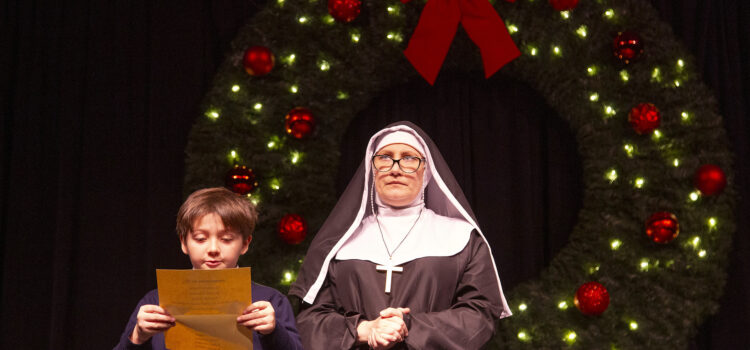
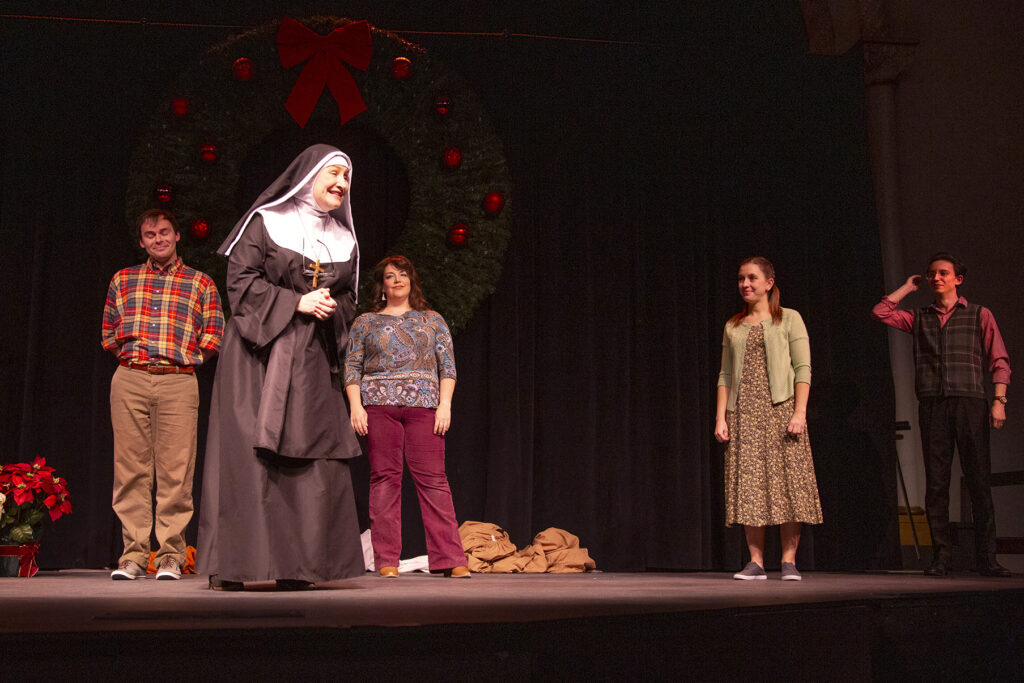
The one-act starts out with a conventional structure but then meltdowns begin. Sister Mary Ignatius, played with utmost conviction by Sarajane Clark, is still teaching children about the perils of sin and hellfire when several alumni – mostly hot messes — come for a visit. When she finds out how far these members of her flock have strayed from the path of righteousness, well let’s just say there are some shocking consequences.

Tables turn, and it isn’t pretty. Director Gary F. Bell stages it as an absurdist horror film.

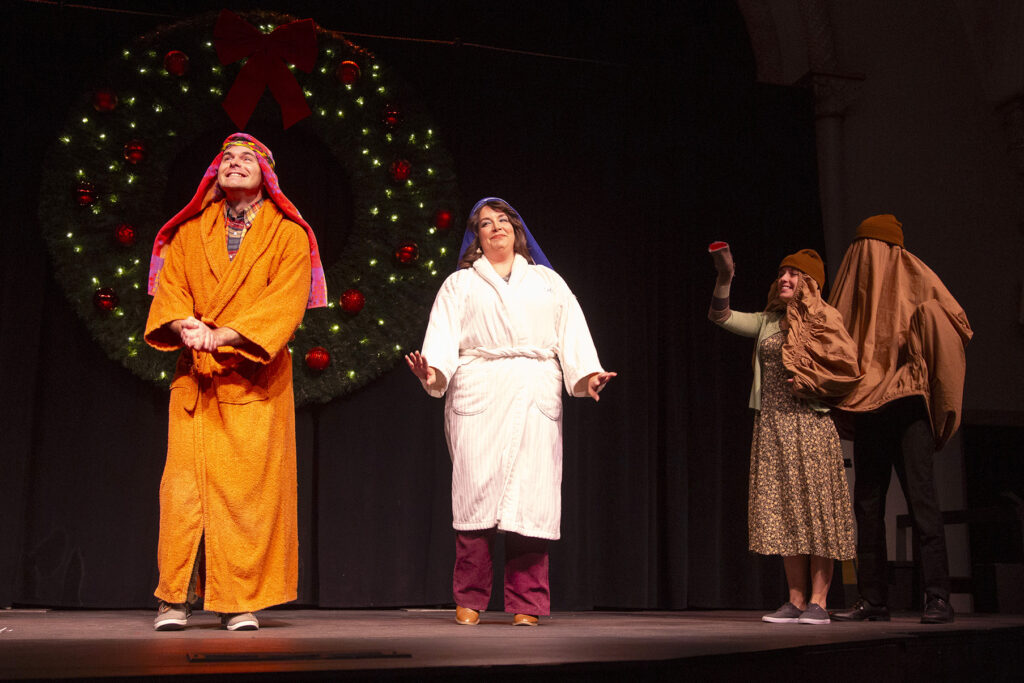
Rachel Bailey is the emotionally wounded Diane Symonds, who threatens Sister’s life. Eileen Engel is Philomena, an unwed mother, Stephen Henley is Gary, polite and gay, with Sean Seifert as Aloysius, a troubled alcoholic. They’re all genuine on stage, veterans that they are.

Sister’s obedient little Thomas is played with poise by youngster Tommy Pepper, who misses the violence on stage.

Anyone who went to a parochial school will be reminded of catechism teachings and how rigid certain nuns were.

Sister Mary Ignatius is an extreme example, but there are nuggets of truth in this mischievous manifesto. The sharp satire makes for some uncomfortable and awkward moments, so folks are warned in case there would be triggers.

Stray Dog Theatre presents “Sister Mary Ignatius Explains It All for You” for mature audiences Thursday through Saturday at 8 p.m. Nov. 30 – Dec. 16. For tickets or for more information, visit www.straydogtheatre.org.

All photos by John Lamb

By Lynn Venhaus

Hold on to your pearls, for “Triassic Parq: The Musical” is a raunchy romp of an offbeat musical comedy.

A parody of the film and novel “Jurassic Park,” the blockbuster 1993 science-fiction action thriller by Steven Spielberg adapted from Michael Crichton’s 1990 bestseller, this is flipped for the dinosaurs’ point of view.

Talk about a chaos theory. Bedlam ensues when one of the genetically engineered female dinosaurs turns male – spontaneously. It’s not nice when you fool Mother Nature – but it sure is naughty.

Goofy and gutsy as can be, the Stray Dog production features a winning cast that gives it their all, in belting out power ballads and selling daffy up-tempo numbers, with light-hearted choreography by Mike Hodges. I don’t think I’ve ever seen a cast work so hard with material that’s this absurd and thin.

Tristan Davis is the Velociraptor of Innocence, all swaggering rocker in “Get Out,’ while Michael Wells is the evangelist-like Velociraptor of Faith, reveling in the campiness of “Morning Assembly” and “Hello, Little Goat” – exhibiting strong, soaring vocals after not being on the stage since “Guys and Dolls” in the Before Times.

Laurell Stephenson is spirited in dual roles — as the skeptical Velociraptor of Science and then having fun interacting with the audience as a character named Morgan Freeman – that was actually played by the deep-voiced Oscar winner once upon a time. He/she disappears quickly after a hilarious set-up.

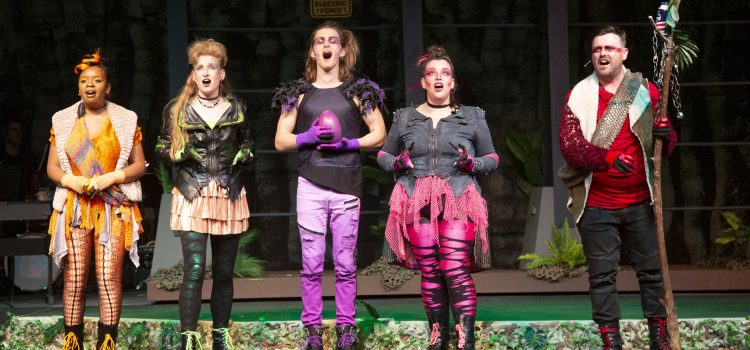
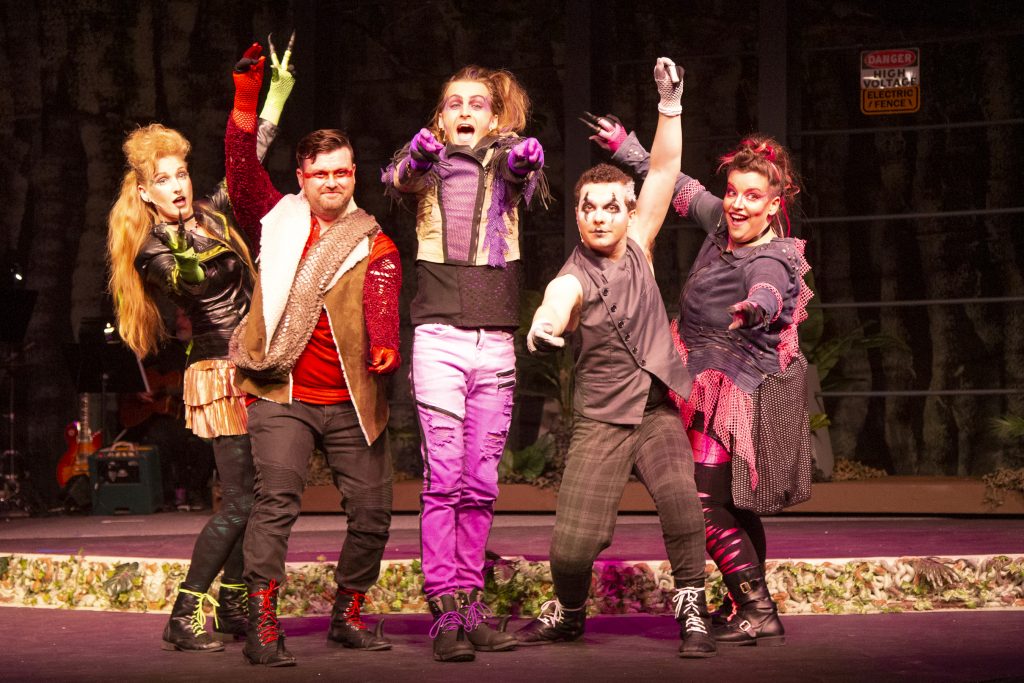
The fearless pair of punk rocker grrrls stand out as the Tyrannosaurus Rexes – a frisky Dawn Schmid as T-Rex 1/Kaitlyn and ballsy Rachel Bailey as the dial-it-to-11 confused T-Rex 2. They unleash their attraction in “Love Me As a Friend.”

The spunky ensemble accepts the wild-ride aspect and overcomes what the silly show lacks in sustainability.

This playful cast of six starts out with high energy in “Welcome to Triassic Parq” – and continues full-throttle to win over the eager crowd in 14 songs while dishing out a lot of sexual innuendo. It would seem like zany schoolkids’ antics were it not for the quality of the vocals – like a John Mulaney Broadway musical parody on “Saturday Night Live.”

Photos by John Lamb

But this is an actual musical that played off-Broadway in 2012 after winning best overall musical production at the 2010 New York International Fringe Festival. The music and lyrics are by Marshall Pailet, with co-lyricists Bryce Norbitz and Steve Wargo, and all three combined on the book.

Songs include lyrics about penises for shock value – “Dick Fix,” riffing on John Williams’ symphonic score “We Are Dinosaurs,” and outlandish “Mama.”

The band is led by Pianosaurus Leah Schultz (and music director0, with Adam Rugo the Guitaratops and Joe Winters the Drumadon.

Director Justin Been goes for the gusto, keeping things zippy and nonsensical, aiming to achieve a real crowd-pleaser, especially for a generation who grew up with the “Jurassic Park” movie trilogy and returned for the franchise offshoot “Jurassic World.”

The original won three tech Academy Awards, while the two even more preposterous sequels in 1997 and 2001 stretched the boundaries of logic, even for sci-fi/fantasy. A reboot called “Jurassic World” in 2015 was followed by a sequel in 2018, with the latest, “Dominion,” set to open June 10.

But in the one-act musical, performed without an intermission, you do not need that much familiarity with the 30-year-old source material, for the emphasis is on spoofing religion, sex, and identity. The prehistoric setting is purely for laughs.

Eileen Engel designed functional costumes with a touch of whimsy to convey the gender-bending.

Scenic designer Josh Smith worked magic in his scaled-down version of the Isla Nublar theme park on the Tower Grove Abbey stage, stunning without benefit of computer-generated imagery or visual effects.

The technical efforts add considerably to the overall presentation, including lighting by Tyler Duenow and outstanding sound work.

Stray Dog has always had a penchant for producing quirky plays –such as the “Evil Dead” musical, Charles Busch’s “Psycho Beach Party,” and “Red Scare on Sunset,” as a different direction between more serious explorations. So the strange, slight “Triassic Parq” is well-suited to be in between “Good People” and “The Normal Heart” this 2022 season.

Whether or not you are fascinated by dinosaurs is immaterial. This is not meant to be anything more than saucy merriment, so lower expectations and accept the vulgarity (or not – this is intended for “mature” adult audiences, as in rated R).

Stray Dog Theatre presents “Triassic Parq: The Musical” from April 15 through 30, with performances 8 p.m. Thursday-Saturday; with additional performances at 2 p.m. on Sunday, April 24, and at 8 p.m. on Wednesday, April 27, at the Tower Grove Abbey, 2336 Tennessee Avenue. For more information or tickets, visit www.straydogtheatre.org.