Patricia Racette’s production finds operatic scale, emotional truth and remarkable balance in Williams’s enduring tragedy.

By CB Adams

Andrew Boyce’s scenic design announces Opera Theatre of Saint Louis’s intentions before a note is sung. Towering walls of weathered white shutters dominate the stage, instantly evoking New Orleans while suggesting something more confining.

Projected across those walls, a black-and-white montage culminates in a huge streetcar lumbering toward the audience with the slow, inexorable force of a locomotive.

It is a striking image and an honest one. We know where this story is headed. Racette and Boyce embrace that inevitability from the outset. There is no attempt to disguise the destination. Some productions try to improve the classics. This one trusts one.

André Previn’s opera, with a libretto by Philip Littell, remains remarkably faithful to Williams’s play. Racette embraces that faithfulness as an artistic choice. She trusts Williams’s characters, conflicts and hard-earned understanding of human weakness. The result never feels preserved under glass.
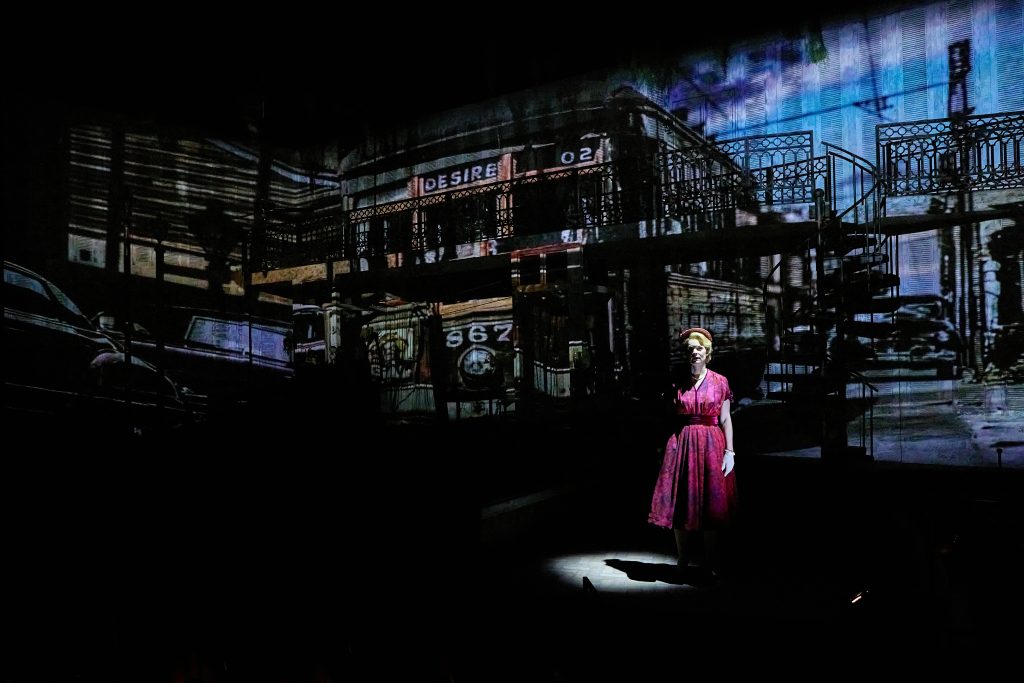
Blanche DuBois (Sara Gartland) arrives in New Orleans. Photo by Eric Woolsey.

Daniela Candillari leads the St. Louis Symphony Orchestra with equal command. Previn’s score moves beneath the action like an unseen current, deepening tension and longing without overwhelming the drama unfolding onstage. Candillari maintains an ideal balance between pit and stage. The orchestra remains firmly in service to the story.

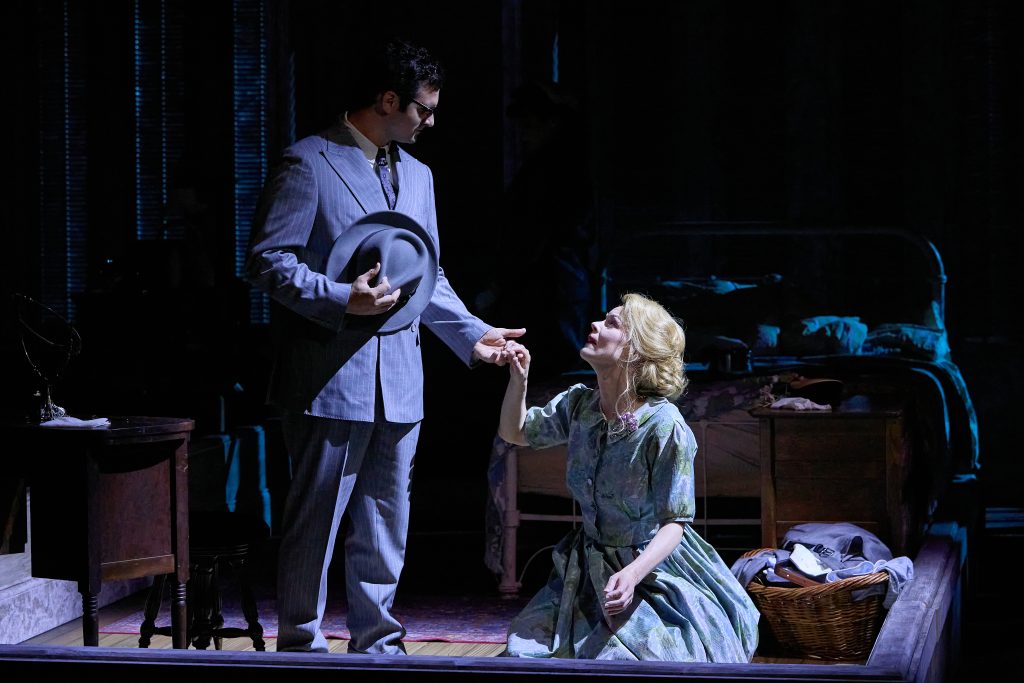
The production’s dramatic engine is the ongoing contest between Sara Gartland’s Blanche DuBois and David Adam Moore’s Stanley Kowalski. They spar like star pugilists across Williams’s language and Previn’s score, each encounter carrying as much psychological force as vocal power.

Gartland captures Blanche’s contradictions without simplifying them. Under Racette’s careful guidance, her Blanche remains vain, vulnerable, manipulative, frightened, self-aware and self-deluding, often simultaneously.

Moore faces the equally difficult task of making Stanley more than a brute. He succeeds. Stanley’s eventual victory remains disturbing, but Moore preserves enough magnetism and humanity to make it believable.
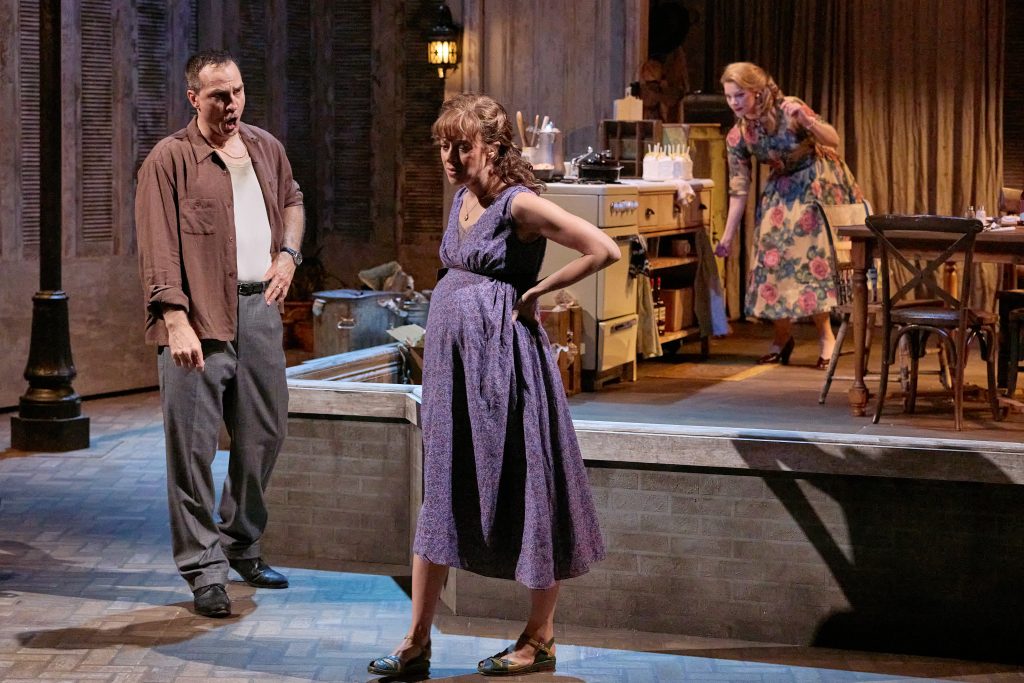
(L to R) David Adam Moore as Stanley, Lauren Snouffer as Stella, and Sara Gartland as Blanche in “A Streetcar Named Desire.” Photo by Eric Woolsey.

Racette allows Stanley’s appeal to remain visible even when his behavior becomes reprehensible. His spoken dialogue, used sparingly throughout the opera, sharpens the realism of the surrounding music rather than interrupting it.

Just as important is Lauren Snouffer’s Stella. More than a participant in Blanche and Stanley’s struggle, she becomes the emotional fulcrum of the evening, giving equal weight to Stella’s love for Blanche, desire for Stanley and determination to survive the impossible position in which she finds herself.

The relationship between the sisters is rendered with uncommon care, while Stella’s marriage to Stanley remains equally persuasive. Those relationships feel lived-in rather than merely dramatic.

Boyce’s towering shutter walls evoke New Orleans architecture while functioning as a kind of emotional enclosure. At times they resemble prison bars, at others the walls of memory closing around Blanche. Their scale is distinctly operatic, creating a world far larger than the cast occupying it.
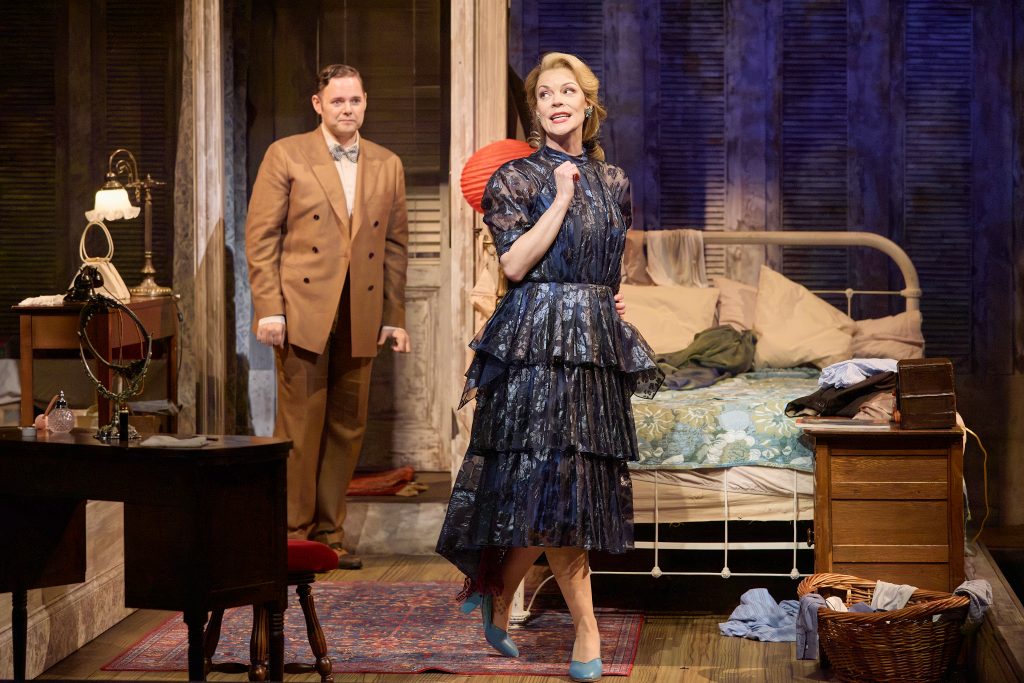
Blanche (Sara Gartland) flirts with the smitten Harold “Mitch” Mitchell. Photoby Eric Woolsey.

Yet Gartland, Moore, Snouffer and their colleagues fill that space through voice, presence and sharply defined characterizations. They do not merely survive the set. They complete it. In a production with relatively few principals, there is nowhere to hide. Every performer must command the space. They do.

The supporting cast contributes significantly to that achievement. Bille Bruley’s Harold Mitchell brings warmth and humanity to the role, while Ashlyn Brown’s Eunice provides an earthy, clear-eyed counterpoint to Blanche’s unraveling. Her nurturing support of Stella reinforces one of the production’s central relationships and helps ground the emotional reality of Elysian Fields.

The ensemble consistently strengthens Williams’s world. Kim Stanish is especially memorable as the Nurse in the final scene. Her prolonged struggle to restrain Blanche avoids melodrama and instead underscores the heartbreaking finality of the character’s collapse, a moment Racette allows to linger rather than rush past.
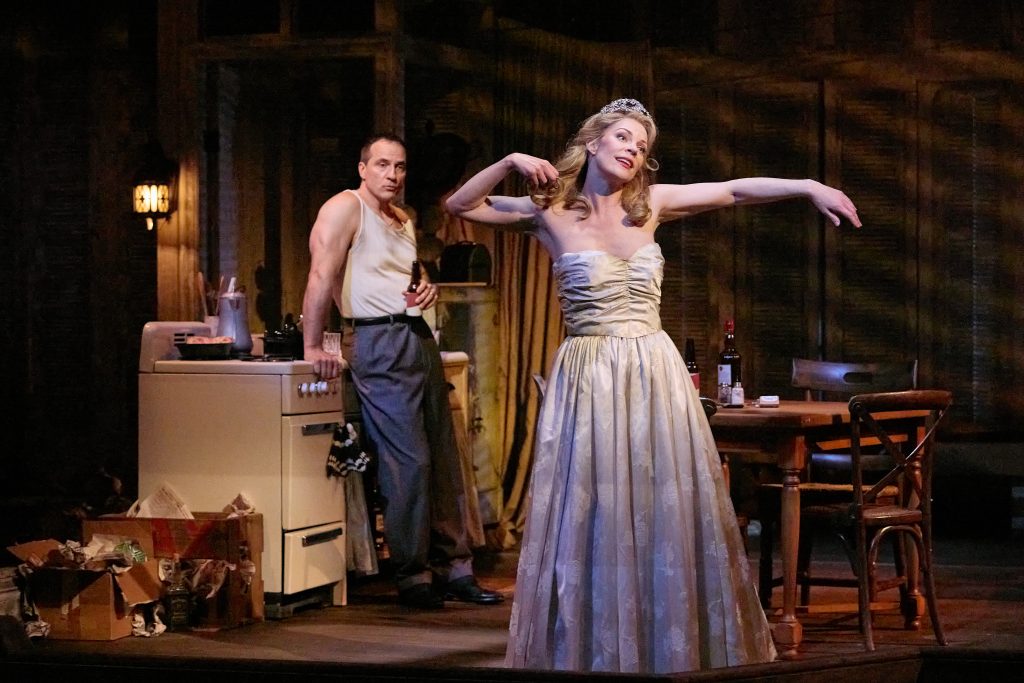
Blanche (Sara Gartland) begins to unravel under Stanley’s (David Adam Moore) menacing presence. Photo by Eric Woolsey.

The production’s scenes of violence and sexual assault are staged with careful restraint. Racette, intimacy coordinator Delaney Piggins and fight choreographer Shaun Sheley convey the ugliness of Stanley’s actions with just enough physical detail to communicate their impact without lapsing into sensationalism.

The projections prove equally effective throughout the evening. Most haunting is the appearance of Blanche’s young husband, whose portrait looms over the stage just as relentlessly as his memory looms over her life.

Throughout the evening, projections become another actor in the drama, carrying memory and desire across Boyce’s towering walls. By the time Blanche reaches her final music, Gartland and the production have earned every note of it.

“A Streetcar Named Desire” continues at Opera Theatre of Saint Louis through June 26 at the Loretto-Hilton Center on the Webster University campus as part of OTSL’s 2026 Festival Season. Ticket information, performance schedules and additional production details are available on the Opera Theatre of Saint Louis website.
A shattered Blanche (Sara Gartland) is gently led away by a doctor (Erik DeMario). Photo by Eric Wooley.

By CB Adams

“Die Fledermaus” is a sparkling comedy of mistaken identities, romantic mischief and champagne-fueled revenge. In Opera Theatre of Saint Louis’s new production, director Shawna Lucey reimagines Johann Strauss II’s classic operetta in the sleek, high-society world of 1960s Manhattan, where cocktail culture and social games set the stage for elegant chaos.

But within this stylish interpretation, there’s something a little new: theft. This “Die Fledermaus” gives new meaning—not just of time and trust, but of the spotlight itself. Nearly every performer finds a moment (or more) to dazzle, tease or upend expectations, and by the curtain call, the show has delivered its comic comeuppance—and it’s stolen your heart. What a way fabulous and fun way to start the company’s current four-opera festival and celebrate its 50th year!

OTSL’s “Die Fledermaus” is a fizzy, stylish delight, reimagining Strauss’s operetta in the sleek, mid-century world of sharp tailoring, cocktail culture and social intrigue. Director Lucey leans into the era’s glamour and satire, crafting a production that feels timeless and freshly minted. The setting proves an ideal backdrop for the operetta’s themes of disguise, flirtation and comic reckoning.

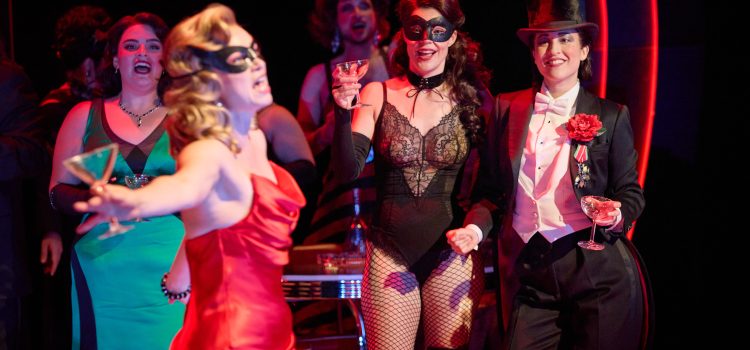
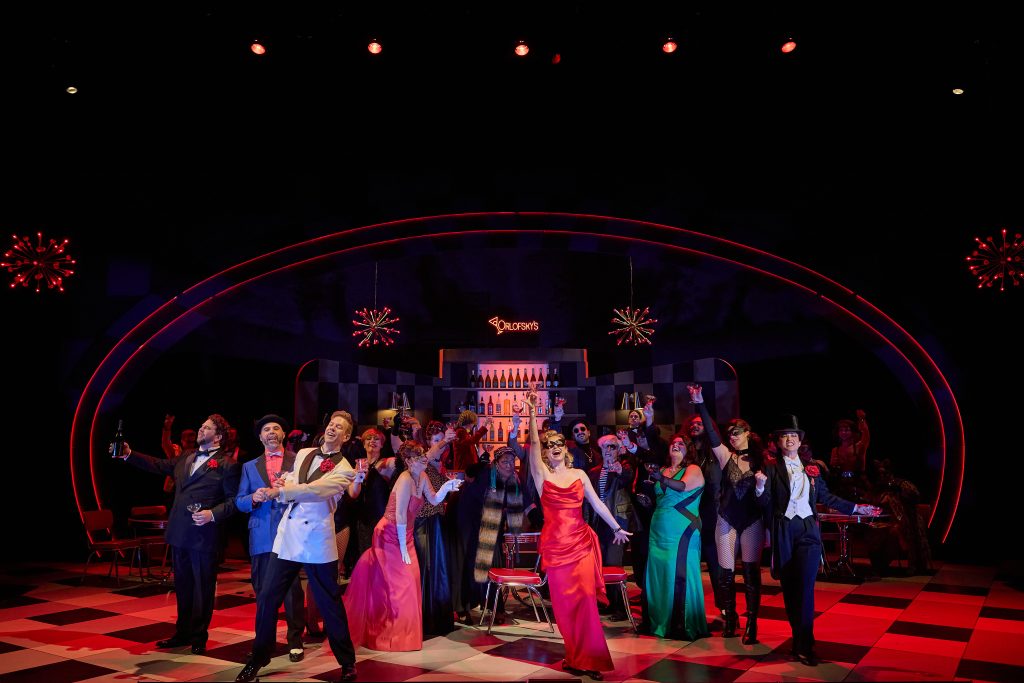
Two scenes in particular showcase the production’s inventiveness and theatrical flair. One is the Act II party, relocated to Prince Orlofsky’s Manhattan penthouse shaken and stirred with a dazzling swirl of martinis, mod fashion and musical mischief. The party becomes a playground for mistaken identities and social games with Kelsey Lauritano’s delightfully eccentric Orlofsky presiding over the chaos like a bemused Warholian host.

Lauritano’s smoky, wine-dark mezzo and magnetic presence give the character a cool detachment and sly charisma. Channeling a touch of Judy Garland glam, Bob Mackie sparkle and the cool mystique of Marlene Dietrich—think, too, of Maurice Chevalier with a Russian accent—she transforms the traditionally male role into a showcase of flair and effortless command.

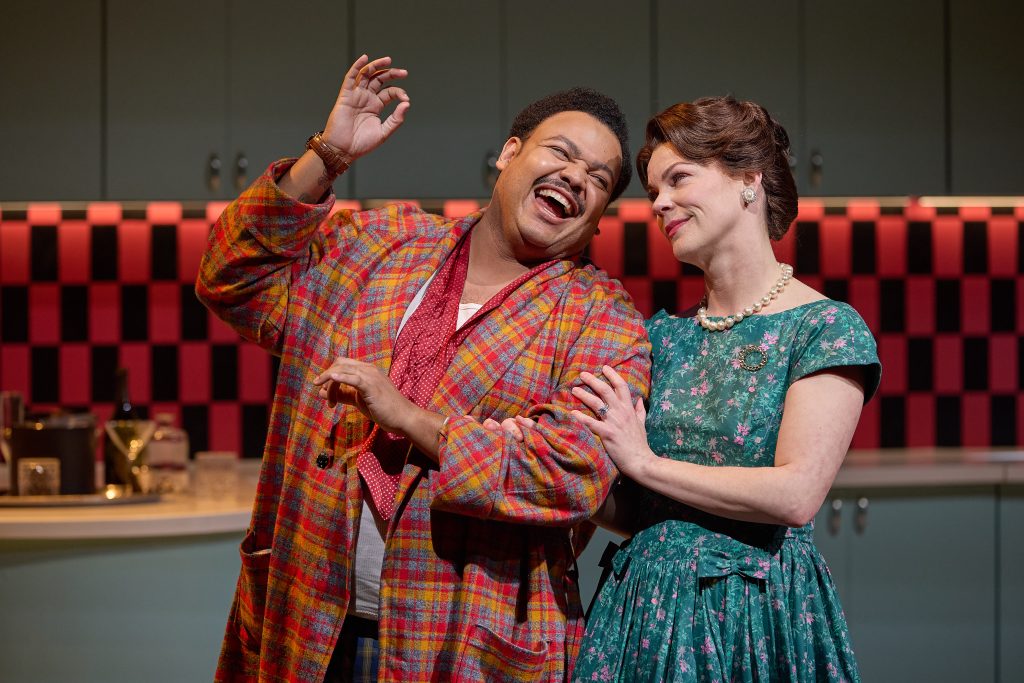
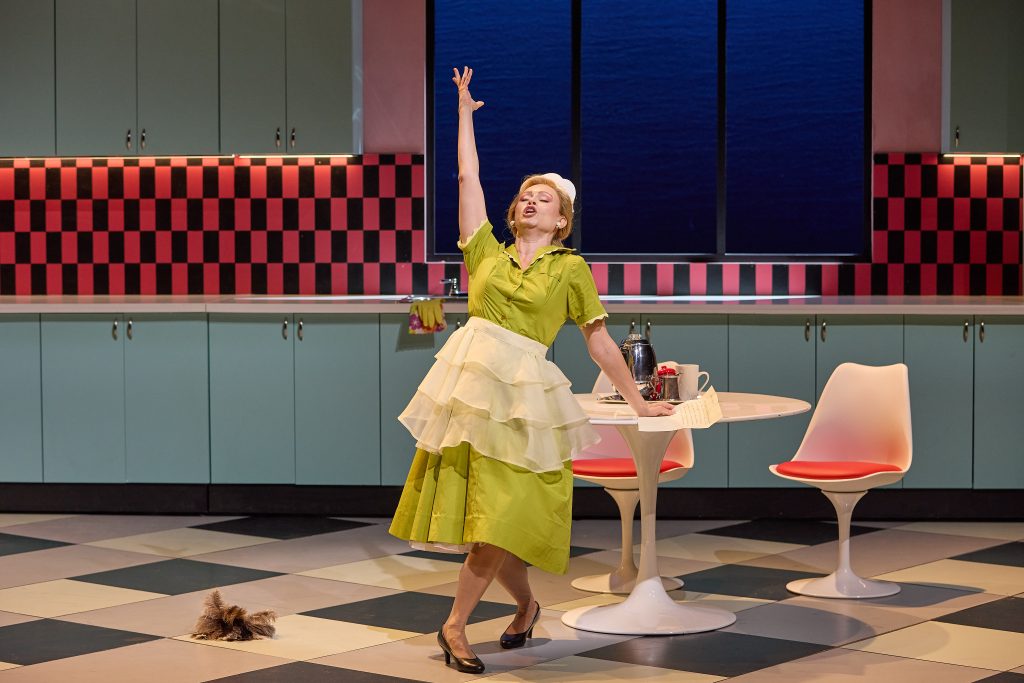
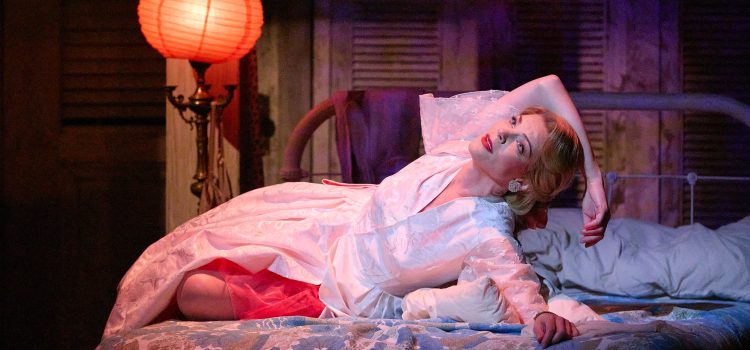
Sara Gartland shines as Rosalinde, bringing vocal radiance and comic precision to a role that demands transformation and versatility. Her journey from a weary, overlooked housewife to a commanding Hungarian countess is one of the production’s most fun performances.

The role calls for lyrical warmth and agile coloratura, especially in the aria “Klänge der Heimat,” where Gartland’s expressive phrasing and technical finesse reveal Rosalinde’s emotional depth and theatrical flair.

Deanna Breiwick as Adele. Photo by Eric Woolsey.

Deanna Breiwick’s Adele, masquerading as an actress, seizes every comic beat with sparkling wit and vocal agility, her luminous soprano effortlessly navigating the role’s coloratura flourishes. With a stage presence that radiates charm and precision, she blends vocal athleticism with a keen sense of comedic timing, making each moment feel both spontaneous and impeccably crafted.

The visual centerpiece of this production is Robert Innes Hopkins’ dazzling set for the Act II party at Prince Orlofsky’s penthouse—a gleaming, mid-century Manhattan fantasia that perfectly captures the production’s blend of elegance and irony. Known for designs that marry classical structure with theatrical flair, Hopkins creates a space that feels both expansive and intimate, a playground for disguise and deception bathed in sleek lines and shimmering surfaces.

His costume designs are equally impressive, with every character—from leads to ensemble—dressed in looks that evoke period glamour with a wink of camp. Even background figures are meticulously imagined, including one party guest who looked like a vintage Barbie doll come to life, adding layers of visual delight to an already sumptuous scene.

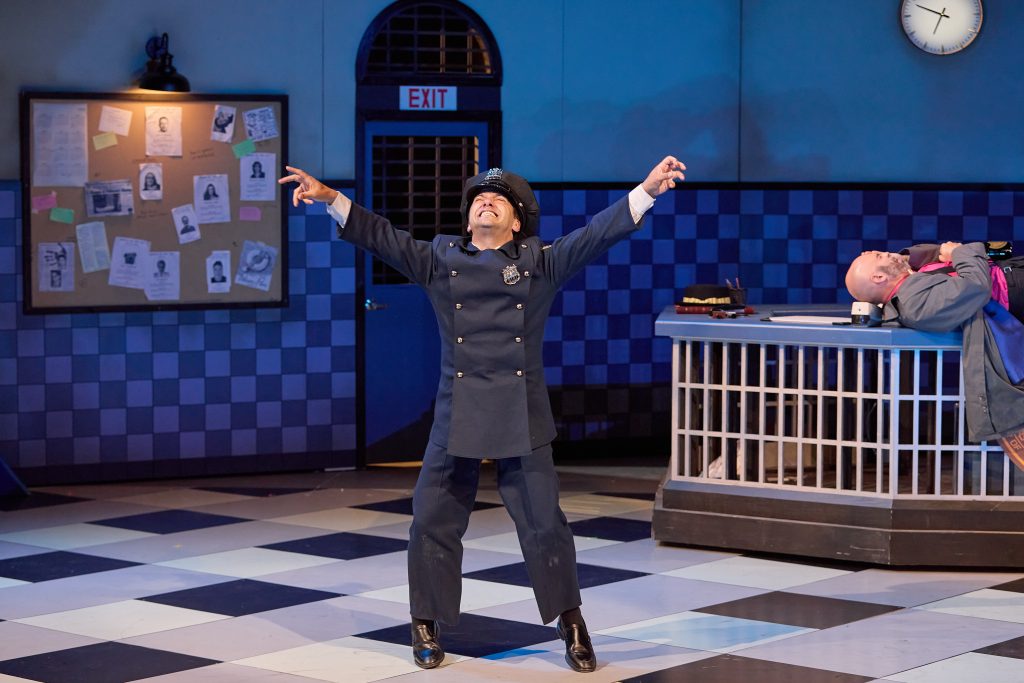
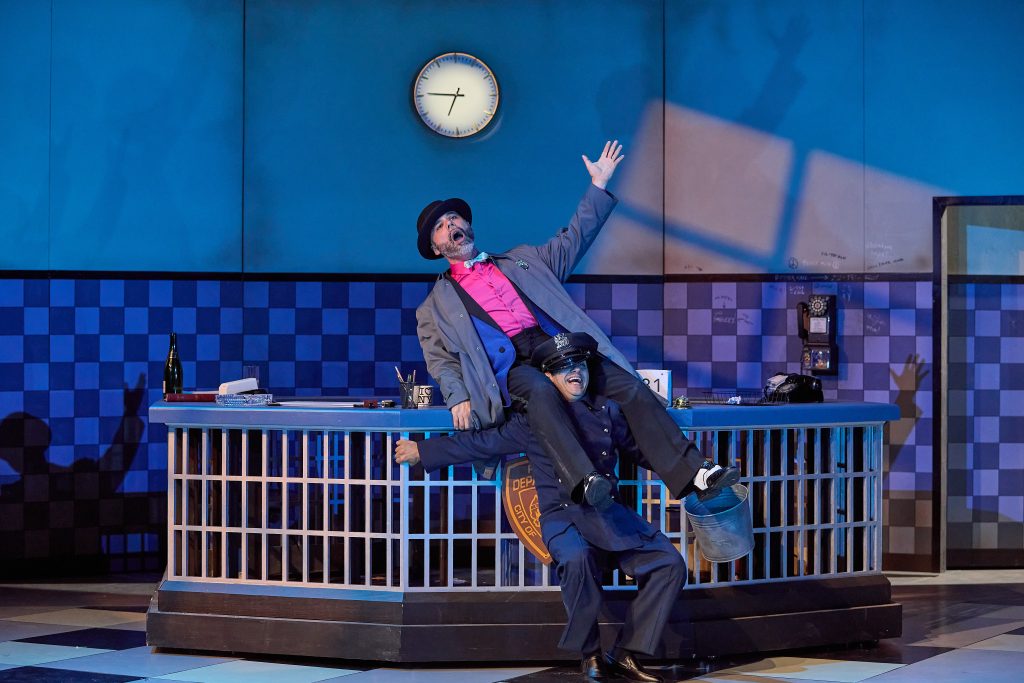
Oscar Olivo as Frosch. Photo by Eric Woolsey.

The other showstopper is the Act III police station scene that shifts gears into full farce, set in a stylized, grungy precinct with “NYPD Blue” and “The French Connection” vibes. Here, the production leans into physical comedy and improvisational energy, with Oscar Olivo’s Frosch, delivering a riotous performance as a world-weary jailer whose antics nearly steal the show.

Robert Mellon’s Frank, the prison warden, is a comic gem, and the ensemble’s timing is razor-sharp. The scene’s loose structure allows for playful invention, and this cast makes the most of it, turning bureaucratic absurdity into comic opportunities.

The cast is uniformly strong, brimming with vocal brilliance and sharp comedic instincts. It’s not easy to pinpoint who deserves the most credit—the singers, Lucey or choreographer Seán Curran—for sustaining such energetic, physically demanding movement across the stage while maintaining vocal clarity. It’s a shared achievement that speaks to the production’s careful coordination and the performers’ versatility.

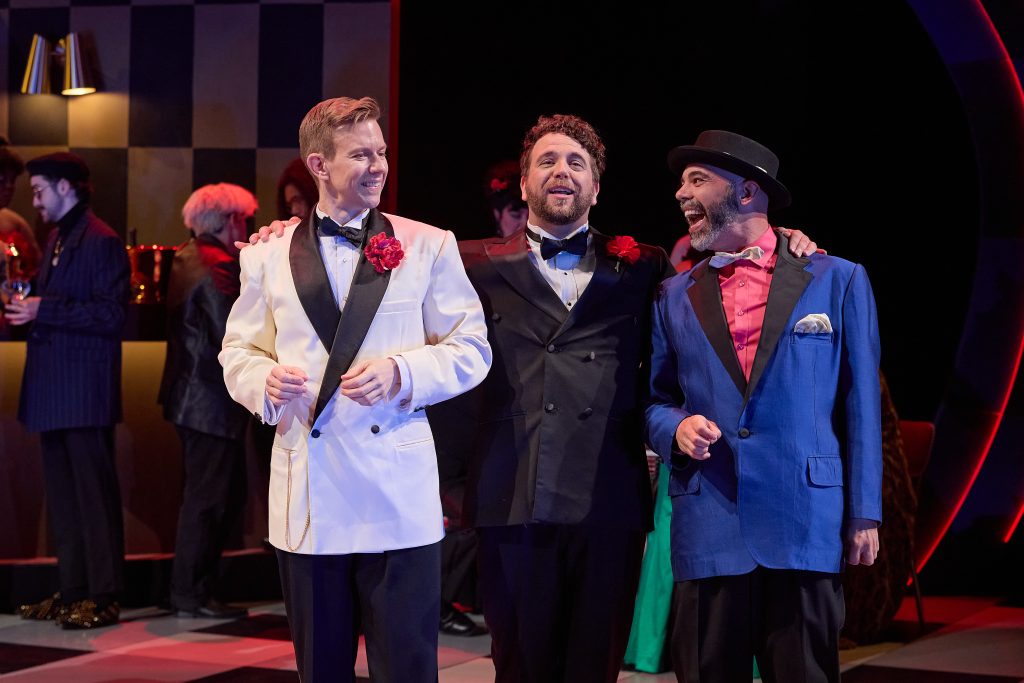
Edward Nelson’s Gabriel Von Eisenstein is a suave, self-assured figure whose downfall is as satisfying as it is hilarious. Johnathan McCullough brings suave authority to Dr. Falke, his baritone warm, polished, and effortlessly expressive. He shapes each phrase with clarity and control, balancing elegance with a knowing wink.

Robert Mellon as Frank the jail warden. Photo by Eric Woolsey.

Joshua Blue is a scene-stealing (but not too scene-stealing) Alfred, reveling in the character’s theatrical bravado and romantic delusions. His tenor is vibrant and ringing, with a golden tone that soars through Strauss’s lyrical lines. Blue’s voice combines power and warmth, and he uses it with a natural ease that makes Alfred’s over-the-top antics feel hilarious and oddly endearing. His comic instincts are sharp, but it’s the sheer beauty of his singing that elevates the performance beyond caricature.

Sophia Baete brings youthful energy and vocal clarity to Sally, Adele’s sister. Her agile, expressive mezzo and confident stage presence make her a memorable part of the ensemble.

Gregory V. Sliskovich is another comic standout as the hapless lawyer, Dr. Blind, delivering his lines with crisp timing and a keen sense of physical humor. His tenor is bright and flexible, lending a buoyant energy to the role that enhances the character’s frantic absurdity without ever losing vocal finesse.

Edward Nelson as Eisenstein, Johnathan McCullough as Dr. Falke, and Robert Mellon as Frank. Photo by Eric Woolsey,

With gorgeous singing, razor-sharp comic timing and a setting that breathes new life into Strauss’s classic, “Die Fledermaus” at OTSL is a jubilant blend of tradition and reinvention—just as Strauss might have imagined. In the week leading up to the performance, I met three people who admitted they’d never been to an opera and found the idea intimidating. I suspect many opera-goers know people like that.

This production is the perfect invitation—accessible, effervescent and irresistibly fun. And in a time when the arts need all the support they can get, buying a ticket and bringing a newcomer isn’t just a good night out—it’s an investment in the future of live performance.

Opera Theater of St. Louis’ “Die Fledermaus” runs in repertory as part of their festival season through June 29. Visit https://opera-stl.org/.

Party time at Orlofsky’s. Photo by Eric Woolsey.