By Lynn Venhaus

In a towering, fearless performance, Jenny Smith embodies one of the all-time great fictional horror villains because she is so, well, normal, in “Misery.” She manages to blend neighborliness with sociopathic rage, quite a feat.

The St. Louis Actors’ Studio has invested handsomely in mounting William Goldman’s play adaptation of Stephen King’s 1987 harrowing psychological thriller, which he also worked on for Rob Reiner’s 1990 movie, “Misery.”

Smith’s terrifying Annie Wilkes, grounded in an identifiable reality, sends chills down the spine when she tells Paul, “I’m your number one fan.” But that won’t be her only phrase that will make us afraid for the author convalescing at her home.

She rescued Paul Sheldon, a successful romance novelist, from a car crash during a blizzard in rural Colorado. When he woke up, captive in her remote farmhouse, he learned she is a nurse and thought he was in safe hands. She keeps the pain pills and conversations coming in steady intervals.
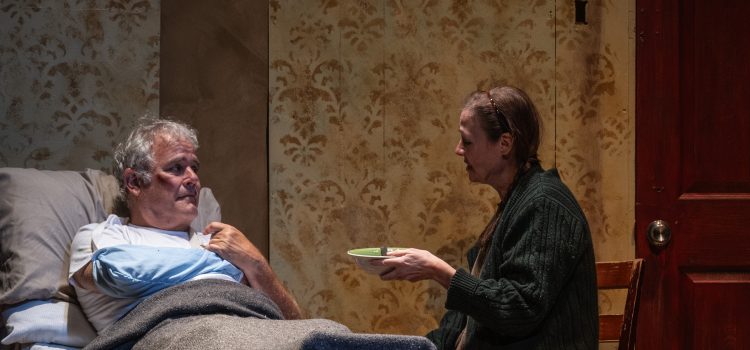
William Roth and Jenny Smith. Photo by Patrick Huber.

Oh, those first impressions. The nightmare has only just begun. Paul will discover her manipulative, controlling ways when she reads his new book from his Misery Chastain series, and his departure manuscript that he had one copy of in his briefcase.

Revealing a dark side, Annie becomes enraged when she learns he has killed off Misery, and forces him to write a comeback novel, “Misery’s Return.” Basically, he is hostage to her whims, and typing as if his life depended on the outcome.

Goldman, two-time Oscar winner for his “All the President’s Men” and “Butch Cassidy and the Sundance Kid” screenplays, has kept much of the witty banter from the movie.

After artful performances as George in “Who’s Afraid of Virginia Woolf?” and the physically demanding role in “The Whale,” William Roth is well-suited to play a helpless patient who must shift into survival mode. Through shrewd observation and crucial timing, he must be resourceful in ways to fight back and try to escape from months-long captivity.

This is a difficult work to adapt, although it’s deceptive because of its setting — a one-act locked-room thriller between a (mostly) bedridden man and a caregiver, with a third supporting character arriving later – inquisitive Sheriff Buster (Kurt Knoedelseder in a folksy turn).

Yet director John Contini meets the challenge of conveying the growing menace, tension and maneuvers without benefit of editing or exterior locations. So much of King’s book, which is darker and more cerebral, is internal.

Contini’s cinematic use of eerie and edgy sound, which he designed, and sinister-sounding music motifs, enhance the storytelling, as does the lighting designed by Dalton Costick. Particularly effective are shadows produced in thunderstorm simulations.
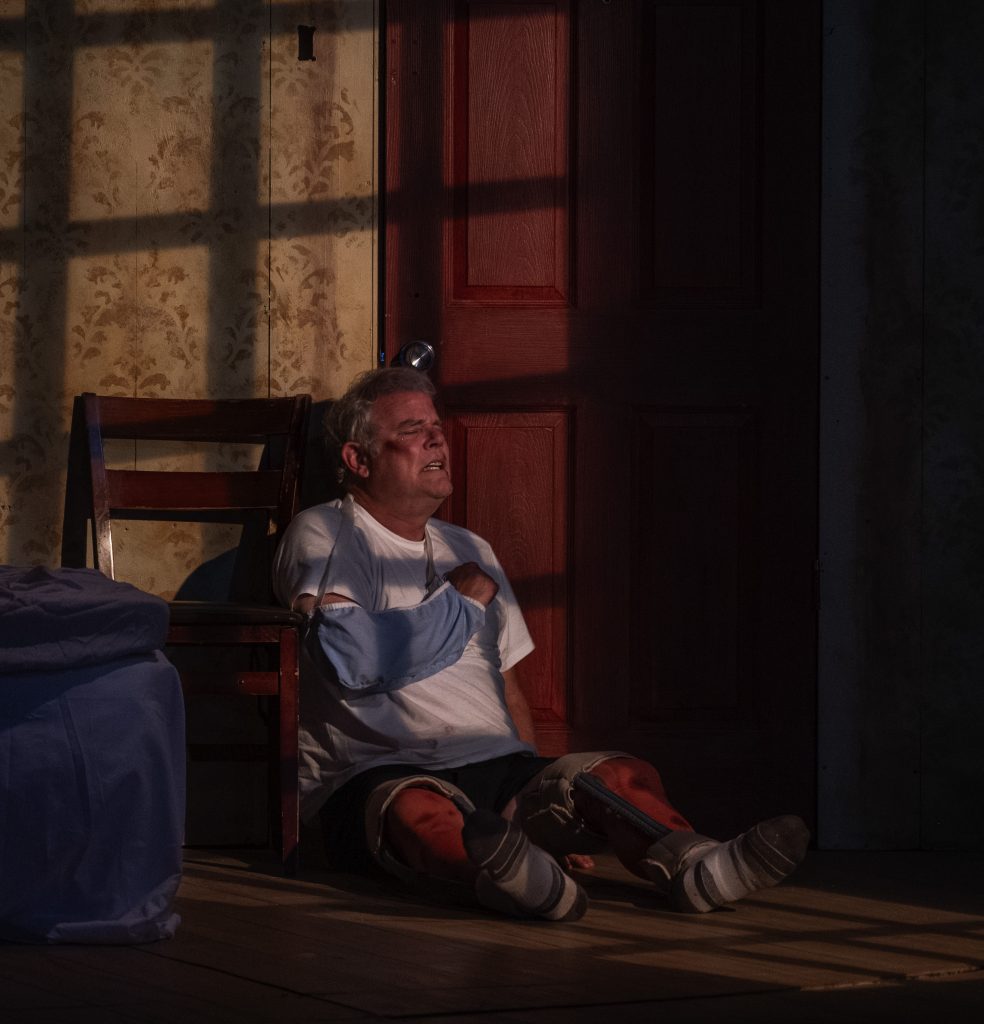
William Roth as the broken-bodied Paul Sheldon. Photo by Patrick Huber.

St. Louis Actors’ Studio is the first regional professional theater to mount it here, and their meticulous attention to detail is admirable. The work premiered on Broadway in 2015, most notable for Laurie Metcalf’s Tony-nominated performance and Bruce Willis’ stage debut.

The play is a natural fit for the cozy Gaslight Theatre’s black box stage, but the scale of the mountainside cottage is one of the biggest challenges in STLAS’s history.

Set designer Josh Ortega and his team have fashioned a revolving three-room farmhouse that is breathtaking in scope. (At the Nov. 15 matinee performance, the audience burst into applause.) The assistant stage managers behind the scenes – Lexi Witcher and Jade Cash – rotated the rooms to reveal a kitchen and hallway.

There is an exterior door/porch drop down area for the sheriff to enter. Ortega also served as the production manager and technical director, which helped the overall aesthetic. Amy J. Page is the ever-sharp stage manager.
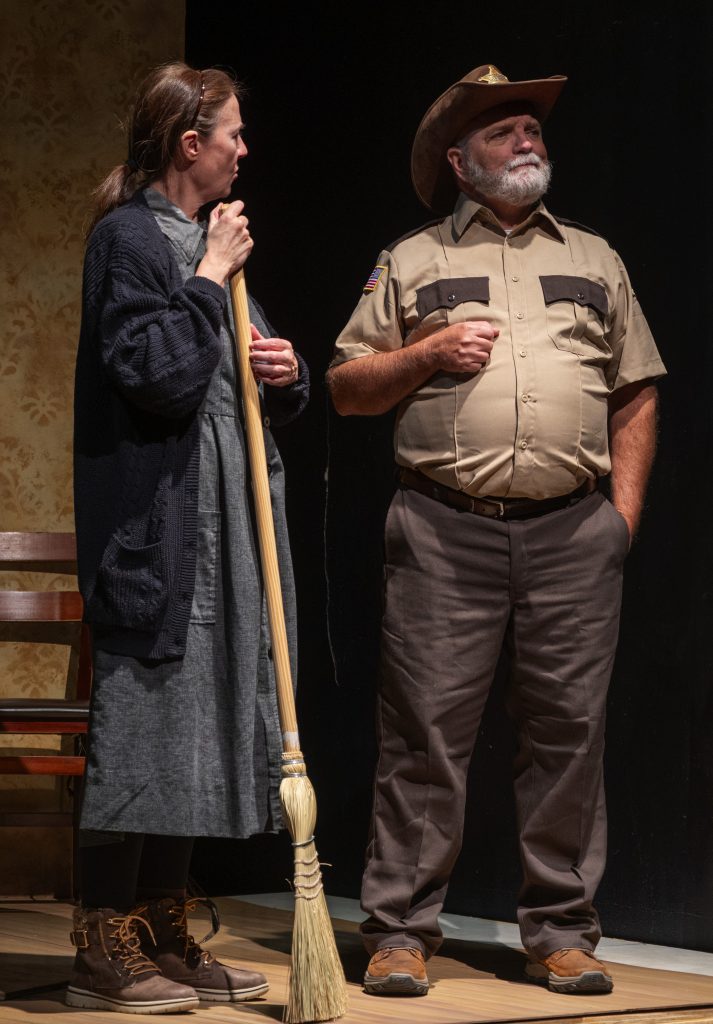
Annie Wilkes chats with Sheriff Buster (Kurt Knoedelseder). Photo by Patrick Huber.

Kathy Bates’ unforgettable performance in the 1990 film earned her an Oscar (Fun fact: The only King character to ever win). The Annie character is one of the great human antagonists, ranked no. 17 on the American Film Institute’s list of 50 Greatest Movie Villains of All-Time (2003) – ahead of the shark in “Jaws” (18).

Smith transitions from Annie’s motherly qualities to cruelty with quicksilver mood swings, showing her deteriorating grip on reality.

Smith, who designed the appropriate character outfits and props too, fits this role like a glove. She has mastered the cadence, quirky euphemisms and eccentricities (Liberace!).

While the scenario gets grimmer, and Sheldon is forced to be more dependent, Roth must smoothly hide his mobility and getting around in the wheelchair.

And spoiler alert, anyone who has seen the movie or read the book knows what eventually happens – the hobbling, when Annie takes a sledgehammer to each ankle. (Just writing that made me wince again).

The pair’s struggles are realistically presented on stage, with fight choreography by Shaun Sheley, for the inevitable climax. Contini’s split-second blocking and the nimble performers get a workout.
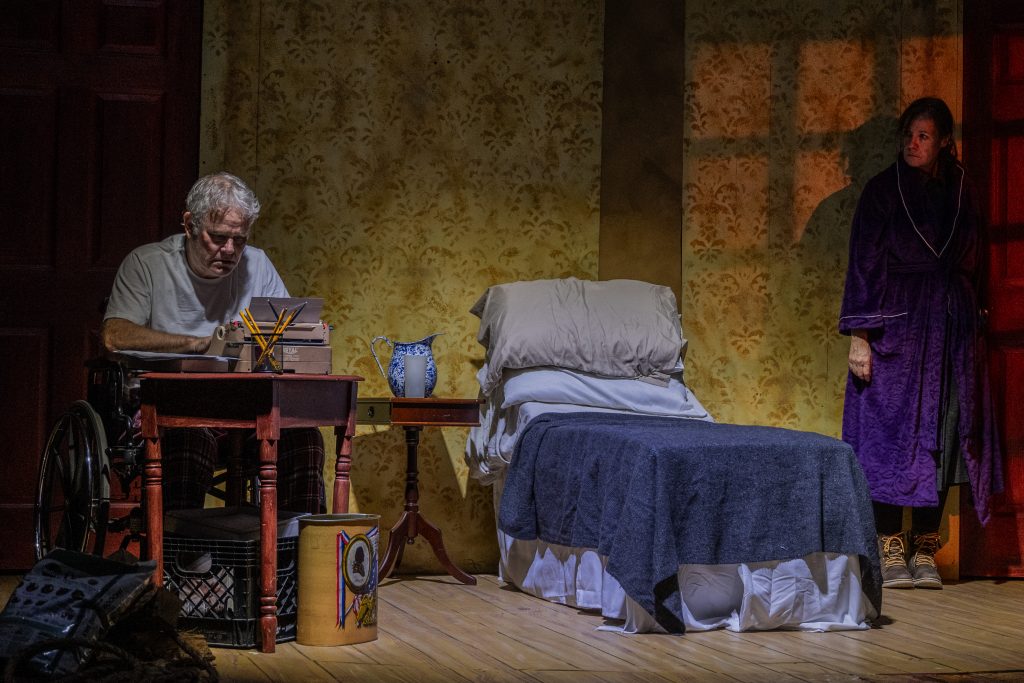
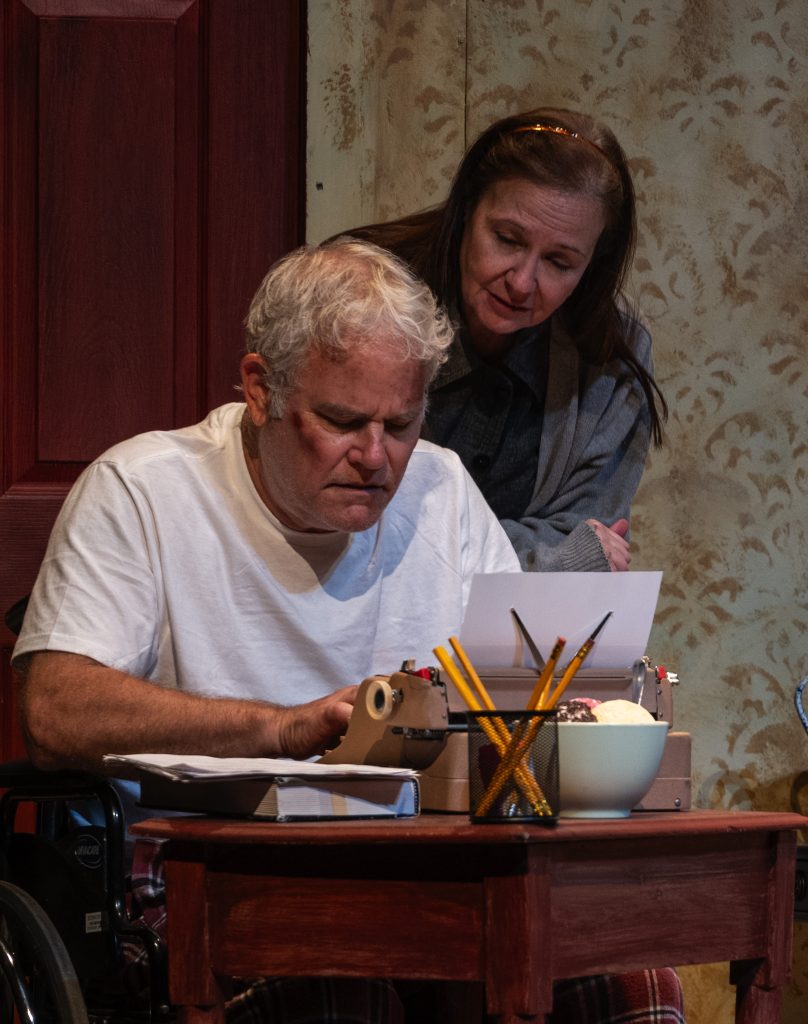
Photo by Patrick Huber.

With its rustic grandmotherly décor, dingy print wallpaper, vintage Royal typewriter, and practical effects in lighting and sound, St. Louis Actors’ Studio has set the stage well for collective theatrical thrills.

Chilling and claustrophobic, “Misery” earns its escape payoff, for the audience feels as cornered as the injured author throughout the 90 minutes. The material also touches on modern celebrity culture – and Annie represents the extreme, which seems more relevant today.

St. Louis Actors’ Studio presents “Misery” from Nov. 6 through 22 at the Gaslight Theatre. Performances are Thursday, Friday and Saturday evenings at 8 p.m. and on Sundays at 3 p.m. For more information or to purchase tickets, visit stlas.org or email [email protected].

Advisory: “Misery” is suitable for adult audiences and teenagers 17 and older. This Stephen King thriller features drugs, physical violence, a captive victim, and uses very strong adult language.
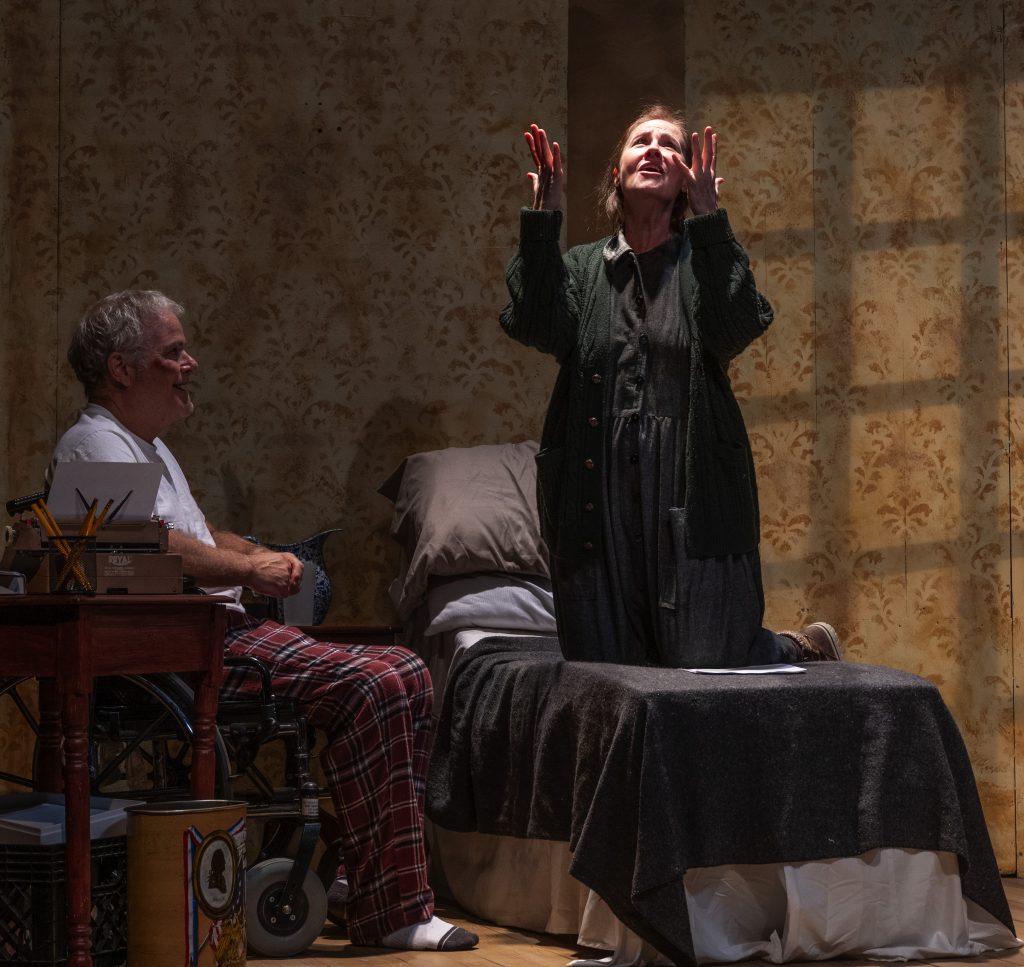

William Roth and Jenny Smith in “Misery.” Photo by Patrick Huber.

By Alex McPherson

Featuring outrageous kills and directorial craft, Osgood Perkins’ “The Monkey” is a nihilistic experience that undermines its potential through a reliance on hit-or-miss dark comedy — substituting emotional connection for blunt-force laughter and smug pessimism about the state of humanity.

Based on the short story by Stephen King, Perkins’ film begins with pilot Petey Shelborn (Adam Scott) attempting to return the titular drum-playing toy monkey to an antiques shop, but not having much success (the shop’s owner meets a grisly end, to put it mildly). Petey takes a flamethrower to the little rascal, but the monkey doesn’t give up so easily.

Years later, in 1999, Petey’s young children, identical twins Hal and Bill (both played by Christian Convery) are living with their mother (Tatiana Maslany), with Petey no longer in the picture. Hal is the more sensitive, soft-spoken one, whereas Bill is a popular, immature bully, often humiliating his brother at school. 

While looking through their father’s belongings one random day, the boys find the monkey, and things start to get tragic. Hal and Bill are unnerved but intrigued by this creepy contraption. They wind the key on the monkey’s back, watch its mouth open into a toothy grin, and see its drumstick spin theatrically.

The boys have absolutely no idea that, when the monkey starts to play the drum that evening, accompanied by circus music, their babysitter will get decapitated at a Teppanyaki restaurant. 

Everyone is shocked by the suddenness and brutality of the death (including the priest at her funeral service, who stumbles through his sermon in darkly funny fashion), but Hal — who feels like the monkey is watching and stalking him at any given moment — suspects he knows who, or what, is behind it.

And, after being humiliated yet again at school, Hal sees a chance to get the revenge he’s craved his whole life against Bill. But the monkey doesn’t take requests, resulting in further tragedies that tear the family apart, and in the monkey being thrown into a nearby well, hopefully never to be heard again.

Flash forward 20 years, and the all-grown-up, at least physically, Hal (now played by Theo James) is a deadbeat dad estranged from his son, Petey (Colin O’Brien), drifting through life without much enthusiasm or purpose.

When their kooky Aunt Ida (Sarah Levy) meets a demise of R-rated “Looney-Tunes” proportions, Bill (also played by James) contacts Hal out of the blue to reveal that, yes, the monkey is back for more bloody shenanigans, and there’s no running away this time.

Perkins, who directed last year’s “Longlegs,” has a knack for creating unsettling worlds where violence could occur at any point. “The Monkey,” though, represents a stylistic departure in terms of its cartoonish, deadpan instincts that encourage viewers to laugh at the carnage — it’s best viewed in a packed theater with viewers willing to go along with its warped sense of humor. 

Without real emotional connection, however, “The Monkey” eventually wears out its welcome by not fully exploring its themes and presenting characters that are difficult to latch onto amid Perkins’ devilishly sardonic tendencies.

Indeed, there’s definitely merit to the off-kilter, desensitized world that Perkins depicts here, and the skillful ways he crafts suspense through patient camera movements and editing that jolts and amuses in equal measure.

The film plays with expectations and takes obvious glee in putting the story’s hapless characters in harrowing situations where, should that monkey kick into gear, their fates are essentially sealed. 

The kills are memorably gory throughout, usually ending in exploding limbs and showers of blood. The bulk of the film’s crowd-pleasing entertainment value comes from watching what elaborate scenario Perkins concocts for us next; he encourages us to laugh at the craziness, which ensures “The Monkey” is never boring.

Perkins doesn’t spend time delving into the monkey’s origins or how it came to focus on Hal and his family. It’s a smiling, omnipresent manifestation of death, fueled by hatred of the Other and remaining ambiguous in its targets — except that it never chooses the one who winds the key. This idea is compelling, as is the film’s timely perspective on continuing to live amid the anarchy in whatever way we can and break cycles of trauma.

The film’s main issues stem from a lack of strong characterization, especially as the screenplay resorts to third-act exposition dumps (also a flaw in “Longlegs”), and tends to undercut its fleeting moments of sincerity with blood-spattered punchlines that leave little room for reflection. Perkins ultimately takes the easy way out rather than thoughtfully engaging with the story’s themes.

The ensemble — Maslany and James especially — do what they can to add extra layers to their characters through their easy charisma and ability to convey unspoken pain, but there’s no escaping the film’s exhaustingly snarky sensibilities.

It’s apparent that “The Monkey” is deeply personal to Perkins, who experienced unimaginable family tragedy himself. But regardless of how he and this film use humor as a deflection from trauma, it creates a distancing effect that numbs and dilutes the film’s messages and, finally, lessens the impact of its twistedly hopeful ending. 

At the end of the day, “The Monkey” is a strange beast — defiantly marching to the beat of its own sinister drum but seemingly forgetting to give its characters the same attention. 

“The Monkey” is a 2025 horror-comedy thriller directed and written by Osgood Perkins. It stars Theo James, Christian Convery, Tatiana Maslany, Adam Scott, Sarah Levy and Colin O’Brien. Rated R for strong bloody violent content, gore, language throughout and some sexual references and runs for 1 hour, 38 minutes. It opened in theaters March 7. Alex’s Grade: B-,

For an exhilarating third time, USDish is looking for one brave soul to participate in the third annual Stephen King Scream Job: Chapter 3! They are hiring a horror movie enthusiast to record their heart rate while they watch 13 of the most chilling Stephen King films for $1,300 and a Fitbit! 

After all, all work and no play makes Jack a dull boy. 

How to Apply

Applications will be accepted now until September 16, 2022, at 12 PM MST. Visit the official page for the application form and more information: https://www.usdish.com/news/get-paid-to-watch-stephen-king-movies

To apply, applicants must share why they want to be frightened this way in less than 200 words. For bonus points, they can include a video of why this is the scream job for them. 

Why Chapter 3?

Since 2019 when we first launched this campaign, NPR and so many more have jumped on the opportunity to share this with their following and we have received over 600,000 applications. 

Last year brought in many second-time applicants and we’re looking to give these adrenaline junkies another go to tell us which Stephen King villain is the scariest. 

Last year’s winner, Ashley LaBossiere found that It (2017) was the scariest Stephen King movie followed by Misery (1990). 

What Will the Heart Rate Analyst Get?

Whoever wins this scream job will not only get $1,300 to make up for all the nightmares, but will also receive a swag bag valued at $350 that includes the latest Fitbit. Movie tickets will also be provided to see the new Salem’s Lot, premiering in 2023. We’ve also prepared a Stephen King Watch Guide that any scaredy cat can follow.