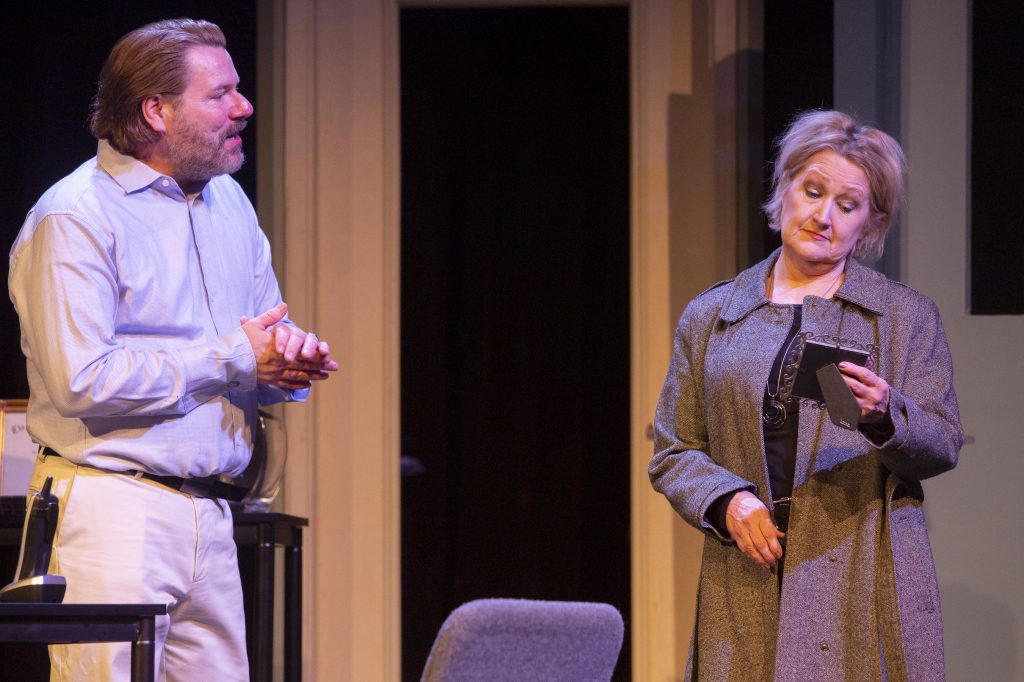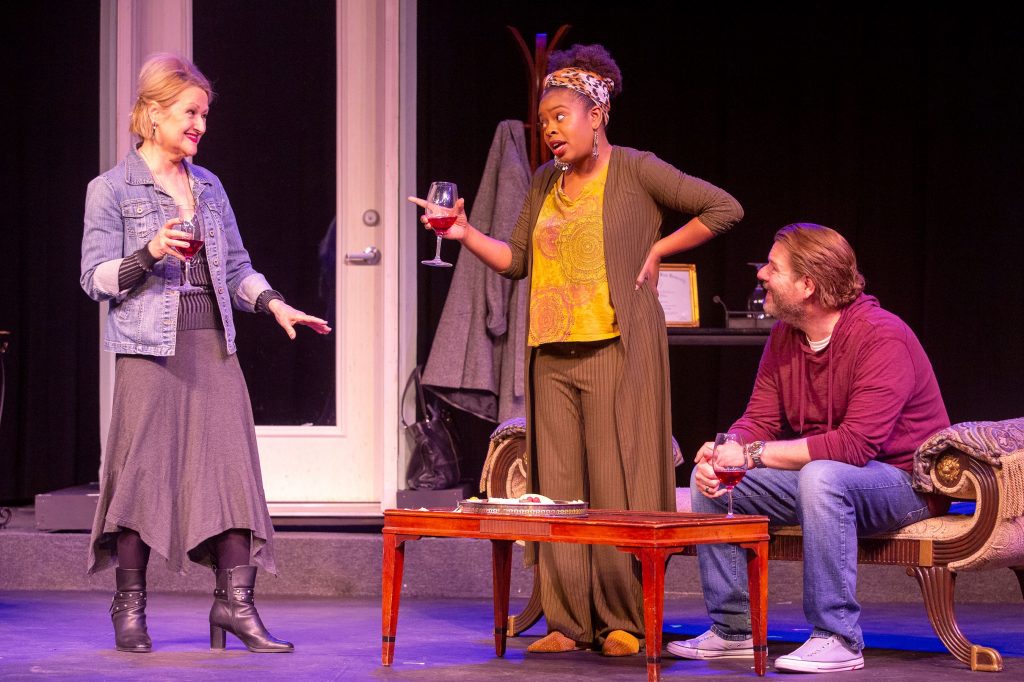

By Lynn Venhaus

Infused with humor and a breezy charm, Stray Dog Theatre’s enchanting interpretation of Stephen Sondheim’s “A Little Night Music” brings out starlit summer imagery, the glory and glimmer of love, and the best in a resplendent cast.

On opening night, nature supplied a full moon on a crisp autumn evening outside the Tower Grove Abbey, a serendipitous touch. Imagine the golden glow of a warm, fragrant moonlit midsummer night – and you’ll easily slip into the mood for this sophisticated romp.

Set in Sweden at the turn of the 20th century, “A Little Night Music” concerns several pairs in various stages of romance or uncoupling – and what entanglements transpire during a summer sojourn in the country.

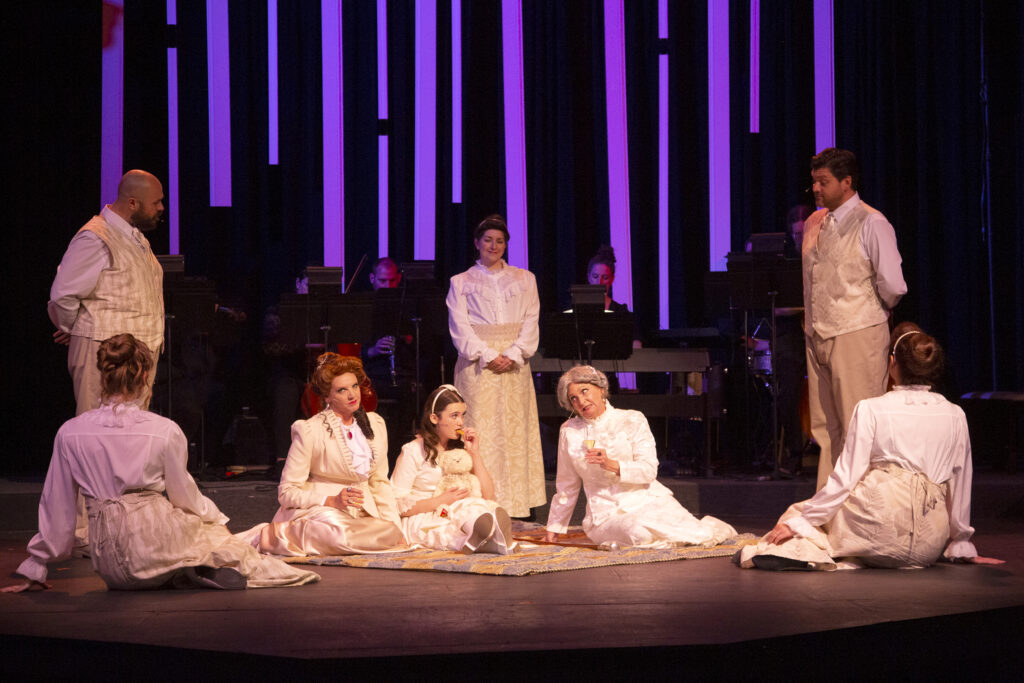
Liz Mischel is amusingly sarcastic as the unfiltered Madame Leonora Armfeldt, a wealthy matriarch who had colorful liaisons as a courtesan. She is schooling her innocent granddaughter Fredrika (a sweet and assured Adeline Perry) on the ways of the world – and men. She tells her the summer night ‘smiles’ three times: first on the young, second on fools, and third on the old.

The Armfeldts and servants picnicking. Photo by John Lamb

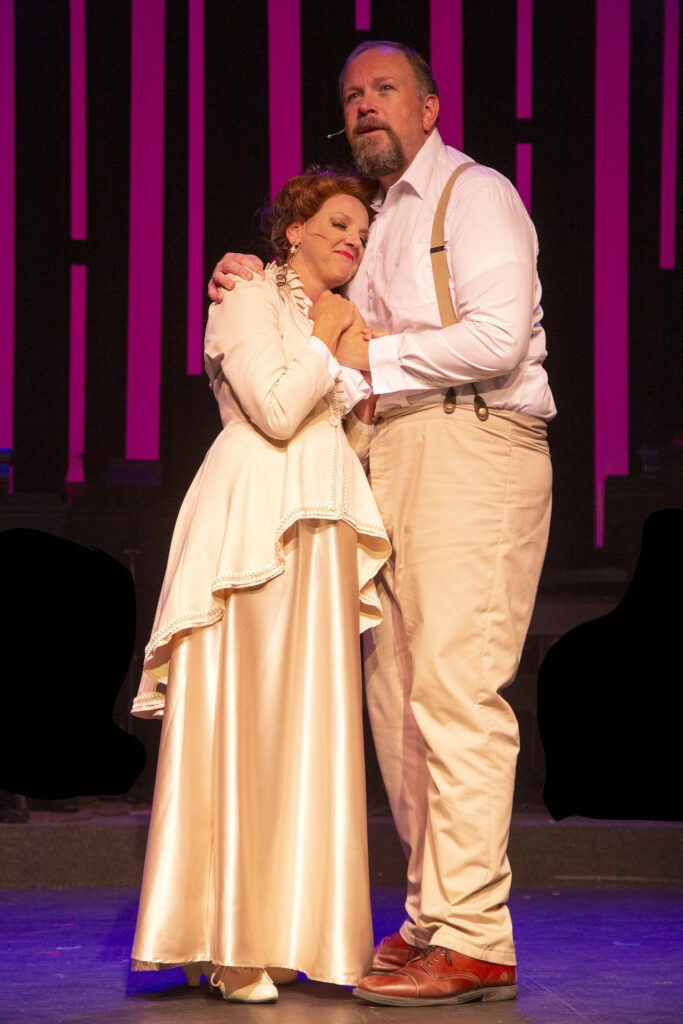
Madame’s daughter, the alluring, touring stage actress Desiree Armfeldt (Paula Stoff Dean) is a force of nature known for not playing by the rules. Her old lover, attorney Fredrik Egerman (Jon Hey), married a naïve young woman Anne (Eileen Engel) about 30 years his junior 11 months ago, and their union has not been consummated (her issues).

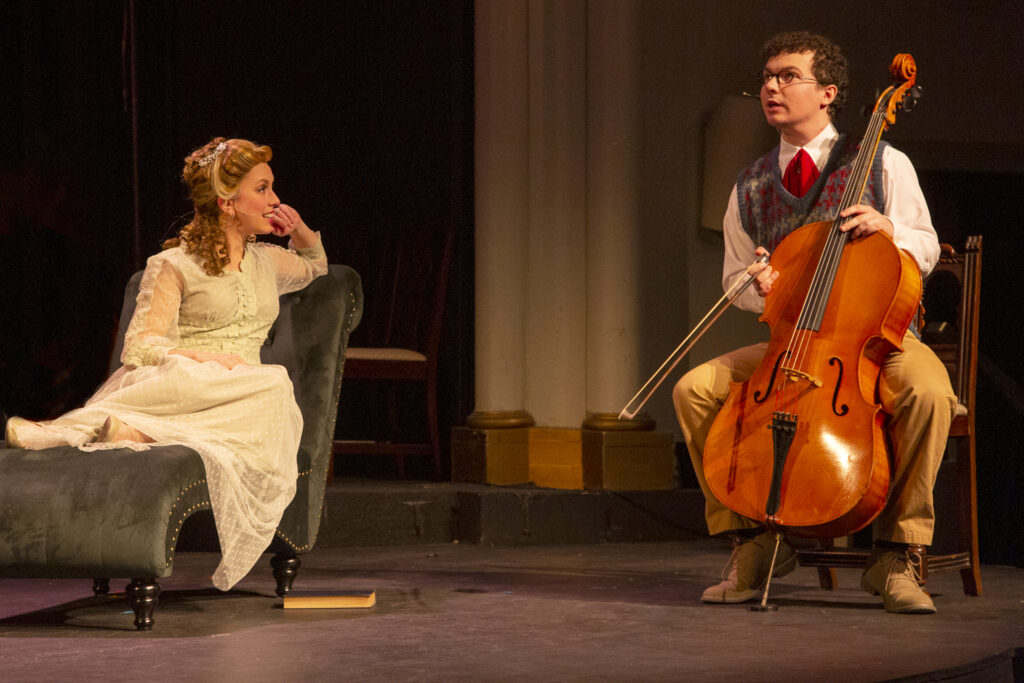
The coquettish but inexperienced wife teases her serious husband’s awkward son, Henrik (Bryce A. Miller), by his late first wife, who is studying for the ministry but has feelings for her, his stepmother. Although clumsy, he is not impervious to desire and has a dalliance with her maid, an older and wiser Petra (a brassy Sarah Gene Dowling making her character’s worldliness obvious).

Miller has to demonstrate the widest emotional range as the confused and ready-to-explode Henrik, and he effectively finesses the fine line between the melodramatic and the comedic to distinguish himself in a cast of veterans.

Desiree is currently the mistress of self-absorbed Count Carl-Magnus Malcolm (Scott Degitz-Fries), a buffoon whose jealous wife, Countess Charlotte (Madeline Black), is in on the charade. Degitz-Fries plays the military royal as an obnoxious, arrogant chauvinist who is not used to ‘no.’ Black channels her rage into a scheme – you know the adage about women scorned – but keeps her character’s refinement intact.

They all circle around and back to each other. Fredrik has taken Anne to see Desiree’s latest play, which eventually leads to an invitation for a country excursion. The complications culminate in the anticipation, flirting, fighting, and fleeing that takes place in the second act. Does love win in the end?

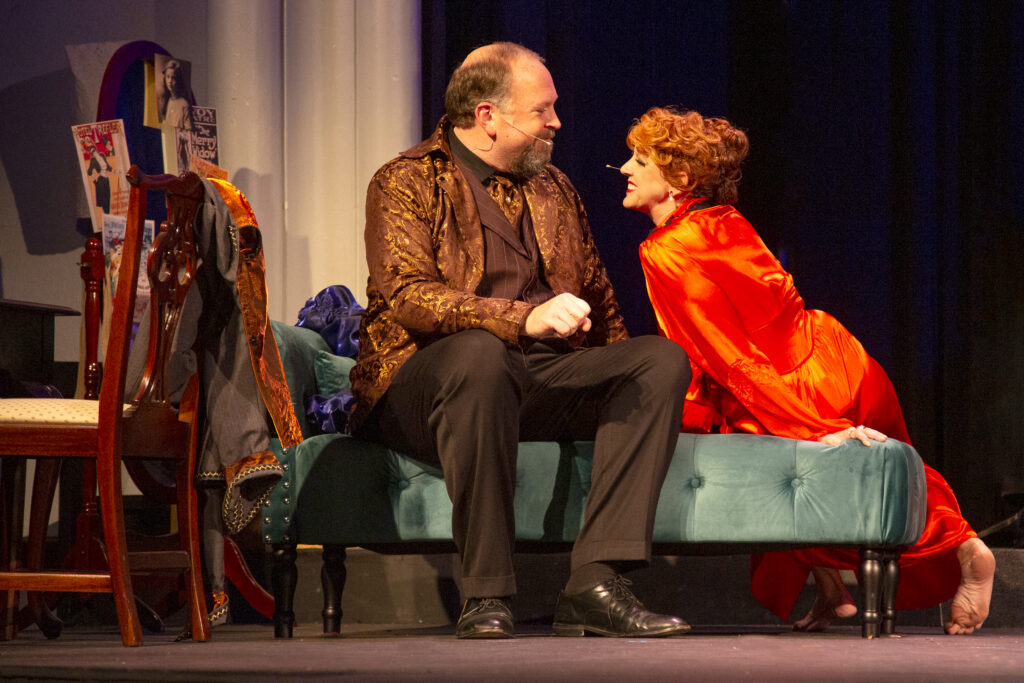
Hey, Dean. Photo by John Lamb.

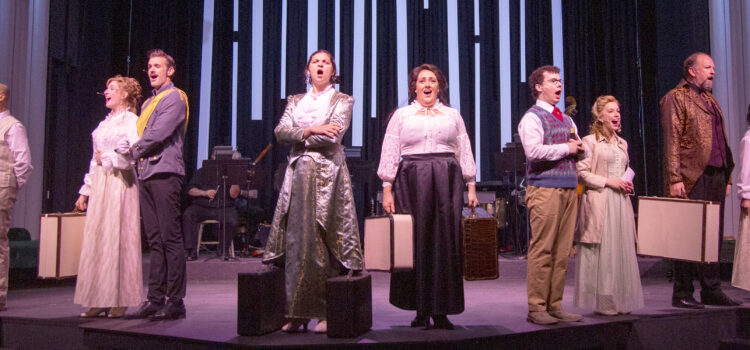
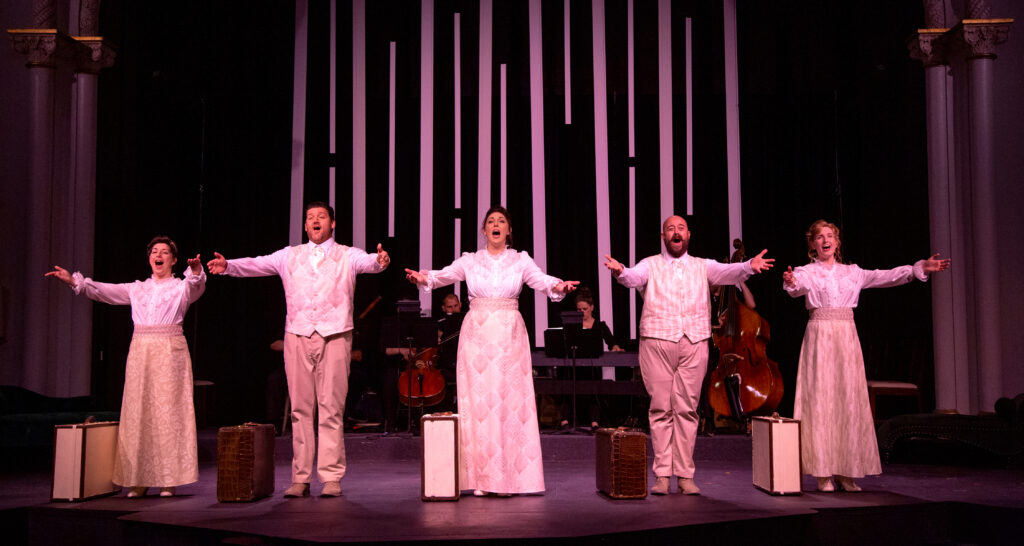
One look at the waltzing quintet in their summer whites that starts this elegant show, and you’re transported back to a different era. Splendidly delivering “Night Waltz,” Cory Anthony, Shannon Lampkin Campbell, Jess McCawley, Kevin O’ Brien and Dawn Schmid glide across the stage as the Liebeslieder Singers, astutely controlling the tempo.

They act like a Greek chorus, and their lush harmonies soar in “The Glamorous Life,” “Remember?” and “The Sun Won’t Set.”

The entire cast’s strong vocal prowess is noteworthy throughout, but a masterfully arranged “Weekend in the Country” is a triumph.

Dean has decided to belt the signature song, “Send in the Clowns,” instead of reciting nearly all of it, as others have done, and it’s a fine rendition. Another highpoint is Dowling’s “The Miller’s Son,” emphatically sung as a mix of longing and reflection.

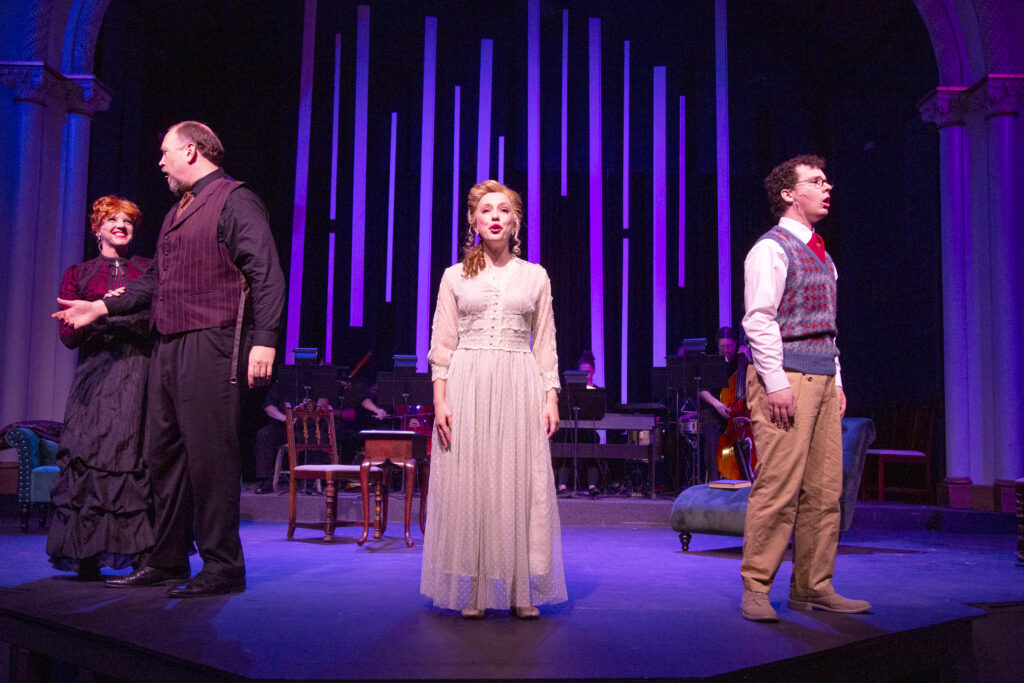
Whether they are singing solo or in duets, or at the same time with different songs (“Now” by Fredrik, “Later” by Henrik and “Soon” by Anne), you’ll marvel at how seamless the numbers are performed.

Black and Engel lament together on infidelity, smoothly combining in “Every Day a Little Death,” and Degitz-Fries has his moment with “In Praise of Women.”

Photo by John Lamb

Employing the beautiful orchestrations of Jonathan Tunick, Music Director Leah Schultz uses three string players that elevate the sumptuous sound. The orchestra is prominently placed on stage, and their work is exquisite.

Schultz, also playing piano, expertly conducts the seven-piece orchestra that includes a cello (Michaela Kuba), a violin (Steve Frisbee) and a bass (M. Joshua Ryan), along with Ian Hayden and David Metzger on reeds and Joe Winters on percussion.

The way director Justin Been has shaken off the stodginess and stuffiness of a high society period piece is impressive. He’s embraced the farcical aspect of revolving romantic hook-ups, sleekly moving the characters through a country estate, the grounds, and an adjacent forest

Looking at the book by Hugh Wheeler with a fresh set of eyes gave it needed oomph, and the ensemble, nimble in comedy, conveys a playfulness that endears. Been has brilliantly adapted the very theatrical and somewhat operetta-ish work for the small stage.

The original 1973 Broadway production won six Tony Awards, including Best Musical, book, and score, and has had revivals in London’s West End and Broadway, adapted into a 1977 film starring Elizabeth Taylor, and has been performed by opera companies around the world – including this summer’s traditional format at Union Avenue Opera in St. Louis.

Anne and Henrik. Photo by John Lamb

With a minimum of set pieces, Been has depicted the states of different affairs well. He designed modern Scandinavian impressionistic slats that hang above the orchestra, perhaps as a nod to magic realism. Jacob Baxley’s sound design and Tyler Duenow’s lighting design add to the imagery.

The creators claim the musical was suggested by Ingmar Bergman’s romantic comedy, “Smiles of a Summer Night,” which premiered in 1955, and is a staple at film retrospectives.

You might not think of Bergman as a merry sort of guy, particularly if you’ve seen his critically acclaimed classics “The Seventh Seal,” “Persona,” “Cries and Whispers,” and “Through a Glass Darkly.” But he mixed sugar and spice to come up with a confection that’s been ‘borrowed’ more than a few times. (Woody Allen’s 1982 “A Midsummer Night’s Sex Comedy,” to name one, which also references Shakespeare’s “A Midsummer Night’s Dream.”).

But this Bergman-inspired fantasia is much lighter, and Been has brought out the laughter, easy on the melancholy – yet has middle-agers expressing regrets.

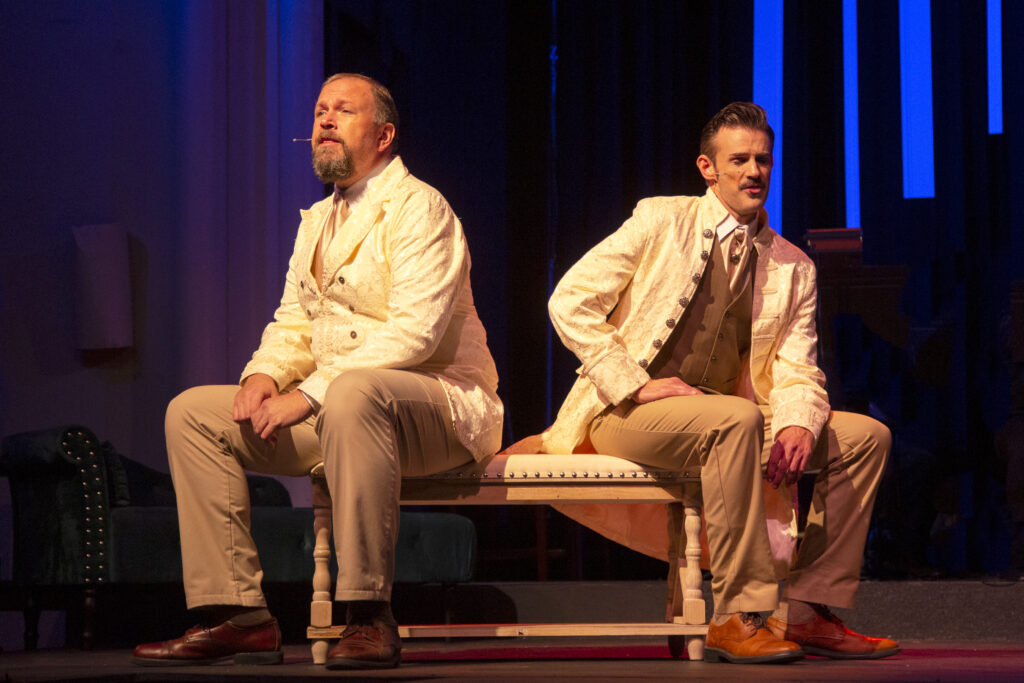
Dean, Hey. Photo by John Lamb

Hey, as Fredrik, and Dean, as Desiree, portray a rueful pair, looking back wistfully and rediscovering their spark. The accomplished actors display a natural rhythm with each other, especially in “You Must Meet My Wife.”

Like the music, the dance numbers are polished, choreographed by Michael Hodges with an emphasis on regal posture — although, at first, notice how awkward the pairings are – it’s on purpose, ahem).

Engel, who is delightful as the conflicted Anne, designed the costumes – and they are a mix of ethereal and chic, conveying the social status of each character. The hair and wig design by Dowling suitably complimented the looks.

Hey and Engel were part of Stray Dog’s “Sweeney Todd” in spring 2017, he in the title role and she as daughter Johanna, and know the challenges Sondheim presents, and their experience serves them well.

Sondheim’s work is getting a lot of posthumous attention – but that’s a good thing, never enough Sondheim done well. Like the recently revived “Into the Woods,” some of his musicals take on richer, more contemplative meaning as one ages and revisits them again.

Stray Dog’s superb “A Little Night Music” is worth the immersion, featuring a triple-threat cast in fine form and an inspired creative team.

The Liebeslieder Singers. Photo by John Lamb.

Stray Dog Theatre presents the Stephen Sondheim’s “A Little Night Music” at 8 p.m. Thursdays through Saturdays through Oct. 22, with additional performances at 2 pm Sunday, Oct. 16 and 8 pm Wednesday Oct.19. Performances take place at Tower Grove Abbey, 2336 Tennessee in Tower Grove East. Tickets are only offered in physically distanced groups of two or four. For more information: www.straydogtheatre.org

Hey and Degitz “It Would Have Been Wonderful.” Photo by John Lamb

By Lynn Venhaus
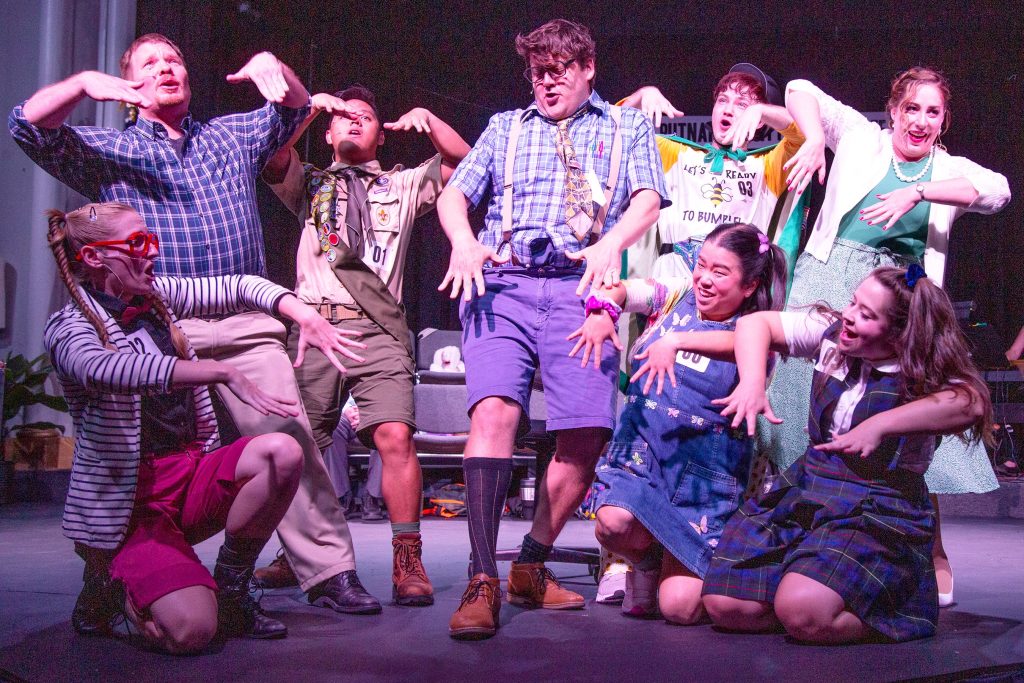
How do you define J-O-C-U-L-A-R-I-T-Y? The literal translation is “The 25th Annual Putnam County Spelling Bee,” now playing at Stray Dog Theatre.

A splendid summer sojourn, the jaunty musical comedy celebrates American traditions and meritocracy, our inherent competitive spirt, and freak-flag waving.

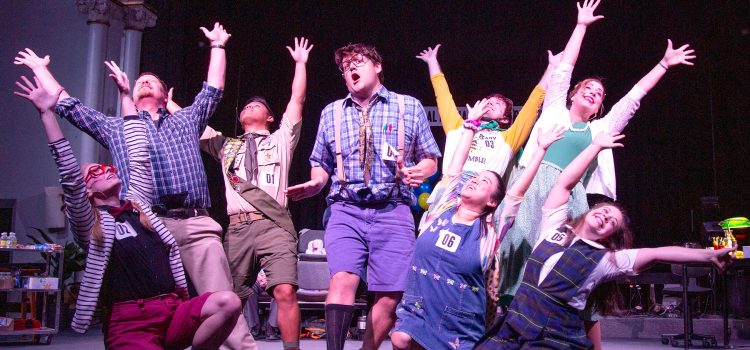
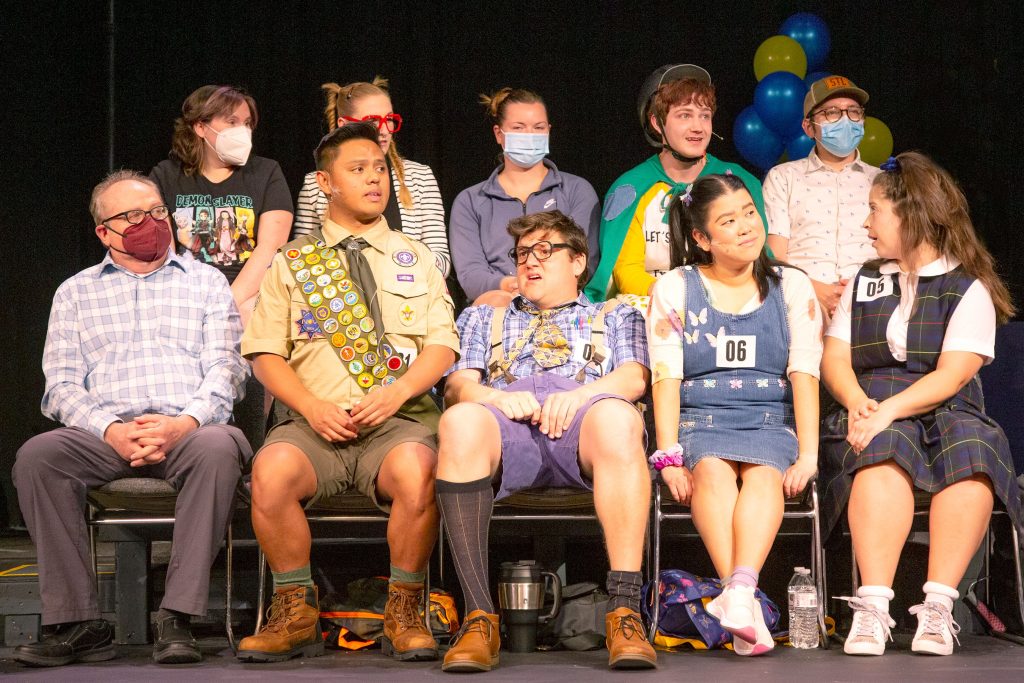
At a nondescript middle school, a sextet of smarty-pants sixth graders competes for a $200 savings bond and a towering trophy at the annual big-deal event. Three adults handle the proceedings, and four audience members are selected to participate, too.

And the blithe spirits on stage and in the audience instinctually know this is far more pleasurable than Mensa members getting together for Scrabble, especially with its clever audience-participation cachet.

However, those who didn’t make the honor roll need not worry, for SAT scores aren’t required at the door, and it’s a very accessible and inclusive work. The catchy music and savvy lyrics by William Finn (“Falsettos,” “A New Brain”) and the whip-smart Tony-winning book by Rachel Sheinkin offer something for everyone.

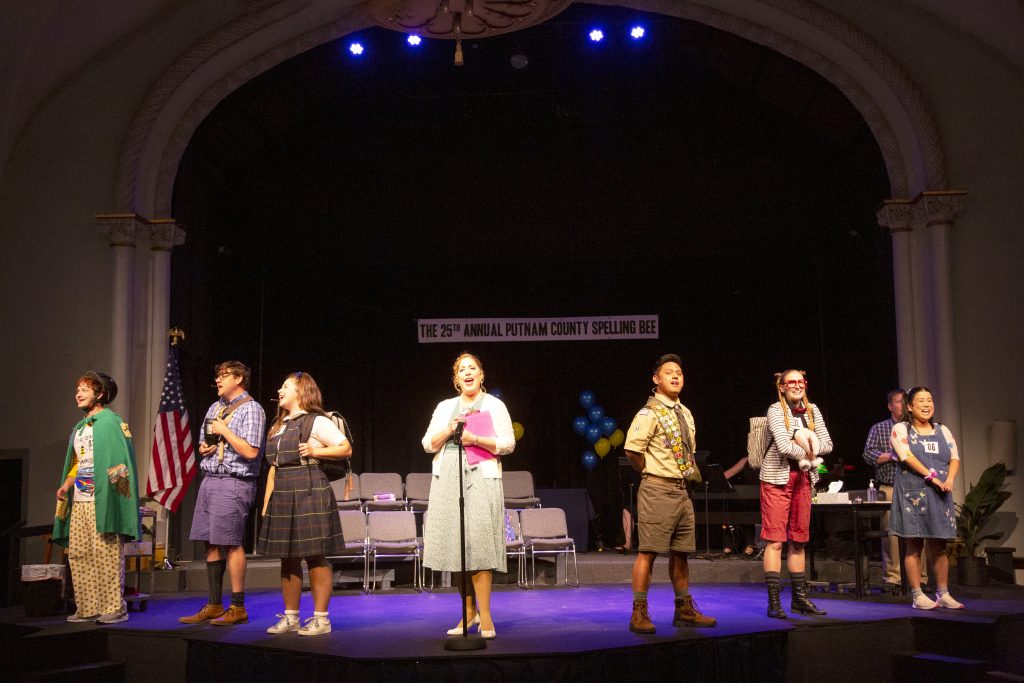
In this enjoyable production, adroitly directed by Justin Been, the dexterous cast has mastered the nimble word play and spit-take worthy improvisations for a rollicking good time. They got game.

The in-sync ensemble expertly colors outside the lines, shading their idiosyncratic characters with humor and humanity. Unlike “You’re a Good Man, Charlie Brown,” where grown-ups also play kids, this is a show with mature content.

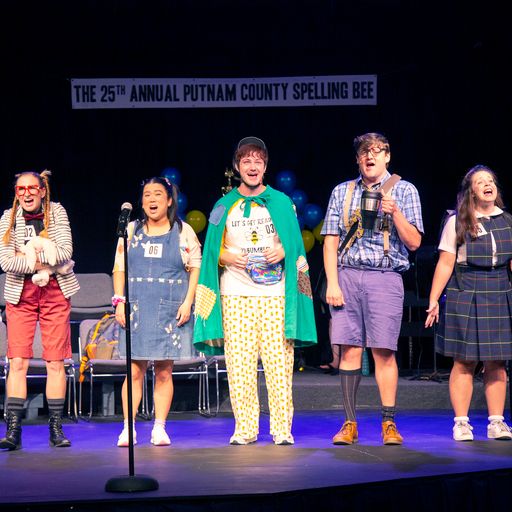
Kevin Corpuz is returning champ Charlito “Chip” Tolentino, a strident Boy Scout who is struggling with puberty and distracted by a female in audience; Grace Langford is resolute newcomer Olive Ostrosky, whose mom is in India and dad is always working; and Sara Rae Womack is fervid Marcy Park, an over-achieving transfer student.

Clayton Humburg is mellow Leaf Coneybear, home-schooled son of hippies; Dawn Schmid is high-strung Logainne “Schwartzy” SchwartzandGrubenierre, politically aware and pushed by her two dads to win at all costs; and Kevin O’Brien is last year’s egghead finalist William Morris Barfee, whose name is really pronounced Bar-Fay, because of an accent aigu, and not Bar-Fee, like the announcer repeats.

Photo by John Lamb

While everyone’s comic timing is admirable, O’Brien elicits many laughs as he embodies a know-it-all misfit unfortunately hampered by one working nostril. Hunching his shoulders, rolling his eyes, and sighing in exasperation, O’Brien is in his element. He has the most peculiar way of spelling out the words – with his “Magic Foot.”

Barfee is one of those supporting roles that is an awards nomination magnet, like Adolfo in “The Drowsy Chaperone” and the UPS guy in “Legally Blonde – The Musical.” Dan Fogler, now of “Fantastic Beasts” who recently played Francis Ford Coppola in “The Offer,” won a Tony Award for originating the role.

The middle-school spellers are joined by four individuals that have volunteered for the gig – signing up in the lobby beforehand.  Good sports, they are called on to spell, without any special treatment, which is a key element to the fun. They might have to spell Lysergic Acid Diethylamide, or cow.

The three adults in the room include ‘comfort counselor’ Mitch Mahoney (Chris Kernan), an ex-con who gives the eliminated contestants a juice box and a hug; former champ and returning moderator Rona Lisa Peretti (Stephanie Merritt), a successful realtor who enjoys reliving her glory days; and Vice Principal Douglas Panch (Jason Meyers), who has returned as a judge after personal time off to work out some ‘things.’

Their perspicacity is evident – and the three veterans are oh-so-smooth with the innuendos and deadpan humor. Merritt is guileful as the supremely assured and unflappable announcer – think Patty Simcox from “Grease” as an adult.

She glibly describes the contestants with seemingly innocent comments and a few double-entendres. You don’t want to miss a word, for you might do a double-take (Wait – what?).

Hilarity ensues whenever the puckish Meyers wryly uses a word in a sentence or describes his feelings. He elevates the script’s wit (those inappropriate comments!) with his crackerjack delivery. Just don’t get him started on Klondike’s decision to drop the Choco Taco! He’s a tad jittery.

Photo by John Lamb

Several performers double as ancillary characters, such as parents – for instance, Kernan and Humburg are Logainne’s importunate fathers. Corpuz shows up as Jesus Christ. (You’ll just have to see).

The convivial show, workshopped into an off-Broadway hit, transferred to Broadway in 2005 – and was nominated for six Tony Awards, winning two. It was originally conceived by Rebecca Feldman and based upon “C-R-E-P-U-S-C-U-L-E,” a play by her improv collective, The Farm. Additional material was supplied by Jay Reiss.

The ingenious construction has managed to keep it fresh 17 years later by relying on the actors to be on the ball with au courant references.

Been astutely uses the state of play as an advantage, maintaining a balance of friskiness and sweetness that makes sure everyone is in on the jokes. No mean-spirited sarcasm here.

The cast’s exemplary improv skills make this a very funny, free-wheeling show. But let’s not forget the music is an integral part, too, and each character nails a signature song. Besides Barfee’s “Magic Foot,” there is — Leaf: “I’m Not That Smart.” Olive: “My Friend, The Dictionary.” Marcy: “I Speak Six Languages.” Logainne: “Woe Is Me.” Chip: “Chip’s Lament.”

Rona’s “My Favorite Moment of the Bee” is a running theme throughout, Mitch serenades the last audience speller with “Prayer of the Comfort Counselor,” and Panch is in “Spelling Montage.”

The troupe’s strong voices harmonize well in the group numbers, too.

Photo by John Lamb

Music Director Leah Schultz smoothly keeps the tempo on track, and is on piano, joined by Kelly Austermann on reeds and Joe Winters on percussion. Choreographer Mike Hodges keeps the moves light-hearted and breezy.

Jacob Baxley’s sound design enhances Rona’s championship spotlight, as does Tyler Duenow’s lighting design.

Eileen Engel’s costume designs distinctly outfit the personalities – and allow them to move easily, whether in the minimal dancing or walking through the aisles.

The Tower Grove Abbey’s small stage is well-suited for the show’s sparse set design, put together by Been.

For logophiles, the principal contestants are relatable. — perhaps a bit more eccentric, but these quirky characters have all learned an early invaluable life lesson: Knowledge is power.

My fellow nerds will feel at one with their tribe. For we know that summer vacation fun isn’t defined by theme park rides, water slides, and sports camps, but by summer reading lists – whether it’s for a library club, school enrichment class or a free personal pan pizza in the Pizza Hut Book It! Program.

It’s still the only musical where the cool kids are here for the orthography. Revenge of the nerds, indeed. So, Wordle can wait – and this show cannot, for there are 8 performances remaining.

Stray Dog Theatre presents the musical “The 25th Annual Putnam County Spelling Bee Thursdays through Saturdays from Aug. 4 to Aug. 20 at 8 p.m., with additional performances at 2 p.m. Sunday, Aug. 14 and 8 p.m. Wednesday, Aug. 17 at the Tower Grove Abbey, 2336 Tennessee Avenue in Tower Grove East. For more information, visit www.straydogtheatre.org

Note: Tickets are only offered in physically distanced groups of two or four.

Photo by John Lamb.

By Lynn Venhaus
At once an urgent call to action, historical political drama, and heart-wrenching story of love and friendship, “The Normal Heart” captures a specific time and place while resonating as a cautionary tale.

With an ensemble cast devoted to making every emotional beat authentic, Stray Dog Theatre’s brave and fearless production chronicles the growing AIDS crisis in New York City from 1981 through 1984, and how badly it was bungled.

It was a harrowing time, and gay activist Larry Kramer’s 1985 mostly autobiographical play is haunting as it conveys the confusion and chaos.

This work is a gripping account of how leaders in the gay community fought an indifferent, inefficient, and ineffective political system that ignored their plight until they couldn’t, as deaths were escalating in alarming way.

With a keen eye on the bigger picture, the company’s artistic director, Gary F. Bell, shrewdly directed principal character Ned Weeks’ journey from angry protestor to frustrated and furious advocate demanding change. It’s not just history, it’s personal.

During the early 1980s, Bell lived in New York City as the acquired immunodeficiency syndrome began decimating a terrified gay population. With the early years of another global pandemic not yet in the rearview mirror, Bell builds on that lack of knowledge and awareness to be relatable.

Many homosexuals were forced to live a closeted life, for fear of retaliation and being ostracized, or fired at work, or target of hate crimes. It was a very different time. And then, as the HIV/AIDS outbreak spread, so much fear and ignorance added fuel to the misunderstandings.

For those who remember living in the shadows 40 years ago, the pain of being unseen, unheard and dismissed during a growing public health crisis is palpable. Others who have been marginalized can identify, too.

Sarjane Alverson and Joey Saunders. Photo by John Lamb

Bell’s lean, cut-to-the-chase presentation focuses on perspective for the look back while being mindful of current parallels so that it feels contemporary and fresh.

In his best work to date, Peirick, a Stray Dog regular, brings an in-your-face intensity to Ned’s mission to make sense of what is happening while confusion reigns in the medical, political, and social circles in his orbit.

He shows how frightened Ned is for those around him, and how his laser-beam attention isn’t immediately shared by peers, much to his dismay. He pushes, he’s abrasive, he’s relentless – and eventually, he rattles the right cages and rallies others to see how the clock is ticking.

Newcomer Joey Saunders plays Felix Turner, a New York Times fashion writer who becomes involved in a serious relationship with Ned. When he is diagnosed with AIDS, how he deals with the decline from symptoms to the illness taking over his life is gut-wrenching and makes it deeply personal.

The other guys view their roles as important vessels, a duty they take seriously, as they all “go there,” daring to plumb emotions for a stunning depth of feeling.

In a dramatic turn as banker Bruce Niles, Jeffrey Wright pours out his anguish to tell how his lover died and the humiliation that followed, while Jon Hey melts down as the overwhelmed Mickey Marcus, frustrated by the lack of results.

It’s impossible not to be moved or not care about these people, to get into their heads and hearts as they confront the biggest health crisis of their time.

Stephen Henley, Jeremy Goldmeier, Stephen Peirick and Jon Hey. Photo by John Lamb

Characters get sick and die. Their lovers, co-workers, friends and family show symptoms and it doesn’t end well. Or those people refuse to accept and believe what is really happening.

Stephen Henley brings compassion to the Southern-style Tommy Boatright and Michael Hodges plays the dual roles of Craig Donner and Grady.

Three portray outsiders that are integral to the story.

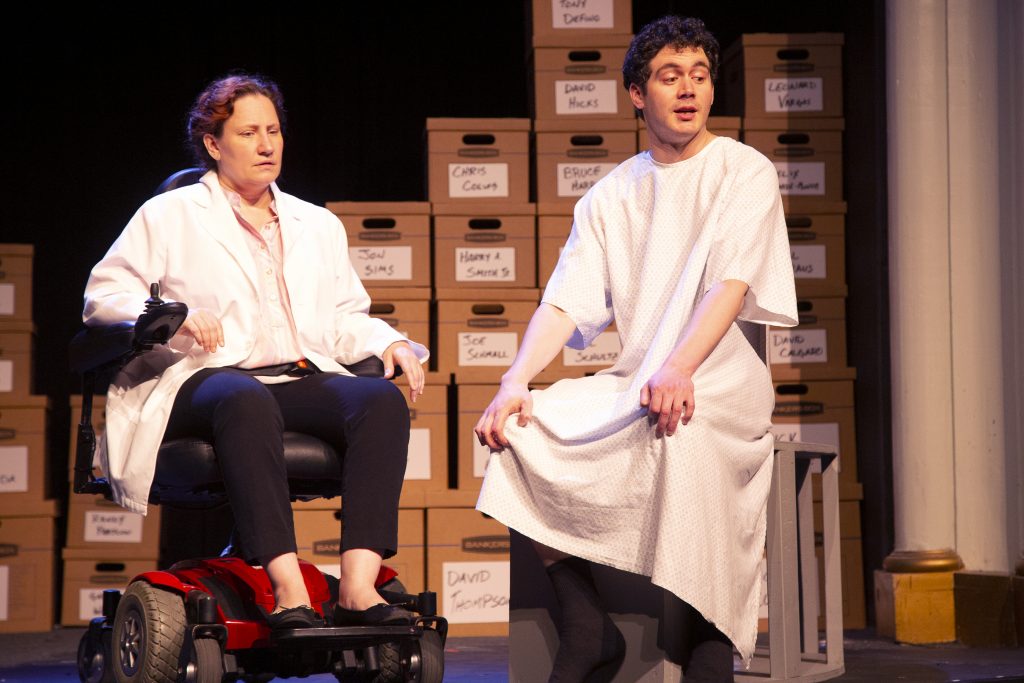
A perfectly cast Sarajane Alverson is strong as Dr. Emma Brookner, who is in a wheelchair from childhood polio – a powerful visual. She is a crucial character who delivers the medical findings and sounds alarm bells

Jeremy Goldmeier has the thankless task of being the hard-edged municipal assistant Hiram Keebler and David Wassilak is buttoned-up Ben Weeks, Ned’s distant lawyer brother.

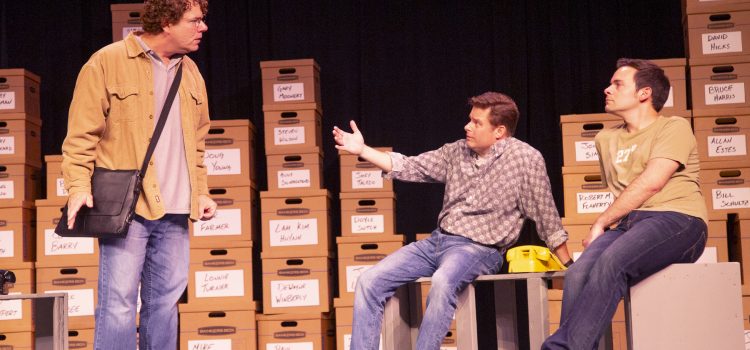
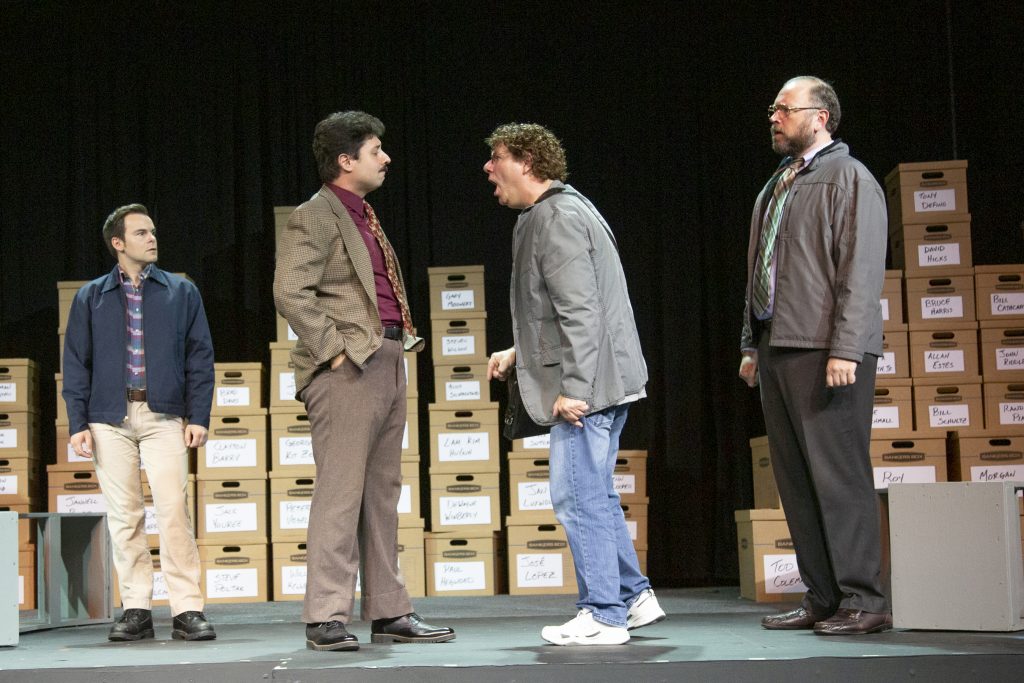
The austere set optimizes a growing set of file boxes as the HIV/AIDS cases surge and death toll mounts. Justin Been handled the scenic design and the sound work, punctuating the heightened emotions with dramatic instrumental music.

Kramer, always demanding, wanted to move the needle on tolerance and acceptance, which is why, 40 years later, this play has a far-reaching impact.

It is always hard to see so much time and energy spent on hate, even in historical context, but through art, there is also a glimmer of hope.

A play this pertinent has expanded its purpose at a time when we need to pay attention, for we must never forget. The organizers of today stand on the shoulders of giants, and Stray Dog is providing an important service to a new generation.

Stray Dog Theatre presents “The Normal Heart” from June 9 to 25, Thursday through Saturday at 8 p.m., with a Sunday, June 19, matinee at 2 p.m., at The Tower Grove Abbey, 2336 Tennessee, in Tower Grove East. Tickets are only offered in physically distanced groups of two or four. For more information: www.straydogtheatre.org

Stephen Peirick and Joey Saunders. Photo by John Lamb

By Lynn Venhaus

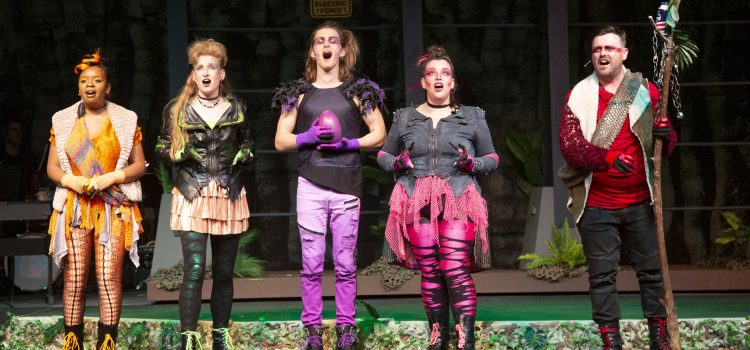
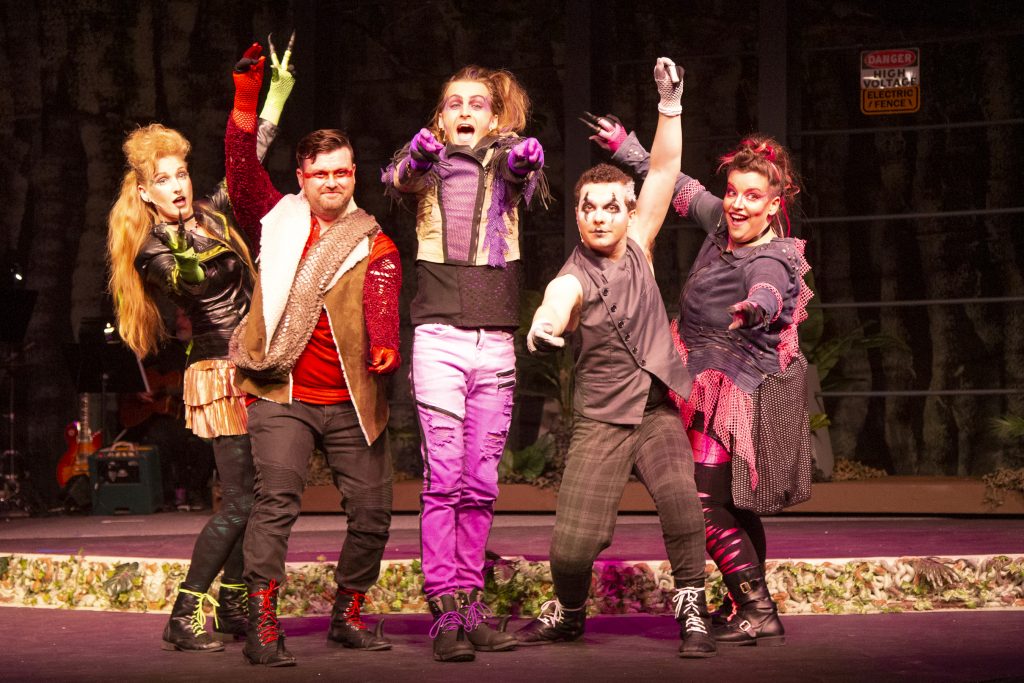
Hold on to your pearls, for “Triassic Parq: The Musical” is a raunchy romp of an offbeat musical comedy.

A parody of the film and novel “Jurassic Park,” the blockbuster 1993 science-fiction action thriller by Steven Spielberg adapted from Michael Crichton’s 1990 bestseller, this is flipped for the dinosaurs’ point of view.

Talk about a chaos theory. Bedlam ensues when one of the genetically engineered female dinosaurs turns male – spontaneously. It’s not nice when you fool Mother Nature – but it sure is naughty.

Goofy and gutsy as can be, the Stray Dog production features a winning cast that gives it their all, in belting out power ballads and selling daffy up-tempo numbers, with light-hearted choreography by Mike Hodges. I don’t think I’ve ever seen a cast work so hard with material that’s this absurd and thin.

Tristan Davis is the Velociraptor of Innocence, all swaggering rocker in “Get Out,’ while Michael Wells is the evangelist-like Velociraptor of Faith, reveling in the campiness of “Morning Assembly” and “Hello, Little Goat” – exhibiting strong, soaring vocals after not being on the stage since “Guys and Dolls” in the Before Times.

Laurell Stephenson is spirited in dual roles — as the skeptical Velociraptor of Science and then having fun interacting with the audience as a character named Morgan Freeman – that was actually played by the deep-voiced Oscar winner once upon a time. He/she disappears quickly after a hilarious set-up.

The fearless pair of punk rocker grrrls stand out as the Tyrannosaurus Rexes – a frisky Dawn Schmid as T-Rex 1/Kaitlyn and ballsy Rachel Bailey as the dial-it-to-11 confused T-Rex 2. They unleash their attraction in “Love Me As a Friend.”

The spunky ensemble accepts the wild-ride aspect and overcomes what the silly show lacks in sustainability.

This playful cast of six starts out with high energy in “Welcome to Triassic Parq” – and continues full-throttle to win over the eager crowd in 14 songs while dishing out a lot of sexual innuendo. It would seem like zany schoolkids’ antics were it not for the quality of the vocals – like a John Mulaney Broadway musical parody on “Saturday Night Live.”

Photos by John Lamb

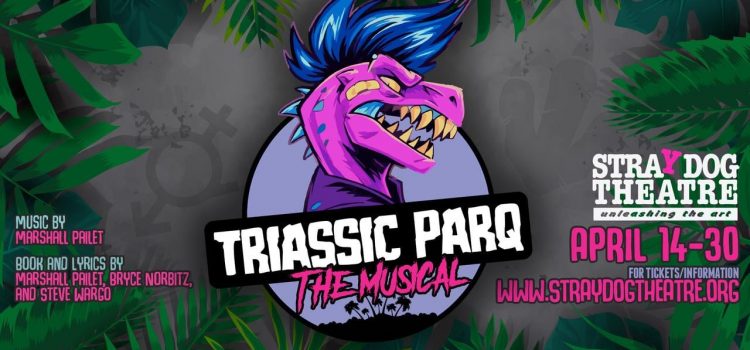
But this is an actual musical that played off-Broadway in 2012 after winning best overall musical production at the 2010 New York International Fringe Festival. The music and lyrics are by Marshall Pailet, with co-lyricists Bryce Norbitz and Steve Wargo, and all three combined on the book.

Songs include lyrics about penises for shock value – “Dick Fix,” riffing on John Williams’ symphonic score “We Are Dinosaurs,” and outlandish “Mama.”

The band is led by Pianosaurus Leah Schultz (and music director0, with Adam Rugo the Guitaratops and Joe Winters the Drumadon.

Director Justin Been goes for the gusto, keeping things zippy and nonsensical, aiming to achieve a real crowd-pleaser, especially for a generation who grew up with the “Jurassic Park” movie trilogy and returned for the franchise offshoot “Jurassic World.”

The original won three tech Academy Awards, while the two even more preposterous sequels in 1997 and 2001 stretched the boundaries of logic, even for sci-fi/fantasy. A reboot called “Jurassic World” in 2015 was followed by a sequel in 2018, with the latest, “Dominion,” set to open June 10.

But in the one-act musical, performed without an intermission, you do not need that much familiarity with the 30-year-old source material, for the emphasis is on spoofing religion, sex, and identity. The prehistoric setting is purely for laughs.

Eileen Engel designed functional costumes with a touch of whimsy to convey the gender-bending.

Scenic designer Josh Smith worked magic in his scaled-down version of the Isla Nublar theme park on the Tower Grove Abbey stage, stunning without benefit of computer-generated imagery or visual effects.

The technical efforts add considerably to the overall presentation, including lighting by Tyler Duenow and outstanding sound work.

Stray Dog has always had a penchant for producing quirky plays –such as the “Evil Dead” musical, Charles Busch’s “Psycho Beach Party,” and “Red Scare on Sunset,” as a different direction between more serious explorations. So the strange, slight “Triassic Parq” is well-suited to be in between “Good People” and “The Normal Heart” this 2022 season.

Whether or not you are fascinated by dinosaurs is immaterial. This is not meant to be anything more than saucy merriment, so lower expectations and accept the vulgarity (or not – this is intended for “mature” adult audiences, as in rated R).

Stray Dog Theatre presents “Triassic Parq: The Musical” from April 15 through 30, with performances 8 p.m. Thursday-Saturday; with additional performances at 2 p.m. on Sunday, April 24, and at 8 p.m. on Wednesday, April 27, at the Tower Grove Abbey, 2336 Tennessee Avenue. For more information or tickets, visit www.straydogtheatre.org.

Stray Dog Theatre (SDT) will present Triassic Parq: The Musical at the Tower Grove Abbey, opening on Thursday, April 14 and running through Saturday, April 30, 2022. Trisassic Parq features music by Marshall Pailet, with book and lyrics by Marshall Pailet, Bruce Norbitz and Steve Wargo and is intended for mature audiences. Presented by special arrangement with Broadway Licensing.

Triassic Parq Synopsis: Religion, identity, sex… and raptors! Triassic Parq is a raucous retelling of that famous dinosaur-themed film, this time seen from the dino’s point of view. Chaos is unleashed on their not-so-prehistoric world when one dinosaur in a clan of females spontaneously turns male!

Directed by SDT Associate Artistic Director Justin Been, with music direction by Leah Schultz, and choreography by Michael Hodges. The cast includes: Tristan Davis, Michael Wells, Laurell Stevenson, Dawn Schmid, Rachel Bailey, and Bryce Miller.

April 14-30, 2022: Show times are Thursdays – Saturdays at 8 p.m. Additional performances on Sunday, April 24 at 2 p.m., and Wednesday, April 27 at 8 p.m.

Venue: Tower Grove Abbey, 2336 Tennessee Avenue, Saint Louis, MO 63104. Gated Parking.

Tickets: Adults $30 / Seniors (65+) & Students $25 (Cash/Checks/All Major Credit Cards)

Information and Ticket Reservations: Call (314) 865‐1995. Visit www.StrayDogTheatre.org. Secure online ticketing!

Community Outreach: In keeping with its mission of community outreach, non‐perishable food is collected at each performance and donated to Food Outreach, Inc. www.FoodOutreach.org

By Lynn Venhaus

Our turfs and our tribes. It’s what defines us.

Well, we like to think that, but maybe it’s our choices that shape us. David Lindsay-Abaire’s “Good People,” a brilliant examination of class, good fortune, and the struggles of those left behind, is getting a stimulating treatment at Stray Dog Theatre.

Talk about a conversation starter! With a superb cast led by the incomparable Lavonne Byers, the gritty “Good People” bluntly spells out the wide divide between the haves and have-nots, and not just financially, but in word, thoughts, and deeds.

Margie Walsh is a Southie, for she lives in South Boston’s Lower End, a primarily working-class Irish American neighborhood where the playwright grew up. So, he wrote with deep understanding and connection.

Byers conveys Margie’s toughness and anxiety, with an undercurrent of desperation that she tries not to show. Her weapon is sarcasm. Hardened by a hardscrabble life, she has fought, clawed, and scratched in a dog-eat-dog world. Stubborn and proud, sometimes she has made life more difficult for herself because she will not rely on anyone, but she is loyal to a fault.

After high school, she became a caretaker. It’s a lifetime ago, and that’s when her dreams died, if she had any. As the single working mother of a developmentally disabled adult daughter, she plugs away at minimum-wage jobs. After being late too many times waiting for her daughter’s sitter to show up, she is fired from working as a cashier at the dollar store.

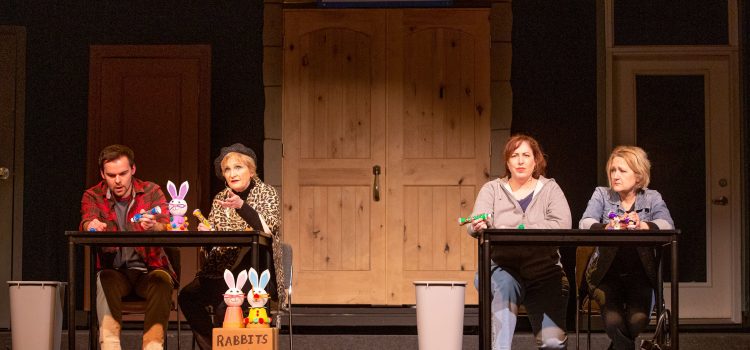
Friends and neighbors gather at the church hall for Bingo in hopes of winning the jackpot and to socialize. Stephanie Merritt is amusing as ballsy Jean, mouthy but well-meaning; Liz Mischel is defensive as the indifferent landlady Dottie, who is also Joyce’s unreliable sitter; and Stephen Henley projects a sweetness as the decent, practical Stevie, her compassionate ex-manager.

The Southie accent is a difficult one, so the dialect work is to be commended, because it’s evident that the ensemble worked on getting it right.

Stephen Peirick and Lavonne Byers. Photo by John Lamb.

About to be evicted, Margie is hanging by a thread. She is not “lace curtain Irish.” Jean knows she needs a break and mentions that she ran into Margie’s old high school flame, Mike, now a doctor. Why doesn’t she ask him for a job, or his help in finding one?

“Mikey” is now a fertility specialist, and he lives with his elegant African American wife Kate and their daughter in Chestnut Hill, an affluent village six miles from downtown Boston. He doesn’t have any office openings. Caught off-guard by the visit 30 years after he last saw her, he prefers not to be reminded of his rough-and-tumble upbringing. She forces an invitation to his wife’s party. Maybe someone else can help with employment.

It’s cancelled, their daughter is sick, but Margie thinks he is blowing her off, and shows up anyway at the door, and Kate mistakes her for the caterer.

Stephen Peirick is Mike, now “Michael,” and Laurell Stevenson is Kate, who live comfortably, although see a couples’ therapist. Their nouveau riche lifestyle is worlds apart from his humble formative years in South Boston. Humble, he’s not.

There is more to the story, but it’s best the audience discover the developments on their own. Just know that pleasant social graces disappear when a confrontation gets ugly. Initial warmth gives way to a chilling coldness.

Under Gary F. Bell’s savvy direction, the trio nimbly escalates emotions that lead to a cruel climax. Peirick, not often playing a jerk, indicates “Michael” is increasingly uncomfortable to be confronted with his past with Margie’s presence.

With her customary confidence, Byers shows how Margie, while agitating, has more integrity in her pinkie finger than the arrogant Michael does. Although Kate is civil at first, and a liberal, she lives in a bubble. And who is ‘self-made’ here, anyway?

Bell heightens the tension while emphasizing “the sides,” and the actors maintain the on-edge feeling throughout the second act, especially in their body language.

At first unassuming but then richly textured, “Good People” is an outstanding production that accentuates that character matters. Your opinion may shift about who is ‘good people.’

Margie, with a hard “g,” clings to her dignity, hoping for a fresh new start, but realizing the dead end is likely where she will stay. She is at once hard to figure out but also completely recognizable.

Scenic designer Josh Smith’s economical set takes a back seat to the human drama unfolding, although there are certain props that are meaningful, such as googly-eyed bright pink bunnies that Dottie makes as her side hustle, and a very expensive vase in Dillon’s upscale home.

Justin Been’s sound design and Tyler Duenow’s lighting design are first-rate.

Lindsay-Abaire, who won a Pulitzer Prize for Drama in 2007 for “Rabbit Hole,” draws his characters well, especially women, for Frances McDormand won a Tony for Lead Actress as Margie in “Good People” in 2011 and Cynthia Nixon won as Becca in “Rabbit Hole.”

In the 11 years since the play was produced on Broadway, the gulf seems wider, and the play, which was excellently produced at The Repertory Theatre of St. Louis in January 2013, seems more pertinent than ever about struggles in hard times.

This is a cast that meets the challenge, and Stray Dog meets the moment in a tautly constructed drama of uncomfortable truths.

Lavonne Byers, Laurell Stephenson, Stephen Peirick. Photo by John Lamb

Stray Dog Theatre is presenting “Good People” Feb. 10-26 at 8 p.m. Thursday through Saturday and an additional 2 p.m. matinee on Sunday, Feb. 20, in the Tower Grove Abbey, 2336 Tennessee Avenue, St. Louis, Mo. 63104. For tickets or more information, visit. www.straydogtheatre.org

Special guidelines are in place for the health and safety of guests, actors and staff: Masks are required of all guests, regardless of vaccination status. They still encourage physical distancing throughout the theater. They recommend, but do not require, that all guests be vaccinated.

By Lynn Venhaus

If you are seeking a sugar-coated Hallmark Christmas movie, “Who’s Holiday” is not that kind of warm-and-fuzzy. Nevertheless, the amusing one-woman show is an engaging cup o’ cheer – unless your heart is two sizes too small.

If you are familiar with past holiday season productions at Stray Dog Theatre, then you are aware of their penchant for a non-traditional offering, and this suits that M.O.

The R-rated merriment runs Dec. 2 – 18, Thursday through Sunday, with a Sunday matinee Dec. 12, at the Tower Grove Abbey – only all performances are sold out, but one can get on their in-person waiting list before each show. –

An irreverent, bawdy post-childhood spin on Dr. Suess’ “How the Grinch Stole Christmas” is a festive communal experience, which could get you in the mood for the holidays – especially when you sing along to an evergreen sentimental song.

Laced with adult humor, this sweet and salty 2017 work by Matthew Lombardo is a natural vehicle for spirited comic actress Sarah Polizzi, who portrays the grown-up Cindy Lou Who. The character is both naughty and nice, and the effervescent performer revels in that aspect.  

Cindy Lou was the adorable 2-year-old Who caught the famous green ogre stealing all the Christmas presents, the Christmas tree and the feast because he did not want anyone to enjoy the holiday. To carry out his nefarious deed, he was dressed as Santa Claus and his dog Max accompanied him. That did not deter the Whos from celebrating, however.

The grouchy Grinch became Dr. Seuss’ legendary storybook villain in 1957, and then immortalized in an animated TV special in 1966, narrated by Boris Karloff. In the years since, it has been adapted several times, including a live-action film starring Jim Carrey that came out in 2000, then a musical followed in 2007, and then a computer-animated feature with Benedict Cumberbatch in 2018 and a live television musical adaptation starring Matthew Morrison last year.

So, it helps to have some sort of working knowledge of the Dr. Seuss book and his first villain.

No longer an innocent, Cindy has returned to living on Mount Crumpit, north of Whoville, and ostracized by her people. Her fall from grace included an illicit romance with the big green beast, teen pregnancy, drug addiction and a prison term. Does not sound very jolly, does it?

So, she engages the audience in cocktails and conversation while sharing her shocking tale of woe.

Despite her hard times, the irrepressible Cindy Lou shows an indomitable spirit – with a beaming smile and a cheery demeanor, although she can get as sour as that grumpy guy – and get a little testy with the neighborhood hooligans. She is ready to put the sordid past behind her and start anew. In a convivial mood, she has invited guests over. But no one shows, much to her dismay. What’s a Party Girl to do? She just wants to have fun.

Polizzi also has the difficult task of speaking in rhyme, the kind that Dr. Seuss was known for in his 60 books, without it sounding sing-song-y, and she accomplishes that.

In a one-person play, the solo character always has a heavy weight to carry an entire show, but it’s only an hour – and she feeds off the audience’s energy with ad libs and being as sparkly as the festive vintage set.

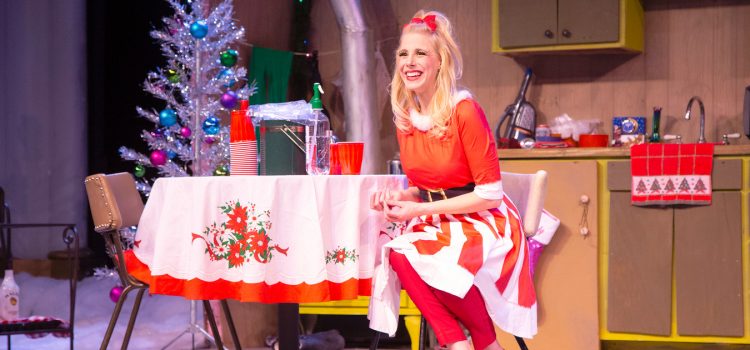
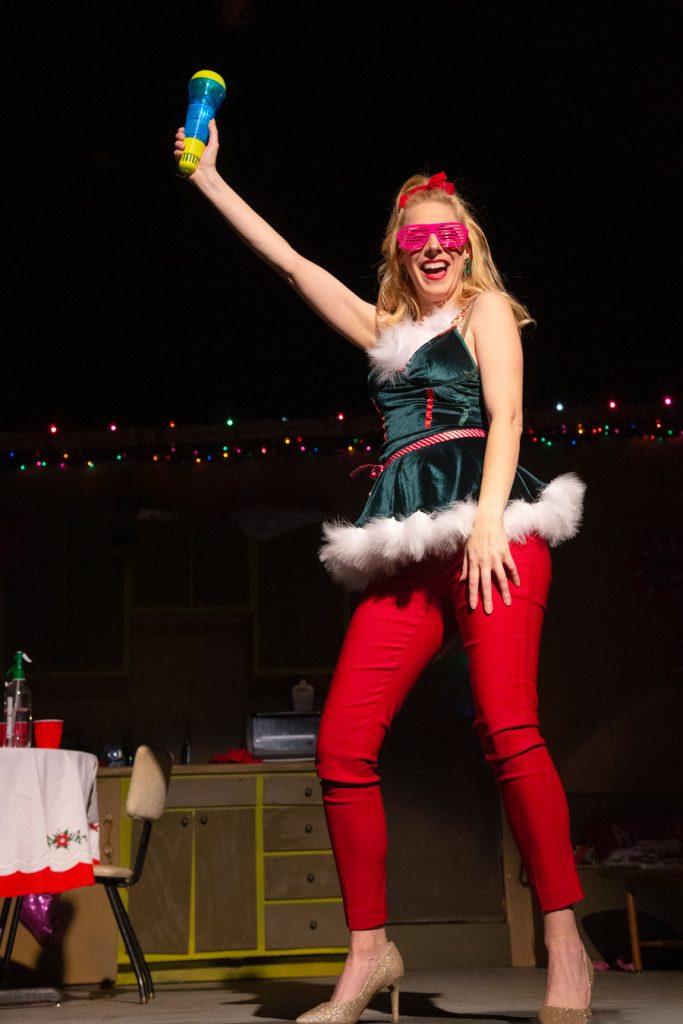
Scenic designer Josh Smith festooned Cindy Lou’s tiny trailer with enough colored lights and kitschy seasonal decorations to make the yuletide bright – and it is delicious eye candy, with lighting designer Tyler Duenow’s effective touches.

Megan Bates’ playful costume design is simple but fetching – retro housewife turned into a livelier vixen.

The twisted tale benefits from Artistic Director Gary F. Bell’s light-hearted direction and it is a very smooth, well-rehearsed production. And Justin Been’s sound design always elevates a show – and his music choices are very smart.

Playwright Lombardo isn’t mean-spirited, just having fun with a parody that’s not unlike a Hollywood child actor’s downfall that makes tabloid fodder – only he exaggerates it to cartoonish proportions.

This isn’t his first production in St. Louis – he wrote the intense heavy drama “High,” which ran as a world premiere-pre-Broadway tryout at the Repertory Theatre of St. Louis in 2010 and starred Kathleen Turner as a nun who was an addiction counselor.

“Who’s Holiday” has both a peppery girls-gone-wild vibe and an affectionate nostalgia for Christmases past. It is certain to leave you feeling merry and bright.

Photos by John Lamb

“Who’s Holiday” is a solo show that runs slightly more than an hour and is presented Dec. 2, 3, 9, 10, 11, 16, 17, 18 at 8 p.m., with a 2 p.m. matinee on Sunday, Dec. 12. The show is sold out, but you may get on a waitlist at the door each performance and must be there in person. Call 314-865-1995 for more information. Visit the website www.straydogtheatre.org

Those with tickets should be aware that seats will only be held until 10 minutes prior to curtain.

Masks are required to be worn by all guests, regardless of vaccination status, at all times while inside the theater and while in the lobby unless actively drinking. They still maintain social distancing throughout the theater. Stray Dog Theatre recommends, but does not require, that all guests be vaccinated.

By Lynn Venhaus

Three actors deliver brilliantly nuanced performances in “Blue/Orange,” a multi-layered satirical comedy-drama that focuses on madness, health care and race within a framework of frustrating bureaucracy and power struggles.

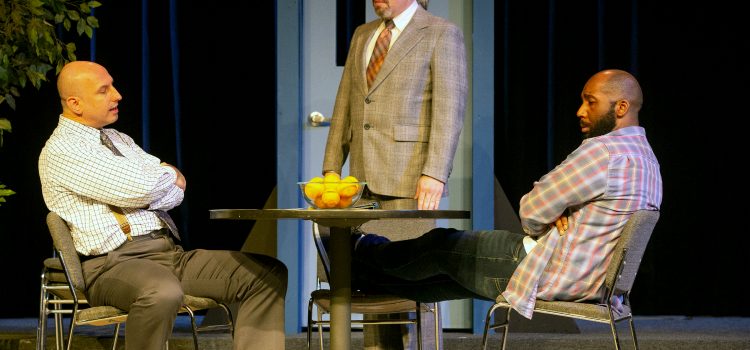
William Humphrey, Ben Ritchie, and Jason Meyers turn in some of their best work by grasping every shifting thought, trigger and changing attitude in conversations that blur lines on mental health.

The discourse is hefty and the roles demanding, for the characters are opaque. Allegiances switch as reasoning seems plausible – but one can’t ever be certain in these fiery exchanges.

Stray Dog Theatre is presenting this intellectually stimulating material as its first indoor show inside the Tower Grove Abbey, their longtime home, in 2021. With a contemporary focus that is more tragic than comic, that tone suits the production’s interpretation of this thorny material.

Shrewdly written by British playwright Joe Penhall, known primarily for several “fringe” works, and set in a UK institution, the play, first staged by the National Theatre in 2000, went on to win the Laurence Olivier Award for Best New Play, with Bill Nighy, as Robert, and Chiwetel Ejiofor as Christopher, nominated for several acting awards.

(More fun facts: Andrew Lincoln played Bruce and the three moved on to the London West End in 2001. The next year, the show opened off-Broadway, with Harold Perrineau Jr. as Christopher, and an acclaimed British revival in 2016 starred Daniel Kaluuya as the patient.)

Stray Dog has wisely decided to forego British accents, so that we are not distracted from the dense amount of dialogue that rapidly volleys back and forth.

The day before Christopher (William Humphrey) is supposed to be discharged from a psychiatric ward, his doctor (Jason Meyers) begins to have reservations that he shouldn’t be released. He shares his concerns with a senior colleague (Ben Ritchie).

Practically jumping for joy as the hyper Christopher, Humphrey is gleefully ready to go – and already packed. He still insists his father is former Ugandan dictator Idi Amin Dada Oumee and sees the pulp inside an orange as blue. In his mind, is this real or delusional? Thus begins a bureaucratic battle.

As the now confused patient becomes increasingly agitated, is he having an acute psychotic episode or is he being unduly provoked? What must happen to prevent him from leaving?

Christopher was diagnosed with a borderline personality order, and on day 28 at the London National Health Service mental hospital, he is due for release – unless a diagnosis changes.

As Dr. Bruce Flaherty, Meyers sees red flags and makes a convincing case that Christopher could be a paranoid schizophrenic. His superior, Dr. Robert Smith, doesn’t detect it. Exuding authority and clinical acumen. Ritchie recites reasons why psychiatry can fail black men like Christopher. After all, Dr. Smith is writing a book – interesting! – on the cultural and ethnocentrism factors that come into play in these situations.

Perhaps drum beating and seeing himself as a “white savior,” the imperious Robert thinks Christopher should return to his neighborhood for the cultural support – even though he lives alone and doesn’t know that many people. Sure, his behavior is odd, but is it cause for alarm?

Smith is worried that if Christopher stays longer, he could get worse and thus begin a never-ending cycle — or is that more of a reflection on the lack of beds and prevalent bottom-line thinking?

Christopher would really like to return to Africa, where he says he has a job, but will settle for his diverse London borough neighborhood if it means his freedom. And there is a probable threat of being attacked by racist thugs, so his fear seems real, but is it indicative of instability – and is pompous Robert being patronizing?

England’s cultural population includes Caribbean and African expatriates, and there are statistics that more black people, percentage wise, are in mental and penal institutions.

And what exactly causes seemingly stable Bruce’s third-act meltdown – and earlier blurting out the “N” word, which could fill an entire act with discussion. This really complicates the narrative, not just exposing an ugly prejudice and stereotypical thinking.

However, the roots of the problems are in the eye of the beholder. As the two professionals argue, drawing Christopher, pawn-like, into a tug of war of damaging rhetoric – clearly emotional scars are being inflicted.

Is this in any way beneficial and do the doctors think this will advance their careers?  

Penhall’s incendiary words, written more than two decades ago, seems as urgent now as they were relevant then. This is a living, breathing work that changes direction throughout its two acts, and the verbal dexterity required is admirable.

In a bracing portrayal, Humphrey straddles the line of helpless vulnerability and angry advocate for getting his life back on track. Both instinctive, Ritchie and Meyers convincingly earn and lose their characters’ credibility.

Associate Artistic Director Justin Been deftly moves the actors around so that we are caught off-guard as characters reveal their positions, transferring the ‘edge’ around – and the performers never get ahead of the script, not tipping their hand about what’s next.

The cast has smartly constructed their roles. It’s an exemplary showcase of control, and lack of, as perceptions differ and speeches flow.

“Blue/Orange” could have easily turned preachy but keeps its intensity, although the second act gets weighed down somewhat with repetitive opinions. And while it’s not predictable, the ending may not satisfy those who have become invested in Christopher’s well-being.

Besides directing, Been also designed the claustrophobic set and the sound, and both he and Artistic Director Gary F. Bell gathered the props. Lighting designer Tyler Duenow maintained the setting’s institutional glare.

The hell that is the ever-present boondoggle for those suffering from mental illness shows no sign of improvement in today’s uncertain world. As this riveting production demonstrates, it’s a difficult subject to ponder, and “Blue/Orange” daringly takes a stand.

Jason Meyers, William Humphrey and Ben Ritchie in “Blue/Orange.” Photo by John Lamb.

“Blue/Orange” is presented Thursday through Saturday, Oct. 7-9, 14-16 and 21-23 at 8 p.m., with a 2 p.m. matinee on Sunday, Oct. 17, at the Tower Grove Abbey, 2336 Tennessee Avenue, St. Louis, 63104.

Limited tickets are available because of physical distancing throughout the theater. For more information or tickets, visit www.straydogtheatre.org, or call 314-865-1995.

Safety precautions because of the COVID-19 public health crisis are in place for guests, actors, and staff. Masks are required to be worn by all guests, regardless of vaccination status. Stray Dog Theatre recommends, but does not require, that all guests be vaccinated. The up-to-date guidelines can be found on their website.

By Lynn Venhaus
At times, friendship is not always the perfect ‘blendship.’ Case in point: “Art,” a razor-sharp comedy currently being staged outdoors by Stray Dog Theatre through Aug. 21.

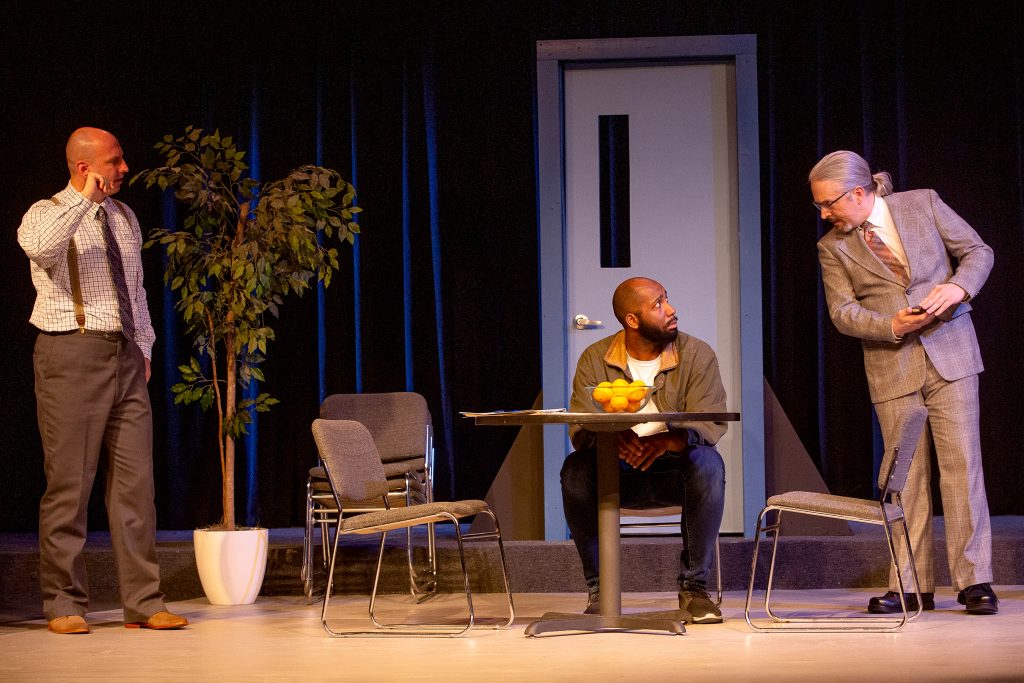
A friendship that spans 15 years is strained over a piece of modern art – an expensive, pretentious painting that art snob Serge (Ben Ritchie) has purchased to show off his privilege and to gain status.

The judgmental Marc (Stephen Peirick), who is domineering, snarky and self-righteous, takes one look and is aghast at this presumably “white” canvas.

With his “Are you serious?” reaction, Marc doesn’t hold back his horror, bluntly calling the vanity purchase a “piece of (expletive deleted),” even if Serge paid 200,000 francs for it.

Serge vehemently disagrees. He points out there is texture. It is, after all, by an artist of some note.

Later, they pull their more sensitive friend Yvan (Jeremy Goldmeier) into taking sides, and he, not wanting to rock the boat, offers a “maybe it has merit” viewpoint. Now he is caught in the middle between two alpha dogs.

Yvan’s comments push Marc’s buttons even further, calling into question the conciliatory one’s intellectual acumen – and life choices – because he might see some artistic significance.  

Yvan is a poorer, put-upon chap about to be married, whose life seems to always be stuck in second gear. Anxious about the wedding, keeping both families’ happy, getting acclimated to a new job – it all seems too much for him, and then the two pals draw him into their tiff.  

Serge is a dermatologist, Marc an aeronautical engineer and Yvan, well, he’s not really one with a ‘career’ – he just started working for his future father-in-law in the stationery business.                                                                                                                                                                                                                                                                                                                                                                                                                                                                                                                              

Ben Ritchie, Stephen Peirick and Jeremy Goldmeier in “Art” at Stray Dog Theatre. Photo by John Lamb.

The subjective debate turns into ugly confrontations that devolve into personal attacks, questioning the meaning of friendship and the definition of art. Their opinions – perhaps over-sharing but doubling down on how they feel – cause immediate fractures. Can respect and trust be restored or will the fallout be too much to overcome?

The dialogue is intricate and brings out each character’s distinctive personalities. As mud is flung, the play still retains some good zingers after 27 years.

All Stray Dog regulars, Peirick, Ritchie and Goldmeier settle into a rhythm that reflects their ease of working with each other.

This clever and humorous work by Yasmina Reza, a master at delving into contemporary foibles and a sharp observer of human behavior, was written in 1994.

Christopher Hampton translated it into English. He won an Oscar this past April for adapting another French playwright, Florian Zeller, into a screenplay for the British film, “The Father.”

“Art” opened on Broadway in 1998 after successful runs in Paris and London, winning the Tony Award for Best Play. It starred Alan Alda (Marc), Victor Garber (Serge) and Alfred Molina (Yvan, Tony nominee).

Reza also wrote “God of Carnage,” which won a Tony Award for Best Play in 2009. That show was produced by Stray Dog Theatre in 2015 and featured Peirick.

Re-emerging after a 16-month coronavirus public health crisis, Stray Dog Theatre has chosen well to begin producing shows again for a live audience.

In a wise stroke during these pandemic times, Artistic Director Gary F. Bell moved the production outside at their usual venue, the Tower Grove Abbey. On the lawn is limited, socially distanced seating, and masks are required (city mandate).

The bare-bones outdoor stage, with scenic design by Josh Smith, features two couches to represent the flats of Serge and Yvan – and of course, artwork, relying on its trio of accomplished actors to focus the action on their nimble wordplay.  

Longtime lighting designer Tyler Duenow handled those duties and Justin Been, associate artistic director, provided his usual stellar sound design with acumen for appropriately selected music

The dialogue is challenging, and the actors must shift tones, delivery and their body language while staying true to the characters, no easy feat. The trio hit their stride – despite after such a long absence from the stage – and retain the play’s acid bite.

Goldmeier is splendid at portraying a sad sack trying to avoid confrontation and scrutiny. It’s obviously not his day, week, month or even year. His emotional fragility and near-meltdown are played for laughs, and Goldmeier adroitly handles the mood swings – and his complicated monologues.

Peirick conveys the tightly wound traits of Marc, while Ritchie delivers a nuanced portrait of a sophisticate, holding his ground about his beliefs and acquisitions.

Marc will go on to question everything – including choice of restaurant for dinner — mostly in a sarcastic, irritated tone. It’s clear that Serge thinks he is intellectually superior to his friends, and more cultured, while Yvan has valued their companionship, especially in light of his messier life.

Keenly in tune with the material and his actors’ capabilities, Bell has smoothly directed the show.

“Art” is a provocateur, questioning our thoughts on art, relationships and modern society. It’s a refreshing conversation starter for anyone craving intellectual stimulation and presented in a safe setting for an evening of entertainment.

Stephen Peirick, Ben Ritchie in “Art.” Photo by John Lamb.

“Art” runs about 90 minutes without intermission. The Stray Dog Theatre presentation is Thursdays through Saturdays at 8 p.m., Aug. 5-21, with an additional performance on Sunday, Aug. 15 at 8 p.m., outdoors on the lawn at Tower Grove Abbey, 2336 Tennessee Avenue. The seating pods of 2 and 4, for only 40 guests, will be filled from front to back, in guest arrival order, starting a half hour before curtain.  For tickets or more information: straydogtheatre.org or call 314-865-1995.

All staff and crew will be wearing masks. Actors will not be wearing masks but are required to be vaccinated to work at Stray Dog Theatre. All guests, vaccinated or not, are asked to wear masks now that a city mandate is in effect.

FYI – Four of the remaining seven shows are sold out.

Artistic Director Gary F. Bell has announced that Stray Dog Theatre plans to return to live performances in late summer and get back to a full season in 2022.

“It has been so very long since we’ve been able to see you in person at the Tower Grove Abbey. I want to start off by thanking you all for supporting SDT’s Digital Series during this unusual time. Today, I am so happy to announce that Stray Dog Theatre has an exciting and vibrant plan for returning to live theatre! We have missed you all so much, and are beyond thrilled to share with you all of our wonderful upcoming offerings,” he said.

Stray Dog is starting with a 2021 Limited Series, which includes three plays in the last half of the year: ‘ART’ by Yasmina Reza, with adaptation by Christopher Hampton, premiering in August 2021; “Blue/Orange” by Joe Penhall in October 2021; “Who’s Holiday” by Matthew Lombardo in December 2021.

“A whole new season will premiere in 2022 and will offer a complete season of 6 plays and musicals just like in the past. We’re excited to announce more about this soon,” Bell said.

A new website will go live on July 1. Prior to July, you can purchase tickets for any of the 2021 Limited Series by calling the box office at (314) 865-1995.

“As always, all of us at Stray Dog Theatre are thinking of you and your safety as we plan our 2021 Limited Series and the brand new 2022 Season. We’re ready when you are!” Bell said.

TICKETS & SHOW GUIDELINES FOR THE 2021 LIMITED SERIES


As a return celebration, the 2021 Limited Series tickets will be $25 per person/per show* and are available by calling the box office at (314) 865-1995. Starting July 1, 2021, you may also purchase tickets by visiting www.straydogtheatre.org.

During the 2021 Limited Series, seating may be limited and offered in “pods” of 2 or 4 which will be physically distanced for maximum safety. If you have any questions please contact us at the box office at (314) 865-1995.

For your safety and ours, all actors, tech crew, and Stray Dog Theatre employees have been vaccinated.

We will be following all local and federal safety guidelines during each production.

*Season Subscriptions are not available for the 2021 Limited Series but will return for our 2022 Season. Ticket prices will return to normal for the 2022 Season.

ART

by Yasmina Rezawith adaptation by Christopher Hampton

Marc, Serge, and Yvan have been the best of friends for years. When Serge buys a very expensive piece of art, the intellectual and emotional arguments that ensue become less theoretical and more personal and threaten to destroy their friendships.

‘ART‘ will be presented under the stars on our gorgeous Tower Grove Abbey lawn.

8PM Thursdays thru Saturdays August 5, 6, 7, 12, 13, 14, 19, 20, 21.Additional performance Sunday, August 15 at 8PM. 

Blue/Orange

Blue/Orange
by Joe Penhall
The day before Christopher is due to be discharged from a psychiatric ward, his doctor has reservations and raises his concerns with a senior colleague. Blue/Orange is an incendiary tale of race, madness, and a Darwinian power struggle at the heart of a dying National Health Service.
BLUE/ORANGE will be presented inside the historic Tower Grove Abbey.
8PM Thursdays thru Saturdays October 7, 8, 9, 14, 15, 16, 21, 22, 23.Additional performance Sunday, October 17 at 2 PM.

Who’s Holiday

by Matthew Lombardo
You saw her last when she was just two
Celebrate the holidays with Cindy Lou Who
Pull up a seat and fill up your cup
‘Cause your favorite little Who is all grown up
A wildly funny and heartfelt adults-only comedy that explores the twisted tales after that fateful night when a certain Grinch tried to steal Christmas. For Mature Audiences.
WHO’S HOLIDAY will be presented inside the historic Tower Grove Abbey.
8PM Thursdays thru Saturdays December 2, 3, 9, 10, 11, 16, 17, 18.Additional performance Sunday, December 12 at 2 PM.