
By Lynn Venhaus
An enticing sense of wonder and palpable joy in nature can be felt in “Beyond Van Gogh: The Immersive Experience,” now available in St. Louis.

Irresistible and imaginative, it is: “magnificent.”

Art lovers will swoon looking at the walls with a 22-foot ceiling, technology enthusiasts will marvel at the cutting-edge three-dimensional world, and all will be exhilarated by the moving digital light show that breathes new life into Vincent van Gogh’s life work.

One must experience this unique multimedia presentation first-hand to understand just what the ‘immersive’ aspect truly means.

The limited engagement which opened Oct. 1, runs through Nov. 21 and is open from 10 a.m. to 10 p.m. Sundays through Thursdays and 10 a.m. to 11 p.m. Fridays and Saturdays. Four entry times are available each hour and tickets are sold online at www.vangoghstlouis.com

The installation is in the Starry Night Pavilion on the grounds of the Saint Louis Galleria, near the Macy’s side. Upon entry of the gigantic white tent, you will be educated about the legendary Dutch painter – his thoughts recorded in letters to his brother Theo, his dreams and own words about his life and work.

 After the introduction, a second room, referred to as a “portal,” prepares visitors for the visuals by having them get used to the moving images – comparing it a dreamlike experience.

The work comes alive in the ‘immersion’ room, the third – and largest – space. then we become acclimated to the visuals of his works, through wall projections and finally, able to partake in stunning colors that swirl, dance and refocus into flowers, cafes and landscapes that operate on a 30-minute loop.

Overall, there are about 300 paintings representing his vast body of work. He had a fondness for portraits of peasants and still life of nature settings, and is known for a multitude of self-portraits.

His instantly recognizable masterpieces “The Starry Night,” “Sunflowers” and “Café Terrace at Night” come to life, no longer in frames, and you can see the details. The numerous shades of blue he used to depict night skies is remarkable – and vibrant.

The music score is symphonic and cinematic, and yes, you can hear snippets of Don McLean, along with Paul Simon, Miles Davis and other modern composers.

Whether you are familiar about the tortured artist or not, you can’t help but have a new appreciation for his work and understanding of the 19th century world he attempted to cope with in his all-too-brief, difficult life.

Sadly, he was more famous in death than in life. He was born in 1853 in Zundert, Netherlands. He didn’t take up painting until he was 28 years old. After bouts with depression, cutting off nearly his entire ear, confined to an asylum for a year – he painted nearly a work a day – he shot himself in the chest in 1890 and died two years later of infection in Auvers-sur-Oise, France. He was 37 years old.

His brother, Theo, an art dealer, died of syphilis six months later, and his widow, Jo, is credited for getting the word out about Vincent, and his paintings into the public eye.

In later years, medical experts have concluded that he likely had depression, bipolar disorder and a borderline personality disorder. Because of his poverty, poor diet, sleeping habits, drinking and smoking, he did not help his health either.
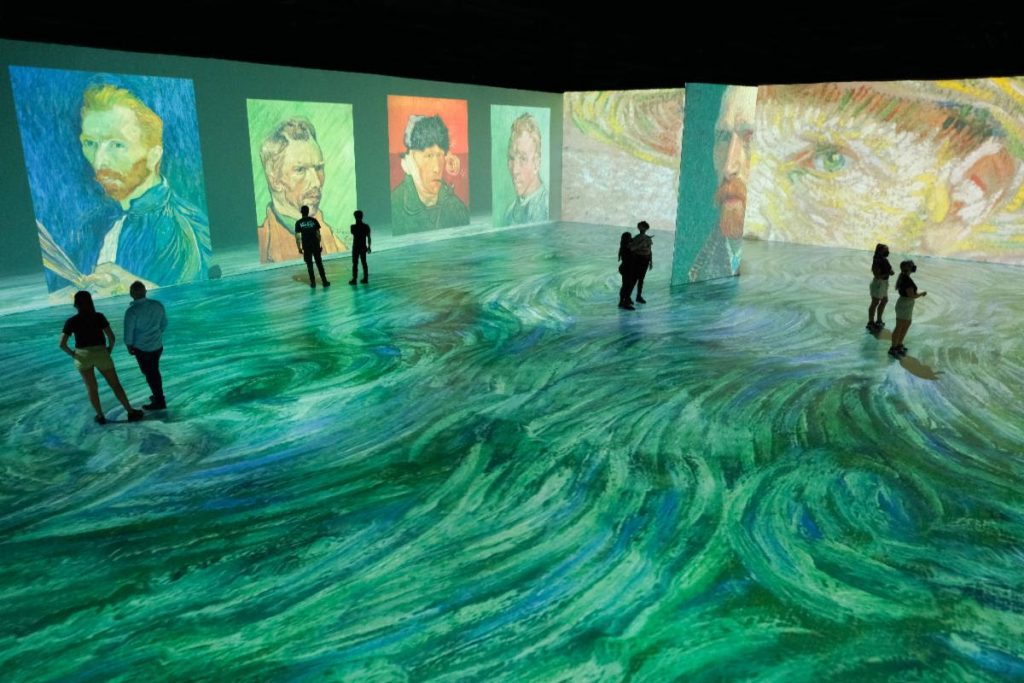
Immersion Room. Provided Photo.

For those interested in exploring more about Van Gogh, four of his paintings are on display at the St. Louis Art Museum in Forest Park, including “Stairway at Auvers” and “Head of a Peasant Woman,” seen in the immersive projections.

For those wondering where others are, “Arles Sunflowers” and “Wheat Fields with Cypresses” are at the Metropolitan Museum of Art in New York City, “The Starry Night” is at the Museum of Modern Art in New York City, and “Starry Night Over the Rhone” is in the Musee D’Orsay in Paris.

“Café Terrace at Night” is at the Kröller-Müller Museum in Otterlo, the Netherlands. For that work, he set up an easel in the Place du Forum, a public square in Arles, and painted it en plein air.

“Irises” is at the J. Paul Getty Museum in Los Angeles and “Haystacks” is at the Philadelphia Museum of Art.

At the Van Gogh Museum in Amsterdam, you will find “Bedroom in Arles,” “The Yellow House,” and “The Potato Eaters.”

The Normal Studio, which has accomplished these shows with other artists, too, is known for pushing the boundaries of performing arts, entertainment, and public installations. Founded in 2009, they fuse physical and technological elements to transform spaces into multimedia magic, telling stories in new and different ways.

It is indeed a one-of-a-kind triumph in the St. Louis region, an experience not to be missed.

The St. Louis exhibit also has a gift shop. For a special, Schlafly has introduced a beer, Swirling Sky IPA, at its various locations. 
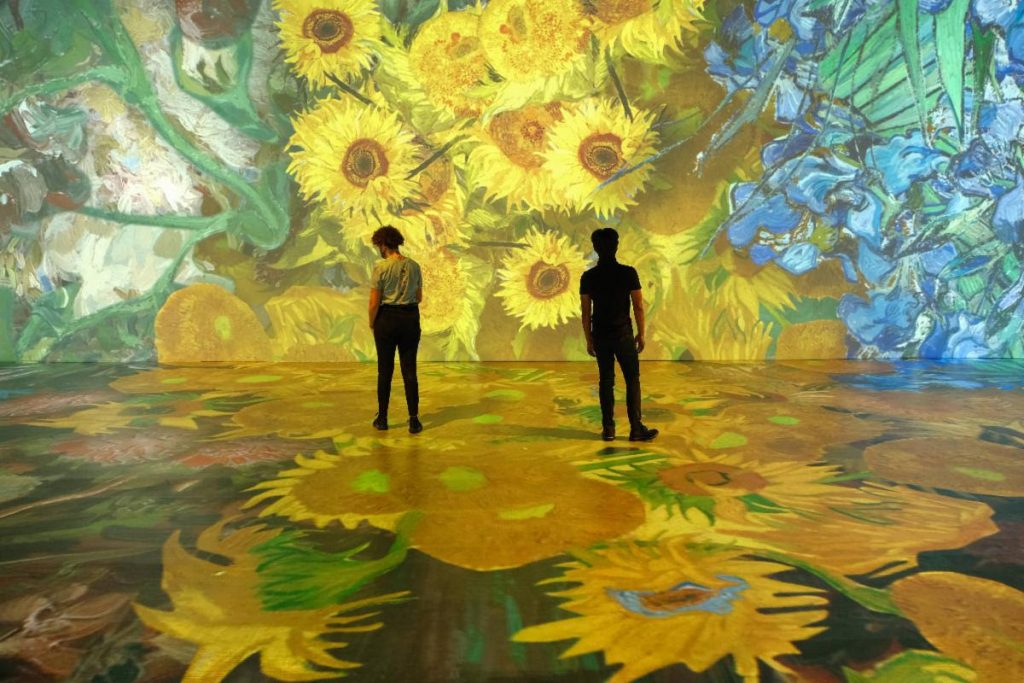
Provided photo.

The exhibition is open from 10 a.m. to 10 p.m. Sundays through Thursdays and 10 a.m. to 11 p.m. Fridays and Saturdays in the Starry Night Pavilion on the grounds of the Saint Louis Galleria, Richmond Heights. Four entry times will be available each hour.  They recommend that the exhibit takes one hour to view.

Prices start at $36.99 for adults, with VIP and premium passes available up to $93, and $24.99 for children ages 5 to 15, with children under 5 are free. Tickets are sold online at www.vangoghstlouis.com

Beyond Van Gogh is following all St. Louis County Health Department guidelines in place during the exhibition’s run. Parking is free at the Saint Louis Galleria. Group tickets are available for eight or more.

For more information, visit www.vangoghstlouis.com.

Provided photos.

By Lynn Venhaus

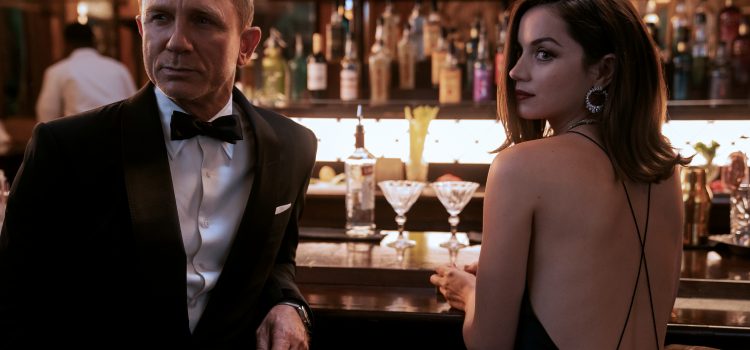
“No Time to Die” is everything you want in a Bond movie, a super-spy thrill ride elevated by director Cary Joji Fukunaga’s flair for assembling dynamic action sequences and his attention to details.

And in a welcome surprise – assertive women show up in an impressive triumvirate of Ana de Armas, Lashana Lynch and Lea Seydoux.

For the fifth and final entry in the Daniel Craig era as the suave James Bond, our very human hero has left active service at M16 and is enjoying a tranquil life of retirement in Jamaica. However, his peace is short-lived when his old friend Felix Leiter (Jeffrey Wright) from the CIA asks for help in rescuing a kidnapped scientist. The mission turns out to be far more treacherous than expected and leads Bond onto the trail of a mysterious villain (Rami Malek) armed with dangerous new technology.

Fukunaga’s keen eye is well-documented in his unflinching 2015 film “Beasts of No Nation,” in which he was also cinematographer, and his masterful first season of the dark, hypnotic “True Detective” in 2014, for which he won an Emmy Award for directing.

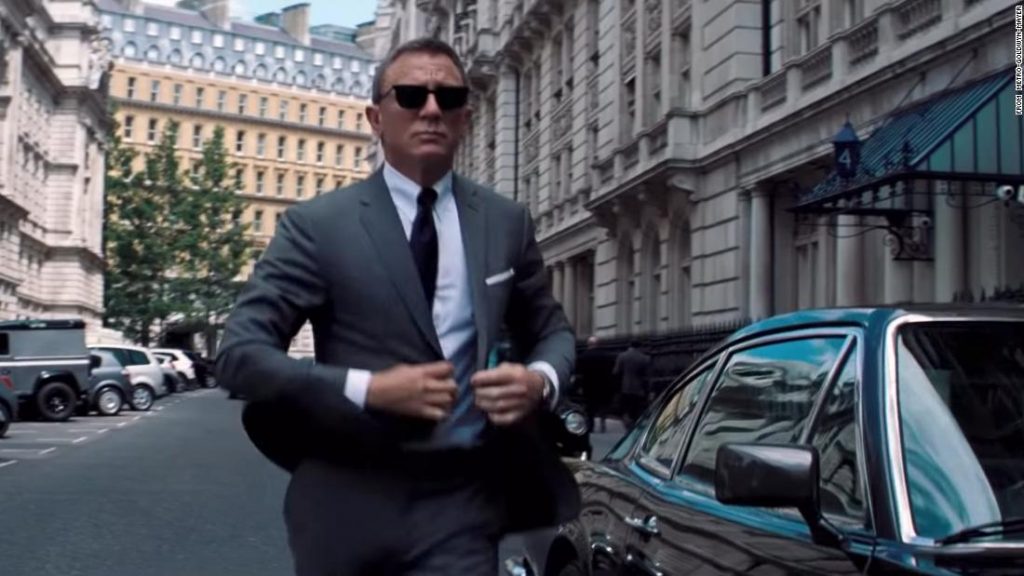
He excels at moving this intriguing spy story along and the globe-trotting camerawork by Linus Sandgren, Oscar winner for “La La Land,” is dazzling. Even at 2 hours and 43 minutes, this slick yet gritty adventure keeps our attention, and satisfyingly wraps up Craig’s story arc as the British icon.

While most other Bond films can stand on their own, some 25 and counting over six decades, the five in the Daniel Craig era are connected. “No Time to Die” relies on viewers knowing that Vesper Lind was Bond’s first wife in the 2006 “Casino Royale” reboot and that tragic backstory, as well as familiarity with what happened in the last one, “Spectre” in 2015 – especially about his girlfriend Dr. Madeleine Swann, daughter of nemesis Mr. White, and sinister mastermind Blofeld (Christoph Waltz), Swann’s dad’s boss.

The script by Neal Purvis and Robert Wade, as well as Fukunaga, is noticeably impacted by the contributions of screenwriter Phoebe Waller-Bridge (heralded creator of “Fleabag”), who brings a refreshing female perspective to the well-documented male patriarchy of the Bond franchise.

This entry is far more female-forward than previous Bond installments – and there is a new 007, Nomi, and she is a feisty, ferocious machine, with Lashana Lynch in a dandy performance, the first black British agent in the film’s 58-year history. No, he may be legendary, but they did not retire Bond’s number, 007.

The iconic ID has been around since Ian Fleming’s first novel, “Casino Royale,” in 1953, and he went on to write 11 novels and two short story collections. Other authors have carried on Bond’s missions.

What direction the Bond franchise goes after Craig’s swan song is anyone’s guess – but post-credits, producers are emphatic: Bond will return in 2022. Debate rages over the possibility of Idris Elba or Rege-Jean Page, or even a female agent. Hmmm…anticipation grows.

In the meantime, Craig fans will enjoy his final emotionally charged performance. He’s been a fine Bond, one of the best, displaying an intensity about dedication to duty, a wily intelligence and a tiny chink in his reserved demeanor about feelings, which is endearing. His orphan roots and lovers’ betrayals have exposed his internal wounds.

While he might not be as memorable as some previous villains, Rami Malek is an interesting adversary as mad genius Lyutsifer Safin, warped by his father’s zeal for using chemicals as weapons.

As the other Bond villain, Blofeld, Christoph Waltz is far better here in one confrontation than he was in the entire “Spectre,” which was a disappointing film after the extraordinary “Skyfall” in 2012.

Not everyone is sold about French actress Lea Seydoux playing the love interest, a rare second appearance for a girlfriend, but it deepened the Craig finale.

This foray features a solid cast, with the always-exceptional Ralph Fiennes returning as a conflicted M, Ben Whishaw as tech whiz Q, Naomie Harris as loyal assistant Eve Moneypenny, Rory Kinnear as government wonk Tanner and this time around, Jeffrey Wright compelling as CIA pal Felix.

Besides a take-notice turn by Lynch, Ana de Armas is sensational as a rookie CIA operative helping Bond in Cuba. She is not given as much screen time as she deserved, and her captivating sequence had viewers wanting more, ushering in a new type of “Bond girl” in a changing era.

Bond may be a relic from a distant past, but the fact that filmmakers acknowledge that change is necessary, makes for a fascinating future.

The franchise, known for stylish escapism, may be forced to adapt to keep relevant in a brave new world, but viewers will always want engaging stories of right triumphing over might – no matter if it’s good girls AND guys.

And wow, are those car chases fun to watch.

Daniel Craig as James Bond in “No Time to Die”

No Time to Die” is an action-adventure directed by Cary Joji Fukunaga and stars Daniel Craig, Rami Malek, Lea Seydoux, Lashana Lynch, Ben Whishaw, Naomi Harris, Christoph Waltz, Ralph Fiennes, Jeffrey Wright, BIlly Magnussen and Ana de Armas. It is Rated: PG-13 for sequences of violence and action, some disturbing images, brief strong language, and some suggestive material. Its run time is 2 hours, 43 minutes. It is in theaters on Oct. 8. Lynn’s Grade: A


By Lynn Venhaus

Friendship is indeed one of life’s blessings, especially those lasting ones through the ebb and flows of the years. The French novelist Francois Mauriac once wrote that “No love, no friendship, can cross the path of our destiny without leaving some mark on it forever.” And this little musical theater gem, “The Story of My Life,” illustrates that theme beautifully.

New Line Theatre kicks off its 30th season with this deceptively simple yet poignant and profound work, an intimate and thoughtful reflection on the special people who change our lives. It runs Sept. 30 through Oct. 23, Thursdays through Saturdays at 8 p.m. at the Marcelle Theater.

It particularly strikes a chord after what we’ve been through during the past 18 months, dealing with a coronavirus pandemic and periods of lockdown and quarantine during the public health crisis. The appreciation of and craving for connection has become an exclamation point.

“The Story of My Life” opened on Broadway in 2009 after earlier productions in Toronto and the Goodspeed Opera House. It was nominated for four Drama Desk Awards, including best musical.

With a keenly observed book written by Brian Hill and heartfelt music and lyrics by Neil Bartram, “The Story of My Life” follows the friendship of Alvin Kelby and Thomas Weaver, two lifelong friends since age 6 who grew up in a small town. Once inseparable, they are reunited after Alvin’s mysterious death.

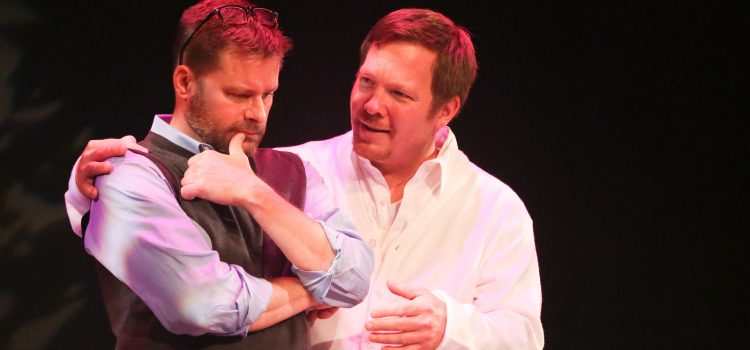
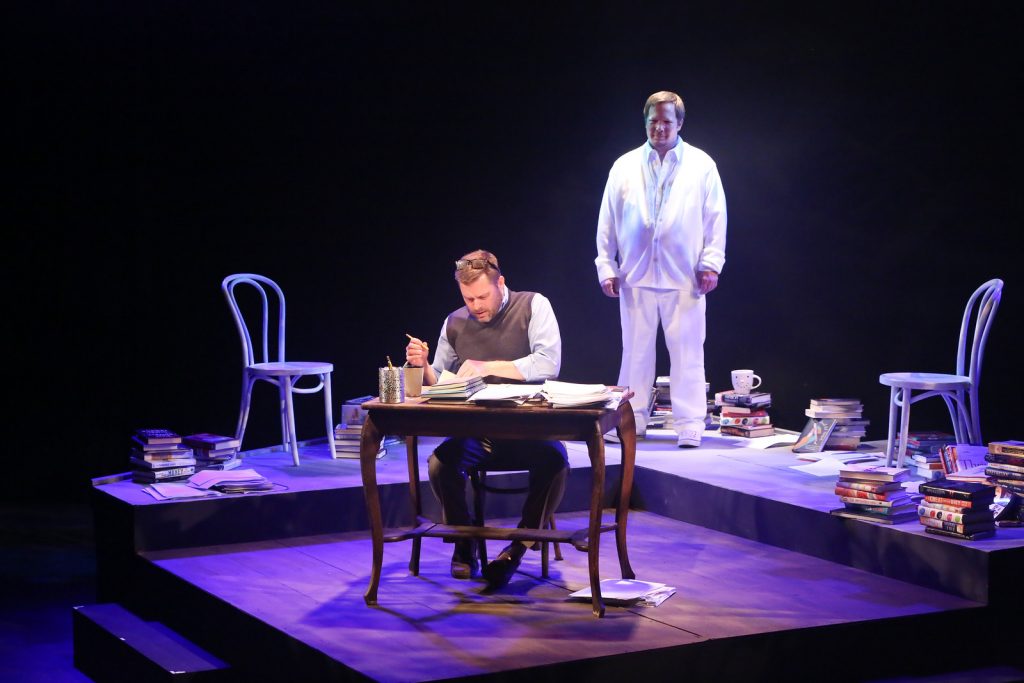
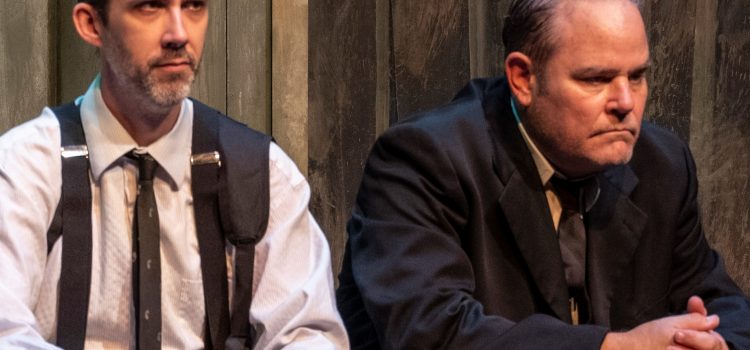
Jeffrey M Wright as Thomas, Chris Kernan as Alvin. Photo by Jill Ritter Lindberg

While Thomas, a successful author, struggles to write Alvin’s eulogy, his deceased pal appears from the afterlife, and they take a sentimental journey, revealing moments big and small from their intertwined lives.

Alvin goes through the manuscripts and short stories in Thomas’ mind, some which found their way to being published and receiving acclaim.

The adage “write what you know” is what guides Thomas as he sums up his best friend. During the process, he finds his own story and comes to terms with his past.

New Line veterans Chris Kernan as Alvin and Jeffrey M. Wright as Thomas make for an appealing pair, ardently portraying the lifetime friends who chronicle their journey in vignettes – their story is told through stories.

And the two actors punctuate each other’s remembrances. Pouring their hearts and souls into the demanding roles, Kernan and Wright are passionate about making these two guys memorable.

With a deft touch, Scott Miller accompanies the pair on keyboard. He also directed the show with a smart no-frills approach that never feels static.

The score finds the magic in special moments that friends share during lengthy relationships – and addresses rough patches, too. There are four parts to “Saying Goodbye,” and each one is real.

Kernan and Wright meet the challenge of being on stage the entire 70 minutes, without an intermission, breathing life into these roles with insight and charm  

Tom’s book report, “1876” and a song after something Alvin said, “The Butterfly,” are just two highlights.

These parts are unlike anything else they have ever done, with Wright known for classic leading men roles like Nathan Detroit in “Guys and Dolls” and Nicky Arnstein in “Funny Girl,” and Kernan often supporting and humorous roles, like one of the dads in “Heathers” and St. Jimmy in “American Idiot,” and his award-winning Snoopy in “You’re a Good Man, Charlie Brown.”

As the likable kids, who bond over their annual Christmas movie tradition “It’s a Wonderful Life,” they resonate at every turn in their lives.

Alvin, a cheerful sort despite being dealt a few George Bailey-like blows during his life, lost his mom at an early age. When his father begins ailing, he takes over running the bookstore instead of going off to college and adventures.

Thomas, a driven guy who communicates better on paper, is the one who grabs the opportunities afforded him and leaves town, rarely returning.

Alvin stays rooted in their town, running the treasure trove that is his father’s bookstore, “The Writers Block,” and misses his buddy, who is off to other crossroads. Nobody “gets” him like Thomas did. “You’re Amazing, Tom” Alvin sings.

As Thomas is off living a life he imagined, does he feel the same about how special their friendship has been?

Redolent with tender and touching moments, “The Story of My Life” includes many warm humorous bits too – starting with Alvin’s reminisce about their teacher, “Mrs. Remington.”

The show’s rich emotional depth effectively builds to a heart-tugging conclusion, ending with “Angels in the Snow.” Moist-eye alert – bring a tissue.

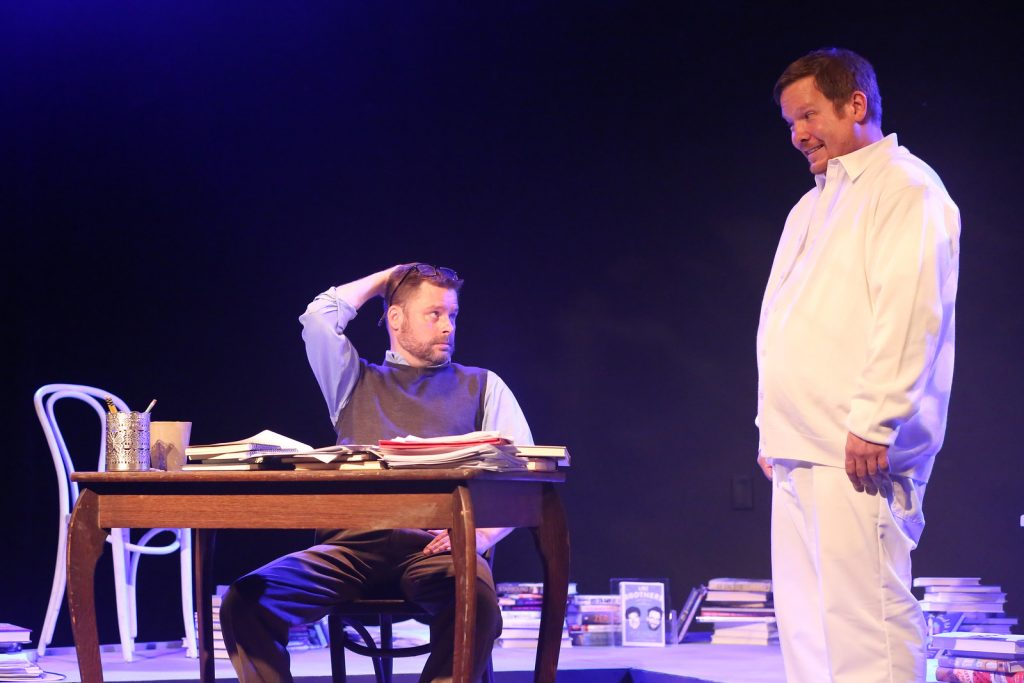
Scenic designer Rob Lippert’s minimalist set – full of books and the written word – and Kenneth Zinkl’s modest lighting design are impressive accents for a show that stands out without any bells and whistles.

An outstanding collaboration by all involved, “The Story of My Life” has a lot to say, and you’ll be glad you spent time getting to know Alvin and Thomas. Maybe you will recognize your own friends and your experiences along the way, like I did.

After all, George Bailey wisely learned: “Remember, no man is a failure who has friends.”

Holiday time or not, this show is a gift to theatergoers eager to feel “the feels” that only live theater can provide. And a reminder about humanity in a time of great uncertainty and division. It could not be more timely – and timeless.

Jeffrey M Wright, Chris Kernan. Photo by Jill Ritter Lindberg.

“The Story of My Life” runs through Oct. 23, Thursdays, Fridays and Saturdays at 8 p.m. at the Marcelle Theater, 3310 Samuel Shepard Drive, three blocks east of Grand, in the Grand Center Arts District. For more information, visit www.newlinetheatre.com.

Tickets are $25 for adults and $20 for students/seniors on Thursdays; and $30 for adults and $25 for students/seniors on Fridays and Saturdays. To charge tickets by phone, call MetroTix at 314-534-1111 or visit the Fox Theatre box office or the MetroTix website.

COVID-19 POLICY

All patrons will be required to wear masks in the lobby and theatre. The stage area will be safely distanced from the audience. In addition, the Kranzberg Arts Foundation now requires all patrons 12 years or older to show proof of their full COVID-19 vaccination or negative COVID-19 test upon entry for all ticketed events at all KAF indoor performance venues, including the Marcelle Theater.  

Photos by Jill Ritter Lindberg.

Tickets are on sale for The Midnight Company’s St. Louis premiere production of Mickle Maher’s It Is Magic at MetroTix.com.  Performances, at Kranzberg’s Black Box Theatre, are Thursdays, Fridays and Saturdays October 21 through November 6, with all shows at 8pm.  Tickets are $15 for Thursdays and $20 for Fridays and Saturdays.  The production will be following all Kranzberg Arts Foundation safety protocols, including proof of vaccination for entry, and masks at all times.

It Is Magic is a sorrowful and hilarious meditation on the deep, ancient evil at the heart of the community theatre audition process, and an investigation into the mysteries of theatre-making itself.  Two sisters, community theatre veterans who’ve never had the chance to contribute artistically, are holding auditions for their adult version of The Three Little Pigs in the theatre basement, while the group’s pretentious artistic director is attending, then avoiding, opening night of his MacBeth on the MainStage above.  A third sister appears, and reality becomes really magical at the local playhouse.

It Is Magic premiered in Chicago in May, 2019, and Third Coast Review called it “…one of those love letters to theatre…delightfully wacky,” while New City Stage said “Any show that juggles loving critics and tearing their throats out is good in my book.”  Midnight has previously presented two Mickle Maher plays, The Hunchback Variations and An Apology For The Course And Outcome of Certain Events As Delivered By Doctor John Faustus On This His Final Evening.  

Mickle Maher plays have Off-Broadway and around the world, and have been supported by grants from the NEA, the Rockefeller MAP fund, and Creative Capital. They include There is a Happiness That Morning Is; Song About Himself; The Strangerer; Spirits to Enforce; Cyrano (translator), The Cabinet; Lady Madeline; The Pine; and An Actor Prepares (an adaptation of Stanislavsky’s seminal book). He is a cofounder of Chicago’s Theater Oobleck, and has taught playwriting and related subjects at the University of Chicago, Columbia College, and Northwestern University. He recently wrote the book and lyrics for a new musical about basketball, commissioned by the Catastrophic Theatre of Houston and Daryl Morey, the General Manager of the Houston Rockets. And he’s currently adapting the graphic novel Berlin by Jason Lutes for the Court Theatre.

Suki Peters will direct It Is Magic.  In Spring, 2022, Suki will play the bride in Cherokee Street Theatre’s adaptation of Kill Bill, and she will direct Once for R-S Theatrics.  The cast for It Is Magic includes Nicole Angeli as Sandy, desperate to get a part in a play, the part being the lead role of the Wolf in her sister’s play.  Nicole was most recently seen in Metro Theater’s It’s A Wonderful Life, in West End’s Photograph 51, and in Stray Dog’s Hedda Gabler and A Doll’s House.  Michelle Hand portrays her sister, the first-time, aspiring playwright, Deb.  This past year Michelle was in Max & Louie’s Tiny Beautiful Things and SATE’s Zoom show Tonya And The Totes In Subterrstrata.  Carl Overly Jr. is Tim in the play, another actor vying for that coveted Big Bad Wolf role.  Carl was in recent productions of St. Louis Shakespeare Festival’s King Lear and COCA’s Billy Elliott, and upcoming will direct Rimers Of Eldritch at St Louis University.  Chrissie Watkins will be Elizabeth, arriving from seemingly nowhere to land smackdab in the middle of the audition process.  Chrissie was seen in Alpha Players’ The Mountaintop this summer.   And Midnight’s Artistic Director, Joe Hanrahan is in the role of Mortier Civic Playhouse Artistic Director Ken Mason, as arrogant, self-absorbed and sporadically brilliant as any Artistic Director comes.  This year Joe has acted in Midnight productions of Here Lies Henry, and in his own scripts of Now Playing Third Base For The St. Louis Cardinals Bond James Bond, My Violin My Voice at the St. Louis Fringe Festival, and Tonight’s Special at the St. Louis Theatre Showcase.  He will next be seen in his new script, Midnight’s Tinsel Town in December.

Linda Menard will be the Stage Manager for the show, Elizabeth Henning is designing costumes, Kevin Bowman is designing the set and lights, and Ted Drury will design sound.

For more information, visit MidnightCompany.com  

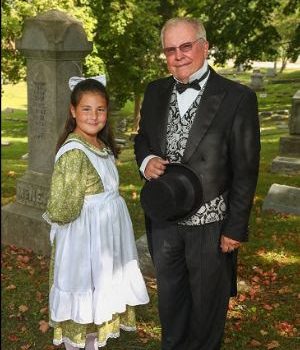
Lucas Pfeiffenberger and Lucy Haskell will welcome guests to the 20th annual Vintage Voices, held in the Alton Cemetery on October 2, 3, 9, 10, 2021. Vintage Voices has become an important cultural event in our community, where actors in period costumes tell the story of Altonians who have shaped our history. Alton Cemetery is located at 5th and Vine Streets, Alton IL 62002.
 
Many anniversaries are being celebrated in 2021 in addition to Vintage Voices’ 20th year. The Star-Spangled Banner has been in existence for 90 years, while Rotary Club of Alton-Godfrey is celebrating 100 years. You’ll hear from the first Black student to graduate from Alton High School who went on to be a professor.  And you might even get to enjoy the Dominant Ninth Choral Society rehearsing.  Nine stops are on the tour this year.
 
Vintage Voices is produced by a volunteer committee. Proceeds from the event support the continuation of the event, upkeep of the Alton Cemetery and various community organizations.
 
Sharlene Meyer, one of the original founders says, “Watching the growth of Vintage Voices has been such a joy. Vintage Voices is entertaining, educational and keeps history alive in Alton. Congratulations to the committee for a great job well done.”
 
To commemorate the 20th annual presentation, paid guests will receive a special souvenir gift, while supplies last.
 
Walking tour tickets are $15 for adults and $10 for students aged 6-18. Tickets can be purchased online at https://vintagevoices.eventbrite.com or with cash at the event.
 
The non-walking performance returns this year on Sunday, October 10, 2021. The one-hour performance begins at 5:00 pm at Jacoby Arts Center, 627 East Broadway in Alton IL. Seating is limited to 60 people. Tickets are $15 and can be purchased at Jacoby Arts Center and online at https://vintagevoices.eventbrite.com.
 
Like the Facebook page, www.facebook.com/vintagevoicestours, for further information.

R-S Theatrics is thrilled to announce their return to live theatre with the St. Louis premiere of Breadcrumbs by Jennifer Haley, running October 8-24, 2021, at The .ZACK (3224 Locust St.).
In Breadcrumbs, a reclusive fiction writer diagnosed with dementia must depend upon a troubled young caretaker to complete her autobiography.  In a symbiotic battle of wills, they delve into the dark woods of the past, unearthing a tragedy that shatters their notions of language, loneliness, and essential self.  Dallas Morning News calls Breadcrumbs “timely and touching,” while DC Theatre Scene says, “It is an act of boldness, to be done only by a playwright in absolute command of her gifts…”  

This production will be directed by R-S Artistic Director Sarah Lynne Holt.  The cast includes Jodi Stockton as Alida and Julie Amuedo as Beth/Mother.  The design team is Costume Designer Amanda Brasher, Lighting Designer Karen Pierce, Sound Designer Ted Drury, and Scenic & Properties Designer Sarah Lynne Holt.  The team is rounded out by Stage Manager Lucy Bowe, Dramaturg Rachel Hanks, Resident Intimacy Coordinator Tress Kurzym and Resident Graphic Designer & Photographer Michael Young.

Breadcrumbs will perform Fridays and Saturdays at 8:00pm and Sundays at 7:00pm.  General admission tickets will be $20, available through MetroTix or at the door.  Audio description for the blind and partially-sighted from MindsEye will be available during the Sunday, October 10th performance.  The October 15th performance will be followed by a presentation and discussion of the effects of trauma and dementia on brain development and behavior with Rachel Hanks, production dramaturg and licensed clinical social worker with a specialty in neurobiologically-informed interventions for traumatic stress and developmental trauma.

In accordance with Kranzberg Arts Foundation and R-S Theatrics guidelines, all audience members age twelve and up will be required to show proof of full vaccination against COVID-19, a negative PCR test dated within 72 hours of the performance start time, or a negative antigen test dated within 24 hours of the performance start time.  Other than actors onstage, everyone over the age of two must remain properly masked in The .ZACK at all times.  This production is funded in part by the Arts and Education Council.  Breadcrumbs is presented by arrangement with Concord Theatricals on behalf of Samuel French, Inc.

R-S Theatrics is a small professional theatre company in residence at Kranzberg Arts Foundation in St. Louis, Missouri.  Our mission is to present St. Louis-area professional premieres of work that introduces new voices to important conversations in our community.  Since launching in May of 2011, R-S has produced acclaimed productions of ParadeIn the HeightsEvery Brilliant Thing, and The Motherf**ker with the Hat, among many others.  

Jennifer Haley is a playwright whose work delves into ethics in virtual reality and the impact of technology on our human relationships, identity, and desire. She won the 2012 Susan Smith Blackburn Prize, a Los Angeles Ovation Award and the Francesca Primus Prize for her play, The Nether, which premiered at Center Theatre Group and was subsequently produced at The Royal Court Theatre with Headlong in London. Other plays include Neighborhood 3: Requisition of Doom, which premiered at the Actors Theatre of Louisville 2008 Humana Festival, and Froggy, in development with Center Theatre Group and American Conservatory Theater. Jennifer’s work has been developed at The Banff Centre, the Sundance Theatre Lab, O’Neill National Playwrights Conference, Lark Play Development Center, PlayPenn, Page 73, and the MacDowell Colony. She is a member of New Dramatists in New York City and lives in Los Angeles, where she founded the Playwrights Union. 

Director Sarah Lynne Holt (she/her) has been a theatre artist in St. Louis since 2001.  She holds a directing degree from Millikin University and has helmed shows at The Midnight Company, Solid Lines Productions, The Q Collective, Kirkwood Theatre Guild, That Uppity Theatre Company, PRIME, The Non-Prophet Theater Company, and The Tin Ceiling.  At R-S Theatrics, she has directed boomA Perfect Arrangement, and numerous other projects, including four years of shows in partnership with The Repertory Theatre of St. Louis’s WiseWrite Young Playwrights’ Festival.  She began working with R-S in 2014, served on the Board of Directors from 2015-2018, and has been Artistic Director since January 2020.  Sarah previously held staff positions with Arcon Radio Players, The Non-Prophet Theatre Company, Last Chance Theatre, and Blue Lemon Theatre Group.Complimentary review tickets are available to media by request.  To reserve tickets, request a full press packet, or get more information, contact Sarah Lynne Holt at [email protected] or visit R-S’s website at r-stheatrics.org.

With the climate crisis evincing ever more  concerns this summer, our Climate Change Theatre Action event on Saturday Oct 16 could not be more timely. 

Our free afternoon event will offer eight short internationally  commissioned plays in four art galleries, a theatrical adaptation of Greta Thuneberg’s address to the UN, a dance performance, outdoor resource tables by environmental organizations, voter registration, and more. 

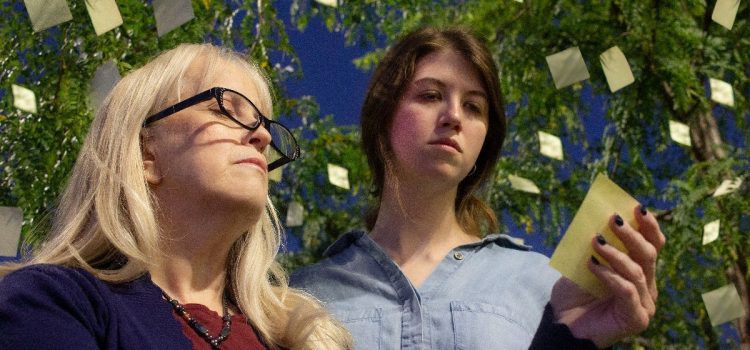
That Uppity Theatre Company, Artistic director Joan Lipkin, in collaboration with Climate Change Theatre Action (CCTA), a project of the Arctic Cycle will present a theatre and arts crawl on Saturday, Oct 16 from 1-4 pm at area art galleries in the Central West End.

The galleries include Duane Reed, Houska, Philip Slein, and Projects +, all located on McPherson Avenue in the historic CWE district.

“We are living in a time of increasing urgency to address critical climate change. It is no longer something that can be avoided or ignored. Regardless of our business, our occupations or personal situation, we are all in it together. Through our participation in the Climate Change Theatre Action, the gallery hopes to take part in a larger effort that is all about increasing our awareness of this crisis,” said Duane Reed, of the Duane Reed Gallery.

Viewers will be able to see a short play or two of under ten minutes before proceeding to the next gallery to see others. The event will feature 4-8 short pieces. Most performances will be repeated 6-8 times or approximately every twenty minutes, starting at 1 pm. Some work may also be performed outside.

Indoor performances will be limited to ten audience members at a time and masking will be required.

Many St Louis theatre artists are involved in presenting this project including Anna Blair, Donna Weinsting, Dan Kelly, Teresa Doggett, Susan Volkan, Michael Paplanus, Don McClendon, Carrie Hegdahl, Alice Kinsella, and Rachel Mitchell, among others.

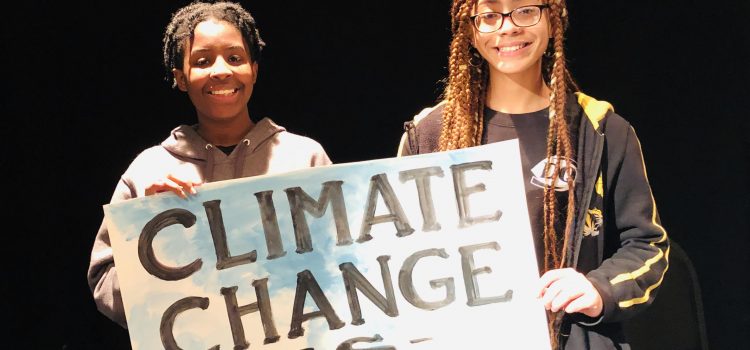
The Central Visual & Performing Arts High School will also present a theatrical adaptation of Greta Thunberg’s speech to the United Nations called” How Dare You”. Ashleyliane Dance Company will offer selections from their critically acclaimed “Environmental
Intelligence” dance piece.

Additionally, there will be outdoors tabling by environmental groups including Great Rivers Greenway, US Green Building Council – Missouri Gateway Chapter, Missouri Coalition for the Environment, Project Animal Freedom, World Bird Sanctuary, Metropolitan Congregations United, Earth Dance Organic Farm School, St Louis Voter Registration Group and more. Street parking is available as well as a paid lot on Euclid Ave between Washington and McPherson Ave.

“The issues facing us are real but so are the opportunities to change the direction of this global crisis,” said Joan Lipkin. “The arts are a pathway to illuminate the issues in an engaging way and also to promote hope, joy and engagement. It is both meaningful and important that St Louis take part in this international arts and ecology movement.”

Produced by Joan Lipkin and Pamela Reckamp, the St Louis event is part of a worldwide series of readings and performances of short plays about the climate crisis and environmental justice. CCTA 2021 will take place from September 19 to December 18 to coincide with the United Nations Climate Change Conference (COP 26).

The last iteration of CCTA, in 2019, included over 220 events in nearly 25 countries. For more details, the list of participating playwrights, and previous collaborators, see www.climatechangetheatreaction.com.

By Lynn Venhaus
An American remake that is as tense and gripping as the 2018 Danish original, “The Guilty” will surprise with its carefully crafted twists in a story you think you have figured out – but assumptions are a dangerous tool.

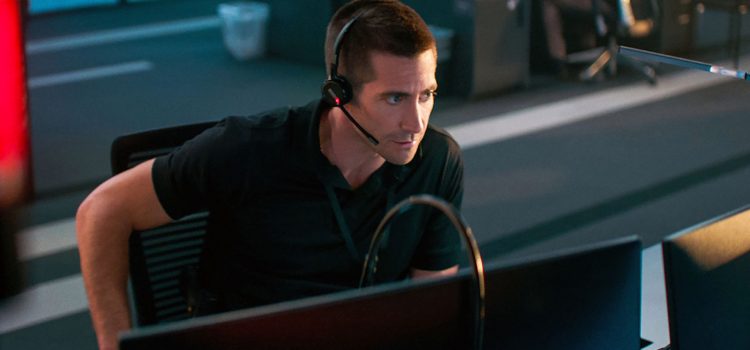
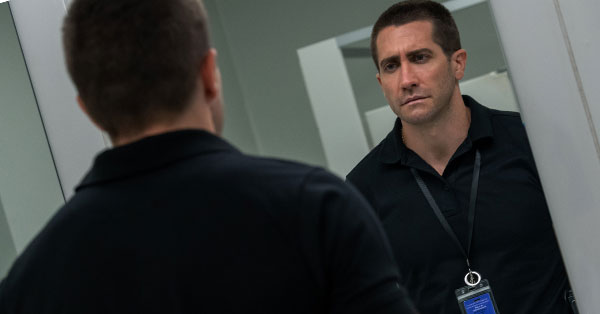
“The Guilty” takes place over the course of a single morning in a 911 dispatch call center. Call operator Joe Baylor (Jake Gyllenhaal) tries to save an emergency caller in grave danger, but he soon discovers that nothing is as it seems, and facing the truth is the only way out.

Gyllenhaal bought the rights to the acclaimed foreign language film, which won the Audience Award at the Sundance Film Festival in 2018 and was Denmark’s entry for the Oscars (not nominated; “Roma” won) three years ago. (The original is currently streaming on Hulu.)

As a producer, he cast himself as the lead, a demoted police officer working as a 911 dispatcher, and assembled a crackerjack team.

The creative crew – including screenwriter Nic Pizzolatto, of HBO’s “True Detective,” has not changed much, but moved the location from Copenhagen to Los Angeles, where the public safety personnel are involved in quelling wildfires. The call center displays horrific scenes of fire ravaging the landscape on its multi-screens.

Original screenwriters Gustav Moeller, who also directed the 2018 film, and Emile Nygaard Albertsen, had written such a compelling script that it really didn’t need much embellishment. It’s a brilliant example of building tension in a contained area in a race against time.

Above all, the source material illustrated that a rush to judgment is often counterproductive. The takeaway is that one should not jump to conclusions before all the details are available.

One change is the temperament of Baylor. Whereas in the original, Swedish actor Jakob Cedergren played the conflicted police officer with a more stoic demeanor, they both are frustrated by the petty calls clogging up the system and show little patience.

Gyllenhaal is a more intense actor, so he plays Joe with pent-up rage. While he answers routine calls, he seems a little more on edge, his inhaler present. Turns out he has a trial set for the next day, but the charges are not revealed right away. Through his conversations with others, we piece it together.

Emily, a mother of two who is in the process of getting a divorce, calls 911, whispers for help, and Joe soon gets involved in a complicated case. She is frantically voiced by Riley Keough.

Gyllenhaal’s ferocity will sometimes get in the way of cool, calm decision making under pressure. He will say and do things that further heighten a dangerous scenario.

Clearly, his conscience is wrestling with some other issues. As a beat cop, he’s trying to be a hero – is this a means of redemption?

Director Antoine Fuqua knows a thing or two about shooting action films – his collaborations with Denzel Washington include the Equalizer reboot and its sequel, the “Magnificent Seven” remake and Washington’s Oscar winner “Training Day.” He directed Gyllenhaal in “Southpaw.”

Fuqua makes a fairly stagnant situation bristle with adrenaline and anxiety. What kind of peril is Emily in? As the film unfolds, we will be able to see the bigger picture.

The voice work is stellar, as one would expect from the supporting players. Besides Keough being the distraught victim on the other end of the phone, Peter Sarsgaard (Gyllenhaal’s brother-in-law in real life) plays her husband Henry, who is living separately from their family.

Ethan Hawke, an Oscar nominee for “Training Day,” is a police sergeant whose work banter with Joe indicates familiarity. Paul Dano, who directed Gyllenhaal in the underrated “Wildlife,” plays a VIP who is mugged while visiting the City of Angels.

The editing by Jason Ballantine is impressive, and the music score by Brazilian composer Marcelo Zarvos conveys an urgency that increases the helpless feelings coming through the phones.

At a 90-minute runtime, Fuqua keeps it taut, and Gyllenhaal displays the effects of compromised morality that’s a necessary ingredient. While this may not be better than the original – they did this tale first after all, so there is a lack of surprise if you have seen it – but for American audiences experiencing it as new material, this puts the thrill in thriller.

“The Guilty” is a thriller directed by Antoine Fuqua and stars Jake Gyllenhaal. Voice work is by Riley Keough, Peter Sarsgaard, Ethan Hawke and Paul Dano. It is Rated R for language throughout and is 90 minutes. In theatres Sept. 24 and streaming on Netflix Oct. 1.
Lynn’s Grade: B+

By Lynn Venhaus
By the numbers: 2 one-act plays, 2 renowned 20th century playwrights, 2 professional actors, a 97-seat black box — with COVID-19 protocols in place — and one professional theater company restarting its 14th season.

The more things change, the more they remain the same. One thing is for certain – the awards magnet St. Louis Actors’ Studio has re-opened with the edgy, gritty dramadies that it specializes in, re-emerging with an acting showcase on stage at The Gaslight Theatre.

After being dark during the public health crisis of 2020 and 2021, pre-vaccine, these early 1959 works by two iconic individual voices, “The Zoo Story” by Edward Albee and “The Dumb Waiter” by Harold Pinter, are vivid and evocative some 60 years later

It’s all the ingredients necessary to create a mesmerizing live theatrical experience.

Newcomer Joel Moses announces his arrival in St. Louis with two masterful portraits, holding his own with veteran William Roth, who is also the company’s artistic director. The original 14th season was called “Two to Tango,” and their pas de deux is a master class in duet acting.

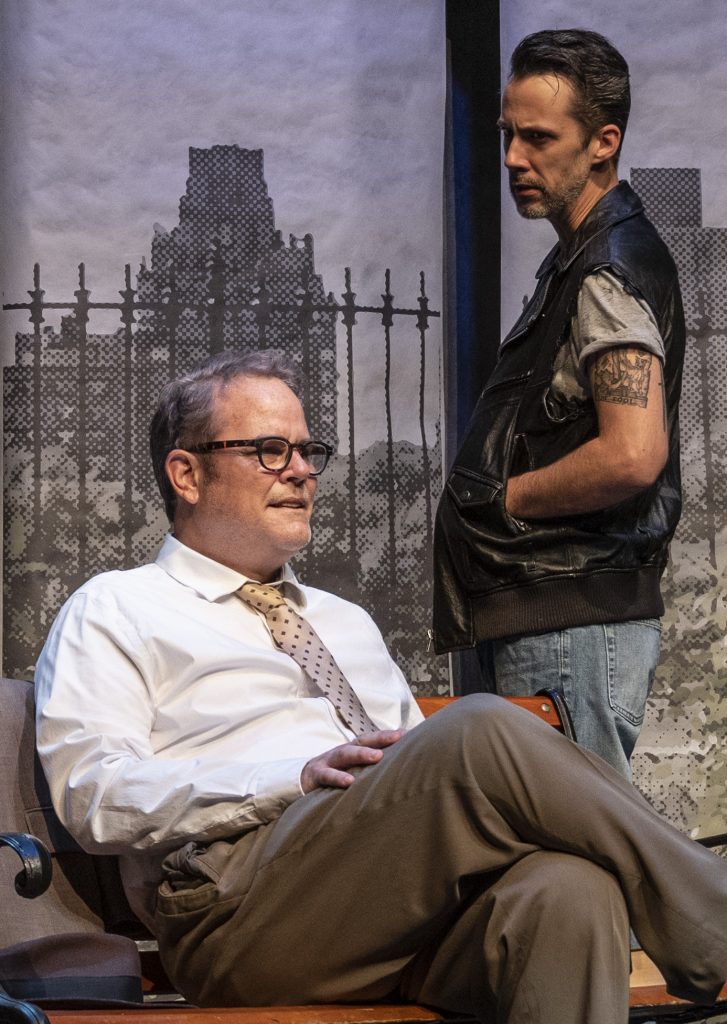
William Roth as Peter and Joel Moses as Jerry in “The Zoo Story.” Photo by Patrick Huber

Starting with Edward Albee’s first play, “The Zoo Story,” it’s immediately apparent that we are in for something special. The one-act, written in 1958, is where Albee, a rebellious youth with wealthy adoptive parents, crafted a work by using themes we’d become more familiar with as he explored dark societal issues.

He won three Pulitzer Prizes for Drama, and his 1962 masterpiece “Who’s Afraid of Virginia Woolf?” won the Tony Award. “The Zoo Story” is where it all began, thus creating a sea change in American postwar theater, and won the 1960 Obie Award.

As powerful today as when it first appeared in regional theater (rejected by New York status quo), “The Zoo Story” is about isolation, loneliness, class and economic disparities, dehumanization of marginalized people, and the pitfalls of living in a material world.

All of that is brought to life in finely tuned performances by Roth and Moses as Peter and Jerry. They meet on a park bench in Central Park one sunny Sunday afternoon.

Peter, as is his custom, is reading a book in solitude. A married publisher of some means has two daughters, two cats and two parakeets.

He intrigues Jerry, who engages Peter in conversation. As is immediately obvious, Jerry has issues – lonely, disconnected, desperate, he craves companionship. He has no filter and no boundaries, a lost soul.

It’s apparent who is the have-not in this twosome. Jerry’s façade cracks early, and his behavior becomes increasingly alarming. As unsettled as Peter is, his manners allow him a sense of decorum, until the situation escalates.

What was disturbing back in 1960, when the play was first produced off-Broadway with William Daniels and George Maharis as Peter and Jerry, remains distressing today – but for different reasons. Back then, such unstable behavior hadn’t been normalized by society – it was shocking. Sadly, we can see what’s coming by looking through the rear-view mirror of 2021. This is what happens, Albee says, when people are discarded as worthless by society.

Albee’s trademark biting dialogue is handled with seamless agility by Roth and Moses, under the thoughtful direction of Wayne Salomon.

A legendary local theater artist, Salomon’s skill is expected – and the finesse attended to this production is admirable. He has polished both plays until they gleam, like the genuine gems they are.

The setting benefits from Patrick Huber’s panoramic view of Central Park as a serene oasis in the bustling city – and further illustrates the differences between the two characters.

This sharp, savvy production is , hard-hitting and though-provoking theater as it was intended. It’s exhilarating to experience.

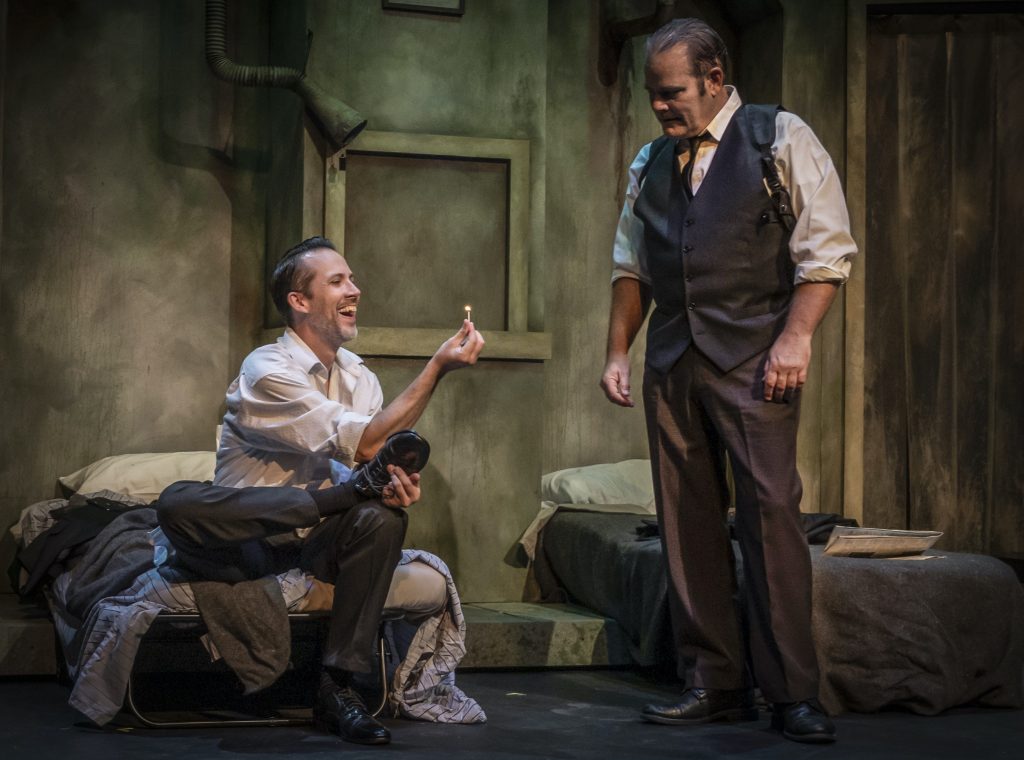
Joel Moses as Gus and William Roth as Ben in “The Dumb Waiter.” Photo by Patrick Huber

After a welcome intermission, as we’re processing the brilliance of the first act, we’re treated to one of Huber’s stunning set changes. How did he do that between shows? It’s a grimy, dingy basement somewhere in England, where two hitmen are awaiting their orders.

This is a fun change-of-pace. Just as absurd as “The Zoo Story,” and also a comedy with dramatic overtones, the British playwright and Nobel Prize-winning Harold Pinter’s early work from 1957 is indicative of his later much-heralded plays, like the menacing “The Birthday Party” and “The Homecoming.”

Moses, in another tour-de-force, is the impatient and somewhat dim-witted Gus, who seems to have grown weary of his routine, monoytonous life waiting for “the call” and killing time on assignment. Without so much as a needed cup of refreshing tea, he’s antsy, bored and hungry.

His companion, Ben, a man resigned to his lot in life, is keenly played by Roth, who becomes aggravated by Gus’ incessant chatter. He’s the teacher to the pupil.

Both actors adopt working-class English accents, and they give out a little information here and there, shaping their characters and how they operate.

They are taken aback when a dumb waiter opens with a slip of paper indicating a food order. The small kitchen’s stove is inoperable, so they can’t even light the kettle for tea. And here orders are coming in with a variety of restaurant dishes listed, expecting to be prepared. A few biscuits, a warm bottle of milk, a stale tea cake and some crisps are all that Gus has brought. They send that up, not knowing what to expect.

The exchange is comical – and involves a whistle and some sort of horn in which to communicate.

Ah, Pinter. A stuffy, claustrophobic setting? Check. Mundane but witty dialogue? Check. Hidden meanings? Check.

The actors get into an appealing rhythm that sadly must end, because well, the play ends. “The Dumb Waiter” leaves you wanting more – dialogue, funny bits, threatening in a mysterious way, and actors having fun — but that is a good thing, not a drawback.

Both plays are humorous, ironic, and suspenseful in their own ways, and it’s interesting to watch the accomplished actors switch gears. Roth and Moses make a dynamic duo – and best of all, this won’t be the end of them working together, at least I hope not.

The two one-acts continue its final weekend, Oct. 1-3, with Friday and Saturday at 8 p.m. and Sunday at 3 p.m. at The Gaslight Theatre in the Central West End, 358 N. Boyle Ave. Tickets are available through Ticketmaster or you can arrive at the box office within an hour of the show. For more information, visit stlas.org or call 314-458-2978.                                                                                                          ,                                                                                                                                                         

By Lynn Venhaus

Thoughtfully constructed with insightful character snapshots foreshadowing the people they become in the landmark television series, “The Sopranos,” the well-cast “The Many Saints of Newark” is one of the year’s best films.

Molti Santi translates to “Many Saints” in English, and the backstory connecting the people to Tony Soprano is a fascinating, yet tangled, web. The movie begins with a voice from the grave, and an Emmy-winning actor reprises his famous role through narration.

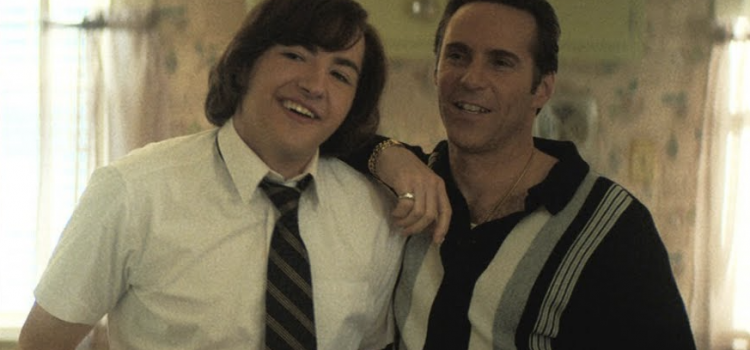
Set in the late 1960s and early 1970s, this prequel to “The Sopranos” follows Dickie Moltisanti (Alessandro Nivola) as he climbs the ladder in the DiMeo crime family. His nephew is Anthony Soprano (Michael Gandolfini), a teenager who idolizes his uncle.

Dickie’s influence over his nephew will help shape the impressionable teenager into the all-powerful mob boss we came to know in the HBO series, which ran from 1999 to 2007. Tony is growing up in one of the most tumultuous eras in Newark’s history as rival gangsters rise and challenge the DiMeo crime family’s hold over the increasingly race-torn city.

The year is 1967, and one mobster notes it’s the “Summer of Love,” which is ironic, given all the violence on the Newark streets. Race riots erupt, creating chaos and confusion. The times, they are a-changing, and rival gangsters try to muscle in on the Italian mob’s stronghold.

Racist attitudes prevail, although Dickie has Harold McBrayer (Leslie Odom Jr.), who collects money from the black side of town for him, as he runs the numbers game.

Leslie Odom Jr., 2016 Tony winner as Aaron Burr “Hamilton” and Oscar nominee as Sam Cooke in last year’s “One Night in Miami,” stretches his acting chops as the ambitious and fearless defender of his turf. He becomes a formidable foe.

A warning, although expected — there is a lot of bloodshed. In scenes of grisly torture and gruesome murders, the violence is explosive on the mean streets, and sometimes, directed at their own inner circle. Such is the way of the family business. Lines are frequently crossed, matter-of-factly, and sometimes without consequence.

Dickie, who has had a love-hate relationship with his menacing father, Aldo “Hollywood Dick” Montisanti, played with verve by Ray Liotta, is drawn to dear old dad’s new Sicilian bride, Giuseppina, played by the beautiful Michela del Rossi, who looks like an actress in a Fellini film. She soon becomes his goomah (mistress).

Connecting the dots gets even more complicated – see the movie to find out how everyone is six degrees of separation.

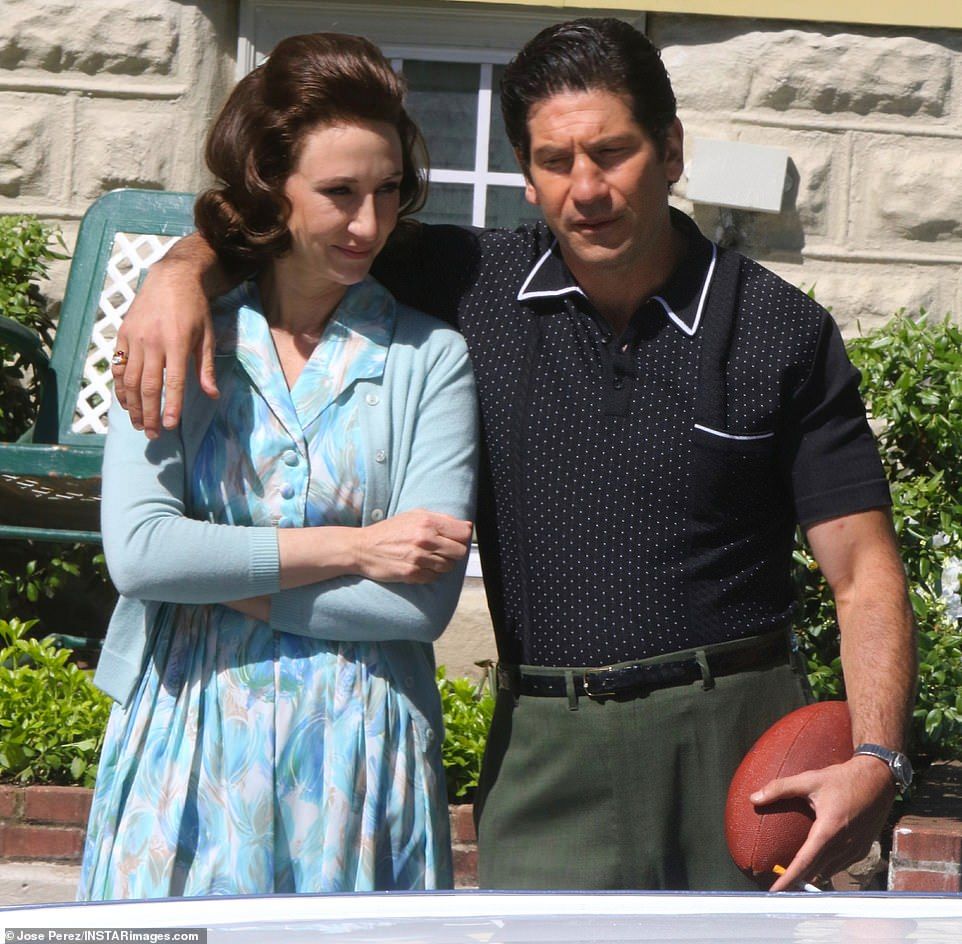
Vera Farmiga and Jon Bernthal as Tony’s parents

Familiarity with the series, which ran for six seasons, is helpful, although not a prerequisite. However, people with knowledge of the series will understand the references and anticipate the mix of dark humor, and secret revelations.

Universally regarded as one of the best shows ever on TV, “The Sopranos” won 21 Primetime Emmys and 2 Peabody Awards.  In 2013, the Writers Guild of America named it the best-written TV series of all time, and TV Guide ranked it the best television series of all time. In 2016, it ranked first in Rolling Stone’s list of the 100 greatest TV shows of all time.

Some of the indelible characters from the television series earned Emmy Awards and nominations, and are an integral part of the prequel, while others barely emerge from the background.

Writer (and show creator) David Chase teamed up with an alum, Lawrence Konner, who was Emmy-nominated for writing “Second Opinion” (Sopranos) and this is a fascinating look back as to how things developed and about the people who made things happen.

In the series, Tony Soprano juggled the problems with his two families – his wife Carmela and their two children, Meadow and Anthony Jr., and his mob family. Power struggles, betrayal, violence, panic attacks, affairs and keeping the business from being exposed as a criminal enterprise were all part of the intoxicating mix. And a lot of people were whacked.

The movie has many of the same issues compacted into nearly two hours – concentrating on the personal and professional struggles of Dickie Moltisanti. And a lot of people get whacked.

For fans, seeing Janice Soprano (Alexandra Intrator) as a rebellious teenager and a young Silvio Dante (John Magaro), wearing a different hairstyle, is just fun.

Corey Stoll is an intriguing Uncle Junior and Vera Farmiga conjures up memories of the mean elderly woman she became as Tony’s mom, so no wonder she is such a non-stop nag here.

Sharp and savvy, Alan Taylor is at the helm. He was previously nominated for primetime Emmy Awards for ‘Game of Thrones” and “Mad Men,” and won for directing “The Sopranos” episode, “Kennedy and Heidi.”

While the writing is top-notch, so are the vintage costume designs by Amy Westcott and the production design by Bob Shaw. It steeps us in the cultural shifting times and the by-gone post-war life in eastern American cities.

In addition, another highlight is a killer soundtrack, just like the series. The eclectic music selection perfectly captures each mood and time: The Rat Pack-vibe of the smoky clubs, the rock music pouring out of Tony’s new stereo speakers and a wide range of tunes punctuating the action.

But the very best element of the film is its cast. In an exceptional star turn, Alessandro Nivola emerges as someone to watch, who rises to the occasion as Dickie – and he’s mesmerizing.

The gamble of casting the late James Gandolfini’s son, Michael, as the younger version of his father’s character, turns out to be a smart decision. He soulfully embodies teenage Anthony with his father’s mannerisms, if not his speaking voice, slipping into the role with ease. He’s another one to watch. It’s guileless and seamless,

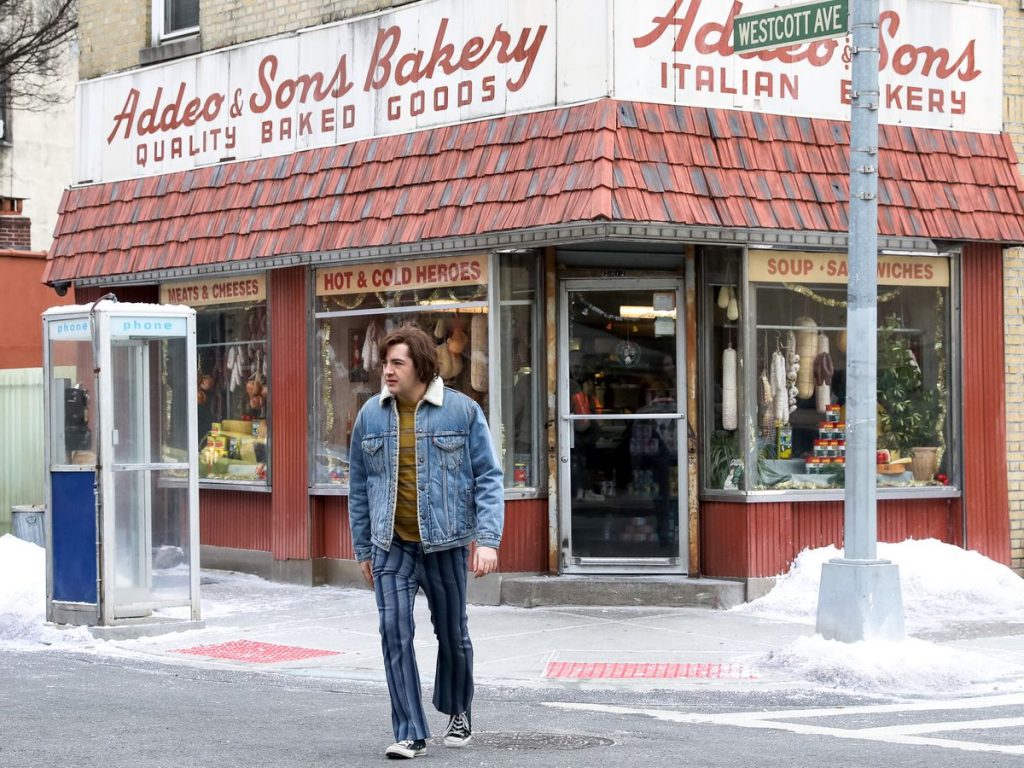
Michael Gandolfini as teenage Tony Soprano

Gritty and gripping, “The Many Saints of Newark” bristles with an excitement that describes a fitting backstory and a welcome return to these characters.

“The Many Saints of Newark” is a crime drama directed by Alan Taylor. It stars Alessandro Nivola, Michael Gandolfini, Corey Stoll, Ray Liotta, Vera Farmiga, Jon Bernthal, Leslie Odom Jr., Billy Magnussen and Michela del Rossi. It is rated R for strong violence, pervasive language, sexual content and some nudity and has a runtime of 2 hours. It is in theaters and streaming on HBOMax on Oct. 1. Lynn’s Grade: A.