By Lynn Venhaus

Throughout history, class wars have ended badly for many people, overt often for people in the lower class, and less so for the ruling class.

But class never matters when people show you their true selves.

Such is the complicated “Bitter Fruit,” a 2018 social commentary-human drama by Argentinian playwright Hector Levy-Daniel, “El Fruto mas amargo,” which has been translated from Spanish by Philip Boehm.

Boehm, Upstream Theater’s artistic director, wanted to bring it here for the U.S. English language premiere, so he not only translated but also directed it in a deliberately mysterious way.

Since 2005, two-thirds of the plays Upstream has produced have been U.S. or world premieres, with the goal to not only “move you” but “move you to think.” And they always do. This is a play to mull about, for at its center is a logical question on identity that has dramatic consequences. How can you deny who you really are, and what does that say about us as a society?

The playwright’s focus on identity crisis has roots in Argentina’s Dirty War, when from 1974 to 1983, an estimated 9,000 to 30,000 were killed by the state, or disappeared, in a right-wing effort to eliminate leftist political adversaries, including writers, students and journalists. Others were imprisoned.

Their children were not always killed, and sometimes, they were put up for adoption or given to supporters of the right wing.

There are children born during this period that don’t know their real identities because they were adopted by their captors and given new lives. They either discover this fact or never know the truth, but there isn’t any justice or peace amid the inequality that rages, along with political corruption.

According to the play’s notes, about 500 children were affected and the Argentine government is still sorting it out after years of protests from grandmothers.

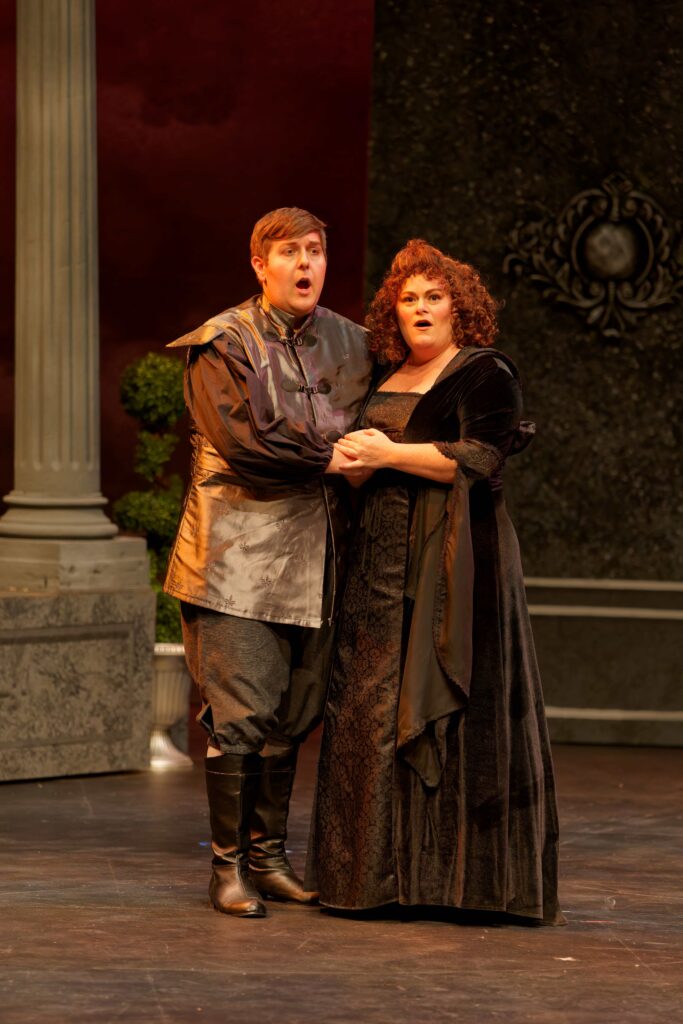
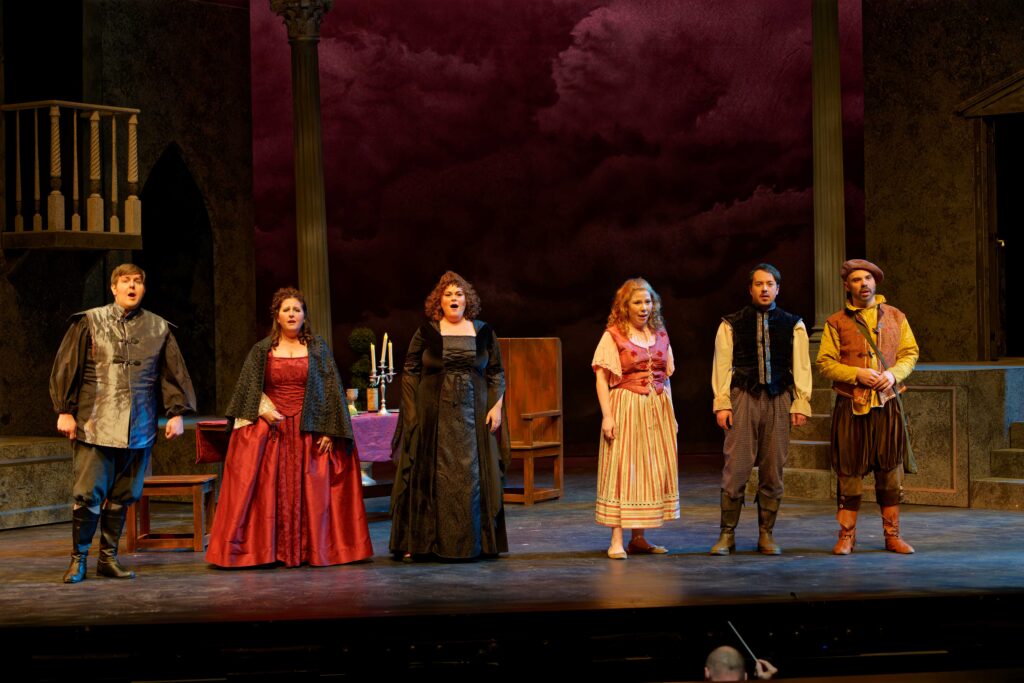
In this quietly devastating production, a committed cast provides complex portraits of people representing different factions of entitlement and insincerity, of loss and lies.

However, as good as actresses Jane Paradise, Jennifer Theby-Quinn and Michelle Burdette Elmore are, all members of the Actors’ Equity Association, they are not Latino women, and they are playing characters named Luisa, Maria, and Teresa respectively.

Isaiah Di Lorenzo has a small but important supporting role as Pedro Coltinari, the labor representative in factory negotiations, and in flashbacks, as Maria’s teenage paramour. He establishes his character’s pure heart and breaking point in only a few scenes.

None of the four identify as Hispanic — although the play never specifically states Argentina or alludes to the Dirty War, and there are no accents used, so…but it is perplexing, and does raise questions.

If it’s vague on purpose, so be it. Nevertheless, these days, people tend to notice whitewashing. It may not be as egregious as, say Laurence Olivier as “Othello” and John Wayne as Genghis Khan in “The Conqueror,” but it is something that crossed my mind, especially given Upstream’s commitment to shows with global themes involving marginalized people.

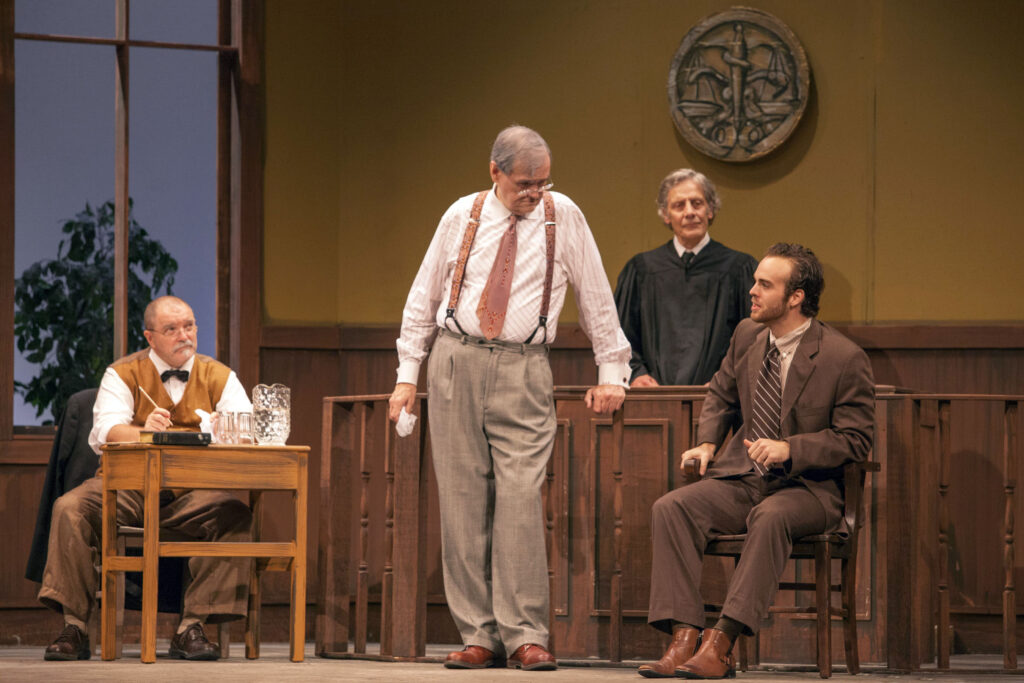
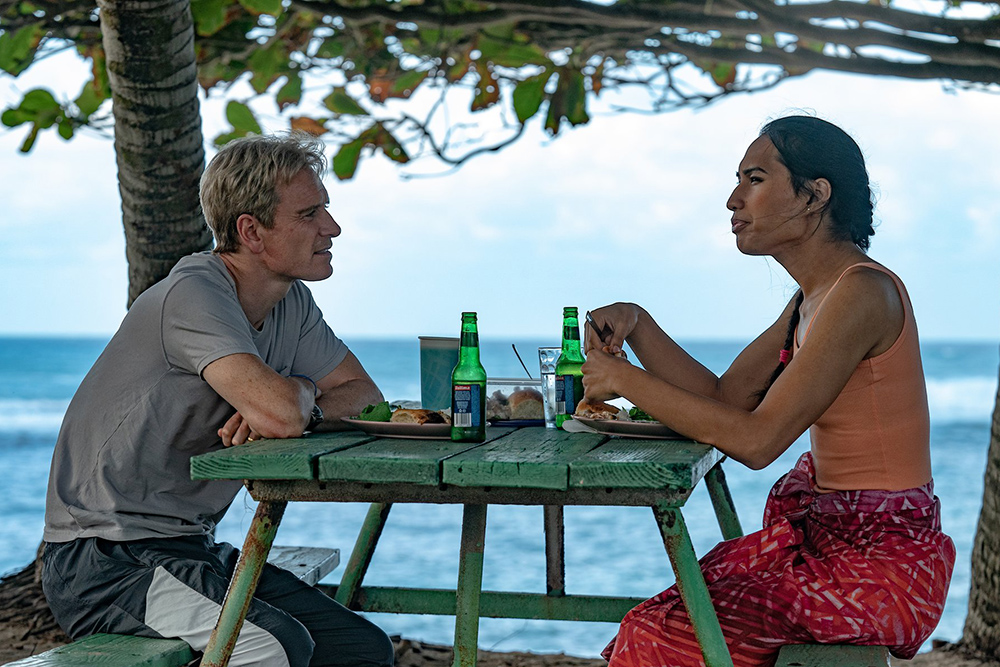
Set in a mansion, it’s late night or early morning, depending on your perspective, and a new maid, Luisa (Paradise), is up to prepare her mistress some tea, as requested as she waits for her daughter. Upon arrival home, haughty Maria, demands to know who this interloper is in her home.

As played coldly by Theby-Quinn, Maria is a cruel woman who has no qualms about making people feel inferior in her presence. She lacks compassion and a conscience, brought up in wealth, sheltered from the world. She is now running her father’s cotton mill with a tight fist and a disdain for the workers. They are in financial trouble, and Maria is tough about negotiations. Her mother, Teresa (Burdette Elmore) is clueless (or is she?).

Yet, once upon a time, Maria fancied a local boy, someone beneath her in social status, and those scenes reflect a person she used to be but is far removed from now.

Teresa, who was kept in the dark about that relationship, is oblivious to other behaviors and sentiments as well, and Michelle Burdette Elmore portrays her as if she’s firmly entrenched in a bubble — and a bit la-di-da.

Luisa’s gaze is a tad too intense for Maria, who is threatened by the new maid, for she views her as a spy who has infiltrated the home on behalf of the workers in the factory. Paradise’s gut-wrenching performance is the show’s highlight.

As tension increases – especially with suspicious deaths, and characters smolder, the secrets, deceptions, and denials are slowly disclosed.

Another of the show’s high points is original instrumental music performed by guitarist Lliam Christy. The minimalist scenic design by Patrick Huber represents a small portion of a large estate, with ornate touches to indicate affluence, darkly lit by Steve Carmichael to reflect shadows. Costume designer Michele Siler selected outfits according to economic status.

The playwright challenges memory and how sacrificing love shows true colors. It’s not an easy play to understand. Because one is off-guard, it is hard to relate to – however, Paradise’s performance as a crushed woman who has lost everything is haunting. Nevertheless, it brings attention to a tragic, dark time involving innocent children – and is that ever over?

Upstream Theater presents the US premiere of “Bitter Fruit,” by award-winning playwright Héctor Levy-Daniel in a translation by Philip Boehm, Oct. 13 through Oct. 29. It is 1 hour, 30 minutes, without intermission. Performances are Thursday through Saturday at 8 p.m., and at 7 p.m. Oct 15 and 2 p.m. Oct.22 and 29, and take place at the Marcelle Theatre, 3310 Samuel Shepard Dr. in Grand Center. For more information: www.upstreamtheater.org, For tickets, visit: https://www.metrotix.com/events/detail/upstream-theater-bitter-fruit

Photo by ProPhotoSTL
Facebook Comments

By Lynn Venhaus
When Haskell Harelik, born Chatzkell Garehlik in Belarus, first steps off the boat in the port of Galveston, Texas, in 1909, actor Dustin Lane Petrillo beams with both joy and wonder.

That sense of liberty, breathing free on our teeming American shore, is palpable, and brings to mind how many other journeys of generations we know about, making “The Immigrant” a universal story that couldn’t be timelier.

This one is specific to Texas following the Russian Revolution. Pograms during those events spurred Haskell to emigrate as part of the Galveston Movement, as one of about 10,000 Eastern European Jews who arrived there 1907-14, arranged by a businessman to alleviate the overcrowding and poor living conditions on the lower east side of New York City.

This fresh New Jewish Theatre production, for the third time in its 25-year history, offers a warm, intimate connection that says as much about our common ground as humans as it does about hope and dreams.

Perceptively directed by Rebekah Scallet, this moving true story is awe-inspiring in its simplicity and eloquence, heart-tugging in its splendid character portrayals by an outstanding quartet, and masterly in its technical achievements.

Playwright Mark Harelik’s richly textured family drama, first produced in 1985, has an absorbing ebb and flow over eight decades, but mainly concentrates on his tempest-tossed grandfather’s early struggles to survive in a foreign land and then eventually succeed in living his American Dream.

Petrillo’s exceptional range as Haskell – and exemplary command of Yiddish — is first shown as a poor, tired, and parched peddler, selling bananas for a penny apiece when he nearly collapses from the heat in front of the Perry’s home in Hamilton, Texas. Wary of the stranger, banker Milton Perry lets him get water from their well, while his tender-hearted wife Ima wants to offer more help to the lost soul in their midst, and their paths will cross again.

David Wassilak, Dustin Lane Petrillo. Photo by Jon Gitchoff.

As the Perrys, David Wassilak and Mindy Shaw mirror the mindsets of the day, suspicious and fearful of “the other,” but are won over by Haskell’s charm and work ethic. When Milton sees Haskell’s papers and discovers he’s a Russian Jew, his prejudice flares up, but the young man is so earnest, he wins over the locals.

Because of Milton’s position, he’s willing to help set up Haskell in a more stable enterprise – a horse-drawn fruit and vegetable cart. That leads to a store in downtown Hamilton that lasted 78 years, until it closed in 1989.

Being a practicing Jew in a primarily Christian enclave, with many Southern Baptists, takes some adjustment, especially for Haskell’s wife Leah, who reunites here with reluctance. Bryn McLaughlin conveys her challenges as she desperately misses her community, but eventually assimilates to a good life as thriving, trustworthy merchants. They raise three boys, with the Perrys being a major part of their lives.

Wassilak and Shaw deliver finely tuned performances, with subtle rural central Texas accents, and together, in sync like an old married couple through the years, for full-bodied realism. Their chemistry is matched by Petrillo and McLaughlin so that you truly feel the couple’s bonds.

Bryn McLaughlin, Dustin Lane Petrillo. Photo by Jon Gitchoff.

Differences about the growing European storm with Hitler in Germany and the reluctance of the U.S. to get involved in 1939 will cause friction between Milton and Haskell. There may be some artistic license, but it’s a wonderful story well-told. The minutia of daily living is superbly captured, all those little things that add up to making a life, no matter what era or what region. (I particularly enjoyed references to rabbit’s foot keychains, anklets and first time seeing an artichoke).

The creative team’s skills are first-rate, with stellar work from Kareem Deanes on sound –organically integrated with birds chirping, and retro background music – as well as his projections design. Each side of the theater has a screen where the audience can view information on Haskell’s journey and portraits of the Harelik family through the years that adds real sentimental moments to this deeply felt tale.

Scenic designer Rob Lippert’s meticulously detailed work on two home facades and landcaped trees and greenery creates a terrific setting to tell this story, placing the audience on each side for seamless action.

Stage Manager Nathan Wright, and Assistant Stage Manager Journee Carter keep the staging crisp and fluid.

Lighting designer Michael Sullivan’s warm illumination creates the feeling of home for both families.

Costume designer Michele Friedman Siler has astutely outfitted the women in changing skirt lengths and vintage styles while dressing the men in their appropriate professional attire, Haskell changing in stature through the years.

The play, co-conceived by Harelik, a professional actor, and Randal Myler, a writer, director, and producer, resonates beautifully with today’s audience.

New Jewish produced this play before, in 1999 and 2011, before I became part of the St. Louis Theater Circle as a founding member in 2012. This was a wise choice to mount it again.

Mindy Shaw, Dustin Lane Petrillo. Photo by Jon Gitchoff

This is Scallet’s directorial debut, and it’s impressive. She is in her second season as artistic director of New Jewish, having moved here in 2020.

The dialect coaching by John Wright deserves mention, and so does the aesthetically pleasing natural wig designs by Dennis Milam Bensie.

“The Immigrant” is a compassionate example of shining our lamps on the golden door for those yearning for better lives. Indirectly, it also is infused with an urgency to not be passive about the current state of turmoil in the world.

The fact that local groups are hosting information sessions on how to help refugees in the Israel-HAMAS War during this play’s run, creates even more meaning. For more information, visit https://jccstl.com/resources-on-the-israel-hamas-war/.

Give me your tired, your poor, your huddled masses yearning to breathe free, The wretched refuse of your teeming shore. Send these, the homeless, tempest-tossed to me, I lift my lamp beside the golden door!” – bronze plaque on The Statue of Liberty, 1883

David Wassilak, Dustin Petrillo. Photo by Jon Gitchoff.


The New Jewish Theatre presents “The Immigrant” Thursdays at 7:30 p.m., Saturdays at 4 and 8 p.m. and Sundays at 2 p.m. Oct. 12 through Oct. 29. Performances take place at the Wool Studio Theatre in the SFC Performing Arts Center, 2 Millstone Campus Drive. The two-act play runs 2 hours, 21 minutes, and has a 15-minute intermission. For more information: newjewishtheatre.org or call 314-442-3283.

The New Jewish Theatre has coordinated with multiple local organizations who help immigrants to plan outreach events at or in coordination with this production to bring awareness to current issues facing immigrants and refugees in St. Louis. They include:

  • A “needed item” drive in collaboration with The International Institute will take place throughout the showings.
  • On October 21, following the 4 pm performance, there will be a discussion panel featuring members of the Central Reform Congregation Resettlement Chavurah.
  • On October 22, following the 2 pm performance, there will be a discussion featuring members of the Shaare Emeth Congregation Resettlement Group.
  • Finally, a Welcome Neighbor dinner will take place at the J between the 4pm and 8pm performances on October 28.
Facebook Comments

By Lynn Venhaus

For the second year, Paul Hibbard is channeling his passion for horror movies into the Hysteria Fest, currently playing Oct. 18-22 at the Arkadin Cinema and Bar, a microcinema right in the heart of Bevo at 5228 Gravois Avenue. He’s coming fresh off a triumphant showing at Franki Cambaletti’s Haunted Garage Festival of his locally shot “Some Visitors,” which has been on the festival circuit and wraps up this month.

As I said to Paul — it’s well-made but highly disturbing. He delighted in that because it is bloody, intense and really creepy — all effective elements when putting that genre together.

He truly cares deeply about filmmaking and travels across the country, attending festivals and meeting filmmakers. His festival schedule is a well-curated list from veterans and up-and-coming filmmakers. For a complete schedule: https://arkadincinema.com/hysteria-fest-2023-oct-18-22/

Paul and I have been on film juries before, for the St. Louis Filmmakers Showcase, and he’s been a guest on our PopLifeSTL Podcast last year and this year, talking enthusiastically about his projects. He also writes for www.ZekeFilm.org. Here’s more on the man who beats to an artistic drummer in all areas of life.

Jackie

Where can you find “Some Visitors” this October? Check out this schedule for the final month of its festival run.

October 7th – Eerie, Pennsylvania – Eerie Horror Film Festival – Warner Theater – midnight
October 13th – Walnut Cove, NC – Horror Movie Freaks Film Festival – The Palmetto Theater. Start time TBD
October 13th – Atlanta, Ga – Atlanta Horror Film Festival – Limelight Theater
October 14th – Dickson City, Pa – NEPA Horror Fest – The Circle Drive-In – All day horror fest that ends with a screening of Rob Zombie’s Halloween with cast/crew in attendance
October 18th – Thunder Bay Ontario Canada – Terror in the Bay Film Festival – Maple Tops Paramount Theater
October 20th – Madison, Indiana – The Horror at the Ohio Film Festival – The Ohio Theater
October 21st – Chicago, Il – The Chicago Horror Film Festival – Facets Theater
October 28th – Port Richey, Fl – Necro Nancy Horror Film Festival – Cinema 6 Theater

Take Ten Questionnaire
1. What is special about your latest project?

“Some Visitors” was my last film. First of all, it was special because it made its premiere at Panic Fest on a double bill with Gaspar Noe’s “Lux Aeterna.” Noe is a director I’ve been obsessed about for years, especially the way he pushes the envelope, and to book me alongside his film at a major festival was amazing. That screening was a special experience. 

And Some Visitors is special because I used it to start my own film festival. It’d play at film festivals and the other directors would watch it and message me saying how great or gnarly it was. I’d tell them I loved their films also, and I’d ask if I could play their films alongside mine at Hysteria Fest. I probably would have started a film festival eventually, but Some Visitors helped me get access to the best horror filmmakers on the festival circuit.

2. Why did you choose your profession/pursue the arts?

I love film and just knew that at first. I didn’t know if I wanted to be a critic and on the festival side or a filmmaker. So I kind of did both. But at the heart of it is a love of film. I directed a play once and the critic said it was entertaining but felt too much like a film in the blocking. I wrote a novel once, and again people said it felt like a film. Everything goes back to my love of films.

3. How would your friends describe you?

Intense. Political. Funny. And with a crippling self-awareness. 

4. How do you like to spend your spare time?

Watching movies, reading and running. Currently training for a half marathon.

5. What is your current obsession?

At the moment I’m super obsessed with the Criterion Channel’s High School Horror collection. 

6. What would people be surprised to find out about you?

I don’t believe in ghosts. People always try to tell me ghost stories when they hear I’m a horror writer. I also make super-violent films but think true-crime is exploitative and irresponsible. I like to challenge, but relishing in real death I hate. 

7. Can you share one of your most defining moments in life?

It may honestly be when “Some Visitors” played with “Gaspar Noe” at a huge genre festival. That felt so validating for a film that was almost impossible to make. I also made a really political satire/comedy called “The Blair Trump Project: making fun of Trump and it played in 2019 on a double bill with The Blair Witch Project” for its 20-year anniversary at the Salem Horror Festival. That was great.

8. Who do you admire most?

My late older brother. He taught me to be strong-willed, political and speak my mind.

9. What is at the top of your bucket list?

I’m not much of a traveler, but I really want to visit Korea someday,

10. How were you affected by the pandemic years, and anything you would like to share about what got you through and any lesson learned during the isolation periods? Any reflections on how the arts were affected? And what it means to move forward?

 Like a lot of people, I would get upset at others who didn’t take the virus seriously and grasped onto anti-science beliefs. I think to me it was a breaking-point in how I viewed life and the arts. I realized then that no matter what, appealing to the masses is impossible, because some of the masses believe in lunacy, and it’s okay for me to become more uncompromising. I thought to create art that was uncompromising. Appeal to the niche market with similar tastes and ideas about art, because you may not appeal to everyone, but when you are trying to appeal to everyone, you are appealing to some with insane beliefs and morals. A film like “Some Visitors” I think I would have been more hesitant to make before the pandemic, but afterwards, I was in the mentality to do what I want. Some will absolutely love it at the expense of some who absolutely hate it, but the ones who love it will fight for it. Which is what has happened. 

11. What is your favorite thing to do in St. Louis?

Go to the Art Museum. I live in walking distance. I’m a member. I go at least once a week. it’s my sanctuary. 

12. What’s next?

We had some traction on turning “Some Visitors” into a feature with some named talent attached, but the strikes stopped all of that. I think I’m just going to focus on Hysteria Fest. I don’t really want to make shorts anymore. I’ll go big with a film if given a chance, but otherwise would rather be a critic and curator. 

Paul Hibbard


More About Paul Hibbard

Birthplace: Arnold, Mo
Current location: St. Louis (Dogtown)
Family: unmarried
Education: Bachelors in Political Science
Day job: Freelance
First job: Movie theater. The old Lindbergh 8

First movie you were involved in or made: I was involved in a film called “Time to Die” that played at the first Showcase ever. My buddy directed it. I was just a background person.

Favorite jobs/roles/plays or work in your medium? Writing is the best. And editing. Both are storytelling. Brian De Palma used to say that directing a film was the dark tunnel between writing and editing. I feel that.

Dream job/opportunity: Film critic at a publication that paid a livable salary. I don’t think that exists anymore. 

Awards/Honors/Achievements: Some Visitors has won a ton of awards, and all of them I’m proud of, but any time the lead actress Jackie Kelly wins, I’m most proud. Because directing acting used to be my weakness. Not that she needs much directing…

Favorite quote/words to live by: “I know nothing of life except through the cinema.” -Jean Luc Godard

A song that makes you happy: “Strange Magic” by ELO

Actor Clayton Bury in “The Blair Trump Project” is also in “Some Visitors”
Facebook Comments

By Alex McPherson

A disturbing story of greed, prejudice, and the American Dream soaked in venom, director Martin Scorsese’s “Killers of the Flower Moon” raises awareness of heinous crimes committed against the Osage People, and contains outstanding craftsmanship, but remains limited in perspective. Scorsese’s film is a reminder of the hardships and resilience of the Osage framed largely through the eyes of White evildoers, to emotionally compromised effect.

Based on David Grann’s bestselling nonfiction book of the same name, “Killers of the Flower Moon” centers around the “Reign of Terror” that befell members of the Osage Nation in the early 1920s. After being forced to relocate to supposedly desolate land in Oklahoma, members of the Osage Nation discovered that their new surroundings contained oil — rendering them the richest people per capita on Earth, but also targets for manipulation by those eager to strip them of all rights and privileges.

Such is the case of William “King” Hale (Robert De Niro), a wealthy cattle rancher and businessman, who feigns love for the Osage but seeks to take control of their oil-rich lands via any means necessary, including murdering them for oil rights.

Hale’s nephew, the infuriating and slow-witted Ernest Burkhart (Leonardo DiCaprio), returns from working as a cook in World War I, looking to Hale for a job, unabashedly admitting his love for women and money. Ernest, having injuries that prevent him from doing much manual labor, starts working as a cab driver, where he meets Mollie Kyle (an incredible Lily Gladstone) — a beautiful, sharply intelligent woman quietly enraged at the ways she’s treated by White-dominated authority — and becomes smitten with her. 

DiCaprio and Gladstone as Ernest and Mollie

Hale encourages Ernest to seduce and marry Mollie, who also happens to be an heir to a large fortune in oil royalties held by her mother, Lizzie Q (Tantoo Cardinal) — so long as Mollie’s sisters and their husbands aren’t around to inherit it first. Thus sets the stage for brazen brutality, as Hale and Ernest’s schemes grow ever more elaborate, and Ernest becomes a part of Mollie’s family — developing genuine love for her while simultaneously killing her family behind her back: infuriatingly ignorant and/or unwilling to reckon with his own bloodthirstiness and lack of humanity. Eventually, a J. Edgar Hoover-ordered FBI investigation gets underway, led by agent Tom White (Jesse Plemmons), but the grisly damage has already been done.

Indeed, “Killers of the Flower Moon” tells a sobering, insidious story that needs to be told, taking plenty of time to set the scene, emphasize the devilish machinations of its villains, and educate viewers on the hardships and resilience of the Osage Nation. What’s sacrificed by Scorsese and co-writer Eric Roth’s screenplay, however, is a more intentional, meaningful focus. 

The film spotlights Ernest’s crisis of conscience (or lack thereof) above diving into the individual tragedies committed against the Osage — illuminating themes that, regardless of relevance, have persisted throughout American history. Scorsese misses an opportunity to explore new, informative points-of-view that have previously been sidelined in mainstream storytelling of this scale.

Stylistically, “Killers of the Flower Moon” excels, but viewers shouldn’t expect anything less from Scorsese. On a big screen, the film is unquestionably immersive, with cinematographer Rodrigo Prieto capturing expansive plains and claustrophobic interiors, blinding sun and menacing, pitch-black darkness, in beautiful compositions that rarely draw too much attention to themselves.

Longtime Scorsese editor Thelma Schoonmaker lets scenes breathe and marinate — giving the incredible ensemble, including numerous Indigenous actors, room to stretch their wings, with Scorsese taking a noticeably sparse directorial style that eschews flashiness for intimate contemplation: sometimes taking a more spiritual, matter-of-fact approach in depicting Osage customs.

Acts of violence against the Osage are depicted with cold remove — coming seemingly out of nowhere, shocking in their immediacy and grotesque without being gratuitous. The late Robbie Robertson’s score is particularly effective as an omnipresent heartbeat to the monstrous acts unfolding before our eyes.

DiCaprio delivers a characteristically engaging performance as Ernest, with a rough-hewn look, disastrous dentistry, and playful swagger that belies a dark heart of greed and moral bankruptcy.

Viewers going into “Killers of the Flower Moon” with expectations for Ernest to be “redeemed” won’t find that arc here, as his love for Mollie is always offset by the cruelty he exhibits behind her back: a buffoon resistant to the shred of goodness located somewhere deep within his corrupted heart.

As our primary vessel for this story, he’s frustrating, if not outright idiotic, being manipulated by Hale and giving into base instincts that cannot coexist alongside his life with Mollie, try though he might.

DeNiro is frighteningly unhinged as Hale, swerving between Hale’s public and private personas with precision. Hale enlists henchmen to do his dirty work for him, but he remains a powerful presence, and Scorsese’s film gives us plenty of time to observe him pulling strings and explaining his schemes, hiding his conspiracies behind seemingly benign smiles and a culture of complicity.

 Gladstone is, without a doubt, the film’s MVP, conveying warmth, quiet rage, crushing sadness, and persistent hope with minimal dialogue. Through it all, Mollie’s bravery shines through — her resistance to accepting Ernest’s betrayal is heartbreaking to watch.

It’s too bad that “Killers of the Flower Moon” fades her into the background after a certain point, though, as well as giving her siblings and other members of the Osage Nation — featuring powerful performances from Cara Jade Myers, Janae Collins, Jillian Dion, and William Belleau, among others — only a handful of sequences (in the span of a mammoth 206-minute runtime) to divert the spotlight from White evildoers.

That extended runtime exacerbates this issue, especially in the third act, full of legal histrionics and prolonged sequences where viewers watch Ernest and co. squirm under interrogation by the FBI; their incompetence and stupidity on full display, even as the “justice system” fails to live up to its name. 

A last-minute framing device at the conclusion paints the proceedings in a somewhat new light (commenting on the twisted appeal of true-crime stories to begin with and bringing attention to the limitations of Scorsese’s directorial viewpoint, ending with a notable shift back to the Osage in its closing moments), but perhaps “Killers of the Flower Moon” could have been better told by a filmmaker more willing to buck tradition.

It’s admirable that Scorsese takes on the challenge here, and will undoubtedly raise awareness to these real-life happenings, but “Killers of the Flower Moon” is also ham-strung by his own storytelling patterns. It’s an important film brimming with technical mastery and exceptional performances, but one that’s not nearly as enlightening or emotionally gripping as it believes it is.

“Killers of the Flower Moon” is a 2023 historical western true crime drama directed by Martin Scorsese and starring Leonardo DiCaprio, Robert DeNiro, Lily Gladstone, Jesse Plemons. Cara Jade Myers, Brendan Fraser, John Lithgow, Tommy Schultz
Rated: R for violence, some grisly images, and language, the run time is 3 hours, 26 minutes. It opens in theatres Oct. 20 and will stream on Apple TV+ at a later date, to be announced. Alex’s Grade: B

Facebook Comments


20 DAYS  IN MARIUPOL, KOKOMO CITY,AND STILL: A MICHAEL J. FOX MOVIE RECEIVE FIVE NOMINATIONS EACH 

GALA TO HONOR AWARD WINNERS ON NOVEMBER 12, 2023
 AT THE EDISON BALLROOM IN MANHATTAN

The Critics Choice Association
 (CCA) has announced the nominees for the Eighth Annual Critics Choice Documentary Awards (CCDA). The winners will be revealed at a Gala Event on Sunday, November 12, 2023 at The Edison Ballroom in Manhattan. The ceremony will be hosted for the second year in a row by longtime event supporter, actor, and standup comedian Wyatt Cenac.

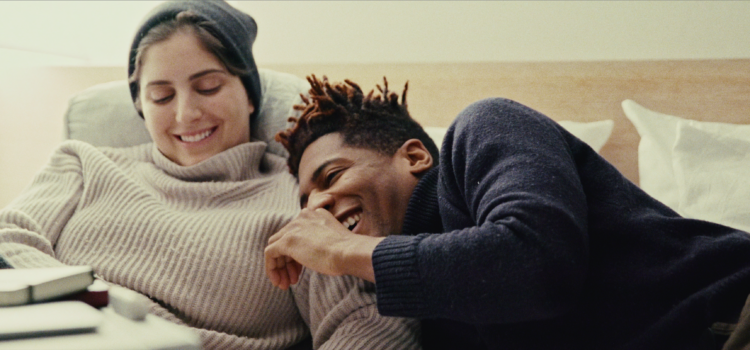
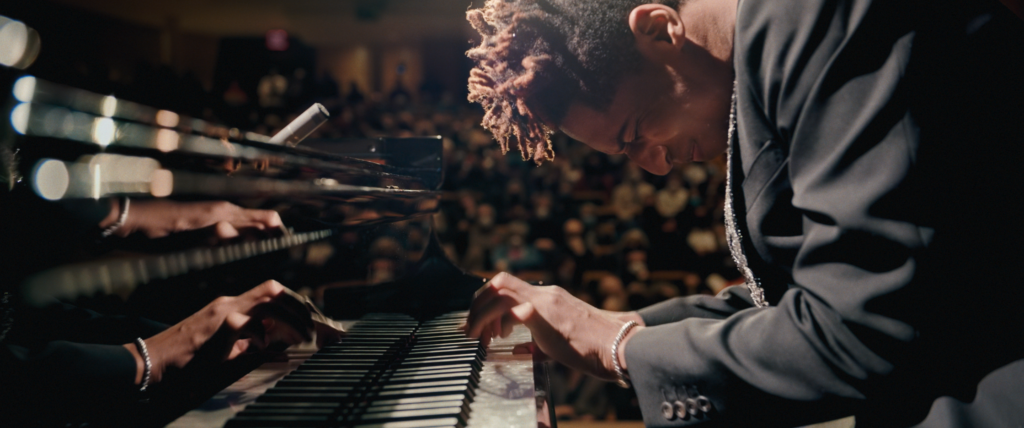
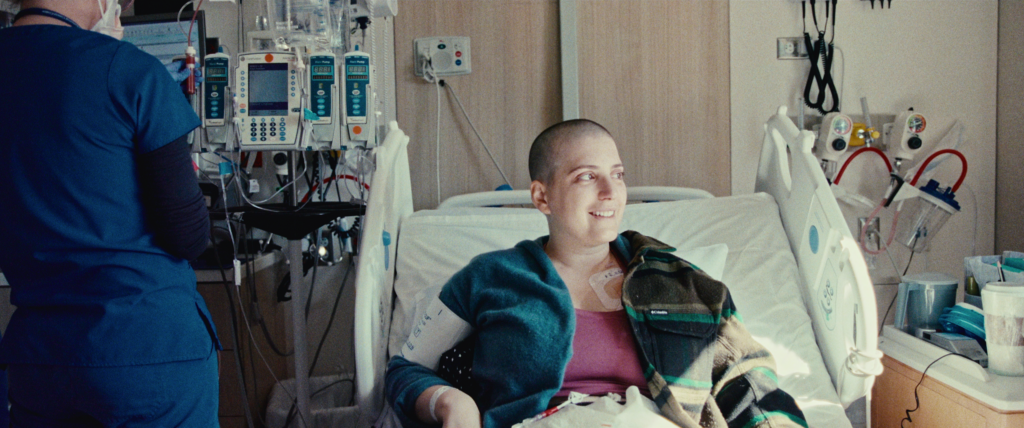
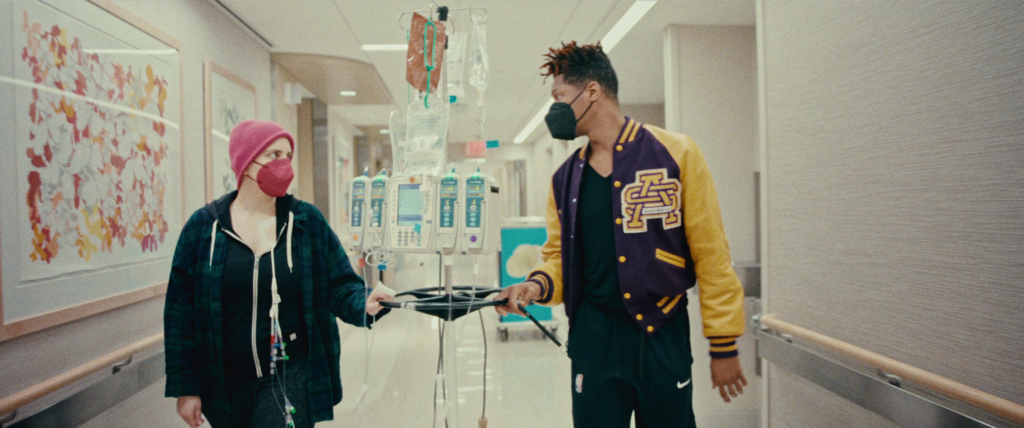
American Symphony leads the pack with six nominations including in the category of Best Documentary Feature. The film’s other nominations are Matthew Heineman for Best Director, Tony Hardmon, Matthew Heineman, and Thorsten Thielow for Best Cinematography, Sammy Dane, Jim Hession, Matthew Heineman, and Fernando Villegas for Best Editing, Jon Batiste for Best Score, and Best Music Documentary.

20 Days in Mariupol, Kokomo City, and Still: A Michael J. Fox Movie received five nominations each. The nominations for 20 Days in Mariupol are Best Documentary Feature, Best First Documentary Feature, Michelle Mizner for Best Editing, Mstyslav Chernov for Best Narration, and Best Political Documentary. The nominations for Kokomo City are Best Documentary Feature, Best First Documentary Feature, and D. Smith for Best Cinematography, Best Editing, and Best Score. The nominations for Still: A Michael J. Fox Movie are Best Documentary Feature, Davis Guggenheim for Best Director, Michael Harte for Best Editing, Michael J. Fox for Best Narration, and Best Biographical Documentary.

Cenac is an Emmy Award-winning comedian, actor, producer, and writer known for the HBO late-night comedy docuseries Wyatt Cenac’s Problem Areas. Additional credits include aka Wyatt Cenac, People of the Earth, and The Daily Show with Jon Stewart. He has made four comedy albums: Wyatt Cenac: Comedy Person, the Grammy nominated BrooklynFurry Dumb Fighter, and One Angry Night in November, and hosted the televised stand-up variety series Night Train with Wyatt Cenac. He started his career in animation as a writer for Mike Judge’s King of the Hill, and has served as a consultant for South Park. Every now and again he pops up in a film, most notably Barry Jenkins’ Medicine for Melancholy.

The Critics Choice Documentary Awards will be live-streamed through Facebook, YouTube and X (formerly Twitter). Viewing links will be available on the Critics Choice Association website at 7:00 PM ET on Sunday, November 12.

In addition to the 18 award categories listed below, a prestigious honor, The Pennebaker Award (formerly known as the Critics Choice Lifetime Achievement Award), will be presented to esteemed documentarian Ross McElwee. The award is named for Critics Choice Lifetime Achievement Award winner D A Pennebaker, who passed away in 2019. The award will be presented by Chris Hegedus, Pennebaker’s producing partner and wife. 

McElwee has made ten feature-length documentaries as well as a number of shorter films. Sherman’s March has won numerous awards, including Best Documentary at the Sundance Film Festival. Sherman’s March was also chosen for preservation by the Library of Congress National Film Registry in 2000 as a “historically significant American motion picture.” Bright Leaves premiered at the 2003 Cannes Film Festival’s Directors’ Fortnight and was nominated for Best Documentary by both the Directors Guild of America and the Writers Guild of America. McElwee’s In Paraguay premiered at the Venice Film Festival in 2008, and he returned to Venice in 2011 to premiere Photographic Memory.

In 2005, complete retrospectives of McElwee’s films were presented at the Museum of Modern Art in New York and later in many more cities. McElwee has received fellowships and grants from the Guggenheim Foundation, the Rockefeller Foundation, the American Film Institute, the LEF Foundation, and the National Endowment for the Arts. McElwee received the Full Frame Documentary Film Festival’s Career Award in 2007. He is currently a Professor of the Practice of Filmmaking at Harvard University and is working on a documentary about the cable television remake of Sherman’s March.

The Critics Choice Association is honoring the year’s finest achievements in documentaries released in theaters, on TV, and on major digital platforms, as determined by the voting of qualified CCA members. The eighth annual awards ceremony is produced by Bob Bain of Bob Bain Productions and Joey Berlin of Berlin Entertainment. 

For the fourth year in a row,  the Critics Choice Documentary Awards welcomes back National Geographic Documentary Films as the Presenting Sponsor.

The Spirits Sponsor of the event is Milagro Tequila.

“We are thrilled with the number of exceptional documentaries released theatrically and on streaming this year and are very excited to introduce an overdue category honoring true crime films and series,” said Christopher Campbell, Vice President of Documentaries of The Critics Choice Association. “This event is about showcasing and celebrating the best in nonfiction, and I want to congratulate all of our nominees and thank them for making us see and think about the world in new ways.”

Carla Renata, Co-President of the Critics Choice Association Documentary Branch added, “We are also thrilled to witness a varied number of nominees spanning subjects represented across all genders (including Transgender Intersex) and genres,  further solidifying the Critics Choice Documentary Awards’ commitment to diversity, equity, and inclusion within the documentary landscape.”

At the Seventh Annual Critics Choice Documentary Awards, Good Night Oppy took home five trophies in all including the top award of the evening for Best Documentary Feature. The film’s other victories were Best Director for Ryan White, Best Score for Blake Neely, as well as Best Narration (written by Helen Kearns and Ryan White, performed by Angela Bassett), and Best Science/Nature Documentary.

“Still: A Michael J Fox Movie”

Nominees for the 8th Annual Critics Choice Documentary Awards
Presented by National Geographic Documentary Films

BEST DOCUMENTARY FEATURE

20 Days in Mariupol (PBS)
American Symphony (Netflix)
Beyond Utopia (Roadside Attractions)
The Deepest Breath (Netflix)
The Eternal Memory (MTV Documentary Films)
Judy Blume Forever (Amazon Studios)
Kokomo City (Magnolia Pictures)
The Mission (National Geographic)
Stamped from the Beginning (Netflix)
Still: A Michael J. Fox Movie (Apple TV+)

The Eternal Memory

BEST DIRECTOR

Maite Alberdi – The Eternal Memory (MTV Documentary Films)
Madeleine Gavin – Beyond Utopia (Roadside Attractions)
Davis Guggenheim – Still: A Michael J. Fox Movie (Apple TV+)
Matthew Heineman – American Symphony (Netflix)
Amanda McBaine, Jesse Moss – The Mission (National Geographic)
Steve McQueen – Occupied City (A24)

BEST FIRST DOCUMENTARY FEATURE

20 Days in Mariupol (PBS)
26.2 to Life (Film Halau)
Bad Press (Oklafilm)
Bobi Wine: The People’s President (National Geographic)
Kokomo City (Magnolia Pictures)
Orlando, My Political Biography (Sideshow)
Smoke Sauna Sisterhood (Greenwich Entertainment)
The Thief Collector (FilmRise)

Anselm

BEST CINEMATOGRAPHY

Tim Cragg – The Deepest Breath (Netflix)
Tony Hardmon, Matthew Heineman, Thorsten Thielow – American Symphony (Netflix)
Lennert Hillege – Occupied City (A24)
Franz Lustig – Anselm (Sideshow)
D. Smith – Kokomo City (Magnolia Pictures)
Toby Strong, James Boon, Bob Poole, Neil Fairlie, Wim Vorster, Joshua Tarr, Pete Allibone, Neil Harvey, Andreas Knausenberger – Secrets of the Elephants (National Geographic)

The Mission

BEST EDITING

Sammy Dane, Jim Hession, Matthew Heineman, Fernando Villegas – American Symphony (Netflix)
Madeleine Gavin – Beyond Utopia (Roadside Attractions)
Michael Harte – Still: A Michael J. Fox Movie (Apple TV+
Michelle Mizner – 20 Days in Mariupol (PBS)
D. Smith – Kokomo City (Magnolia Pictures)
Aaron Wickenden – The Mission (National Geographic)

The Last Repair Shop

BEST SCORE

Jon Batiste – American Symphony (Netflix)
Danny Bensi & Saunder Jurriaans – The Mission (National Geographic)
Nainita Desai – The Deepest Breath (Netflix)
Philip Glass – The Pigeon Tunnel (Apple TV+)
Katya Richardson & Kris Bowers – The Last Repair Shop (Breakwater Studios)
D. Smith – Kokomo City (Magnolia Pictures)

Secrets of the Elephants

BEST NARRATION

20 Days in Mariupol (PBS)
   Written and Performed by Mstyslav Chernov

32 Sounds (Abramorama)
   Written and Performed by Sam Green

The Disappearance of Shere Hite (IFC Films)
   Written by Nicole Newnham
   Performed by Dakota Johnson

John Lennon: Murder Without a Trial (Apple TV+)
   Performed by Kiefer Sutherland

Secrets of the Elephants (National Geographic)
   Written by Martin Williams
   Performed by Natalie Portman

Still: A Michael J. Fox Movie (Apple TV+)
   Written and Performed by Michael J. Fox

The Disappearance of Shere Hite

BEST ARCHIVAL DOCUMENTARY

Being Mary Tyler Moore (HBO | Max)
The Disappearance of Shere Hite (IFC Films)
It Ain’t Over (Sony Pictures Classics)
JFK: One Day in America (National Geographic)
The Lady Bird Diaries (Hulu)
The League (Magnolia Pictures)

BEST HISTORICAL DOCUMENTARY

The 1619 Project (Hulu/Onyx Collective)
JFK: One Day in America (National Geographic)
The Lady Bird Diaries (Hulu)
Lakota Nation vs. United States (IFC Films)
The League (Magnolia Pictures)
Occupied City (A24)
Stamped from the Beginning (Netflix)

BEST BIOGRAPHICAL DOCUMENTARY

Being Mary Tyler Moore (HBO | Max)
The Disappearance of Shere Hite (IFC Films)
Going to Mars: The Nikki Giovanni Project (HBO Documentary Films)
Judy Blume Forever (Amazon Studios)
Pretty Baby: Brooke Shields (Hulu)
Sly (Netflix)
Still: A Michael J. Fox Movie (Apple TV+)

BEST MUSIC DOCUMENTARY

American Symphony (Netflix)
Carlos (Sony Pictures Classics)
Ladies First: A Story of Women in Hip-Hop (Netflix)
Little Richard: I Am Everything (Magnolia Pictures/CNN Films)
Love to Love You, Donna Summer (HBO | Max)
Taylor Swift: The Eras Tour (AMC Theatres)
What the Hell Happened to Blood, Sweat & Tears? (Abramorama)

The Lady Bird Diaries

BEST POLITICAL DOCUMENTARY

20 Days in Mariupol (PBS)
Beyond Utopia (Roadside Attractions)
Bobi Wine: The People’s President (National Geographic)
Deadlocked: How America Shaped the Supreme Court (Showtime)
Every Body (Focus Features)
Lakota Nation vs. United States (IFC Films)
Silver Dollar Road (Amazon MGM Studios)

Wild Horses: Mustang Spirit of the West

BEST SCIENCE/NATURE DOCUMENTARY

32 Sounds (Abramorama)
Between Earth & Sky (PBS)
Life on Our Planet (Netflix)
Path of the Panther (National Geographic)
Poisoned: The Dirty Truth About Your Food (Netflix)
Secrets of the Elephants (National Geographic)
Wild Beauty: Mustang Spirit of the West (Gravitas Ventures)

It Ain’t Over

BEST SPORTS DOCUMENTARY

Black Ice (Roadside Attractions)
BS High (HBO | Max)
The Deepest Breath (Netflix)
It Ain’t Over (Sony Pictures Classics)
The League (Magnolia Pictures)
Reggie (Amazon Studios)
Stephen Curry: Underrated (Apple TV+)
Welcome to Wrexham (FX)

BEST TRUE CRIME DOCUMENTARY

Burden of Proof (HBO | Max)
The Jewel Thief (Hulu)
John Lennon: Murder Without a Trial (Apple TV+)
Murdaugh Murders: A Southern Scandal (Netflix)
Telemarketers (HBO | Max)
The Thief Collector (FilmRise)
Victim/Suspect (Netflix)

BEST SHORT DOCUMENTARY

The ABCs of Book Banning (MTV Documentary Films)
The Barber of Little Rock (Story Syndicate)
Between Earth & Sky (PBS)
Keys to the City (New Yorker)
The Last Repair Shop (Breakwater Studios)
Last Song From Kabul (MTV Documentary Films)

John Lennon: Murder without a Trial

BEST LIMITED DOCUMENTARY SERIES

The 1619 Project (Hulu/Onyx Collective)
Big Vape: The Rise and Fall of Juul (Netflix)
Deadlocked: How America Shaped the Supreme Court (Showtime)
JFK: One Day in America (National Geographic)
John Lennon: Murder Without a Trial (Apple TV+)
Secrets of the Elephants (National Geographic)
Shiny Happy People (Amazon Studios)
Telemarketers (HBO | Max)

Welcome to Wrexham

BEST ONGOING DOCUMENTARY SERIES

30 for 30 (ESPN)
Frontline (PBS)
Murdaugh Murders: A Southern Scandal (Netflix)
POV (PBS)
Trafficked with Mariana van Zeller (National Geographic)
Welcome to Wrexham (FX)

About the Critics Choice Awards

The Critics Choice Documentary Awards are an offshoot of the Critics Choice Awards, which are bestowed annually by the CCA to honor the finest in cinematic and television achievement. Historically, the Critics Choice Awards are the most accurate predictor of Academy Award nominations.

The Critics Choice Awards ceremony will be held on January 14, 2024 at the Fairmont Century Plaza in Century City, CA, and will be broadcast live on The CW.

About the Critics Choice Association (CCA) 

The Critics Choice Association is the largest critics organization in the United States and Canada, representing more than 580 media critics and entertainment journalists. It was established in 2019 with the formal merger of the Broadcast Film Critics Association and the Broadcast Television Journalists Association, in recognition of the intersection between film, television, and streaming content. For more information, visit: www.CriticsChoice.com.

Facebook Comments

By Lynn Venhaus
A sprawling saga exploring the horrific exploitation of Native Americans and how the entitled white interlopers of Fairfax, Okla., manipulated, stole, extorted, and killed them is a true story that needs to be told.

While I’m not declaring “Killers of the Flower Moon” a modern masterpiece like many of my colleagues, I admire the efforts and care that the filmmakers brought to this explosive, gut-wrenching tale of injustice.

Members of the Osage tribe in the U.S. are murdered under mysterious circumstances in the 1920s, after oil is found on their land, and finally, after too much time — and death — has elapsed, it sparks a major F.B.I. investigation started by J. Edgar Hoover.

Martin Scorsese is such a visceral director, with his keen eye for visuals and distinctive way music organically becomes part of his storytelling, that his sweeping view of the prairie and respect for the indigenous people of the land is breath-taking.

And in his expert way, captures the ugly, insidious greed and power plays that overtake this locale in moody, murky images and unsavory incidents. But the decision to concentrate mostly on the villains, who keep getting away with these awful crimes, is hard to watch for 206 minutes. I know, how he depicts corruption is a Scorsese trademark. (But blasphemy — is he the right person to tell this story?)

A densely layered plot becomes one long slow death march, and yes, it’s disturbing. We get to the point quickly about the amoral criminal behavior underway, but the repetitiveness, slow-burn style, makes one impatient for any sign of justice.

Do we need 3 hours, 26 minutes to tell this story? No. Based on American journalist David Grann’s best-selling 2017 nonfiction book “Killers of the Flower Moon: The Osage Murders and the Birth of the FBI,” the work would likely be better served as a mini-series.

The Kyle sisters

Many characters get the short shrift. You may be hard-pressed to recall their characters or the way they fit into the puzzle: Tantoo Cardinal, JaNae Collins, Jillian Dion, William Belleau, Louis Cancelmi, Tatanka Means, Michael Abbot Jr., Pat Healy, Scott Shepard, Jason Isbell and Sturgill Simpson, although you’ll remember Cara Jade Myers as Mollie’s wronged sister Anna, who is brutally murdered, and Tommy Schultz as Blackie Thompson, who figures in to some of the earlier shenanigans.. And then, Brendan Fraser and John Lithgow show up, ever so briefly, as attorneys near the end.

With its $200 million price tag, it is technically brilliant, with exceptional cinematography by Rodrigo Prieto (who also did “Barbie” this year!), and stunning production design by Jack Fisk. 

Yet, I can’t ignore the flaws in the storytelling. At times, it’s cold, flat, and airless because it’s hard to root for people. As the Osage daughter Mollie, Lily Gladstone is the heart of the film, but that’s a lot to carry on her shoulders – although she’s definitely the secret weapon. She will be in the awards conversations at year’s end.

Scorsese, and co-writer Eric Roth, concentrated on the improbable romance of opportunistic Ernest Burkhart (Leonardo DiCaprio) and Gladstone’s Mollie Kyle, and what happens in their orbit is indicative of the behaviors of the time.

By 1872, the U.S. government had forced the Osage from their ancestral homeland to Oklahoma, and at the turn of the century, oil was discovered, which brought a fortune to the Osage nation. Because they became some of the wealthiest people in the world overnight, that didn’t sit well with the old-white-guys network, who would systematically destroy and take over any way possible to get their hands on that money from the ‘black gold.’ For some, that involved marrying an Osage, and becoming the heir.

DeNiro as William Hale and DiCaprio as Ernest Burkhardt

Robert De Niro is sensational in a strong sly performance as William Hale, the town’s kingpin — interestingly enough, nicknamed “King.” He controls everything, and pretends to be a great friend to all. Those in his employment do his dirty work, and the despicable deeds start piling up, too many to ignore. Scorsese brings out DeNiro’s best, and since 1973, they have made 10 films together.

Hale is Ernest’s uncle. And Ernest has arrived after serving in World War I, as a cook, who can’t do manual labor but is eager to make money. He starts out as a taxi driver, where he meets Mollie, and hopes sparks will fly. They eventually marry and have three children. DiCaprio, always interesting, goes to the dark side here, disheartening for his loved ones when the truth eventually comes out. It’s DiCaprio’s sixth feature collaboration with Scorsese, since “The Gangs of New York” in 2002.

Enter Jesse Plemons as FBI agent Tom White, who seems like he could be intimidated, but is brave enough to pursue righting wrongs. He comes in later in the second act, which is interesting because the book concentrated on his narrative.

The performances are superb, although Leo’s bulldog grimace wears thin as does his period-appropriate dental work (yikes). Does subtly sinister suit the golden boy? Jury’s out, but thankfully, his portrayal is more conflicted than sympathetic.

But Gladstone is remarkable, her fierce intelligence shining through as the betrayed wife. I was impressed with her work in Kelly Reichardt’s 2016 indie movie “Certain Women,” so happy to see attention being paid.

Robbie Robertson’s music score is so organic that at times, you will not notice it. As a member of The Band and a great friend of Scorsese, they have worked together on soundtracks before – “Raging Bull,” “The King of Comedy,” “The Color of Money” and “The Irishman,” after their legendary documentary collaboration “The Last Waltz” in 1978.

Now that Robertson has passed (Aug. 9), the film is dedicated to his memory. He was a Native American as well – the son of a Cayuga and Mohawk mother and lived on the Six Nations Reserve in Canada southwest of Toronto during his youth. So that’s a special connection.

For its unusual finale, the film jarringly shifts to a radio show, which gives a razzamatazz wrap-up of all the corruption and dastardly deeds that have transpired.

Overall, the film is a haunting reminder of the atrocities committed against the Osage Nation specifically and indigenous people in general, and for that, it should spark outrage, which is necessary.

Perhaps watching it again when it streams on the small screen (No date as yet, just ‘later on Apple TV+), I will find more nuance and make a stronger emotional connection. It is a story that needs to be told.

“Killers of the Flower Moon” is a 2023 historical western true crime drama directed by Martin Scorsese and starring Leonardo DiCaprio, Robert DeNiro, Lily Gladstone, Jesse Plemons. Cara Jade Myers, Brendan Fraser, John Lithgow, Tommy Schultz
Rated: R for violence, some grisly images, and language, the run time is 3 hours, 26 minutes. It opens in theatres Oct. 20 and will stream on Apple TV+ at a later date, to be announced. Lynn’s Grade: B-

DeNiro, Jesse Plemons
Facebook Comments

By Lynn Venhaus

This movie would work better as a stand-up routine, for taking Bill Burr’s familiar cranky white guy rant into a broader community setting makes for a chaotic buffet-style narrative that is mainly throwing jokes out there to see what lands.

Burr, who is a funny no-filter comedian that is reluctant to embrace societal change and unapologetic about his discomfort with woke mindsets, is often relatable about his struggles to fit in to the modern world.

“Old Dads” is about a middle-aged father and his two best friends after they sell their sports apparel company to a millennial. They find themselves out of step and behind the times as they struggle to navigate a changing world of culture, career, and fatherhood.

As Jack Kelly, a bitter 46-year-old but loving husband and father living in Woodland Hills, Calif., he’s not the only Gen X-Baby Boomer mired in the past, for his childhood buddies are not going gentle into the good night either.

Connor Brody, played in cookie-cutter mode by Bobby Cannavale, is an old dude trying to be hip and cool. Mike Richards, as played by Bokeem Woodbine, is content not to marry his girlfriend and doesn’t want more children because he has two grown Ivy League graduate sons by his ex-wife, is the most undeveloped and frustrating chauvinistic character.

There is humor in people not happy with anything past 1987 and the ever-changing times. But it also wears thin after incessant macho postering. Enough with anatomy jokes!

Dealing with competitive progressive pre-schools and parenting kids today is also ripe for mocking, especially tiptoeing around indulging, not disciplining, youngsters. And that is the movie’s saving grace, because helicopter parenting is ridiculous.

Burr’s belligerence can’t be softened, really, and that’s applauded by some while others cringe, such is the cultural zeitgeist these days. And don’t bring up white privilege to him. He’s good at poking fun at modern absurdities but does get carried away about victimhood (however, that’s his ‘schtick’).

Old Dads. (L to R) Bokeem Woodbine as Mike, Bill Burr as Jack, Katie Aselton as Leah in Old Dads. Cr. Michael Moriatis/Netflix © 2023.

As co-writer with Ben Tishler, Burr touches on many issues that are deemed offensive in today’s diverse, inclusive society that it becomes boorish midway and inexplicably, piles on lots o’ sex jokes. Why men behaving badly at a strip club that doubles down into Neanderthal territory is supposed to be some sort of epiphany? Clumsy at best, really stretching patience thin.

And are the sitcom antics of grown men not happy in their marriages still laugh-worthy? This is Burr’s directorial debut and he’s not convincing us, because the guys aren’t that likable with their self-centered stubbornness.

Oh sure, they love their wives and children, but do they really evolve beyond some supportive dialogue after a movie full of tirades? And parenting is only a fraction of this movie.

The wives, all beautiful, do show some gumption but they put up with a lot of icky. Katie Aselton is Jack’s pregnant wife Leah, Jackie Tohn is Connor’s controlling wife Cara, who speaks in psychobabble, and Reign Edwards is Mike’s pregnant wife Britney.

Now, what is funny is the changing workplace. When the three besties sell their business, they still show up for work, and it’s all New-Agey thinking on display. Playing the Millennial CEO Aspen Bell is Miles Robbins, who may look familiar because he is the son of Susan Sarandon and Tim Robbins, and his comedic instincts are sharp. He’s believable and fun to watch, and when he helps the guys out in the third act, his storyline goes nowhere after that.

The movie is such a mixed bag that a discourse on smoking cigars and vaping goes on interminably – with Paul Walter Hauser in a cameo. And speaking of drive-by appearances, Bruce Dern is a looney ride-share service driver? C. Thomas Howell is a guy who goes off the grid in New Mexico groomed to be the new face of the company’s sportswear?

Funny bits about e-scooters and planning school benefits strike chords, but obviously “Old Dads” is specifically meant for an audience who’d rather armchair-quarterback life than go out there and make the most of the 2020s, enlightened or not.

“Old Dads” is a comedy directed by Bill Burr, starring Burr, Bobby Cannavale, Bokeem Woodbine, Rachael Harris, Miles Robbins, Katie Aselton, Reign Edwards and Jackie Tohn. It is rated R for pervasive language, sexual material, nudity, and brief drug use and runs 1 hour, 44 minutes. Streaming on Netflix starting Oct. 20. Lynn’s Grade: C-

Facebook Comments

By Lynn Venhaus

The rapacious 12th Century Plantagenet Family behaves as badly as the modern-day Roys of Manhattan and The Duttons of Montana, a rogues’ gallery of royal connivers in “The Lion in Winter.”

That’s one of the many reasons why The Midnight Company’s bracing production is fun – and riveting – to watch because sparks fly, and flames are fanned in a master class exercise in acting.

Director Tom Kopp has lit a fuse under his finely tuned ensemble so that they burn bright, crackling with big birthright energy while delivering virtuosic performances: Joe Hanrahan, Lavonne Byers, Joel Moses, John Wolbers, Ryan Lawson-Maeske, Michael Pierce and Shannon Campbell.

As the formidable ensemble tackles each aristocratic character like a predator setting a trap for his prey, they often strike a playful, comedic tone but mainly heighten the drama’s intensity because their massive ambitions collide in a winner-takes-all battle. The prize: inheriting the crown of King Henry II of England.

Multi-hyphenate award winner Joe Hanrahan plays mega-manipulator Henry with a smirk and a gleeful vitality, emphasizing his skills at being a disrupter and poster boy for “It’s Good to Be King.” He met his match with his older ‘bride,’ Eleanor, the richest and shrewdest woman in the world who bore him four sons, but they sure don’t care much for them, except as pawns in their epic face-offs.

James Goldman’s 1966 play is set at a contentious Christmastime in 1183 in a castle in Chinon, France, on land still owned by the British ruler. The classic dysfunctional family is hanging festive holly, but they are far from jolly.

That’s to be expected, with the mom – who tried to overthrow the king awhile back — about to return to prison, where she’s been kept by her husband for 10 years, and then dear old domineering dad put the three bad-tempered sons in the dungeon. His firstborn has died. Sounds – and looks like – a holiday in hell.

The wannabe kings. Photo by Joey Rumpell

With anger and resentment thick in the air and mulled wine flowing, swords are brandished and emotions erupt as conflicts ensue. You can see the wheels turning in their cunning little heads. Kopp has briskly staged the posturing, maneuvering, embracing, and shouting so that we’re kept off-guard and suspicious.

The group is tangled in one–upmanship, some more obvious than others – but it’s apparent the amount of trust and respect among the actors that allows them to have a field day with the material and each other.

One of the grand dames of St Louis regional theatre, Lavonne Byers ascends to her lofty perch as the crafty and regal queen – and in a savvy display, she doesn’t telegraph what she’s doing until it’s done, so smooth in the takeovers.

The two-time St. Louis Theater Circle winner and frequent nominee devours anyone in her path as the legendary Eleanor of Aquitane, the role that won Katharine Hepburn her third of four Academy Awards in the 1968 movie version.

As the mom-and-pop puppetmasters, Hanrahan and Byers are spirited in doing the Tango Queen as they dance around – and this battling couple actually loves one another. But as to which of their three chips off the old block will take over the kingdom is quite a game of chess.

Richard, the warrior, as in “The Lionhearted,” won’t be denied, but neither will the pre-Renaissance Machiavellian Geoffrey, bitter about being passed over, and they both are out of favor because the youngest, an immature buffoonish John, is daddy’s favorite. (Maybe because they both behave like petulant children.)

The terrific trio of Joel Moses as the steely soldier Richard, John Wolbers as sly schemer Geoffrey, and Ryan Lawson-Maeske as spoiled brat John lock into their characters seamlessly.

I’m not concerned about their characters’ ages – Richard, 26; Geoffrey, 25; and John, 16, and you don’t have to be either – it’s called acting, and they’re very good at creating full-bodied portrayals. When you have actors not usually known for playing villains in amoral roles, it’s delectable. (Also, smart choice to not have English accents).

The French kids. Photo by Joey Rumpell

Then complicating things are those testy French folks staying there, unpleasant attitudes flaring up – the young King Philip, 18, who’s been in charge for three years, and his sister, Alais, 23, who besides being a princess is supposed to be engaged to Richard but is Henry’s very young mistress. That’s another soap opera, but she may be the most ruthless of all.

Alais has been in the castle for a long time, pretty much raised by Eleanor. Strange bedfellows indeed. Shannon Campbell and Michael Pierce are strong in those roles, setting themselves apart from those high-maintenance Plantagenets but still crafty. After all, the new king is itching to go to war with England.

The creative team has delivered a vibrant staging, with stage manager Karen Pierce keeping the action from sagging. With a well-appointed set design by Brad Slavik, well-lit by lighting designer Tony Anselmo, and vintage props collected by Miriam Whatley, the look is a pleasant replica of nooks in a drafty castle. Costume designer Liz Henning demonstrates her considerable gifts outfitting the royals in impressive fabrics, textures, embroidery and finery.

A special touch is original music composed by Susan Elaine Kopp that gives it an authentic cultural  “welcome to the almost Renaissance” sound.

If you like diving into history, you may enjoy finding out who succeeded Henry. Spoiler alert: the tall fighting man. But that should be its own sequel.

The Midnight Company’s invigorating production makes the past become an absorbing power play by movers and shakers that leaps off dusty pages of an Encyclopedia Brittanica. Long live the kings in a not-to-be-missed show.

The Midnight Company presents “The Lion in Winter” from Oct. 5 to Oct. 21, with performances at 8 p.m. on Thursdays, Fridays and Saturdays, and at 2 p.m. Sundays on Oct. 8 and 15 at the .Zack Theatre,

Mom and Pop. Photo by Joey Rumpell
Facebook Comments

Theatre creates new production of a holiday classic, cancels two productions, amid $2.5M budget shortfall 

The Repertory Theatre of St. Louis today announced that it needs significant support from the St. Louis community by the end of 2023 to continue its programming in the second half of the 2023-2024 season, which kicked off last month with a widely-acclaimed production of “The Lehman Trilogy.”

In response to a projected $2.5M budget shortfall facing the theatre, similar to financial challenges facing theatres across the country, The Rep has streamlined its season, replacing its annual holiday spectacular, “A Christmas Carol,” with an adaptation of the beloved holiday film “It’s A Wonderful Life: A Live Radio Play” and canceling the previously announced productions of “The Lion” and “The Greatest Love for Whitney: A Tribute to Whitney Houston.”

“It’s a Wonderful Life: A Live Radio Play” will feature local actors and crew members who were originally scheduled to perform and work on A Christmas Carol. To address the budget shortfall, The Rep is also launching a “Rally for The Rep” campaign to
encourage the St. Louis community to support the theatre.

“The theatre is at an inflection point, and we need to raise $2.5M through ticket sales and philanthropy by the end of 2023 to continue to produce works in the second half of our season. The St. Louis community has sustained us for nearly six decades, and now more than ever, we need them to invest in our future. Although we are calling on the community for support as we are cutting back this season, The Rep is dedicated to honor our longstanding commitment to bringing St. Louis audiences world-class theatrical experiences from the most exciting emerging and established voices in American theatre,” said Danny Williams, Managing Director of The
Repertory Theatre of St. Louis.

“The slower-than-hoped-for return of audiences following the pandemic exacerbated financial challenges and necessitated that we make these significant and difficult changes. We need patrons to bring friends and family and show support in any way that they can to help us ensure that the productions we have planned in 2024 can happen.”

In the past decade, theater companies across the country have seen major shifts in their business models, and The Rep was no longer able to respond to these shifts in an effective manner. The Rep’s decision to update the 2023-2024 season comes at a time when theaters across the country are facing financial hardships, due in part to the Coronavirus pandemic. Since 2020, audience attendance at theaters has significantly declined, and the number of shows produced nationwide has decreased by 41%, according to a study conducted by Jacobson Consulting Applications, Inc.

The Lehman Trilogy. Photo by Phillip Hamer

While The Rep’s critically acclaimed productions of “The Lehman Trilogy” and “Twisted Melodies” far exceeded the national trends for attendance, the gaps still remain, and crucial community investment is needed to fully mount the 2023-2024 Season. The Rep plans to bring world-class, adventurous new works and beloved classics to its stages at the Loretto-Hilton Center in the second half of its 2024 season but needs to raise $2.5M throughits “Rally for The Rep” campaign to do so.

Currently scheduled for 2024 is Lookingglass Theatre Company’s adaptation of Moby Dick in February and Tracy Letts’ August: Osage County, which begins performances in March 2024.

The Rep is reaching out directly to season subscribers and current ticket holders regarding all changes.

For more information and to purchase tickets, visit www.repstl.org or call the Box Office, Monday – Friday from 10:30 a.m. – 5:00 p.m. at (314) 968-4925. The Rep Box Office will also be available for in-person support at the Loretto-Hilton Center, Tuesdays, and Wednesdays
from 10:30 a.m. – 5:00 p.m.


NEW: HOLIDAY PRESENTATION
It’s A Wonderful Life: A Live Radio Play
The beloved American holiday classic comes to captivating life as a live 1940s radio broadcast!
December 1 – December 23
Loretto-Hilton Center
Made possible with support by The Berges Family Foundation
Adapted by Joe Landry

It’s a Wonderful Life is based on the story The Greatest Gift by Philip Van Doren Stern Engage your imagination in the world of vintage radio broadcasting as you rediscover the magic of the holiday season with It’s A Wonderful Life – A Live Radio Play. Experience the
Golden Age of Radio through this classic holiday film reimaged as a live radio performance. Bear witness to this timeliness holiday story that explores the life of George Bailey, a compassionate and selfless man, standing on the brink of despair, when an angel named
Clarence is sent down to Earth to teach George the power of kindness, the importance of family and friends, and the realization that each life, no matter how ordinary it may seem, is truly wonderful.

“Evita” at the Rep

ABOUT THE REPERTORY THEATRE OF ST. LOUIS
The Repertory Theatre of St. Louis (The Rep) is the region’s premiere theatre for compelling, award-winning theatrical experiences that entertain, engage, and illuminate audiences’ shared humanity. Founded in 1966, for more than five decades The Rep has sustained and built upon its commitment to artistic excellence by creating, developing, and curating adventurous new works and beloved classics from the most exciting emerging and established American voices.

The Rep builds bridges within the St. Louis community and beyond by offering productions that allow audiences to see themselves and the stories that matter to them represented on stage, through the organization’s robust community engagement programs, and across its educational initiatives.

The Rep welcomes audiences with inspiring and expansive productions at several inviting stages across St. Louis including the Virginia Jackson Browning Theatre at the Loretto-Hilton Center for the Performing Arts and other venues around the St. Louis area. A thought leader in the national theatre landscape, The Rep is a dedicated partner with arts organizations in St. Louis and across the country, expanding audiences’ appreciation and understanding of the world through theatre. For more information, please visit repstl.org and follow @repstl.

The Loretto-Hilton Center at Webster University is The Rep’s home.
Facebook Comments

By Lynn Venhaus

In what she describes as a dream, Liza Birkenmeier came home to St. Louis to oversee the mounting of her play “Dr. Ride’s American Beach House,” which the St. Louis Actors’ Studio is producing this month at The Gaslight Theatre, an appropriate location for a city rooftop peering over the Mississippi River near Interstate 55.

Featuring St. Louis references and specific songs from that summer, the action takes place on June 17, 1983, on the eve of astronaut Sally Ride’s historic Challenger Space Shuttle mission.

“To be in St. Louis for the process — for the process to be in St. Louis at all — is a dream. The play takes place here and is full of the wonder I have at the city and the people,” she said.

The New York-based playwright, 37, was commissioned by Ars Nova in New York City, where it premiered in 2019, and became a New York Times Critics Pick and a finalist for the Lambda Literary Award.

Selecting Sally Ride came later to the process, Liza said. But when she found out the date of her launch, and how, as the first American woman astronaut, she still couldn’t live an authentic life, so she was a closeted lesbian. In her obituary some 30 years later, she mentioned her partner of 27 years.

RN Healey and Lindsey Brill in STLAS’s “Dr Ride’s American Beach House” Photo by Patrick Huber

The play’s female characters include two lesbians who are childhood friends, Matilda and Harriet, who have MFAs in poetry but work as waitresses, and have invited a guest, Meg, to their Two Serious Women Book Club. Meg is an out-lesbian, and she is shocking to them, how comfortable she is being herself.

Smartly written and acted, the play gives us snapshots of women living lives of quiet desperation, and what a bold, risky, adventurous woman like Sally Ride represents to them.

The comedy-drama runs Oct. 6-22, with Thursday through Saturday performances at 8 p.m. and Sundays at 3 p.m. at The Gaslight Theatre, 358 N. Boyle Ave., St. Louis.

Tickets are available through Ticketmaster or at the box office one hour prior to the performance. For more information, visit www.stlas.org

Birkenmeier has a connection with St. Louis Actors’ Studio, as she performed in the riveting drama “Blackbird” in 2018, earning a St. Louis Theater Circle nomination for outstanding actress as the 27-year-old Una, who confronts the 55-year-old man, Ray, who seduced her 15 years ago, when she was 12. John Pierson played Ray in this complex portrayal of ruined lives intertwined. Her director, Annamaria Pileggi, is also the director of her show.

Liza Birkenmeier and John Pierson in “Blackbird” at STLAS in 2018

In her notes, she said she is grateful to work with Pileggi, Patrick Huber, and Amy Paige again, and to be united (or reunited) with this group of artists.

After high school in St. Louis, Liza earned a bachelor’s degree in drama at Washington University and an MFA degree at Carnegie Mellon University. She now lives in Brooklyn with her wife, Shannon, and two cats.

Her work as a playwright has been seen and developed at The Public Theatre, TiQ, HERE, Dixon Place, University Settlement, Playwrights Realm, Lincoln Center, and elsewhere.

She is a New Georges Affiliated Artist, a Yaddo and Macdowell Fellow, and is currently commissioned by Sam French and the Manhattan Theatre Club.

“F*ck7thGrade,” a musical collaboration with Jill Sobule, was nominated for a Drama Desk Award for outstanding musical and was also a New York Times Critics Pick and finalist for the Lambda Literary Award in Drama; it will return to the Wild Project this fall, where it premiered in 2022.

Recently, she premiered “Grief Hotel” at Clubbed Thumb, directed by Tara Ahmadinejad. Other plays include “Islander,” “Honestly Sincere” (New York Times Critics Pick/Drama League Award), and “Radio Island” (finalist for the Philip Seymour Hoffman Relentless Award).

This semester, she is teaching playwrighting at Washington University and has written a novel. There is a lot more wit, wonder and words in her future.

The Take Ten Questionnaire:

1.What is special about your latest project?

“There are too many special things about this production of ‘Dr. Ride’s American Beach House’ at STLAS for me to name. To be in St. Louis for the process — for the process to be in St. Louis at all — is a dream. The play takes place here and is full of the wonder I have at the city and the people.

Annamaria Pileggi and I have been working together since I was her student at Wash U. I’m wildly happy that she’s directing this particular piece here and now. The cast and creative team are full of former classmates and teachers. It’s a warm and surreal experience.”


2. Why did you choose your profession/pursue the arts?

“It would have been so much saner for me to have chosen this! Truly, I have a compulsion to make stuff and then try to show people. I’ve always imagined building planets, inviting people to visit them, and then feeling desperate for someone to say: ‘Oh, I’ve always wished to be here!’ There’s no reason; it’s embarrassing.”

3. How would your friends describe you?

“Inspiring and competent. (Is this getting fact-checked?)”

4. How do you like to spend your spare time?

Walking around my neighborhood, trying to become a genius.

5. What is your current obsession?

It hasn’t changed in so many–thirty? –years! Novels. 

6. What would people be surprised to find out about you?

“I love Provel cheese?”

7. Can you share one of your most defining moments in life?

“When I was in the fifth grade (at the Forsyth School), I insisted on playing the ‘sailor that gets mauled by the Cyclops’ in the class production of The Odyssey. There was no such part, but I guess I weaseled in a scene in which I could die a violent death, come back to life, and sing a solo. In a way I don’t know if I can explain, this is what I continue to do.”


8. Who do you admire most?

“My cats.”


9. What is at the top of your bucket list?

“I would like to pull off an elaborate con. Ideally, this would be theatrical, nonviolent, and lucrative. Or have a novel published. Somehow this feels like the same thing.”


10. How were you affected by the pandemic years, and anything you would like to share about what got you through and any lesson learned during the isolation periods? Any reflections on how the arts were affected? And what does it means to move forward?

“My dad, who is a pulmonary critical care physician, was working in the COVID unit at the Veterans Hospital here in St. Louis, and I was at home in Brooklyn. While I think he’s the coolest person imaginable, I dreaded that part of his work. As things felt more ‘normal’ with time, I started to work again, and I found that writing in novel ways, for novel opportunities–for online pieces, podcasts, all non-live stuff–was so healthy for my brain.

I always think I’m being ‘creative,’ but I wonder if even in untraditional, off-Broadway theater, I had gotten into accidental habits. The first play I wrote for live performance since 2020 was called ‘Grief Hotel’ and somehow had, in sneaky ways, some sadness and anxiety of isolation, even though it was a comedy. It premiered at Clubbed Thumb in New York this summer, and was one of my favorite, proudest experiences.


11. What is your favorite thing to do in St. Louis?

See my friends and go to Blues games.

12. What’s next?

“I wrote a novel. Wish me luck!”


More About Liza Birkenmeier


Birthplace: Olivette
Current location: Greenpoint, Brooklyn, NY since 2012.
Family: My wife, Shannon, and two cats, Lila and Lenù
Education: BA Washington University. MFA Carnegie Mellon.
Day job: This semester, teaching Playwriting at Wash U!
First job: Brown Shoe warehouse, replacing choking hazard laces on Build-A-Bear Sketchers.

Awards/Honors/Achievements: I’m most proud of being a two-time finalist for the Lambda Literary Award for LGBTQ Drama and of my work with Ars Nova and Clubbed Thumb in New York.

Favorite quote/words to live by: Sentences that Yiyun Li, Annie Dillard, Elena Ferrante, Elif Batuman, Maggie Nelson, Iris Murdoch, and Annie Erneaux wrote. 

“Dr Ride’s American Beach House” off-Broadway. Photo by Ben Arons
Facebook Comments