Reedy Press is pleased to announce the release of its newest local interest book, Hannibal: A Walk Through History, by Dea Hoover.
Immortalized by the writing of its most famous resident, Samuel Clemens, aka Mark Twain, Hannibal is known around the world as much for its history as for the characters it birthed.
Take a guided walk through that history in America’s Hometown. Enjoy the opportunity to trace the paths of the childhood adventures that Mark Twain shared through the stories of Tom and Huck, or follow the path of the Women of Hannibal or seek a bit more adventure with the Cave, Chaos and Cemeteries Path. Readers can use this new book to carve out their own adventure.
Local author and tour director Dea Hoover deftly guides readers around her birthplace like an old friend. Her carefully planned walks will inspire visitors to explore life along the Mississippi and create memories that last a lifetime.
Hannibal: A Walk Through History is available wherever books are sold.
BOOK DETAILS
Hannibal: A Walk Through History, by Dea Hoover,
ISBN: 9781681063249
softcover, 8.5 x 11
48 pages
$16.00
ABOUT THE AUTHOR
As a veteran tour director, Hannibal-born Dea Hoover is accustomed to hearing the familiar mantra, “Are We There Yet?” – thus the name of her full-service tour operation in the city of St. Louis. In 2008, Are We There Yet?, LLC expanded its operations with the acquisition of St. Louis’ first local receptive tour operation Discover St. Louis, LLC, founded in 1975.
She is the best-selling author of STL Scavenger: The Ultimate Guide to St. Louis’s Hidden Treasures (Reedy Press). Dea grew up in the Firestone tire and GE appliance store in Vandalia, Missouri that her mother still owns and operates. After moving to St. Louis to attend Washington University, Dea cut her teeth in retail at Famous-Barr, sold cars at Saturn of South County and then found her true calling as a natural-born storyteller in the guise of a tour guide. Her father foretold her future of public speaking when he enrolled her in a Dale Carnegie course at the age of 16. With her experiences as a 4-Her and as a first generation college graduate, she had the cards in her hand that she could play at different times in her adult life to find fulfillment and happiness.
Currently residing in The Hill neighborhood of St. Louis with her husband Declan, they own and operate their tour companies from their home. For leisure, Dea plays weekly in a league at the Italia-America Bocce Club. She is a voracious reader attending two Book Clubs and participating in all events to do with history and even leading some. Her favorite pastime is visiting with family and friends and basking in the glow of conversation. In this age of email and texting, Hoover remains a phone talker.
The Hannibal Lighthouse
Scheduled Events for Hannibal: A Walk Through History
Presentation and Book Signing Tuesday, July 26 from 6:30 p.m. – 8:00 p.m. Washington Public Library 410 Lafayette St Washington, MO 63090 (636) 390-1070 Free and open to the public
Presentation and Book Launch Wed, July 27 from 5 p.m. – 7 p.m. Oliva on The Hill 4915 Daggett Ave St. Louis, MO 63110 (314) 899-6271 Free and open to the public
Presentation and Book Signing Saturday, September 17 from 2 p.m. – 3 p.m. Hannibal Public Library 200 S 5th St Hannibal, MO 63401 (573) 221-0222 Free and open to the public
Presentation and Book Signing Sunday, September 18 from 12 p.m. – 2 p.m. Van-Far R1 High School 2200 US-54 Vandalia, MO 63382 (573) 594-6442 Open to the public (ticketed, admission fee)
Presentation and Book Signing Thursday, September 22 from 2:30 – 3:30 p.m. Audrain County-Mexico Public Library 305 W Jackson St Mexico, MO 65265 (573) 581-4939 Free and open to the public
Presentation and Book Signing Friday, September 23 from 10:30 to 11:30 a.m. Vandalia Public Library 312 S Main St Vandalia, MO 63382 (937) 463-2665 Free and open to the public
Mark Twain meets with childhood friend Laura Hawkins, the inspiration for Twain’s character, Becky Thatcher
The 14th Annual Robert Classic French Film Festival — sponsored by Jane M. & Bruce P. Robert Charitable Foundation — celebrates St. Louis’ Gallic heritage and France’s cinematic legacy. This year’s featured films span the decades from the 1920s through the 1990s, offering a revealing overview of French cinema.
The fest annually includes significant restorations, and this year features seven such works, including a brand-new restoration of Luis Bunuel’s “The Discreet Charm of the Bourgeoisie,” which is part of our year-long Golden Anniversaries programming, which features films celebrating their 50th anniversaries.
In honor of St. Louis’ own Josephine Baker and her installation in France’s Panthéon on Nov. 30 of last year, the fest will present her silent film debut, “Siren of the Tropics,” with an original score and live accompaniment by the Rats & People Motion Picture Orchestra.
Every program features introductions and discussions by film or French scholars and critics. All films are in French with English subtitles.
The Jane M. & Bruce P. Robert Charitable Foundation is the event’s title sponsor.
Venue: Webster University’s Winifred Moore Auditorium in Webster Hall, 470 E. Lockwood Ave.
Tickets: Tickets are $15 for general admission; $12 for students and Cinema St. Louis members. Webster U. students are admitted free. Advance tickets can be purchased through the Cinema St. Louis website.
Passes: Two types of passes are available: Five-Film Passes are $65, $50 for CSL members; All-Access Passes are $120, and $95 for CSL members.
Intro and discussion by Diane Carson, professor emerita of film at St. Louis Community College at Meramec and film critic for KDHX (88.1 FM).
7:30 PM FRIDAY, AUG. 12
Fantastic Planet/La planète sauvage
René Laloux, Czechoslovakia/France, 1973, 72 min., color, French, restoration, DCP
Intro and discussion by Andrew Wyatt, editor of and film critic for Cinema St. Louis’ The Lens blog.
7:30 PM SATURDAY, AUG. 13
Breathless/À bout de souffle
Jean-Luc Godard, France, 1960, 90 min., black-and-white, English & French, restoration, DCP
Intro and discussion by Kathy Corley, documentary filmmaker and professor emerita of film at Webster University.
7:30 PM SUNDAY, AUG. 14
Amélie/Le fabuleux destin d’Amélie Poulain
Jean-Pierre Jeunet, France, 2001, 122 min., color, French, DCP
Intro and discussion by Jean-Louis Pautrot, professor of French and International Studies in the Department of Languages, Literatures and Cultures at Saint Louis University.
Intro and discussion by Salim Ayoub, Bruce P. Robert Endowed Professor in French and Francophone Studies and director of the Centre Francophone at Webster University.
7:30 PM SATURDAY, AUG. 20
Le cercle rouge
Jean-Pierre Melville, France, 1970, 140 min., color, French, restoration, DCP
Intro and discussion by Robert Garrick, attorney, former contributor to the davekehr.com film blog, and contributor to Cinema St. Louis’ The Lens blog.
7:30 PM SUNDAY, AUG. 21
Irma Vep
Olivier Assayas, France, 1996, 99 min., color, English & French, restoration, DCP
Intro and discussion by Joshua Ray, film critic for Cinema St. Louis’ The Lens blog and host of The Lens podcast.
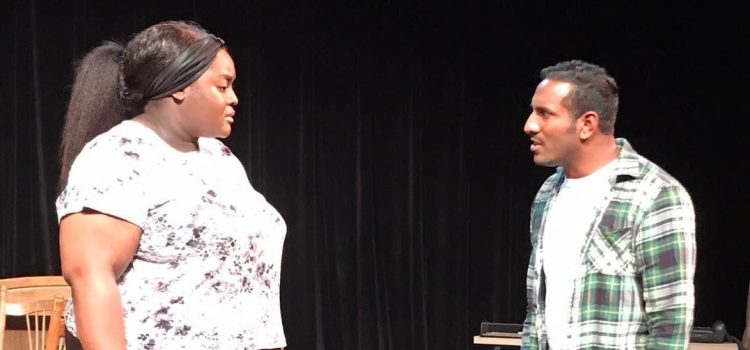
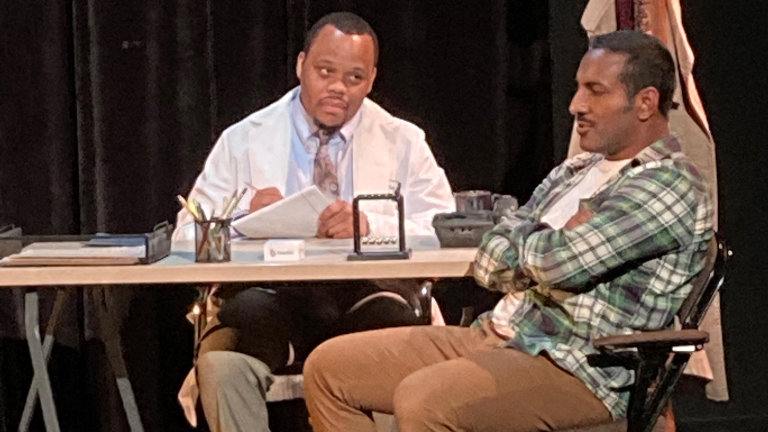
By Lynn Venhaus In his first feature film “Un-resolved,” Bruce Carlton Cunningham Jr. has created a gritty, sprawling tale of revenge not unlike a Shakespearean drama but set on the streets of St. Louis. He not only produced, but directed, wrote and stars as Tremaine in the ambitious project.
The story is about an ex-convict, just released from prison, who attempts to make up for the lost time with his youngest daughter, who is dying, and to reconnect with his oldest daughter, who has befriended a deadly enemy from his past.
The 2 hour and 47 minute film will screen at 4:30 p.m. on Sunday, July 24, at the Brown Hall Auditorium of the Washington University campus, as part of the St. Louis Filmmakers Showcase sponsored by Cinema St. Louis. Cunningham will be present, along with members of his cast and crew.
Bruce has been a prolific producer in St. Louis for the past 21 years. As an actor, writer and director, he has appeared in several short films, including “Ricky’s Hurt” (2016), “Retribution” (2015), “Static: A Fan Film” (2018), “Icon: A Fan Film” (2020), “Hardware: A Fan Film” (2021), a feature film, “A New Husband For Christmas” (2020) and a web series, “Gonzo” (2016).
Un-resolved
He graciously answered our Take Ten Questions:
Bruce Cunningham
What is special about your latest project? This is my first feature film and I put a lot of work into it to make sure it was a compelling story. It was a long journey making this, but I am glad I completed it and didn’t give up.
Why did you choose your profession/pursue the arts? I started acting when I was nine years old. I would watch a lot of T.V. & movies rather than going outside to play or staying up late. I wanted to be a part of the onscreen action: car chases, jumping from buildings, flying through the air, living in different worlds and being different characters. That sparked my desire to act and make movies.
How would your friends describe you? Humorous. Silly. Down to earth. No filters and no brakes. Focused. Loves to have a good time.
How do you like to spend your spare time? I like to read, watch movies, travel, workout, shoot guns, learn new things and spend time with friends and family.
What is your current obsession? Hmmmm, that may be private.
What would people be surprised to find out about you? I look younger than I am.
Can you share one of your most defining moments in life? Becoming a father was very defining because I have someone I have to pour into and be an example for. My daughter keeps me on my toes.
Who do you admire most? I admire my mother the most. I love her wisdom and her approach to life and situations.
What is at the top of your bucket list? I haven’t really thought about it. I’m still thinking about this one. Maybe act alongside Denzel Washington.
How were you affected by the current pandemic years, and anything you would like to share about what got you through the pre-vaccine part, with shutdowns, and any lesson learned during the isolation periods?
I definitely did not like to see and hear of all of those people dying of COVID. It was a major change, I spent a lot of time by myself and I changed my perspective on a lot of things. On the bright side, I had more time to edit my film during the shut down and that kept me busy.
What is your favorite thing to do in St. Louis? Take walks in the park.
What’s next? I just finished acting in other projects. Now, I am relaxing and trying to get “Un-resolved” out to the world. Pretty soon, I am going to start writing for the next film.
More About Bruce Carlton Cunningham Jr.
Birthplace: STL Current location: STL Family: Single Father of one Education: B.S. Video/Film Production & Minor in Theatre. M.S. Managing Information Technology Day job: Information Technology First job: Hardee’s First movie you were involved in or made: Retribution Favorite jobs/roles/plays or work in your medium? So far, it is between the roles of Tremaine (UN-RESOLVED) and George (UNDERNEATH) Dream job/opportunity: I would like to do a full action film. Awards/Honors/Achievements: None at the moment, but keep watching. When it comes to achievements, finishing my first film would be my latest achievement. Favorite quote/words to live by: “If there is a door, then you have to kick it down. If there is no door, then create one and kick it down.” A song that makes you happy: “Ali Bombaye”
By Lynn Venhaus Technically brilliant but weak in coherent storytelling, “Nope” is an amalgam of tones and textures that convey horror and the strangest things.
In only his third film, director Jordan Peele, Oscar-winning writer of “Get Out,” follows up “Us” from 2019 with equal parts originality, pastiche, and satire. It’s clever, spooky, funny, and gruesome.
Two siblings, OJ and Emerald Haywood (Daniel Kaluuya and Keke Palmer), are taking care of their family’s horse ranch in inland California. Their father, Pops (Keith David), built up the horse business to provide animals for Hollywood productions and became a legend. They are barely staying afloat now, though. The horses get spooked and the pair witness unexplained phenomenon that gets increasingly hostile. But fascinating – and if they can prove alien life, a financial life raft.
Kaluuya, so good in Peele’s cultural phenomenon “Get Out” and Oscar winner as Fred Hampton in “Judas and the Black Messiah,” is the laid-back horse trainer, OJ (wink-wink), who worked with his dad Otis Sr., on the dusty remote spread. His bubbly, scattered sister Emerald – Palmer in a live-wire role — does not complete tasks or take responsibility, so OJ is left being the heavy lifter.
But when weird things start happening, will they be able to successfully team up and rise to the occasion to defeat something they don’t understand?
Meanwhile, at a nearby Old West Town amusement-theme operation, former child star Ricky “Jupe” Park (Steven Yeun) tries to overcome a traumatic childhood incident and entertain the masses, using the sci-fi spectacle to his advantage. At least, that is his plan.
The characters are intriguing and mysterious, but the Haywood kids’ personalities, being opposites, don’t lend themselves to building emotional connections when that would have immensely benefitted the movie.
It is clever how the siblings figure out what works and what doesn’t. With the help of a techie at a big-box store, Angel Torres, well-played by Brandon Perea, and an old-school cinematographer drawn to the mysterious goings-on – Michael Wincott, who maintains a sage but wary vibe.
Steven Yeun as a former child star
Yeun, showing yet another facet after his Oscar nomination for “Minari,” evokes sympathy, pity and at times is a pathetic, sad figure, as the former scarred-for-life child star clinging to a lower ring of showbiz as a vaudevillian showman.
Now that’s one you want to know more about – even if those two flashback scenes to the set of his sitcom are quite disturbing.
Because it’s hard to get invested in the Haywood and Park journeys when you are confused about what is happening. Peele, at times, instead of surprising us, dulls the impact by keeping us at arm’s length.
Not that there aren’t a couple jump scares, some well-placed funny lines, and escalating tension every time the power goes out or the UFO vessel swoops down on its prey. The voyager in the sky is less revealing than Ed Wood’s “Plan Nine from Outer Space” or “Unsolved Mysteries,” and that ‘less is more’ effort is frustrating.
What lessens Peele’s impact is that he struggles with pacing – from a slow-burn beginning establishing who’s who to a draggy third act. With a runtime of 2 hours and 15 minutes, at least 20 minutes could have easily been shaved off.
This is an example where the anticipation is greater than the supernatural alien payoff, similarly unfulfilling like in Denis Villeneuve’s “Arrival” (2016) and M. Night Shyamalan’s “Signs” in 2002. The gold standard in space paranormal visits remains Steven Spielberg’s 1977 “Close Encounters of the Third Kind,” but “Nope” tackles other issues that aren’t in the ‘aliens arrive’ lane — black representation in Hollywood, entertainment spectacles, American identity and more. Some of the themes he’s using are clear, while others are opaque.
The writing, in a rather minimal slideshow way, lacks plot details that would help connect the dots and thread the needle, preferring to be stingy with any information that can illuminate or help explain the strange goings-on. Even though there are some truly creepy segments, Peele seems to strive for confusion instead of understanding.
Daniel Kaluuya as OJ Haywood
Hoyte van Hoytema, Oscar-nominated for “Dunkirk” and Christopher Nolan’s go-to cinematographer, has captured the grandeur of this gulch in Santa Clarita Valley, with its mountains and foothills, its dusty vastness, as well as its ominous clouds and eerie remoteness. It’s both breathtaking in scope and spine-chilling in growing the unease.
Rebecca De Jong’s production design is a marvel of kitschy western theme park with glitzy faux fun touches, the fringes of old-fashioned entertainment from a bygone era, and Mother Nature’s ability to surprise and raise goosebumps at the same time.
Composer Michael Abels, who has scored Peele’s previous films, builds both the weirdness and the growing menacing tone in his musical selections. And as with any eclectic soundtrack melding pop culture periods, is pitch-perfect in his selections of Dionne Warwick, Corey Hart and others.
“Nope” is unlike Peele’s previous two films and allows him to stretch into interesting genre work – but had the focus been tighter, we’d be looking at a masterpiece, instead of a flawed film that I wanted to like so much more. If we could have invested more in the characters, that would have enriched the storytelling exponentially.
It really does have some marvelous moments – but at the same time, many head-scratching ones too.
A TMZ intruder
“Nope” is a 2022 horror-sci-fi-mystery thriller directed by Jordan Peele and starring Daniel Kaluuya, Keke Palmer, Steven Yeun, Brandon Perea, Michael Wincott, and Keith David. Rated R for language throughout and some violence/bloody images, its runtime is 2 hours and 15 minutes. In theaters beginning July 22. Lynn’s Grade: B-
By CB Adams Before the lights dimmed and the 8th annual LaBute New Theater Festival began, this reviewer felt pity instead of anticipation – pity for the nine playwrights who had to endure a two-year, pandemic-induced delay for their works to be fretted and strutted upon the intimate performance space at the Gaslight Theater.
During the festival’s four-week run, the St. Louis Actors’ Studio presents two sets of five one-act plays selected in 2020 – a Whitman’s Sampler (something for everyone!) of short dramas. Each slate includes “St. Louis,” written by the festival’s founder and namesake, the Tony-nominated, acclaimed writer and director Neil LaBute.
Two years may have felt like an eternity to playwrights and public alike, but the first set of one acts, running from July 8–17, delivers a collectively gratifying experience resonating with relevance to the current zeitgeist.
The first set includes Aren Haun’s “What Else is New,” John Doble’s “Twilight Time,” Willie Johnson’s “Funny Thing,” and Fran Dorf’s “Time Warp,” as well as LaBute’s “St. Louis.”
Experiencing this evening of one acts is like reading a short-story collection. You might not enjoy every play (not all in the first set are one-hit wonders), but taken together, they are engaging, thought-provoking and satisfying. When soliciting for one acts, the LaBute Festival seeks plays that feature no more than four characters. They should be crafted specifically to exploit the Gaslight’s intimate, 18-foot square performance space with quick changes in scenery, setting and set moves.
For theater-goers who love plays that focus on the fundamentals of dramaturgy – plot, character and theme – the LaBute Festival is a must-see, based on this first slate.
The plays presented this year are diverse, yet share a common thread, if not a common theme, of human connectedness:
“What Else is New,” set in a diner, involves Bruno (and his suitcase), an unhoused loner (replete with an annoying need for conversation and more tics and twitches than Brad Pitt in the film “12 Monkeys”) and Mark, a disinterested college art student who works the counter. t’s a marvel to watch the two characters circuitously connect.
“Twilight Time,” concerns a chance encounter between Benjamin and Geraldine, two disaffected youths who discover they are both planning their suicides. Though not as humorously death-drenched as “Harold and Maude,” they connect over common political and other opinions and soon make plans to live, perhaps happily ever after.
“Funny Thing” is anything but funny as the four-month relationship between Older Man and Younger Man is stuffed into a blender and set to frappe. The resulting, non-chronological plot makes frequent pivots that are easy to follow, thanks to fine acting and effective lighting changes.
No one dances in “Time Warp,” but, as the song goes, “…With a bit of a mind flip / You’re into the time slip / And nothing can ever be the same…” For those of us who like stories that explore the possibilities presented by punctures in the time- space continuum, “Time Warp” delivers a mind-bending – and ultimately harrowing – tale involving Brian, a Vietnam War army psychiatrist, his wife, Beth, a curiosity shopkeeper, CG Young, and a specter-like painter and fellow soldier, Joey Passarelli. The warping of time and circumstance ensues, though not in a science fiction sort of way.
LaBute’s “St. Louis” (presented in both sets of the festival) could have been titled Stand and Deliver because that’s what this play’s three characters do: they stand and deliver (as does the entire play itself). St. Louis does not concern itself with Ted Drewes, the Arch or any other tourist destinations. There are a few compass- point references to St. Louis, such as the Central West End, but the true location of this one act is the triangulated world and relationships of the three monologists, She, Her and Him. The climax of the relationship – the connection – among these characters is too good to spoil.
But, climax aside, the most noteworthy achievement is how the story is unfolded by the three characters, each in a pool of light and each speaking as if to their own offstage interlocutor. Separately, and yet collectively, they stand and deliver their part of a shared, very personal history. Under the deft direction of Spencer Sickmann (himself a seasoned actor), the actors collectively embrace their characters and deliver these short plays with confidence, believability and chemistry.
And, in the case of “Twilight Time,” they surpass the play itself. Mitch Henry Eagles plays triple duty in “What Else is New,” “Funny Thing” and “Time Warp.” All are fine performances, but the standout is as the Younger Man in “Funny Thing.” His character is whiplashed by the on-again/off-again relationship he shares with Older Man and Eagles easily flips between “should I stay” or “should I go?”
Bryn McLaughlin does double duty as Geraldine in “Twilight Time” and She in “St. Louis.” Her performance in the former is the strongest in that play, and in the latter, she’s even better as she projects a strong, confident counterpoint to the bro-ish Him. As Him, Brock Russell plays a character one loves to hate, or vice versa, and that dichotomy is testament to his ability to fully reveal the complexities of Him.
Eric Dean White demonstrates tremendous range playing the twitchy chatterbox Bruno in “What Else is New” and, a couple of one acts later, as the sensitive psychiatrist and husband in “Time Warp.” The nervous energy he pours into his Bruno is as exhausting as it is exhilarating.
In the case of these one acts, to call the sets, lighting and costumes bare bones is a compliment. As in most literary short stories, there’s nothing extraneous and everything must serve a purpose in black-box one acts. In this first slate of plays, that’s exactly what Patrick Huber achieves with the flexible sets and lighting, as does Carla Landis Evans with the costume designs.
Set One of the LaBute New Theater Festival runs July 8-17 at at the Gaslight Theater, 358 N Boyle Ave. Set Two runs from July 22–31. Times are 3 p.m. on Sundays and 8 p.m. Friday and Saturday. For more information, www.stlas.org All photos by Patrick Huber
Whether you’re a die-hard Muny season ticket holder, a Stephen Sondheim devotee, someone attracted to a dark Dickensian tale about a murderous Victorian barber, someone seeking a great night of musical theater, or anything in between, “Sweeney Todd: The Demon Barber of Fleet Street” is a must-see.
Fresh off the heels (or should we say umbrella) of “Mary Poppins” comes a show with a wholly different cut. It’s populated with hordes of the great unwashed, a steampunk-inspired set, love songs sung to razors and more dead bodies on stage than a Greek tragedy. And if that’s not enough, add in the music and lyrics by Sondheim (one of his greatest showpieces). Who else could have created a toe-tapping sing-along about meat pies made with human flesh?
“Sweeney Todd” originally opened in 1979 and, after sweeping the Tony Awards, has since grown into one of Broadway’s top-ten musicals – emphasis on musical because 80 percent of this show is sung. It is just now making its Muny premiere after a two-year pandemic-induced delay. It is definitely worth the wait.
Photo by Julia Merkle
This a muscular “go big or go home” production. Rob Ruggiero, director, and Mike Isaacson, artistic director and executive producer, leveraged their many talents and definitely chose the go-big option. They take full advantage of the Muny’s automated stage with its performer lifts, turntable and scenery wagons. A tip of the hat also goes to Jessica Hartman, associate director and musical staging, and James Moore, musical director, for their talents.
One of the challenges of “Sweeney Todd” is presenting the violence and carnage, which includes numerous throat slashings. The bloodletting is cleverly and effectively portrayed through lighting (thanks to design by John Lasiter) rather than with fountains of fake blood.
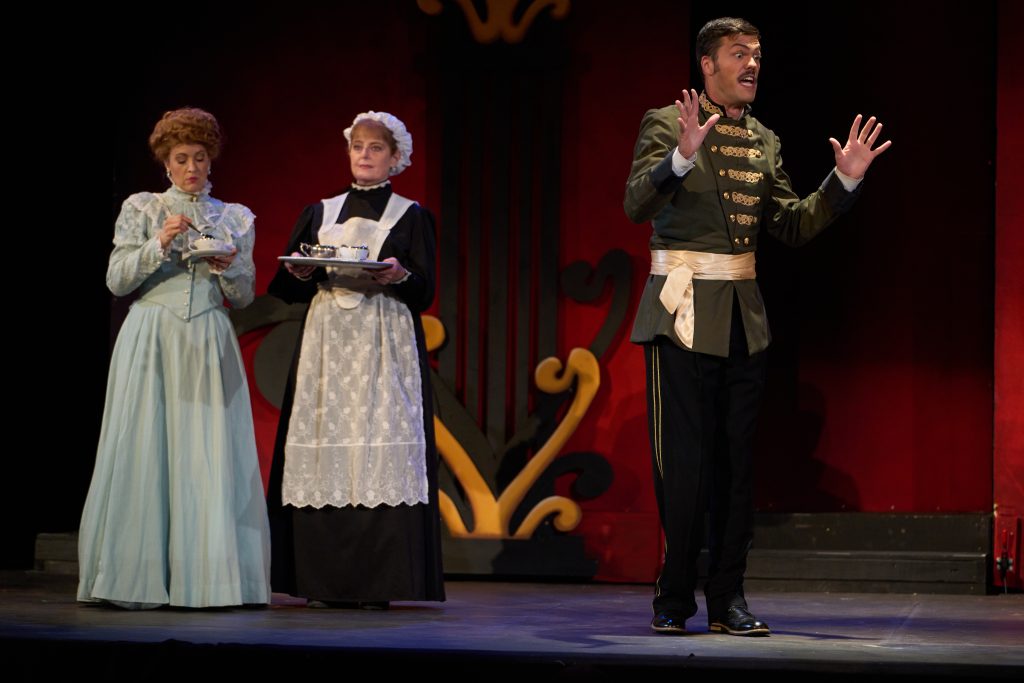
As befits the big production values, this “Sweeney Todd” requires – and delivers – a powerful principal cast. Tony nominee Carmen Cusack, an audience favorite, plays the crafty, ambitious Mrs. Lovett. Cusack’s voice is equal to Ben Davis’s booming Sweeney Todd. Davis achieves a Todd who is complex, wounded and angry, and can still fill the stage with a larger-than-life presence. Julie Hanson’s bawdy Beggar Woman weaves throughout the scenes like an annoying fly with a Cockney accent, while Stephen Wallen’s corpulent The Beadle waddles about like an officious toady in service to Robert Cuccioli’s imperious, love-struck lech, Judge Turpin.
Photo by Phillip Hamer
Even a slasher show like “Sweeney Todd” has a love story at its heart. Riley Noland plays Johanna with a thin high voice that befits her role as captive and victim. Her duet with Jake Boyd as sailor boy/love interest Anthony Hope is an extended highlight of this production. Though the two interact mostly from afar, their love and attraction is palpable.
Lincoln Clauss’s Tobias Ragg is a standout. The Ragg character evolves from wig-wearing hawker of snake-oil hair tonic to sprite-like table server and finally to traumatized avenger. Clauss has the acting and vocal range to match.
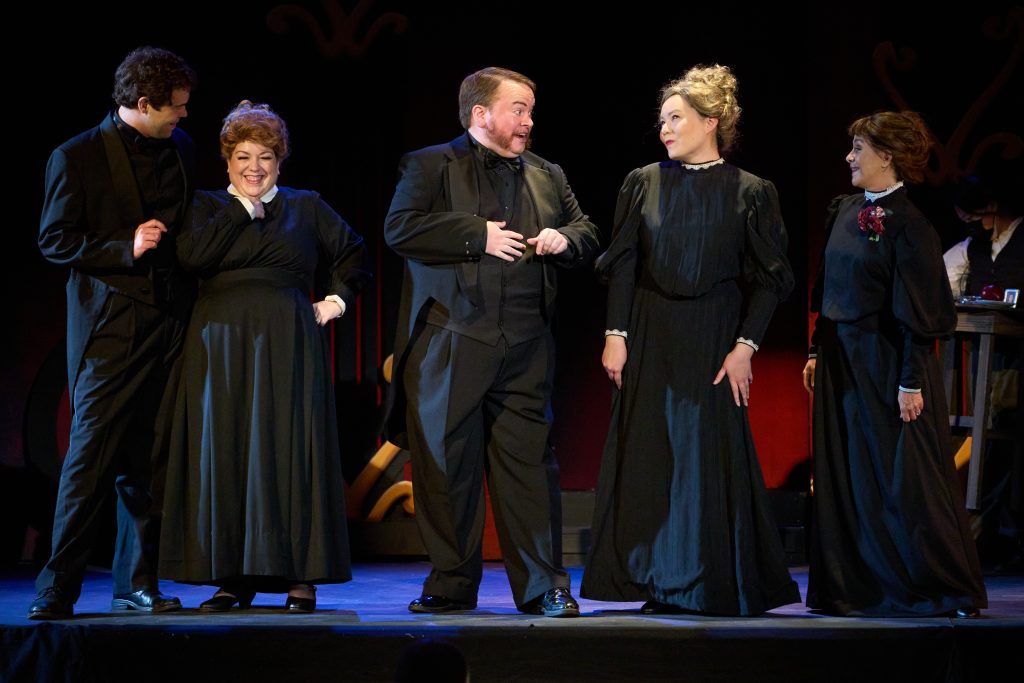
This production also makes full use of a large ensemble chorus with a panoply of tatty, bedraggled characters who introduce and frame Sweeney Todd’s descent from a cruelly treated barber into a lusty lasher and ultimately tragic victim of his own revengeful scheming. And, there haven’t been this many raised fists on the Muny stage since “Les Misérables” was in town.
The ensemble sings the last chorus at the conclusion of “Sweeney Todd,” but it’s the audience, walking toward the exits and excitedly talking about this production’s wow factor, that gets the last word and best positive review.
Photo by Phillip Hamer
The Muny presents “Sweeney Todd” July 16 – 22 at 8:15 p.m. nightly on the outdoor stage in Forest Park. For tickets or more information, visit: www.muny.org.
Photo by Phillip HamerThe cast of Sweeney Todd. Photo by Phillip Hamer
A Rube-Goldbergian smorgasbord of grotesqueries, special effects guru Phil Tippett’s stop-motion passion project, “Mad God,” oozes with both incredible artistry and dispiriting nihilism.
A curving tower stretches into the red-scorched sky, grasping for freedom from the hellscape below. A scroll reads “Leviticus 26-27,” in which God tells Moses the curses he’ll bring down upon the Israelites if they’re disobedient. We’re then introduced to a humanoid figure, clad in steampunk-esque attire and a gas mask, who boards a diving bell and floats beneath the clouds.
Referred to as “the Assassin,” he’s sent on a fateful mission by a long-nailed overseer (Alex Cox, portraying the titular Mad God in one of the film’s only live-action performances). As the Assassin descends, he passes remnants of civilizations gone by and monuments to higher powers, until finally reaching the cracked, muck-covered surface.
He carries a suitcase with a bomb inside, as well as a map that seemingly crumbles every time it’s glanced at. En route to an ambiguous destination, the Assassin navigates a hostile environment filled with untold horrors. This includes a cleaver-wielding troll with huge teeth, disposable workers molded from excrement slaving away to a scabbed-mouthed supervisor screeching in babytalk, and surgeons engaging in extreme medical malpractice (to say the least).
Indeed, Tippett’s painstakingly realized world is the real star of the show, and “Mad God” eventually shifts focus to showcase bloody vignettes within each circle of Hell, progressing closer towards the core of it all. Is there a light at the end of the tunnel?
Nope, but it’s damn-near impossible to avert your gaze from the darkness. “Mad God” is a work of such incredible devotion that the plot’s obliqueness doesn’t detract much from the experience on the whole — so long as viewers approach it as more of an artistic thesis statement on humanity than a traditional narrative.
Tippett’s film is, above all else, a display of one man’s staggering interpretation of a universe broken beyond repair, and each frame of this 30-years-in-the-making project is meticulously-formed — the gnarled beasts and industrial apocalypse surrounding them are lent tactility by the stop-motion approach. This renders them extra disturbing and, strangely enough, charming in a morbidly fascinating way, before they’re unceremoniously brutalized by their next-door neighbors.
The cinematography, by Tippett and Chris Morley, also rivals any live-action production released this year, with shots emphasizing the vast, imposing scale of a place stuck in endless cycles of war, exploitation, and utter hopelessness.
Minotaurs, spider-legged aliens, a baby resembling that of “Eraserhead,” a sentient doll wasting away, the camera exhibits them all, unflinching in its gaze, leaving immediate, searing impressions. Add to this a wistful score by Dan Wool — featuring a central melody gradually morphed over the course of the film — and “Mad God” is glorious to behold from a visual and auditory perspective.
Story-wise, it’s a bit more complicated. As viewers are shepherded from one deranged situation after another like tourists, “Mad God” reveals itself to ultimately be an illustration of humanity’s worst instincts and the futility of existence when all is out of your control; survival is tenuous at best. Everything in “Mad God” feeds into the next, like a clockwork machine of suffering, suiting the needs of forces beyond our comprehension, forever churning onwards even through civilization’s extinction.
The film eludes simple explanation, and “Mad God” stumbles as a result of the dour, sadistic tone maintained from beginning to end. Regardless of the relatively brief, 85-minute runtime, observing the same themes being repeating themselves again and again — albeit via different vessels — grows tiresome.
Additionally, we don’t spend enough time with any specific creatures to grow “attached” to them, which makes the appeal of “Mad God” centered around what unhinged sight Tippett has in store for us next. The most sympathetic entities, surprisingly, are those aforementioned shit-people, doomed to serve a tyrannical overlord without any agency of their own. It’s all a bit of a sensory overload, almost feeling overstuffed by the conclusion.
This relentlessness might just be the point, however, lending the film’s final psychedelic stretch a sense of existential release as we witness death and rebirth on a grand scale.
Perhaps the epitome of “isn’t for all tastes,” “Mad God” is a nevertheless impressive work of craftsmanship that intrigues and repels in equal measure.
“Mad God” is a 2021 animated fantasy-horror film written and directed by Phil Tippett. It stars Alex Cox and runs 1 hour, 23 minutes. It is is intended to be viewed by mature, adult audiences and is not suitable for children under 17. It is available on Shudder, AMC on Demand and Spectrum on Demand. Alex’s grade: B
During the ten-minute intermission, I overheard a woman in the audience tell her companion: “I hope my kids don’t find my diaries.”
Whoa, and that reaction was before The Midnight Company’s seismic second act of “Rodney’s Wife.” I surmised other parents probably shared that sentiment at some point during this unsettling, distressing drama written by Richard Nelson.
Director Joe Hanrahan, who is eager to explore different dimensions, does not shy away from edgy or dark, thinks cinematically, and has an affinity for the period and the inner workings of show business, slowly pulling back the curtain, so to speak.
He has assembled a cast of six local acting heavyweights, who illustrate why they are so highly regarded, and the retro Italian setting is a designers’ dream.
The daughter of Rodney and his second wife, who found her mother’s diary from an eventful summer in 1962, introduces herself and takes us back to that time.
Kelly Howe is believable in dual roles, carefully choosing what emotion to display when. The statuesque Fay is a former actress who had married a widower 10 years ago. Rodney (John Wolbers) is now a fading movie actor. Is she content in her current role as “Rodney’s wife”?
In a quietly shattering performance, Howe starts out staying in the background while other big personalities suck the air out of the room — and then tries not to be suffocated.
Kelly Howe as Fay. Photo by Joey Rumpell
Her arrogant, domineering husband and his overbearing, busybody sister Eva (Rachel Tibbetts) try to control the temperature in the room. Eva was married to Rodney’s manager but is now a widow.
For people who pretend to live out loud, something is obviously ‘off,’ and subtle clues poke through the facades. Nelson builds tension, with anxiety and desperation fighting for attention in a shades of Anton Chekhov meets Tennessee Williams way, minus all-encompassing gloom and predictably overwrought hysteria.
Without spoiling any crucial plot turns, “Rodney’s Wife” has many layers and moving parts in its portrayal of a dysfunctional family. Oh, it’s complicated, all right. The melodramatic action is akin to divulging bombshells on a TV soap opera, and torching others with the secrets.
A prolific American writer, Nelson won a Tony Award for best book of a musical (James Joyce’s “The Dead” in 2000), and several Obie Awards. “Rodney’s Wife” was mounted off-Broadway in 2004 at the Playwrights Horizons, starring David Strathairn and Jessica Chastain as father and daughter.
As Fay prepares for a small celebration in a rented villa on the outskirts of Rome, well-heeled and seemingly carefree folks rush in, laughing and drinking copious amounts of alcohol. Rodney’s daughter Lee (Summer Baer), who has been mostly away at boarding school and college, has surprised her father with big news — she is engaged to Ted, a smart, amiable American writer (Oliver Bacus).
Rodney is regaling his future son-in-law with boorish moviemaking stories. Turns out the actor, a legend in his own mind, is filming a spaghetti western, but this is not exactly Clint Eastwood as the Man with No Name. These are the low-budget early years of the Italian fascination with the American West, before Sergio Leone would make his mark with this distinctive genre.
Dissatisfied and unpleasant, Rodney is rescued from his miserable experience by his new manager Henry (Ben Ritchie), who drops off a script that he views as more suitable for his talents, only they’d have to leave for America the next day. In addition, Henry, while professional and practical, has his own worries back home.
And why is Fay like a cat on a hot tin roof in the midst of the merriment?
Summer Baer and Ben Ritchie. Photo by Joey Rumpell
What started out as a forced happy family gathering unravels into shock and betrayals, attitudes are laid bare, and scabs are picked at and reformed. Some prefer not to play along, others mask their feelings for survival, and the perpetual role-playing is ongoing.
All six are clinging – whether to fading beauty, to their comfortable lifestyle, to forging a new identity, to the past, to keeping up appearances, their deceptions, or to whom they think they are/should be.
As the self-absorbed Rodney, John Wolters is revelatory, displaying a dramatic heft that you don’t often see when he’s trotting the boards, usually (but not always) in lighter fare. I wish Nelson had not written Rodney as a cliché.
Sartorially splendid, Rachel Tibbetts’ Eva craves the spotlight as much as her actor brother, and she fools no one as a busybody Karen trying to tell everyone else how to live their lives. Her equally loud brother indulges her, and Tibbetts embraces being abrasive in a role that’s mostly comical, but she conveys enough depth to make it more than one-note.
As the not-fully-formed 25-year-old adult daughter Lee, Summer Baer modulates the tones between dutiful daughter, her stepmom’s pal, tolerant of her hovering aunt and supportive fiancé to Ted. But what is it that she wants? A conflicted Lee doesn’t appear to be as forceful expressing what she wants as everyone around her seems to know what’s best for her.
Photo by Joey Rumpell
Although Bacus portrays Ted as assured as he’s making first impressions, it is as if Lee has blithely brought a prey into the lion’s den. You feel for this guy, hoping he’s better at seeing the red flags than we are.
Nelson has boxed himself into a corner narratively, and both Fay and Lee are frustratingly enigmatic – but the pair of actresses do everything they can for more fully realized interpretations.
However, his savvy choice of Rome 1962 is an exciting canvas for Bess Moynihan, whose scenic and lighting designs are astonishing, and for Liz Henning, whose astute costume designs are some of the best she’s ever done on local stages. Miriam Whatley has designed props that are ideally suited to the atmosphere.
Moynihan’s flair for striking production design – complete with an inviting patio –provides a good flow for character movements. Her superb lighting, especially the natural dawn, effectively establishes the shifting moods over the course of a night and day.
The drama’s impressive sleek look touches on what an attractive playground Italy was in the 1960s, not only because of the cultural revolution in movies, music, art, fashion, and style but how post-war Italy was putting fascism in the rear-view mirror and hedonism was in full throttle.
Hanrahan and company are successful in creating an intoxicating vibe of exotic travel, lush surroundings, and a pop art palette without having the benefit of idyllic sun-drenched exteriors. (I mean, we’ve seen “Three Coins in the Fountain”! I digress…).
As an example, Federico Fellini had unleashed “La Dolce Vita” in 1960 and was working on his opus, “8-1/2” (released in 1963), and he wasn’t the only director getting buzz in this new golden age. Michelangelo Antonioni’s “L’avventura” also was released in 1960.
Rodney looks like a guy who could be driving an Alfa Romeo while the handsome, well-mannered Ted could be tooling down the Amalfi Coast in a Fiat, doing his best Marcello Mastroanni.
The women wear their stylish cocktail dresses and chic casual attire with aplomb, sometimes adorned with bright scarves, and their hair is fixed in elegant styles – Lee’s swept-back ponytail, Eva’s classic elegant knot. The air of luxury permeates the small space.
During intermission or before/after the show, be sure to view a special fashion collection in the Chapel, which highlights haute couture of the era, and the designers, colors and styles that were famous.
Because of the fine performances, The Midnight Company has elevated this work, sharpening the explosive interpersonal dynamics. With inspired highly skilled craftmanship from the creative team, The Chapel’s intimate space has been admirably transformed into a mid-century modern with an international aesthetic.
Using the irony of such a luxurious landscape, Nelson has basically imprisoned his characters, who are products of their time, for better or for worse, which makes the sorrow and the unspoken regrets hang heavy in the air.
The Midnight Company presents “Rodney’s Wife” from July 7 to July 23, with performances at 8 p.m. on Thursdays, Fridays, and Saturdays and at 2 p.m. on Sunday, July 10 and 17, at The Chapel, 6238 Alexander Drive, St. Louis. For more information, visit: www.midnightcompany.com.
The Saint Louis Art Fair presented by Centene Charitable Foundation (SLAF) and produced by Cultural Festivals is proud to announce its 29th year as the Art Fair returns to the streets of downtown Clayton on September 9 to September 11, 2022. The Saint Louis Art Fair is a nationally juried fine art and fine craft show consistently ranked as one of the nation’s top fine art fairs.
“On behalf of the Board of Directors, we look forward to welcoming everyone back this September to be a part of the magic in the streets of downtown Clayton, Missouri during the St. Louis Art Fair,” said Stacy Engles Wipfler, 2022 Chairperson. “With world-class Art, local food and drink, live entertainment and thousands of area community members sharing their love of art, I can’t think of better way to end summer and kick off fall. This event would not be possible without our generous sponsors, tremendous staff, hundreds of volunteers and our event management team leaders, and of course we also thank the City of Clayton for continued support as we lay out the groundwork for this year’s art fair.”
Hours for this year’s art fair will be Friday, September 9 from 5:00 pm to 10:00 pm; Saturday, September 10 from 11:00 am to 10:00 pm; and Sunday, September 11 from 11:00 am to 5:00 pm. The three-day celebration of art attracts thousands of art enthusiasts from across the region to a space filled with beautiful art, live music performances, delicious food samplings from some of the area’s premier restaurants, children’s activities, and much more.
Each year, the production team and its governing board choose a theme to best represent the mood and feel they’d want guests to experience. This year’s theme exemplifies the spirit of joy and expressiveness that Art provides to the community. To highlight the immense amount of love and connection SLAF receives from its supporters, the theme has officially been selected as, “Love is in the Art.”
“We continue to be overwhelmed by the love and support of the community and are thrilled to be bringing the Saint Louis Art Fair presented by Centene Charitable Foundation back to the streets of downtown Clayton,” said Executive Director Sarah Umlauf. “Our goal this year is simply to continue our mission to inspire and engage our community with the foremost celebration of exceptional visual art, and, of course, spread the theme of ‘love’.”
A nationally recognized art fair, artisans will be coming from more than 33 states and 3 countries with an incredible collection of sculptures, paintings, mixed media, and more on display in downtown Clayton. Something is bound to catch every art lover’s eye while capturing their hearts. As always, the art fair features a field of emerging artists, first-timers as well as returning artists and award winners who will bring their original art to town for the event. Each year, up to 1,200 artists submit to be included in the prestigious art fair. From there, jurors whittle the list down to 180 artist vendors, who are invited to showcase their creations.
Guests will not only fall in love with the Art but find entertainment from a variety of musical, dance and spoken-word performances along with a special Creative Castle area with hands-on activities for children. There will also be new, interactive artistic experiences including custom-led tours to help you, “Meet the Artists,” larger-than-life floral installations, chalk art creations, chef-inspired food demonstrations, and so much more! Please refer to saintlouisartfair.com for more details and a full schedule of new features.
Additionally, SLAF is excited to release its 2022 Commemorative Print. The official Commemorative Print will be unveiled during a private Saint Louis Art Fair Kick-off Party on Thursday, August 11.
Sign up for Cultural Festivals’ St. Louis Art Fair newsletter and follow Saint Louis Art Fair on social media for the latest updates. Follow us on: Facebook @CulturalFestivals, on Twitter @STLArtFair and on Instagram @STLArtFair.
About Cultural Festivals and the Saint Louis Art Fair
Cultural Festivals enhances the cultural landscape of St. Louis, offering innovative programs that bring the arts to dedicated arts enthusiasts.
The Saint Louis Art Fair presented by Centene Charitable Foundation and produced by Cultural Festivals is a not-for profit corporation, designated by the Internal Revenue Service as a 501(c)3 organization and is tax-exempt in the state of Missouri. Governed by a local board of directors, all support goes directly toward presentation of the annual St. Louis Art Fair and its cultural outreach programs and services presented throughout the year. Donations to the Art Fair are tax-deductible as a charitable contribution. For more information, visit www.saintlouisartfair.com.
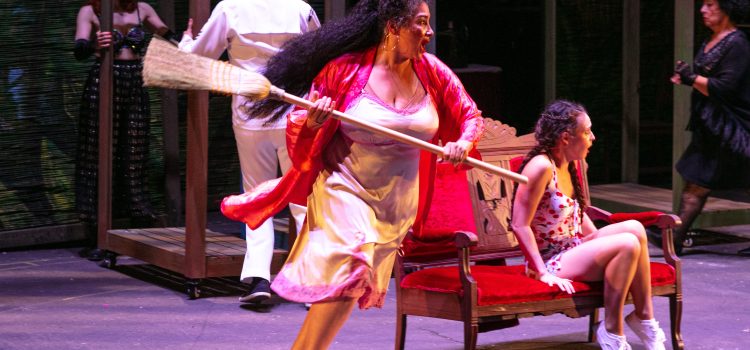
Opera Theatre of St. Louis has concluded a successful and altogether satisfying 48th festival season. But it would be a shame to look forward to the next season without first taking note of a cast change for five of the six performances of this year’s premiere of the performing edition of “Harvey Milk” (music by Stewart Wallace and libretto by Michael Korie).
When the original tenor in the role of Dan White had to withdraw after the premiere, Cesar Andres Parreño provided a two-of-one performance. Not only did he nail the role of White, the real-life nemesis/assassin of civil rights hero Harvey Milk, Parreño also made his principal role debut at Opera Theatre.
This was a busy season for Parreño. His principal role debut occurred on the heels of his performance of the supporting role of Remendado in the company’s production of Bizet’s Carmen his debut role for Opera Theatre. And that after being accepted into Opera Theatre’s Gerdine Young Artist Program, which is committed to discovering, nurturing and launching emerging young artists such as Parreño. Like other young artists in the program, he was offered opportunities to be featured in featured in supporting roles, cover all roles in mainstage productions and perform as featured soloists in the annual Center Stage concert.
Parreño hails Manabí, Ecuador and started his voice studies with Beatriz Parra at Colegio de Artes Maria Callas. He was named a Kovner Fellow in Darrell Babidge’s studio at The Juilliard School, where he was the first Ecuadorian ever to attend. In 2016, Parreño performed as a soloist with the University of Cuenca’s Orchestra and with Guayaquil’s Symphonic Orchestra. Since then, his performances have included his debut role as Lysander in Benjamin Britten’s “A Midsummer Night’s Dream,” in Chautauqua, New York, his soloist debut with the Juilliard Orchestra in Stravinsky’s “Pulcinella” and his Peter Jay Sharp Theater opera debut as Momo in Luigi Rossi’s “L’Orfeo.”
Parreño definitely had credible potential to step into the role of Dan White in “Harvey Milk.” Kudos to Opera Theatre for nurturing young talent of his caliber. Anything can happen in live theater – and regularly does – and it is gratifying to know that the show will go on. There’s no way to compare Parreño’s performance with his predecessor’s, but after experiencing his performance, there’s no reason to. Parreño was that good, not only with his beautiful, classic Irish tenor moments, but for his ability to humanize what could otherwise have been a one-dimensional “bad guy.” He may not physically resemble the real-life Smith (a sandy-haired WASP), but that doesn’t – and shouldn’t – matter.
Parreño’s performance can, however, be compared to those of his fellow singers: baritone Thomas Glass (making his own Opera Theatre debut) as Harvey Milk and tenor Jonathan Johnson as Scott Smith, Milk’s lover. During a performance filled with memorable and moving arias by all three men, the best was certainly the deeply affecting love duet between Glass and Smith. It set a high standard for love duets in the future.
This talented triumvirate were the epitome of the best ensembles – excellent voices, engaging characterizations and spot-on dramatic timing. In other words, Parreño, with his bright tenor, was in very good company.
With its 48th festival season now completed, all the reviews having been published and hoping COVID cancellations are a thing of the past, it’s good to know that young talent is being nurtured, fostered and encouraged through programs like Opera Theatre’s Gerdine Young Artist Program. And that, live theater being live theater, that young talent may unexpectedly get the chance to step into a principal or supporting role. As W. H. Auden once observed, “Drama began as the act of a whole community. Ideally, there would be no speculators. In practice, every member of the audience should feel like an understudy.”