
By Lynn Venhaus

An engrossing true tale of a visionary businesswoman’s triumph in revolutionizing the champagne industry in France, “Widow Clicquot” rises above its standard doubts-to–success template through poetic storytelling and a mesmerizing performance by Haley Bennett in the title role.

Director Thomas Napper unfolds a tragic heartbreaking love story while showing how a defiant young woman took control of a failing family business and her shattered life through renewed passion and purpose.

Her achievements established Veuve Clicquot as one of the finest luxury brands, which was founded by her father-in-law, Philippe, in 1772.

Based on a New York Times bestselling biography, “The Widow Clicquot” by historian Tilar J. Mazzeo, which was published in 2008, the film looks back at Barbe-Nicole Ponsardin Clicquot’s marriage to Philippe’s heir, Francois. Their fathers were in the textile business in Reims, France, and arranged the union in 1798, when she was 21.

As marvelously portrayed by a hypnotic Tom Sturridge, Francois’ unconventional, uncompromising ways and their grand passionate romance adds an intriguing component to contrast with her hard-fought solo battle to keep his dream and memory alive after his untimely death.

The screenplay by Erin Dignam, based on a story by Christopher Monger, keeps an air of mystery through flashbacks as to the bright comet that was Francois, and how his influence helped Barbe-Nicole work through her grief and loss. She was widowed at age 27.

Francois’ inspired flights of fancy were also part of his manic-depressive disorder that, left untreated, caused his behavior to be erratic and volatile, and Barbe-Nicole recognized his trouble in the paradise he envisioned. She was also his most steadfast supporter and benefited from his tutelage. Theirs seemed to be a true partnership.

Her invention of rose champagne, and her finest hour, “The Comet” vintage of 1811, is legendary, not to mention such breakthroughs as the ‘riddling table’ to clarify champagne and speed up the process, that is her inevitable claim to fame.

How she endured power struggles, and faced the male skeptics of that time, when events and their pomposity threatened to wipe out her inheritance, and the very reasons for her to thrive, is chronicled in accurate historic detail during the reign of Napoleon.

After all, women weren’t allowed to run a business, unless they were a widow who inherited the husband’s livelihood, and his trade embargo on not allowing merchants beyond France’s borders really stymied profits. Fortunately for her, and in the nick of time, his empire imploded.

Bennett, in a finely etched portrait, displays the temperament needed to be an effective Girl Boss, treating workers with kindness and gratitude, building loyalty, and creating a collaborative workplace. She has much to overcome, and her grit is admirable.

Her super-power is knowing when she needs help – gaining strength from her husband’s legacy, and heeding advice from the unlikely ally Louis Bohne, the family’s wine merchant, her husband’s close friend, and her eventual love interest.

Sam Riley is a lively Louis, whose support for their product keeps the business afloat and propels her to legendary status.

While other actors play the traditional naysayers, etched in broad strokes — rivals, turncoat Droite (Paul Rhys) and her father-in-law (Ben Miles), who actually is won over, she has cultivated loyalists in a young accountant, Anson Boon as Edouard Werle, and field foreman George (Leo Suter). Her faithful attendant, Anne, well-played by Natasha O’Keeffe (Lizzie in “Peaky Blinders”), is the friend she needs.

Bennett, outstanding as luminous Roxanne in the uncommon and underrated “Cyrano” in 2021, had a breakout year in 2016 with three films – “The Girl on the Train,” “The Magnificent Seven,” and “Rules Don’t Apply.” She continually impresses with her naturalism, grace and range.

She has convincing chemistry with both Sturridge and Riley, which sustains both love stories.

Sturridge, twice nominated for Tony Awards, for “Orphans” and “Sea Wall/A Life,” is also known for playing the main role, Dream, in “The Sandman” series on Netflix. He captures the tormented Francois, his declining mental health, his unusual outlook and his contagious lust for life.

His larger-than-life portrait makes Francois indelible, and you understand his deep connection to the land and his wife, and their daughter Clementine (Cecily Cleeve). He has the soul of a poet, and a problematic opium addiction.

Bennett’s narration of her diary notes, recounting her love for her husband, and her methods in finding a way forward through common sense and best practices she has learned along the way, is quite stirring, and provides an emotional center.

Above all, the widow’s perseverance stands out. I realize these are familiar plot points, especially with the men all bent out of shape about allowing a woman to run things. But hearing another woman’s remarkable success story never gets old.

While the movie is 90 minutes, it ends rather abruptly – enough so that I wanted to learn more about this woman rather than an epilogue wrapping up her next decades as the toast of the region. But it’s a terrific monologue to end on, and Bennett’s knock-out delivery will endure.

Adding to the visual and aural enhancement of the film are cinematographer Caroline Champetier’s lush exterior shots and her stressful interior shots, where unnerving and tense conflicts arise. Production designer Jean-Hughes de Chatillon and costume designer Marie Frémont contribute to the authenticity.

Bryce Dessner’s string-heavy score, at times restless, melancholy and hopeful, connects the facets in a memorable way. Known as part of The National with his brother Aaron, they have branched out with impressive film scores, including the aforementioned “Cyrano,” and ‘C’mon, C’mon.”

“Widow Clicquot” provides a fascinating account of a rare woman who smashed a glass ceiling in significant ways, and the three main actors are genuinely effective in bringing these vivid characters to life.

“Widow Clicquot” is a 2023 drama that premiered at the Toronto International Film Festival last November and is now in nationwide release, as of July 19. It is directed by Thomas Napper and stars Hayley Bennett, Tom Sturridge, Sam Riley, Anson Boon, Ben Miles, Paul Rhys and Natasha O’Keeffe. It is rated R for some sexuality and nudity, and the run time is 1 hour, 29 minutes. Lynn’s Grade: B.

Facebook Comments

By Alex McPherson

Tonally uneven and overlong, but floating above mediocrity thanks to the chemistry of its leads and crowd-pleasing sensibilities, director Greg Berlanti’s “Fly Me to the Moon” maintains a steady, low-key appeal.

Berlanti’s rom-com-meets-political-satire unfolds during the lead-up to NASA’s Apollo 11 lunar landing in 1969. Public support for NASA is waning, and it’s in desperate need of funding from a reluctant Congress. Kelly Jones (Scarlett Johansson), a PR professional from Manhattan who wields her powers of marketing spin like a super power, is hired by shady government operative Moe Berkus (Woody Harrelson), under orders from President Richard Nixon, to boost NASA’s public image and get the program back on its feet.

Kelly, who is both a genius and a scam artist, is up to the task, but carries personal demons from her past that Moe threatens to unearth should she not play along with Nixon’s schemes.

Kelly and her assistant Ruby (Anna Garcia) travel to the Kennedy Space Center from New York. Kelly bumps into Cole Davis (Channing Tatum) at a local diner, and the two quickly hit it off. Cole says she’s “on fire,” which Kelly thinks is just a bad pick-up line until she realizes that the book she’s reading is literally on fire — sparks fly in a different sense. 

Both parties think this meet-cute won’t amount to much, but neither of them know that they’ll be working together; Cole, a Korean War veteran, is actually the NASA flight director, and he’s not too thrilled about Kelly’s tactics to boost NASA’s image.

Whereas Kelly seeks to harness the powers of manipulation to sway public perception of NASA, shamelessly and effectively pandering to her targets, Cole is an idealist, carrying the guilt of those who perished in the Apollo I tragedy and unwilling to jeopardize his values for the shrewdness of advertising.

Still, Cole can’t deny his attraction to the opportunistic Kelly, who, right when she begins working at NASA, is getting employees to pretend to play Cole and his colleagues on TV, and swiftly gets major brands on board to support NASA.

It’s all about image and playing to people’s biases, which Cole initially refuses to go along with. Eventually, though, especially when convincing congresspeople to support the cause, he realizes Kelly’s way is the only way, while also falling for her for good measure.

Things are complicated when Moe insists Kelly film a fake version of the moon landing as a contingency plan should the actual mission not succeed. Realizing she has no choice, Kelly follows through, hiring the flamboyant director Lance Vespertine (Jim Rash) to helm the recording.

As the launch date nears and Kelly and Cole’s romance continues to develop, Kelly must choose between truth and lies, as America approaches an historical turning point, if only we’re allowed to see it.

Despite its star-studded fluffiness, “Fly Me to the Moon” aims higher than just being an old-fashioned rom-com. No matter how entertaining it is moment-to-moment, though, Berlanti’s film suffers an identity crisis, abruptly veering from goofy to somber and back again.

It fails to fully commit to any one style — remaining frustratingly half-baked, but never less than amiably enjoyable, as the 132-minute runtime chugs along.

Still, “Fly Me to the Moon” has its charms. Johansson and Tatum’s alternately playful and combative dynamic is fun to watch. Johansson, fast-talking and able to sway minds with ease, convincingly lends Kelly both confidence and vulnerability, with eye-popping costuming and hairdos to match.

Johansson is ultimately the reason to see “Fly Me to the Moon” — her Kelly is a force to be reckoned with, and it’s satisfying to watch her play people and persuade them to believe the unbelievable, until she gradually becomes disillusioned with her own twisted, but highly successful, ethical code.

Tatum does well enough portraying the uptight, damaged Cole. His sometimes awkward screen presence is more of a benefit than a hindrance in Cole’s case. Johansson and Tatum have solid chemistry, and “Fly Me to the Moon” shines brightest when they’re allowed to verbally spar and bounce their competing ideologies off each other to chuckle-worthy effect via Rose Gilroy’s ambitious, uneven screenplay.

Indeed, Gilroy’s script aims higher than the traditional beats we expect from this genre. It twists tropes, and history, to convey some surprisingly prescient ideas about truth, nationalism, love, and scientific advancement within its enemies-to-lovers formula — packaging some timely takeaways alongside the usual heart-warming clichés we’ve come to expect. 

However, not all the pieces Berlanti presents coalesce smoothly, leaving us with an experience that’s tonally all over the place, and neither as biting, poignant, or sexy as it could have been.

“Fly Me to the Moon” is at once a satirical comedy about the all-powerful nature of Spin, a family-friendly rom-com, and a sincere ode to the men and women who put us on the Moon (using the Apollo I tragedy as narrative fodder for Cole’s trauma and determination).

Characters run the gamut from flat-out cartoonish to sincerely grounded in reality, with Berlanti ultimately trying to prompt awe and appreciation for the bravery and hard work of those at NASA.

It’s all a bit much, with Berlanti’s direction showing hints of stylistic flair (including split screens and time-lapse editing), but otherwise remaining languid and conventional, along with editing by Harry Jierjian that lacks snappiness, leaving certain sequences — such as prepping for the staged moon landing — floundering without much momentum.

The production design is stellar, at least, capturing the time period with high attention-to-detail, and Dariusz Wolski’s cinematography is eye-catching, worthy of the big screen treatment.

 The film’s jokes, including several references to Stanley Kubrick and a black cat that keeps disrupting proceedings, are amusing without being in any way surprising. Supporting players like Ray Romano, Donald Elise Watkins, Gene Jones, and Colin Jost (in a brief cameo playing a senator that needs convincing) are serviceable without being given enough screen time to fully shine.

Daniel Pemberton’s score, alternating between jazzy rhythms and soaring strings, does much of the heavy lifting in the third act, giving the requisite exposition dumps and “heartstring-tugging” sequences of human achievement some weight. 

Clunky storytelling aside, though, “Fly Me to the Moon” fits the bill as a breezy, lightly enjoyable romp that’s at least trying to tackle something beyond itself. As current events have shown, presentation matters, but what’s truthful should matter even more — a call to common sense that the flawed yet well-intentioned “Fly Me to the Moon” hammers home, not to the stars, but to us on Earth.

“Fly Me to the Moon” is a 2024 comedy-drama directed by Greg Berlanti and starring Scarlett Johansson, Channing Tatum, Ray Romano, Jim Rash, Lisa Garcia, and Woody Harrelson. It is rated PG-13 for some strong language, and smoking, and the run time is 2 hours, 12 minutes. It opened in theatres July 12. Alex’s Grade: B-

Facebook Comments

“I’m determined to do it–and nothing’s more determined than a cat on a tin roof–is there? Time goes by so fast. Nothin’ can outrun it.” – Maggie, “Cat on a Hot Tin Roof,” Tennessee Williams

“The last eight seasons HAVE gone by so fast – it is hard to believe how much we have grown,” explains Carrie Houk, Tennessee Williams Festival St. Louis’ Executive Artistic Director. “This year we happily return to our home – Grand Center.  In addition to bringing you the play you have all been waiting for, we celebrate Grand Center Theatre District with a little song, a little dance, a little seltzer down the pants!  As Mrs. O’Fallon exclaims in The Magic Tower – “You show people!  Always putting on an act!” That’s what we do and we cannot wait to share our wares with you.”

This year’s TWStL will give center stage to Tennessee Williams’ Cat on a Hot Tin Roof directed by award-winning Michael Wilson at The Grandel Theatre in Grand Center August 8-18.

“I am thrilled to return to St Louis – the city which had such a profound impact on the life and work of Tennessee Williams – for its 9th Annual eponymous Festival to direct its centerpiece production, an all-new revival of his Pulitzer Prize winning and arguably most popular play, CAT ON A HOT TIN ROOF. “ – Wilson, Director

Michael Wilson is an American stage and screen director working extensively on Broadway, Off-Broadway, and at the nation’s leading resident theaters. He made his screen directorial debut with the 2014 Lifetime/Ostar television film adaptation of Horton Foote’s The Trip to Bountiful, which was nominated for two 2014 Emmy Awards and six 2015 NAACP/Image Awards. On Broadway, Wilson directed the 2013 Tony Award-winning revival of The Trip to Bountiful starring Cicely Tyson.

Other Broadway productions include the 2012 Tony nominated revival of Gore Vidal’s The Best Man (starring James Earl Jones, Angela Lansbury, Candice Bergen); the Tony nominated Best Plays Dividing the Estate; and Enchanted April. Internationally, he directed both parts of Tony Kushner’s Angels in America for the 1995 Venice Biennale. He directed the acclaimed Los Angeles premiere of the musical Grey Gardens: starring Betty Buckley and Rachel York for CTG/Ahmanson Theater at the Music Center.

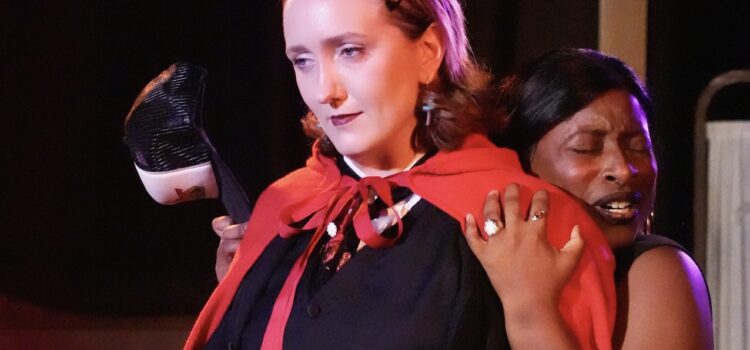
This Pulitzer Prize winning drama follows the story of the Pollitts, a wealthy southern family whose history of greed and deception looms overhead as the imminent death of the family’s patriarch approaches. Siblings and spouses go head-to-head to secure the Pollitt fortune, weaving an overwhelming web of mistruths.

Post-show commentary will be conducted by Resident Scholar, Tom Mitchell, on Sunday Aug. 12 and Thursday Aug. 15.

“Life Upon the Wicked Stage / Celebrating Grand Center Theatre District – Then and Now” will be the focus for three one-act plays with music directed by former St. Louisan Brian Hohlfeld:

  • “In Our Profession”
  • “The Magic Tower”
  • “The Fat Man’s Wife”

Almost 100 years ago, what we now call Grand Center in St. Louis was the place to go for entertainment. Vaudeville was struggling but still popular…double-features (with live acts in between) played all day at The Fabulous Fox and Missouri theaters…music poured from dance halls and clubs…and the hotels were packed with the touring casts of last year’s Broadway’s hits.

Young Tom Williams soaked it all up.

In celebration of the history and the continuing charm of Grand Center, TWStL will present “Life Upon the Wicked Stage” taking place upstairs at The Curtain Call Lounge just steps from the bustling streets and locations where much of the action takes place.

“Like the rest of the theatre-going public, Tom was intrigued by what went on backstage, a world he would soon become familiar with, and imagined what the lives of the nomadic show-folk must be like. He brings them to life with affection and bemusement in these one-acts all set in the 1930s and portrays the ups and downs of a career in show-biz. In these early plays, Williams, still finding his voice, is clearly influenced by the plots and styles of the movies he would have seen on this very street, bringing the experience full circle,” explains Houk.

The theatrical but intimate setting of the Curtain Call is perfect for a program about show-biz. Like a “mini-jukebox musical,” “Life Upon the Wicked Stage” features songs from the period to evoke the era of Vaudeville and the type of entertainment Tom would have encountered in his Grand Avenue outings long, long ago…

Director Hohlfeld has been writing for feature films and television animation for over 35 years, with projects at Paramount, Universal, Warner Brothers, Tri- Star, Columbia, Disney, and Hasbro Studios. As a producer and writer, he has been nominated for four Daytime Emmy Awards and twice for a Humanitas Award, winning once for the Disney Jr. show he created My Friends Tigger and Pooh.

Hohlfeld started his career in St. Louis as an actor and playwright with the Theatre Project Company and the St. Louis Rep. For the St. Louis Tennessee Williams Festival, he directed the memorable on-site production of The Glass Menagerie as well as several one-acts onstage and as part of the radio series “Something Spoken,” in collaboration with Classic 107.3.

The following panels – which will further shed light upon the themes of the Festival – will take place at The Grandel.

  • Secrets of Tennessee’s Stage Directions
  • The Wicked Stage: 1930s Theatre and Performances in St Louis
  • Cat on a Hot Tin Roof: Revision upon Revision

Other Festival events include:

  • Reading of “Stella for Star” an adaptation of the first award-winning story by the young Tom

Williams curated by TWSTL Scholar Tom Mitchell

  • A Walking Tour: Grand Center Theatre District, Then and Now… led by Mitchell
  • Late Night Open Mic “Life Upon the Wicked Stage”

“Festival audiences are in-store for our best programming ever!” exclaims Board Chair Ted Wight.  “Cat on a Hot Tin Roof is one of Tennessee William’s most popular plays that will delight the audience with intriguing theater.”

Tickets are on sale through Metrotix. Additional information and Festival event details can be found at twstl.org.

‘A Streetcar Named Desire’ in 2018 won seven awards from the St Louis Theater Circle.

About the Festival

In 2014, award-winning producer, casting director, actor, and educator Carrie Houk produced Williams’ Stairs to the Roof with such success that the ongoing annual Festival was established. The Festival, which aims to enrich the cultural life of St. Louis by producing an annual theater festival and other artistic events that celebrate the artistry and life of Tennessee Williams, was named the Arts Startup of the Year Award by the Arts and Education Council at the 2019 St. Louis Arts Awards. In its eight iterations since 2016, the Festival has attracted thousands to its readings, panel discussions, concerts, exhibitions, and productions, has reached hundreds of young people through its educational programming, and has garnered 13 awards from the St. Louis Theater Circle and was recently nominated for a  St. Louis Theater Circle awards for Outstanding Performer in a Drama, Female or Non-Binary Role for 2023’s Suddenly Last Summer.

Tennessee Williams and Anna Magnani on a Roman holiday filming “The Rose Tattoo”

About Tennessee Williams

Born Thomas Lanier Williams III in 1911 in Mississippi, Williams moved to St. Louis at age seven, when his father was made an executive with the International Shoe Company (where the City Museum and the Last Hotel are now located). He lived here for more than two decades, attending Washington University, working at the International Shoe Company, and producing his first plays at local theaters. He credited his sometimes-difficult experiences in St. Louis for the deeply felt poetic essence that permeates his artistry. When asked later in life when he left St. Louis, he replied, “I never really left.” Most people are familiar with the famous works that have garnered multiple Pulitzer Prizes, Tony Awards, and Academy Awards, such as The Glass Menagerie, A Streetcar Named Desire, Cat on a Hot Tin Roof and Suddenly Last Summer. He also wrote hundreds of additional plays, stories, essays, and poems, many of which are only now seeing the light of day as his estate permits greater access. He is today considered by many leading authorities to be one of America’s greatest playwrights.

Facebook Comments

By Lynn Venhaus

The manufactured mayhem of “Twisters” may check off all the boxes for an entertaining summer blockbuster, but its unremarkable storyline neutralizes the visually stunning weather-induced shock and awe.

While the film showcases state-of-the-art modern technology, both in digital effects and severe weather tracking tools, this retread doesn’t feel new or fresh, but rather repetitive in its brutal storm depictions.

After all, dealing with dangerous weather patterns has become a routine part of real life in the Midwest in the 21st century. Case in point: our current summer.

So, what distinguishes this from a Weather Channel special report? This second go-round, loosely based on the 1996 disaster epic “Twister,” is super-sized in fury and look, and the mostly rural setting feels like a theme park meets “The Amazing Race,” stoking frantic chase scenes on a grander scale.

Daisy Edgar-Jones plays Kate Cooper, a retired tornado-chaser and brainiac meteorologist who is persuaded to return to Oklahoma to work with a new team and new technologies during a once-in-a-generational series of terrifying storm systems. She encounters swaggering social-media star Tyler Owens (Glen Powell) heading a team of hotshots. Will sparks fly or fizzle, and will they save anyone but themselves?

Debris flies, and people are flung like the Wicked Witch of the East. The visual effects and stunt work are impeccable, and a collapsing water tower, explosions at a massive oil refinery, and destruction of a movie theater exemplify the ‘go-big’ playbook.

The alarming sudden onset of extreme weather is emphasized in multiple scenes, such as a carnival atmosphere turning deadly with little warning. Interestingly though, the phrase “climate change” is never uttered but looms large in our minds.

Simply stated, no, this ‘sequel’ is not as good as the 1996 original, which endeared itself to countless millennials for its ground-breaking digital effects (a flying cow!) and its revered lightning-rod cast of Bill Paxton, Helen Hunt, Cary Elwes, Philip Seymour Hoffman, Lois Smith, Jamie Gertz, Alan Ruck and other familiar ‘90s faces at a far more cinematically adventurous time.

In retrospect, the first one wasn’t anything more than a popcorn-type thrill ride, and cheesy at that, but there remains great affection for this ragtag group of adrenaline junkies because they were a fun bunch to watch – and were doing something different. Adding to the poignancy is that beloved Paxton and Hoffman are no longer alive.

The twist? The monster wasn’t a colossus like a T. Rex or Godzilla, but Mother Nature – and just as scary.

The original’s daredevil director was Jan de Bont, fresh from making the riveting action film “Speed” in 1994. Its tech-talk-rekindles-romantic-sparks screenplay was written by Michael Crichton and his then-wife Anne-Marie Martin. He was on a roll after his “Jurassic Park” novel was adapted by Steven Spielberg in 1993. (Spielberg is executive producer of both “Twister” and “Twisters,” by the way.)

While one can wonder why a sequel pops up 28 years later, this “Twisters” is similar because characters are based on fired-up storm chasers and Oklahoma is again the Tornado Alley center of dangerous activity. Oh, an apparatus named Dorothy is in both.

This time, the project is helmed by Lee Isaac Chung, a surprising choice after his 2020 gentle, intimate semi-autobiographical film “Minari,” but he does know how to tug heartstrings. He competently handles the powerful dustups on the Plains and the propulsive action but is saddled with a formulaic script.

After scoring big with the epic “The Revenant” screenplay, Mark L. Smith penned the George Clooney duds “The Boys on the Boat” and “The Midnight Sky.” He is unsurprising here, both in action and interpersonal relationships, from a story by Joseph Kosinski, director of “Top Gun: Maverick.”

(I mean, really, a skittish fish-out-of-water British journalist tagging along with a crew of quirky influencers? That’s a tired character.)

Wisely, though, the lead role is a whip-smart female scientist, who is introduced as a bright-eyed college student brimming with brilliant ideas, an uncanny knack at sizing up impending storm shifts, and a fearless save-the-world bravado. Yay for STEM girls!

The film’s best scene is a harrowing account of her spirited team’s encounter with an F5 tornado that she misread as an F1 earlier as they tried out her theory on dissipating its strength. That tragic result set the tone for the obstacles ahead.

Her life’s plans altered, it’s five years later, and she is a meteorologist- analyst for the National Weather Service in New York City, sad-eyed and deflated.

Old friend and fellow guilt-ridden survivor Javi (Anthony Ramos) pleads with her to join his corporate-funded team back home. It’s the height of a troubling storm season, and he’s trying to implement new radar hardware he devised.

With some trepidation and heavy emotional baggage, Kate returns, although she can’t forecast that this time she’ll renew her life’s purpose. You do root for her success.

Edgar-Jones, an appealing actress best known for “Where the Crawdads Sing,” and BAFTA-nominated for the TV show “Normal People” opposite Paul Mescal, shows off spunk and verve with a very obnoxious guy getting under her skin and in her way. That would be newly anointed heartthrob Powell.

Spoiler alert: They’ve met their match, but they don’t know it yet.

Charming It-guy Powell knows his lane, and fits the modern image of a smiling happy-go-lucky movie star. He doesn’t stray from the formula that got him to headline status. Cowboy scientist? Sure, why not? Throw in rodeo background and computer skills.

He is at his most annoying early on as a You Tube sensation, showboating as a “Tornado Wrangler” and leading a motley crew of fame-obsessed whooping and hollering trackers.

The real serious scientists ‘tsk-tsk’ the reckless hobbyists, and the city girl vs. the celebrity clown showdown is on, with lots of zingers being fired.

Turns out he isn’t what he appears to be, and neither is anyone else – although you might feel deja vu. Future “Superman” David Corenswet looks like a no-nonsense guy as Javi’s wingman Scott — and a lot like Elwes’ Dr. Jonas Miller. Brandon Perea is trying to be kookier as the videographer Boone than Hoffman’s Dusty. As Kate’s mom Cathy, Maura Tierney assumes the Aunt Meg role played by Smith.

As the competition intensifies between the groups, battle lines become blurred as the focus shifts to helping devastated victims. Sasha Lane is a kind drone operator, Lily. Katy O’Brian and Tunde Adebimpe are part of hotdoggers’ squad.

Powell’s cockiness conveniently melts away as a more compassionate do-gooder emerges. At this point, is anybody paying attention to the science theories or personal motives as trucks bearing heavy equipment speed through country roads while a who’s who of country music blares above the sirens?

Impressive artisans excel on an enormous canvas – cinematographer Dan Mischel, whose credits include the Star Wars’ reboots “The Force Awakens” and “The Rise of Skywalker,” editor Terilyn A. Shropshire, production designer Patrick M. Sullivan Jr. and composer Benjamin Wallfisch.

Noteworthy is a cameo by James Paxton, the late Bill Paxton’s son. His father will be forever remembered as TV weatherman Bill Harding and he plays an aggravated customer complaining just before cyclone chaos is about to erupt.

Early work by Daryl McCormack as Kate’s boyfriend Jeb, and Kiernan Shipka and Nik Dodani as pals Addy and Praveen is also memorable.

A special shout-out to Waterloo, Ill.’s own Alexandra Kay, a country singer who is featured on the Jelly Roll song “Leave the Light On,” which is a part of the soundtrack including such heavy hitters as Lainey Wilson, Zach Bryan, Luke Combs and others.

“Twisters” will satisfy audiences who want to be swept away like retro summer blockbusters once achieved, without the pesky environmental messages and science lessons. However, those looking for more than imitation, with some discernible gumption, will have to be content with a pleasant-enough engaging cast and fear-inducing stormy weather.

“Twisters” is a 2024 action-adventure directed by Lee Isaac Chung and starring Glen Powell, Daisy Edgar-Jones, Anthony Ramos, Maura Tierney, David Corenswet, Brandon Perea, Sasha Lane, Tunde Adebimpe, Katy O’Brian and Harry Hadon-Patton. It is rated PG-13 for intense action and peril, some language and injury images, and run time is 2 hours and 2 minutes. It opened in theatres July 19. Lynn’s Grade: C+

Facebook Comments

By Lynn Venhaus

Supple vocal work stands out in Tesseract’s latest premiere, “My Heart Says Go,” a hip-hop-meets-pop musical well-suited for the company’s enthusiasm in mounting energetic ensembles.

But inconsistent sound quality, a louder-decibel pre-recorded music track overpowering the singers, and a cliché-riddled script hampered its impact.

Always dynamic Kevin Corpuz anchors this one-act musical as Indigo, a conflicted first-generation college student who quits to pursue his dream of making music. He is often a ball of fire on stage, i.e. “The Who’s Tommy,” “Godspell,” “Be More Chill,” “Urinetown,” “In the Heights,” and “Altar Boyz,” and this role is tailor-made to his strengths.

Indigo’s hard-working immigrant father (Kelvin Urday) thinks he’s made a grievous error. Despite that friction, Indigo moves to L.A., and meets a couple of people whom he thinks will help him reach his singer-songwriter goals.

Indigo quickly connects with Clara (Sarah Wilkinson), a struggling talented fashion designer who has a troubled relationship with her alcoholic mother (Loren Boudreau).

Sarah Wilkinson matches Corpuz in spirit and inner light. Their buoyancy, particularly in their emphatic movements, is tangible.

Clayton Humburg, Kevin Corpuz, Sarah Wilkinson. Photo by Florence Flick.

Bright spots are “What Does My Heart Say?” and “The Place Where Dreams Come True”; “Don’t Give Up” is a rousing finale.

Another vibrant portrayal is by Clayton Humburg as a lively rapper named Timmy, a guy brimming with positivity who assumes the role as Indigo’s biggest cheerleader.

While he doesn’t look that much older than Corpuz, Urday is touching as the concerned single father Eliseo, and the two bring out the emotions of a close dad-son bond in several heartfelt scenes and vocals (“Father vs. Son,” “Heat of the Moment” and “Foot Down”). Urday’s musical numbers are beautifully delivered, as is customary.

Victoria Pines is a soulful vocalist as a train conductor, and some sort of conduit to the characters. Her part, however, is underdeveloped and unclear how she connects to these people long after they rode the train. She shines in “Find Your Voice.”

The book is the weakest element of this show, and really drags down the overall experience. The characters are merely archetypes, and if the main characters weren’t live-wire performers, this would be painfully humdrum.

The book, written by Matthew Hawkins, overflows with triteness. How many times are aspiring artists used in hopes-and-dreams scenarios? This isn’t all that original, and nothing we haven’t seen before. Follow your passion, overcome obstacles, believe in yourself, blah blah blah. Must be compelling to sustain interest and empathy, and because of the cast’s talent, it is..

Dreams are such a theatrical staple that the brilliant satire “The Musical of Musicals” has a song called – what else? — “Follow Your Dream.”

Hey, having dreams fuels our fires, and any chance to remind people to persist following their heart is well-intentioned. But freshness is the key for endearment.

Wilkinson, Loren Goudreau. Photo by Florence Flick.

For an example, the addict mom is an unnecessary subplot, and you can predict her story arc the minute she enters. Both Pines’ conductor and Kevin Hester’s grungy recording studio engineer seem like they are characters in another show. Hester’s a fine vocalist, but he mumbled his speaking lines and barely spoke above a whisper, so his dialogue was hard to hear.

While everyone is earnest, the ensemble doesn’t seem to be well-defined either. They are a bouncy group, nevertheless – Khristian Duncan, David Gregory, Laura Schulze, and Goudreau are spry in song and dance.

Milo Garlich was out because of illness Sunday, so choreographer Maggie Nold stepped in, and didn’t miss a beat.

Grace Langford aces a brief role as a heart doctor supervising Indigo in med school.

The performers’ passion carries this show across the 90-minute finish line, as well as the music direction by Larry D. Pry and Nold’s choreography.

The sunny coupling of Wilkinson and Corpuz is natural, as they were last seen together as Rapunzel and Rapunzel’s Prince in New Jewish Theatre’s award-winning “Into the Woods” in November, and so was Pines as Jack’s Mom. Pry was the musical director of that show. Obviously, that’s a winning combination.

Other than the disappointing script, a major problem stemmed from the technical elements. The garbled sound was challenging, with echoes and reverbs marring vocals, and most of the time the recorded music overpowered the vocalists. Sound designer Ryan Day is familiar with The Marcelle, so I am not sure why there were so many issues.

The blocking where characters had scenes far back made it even harder to engage, because the sound was such a mixed bag. The lighting overall was inconsistent and shadowy, and again, another experienced Marcelle technician, Matt Stuckel, oversaw the design. The neon lights on the back wall, however, were a nifty touch.

Director Brittanie Gunn relied on simple staging to focus on the characters’ journeys. By using the entirety of The Marcelle stage, it seemed at times too cavernous for such a small musical. Nevertheless, she maintained a zippy pace, with smooth entrances and snappy group placings.

The score of this show is based on the personal experience of Jorge “Jay” Rivera-Herrans, who switched from pre-med to the film, television and theater department as a student at University of Notre Dame. After graduation, he received a fellowship, continued pursuing his ideas, and the school served as his incubator.

No one doubts his ardor or sincerity. The musical premiered in 2023 and has become a viral sensation. I imagine that’s largely on the strength of the musical being a celebratory anthem because the story should be further workshopped, and characters more fleshed out.

Kelvin Urday, Kevin Corpuz. Photo by Florence Flick.

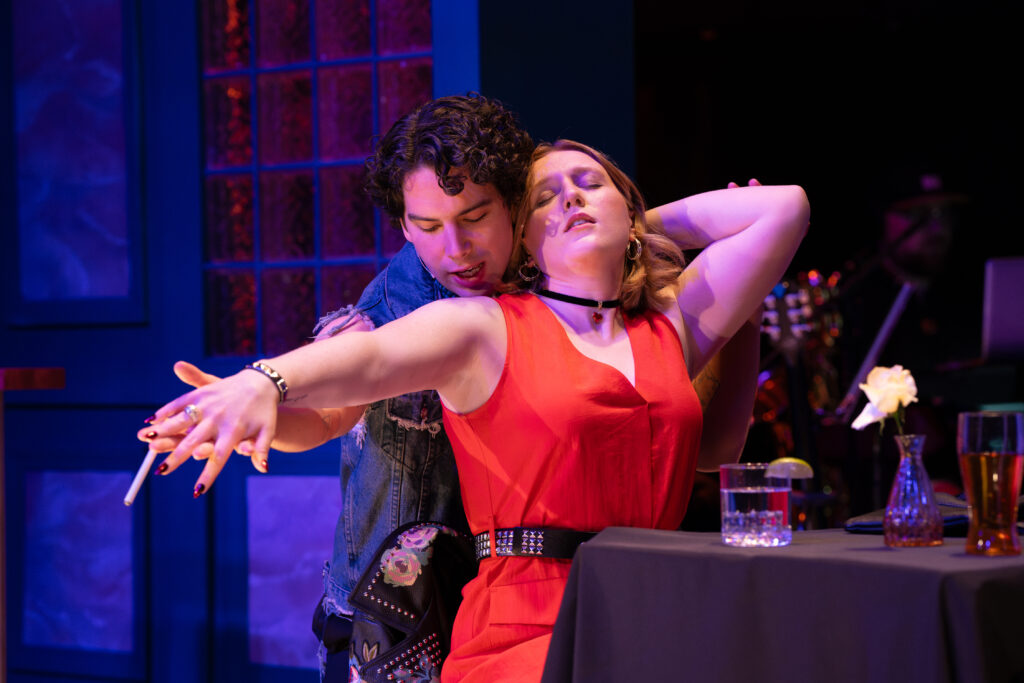
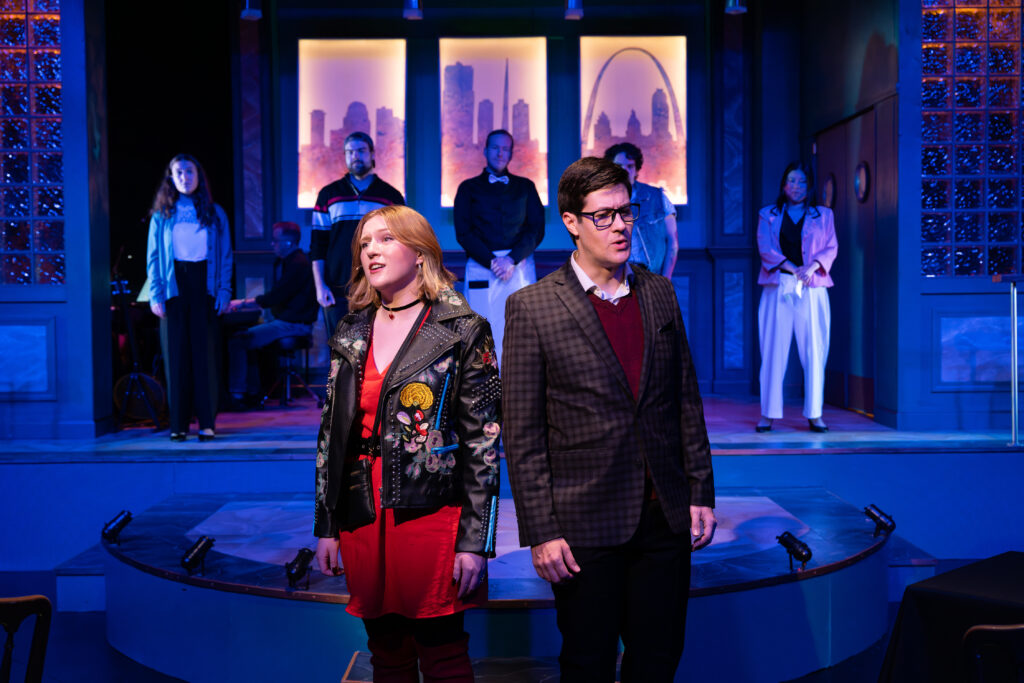
One of the show’s highlights is the costume design by Abby Pastorello, who either found or made embroidered denim jackets and shirts to give a unique flair to Clara’s original designs. Those outfits were a bright addition to an otherwise scruffy group wearing band T-shirts and casual attire. In contrast were fashionista Clara’s well-put together looks, especially a bedazzled black leather ensemble that Wilkinson rocked.

This show has a shaggy charm, not unlike Lin-Manuel Miranda’s early one-act endeavor “21 Chump Street,” but on the off-the-charts inspiring meter, it lags behind “tick, tick…Boom!” “Dreamgirls,” “Beautiful: the Carole King Musical,” and many others as a whole package.

Of course, this is on a much smaller scale, and targeted to tug at your heart strings. It is a labor of love for all involved.

In recent years, Tesseract has taken more risks with musical premieres, such as “The Mad Ones,” “Ordinary Days,” and the upcoming original “Cascade’s Fire,” and tackled big shoes with “Kinky Boots” and “The Last Five Years.” Their ambitious drive is refreshing.

Hopefully, the technical director Kevin Sallwasser can get the glitches worked out this week before the show returns. The production already has a first-rate cast that it showcases fervently.

(As an aside, many a show presented in the smaller Grand Center venues has been known to have sound issues, aka at The .Zack and The Grandel. If these venues encourage stage productions, doesn’t it behoove the facilities’ powers-at-be to upgrade sound technology? We critics are beginning to sound like broken records.)

Victoria Pines as the Conductor, surrounded by the ensemble. Photo by Florence Flick.

Tesseract Theatre Company presents “My Heart Says Go” July 11 – July 21, as part of its Summer Festival of New Musicals at the Marcelle Theatre in Grand Center. Performances are July 11-13 and July 20 at 8 p.m., and July 14-21 at 4 p.m. For more information, visit www.tesseracttheatre.com

Facebook Comments

By Lynn Venhaus

The playwright Harold Pinter made a long and distinguished career out of confounding people with odd plays featuring weird situations, convoluted dialogue, and peculiar characters. “Old Times,” written in 1971, is his freaky, flaky waltz down memory lane that never resolves anything but builds unnerving tension. It is one of his more divisive dramas.

When Roundabout Theatre Company was in rehearsals preparing for a revival in 1984, actor Anthony Hopkins asked Pinter to explain the play’s ending. He famously responded: “I don’t know. Just do it.”

OK, then. When the playwright intends to leave us hanging, it may be hard for a theatergoer to decipher, and there are plenty of theories about what really happened in this show. The point is caring enough to be satisfied with your highly personal observation.

This play is already a tall order for even the most accomplished artists, and unfortunately, is more frustrating than fulfilling in The Midnight Company’s latest presentation.

Director Sarah Lynne Holt has framed Pinter’s familiar enclosed space setting in a stripped-down theater-in-the-round style at The Chapel, where the audience is squished into a wedge of chairs where your view of the three actors may be limited.

That’s a detriment to absorbing the highly stylized delivery of the three actors where every non sequitur, riddle, pause and selected memory is supposedly fraught with meaning. And the sound isn’t consistent either, which makes it even harder to understand the disjointed patter.

The staging is clumsy, and while I realize it’s a low-budget production, the serving of tea is awkward, and the pouring of brandy into cordial glasses, not snifters, is puzzling.

Kelly Howe, Joe Hanrahan and Colleen Backer. Photo by Joey Rumpell.

Individually engaging performers — Colleen Backer as Kate, Kelly Howe as Anna, and Joe Hanrahan as Deeley, aren’t meant to be a cohesive trio, and their distance only raises more questions, as intended.

On the surface, it appears that a husband, Deeley, and a wife, Kate, are visited by her old friend and former roommate, Anna, from their carefree single days. They live remotely by the sea while she lives in Sicily but once lived in London. Kate and Anna haven’t seen each other in 20 years.

Well, that’s the story that they seem to be sticking with, and from the start, you can tell something is off kilter. Reality is blurred and recollections are tested in a most bizarre reconnection.

Vague on purpose, Howe hints that Anna has a swinger past and can still seduce, trying to be coquettish with both Kate and her husband.

The married couple don’t find that odd, nor do they appear to be what they seem. So, what kind of a charade is exactly going on?

While Backer and Howe are two evocative actresses — and it’s important to see their facial expressions if you can position yourself to do so, even their suggestive glances and knowing looks can’t convince us of any sexual heat between each other and Deeley.

And Deeley comes across as kind of pervy with his unfiltered accounts of sexual desire, conquests and previous hook-ups with these and other women. Is Hanrahan purposely playing him as creepy? We do discover his lounge lizard past.

The characters are all supposed to be in their 40s, and clearly, Hanrahan is not, even though he doesn’t look his age.

But one aspect that supposedly distinguishes other productions is sexual tension, as in the 2015 Broadway revival starring Clive Owen, Eve Best and Kelly Reilly, where critics repeatedly mentioned it. The heat is not evident here.

While that is an elusive quality, that addition could have been crucial to the audience buying into this scenario.

The women affect British accents while Hanrahan avoided it, so that’s another point that may bother you.

Pinter teases that there is something darker afoot. But the information is slim about their quirky characters the more the play goes on. Kate, who barely speaks, finally blurts out that she remembers her roommate being dead. Say what?

They may all be alive or dead, they all might be figments of someone’s imagination, and the way they reminisce about the past may be total fiction. Emotions are guarded and the characters don’t say what they mean. You wanted Pinteresque, and you got it.

If you are fascinated by his maddening style of doling out clues and pieces of information that may or may not wind up germane to the story, then you’ll invest the time to solve the puzzle.

If you are irritated by his overuse of pauses, or if you lack the patience to be convinced of anything not spelled out, then this material will let you down. It’s all in your perceptions.

Hailed as one of the most influential writers of the 20th century, Pinter won the Nobel Prize for Literature in 2005, and is famous for “The Birthday Party,” “The Homecoming,” “Betrayal” and “The Caretaker.” He died at age 78 in 2008.

He tended to concentrate on isolation, fear and troubled personal relationships, creating an elliptical dialogue. He also liked to confuse time and space. Frequent descriptions of his work – unpredictable, unspecific, and combative – are apt.

Another choice is that Holt does little to guide the audience in a certain way, preferring to keep everyone guessing and debating afterwards instead. But according to the press release, she didn’t want to make it easy for people to agree on what happened.

The Emperor’s New Clothes or brilliant 20th century mind at work? You say subtle, I say pretentious.

I don’t find this material a good fit for the strengths of the award-winning veteran performers. They can, and have done, so much better. I usually enjoy watching them on stage, but Pinter’s obtuseness can only carry a show so far, especially when you feel disengaged.

The clock is ticking, and the play lasts 1 hour and 35 minutes with one intermission. Fatigue sets in when you realize they aren’t really saying much – and won’t.

I am pretty sure no two people who see “Old Times” will agree on interpretations, and then again, there’s no one right answer.

The trick is caring. The murkiness is troubling, and if you are OK without a satisfactory resolution, that’s your prerogative.

The Midnight Company presents “Old Times” July 11-27 at The Chapel, 6238 Alexander, with performances Thursdays through Saturdays at 8 p.m., and Sunday matinees July 14 and 21 at 2 p.m. Tickets can be reserved at MetroTix.com. For more information, visit www.midnightcompany.com

Facebook Comments

By Lynn Venhaus
A walrus and a manatee walk into a polar bear’s bar that’s a comical rant. There is trouble in paradise between Adam, Eve, God and Satan. A mother and a daughter square off, a coach and a parent exchange words, and a married couple share their rocky heart-tugging journey.

A range from savvy farce to poignant drama, this year’s 10th annual LaBute New Theater Festival’s line-up stresses shared humanity in five strong complete-thought one-act plays that press different emotional buttons.

Every year since 2013 – when live theater could be presented, St. Louis Actors’ Studio has collaborated with playwright, screenwriter and film and theater director Neil LaBute to support new works from across the country.

LaBute not only lends his name, but he is part of a 10-member panel that selects the plays from a vast number of submissions, often emerging voices. The company provides the resources for local presentations.

In years’ past, selections have included some edgier and esoteric works, but this current slate is as relatable as it is affecting – and still in a thought-provoking way.

However, typical topics like politics, the state of the world or a dystopian future are not on this roster.

It may not be intentional, but I detected a unifying theme between the five — wrestling with demons and doubts, and addressing elephants in the room, all in compelling contemporary presentations. After all, there is more commonality than differences among us, as the arts frequently point out.

Lorelei Frank, Greg Hunsaker and Tyler Crandall in “Grief & Woe.” Photo by Patrick Huber.

All five are particularly suited for The Gaslight Theatre’s black box stage intimacy, and in keeping with the festival’s rules, plays can only have up to four characters.

LaBute contributes a world premiere one-act every year. This year’s original presents a view askew of sports at young levels. Although not specified, I surmised it was a summer squad aka “Little Leagues” or those between school leagues, like American Legion and ‘select’ teams.

Called “Who’s on First?”, this uncomfortable exchange between a baseball coach and the parent of a player whose skills are lacking is entirely plausible.

A rueful commentary on how we got here, LaBute’s razor-sharp rhythmic dialogue is superbly delivered by Chuck Winning as the coach (Abbott!) and Anthony Wininger (Costello!) as the father.

As they painstakingly reveal motivations, they re-affirm the present-day stakes matter-of-factly. The scene, which opens the second act after a 15-minute intermission, takes place in a dugout, and is shrewdly directed by Kristi Gunther, the current production manager at St. Louis Actors’ Studio.

She and Spencer Sickmann, a veteran performer who took a couple years off for a personal-life break, has returned to tag-team directing this program.

Previously, he had acted in two earlier new theater festivals, and in leading roles in LaBute’s “Comfort,” St. Louis native Beau Willimon’s “Farragut North,” and St. Louisan Cory Finley’s “The Feast,” among others.

Hunsaker, Anthony Wininger and Crandall. Photo by Patrick Huber.

Gunther assuredly guided two conflict pieces – a wacky one that escalated, called “Walrus,” and a somber two-hander that came to a resolution, in “Cage.”

Sickmann perceptively helmed the opening kick-off, a bracing battle of the sexes featuring a fractured relationship between the first man and first wife, Adam and Eve. Quick-witted dialogue by playwright Paul Bowman of New Albany, Ind., makes “Grief & Woe” an interestingly observed relationship study, interrupted by God’s rules and Lucifer’s interference.

The Garden of Eden resembles a battleground like “Men are from Mars; Women are from Venus.” The not-so-happy bickering couple is tested by a seductive, slithery serpent, ‘just call me Lou,’ played slyly by Winning, affecting a devil-may-care attitude and dominating the stage.

A benevolent but exasperated “Mr. G” is humorously fleshed out by Greg Hunsaker as a cross between a Borscht Belt comedian – think “Your Show of Shows” sketch – and a ‘60s sitcom boss.

It’s a clever albeit lighthearted scenario, with impressive new-to-Gaslight-stage Tyler Crandall as an inattentive Adam and Lorelei Frank as a frustrated Eve

The festival is usually modestly presented, with simple, functional staging by set designer Patrick Huber, who also astutely augments each scene as lighting designer. With distinctive outfits and props, production values are elevated this year by costume designer Abby Pastorello’s outstanding choices and Emma Glose’s props.

Pastorello’s slick attire for Winning as “Lou” is a sensational assortment of pieces including a shiny carnival barker’s jacket, brocade vest, lime green shoes and a gold-plated leaf barrette for his deceptive wig.

To easily alter appearances of actors comically portraying North Pole wildlife in the act-one closer, “Walrus,” she chose whimsical noses, ears and ‘hands’ so that it’s obvious Wininger is an obnoxious blowhard walrus, Crandall is the more agreeable, timid manatee and Hunsaker is the no-nonsense proprietor of the drinking establishment where they regale each other with tales of life in arctic waters.

Gunther directed as if they could be super-fans knocking back a drink in a Chicago sports bar, and the trio has fun with the goofy premise. The cagey play was written by Brandt Adams of Brooklyn, N.Y.

A complicated relationship between a mother and daughter is depicted in an argumentative “Cage” by Barbara Blatner of New York. The pair, deftly played by Jane Paradise (Bobby) and Frank (George), must consider the other person’s pain and come to an understanding.

Using the miserable girl bringing home a wild snake as a pet, it’s a metaphor about the things that hold us back and move us forward, and the women strike the right tone.

Hunsaker and Jane Paradise. Photo by Patrick Huber.

In one of the saddest and hardest-hitting one-acts ever presented, “Love in the Time of Nothing” chronicles a marriage from courtship through loss, as a couple grapples with the husband’s early-onset Alzheimer’s Disease.

Playwright Jayne Hannah of North Providence, R.I., accurately reflects the rollercoaster life after a dementia diagnosis changes everything for a husband in his 50s and a wife in her 40s.

If you have family experience with this disease, you will recognize all the symptoms, treatments, roadblocks, and the heartbreaking decline of a once-vibrant mind and the unrelenting burden placed on caretakers.

Hunsaker, as David, and Paradise, as Julieanna, masterfully interpret Hannah’s literate and lyrical prose, conveying the ecstasy and agony of a serious commitment.

These parts are demanding of the actors, and their proficiency makes an impact. This one lingers, and it was a wise choice for the finale. Sickmann presents both the hope of good times and the tragic realization of never-ending sad times with inevitable anguish.

This year’s festival is smoothly executed, intellectually nourishing and engaging in unexpected ways. The best part, besides being a splendid showcase for high-caliber performers, is that it surprises with its empathy.

The needle drops are particularly affecting, so kudos to whoever selected the music. Pastorello also effectively managed wigs, hair and makeup.

Special shout-outs to stage manager Amy J. Paige and her assistant Collin Brinkley for their unflagging efforts to keeping the pace from sagging, and their ninja staff for quick set changes.

To celebrate a decade of this fruitful collaboration, STLAS has published a book, “Unlikely Japan and Other Plays: Ten One-Acts from Ten Years of the LaBute New Theater Festival,” that features ten pieces by LaBute that were created and staged exclusively by STLAS at The Gaslight, 59E59 Street and Davenport Theaters.

The book is currently available on Amazon and can be ordered directly from St. Louis Actors’ Studio. It is also available at the box office during this show’s run.

Frank and Paradise. Photo by Patrick Huber.

St. Louis Actors’ Studio presents the 10th annual LaBute New Theater Festival July 12 to 28, with performances at 8 p.m. Thursday through Saturday and at 3 p.m. on Sundays for July 18-21 and July 25-28, but only Friday-Sunday July 12-14 at The Gaslight Theater on North Boyle in the Central West End. For more information: www.stlas.org

General admission tickets are available via Ticketmaster or at the theater box office one hour before show time. For more information, visit stlas.org or email [email protected].

A playwright reception will be held on July 19 to celebrate the artists’ work, giving patrons an opportunity to learn and understand the stories they’ve just digested.

Facebook Comments

By Lynn Venhaus

When the Muny teams up with visionary director John Tartaglia, they create a magical world, and it always takes us to a happy place.

Enamored by only a few chords of “The Little Mermaid” score’s breezy calypso music, the luscious blue green turquoise palette of scenic designer Ann Beyersdorfer’s dazzling seascape and video designer Katherine Freer’s vibrant underwater kingdom teeming with marine life, and we’re eager to dive into this glistening fairy tale fantasia.

With his track record of infusing shows with whimsy and wonder, one expects Tartaglia to achieve new heights for the Muny’s third presentation of Disney’s cherished musical – and wow does he.

Imaginatively staged and seamlessly incorporating all the wizardry available – including innovative use of puppetry from revered Puppet Kitchen International, with designs by Eric Wright, and stunning aerials by ZFX, Hans Christian Andersen’s fish-out-of-water romance enchants in exciting new ways.

If you took away the bells and whistles, this Douglas Wright book adaptation of the Dane’s 1837 short story would still tug on your heartstrings, because stripped down, it is ultimately about families giving each other the greatest gifts –roots and wings.

Rich Pisarkiewicz (left) and Michael Maliakel in the 2024 Muny production of Disney’s “The Little Mermaid.” Photo by Phillip Hamer

Headstrong Ariel has an insatiable wanderlust, as does Prince Eric, whose zest for adventure pulls him away from his birthright. They disobey to chart their own course, and that comes with risks. She rescues him from drowning, and that remarkable visualization involving flying apparatus is thrilling.

All Disney princes and princesses yearn – and these restless royals must triumph. (And Michael Maliakel knows about being a hero — he played “Aladdin” for three years on Broadway.) The handsome heir is bewitched by the mermaid’s beautiful voice, and the spunky teen falls hard for a forbidden but enticing human world.

With their appealing ardor, Savy Brown and Maliakel are adorable as the made-for-each-other pair. Both have lush voices, and they convey their longing through his fervent renditions of “Her Voice” and “One Step Closer” and her luxe delivery of the iconic “Part of Your World” plus the engaging opener “The World Above.”

The classic true love’s kiss trope is significant because it will break dastardly Ursula the Sea Witch’s curse, so that Ariel can keep her voice and become human. And there isn’t a more intoxicating love song than “Kiss the Girl,” especially with the moonlit romantic mood achieved in the second act.

Ever since lyricist Howard Ashman and composer Alan Menken wrote the game-changing music for the 1989 animated film, generally regarded as the property that resuscitated Disney’s reputation and ushered in the studio’s creative renaissance of the 1990s, “The Little Mermaid” has endured as a beloved pop culture fixture.

Books, videos, merchandise, the stage musical in 2007, and a live-action remake film in 2023 continue to entertain fans around the world.

From left: Adam Fane, Nicole Parker and Kennedy Kanagawa in the 2024 Muny production of Disney’s “The Little Mermaid.” Photo by Phillip Hamer

The Muny presented this wildly popular Disney title in 2011 and 2017, and costume designer Robin L. McGee is back from the latter’s creative team seven years later to put a fresh spin on a wide range of colorful outfits.

In a pivotal scene, an iridescent seafoam green dress makes Ariel even more radiant, and in a sixth-time collaboration with Puppet Kitchen International, Ursula’s octopus tentacles (real guys inside) remain a marvel in motion.

Tartaglia has opted for the villain to be more cartoonish rather than menacing, and newcomer Nicole Parker is campy, wears garish makeup, and alternates between exaggerated cackling and screeching as the slinky wicked witch.

Gearing it towards a younger audience, the director made it less dark, although “Poor Unfortunate Souls” makes her intentions clear, and “Daddy’s Little Girl,” alongside her henchmen, oozes spite.

Her electric eel minions, Flotsam and Jetsam, are also softened. Kennedy Kanagawa and Adam Fane are nimble in their slithery headdresses and eerie in their numbers, especially “Sweet Child.”

The three standout comical characters — confidante fish Flounder, silly seagull Scuttle and skittish sidekick Sebastian the crab – ingratiated themselves quickly with the audience.

From left: Leia Rhiannon Yogi, Jen Cody and Savy Jackson in the 2024 Muny production of Disney’s “The Little Mermaid.” Photo by Phillip Hamer

Leia Rhiannon Yogi is a cheerful Flounder, demonstrating her dexterity with the bright-hued puppet, while the sublime Fergie L. Philippe, so memorable as Emmett in “Legally Blonde” two summers ago, steals every scene he is in as the lovable calypso-singing crustacean.

He joyously leads the vivacious super-sized spectacle, “Under the Sea,” complete with swirling sea creatures including jellyfish, swimming turtles and Pufferfish. The Oscar-winning Best Song is arguably the show’s best number on the gigantic stage.

Muny fan favorites Jen Cody, Ben Davis and Christopher Sieber each bring their own distinct interpretation to their integral supporting roles.

A limber comedienne, Cody does backflips and handsprings as firecracker Scuttle, mangling English and denoting her crisp comic timing. She blithely leads a rollicking “Positoovity” and “Positaggity.” She has previously delighted audiences as the grandma in “The Addams Family,” Elizabeth in “Young Frankenstein” and stripper Tessie Tura in “Gypsy,” among other amusing roles.

Natural leading man Davis, last seen in his virtuoso St. Louis Theater Circle Award-winning performance as “Sweeney Todd,” is an imposing regal – and buff – King Triton, who must put aside his prejudices and doubts for his daughter’s happiness.

He brings necessary gravitas to the role, although the glow-in-the-dark scepter seems cumbersome at times. His rich baritone is such a pleasure, and he imbues his song “If Only (Triton’s Lament)” with real emotional heft. The reprise with the quartet of Ariel, Eric, Sebastian and Triton is quite lovely.

Christopher Sieber in the 2024 Muny production of Disney’s “The Little Mermaid.” Photo by Emily Santel

Christopher Sieber, who was a terrific Daddy Warbucks in the charming “Annie” directed by Tartaglia in 2018, has fun being over-the-top as the fussy French Chef Louis in his signature number “Les Poissons.”

The actor has been nominated for the Tony Award twice, as the original Lord Farquaad in “Shrek the Musical” (Fun fact: Tartaglia was Pinocchio) and Sir Dennis Galahad in “Spamalot” (More fun facts: Ben Davis played Galahad in the 2013 Muny production, and both Sieber and Davis were in the Muny’s 2017 “Jesus Christ Superstar,” with Sieber as King Herod and Davis Pontius Pilate).

Versatile veteran actor Rich Pisarkiewicz gets an opportunity to shine in a role well-suited to his talents – Prince Eric’s loyal guardian Grimsby. He is in his 44th season at the Muny, and this is his 87th show.

Some of the creative team worked with Tartaglia on last year’s extraordinary “Disney’s Beauty and the Beast,” including McGee, Beyersdorfer, lighting designer Jason Lyons, wig designer Ashley Rae Callahan, sound designers John Shivers and David Patridge, and ebullient choreographer Patrick O’Neill. His movements reflect people moving as if in water.

Tartaglia’s background includes puppetry with Jim Henson on “Sesame Street,” and is back working on “Fraggle Rock” on Disney Plus these days. His artistry is obvious, and this joins his other unique Muny productions “Mary Poppins,” “Matilda,” “The Wizard of Oz,” and “Tarzan” in recent years as examples of his unmistakable playfulness and indomitable spirit. He kept the tempo lively and brisk.

Savy Jackson and Ben Davis in the 2024 Muny production of Disney’s “The Little Mermaid.” Photo by Phillip Hamer

Music Director Michael Horsley’s elegance is noteworthy too. The hummable tunes and featured personalities keep us interested, easily earning smiles on a summer night from lots of families in attendance.

The creative artists’ inspired flourishes refreshed this chestnut, with the most striking aspect the constantly moving aquatic tableau – Beyersdorfer’s neon-splashed set, Freer’s mesmerizing video, Lyons’ sumptuous illuminations, McGee’s striking looks, Wright’s original puppets, O’Neill’s dance steps and the belief that the whole team could produce the impossible.

Everyone involved brought the best parts of themselves to this project, and its splendor shines brightly.

The Muny presents “Disney’s The Little Mermaid” July 8 through July 16 nightly at 8:15 p.m. on the outdoor stage in Forest Park. The runtime is nearly 2 hours and 20 minutes, including one 15-minute intermission. Tickets are available at muny.org, by calling MetroTix at (314) 534-1111 or in person at the Muny Box Office, 9 a.m.-9 p.m. daily.

Fergie L. Philippe and Jen Cody in the 2024 Muny production of Disney’s “The Little Mermaid.” Photo by Phillip Hamer
Facebook Comments

By Lynn Venhaus

Bursting with style and verve, director Ti West’s “MaXXXine” features yet another outstanding Mia Goth performance, but sacrifices heart in its unwieldy embrace of the past.

Taking place in 1985, West’s film continues the story of Maxine Minx (Goth), the sole survivor of the horrific massacre detailed in the 1979-set “X,” in which octogenarian psycho-killer Pearl (also played by Goth) and her husband Howard (Stephen Ure) murdered the cast and crew of a pornagraphic film shooting on their Texas farm.

Having fled the scene before police arrived, and after squashing Pearl’s head like a pumpkin under the wheel of a pickup truck, Maxine is now trying to make a name for herself in Hollywood, an epicenter of the Satanic Panic. She’s built a robust career in the adult film industry, distancing herself as much as possible from the Texas bloodbath and her televangelist father. 

Tough, hardened, and almost scarily determined, Maxine works ‘round the clock to pay the bills and make a name for herself, rushing from strip clubs to porn shoots to downtown peep shows in her white, vanity-plated convertible. Ultimately, Maxine seeks mainstream stardom, and when we first meet her, she’s crushing an audition for a lead role in an upcoming horror film called “The Puritan II,” helmed by no-nonsense director Elizabeth Bender (Elizabeth Debicki).

It’s not getting the part that’s the challenge, though; it’s keeping it, as Maxine’s friends and co-workers start dying grotesque deaths, possibly at the hand of the Night Stalker, who led a very-real reign of terror over LA. The situation is further complicated by the arrival of gold-toothed private eye John Labat (Kevin Bacon), who seemingly works for the killer and threatens to unearth Maxine’s traumatic history, as well two local cops (Michelle Monaghan and Bobby Cannavale) who grow increasingly suspicious about Maxine’s involvement in the murders. 

Maxine wants to leave it all behind and pursue her dreams, but she can only outrun her past for so long. Eventually, she must confront it head on, fighting to transform into the Star she’s yearned to become, no matter the cost.

Indeed, “MaXXXine” is a vastly different film from its predecessors, eschewing the ‘70s grittiness of “X” and the technicolor nightmare of “Pearl” to pay tribute to the Video Nasty era of the 1980s, leaning into B-movie tropes. For no matter how engaging “MaXXXine” is in the moment — with immersive scene-setting and plenty of memorable kills — it becomes a disappointingly emotionless experience. 

Its numerous threads (each potentially compelling on their own) aren’t given time to breathe or leave a lasting impact. But there’s still an irresistible quality to “MaXXXine” that grows upon further reflection. West’s film is fully committed to its influences, and it takes big swings that, if only intermittently successful, are always interestingly flawed.

Goth gives a typically excellent performance, portraying Maxine as a damaged, fiercely determined anti-hero who wants to leave her trauma behind and carve a bloody new path for herself in the name of pure ambition. There’s little doubt that West and Goth want us to root for Maxine despite her actions (like a run-in with a Buster Keaton look alike that gives new meaning to the name). Goth commands her scenes brilliantly, dishing out her own type of gory empowerment.

The film rarely slows down to let Maxine, or viewers, reflect on all that’s happened, though. And perhaps that’s intentional, as Maxine fears her own memory. Her PTSD pops to the surface in the brief moments when the chaos of her daily life subsides, and she fights to push it down.

West’s approach also reflects a broader issue with “MaXXXine,” however. It’s missing the heart of “X” and, especially, “Pearl,” which were willing to take their foot off the gas to let viewers sit with the characters and help flesh them out beyond their familiar archetypes.

Scenes like Brittany Snow’s rendition of Fleetwood Mac’s “Landslide” in “X” – with a split-screen contrasting the group’s youthful exuberance with the tragedy of Pearl’s missed opportunities —  or Goth’s long-take, confessional monologue in “Pearl,” help humanize these characters, breaking conventions to give unexpected emotional weight to outcomes we know will happen anyway. 

“MaXXXine” has a couple of those instances, but they’re positioned within a film that’s content to dazzle rather than provoke deeper thought, rushing along to the next kill or reveal without letting these scenes breathe. West surrounds our anti-hero with disposable characters of varying morality and sends us down a predictable rabbit hole of carnage that’s strangely empty, but never boring. 

Much of the film’s fun is due to its maximalist style, which echoes the work of Brian de Palma and the giallo genre, with Eliot Rockett’s cinematography drenching scenes in neon hues and creating a tactile grunginess that practically emanates from the screen, supported by a punchy soundtrack, authentic production design, and tongue-in-cheek dialogue that (mostly) fits the lurid, cartoonish rhythms.

The film’s cinematic references are usually amusing, but sometimes little more than novelty, such as multiple visits to the set of “Psycho” that may or may not allude to some sort of meta-commentary.

Supporting players like Bacon and Debicki bring lively energy to their characters, with Bacon appropriately sleazing it up and Debicki depicting her director as someone who’s had to sacrifice much to get to where she is.

Debicki delivers some of the film’s most heavy-handed dialogue – making a “B-movie with A material,” as Elizabeth puts it – but her character maintains a compelling dynamic with Maxine, whose present-day goals keep getting hijacked by figures and memories from her past. 

Giancarlo Esposito steals scenes as Maxine’s sketchy “entertainment lawyer” willing to go to extreme lengths to help his clients. Moses Sumney, as Maxine’s friend who runs a video store beneath her apartment, does what he can with a rather thankless role, while Monaghan and Cannavale are only fitfully effective with their good cop/bad cop schtick.

Lily Collins is sadly underutilized as a darkly funny star of the first “Puritan” film, while Halsey, as one of Maxine’s co-stars, with a bizarre accent to boot, is thankfully only around for a scene or two.

Maxine herself is the real star of the show, which she would be happy with. But by oversimplifying the world around her, West makes the moral gray area that made “X” and “Pearl” so exciting practically non-existent here, following through on its predecessors’ themes in unsurprising ways.

The mystery of who’s behind the killings in “MaXXXine” is also eye-rollingly predictable. West hits us over the head with messages regarding societal attitudes towards sex and violence that come across as more in-your-face than involving, complete with a conclusion that goes wildly off the rails and doesn’t feel entirely earned. 

Despite all this, “MaXXXine” is still highly entertaining thanks to its direction and Goth’s performance. It’s just an uncharacteristic letdown from West, who presents us with a B movie with B ideas, and an enjoyable albeit undercooked conclusion to his otherwise fantastic trilogy.

“MaXXXine” is a 2024 horror film directed by Ti West and starring Mia Goth, Elizabeth Debicki, Kevin Bacon, Giancarlo Esposito, Bobby Cannavale, Michelle Monaghan, Moses Sumney, Halsey, Lily Collins, and Simon Prast. It is rated R for strong violence, gore, sexual content, graphic nudity, language and drug use, and has a 1 hour, 44-minute runtime. It opened in theatres July 5. Alex’s Grade: B.

Facebook Comments

By Lynn Venhaus

A stylish nostalgic romantic comedy-drama that vividly recalls the high-stakes of America’s Space Race with the Russians, “Fly Me to the Moon” is a rare summer movie that is as charming as it is smart.

Specifically set during NASA’s bold Apollo 11 drive, director Greg Berlanti meticulously recreates the historic mission, while focusing on two very different points of view in a light-hearted way.

It’s a pivotal time in 1969. Marketing maven Kelly Jones (Scarlett Johansson), who was brought in to fix NASA’s public image, wreaks havoc on launch director Cole Davis’s (Channing Tatum) singular, serious focus – the already difficult task of putting a man on the moon. When the White House deems the mission too important to fail, Jones is directed to stage a fake moon landing as backup.

Those of us alive then know what really happened on July 20, 1969, when an estimated 650 million people tuned in to the three broadcast networks to watch Neil Armstrong take his first steps on the moon (94% of all Americans watching television!).

It’s presented in thrilling footage here, and to watch CBS’s most-watched Walter Cronkite react again brought a tear to my eye and a lump in my throat. I hope the movie has broader appeal than just us NASA nerds and Baby Boomers who paid attention to every exciting detail when the astronauts were like rock stars, but it really hits our sweet spot.

(My second-grade teacher hauled in a TV so we could watch John Glenn’s Friendship 7 launch into orbit on Feb. 20, 1962). The constants in the 1960s news cycle were the Vietnam War, civil rights protests, and the space race, which inspired people to dream the impossible at a time of great turbulence.

Rose Gilroy’s clever script, with story by Keenan Flynn and Bill Kirstein, smartly builds tension. A subplot that shifts the stakes pokes fun at the fake staging rumor that caught fire like so many conspiracy theories of the 1970s — and there’s even a couple Stanley Kubrick jokes, as he was linked to have filmed the hoax.

Only the twist here is that then-President Nixon is so worried about America’s image in the world if the mission fails that he directs a super-secret Project Artemis as a back-up plan. His shady government operative, Moe Berkus, is played by Woody Harrelson as an unflappable enforcer. Given Tricky Dick’s reputation, this fraud scenario doesn’t seem too far-fetched.

Adding plenty of heat are Channing Tatum and Scarlett Johansson in an opposites-attract romance that feels like an homage to the 1960s flirty wholesome fun comedies that often starred Doris Day, Natalie Wood, James Garner and Rock Hudson.

Tatum is well-suited to play Cole Davis, a decorated pilot turned dedicated NASA launch director, with a heart-tugging backstory, and Johansson blithely embodies a slick marketing specialist tasked with getting America moonstruck. She’s a throwback to the “Mad Men” advertising heyday depiction, with some baggage of her own as well.

You can either be cynical about the retro cliches or embrace its old-fashioned breeziness. The performers are engaging, and their glibness produces sparks.

The captivating vintage vibe, down to the Tang promotions, sunshiny Florida setting, and pocket-protector engineer outfits, is presented with flair by production designer Shane Valentino, art director Lauren Rosenbloom, and costume designer Mary Zophres. Her kicky selections for Johansson are particularly fetching, and some of her choices for Tatum make him look like Captain Kirk.

They immerse you into a bygone time and place in much the same way as Tom Hanks’ feel-good ‘60s rock band comedy “That Thing You Do!” did in 1996. Composer Daniel Pemberton’s score elevates the atmosphere, and his needle drops of ‘60s hits and moon-themed songs enhance this experience.

The chipper supporting cast includes Ray Romano as Henry Smalls, a NASA stalwart who is closest to Cole, Lisa Garcia as Kelly’s assistant, and Noah Robbins and Donald Elise Watkins as dorky but enterprising engineers.

Jim Rash steals his scenes as a very flamboyant and temperamental director brought in for the deception footage. And Johansson’s real-life husband Colin Jost makes an appearance as one of the senators who needs convincing for funding.

The movie honors the 400,000 NASA workers who helped make going to the moon a reality. Sure, the movie could have been a tad shorter, but it touched upon everything it needed to combine the true story with the comedic fictional account.

This crowd-pleaser takes flight evoking an era where, despite a divided union, we could come together as Americans and celebrate our best and brightest, the dreams we could achieve. I don’t recall a more patriotic moment in my life in the late 20th century, with the 1980 USA hockey team “Miracle on Ice” a close second.

Fueled by magnetic star power, “Fly Me to the Moon” is a delightful summer trifle with a surprising emotional center.

“Fly Me to the Moon” is a 2024 comedy-drama directed by Greg Berlanti and starring Scarlett Johansson, Channing Tatum, Ray Romano, Jim Rash, Lisa Garcia, and Woody Harrelson. It is rated PG-13 for some strong language, and smoking, and the run time is 2 hours, 12 minutes. It opened in theatres July 12. Lynn’s Grade: A

Facebook Comments