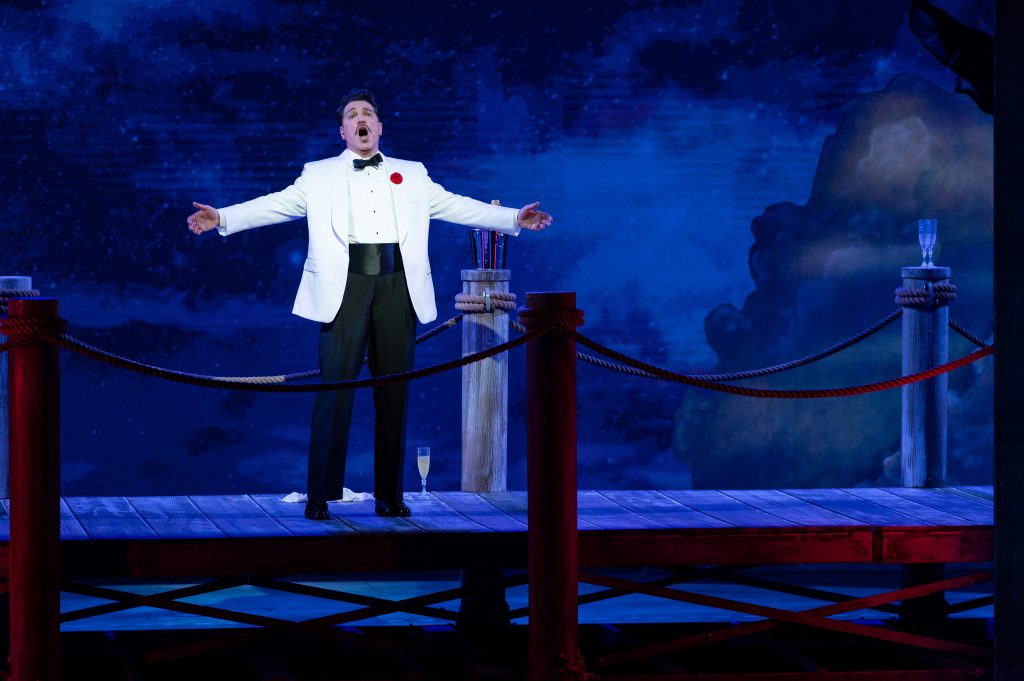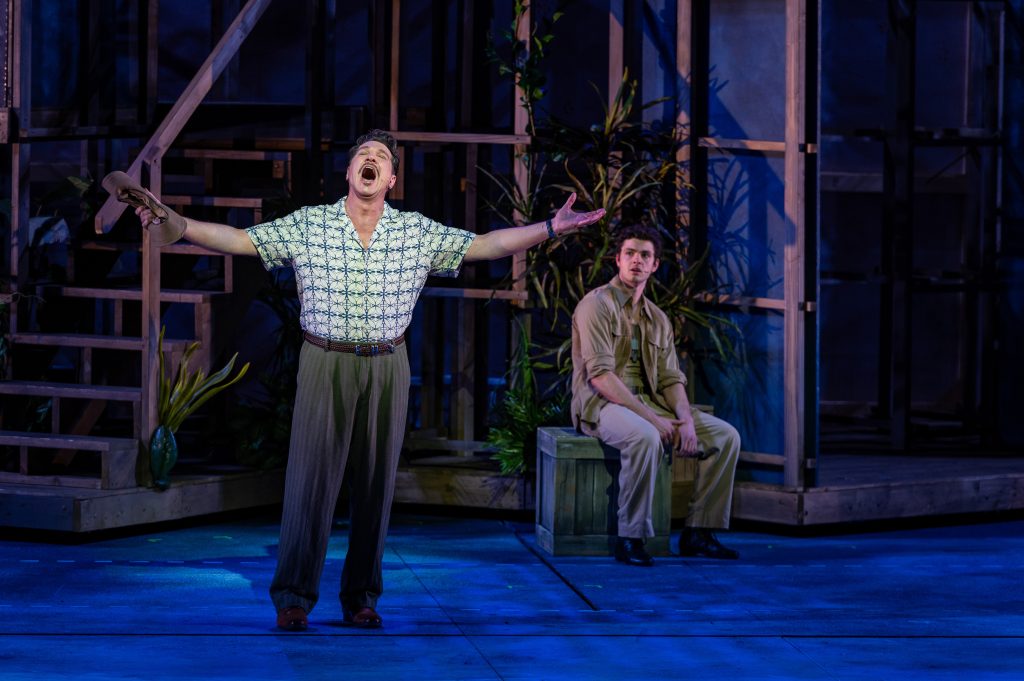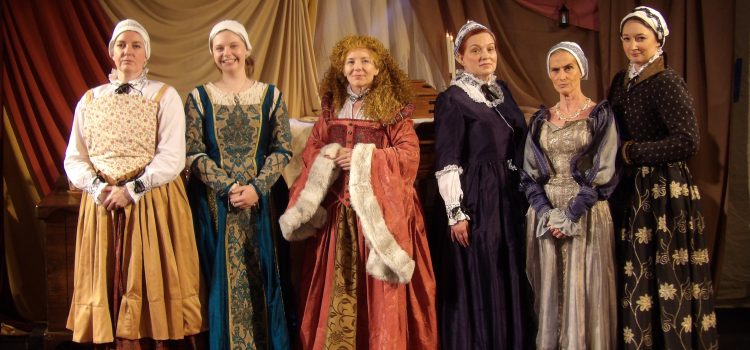

By Lynn Venhaus

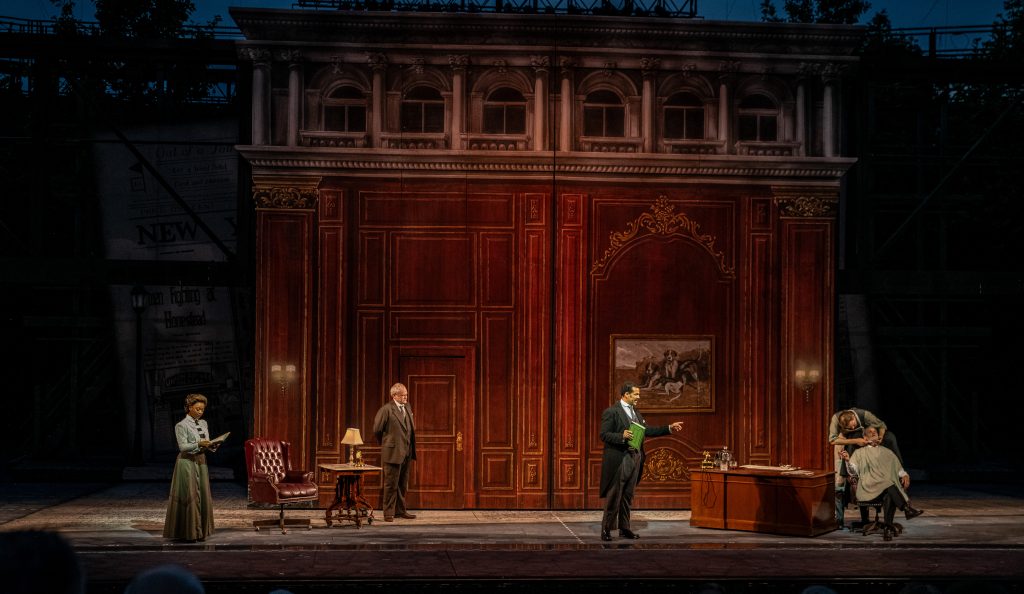
With every door creak, candle flicker, wind moan, and eerie shadow glimpse, “The Woman in Black” immerses us in a haunting and unforgettable ghost story.

The Repertory Theatre of St. Louis has impeccably presented a London West End production that will live in my head for a while, a gripping suspenseful classic Gothic fiction that is best experienced with a receptive audience.

The 1987 play earns its jump scares as an edge-of-your-seat feeling grows, building nearly unbearable tension for a pulse-pounding climax. It is an outstanding example of how our minds process strange things.

Stephen Mallatratt’s clever theatrical adaptation of Susan Hill’s 1983 mystery has engrossed audiences over 30 years. Reminiscent of Henry James’ unsettling “Turn of the Screw,” this is about a haunted house whose terror uncomfortably lurks through the ages. But that’s really only the start of horrifying consequences.

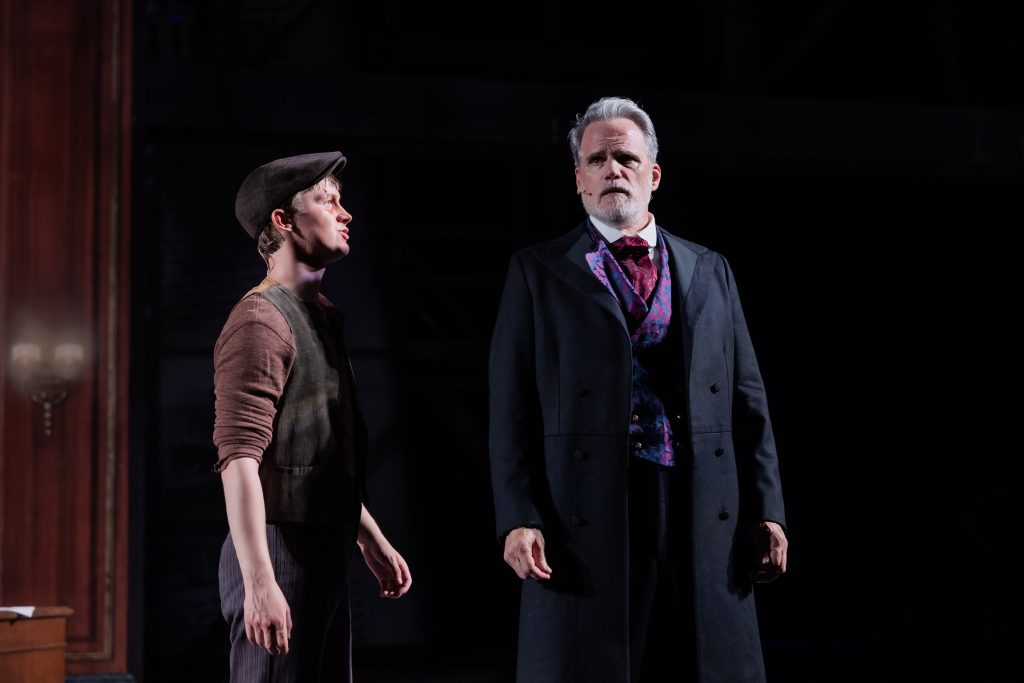
A lawyer, Arthur Kipps, has been bedeviled by a spectral figure in black for years, and to relieve his misery, he has hired a young actor to share his captivating story. He feels it must be told.

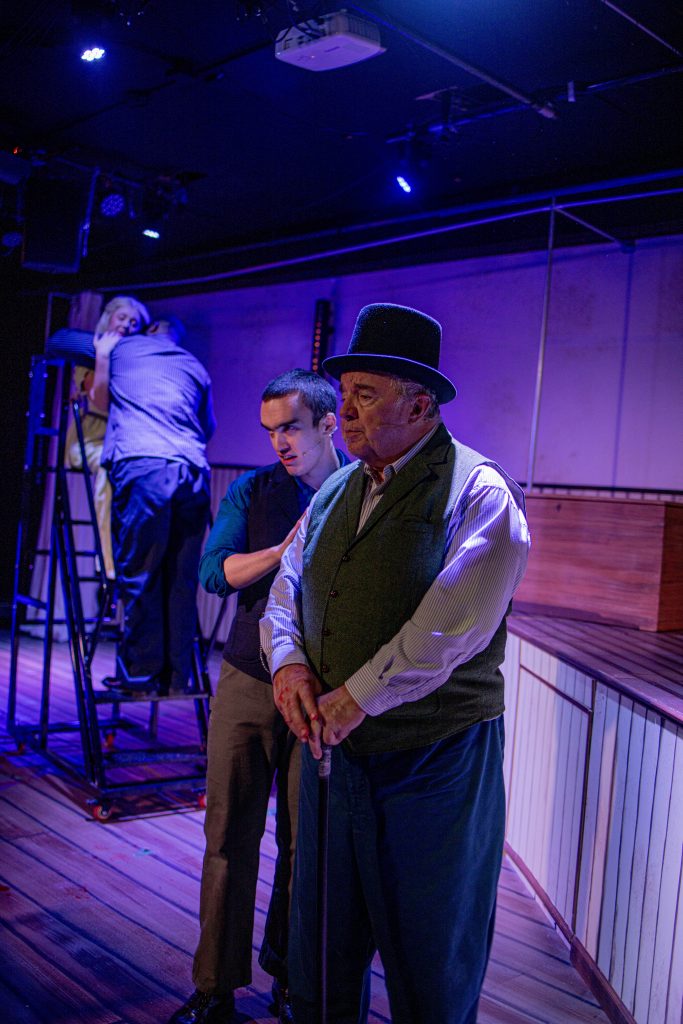
James Byng, Ben Porter. Photo by Jon Gitchoff.

While the first act is much slower as it sets up the action, the second act ramps up the shocks and scares so effectively, we are totally enthralled in mutual shivers.

Our imaginations work overtime, and that’s such a wonderful communal feeling to be bonded with total strangers (and friends and family) over our fears, waiting for the next spine-tingling moment – or gasp or scream or the occasional giggle and sigh in relief.

This chilling tale unfolds as a play within a play, and the duo becomes ensnared in a terrifying sequence of events in an isolated old house near misty marshes. David Acton, who plays the tormented Arthur Kipps, works in tandem with James Byng as “The Actor,” to convince us we should be very afraid.

Acton and Byng’s superb storytelling deliver the well-timed frights – and the welcome doses of humor. Both actors were in productions at London’s Fortune Theatre, and their interactions are flawless.

Ben Porter. Photo by Jon Gitchoff.

As a young solicitor, doing estate legal work for his firm’s clients, Kipps traveled to a remote village in northern England to sort through the documents of the deceased Alice Drablow, who owned Eel Marsh House. Byng portrays his younger self, lonely without his fiancé Stella nearby.

 He writes letters home and begins to read some of Mrs. Drablow’s alarming personal correspondence. The house’s unfortunate location means that it is cut off from the local village when the tide comes in. Kipps notices the villagers’ unwillingness to talk about the Eel Marsh House, but he does get assistance from local guys Samuel and Jerome (and an unseen dog named Spider).

One dark night, Kipps is alone with his thoughts in the creaky old house. Or is he? For the audience, the ‘flight or fight’ feeling escalates, not to mention the overwhelming atmosphere of dread. (This is the period where people were clutching others).

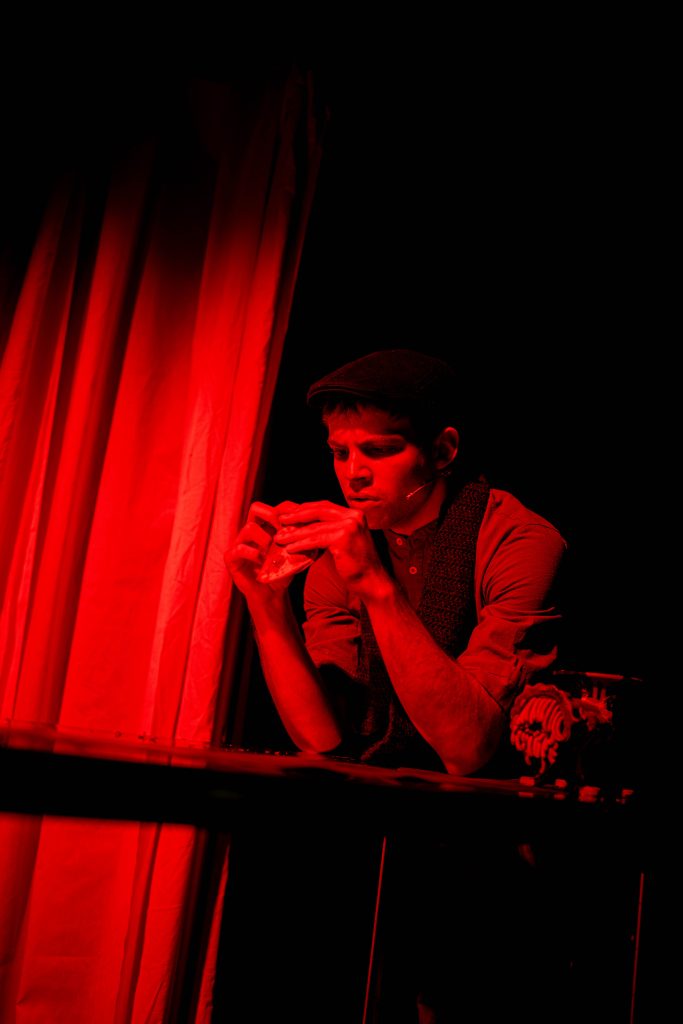
James Byng. Photo by Jon Gitchoff.

As Kipps becomes aware of another presence, whoa. It’s truly a marvel of Swiss watch timing how exemplary the presentation is.

Because of the show’s emotional heft, another actor, Ben Porter, can perform both roles in repertory, and sometimes does. He was nominated for a Drama League Award in 2020 for distinguished performance in this play.

Original director Robin Herford has seen to it that every eerie detail isn’t missed on The Rep’s thrust stage. He has worked with touring director Antony Eden, associate director Maggie Spanuello, designer Michael Holt, lighting designer Anshuman Bhatia, sound designer Sebastian Frost and vision producer Imogen Finlayson.

The masterful use of sound and lighting adds to the creepy atmosphere, enhancing the minimalist set and ensuring the horror is believable in every moment. These visions will linger.

This production is being produced in a special arrangement with PW Productions, the original West End producers. After opening in London in 1989, it was performed there until March 4, 1923, for 13,232 shows, the second longest-running non-musical in West End history, second only to Agatha Christie’s “The Mousetrap.”

James Byng, Ben Porter. Photo by Jon Gitchoff.

Pemberley Productions, a tour booking company in New York and Chicago, has produced and general managed “The Woman in Black” in North America since 1918.

The effective shadows and the unnerving scares are in the well-crafted storytelling. With its twisty tricks unveiled, the play is a thrilling treat, as satisfying as the best horror movies. It’s as if we’re all at a bonfire, mesmerized by the evil conjured up at a most entertaining evening. The execution is sensational, and the pair of actors make it a must-see spellbinding experience. I’m leaving the lights on.

The Repertory Theatre of St. Louis presents “The Woman in Black” Oct. 8 – 26 at the Loretto-Hilton Center, 130 Edgar Road, St. Louis. To purchase tickets, visit www.repstl.org or call the box office, Monday – Friday noon – 5 p.m.  at (314) 968-4925.

The play is 2 hours with a 15-minute intermission. Post-show discussions follow the Sunday, Oct. 19 and Wednesday, Oct. 22 performances.

Facebook Comments

By Lynn Venhaus

“After the Hunt” is a horrible movie about despicable people that attempts to tackle cancel culture, identity politics and a so-called female generation gap in 2019, which is strategically set during the #MeToo movement.

Ambiguous, pretentious and overlong, the psychological drama is a tedious watch because several lead characters are smug narcissistic liars who are morally bankrupt and intellectual know-it-alls.

These insufferable types are part of the insular world of Ivy League academia, in the philosophy department at Yale. Whether action is in a high-stakes classroom, a snooty Yale Club or a swanky dinner party, these caricatures are either going to pontificate or act out.

Directed by provocateur Luca Guadagnino, who is frustratingly vague about the points he’s trying to convey, meanders more than usual and boxes himself into a corner with Nora Garrett’s baffling screenplay.

Ayo Edebiri and Julia Roberts.


Apparently not a fan of political correctness, Guadagnino really does a disservice to victims of sexual abuse who deserve to be seen and heard. It’s an insult to anyone who has had the courage to come forward, at the risk of damage to their reputation. #MeToo needed to happen and should have much sooner.

While the A-list cast is given juicy, complex roles, the irredeemable parts lack connection and emotional truth.

Julia Roberts, at her most unlikable, plays haughty, viperous professor Alma Imhoff, whose fancy-schmancy lifestyle with her lapdog husband Frederik is built on secrets and lies.

Truly egregious is that Michael Stuhlbarg is wasted in an utterly ridiculous role as an attentive partner who gets little respect. Chances are odd-man-out Frederik will get fooled again, and again.

As this rotten character, Roberts doesn’t elicit one iota of sympathy. She recklessly drinks too much. She has severe abdominal pain and violent vomiting episodes, but instead of going to a doctor she abuses painkillers, which she downs by fistfuls.

Andrew Garfield and Julia Roberts.

She treats students cavalierly and acts superior to her peers. Not exactly role model material. Chloe Sevigny is also wasted as Dr. Kim Sayers in a too brief role as a psychiatric counselor that factors in to yet another subplot thread.

Alma is graduate student Maggie’s thesis advisor, and she attends her mentor’s dinner party. An inebriated Hank Gibson, a cocky professor played by Andrew Garfield, walks Maggie home.

As the star pupil, Ayo Edebiri is miscast as a character that is as nebulous as Garfield is repellent.

Later, a distraught Maggie confides in Alma that Hank, who was in her apartment for a nightcap, sexually assaulted her.

He denies it. She reports it. He’s fired and makes a lot of noise publicly. He was up for tenure, as is Alma, who has conveniently distanced herself from the situation. Or has she?

Ayo Edebiri as Maggie on the Yale campus.

It quickly gets very ugly. Maggie views it as a betrayal. Understandably, the Gen Z students rally around her. She is quite vocal in the press, while Alma becomes very vicious in response, showing a cold and calculating side to her bewildering personality.

Garfield is so off-putting as the swaggering Hank that it would be difficult to conjure up a smidgeon of sympathy over his career in tatters if that is what the film leans towards.

Don’t expect any relatability to these self-important characters. The academia snake pit comes across like an unappealing morass. These are selfish people who have such an inflated opinion of themselves that they think everything is about them.

Doesn’t it matter that Hank’s behavior is troubling and dangerous? In some sort of alternative universe, Maggie is now the subject of derision because her wealthy, influential parents are Yale’s biggest donors. Wait, what?

Is it a witch hunt? Hank’s version accuses Maggie of plagiarism. Oh, as if that’s not enough, they must unravel Alma’s past. There are too many plot points, and none satisfactorily resolved.

This supercilious debate about morality, ambition and ‘woke’ ideology fails to resonate. Is it an unwise battle between trailblazing women who broke glass ceilings and the entitled Gen Z’ers whose lives of privilege have handed them multiple gold-plated opportunities?

Contrivances abound as the plot goes in circles. Hank, longtime friend of Alma’s, perhaps had a sexual relationship with her, or did they just flirt a lot? She’d rather drink at a bar with him than go home to her psychoanalyst husband’s cassoulet.

And Maggie is purposely drawn to be unformed. She is in a relationship that lacks details. Her trans romantic partner and roommate is away when the Hank incident supposedly took place.

Cinematographer Malik Hassen Sayeed makes the hallowed halls of a prestigious university gleam with historic seriousness and the tony Imhoff home cultured and cavernous. The annoying contemporary score by Trent Reznor and Atticus Ross is uncharacteristically too obtrusive.

Chloe Sevigny and Julia Roberts.

Guadagnino is a polarizing director, with detractors saying his style is too murky on substance. His sumptuous locations look beautiful, and the films often superficially and uncomfortably deal with desire – “I Am Love,” “The Bigger Splash,” “Call Me by Your Name,” “Challengers” and “Queer.” Characters often are complicated and meant to be stimulating but lack clear identities.

A better film on this subject, an authentic one set in a college town, is “Sorry, Baby.”

What is “After the Hunt” trying to say, and why does it try too hard to get our attention when there really is no point? We are tasked with the heavy lifting of deciphering the storytelling.

After more than 2 hours, the preposterous conclusion feels like cheating, ending in a very self-indulgent way. 

The Imhoff dinner party in New Haven.

“After the Hunt” is a 2025 psychological drama directed by Luca Guadagnino and starring Julia Roberts, Andrew Garfield, Ayo Edebiri, Michael Stuhlbarg and Chloe Sevigny. It is Rated R for language and some sexual content and the run time is 2 hours, 19 minutes. Opens Oct. 17 in theatres. Lynn’s Grade: F.

Facebook Comments

By Alex McPherson

A bleak and palm-sweating look at just how profoundly screwed we all are, director Kathryn Bigelow’s “A House of Dynamite” refuses to answer its impossible questions about nuclear war, and urges reflection on the chaos and fatalism of our current fractured reality.

The film, a work of fiction that remains chillingly plausible, zeroes in on the question: What if a nuclear warhead launches from an unknown location in the Pacific for an unknown reason, and is en-route to Chicago with only 18 minutes until impact?

It’s an eventuality that many personnel in the windowless facilities of the government have been trained to deal with, but can they put theory into practice when the beginning of the end is at hand? Is anyone prepared to endure the fallout? 

Bigelow’s film repeats those 18 minutes three times from different perspectives within a series of situation rooms and command-and-control suites from Alaska to Washington, D.C., going up the chain of command until we reach the President (Idris Elba).

Military and civilian personnel — portrayed by an impressive ensemble including Anthony Ramos, Rebecca Ferguson, Moses Ingram, Tracy Letts, Jared Harris, Greta Lee, and Gabriel Basso, among others —  scramble to make sense of and neutralize the threat before it’s too late. The President struggles to decide what to do next should that missile actually hit Chicago. 

Time is of the essence, and these trained staff are susceptible to buckling under the weight of what’s headed their way. They are ultimately powerless no matter their rank, and an uncertain future is in the trembling hands of the Commander in Chief. As one flummoxed NSA advisor puts it, the options are either surrender or suicide.

The stakes are dreadfully high, and, despite some unnecessary flourishes, Bigelow refuses to reassure us. Indeed, “A House of Dynamite” is a warning about our (and the world’s in general) precarious situation involving nuclear weapons, as well as a high-strung look at the ways procedures and moral clarity can crumple when theory is put into practice.

Not exactly a “jovial” viewing experience, and one ripe for debate. Still, it’s compulsively entertaining— bringing the scenario to life with a vigorous attention to detail and layered structure that builds toward an integral choice. Bigelow is firmly in her wheelhouse here, supported by acting and production value wholly up to the task.

Bigelow and screenwriter Noah Oppenheim aren’t aiming to make a “satire” here à la Stanley Kubrick’s “Dr. Strangelove.” Rather, the officials depicted in “A House of Dynamite” are skilled at their jobs, many with families at home dealing with familiar, relatable challenges. 

The meaningful, albeit brief, insight into their personal lives before the ICBM is detected furthers the idea of these officials being people at the end of day — that no matter their rank, they are capable of fault just like the rest of us.

Their success in this situation, as depicted in this film, is also ultimately as much dependent on luck as their competence; the advanced technology they have at their disposal can only help them so much, too, as unknowns about the missile’s origins and what they should do if it strikes Chicago are left frustratingly opaque.

Bigelow, having consulted with several ex-Pentagon officials, brings a fly-on-the-wall verisimilitude to her direction, with cinematography by the legendary Barry Ackroyd (a frequent Paul Greengrass collaborator) that adds an effectively shaky, almost documentary-esque realism to the proceedings from start to finish.

“A House of Dynamite” is primarily composed of conversations, but fraught ones, backed by a rattling, slightly overused score by Volker Bertelmann (similar to his work in “Conclave”) that lends extra tautness. 

The film’s triptych structure adds additional context to what we’ve heard and seen before. Bigelow and Oppenheim visualize the series of checks of balances at play, and the reality that those systems cannot save us.

It’s all effectively nerve-jangling, stressful, and draining through the film’s insistence on going through those 18 minutes three different times — ending on a note that encourages conversation, or, perhaps more likely, shocked silence. Less impressive are the occasional “Hollywood” lines of dialogue that break the illusion of real-life that Bigelow works hard to maintain.

But with such an outstanding cast — Ferguson, Letts, and Elba are particular standouts — it’s difficult to become too distracted by the script’s intermittent clunkiness.

“A House of Dynamite” has additional resonance when thinking about what our current governmental administration would do in the same position. Even with experts at the helm in this film, though, doom is possible if we continue down the same path, alongside procedures that are far from foolproof. Bigelow presents a dire message, and it’s extremely hard to take your eyes off the screen.

“A House of Dynamite” is a 2025 political thriller directed by Kathryn Bigelow and starring Idris Elba, Rebecca Ferguson, Jared Harris, Anthony Ramos, Jason Clarke, Tracy Letts, and Gabriel Basso. The film is rated R for language and run time is 1 hour, 52 minutes. It opened in theatres Oct. 10 and streams on Netflix Oct. 24. Alex’s Grade: B+.

Facebook Comments

By CB Adams

Union Avenue Opera’s inaugural One-Act Festival is intimate in scale and ambitious in reach, a chamber-sized gesture that embraces the big questions shaping our moment — race, gender, justice, identity.

By pairing “dwb (driving while black)” and “As One,” the company affirmed opera’s ability to thrive in spectacle and in distillation, to fill a grand hall and also to transform a close space into a forum for empathy.

Marsha Thompson in “dwb (driving while black)

“dwb (driving while black)” — Urgency in Compression

“dwb (driving while black),” composed by Susan Kander with words by Roberta Gumbel, follows a Black mother from the moment of birth through the long arc of raising a son. The opera charts a continuum of love, vigilance and reluctant instruction in how to survive, compressing years into a concentrated meditation.

Soprano Marsha Thompson brought to the role a warm, agile soprano with strength and flexibility. She carries emotional nuance through her upper and middle registers and meets its dramatic demands with secure technique — qualities evident in her performances elsewhere in roles such as Violetta, Aïda and Tosca.

Her familiarity with the part, including past performances with Fort Worth Opera, lent her assurance and depth. She moved from tenderness to unease with natural poise, always anchoring the story in a mother’s love.

Director Ivan Griffin staged the work with economy, allowing the smallest gestures to resonate. The motif of shoes — baby shoes, boyhood sneakers, grown-up lace-ups — provided a visual shorthand eloquent in its simplicity.

In a festival devoted to brevity, this staging showed how objects can tell stories and how music can give them voice.

“As One” — Duality and Discovery

“As One,” by Laura Kaminsky with Mark Campbell and Kimberly Reed, is the most performed contemporary opera in North America, and Union Avenue’s staging marked its first appearance in St. Louis. The milestone carried weight, and the company embraced it fully.

The opera follows Hannah, a transgender woman, through two voices — lyric baritone Evan Bravos as “Hannah Before” and lyric mezzo-soprano Emma Dickens, a St. Louis artist, as “Hannah After.”

Bravos, with his impressive range, has performed the role with Opera Santa Barbara and other companies, and his experience gave him a confident presence that anchored the evening.

Emma Dickens and Evan Bravos.

Dickens sang with warmth, flexibility and a rich middle voice, her local presence giving the work an added resonance. Together they created a dialogue of memory and emergence that edged, with beauty and persuasion, toward unity.

The production of “As One” also included a visual narrative of still photographs and video to illustrate Hannah’s journey. These images complemented the action thoughtfully, and yet the magnetism of Bravos and Dickens drew attention primarily to their interplay. I

n a larger space, projected more expansively, the visuals could carry greater weight; in the gallery setting, the storytelling was carried most powerfully by the singers themselves.

Director Joan Lipkin, in her opera debut, emphasized resilience and humor, qualities underscored by Scott Schoonover’s musical direction. Kaminsky’s score is rhythmic and lyrical, and Reed’s lived experience infused the libretto with authenticity. Together the creative team shaped a work of immediacy and poignancy.

Scott Schoonover, Nikki Glenn, Stephen Luehrman, Marie Brown, and Manuela Topalbegovic. 

The Music and the Musicians

Both operas gained strength from committed playing and Schoonover’s clear leadership. In “dwb,” the pairing of cello and percussion created a spare frame that heightened the impact of Thompson’s performance.

In “As One,” Kaminsky’s writing unfolded with beauty and urgency, performed with conviction by Bravos and Dickens and balanced with clarity by the ensemble. The result was music-making that embraced intimacy and carried emotional sweep.

Union Avenue’s One-Act Festival ran Oct. 10–12 in the gallery of Union Avenue Christian Church.

Marsha Erwin, Marsha Thompson, and Sebastian Buhts.
Facebook Comments

By Lynn Venhaus

“A hundred years from now, will anyone care?”

And that line, asked by a small-town council member, is a double-edged sword in Tracy Letts’ brilliant “The Minutes.” Presented by Stray Dog Theatre, this comedy-drama is a rare work of raw theatrical power as told by a razor-sharp ensemble.

In his usual unflinching way, the master playwright probes the very tenets of democracy with his customary sharp wit and acerbic style. The eight-year-old play is as timely as ever as news is suppressed, and rules of law are disregarded currently in various administrations.

The Tony-nominated play, produced by the Steppenwolf Theatre Company in Chicago in 2017, was scheduled for previews on Broadway in 2020, but had to be shut down due to COVID-19, then returned for opening in 2022.

What starts out as an amusing series of exchanges recalling the eccentric film “Waiting for Guffman” and nutty TV sitcom “Parks and Recreation,” nailing the quirkiness of small-town living and municipal government, makes a hairpin turn into a scalding look at democratic principles that should leave you shaken and stirred.

Tawaine Noah, John Reidy, Gerry Love, Jon Hey, Stephen Peirick and Jan Niehoff. Stray Dog photo.

The well-chosen cast, shrewdly subverting expectations, smartly interprets Letts’ blistering look at how those in power will ignore revisionist history to distort the accuracy for political agendas. And that’s chilling to think about how history is written and recorded.
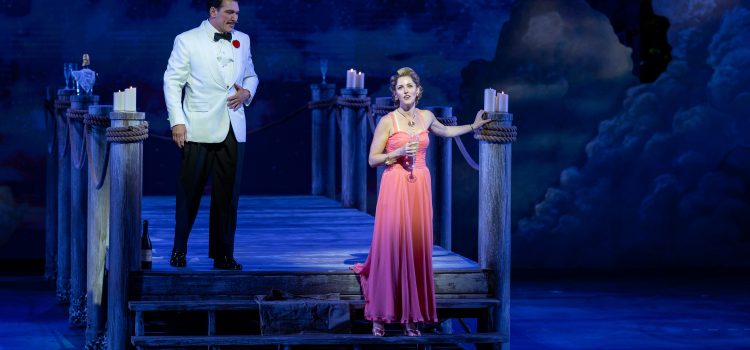

In his contemporary civics discourse, Letts focuses on a fictional town called Big Cherry. At first, we witness funny coffee-break chatter before eight elected members of the city council comprise a quorum, and along with the mayor and clerk, have a closed-door session – but wait, one guy is missing, and the reason isn’t very clear.

Oh, Letts’ cunning. The minutiae have a motive – he’s carefully chosen every topic, every chuckle. Letts has smoothly built the action to reveal how people in authority overlook principles for their own greed and ambition.

The personalities are distinct. John Reidy is sly Mr. Breeding, your typical gladhander who measures people by their golf game. Will Shaw is the eldest statesman Mr. Oldfield, a cranky sort who likes things the way they were. Patrick Canute is harder-to-read Mr. Hanratty, who appears to be thoughtful and committed.

John Reidy, Jan Niehoff and Lavonne Byers in skit re-enactment of town’s founders. Stray Dog photo.

As Mr. Blake, Tawaine Noah is glib and fired up, pushing his pet project, “Lincoln Smackdown,” a cage match. Has he been drinking? Jan Niehoff is ditzy Ms. Matz, who is scattered and blurts out that she’s heavily medicated. Lavonne Byers is Ms. Innes, whose inflated sense of self-importance means she tends to make things all about her. Grandstanding is her favorite way to address her peers.

Mr. Assalone is one of Mayor Superba’s cronies who has little patience for transparency. As “that guy,” his portrayal measured, Jon Hey is smarmy and curt, attitude and aggression festering as the meeting progresses.

Gerry Love deftly plays the iron-fisted mayor as jovial enough but he’s manipulative, controlling and entitled, as his good old boy façade collapses into self-righteous excuses.

The city clerk, Ms. Johnson, savvily played by Rachel Hanks, is machine-like in efficiency, and Hanks has affected an annoying sing-songy voice to appear like an insufferable goody-two-shoes honor roll student you knew in school.

The guy who gets under all their skin is Mr. Peel, the earnest newcomer. Always impressive Nick Freed skillfully portrays the newly elected council member who wants to make a difference. He asks a lot of questions, harmless enough, but his curiosity is unwelcome.

Tawaine Noah, Nick Freed.

Mr. Peel missed the last meeting because his mother died. Where is Mr. Carp? This appears shrouded in secrecy. In a clever flashback, Stephen Peirick shows up as the now absent council member who dared to challenge his colleagues.

As preparations are underway for the annual Founders’ Day, a horrified Carp is compelled to share his findings. Delivered urgently and passionately, Carp has discovered something rotten they don’t want to hear.

Even the reason behind the town’s name is a lie. What is taught in classrooms and presented in pageants with great fanfare is not the reality Carp has uncovered. There’s a danger to the truth, and Peirick implores them to listen.

Peel, a dentist who is not from Big Cherry but moved there with his young family, is not familiar with the town’s founding father story. All he wants is to see the minutes from the meeting he missed. But as Peel becomes aware of why Carp retreated, a growing apprehension of being an outlier comes sharper into focus, and Freed’s work here adroitly exposes malfeasance.

Understanding the play’s complexities, director Justin Been finessed Letts’ nuances in a terrific push-pull with all the characters. As the power dynamics shifted, he carefully modulated the temperature in the room as the actors serve and volley, mostly seated, but occasionally as they move around the dais.

Along with Tyler Duenow’s effective lighting design, Been’s sound design signals a storm outside on this November evening. His scenic design captures a nondescript place like dozens of meeting spaces around the country, where public participation shapes laws.

Other creatives contributing to the production include Kevin Corpuz’ choreography, Colleen Michelson’s costume design and Lizi Watt as cultural consultant.

Letts, who was a finalist for the Pulitzer Prize for Drama in 2018 for this pitch-black show, exposes ugly truths and how self-preservation and complacency factors into moral dilemmas.

Letts grew up in Oklahoma and won a Pulitzer Prize and Tony Awards for his masterwork, “August: Osage County” in 2007. An insightful writer about dysfunctional human experience, he’s always thought-provoking, sometimes unsettling, with a penchant for the absurd.

Patrick Canute and Nick Freed. Stray Dog photo.

In “The Minutes,” he expertly built tension as the comfort level evaporated. At its core, the complicit council’s smugness threatened to suffocate common sense and decency in favor of expediency.

The one quibble is that while Letts engaged with a conventional narrative structure, he abandoned that for a surreal ending that seemed at odds with the tone of what’s gone on exploring imagery vs. substance, alternative facts vs. reason.

While he enjoys keeping people on edge, it appeared to be an extreme turn after already zig-zaggy storytelling. Still, an admirable work performed vividly with deliberate direction.

“The Minutes” is a potent, politically charged American allegory for the ages, relevant then and now. It may be a cliché that the smallest towns hide the biggest secrets, but exposing hypocrisy is always welcome.

Lavonne Byers, Will Shaw. Stray Dog photo.

Stray Dog Theatre presents “The Minutes” Oct. 2 – 18 at the Tower Grove Abbey, 2336 Tennessee Avenue, St. Louis, Mo 63104. Performances are at 8 p.m. on Thursdays through Saturdays, with additional performances at 2 p.m. Sundays on Oct. 5 and Oct. 12. The play is 90 minutes without an intermission.

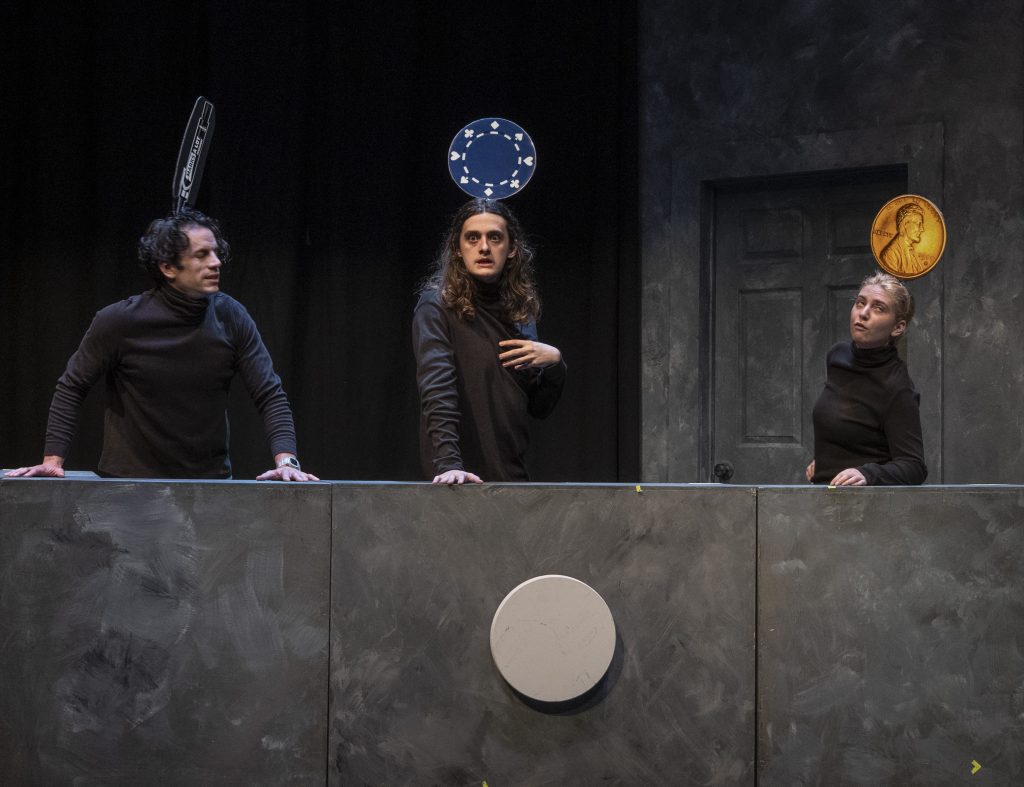
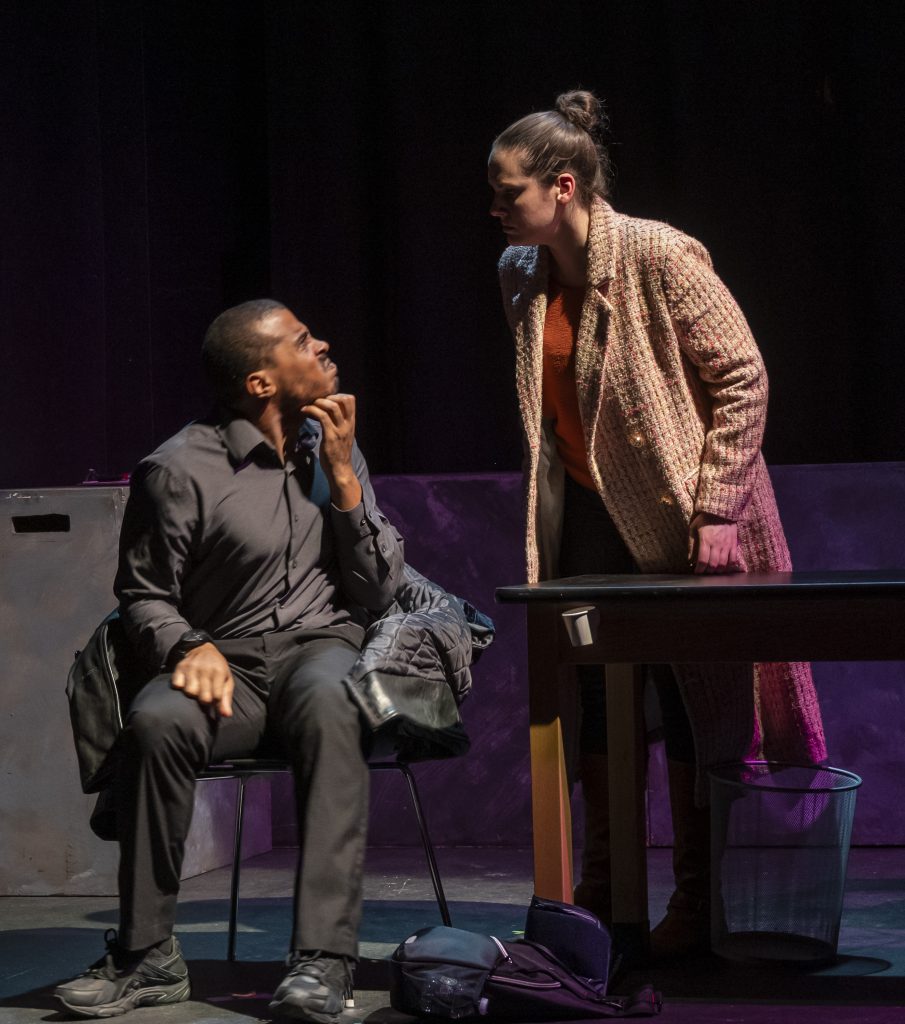
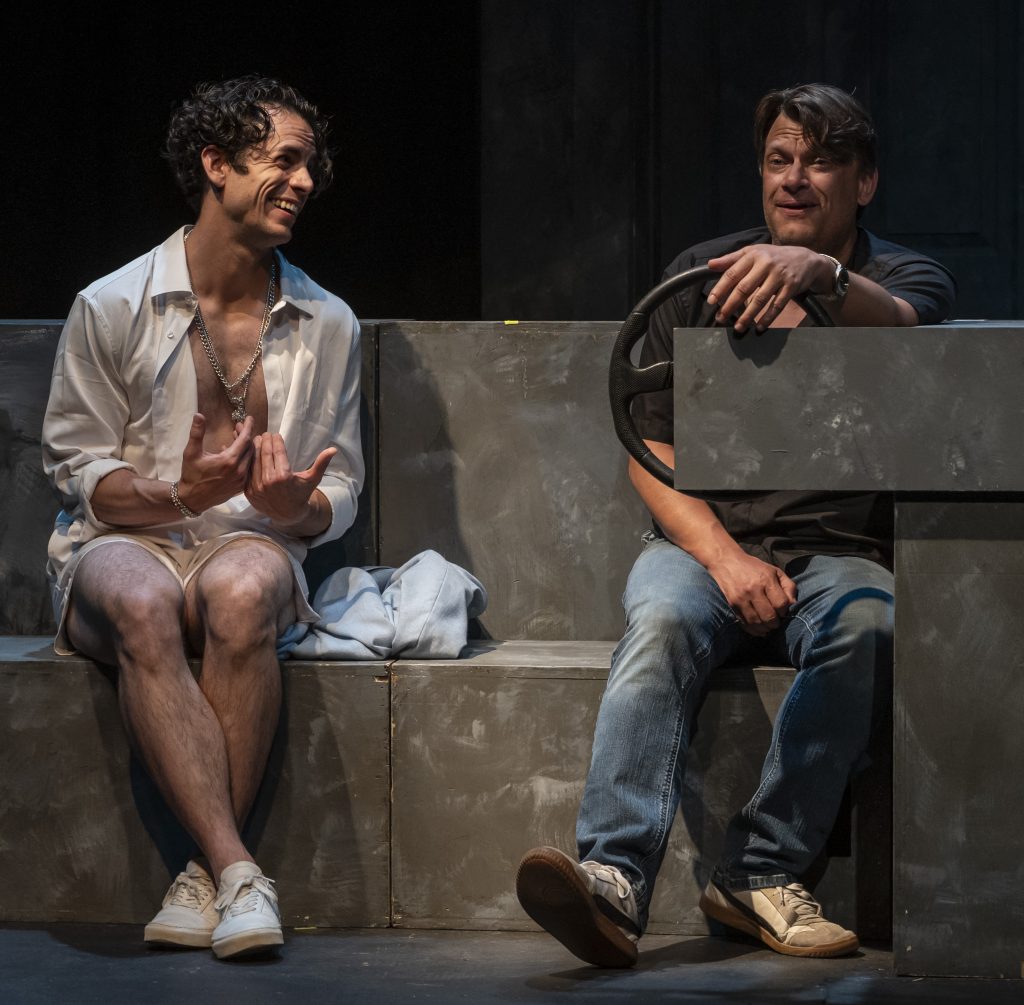
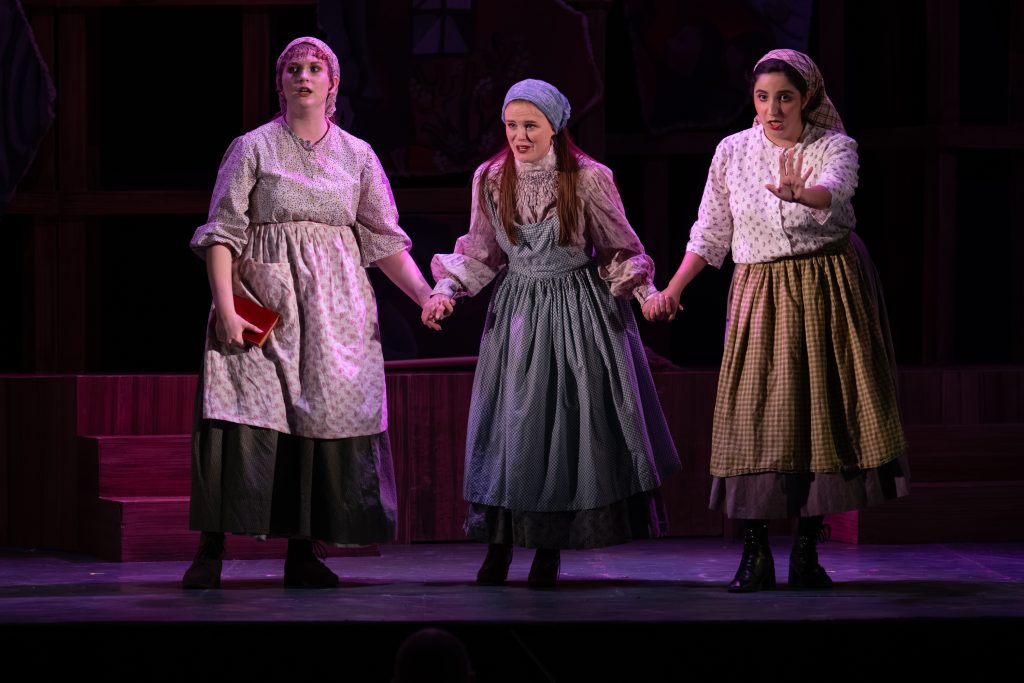
The cast of “The Minutes” at Stray Dog Theatre.

All photos by Stray Dog Theatre.

Facebook Comments

By Alex McPherson

Plenty of punches are thrown but few connect in Benny Safdie’s solo directorial debut “The Smashing Machine,” an awards-hungry drama that sacrifices depth for dress up.

Safdie’s film focuses on Mark Kerr, one of the original American Ultimate Fighting Championship fighters, from 1997 to 2000. When we first meet Mark, he’s the hulking yet surprisingly vulnerable undefeated champ who cannot fathom the concept of losing. He appears almost gentle in his public interactions, yet he remains a force of nature in the ring with a messy life behind the scenes.

He’s accompanied by his girlfriend, Dawn Staples (Emily Blunt), with whom he shares a decidedly unstable relationship. They struggle to navigate the effects of Mark’s celebrity status, Dawn’s attempts to support him, and Mark’s addiction to painkillers.

Mark decides to take part in PRIDE to make more money, the rival UFC league in Japan, with his wrestling BFF Mark Coleman (real-life MMA fighter Ryan Bader). But Mark’s addiction takes its toll, and he loses focus, leading to his first major loss — well, a “No Contest” ruling by the judges.

This sends Mark into a tailspin. His public image is being chipped away, and his already rocky personal life veers down new chaotic avenues. Mark finally goes into rehab and emerges 21 days later (a time jump that the film abruptly cuts to) ready to redeem himself at PRIDE. But can Mark win the championship once and for all, and potentially beat up-and-coming Coleman?

Familiar and slightly-less-familiar beats follow, leading up to, ahem, not all that much to think about. Safdie, one-half of the team that brought us high-throttle stress fests “Good Time,” “Heaven Knows What,” and “Uncut Gems,” takes an unusually surface-level look at Mark’s life in “The Smashing Machine.”

It’s an ostensibly “raw” approach that comes off as curated and sanitized. At least Johnson and Blunt give impassioned performances that are perfect for Oscars highlight reels.

As an opportunity to showcase his acting muscles alongside his actual ones, Johnson delivers. He convincingly showcases the various “sides” of Mark scene to scene as he navigates his public persona and private realities, bringing an intensity and vulnerability (with the help of some impressively detailed makeup) that pairs effectively with Maceo Bishop’s rugged cinematography.

Blunt, too, is intense and volatile as Dawn. The confrontations between Mark and Dawn  are where “The Smashing Machine” succeeds most, as Safdie’s screenplay keeps who we’re “rooting for” in flux as the couple navigates the effects of Mark’s sobriety with often explosive results. 

Indeed, when “The Smashing Machine” focuses in on Mark’s vices, vanity, and loneliness after not being able to maintain the carefully-sculpted façade he’s spent years working towards (particularly during the first half), it succeeds where it counts.

Safdie’s voyeuristic approach brings an uncomfortable immediacy that’s emotionally taxing to watch (in a good way), and the film’s period-accurate stylings and music give it a grimy sense of pizazz; the fights themselves are viscerally well-choreographed, lent extra force by Nala Sinephro’s percussive, restless score.

As soon as Mark goes through the rehab center’s doors, though, Safdie winnows the narrative down to a much more digestible framework, zapped of thematic heft. Mark’s journey from addiction to sobriety largely takes place behind (literal) closed doors, and the nuances of that growth are locked within. 

Perhaps the real-life Mark Kerr, who worked as an “informal consultant” on the film, had reservations about just how much Safdie could reveal about his story — seeing the “before” and “after” is definitely a choice, one that skips over a crucial element of Mark’s journey and the courage his recovery requires.

Mark’s eventual self-compassion and acceptance arrives, but, given the film’s lack of meaningful connective tissue, his evolution is merely seen, not felt, or fully understood.

Not every film has to be about something grandiose or particularly important. Wanting to shine light on a sport’s early pioneer is a noble enough goal. With the pedigree of a Safdie brother in the director’s chair, “The Smashing Machine” had the potential to hit hard. All this film leaves us with, though, is a sense of half-developed feeling — lots of yelling and period-accurate immersion lacking much to reflect on once the end credits roll. Oh well, maybe Johnson will get that Oscar.

“The Smashing Machine” is a 2025 sports biopic written and directed by Benny Safdie and starring Dwayne Johnson and Emily Blunt. Rated: R for language and some drug abuse. its runtime is 2 hours, 3 minutes. The film opened in theatres Oct. 3. Alex’s Grade: C.

Facebook Comments

By Lynn Venhaus

How legendary singer-songwriter Carole King found her voice is chronicled in the crowd-pleasing “Beautiful: The Carole King Musical,” a remarkable life story that hits all the right notes in an exuberant debut at Stages St. Louis.

The smartly constructed show is the soundtrack of a generation, and King’s influential journey parallels the evolution of women in the 1960s and 1970s.

Bursting with catchy pop songs, King’s fascinating rise to stardom is as much about the beginnings of rock ‘n roll – all those tunes that had a good beat and we could dance to them – as well as the transformative power of music.

Entrancing in the title role, Brianna Kothari Barnes believably transforms from an insecure, talented teen into a strong independent woman, making Carole easy to love and empathize with through every change and heartbreak.

The charming, affable Barnes was matched in zest by the other principals and ebullient ensemble. Nobody misses a beat.

“It’s Too Late” turning point. Photo by Phillip Hamer.

Carole grew up in Brooklyn and then fought her way into the record business as a teenager. She begins as part of the pop hit machine at the Brill Building, located at Broadway and 49th St. in New York City.

Hired by producer Don Kirshner (a droll Jeff Cummings), she meets her first husband Gerry Goffin (Sean McGee) at Queens College, and they make beautiful music together – he writes the lyrics, and she composes the melodies, from 1959 to 1969. Soon, the whole world would sing their songs.

The hits keep coming when they start a friendly rivalry with the songwriting duo Barry Mann (David Socolar) and Cynthia Weil (Kailey Boyle) and that not only enlivens the script but ups the game. The foursome’s good-natured competitiveness produced standards for the girl groups and teen idols that defined the rock era.

(Fun fact: The Brill building was home to Burt Bacharach-Hal David, Mike Lieber-Jerry Stoller, Neil Diamond, and Jeff Barry-Ellie Greenwich.)

The Drifters – Ian Coulter-Buford, Trey McCoy, Devin Price, Justin Reynolds. Photo by Phillip Hamer.

Douglas McGrath’s witty and warm book conveys the emotional connections that music makes throughout the show, in many different ways. The two pairs have an effortless interaction – until the dramatic action gets tense because the biz overtakes Gerry’s psyche – but they all share an easy chemistry.

Veteran Amy Loui astutely captures Carole’s well-meaning mom Genie Klein, quick with the advice and the quips. As Kirshner, Cummings is both a caring friend and a sharp-as-a-tack boss with a terrific ear for what sells.

The ensemble is equally robust in singing the non-stop parade of peppy hits – Tatiana Bahoque, Maya Talia Bishop, Ian Coulter-Buford, Hugh Entrekin, Tiffany Frances, Jayna Glynn, Connor Kelly-Wright, Trey McCoy, McKay Marshall, Cara Palombo, Devin Price, Sydney Quildon, Alexandrea Reynolds, Justin Reynolds, Bryce Valle, and RJ Woessner.

As the chart-toppers The Drifters, The Shirelles, Little Eva and others, they perform their iconic songs. “Up on the Roof,” “One Fine Day,” “The Locomotion,” and “Will You Still Love Me Tomorrow” among them.

These songs clearly struck a chord. One of my favorite moments is when Hugh Entrekin and RJ Woessner, as The Righteous Brothers, deliver a soulful “You’ve Lost That Loving Feeling.”

David Socolar and Kaley Boyle as Barry Man and Cynthia Weil. Photo by Phillip Hamer.

So many music memories abound — Carole’s emergence as a potent solo artist when she tries out ‘It’s Too Late” at the Bitter End signals a turning point.

Her landmark 1971 album, “Tapestry,” which sold over 25 million copies, won Grammys for Best Record, Song and Album of the Year. It is still one of the bestselling albums of all-time, and the longest Billboard run by a female artist.

My generation knows every single word — still (My 1972 high school yearbook was titled “Tapestry”).

For us Boomers, this show is a true lovefest, a sentimental flashback. But other generations can enjoy it as well – as a blast from the past pop music history lesson and as a portrait of a resilient woman who finally believed in herself.

In a male-dominated business, her integrity and kindness stood out, and she not only survived but thrived in changing times.

Photo by Phillip Hamer.

Popular on Broadway, “Beautiful” played for 2,418 performances from Jan 12, 2014, to Oct 27, 2019, nominated for seven Tony Awards and won two – Jessie Mueller as Carole and sound design.

(The gifted and troubled Goffin died in 2014 at age 75, and did see “Beautiful” on Broadway before he passed. He and Carole each had three other spouses in their lives.)

Two national tours have played at the Fabulous Fox in St. Louis, in 2016 and 2019. The Muny produced it as one of four premieres for its 105th season in 2023. This production is the fifth time for me, since Broadway in 2014, and I believe it’s on par with that show – for its intimacy and its heartfelt desire to tell this fascinating story.

Jennifer Werner, who directed and choreographed the musical, brings out the fun and the joy in the music-making. For lack of a better word, she made the production ‘sing’ – and the scenes flow into each other smoothly. She made us feel what the times were like.

So Far Away…Carole at Carnegie Hall. Photo by Phillip Hamer.

 Music Director David Nehls conducted with gusto, and to play 29 songs from the great American songbook with aplomb was a remarkable feat for the musicians. Besides Nehls on keyboard, so was Mark Maher, with Alerica Anderson on bass, Travis Mattison on guitar, Abby Steiling on violin (select performances Fiona Brickey), Lea Gerdes and JD Tolman on reeds, Tom Vincent on trombone, Andy Tichenor on trumpet, Jonathan Taylor on drums and percussion. Randon Lane was associate music director.

Collaborating to set the scene, Peter Barbieri’s grid-like scenic design superbly captures the different eras, as did costume designer Johanna Pan, with costume design coordinator Cat Lovejoy and wig and hair designer Paige Stewart. all precise in the vintage looks.

Sean M. Savoie’s lighting design added just the right ambiance for every scene, day or night, while sound designer Breanna Fais was pitch-perfect in execution.

“Beautiful: The Carole King Musical” is the best kind of jukebox musical – one that unites us, tells us a story rich in sincerity and humor, and has us leaving the theater with a smile on our faces and a song in our hearts.

We all feel the earth move at curtain call. Photo by Phillip Hamer.

Stages St. Louis presents “Beautiful: The Carole King Musical” from Sept. 19 to Oct. 19 at the Kirkwood Performing Arts Center’s Ross Family For more information, visit For tickets, visit www.stagesstllouis.org

.

The outstanding ensemble of “Beautiful: The Carole King Musical” at Stages St. Louis. Photo by Phillip Hamer.
Facebook Comments

By Alex McPherson

Even a top form June Squibb can’t quite save director Scarlett Johansson’s “Eleanor the Great,” a dramedy that can’t reconcile its disparate tones.

Johannson’s directorial debut stars the 94-year-old Squibb as Eleanor Morgenstein, a snarky Jewish widow sharing an apartment in a Florida retirement complex with her best friend, Bessie (Rita Zohar). The two are happy together, with Eleanor finding particular enjoyment in nagging the neighborhood “youths” with her bubbly-faced, acerbic wit.

In quieter moments, though, Bessie battles inner demons and trauma. Bessie, also a widow, is haunted by her experience during the Holocaust, sometimes sharing harrowing stories of death and survival with Eleanor that she has never told anyone else. This delayed “catharsis” clearly eats away at her.

When Bessie dies unexpectedly, Eleanor is, understandably, deeply shaken. She moves back in with her divorced, perpetually stressed daughter Lisa (Jessica Hecht) and grandson Max (Will Price) in their small New York apartment.

Besides mercilessly judging Lisa from the get-go, Eleanor’s loneliness rapidly creeps in, and she feels adrift without Bessie by her side. Lisa signs Eleanor up for a senior’s social group at the local Jewish community center, hoping to get her out of the apartment and help her make new connections. 

Things get wonky when Eleanor accidentally wanders into a support group for Holocaust survivors and, impulsively, decides to claim Bessie’s experiences as her own. Eleanor gets the attention of NYU journalism student Nina (Erin Kellyman), who sits in on the support group hoping to write a story for class and connect with her own Jewish roots. She quickly decides that Eleanor would be the perfect person to center for her article. 

Nina is also grieving her mother who recently passed away. She’s currently living in an apartment with her news reporter father, Roger (a typically excellent Chiwetel Ejiofor), who has grown increasingly distant since the loss. 

Despite some initial reluctance, Eleanor sparks up a friendship with Nina, and the two grow close. Eleanor’s lie gives Nina the chance to grapple with her own grief, and find solidarity with a pseudo-parental figure.

But as Eleanor continues this falsehood of being a Holocaust survivor, it’s only a matter of time until the truth is revealed. Eleanor’s connections and newfound sense of belonging are in serious jeopardy.

But not all that much jeopardy. As it turns out, Johansson’s film is content to bring up thorny topics of truth, love, aging, and trauma without fully exploring them, awkwardly positioning its “‘Dear Evan Hansen’ for the Holocaust” thread alongside a lighthearted story of intergenerational friendship.

The former almost seems too much for Johansson and screenwriter Tory Kamen to handle; they refuse to reckon with the darker implications of Eleanor’s lie and the effects it has on those who believe her. “Eleanor the Great” ultimately eschews true introspection for a schmaltzy resolution that sands down ambiguity for the sake of convenience. Still, there’s enough impactful performances and wry humor to hold mild interest.

Squibb, coming off the heels of last year’s sleeper hit “Thelma,” carries most of Johansson’s film, punchily delivering Eleanor’s barbed insults and judgy asides in another strong late-career performance. She also embodies how Eleanor’s lie gradually eats away at her and her gradual recognition of how it represents her own grief.

Squibb’s commanding, confident screen presence, “innocence” belying impulsion and cynicism, anchors even the most over-explanatory dialogue from Kamen’s screenplay — if only “Eleanor the Great” had trusted Squibb further to convey Eleanor’s inner concerns in a more subtle fashion rather than having both Eleanor and other characters bluntly spell them out for us.

Kellyman holds her own alongside Squibb, bringing fresh-faced energy and deep wells of grief, with Johansson’s unobtrusive, albeit bland direction and Kamen’s gentle screenplay believably selling the characters’ friendship.

It’s in these moments — where Eleanor imparts worldly wisdom to Nina, and the two of them explore New York City together — where “Eleanor the Great” shines as the uplifting film it could have been without the baggage of its darker elements.

It’s not that Johansson and Kamen shouldn’t be commended for attempting to explore such a weighty topic as the Holocaust, but “Eleanor the Great” too often remains stuck in an inter-genre limbo that never figures out what it wants to be.

Yes, it’s admirable that Johansson cast real-life survivors of the Holocaust for Bessie and the support group. Yes, scenes where Zohar recounts Bessie’s history (through flashback) are raw and gripping, particularly in the film’s final stretch.

But “Eleanor the Great” lets Eleanor herself off the hook too easily, particularly in its predictable generalizations about grief’s many different forms, leaving the more ambiguous consequences of Eleanor’s decisions to viewers’ imaginations.

The tonal whiplash is striking, prompting off-kilter vibes that “Eleanor the Great” can’t shake. Squibb and Kellyman make a dynamic pair, though, and the film’s rickety yet ultimately familiar shape makes it a passable enough, not “great,” time at the movies.

“Eleanor the Great” is a 2025 drama film directed by Scarlett Johansson and starring June Squibb, Erin Kellyman, Rita Zohar, and Chiwetel Ejiofor. It is 1 hour, 38 minutes, and rated PG-13 for thematic elements, some language, and suggestive references. It opens in theatres Sept. 26. Alex’s grade: B-.

Facebook Comments

By Lynn Venhaus

What is the cost of truth? And how will you pay for your own truth if it’s at the expense of another person’s goals?

In the engrossing drama “The Wanderers,” two married Jewish couples, from different time periods and circumstances, must navigate what exactly society’s social structure on togetherness means to them.

In the current New Jewish Theatre production, all the couple’s work is revelatory, and the execution is masterful. Their stories intertwine in interesting ways.

In the 1970s, Esther and Schmuli are Orthodox Jews who must follow a strict set of Hasidic Judaism rules, and their rigid roles as husband and wife are set, no variations in the Satmar community in Williamsburg, Brooklyn.

They have married the old-fashioned way – a business transaction made by their parents, with love not in that equation. However, they are very family-focused in their beliefs.

Bryce Miller and Jade Cash as Schmuli and Esther. Photo by Jon Gitchoff.

In exceptional nuanced performances, Jade Cash as the curious Esther and Bryce Miller as the conservative husband Schmuli are raising two daughters. Esther’s best friend has married for love, a man outside her faith and race, and they seem perfectly happy in their secular lifestyle.          

While Esther learns more about the forbidden outside world, she’s intrigued by the personal freedoms she witnesses.  Bound by the constraints of their religion, Esther is increasingly restless.

She’d love to go to school, become a librarian – and listen to pop music on the radio while she’s finishing chores. Meanwhile, she gives birth to a son, and that changes their family dynamic.

She will soon learn the cost of yearning. And Esther’s plight is gut-wrenching, for she will have hell to pay, all because she dared to dream of becoming a better version of herself. Cash, who is getting more impressive with each new role, tugs at our heartstrings as she questions the old ways.

Bryce Miller and Jade Cash in Albany, New York. Photo by Jon Gitchoff.

Schmuli is challenged, too, because he follows traditions, no discussion, no questions. He is worried about unfavorable opinions and family scandals. He’s caught in a cultural war and battle for identity that he doesn’t understand.

Miller, who immerses himself as the devout head of household, conveys Schmuli’s faith authentically. In his loneliness, he becomes conflicted, and attempts to grasp changing male-female roles.

In the alternating contemporary story (2010s, gentrified Williamsburg), the other couple, Abe and Sophie, don’t necessarily practice their faith but send their children to Hebrew School. They are not rule-followers, per se, but the couple, writers by profession, attempt to raise their children in a traditional yet modern family.

Wendy Renee Greenwood and Joel Moses. Photo by Jon Gitchoff.

As they traverse a challenging emotional and spiritual landscape, neither Sophie nor Abe can let go of the past. Wendy Renee Greenwood gives a devastating performance as a wife, mother, daughter and writer who is holding her family together after facing numerous disappointments. She struggles with unfulfilled dreams and a widening gulf between her husband and her identity. Is never being satisfied going to be her destiny, just like Esther’s?

Her husband Abe, a more successful writer with a Pulitzer Prize and two National Book Awards, is tempted through an email relationship with a beautiful movie star. It starts harmless enough, as dreamgirl Julia Cheever came to a book reading of his. Flattered by that, he takes off into Abe-land when she sends him an email.

Maggie Wininger is luminous as the charismatic actress who has her own insecurities and personal issues while she practices her craft, deals with failures and successes, and tries to juggle everything for life balance. Think Julia Roberts, that kind of screen presence and popularity.

Joel Moses and Maggie Wininger read their emails to each other. Photo by Jon Gitchoff.

Joel Moses, as is typical, immerses himself in a rollercoaster journey involving growth, grief, self-doubts, emotional infidelity, and lack of effort to be present for his wife and two children.

Abe is gregarious, intelligent, conflicted and increasingly lost. Why can’t he see what he has and not what he hasn’t? When he crosses a line, can he go back and correct the mistakes he’s made?

Director Robert Quinlan brings out the intricacies between these couples and the ties that bind them – their family, heritage, dreams, desires and society mores.

He’s established these different worlds on opposite ends of a runway type set, with functional and efficient scenic design by Reiko Huffman, one of remarkable detail in intimate spaces.

Joel Moses writing in solitude. Photo by Jon Gitchoff.

IPlaywright Anna Ziegler’s twisty tale on relationships is fascinating in its entanglements. The play premiered in 2018, and debuted on Broadway in 2023. While not namechecking them per se, she explores the pledges a pair makes to each other in traditional wedding vows — “for better, for worse,” “in sickness and in health,” and “to love and to cherish” – in several vignettes.

In a layered – and sometimes dense — approach, she shows how unanchored they become trying to cling to what they assume is best for them. It’s a thoughtful play, looking at the joys and challenges of commitment in two different worlds.

Greenwood, Moses, Miller and Cash are fully invested in these roles, portraying each high and low with deep felt intensity. Wininger’s contribution is an interesting contrast of a famous person as fantasy and explaining her reality.

Their emotionally rich portraits engage and connect us to their characters’ motivations. Ziegler doles out their backstories, which led to their current plights in small nuggets. The couples get into situations in which there seems to be no escape, and this gives the play the necessary conflicts. While all vary in their beliefs, they admit their fears and show their vulnerabilities.

Jade Cash and Bryce Miller — what might have been? Photo by Jon Gitchoff.

The technical work is strong in its storytelling, too, with Amanda Werre’s skilled sound design and lighting designer Jayson Lawshee’s striking choices between reality and fantasy noteworthy. Costume designer Michele Friedman Siler accomplishes the traditional Hasidic apparel while giving the contemporary story casual attire, and the movie star cosmopolitan career wear.

The specific time frames for looking at love from both sides are 1973 -1982 for Schmuli and Esther, and 2015-2017 for Abe and Sophie, with Albany, New York part of later storytelling.

Thought-provoking, and at times, frustrating, this examination of love and marriage is far-reaching in its complicated couplings. It is those layers that give the actors some real substance, and the audience intriguing questions to ponder, and conversations to begin..

New Jewish Theatre presents “The Wanderers” from Sept. 11 through Sept. 28, with performances on Thursdays at 7:30 p.m. Saturdays at 4 and 8 p.m. and Sundays at 2 p.m. at the SFC Performing Arts Center, 2 Millstone Campus Drive. For more information: jccstl.com/arts-ideas/new-jewish-theatre/current-productions.
The play is 1 hour, 45 minutes without intermission.

Joel Moses and Maggie Wininger. What price devotion? Photo by Jon Gitchoff.
Facebook Comments

By Alex McPherson

Alternately goofy and self-serious, director Justin Tipping’s “HIM” fumbles intriguing ideas and crash lands into a barren field of mediocrity.

Executive produced by Jordan Peele — but, crucially, not directed by Peele — “HIM” follows rising football quarterback star (and emotionally stunted hunk) Cameron “Cam” Caid (Tyriq Withers). Cam is entering the pro draft, hoping to be recruited by his favorite team, the San Antonio Saviors.

Cam has worshiped the Saviors since he was a child, particularly their star quarterback Isaiah White (Marlon Wayans). Isaiah suffered a gruesome injury on live television years ago yet recovered enough to play another 14 years and rack up eight championship rings. Cam’s demanding, masculine father reproached young Cam from looking away when Isaiah’s injury happened, instilling in him a twisted idea of what a “real man’s sacrifice” looks like and a drive to become the next GOAT.

In the present day, Cam is close to achieving that goal, but his father has passed away. He’s supported by a doting team including his mother, high-school-sweetheart girlfriend, and slippery manager (a somewhat out-of-place Tim Heidecker). There’s even rumors that White might be stepping down, giving Cam a prime opportunity to replace him.

One night, as Cam trains to take part in a pre-draft scouting “combine,” he’s surprise-attacked by a samurai-costumed being wielding a giant hammer, giving Cam some good ol’ CTE and apparently dashing his chances of joining the big leagues.

All is not lost (yet), as Cam suddenly receives an invitation from the all-powerful Isaiah himself to join him for a week-long training/rehab program at his off-putting New Mexico compound. Cam is thrilled and filled like childlike glee, but soon finds himself out of his depth. Suffice it to say, it’s not a particularly great sign when he’s jump-scared by freaky-looking fans en route to the compound in the middle of the desert. Cam doesn’t think too much of it, or much of anything, for that matter.

Isaiah swiftly takes Cam under his wing with persuasive philosophizing, homoerotic tension, and demanding, increasingly bloody training exercises under the guise of “becoming the best,” all while his devoted assistant Marco (Jim Jefferies) jabs Cam with syringes full of unknown substances and Cam loses touch with the outside world. The situation gets crazier by the minute. Will Cam come to his senses, or is the allure of becoming “Him” worth the sacrifice?

The notion of exploring the dehumanizing horrors of America’s favorite pastime is rich, if not particularly novel, and “HIM,” with its unbridled maximalism, runs into its themes head on. It’s a mélange of excess, though, that often resembles a prolonged, gory, “edgy” music video — abandoning earned emotion for bludgeoning and cliché-ridden horror that quickly wears thin.

Indeed, “HIM” is a mixed bag. Each instance of visual creativity and trippily impressive scene-setting is offset by wooden dialogue and emotionally-leaden performances (with the exception of an enjoyably off-his-rocker Wayans) that rapidly chip away at the worthy topics that Tipping and co-screenwriters Skip Bronkie and Zachary Akers have on their minds. It’s all style, stitched together with hyperactive editing by Taylor Joy Mason that resorts to convenient, rushed montage with a heavy background of hip hop as Cam’s bootcamp progresses. 

The film’s “experiential” qualities are still sometimes arresting; giallo-inflected freakouts and X-ray bone-breakage in a brutalist, alien-like setting that Tipping and production designer Jordan Ferrer clearly had fun with concocting. Cam never quite gets his footing, and, perhaps fittingly, neither do we, caught up in a swirl of weirdness that’s intoxicating for Cam, yet tiresome for everyone else involved.

Management of tone, or the lack thereof, is perhaps the film’s most glaring flaw, oscillating back and forth between broadly satirical and deadly serious, frequently taking pains to revel in shock imagery and inserts that grow repetitive while losing any fear-inducing impact along the way. 

Withers’ uneven performance adequately sells the gradual “loss” of who Cam used to be, even as the script resorts to exposition dumps and familiar trauma-dependent backstory as a last-ditch effort to pump some pathos into the narrative by the third act. On the other side of the spectrum, Wayans, plus Julia Fox as Isaiah’s unstable wife Elsie, fully lean into the narrative’s absurdity with intermittently amusing results; too bad the screenplay lacks any real character of its own.

There’s admittedly fun to be found in how “HIM” explores football as a suffocating, pseudo-religious experience where the gods of capitalism manipulate the vulnerable while fighter jets zoom overhead spouting red, white, and blue smoke.

No spoilers, but the final scene is quite a spectacle, bringing together the film’s heavy-handed metaphors for a glorious display of incendiary violence that’s fully self-aware. But Tipping, as of now, is no Peele, and “HIM” is most assuredly no touchdown.

“Him” is a 2025 sports horror film directed by Justin Tipping and starring Marlon Wayans, Tyriq Withers, Julia Fox, Tim Hedecker. It is 1 hour, 36 minutes, and rated R for strong bloody violence, language throughout, sexual material, nudity and some drug use. It opens in theatres Sept. 19. Alex’s grade: C-.

Facebook Comments