By Lynn Venhaus
A bittersweet wrap-up of the classy historical drama, “Downton Abbey: The Grand Finale” is a fitting final bow for its legion of fans.
The beloved television series started in Edwardian England and ran for six seasons on PBS, winning 15 Emmy Awards, and was followed by a popular film trilogy, the first in 2019 and second “A New Era” in 2022.

Reminiscent of the British television hallmarks “Upstairs, Downstairs” and “Brideshead Revisited,” but “Downton Abbey” had more soap opera elements, optimistic tone, and used the past to reflect on present class and gender issues.

The rich-people problems of the Earl of Grantham’s family captivated with their depiction of a regal world, class dynamics, the historical impact of the 1910s and 1920s, and their relationships with their servants.

All helmed by director Simon Curtis, he maintains their winning formula of heartbreak, joy, intrigue, and luxury in the latest endeavor. For viewers who have never seen the series, you will be able to follow along without frustration.

Laura Carmichael and Michelle Dockery as Lady Edith and Lady Mary.

Redolent with warm humor and lavish designs, creator and writer Julian Fellowes’ compelling narratives on the aristocrats upstairs and their dedicated staff downstairs have taken fans on a transportive journey through every corner of the grand country homestead and grounds (the real Highclere Castle in north Hampshire stands in).

In this one, set during the global economic crisis that was the Great Depression in the 1930s, it’s clear that the times are changing. The principal characters start out enjoying the London social season, but trouble intrudes.

The family, now with money woes post-stock market crash, faces societal changes, and a necessary shift in direction. Their traditional way of life is disappearing.

From the beginning, Lord Robert Crawley (Hugh Bonneville), Earl of Grantham, always saw Downton Abbey as his family heritage, and now must wrestle with moving on and allowing the next generation to take over.

After his heir’s death aboard the R.M.S. Titanic, his distant cousin, Matthew Crawley (Dan Stevens), was next in line. He married Robert’s daughter Lady Mary (Michelle Dockery), and after he died in a car crash, and she later married Henry Talbot (Matthew Goode), others believed that Mary should inherit the vast estate.

So that is at issue. Mary has another scandal to deal with, publicly played out, and there is a family matter that involves her mother, Countess Cora (Elizabeth McGovern). Her brother, Harold Levinson (Paul Giamatti), arrives from his home in America with a financier friend, Gus Sambrook (Alessandro Nivola). Further complications arise, which fans will find out soon enough.

The twisty line of succession, staff retirements, and future residences are also part of the plot that provides fans with nods for their loyalty. The emotional tugs are there, if not the conflicts.

There isn’t a dramatic occasion like King George V and Queen Mary arriving on their tour of Yorkshire in 1927, as in the first film, followed by Violet Crawley’s inheritance of an Italian villa in 1928 and a film crew using the estate for a movie shoot in the second one.

However, this third go-round doesn’t leave stones unturned and looks towards a world where Thomas Barrow (Robert James-Collier), formerly of the house staff who is the dresser for dashing movie star Guy Dexter (Dominic West), is allowed to mingle upstairs with guests.

Just as Bonneville’s Lord Robert is grumpy about his displacement, so is ‘retired’ butler Charles Carson (Jim Carter). He is reluctantly relinquishing his duties to eager Andy Parker (Michael Fox), who – gasp – has a mind of his own.

The downstairs staff.

Those who have a special fondness for the humble downstairs folks can rejoice, because the staff characters are as appealing as ever. The delightful cook Mrs. Patmore (Lesley Nicol) and housekeeper Elsie Hughes, played by chipper Phyllis Logan, are among the many fan favorites.

As pregnant Anna Bates, Joanne Froggatt takes good care of Lady Mary as her maid, and her doting husband, valet John Bates (Brendan Coyle), takes good care of her. Always a bright spot, Daisy Parker (Sophie McShera) takes on a bigger role in the kitchen.

Another welcome addition is impressive Arty Foushan as a cheeky Noel Coward, the sharp-witted playwright who charms every person he meets at a Grantham dinner party – and even gets an idea for his next play by hearing about Lady Mary’s private life (wink, wink).

As always, the ensemble cast is strong – and so are the attachments to them. The sprawling cast conveys its customary lived-in quality and longtime association with each other in heartwarming fashion.

Among family members, Laura Carmichael shows Lady Edith’s inner strength in a new way, especially in steadfast support of her sister. And Allen Leach is always a voice of reason as Tom Branson.

Penelope Wilton, Allen Leach, Michelle Dockery, and Paul Giamatti.

As progressive Isobel, Penelope Wilton is always a welcome presence, and she comically tussles with a huffy snob Sir Hector Moreland (the great Simon Russell Beale) at the county fair.

For its swan song, the cinematography by Ben Smithard, costumes by Anna Robbins, production design by Donal Woods and variations on the familiar theme music by composer John Lunn are opulently crafted.

Not only does Robbins surpass herself on the ballgowns and party clothes, but she outfits an Ascot afternoon with an incredible array of hats.

The series MVP, two-time Oscar winner Maggie Smith as dowager Countess Violet Crawley, left a huge gap after her death last year. Her character’s death was written into the second film, and tributes continue here. But her sparkling quips are dearly missed.

Fans who fell in love with this story 14 years ago are welcomed to the party, and it’s a fond farewell full of wit, sentiment and a warm hug of nostalgia.

“Downton Abbey: The Grand Finale” is a 2025 period drama, directed by Simon Curtis and starring Hugh Bonneville, Michelle Dockery, Elizabeth McGovern, Laura Carmichael, Jim Carter, Lesley Nicol, Phyllis Logan, Allen Leach, Arty Foushan, Paul Giamatti, Alessandro Nivola, Sophie McShera, Brendan Coyle, Michael Fox, Joanne Froggatt, Simon Russell Beale, Robert James-Collier, and Dominic West. It is rated PG for suggestive material, smoking and some thematic elements and run time is 2 hours, 3 minutes. It opens in theatres Sept. 12. Lynn’s Grade: B.

Facebook Comments

By Lynn Venhaus

Sidesplitting hijinks ensue as a marital merry-go-round farce, “The Cottage,” spills the tea and twists a Noel Coward-esque comedy of manners for a female-forward finish.

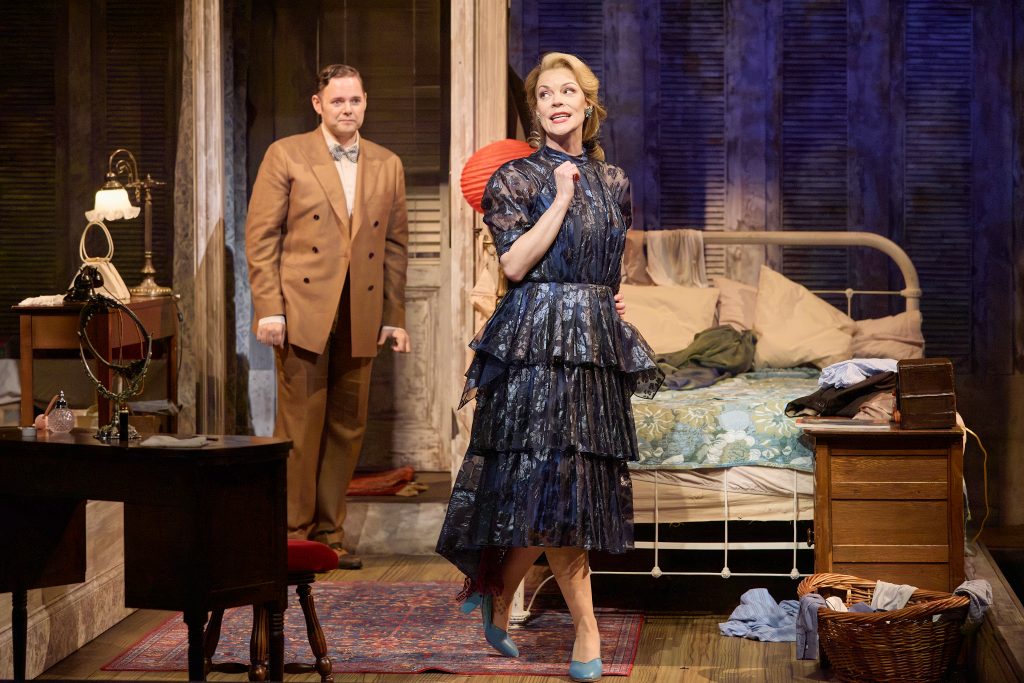
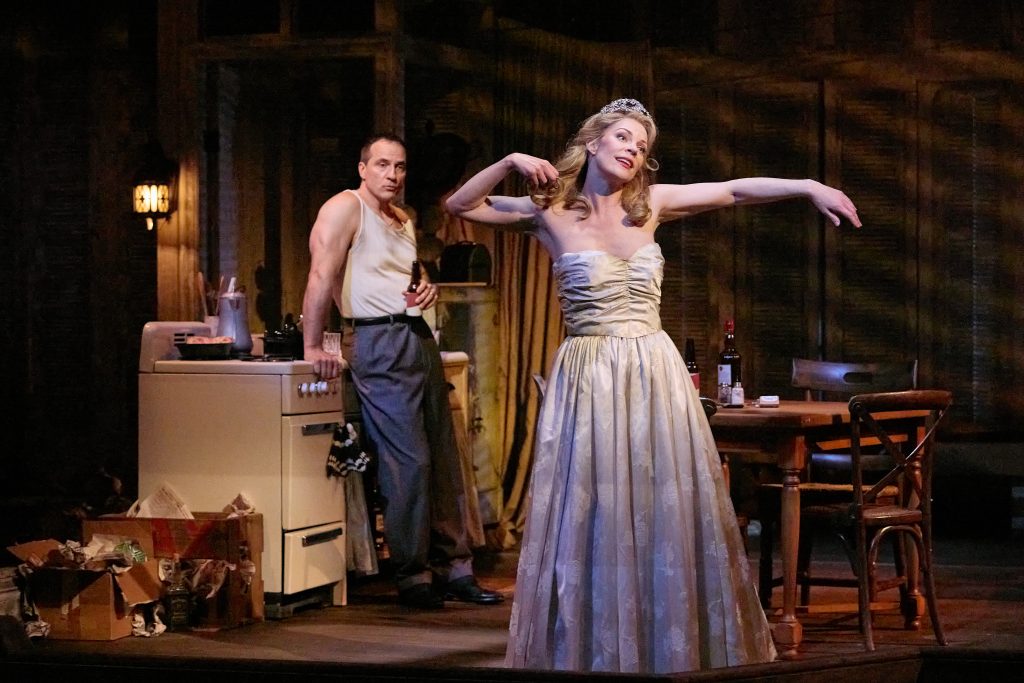
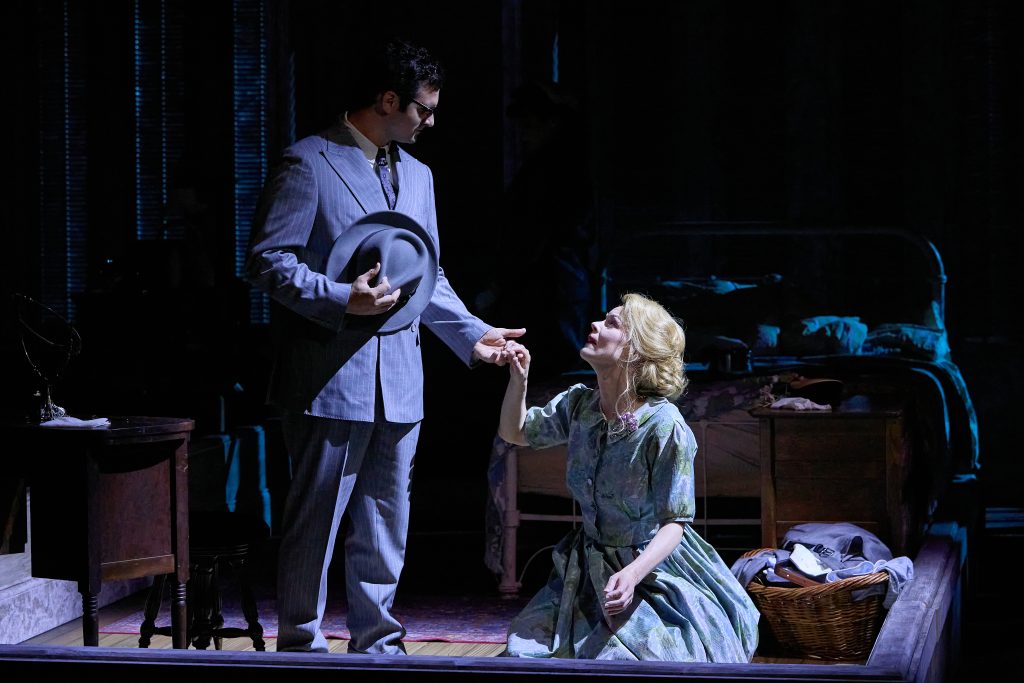
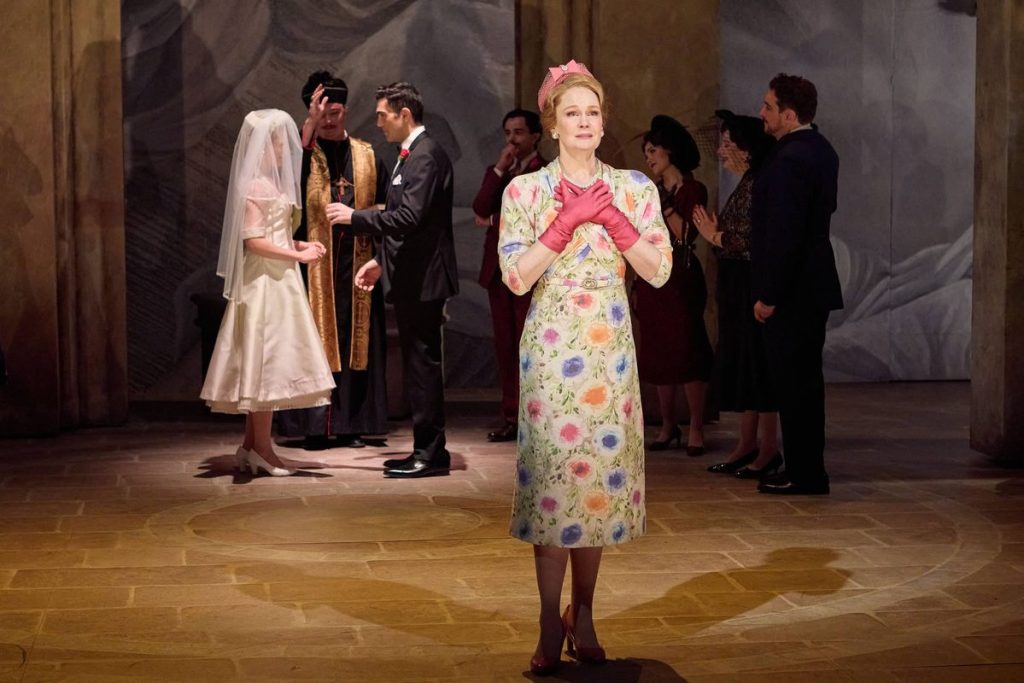
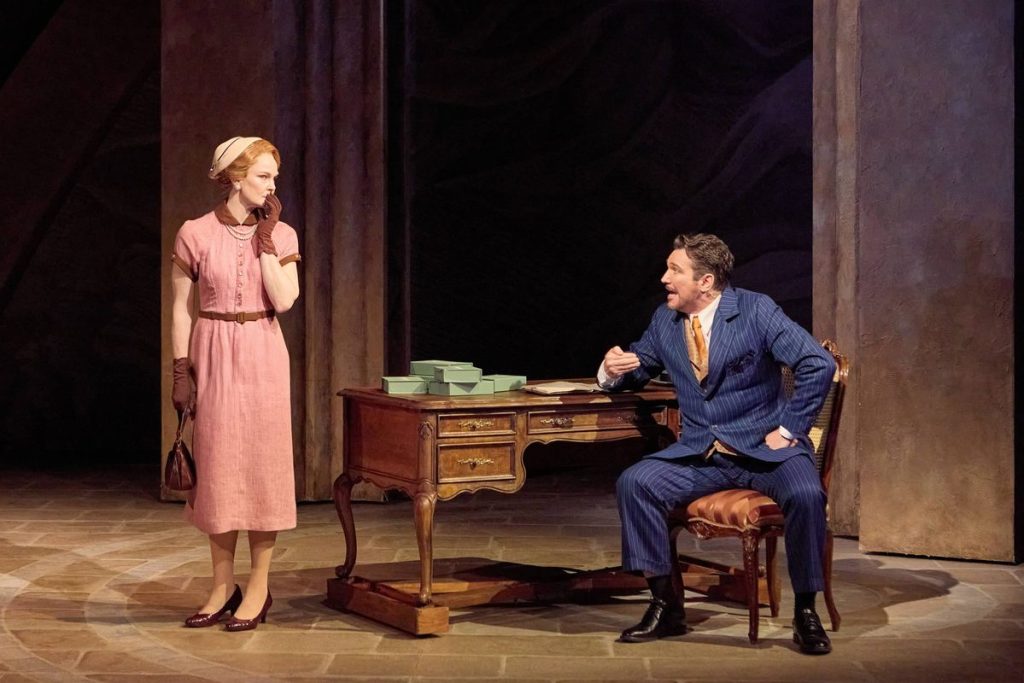
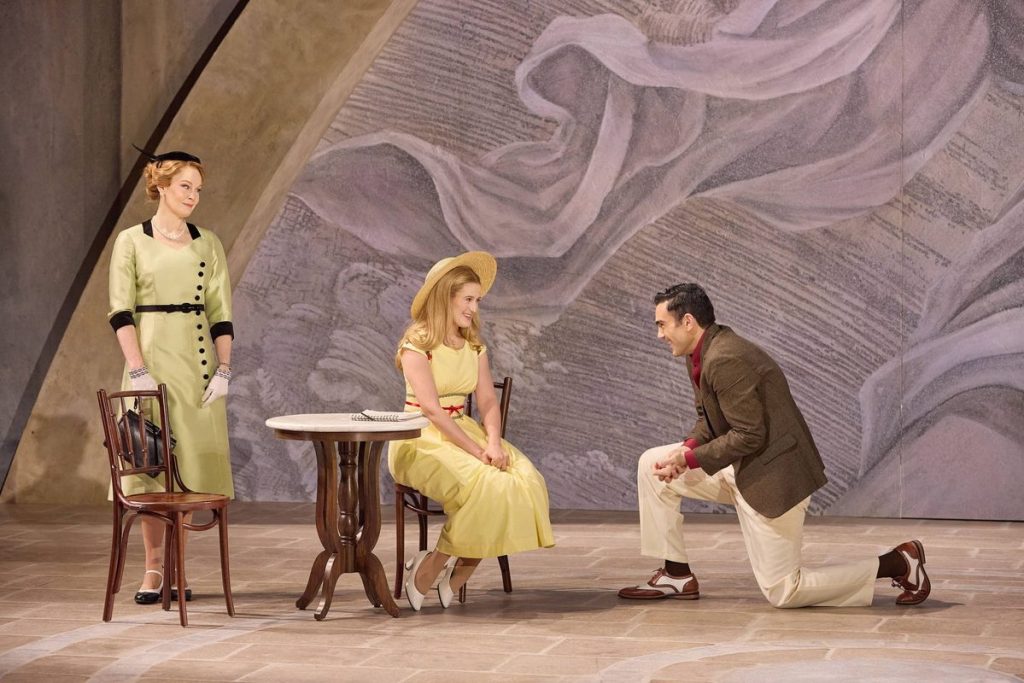
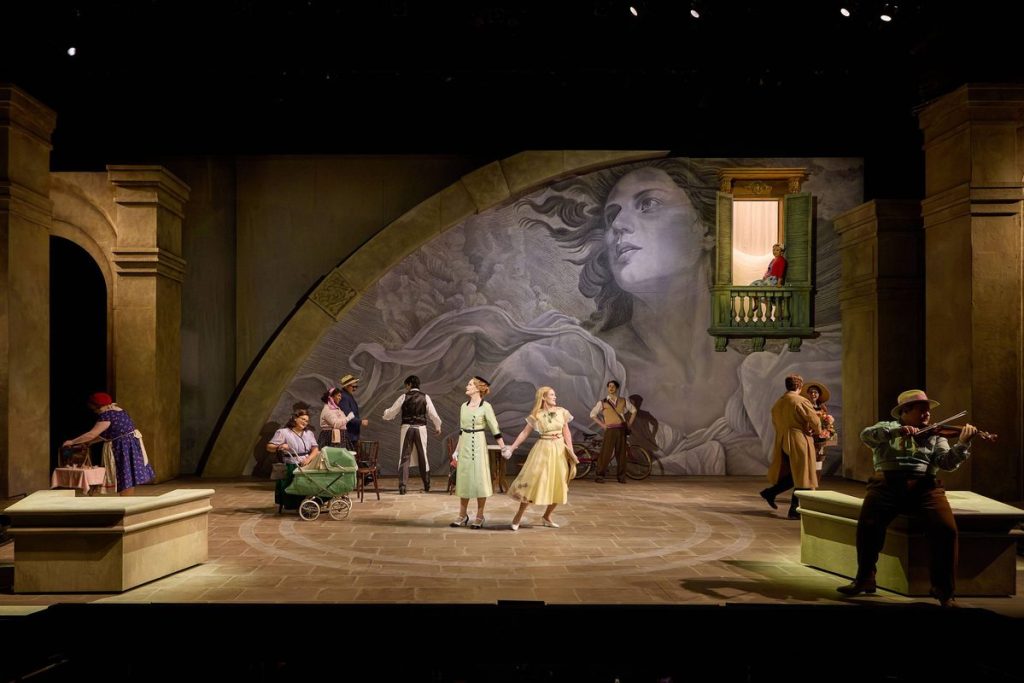
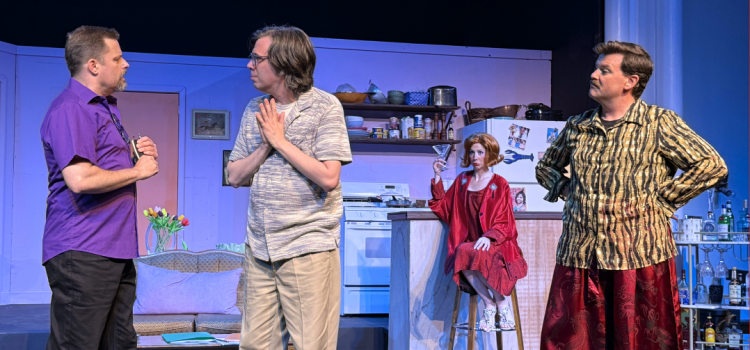
Now playing through Sept. 28 on the Repertory Theatre of St. Louis’ mainstage, a splendid sextet puts the roar in this Roaring Twenties romp as they gamely carry on in a sophisticated upper-crust British setting.

They deftly deliver standard King’s English dialect – all those ‘darlings,’ ‘indeeds’ and ‘rathers’ – in crisp witty, and a tad cynical, manner (special shout-out to dialect coach Lauren Roth).

Sandy Rustin’s jaunty play effectively depicts complicated relationships among polite society, and the cast’s Swiss-watch timing and nimble silliness combine for a sparkling collaboration that shows off their verbal and physical dexterity. Their flair for slapstick is impressive, as is their limber body language.

The company of “The Cottage.” Photo by Jon Gitchoff.

It all begins one sunny Monday morning in June 1923 at the Van Kipness matriarch’s tony countryside cottage, about 90 minutes outside of London. For seven years, Sylvia and Beau have enjoyed an annual tryst there.

Sylvia happens to be married to Beau’s stuffed-shirt brother Clarke. A hopeless romantic, she has impulsively told Clarke and Beau’s wife Marjorie of their affair so she can get her happily ever after.

That sets off a chain reaction where shocking truths are revealed, more characters are introduced, and doors lead to unexpected entrances and exits. These denizens of the smart set find their private lives upended, along with their carefully cultivated identities.

With this fashionable group, let’s just say love and marriage don’t go together like a horse and carriage, and things are not what they seem. As Coward famously said: “It’s discouraging to think how many people are shocked by honesty and how few by deceit.”

Jihan Haddad and Jack Dryden get frisky as Marjorie and Clarke. Photo by Jon Gitchoff.

The remarkable ease with which this cast achieves synergy is a credit to the talents of Andrea San Miguel as the spirited and stylish Sylvia; Jordan Coughtry as the handsome but caddish Beau; Jihan Haddad as the ladylike Marjorie; St. Louis native Jack Dryden as buffoonish Clarke; Isa Venere as ditzy Dierdre; and Andres Enriquez as Richard, best described as a loose cannon.

Rustin, who wrote the hilarious play adaptation of the murder-mystery-comedy “Clue” based on the 1985 movie, is faithful to the British style of drawing-room comedies that skewered the manners and morals of high society – but only up to a point.

In a refreshing move, she has flipped the script on women only being in service to men in these throwback shows. You see the women emerge, speaking about their wants and desires, ultimately taking charge of their own lives.

It has more of a modern sense and sensibility – and most importantly, they get the last laugh. A charming live wire, San Miguel is the perfect embodiment for an awakening, a transformative journey for Sylvia, an intelligent woman stuck in stereotypes of the time.

However, besides her own stamp on Coward’s celebrated writing, Rustin injected the story with more than a month’s worth of soap opera confessions – and those juicy tidbits keep on coming. Must not forget Sam Matthews’ brief appearance as the gardener.

San Miguel and Coughtry as a passionate couple. Photo by Jon Gitchoff.

It’s best not to spoil more of the twisty turns the plot took as it unraveled, all at a swift pace. As details unfolded, anxiety ramped up, and rarely was anyone calm, cool and collected – all the better for zaniness.

Director Risa Brainin fluidly directed the chaos, making sure the action had a rhythm, and the well-cast ensemble maintained a pleasing tempo throughout. (Notable nod to casting director Delaney Piggins for assembling this finely tuned machine).

To emphasize their eccentric personalities, Brainin breezily blended them into the well-appointed set and ensured they each stood out when they were the focus.

One inspired segment involved Venere’s exaggerated acrobatic moves as an unconscious Dierdre is awkwardly handled by the others, reminiscent of classic Carol Burnett and Molly Shannon’s zesty physicality.

And this piggybacks on good-sport Haddad handling classy 8-months-pregnant Marjorie’s untimely gas-passing for more goofiness, which she managed with terrific finesse. (And loud guffaws and shrieks from the audience.)

Coughtry, San Miguel, Verare, Dryden and Haddad. Photo by Jon Gitchoff.

Brainin and scenic designer Robert Mark Morgan, ever mindful of architectural harmony, worked out a floor plan for maximum effect, as characters moved back and forth from the kitchen, the stairs leading to the bedrooms, and the guest room that was offstage, for the main action is in the elegant drawing room.

A focal point is a grand-scale front door with faux stained glass to complement the luxurious setting. Morgan’s exquisitely detailed set is the bee’s knees with its bespoke touches. Michael Klaers’ lighting design illuminates the bright space, with special attention to spotlighting Mama Van Kipness’ stern portrait hung in a prominent place.

Renee Garcia’s posh period costume designs are the cat’s pajamas, with sumptuous fabrics, fancy bathrobes, chic graceful designs, flattering colors, and tasteful tailored menswear and overcoats.  

The wig and makeup design by Dennis Milam Bensie is attractive in vogue styles, well-suited to the characters.

Coughtry, Verare. Photo by Jon Gitchoff.

Amanda Werre’s exemplary sound design is a necessary mix of victrola music, shower sounds, a weapon discharge – and loud flatulence.

Noteworthy nods to fight director Paul Steger and intimacy director Jamie McKittrick, and to production stage manager Evangeline Rose Whitlock for their astute contributions

As delightful as the performers are and the production’s flawless execution, the running time could be shaved, at least 10 minutes in each act, so that Rustin’s points don’t seem as repetitive. It would help maintain the bubbly mood as the urbane story gets increasingly absurd.

The play is 2 hours, 15 minutes, including a 15-minute intermission.

Andres Enriquez as Richard. Photo by Jon Gitchoff.

First produced in 2013 before regional productions, the play had a 2023 debut on Broadway directed by Jason Alexander that starred Eric McCormack, Laura Bell Bundy, Alex Moffat, Lilli Cooper, Dana Steingold and Nehal Joshi in a limited engagement for 111 performances.

The current cast appeared to be having a blast, so it’s easy to imagine how difficult it was to not crack up and keep their composure on stage and during rehearsal, let alone acquire the fleet moves and effortlessly deliver acerbic dialogue in a highly theatrical manner that reflected that era.

If madcap mischief and light-hearted entertainment are your cup of tea, you should plan a getaway to the Loretto-Hilton Center. Scandals are usually never this fun.

The Repertory Theatre of St. Louis presents “The Cottage” Sept. 3-Sept. 28 at the Loretto-Hilton Center on the campus of Webster University, 130 Edgar Road. For tickets or more information, visit www.repstl.org. The box office is available by calling 314-968-4925 and opens two hours prior to curtain time.

Post-show discussions follow the Sunday matinee at 2 p.m. Sept. 14 and the Wednesday matinee Sept. 18.

San Miguel, Coughtry, Haddad, Dryden and Enriquez. Photo by Jon Gitchoff.
Facebook Comments

Dateline: Sept. 1
By Lynn Venhaus, Alex McPherson, C.B. Adams and Carl “The Intern” Middleman

Are we ready to cross into the spooky season? And no, I don’t mean the pumpkin-spice aisle at the grocery store. (And besides, aren’t you stockpiling Halloween candy like sensible adults?). In the pop culture universe, we’re buzzing about film festivals, new television season, live theatre coming our way, and outdoor fall activities.

Here’s Round 3 of our new endeavor — our curated weekly round-up guaranteed fresh every Monday on our website and in your inbox. (Or in case of holidays, Tuesday. We hope you not only enjoy but spread the word – we’d like to reach as many fellow Popsters as we can.

This newsletter features links to our recent online works, in other publications, and heads’ up tips on what’s ahead, is meant to serve as a guide for you navigating an extensive ‘what to watch, go, see, do” that the universe is beckoning us to check out.

Now Showing:
Our timely film reviews so you can decide what’s worth your time and money.

Caught Stealing: Austin Butler’s star charisma enlivens a scruffy, grungy, brutal chase through late 90s New York. Mayhem ensues in a bloody treasure hunt.

Zoomer and Boomer Takes:

Alex review: https://poplifestl.com/darren-aronofsky-takes-a-detour-in-hyperviolent-crime-thriller-caught-stealing/
Lynn review: https://poplifestl.com/austin-butler-drives-dark-comedy-action-thriller-caught-stealing/

Hamilton: To celebrate its 10th anniversary on Broadway, the filmed version of the musical, which premiered on Disney + during the pandemic on July 1, 2020, will be available in local theatres, and will feature a cast reunion special feature.

I consider :“Hamilton,” which I’ve now seen three times, to be the greatest live theatrical experience of my lifetime. Here is my review of the 2020 movie: https://poplifestl.com/hamilton-the-movie-meets-the-moment/

“This view has new opportunities for discovery, to marvel at Miranda’s attention to detail and his nimble storytelling. The recurring themes and repetitive nature of the score add texture to the rhythms and harmonies, and the cast’s enunciation and verbal dexterity is remarkable.” – Lynn

New to Streaming:

“The Thursday Murder Club” — charming -2-hour comedy-mystery with an all-star British cast on Netflix, including Helen Mirren, Pierce Brosnan, Ben Kingsley, Celia Imrie, Jonathan Pryce, David Tennant, Naomi Ackie and Think “Knives Out” meets “The Best Exotic Marigold Hotel.”

Here’s Lynn’s review on KTRS Aug. 29: (My segment starts at 34:30 and ends at 49:30)

The mystery may be by the book,  but the team in the retirement home solving cases is a delight to watch — Helen Mirren, Pierce Brosnan, Ben Kingsley and Celia Imrie (you know her from The Best Exotic Marigold Hotel movies and Bridget Jones).

The great Jonathan Pryce plays Helen Mirren’s husband who has dementia and Naomi Ackie plays a local police officer who is investigating a real murder.

I had fun watching them all play together on the playground (in this case, a grand old senior living center).

Also on streaming beginning Sept. 5 on Apple TV+:– “Highest 2 Lowest,” the latest collaboration between Spike Lee and Denzel Washington, filmed energetically in the streets of New York. Here’s Lynn’s review in the Webster-Kirkwood TImes.
https://www.timesnewspapers.com/webster-kirkwoodtimes/arts_and_entertainment/reel_world/highest-2-lowest/article_44478a18-0e77-4ec4-b13d-92c76833c4b5.html

On Stage:Sublime voices, staging so-so. CB Adams review of Union Avenue Opera’s “Salome.” https://poplifestl.com/union-avenue-operas-salome-delivers-power-and-uneven-spectacle/

PopLifeSTL Presents Podcast: Chas Adams joined Lynn this week as Carl the Intern Middleman is on an epic hero’s journey on the Mother Road with his family, and we had a swell time talking with promoter Greg Hagglund of Steve Litman Productions about a Napoleon Dynamite Bash at the District in Chesterfield on Sept. 3.The Napoleon Dynamite Bash is a teaser in preparation for showing the movie on Oct. 9 at The Factory, with cast members Jon Heder (title character), Jon Gries (Uncle Rico) and Efren Ramirez (Pedro) in attendance for a Q&A.

We also enjoyed talking with Eric Dundon from the St. Louis Symphony Orchestra and talk about an epic journey! Their upcoming events this month — unveiling Powell Hall’s additions, the free community concert in Forest Park Sept. 17, and release of their new album with composer in residence Kevin Puts. They have many things going on!

Here’s our jam-packed podcast! https://soundcloud.com/lynn-zipfel-venhaus/august-31st-2025-with-greg-hagglund-slsos-eric-dundon?si=beac0cb47d034e3b9f66ec74673b0eee&utm_source=clipboard&utm_medium=text&utm_campaign=social_sharin

Our Playlist:
We recommend —
Chas: My playlist has been a continuous shuffle of my 200+ song playlist called The Road — tunes with traveling, driving and getting away as the theme or vibe.

Alex: The soundtrack/score for “Inglourious Basterds.”

Carl: Part 2 of the “WKRP in Cincinnati” double feature – this time with Venus Flytrap  https://www.awphooey.com/venus

Lynn: After certifiable musical genius Jon Batiste rocked the Muny Thursday, exuding goodness and light, I’ve been listening to different cuts from several albums. I love the vast scope of his music, but I’ll share his Grammy-nominated song “Butterfly” from his 2024 “World Music” album, live from “Late Show with Stephen Colbert”: https://youtu.be/CR115pxSjWM?si=czO2tsGn51myAWjg

And if you haven’t seen the heart-tugging documentary about Jon and his wife, writer Suleika Jaouad, “American Symphony,” it’s streaming on Netflix. Here is my review: https://poplifestl.com/american-symphony-triumphs-as-tender-look-at-art-life-and-love/

Good Eats and Fun Treats: Fans of “Napoleon Dynamite” can try “Tot Dogs” at Steve’s Hot Dogs in The District at Chesterfield, plus take their photo with a llama on site, enter a look-a-like contest, play trivia and win tickets to the upcoming movie event, and more to celebrate the 2004 cult classic film on Wednesday, Sept. 3, from 5 to 7 p.m.
The Napoleon Dynamite Bash is a teaser in preparation for showing the movie on Oct. 9 at The Factory, with cast members Jon Heder (title character), Jon Gries (Uncle Rico) and Efren Ramirez (Pedro) in attendance for a Q&A.

Rear Window with Jimmy Stewart and Grace Kelly.

The Vault:
Special anniversaries this week –

Sept. 1, 1984: Tina Turner’s single “What’s Love Got to Do with It,” shot to no. 1, his first as a solo artist. Turner, who attended Sumner High School in St. Louis, launched her music career here, singing with Ike Turner’s band.

Sept. 2, 1954: Alfred Hitchcock’s classic thriller Rear Window was released in American theaters. Often imitated. A luminous Grace Kelly takes your breath away.

Sept. 3, 1972: Everybody, sing along! “It was the 3rd of September, that day I’ll always remember.” That’s the first line of The Temptations’ iconic cover “Papa Was a Rollin’ Stone,” which won a Grammy and went to no. 1 on the Billboard Top 100.

Sept. 4, 2002: Kelly Clarkson was crowned winner of the first “American Idol” singing competition show.

Sept. 5, 1976: Jim Henson’s “The Muppet Show” premiered on TV and Mia Farrow was the first guest star.

Sept. 6, 1997: The funeral of Diana, Princess of Wales, was watched by an estimated 2.5 billion people globally. She had died a week earlier, at age 36, in a car accident in Paris on Aug. 31.

Sept. 7, 2008:
Jonathan Larson’s Tony and Pulitzer Prize winning musical “Rent” closed after 12 years on Broadway, and 5,123 performances.

The company of ‘The Cottage.’ Photo by Jon Gitchoff.

On Our Radar: What we’re excited about this week.

Chas: I’m looking forward to this week’s return of the Two Reps – The Black Rep and St. Louis Repertory Theatre!

On my radar is the upcoming “Art Work: On the Creative Life” by Sally Mann, one of my top five photographers. Not only is she a stellar artist, but she can also write beautifully. I’ve pre-ordered a hardcover on its Sept. 9 release.

Alex: “Sanatorium Under the Sign of the Hourglass” at the Webster Film Series next weekend (Sept. 5-7).

Carl the Intern: Finishing the last 302 miles of the Route 66 trip from Santa Monica to Chicago.

Lynn: The fall theatrical season kicks off with the farce “The Cottage” at The Rep and the musical “Raisin” at the Black Rep, and I’m excited to see both productions.

“The Paper” starts Thursday on Peacock, and it may become my new favorite show. It’s the new spin-off of “The Office,” and it’s the same documentary crew now at a struggling small-town newspaper in Ohio – the Toledo Truth-Teller. Domhnall Gleeson, plays the new editor-in-chief. After 50 years in news, I may either laugh or cry, or both.Chas:

Where Can You Find Us?

Chas: St. Louis Arts Scene, PopLifeSTL.com, STL Stage Snaps on YouTube and IG, and the socials.

Alex: https://bsky.app/profile/gdogmcp.bsky.social and https://letterboxd.com/gdogmcp/

Carl the Intern: Find me@_CarlTheIntern on IG, X & Threads and on the Big 550 KTRS M-F 5a-10a.

Lynn: KTRS, “The Frank and Jill Show,” every Friday at 11:08 a.m., PopLifeSTL.com, Webster-Kirkwood Times, Alliance of Women Film Journalists (awfj.org), plus Belleville News-Democrat for news and features, St. Louis Magazine for dining contributions, and all the socials.

Facebook Comments

By Alex McPherson

As it descends further into chaos, director Darren Aronofsky’s crime thriller “Caught Stealing” becomes increasingly muddled; it’s a grimy, mean-spirited film that’s effective in spurts but remains dazed by (literal) hit-or-miss sensibilities.

Based on the book of the same name by Charlie Huston (who also wrote the screenplay), “Caught Stealing” follows 20-something Hank Thompson (Austin Butler), an aimless, alcoholic man tending bar in New York City’s Lower East Side circa 1998.

Hank grew up in a small town in California hoping to become a major league baseball player. At one point years ago, he was close to achieving that dream — but the possibility was shattered when Hank was in a drunk driving accident that resulted in a career-ending knee injury and the death of his teammate.

Cool and sociable, but remaining wracked by a past that he’s too scared to address, Hank carries on well enough in the Big Apple, finding some purpose amid the eccentric clientele of his dive bar, his friends-with-benefits relationship with EMT Yvonne (Zoë Kravitz), and his continued passion for the San Francisco Giants.

Hank’s tenuous stability is threatened by his mohawked, punk-rock neighbor Russ (Matt Smith), who entrusts Hank with caring for his feisty cat, “Bud” (Tonic the Cat), while he visits his ailing father in London. Hank confronts two unhinged Russian mobsters trying to break into Russ’s apartment, and they insist that Russ gave Hank something they want.

Hank is subsequently beaten to a pulp, losing a kidney in the process, along with any hope of peace and safety. Turns out Russ is involved in some shady business with the Russian mob and, more troublingly, the cutthroat Hasidic Drucker brothers (Liev Schreiber and Vincent D’Onofrio), who — as sympathetic but shady narcotics detective Roman (Regina King) informs him — he does not want to encounter if he wants to make it out alive.

Thus begins a blood-soaked comedy of errors with a high body count, as Hank encounters various idiosyncratic people throughout NYC who could quickly end his life.

When the stakes are tragically raised and a large sum of money comes into the picture, Hank must stand up for himself and fight for those he cares about, in a nihilistic crime thriller that also finds room to be resolutely pro-cat in between the grisly violence and frequent bursts of smugly anarchic humor.

“Caught Stealing” represents a departure from Aronofsky, who previously directed such films as “Black Swan,” “Mother!,” and, most recently, the emotionally cruel “The Whale.”

This film, on the other hand, takes a more traditionally entertaining approach, albeit not shying away from brutal beatdowns, crossfire casualties, and traumatic flashbacks.

Aronofsky maintains a tongue-in-cheek tone throughout the carnage, whisking us along to new, high-stakes scenarios as Hank fumbles his way through an increasingly convoluted story that prioritizes momentum over depth, becoming a compulsively watchable crime genre pastiche with little actual meaning.

Fortunately, the film’s ensemble and tactile stylings lift it above the story’s limitations. Butler is a near-perfect lead here, bringing a swagger belying palpable hurt that lends pathos to a character whose traumas are hammered home with obvious force.

Aronofsky and cinematographer Matthew Libatique keep the camera close to Butler, his facial expressions highlighting Hank’s “evolution” in a richer way than the screenplay affords.

Butler’s raw physicality and vulnerability suit the character well, making Hank’s repeated near-death escapes and ability to withstand gratuitous punishment easier to buy into, if only just.

Butler and Kravitz also have red-hot chemistry, particularly in the beginning when Aronofsky lets us sit with these characters for a bit before things spiral out of control. Smith gets time to shine as the perpetually disoriented, live-wire Russ, who slings a near-constant stream of obscenities and has a rather jumpy trigger finger.

Other turns from King, rapper-turned-actor Bad Bunny, and, especially Schreiber and D’Onofrio (clearly relishing their roles) help keep energy high and the film intermittently amusing through its twists and turns. 

“Caught Stealing” doesn’t have the patience to flesh out these characters organically, though; they’re fairly well-drawn but are quickly subsumed into the convoluted machinations of a plot that refuses to slow down once the first punch is thrown.

That’s not necessarily a negative — Aronofsky ensures the film always has some harsh spectacle waiting around the next corner, framed with a gnarly eye and complemented by production value that convincingly transports us back in time to the squalid city streets and dingy locales (although the setting is used more as a backdrop than a key part of the narrative). 

What the film can’t escape is a prevailing sense of pointlessness beyond in-the-moment thrills. “Caught Stealing” becomes rather generic by the end, neatly tying up its threads and rushing through a typically far-fetched climax.

For all its gruesome violence, self-satisfied humor, and sporadic moments of strange earnestness, Aronofsky’s film lacks a true “standout” element, eventually blending together and fading away once the credits roll (the credits are depicted with more eye-catching visual flair than most of the film itself).

But at least Aronofsky is trying something new, even if “Caught Stealing” is far from a clean getaway.

“Caught Stealing” is a 2025 darkly comedic action thriller directed by Darren Aronofsky and starring Austin Butler, Regina King, Zoë Kravitz, Matt Smith, Liev Schreiber, Vincent D’Onofrio, Benito Martínez Ocasio, Griffin Dunne and Carol Kane. It’s rated R for strong violent content, pervasive language, some sexuality/nudity and brief drug use, and the run time is 1 hour, 47 minutes. It opens in theatres on Aug. 29.Alex’s Grade: C+

Facebook Comments

By Lynn Venhaus

Two lethal Hasidic Jews, two Russian mobster goons, a Latino gangster and a tough-talking cop walk into a grungy East Village bar in 1998 New York City, and mayhem ensues in a fast-paced bloody treasure hunt “Caught Stealing.”

Henry “Hank” Thompson (Austin Butler), a former jock who could have had a shot in the major leagues, is now tending bar in New York City’s Lower East Side, drinking way too much and tormented by what might have been. His neighbor Russ (Matt Smith) asked him to take care of his cat while he heads home because his father had a stroke. Without warning, Hank becomes embroiled in the criminal underworld.

Inexplicably, unlucky Hank’s life becomes a living hell. Butler, with his movie star charisma,  drives the film’s energy as the former golden boy tarnished by a messy life.

Embroiled in a violent “Wrong Man” type scenario, he leads a strong ensemble cast as disparate as mohawked Matt Smith as the Brit punk neighbor, Regina King as the hardboiled detective, Liev Schreiber and Vincent D’Onofrio as machine gun-toting Hebrews with Carol Kane as their Bubbe, a grungy Griffin Dunne as grizzled bar owner Paul, and feisty Zoe Kravitz as his charming paramedic girlfriend Yvonne.

Zoe Kravitz, Austin Butler.

Butler and Kravitz click with tangible chemistry, and the cast digs into the quirky characters developed by author Charlie Huston, in his Hank Thompson mystery trilogy, who also wrote the screenplay.

Because Huston followed his 2004 “Caught Stealing” with 2005’s “Six Bad Things,” and 2006’s “A Dangerous Man,” can a sequel be far behind? (In case you are wondering, Huston is the grandson of legendary film actor and director John Huston and nephew of actors Anjelica Huston and Danny Huston.)

That’s the thing about a book adaptation. We don’t get the rich backstories of what’s going on in people’s heads – it’s up to the cast to convey, with nuance and depth, their inner lives.

Director Darren Aronofsky, leans more into the bullets flying and full-throttle chaos and less into character development as we’re quickly plunged into this darkly comedic-action thriller with a high body count —similar to “Bullet Train” three years ago.

Regina King, Austin Butler.

As a summer wild ride that knocks off pieces of “John Wick,” “After Hours” and any Quentin Tarantino -Guy Ritchie crime caper is light on original style but heavy on unpredictable, but it suffices as an easy-to-digest movie relying on cast appeal.

The humor is interspersed with gruesome killings, so the tonal whiplash shift doesn’t always work.

Aronofsky, who has helmed “The Whale,” “The Wrestler,” “Black Swan,” “Noah” and “Requiem for a Dream,” may seem like an odd fit, but he nails the scruffiness of late ‘90s NYC.

Of course, he benefits from cinematographer Matthew Libatique’s keen eye for detail in Pre-Millennium times, and winks by including some of his favorite spots like the long gone Kim’s Video.

Crackerjack editing by Andrew Weisblum, accompanied by a pulsating score from Rob Simonsen, also helps with the atmosphere. 

Matt Smith, Butler.

Haunted by his past, including a career-shattering drunk driving accident  15 years ago, that fuels Hank’s decisions and re-occurring nightmares. He deals with a reckoning through the film that is only touched on, but developed more in the books.

A California transplant who roots for his beloved San Francisco Giants and talks to his devoted mother (Laura Dern, in uncredited cameo) almost daily, Hank is likable but has issues he needs to address.

The pair of bald thugs who first roughed him up (Nikita Kukushkin and Yuri Kolokolnikov) are relentless, then they are joined by an enforcer (Bad Bunny) with a time-stamped ultimatum.

Trying to stay alive takes precedence for Hank as his loved ones are in danger, and he must see an endgame, but it doesn’t seem in sight. These plot threads keep unraveling, leading to tedium.

Liev Shreiber, Vincent D’Onofrio, Butler.

With all these colorful characters, one appreciates their contributions, but the chase becomes a labyrinth, and the film starts running out of gas.

Still, more surprises are in store. Yet, the cat named Bud is a reliable scene-stealer (Tonic, from “Pet Sematary” reboot).

“Caught Stealing” is a rough ride, depending on how you tolerate violence.

However, Butler proves himself as a certifiable leading man, Oscar nominated for “Elvis” and trying hard to show a range (“Dune,” “The Bikeriders,” and Eddington”). He is such a winning presence as Hank that you want to follow him on his journeys. They set up the ending for a sequel.

Wherever Hank and Bud go, you hope they go together. And you can sense they will be magnets for trouble. And there’s enough of a crime caper here to keep us turning in an imperfect summer throwaway.

“Caught Stealing” is a 2025 darkly comedic action thriller directed by Darren Aronofsky and starring Austin Butler, Regina King, Zoë Kravitz, Matt Smith, Liev Schreiber, Vincent D’Onofrio, Benito Martínez Ocasio, Griffin Dunne and Carol Kane. It’s rated R for strong violent content, pervasive language, some sexuality/nudity and brief drug use, and the run time is 1 hour, 47 minutes. It opens in theatres on Aug. 29. Lynn’s Grade: B-

Facebook Comments

Available worldwide September 19 on the Delos label, album includes recordings of Puts’ Concerto for Orchestra, Silent Night Elegy, and Virelai (after Guillaume de Machaut), recorded at Powell Hall

The St. Louis Symphony Orchestra (SLSO) has announced the international release of an album featuring the world premiere recordings of three works by Pulitzer Prize-winning composer Kevin Puts. The album marks the SLSO’s first collaboration with the Delos label.

Conducted by SLSO Music Director Stéphane Denève, the album features Puts’ Concerto for Orchestra, a six-movement orchestral showcase; Silent Night Elegy, a single-movement essay of music from the Pulitzer Prize-winning opera Silent Night; and Virelai (after Guillaume de Machaut), composed to celebrate Denève’s inaugural concerts as SLSO Music Director. The SLSO was the lead commissioner and gave the world premiere performances of Concerto for Orchestra and Virelai, and was a co-commissioning orchestra for Silent Night Elegy.

Since 2004, Puts has been a close artistic collaborator of the orchestra and will serve as the SLSO’s Composer in Residence for the 2025/26 season, which celebrates the reopening of the orchestra’s venue, Powell Hall at the Jack C. Taylor Music Center, following a transformational expansion and renovation. The opening weekend of concerts features the world premiere of an SLSO-commissioned song cycle by Puts, House of Tomorrow. Puts’ music will be performed throughout the season, including Concerto for Orchestra and Virelai.

Stephane Deneve

Stéphane Denève, SLSO Music Director, said, “Discovering during our first conversations that Kevin and I share many similar interests and connections—including St. Louis, a city where he was born and where I live today— helped to create our years-long friendship. The SLSO likewise has had a rewarding relationship with Kevin for more than 20 years, and this album is a beautiful representation of our musical kinship. His music is a symphonic tour de force which proves that wondrously crafted music of our time can touch the heart as well as the mind.”

Kevin Puts, composer, said, “I often tell my students about the importance of finding one’s people over the long arc of a career: write the music you care most earnestly about and a supportive network of musicians to coalesce around your work. For me, Stéphane and the SLSO is primary among these. All three works on this album were fueled by our musical kinship. As a native of St. Louis, it is especially meaningful to hear my work endorsed so expertly by the great musicians of the SLSO, an orchestra which I have known since my earliest years.”

Recorded at historic Powell Hall in September 2019 (Virelai), February 2020 (Silent Night Elegy) and January 2023 (Concerto for Orchestra), the album is slated for physical and digital release on the Delos label on September 19. Pre-orders begin on August 22.

The album celebrates the dynamic partnership between Puts, Denève, and the SLSO. Dedicated to the SLSO and Denève, Puts composed Concerto for Orchestrain response to an Amanda Gorman poem written in the wake the horrific school shooting that occurred in Uvalde, Texas, in 2022. Silent Night Elegy is drawn from Puts’ acclaimed opera, which adapts Joyeux Noël, the award-winning film that tells the story of the spontaneous ceasefires along the Western Front on the first Christmas Eve of World War I. Virelai, a brief and celebratory fanfare, was inspired by Guillaume de Machaut, the 14th-century composer and poet. 

Kevin Puts

Since the first SLSO performances of his music in 2004, the orchestra has performed many of Puts’ pieces ranging from full orchestral works to chamber works and choral music sung by the St. Louis Symphony Chorus. As the SLSO’s historic home reopens for the 2025/26 season, the inaugural concerts in the renovation venue include the world premiere of Puts’ new song cycle, House of Tomorrow, featuring acclaimed mezzo-soprano Joyce DiDonato. Kevin Puts’ music is published worldwide by G. Ricordi & Co., New York, a Universal Music Publishing Classics & Screen company. 

This SLSO release is the latest in a robust history of recordings that has resulted in nine Grammy Award wins. Most recently, the SLSO, in conjunction with Pentatone, released the SLSO’s inaugural recordings with Denève and violinist James Ehnes with music by Leonard Bernstein and John Williams. The SLSO won the 2014 Grammy Award for Best Orchestral Performance for the Nonesuch release of John Adams’ City Noir conducted by former Music Director David Robertson.

About the St. Louis Symphony Orchestra

Celebrated as one of today’s most exciting and enduring orchestras, the St. Louis Symphony Orchestra is the second-oldest orchestra in the country, marking its 146th year with the 2025/26 season and its seventh with Stéphane Denève, The Joseph and Emily Rauh Pulitzer Music Director. Widely considered one of the leading American orchestras, the Grammy® Award-winning SLSO maintains its commitment to artistic excellence, educational impact, and community collaborations—all in service to its mission of enriching lives through the power of music. The 25/26 season marks the reopening of the orchestra’s historic home following a two-year transformational expansion and renovation designed by acclaimed architecture firm Snøhetta. The Jack C. Taylor Music Center, with a renovated Powell Hall at its heart, builds on the institution’s momentum as a civic leader in convening individuals, creators, and ideas, while fostering a culture welcoming to all. For more information, visit slso.org.

About Stéphane Denève

Known for his visionary storytelling and heartfelt interpretations, Stéphane Denève, The Joseph and Emily Rauh Pulitzer Music Director, joined the St. Louis Symphony Orchestra in September 2019, having served as Music Director designate during the 2018/2019 season. 

Now in his seventh season as the 13th Music Director of the SLSO, Stéphane has shaped his tenure around creating extraordinary experiences that give an authentic voice to music. An expert with repertoire across genre and time, he has cultivated specific recognition for his interpretation of French, American, vocal, and operatic music.

Through thoughtful and innovative programming, he maintains an enthusiasm for music and composers of today. A gifted communicator and educator, he is committed to inspiring the next generation of musicians and listeners, as well as nurturing the SLSO’s role as a creative leader for the St. Louis community and making orchestral music accessible to all.  

Recognized internationally for the exceptional quality of his performances and programming, he regularly appears at major concert venues with the world’s greatest orchestras and soloists. In addition to his role in St. Louis, he is the Artistic Director of the New World Symphony (Miami) and the Principal Guest Conductor of the Netherlands Radio Philharmonic. He has held leadership positions at the Brussels Philharmonic, the Philadelphia Orchestra, and the Royal Scottish National Orchestra.  

Stéphane regularly works with orchestras and opera companies worldwide and is also a popular guest at many of the US summer music festivals and venues. As a recording artist, he has won critical acclaim for his recordings of the works of Connesson, Debussy, Franck, Poulenc, Ravel, and Roussel. He is a triple winner of the Diapason d’Or of the Year and has been shortlisted for Gramophone’s Artist of the Year Award. His inaugural album with the SLSO, featuring the music of Leonard Bernstein and John Williams with violinist James Ehnes, earned critical acclaim. 

Since his first visit to St. Louis in 2003, Stéphane has charmed audiences with his wit, warmth, and genuine passion for music and the St. Louis region. He is shaping the future of the SLSO through his appointments of artistic leaders and one-quarter of the orchestra to date, advanced audience-building initiatives with new happy hour concerts, and made music more accessible to the community through cross-artistic collaborations with partnering St. Louis arts organizations. He has welcomed music lovers to SLSO performances in St. Louis, at universities throughout the Midwest, and in some of Europe’s most-respected concert venues. 

About Kevin Puts

Pulitzer Prize and Grammy®-winning composer Kevin Puts has established himself as one of America’s leading composers. He has been commissioned and performed by leading organizations, including the Metropolitan Opera, Philadelphia Orchestra, the New York Philharmonic, Carnegie Hall, Opera Philadelphia, Minnesota Opera, and many more, and has collaborated with world-class artists such as Renée Fleming, Joshua Bell, Yannick Nézet-Séguin, and Marin Alsop, among others.


In March 2022 Puts’ fourth opera, The Hours, had its world premiere on the concert stage by the Philadelphia Orchestra under the baton of Yannick Nézet-Séguin. The Hours premiered to sold-out houses at the Metropolitan Opera in November 2022 starring Renée Fleming, Kelli O’Hara, and Joyce DiDonato and was called “a stunning triumph” by Variety Magazine. The opera’s revival in May 2024 played to packed houses and marked the first instance in the Metropolitan Opera’s history of a work returning the season after its premiere. His multi-media song cycle The Brightness of Light featured Renée Fleming and Rod Gilfry at its Tanglewood premiere with Andris Nelsons and the Boston Symphony and has been presented by over 20 orchestras. Puts’ triple concerto, Contact, had its world-premiere in March 2022. A recording of the piece by the Philadelphia Orchestra and conductor Xian Zhang was released on the Deutsche Grammophon album “Letters for the Future” and was awarded “Best Contemporary Classical Composition” at the 2023 Grammy® Awards. Puts was named Musical America’s Composer of the Year in 2024.

Puts’ breakthrough opera Silent Night–for which he was awarded the 2012 Pulitzer Prize– was heralded as “remarkable” (The New York Times). Since 2006, he has been a member of the Composition Faculty at the Peabody Institute. He has also served as Distinguished Visiting Composer at the Juilliard School as well as Director of the Minnesota Orchestra Composer’s Institute.

About Delos

Founded 50 years ago in California by Amelia Haygood and later expertly led by pianist Carol Rosenberger, Delos features collaborations with a host of renowned artists and ensembles and is a beacon for American composers. With more than 680 albums featuring top artists from America and around the world, Delos is known as a label with a strong personality which has also garnered acclaim for the technical excellence of its recordings. Outhere Music welcomed the prestigious label into its family in November 2023.

Facebook Comments

By CB Adams
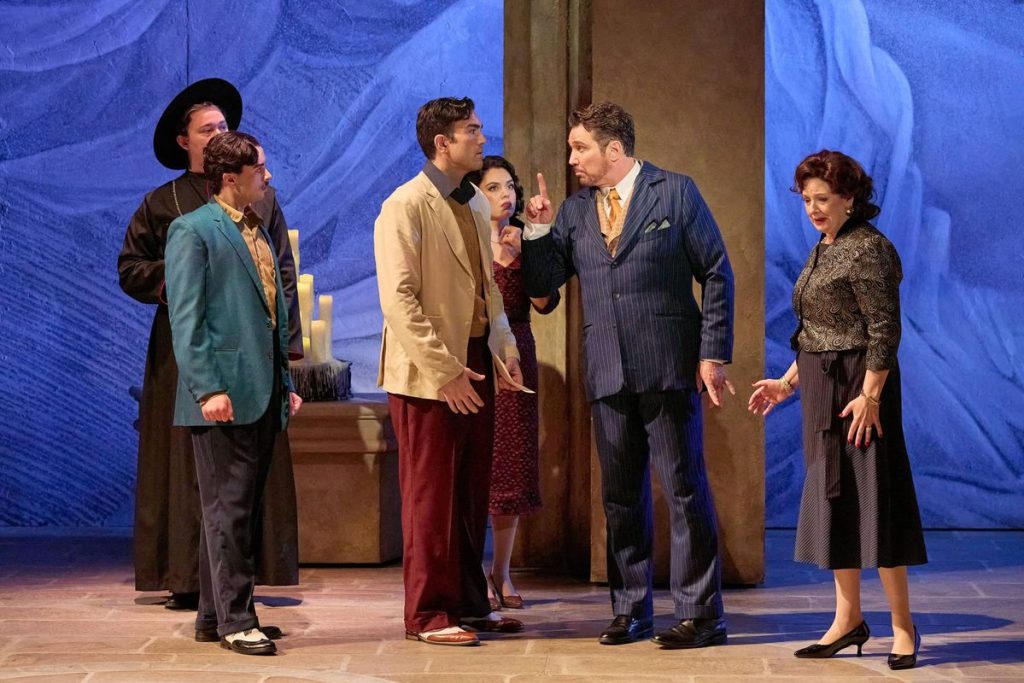
It is a rare pleasure to encounter “Salome,” Richard Strauss’s 1905 masterpiece (after Oscar Wilde’s scandalous play), on a St. Louis stage. Union Avenue Opera’s production reminds us that even in a modest house, this one-act psychodrama retains its power to disturb.

The evening offered superlative singing across the board, a moody if sometimes murky staging and Strauss’s extraordinary score rendered with clarity and bite by a chamber-sized orchestra that, under Scott Schoonover, sounded far larger than its 23 players.

The vocal achievement was formidable. St. Louis’s own Kelly Slawson brought fearlessness and stamina to the punishing title role, her dramatic soprano slicing cleanly through Strauss’s post-Wagnerian textures. The part notoriously demands everything from flights of coloratura to plunges into the contralto register along with sheer brute endurance.

Slawson met those challenges with assurance, shaping a Salome who was as predatory as she was magnetic. She infused the role with a heavy-metal intensity — thrilling, unsettling and never bland.

Opposite her, baritone Daniel Scofield supplied a commanding Jochanaan, his resonant timbre and prophetic fire holding the line against Salome’s obsessive advances.

Daniel Scofield, Kelly Slawson. Photo by Dan Donovan.

Will Upham’s Herod was appropriately febrile, a portrait of jittery decadence, while Joanna Ehlers’s Herodias offered caustic bite and a Wildean cynicism delivered with relish.

Brian Skoog (Narraboth) brought pathos to his brief trajectory, Emily Geller (the Page) added androgynous ambiguity and the quintet of Jews (Zachary Devin, Thomas M. Taylor IV, David Morgans, James Stevens, Fitzgerald St Louis) bickered with crisp ensemble precision. It was a cast without weak voices.

For all its musical strengths, the staging stumbled at two moments of dramatic consequence. The first misstep came early in the opera with Narraboth’s suicide. Poorly blocked, the scene left the audience’s eye on Salome rather than the lovesick captain.

His awkward, almost perfunctory thrust of the sword could have been missed entirely, thereby diluting Herod’s subsequent questions about the bloodied corpse. What should resonate as the opera’s first shocking rupture barely registered.

Will Upham and Joanna Ehlers. Photo by Dan Donovan.

The Dance of the Seven Veils, the opera’s centerpiece, likewise faltered. Slawson committed herself wholly, but the choreography lurched from abrupt pivots to ground- wriggling, from a parody of Norma Desmond to burlesque flourishes, all without discernible logic. A needless ascent and descent of the steps only deepened the sense of randomness.

At one point she barked toward the chorus; at another, the sequence spun into manic incoherence. The result brought to mind Brad Pitt’s turn in “12 Monkeys” — all nervous tics, sudden lunges and wide-eyed mania, as though every acting exercise had been flung on stage at once.

In a film, that kind of method-to-madness can be riveting; in this opera, it scattered the focus of a moment that should be singularly hypnotic. As a seduction meant to clinch the opera’s fatal bargain, the dance distracted rather than compelled — a pity, given the strength of the surrounding production.

Kelly Slawson as Salome. Photo by Dan Donovan.

Schoonover drew exceptional results from the orchestra. Strauss scored “Salome” for more than a hundred musicians, but Union Avenue performed it using Francis Griffin’s reduced orchestration for 23 players. In Schoonover’s hands, the ensemble produced a luminous, incisive sound that never swamped the singers while still carrying the music’s unsettling erotic charge.

Union Avenue’s “Salome” deserves praise as a rare and rewarding opportunity (despite its missteps) to encounter Strauss’s modernist milestone. Vocally and musically, it was a triumph; dramatically, it remained absorbing despite missteps. For audiences willing to face opera at its most decadent and disturbing, this production more than justified the journey.

Union Avenue Opera’s production of “Salome” was performed Aug. 15, 16, 22 and 23 at the Union Avenue Christian Church

The cast of “Salome.” Photo by Dan Donovan.
Daniel Scofield. Photo by Dan Donovan.

Emily Geller, Brian Skoog. Photo by Dan Donovan

Facebook Comments

By Lynn Venhaus

“Eenie Meanie” is the latest Quentin Tarantino-Guy Ritchie wannabe that is derivative of “Baby Driver,” “Drive,” “Fast and Furious” franchise and other pedal to the metal adrenaline rush movies heavy on blood-splattered action and light on logic and depth.

First-time director Shawn Simmons has assembled a recognizable cast headed by charismatic Samara Weaving, but the rest of the characters woefully lack any thoughtful development and are not interesting enough to spend an entire film with – and the main conflict is repellent.

 It’s as if this cast is plopped straight into a B-movie heist plot without any indication if they are either the good or the bad guys, mostly idiots and all caricatures. And each actor seems to be in a different movie.

Weaving is Edie, nicknamed Eenie Meanie, first shown as a glum, nervous teen with awful parents, who later endured a harsh life of foster homes and has a criminal past as a getaway driver.

Samara Weaving and Karl Glusman in “Eenie Meanie”

She’s a very good driver, nevertheless. After the opening scene, depicting how irresponsibly foolish her parents are (Steve Zahn, Chelsey Crisp), the film fasts forward to 14 years later.

Now a single bank clerk going to community college, her roommate is a longtime supportive friend Baby Girl (Kyanna Simone). Edie, spinning her wheels, has a loser boyfriend, among other tough-life dramas. Therefore, given choices, she usually goes with the wrong one.

John, the dippy bad luck-magnet boyfriend, is played by Karl Glusman. They are on-again, off-again, and she’d be much better off without him, because all indications are he’s a Bad Idea.

Gusman, part of ensemble casts in “The Bikeriders,” “Civil War,” and “Greyhound,” among others, tries to make John have some redeeming qualities, but the part is a screw-up, so…

He has screwed up a casino heist scheme by her old boss Nico (Andy Garcia wasted in tough-guy mode). Reluctantly, it’s Edie to the rescue – because she is always cleaning up everyone’s messes.

Marshawn Lynch is a getaway driver, so is Samara Weaving in “Eenie Meanie.”

She finds out she is pregnant, compounding the situation, so she helps the doofus avoid getting beaten to a pulp.  They take off on the run, squealing tires in zippy car chases where they mostly escape danger that keeps popping up.

The couple, who have some interesting exchanges, click on screen as they are pursued by an assortment of cliched quirky characters that are standard in these types of films.

Because of that, the screenplay is less thrilling because it’s a cluttered, clustered mishmash. Is she destined not to get anything she wants in life? That’s very sad.

Her new path is on hold while she deals with these peculiar, mostly unsavory, people. They are all in a never-ending toxic cycle – and why should we care? You feel for Edie because life has given her a big bag of lemons, and she can’t seem to make lemonade, no matter how hard she tries.

Randall Park is misused in a brief, persnickety role, while ex-pro running back Marshawn Lynch appears in a flashier but tiny part as another driver for Nico.  

Hopefully, Weaving will have a better choice of roles in her future. Without a fresh spin, “Eenie Meanie” can’t rise above its hackneyed plot and trite characters, unable to cross the finish line.

“Eenie Meanie” is a 2025 action-crime thriller directed by Shawn Simmons and starring Samara Weaving, Karl Glusman, Andy Garcia, Marshawn Lynch, Jermaine Fowler, Kyanna Simone, Steve Zahn, Chelsey Crisp, and Randall Park. It is rated R for violence/bloody images, pervasive language, nudity, some sexual material and brief drug use, and run time is 1 hour, 46 minutes. It started streaming on Hulu Aug. 22. Lynn’s Grade: C-.

Facebook Comments

By Lynn Venhaus

A dour, dismal retelling of a ​1​930s island utopia that goes horribly awry, “Eden” is supposed to be high-stakes drama where people build a better society, but it turns comical– not in a good way — then the inevitable blood-spilling​ happens.

Based on a factual account of a group of outsiders who settle on a remote uninhabited island only to discover their greatest threat isn’t the brutal climate or deadly wildlife, but each other. They abandon modern society in search of a new beginning.

Jude Law, Ana de Armas, Vanessa Kirby, Daniel Brühl, and Sydney Sweeney see their utopian dream unravel as tensions mount and desperation takes hold. Facing a brutal climate, deadly wildlife, and lack of resources, the colony descends into chaos when a twisted power struggle leads to betrayal, violence and deaths.

Worst of all, Ana de Armas and Vanessa Kirby, two Oscar-nominated actresses, are at their worst, with ridiculous over-the-top performances​. Jude Law is not that much better as an increasingly unhinged doctor-turned-philosopher.

It was an embarrassment for the whole cast but faring better were a nearly unrecognizable Sydney Sweeney and sturdy German actor Daniel Bruehl, who worked with director Ron Howard on “Rush,” but it’s not their task to carry the whole film.

Bruehl’s accent is authentic – the others, not so much.

Sadly, most of this ​l​ethargic film is painful to watch for 2 hours and 9 minutes. Because these people don’t want to be on the island with each other, why should we invest ourselves in their drama?

Based on a true story, director Ron Howard’s misfire unfortunately doesn’t give us a clear point of view because he took two conflicting published accounts of what happened and tried to blend them. He co-wrote the screenplay with Noah Pink, and the result is confusion as to what really occurred — and provides few answers.

Disillusioned Dr. Friedrich Ritter (Jude Law) and his equally peculiar wife, Dora Strauch (Vanessa Kirby), left civilization behind for Floreana in the Galapalos Islands, a province of Ecuador​.

Suffering from multiple sclerosis, Dora hoped the island air would help her physically while Ritter’s radical philosophies are inspiring others with his letter-writing that is being published in Europe. He believes society is doomed and becomes more ​ disturbing as he types his manifesto, obsessed with his crackpot ideas.

That leads to other ‘outsiders’ being lured there, not realizing how hostile the environment would be, and ​unaware they won’t be welcomed by the ​​disdainful duo. 

First to arrive ​a​re industrious Heinz and Margret Witmer (Bruehl, Sweeney) in 1932​. Hard-working and kind, t​h​ey are accompanied by Heinz’s ​obedient son Harry (Jonathan Tittel), who has tuberculosis.

They are good people, but the next to arrive isn’t. Self-absorbed, deceitful and haughty, the ridiculous Baroness Eloise ​Bosquet de Wagner Wehrhorn arrives with an entourage (lovers). Her goal is to build a luxury hotel ​on the beach for only millionaires.

She manipulates the men around her, flaunts her hedonistic lifestyle, and treats the Witmer’s as hired help. The detached Ritters dismiss her​ as a frivolous party girl, until she surprises them with a devious legal maneuver.

De Armas, exerting over-the-top theatricality, schemes, fumes and uses everyone for her own selfish gains. Her soap opera’s villain character becomes tiresome, and her rottenness infects everyone. As an actress, de Armas seems to rely ​more on her sexuality in films, risking becoming a caricature.

Heinz, who fought in World War I, builds a new life for his family, despite setbacks and de Armas’ sabotage attempts. Margret, a young dutiful homemaker, discovers she is pregnant. 

Sweeney has the film’s most physical and harrowing scene as she’s in labor, alone, afraid and surrounded by danger, including a pack of wild dogs. She’s also revealed to be one smart, resourceful woman.

After Law’s impressive performance last year as an FBI agent in “The Order,” he returns to being streaky again with his choices, and here he’s flamboyantly scenery chewing. Spouting Nietzsche and baring all, Law is extremely unlikable as this megalomaniac who believes in his own delusional providence.

Kirby, last seen as the kindly but fierce mother figure Sue Storm in “Fantastic Four: First Steps,” adds aloof bitter shrew to her repertoire.

Shot in Australia, the film premiered at last year’s Toronto International Film Festival and is being released now.

This disappointing effort from Howard joins his other misses, “Hillbilly Elegy” in 2020, “In the Heart of the Sea” in 2015, and “The Dilemma” in 2011.

The story gets darker and drearier, no thanks to Hans Zimmer’s dirge-like score nor Mathias Herndl’s stark cinematography. As the film disintegrates along with the characters – each seem to be in their own different movie – it hints at a “Lord of the Flies” scenario.

The pace, already sluggish, becomes interminable with the inevitable showdown and wrap-up. “Eden” is a disastrous survival story that has little optimism. I’d want to be voted off the island immediately.

“Eden” is a 2024 psychological thriller directed by Ron Howard and starring Jude Law, Vanessa Kirby, Ana de Armas, Danel Bruehl, Sydney Sweeney, Felix Kammerer, Richard Roxburgh, Jonathan Tittel, and Toby Wallace. It is rated R for some strong violence, sexual content, graphic nudity and language,.and its runtime is 2 hours, 9 minutes. It opens in theatres Aug. 22. Lynn’s Grade: D

Facebook Comments