By Lynn Venhaus

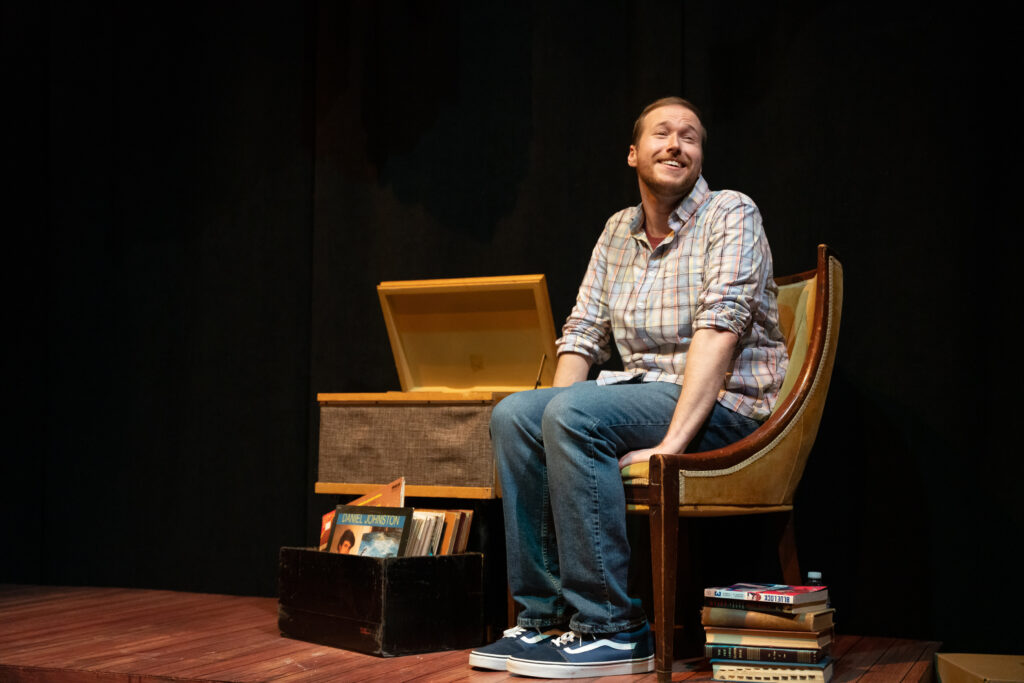
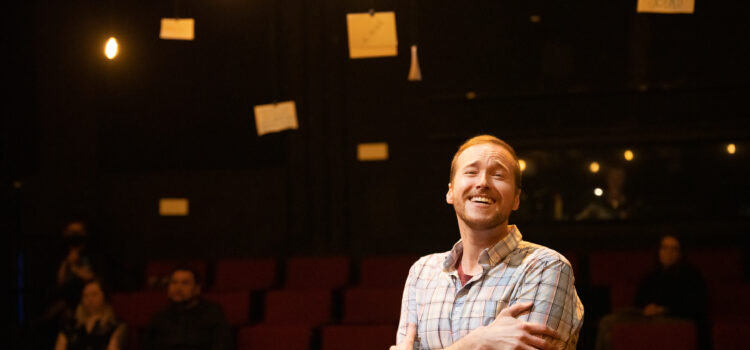
A fascinating piece that combines intricate magic feats with intimate storytelling, “Forget Me Not” is an uncommon presentation.

Illusionist Kyle Marlett engages with an original and autobiographical one-man show that is much more than sleight of hand magic tricks and stunning visuals. As nifty as those inspired bits are, they are part of a bigger picture.

This is not your flashy extravaganza with pulsating music and fancy lighting that you often see as show biz spectacles — nor is it lacking artistry. Quite the contrary. It’s a one-of-a-kind rumination on learning, living, and leaving a mark, done with tender care.

This ambitious production appears to be a solo enterprise, but it’s not, for he has an accomplished cohort. Gunnar Sizemore, an actor who has appeared as Micah in the TV series “Nashville,” is Marlett’s co-creator. He is a director and voice actor, too, known for voicing Bao in the TV series “Kung Fu Panda: The Paws of Destiny,” among others.

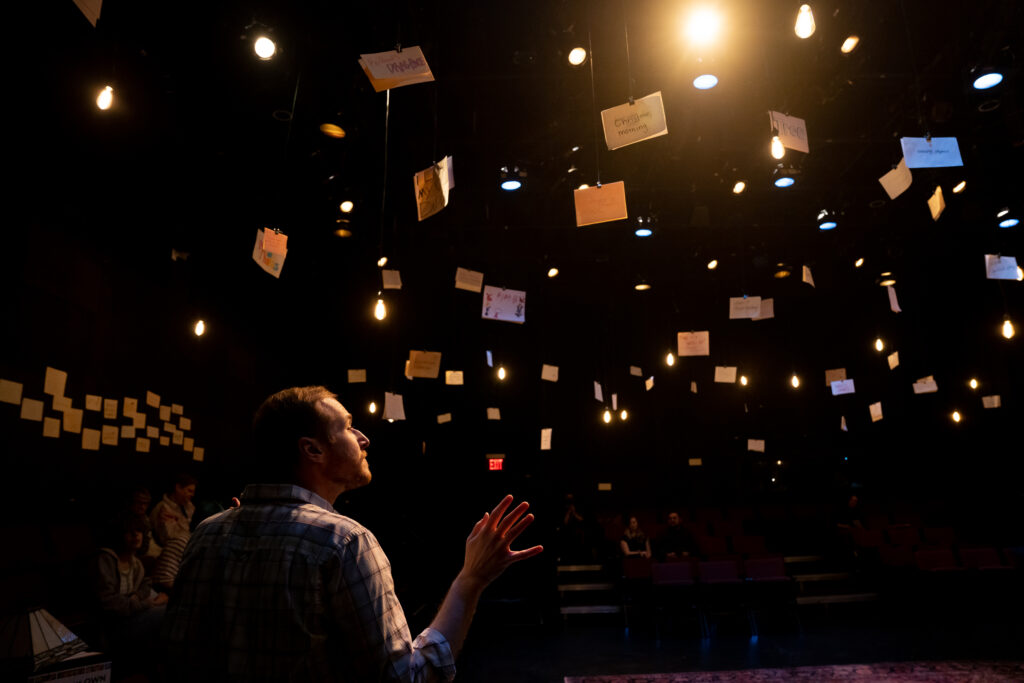
The unusual set design – walls of boxes, some opening for effect, was co-designed with Patrick Huber. Several boxes hang from the ceiling, and are timed to drop as part of the show.

Kyle Marlett “Forget-Me-Not”

The subdued atmosphere includes low lighting and smoky effects, and the sound is soft. Huber was the lighting designer, too, and Marlett designed the sound.

Wearing his heart on his sleeve, Marlett shares his life story in a measured tone, with striking visual flourishes along the journey – such as recounting the times he and his brother shared giant bowls of cereal after school.

He has been estranged from that brother because of drugs. His brother’s woes and his father’s alcoholism didn’t make for a happy childhood, and he grew up escaping into his own fantasy world.

Magic enthralled him from the get-go and determined his path. His story’s unique, yet familiar, and that’s the endgame goal here – to engage people in a memorable way.

It’s doubtful that you’ve seen anything like it before. I know I haven’t.

Marlett has more than 1.5 million followers online and has been on such television shows as “The Tonight Show,” “Penn and Teller’s Fool Us,” and “RuPaul’s Drag Race.” He has also produced magic for movies and streaming series. A few years ago, he appeared at The Gaslight Theatre “in a very different show,” he told me.

Now, this show’s purpose is to focus on more meaningful connections. You know, the heavy stuff – Why are we here? What happens after we’re gone – who will tell our stories? What impact can we have? The clock is ticking, so how do we go about being remembered?

Marlett respectfully asked the audience for their thoughts, and to share some details, while he incorporated magic into the structure. Without razzle-dazzle, they were quite impressive – and the audience reacted warmly.

 This is a departure from the customary fare at St. Louis Actors’ Studio but follows that theme of connection that’s been ever-present in our post-pandemic (well, post-vaccine) world.

The feeling of a shared experience, like live theater represents, remains.

The St. Louis Actors’ Studio presents “Forget Me Not,” Dec. 3-18, Thursdays through Saturdays at 8 p.m. and Sundays at 3 p.m. in The Gaslight Theatre. It is 75 minutes without an intermission. Box office 314-458-2978 or www.ticketmaster, or one-hour before each show. For more information, visit www.stlas.org or contact [email protected].

Facebook Comments

By Alex McPherson

Moody, enigmatic, and unnerving, director Joanna Hogg’s “The Eternal Daughter” is a stylistically ingenious ghost story — featuring Tilda Swinton in dual roles — albeit one that doesn’t land all the emotions it aims for.

The film centers around Julie Hart (Swinton), a filmmaker traveling with her mother, Rosalind (Swinton, with a luscious wig), and her adorable dog, Louis (Swinton’s actual dog), to a countryside hotel in Wales to celebrate Rosalind’s 80th birthday and to surreptitiously write a screenplay inspired by Rosalind’s life.

Rosalind used to spend time at this sprawling estate as a child when her Aunt Jocelyn owned the building during World War II; she associates memories of both joy and sadness within the aged walls. Still, however, the hotel isn’t exactly the most inviting abode — surrounded by jagged woodlands and perpetually draped in a thick fog that threatens to consume anyone within reach. The blustering wind howls through the foundation like a spirit’s cry for help and release.

Upon arrival late one evening, Julie and Rosalind appear to be the sole guests staying there — with only a hilariously passive aggressive receptionist (Carly-Sophia Davies) to greet them. Julie has other things to worry about. These include being able to learn more about the woman she’s spent so much time trying to connect with, yet knows so little about, who she’s mining for her own creative endeavors.

Their usually banal interactions about Rosalind’s experiences, or what to simply order for dinner, allude to deeper anxieties and insecurities. Additionally, whenever Julie tries to focus and write, she’s interrupted by strange noises emanating from somewhere in the hotel, as if the building itself is a living entity trying to dissuade her project. 

A mystifying tale ensues, but Hogg (whose previous filmography includes the somewhat autobiographical “Souvenir” films) isn’t interested in scaring viewers. Rather, “The Eternal Daughter” uses its eerie atmosphere to explore themes of grief, acceptance, and the creation of art itself — of how it works as a preservation of memory and a means to confront life’s challenges.

“The Eternal Daughter” thrives off slow-burn paranoia that immerses viewers into Julie’s increasingly disoriented headspace. From ominous bumps on the floor above, to machines suddenly whirring to life, and doors literally groaning as they shut behind Julie, Hogg succeeds at creating an off-kilter environment that keeps viewers on edge. 

Jump scares are nowhere to be found. Rather, thanks to tactile sound design, distanced yet meticulous cinematography by Ed Rutherford dripping in gothic stylings, and a creepily melodic score by David Saulesco, “The Eternal Daughter” is a psychological chiller that has absolutely no qualms about alienating viewers with short attention spans. It’s deeply immersive from start to finish — letting viewers cautiously wander Julie’s unfamiliar surroundings with her, as she slowly searches for some unknown source that grips her thoughts.

Of course, Swinton’s performances (as both Julie and Rosalind) are exemplary: understated and subtle. Julie’s a tormented character — immersed in her filmmaking work, to the detriment of her social life, without children of her own, and grappling with the reality that Rosalind won’t be with her much longer. She also feels guilty about secretly recording their conversations, “intruding” where she feels she doesn’t belong. Swinton captures Julie’s high-strung demeanor while also showing the widening cracks in her facade. 
Rosalind, on the other hand, is concerned about Julie, but keeps her true feelings subdued — illuminated in brief remarks that, despite their plainness, hit the sensitive Julie like a truck. The bizarre nature of the casting decision quickly fades away, as Swinton fully inhabits both characters and renders them distinct, yet cut from the same cloth nevertheless. It underscores the idea of Julie being unable to separate herself and her well-being from her mother — for better and worse, she struggles to accept the inevitable. 

Hogg’s screenplay succeeds (for the most part) at weaving dark comedy and pathos into the proceedings — the aforementioned receptionist’s weirdly aggressive reactions provide much of the comic relief, as does Louis, one of the best canine actors in the business. A benevolent groundskeeper named Bill (Joseph Mydell), on the other side of the spectrum, exudes warmth and kindness. He stays in touch with his late wife via memories associated with each room in the big house, and tunes us into Hogg’s grand schemes. 

A central theme of “The Eternal Daughter,” in fact, revolves around the ways we stay connected to loved ones who pass, and the ways that self-expression can function as a way to free ourselves of regret and make peace with the past. Julie, in trying to finally connect on a deeper level with her mother, must also confront her own tormented psyche, and art provides a prime medium to do so.

Hogg isn’t a stranger to such themes in her work, but “The Eternal Daughter” feels distinct in the way she crafts a full-blooded ghost story out of (somewhat pretentious) themes. Indeed, by lingering so much on unusual, seemingly minute details, “The Eternal Daughter” is a puzzle box that begs to be solved. The editing, cinematography, dialogue, and music all contribute to an overarching narrative that’s quietly complex. Hogg encourages patience and close inspection — building towards a reveal that’s suitably bewildering. 

The film’s construction also works to its detriment, though. By seeming so impenetrable, at least on first viewing, “The Eternal Daughter” sacrifices heft that prevented me from becoming emotionally wrapped up in Julie’s ultimately small-scale story. The effort the film requires to unpack doesn’t quite equal the payoff, rendering it more satisfying as a conceptual experiment than a gripping narrative. Still, though, for arthouse-inclined viewers, “The Eternal Daughter” will captivate, confuse, and leave them hungering for whatever Hogg has in store next.

Tilda Swinton

“The Eternal Daughter” is a 2022 drama-mystery directed by Joanna Hogg and starring Tilda Swinton, Carly-Sophia Davies. It is rated PG-13 for some drug material and the runtime is 1 hour, 36 minutes. It opened in theaters on Dec. 2 and is available on Video on Demand. Alex’s Grade: B+

Facebook Comments

By C.B. Adams

I have an acquaintance for whom the terms Puccini and opera are synonymous. For him, opera and the Italians define the artform. Although I don’t agree with his limited definition, I can’t deny that the Italians in general and Giacomo Puccini in particular occupy a special space within the opera canon. That’s why Winter Opera’s production of La Rondine, (music by Puccini with librettists Alfred Maria and Heinz Reichert) was a such a solid, comfortable pleasure.

For reasons not worth reiterating, La Rondine (The Swallow) is not considered one of Puccini’s “greatest hits” but, as my acquaintance might say, “Who cares?! It’s Puccini!” I would duly note his fandom and add that we would all be the poorer if La Rondine weren’t performed periodically, despite its modestness. It’s a good Puccini primer, filled with waltzes, melodies, two arias (one perhaps more famous than the entire rest of the opera) and a duet. It further makes Puccini’s higher-profile operas even more impressive by comparison.

The creative team at Winter Opera chose well with La Rondine because it benefits from a tighter production and the stage at the Kirkwood Performing Arts Center. Smaller is better for this opera, something that scenic designer Scott Loebl and stage director Erica Gibson understood, even as swapped Puccini’s original setting from France’s Second Empire era to the “roaring” 1920s. Amy Hopkins’ costume designs were perfectly matched to the updated era, as well.

The updated setting, replete with a raised chessboard-like black and white floor, allowed Gibson to move the characters move like pawns throughout the action. Although the motivation’s of Magda, especially her decision to return to her “old life” in the conclusion of the third act, aren’t understandable or compelling by modern sensibilities, this doesn’t detract from this production. “Who cares?! It’s Puccini,” is latent throughout.

Photo by Rebecca Haas

Puccini placed the La Rondine’s famous aria, “Chi il bel sogno di Doretta,” early in Act One. The piece’s soaring phrases offer sopranos the opportunity to impress an audience. In Winter Opera’s production, soprano Karen Kanakis as Magda compellingly sang the aria with her lilting, floating top notes. The piece ends with the “What do riches matter if true happiness blossoms?” Kanakis delivers this question with  such truth and honesty that it sets up the tragedy of the finale, which turns this line from rhetorically hopeful into sadly ironic.

Matching Kanakis’ performance was tenor Nathan Schafer as Ruggero. Schafer overcame some of the weaknesses of the character through his performance’s clarity and warmth. His duets with Magda were some of the best, even as he had to animate Ruggero’s one-dimensionality (as written). Equally strong were Nicholas Huff as Prunier, Lauren Nash Silberstein as Lisette and baritone Jacob Lassetter as Rambaldo – as well as the chorus.

Bubbling beneath the Winter Opera singer was the orchestra, conducted by Scott Schoonover, artistic director of Union Avenue Opera. The modest size of the orchestra was enlarged by the restrained size and good acoustics of the Kirkwood Performing Arts Center. 

Winter Opera is off to a terrific start with La Rondine, leaving only the question of how they will meet or exceed this accomplishment with the rest of the season’s offerings – Verdi’s MacBeth in January and Sigmund Romberg’s The Desert Song in March.

Photo by Rebecca Haas
Facebook Comments

The award-winning documentary A New Home follows up its festival run on Amazon Prime Video as it continues to introduce viewers across the country to St. Louis’ Bosnian community.

The latest collaboration from Director/Producer Joseph Puleo and Executive Producer Rio Vitale, debuted this past summer where the filmmaking team once again achieved unprecedented success. Their showing was the most attended film as part of the St. Louis Filmmakers Showcase and took home both Best Documentary & Best Sound (Documentary).

A coveted feature screening slot at the 31st St. Louis International Film Festival also provided local theater-goers an encore viewing opportunity this past November.

“I greatly admire the way Joseph Puleo shows our city and our civic heritage in cinematic love letters to St. Louis, highlighting ethnicities that have made a vital and lasting impact on the place we all call home,” explains Cinema St. Louis Artistic Director Chris Clark. “His films are perfectly crafted, well-oiled machines that always draw a crowd due in no small part to his endless drive and passion to promote both his own work and the events themselves.”

In a follow up to America’s Last Little Italy: The Hill, the duos new film examines the story of Bosnian War refugees fleeing to St. Louis, Missouri, 30 years ago. As the war in Ukraine continues to rage and thousands of its citizens are displaced and seeking new homes, the plight of the Bosnians remains as relevant as ever.

Joey Puleo

When Bosnians fled their homes to escape the war in 1992, many ended up in St. Louis, largely because of its affordable housing and available jobs. The new arrivals began assimilating, starting their own businesses and transforming a once dilapidated South City neighborhood in the shadow of the Bevo Mill into a thriving “Little Bosnia.” Over the ensuing three decades, an estimated 70,000 Bosnians have migrated to St. Louis, making it the most inhabited area for Bosnians outside of Bosnia itself.  A New Home tells the story of these refugees’ perseverance and determination to not only start life over but prosper.

Pre-production on A New Home began in the spring of 2021 with hours of VHS footage and more than a thousand photographs generously donated to the project to utilize during the editing process. The film also includes interviews with luminaries including Patrick McCarthy, author of After the Fall: Srebrenica Survivors in St. Louis; Ben Moore, Senior Researcher at the Center for Bosnian Studies; Anna Crosslin, past president of the International Institute of St. Louis; former Missouri congressman Russ Carnahan; and Doug Moore, a former journalist at the St. Louis Post-Dispatch, as well as 5 Bosnian War survivors and refugees.

A New Home is a fascinating documentary that I highly recommend,” states former Mayor of St. Louis, Francis Slay, who is also featured in the film. “I hope everyone in the St. Louis area gets a chance to watch and not only be entertained but learn about their Bosnian neighbors’ struggle for safety and freedom and the lasting impact they have had on our entire region.”

“This documentary was a complete labor of love,” said Puleo. “To be trusted with telling the harrowing and triumphant story of the Bosnians in St. Louis was not a responsibility that I took lightly and their courageous resolve inspired me to give this film all I could give. The audience response so far has been overwhelmingly positive and we cannot wait for more people to get the opportunity to see A New Home through Amazon’s portal.” 

Joey films Medina and Adis Hasanagic and their children

About The Creators:

Joseph PuleoDirector/Producer

Joseph Puleo was born on July 13, 1992, in St. Louis, Missouri. He attended Lindenwood University and graduated from their school of film in 2014. His short film, Top Son (2016) was a Top 5 finalist in Kevin Hart’s LOL Network “Eat My Shorts Competition” where it screened at the Just For Laughs festival in Montreal. His debut feature-length documentary, America’s Last Little Italy: The Hill (2020) was shown on PBS stations across the country and received multiple awards.

Rio Vitale, Executive Producer

Rio Vitale was born in St. Louis, Missouri, and has 40 years of experience in the financial brokerage industry. In 2014, Vitale published his first book, St. Louis’s The Hill. In 2016, he was knighted by the Italian government for his extensive work in the Italian community. In 2020, Vitale began a new venture into film production, executive producing the award-winning feature-length documentary, America’s Last Little Italy: The Hill.

To read the “Take Ten with Joey Puleo,” click here:
https://www.poplifestl.com/take-ten-with-fillmmaker-joey-puleo/

Facebook Comments

Hall will be in concert with Special Guest Todd Rundgren on Thursday, Dec. 1, at 7:30 p.m. at Stifel Theatre in St. Louis

By Lynn Venhaus

A soul survivor spanning 50 years in the music business, Daryl Hall still gets excited talking about performing live.

You can hear the enthusiasm about his latest venture in his voice during a recent phone interview. He embarked on the BeforeAfter Tour April 1 in Chicago, his first solo tour in more than a decade, and it’s been extended twice, launching again on Nov. 19, and wrapping up this week.

He will appear in concert on Thursday, Dec. 1, at Stifel Theatre in St. Louis, along with his special guest — old friend and fellow Philadelphian, Todd Rundgren.

Tickets are available for the show that starts at 7:30 p.m.: https://www.ticketmaster.com/daryl-hall-and-the-daryls-house-st-louis-missouri-12-01-2022/event/06005D2F8AF11B70

The last show for this year is Dec. 3 in Evansville, Ind.

“We are so happy because it’s been beyond our expectations,” he said from his home in Connecticut. “People are loving the show. It’s a big departure for me being out on my own and starting this new thing.”

Before After

Hall has released his first-ever solo retrospective, “Before After,” which features 30 selections from his five solo albums, from “Sacred Songs” in 1980 through “Laughing Down Crying” in 2011. In addition, the collection features six never-released performances from “Live from Daryl’s House,” his acclaimed web and television series.

The two-disc album, from Legacy Recordings, a division of Sony Music Entertainment, can be purchased here: https://legacyrecordings.lnk.to/BeforeAfterPR

The current Daryl’s House Band accompanies Hall and Rundgren, and includes guitarist Shane Theriot, bassist Klyde Jones, saxophonist Charlie DeChant, keyboardist Elliott Lewis, drummer Brian Dunne and percussionist/singer Porter Carroll.

“I have the best band in the world,” he exclaimed. “They travel with me all the time. Their experience shows on stage.”

Two new episodes of “Live from Daryl’s House” have been recorded and he said they’re getting ready to do a third, so stay tuned.

Todd on Live From Daryl’s House

Hall, 76, and Rundgren, 74, continue to thrive on the music paths they started as teenagers.

Both singer-songwriters and multi-faceted musicians, they have produced and arranged recordings for much of their Hall of Fame careers.

For this tour’s setlist, Rundgren starts off with an individual set, followed by an intermission, then by Hall. Then, they come together for the grand finale.

During the pre-vaccine part of the pandemic, when the world shutdown, so did he.

“I didn’t write a song. I hardly left the house. I slowed down,” Hall said.

But working on the retrospective and mapping out a tour was the impetus he needed to get back to doing what he loves to do.

Why take to the road after having such a long illustrious career?

“I am a working musician,” he said. “I live to work. I also have these guys (the band) to take care of. It is hard to challenge just yourself. This tour is a labor of love. I enjoy the work.”

Hall was thrilled to play at Carnegie Hall in New York City and Ryman Auditorium in Nashville for the first time.

Grateful to be connecting again with live music, he’s as invigorated as the fans.

“People are ready to go out and have a good time, relax. We’ve tapped into that need for human connection after the past couple of years,” he said.

That Philly Soul

Bonded by their Philly roots and simpatico relationship, Hall and Rundgren are a match that fans have responded to, described as a ‘dream team.’

Todd, Oates, Hall in 1974 (see info below)

“We grew up 20 miles from each other in Chester County (southeast Pennsylvania, part of Philadelphia metro area, Hall in Pottstown and Rundgren in Upper Darby),” he said. “We were aware of each other, but we didn’t meet until we both had moved to New York City at the same time.”

Where they met still makes him smile.

“We met at a showing of the movie ‘Fantasia,’ which is just so perfect, and we talked about how we should record together,” he said.

That led to Rundgren producing Hall & Oates’ third album, “War Babies,” in 1974.

“We continued to work together. He’s a real kindred spirit,” he said. “Todd’s music is so soulful, eclectic. He’s a maverick. We literally come from the same place. We were made to work together.”

Fans already know how good the blue-eyed soul pair sound together, for they’ve created magic both at Daryl’s home studio and at Todd’s place in Hawaii.

Their music has been flavored with the Sound of Philadelphia – noted for its funk and rhythm and blues fusion with pop, with a jazzy melodic structure, often including horns and strings in the instrumental arrangements. Philly soul can be heard in such acts as The Spinners, O’Jays, Delfonics and Stylistics.

“It was a very big influence in my music. You can’t help but have pride in the Philly Sound, it’s still a major influence in the world,” he said.

As the best-selling duo of all-time with John Oates, Hall had six no. 1 hits in the 1970s and 1980s. Hall & Oates’ accessible pop has stood the test of time – and you can hear their greatest hits used in current commercial campaigns.

Inducted into the Rock and Roll Hall of Fame with Oates in 2014, they team up from time to time, including several concerts this past year.

Hall, whose mom was a vocal teacher and choir director, said he can’t remember a time when he wasn’t singing. While in college at Temple University, he recorded his first song with a group he formed, The Temptones. He was 18, and he’s been recording ever since.

In the early days of Hall & Oates, they didn’t break through with major success until “Sara Smile,” was released as a single in 1975.

“That song is very significant to me,” he said. “It was very exciting to hear it on the radio. It was an indescribable feeling.”

(“Sara Smile” was about his girlfriend at the time, Sara Allen, who contributed to some of Hall & Oates’ most popular songs – “You Make My Dreams,” “Maneater,” “Private Eyes” and “I Can’t Go for That” among them. They were in a long-term relationship for about 30 years, breaking up in 2001).

Live from Daryl’s House

Just as Hall & Oates had their many successes during the early days of MTV, embracing music videos as a promotional tool, Hall has managed to reinvent himself in the digital age through his award-winning series.

He launched LFDH as a free monthly show on the internet in 2007 and played music with friends. He wanted it to have a relaxed vibe of hanging out and having a good time jamming. It also ran on television, including Viacom’s Palladia channel.

“It’s been phenomenal. It was an idea whose time had come. Nobody was watching the internet then. How times have changed since then,” he said.

Fans new and old responded to his collaborations with the latest generation of musicians as well as his contemporaries – and a variety of genres. He’s played with Neon Trees, Jason Mraz, Smokey Robinson, The Spinners, Tommy Shaw, Kenny Loggins, Joe Walsh, and The Goo Goo Dolls.

Winner of a Webby Award for best variety series and O Music Award from MTV for best performance series, LFDH has recorded 82 episodes, some of which are archived on his website, while others are available on YouTube.com

For many years, he recorded the show in the 18th century home he rehabbed in New York’s Hudson Valley, in Millerton, but then moved to Connecticut. For a new place starting with the 66th episode, he renovated the former Towne Crier nightclub in Pawling, N.Y., into a restaurant-and-live-music venue, which opened in 2014. It is currently open for business and offering live entertainment.

https://www.livefromdarylshouse.com/welcome.html

For more on the artists:

John Oates, Daryl Hall

Hall & Oates

They met in 1970 while students at Temple University, and recorded their first album, “Whole Oats,” in 1972. A year later, “Abandoned Luncheonette” followed, featuring the hit “She’s Gone.”

With the release of “Sara Smile” from what’s known as “The Silver Album” in 1976, they became superstars. In 1987, the Recording Industry Association of America declared they were the best-selling musical duo of all-time and have maintained that record.

Hall would be a part of “We Are the World” and the duo was on the stage during Live Aid in Philadelphia in 1985. They also backed up Tina Turner and Mick Jagger.

As for his description of St. Louis legend Turner, Hall said: “She’s great. She’s very gracious and kind,” he said, noting that the first record he bought at age 12 was Turner’s.

Todd Rundgren

Todd Rundgren

Rundgren began playing guitar as a teenager and formed the psychedelic garage rock quartet Nazz in 1967, releasing three albums between 1968 and 1971. He re-recorded his hit song, “Hello It’s Me” as a solo artist. He released “Runt,” his first solo album, in 1970, and learned how to produce an album himself.

A production deal led him to projects with Janis Joplin, the Band, Patti Smith, and others. He also produced albums for the New York Dolls, Grand Funk Railroad, Meat Loaf and Daryl Hall & John Oates.

For his 2-disc masterpiece, “Something/Anything?” in 1972, he sang all the vocal parts and played all the instruments on three of the four sides. He has released 25 solo albums and 10 with Utopia. His latest, “Space Force,” was released on Oct. 14.

His music video for ‘Time Heals” was the eighth one played when MTV launched on Aug. 1, 1981.

He is genuinely regarded as an innovative and resourceful singer, songwriter, musician, sound engineer and record producer. A multimedia artist, he is considered a pioneer in the fields of electronic music, progressive rock, music videos, computer software, and Internet music delivery. By the mid-90s, he was experimenting with interactive CD-ROM and new video technology.

He was inducted into the Rock ‘n Roll Hall of Fame in 2021, although he refused to attend the ceremony.

He has toured with Ringo Starr and the All-Star Band, the new Cars and recently appeared on the Celebrating David Bowie tribute tour in October and November.

Photos: Todd Rundgren, on his 26th birthday, on June 22, 1974, was in concert at the Wollman Rink in Central Park, and Daryl Hall and John Oates were part of his ‘chorus.’ He was producing their “War Babies” album then. (Photo posted on YouTube, with audio, from the 1974 concert: https://youtu.be/ls0Yje9-woI)

Facebook Comments

By Lynn Venhaus

What a pleasant surprise the leap of faith “Ordinary Days” is – as the inaugural musical presentation of Tesseract Theatre Company, as an original musical by Adam Gwon, as a coda to this year and as a reflective piece for our third winter of a pandemic.

An intimate, affecting sung-through musical that intersects the lives of four young New Yorkers, “Ordinary Days” resonates with its struggles, search for fulfillment and the palpable sense of yearning from the new-to-me quartet.

Discovering the vocal talents and comedic timing of Brittani O’Connell, Jacob Schmidt, Micheal Lowe, and Lauren Tenenbaum is also part of the fresh-and-fun experience.

As directed by veteran Elisabeth Wurm, the cast maneuvers like the New Yorkers they portray. There’s a certain rhythm to moving around the city, and the four performers nail the aptitude and the attitude. (Full disclosure: my youngest son has lived there since 2011, so I have visited over the years, and have observed the natives, transplants, and tourists.)

When navigating the hustle and bustle, I am often reminded of Stephen Sondheim’s lyrics to “Another Hundred People” in “Company”: “It’s a city of strangers, Some come to work, some to play… Some come to stare, some to stay And every day The ones who stay
Can find each other in the crowded streets and the guarded parks…”

Worried about their futures while still clinging to their hopes and dreams, these two pairs have found each other in a city misrepresented by a cold-hearted perception. It’s not, but you must learn survival — “If I can make it there, I can make it anywhere” is pretty much true.

Tenenbaum is Deb, a small-town girl with dreams of more, who is in grad school and misplaces a notebook crucial to her thesis. It’s found by Warren, a guileless goofy guy played by Schmidt, who is too pleasant and agreeable for his own good, for he’s one of those random guys passing out flyers on the street who is repeatedly ignored. His job is cat-sitting but he’s the proverbial struggling artist. He’s desperate to fit in – can he still be chipper when trying not to get swallowed whole by the city?

Frazzled high-strung Deb is always in a hurry, and will eventually learn to be in the moment, or else the treasured little things in life will pass her by. She thinks Warren is weird, but eventually they become good friends.

Jacob Schmidt, Lauren Tenenbaum

 The other couple is romantically linked. They have been together for a while but mulling over taking it to the next level, as Jason moves his things in to Claire’s. But something isn’t quite right. O’Connell plays Claire, whose backstory includes a 9-11 casualty, and Lowe is Jason, whose journey leads to commitment, but is Claire ready?  

Learning to appreciate the simple things of life – while feeling lonely, isolated, and out of sorts – has been a common theme during the coronavirus pandemic, which has brought a gamut of emotions to the surface since March 2020.

So, Adam Gwon’s play, written in 2008, takes place in 2005, which is important for the actions and transitions. It is a marvel of relatable key moments – Oh, youth! The 30s! – and somehow, reverberates with the same contemplations we’ve had during this pandemic era of uncertainty.

Gwon is a noteworthy talent, included in Dramatists Magazine’s “50 to Watch,” and “Ordinary Days” put him on the map. His lyrics are sharp and vibrant, have an everyman quality and universal appeal. (He also wrote the revue “Old Jews Telling Jokes,” which was presented by New Jewish Theatre in 2014.)

Tesseract’s presentation of “Ordinary Days” is a fine introduction to his music, and Music Director Zach Neumann deftly plays the keyboards and keeps the pace brisk for the singers, whose strong enunciations and interpretations really make the vivid lyrics hit home.

Schmidt sets a convivial tone with “One By One By One,” then shades his character’s personality through “Life Story” – his heart and his humor apparent.

Tenenbaum, also quirky but bursting with possibilities, explains her life to date in “Don’t Wanna Be Here” and her mojo in “Dear Professor Thompson, Part I” – continuing her funny bundle of nerves.

Deb and Warren’s meet-cute at The Metropolitan Museum of Art turns into a sweet duet “Sort of Fairy Tale” – ‘violent punctuation”! And continues with “Big Picture.”

Brittani O’Connell, Micheal Lowe

The Met figures into Claire and Jason’s relationship, but not as positive as the other pair’s.

While moving in, gifted vocalists O’Connell and Lowe explore their next-step feelings in “Let Things Go” and “The Space Between,” and go through their stuff in “I’m Trying.” They succinctly sum up a couple’s argument with a lighter humorous touch in “Fine.”

Among the most poignant is O’Connell’s “I’ll Be Here” – which should elicit leaky eyes from nearly everyone – and Lowe’s simple but so eloquent “Favorite Places.”

The hits just keep on coming — “Hundred-Story City” captures the love-hate relationship that New Yorkers have with the concrete jungle. And “Rooftop Duet/Falling” ties the show together.

Claire has realized she must let go of the past before she can move on, and O’Connell’s character arc is the deepest felt, but all performances are warm and captivating. They harmoniously come together in the stirring finale “Beautiful.”

With the focus squarely on the individuals and how they factor in with others, the set design is simple, and relies on photographs projected on the large screen – sights of living in New York City. (NYC always feels familiar because we’ve seen it so many times in entertainment.)

If you feel that you have taken away from our recent 21st century life-and-death experience the importance of connection, like I have, then this timely and charming reminder to appreciate beauty and joy in our lives, no matter how small or fleeting, delivers its heartfelt message as only live theater can.

This may be Tesseract’s first musical, but it won’t be their last, as they are planning to present the two-hander “The Last Five Years” by Jason Robert Brown in February and the Tony Award winner for Best Musical in 2013, “Kinky Boots,” later this year.

I’m liking this leap of faith Taylor Gruenloh has set his company on – and the first step is a knockout, a memorable musical for our times. Dare I say “optimistic”?

Tesseract Theatre Company presents “Ordinary Days” Nov. 18-27 on Friday at 8 p.m., Saturday at 8 p.m., and Sunday at 4 p.m. at the. Zack Theatre, 3224 Locust. Tickets are available at MetroTix.com or at the box office before the performance. $25 for general audience and $20 for students. For more information, visit www.tesseracttheatre.com

Facebook Comments

By Lynn Venhaus

Dear Mr. Spielberg,
Your movies have given my family and I so much joy over the years. I was away at college the summer of 1975 when one warm July night, my roommates and I went to see “Jaws” at the local movie theater. You invented the summer blockbuster, and ever since, all your movies have been an event.

I introduced my children to “E.T.” first, and I still tear up every time I watch it. “Jurassic Park,” “Saving Private Ryan,” “Schindler’s List,” “Raiders of the Lost Ark” and “Lincoln” — you’ve made some of the best films of all-time.

“Bridge of Spies,” “Catch Me If You Can,” and “The Post” are personal favorites, and your adaptation of “West Side Story” was at the top of my Ten Best List last year.

So, I had very high expectations for “The Fabelmans,” especially after viewing the “Spielberg” documentary on HBO. I know it’s “loosely based on your childhood, from age 7 to 18, and it explores the power of how movies help us see the truth about each other and ourselves.

Maybe that adage, “Never meet your heroes” applies here.

Because, while I find the performances exceptional and the production elements superb, your retelling of your ‘semi-autobiographical’ coming-of-age story isn’t as magical as your other films.

THE FABELMANS, from left: Paul Dano, Michelle Williams, Seth Rogen, 2022. ph: Merie Weismiller Wallace / © Universal Pictures / Courtesy Everett Collection

Yes, you followed your dream, but turns out your childhood isn’t all that extraordinary. Except for the reason your parents’ marriage broke up, your early life was like many other kids – divorced parents, dad moving because of work, an artistic kid being bullied and for Jews, antisemitism.

Basically, you had a rather “Leave It to Beaver” childhood, not as vanilla as many a WASP, but fairly typical — your parents loved you and your sisters, attempted to give you a wonderful life, and your dad was a genius engineer.

As a filmmaker, you were too close to the subject matter, and needed to get out of your own way.

When you concentrate on discovering your passion for filmmaking and finding ways to tell a story, now that’s fascinating.

But all that high school drama with the mean jocks, yawn. Except for the Ditch Day film, which really highlighted your gifts and how people are revealed upon observation.

But — two and a half hours? And the best scene is at the end! You stuck the landing beautifully – and that little nod to Charlie Chaplin’s The Tramp before the credits roll, chef’s kiss.

That final encounter on the studio lot gives the film the zest that was missing – and it was the spark that propelled your drive to be in the business.

It’s the best cameo of the year, no spoiler from me!

Gabriel LaBelle as Sammy Fabelman

Your life as a golden boy of cinema has introduced you – and us — to worlds of wonder, and we feel like we know you.

The film is heartfelt and shows how much love you have for your family and the movie-making process. Artists must create and you have been able to make an impact on a global scale. Truly remarkable.

You will be remembered as one of the greatest directors of all time, and we see the effort.

I will wait for the sequel that discloses your early career milestones, breaking through in Hollywood, and the people that shaped you along the way. Now, that story may be the extraordinary one that I was expecting here.

Sincerely, an unabashed fan whose favorite thing is discussing entertainment, and thinks that all of life’s riddles are answered in the movies.

Back to the nuts and bolts for review purposes — Gabriel LaBelle makes quite an introduction as gawky young Sammy Fabelman, who makes movies using his Boy Scout troop as cast and crew.

Paul Dano and Michelle Williams are well-suited to play parents Burt and Mitzi, who bring up four children born during the post-World War II Baby Boom and moved the family from New Jersey to Arizona to Southern California before finally divorcing.

Williams has flashes of brilliance as the mercurial mom, a classically trained pianist whose concert days are past, but the longing isn’t. She’s in love with Bennie (Seth Rogen), Burt’s best friend, and they are eventually together.

When Sammy’s keen eye discovers a little too intimate interaction between the pair during a family camping trip, he’s devastated, resulting in viewing his mother differently. It’s a powerful scene when he shows, not tells, her what he saw.

That conflict is a major focus of the original screenplay co-penned by Spielberg and collaborator Tony Kushner.

A smaller one is his computer whiz dad thinking filmmaking is a hobby and that Sammy needs a more stable career pursuit, but that is a standard trope between artists and scientists. Dano’s quiet demeanor effectively contrasts with Williams’ more flamboyant personality.

Appearing briefly in a slight but showy role that screams supporting actor nomination, Judd Hirsch is an eccentric uncle who used to be in the circus and recognizes a kindred spirit in Sammy.

Young Sammy, who must react to his first film, “The Greatest Show on Earth,” in 1952, is played by standout Mateo Zoryan.

Janusz Kaminski’s cinematography is splendid, so is Rick Carter’s production design, and John Williams has produced a fine score.

But, there is just something nagging about a film that I wanted to be great, but is just good.

“The Fabelmans” is a 2022 drama directed by Steven Spielberg and stars Gabriel LaBelle, Michelle Williams, Paul Dano, Judd Hirsch and Seth Rogen. Rated PG-13 for some strong language, thematic elements, brief violence, and drug use, and run time is 2 hours, 31 minutes. In theaters Nov. 23. Lynn’s Grade: B

Facebook Comments

By Alex McPherson 
Visually spectacular and thematically rich, “Guillermo del Toro’s Pinocchio” is a feast for the senses, a rallying cry for rebellion, and a reminder to cherish those we hold dear.

Utilizing stop-motion animation and updating Carlo Collodi’s 1883 story to 1930s Italy — during a scourge of fascism, with the threat of violence ever-looming — the film zooms in on an elderly carpenter named Gepetto (voiced by David Bradley, with ample tenderness), who tragically loses his young son Carlo (Gregory Mann) in a bombing.

Drunk, furious, and at the end of his rope, Gepetto chops down the tree growing from Carlo’s tombstone — which turns out to be the home of the erudite, self-absorbed Sebastian J. Cricket (Ewan McGregor) — and crudely fashions together our titular Pinocchio (also voiced by Mann) as a stand-in for his lost child.

A vibrant, yet ominous Wood Sprite (Tilda Swinton, as cooly off-putting as always), with dozens of eyes peppering its wings, takes pity on Gepetto and brings his hurried creation to life, entrusting Sebastian to be Pinocchio’s moral guide. Suffice to say, Pinocchio’s first moments don’t go entirely smoothly. He careens across Gepetto’s cottage with gleeful abandon — destroying practically anything that gets in his way — as Gepetto watches, horrified, dodging incoming projectiles. 

Pinocchio’s a lively, rambunctious, and curious soul, but Gepetto’s constant need to make him behave and fit certain roles — most notably, that of Carlo — only ends up backfiring. Townsfolk, most of whom are religious, immediately label Pinocchio as an Other to be ostracized. A fascist official named Podesta (a menacing Ron Perelman) takes a keen interest in Pinocchio’s peculiarities, as does the slimy owner of a traveling carnival, Count Volpe (Christoph Waltz), and his abused “assistant,” Spazzatura (Cate Blanchett, convincingly imitating a monkey).

What follows is a meditation on grief, freedom, childhood, and death that follows the general trajectory of Collodi’s vision and Disney’s 1940 iteration of the story, but with an extra helping of del Toro’s trademark empathy and political fervor.

Indeed, from a visual perspective alone, “Guillermo del Toro’s Pinocchio” is damn-near flawless. From the minute, tactile details poured into each and every character, it’s clear that the film is a labor of love from all involved.

Del Toro and co-director Mark Gustafson (the animation director of Wes Anderson’s brilliant “Fantastic Mr. Fox”) imbue these hand-sculpted figures with expressiveness (both grotesque and enchanting, often simultaneously) that — paired with the impeccable voice cast — beautifully suits this tale of love and compassion amid suffering.

The occasional rough edges only strengthen the characters’ authenticity, each molded from a world that’s beaten them down, in one way or another, in attempts to maintain control and “order.” Frank Passingham’s eye-popping cinematography takes full advantage of the freedom of animation to present numerous shots that won’t leave my mind anytime soon — particularly regarding the freakishly unnerving sea beast.

Pinocchio himself feels right at home in del Toro’s oeuvre — charming, naive, ignorant — thrust into an unfamiliar environment and told to obey. This pressure put on him by Gepetto to be someone he’s not is mirrored by Podesta’s son, Candlewick (Finn Wolfhard), who’s being forced to adopt a vile ideology forced on him by his father and by the larger authority. 

Mann brings an expert level of innocence and confidence to the character, delivering both heartwarming and heart wrenching dialogue throughout. Pinocchio’s coming-of-age is as poignant as ever as he fights his way out of heinous situations — including exploitative work conditions, for entertainment and in service of a tyrannical government — to finally be seen as more than the irreplaceable Carlo in Gepetto’s eyes and to be loved for who he actually is. In this regard, Gepetto has just as much to learn about himself as Pinocchio does, and del Toro renders him a flawed, uncertain, yet deeply caring person, capable of growth even at his old age.

On the lighter side, McGregor is often hilarious as the stringent, wiseass cricket, shouldering most of the film’s laughs. Del Toro and Patrick McHale’s script crackles with sly, dark humor, paired with plenty of slapstick comedy at Sebastian’s expense, that never insults viewers’ intelligence. Waltz’s iconic line delivery perfectly suits Count Volpe’s capitalistic deviousness, and Blanchett is incredible without uttering a single line in English — her vocal mannerisms as the poor monkey Spazzatula convey multitudes.

Even though “Guillermo del Toro’s Pinocchio” follows a familiar template, there’s boatloads of creativity on display in terms of storytelling and aesthetic grandeur. Setting the tale during Mussolini’s reign gives Pinocchio’s acts of disobedience even more weight, and the emphasis on mortality (and the afterlife, given a morbidly idiosyncratic spin) adds wrinkles that caught me off-guard in the end, nearly bringing me to tears.

Additionally, it’s, for some reason, a musical, and while Alexandre Desplat’s score is typically sublime, the songs aren’t exactly necessary to keep the plot moving. That minor quibble aside, this is a film full of joy, sadness, danger, and understanding of life’s great challenges — one that will prove to be a timeless achievement.

“Guillermo del Toro’s Pinocchio” is a 2022 stop-motion animated musical fantasy film co-directed by Guillermo del Toro and Mark Gustafson and voice-work is done by David Bradley, Gregory Mann, Ewan McGregor, Ron Perelman, Christoph Waltz, Cate Blanchett, Tilda Swinton, John Turturro, Tim Blake Nelson and Finn Wolfhard. It is rated PG for dark thematic material, violence, peril, some rude humor and brief smoking and the run time is 1 hour, 57 minutes. It was released in select local theaters on Nov. 18 and will be streaming on Netflix Dec. 9. Alex’s Grade: A.

Facebook Comments

The ELO Tribute Band will Headline Show at Delmar Hall on Thanksgiving Eve Nov. 23

By Lynn Venhaus

Majestic splendor.

That’s the sight, sound and the vibe of Mr. Blue Sky, the St. Louis-based Electric Light Orchestra tribute band that makes sure every multimedia production is authentic.

With its 10 bandmates and dazzling visual imagery taking the audience both back in time and into the future, their intricate harmonies and musicianship stand out.

When Mr. Blue Sky takes the stage at the Delmar Hall on Nov. 23, the third time’s a charm for they have sold out that venue twice before (Hint: get tickets now, for the night before Thanksgiving is considered the biggest night out of the year. Tickets are available through Ticketmaster (see link at end of article). Doors open at 7 p.m., show starts at 8 p.m. Delmar Hall is at 6133 Delmar Boulevard.

Local legend Steve Ewing from the Urge (and Steve’s Hot Dogs) will open the show with his duo.

This special night will be different from their triumphant appearance at the Chesterfield Amphitheater two months ago (where they drew 1,500 people), for they like to mix it up for every appearance.

Veteran St. Louis musician Jeff Faulkner, who assembled the tribute band three years ago, said the Nov. 23 show will feature two new songs and a different setlist.

Jeff Faulkner of Mr Blue Sky

“We do all the hits — 22 top ten hits, we always play those,” Faulkner said. “Then we’ll play deeper cuts like ‘Face the Music,’ we play some Traveling Wilburys. We played the ‘Discovery’ album in entirety when we were at The Wildey.”

He enjoys introducing the symphonic rock icons to new fans and reminding longtime fans of their legacy.

“It’s really great music. I think Jeff Lynne is one of the best singer-songwriters in the history of rock ‘n roll,” he said. “He is a musical genius.”

Besides Faulkner on lead guitar and vocals, their all-star line-up includes Dave Watkins on lead guitar and vocals; Anastasia Hamilton, vocals; Abby Stahlschmidt, violin; Jessie Youngblood, violin; Jake Brookman, cello; Stephen Winter, keyboard and vocals; Charlie Brown, keyboard and vocals; Steve Bunck, drums; and Ben Moyer, bass and vocals.

The group’s musicians have performed with local heavyweights Pavlov’s Dog, That 80s Band and the St. Louis Symphony Orchestra. And have toured with The Who and Weird Al Yankovic.

Besides Delmar Hall, they’ve sold out shows at The Pageant, The Wildey Theatre, The Duck Room, and Ballpark Village. They recently performed in the Chicago area, at Impact Fuel Room in Libertyville, to a rocking crowd.

“A fair percentage of people that we’re playing for are familiar with ELO’s music – even if they don’t realize it. Probably 90% of them know ‘Mr. Blue Sky,’ Faulkner said. “They’re used in so many movies, so many commercials. Even if you don’t think you know ELO, you know ELO.”

Faulkner fell in love with the English rock band at an early age. Their fusion of modern rock and pop with classical overtones intrigued him.

ELO was formed in 1970 by songwriters and multi-instrumentalists Jeff Lynne and Roy Wood with drummer Bev Bevan, and following Wood’s departure in 1972, Lynne became the sole leader, arranging and producing every album – and wrote nearly all their original material.

Lynne disbanded the group in 1986, but Bevan formed his own, ELO Part II, which later became the Orchestra. Apart from a brief reunion in the early 2000s, ELO wasn’t active again until 2014, when Lynne reunited with Richard Tandy as Jeff Lynne’s ELO.

During their original 13 years of active recording and touring, they sold more than 50 million records, and had 15 Top 20 songs on the Billboard Hot 100. Their most successful album, the double album “Out of the Blue” in 1977, was among their top 10 albums in the ‘70s and ‘80s. They had a disco-inspired album “Discovery” in 1979 and a science-fiction themed “Time” in 1981.

In 2017, Bevan, Lynne, Tandy, and Wood were inducted into the Rock and Roll Hall of Fame.

Faulkner discovered that there wasn’t a tribute band in St. Louis, so he decided to go in that direction.

“It hadn’t been done before. With the strings and the orchestral sound, ELO is just different. That’s what makes it unique. We have a three-piece string section,” he said.

He is very proud of the work that the band has put into capturing “the majestic splendor.” “It’s taken a lot of work to get it there, but we have gotten it there,” he said.

To hear our PopLifeSTL.com podcast with guest Jeff Faulkner, co-hosted by Carl “The Intern” Middleman and Lynn Venhaus on March 11, here is the link:

Take Ten Q&A with Jeff Faulkner:


1. Why did you choose your profession?


“It’s what I’ve been most passionate about since I was 11 years old.”

2.  How would your friends describe you?

“Outgoing, and a big sense of humor.”

3.  What do you like to do in your spare time?

Traveling, seeing live music and theatre

4. What is your current obsession?

Rufus Wainwright

5. What would people be surprised to find out about you?

“I’m 9-1/2 years sober.”

6. Can you share one of your most defining moments in life?

“When my son was born.”

7. What do you admire most?

“Kindness, and humility.”

8. What is at the top of your bucket list?

“Going back to Europe and visiting Germany and Italy.”

9. How were you affected by the current pandemic years, and anything you would like to share about what got you through the pre-vaccine part?

“It shut down my industry completely for three months. I spent a lot of time hiking various trails, and binge-watching sit coms.

10. What is your favorite thing to do in St. Louis?

Hanging out in the Loop, Forest Park, and going to Blues hockey games

11. What’s next?

Mr. Blue Sky has great shows coming in 2023!

Mr Bue Sky


More to Know About Jeff Faulkner:


Age: 47
Birthplace: St. Louis
Current: Brentwood, Mo
Education: 2 years of college
Day job: Musician
First job: Dishwasher
What you like about what you do: I love everything about being a musician
Dream job: I have it
Awards/Honors/Achievements: Mr. Blue Sky has finished as a finalist for best cover band in St Louis Mag the last two years
Favorite quote/words to live by: Carpe Diem
A song that makes you happy: “Mr. Blue Sky”

For tickets, go to this link: https://www.ticketmaster.com/event/06005D3DCE0A667B?mibextid=Zxz2cZ&fbclid=IwAR37gHyVqGUviR-F-nx6R9f9nCr40MeDqWa73uNgxAjygW_PKglN4Yls_lM

For more on the band, visit: www.mrblueskymusic.com

Mr Blue Sky
Facebook Comments

By Lynn Venhaus
“She Said” is a brilliant chronicle of a watershed moment in American society — an important tipping point that helped launch the #MeToo movement and gave voice to countless victims.

In October 2017, two New York Times reporters Megan Twohey (Carey Mulligan) and Jodi Kantor (Jodi Kantor) broke the shocking story about sexual assault in Hollywood, able to get women on the record about powerful producer Harvey Weinstein’s three decades of abuse, shattering years of silence and altered American culture forever.

Framed as a scrupulous workplace account of two driven working mothers juggling their journalism careers and their young families, filmmakers infer that they helped make the world a better place for their daughters.

The absorbing narrative is as accurate as possible about journalism and the need to tell such important stories. Through vivid revelations, they show how much courage it took for people to come forward, risking their reputations and livelihoods.

With laser focus, director Maria Schrader has meticulously built a riveting drama from a sharp, incisive script by Rebecca Lenkiewicz, who adapted the 2019 nonfiction bestseller “She Said: Breaking the Sexual Harassment Story That Helped Ignite a Movement” by New York Times reporters Megan Twohey and Jodi Kantor.

The filmmakers’ skill and concern detailing a reporter’s process and a newspaper’s commitment to seeking the truth without any sensationalism or exploitation has resulted in a historic record that is in the same league as “All the President’s Men” and “Spotlight.”

The cast is stellar across the board, with Zoe Kazan, as persistent Jodi Kantor, and Carey Mulligan, as resilient Megan Twohey, presenting each reporter’s dogged determination, integrity, and professionalism. 

As an energetic team, they pound the pavement tracking down sources who worked for Miramax and The Weinstein Company, arrange meetings and convince people to trust them with the evidence. Women who were actresses, production assistants and employees agreed to go on record, and these truth tellers caused an explosion felt from coast to coast once articles were published in 2017.

Kantor and Twohey, who are still at the Times, won Pulitzer Prizes for their work here, along with Ronan Farrow, whose work at the New Yorker was going on at the same time.

But while the aftermath is brought up as the film’s coda, this 129-minute film stresses the diligent meat-and-potatoes work that exposed the insidiousness of rampant sexual harassment in Hollywood, and how broken the system was for women.

Schrader makes sure we hear powerful men shouting at the women, trying to intimidate them, but she also uses real voice transcriptions.

While it may not be as explosive cinematically as superhero adventures, the theme of right vs. might hits hard from people not wearing capes but whose guideposts are truth and justice. Patricia Clarkson plays conscientious Times editor Rebecca Corbett and Andrew Braugher portrays no-nonsense executive editor Dean Baquet as they make crucial decisions in covering the substantial allegations.

Fine actresses portray the brave past Weinstein employees who described his predatory sexual misconduct including Jennifer Ehle as Laura Madden, Samantha Morton as Zelda Perkins, Angela Yeoh as Rowena Chiu. Ashley Judd, who broke the dam by publicly coming forward, plays herself.

Important voice work is done by Mike Houston as Weinstein, Keilly McQuail as Rose McGowan and James Austin Johnson as Donald Trump. Johnson is best known for his interpretations on “Saturday Night Live.”

As the supportive spouses, Tom Pelphrey plays Megan’s literary-agent husband Vadim “Jim” Rutman and Adam Shapiro is Kantor’s fellow Times writer, columnist Jim Lieber. They add the emotional element of how difficult life-work balance is.

Composer Nicholas Britell’s dramatic score heightens the tension as people connected to the Weinstein empire confirm information and a deadline looms.

How many women have been helped or validated because of this story? Truly astounding what happened five years ago, and what continues. After their initial probe, more than 80 women accused Weinstein of crimes. Now a convicted rapist, the disgraced mogul eventually was sentenced to 23 years in prison and is currently on trial in another case.

“She Said” is so well-made and convincingly acted that it can’t help but continue much needed conversations at work and home. It’s an information-packed procedural with lasting impact.

“She Said” is a 2022 biographical drama directed by Maria Schrader and starring Zoe Kazan, Carey Mulligan, Andre Braugher and Patricia Clarkson. Rated R for language and descriptions of sexual assault, its run time is 2 hours, 9 minutes. It is in theaters Nov. 18.
Lynn’s Grade: A

Facebook Comments