by CB Adams

Opera Theatre of Saint Louis’ production of “The Light in the Piazza” consistently achieves the atmosphere of operatic emotional depth, even if it reaches true operatic emotional danger less often.

Through soaring vocal performances, elegant visual storytelling and sustained tonal sophistication, OTSL delivers a production enveloped in cultivated romanticism and musical yearning.

Cameron Anderson’s striking set design establishes that atmosphere immediately. Sweeping stone arches dominate the stage, carrying the accumulated emotional history of Florence itself.

The arches become emotional architecture — thresholds, passages and reminders that these characters are visitors twice over: tourists moving through Italy and emotional travelers moving toward unfamiliar versions of themselves.
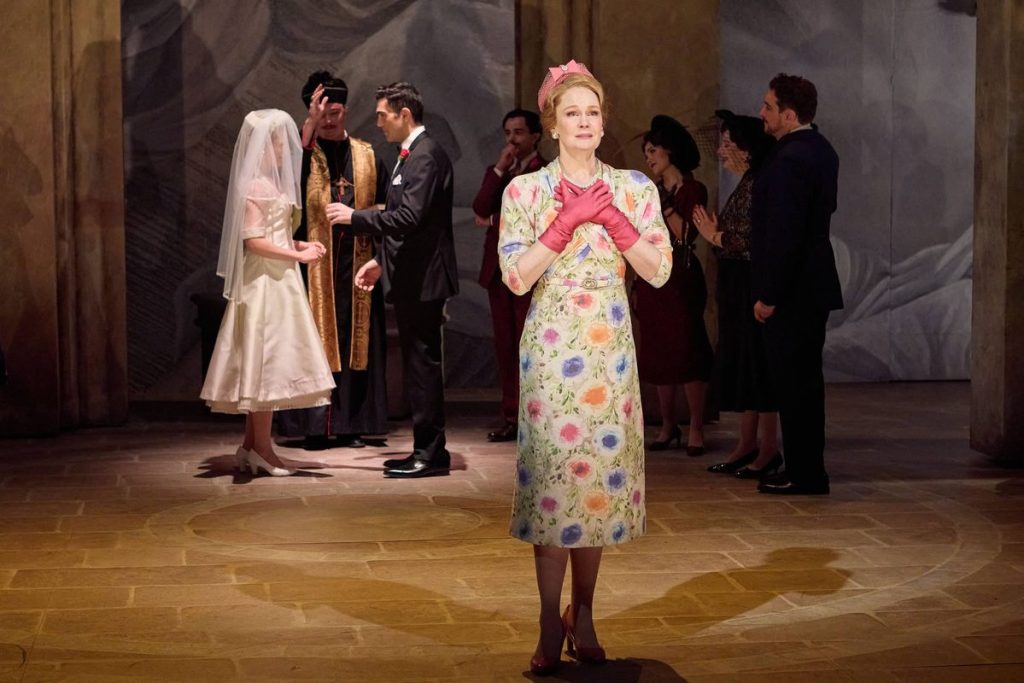
Kate Baldwin as Margaret Johnson. Photo by Eric Woolsey.

Eric Southern’s lighting deepens that visual language beautifully. A stark shaft of light isolates Clara at both the opening and near the production’s conclusion, quietly framing her as emotionally exposed and suspended between dependence and adulthood, innocence and self-determination.

Southern’s lighting and Anderson’s arches together create a visual vocabulary of passage, vulnerability and emotional crossing.

Crystal Manich directs with clarity and tonal confidence. Scene transitions flow with dreamlike fluidity, and the production sustains a remarkably cohesive emotional vocabulary from beginning to end.

The production ultimately belongs to Kate Baldwin’s Margaret Johnson.
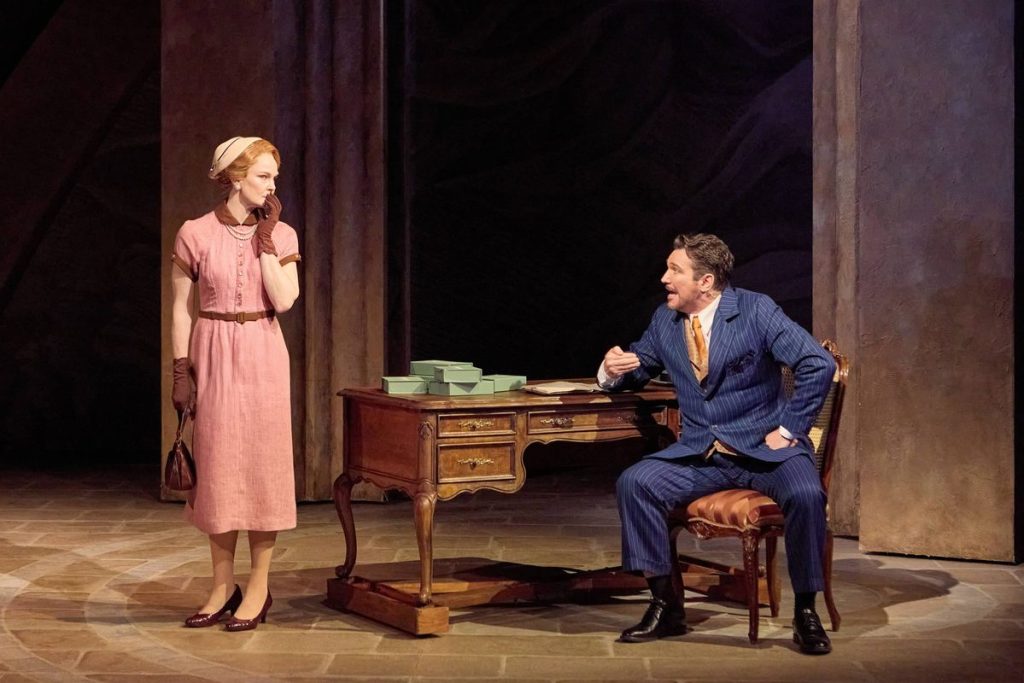
Kate Baldwin and Paolo Szot in “The Light at the Piazza.” Photo by Eric Woolsey.

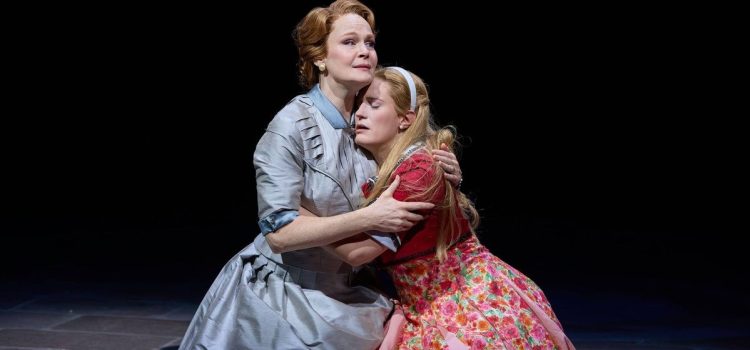
Baldwin gives the evening its mature emotional intelligence, shaping Margaret as a woman who understands that love offers no guarantees, safeguards or reliable maps. Warmth, wit, restraint and quiet exhaustion coexist seamlessly in her performance.

Her richly controlled vocals navigate Adam Guettel’s harmonically restless score with remarkable ease, while her acting continually reveals the emotional calculations unfolding beneath Margaret’s composed exterior.

Though Clara’s romance initiates the story, OTSL’s production increasingly reveals itself as Margaret’s drama — a mature reckoning with love, uncertainty and the frightening necessity of release.

Roy Hage’s Fabrizio proves equally essential to the production’s success. Hage brings lyrical warmth, sincerity and earnest emotional transparency to the role, grounding the production’s refined theatricality in genuine feeling.
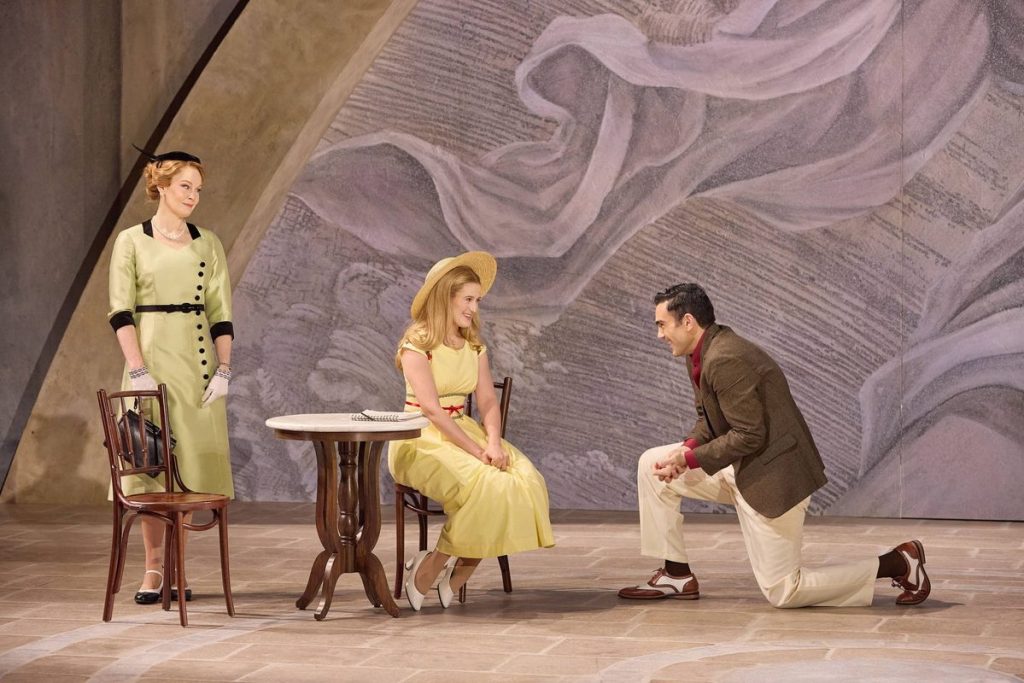
Kate Baldwin, Katrina Galka and Roy Hage in “The Light at the Piazza.” Photo by Eric Woolsey.

His chemistry with Katrina Galka’s Clara gives the romance persuasive emotional momentum even when the show’s idealism threatens to outrun practical realism.

Hage’s tenor remains consistently expressive and inviting, and his openness sustains much of the production’s emotional accessibility.

Galka delivers a thoughtful and sympathetic Clara, particularly in the later scenes where the character’s frustration with her constrained life emerges more forcefully.
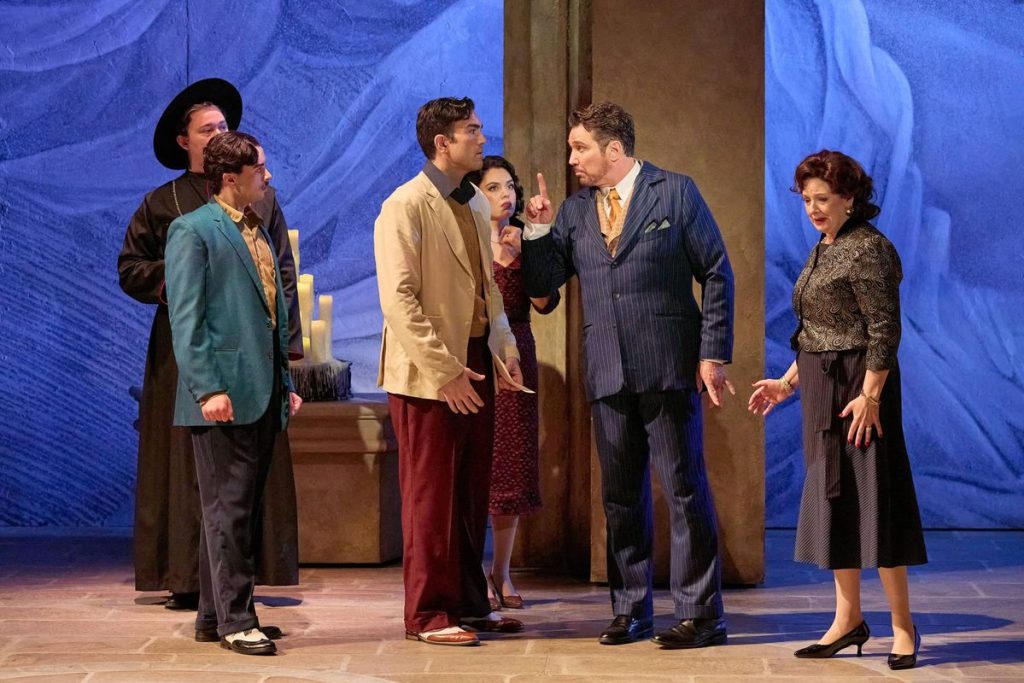
The Naccarelli family in “The Light at the Piazza.” Photo by Eric Woolsey.

Even so, the production’s emotional center of gravity gradually shifts toward Baldwin and Hage, whose performances carry greater theatrical and vocal authority.

That contrast between youthful emotional openness and the erosion of adult certainty gives the production much of its emotional texture. Clara and Fabrizio move toward love with instinctive urgency, while Margaret and Roy inhabit the lingering emotional afterlife of a marriage whose passion has cooled into habit and caution.

Under Rob Berman’s direction, the St. Louis Symphony Orchestra fully embraces Guettel’s lush, classically inflected score. The music unfolds less as a sequence of distinct songs and more as a continuous emotional current built from soaring phrases, suspended harmonies and yearning orchestral textures.
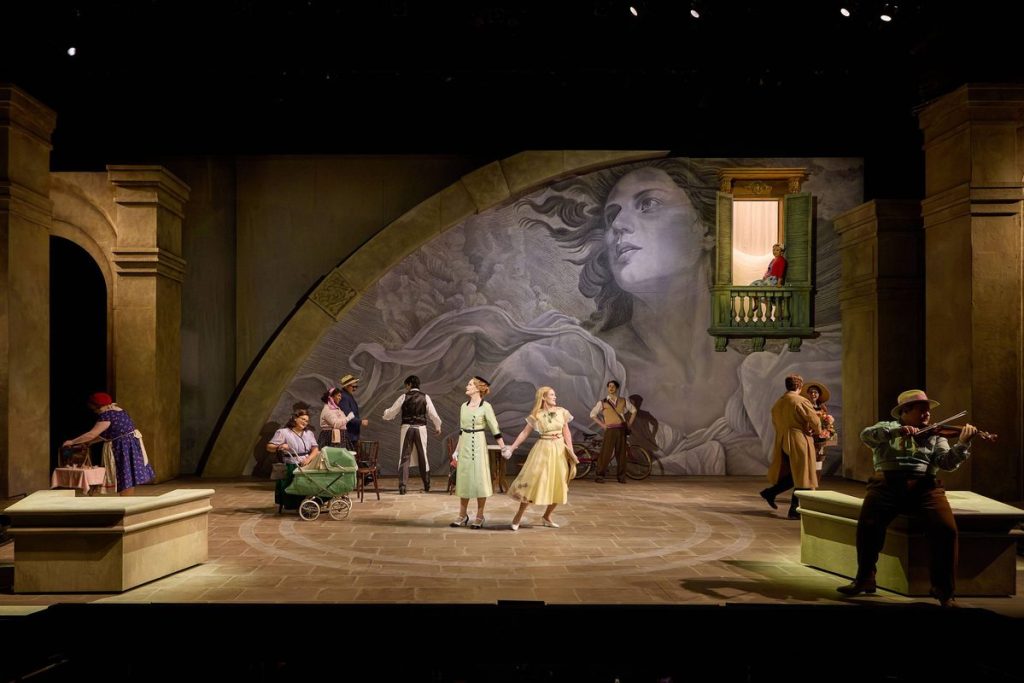
The museums of Florence. Photo by Eric Woolsey.

At times, however, that richness works against dramatic immediacy. The orchestra occasionally overwhelms dialogue, and extended untranslated passages in Italian force audiences to work harder than necessary to remain textually connected.

Those passages clearly reinforce Margaret’s outsider status within Florence’s emotional and linguistic landscape. Still, the cumulative effect creates more distance than intimacy.

Perhaps it is unfair to apply operatic standards of clarity and accessibility to a musical deliberately straddling both worlds. Yet when an opera company stages “The Light in the Piazza” with such unapologetically operatic ambition, those comparisons become inevitable.

What ultimately lingers after OTSL’s “The Light in the Piazza” is less any individual song or dramatic revelation than the production’s carefully sustained emotional and visual atmosphere. The voices, the arches, the light and the cultivated romanticism remain vividly intact —  a performance more immersive than transformative, though consistently elegant and theatrically persuasive throughout.
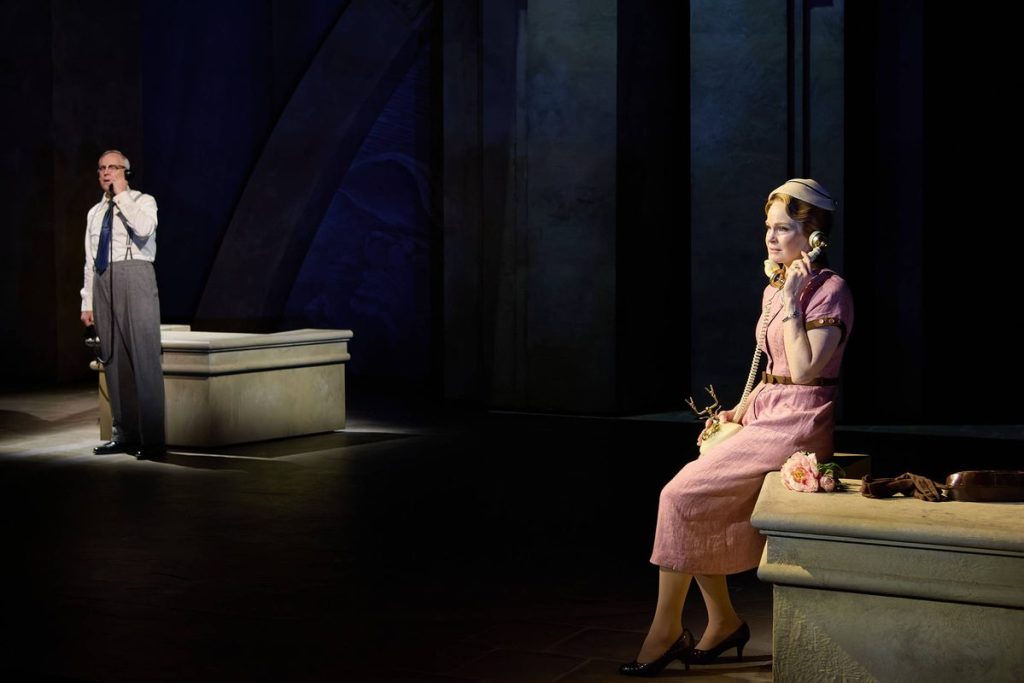
Michael James Reed and Kate Baldwin as The Johnsons in “The Light in the Piazza.” Photo by Eric Woolsey.

“The Light in the Piazza” continues through June 28 at the Loretto-Hilton Center on the Webster University campus, presented in rotating repertory as part of Opera Theatre of Saint Louis’ 2026 festival season. Ticket information, dining options and additional production details are available through the OTSL website.

By Lynn Venhaus

A stand-up-and-cheer musical that makes the most of its moves and moments, “The Karate Kid The Musical” is a triumph for Stages St. Louis.

With its inspirational underdog storyline and a multi-generational, universal appeal that transcends a formula 1984 movie script, the musical version takes those familiar beats and capitalizes on the warm glow of nostalgia.

Perhaps against all odds, this slick production genuinely connects to an audience, wearing its heart of gold on its gi.

With its impeccable technical elements and a captivating East meets West aura, director Amon Miyamoto has polished this big-deal show to dazzle with crisp movements, stunning scenic and lighting designs, and a seamless flow – despite a long first act.

For those who haven’t seen “The Karate Kid” film from 1984, which garnered an Oscar nomination for Noriyuki “Pat” Morita as Mr. Miyagi and made such catch phrases as “Wax on, wax off” and “You trust the quality of what you know, not quantity” popular, viewing it isn’t a prerequisite.

The message of using your head and heart, not fists, to win in life, is evergreen.

This world premiere, with its winsome Miyagi-verse a major factor, runs through June 26 at the Kirkwood Performing Arts Center. 

Where it lands after that depends on what’s referred to as “a pre-Broadway tryout,” which means it is a work in progress. For now, it is in a first-reaction phase, and what we see here might not be the completed licensed material.

The simple premise is thus: Widowed mom and her teenage son move from New Jersey to Southern California, and while she has a good job, the Italian kid with the Jersey accent doesn’t fit in with the surfer crowd. 

Daniel LoRusso becomes a target of elitist punks who train at the same high-intensive karate school – the Cobra Kai dojo. Mr. Miyagi, the Okinawa-born maintenance man-gardener, happens to be a martial arts master and trains him to fight in an all-valley tournament a few months away.

While the movie has a distinctively ‘80s signature, not unlike “Footloose,” “The Breakfast Club,” “Fast Times at Ridgemont High,” “Fame” and “Risky Business” back in the day, it has become a pop culture classic, as much known for Mr. Miyagi’s words of wisdom as the iconic “crane’ move. (And that big moment prompts more cheers).

The movie is credited with launching renewed interest in martial arts from American youth, sparking a franchise with two more sequels (1986 and 1989, a 1994 reboot “The New Karate Kid” and the television series, “Cobra Kai,” now on Netflix and about to start its fifth season on Sept. 9.

The musical’s book is adapted by screenwriter Robert Mark Kamen, who based the original film in part on his own experiences. 

In broad strokes, Kamen capitalizes on the key pieces – mother and son starting a new life, teenage boy not fitting into the California coastal milieu, the maintenance man who becomes a father figure, and the David vs. Goliath battle royale.

What is new is that the musical is framed as Mr. Miyagi’s memory, thus we return to the 1980s, and the journey of how he and Daniel developed a deep bond. 

Musical composer and lyricist Drew Gasparini obliges with numbers that fit into the framework, stripping the action down to basics: “California Dream,” “Square One,” “I Want to Know What You Know,” and the finale sentiment, “Stronger Than Before.”

The unorthodox training is captured in “Method to His Madness” and the epiphany breakthrough “Balance.”

A striking sense of rhythm is noteworthy throughout every ensemble number, with vibrant, precise choreography by Keone and Mari Madrid that uniquely stands out. A mix of modern hip-hop and traditional, cultural Far East dance, it is extraordinary in execution. 

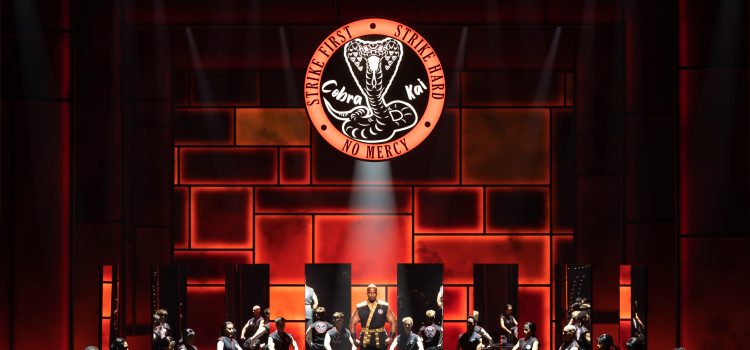
It’s rare that a big, splashy musical number receives a standing ovation midway through the first act, but the bravado of “Strike First. Strike Hard. No Mercy” was a showstopper that prompted many in the opening night crowd to leap from their seats in enthusiastic applause.

Alan H. Green, who plays the brutal taskmaster John Kreese, had the crowd at his first snarl and it’s a fierce performance as the unsavory ‘win at all costs’ sensei.

By the time his ruthlessness is revealed, “The Whole World Will Be Watching,” to end act one, hints at danger ahead in Act 2, fueling anticipation for the big showdown.

Credit goes to the engaging ensemble – a mix of seasoned pros and energetic young performers, for their contributions to Stages meeting this moment.

Cardoza is the lynchpin here – charming and earnest, and all the relationships hinge on his likability as Daniel. He develops a palpable bond with Mr. Miyagi – Jovanni Sy in an unforgettable heart-tugging performance.

And that connection burrows into our hearts. 

Daniel and his mother, Lucille, played by the wondrous Kate Baldwin, a two-time Tony nominee, are at different crossroads, which they express clearly in songs. 

Baldwin showcases a sweet, well-trained soprano in “Doing Something Right” and a soulful “If I Could Take Away His Pain.”

No stranger to St. Louis, she won a St Louis Kevin Kline Award for her performance as Maria in The Muny’s 2005 staging of “The Sound of Music.”

The standard love triangle between Ali, her ex Johnny Lawrence and Daniel sets up the bigger issues with the bully (Jake Bentley Young fine in the thankless one-note role). 

As a girl with gumption, Jetta Juriansz puts some oomph into the stock love interest part, and her songs “Who I’m Supposed to Be” and “What Comes Next.”

As Daniel’s new pal Freddy, Luis-Pablo Garcia is a real charmer, and capably leads “Dreams Come True.”

Music Director Andrew Resnick’s strong arrangements are another noteworthy element, as is John Clancy’s orchestrations. 

It is evident that all the technical parts came together in such a high level, indelible way as to mesmerize. The black and red imagery is bold and impressive.

With its angles and moving doors, windows and walls, the stunning set design by Tony winner Derek McLane is one of the finest ever executed here – and another reason to wax rhapsodic. So is Tony winner Bradley King’s exceptional lighting design. 

With its snappy pace and mostly upbeat score, “The Karate Kid – the Musical” turns into a fun time meant to be shared with a pumped-up crowd, not unlike other classic feel-good sports stories “Rocky,” “Rudy” and “American Underdog.”

Obviously, this is a production with an unabashed gooey center, and say what you will, delivered as promised, bringing much comfort and joy to a wildly enthusiastic audience. 

After all, “Man who catch fly with chopstick, accomplish anything.”

Stages St Louis presents “The Karate Kid – The Musical” from May 25 to June 26 at the Kirkwood Performing Arts Center. For more information, visit www. StagesSTL.org. 

Portions of this review appeared in the June 17 issue of the Webster-Kirkwood Times.