By Lynn Venhaus

Big personalities and bigger voices fill the Muny’s expansive stage for an enthralling excursion into an exotic place that remains a timeless touchstone of American musical theatre.

In their 11th staging of “South Pacific” – a stunning tour de force in every element, the Muny meets a significant cultural moment through the vision of director William Carlos Angulo. Using the gutsier 2008 revival script, the show expands on the heightened love, intolerance and war themes.

Angulo emphasizes the two intercultural romances where couples grappled with acceptance and overcoming prejudice some eight decades ago, which resonates today. Suave Emile de Becque is a French plantation owner with a mysterious past who falls for spunky nurse Nellie Forbush, from Little Rock, Ark.

The time is 1943 when the Allies fought the Axis – the coalition of Nazi Germany, fascist Italy and Imperial Japan in World War II. The unworldly Nellie is stationed on an unnamed island where the U.S. Navy and Marines are keeping tabs on the enemy.
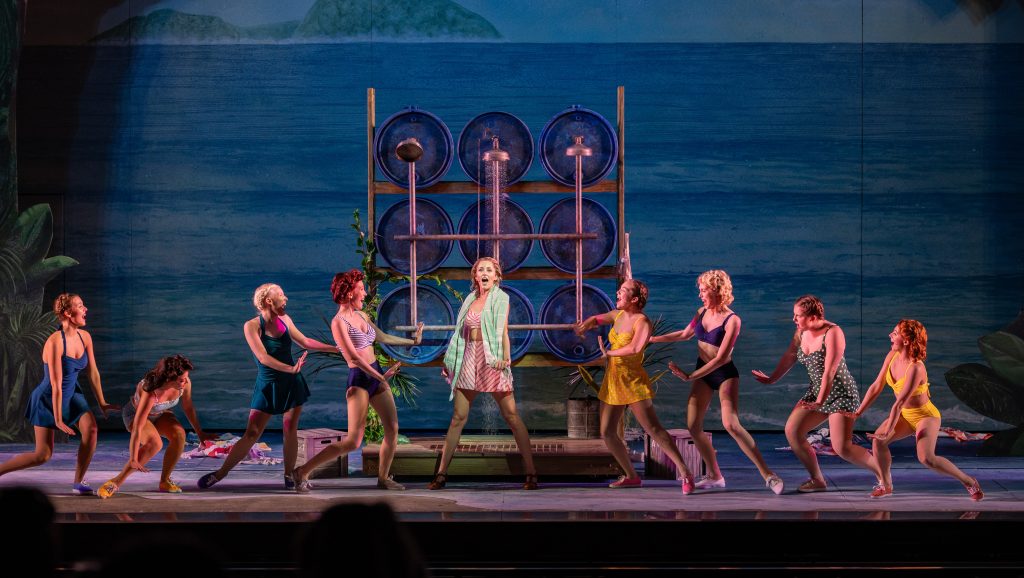
Taylor Louderman (center) with members of the company of the 2026 Muny production of Rodgers & Hammerstein’s “South Pacific.” Photo by Phillip Hamer

These characters populated James Michener’s short stories in “Tales from the South Pacific,” which was adapted by Joshua Logan and Oscar Hammerstein for the wartime musical, with music by Richard Rodgers and lyrics by Hammerstein. It opened on April 7, 1949, when war memories were fresh in people’s minds.

The work won the Pulitzer Prize for Drama in 1950, the first (and only musical until “Hamilton” in 2016) and 10 Tony Awards. It ran for nearly five years on Broadway until 1954, a record album was a huge hit, and a popular movie adaptation was released in 1958. The show had never been revived on Broadway until Bartlett Sher’s acclaimed 2008 Lincoln Center run, which tackled the darker themes realistically.

After Marine officer Lt. Joseph Cable arrives for a dangerous espionage mission, he is smitten by Liat, a Tonkinese woman who lives on the mystical island Bali Ha’i. As the young lovers, Michael Canu and Michaela Marfori are mesmerizing in dance sequences that Angulo has incorporated for richer storytelling. Choreographer Karla Puno Garcia has added a tender tableau that sets this production apart, a ravishing debut.
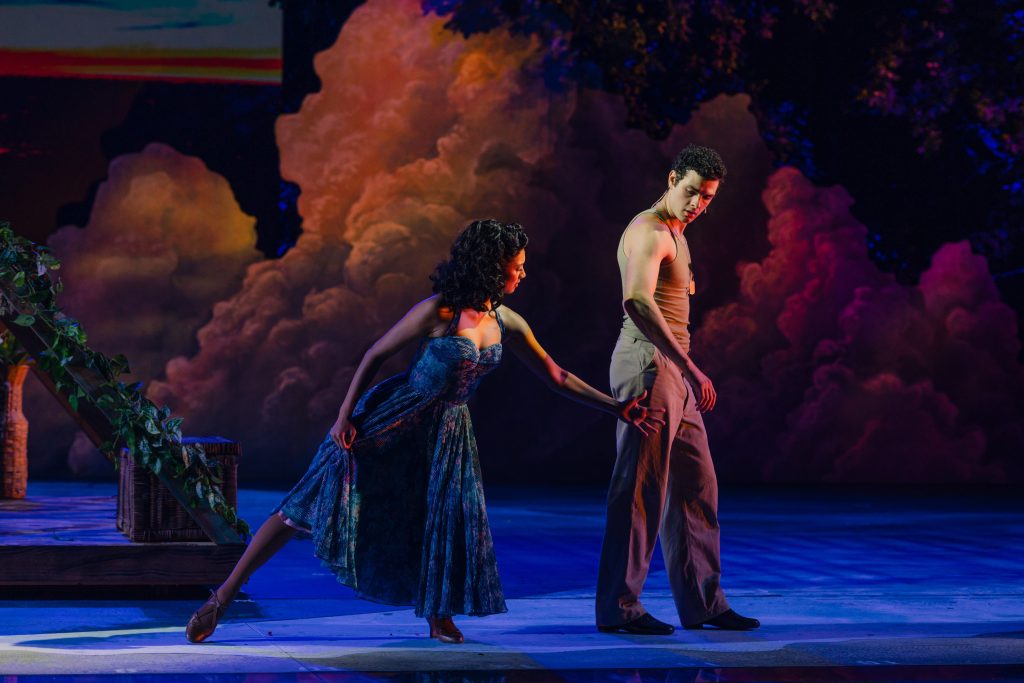
Michaela Marfori and Michael Canu in the 2026 Muny production of Rodgers & Hammerstein’s “South Pacific.” Photo by MaryKatherine Patteson, The Muny

That glorious music! Music Director Roberto Sinha conducts 29 musicians for those iconic sweeping ballads and fun ensemble numbers, so very sumptuous, starting with that fabulous overture.. Sinha returns after marvelous maestro turns in Angulo’s “In the Heights” and “Dear Evan Hansen” and is currently the music director of Broadway’s “Hamilton.”

To experience Brazilian bass-baritone Paulo Szot recreate his Tony-winning role as Emile is wondrous and breathtaking live. This is the kind of powerful operatic performance that people will still be talking about for years.

They’ll single out his magnetic renditions of “Some Enchanting Evening” and “This Nearly Was Mine” with the kind of reverence that is spoken about Yul Brynner in “The King and I,” Robert Preston in “The Music Man,” and Zero Mostel in “Fiddler on the Roof.”

Sarah Fenske, St. Louis Magazine executive editor, declared it “The Summer of Szot” after seeing him at both Opera Theatre of St. Louis as charming Signor Naccarelli in “The Light in the Piazza” and now the Muny. I’m jumping on this bandwagon too. (He’s returning to Broadway to play Lance in “& Juliet” later this month, a role he originated.)
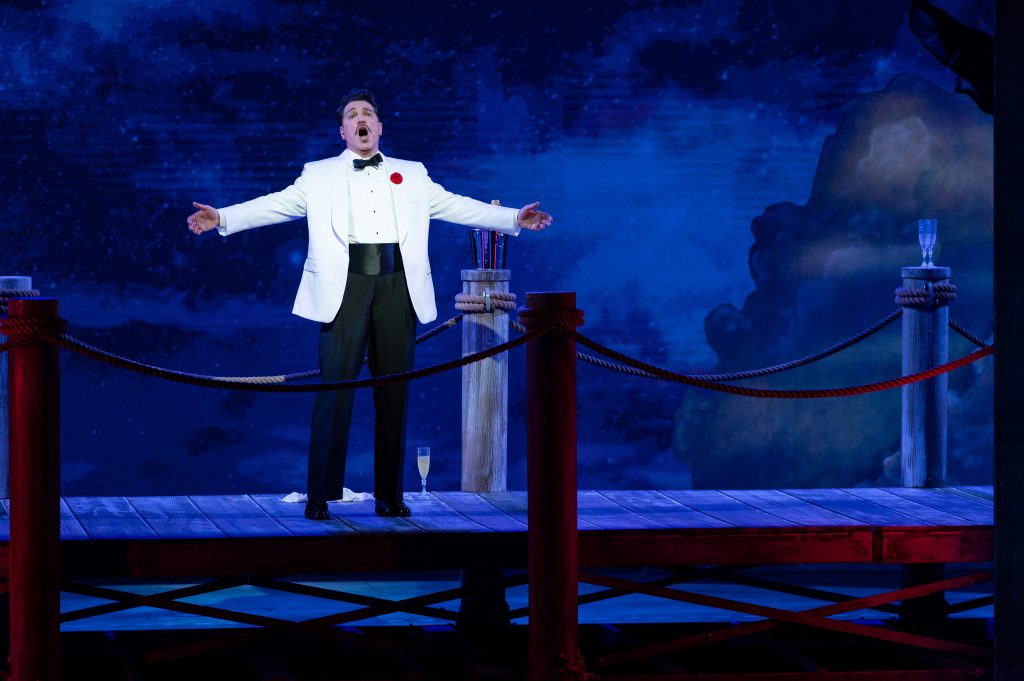
Paulo Szot in the 2026 Muny production of Rodgers & Hammerstein’s “South Pacific.” Photo by Phillip Hamer

While a charismatic presence, he’s not the only reason to see this cherished classic. Taylor Louderman is enthusiastically welcomed back to where it all started for the Tony nominee as a teenager, combining a sunny disposition with her physicality and lovely lilting vocals as the spirited, unsophisticated Nellie. Showing genuine emotional depth, she brings out the turmoil that Nellie faces because of ingrained attitudes that affect her relationship with Emile.

Now playing a very grown-up role, she’s the epitome of exuberance in “A Cockeyed Optimist,” “I’m Gonna Wash That Man Right Outa My Hair,” “I’m In Love with a Wonderful Guy,” and “Honey Bun.” Together, Louderman and Szot have a sweet chemistry., and their “Twin Soliloquys” is silky smooth.

Not only can Canu dance ballet, but his strong tenor soars in “Younger Than Springtime” and “My Girl Back Home.” Being brought up in Philadelphia society, when he’s disgusted by his own ingrained bigotry, he erupts into the pivotal “You’ve Got to Be Carefully Taught.”
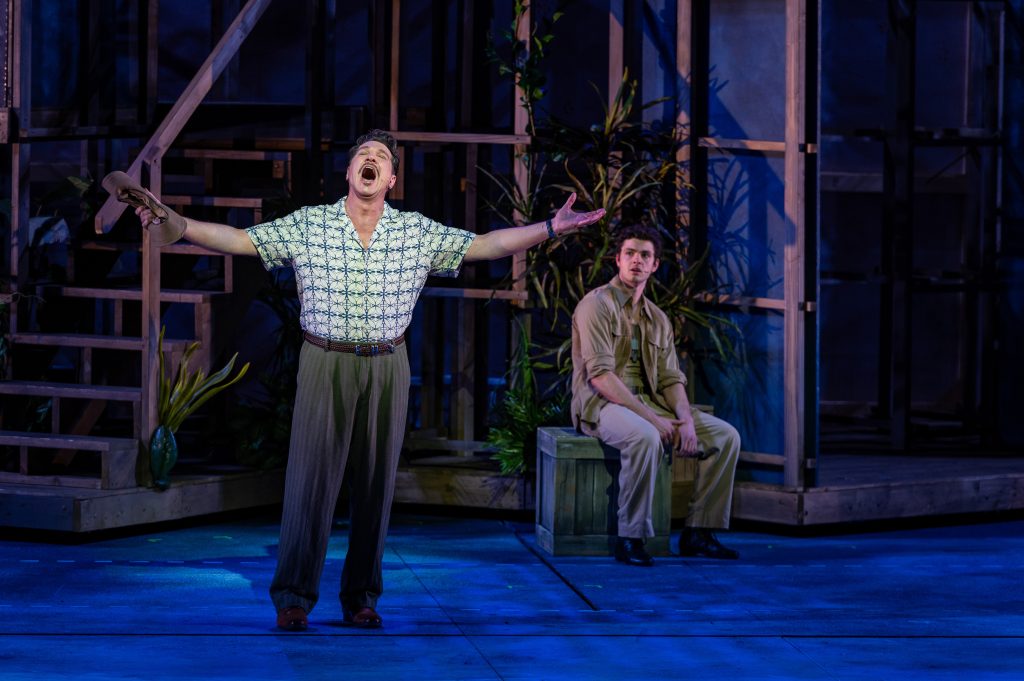
Paulo Szot and Michael Canu in the 2026 Muny production of Rodgers & Hammerstein’s “South Pacific.” Photo by Phillip Hamer

This decades-old social commentary remains impactful today, which sets “South Pacific” apart from other golden-age chestnuts. When she meets Emile’s Polynesian children, Louderman must say “colored,” which has been restored in the script. The understanding comes later. It’s a scrupulously constructed show that wants to say something.

The rest of the ensemble is flawless, with Joan Almedilla a knockout as Bloody Mary, avoiding making her a caricature, and transporting us in “Bali Ha’i.” After playing a conniving prince in “Frozen” last year, Bobby Conte returns as an animated Luther Billis, the lovable schemer who provides much needed comic relief.

It’s a pleasure to see three St. Louisans make their mark on the Muny stage, with veteran Michael James Reed as Captain George Brackett, Jeff Cummings in his debut as Commander William Harbison, and former Muny Kid Robert Crenshaw in his debut as Stewpot. Crenshaw, who lit up stages on national tours of “Ain’t Too Proud” and “The Wiz,” is fun to watch as the goofy Seabee.

Jeff Cummings (left) and Michael James Reed in the 2026 Muny production of Rodgers & Hammerstein’s “South Pacific.” Photo by MaryKatherine Patteson, The Muny

The lavish atmosphere, in contrast to the gritty war mission, is beautifully rendered in Arnel Sancianco’s lush scenic design, with the tropical touches carried through in John Lasiter’s sun-drenched lighting design and Yee Eun Nam’s video designs of breezy foliage and ocean waves. Josh Hummel crafted the sound design.

Costume designer Raquel Adorno’s lovely flowing evening gowns set an enchanting mood, with a gorgeous palette of seafoam greens and blues as well as flowery prints. The elegant party clothes contrast with the military attire of the sailors and nurses. Ashley Rae Callahan was the wig designer.

The robust singers and dancers have fun with “Bloody Mary,” “There Is Nothin’ Like a Dame,” and the Thanksgiving Follies. As Emil’s children Ngana and Jerome, Grace Moore and Josiah Paik are delightful in “Dites-Moi.”
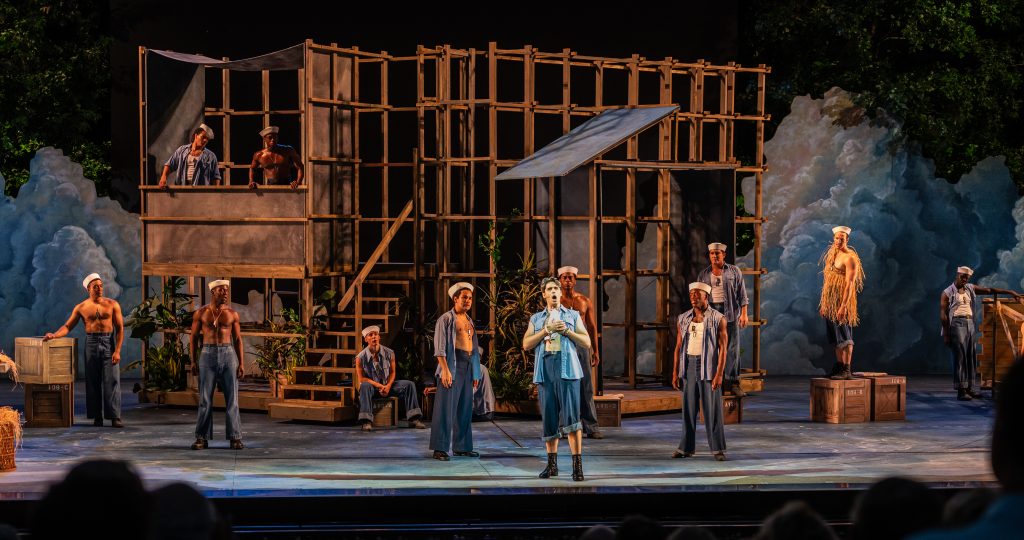
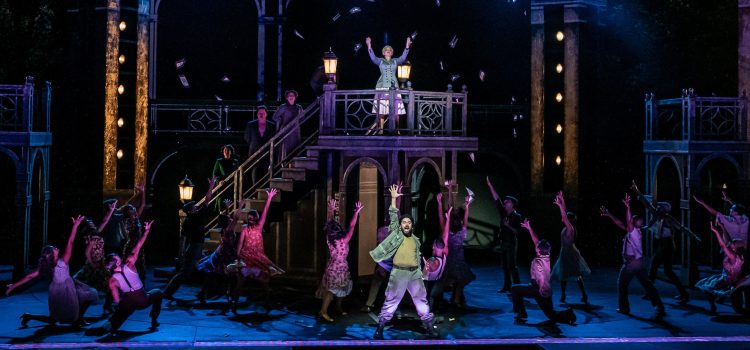
Bobby Conte (center) and members of the company of the 2026 Muny production of Rodgers & Hammerstein’s “South Pacific.” Photo by Phillip Hamer

The cast includes Julia Aguinaldo, Tre’ Booker, Jessica Carmona, Chloe Chamberlin, Aaron Patrick Craven, Arielle Ploy Dettmer, Alex Benetiz Evans, Rachel Fairbanks, Hannah Florence, Garrick Goce Macatangay, Jake Mendes, Caylie Rose Newcom, Julian Ramos, John Ray Jr., Hayden Rivas, David Rowen, Connor Schwantes, Gordon Semeatu, Francisco Thurston, and Nicholas A. Wilkinson.

The Muny’s “South Pacific” is a snapshot of how we once were, with hope for the future.  It’s a grand glimpse of the best of times, the worst of times, and how people connect dramatically on the world arena. This exceptional cast and crew of artisans have created an unforgettable night of theater that deeply resonates and carries us away in song.

“The Muny” presents “South Pacific” on the outdoor stage from July 6 – 12. Visit muny.org for more information on The Muny’s 108th season. 
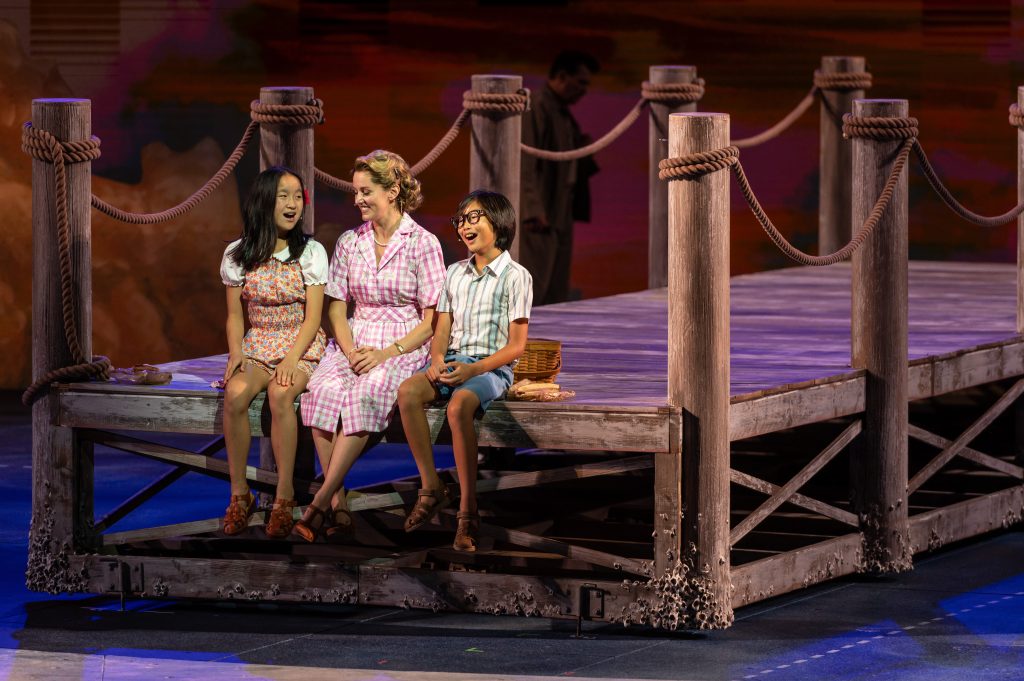
From left: Grace Moore, Taylor Louderman and Josiah Paik in the 2026 Muny production of Rodgers & Hammerstein’s “South Pacific.” Photo by Phillip Hamer

by CB Adams

Opera Theatre of Saint Louis’ production of “The Light in the Piazza” consistently achieves the atmosphere of operatic emotional depth, even if it reaches true operatic emotional danger less often.

Through soaring vocal performances, elegant visual storytelling and sustained tonal sophistication, OTSL delivers a production enveloped in cultivated romanticism and musical yearning.

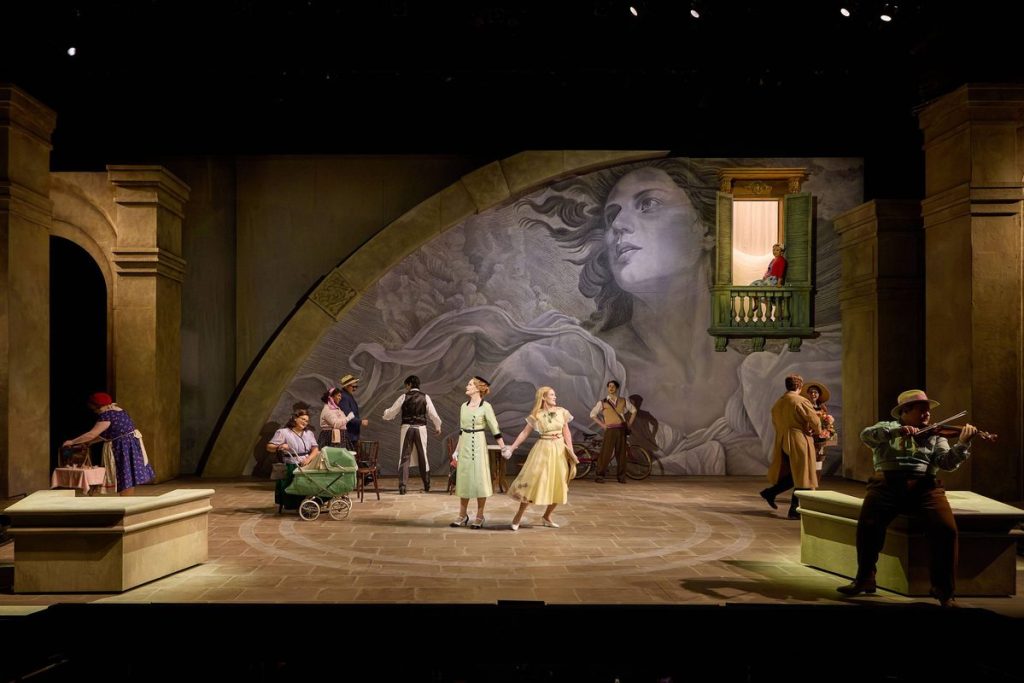
Cameron Anderson’s striking set design establishes that atmosphere immediately. Sweeping stone arches dominate the stage, carrying the accumulated emotional history of Florence itself.

The arches become emotional architecture — thresholds, passages and reminders that these characters are visitors twice over: tourists moving through Italy and emotional travelers moving toward unfamiliar versions of themselves.

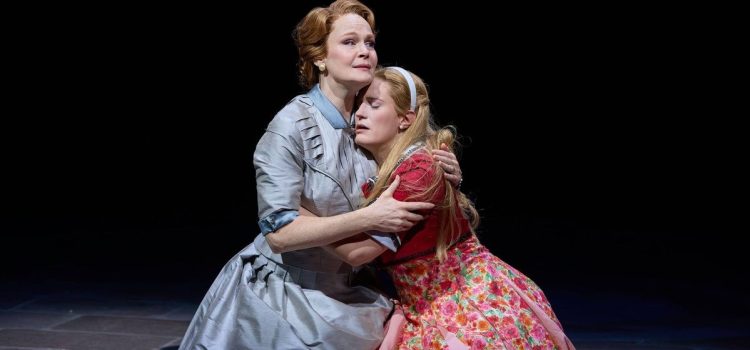
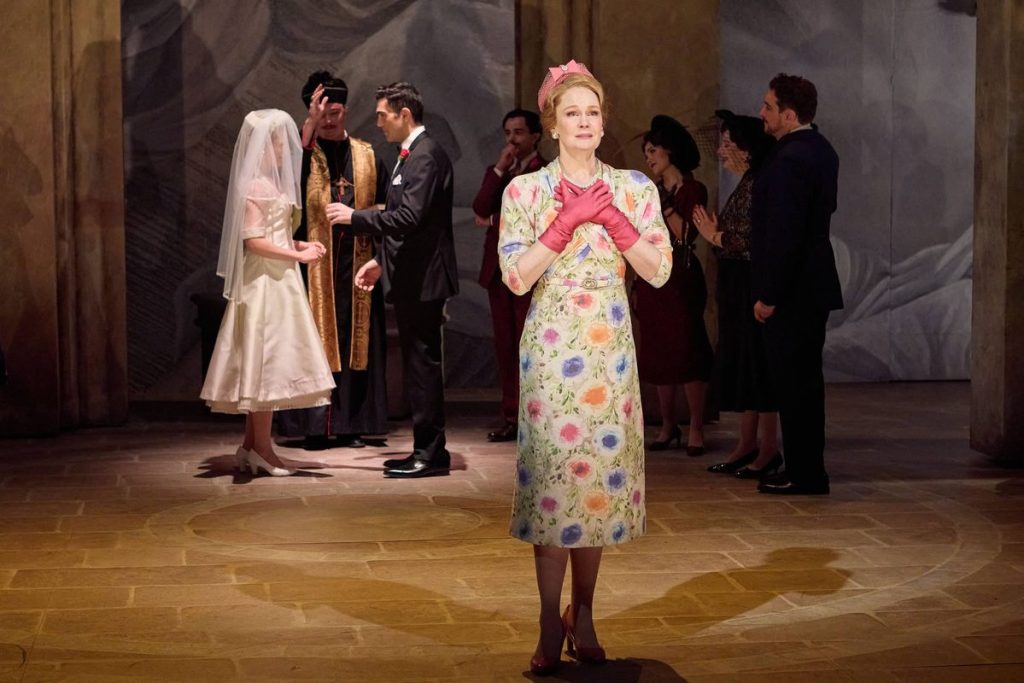
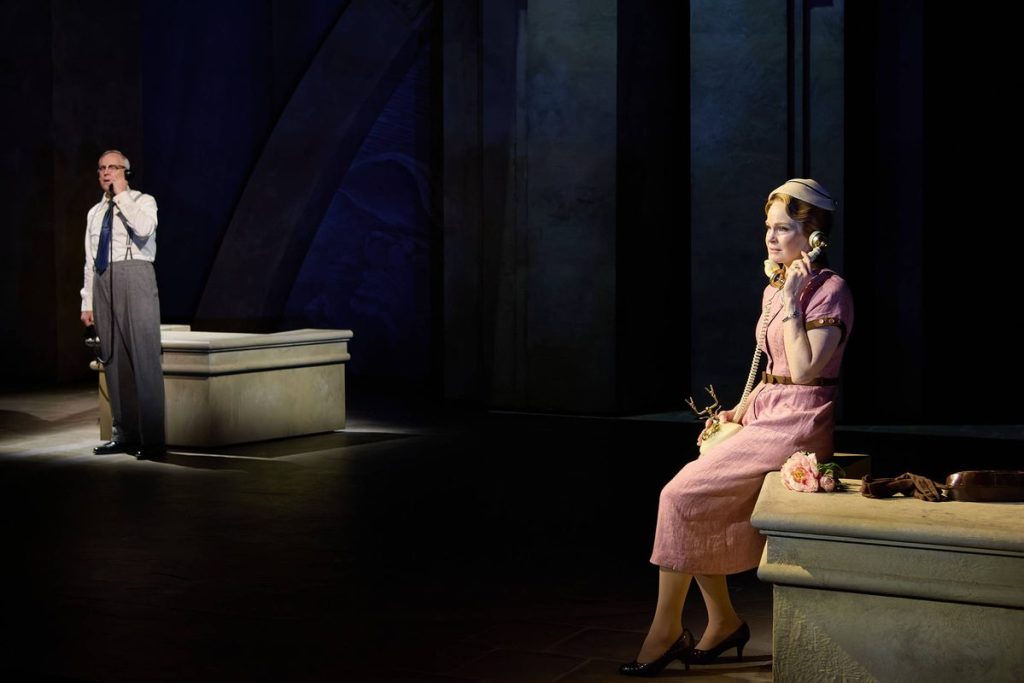
Kate Baldwin as Margaret Johnson. Photo by Eric Woolsey.

Eric Southern’s lighting deepens that visual language beautifully. A stark shaft of light isolates Clara at both the opening and near the production’s conclusion, quietly framing her as emotionally exposed and suspended between dependence and adulthood, innocence and self-determination.

Southern’s lighting and Anderson’s arches together create a visual vocabulary of passage, vulnerability and emotional crossing.

Crystal Manich directs with clarity and tonal confidence. Scene transitions flow with dreamlike fluidity, and the production sustains a remarkably cohesive emotional vocabulary from beginning to end.

The production ultimately belongs to Kate Baldwin’s Margaret Johnson.

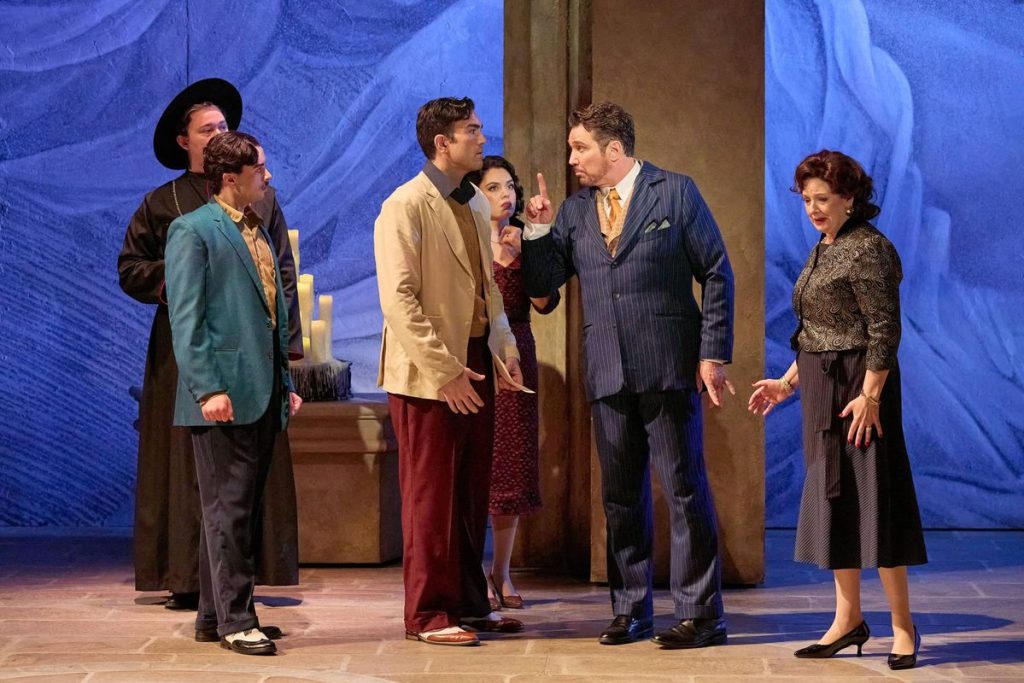
Kate Baldwin and Paolo Szot in “The Light at the Piazza.” Photo by Eric Woolsey.

Baldwin gives the evening its mature emotional intelligence, shaping Margaret as a woman who understands that love offers no guarantees, safeguards or reliable maps. Warmth, wit, restraint and quiet exhaustion coexist seamlessly in her performance.

Her richly controlled vocals navigate Adam Guettel’s harmonically restless score with remarkable ease, while her acting continually reveals the emotional calculations unfolding beneath Margaret’s composed exterior.

Though Clara’s romance initiates the story, OTSL’s production increasingly reveals itself as Margaret’s drama — a mature reckoning with love, uncertainty and the frightening necessity of release.

Roy Hage’s Fabrizio proves equally essential to the production’s success. Hage brings lyrical warmth, sincerity and earnest emotional transparency to the role, grounding the production’s refined theatricality in genuine feeling.

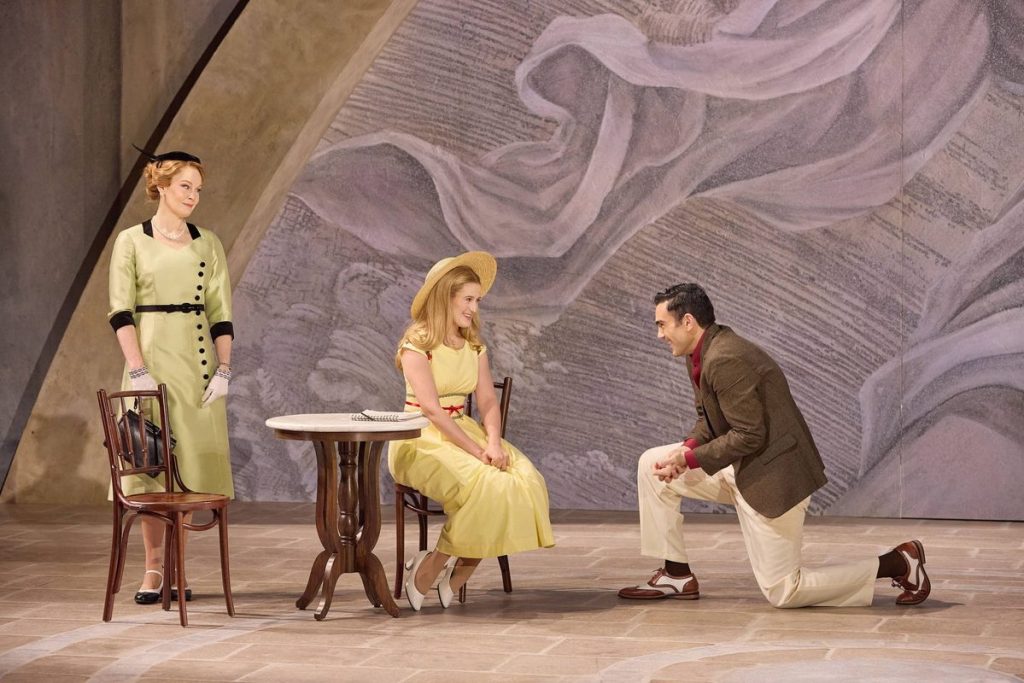
Kate Baldwin, Katrina Galka and Roy Hage in “The Light at the Piazza.” Photo by Eric Woolsey.

His chemistry with Katrina Galka’s Clara gives the romance persuasive emotional momentum even when the show’s idealism threatens to outrun practical realism.

Hage’s tenor remains consistently expressive and inviting, and his openness sustains much of the production’s emotional accessibility.

Galka delivers a thoughtful and sympathetic Clara, particularly in the later scenes where the character’s frustration with her constrained life emerges more forcefully.

The Naccarelli family in “The Light at the Piazza.” Photo by Eric Woolsey.

Even so, the production’s emotional center of gravity gradually shifts toward Baldwin and Hage, whose performances carry greater theatrical and vocal authority.

That contrast between youthful emotional openness and the erosion of adult certainty gives the production much of its emotional texture. Clara and Fabrizio move toward love with instinctive urgency, while Margaret and Roy inhabit the lingering emotional afterlife of a marriage whose passion has cooled into habit and caution.

Under Rob Berman’s direction, the St. Louis Symphony Orchestra fully embraces Guettel’s lush, classically inflected score. The music unfolds less as a sequence of distinct songs and more as a continuous emotional current built from soaring phrases, suspended harmonies and yearning orchestral textures.

The museums of Florence. Photo by Eric Woolsey.

At times, however, that richness works against dramatic immediacy. The orchestra occasionally overwhelms dialogue, and extended untranslated passages in Italian force audiences to work harder than necessary to remain textually connected.

Those passages clearly reinforce Margaret’s outsider status within Florence’s emotional and linguistic landscape. Still, the cumulative effect creates more distance than intimacy.

Perhaps it is unfair to apply operatic standards of clarity and accessibility to a musical deliberately straddling both worlds. Yet when an opera company stages “The Light in the Piazza” with such unapologetically operatic ambition, those comparisons become inevitable.

What ultimately lingers after OTSL’s “The Light in the Piazza” is less any individual song or dramatic revelation than the production’s carefully sustained emotional and visual atmosphere. The voices, the arches, the light and the cultivated romanticism remain vividly intact —  a performance more immersive than transformative, though consistently elegant and theatrically persuasive throughout.

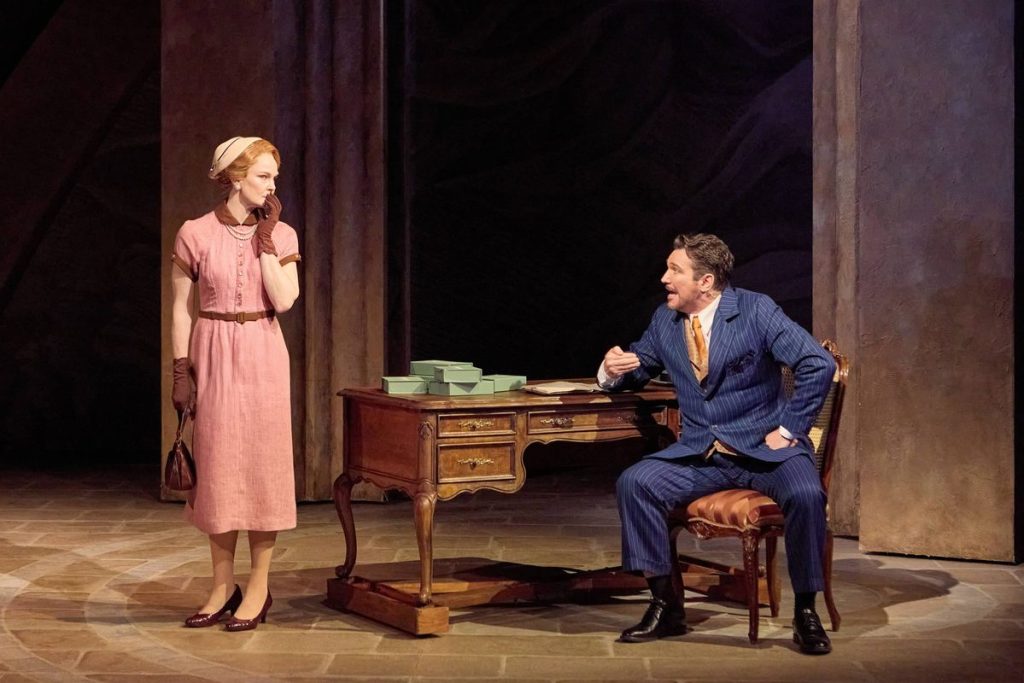
Michael James Reed and Kate Baldwin as The Johnsons in “The Light in the Piazza.” Photo by Eric Woolsey.

“The Light in the Piazza” continues through June 28 at the Loretto-Hilton Center on the Webster University campus, presented in rotating repertory as part of Opera Theatre of Saint Louis’ 2026 festival season. Ticket information, dining options and additional production details are available through the OTSL website.

By Lynn Venhaus

Virtuoso vocals and transfixing tangos propel the Muny’s grand-scale stylized and dramatic “Evita,” the Andrew Lloyd Webber and Tim Rice classic.

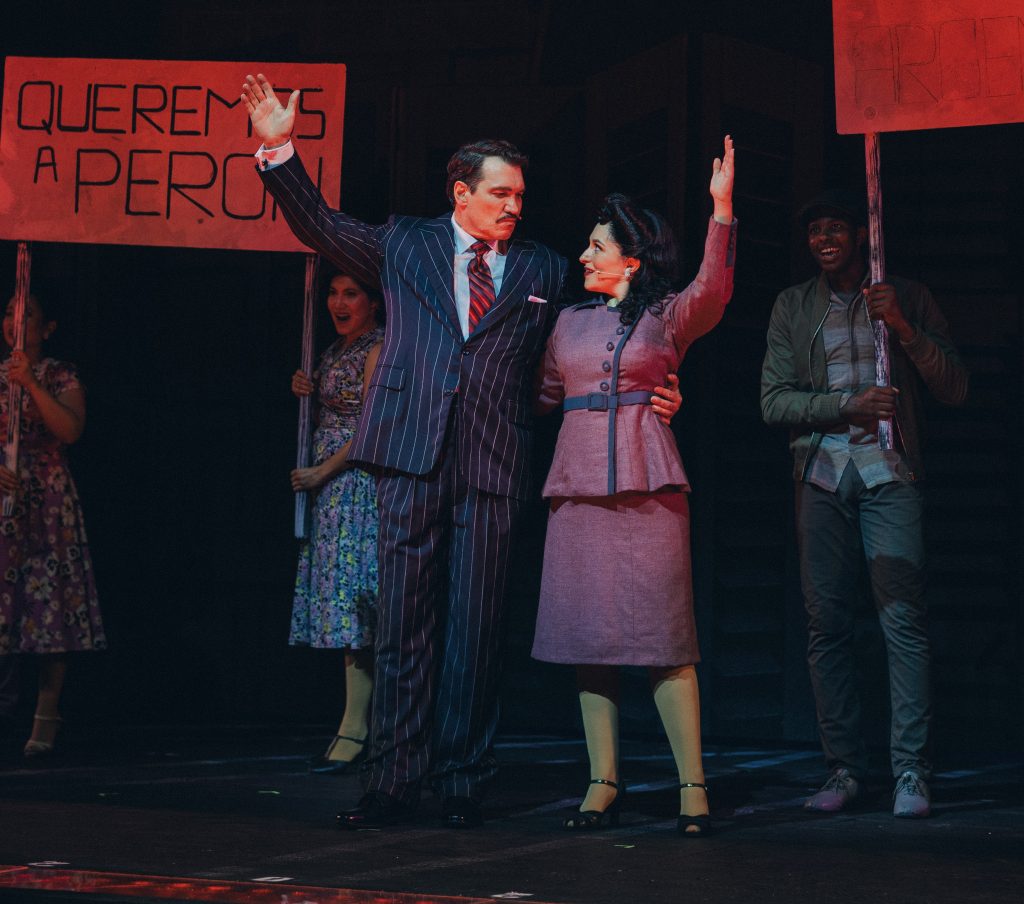
Featuring three of the most expressive voices to grace the outdoor stage this or any season, Katerina McCrimmon is the titular character, Paulo Szot is Argentinian president Juan Peron and Omar Lopez-Cepero is narrator Che, the historic revolutionary born in Argentina. The musical goes through her meteoric rise to power and influence as Argentina’s First Lady.

Through their stunning renditions of the signature songs, the trio earns the audience’s awe and admiration. Notable for their commanding stage presence, technical skills and strong delivery, they flourish in the imposing setting.  

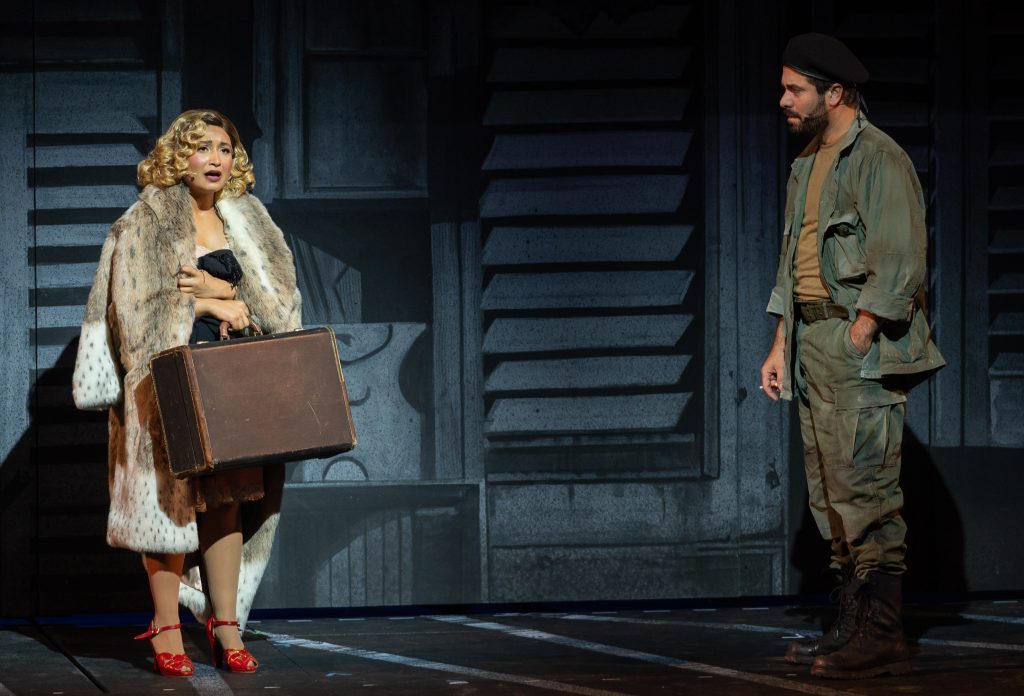
Also standing out were tenor Daniel Torres as the charming Magaldi in “On This Night of a Thousand Stars,” and mezzo-soprano Sabrina Santana poignant as Peron’s mistress, whose heart-tugging “Another Suitcase in Another Hall” is one of the evening’s highlights.

The glamourous and charismatic Evita, who died tragically of cervical cancer at age 33 in 1952, grew from humble beginnings to beloved icon. Marrying Peron in 1945, she became a populist leader after his election in 1946, later described as the “Spiritual Leader of the Nation.”

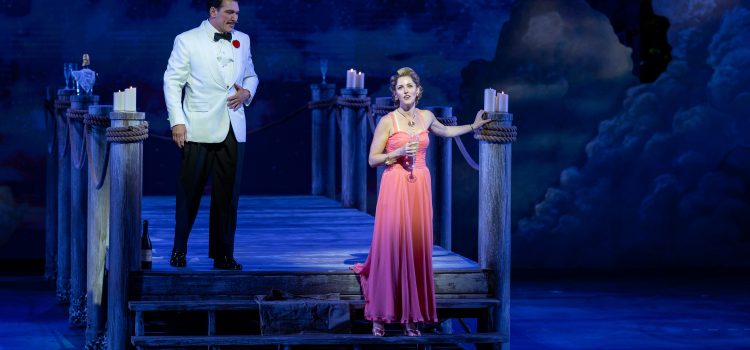
Paulo Szot and Katerina McCrimmon in the 2025 Muny production of “Evita.” Photo by The Muny | Emily Santel

The story starts in 1934 when the poor Maria Eva Duarte was 15. As Evita, she championed the rights of the working class, women and the poor, establishing social programs and instrumental in women’s suffrage. But she also had her detractors, not accepted by the aristocracy.

McCrimmon, who is skilled at bringing the house down, for she toured as Fanny Brice in the most recent revival of “Funny Girl” and her rendition of “Don’t Rain on My Parade” was a highlight of the Fox 2024-2025 Broadway season.

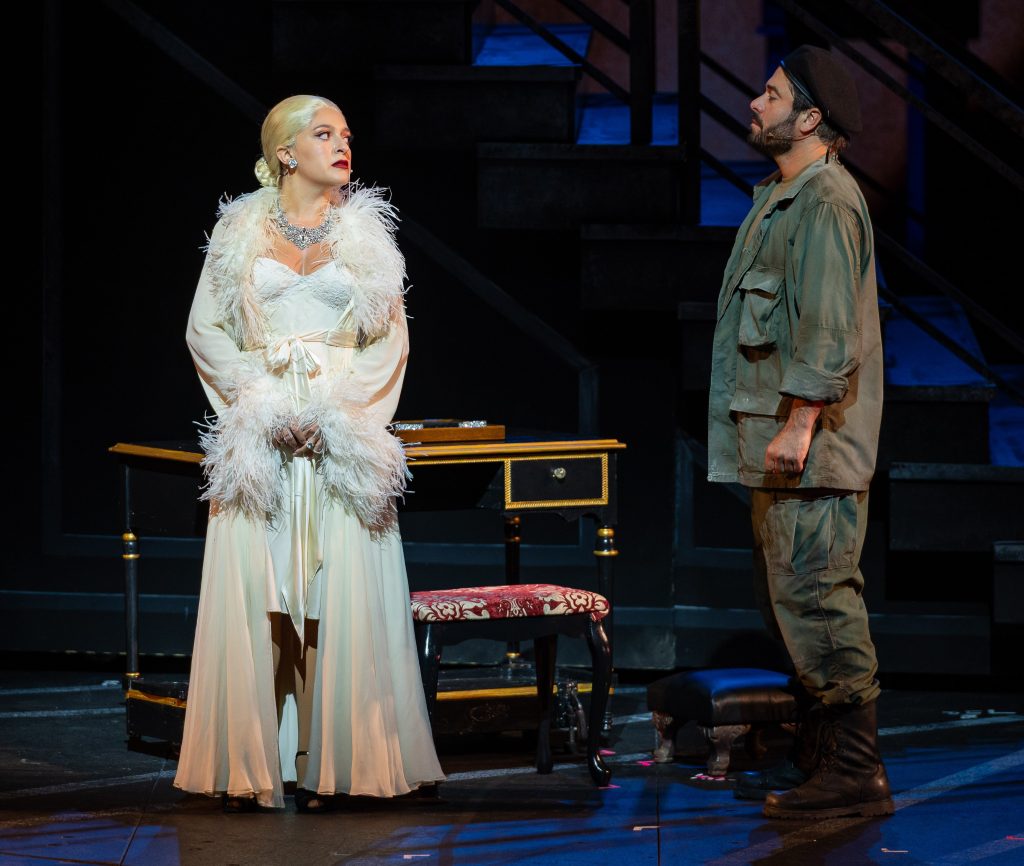
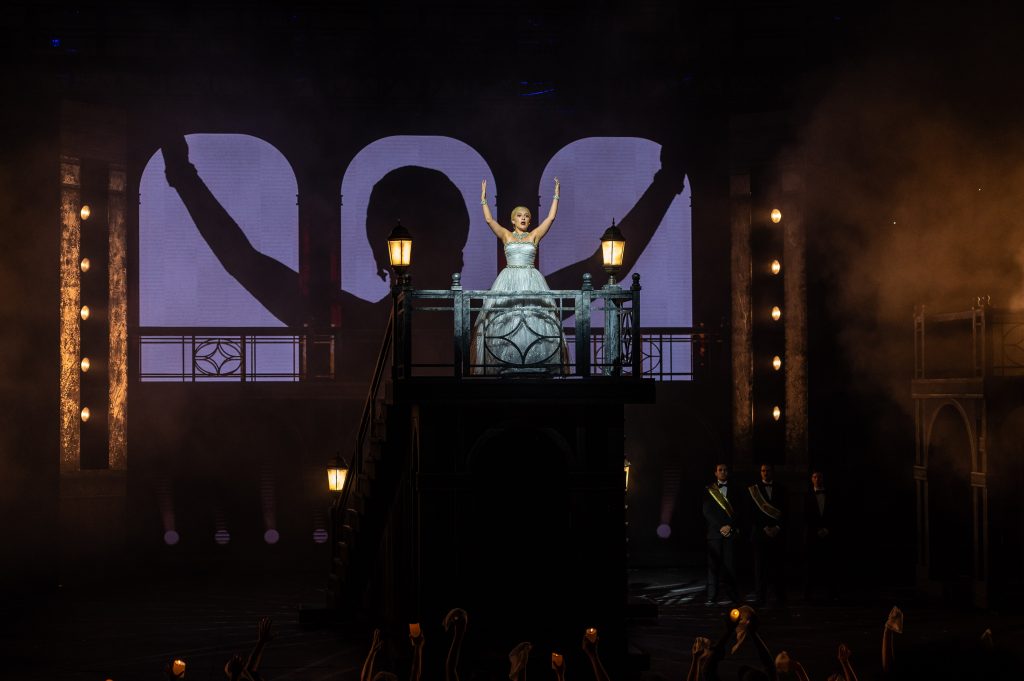
With her tour-de-force delivery, she creates a magical Muny moment with the showstopper “Don’t Cry for Me Argentina.” Image-wise, she’s breathtaking in a shimmering flouncy white ballgown with silver sparkles, standing poised on a stately balcony/staircase representing Casa Rosada, the government seat.

With customary finesse, the Muny’s execution is nearly flawless. Innovative director Josh Rhodes, who also choreographed, had a specific vision and meticulously followed through, collaborating with the associate director and choreographer Lee Wilkins. Natalia Nieves-Melchor is the assistant choreographer and dance captain.

Omar Lopez-Cepero in the 2025 Muny production of “Evita.” Photo by The Muny | Emily Santel

Rhodes’ flair for incorporating novel ideas was evident in “Chess” two years ago, and now, this time.

McCrimmon and Szot are a good match together, first paired in “I’d Be Surprisingly Good for You.” Tony winner as Emile de Becque in Bartlett Sher’s acclaimed 2008 revival of “South Pacific,” his rich, warm baritone is powerful in “The Art of the Possible,” “A New Argentina,” and shows range in the tender “She Is a Diamond.”

A bona fide star in three previous Muny shows, Omar Lopez-Cepero is an exceptional Che. As a cynical commentator, he snarls, he scowls, he expresses his disdain for Evita’s opportunistic and manipulative ways. And his songs are just as passionate.

He’s an observer, Greek chorus, challenger and critic on stage most of the time. Lopez-Cepero’s intensity comes through singing “Oh What a Circus,” “High Flying Adored,” “The Chorus Girl Hasn’t Learned,” “The Money Kept Rolling In” and “Dice Are Rolling,” among others.

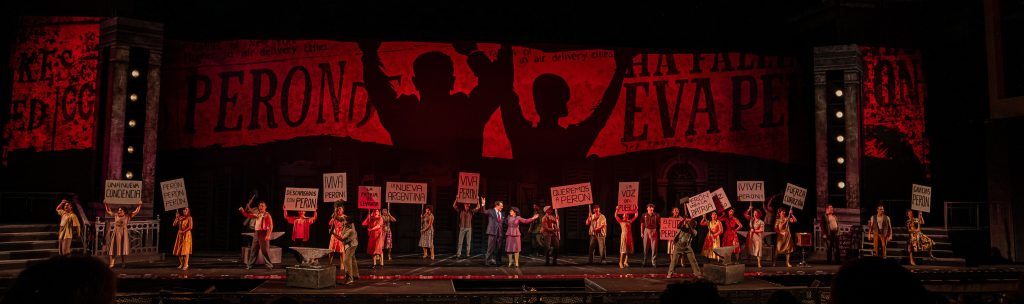
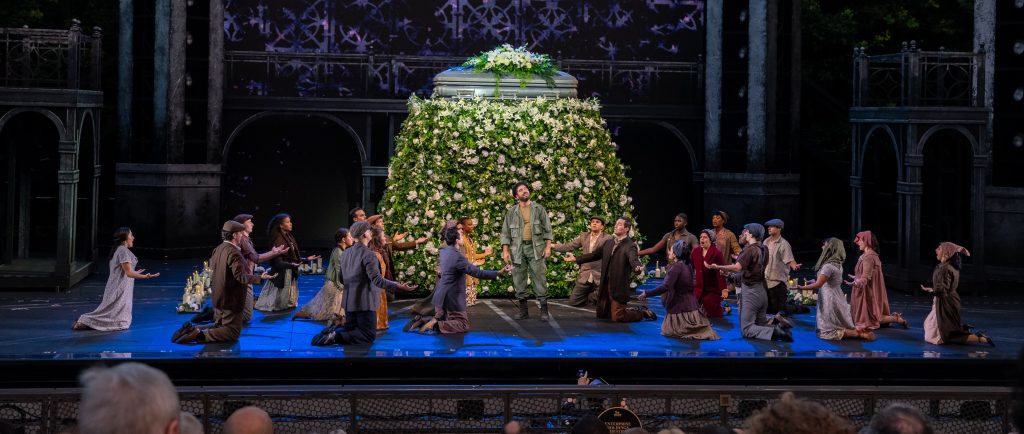
Members of the company of the 2025 Muny production of “Evita.” Photo by Phillip Hamer

Lopez-Cepero was memorable in “On Your Feet!”, “The Unsinkable Molly Brown” and “Paint Your Wagon” in recent years, and he owns this role, making his performance unforgettable.

Best of all is music director Ben Whiteley’s brilliant orchestrations and conducting. He has brought out vivid colors in the musical imagery through captivating use of instrumentations.

He exuberantly captures Latin rhythms, jazz influences and pop melodies in the anthemic score.

Each orchestra piece stands out, thanks to the top-shelf skills of the 24-piece orchestra. Their work is exquisite from “A Town Square in Buenos Aires” through 26 more compositions to the finale “Lament.”

Sabrina Santana and Omar Lopez-Cepero in the 2025 Muny production of “Evita.” Photo by Phillip Hamer

Sound designers David Patridge and John Shivers also enhanced the aural experience.

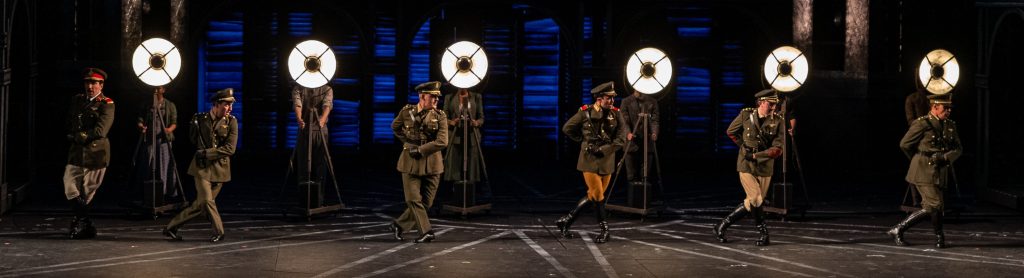
Adam Koch’s majestic scenic design, accompanied by Paige Seber’s moody lighting design, and Steven Royal’s distinct black-and-white video design, all Muny debuts, create an immersive regal tableau. Fun fact: 20 years ago, Koch was a young assistant stage designer at the Muny. Welcome back!

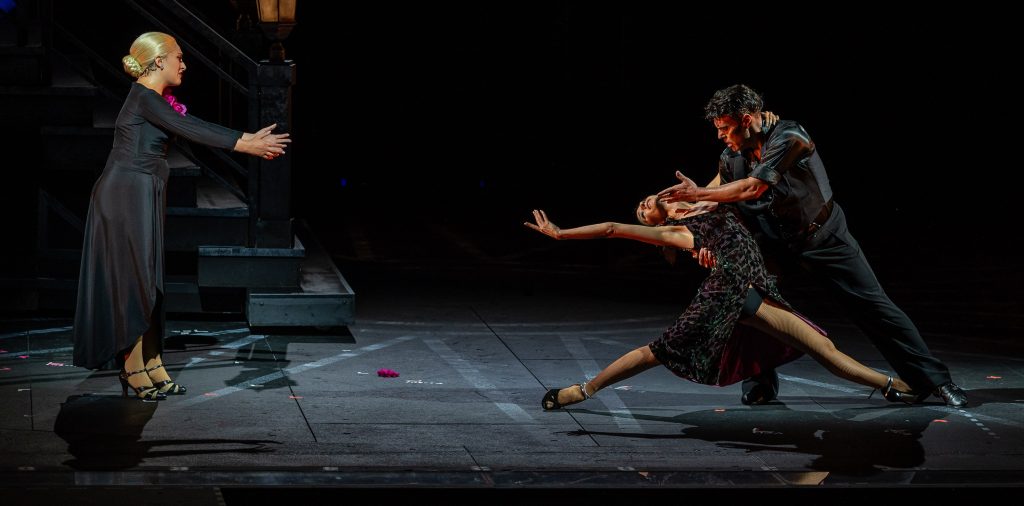
One of the most eye-catching elements is world-class tango dancers Junior Cervila and Noelia Guerrero – you can’t take your eyes off them. Cervila choreographed the tango-infused numbers.

They are mesmerizing in their first act introduction, then “Waltz for Eva and Che,” the finale, and most beautifully presented in the bittersweet ballad “You Must Love Me.”

From left: Katerina McCrimmon, Noelia Guerrero and Junior Cervila in the 2025 Muny production of “Evita.” Photo by Phillip Hamer

Written by Webber and Rice for the 1996 film adaptation, it not only became a stand-alone hit for Madonna, but also won Best Original Song at the 1997 Academy Awards. It has since been incorporated into the show.

 “Rainbow High,” where McCrimmon directs her transformation so that she can be adored and their ‘savior,’ ramping up the “star quality,” is also impressive, as is a feisty, playful “Buenos Aires.”

An articulate 20-person ensemble, representing different social classes, becomes a community, and their movements represent a changing cultural landscape – Rhodes’ vibrant choreography spotlights the country’s sociopolitical changes.

Andrés Acosta, Leyla Ali, Marissa Barragán, Leah Berry, Patrick Blindauer, Jordan Casanova, Marilyn Caserta, Junior Cervila, Devin Cortez, Nicholas Cunha, Kyle de la Cruz Laing, Daniel Alan DiPinto, Kylie Edwards, Noelia Guerrero, Natalia Nieves-Melchor, Zibby Nolting, Arnie Rodriguez, Leann Schuering, Trevor Michael Schmidt, Sharrod Williams and Noah Van Ess are featured – in celebration and in mourning. An ensemble of ten Muny Kids and eight Muny Teens are also incorporated. Shout-out to stage manager Kelsey Tippins.

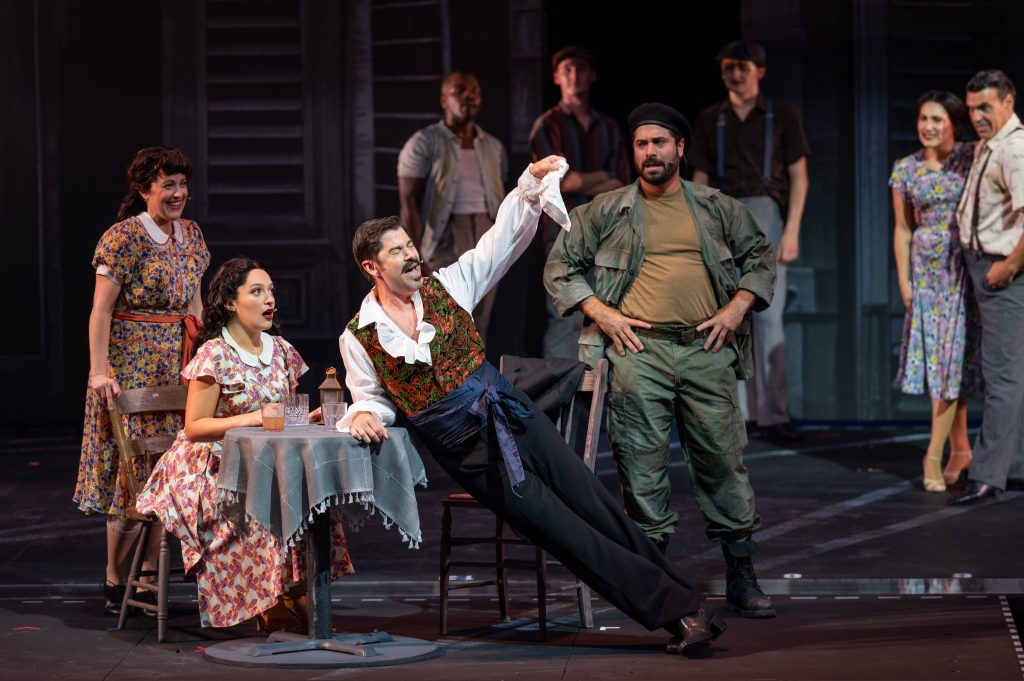
Omar Lopez-Cepero and the company of the 2025 Muny production of “Evita.” Photo by Phillip Hamer

First-time costume designer Brian Hemesath brings considerable show business credentials with him – Three-time Emmy winner for “Sesame Street,” 100 digital shorts for The Lonely Island on SNL 2002-2015 and work on Spielberg’s “West Side Story” and John Wick films.

His timeline for Evita’s evolution from peasant to model, radio star, actress and First Lady is a mix of flashy and classy. Wig designer Kelley Jordan’s work is exemplary, complimenting his various looks.

The alluring presentation is not the issue. Webber and Rice’s storytelling is the show’s weakest aspect. Partly because throughout time, Eva has become a historical footnote, and many are not familiar with her controversial story.

Katerina McCrimmon and Omar Lopez-Cepero in the 2025 Muny production of “Evita.” Photo by Phillip Hamer

Is she a heroine or a villainess? It’s up to you to decide, but the musical’s format is hampered by unsympathetic viewpoints. You also may need a tutorial before you go, if you are unaware of the backstory.

This is not to say that the cast isn’t impassioned, because they are, and are fully committed to giving their all. They try very hard to make it an inspirational touchstone.

I’ve always found this musical cold – even though I invariably admire the performers. After seeing a national tour at the Fox Theatre in 2015 and an equal parts gritty and elegant presentation at the Repertory Theatre of St. Louis in 2018, I’m still waiting for the show to give me a reason to care.

Members of the company of the 2025 Muny production of “Evita.” Photo by Phillip Hamer

Nevertheless, the Muny’s creative teams’ craftsmen and artists have premiered one of the most dazzling productions with precision and clarity. Rhodes and company are authentic in historical context.

(Full disclosure, outside of “Jesus Christ Superstar,” not the biggest fan of Webber-Rice’s main claims to fame. I feel they are more about spectacle and bombast than an emotional investment. I hope for something to move the needle but so far not yet. So, there is that.)

Their ambitious and very theatrical sung-through musical “Evita” became a sensation first in London in 1978, starting with a rock opera concept, transferring to Broadway a year later and becoming the first British musical to win the Tony in 1979.

It made stars of its leads, Patti LuPone and Mandy Patinkin, who won Tony Awards (show nominated for 11, won 7).

From left: Katerina McCrimmon, Daniel Torres, Omar Lopez-Cepero and members of the company of the 2025 Muny production of “Evita.” Photo by Phillip Hamer

A 1996 movie starred Madonna and Antonio Banderas, and a 2012 Broadway revival starred Ricky Martin. London’s West End has revived the musical five times, including a current Jamie Lloyd interpretation starring Rachel Zegler.

The Muny debuted the show in 1985, and reprised it in 1989, 1996 and 2001. So, it’s been 24 years since a fresh take.

With its superlative all-around singers and their polished stage presence, “Evita” is a stylish whirl of dance and recognizable musical numbers.

The Muny presents “Evita” July 18 -24 at 8:15 p.m. nightly at the outdoor stage in Forest Park, 1 Theatre Drive.The musical is 2 hours, 20 minutes with an intermission. For more information, visit www.muny.org

.

Katerina McCrimmon in the 2025 Muny production of “Evita.” Photo by Phillip Hamer