The performing arts do love a new label, especially for an old idea. Take “poperetta,” a recent coinage for musical theater that mixes high and low, sophistication and popular appeal. Gilbert and Sullivan might reasonably ask what took us so long. Nearly 150 years after “The Pirates of Penzance” first set sail, Opera Theatre of Saint Louis’ exuberant revival finds this Victorian confection still afloat, still tuneful and still very funny. Apparently, nobody told it that it was old.
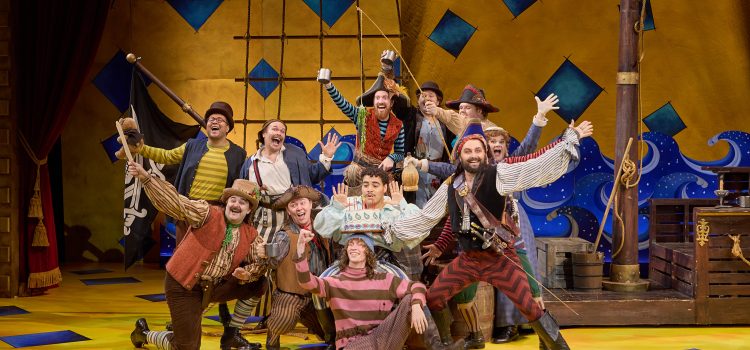
Director and choreographer Seán Curran knows precisely what keeps this gloriously improbable work moving. His production, first staged at OTSL in 2013, has since been mounted by opera companies across the country. Back where it began, the production remains fresh and remarkably sure of itself. The stage is rarely still. Gesture, rhythm and split-second timing accumulate into comedy, grounded by characters who treat every ridiculous circumstance with complete seriousness.
James Schuette’s sets and costumes announce the game before Sullivan’s score gets underway. A grand gilt Victorian proscenium, crowned by a skull and crossed swords, frames the thrust stage. Red curtains, vivid painted backdrops and a pirate ship cheerfully wheeled into place suggest a pop-up book sprung to life. The machinery shows. That’s part of the point.
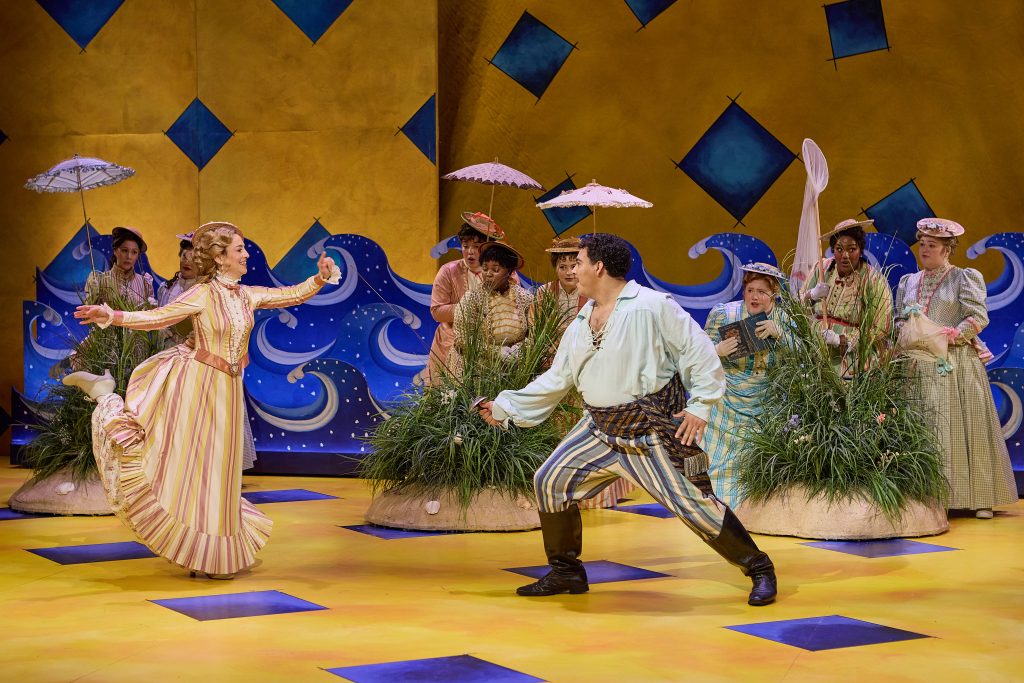
Daniel Luis Espinal gives Frederic a bright, ardent tenor and a winning innocence. Jana McIntyre’s Mabel brings character and wit to the role’s coloratura demands. Their romantic sincerity gives the surrounding lunacy something firm to bounce against.
Jana McIntyre and Daniel Luis Espinal, Photo by Eric Woolsey.
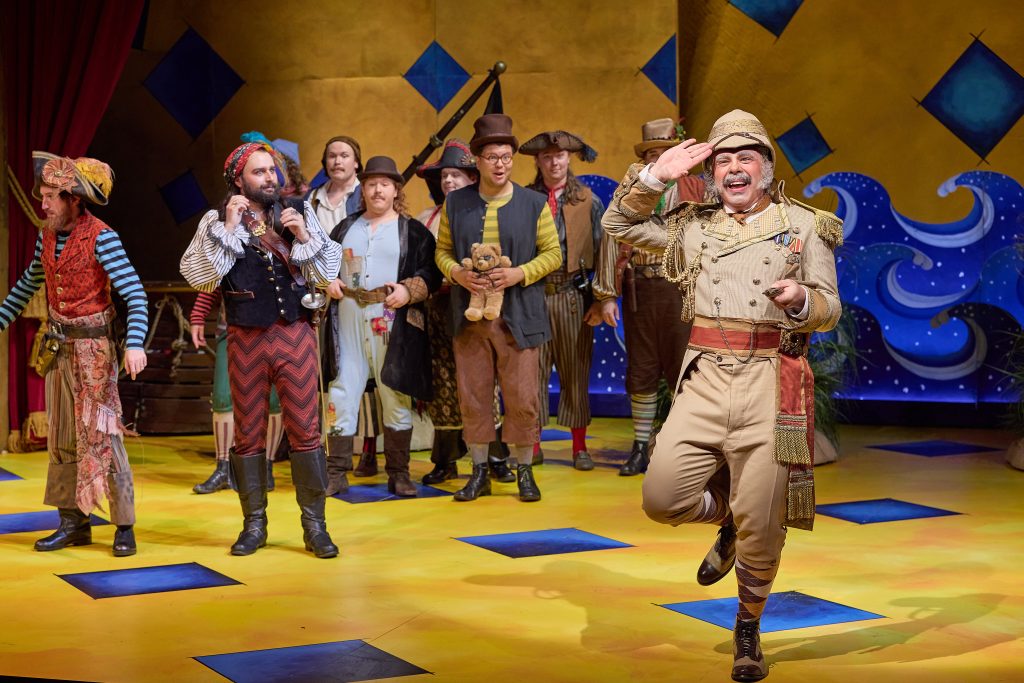
The production has comic talent to spare. William Socolof’s Pirate King swaggers and blusters with comic authority, while Meredith Arwady brings a formidable contralto and deft comic timing to Ruth. Robert Mellon makes Major-General Stanley a beaming monument to cheerful foolishness, dispatching the famous patter song with impressive clarity. Shyheim Selvan Hinnant makes the Sergeant of Police one of the evening’s comic highlights, leading his hapless constables through some of Curran’s funniest physical comedy.
George Manahan conducts members of the St. Louis Symphony Orchestra with equal attention to Sullivan’s melodic beauty and the propulsion that keeps Curran’s production moving. The chorus, prepared by Andrew Whitfield, contributes power, verbal clarity and distinct comic character.
After nearly 150 years, “The Pirates of Penzance” has nothing to prove. Curran and company trust the music, sharpen the comedy and keep the whole improbable contraption moving. The old thing sails beautifully.
Opera Theatre of Saint Louis’ production of “The Pirates of Penzance” was performed May 23 through June 27 as part of the company’s 2026 Festival Season.
Robert Mellon as the Major General. Photo by Eric Woolsey.
CB Adams is an award-winning fiction writer and photographer based in the Greater St. Louis area. A former music/arts editor and feature writer for the St. Louis Globe-Democrat, his non-fiction has been published in local, regional and national publications. His literary short stories have been published in more than a dozen literary journals and his fine art photography has been exhibited in more than 40 galley shows nationwide. Adams is the recipient of the Missouri Arts Council’s highest writing awards: the Writers’ Biennial and Missouri Writing!. The Riverfront Times named him, “St. Louis’ Most Under-Appreciated Writer” in 1996.
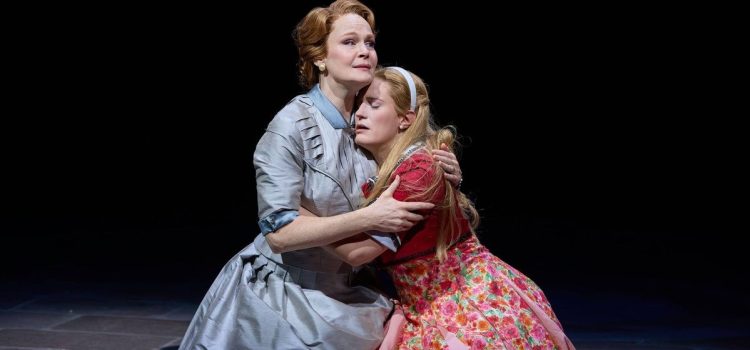
Opera Theatre of Saint Louis’ production of “The Light in the Piazza” consistently achieves the atmosphere of operatic emotional depth, even if it reaches true operatic emotional danger less often.
Through soaring vocal performances, elegant visual storytelling and sustained tonal sophistication, OTSL delivers a production enveloped in cultivated romanticism and musical yearning.
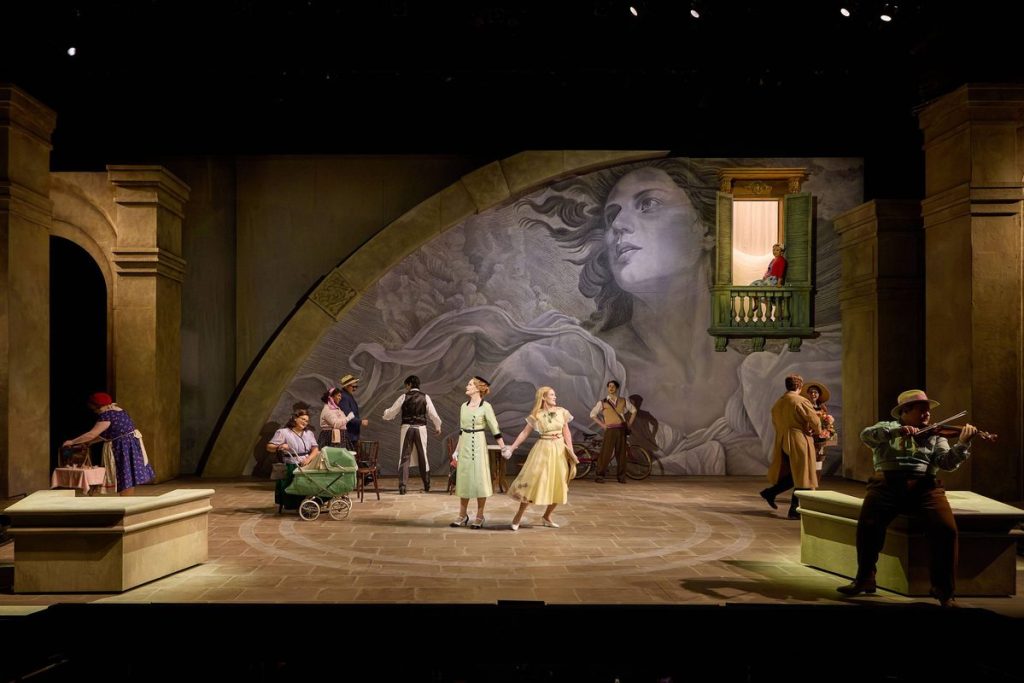
Cameron Anderson’s striking set design establishes that atmosphere immediately. Sweeping stone arches dominate the stage, carrying the accumulated emotional history of Florence itself.
The arches become emotional architecture — thresholds, passages and reminders that these characters are visitors twice over: tourists moving through Italy and emotional travelers moving toward unfamiliar versions of themselves.
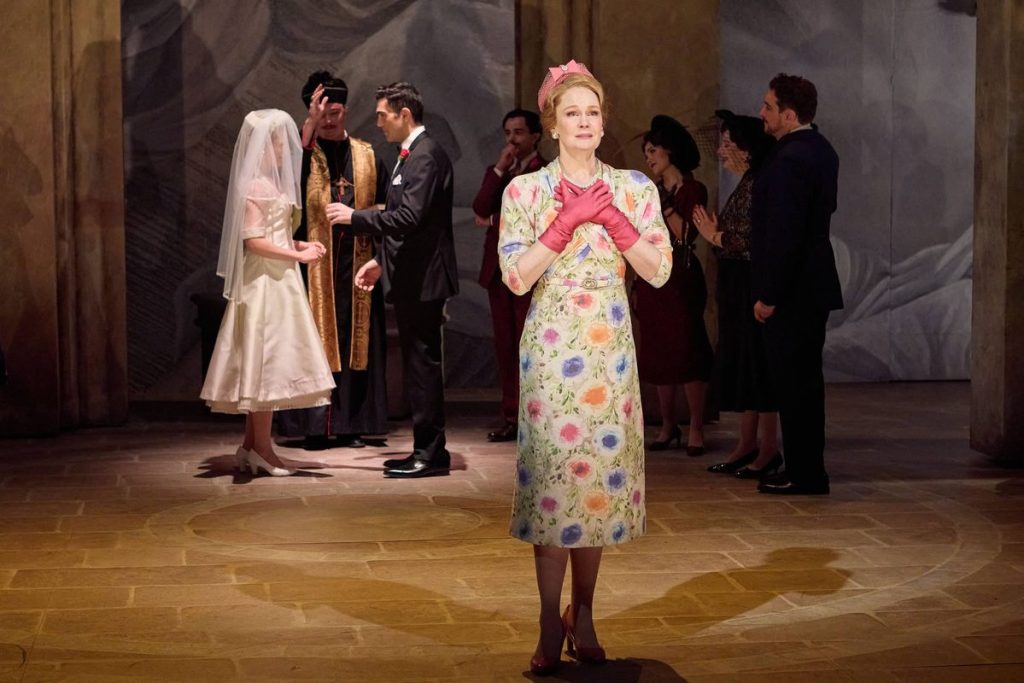
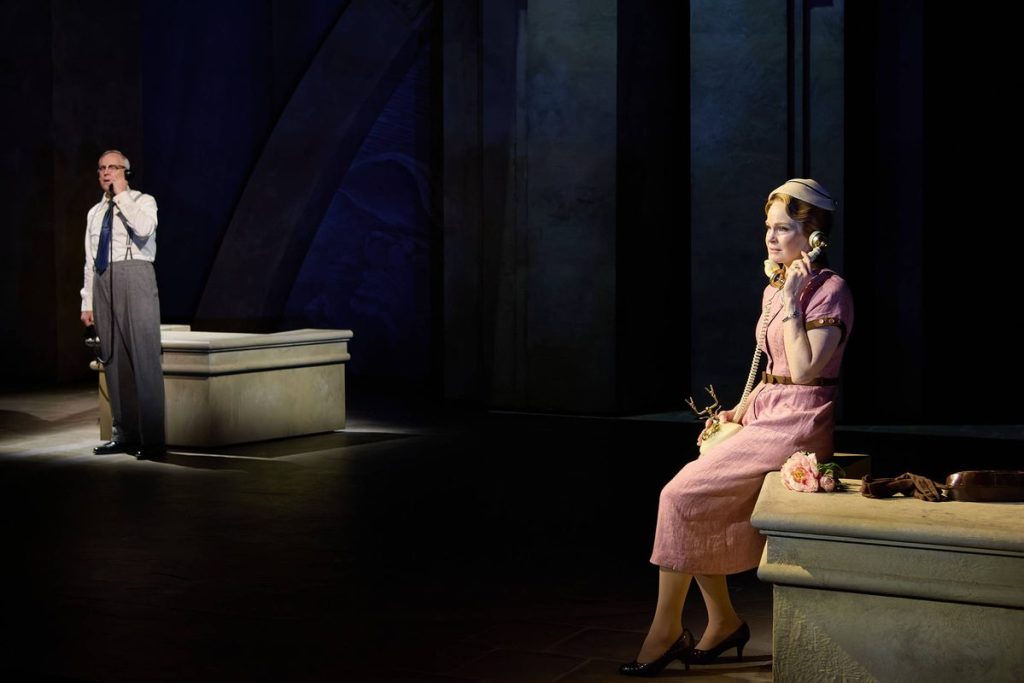
Kate Baldwin as Margaret Johnson. Photo by Eric Woolsey.
Eric Southern’s lighting deepens that visual language beautifully. A stark shaft of light isolates Clara at both the opening and near the production’s conclusion, quietly framing her as emotionally exposed and suspended between dependence and adulthood, innocence and self-determination.
Southern’s lighting and Anderson’s arches together create a visual vocabulary of passage, vulnerability and emotional crossing.
Crystal Manich directs with clarity and tonal confidence. Scene transitions flow with dreamlike fluidity, and the production sustains a remarkably cohesive emotional vocabulary from beginning to end.
The production ultimately belongs to Kate Baldwin’s Margaret Johnson.
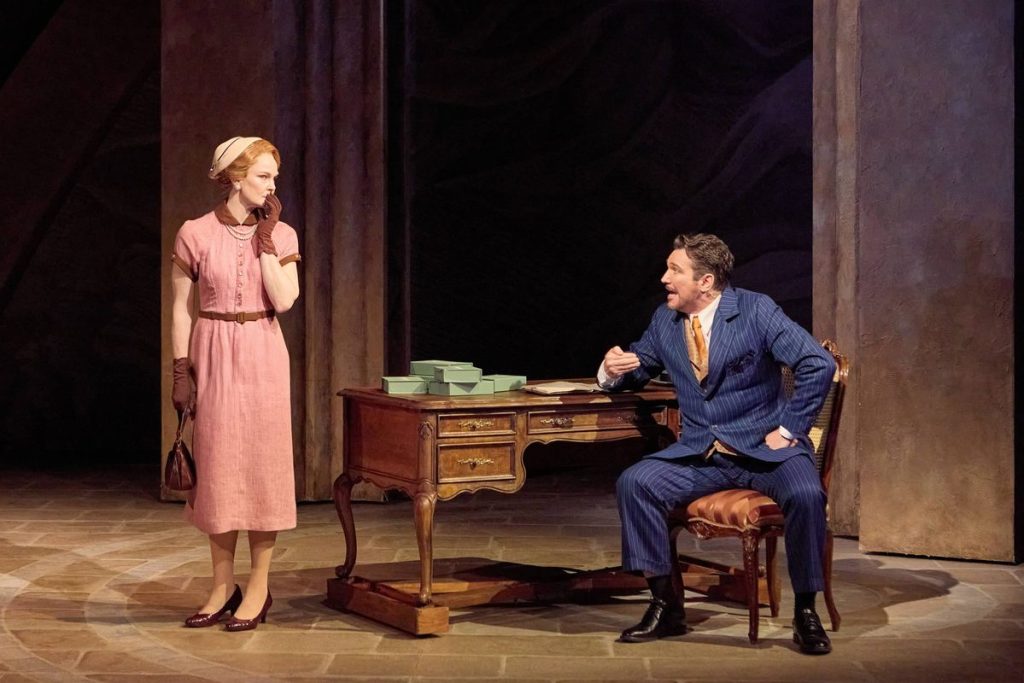
Kate Baldwin and Paolo Szot in “The Light at the Piazza.” Photo by Eric Woolsey.
Baldwin gives the evening its mature emotional intelligence, shaping Margaret as a woman who understands that love offers no guarantees, safeguards or reliable maps. Warmth, wit, restraint and quiet exhaustion coexist seamlessly in her performance.
Her richly controlled vocals navigate Adam Guettel’s harmonically restless score with remarkable ease, while her acting continually reveals the emotional calculations unfolding beneath Margaret’s composed exterior.
Though Clara’s romance initiates the story, OTSL’s production increasingly reveals itself as Margaret’s drama — a mature reckoning with love, uncertainty and the frightening necessity of release.
Roy Hage’s Fabrizio proves equally essential to the production’s success. Hage brings lyrical warmth, sincerity and earnest emotional transparency to the role, grounding the production’s refined theatricality in genuine feeling.
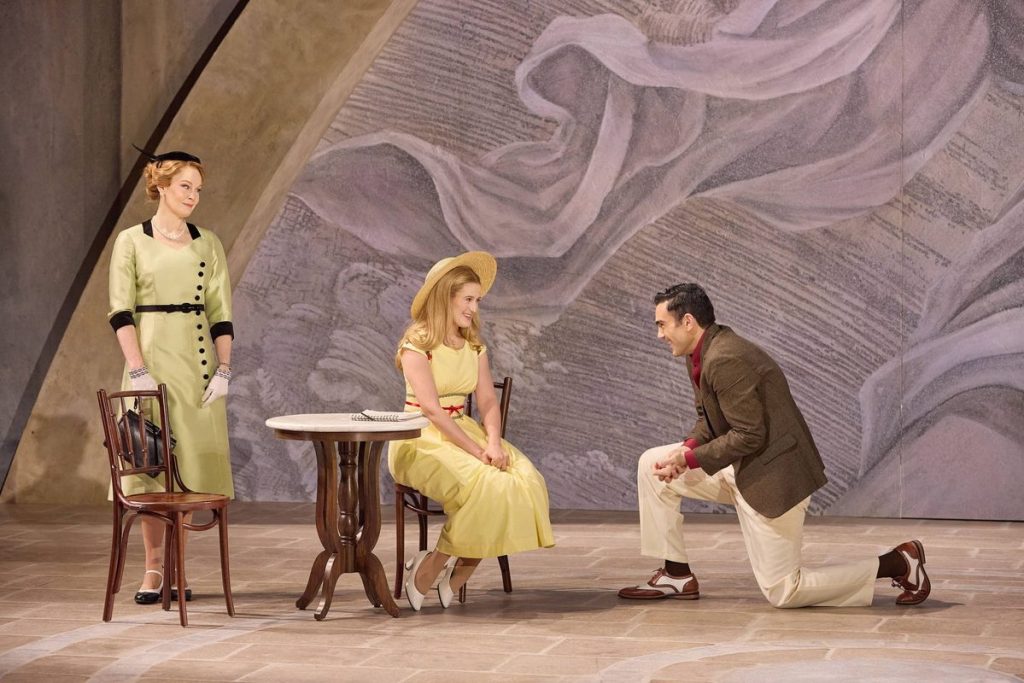
Kate Baldwin, Katrina Galka and Roy Hage in “The Light at the Piazza.” Photo by Eric Woolsey.
His chemistry with Katrina Galka’s Clara gives the romance persuasive emotional momentum even when the show’s idealism threatens to outrun practical realism.
Hage’s tenor remains consistently expressive and inviting, and his openness sustains much of the production’s emotional accessibility.
Galka delivers a thoughtful and sympathetic Clara, particularly in the later scenes where the character’s frustration with her constrained life emerges more forcefully.
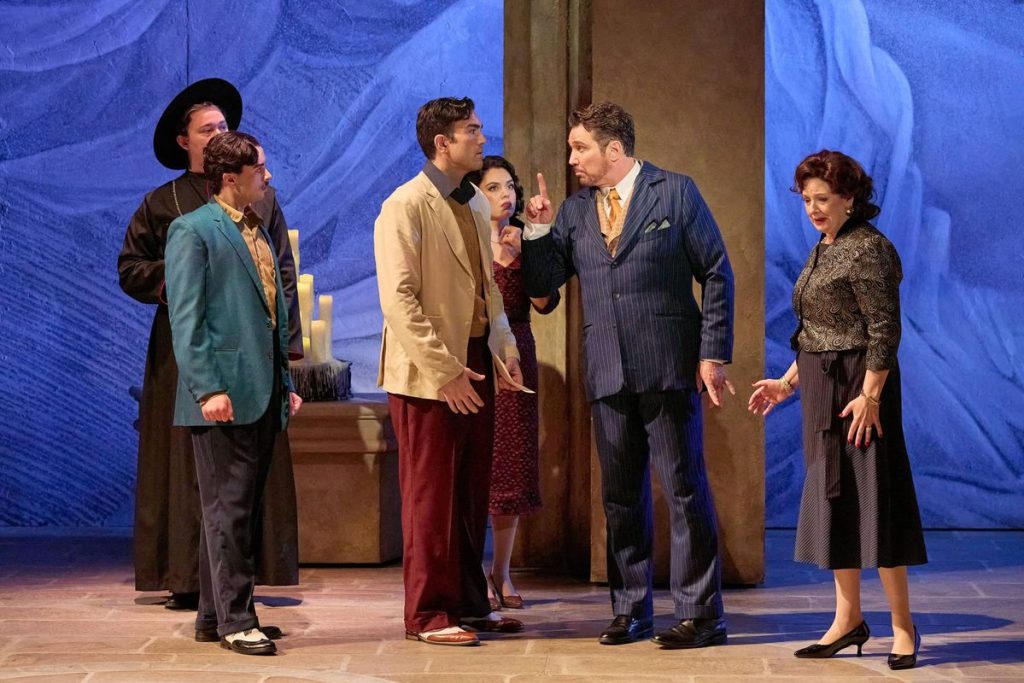
The Naccarelli family in “The Light at the Piazza.” Photo by Eric Woolsey.
Even so, the production’s emotional center of gravity gradually shifts toward Baldwin and Hage, whose performances carry greater theatrical and vocal authority.
That contrast between youthful emotional openness and the erosion of adult certainty gives the production much of its emotional texture. Clara and Fabrizio move toward love with instinctive urgency, while Margaret and Roy inhabit the lingering emotional afterlife of a marriage whose passion has cooled into habit and caution.
Under Rob Berman’s direction, the St. Louis Symphony Orchestra fully embraces Guettel’s lush, classically inflected score. The music unfolds less as a sequence of distinct songs and more as a continuous emotional current built from soaring phrases, suspended harmonies and yearning orchestral textures.
The museums of Florence. Photo by Eric Woolsey.
At times, however, that richness works against dramatic immediacy. The orchestra occasionally overwhelms dialogue, and extended untranslated passages in Italian force audiences to work harder than necessary to remain textually connected.
Those passages clearly reinforce Margaret’s outsider status within Florence’s emotional and linguistic landscape. Still, the cumulative effect creates more distance than intimacy.
Perhaps it is unfair to apply operatic standards of clarity and accessibility to a musical deliberately straddling both worlds. Yet when an opera company stages “The Light in the Piazza” with such unapologetically operatic ambition, those comparisons become inevitable.
What ultimately lingers after OTSL’s “The Light in the Piazza” is less any individual song or dramatic revelation than the production’s carefully sustained emotional and visual atmosphere. The voices, the arches, the light and the cultivated romanticism remain vividly intact — a performance more immersive than transformative, though consistently elegant and theatrically persuasive throughout.
Michael James Reed and Kate Baldwin as The Johnsons in “The Light in the Piazza.” Photo by Eric Woolsey.
“The Light in the Piazza” continues through June 28 at the Loretto-Hilton Center on the Webster University campus, presented in rotating repertory as part of Opera Theatre of Saint Louis’ 2026 festival season. Ticket information, dining options and additional production details are available through the OTSL website.
CB Adams is an award-winning fiction writer and photographer based in the Greater St. Louis area. A former music/arts editor and feature writer for the St. Louis Globe-Democrat, his non-fiction has been published in local, regional and national publications. His literary short stories have been published in more than a dozen literary journals and his fine art photography has been exhibited in more than 40 galley shows nationwide. Adams is the recipient of the Missouri Arts Council’s highest writing awards: the Writers’ Biennial and Missouri Writing!. The Riverfront Times named him, “St. Louis’ Most Under-Appreciated Writer” in 1996.
I shouldn’t admit this, but during the intermission at opening night of Opera Theatre of St. Louis’ production of “La Bohème,” I thought of Cher.
I should have been madly scribbling notes about all of the salient aspects of this Puccini classic, as all good reviewers should, but instead I was thinking of Cher’s performance as Loretta Castorini in the movie “Moonstruck.” Specifically, the scene when she’s discussing her experience having just attended “La Bohème.”
“I was surprised…” she says. “You know, I didn’t really think she was gonna die. I knew she was sick.”
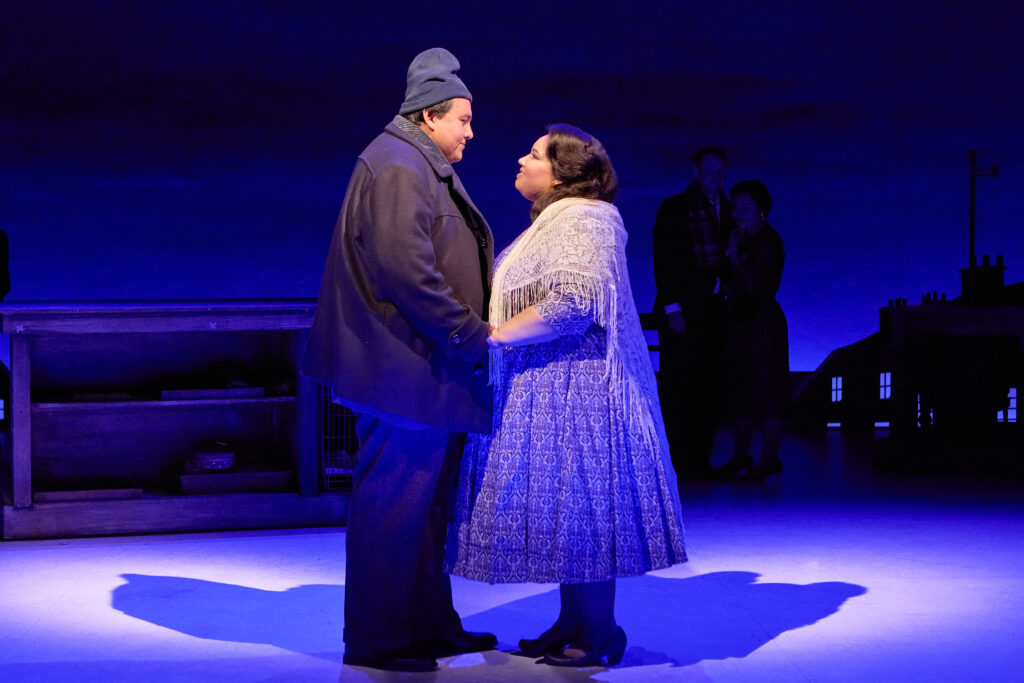
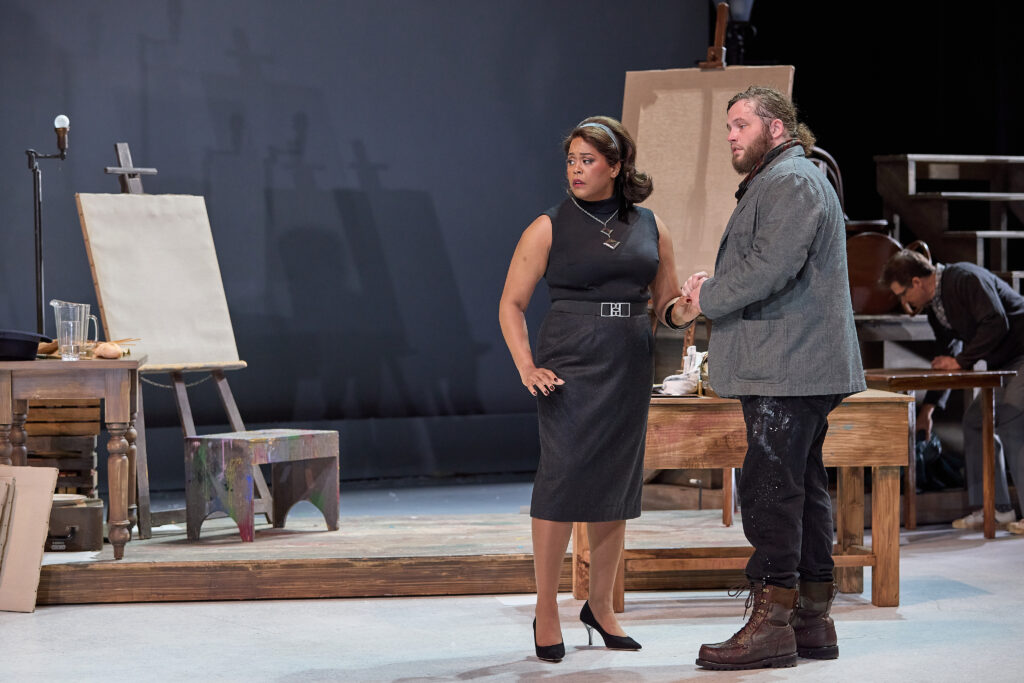
The “she” is Mimi, and if Loretta had seen lyric soprano Katarina Burton’s performance, she might have realized that Mimi really was gonna die. That’s because Burton maintains a tightly controlled, authentic simplicity that draws attention to Mimi’s inner life and emotional journey. That journey is imbued with a subtle-but-persistent death-hauntedness – starting with a small, foreshadowing cough as she makes her entrance in the first act.
The specter of death makes Burton’s performance of Mimi’s deterioration compelling, tragic and all the (tragically) sweeter, especially her love and tribulations with Rodolfo. I hesitate to write that line because I’ve become more than bit disillusioned with the whole dying heroine trope. You know, “Terms of Endearment,” “Steel Magnolias,” “Hope Floats,” “Beaches,” etc., etc.
It’s to Burton’s credit that I suspended my dislike for this narrative device. Her voice conveys the necessary subtle nuances and delivers Puccini’s demanding melodies with a beautiful legato and emotional depth. She is a convincing actress who genuinely portrays Mimi’s joy, love and eventual (inevitable) suffering.
That was enough to win me over to Team Mimi – as was her chemistry with Rodolfo. The dynamic of this duo in their duets and emotional scenes provides a satisfying balance in these interactions.
If Burton’s Mimi foreshadows her journey with a small cough, Moisés Salazar’s’ Rodolfo faces his journey’s climax with the catch of his throat when he realizes Mimi has died. Salazar’s performance provides many confident and fine moments, but it is at that catch of the throat that rang the truest, most human and genuine. It’s also the moment that makes clear his journey of loss is just beginning.
Salazar exhibits a powerful and expressive tenor voice that ably conveys lyrical tenderness, dramatic intensity and a palpable emotional connection and chemistry with Mimi, enhancing the romantic and tragic dimensions of their relationship. His acting abilities enlivened his Rodolfo’s youthful ardor and eventual despair.
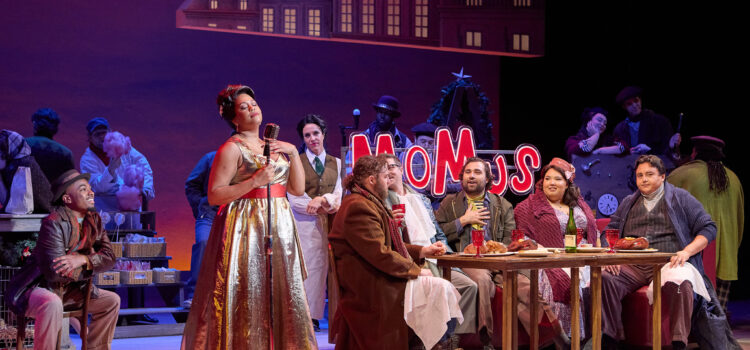
Brittney Renee achieves another bit of opera theater magic in the final act. In the first three, Renee delivers a Musetta who displays the requisite range of confident liveliness and flamboyance with a touch of naughtiness (Café Momus, anybody?). But it’s her act of kindness toward Mimi in fourth act that most humanizes the character. Renee’s compassion adds genuine depth to the role.
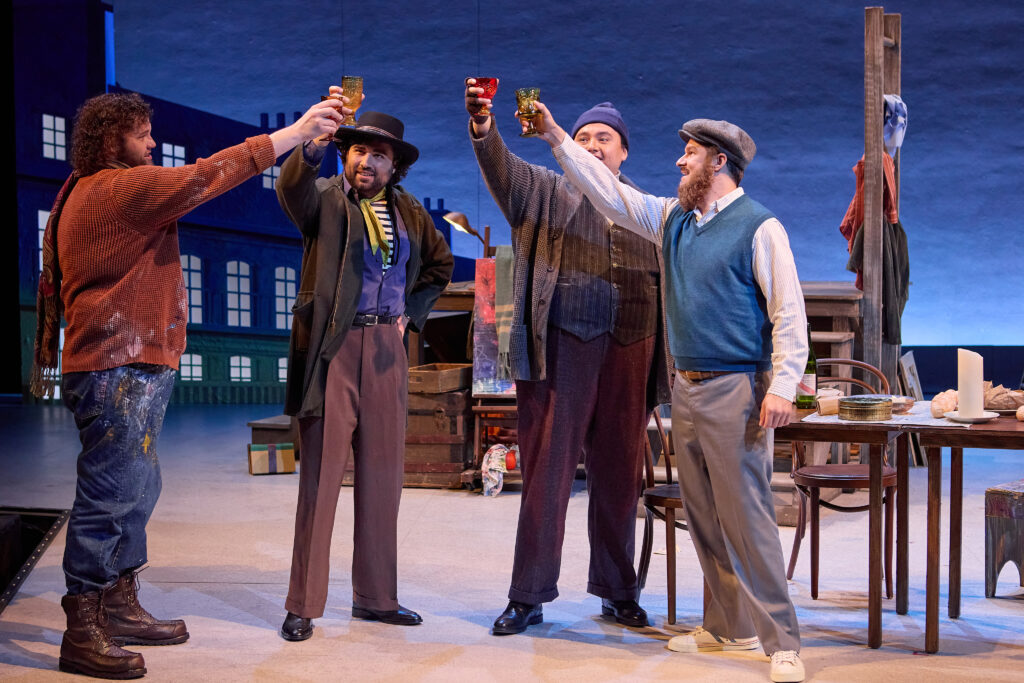
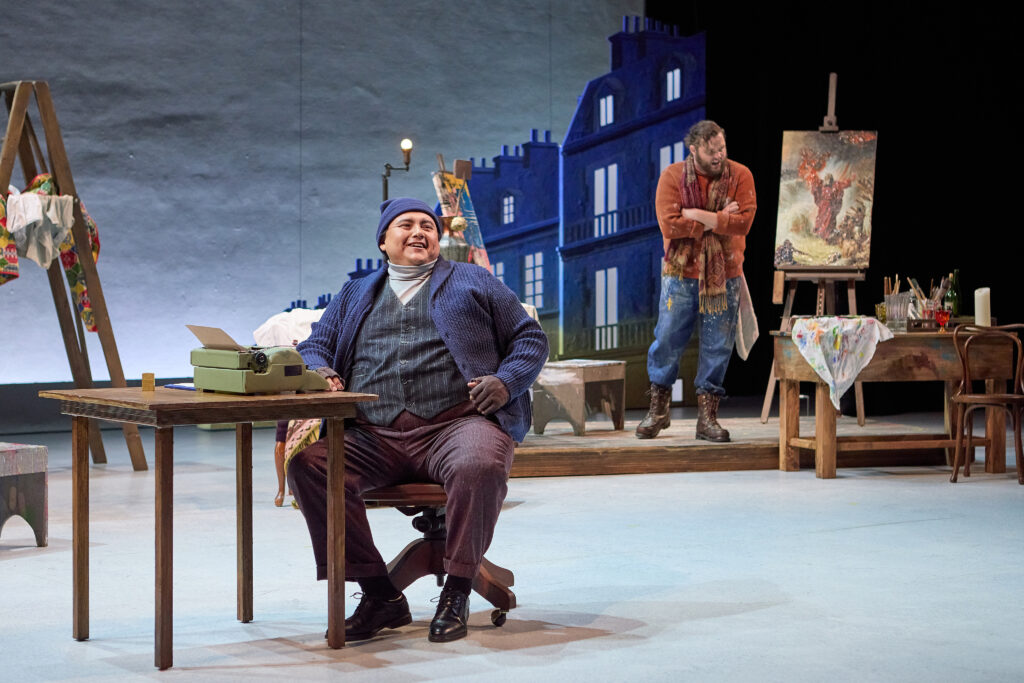
Great chemistry is a hallmark of this cast, especially among the Bohemians – Thomas Glass as Marcello, André Courville as the philosopher, Collins, and Titus Muzi III as Schaunard. Collectively and individually, their vocal abilities combined with seamless ensemble singing, maintains harmonic unity, but it is in their camaraderie and musical interplay provides the necessary chemistry to drive much of the opera’s emotional and narrative depth.
Proof that there are no small roles in theater is found in the minor character Parpignol, the toymaker and vendor who makes his one and only appearance in Act II. Levi Adkins inhabits the character who contributes to the effervescence of the abundant, bustling Christmas Eve scene.
Most memorable is his Napoleonic hat, red and white jacquard pantaloons and backpack drum, thanks to the efforts of costume designer Amanda Seymour as well as wig and makeup designers Krystal Balleza and Will Vicari.
Another memorable costume is notable for a very different reason. It’s Mimi’s periwinkle blue coat and purse in Act II. As Mimi opens her heart to Marcello outdoors, they interact in the cold outdoors. The way Burton clings to that handbag while standing in a coat that is too light for such cold, reveals volumes about the uncomfortable state of her character.
It’s moments like this when the collective efforts of the cast, director Michael Shell, set design (Takeshi Kata) and lighting design (Marcus Doshi) align to elevate a small moment.
The members of members of the St. Louis Symphony Orchestra consistently provide terrific performances for OTSL performances – so much so that it’s easy to forget how important the music is. For “La Bohème,” the musicians, under the direction of José Luis Gómez, exquisitely convey the depth of characters’ sentiments and enhance the immersion in the poignant narrative.
As a member of the “chestnuts club,” opera’s “La Bohème” is like ballet’s “The Nutcracker” and can be counted on to put cheeks in seats. The regular appearance of a “La Bohème” of this quality should be celebrated because the opera stands up well to repeated viewings (and listenings) and is a good “gateway” to the artform. It’s like pressing replay, pulling on a favorite sweater or meeting a friend for lunch.
And, to invoke Cher once more, it makes me believe yet again “…in life after love..”
“La Bohème” is part of Opera Theatre of St. Louis 2024 repertory season continuing through June 30 at the Loretto-Hilton Center on the Webster University campus. For tickets or more information visit www.opera-stl.org.
CB Adams is an award-winning fiction writer and photographer based in the Greater St. Louis area. A former music/arts editor and feature writer for the St. Louis Globe-Democrat, his non-fiction has been published in local, regional and national publications. His literary short stories have been published in more than a dozen literary journals and his fine art photography has been exhibited in more than 40 galley shows nationwide. Adams is the recipient of the Missouri Arts Council’s highest writing awards: the Writers’ Biennial and Missouri Writing!. The Riverfront Times named him, “St. Louis’ Most Under-Appreciated Writer” in 1996.