By CB Adams

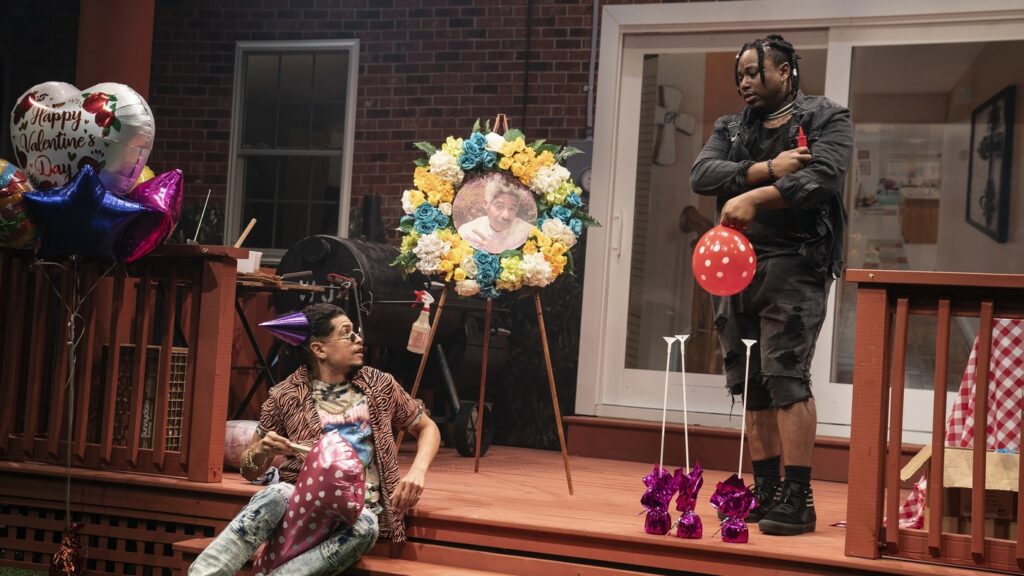
Tennessee Williams Festival St. Louis has lavished Branden Jacobs-Jenkins’ “Appropriate” with an extraordinary amount of artistry, care and, yes, love. Director Benny Sato Ambush and company expend all three in service to the script, then leave it to the audience to decide what to carry away. A production this accomplished leaves the play nowhere to hide.

What emerges is a play about the corrosive nature of secrets and what happens when excavation produces more questions than certainty. The horrifying photographs discovered among a dead father’s possessions provide the catalyst, while foreshadowing something still more disturbing and revelatory. What they unleash within his surviving family becomes the play.

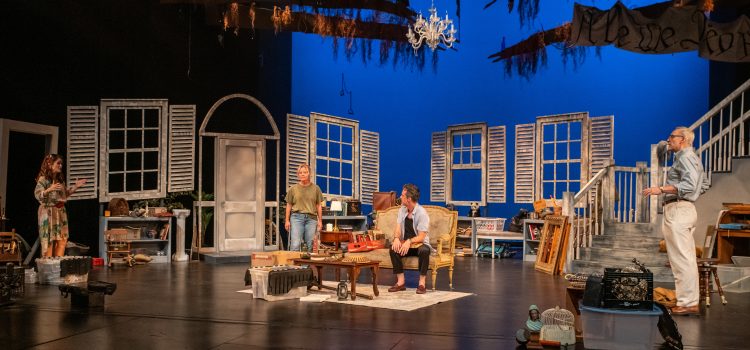
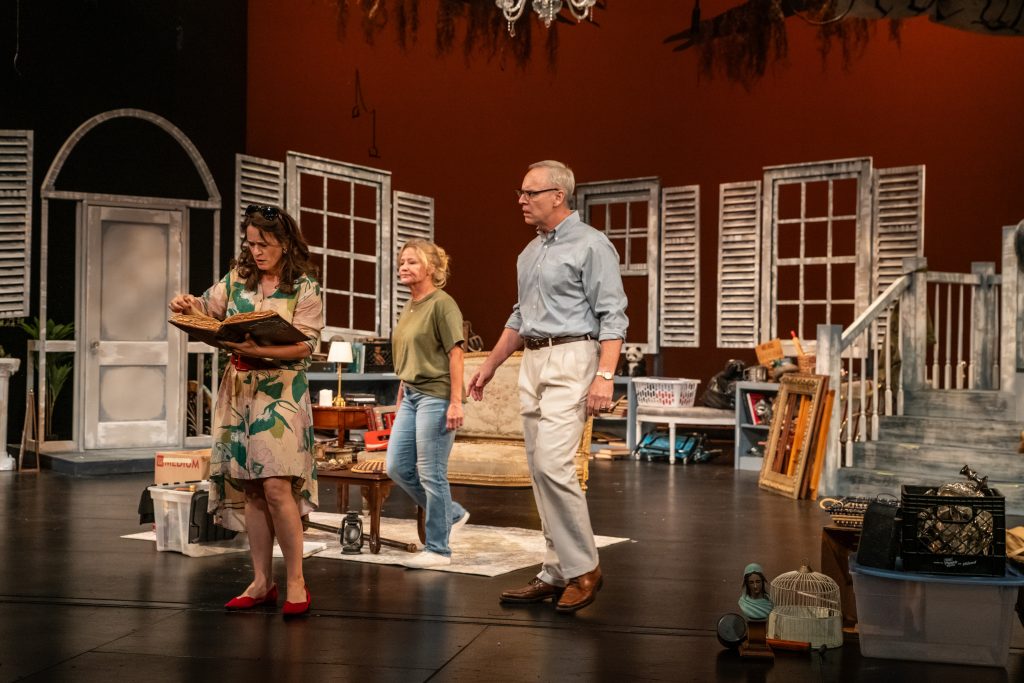
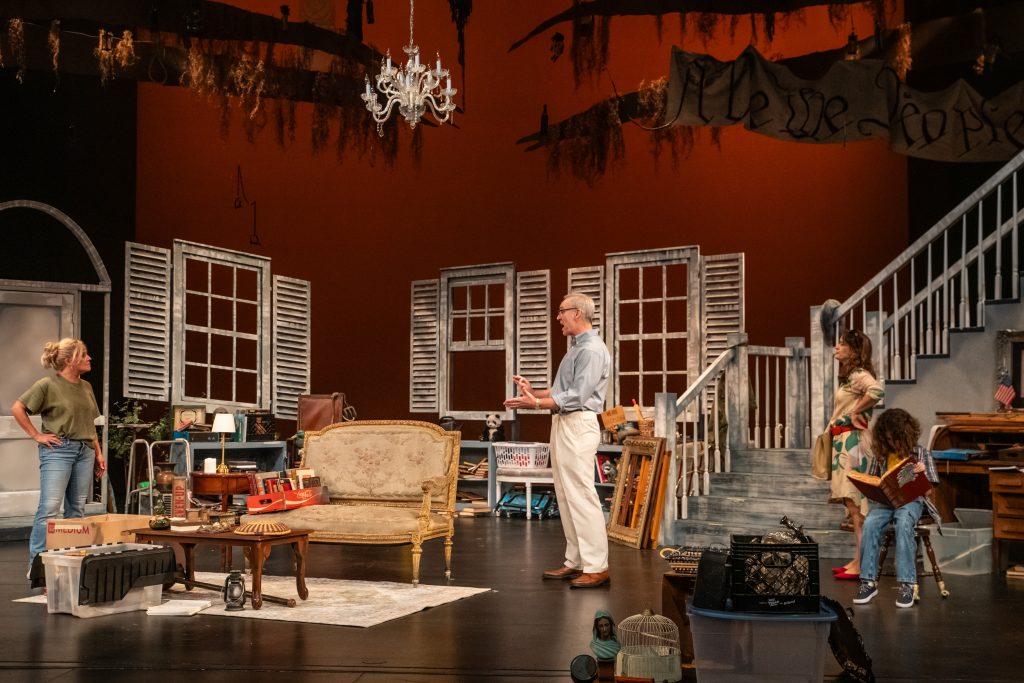
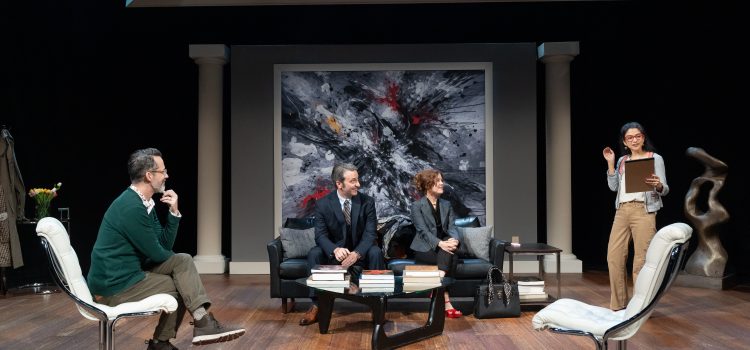
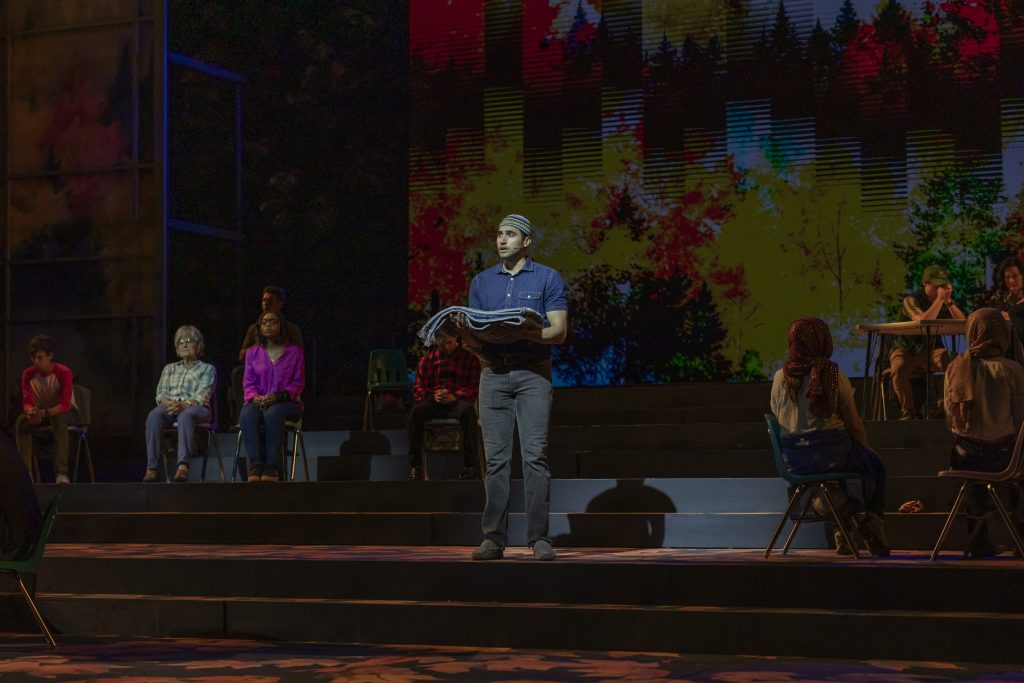
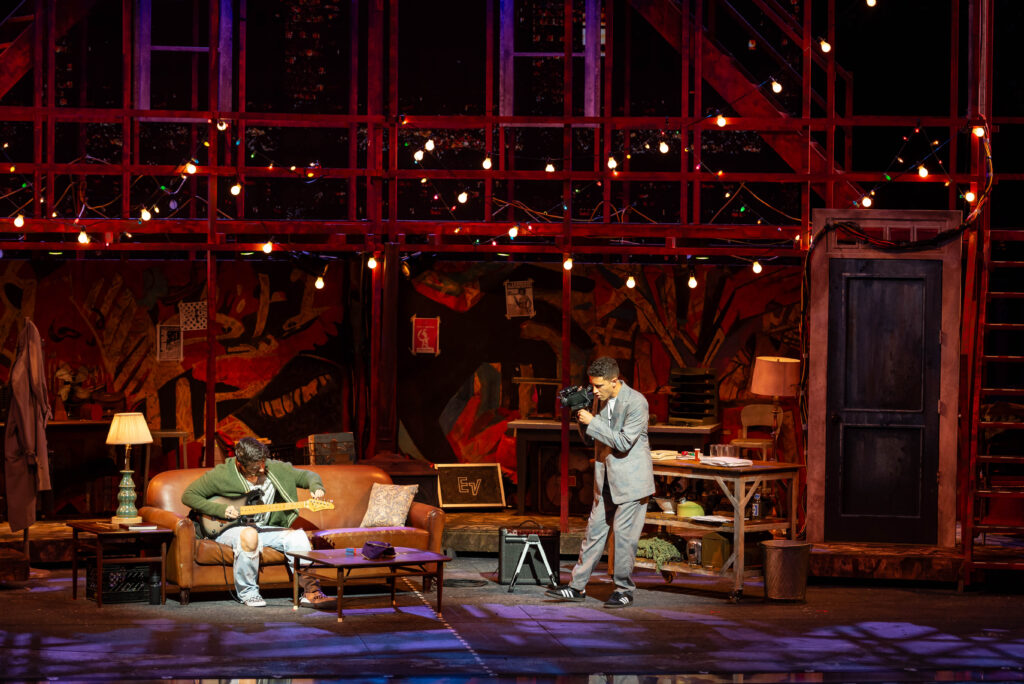
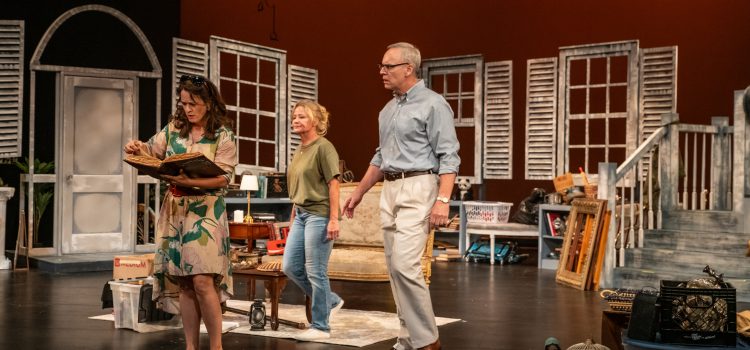
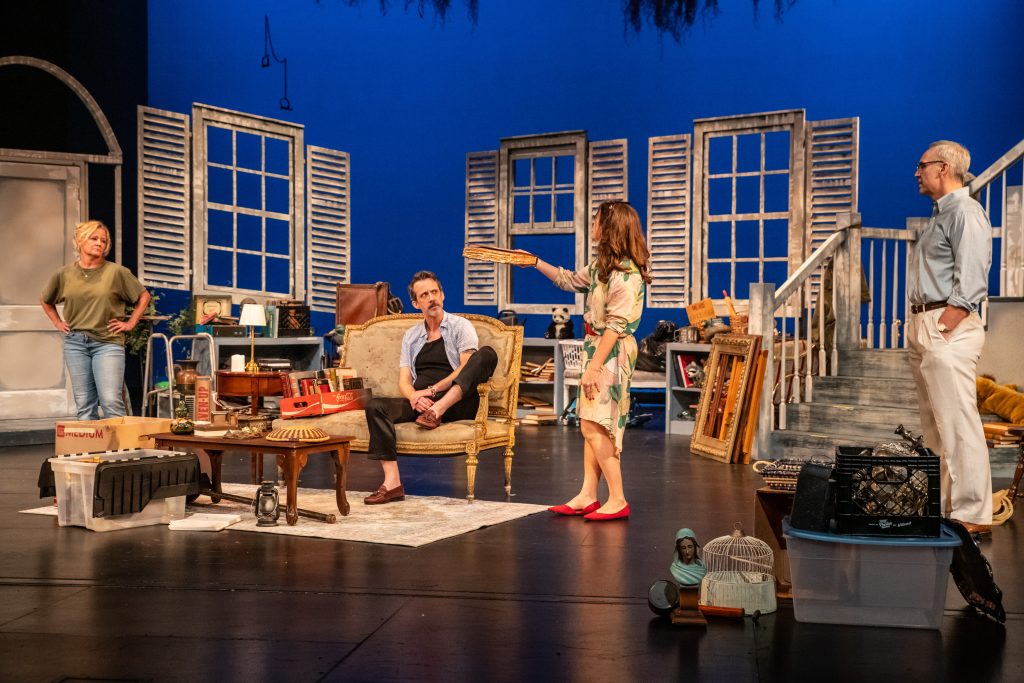
The Lafayettes, a white Southern family, have gathered at their late father’s crumbling Arkansas plantation house to empty it, sell it and presumably get on with their lives. Scenic and lighting designer Matthew McCarthy’s cluttered house looks in need of repair—hell, beyond repair—much like the family temporarily occupying it. The place is simultaneously familiar and foreign to them, an ambiguity Ambush mines throughout.

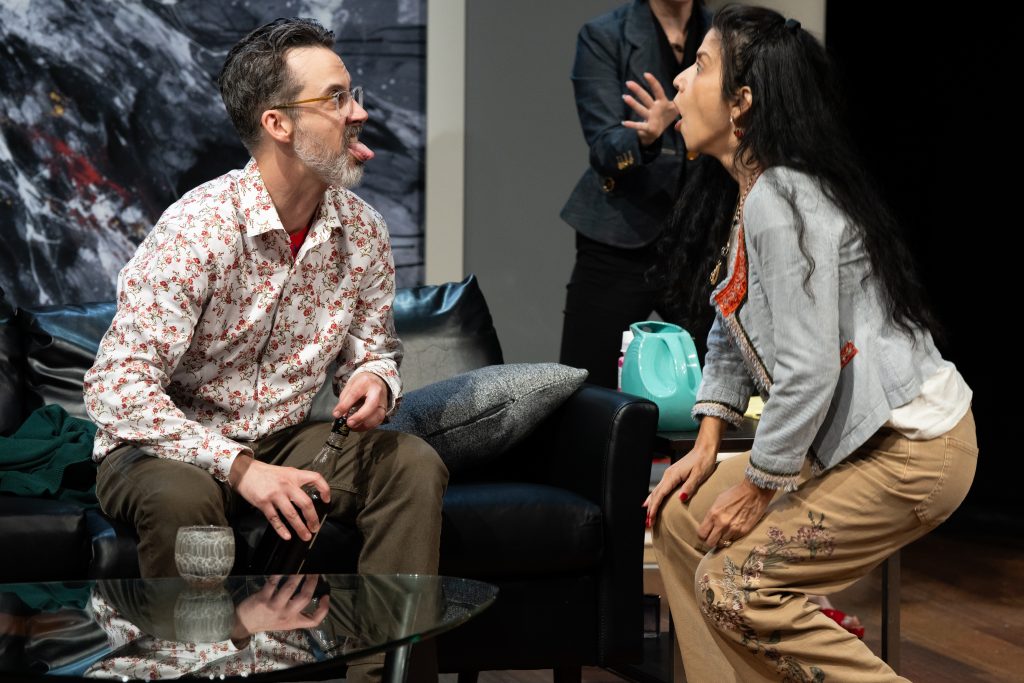
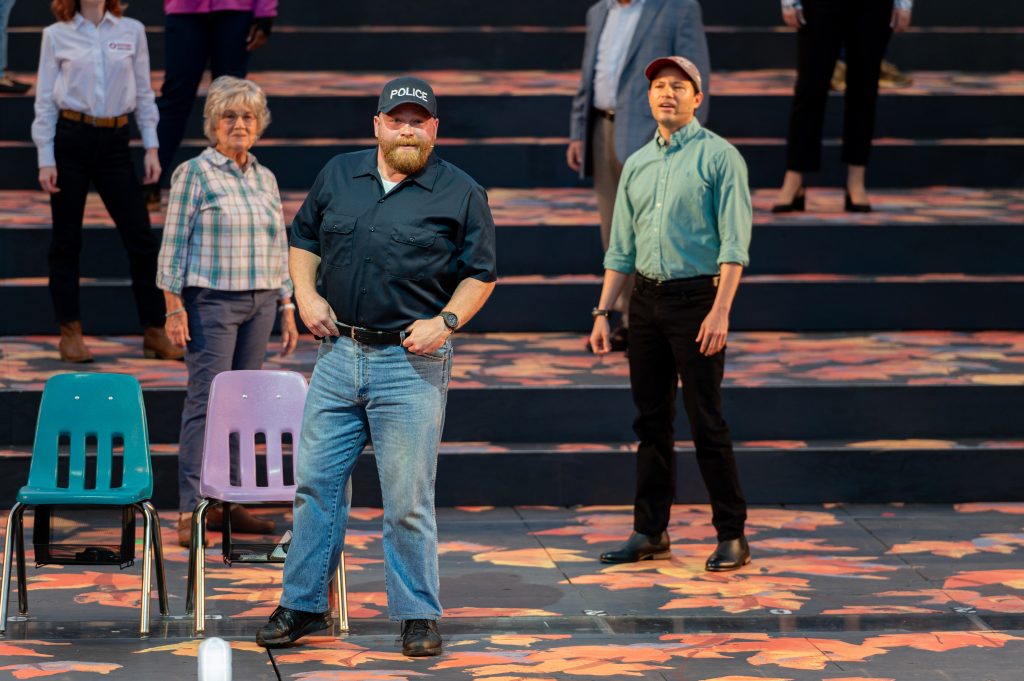
So does his exceptional ensemble. This is a family of old wounds and long memories of psychic bruises, and Jacobs-Jenkins knows where to press. Eventually everyone presses back. Fights are notoriously difficult to stage convincingly, and fight choreographer Shaun Sheley engineers this one so that accumulating hostility makes violence feel inevitable even as its eruption arrives as a shock. Bodies collide, years of grievance turn physical, and the production lands one of its most difficult moments.
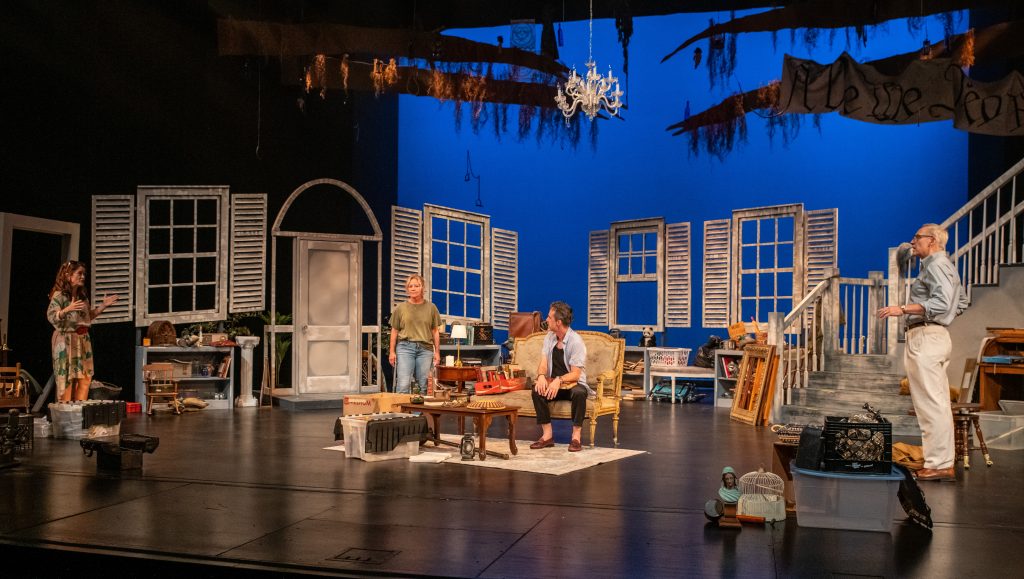
Jilanne Marie Klaus makes Toni’s anger intelligible while allowing its ugliness full rein. Her grievances have calcified into an understanding of sacrifice, loyalty and what she believes she is owed. By Toni’s climactic declaration, Klaus has made clear how she arrived there, even as Toni reveals how far those grievances have carried her.

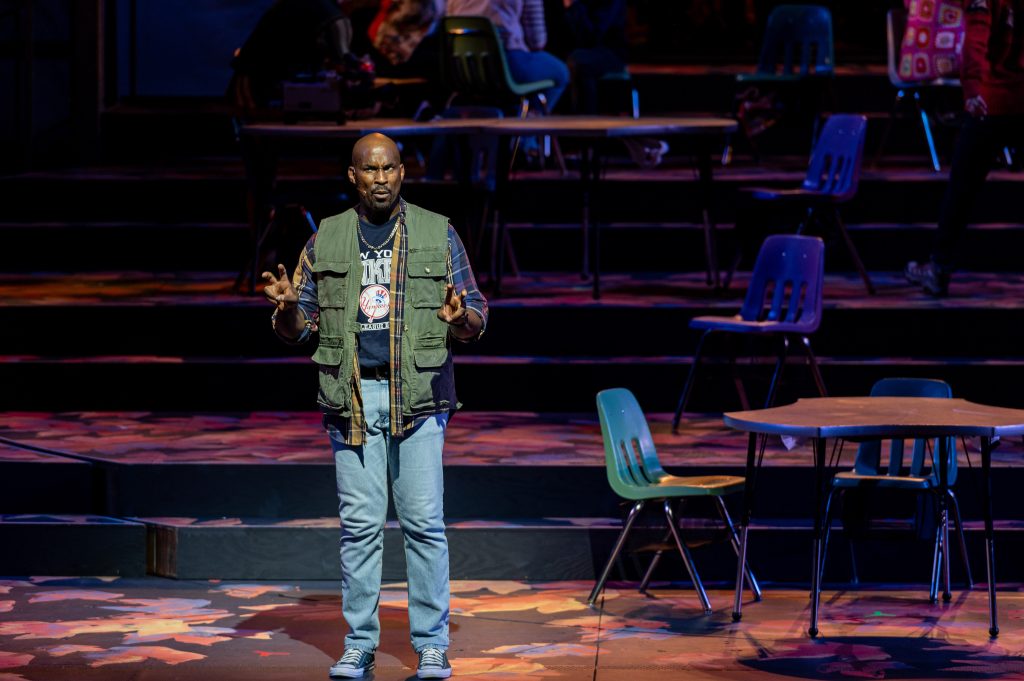
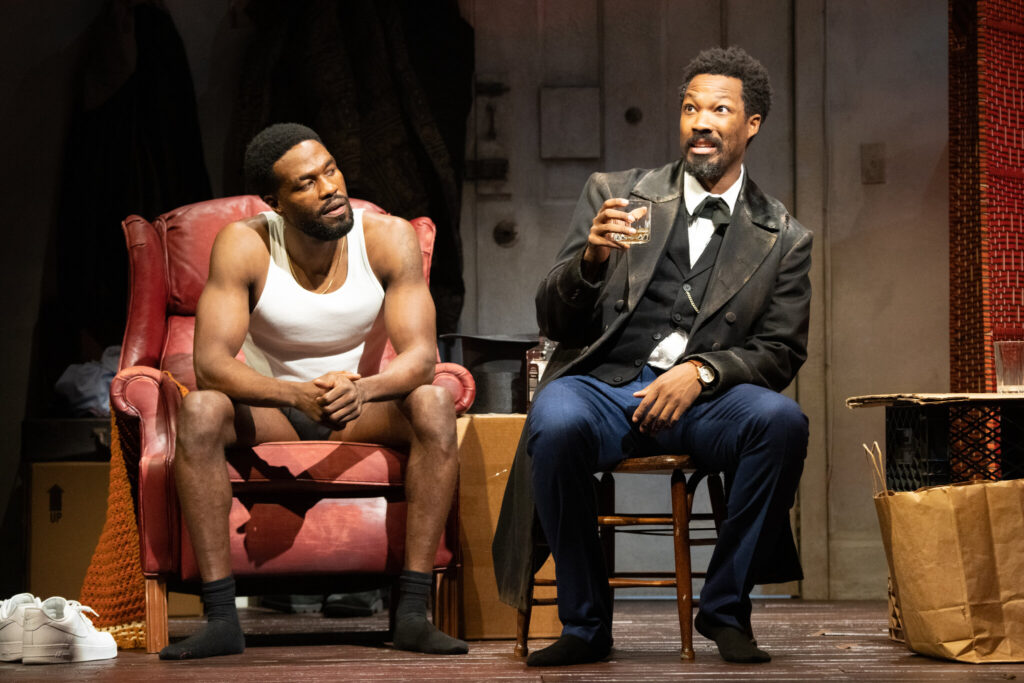
Joel Moses spends significant stage time bare-chested as Franz attempts to lay bare the man he believes he has become. Moses turns a faux-baptism and Franz’s pleas for understanding into blistering acts of self-revelation. Then Frank’s past resurfaces, forcing the family to contend with the man he was and the man claiming to stand before them now.

Michael James Reed begins with Bo’s recognizable silhouette—the tightly wound New Yorker juggling a threatened career, wife and children while hoping to dispatch his family obligations—and gradually opens him to something more vulnerable. In the aftermath of the violence, Reed brings Bo both home and not-home, allowing believable tears to reveal another dimension of a man whose competence has carried him only so far.

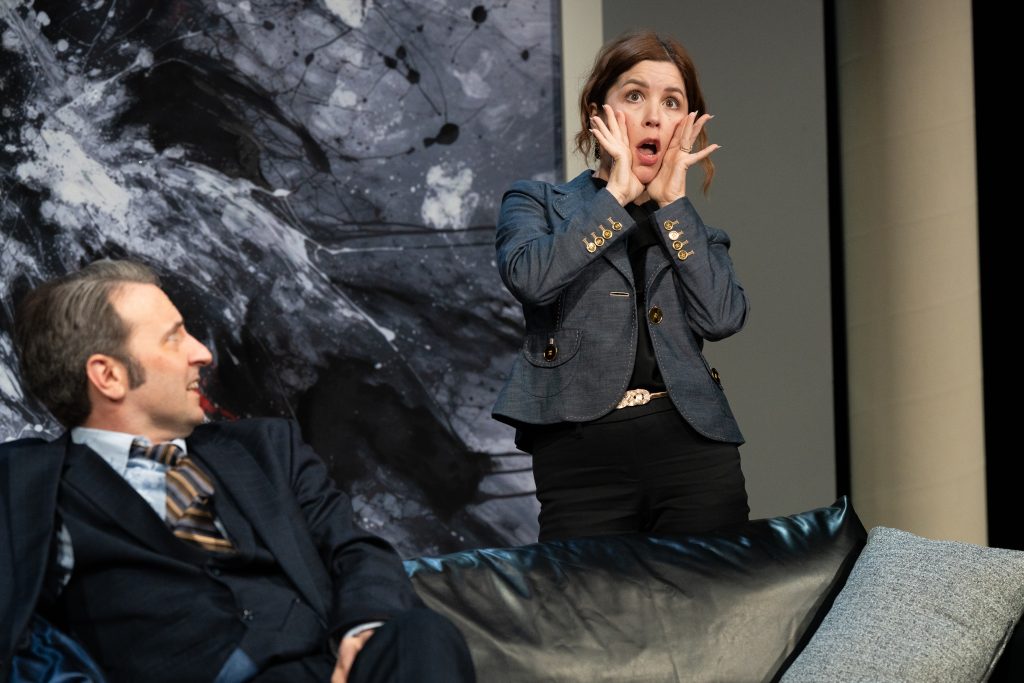
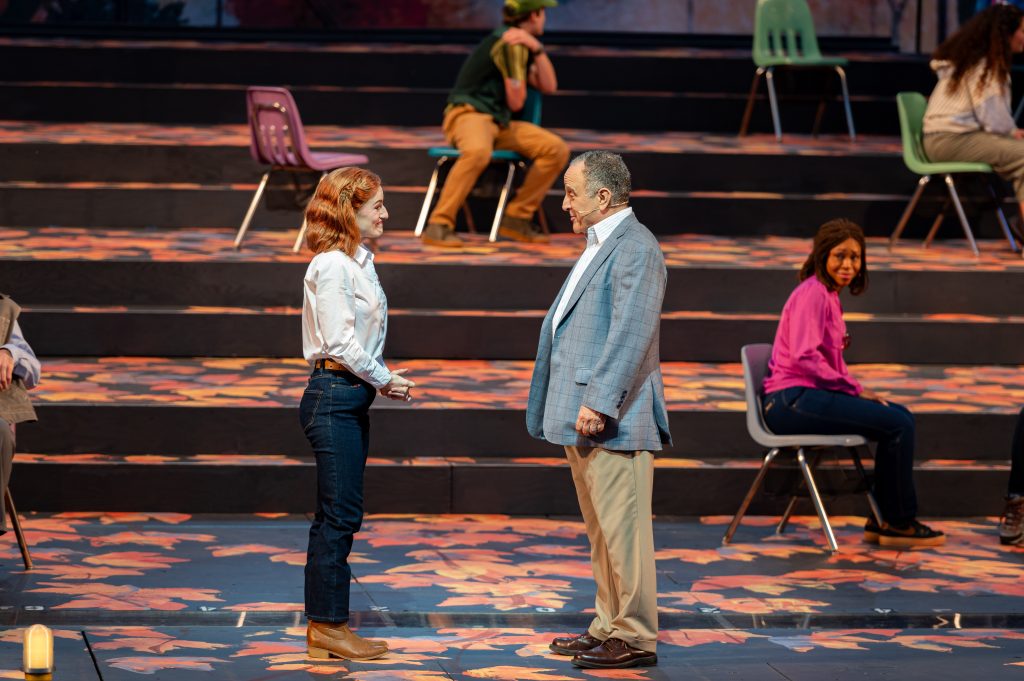
The women reveal different constructions of womanhood as the house strips away first impressions. Lizi Watt tightly unwinds Rachael scene by scene, moving the exasperated wife and in-law toward grievances and moral claims she fully earns. Maggie Newstead-Adams lets River arrive in full crunchy-granola, woo-woo New Age space-cadet mode, then deftly reveals deeper waters beneath the family’s assumptions about softness, youth and femininity.
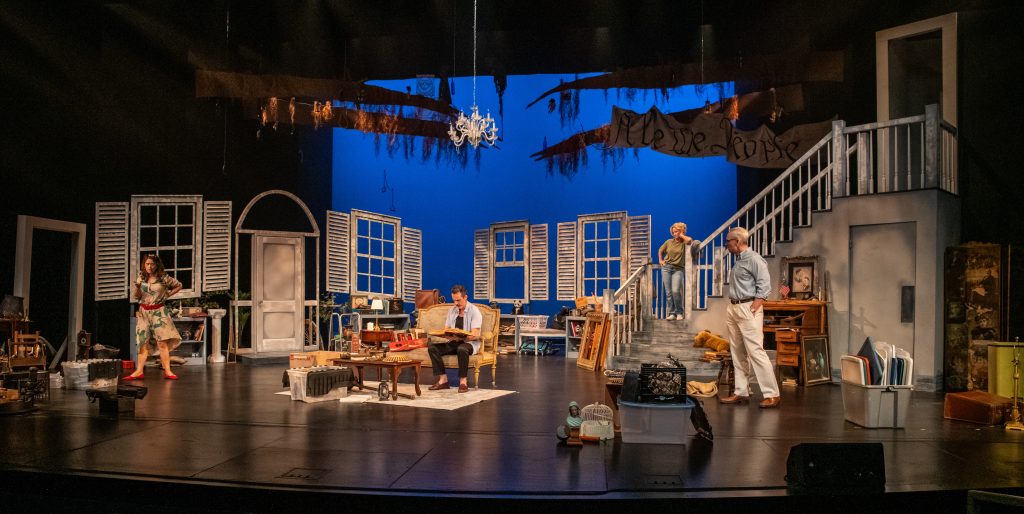
The next generation is already carrying things forward. Braden Phillips makes Rhys a kind of put-upon horny Boo Radley opposite Ainsley Hammond’s naive teenage-rager Cassidy, while the youngest child innocently supplies one of the evening’s consequential revelations about the grandfather none of them fully knew.

Then there is the album.

It looks almost like a revered family Bible, a hefty, timeworn volume expected to preserve births, deaths and generations of Lafayette history. Instead, its pages contain photographs documenting horrific racial violence against Black Americans. Ambush stages this grotesque inversion of a family keepsake almost as another character, introducing the book with a held moment in a spotlight. It passes from revulsion to fascination and something more uncomfortable: prurience, that human impulse to gawk, the same one that slows traffic as drivers looky-loo through their windows at a fatal crash.

The album gets deliberately submerged in an attempt at erasure, then returns waterlogged to center stage as the family contemplates what it might fetch. The progression grows more grotesque: horror becomes curiosity, human suffering becomes collectible, and finally someone puts a price on it.
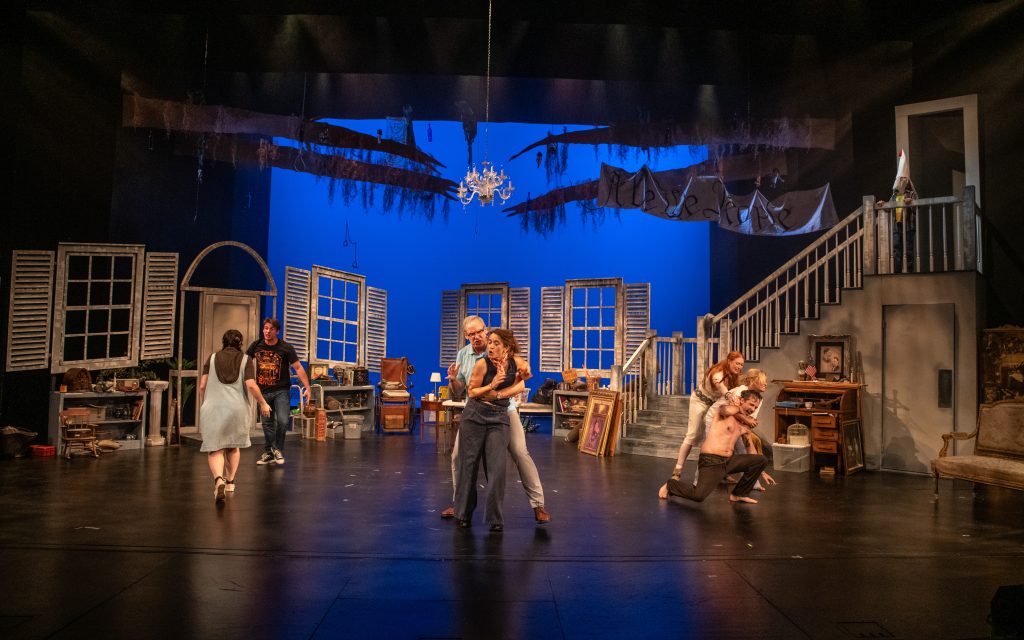
There is something here of Tim O’Brien’s “The Things They Carried,” his collection of linked stories about the physical and emotional burdens carried by soldiers in Vietnam. Call these the things they inherited: the Lafayettes return carrying old grievances and discover their dead father has left them much more to carry.

That inheritance also explains why “Appropriate” belongs at a Tennessee Williams festival. Jacobs-Jenkins has acknowledged borrowing from Williams and other American dramatists. That is the Tennessee Effect at work: inheritance put back to work, absorbed, altered and extended. “Appropriate” might be what happens when Big Daddy from “Cat on a Hot Tin Roof” is already dead and buried—or is he? The patriarch is gone, but the house, the inheritance, the secrets and the damage remain.

Sound designer Mary Robinson’s insistent cicadas and ghostly whispers make the world beyond the house almost another presence. Ambush opens that world further in his culminating historical montage, where Robinson’s sound carries us from the secrets of one Southern family into the larger history of racial violence in America. Different people in the audience inevitably receive that history from different starting points. The production can put the same history before everyone. It cannot make that history equally remote—or equally revelatory—to everyone.

Walking toward the parking lot afterward, one woman supplied perhaps the most appropriate curtain line:

“I feel like we need a debrief.”
Tennessee Williams Festival St. Louis’s production of Branden Jacobs-Jenkins’ “Appropriate” runs through Sept. 27 at the Catherine B. Berges Theatre at COCA, with remaining performances Sept. 25–27. For tickets and more information, visit twstl.org.

By Lynn Venhaus

With its complex characters, fractured family dynamic and multi-layered storyline, Branden Jacobs-Jenkins’ explosive drama “Appropriate” has much to unpack.

At their peak, a powerhouse local cast takes us on an unsettling, unforgettable journey, for their characters aren’t prepared for all the emotional baggage that will spill out. Well-cast and well-rehearsed, this production showcases intense immediate realism.

Dark secrets will be revealed, forever shaking the family. Think of it like a bandage being ripped off an open wound – repeatedly. The atmosphere is combustible – a marvel of sight, sound, imagery and tension under Benny Sato Ambush’s direction.

The cicadas are loudly buzzing on a hot, muggy summer night in rural southeast Arkansas when three Lafayette siblings converge to settle their late father’s estate. The clutter in the decaying plantation home is as profound as the anxiety as they prepare for an estate sale.

This is not a warm family reunion – interactions are awkward, bitter and contentious. This play, first performed in 2013 and then off-Broadway a year later, was revived in 2023 to much acclaim. Its power is intact, reminding us of systemic racism and unconscious bias when it’s hard to confront as legacy.

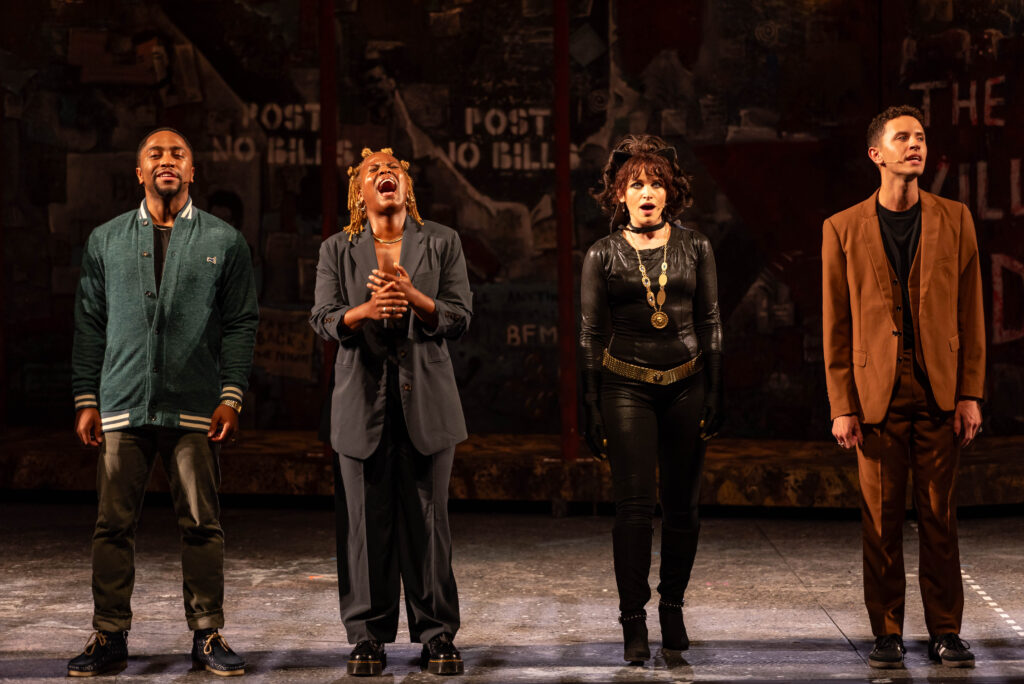
The Lafayette siblings – Jilanne Marie Barnes, Joel Moses, and Michael James Reed, with Lizi Watt holding photo album.

Wayward son Francois “Frank” (Joel Moses), who now calls himself “Franz,” is seeking redemption after years of addiction and bad behavior. He drove there from Portland with his eccentric young fiancé, River (Maggie Newstead-Adams).

Stressed-out eldest sister Antoinette “Toni” (Jilanne Marie Barnes) considers him toxic and won’t extend an olive branch. Brother Beauregard “Bo” (Michael James Reed), an attorney like their father, is expecting to take charge like he always does, but Toni is the executor. They all bicker incessantly.

Bo’s wife, Rachael (Lizi Watt), and their two precocious children, Cassidy (Ainsley Hammond) and Ainsley (Aviv Giancola-Poremba), came from New York City, thinking of this as an educational trip. Toni’s troubled son Rhys (Braden Phillips) is present. These are flawed relatives with enough intergenerational trauma for an eight-episode limited series.

“Appropriate,” with all the intentional meanings of that word, will delve into race, identity, and historical legacy. As the patriarch’s despicable past is discovered, the evidence can’t be ignored or denied. How family members deal with a photo album of graphic lynchings and other disgusting emblems of a vicious white supremist adds to the uncomfortable territory.

The playwright, who has won two Tony Awards, a Pulitzer Prize for Drama, and an Obie Award, has a natural command of how people interact and converse. His dense dialogue combines caustic wit with raw pain and sharp contemporary insight – and yes, phrases will shock.

Not a fun family reunion.

Joel Moses’ Franz is this deeply vulnerable bundle of insecurities, trying to show the better person he has become, but his siblings can’t let go of their hurtful memories about his decadent past and their resentful feelings. Unlocking a pitiable black sheep as only he can, Frank is another masterful performance by one of St. Louis’ finest actors.

Joining him in top-tier reliability is Michael James Reed, who is, without fail, always at the top of his game. He provides interesting layers to the complicated Bo, Ivy League-educated and successful.

At first, it feels like Bo checked out of caring about his family a long time ago. His main concern is the corporate ladder, and he appears to be the family “fixer.” Money-centered, he’d monetize the dad’s hateful artifacts in a heartbeat. But he’d love to distance himself from this tarnished past; he just wants to recoup all the funds he spent caring for dear old dad and get back to Manhattan.

Jilanne Barnes’ Toni is tired. Exhausted by life, her short straw, and trying to fix broken things that can’t be repaired, she is unpleasant for 95% of her stage time. That is heavy for an actress, and Barnes’ meets the challenge. Toni sacrificed and deeply cared for her father. She refuses to sully his memory.

Shrill and spiteful, she has alienated most everyone there, especially Bo’s Jewish wife Rachael. First impressions on the sister-in-law are that she’s a typical affluent status-conscious mother, trying to control the outside world’s influence on her children.

Estate sale preparation not going smoothly.

Lizi Watt displays Rachael’s buttons that Toni keeps pushing, with antisemitic name-calling, and it gets ugly — “August: Osage County” nasty. Fight choreographer Shaun Sheley’s work is noteworthy.

Most surprising is Maggie Newstead-Adams’ nuanced portrait of River. She presents herself as New Age and is derided for her ‘hippy-dippy’ qualities. Assuming she’s a stereotype, she proves herself to be wise beyond her 23 years and compassionate. Newstead-Adams’ poise among all the other acclaimed talent is impressive.

Spiritually, she is most attuned to the ghosts haunting this old plantation. Mary Robinson’s impeccable sound design announces the spirits’ eerie presence, as the family talks about the two graveyards on the property – one white, one with black slaves (without headstones).

When the third generation finds disturbing relics of their bigoted grandfather, the sins of the past erupt. As the program points out: “Walls remember what a family chooses to forget.”

By society’s standards, Daddy — Ray Lafayette — was a highly successful, highly educated man. He lived in Washington D.C. for a time, during a lauded legal career, and chose to return to the ancestral homestead, with thoughts of turning it into a bed-and-breakfast.

What secrets does Daddy have in that photo album?

Toni and Frank both refer to his mental deterioration, but the moral decay is something the family is loathe to address. But they start to peel back time, remembering behaviors. An all-white cast, dealing with the reality of historical racism, examines how the past haunts the present, and the bigger picture that it represents.

The outstanding artisans connected with this complicated production have crafted a stunning, crumbling Southern Gothic setting. The ambience is immediate, and so are the bad vibes. Matthew McCarthy’s richly appointed set design, complimented by Mikhail Lynn’s meticulous prop design, plunges us into this dilapidated structure, with the family’s despair emanating from every junk-filled corner.

McCarthy also designed effective lighting, and Ethan Dudenhoeffer was a wizard as technical director. Abby Pastorello’s costume design captured every character’s personality with terrific verve.

To reduce commentary about “Appropriate” can point out the obvious — a dysfunctional family in deep denial, which could stamp Tennessee Williams’ “The Glass Menagerie” and other landmark plays in the same way. That is why it’s not hard to see this connection that the Tennessee Williams St. Louis Festival chose to pivot with — “The Tennessee Effect” as this 11th year’s theme. It’s, well, appropriate.

Big brother will man-splain.

The takeaways are plentiful. We can only try to do better when we know better. If we aren’t willing to have discussions, where does society go?

In “Appropriate,” there is no tidy ending, no way to wrap up with a soothing bromide or suppress this legacy. The two-act dark drama is raw, unflinching, and damning of white fragility.

Some inheritance. They should be hot and bothered. And so should we.

The Tennessee Williams Festival presents the St. Louis premiere of “Appropriate” Sept. 17-27. Performances take place at the Berges Theatre at COCA in University City. For more information: twstl.org

By Lynn Venhaus

Merry mischief makers mix the Muny’s musical mash-up “Something Rotten!” into a zesty end-of-season treat. Of course it’s special — it has an exclamation point!

Sending up the art form while celebrating it, a high-energy ensemble accepts the mission: deliver a delightful, daffy show at a dizzying fast-pace for the 108th season closer.

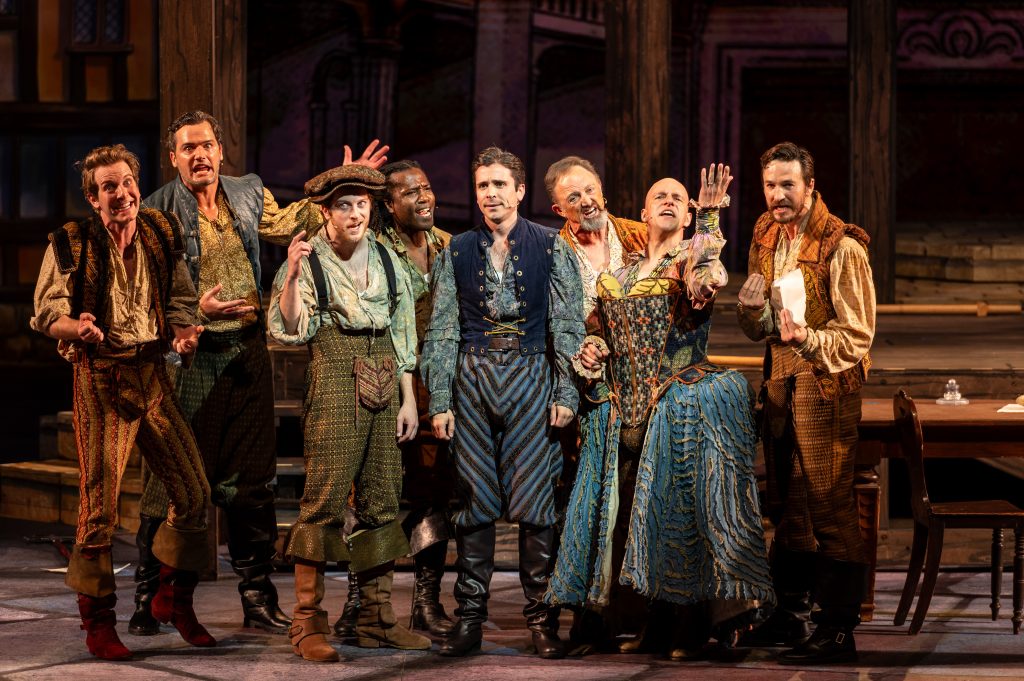
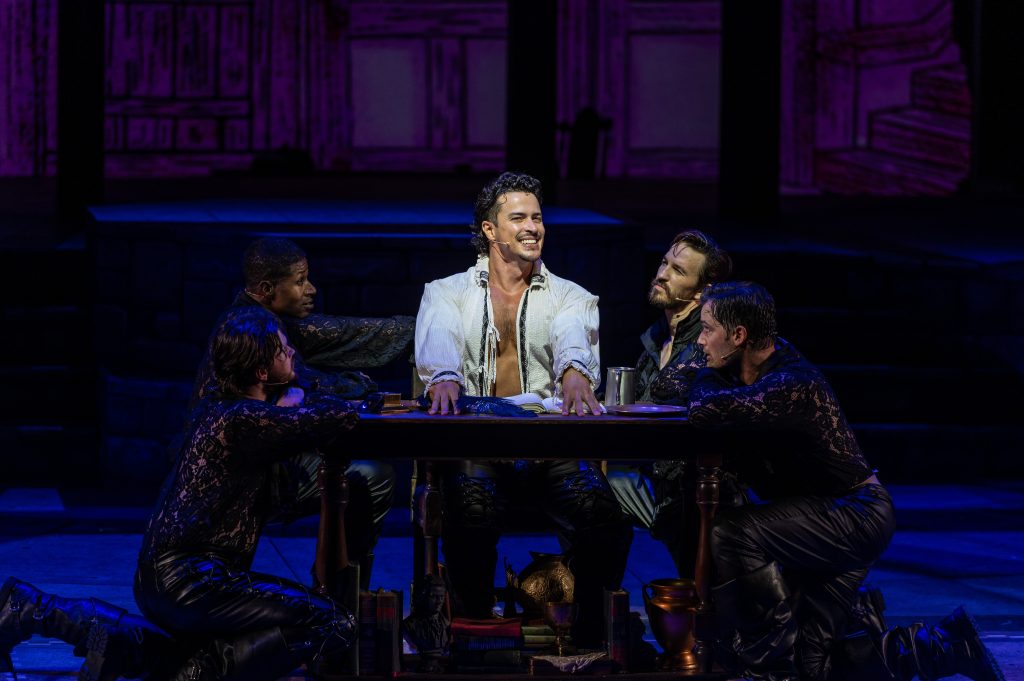
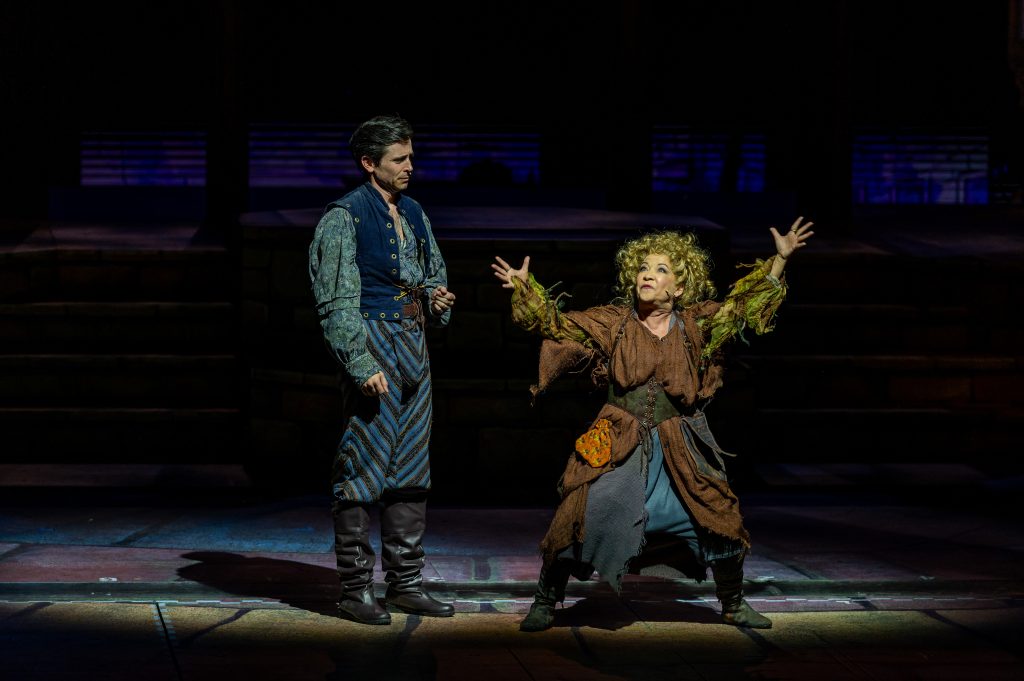
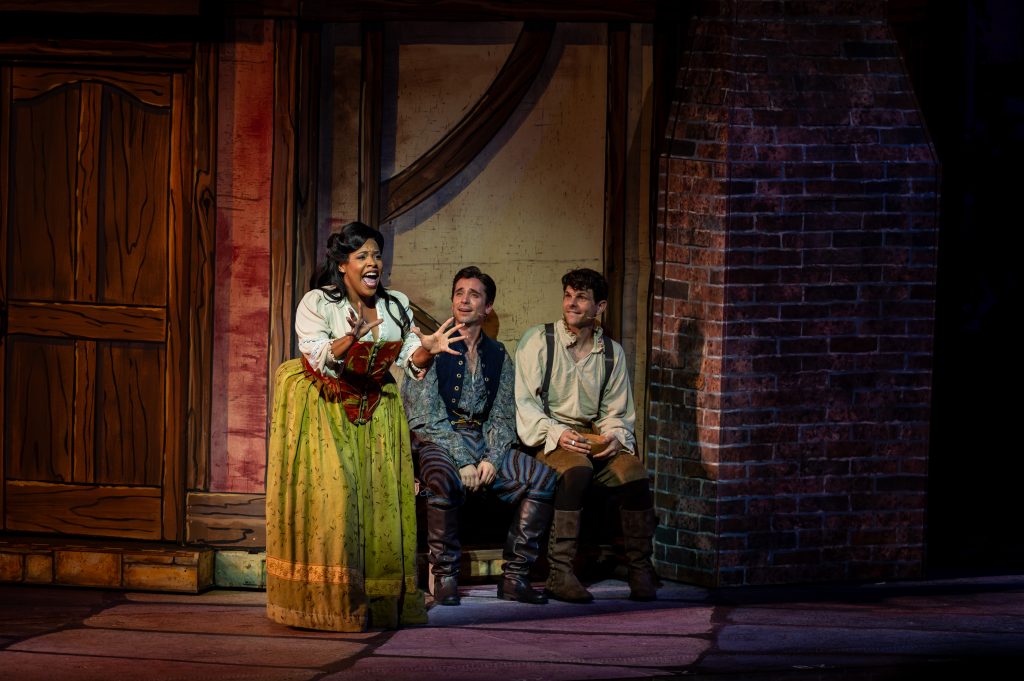
One of two premieres this summer, this comedic gem takes place in 1595, during the Renaissance, and brothers Nick and Nigel Bottom (Matt Doyle, Will Burton) are desperate to write a hit play but are overshadowed by the pompous megastar William Shakespeare (Jacob Dickey), who has fangirls and an adoring entourage.

Nick enlists a soothsayer, Nostradamus (not that one, but his niece Donna), to predict the next big thing. Dynamo Jen Cody tells him to write a musical. Singing! Dancing! Acting! All together now — say what?

Matt Doyle (center) and the company of the 2026 Muny production of “Something Rotten!” Photo by Phillip Hamer

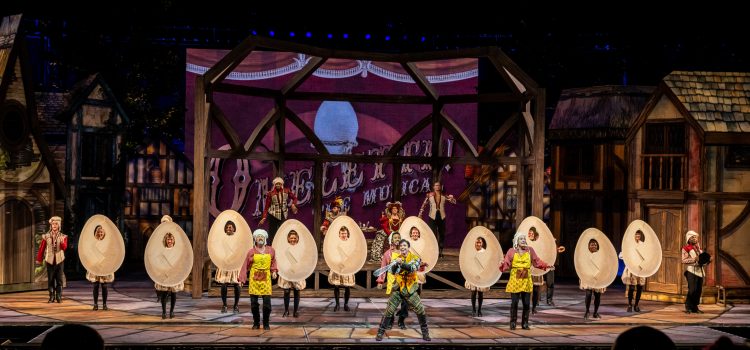
And when Nick asks Nostradamus to predict what Shakespeare’s next hit will be, however, she just misses the mark – proclaiming it is “Omelette!” (Not you know that depressed Danish prince with family and girl trouble.)

And into the madcap romp we go near Mel Brooks-Monty Python land. What silliness! “Something Rotten!” contains more than 60 inside jokes and ‘Easter eggs’ referencing other musicals and shows throughout the entire production.

Theater-insider quips and well-written zingers abound — and an all-in audience reacts with glee. IYKYK, but it’s not required to be well-versed in Shakespeare and all things musical theatre to enjoy this amusing spectacle.

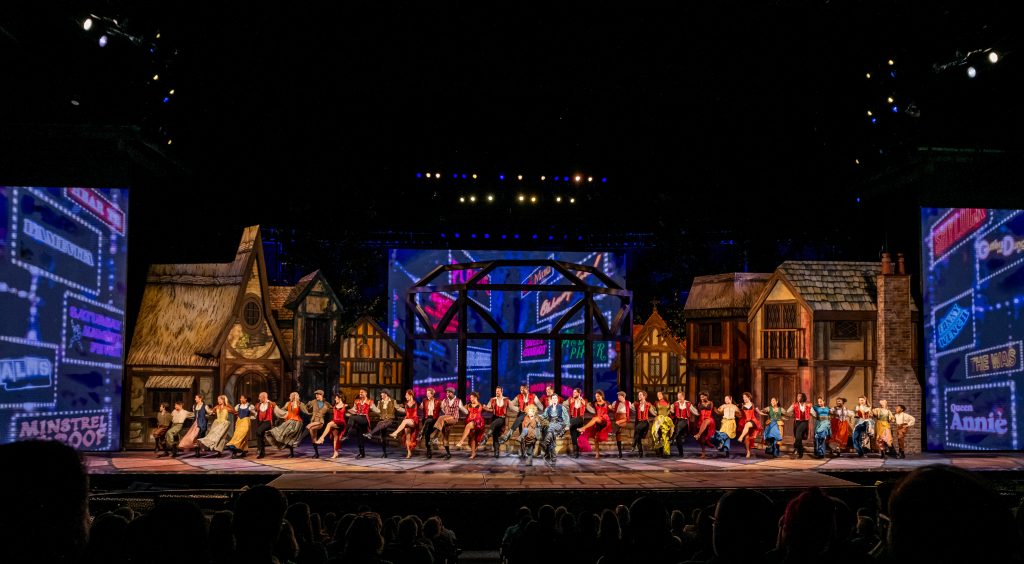
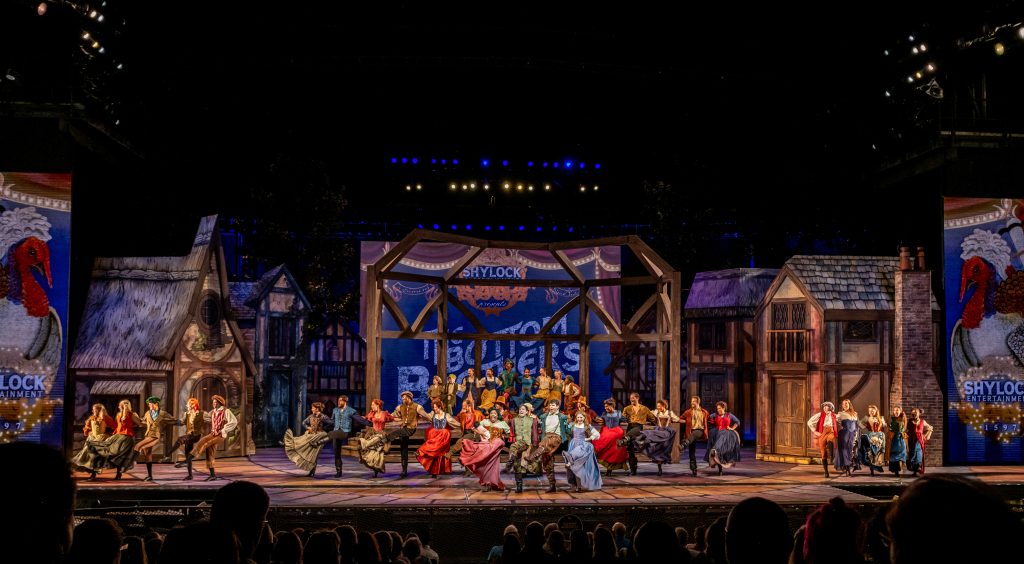
A crowd-pleasing cast of Broadway veterans and familiar faces is firing on all cylinders. They look like they are having a lot of fun throughout, but especially in the super-sized splashy signature numbers “A Musical,” “Welcome to the Renaissance,” and an absolutely bonkers “Something Rotten/Make an Omelette” (defies description).

The company of the 2026 Muny production of “Something Rotten!” Photo by Phillip Hamer

The show-stopping “A Musical” is a bursting party pinata with nods to “Annie,” “Rent,” “A Chorus Line,” “Cats,” “Wicked,” “Chicago” and “Les Miserables” and more.

A big and shiny, mighty fine-y
Glitter, glitz, and chorus line-y
Bob your head and shake your heiney
Musical

As the Minstrel, DeMarius R. Copes splendidly kicks off the spoofy, goofy fun with the catchy opener “Welcome to the Renaissance” that sets the go-for-broke tone.

The ebullient tap-dancing ensemble excels throughout the show: Lawrence Alexander, Matt Allen, Darien Crago, Aaron Patrick Craven, Kristen Smith Davis, Johnny Duvelson, Michael Harp, Sean Harrison Jones, Ryan Kasprzak, David Paul Kidder, Carina-Kay Louchiey, Spencer Davis Milford, Lizz Picini, Daniel Plimpton, Renée Reid, Allysa Shorte and Caitlin Stebelman.

Elizabeth Teeter and Will Burton in the 2026 Muny production of “Something Rotten!” Photo by Phillip Hamer

The 2015 show, conceived by brothers Karey and Wayne Kirkpatrick as a paean to the creative process in a pastiche of Broadway’s greatest hits, received 10 Tony nominations. Christian Borle won his second Tony as Shakespeare, its only nod.

The brothers – one a songwriter, the other a screenwriter — teamed up on the music and lyrics, and British satirist John O’Farrell came aboard to collaborate with Karey on the clever book. Hailed by critics and fans alike, it ran for 742 performances.

Magnetic Matt Doyle commands the stage as the passionate but stubborn Nick, who is driven to out-write the Bard for his failing acting troupe. He shows his resentment in “God, I Hate Shakespeare.”

He’s so consumed by jealousy that he clashes with his insecure but very talented brother Nigel, who is the better wordsmith. He and Will Burton make a good pair, teaming in the rousing “Bottom’s Gonna Be on Top” Act 1 closer.

Jacob Dickey (center) and the company of the 2026 Muny production of “Something Rotten!” Photo by Phillip Hamer

Doyle, Tony winner as Jamie in the 2022 “Company” revival, is a master of lightning-fast vocal stamina (Sondheim’s “I’m Not Getting Married Today”!), and with his soaring vocals, gets the audience on his side in the redemptive “To Thine Own Self.”

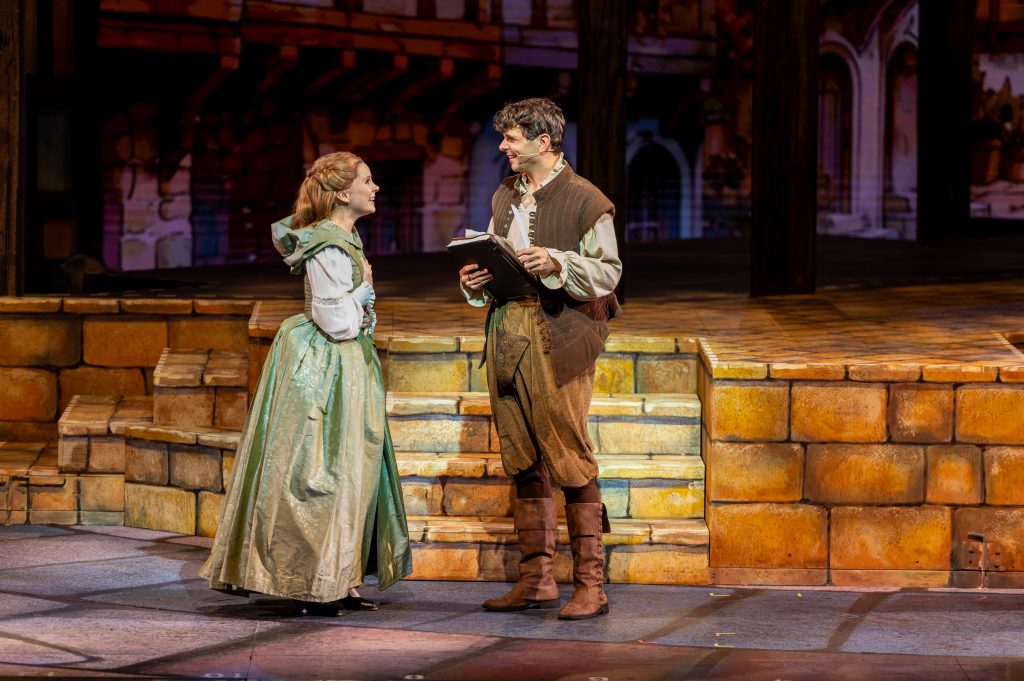
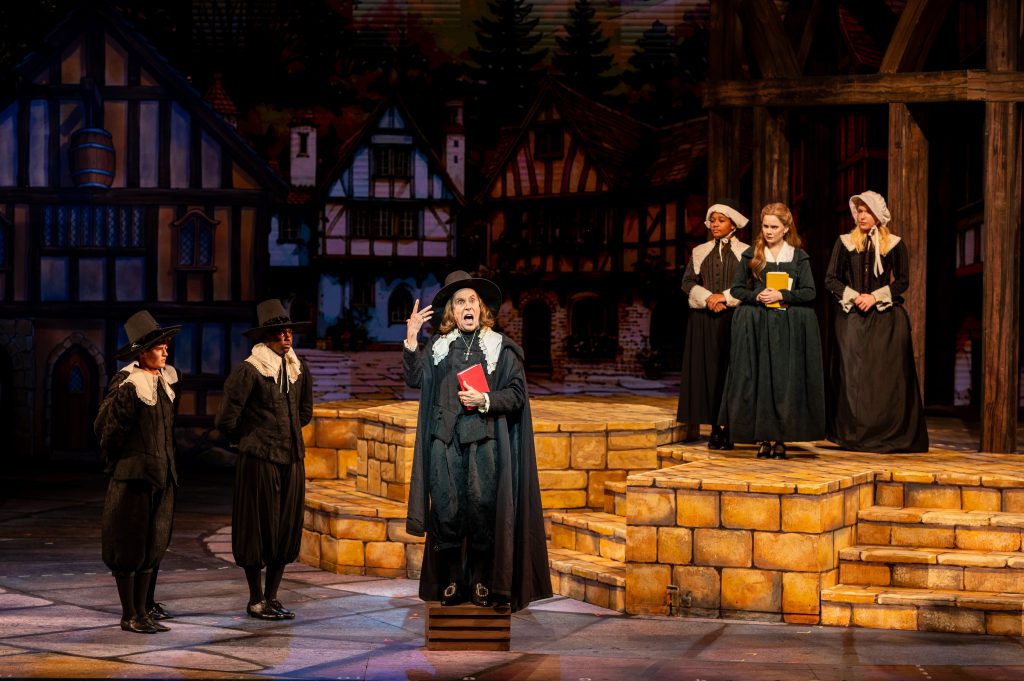
Burton is sweet as the sensitive, shy guy whose way with words wins over the heart of Portia, a Puritan. Elizabeth Teeter, in a welcome return to the Muny, is bright and bubbly as the poetry-obsessed young woman that rebels against her overbearing oppressive father Brother Jeremiah (her real-life dad, Lara Teeter).  The couple blend beautifully in the heartfelt ballad “I Love the Way.”

With moves like Jagger, Jacob Dickey plays slick Will as a whirling dervish of preening rock ‘n roll excess. This showman’s got game, and swagger to spare – and is an arrogant buffoon.

New to the Muny stage, Dickey sure knows how to make an entrance, working every angle. The mega-watt “Will Power” encapsulates rock god cliches, a la “Spinal Tap,” and his unbridled ego shines through on “Hard to Be the Bard.”

Matt Doyle and Jen Cody in the 2026 Muny production of “Something Rotten!” Photo by Phillip Hamer

Jen Cody is always a secret weapon and makes her ninth Muny show memorable, stealing every scene as genre-bending Nostradamus. With her crisp and snappy delivery, her visions of the future were a hoot, quickly endearing herself.

Fun Fact: Cody won an Annie Award (animated films) for voicing the flamboyant Southern belle Charlotte “Lottie” La Bouff in “The Princess and the Frog” in 2009.

Bryonha Marie, a Muny standout as Dolores in “Sister Act” and Mother Abbess in “The Sound of Music,” is fierce and fun-loving as Bea, an early feminist married to Nick. She wants to help support her family, and takes odd jobs disguised as a guy, best expressed in “Right Hand Man.” She and Doyle are a pleasing pair.

With such quick-witted pros as Lara Teeter as Brother Jeremiah, the priggish fire-and-brimstone Puritan preacher; Adam Heller as producer wannabe Shylock; and Gary Glasgow as wealthy patron Lord Clapham, they’re a force field of fun. Their timing is impeccable and their presence cheerful.

From left: Bryonha Marie, Matt Doyle and Will Burton in the 2026 Muny production of “Something Rotten!” Photo by Phillip Hamer

Director Rob Ruggiero, the winningest director in St. Louis Theater Circle Awards history (3), leans into the zany. His Muny collaborations on grand-scale musicals are always distinctive, bringing out the best in cast and crew alike.

The creative team is in absurd overdrive – costume designer DW adds visual gags to the vibrant costumes, based on originals by Gregg Barnes; new video designer Camilla Tassi has fun with Broadway marquees and those plentiful eggs, and lighting designer Rob Denton illuminates it all with verve. Sound designer Joshua Hummel and wig designer J. Jared Janas added to the playful ambience.

Scenic designer Edward E. Haynes Jr., back for his 10th show, created a colorful canvas transporting us to 16th century London and Stratford-upon-Avon with striking rotating and expansive Tudor and Elizabethan architecture.

Choreographer Parker Esse’s vivacious storytelling is a master class of fluid, upbeat motion, with associate choreographer Justin Prescott ensuring seamless moves from one high-spirited number to the next. Here for her third show, music director Anne Shuttlesworth is a marvelous maestro in motion, a beat poet with a baton.

The company of the 2026 Muny production of “Something Rotten!” Photo by Phillip Hamer

Another fun fact: The 2015 show, previously on national tour here at the Fox Theatre in 2017, starred Muny favorite Rob McClure as Nick Bottom, and his real-life wife Maggie Lakis, as Bea.

Surely even the grumpiest, most cynical theatergoer will find something to smile about, for laughs were in abundance from start to finish in this well-cast, well-staged show.

With zippy wordplay, sterling comic timing and vivacious musical numbers, the Muny has delivered another love letter to this cherished art form. “Something Rotten!” is a refreshing tonic, something silly and summer-y to savor when we’ll be in the throes of the winter blues! Until we meet again, thanks for the memories.

The Muny presents Something Rotten August 17 – 23 at 8:15 pm. Performances take place on the Muny’s outdoor stage in Forest Park. For more information: muny.org.

Lara Teeter (center) and the company of the 2026 Muny production of “Something Rotten!” Photo by Phillip Hamer

By Lynn Venhaus

In a modern satire on parenting, social graces and the notion that polite society is merely a thin veneer, “God of Carnage” becomes a living room throwdown in the hands of a murderer’s row of talent and razor-sharp execution at New Jewish Theatre.

Think of it as a rambunctious comedy of manners – without the manners. This relationship play, where two upper-middle-class couples meet after a playground fight between their 11-year-old sons, will get really ugly – and hilarious.

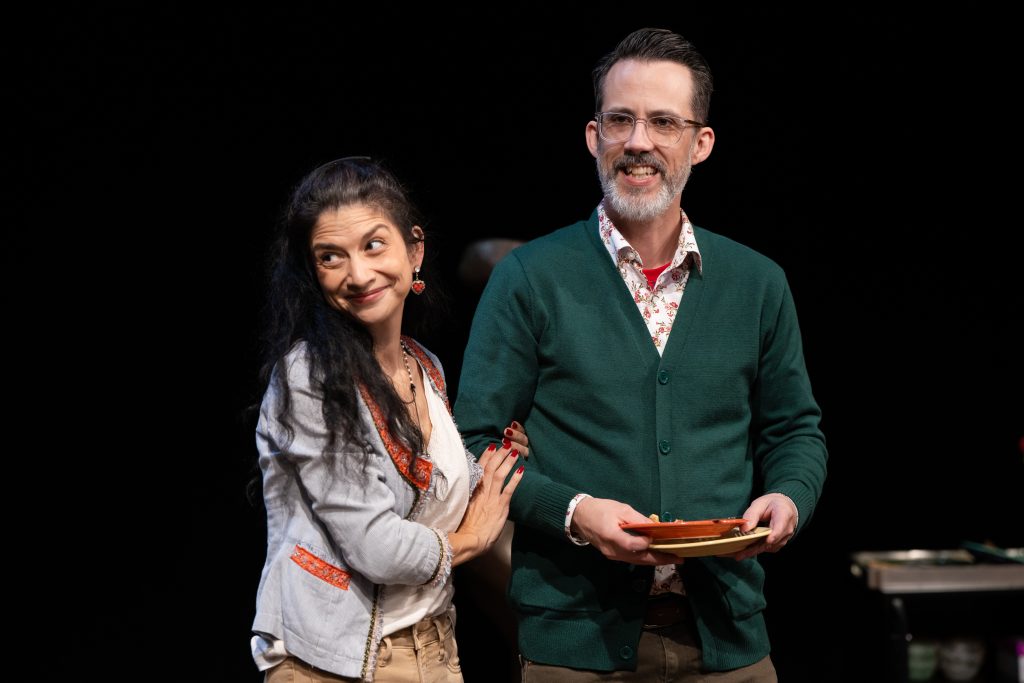
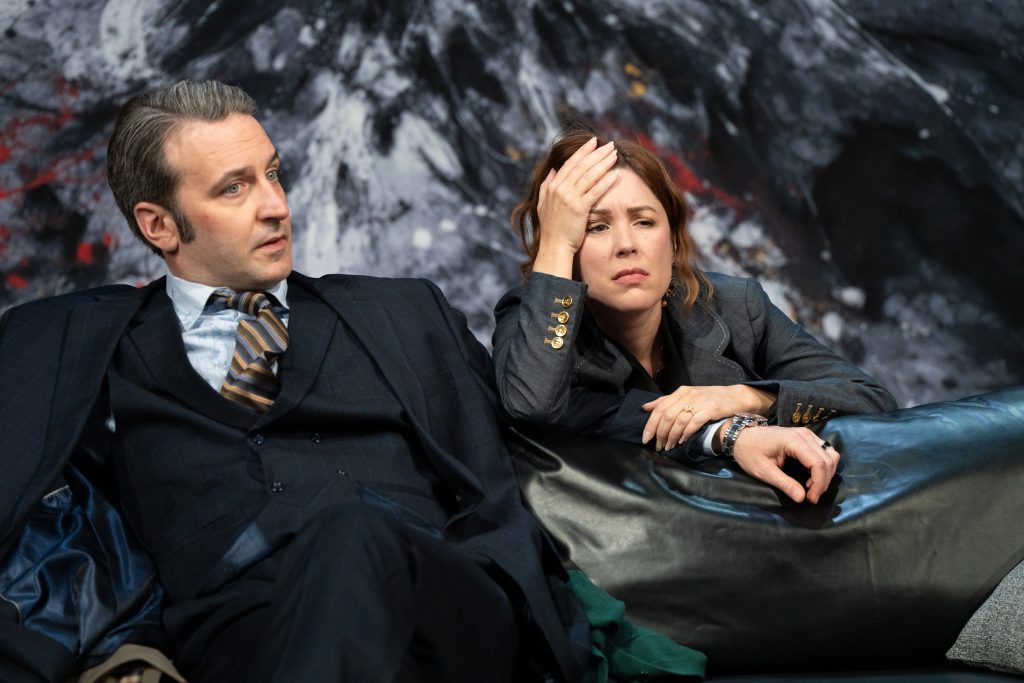
All pros, the dynamic quartet offer a master class of limber verbal and physical exchanges. Alan and Annette Raleigh (Nick Freedman, Bridgette Bassa), contrite, arrive one afternoon at the Novaks (Joel Moses, Christina Rios), uneasy. Henry Raleigh hit Benjamin Novak with a stick, knocking two teeth out.

For the next 90 minutes, the civilized discussion unravels from courteous into chaos, with shrewd characterizations that expose these upwardly mobile sophisticates’ immaturity, hypocrisy and true nature.

Christina Rios and Joel Moses are Veronica and Michael Novak. Photo by Jon Gitchoff

Playwright Yasmina Reza earned her second Tony Award for Best Play for its Broadway debut, translated from the French by Christopher Hampton, in 2009, following her critically acclaimed “Art” in 1998. The all-star ensemble was nominated: Jeff Daniels, Hope Davis, James Gandolfini and Marcia Gay Harden, who won best supporting actress.

This is the first time New Jewish Theatre is tackling one of the French Jewish playwright’s celebrated shows. And this cast of local all-stars are paired well, bouncing off each other with a natural rhythm, keeping the witty dialogue sharp and the action fast paced.

These ill-will games are fluidly directed by Gad Guterman, whose clear-cut vision escalates the tension as pretense crumbles and the gloves come off in the Brooklyn home.

Rob Lippert’s well-appointed set gives the Fab Four adequate room to nimbly move, and each has their stand-out meltdowns. Alan is a corporate lawyer, Annette in wealth management, Michael a wholesaler and Veronica a writer.

Nick Freed and Bridgette Bassa are Alan and Annette Raleigh. Photo by Jon Gitchoff.

Even though superficial, the initially polite adults become openly hostile and judgmental as conflicts build. The awkwardness is palpable; the social niceties start falling away. They compliment Veronica on her clafouti, a French baked fruit dessert she made from scratch, talk about their careers and life in their affluent Cobble Hill neighborhood. Then, things take a turn.

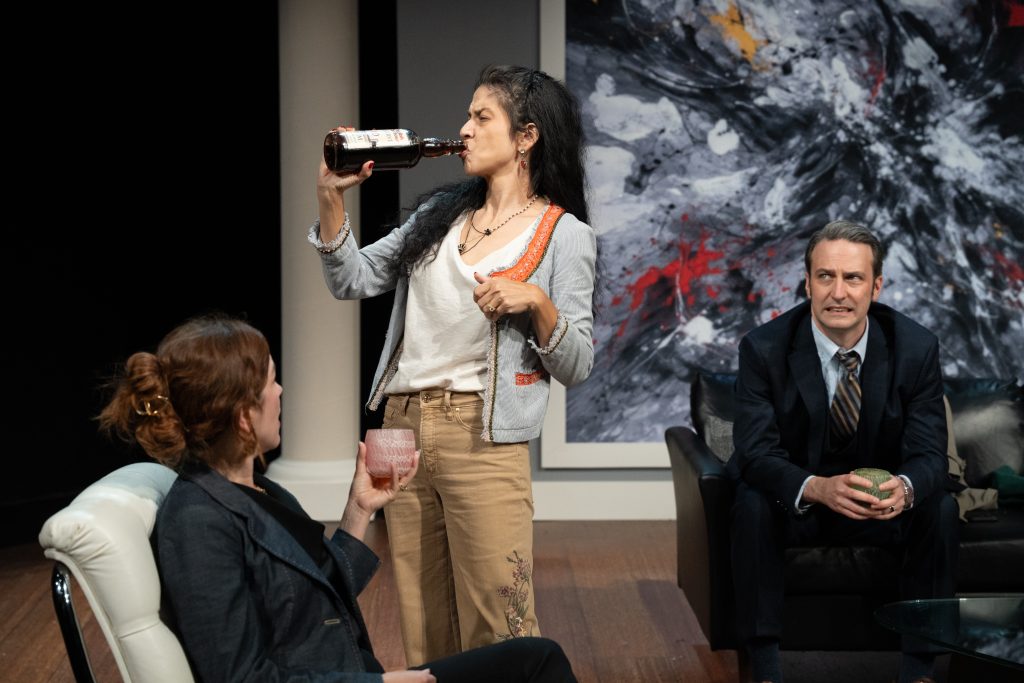
The actors dig in as the grown-ups don’t take long to get primitive – misinterpreting phrases, defending meanings, and boldly stating opinions. Rum flows, marital issues surface and the tact disappears. Better judgment goes out the window.

Nick Freed deftly captures Alan’s smugness and self-importance as the preoccupied attorney, constantly distracted by taking calls about a problematic client in a high-profile case. His wife, Annette, is polished but frazzled, trying to diffuse misunderstandings at first. In this role, Bridgette Bassa boldly takes the driver’s seat after she gives up, exasperated, and lets loose.

As Veronica, Christina Rios portrays the sanctimonious control freak host. She writes pretentious books focused on social causes, and projects a superior attitude that contrasts with her husband Michael’s seemingly more easy-going nature. But ever so cleverly, she gets sassier and her moods swing farther.

The reserved bottle of rum comes out. Photo by Jon Gitchoff.

As the gruffer dad, Moses attempts to be agreeable but is hamster-shamed when he gets rid of his daughter’s beloved pet and becomes defensive right away. At first, he seems to choose his words more carefully, but then adroitly strips away any liberal pretense.

As they argue, Rios picks her battles, and her clashes with Moses rise on the DEFCON scale – so madcap and raucous. They both are such skilled performers in movement, as are Bassa and Freed, that the free-for-all is a master class in over-the-top antics. Special nod to fight choreographer John Wilson, for the staging is quite a workout.

The men, in a bro-bonding way, gang up on the women as alliance shifts, pointing out animalistic instincts. It is Alan who mentions his belief in the God of Carnage – “He has ruled, interruptedly, since the dawn of time.”

Getting metaphorical, Reza is taking aim at the primal and violent nature of humanity that we are born with, our tendency toward aggression and self-interest. Despite modern education and culture, when those artificial societal norms masks are torn off, the true instincts can surface.

The Novaks spitefully go at it. Photo by Jon Gitchoff.

Hence, the digression into childish behavior, appearing like playground bullies as attacks become personal, and a wild night ensues. Rather than just a battle royale, it offers smart food-for-thought: When our ideas are challenged, how do we react because in our everyday lives, we all deal with difficult people and situations.

The technical aspects marvelously enhance the engaging experience, with lighting design by Jayson Lawshee-Gress and sound design by Kareem Deanes that is beautifully timed, especially the frequent cell phones — Kudos for picking “The Imperial March (Darth Vader’s Theme)” for Michael’s mother’s ringtone!

Costume Designer Michele Friedman Siler has chosen the ideal socio-economic status wardrobe for each character, down to the accessories, and props supervisor Laura Skroska has selected a colorful assortment of hospitality items for eating and drinking. (I particularly liked Veronica’s Frida Kahlo socks).

Christina Rios and Bridgette Bassa share pleasantries. Photo by Jon Gitchoff.

Because of the cast and crew’s high-level of commitment, the explosive rollercoaster-like proceedings come across effortlessly on stage, when in reality it took an amusement park-sized dedication to get the tempo, timing and storytelling arranged so precisely.

This outstanding production of “God of Carnage” maintains momentum and relevancy — and is laugh-out-loud funny. (You may have heard me on Thursday, June 25).

New Jewish Theatre presents “God of Carnage” June 11 – 28, which runs at the J’s Wool Studio Theatre (2 Millstone Campus Drive, St. Louis, MO 63146). Performances are on Thursdays, Saturdays, and Sundays. Showtimes and tickets are available by phone at 314.442.3283 or online at jccstl.com/njt

Bridgette Bassa gets feisty with Nick Freed. Photo by Jon Gitchoff.

By Lynn Venhaus

“Come From Away” wraps you in a warm hug and doesn’t let go.

Brimming with heart, humor and humanity, the 2017 musical arrived for its highly anticipated Muny debut with all the feels intact, making clever use of the expansive stage and its dynamic ensemble demonstrating the extraordinary power of kindness during adversity.

This deeply personal, emotionally complex story has resonated strongly with theatregoers, and the Muny’s customary attention to casting and execution put that at the forefront. The first-rate cast projects enthusiasm and affection for this material from start to finish, buoyed by the creative team’s excellence and the audience’s embrace.

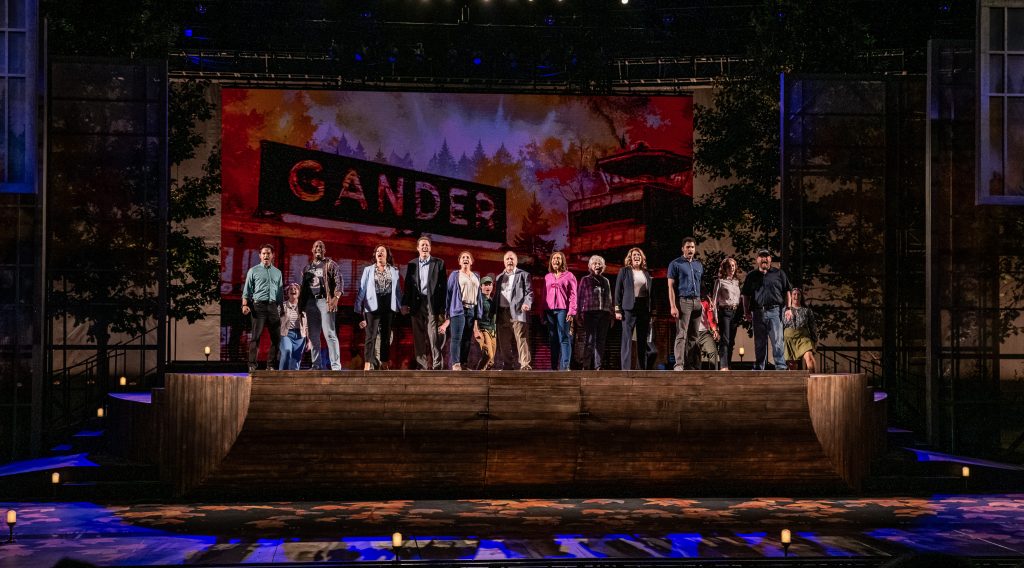
The 100-minute show focuses on the town of Gander, Newfoundland, and its hospitable response to 38 planes landing at their airport with 6,122 passengers and 473 crew on Sept. 11, 2001.

After the terrorist attacks on the World Trade Center and the Pentagon, the FAA closed the US airspace and Operation Yellow Ribbon began – a coordinated effort to accommodate diverted flights. Gander was among the towns helping, including nearby Lewisporte and Appleton.

The company of the Muny production of “Come From Away.” Photo by Phillip Hamer

Gander, a Canadian community of about 9,600 and home to the Gander International Airport, opened their homes and converted schools and community buildings into shelters, becoming a beacon of light in the darkest of times.

In the U.S. and for those affected elsewhere, it was an anxious and uncertain period. The fearful passengers had to stay on planes for many hours, without any information other than it was an emergency, until they were officially released and herded into buses with only their carry-ons.

Based on these real people’s stories, the husband-and-wife team of Irene Sankoff and David Hein vividly wove acts of compassion, listening, laughing, hospitality and fellowship into a heart-tugging narrative to accompany their music and lyrics.

They also addressed challenges like culture clashes and language barriers, and how people worked through tense situations.

They focused on a rerouted American Airlines flight from Paris headed to Dallas. Because of Gander’s generosity to strangers who couldn’t leave for five days, lasting friendships formed, resulting in a 10-year reunion in 2011, where the writers interviewed those in attendance.

Heidi Blickenstaff in the Muny production of “Come From Away.” Photo by Phillip Hamer

“Come from Away” truly is a remarkable story, with distinct characters that touch our soul. Thus, a theatrical gem was born with tender loving care – now the longest running musical ever from Canada. The Broadway run, interrupted by COVID, played to sold-out houses for 1,670 regular performances and 25 previews from February 2017 to October 2022.

Nominated for seven Tony Awards, including Best Musical, Christopher Ashley won for directing. (“Dear Evan Hansen” was the big winner that night and will debut at the Muny in July).

A trio from last year’s revered classic “Les Miserables” has returned to craft another powerful tale of enduring connection – director Seth Sklar-Heyn, choreographer Jesse Robb (whose mother was born and raised in Newfoundland), and costume designer Gail Baldoni.

Their meticulous work, along with exemplary essentials from scenic designer Edward E. Haynes Jr., video designer Mike Tutaj, lighting designer Rob Denton, and wig designer Kelley Jordan, created a vibrant tableau that immediately drew the large Muny crowd into the Far North.

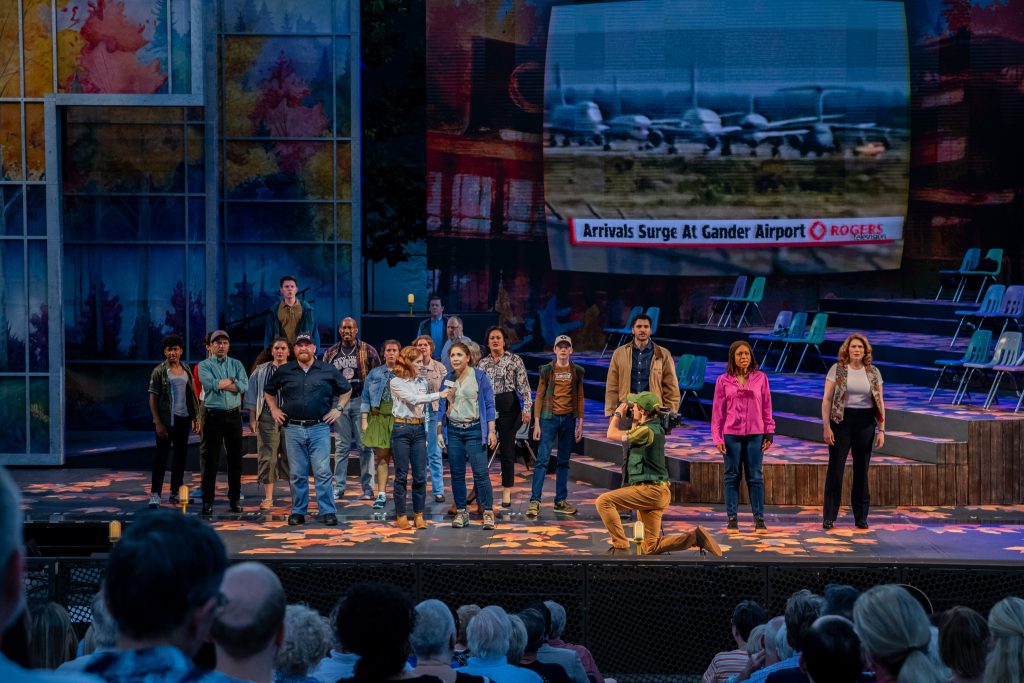
Haynes’ ingenious stairs-jet configuration rotated, using the turntable to swiftly create the necessary spaces. Tutaj’s video work uses news footage from Rogers TV and suggests locations like Tim Horton’s and Trailway Pub, to add awareness of time and place. And Denton’s superb lighting gave the show its usual intimate feel.

Alan H. Green in the Muny production of “Come From Away.” Photo by Phillip Hamer

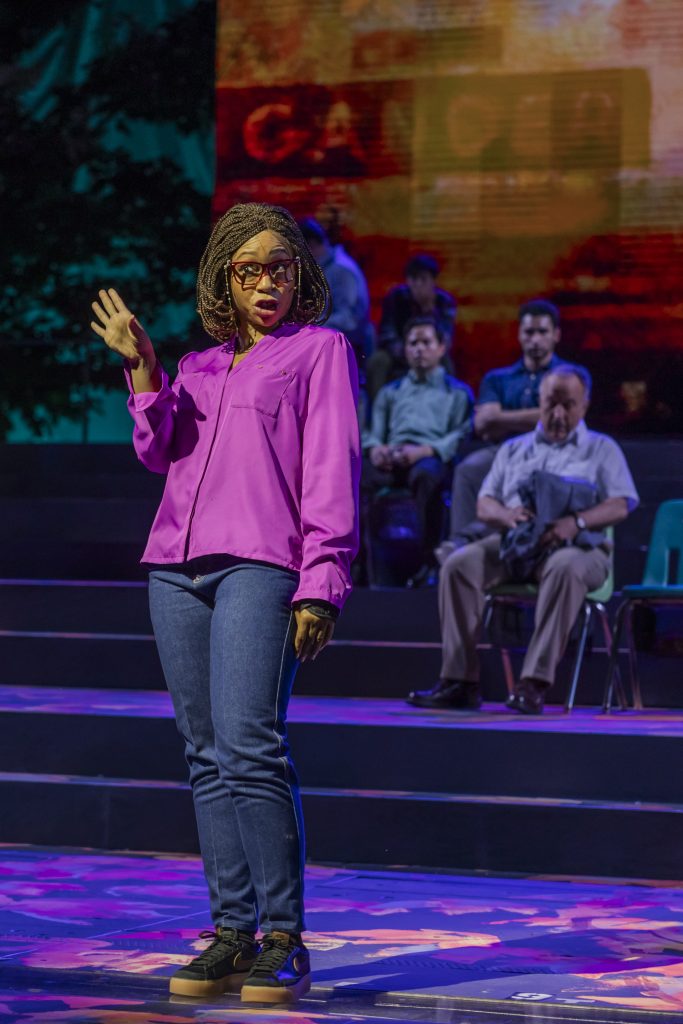
As they seamlessly portray multiple roles – both townsfolks and ‘plane people,’ the players talk directly to us. The proud islanders start their routine on a Tuesday morning, introducing themselves in a chill-inducing “Welcome to the Rock.”

“You are here at the start of a moment…”

Our reaction is immediate, taking us right back to that frightening morning – when we heard, what we saw, how we felt – if you experienced it. If not, its tone is evocative of that tragic day and the aftermath.

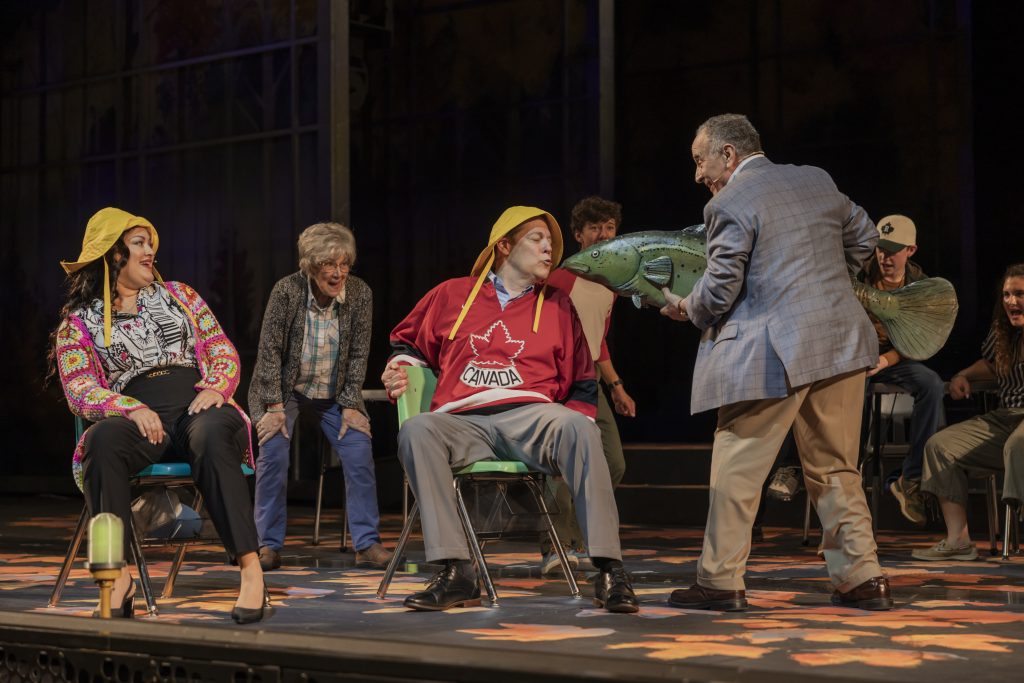
Muny stalwart Adam Heller is well-suited to play the take-charge mayor, Claude Elliott, among other characters, leading the opening number and the raucous “Screech In” (involving kissing a codfish and downing rum shots).

Looking back, he tells the audience: “Tonight we honor what was lost, but we also commemorate what we found.”

Abigail Isom and Adam Heller in the Muny production of “Come From Away.” Photo by Phillip Hamer

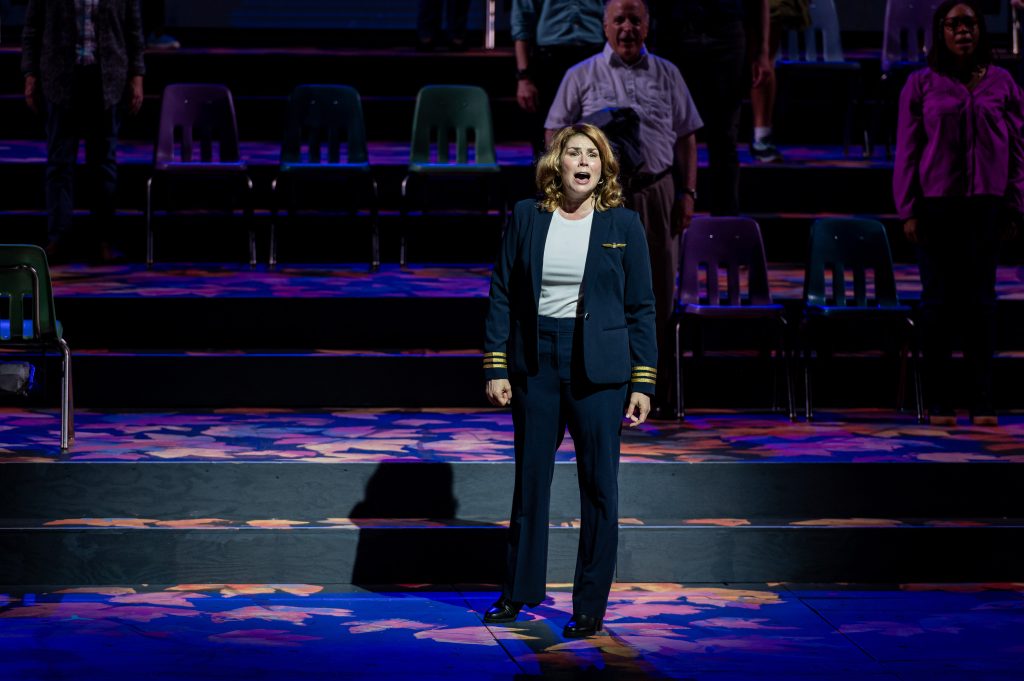
With her powerhouse mezzo-soprano, Heidi Blickenstaff soars as the trailblazing pilot Beverley Bass in the signature song “Me and the Sky.” Impressive as mom Mary Jane in the national tour of “Jagged Little Pill” (including the Fox in January 2024), she is captivating as Beverley, whose passion for aviation drove her career but she now worries that her workspace has become a weapon.

The dozen performers, appearing like regular folk, clearly delineate multiple characters, whether through accents, wardrobe pieces or personality shifts.

Memorable “come from aways” include two-time Grammy winner Tamika Lawrence as Hannah O’Rourke, who is frantically trying to reach her son, a New York firefighter. Her solo, “I Am Here” is heart-breaking.

Stellar veteran performers John Bolton and Ashley Brown are a delightful duo as the British bachelor Nick Marson and divorced mom Diane Gray, whose budding friendship might be more.

A gay couple, “the two Kevins” – Jason Tam as Kevin Tuerff and Trey DeLuna as Kevin Jung, who seemed to be at odds, disagree often. One’s all in for being a good sport, and the other is not comfortable in the public situation.

Trey DeLuna and the company of the Muny production of “Come From Away.” Photo by The Muny | Emily Santel

DeLuna, who was in the national tour, delivers a gut-wrenching turn as Egyptian chef Ali, who is under suspicion as a Muslim, and prejudice grows.

One of the most moving numbers is “Prayer,” showing travelers practicing their faith – Jews, Christians, Catholics and Muslims.

Alan H. Green is comical as Bob, who is confused by all the nice emanating from the locals. He also plays a pilot and an African traveler who can’t speak English. If he looks familiar, in St. Louis, he starred in “Sister Act” at the Muny and in “The Karate Kid” at Stages.

On the home front, total pro Zoe Vonder Haar is ideal as good-natured Beulah Davis, one of the major caregivers. And she doubles as a nervous flyer who gets tipsy and loudly sings “My Heart Will Go On” from “Titanic,” which they watched as an in-flight movie.

Likable Jacob Keith Watson smoothly transforms into the police constable Oz Fudge, a bar owner, Jewish rabbi, a surly traveler and others.

From left: Zoe Vonder Haar, Jacob Keith Watson and Jason Tam in the Muny production of “Come From Away.” Photo by Phillip Hamer

Seasoned Muny vet Abigail Isom is the amiable TV news reporter Janice, whose first day on the job is 9-11, and easily transitions to a freaking out flight attendant. She also plays a store clerk, getting laughs with: “Thank you for coming to Walmart. Would you like to come back to my house for a shower?”

Andrea Burns is the pragmatic SPCA representative, taking care of 19 animals in cargo cages, including endangered Bonobo chimpanzees that are headed to the Columbus Zoo in Ohio.

Dialect coach Joanna Battles helped the cast become Canadians with a specific accent, and their work was impeccable.

The teen ensemble acting as townsfolk and travelers include Chloe Jennings, Grant LaMartina, Annakait Peters-Bahkou, Drew Mathers, Jarod Rhodes, Jameson Roam and Will Schulte.

Standby for the women is Leah Berry and for the men, Spencer Davis Milford.

From left: Ashley Brown, Zoe Vonder Haar, John Bolton and Adam Heller in the Muny production of “Come From Away.” Photo by The Muny | Emily Santel

The vocally strong cast harmoniously blends together in the songs that are an integral part of the storytelling – “38 Planes,” “Blankets and Bedding,” “28 Hours/Wherever We Are,” “Darkness and Trees,” “On the Edge,” “Stop the World,” “Somewhere in the Middle of Nowhere,” and “Something’s Missing” – expressing the necessary emotions.

The unifying score reflects the cultural heritage of Newfoundland – using Celtic rhythms and traditional folk, and fuses neatly with emotive modern musical theatre elements.

The robust orchestrations are by Aaron Eriksmoen, with arrangements by Ian Eisendrath, incorporating a fiddle and even an “ugly stick” (household items) on stage.

The Muny orchestra, energetically led by music director Evan Roider, captures the score’s unique sound, adding a harp and whistles to its instruments.

The first national tour came to the Fox Theatre in May 2019, and a return weekend engagement followed in 2023, striking a chord (blubbered throughout, and I wasn’t alone).

With multiple cameras, Apple TV+ filmed the Broadway cast in front of a live audience, including some 9-11 survivors and frontline workers, on Sept. 11, 2021, commemorating the 20th anniversary. It has been available for streaming since Sept. 10, 2022.

Tamika Lawrence in the Muny production of “Come From Away.” Photo by The Muny | Emily Santel

While 9-11 was 24 years ago, that time is etched into our collective memories. After a touching brief display of unity and flag-waving, today’s America is very different.

We now have a divisive political climate that’s mean-spirited and worrisome. Then we were isolated during a global pandemic that impacted our lives, an ever-mutating virus that killed more than 7 million people. More short fuses, more fear of others, anger and outrage are prevailing attitudes.

Recently, in St Louis, the deadliest tornado since 1959 tore apart neighborhoods. Watching a community come together on the Muny stage recalled empathetic responses of the past six weeks here, for people stepped up when called upon to do so.

We’ve been through a lot – as a country and as a region. Yet, glimmers of hope emerge, along with everyday heroes, and it’s gratifying to feel the uplift that “Come from Away” provides.

Mission accomplished. Triumphing with its affecting production that appreciative audiences won’t soon forget, the Muny reminds us why our shared experience is what live theater does best.

The Muny presents “Come from Away” nightly at 8:15 p.m. from June 26 to July 2 at the outdoor theatre in Forest Park. The production is 1 hour, 40 minutes without intermission. For more information, or for tickets, visit www.muny.org

The company of the Muny production of “Come From Away.” Photo by Phillip Hamer

Broadway meets community as The Muny, Greater St. Louis Inc., KMOV and Ballpark Village proudly announce a Tony Awards Watch Party on Sunday, June 8, to benefit St. Louis tornado relief efforts. The watch party begins at 5 p.m. CT. The Muny will receive the 2025 Regional Theatre Tony Award as part of The Tony Awards: Act One, a preshow ceremony starting at 5:40 p.m. CT.

The free, public event will take place at Ballpark Village, where guests can watch Broadway’s biggest night live on the big screen, surrounded by fans, friends and fellow supporters of the arts and the St. Louis community.   

The watch party will be hosted by Tony nominee, Muny alum and Missouri native Taylor Louderman, along with KMOV’s Great Day St. Louis co-host Laura Hettiger, bringing star power and hometown pride to this celebration of theatre and resilience. 

Admission is free, but attendees are asked to bring a nonperishable food item or toiletry donation to support the St. Louis Area Foodbank, or make a monetary gift upon entry to support  Urban League of Metropolitan St. Louis, two organizations working tirelessly to assist those impacted by recent severe weather across the region. 

Celebrating The Muny’s National Recognition 

This year’s celebration holds special significance for St. Louis, as The Muny will be honored during the ceremony as the 2025 recipient of the Regional Theatre Tony Award. The prestigious award recognizes The Muny’s exceptional contribution to the American theatre landscape and its unwavering commitment to artistic excellence and community engagement for over 100 seasons. The award will be presented during The Tony Awards: Act One — a preshow of live, exclusive content leading into the 78th Annual Tony Awards, televised on CBS — streaming exclusively on Pluto TV. 

Event Highlights 

  • Live viewing of the 78th Annual Tony Awards and Act One preshow 
  • Hosted by Tony-nominated actress Taylor Louderman and KMOV’s Laura Hettiger 
  • Celebration of The Muny’s Regional Theatre Tony Award win 
  • Food and beverages available for purchase 
  • Special guest appearances, remarks and giveaways 
  • Donation drive supporting tornado relief through the St. Louis Area Foodbank and Urban League of Metropolitan St. Louis 

Day: Sunday, June 8, 2025 
Time: Event starts at 5 p.m. CT | The Tony Awards: Act One 5:40 p.m. CT | 78th Tony Awards 7 p.m. CT 
Place: Ballpark Village, 601 Clark Ave., St. Louis 
Cost: Free and open to the public — but bring a nonperishable food item, toiletry or monetary gift 

For more information, follow The Muny on social media.

Season 107 at The Muny opens with Bring It On: The Musical (June 16-22) and includes Come From Away (June 26-July 2), Disney’s Frozen (July 6-14), Evita (July 18-24), Dear Evan Hansen (July 28-Aug. 3), La Cage aux Folles (Aug. 8-14) and Jersey Boys (Aug. 18-24).

New season tickets start at just $126 and are on sale now at muny.org/season-tickets and at the Muny Box Office, located at 1 Theatre Drive in Forest Park. Single-performance tickets go on sale May 19. 

The 78th Annual Tony Awards will return to the legendary Radio City Music Hall in New York City next month. Hosted by Tony, Emmy and Grammy Award winner and three-time Oscar nominee Cynthia Erivo, The American Theatre Wing’s Tony Awards will broadcast live to both coasts on Sunday, June 8 (7-10 p.m. CT) on CBS and streaming on Paramount+.  

Paramount+ With Showtime subscribers will have access to stream via the live feed of their local CBS affiliate on the service, as well as on-demand. Paramount+ Essential subscribers will not have the option to stream live but will have access to view on-demand the day after the special airs.

A full list of this year’s nominees and additional honorees is available here.

Taylor Louderman

About The Muny

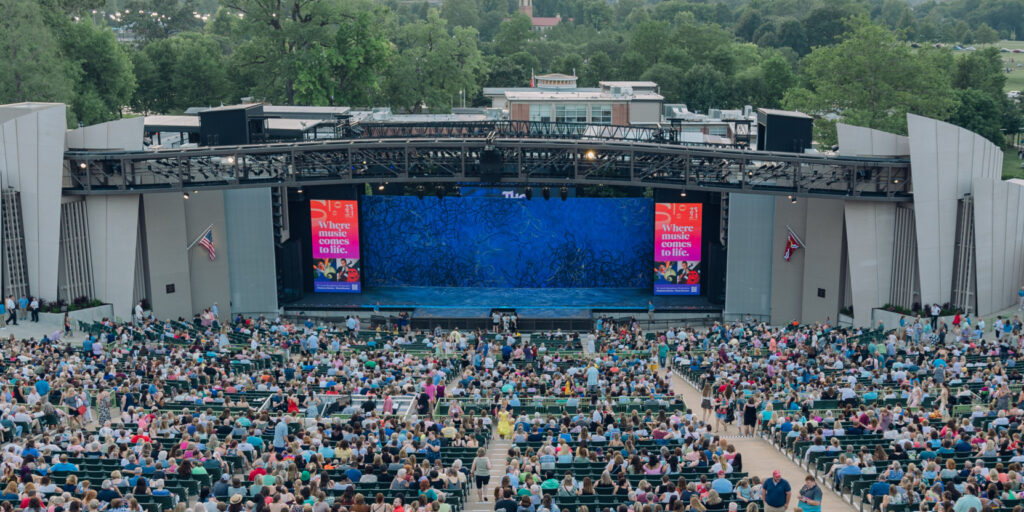
Now entering its 107th season in St. Louis, The Muny — the recipient of the 2025 Regional Theatre Tony Award — is a 501(c)(3) nonprofit dedicated to producing exceptional musical theatre that is accessible to all, continuing its remarkable tradition in Forest Park. As the nation’s oldest and largest outdoor musical theatre, The Muny welcomes more than 300,000 patrons each summer for seven world-class productions under the stars. Learn more at muny.org, and follow along at facebook.com/munytheatre , instagram.com/themuny and youtube.com/themunytv.

About the Tony Awards

The Tony Awards are produced in collaboration with Tony Award Productions, a joint venture of the American Theatre Wing and The Broadway League, and White Cherry Entertainment. Ricky Kirshner and Glenn Weiss are executive producers and showrunners for White Cherry Entertainment. Weiss will serve as director. The American Theatre Wing’s Tony Awards are presented by The Broadway League and the American Theatre Wing.  At The Broadway League, Kristin Caskey is Chair and Jason Laks is President.  At the American Theatre Wing, Emilio Sosa is Chair and Heather A. Hitchens is President & CEO. Learn more at tonyawards.com. Follow @TheTonyAwards on Instagram, TikTok and Facebook. 

By Lynn Venhaus

A personality-driven low-key charmer, the musical ‘[title of show]’ offers a fresh perspective with its vivacious gender-bending cast.

And what’s not to love about a 20-year-old original musical that is unapologetically OK with being “nine people’s favorite thing than a hundred people’s ninth favorite thing”?

In a world of “Cake Boss” and “The Great British Bake Off,” why not choose to be a Rice Krispie Treat? (Nothing wrong with that – and you can have one at intermission, too).

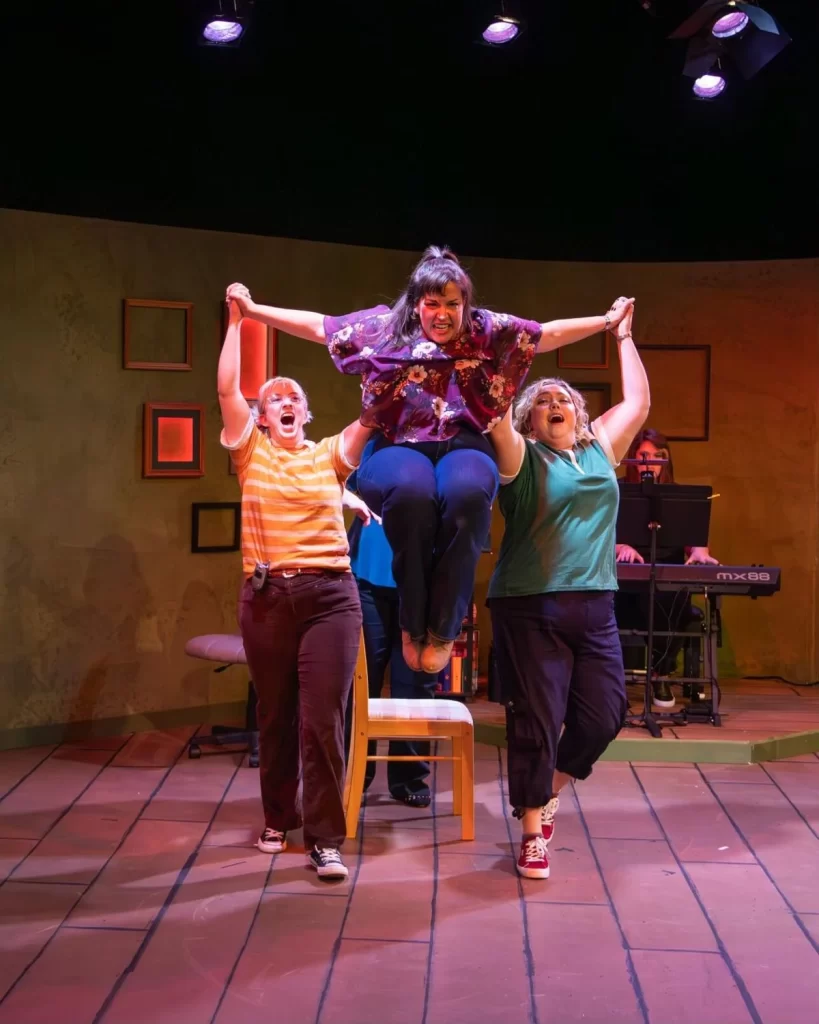
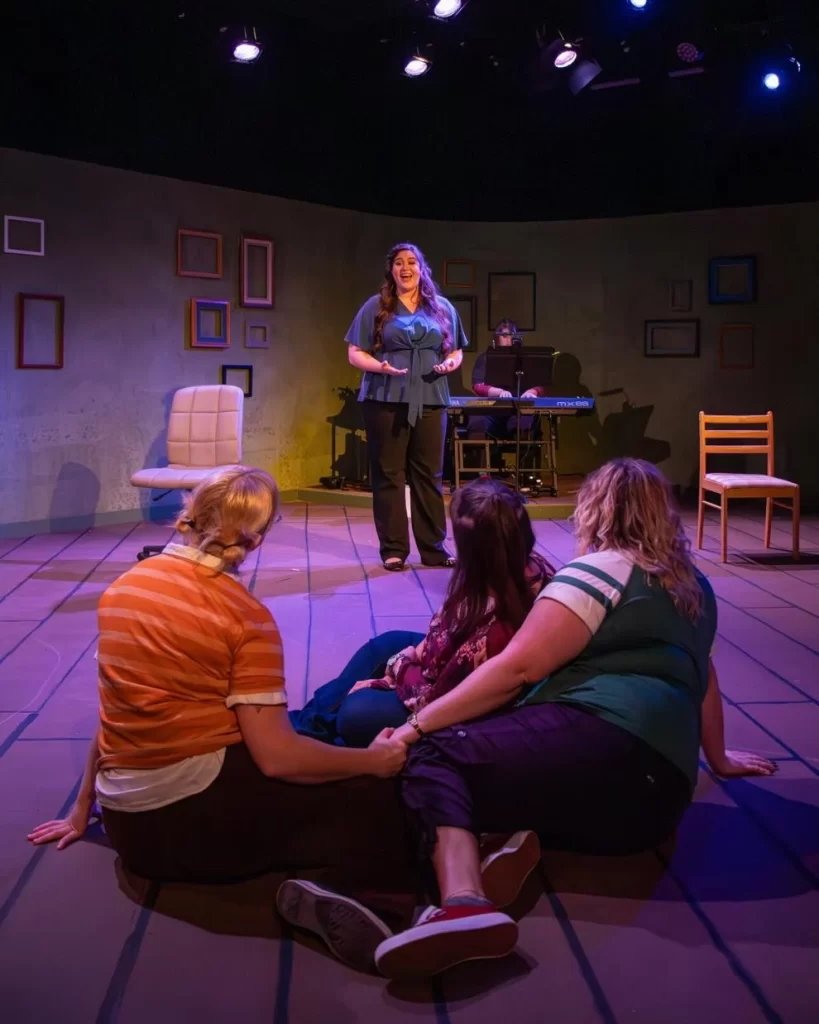
Prism Theatre Company is presenting this enjoyable modest production in two acts with a disarming all-femme quartet of performers and one expert musician accompanying them on keyboard.

Mallory Golden serves as the music director, and they are called “Larry.” They have an occasional spoken line of dialogue and comical in their timing.

They have guy names because Prism did not change those characters when they cast women. The musical’s creators – Jeff Bowen wrote the music and lyrics, Hunter Bell the book – are called Jeff and Hunter, and played by a spunky pair, Katie Orr and Jaelyn Hawkins.

It really doesn’t make a difference – it’s entertaining from this point of view because it is brimming with sly theatrical references and features a classic struggle about pursuing your dreams, no matter what obstacles. Their ambition resonates.

It’s also a tale of friendship, those pals who get you through tough times, who encourage and collaborate – and work through tension and chaos. The four principal actresses project the camaraderie that is necessary to make this show work, under the adroit direction of Sam Hayes.

Being gender-fluid doesn’t change how meta this musical is, because they are two friends who are theater artists writing a musical about writing a musical. Their first goal together is to send in an original work to the inaugural New York Musical Theatre Festival – only its deadline is three weeks away.

Their frantic, fraught creative process, with their real-life obstacles, are what makes the show unique to them. The time and place are New York City, 2004. Starving artists whose endgame is Broadway have their own sets of issues, which factors into the show – all driven by the mindset “If you can make it here, you can make it anywhere.”

And from there, their goals get bigger, their challenges more daunting, and their exasperations and aspirations escalate. It’s clever and funny in a very natural, authentic way.

Rounding out the cast are their two friends they cast in their show. Rachel Bailey is sassy, snarky Susan, a comic actress whose day job is an office worker, and Savannah Fernelius is assertive Heidi, a polished performer who wonders if she is doing the right thing hitching her wagon to this project. They are based on Susan Blackwell and Heidi Blickenstaff, who not only were in the show, but were part of the process.

It is a wild rollercoaster ride of emotions for the quirky characters, all who have skin in the game. They yearn for fame and recognition. They persist. They want to matter, find their place in the world.

The creative team may be “Two Nobodies from New York” but they want to be “Part of It All.” Why not dream big? (“The Tony Award Song”).

The two writers are imaginative and capable. Their progress is chronicled in such witty ditties as “An Original Musical” (with the proverbial blank piece of paper) and “Filling Out the Form.”

Their brainstorming techniques are hilarious in “Monkeys and Playbills.” The second act’s stakes are captured in “Montage Part 1: September Song,” “Montage Part 2: Secondary Characters” and “Montage Part 3: Development Medley.”

The four are not only nimble at comedy, but can crisply sell a showtune with strong melodic voices.

Katie Orr, Rachel Bailey and Jaelyn Hawkins. Photo by Cady Bailey.

The Susan-led “Die, Vampire, Die!” is an ingenious way to vanquish demons and doubts, and Bailey is good at animated delivery.

In her professional debut, Fernelius makes quite an impact with silky-smooth vocals, and powerfully delivers a stunning “A Way Back to Then.” She has been standing out in college and community theater and is indeed ready for her close-up.

The show’s offbeat approach obviously differentiates from fairy tale-fiction in a land of enchantment (“Into the Woods” references abound, by the way). The quartet are more self-aware than naïve, more jaded and cynical about the highs and lows in life yet wear their hearts on their sleeves and they wish.

Their strengths and weaknesses are fully on display, not unlike those four unfiltered millennials in the HBO television series “Girls” that ran for five seasons. Raw and real, they aggravate each other and express their feelings.

Hunter fires off torrents of profanity, easily upset and distracted. (You can imagine him/her erupting at the neighborhood association meeting). Hawkins is funny in her no-holds-barred character’s tendency to go to DEF-CON 1.

Like many well-meaning longtime friends, Jeff knows how to deal with Hunter, and Orr is instinctive in her portrayal of the one who isn’t prone to histrionics.

There is a mature content advisory: “This play contains heavy adult language and open discussion of adult content. Audience discretion is advised.”

The pair of actresses playing actresses are creating an identity through their roles – “I Am Playing Me” and are initially at odds with each other – “What Kind of a Girl Is She?”

Savannah Fernelius is Heidi. Photo by Cady Bailey.

This is Prism’s first musical, and as a love letter to musical theater, it’s an interesting exchange of ideas and talents. It’s yet another version of “The Little Engine That Could,” showbiz style.

And in their hands – heartfelt. Co-producers Joy Addler (managing director) and Trish Brown (artistic director) founded this regional professional theater troupe with the mission of supporting women. This season’s theme is “Raise Your Voice.” I’d say this choice is apt.

The earnest presentation has a rough-around-the-edges quality yet has the enthusiasm of Judy Garland and Mickey Rooney gathering the neighborhood kids in those “Hey kids! Let’s put on a show!” old-timey musicals – but instead of a barn, they’re in a minimalistic rehearsal space with four chairs.

On a much smaller scale, this show follows the world-building on display in big-deal beloved musicals like “A Chorus Line,” “Singin’ in the Rain,” and “Dreamgirls.”

While it may not have a showstopper like “What I Did for Love,” the substantive songs showcase their doubts, fears, instincts, hopes and dreams in a relatable way.

Cady Bailey’s choreography is appropriate for the characters and incorporates snappy theatrical dance moves in an endearing way.

The quartet’s fervor for this material is perceptible, so is their warmth. The way they work together is specific, which adds a distinctive flavor to the show. There isn’t a whiff of artifice or slickness, rather a gutsy “Take us as we are” attitude.

And their work-in-progress show is constantly expanding and involving, as they adapt, evaluate, revise, re-evaluate, and have hissy fits. “Change It/Don’t Change It” illustrates those efforts, and “Awkward Photo Shoot” is a full-out meltdown of dysfunction.

Scenic designer Caleb D. Long has kept things basic and functional, with a nifty arrangement of frames that light up, and the noteworthy lighting design by Catherine Adams is effective. Golden also did the sound design, which is without issues in the intimate Kranzberg Black Box.

Their costumes, designed by Hayes, are everyday casual, look like out-of-their-closet selections. The sense of a team effort, with Sadie Harvey assistant director and props master, Katie Smith props artisan, carpenter William Higley, along with technical director Caleb D. Long, Golden, and Adams is apparent.

Bell and Bowen may not be as well-known as Pasek and Paul or as hip as Kerrigan and Loudermilk, but their memorable original work “[title of show]” earned awards nomination and elevated their credentials.

Bell, a graduate of Webster University’s Conservatory of Theatre Arts, won an Obie special citation award and was nominated for Drama League, GLAAD Media and Tony awards for best book of a musical. Bowen won an Obie special citation award for the music and lyrics.

After the musical debuted at the festival, two years later it opened off-Broadway at the Vineyard Theatre in 2006 and then moved to Broadway two years later, at the Lyceum Theatre, in 2008.

Proactively, in hopes of mounting the show at a Broadway theater, Bell and Bowen created a video blog, called “The [title of show] Show” that documented the musical’s progress and featured famous guest actors in episodes that went viral. In Episode 8, mission accomplished: the New York Times announced the show’s opening date at the Lyceum. (The show continued as a web series with a season 2, music videos and specials.)

What Bell and Bowen have learned the hard way – albeit with a delightfully improbable successful run about what all goes into making a musical — (and they did it before “Something Rotten!”) – can be summed up through the words of philosopher Ralph Waldo Emerson: “It’s not the destination, it’s the journey.”

This cast’s exuberance and the creative team’s efforts result in a satisfying tag-along adventure. Its candor and cheekiness are refreshing. And yes, that was Sutton Foster leaving a voice mail rejecting their offer. Touche!

Prism Theatre Company presents “[title of show]” weekends through Sept. 8.  Performances take place at the Kranzberg Center in Grand Center, 507 N Grand Blvd, St Louis, MO 63103. For more information: prismtheatrecompany.org.

For tickets, visit https://www.metrotix.com/events/detail/prism-theatre-company-title-of-show

By Lynn Venhaus

Measure your life in love.

Simple advice from Jonathan Larson, the musical genius behind the “Rent” phenomenon, whose tragic death on Jan. 25, 1996 – from an undiagnosed aortic aneurysm, after the final dress rehearsal, meant he never saw the impact his words and music had worldwide. He ran out of time, but his life’s work lives on forever.

Especially the part about how we can’t control our destiny. That underlying poignancy is part of the passion and the power of his landmark rock opera that finally graces the Muny stage 27 years after it produced a seismic shift in popular culture.

It’s time, and the Muny makes the most of those moments so dear in a grand staging that honors Larson’s compassionate vision with the dramatic operatic scale this modern take on Giacomo Puccini’s “La Boheme” deserves.

A celebration full of life, this touchstone production’s creative team is exactly the right fit, showcasing tender beauty and pure joy. Director Lili-Anne Brown, who brought us the exceptional “The Color Purple” last year, focuses on the humanity, dignity and acceptance that is such a potent part of this revolutionary musical.

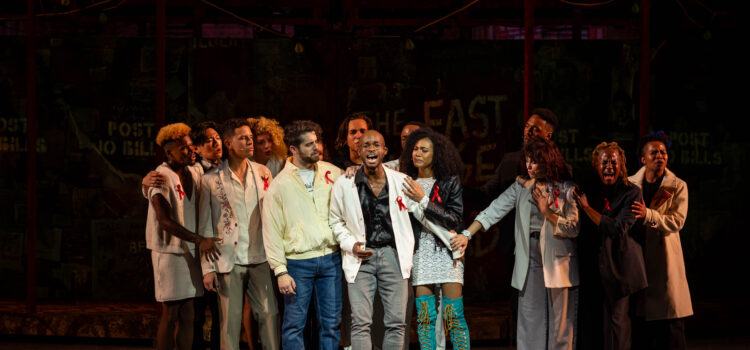
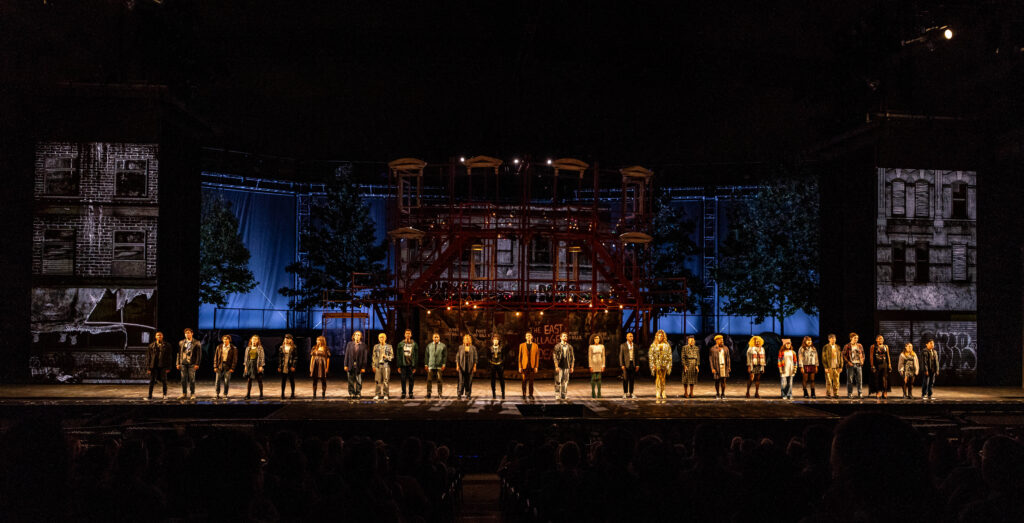
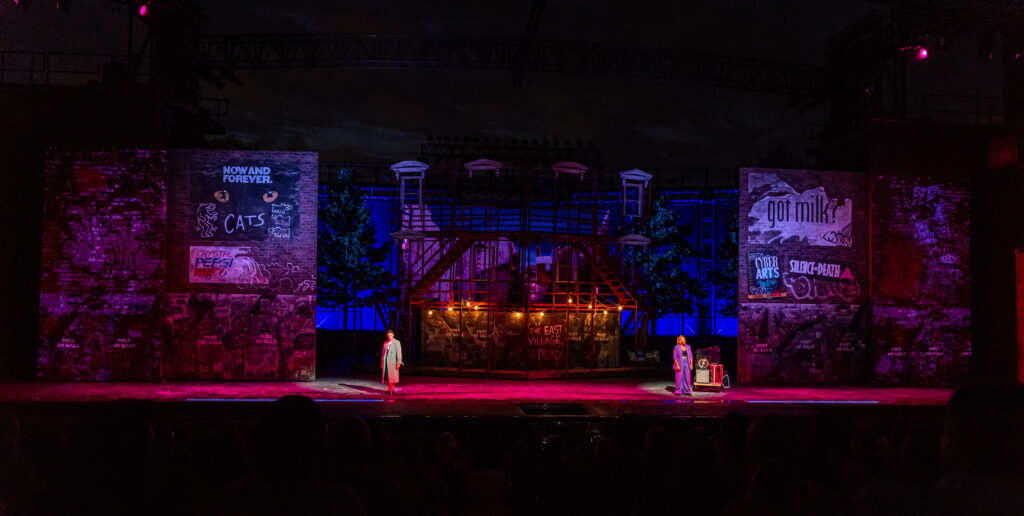
Set in the “Alphabet City” part of New York City’s East Village, over the course of one year, impoverished young artists and outcasts live through the HIV/AIDS epidemic during the late 1980s, choosing to love over fear. This cast maintains the raw, realistic appeal, making sure it rings true.

The eight principal performers make an indelible impression, their vitality thrilling to witness, and their luxurious vocals a testament to their talent and technical skills. “You’ll See,” “No Day but Today,” and “Will I?” with strong supporting cast mates become earworms that will stay in your mind for days.

When their vocal prowess is spotlighted through Jermaine Hill’s vibrant music direction – what an exhilarating job the orchestra does! – it’s wondrous. 

Hill was a part of the stellar “The Color Purple” collaborators, as were scenic designer Arnel Sancianco, who has fashioned a striking movable apartment building tower, and video designer Paul Deziel, whose work stands out, with Mark’s cinema verité footage and the humorous bits of celebrity minutia in the news scroll.

Vincent Kempski is a dynamic Roger, bringing the grit and rock musician edge to “One Song Glory” and “Your Eyes.” He and Lincoln Clauss, as documentary filmmaker Mark, are a comfortable pair of roommates, with effective bravado in “Rent” and “What You Own.” Clauss was a memorable Tobias in last summer’s “Sweeney Todd,” and leads as the pragmatic narrator here.

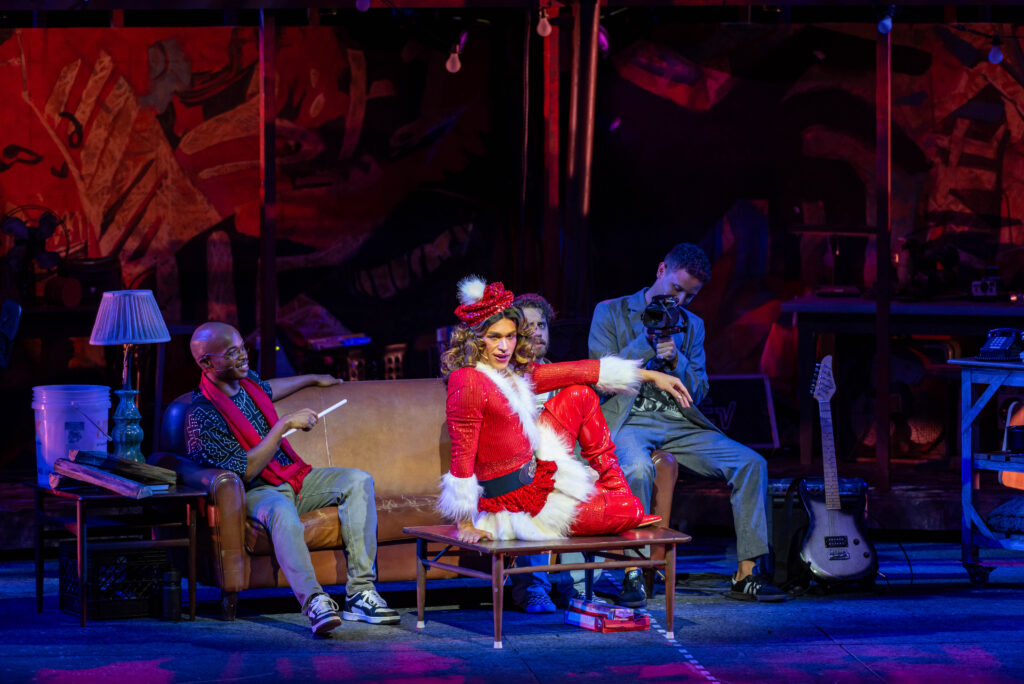
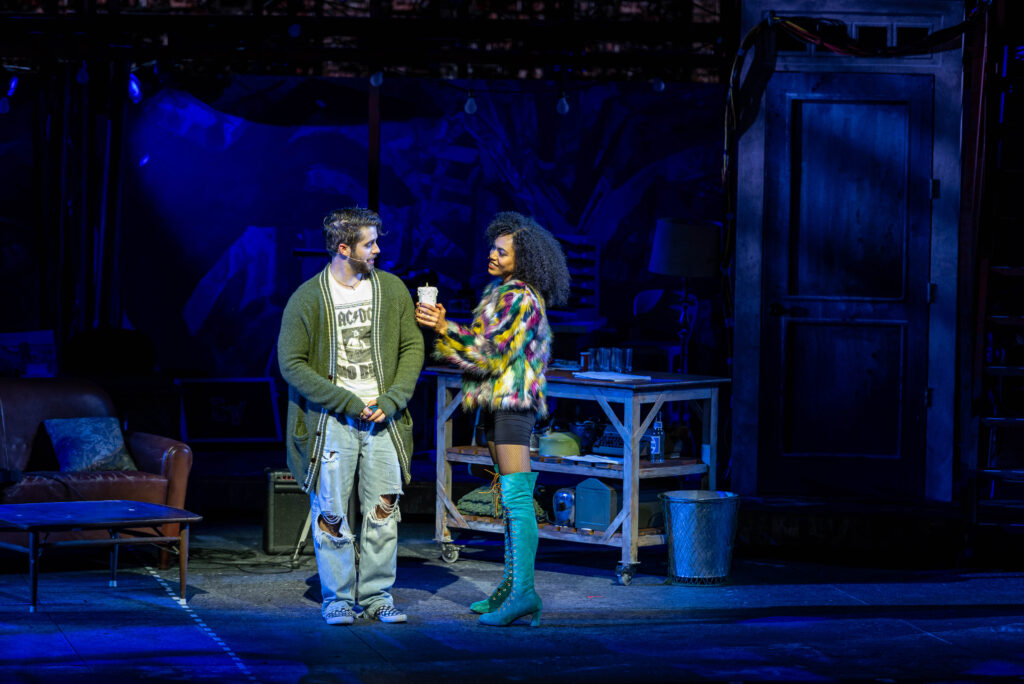
Sparks fly when Ashley De La Rosa, as drug-addicted exotic dancer Mimi, meets Roger, and their duets are superb: “Light My Candle” and “Without You” especially. She exhibits a confident demeanor, rocking the over-the-knee turquoise patent leather boots and smoothly gliding around the stage to choreographer Breon Arzell’s moves.

Adrian VIllegas as Angel. Photo by Phillip Hamer.

Adrian Villegas perfectly embodies the life force that is flamboyant one-of-a-kind drag queen Angel Dumott Schunard, delightful in “Today 4 U.” As scene-stealing as they are, what’s most remarkable is Terrance Johnson’s heart-is-full portrayal of philosophical tech-savvy activist-professor Tom Collins, who falls in love with Angel.

He was brought in to assume the role because the original cast member Evan Tyrone Martin took ill. Johnson and Villegas appear like they’ve been doing the show together for a long time, duet on a heartfelt “I’ll Cover You” and with others for a spirited “Happy New Year.” And Johnson’s vocals on “Santa Fe” and solo snippets in other songs are sumptuous.

Lindsay Heather Pearce, who played Elphaba in “Wicked” on Broadway, can belt with the best of them, and shows it on live-wire performance artist Maureen’s “Over the Moon” and “Take Me or Leave Me.” Tre Frazier has the thankless task of playing sellout Benjamin Coffin III, friend turned foe.

Special shout-out to ensemble-mates Julia Yameen (Mark’s mom), Shelby Brown (Joanne’s mom), Jhardon Dishon Milton (Joanne’s dad), and Erica Stephan (Roger’s Mom) as the parents heard on the voice mails.

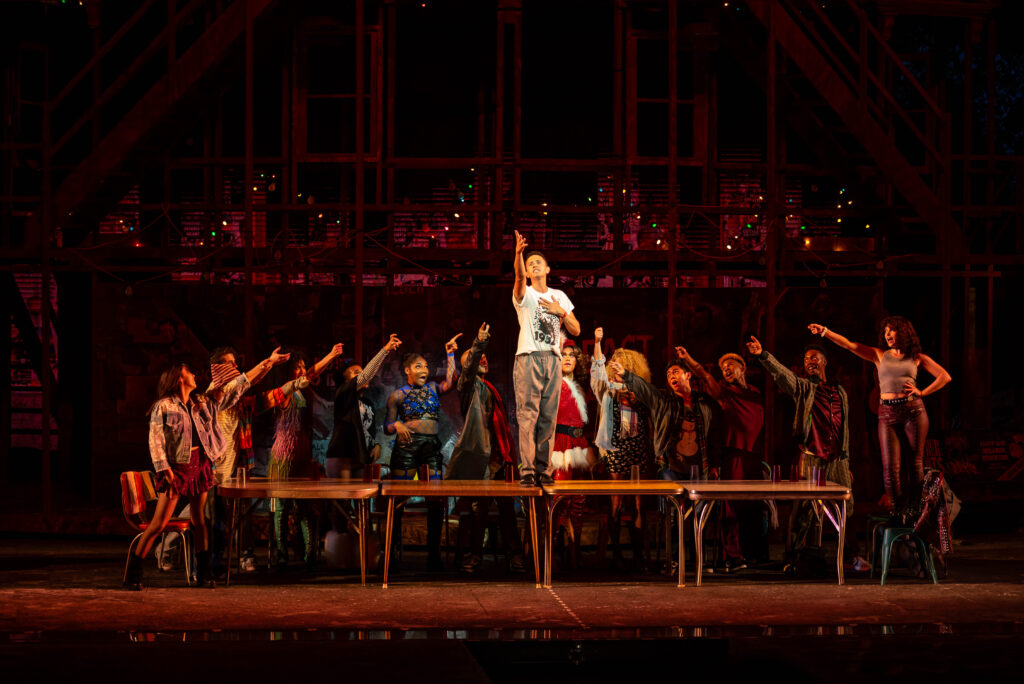
Among the many highlights is “La Vie Boheme,” the ebullient, defiant Act 1 closer that features characters finding their voices in a number that defines community. And fun name drops! (Pee-wee Herman!).

Seasons of Love. Photo by Phillip Hamer.

After intermission, when you hear the iconic piano chords and the entire ensemble files out to present the signature song, “Seasons of Love,” it is delivered with tremendous strength and feeling, creating a sublime contemporary “Muny Moment.” I will admit to moist eyes. Just hearing the divine Anastacia McCleskey crush that power-ballad solo, her voice ascending into the stratosphere, is goosebumps-time.

As Celie in last summer’s “The Color Purple,” she won the Outstanding Lead Actress in a Musical Award from the St. Louis Theater Circle in April. She plays Maureen’s attorney girlfriend Joanne Jefferson with genuine charm.

Costume designer Raquel Adorno has outfitted the cast appropriately in era streetwear, but my only quibble is I miss Mark’s maroon and blue sweater with his striped scarf. At times, it was hard to keep Mark and Roger separate. But Angel’s glitzy attire was eye-popping.

The sound had issues when the music was louder than the performers, where I was sitting, but I wondered if it was better elsewhere in the amphitheater.

Those people not familiar with the show could have had trouble figuring out action, so I recommend reading up on the show beforehand. I finally saw Puccini’s opera a few years ago, and was struck at how closely it resembled the “Rent” characters, except in a different century and country – Paris in 1830. The life-and-death themes, nevertheless, are universal.

Roger and Mimi. Photo by Phillip Hamer.

 While AIDS is no longer a death sentence, that period of uncertainty was harrowing and horrifying, and Larson’s stark look at loss – and homophobia — still resonates.

The show captured a specific time and place, but its pathos was always identifiable. After all, we’ve just been through several years of a devastating global health emergency and are currently losing thousands to an opioid crisis.

As a struggling artist for years, Larson knew the world he wrote about, based on a concept by Billy Aronson. Among his legacy, he urged us to cherish each of the 525,600 minutes we’re given every non-Leap year. Posthumously, Larson went on to win the Pulitzer Prize for Drama and three Tony Awards (musical, book, score).

“Rent” ran for 12 years on Broadway, has had countless touring shows for 25 years, a 2005 film adaptation, and a live television presentation in 2019.

No matter how many times I hear this score (and I know every word after heavy playlist rotation of the original Broadway cast double-CD recording), I am moved by how timeless each song is.

We are living in the Twilight Zone, only now America is well past the millennium. If we are fortunate, we know love and appreciate friends.

This exceptional cast makes us feel each emotion expressed, and I mean really feel the connections with an unmistakable chemistry and a reverence for the material.

The eight principals who moved to Broadway’s Nederlander Theatre April 29, 1996, were lightning in a bottle: Anthony Rapp as Mark Cohen, Adam Pascal as Roger Davis, Daphne Rubin-Vega as Mimi Marquez, Tony winner Wilson Jermaine Heredia as Angel, Jesse L. Martin as Tom Collins, Idina Menzel as Maureen Johnson, and the more ‘outsider’ characters –Fredi Walker as Joanne Jefferson and Taye Diggs as Benjamin Coffin III.

They caused a commotion, inspiring devotion. Their performances made the ordinary extraordinary and galvanized a generation. They changed their lives, and in the process, other Gen Xers.

They made it possible for others, especially ones who go against the grain, to be an “us” instead of a “them.”

Photo by Phillip Hamer.

Cut to 2023, and Gen Zers are now post-9/11 babies. Can “Rent” still strike a chord? It may no longer shock, but it can awe.

“Rent” still matters. It has the ability to connect on a personal level for all sorts of different reasons.

Take it from me, a Boomer Rent-head who saw it live on its first national tour, shared it with my oldest son as he entered his 20s, and consider the night I saw Anthony Rapp and Adam Pascal reprise their roles in 2009 one of the best nights of live theater ever (the electricity and the energy was off-the-charts). I’ve seen it so many times, I’ve lost count. I think it’s 11, and until the Muny Saturday night, I hadn’t seen a professional company perform it since the 20th anniversary tour in 2016. That music still holds a spell.

The Muny production is a triumph in every way, giving oxygen to an eternal flame, and a rite of passage, moving the cultural institution forward. Watching it under a moonlit sky was glorious, a stirring shared experience with thousands of other Rent-heads and a captivated Muny audience.

As Larson reminds us, there really is no day but today, as life is ours to miss.

‘La Vie Boheme,’ Photo by Phillip Hamer.

The Muny presents “Rent” Aug. 4-10 nightly at 8:15 p.m. on the outdoor stage in Forest Park. For more information, visit www.muny.org.

(Notes: For more about Jonathan Larson, see the 2021 musical film “Tick, Tick…Boom!” currently streaming on Netflix. Directed by Lin-Manuel Miranda, who said “Rent” changed his life when he first saw it as a teenager, it features an Oscar-nominated performance by Andrew Garfield as the young songwriter trying to get noticed.

Anthony Rapp’s 2006 book “Without You: A Memoir of Love, Loss, and the Musical Rent” is a worthy read.)

Mark and Joanne. Photo by Phillip Hamer

By Lynn Venhaus
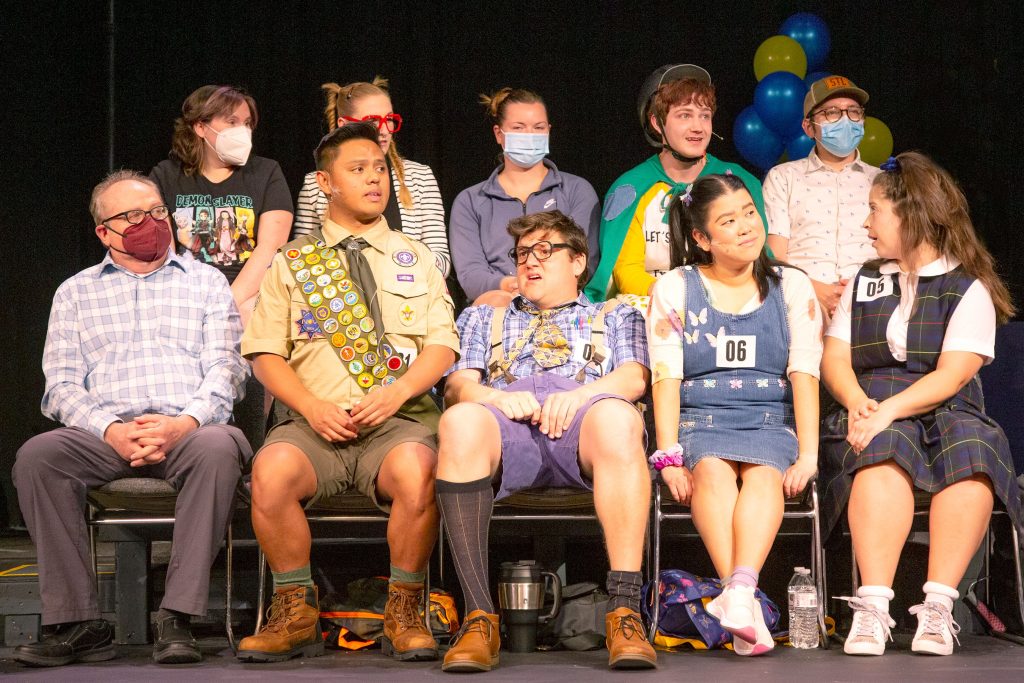
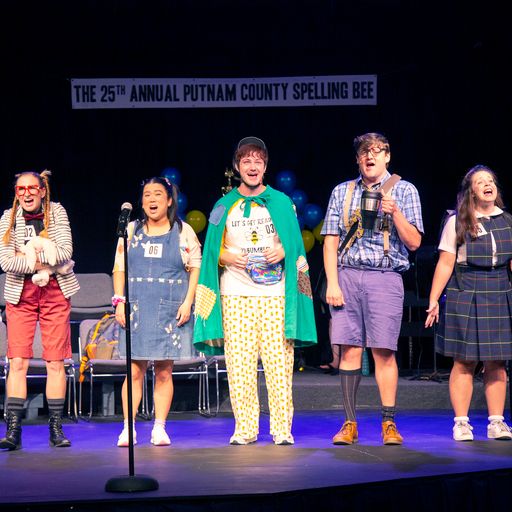
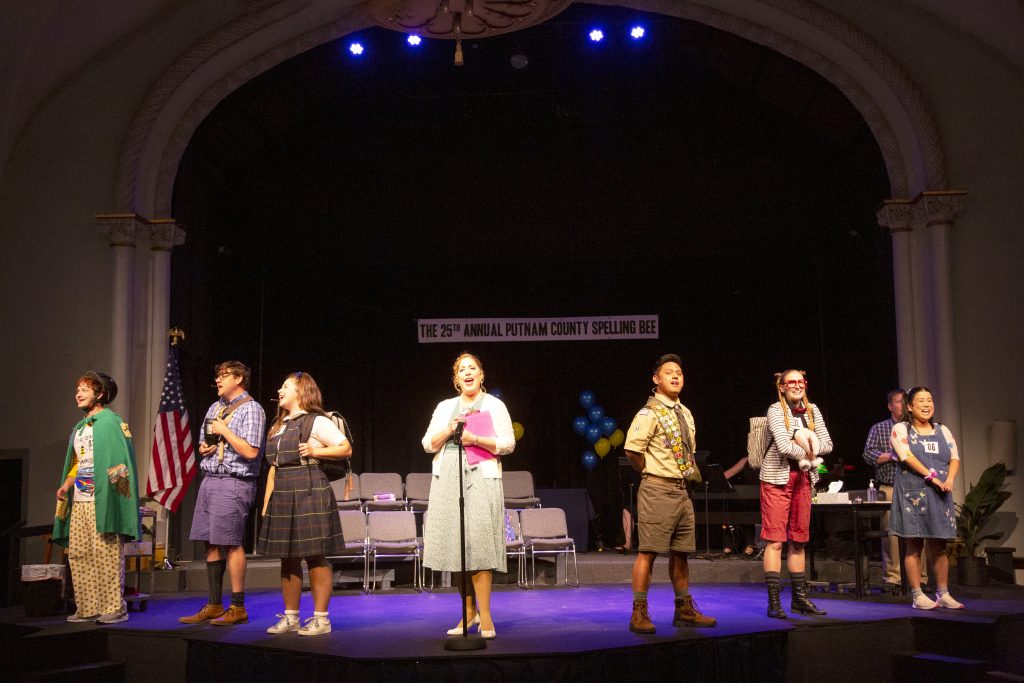
How do you define J-O-C-U-L-A-R-I-T-Y? The literal translation is “The 25th Annual Putnam County Spelling Bee,” now playing at Stray Dog Theatre.

A splendid summer sojourn, the jaunty musical comedy celebrates American traditions and meritocracy, our inherent competitive spirt, and freak-flag waving.

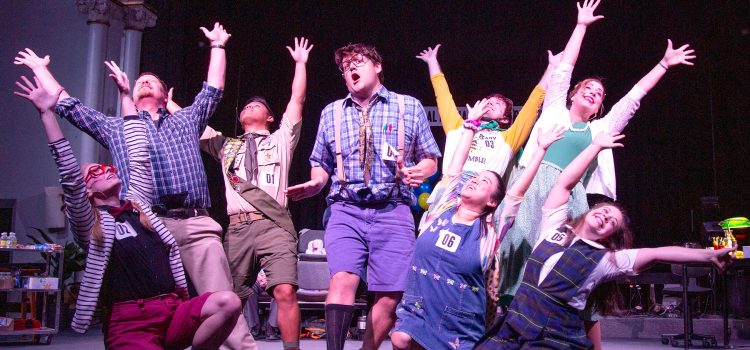
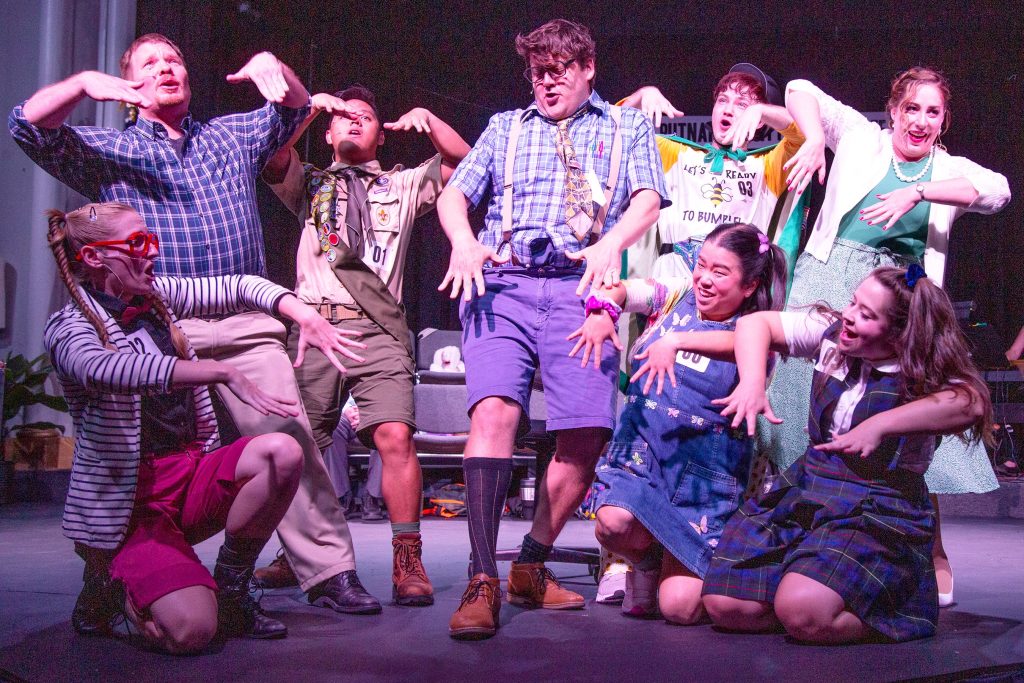
At a nondescript middle school, a sextet of smarty-pants sixth graders competes for a $200 savings bond and a towering trophy at the annual big-deal event. Three adults handle the proceedings, and four audience members are selected to participate, too.

And the blithe spirits on stage and in the audience instinctually know this is far more pleasurable than Mensa members getting together for Scrabble, especially with its clever audience-participation cachet.

However, those who didn’t make the honor roll need not worry, for SAT scores aren’t required at the door, and it’s a very accessible and inclusive work. The catchy music and savvy lyrics by William Finn (“Falsettos,” “A New Brain”) and the whip-smart Tony-winning book by Rachel Sheinkin offer something for everyone.

In this enjoyable production, adroitly directed by Justin Been, the dexterous cast has mastered the nimble word play and spit-take worthy improvisations for a rollicking good time. They got game.

The in-sync ensemble expertly colors outside the lines, shading their idiosyncratic characters with humor and humanity. Unlike “You’re a Good Man, Charlie Brown,” where grown-ups also play kids, this is a show with mature content.

Kevin Corpuz is returning champ Charlito “Chip” Tolentino, a strident Boy Scout who is struggling with puberty and distracted by a female in audience; Grace Langford is resolute newcomer Olive Ostrosky, whose mom is in India and dad is always working; and Sara Rae Womack is fervid Marcy Park, an over-achieving transfer student.

Clayton Humburg is mellow Leaf Coneybear, home-schooled son of hippies; Dawn Schmid is high-strung Logainne “Schwartzy” SchwartzandGrubenierre, politically aware and pushed by her two dads to win at all costs; and Kevin O’Brien is last year’s egghead finalist William Morris Barfee, whose name is really pronounced Bar-Fay, because of an accent aigu, and not Bar-Fee, like the announcer repeats.

Photo by John Lamb

While everyone’s comic timing is admirable, O’Brien elicits many laughs as he embodies a know-it-all misfit unfortunately hampered by one working nostril. Hunching his shoulders, rolling his eyes, and sighing in exasperation, O’Brien is in his element. He has the most peculiar way of spelling out the words – with his “Magic Foot.”

Barfee is one of those supporting roles that is an awards nomination magnet, like Adolfo in “The Drowsy Chaperone” and the UPS guy in “Legally Blonde – The Musical.” Dan Fogler, now of “Fantastic Beasts” who recently played Francis Ford Coppola in “The Offer,” won a Tony Award for originating the role.

The middle-school spellers are joined by four individuals that have volunteered for the gig – signing up in the lobby beforehand.  Good sports, they are called on to spell, without any special treatment, which is a key element to the fun. They might have to spell Lysergic Acid Diethylamide, or cow.

The three adults in the room include ‘comfort counselor’ Mitch Mahoney (Chris Kernan), an ex-con who gives the eliminated contestants a juice box and a hug; former champ and returning moderator Rona Lisa Peretti (Stephanie Merritt), a successful realtor who enjoys reliving her glory days; and Vice Principal Douglas Panch (Jason Meyers), who has returned as a judge after personal time off to work out some ‘things.’

Their perspicacity is evident – and the three veterans are oh-so-smooth with the innuendos and deadpan humor. Merritt is guileful as the supremely assured and unflappable announcer – think Patty Simcox from “Grease” as an adult.

She glibly describes the contestants with seemingly innocent comments and a few double-entendres. You don’t want to miss a word, for you might do a double-take (Wait – what?).

Hilarity ensues whenever the puckish Meyers wryly uses a word in a sentence or describes his feelings. He elevates the script’s wit (those inappropriate comments!) with his crackerjack delivery. Just don’t get him started on Klondike’s decision to drop the Choco Taco! He’s a tad jittery.

Photo by John Lamb

Several performers double as ancillary characters, such as parents – for instance, Kernan and Humburg are Logainne’s importunate fathers. Corpuz shows up as Jesus Christ. (You’ll just have to see).

The convivial show, workshopped into an off-Broadway hit, transferred to Broadway in 2005 – and was nominated for six Tony Awards, winning two. It was originally conceived by Rebecca Feldman and based upon “C-R-E-P-U-S-C-U-L-E,” a play by her improv collective, The Farm. Additional material was supplied by Jay Reiss.

The ingenious construction has managed to keep it fresh 17 years later by relying on the actors to be on the ball with au courant references.

Been astutely uses the state of play as an advantage, maintaining a balance of friskiness and sweetness that makes sure everyone is in on the jokes. No mean-spirited sarcasm here.

The cast’s exemplary improv skills make this a very funny, free-wheeling show. But let’s not forget the music is an integral part, too, and each character nails a signature song. Besides Barfee’s “Magic Foot,” there is — Leaf: “I’m Not That Smart.” Olive: “My Friend, The Dictionary.” Marcy: “I Speak Six Languages.” Logainne: “Woe Is Me.” Chip: “Chip’s Lament.”

Rona’s “My Favorite Moment of the Bee” is a running theme throughout, Mitch serenades the last audience speller with “Prayer of the Comfort Counselor,” and Panch is in “Spelling Montage.”

The troupe’s strong voices harmonize well in the group numbers, too.

Photo by John Lamb

Music Director Leah Schultz smoothly keeps the tempo on track, and is on piano, joined by Kelly Austermann on reeds and Joe Winters on percussion. Choreographer Mike Hodges keeps the moves light-hearted and breezy.

Jacob Baxley’s sound design enhances Rona’s championship spotlight, as does Tyler Duenow’s lighting design.

Eileen Engel’s costume designs distinctly outfit the personalities – and allow them to move easily, whether in the minimal dancing or walking through the aisles.

The Tower Grove Abbey’s small stage is well-suited for the show’s sparse set design, put together by Been.

For logophiles, the principal contestants are relatable. — perhaps a bit more eccentric, but these quirky characters have all learned an early invaluable life lesson: Knowledge is power.

My fellow nerds will feel at one with their tribe. For we know that summer vacation fun isn’t defined by theme park rides, water slides, and sports camps, but by summer reading lists – whether it’s for a library club, school enrichment class or a free personal pan pizza in the Pizza Hut Book It! Program.

It’s still the only musical where the cool kids are here for the orthography. Revenge of the nerds, indeed. So, Wordle can wait – and this show cannot, for there are 8 performances remaining.

Stray Dog Theatre presents the musical “The 25th Annual Putnam County Spelling Bee Thursdays through Saturdays from Aug. 4 to Aug. 20 at 8 p.m., with additional performances at 2 p.m. Sunday, Aug. 14 and 8 p.m. Wednesday, Aug. 17 at the Tower Grove Abbey, 2336 Tennessee Avenue in Tower Grove East. For more information, visit www.straydogtheatre.org

Note: Tickets are only offered in physically distanced groups of two or four.

Photo by John Lamb.