By Lynn Venhaus

With words of wit and strong female leads, “Austen’s Pride” has promise to fulfill its potential, coinciding with the literary world’s preparations to celebrate Jane Austen’s 250th birthday on Dec. 16.

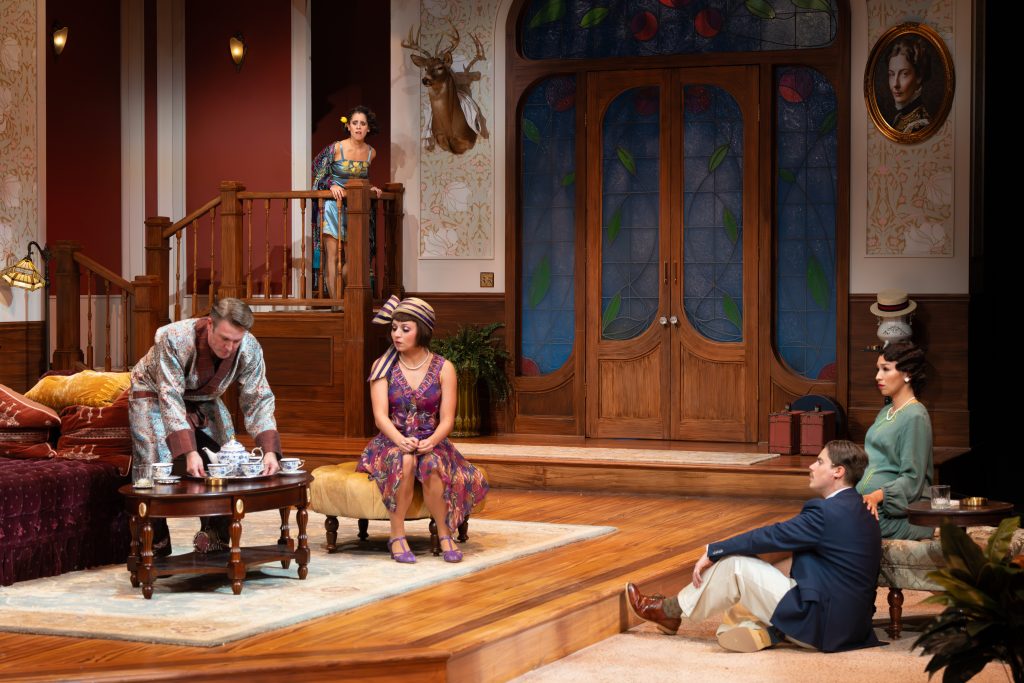
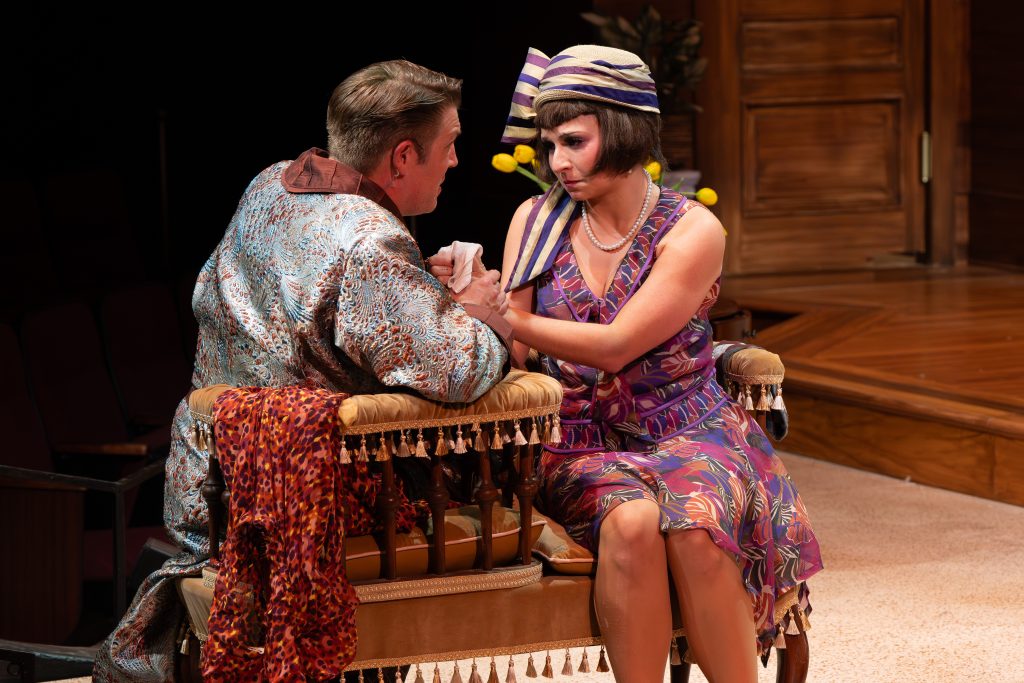
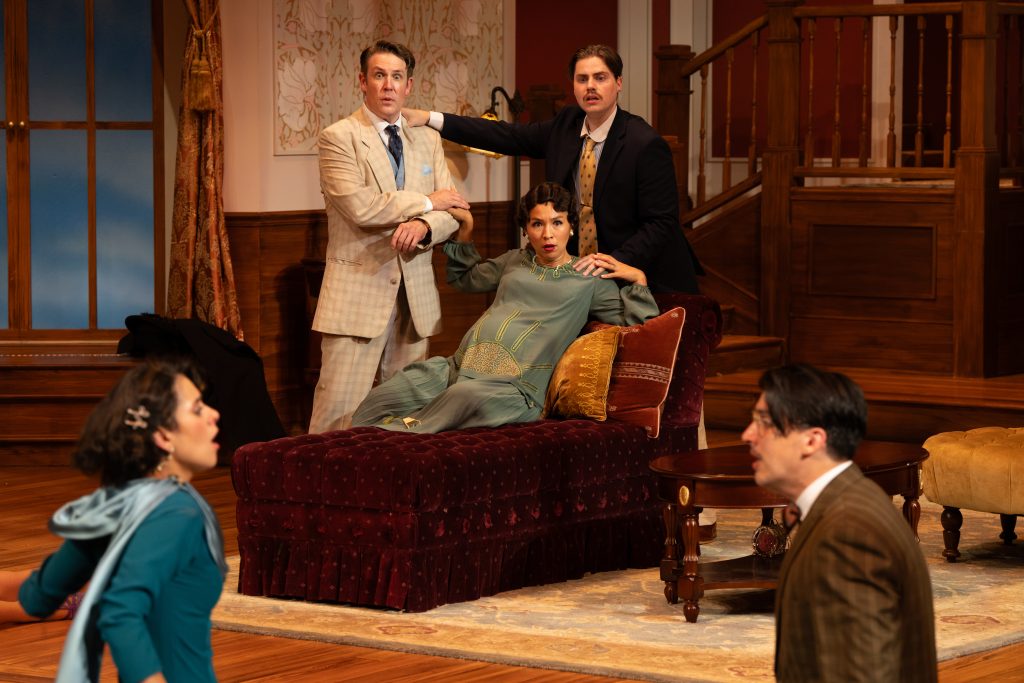
In its pre-Broadway tryout at Stages St. Louis, a charming, refined cast, with shrewd, fluid direction by Igor Goldin, re-imagines Austen’s most acclaimed work, “Pride and Prejudice” as a double narrative.

The music, however, is a mixed bag — with a few emotionally connecting songs, but most lack depth, have unmemorable melodies, and aren’t necessary to advance the story.. It’s the musical’s weakest element. If reworked, the production could be a fine straight drama, laced with humor, of course.

Considered one of the most important and influential novelists in English literature, Austen crafted memorable characters through her use of irony, humor and realism, and critiques of a patriarchal structure during her lifetime.

She died at age 41 and achieved more fame posthumously for her six novels. Her insightful writing about the everyday lives of women in the 18th and 19th centuries has appealed across generations and cultures.

Therefore, distilling her famous characters into a 2-hour, 30-minute musical was an ambitious undertaking. Lindsay Warren Baker and Amanda Jacobs, who wrote the music, lyrics and book, are faithful to her personal growth story arcs, even if they can’t offer more depth and nuance like a novel does.

Dan Hoy as Darcy and Cole Thompson as Charles Bingley. Photo by Philip Hamer.

The musical’s premise is that after the success of “Sense and Sensibility,” the happy publisher wants another work from Austen. At the urging of her supportive sister Cassandra (Dianica Phelan), Jane begins re-working “First Impressions,” which she had already started.

As she writes, the characters spring to life. Austen converses with them and thinks aloud about her process, thus beginning her own journey of self-discovery.

The tag team of an engaging Olivia Hernandez as the whip-smart author and Delphi Borich as uncompromising Elizabeth Bennet are the driving force here.

Their “When I Fall in Love” is a captivating duet, as Borich and Hernandez’s enchanting voices blend beautifully.

Your fondness for Austen’s works may factor into your reaction to this work in progress that’s headed on tour to several American cities, with St. Louis the first stop from July 25 to Aug. 24.

The Bennet Family and Mr. Collins. Photo by Philip Hamer.

In September, the show will travel to Charlotte, N.C.; Memphis, Tenn.; Newport News, Va.; The Villages in Florida; Oxford, Ala.; Owensboro, Ky.; and Waterbury, Conn.  More dates may be announced. Right now, there is no timetable for Broadway, but producer R. Erin Craig is working on that goal.

The musical debuted in March 2019 at A.C.T. of Connecticut, then opened that October in Seattle at the 5th Street Theatre, which has developed other Broadway-bound shows, including “Mrs. Doubtfire.” A one-night-only concert version at Carnegie Hall was performed by eminent Broadway veterans on June 29, 2023.

Austen’s timeless themes of love, family and societal expectations, combined with her sly feminist-leaning social commentary, endure.

Women had limited options, so marriage could improve their social standing and economic security. (Keep in mind the historical context, for these characters are products of their time).

Olivia Hernandez as Jane Austen and Delphi Borich as Elizabeth Bennet. Photo by Philip Hamer.

Elizabeth Bennet, the second of five daughters, has an older sister and three younger. Her growing relationship with reserved aristocrat Fitzwilliam Darcy propels the story, while Jane’s romance with the good-natured Charles Bingley, and her younger sister Lydia’s dalliance with disgraced George Wickham, are subplots. Elizabeth rejects the self-important clergyman Mr. Collins’ proposal, thus causing upheaval.

Those not entranced by the Bennet girls’ romantic entanglements and squabbles should be able to grasp the story without a primer.

As the sarcastic and disengaged father, Kevyn Morrow has a fitting solo “Silly Girls.” Critical of others, his favorite is Lizzy. He delivers the best zinger: “Your mother will never see you again if you do not marry Mr. Collins… and I will never see you again if you do.”

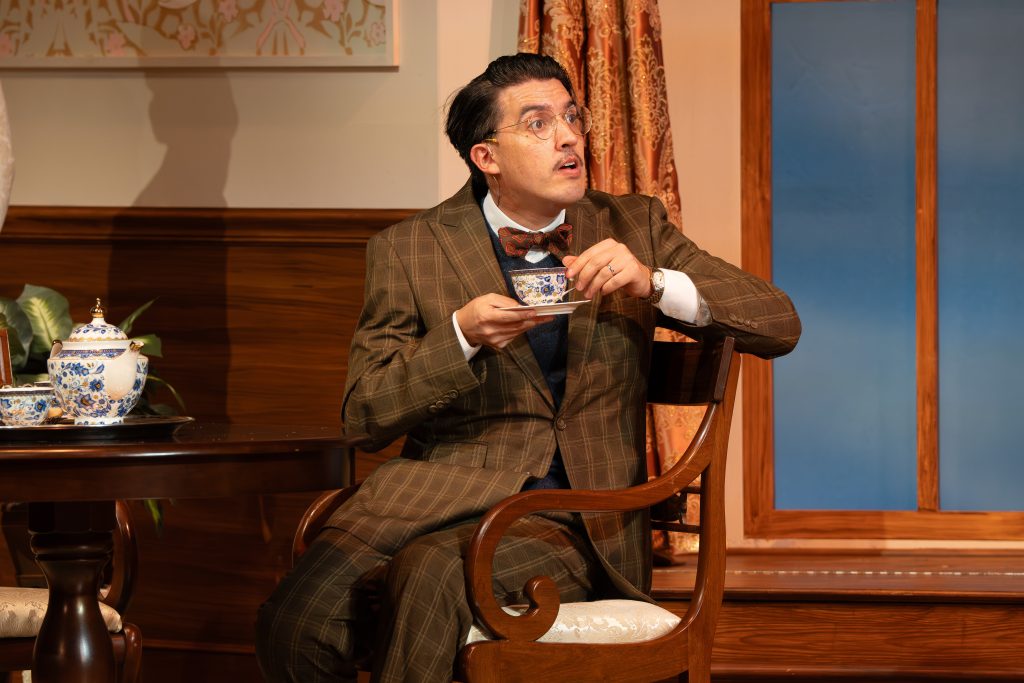
Other notable men include a delightful Cole Thompson as the smitten Bingley, Michael Burrell as a charming but untrustworthy Wickham, and Paul Castree as the pompous Collins.

Completing the close-knit Bennet family are Addie Morales as Jane, Sarah Ellis as Mary, Cali Noack as Catherine “Kitty,” and Kate Fahey as Lydia.

Kate Fahey as Lydia. Photo by Philip Hamer.

Mrs. Bennet’s social-climbing pretentious, tactless and foolish ways and the two youngest daughters’ giggly immaturity have always annoyed, and the actresses playfully exaggerate those traits.

Besides Mary, Ellis plays Bingley’s sister Caroline and the Bennet girls’ aunt Mrs. Gardiner, with Castree also Mr. Gardiner. Several other performers have multiple roles, including Noack as Georgina Darcy and Luttrell as Tom Lefroy. The cast assumes all their roles with aplomb.

The well-prepared ensemble includes Travis Anderson, Matt Gibson, Keith Johnson, and Drew Tanabe as Redcoats, Brett Rawlings and Graham Keen (Dance Captain) as swings, and Abigail Isom, Jazmin Gorsline, and Caroline Santiago Turner as standbys.

With Colin Firth forever etched as Darcy in the 1995 mini-series, it was harder to accept Matthew Macfadyen in the outstanding 2005 film, but like Dan Hoy here, he grew on me. Because of Darcy’s aloof and arrogant demeanor, it takes awhile to warm up anyway.

Darcy, Jane and Lizzy. Photo by Philip Hamer.

As for the music, the lack of steady catchy melodies is problematic. Most are indistinguishable from each other.

However, that’s not to say that there aren’t a few songs that stand out, for Hoy gorgeously sings Darcy’s “Fine Eyes,” and he poignantly duets with Hernandez on “The Portrait Song.”

In “My Poor Nerves,” Sally Wilfert displays her skills as a nimble comedienne. She also doubles as the insufferable Lady Catherine de Bourgh.

But Lydia’s flirty “I Can’t Resist a Redcoat” must be cut. OK, in that era, girls married in their early teens, but a 15-year-old singing it nowadays is cringey.

So dubbed the Regency era in British history, which spanned 1795 to 1837, that period is often romanticized as a time of elegance and social refinement. Costume designer Emily Rebholz created sumptuous vintage apparel, with impressive ballroom finery. Tommy Kurzman’s hair and wigs designs further illustrated the 19th century look.

Ballroom dance. Photo by Philip Hamer.

Choreographer Lisa Shriver’s authentic ballroom dances are a high point as well. Music director Sheela Ramesh emphasized the elegance in Jacob’s orchestrations. She conducted a 9-piece orchestra: Reagan Casteel on keyboard, Fiona Brickey on violin, Eileen Burke on oboe, Marcia Erwin on cello, Lea Gerdes on woodwinds, Stephen Hanrahan on French horn, Adam Anello on bass, and Chris Traylor on drums and percussion, with Ramesh on keyboard and Carrie Benton Smith filling in on keyboard at certain performances.

The distinctive style in architecture and art is depicted simply by scenic designer Josh Zengen, more of a suggestion, with minimal objects representing the Bennet country estate Longbourn House, Darcy’s Pemberley and Charles Bingley’s residence Netherfield Park. The video backgrounds augment the minimalist set, showcasing the lush countryside.

Jason Lyons’ lighting design and Phillip Peglow’s sound design are integral to the overall effect, crisp and precise. The director, choreographer, scenic and lighting designers were all attached to the 2019 version, too.

Despite being technically proficient, the show lacks the consistent spark a musical should produce, mainly because it’s too long and has too many songs that sound the same.

For the love story to succeed, Darcy must overcome his pride, and Elizabeth must overcome her prejudice. That’s good advice for everyone moving forward, no matter what generation, fact or fiction.

Photo by Philip Hamer.

.Stages St. Louis presents “Austen’s Pride” from July 25 to Aug. 24 at the Kirkwood Performing Arts Center. For more information on Austen’s Pride, please visit StagesStLouis.org

By Lynn Venhaus
Spotlighting attitude and intrigue, a still-vivacious “Madam” has been nipped, tucked, and excised into a promising female-forward musical focused on womanhood’s advancement in this third go-round.

At the center is a fascinating account of Eliza Haycraft, one of St. Louis’ most notorious businesswomen, who ran a brothel and was known for her philanthropy in the late 19th century.

Born in 1820, Haycraft arrived destitute in St. Louis at age 20. She couldn’t read or write. Eventually, she bought commercial and residential property, then rented it back out.

A champion of ordinary folk, she was loved by the public, helping the poor and offering financial aid. During and after the Civil War, she supported widows and orphans affected.

The opening song, a statement, “Empire” touts her achievements building her business, and Haycraft became the wealthiest local woman during the Reconstruction Era. The tribute is the show’s catchiest earworm and emphasizes modern sensibilities.

“Madam” takes place during the last year of her life – Haycraft died in 1871 at age 51. She still had enough gumption to fight to be buried in Bellefontaine Cemetery. (She won, but to date, her grave doesn’t have a headstone).

Kimmie Kidd as Eliza Haycraft. Photo by Cady Bailey.

But despite the passage of The Social Evils Act of 1870 making her business legitimate for a brief time, she was shut out of polite society, even with the town’s upper crust, political bigwigs and business scions her patrons. Ye olde double standard.

In fact, the law was detrimental to the women – denied habeas corpus (unlawful detention) to women arrested for prostitution and had a fee/tax instituted, not to mention unlimited police power to search homes and people. Aren’t we having this discussion now about who has control over women’s bodies?

The women who worked for Eliza that she nurtured and took good care of get more attention this go-round. Their personal experiences are woven in, and Haycraft seems more of a supporting – but integral – role.

As she has in all three versions, Kimmie Kidd owns the role, and commands the stage. Kidd is well-known for her star power on local stages, and she shines here as a smart, pragmatic, trailblazing woman. She has two richly textured solos – “Friends” and “Dinner for One.”

Kidd knows how to sashay and make her mark. She also joins her girls in a robust “The Grateful Imposter” finale.

Taken under her wing are a spunky quartet – Adrienne Spann as gutsy Billie, Lillian Cooper as naïve Tennie, Avery Lux as agreeable Ripley, and Rachel Bailey as jaded Calista bring sass and spirit to the working girls.

Rachel Bailey as Calista. Photo by Cady Bailey.

They are also devoted to Eliza, as their song “It’s Because of Eliza” indicates. Haycraft empowered them by allowing them to refuse service to anyone. She had three simple rules: Respect, Consent and Pay Up Front. She also believed “No debts among women.”

They support themselves through prostitution but assert independence at a time when they have few legitimate rights. Girl power ahead of its time, and this show leans into that.

Adrienne Spann, whose star is on the rise, brings ambitious Billie to vivid life in such songs as “Another Fence” and her solo “Joy.” Her character is a composite of historically strong women, including an escaped slave who disguised herself as a man to fight in the Union Army.

Rachel Bailey has found a niche in playing outspoken, sagacious women, and Calista is a bold version of that. Her spidey sense is revealed in an exchange with Mercy that leads to the new number, “La Fille Evanouie.”

Think of Calista as the tough-love mom with a world-weary view of life, but ever the intuitive and shrewd woman looking out for herself.

With Calista, the feisty group numbers include “Special,” “The Great Imitator,” “It Feels So Good” and “Another Pastime.”

Adrienne Spann sings “Another Fence.” Photo by Cady Bailey.

The young Tennie and Ripley appear to be squabbling, but through their journey, grow up under the ladies’ influence. Their characters are not as distinct as the others, but Lillian Cooper and Avery Lux are energetic, enthusiastic performers.

The new downtrodden kid in town, actress Mercy Jones, is hiding a secret, but Madam takes a shine to her, and she ingratiates herself into the quarters. They all have one thing in common, though – dreaming of a better life.

Jade Cash is mysterious as Mercy – we are kept off-guard but sense her conflicted nature. She announces her intentions in her solos “Man with Money” and “Star.” She joins the working girls for the playful “Love is Work.”

When she has a change of fortune in the second act, she joins the girls in the opener “Mercy’s Empire.”

Unbeknownst to the other girls, Mercy is the sister of The Benefactor, an over-the-top villain modeled after dastardly vaudeville archetypes. In a departure from his usual likable protagonist roles, Dustin Petrillo oozes unctuousness, no scruples detectable.

He lusts after the downtown property so he can amass more power through the St. Charles Street real estate, and resorts to nefarious tactics. Petrillo is dynamic – and depraved — in “All the Money in the World” and duets with Kidd in the power play “All of This Goes Away.”

Dustin Petrillo as The Benefactor. Photo by Cady Bailey.
Accomplished composer Colin Healy and his dedicated creative partner, multi-faceted Bradley Rohlf, have rewritten, reworked and re-mounted the musical at their Greenfinch Theater and Dive Bar for Fly North Theatricals.

It’s Healy’s sixth original musical, and he not only wrote the music, infusing the score with St. Louis-flavored blues and jazz, but also the lyrics and book.

After a workshop at COCA, the musical was staged in 2019 at the Bluff City Theater in Hannibal, Mo., which commissioned the work. Fly North mounted it here in January 2020 at the .Zack.

This update has slashed six songs and reconfigured others to make the show tighter. While the vocalists harmonize well, one of the drawbacks was the sound was too loud for the space during Saturday, July 26, presentation.

That, and this current reliance on singers trying to be powerful when in fact it becomes a cross between screaming and belting, or ‘screlting,’ to the detriment of pleasant-sounding melodies.

The repetitive nature of this new direction detracts from the likable performers’ commitment to their parts, not to mention strain on voices.

The streamlined musical numbers also benefit from Cady Bailey’s choreography, with an exceptionally skilled Lux standing out as a well-trained dancer.

While the songs have strong rhythmic hooks and clever lyrics, the book could still use some tweaking. A few plot threads are muddled, including Calista’s illness (real or fake?) , what is so attractive about Eliza’s location and some unanswered questions in a desire to wrap the show up.

Jade Cash as Mercy Jones. Photo by Cady Bailey

In the two previous versions, Mercy and The Benefactor were husband and wife. This version is stronger by making them siblings.

For this production, director Sam Hayes keeps the pace brisk, the women alert and enabled, and makes sure each has moments to shine.

As costume designer, too, they also adorned the characters in eye-catching finely textured outfits and finery that enhances the show’s visual appeal.

Healy is the musical director and Rohlf is the technical director and lighting designer. Both worked on the set design, which created a homey, cozy feel with a parlor and bedroom for Calista in the intimate space.

Katie Orr painted the set with its intricate stencil work, Kel Rohlf gathered the period props, and Dizzy Funke was production and stage manager, with Dereis Lambert production assistant and light board operator. Aslyn Damerval was the dramaturg and Rhiannon Creighton the intimacy coordinator.
Shining a spotlight on a prominent but little-known 19th century woman, “Madam” is an alluring musical that draws potency from its modern parallels. The one-of-a-kind Haycraft is worth researching to find out more about a well-lived life.

A lovingly crafted piece presented with sincerity and obvious talent, one hopes it finds a way to flourish and prosper, much like the title character deserved.

Fly North Theatricals presents “Madam” from July 25 to Aug. 10, with performances at 7:30 p.m. Thursday through Saturday and 2 p.m. Sunday at the Greenfinch Theater and Dive Bar, 2525 Jefferson Avenue. For more information, visit www.flynorth.org.

By Lynn Venhaus
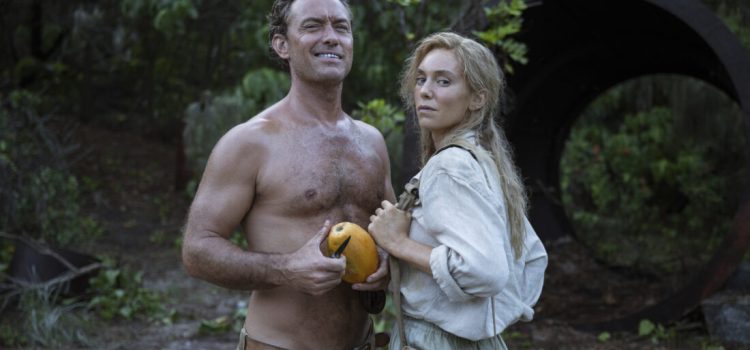
Behold! Honoring the men who went before, who blazed a trail with silly spoofs and non-stop nonsensical gag reels not seen in 31 years, “The Naked Gun” has returned in a goofy reboot that’s a chip off the old block.

With more jokes landing than missing, and a reverence for the formula that worked before, the new filmmakers honor the loony legacy. Led by producer Seth McFarlane, writer-director Akiva Schaffer and his two co-writers Dan Gregor and Doug Mand, they keep the jokes rapid-fire and the humor absurd and politically incorrect.

Fans of the previous trilogy, the gold standard “Airplane!” that created an entire parody sub-genre in 1980, and the short-lived TV show “Police Squad!”, can rejoice. The spirit of Frank Drebin lives!

Oscar nominee Liam Neeson has the special set of skills to pull off Frank Jr., following in his dad’s harebrained footsteps. Neeson has fun mocking his action hero persona, using the same deadpan delivery that earned Nielsen high praise from Roger Ebert, describing him as “the Olivier of spoofs.”

He and Pamela Anderson, who plays the femme fatale/love interest Beth Davenport with impressive verve, go full throttle in their scenes together, as their predicaments get wackier. They appear to be having a swell time hamming it up. Hilarity ensues especially during rom-com weekend montage that’s snowballs o’ fun, and there are some visual double entendres NSFW. (It is PG-13).
The dandy character actor Paul Walter Hauser is a good sport playing Frank Jr’s partner, Ed Hocken Jr., and he’s the son of original castmate played by George Kennedy, another revered character actor.

Oscar winner for “Cool Hand Luke, Kennedy starred in the ‘70s “Airport” disaster movies that sparked the spoofs in 1980 — the funniest movie ever made, “Airplane!” A full circle moment.

The cast also includes CCH Pounder as the exasperated police chief and Danny Huston in fine form as the villainous industrialist Richard Cane. Singer Busta Rhymes is a bank robber in one interrogation scene, and Weird Al Yankovic, who had cameos in the three previous films, shows up here, too.

While Davenport’s brother’s murder is centerpiece to the story that uses film noir tropes, the plot doesn’t matter. Everybody’s trying hard to make people laugh, and it comes across.

That said, with the focus on so much silliness, the inconsequential plot runs out of steam. Even with its 85-minute runtime, it’s time to wrap – and that’s a sweet surprise, how briskly paced the film is.

With time-honored classic comedic elements, mixed in with modern jabs and some fresh takes, this is a franchise worth rebooting.

All hail for the ZAZ team of comic geniuses David Zucker and his brother Jerry Zucker, and the late Jim Abrahams, who died last year. (God rest ye, merry gentleman). In their cultural phenomenon “Airplane!”, the trio laid the foundation for this daffy treasure trove of sight gags, clever non sequiturs, funny sendups and an off-color joke or two.

Their trilogy included 1988’s “The Naked Gun: From the Files of Police Squad!”, 1991’s “The Naked Gun 2 1/2: The Smell of Fear,” and 1994’s “Naked Gun 33 1/3: The Final Insult.”

Employing Leslie Nielsen as the oblivious detective Frank Drebin back then was a master stroke. A big surprise in the smash hit “Airplane!” as a doctor who comes to passengers’ aid after they’re struck with food poisoning, Nielsen was enlisted for ZAZ’s ahead-of-its-time TV police procedural satire “Police Squad!” It was cancelled after six episodes on ABC in 1982.

Before ZAZ unlocked a comic gem, Nielsen was a serious dramatic actor and made over 100 films during his 60-year career, including “Forbidden Planet” and “The Poseidon Adventure.” That all changed in 1980, and he had a terrific second act with schtick, laughing all the way to the bank.

Schaffer’s keen comedic skills, honed as one third of The Lonely Island team of Andy Samberg and Jorma Taccone, helped strike comic gold before. Namely, many “Saturday Night Live” specials, and he helmed the funniest film of 2022 “Chip ‘n Dale: Rescue Rangers,” and one of the most hilarious of 2016 “Pop Star: Never Stop Never Stopping.”

Along with Gregor and Mand, who collaborated with Schaffer on ‘Chip ‘n Dale,” and were staff writers on “How I Met Your Mother,” they embrace the zaniness that went before and put their wits to cracking as many jokes as possible, even if they are tasteless or misfire. The pop culture references come fast and furious.

That’s brave, irresistible, and welcome. The timing is right to allow your brain to have a vacation and just laugh out loud. Did they say that? Yes, yes, they went there, and it’s refreshing.

“The Naked Gun” is a 2025 comedy directed by Akiva Schaffer and starring Liam Neeson, Pamela Anderson, Paul Walter Hauser, CCH Pounder and Danny Huston. It’s runtime is 1 hour, 25 minutes, and it’s rated PG-13 for crude/sexual material, violence/bloody images and brief partial nudity. It opened in theatres on Aug. 1. Lynn’s Grade: B+

By Lynn Venhaus

Deeply personal and profoundly moving, “Dear Evan Hansen” grabs our hearts and doesn’t let go.

Sensitively presented by director Rob Ruggiero and perceptively told by an emotionally engaged cast in its powerful Muny and Midwest regional debut, the musical is anchored by an astounding Michael Fabisch, who immediately wins us over as the awkward outcast Evan.

In his star-making turn, the captivating Fabisch, who played Evan on the most recent national tour, projects vulnerability and a remarkable range of feelings as an anxious high school senior struggling to fit in.

He is in nearly every scene — his physical stamina as impressive as the emotional depth he expresses in the signature songs “You Will Be Found,” “For Forever,” “Words Fail,” and “Waving Through a Window.”

Through a series of unfortunate events, Evan finds himself entangled in a web of lies after a troubled classmate’s suicide, which spirals out of control.

Rob McClure (left) and Michael Fabisch in the Muny production of “Dear Evan Hansen.” Photo by The Muny | Emily Santel

When you first hear that everything is based on a lie, you may have a ‘wait – what?’ reaction. However, Evan’s hard-fought journey of self-discovery resonates. He makes mistakes, and there are consequences, but ultimately, there is hope.

The story asks us not to judge Evan but understand why he created this charade — to comfort a grieving family. Forgiveness is a powerful tool here too.

The spotlight on the anonymous and anti-social Connor Murphy has a beneficial outcome — The Connor Project, a viral movement for inclusion, that grew from the students’ efforts.

Statistics tell us loneliness is at an all-time high. A National 4-H Council survey found that seven out of 10 young people say they struggle with mental health issues. I think this musical can save lives, and if it helps someone reach out, what a wonderful result. It is certain to spark conversations.

From left: Michael Fabisch, Bryan Munar and Joshua Bess in the Muny production of “Dear Evan Hansen.” Photo by Phillip Hamer

Even during an intense summer heat wave, a highly attentive audience leaned in, rapt. Sensing that the musical connected to each person in some way, no matter what age, I was struck by the hush of the engaged crowd – except for a few overheard sniffles here and there (understandable, and with me, unavoidable).

Try getting through “So Big/So Small,” a heart-melting vocal by Jackie Burns, who plays Evan’s caring single mother Heidi.  Her husband left when Evan was 7 and has a whole new life in Colorado. She addresses her shortcomings in this tearjerker.

Burns, Broadway’s longest running Elphaba in “Wicked,” is raw and real in her portrayal of Evan’s hard-working, exhausted mom, juggling her job as a nurse’s aide, school classes to become a paralegal, and trying to provide for her son but not always being there for him.

“I knew there would be moments that I’d miss
And I knew there would be space I couldn’t fill
And I knew I’d come up short a million different ways
And I did
And I do
And I will”

Pass the tissues. Not only does this song foster empathy, but the entire show can be viewed as therapeutic/cathartic – and necessary. Oh, the dialogues to follow in homes across America.

Michael Fabisch and Jackie Burns in the Muny production of “Dear Evan Hansen.” Photo by The Muny | Emily Santel

The show is universally relatable because of its themes of mental health, grief, social anxiety, fear of being alone, yearning for acceptance, and understanding how others feel invisible or unvalidated for who they are.

While the high school setting conveys both despair and wanting to please in an overwhelming digital age, the adults are affected too, as they do ‘adulting’ in an ever-changing playing field where the goal posts keep moving.

Everybody seems to be trying to do the right thing and find their place in the world, flaws and all. That is why the cast’s ability to depict frustration, confusion and joy is felt, landing in every corner of the Forest Park seats. Who wouldn’t want an opportunity for reinvention?

An ensemble peppered with fresh faces and seasoned principal performers tugs hard at the heartstrings as their impassioned voices unite in splendid harmonies. The Act One closer, “You Will Be Found” is an anthem we always need, but more so in our contemporary cold, cruel world.

Standing out in supporting roles – and making their Muny debuts – are Joshua Bess as the anonymous and aggressive Connor, whose apathy may have masked a cry for help, Afra Sophia Tully as his sister Zoe, and Bryan Munar as tech whiz Jared, a family friend who reluctantly helps Evan become an internet sensation.

Savy Jackson in the Muny production of “Dear Evan Hansen.” Photo by Phillip Hamer

Savy Jackson, last year’s Ariel in “The Little Mermaid,” is charming as the cheerful over-achieving Alana. Rob McClure, in his ninth Muny show, and his real-life wife Maggie Lakis, also a Muny vet, portray Connor’s parents Larry and Cynthia, pain and sorrow etched on their faces.

Pairing with Fabisch, Bess is light-hearted in “Sincerely, Me,” Tully has a tender duet in “Only Us.” and McClure sentimental in “To Break in a Glove.”

A fusion of musical theatre and pop, the score by composer Benj Pasek and lyricist Justin Paul is well-integrated into the recognizable story by Steve Levenson.

Golden boys Pasek and Paul, the latest EGOT winners (20 and 21st), earned Tonys and a Grammy Award for “Dear Evan Hansen,” an Oscar for “City of Stars” from “LaLa Land,” and the primetime Emmy for the song “Which of the Pickwick Triplets Did It?”, from “Only Murders in the Building” in the episode “Sitzprobe.”

With its beautiful imagery of an idyllic day, indelible poetry about friendship, and haunting melody, “For Forever” hits hard. While it’s a total fabrication from Evan to soothe the Murphys in mourning, it emphasizes Evan’s aching desire for connection.

Michael Fabisch (center) and members of the company of the Muny production of “Dear Evan Hansen.” Photo by The Muny | Emily Santel

The Muny concept for this show works well – not overpowering with razzle-dazzle but letting the identifiable story with its unforgettable characters be the focus. Ruggiero, in directing his 11th show, has a knack for staging on the outdoor space, and his insight influences the production’s vibrant tempo.

A 17-member cast, with eight principal characters and including “virtual community voices”  – Kaley Bender, Vera Brown, Alex Daspit, Spencer Davis Milford, Zoe Brooke Reed, Essence Anisa Tyler, Noah Van Esse, and Oscar Williams, is expanded to include a 24-person teen ensemble on stage and eight vocalists offstage.

The projection technology, its depiction of social media, and setting the scene locations, helps illustrate the isolation – and the intimacy. Michael Schweikardt’s sleek scenic design, paired with Kevan Loney’s video design, is a terrific visual landscape.

Eschewing the need to open up scenes, Ruggiero has pared them down instead – dining room, bedrooms, school computer lab – with human interaction, strikingly illuminated by lighting designer Rob Denton.

John Shivers and David Patridge’s sound design was effective in its integration of electronic communication as well as delivering crisp vocals in musical numbers.

Michael Fabisch and Afra Sophia Tully in the Muny production of “Dear Evan Hansen.” Photo by Phillip Hamer

Music director Roberto Sinha strategically used sumptuous strings and mastered poignant orchestrations by Alex Lacamoire, while Justin Paul’s vocal arrangements added emotional heft. How can you not fall in love with that score?

Costume designer Joseph Shrope outfitted the characters in age-appropriate casual attire, and of course, Evan wore his trademark polo shirts.

The musical, which opened on Broadway in December 2016, won six of the nine Tony Awards it was nominated for in 2017, including Best Musical, Best Book of a Musical, Best Original Score, Best Actor in a Leading Role in a Musical (Ben Platt as Evan), Best Featured Actress in a Musical (Rachel Bay Jones as Heidi), and Best Orchestrations.

It ran on Broadway until Sept. 18, 2022, for nearly six years, including 1,672 regular performances and 21 previews.

Because of its enduring and extraordinary impact, the musical remains a timeless, moving experience. Emphasizing truth, the Muny’s adaptation is worthy of your time and attention – for it speaks from the heart straight to the heart. You are not alone.

The Muny presents “Dear Evan Hansen” July 28 – Aug. 3 on the Forest Park outdoor stage. For more information or tickets, visit www.muny.org.

The company of the Muny production of “Dear Evan Hansen.” Photo by Phillip Hamer

By Lynn Venhaus

Live, laugh, learn – and love. All of it is there in “Two Jews Walk into a War,” in which two last-standing men navigate a tightrope between saving their world and giving up in a most despairing location – the last remaining synagogue in war-torn Kabul, Afghanistan.

You may not think that sounds remotely humorous, but this disarming comedy is warm, illuminating, touching and very funny.

The New Jewish Theatre’s polished production benefits from veteran actors Gary Glasgow as Ishaq and Chuck Winning as Zeblyan, showcasing their sharp comedic timing, enhanced by the company’s impeccable technical work.

Like the title implies, the play harkens back to a vintage entertainment era, like the Borsch Belt and Catskills comedic circuit, not to mention Neil Simon. Jewish comedians flourished in nightclubs during those times. But it’s not jokey in a stand-up way, it just reminds us how humor is often used in times of great distress.

The humor here, however, is laced with hope and faith, too, and touches on our desire to contribute to society during our lifetime, and the importance of heritage and religious freedom.

Gary Glasgow and Chuck Winning. Photo by Jon Gitchoff.

The thoughtful production is based on a remarkable true story. Playwright Seth Rozin discovered that there were in fact just two Jewish people left in Afghanistan where there once had been a population of 30,000+.

Reading about them in the New York Times, that dynamic between these two last-standing Jews intrigued Rozin, for they hated each other, and convinced him that there was comic gold to be mined from this relationship—and he was right.

He gave the characters different names, but their true natures shine through in the two actors’ lived-in portrayals. The angle here is that their intense dislike of the other is because of very different personalities and temperaments, not to mention a wide age gap. They kept their distance until circumstances forced them to work together for survival.

That’s where they come to a détente – sort of. Oh, they still bicker, tempers flare, and their one-upmanship about who has suffered more is funny. Ah, gallows humor – a handy tool for getting by.  

The men are an amusing odd couple, but eventually, they bond, and it’s realistic. Their Judaism binds them, and uniting in their beliefs is more important than their petty squabbles.

The synagogue interior. Photo by Jon Gitchoff.

While the meticulously detailed abandoned synagogue by scenic designer Lily Tomasic is a tribute to religious traditions, and now a haven despite taking hits, the flawless sound design by Kareem Deanes and Michael Sullivan’s lighting design captures the dangers outside of living in the Taliban-controlled city.

Bullets spray, bombs explode, a mosque’s call to prayer can be heard, and chaos reigns. As a contrast, scene changes feature upbeat Klezmer and Middle Eastern music interludes. The transitions are also smooth, so shout-out to stage manager Patrick Siler.

The devout Ishaq, self-appointed caretaker of the crumbling synagogue, observes every Jewish ritual and law and is perturbed by what he views as Zeblyan’s casual regard for his faith, among other traits.

Glasgow projects piety and a need to always be ‘right’, while Winning needles him, like a kid asking “Why?” all the time. Ever a skeptic, he’s fine with disagreeing with Ishaq at every opportunity. Plus, his swagger rubs the elder the wrong way.

The difference in their sizes also lends itself to a chuckle, in a Laurel and Hardy, Abbott and Costello way. Zeblyan, a carpet merchant, is more cosmopolitan, and is still working in the city. He orders lattes at Starbucks and visits an internet café. He’s given an iPod by a customer, and convinces Ishaq to listen, although the elder does not take to modern tunes.

Photo by Jon Gitchoff.

Their interactions are lively and engaging, so when they tackle more serious issues — mourning the loss of their community, and their fears and anger about what has transpired, you share their heartfelt concerns.

Their parents were friends and in search of a better life, moved their families to Afghanistan when the two men were young. They are used to hardships, for their families were Holocaust refugees. Zeblyan’s wife and children have since moved to New Jersey, leaving him alone in Kabul; Ishaq was never married.

Their common ground occurs when they agree they must have a Torah, the sacred scroll that contains the first five books of the Bible. They no longer have one. Ishaq will recite, for he knows it by heart, while Zeblyan will transcribe. Hand-written on parchment, it must be perfect, which triggers funny sight gags and more verbal sparring.

The purpose? Ishaq hopes to recruit a rabbi so they can convert an Afghani woman to Judaism and then marry one of them and begin repopulating Jews in Afghanistan. That is a tall order, but this drives them to work daily on this project.

That leads to pondering about why certain things were excluded from this ancient holy text. Ishaq, the expert, has a different interpretation than Zeblyan, who is questioning the loopholes, especially about sex. These are learned men having frank discussions, with the younger getting a little risque.

Gary Glasgow as Ishaq. Photo by Jon Gitchoff.

Understanding the tenets of our individual faiths are never easy, and those debates here are as interesting as they are humorous, for both men realize they must carry their heritage forward – it is a necessary duty.

Under the assured direction of Aaron Sparks, who had a medical situation that led to artistic director Rebekah Scallet stepping in to help, the production’s precision is notable. The two actors, always at the top of their game, are well-suited to work in tandem, and their scenes together are sharp, with smooth coordination.

Sparks and Scallet’s top-notch team, which also included Michele Friedman Siler’s costumes, strengthened the engrossing storytelling.

Both performers, experienced actors in Shakespeare plays, are adept at wordplay, and keep us riveted as this inspiring story unfolds. This two-hander is quite challenging, and their strength was significant. It’s more physical than one would suspect, too.

Resilience in the face of overwhelming odds is admirable, and in today’s world, the story takes on more urgency and heroism. As Winston Churchill famously said: “When you’re going through hell, keep on going.” The ‘Never Give Up’ message is always important.

That spirit is at the heart of New Jewish’s revealing production, where I learned and laughed – a lot.

Chuck Winning as Zeblyan. Photo by Jon Gitchoff.

New Jewish Theatre presents “Two Jews Walk into a War” from July 24 to Aug. 10, with performances Thursdays at 7:30 p.m., Saturdays at 4 p.m. and 8 p.m., and Sundays at 2 p.m. in the SFC Performing Arts Center, 2 Millstone Campus Drive. The runtime is 1 hour, 30 minutes without intermission. For more information: jccstl.com/arts-ideas/new-jewish-theatre/current-productions.

By Lynn Venhaus

Virtuoso vocals and transfixing tangos propel the Muny’s grand-scale stylized and dramatic “Evita,” the Andrew Lloyd Webber and Tim Rice classic.

Featuring three of the most expressive voices to grace the outdoor stage this or any season, Katerina McCrimmon is the titular character, Paulo Szot is Argentinian president Juan Peron and Omar Lopez-Cepero is narrator Che, the historic revolutionary born in Argentina. The musical goes through her meteoric rise to power and influence as Argentina’s First Lady.

Through their stunning renditions of the signature songs, the trio earns the audience’s awe and admiration. Notable for their commanding stage presence, technical skills and strong delivery, they flourish in the imposing setting.  

Also standing out were tenor Daniel Torres as the charming Magaldi in “On This Night of a Thousand Stars,” and mezzo-soprano Sabrina Santana poignant as Peron’s mistress, whose heart-tugging “Another Suitcase in Another Hall” is one of the evening’s highlights.

The glamourous and charismatic Evita, who died tragically of cervical cancer at age 33 in 1952, grew from humble beginnings to beloved icon. Marrying Peron in 1945, she became a populist leader after his election in 1946, later described as the “Spiritual Leader of the Nation.”

Paulo Szot and Katerina McCrimmon in the 2025 Muny production of “Evita.” Photo by The Muny | Emily Santel

The story starts in 1934 when the poor Maria Eva Duarte was 15. As Evita, she championed the rights of the working class, women and the poor, establishing social programs and instrumental in women’s suffrage. But she also had her detractors, not accepted by the aristocracy.

McCrimmon, who is skilled at bringing the house down, for she toured as Fanny Brice in the most recent revival of “Funny Girl” and her rendition of “Don’t Rain on My Parade” was a highlight of the Fox 2024-2025 Broadway season.

With her tour-de-force delivery, she creates a magical Muny moment with the showstopper “Don’t Cry for Me Argentina.” Image-wise, she’s breathtaking in a shimmering flouncy white ballgown with silver sparkles, standing poised on a stately balcony/staircase representing Casa Rosada, the government seat.

With customary finesse, the Muny’s execution is nearly flawless. Innovative director Josh Rhodes, who also choreographed, had a specific vision and meticulously followed through, collaborating with the associate director and choreographer Lee Wilkins. Natalia Nieves-Melchor is the assistant choreographer and dance captain.

Omar Lopez-Cepero in the 2025 Muny production of “Evita.” Photo by The Muny | Emily Santel

Rhodes’ flair for incorporating novel ideas was evident in “Chess” two years ago, and now, this time.

McCrimmon and Szot are a good match together, first paired in “I’d Be Surprisingly Good for You.” Tony winner as Emile de Becque in Bartlett Sher’s acclaimed 2008 revival of “South Pacific,” his rich, warm baritone is powerful in “The Art of the Possible,” “A New Argentina,” and shows range in the tender “She Is a Diamond.”

A bona fide star in three previous Muny shows, Omar Lopez-Cepero is an exceptional Che. As a cynical commentator, he snarls, he scowls, he expresses his disdain for Evita’s opportunistic and manipulative ways. And his songs are just as passionate.

He’s an observer, Greek chorus, challenger and critic on stage most of the time. Lopez-Cepero’s intensity comes through singing “Oh What a Circus,” “High Flying Adored,” “The Chorus Girl Hasn’t Learned,” “The Money Kept Rolling In” and “Dice Are Rolling,” among others.

Members of the company of the 2025 Muny production of “Evita.” Photo by Phillip Hamer

Lopez-Cepero was memorable in “On Your Feet!”, “The Unsinkable Molly Brown” and “Paint Your Wagon” in recent years, and he owns this role, making his performance unforgettable.

Best of all is music director Ben Whiteley’s brilliant orchestrations and conducting. He has brought out vivid colors in the musical imagery through captivating use of instrumentations.

He exuberantly captures Latin rhythms, jazz influences and pop melodies in the anthemic score.

Each orchestra piece stands out, thanks to the top-shelf skills of the 24-piece orchestra. Their work is exquisite from “A Town Square in Buenos Aires” through 26 more compositions to the finale “Lament.”

Sabrina Santana and Omar Lopez-Cepero in the 2025 Muny production of “Evita.” Photo by Phillip Hamer

Sound designers David Patridge and John Shivers also enhanced the aural experience.

Adam Koch’s majestic scenic design, accompanied by Paige Seber’s moody lighting design, and Steven Royal’s distinct black-and-white video design, all Muny debuts, create an immersive regal tableau. Fun fact: 20 years ago, Koch was a young assistant stage designer at the Muny. Welcome back!

One of the most eye-catching elements is world-class tango dancers Junior Cervila and Noelia Guerrero – you can’t take your eyes off them. Cervila choreographed the tango-infused numbers.

They are mesmerizing in their first act introduction, then “Waltz for Eva and Che,” the finale, and most beautifully presented in the bittersweet ballad “You Must Love Me.”

From left: Katerina McCrimmon, Noelia Guerrero and Junior Cervila in the 2025 Muny production of “Evita.” Photo by Phillip Hamer

Written by Webber and Rice for the 1996 film adaptation, it not only became a stand-alone hit for Madonna, but also won Best Original Song at the 1997 Academy Awards. It has since been incorporated into the show.

 “Rainbow High,” where McCrimmon directs her transformation so that she can be adored and their ‘savior,’ ramping up the “star quality,” is also impressive, as is a feisty, playful “Buenos Aires.”

An articulate 20-person ensemble, representing different social classes, becomes a community, and their movements represent a changing cultural landscape – Rhodes’ vibrant choreography spotlights the country’s sociopolitical changes.

Andrés Acosta, Leyla Ali, Marissa Barragán, Leah Berry, Patrick Blindauer, Jordan Casanova, Marilyn Caserta, Junior Cervila, Devin Cortez, Nicholas Cunha, Kyle de la Cruz Laing, Daniel Alan DiPinto, Kylie Edwards, Noelia Guerrero, Natalia Nieves-Melchor, Zibby Nolting, Arnie Rodriguez, Leann Schuering, Trevor Michael Schmidt, Sharrod Williams and Noah Van Ess are featured – in celebration and in mourning. An ensemble of ten Muny Kids and eight Muny Teens are also incorporated. Shout-out to stage manager Kelsey Tippins.

Omar Lopez-Cepero and the company of the 2025 Muny production of “Evita.” Photo by Phillip Hamer

First-time costume designer Brian Hemesath brings considerable show business credentials with him – Three-time Emmy winner for “Sesame Street,” 100 digital shorts for The Lonely Island on SNL 2002-2015 and work on Spielberg’s “West Side Story” and John Wick films.

His timeline for Evita’s evolution from peasant to model, radio star, actress and First Lady is a mix of flashy and classy. Wig designer Kelley Jordan’s work is exemplary, complimenting his various looks.

The alluring presentation is not the issue. Webber and Rice’s storytelling is the show’s weakest aspect. Partly because throughout time, Eva has become a historical footnote, and many are not familiar with her controversial story.

Katerina McCrimmon and Omar Lopez-Cepero in the 2025 Muny production of “Evita.” Photo by Phillip Hamer

Is she a heroine or a villainess? It’s up to you to decide, but the musical’s format is hampered by unsympathetic viewpoints. You also may need a tutorial before you go, if you are unaware of the backstory.

This is not to say that the cast isn’t impassioned, because they are, and are fully committed to giving their all. They try very hard to make it an inspirational touchstone.

I’ve always found this musical cold – even though I invariably admire the performers. After seeing a national tour at the Fox Theatre in 2015 and an equal parts gritty and elegant presentation at the Repertory Theatre of St. Louis in 2018, I’m still waiting for the show to give me a reason to care.

Members of the company of the 2025 Muny production of “Evita.” Photo by Phillip Hamer

Nevertheless, the Muny’s creative teams’ craftsmen and artists have premiered one of the most dazzling productions with precision and clarity. Rhodes and company are authentic in historical context.

(Full disclosure, outside of “Jesus Christ Superstar,” not the biggest fan of Webber-Rice’s main claims to fame. I feel they are more about spectacle and bombast than an emotional investment. I hope for something to move the needle but so far not yet. So, there is that.)

Their ambitious and very theatrical sung-through musical “Evita” became a sensation first in London in 1978, starting with a rock opera concept, transferring to Broadway a year later and becoming the first British musical to win the Tony in 1979.

It made stars of its leads, Patti LuPone and Mandy Patinkin, who won Tony Awards (show nominated for 11, won 7).

From left: Katerina McCrimmon, Daniel Torres, Omar Lopez-Cepero and members of the company of the 2025 Muny production of “Evita.” Photo by Phillip Hamer

A 1996 movie starred Madonna and Antonio Banderas, and a 2012 Broadway revival starred Ricky Martin. London’s West End has revived the musical five times, including a current Jamie Lloyd interpretation starring Rachel Zegler.

The Muny debuted the show in 1985, and reprised it in 1989, 1996 and 2001. So, it’s been 24 years since a fresh take.

With its superlative all-around singers and their polished stage presence, “Evita” is a stylish whirl of dance and recognizable musical numbers.

The Muny presents “Evita” July 18 -24 at 8:15 p.m. nightly at the outdoor stage in Forest Park, 1 Theatre Drive.The musical is 2 hours, 20 minutes with an intermission. For more information, visit www.muny.org

.

Katerina McCrimmon in the 2025 Muny production of “Evita.” Photo by Phillip Hamer

By Lynn Venhaus
Noteworthy for different perspectives and original approaches, a mostly female-forward selection of one-act plays are the highlights of this year’s LaBute New Theater Festival.

Another interesting development is a noticeable female and non-binary presenting team on stage and behind the scenes crew that offer crisp performances and assured contributions. And that’s no dig to the men’s expertise. It’s refreshing to see uncommon fresh voices involved.

The festival, now in its 11th year, and established in 2013, is a unique collaboration between St. Louis Actors’ Studio and Neil LaBute, the renowned playwright, screenwriter, and director of theater and film.

This innovative endeavor introduces and supports new work from across the country. LaBute not only lends his name, but he is part of a 10-member panel that selects the plays from hundreds of submissions, often emerging professional playwrights, and from a vast swath of locations.

This year’s most outstanding work is a gripping sci-fi horror thriller in the vein of the best “Twilight Zone” anthologies called “TEOTWAWKI.”

More than an acronym used by R.E.M. in a song about “The End of the World as We Know It (And I Feel Fine),” this panicky doomsday piece written by two-time finalist Aleks Merilo of Palo Alto, Calif., has taut, carefully crafted layers that have a palpable urgency.

 Deftly directed by Bryn McLaughlin, she effectively builds suspense in a haunting and satisfying way. Sarah Wilkinson is pitch perfect as the spunky, scared, sweet young woman trying to find someone still alive. Every day, she talks on a ham radio, desperately trying to locate fellow survivors.

The likable Wilkinson, a St. Louis Theater Circle Award winner who continues to show her versatility on stage – in primarily musicals and comedies, now adds chilling drama to her growing list of credits.

This terrifying snapshot of a catastrophic event that has led to the collapse of modern society lingers, and Wilkinson is a standout in the introductory piece, and in two others.

Four of the one-acts that follow are uniformly solid, a potent mix of edgy whip-smart farce, audacious parody of corporate greed, cynical tone-deaf privilege on display during daily commutes to work, and a modern poignant reflection on human chemistry and connection.

The one that didn’t quite land in the way it was intended was a rather whiny two-hander, “Poor Me,” by Tracy Carns of New York, who pitted former roommates and supposed friends in the awkward position of one having to tell the other to vacate a residence.

Despite savvy performances from Claire Coffey as defiant Cleo and affable Xander Huber as a nervous, reluctant Tad, the play focuses on a self-absorbed laid-off marketer who is squatting in an apartment building owned by Tad’s father.

She used to live there with Tad and his girlfriend, her friend, but now they are expecting a baby and have since moved away. Cleo’s still there, despite nudges and pleadings, the apartment building is going to be renovated, and they need her to find another place.

She is adamant about staying. Refusing the ultimatum, it’s a frustrating standoff where you have little sympathy for either party, even with Huber’s hangdog expression, especially after revelation of some ugly truths. However, the ending, which appears tacked on, is a head-scratcher.

Coffey, effortlessly poised, excels in three other works – “Hungry Women,” “Carpool” and “Scenes from a Bookstore,” as do the other shrewd performers.

Reagan Posey-Mank, MacLean Banner and Claire Coffey in “Hungry Women.” Photo by Patrick Huber

A cross between “The Gilded Age” and “Yellowjackets,” “Hungry Women” is an unusual satirical look at widows contending with being on their own and going through a famine. Four women, all in well-to-do finery, meet for lunch, and reveal the horrors that have upended their lives.

While explanations aren’t that much a part of Melissa Maney’s witty flip of gender expectations and feminism enlightenment, the quartet of amenable actresses are primed to be brave and fervent.

Maney, of Hillsborough, N.J., gives the actresses meaty roles to have fun with, and Wilkinson again confidently shines in the part of Vic, requiring moxie and swagger — big determined energy.

MacLean Banner and Reagan Posey-Mank are newcomers to the Gaslight Theatre, and as Mary and Eden, project congeniality with Wilkinson and Coffey as Ruth (also newbies) in their dressy layers and coiffed hairstyles. Special mention to costume and wig designer Abby Pastorello for the period pieces.

Sarah Wilkinson as Vic with Blanner, Posey-Mank and Coffey. Photo by Patrick Huber.

The mannered housewives have fun feigning shock at some morally outrageous developments and make their transformations believable.

Director Avery Harrison leaned into the pearl-clutching humor, and the performers boldly followed suit.

Banner, a formidable presence as Disney princesses in big splashy musicals and an insightful director of youth group summer productions, flexes different instruments in her toolbox in three of the one-acts.

Taylor Crandall and MacLean Blanner in “Scenes from a Bookstore.” Photo by Patrick Huber.

She is most impressive as a young wife and mother in Neil LaBute’s “Scenes from a Bookstore.” She and Tyler Crandall have convincing chemistry as two people who may share a history and unexpectedly reconnect in a Hudson Valley bookstore.

LaBute has slyly built a ‘will they or won’t they’ dynamic as the two keep running into each other, some obviously planned encounters. She has taken a part-time job there as the play unfolds.

The charismatic Crandall and naturally appealing Banner offer nuanced portraits of these two, coyly named “Him” and “Her.” Coffey, who easily fits into an elegant female role, plays ‘the’ wife, “She,” who drops into the business. Think of it as a relationship lens in the manner of Ingmar Bergman’s intimate “Scenes from a Marriage,” with much implied and less spoken aloud.

McLaughlin directed this layered work without ever tipping the scales. It may be a conversation-sparker afterwards, as it’s the last piece in this thought-provoking line-up. LaBute contributes a one-act every year.

The play also has precise technical cues too, and production manager Kristi Gunther, set and lighting designer Patrick Huber, and props designer Emma Glose seamlessly communicated the times and dates as the story progressed.

A laugh-out-loud audacious work is “A Modest Proposal” by David MacGregor of Howell, Mich. Smoothly helmed by Harrison in a nondescript office, MacGregor humorously ratchets up the out-of-control disparity between the haves and the have-nots.

A feisty self-assured consultant, played with relish by Wilkinson, proposes something so absurd as a solution to their bottom-line profitability that the egomaniac bosses, Crandall as an arrogant CEO and Posey-Mank as a condescending CFO, are seriously considering it.

Under Harrison’s distinctive direction, Wilkinson is smooth and silky as the persuasive salesman whose far-fetched plan is guaranteed to push buttons.

Claire Coffey, Xander Huber and MacLean Banner in “Carpool.” Photo by Patrick Huber.

Dave Carley’s script for “Carpool” is subtle, taking a familiar routine and enlivening it with co-worker interactions. Banner is the driver, known as A, Coffey is riding shotgun, known as B, and Huber is a mostly silent uncomfortable intern whose expressions speak volumes.

Then, Carley, from Ontario, Canada, adds some quirky twists, and director Harrison shapes it to be an amusing, off-beat piece.

A benchmark of this year’s festival is the quality of the performers and the writing, and these artists adroitly worked together.

Stage manager Amy J. Paige and her assistant Jayla Pruitt efficiently move things along, and the team pitches in for quick, minimal set changes, usually with splendid needle drops.

In the always intriguing festival’s annual execution, the contemporary pieces are stimulating, with authentic characters created by writers who have something to say, engagingly acted and modestly presented in The Gaslight Theatre’s intimate black box. This year’s offerings demand attention.

St. Louis Actors’ Studio presents the 11th annual LaBute New Theater Festival July 11 to 27, with performances at 8 p.m. Thursday through Saturday and at 3 p.m. on Sundays at The Gaslight Theater on North Boyle in the Central West End. General admission tickets are available via Ticketmaster or at the theater box office one hour before show time. For more information, visit www.stlas.org.

Tyler Crandall, Xander Huber, Sarah Wilkinson and Reagan Posey-Mank pose with playwright Aleks Merilo (center) at LaBute Festival. Photo by Patrick Huber.

By Lynn Venhaus

A grizzly bear, crocodile, prairie dog, red panda, and tiger dance into a party in Zoorona, and we get a bouncy beat, a perky vibe, and a bright-eyed and bushy-tailed family-friendly adaptation of Shakespeare’s classic love story, revived as “Romeo and Zooliet.”

After all, what’s in a name? “That which we call a rose by any other name would smell as sweet.” What if the animal kingdom put on their own show in the friendly confines of a public zoo?

This inspired first-ever collaboration between St. Louis Shakespeare Festival and the Saint Louis Zoo is staged in a grassy, wooded valley area known as “Historic Hill,” between the sea lions and Cat Country on the zoo’s south side.

It is an enchanted setting on a midsummer night, and even a rain delay and sound glitch on Friday, July 11, couldn’t dampen the enthusiasm and enjoyment, particularly of the young and the young at heart.

Ingeniously camped in a performance space named “The Glowb,” clever large custom-made animal puppets cavort in their make-believe habitats, courtesy of Shakespeare-trained actors nimbly operating their characters while they provide the voices and the movements.

Ryan Omar Stack and Nisi Sturgis. Photo by Theo R Welling.

The synergy between playful puppeteers is uplifting, especially when you have a tale aimed at young audiences that is an ode to friendship. (In crossing the biological divide, no animals were harmed in this charming presentation).

The tragic-free conflict, created with wildlife behaviors in mind, is that cuddly bear cub Juliet, an omnivore who leans towards being a vegetarian, becomes best friends with adorable prairie dog Romeo, an herbivore who eats plants.

They don’t mind their differences and want to spend time together without their friends and families interfering. Those colorful characters are not feuding; they’re just from different clans.

Playwright Jennifer Joan Thompson’s imaginative script, based on a 2015 graphic novel, “The Stratford Zoo Midnight Revue Presents Romeo and Juliet,” which was written by Ian Lendler and illustrated by Zack Giallongo, takes flight in this delightful zoo setting.

An exuberant Ricki Franklin, a master interpreter of Shakespearean iambic pentameter, is the sweet Juliet seeking a best buddy. Franklin is a two-time winner of the St. Louis Theater Circle Award for performer in a supporting role for “Twelfth Night” and “As You Like It,” two recent outdoor productions in Shakespeare Glen, and her vibrant stage presence is welcoming.

Jacob Schmidt and Jordan Moore. Photo by Theo R. Welling.

Agile Jordan Moore plays nice Romeo, smitten with Juliet in a way where it’s the platonic version of “Did my heart love till now? forswear it, sight! For I ne’er saw true beauty till this night,” and wants to hang out after they dance.

Juliet’s controlling mom, Lady Capulet, has other ideas — to have a play date with Paris, a smarmy crocodile with ulterior motives, for he sees a meal ticket. Nisi Sturgis’s suppleness in moving with an enormous bear apparatus above her head is impressive.

Adroit Ryan Omar Stack cunningly delivers his double entendre lines, trying to cover up his hearty appetite. He also portrays the prince, who is a sage sea lion (and easily distracted by balls!)

Zookeepers have gone home for the evening, and assorted critters come alive for fun and adventure. The remarkable puppets were designed and fabricated by Michael Curry Design. They collaborated with Julie Taymor for incredible “The Lion King” puppets, so no wonder these are striking in detail.

All the characters are animals that can be found in the Saint Louis Zoo – and on your way in and out, you can watch the prairie dogs’ antics as they go about their evening.

Narrators are a penguin, their offspring, and a puffin. Bryce Cleveland is Puff, Genevieve Mazzoni is Penny. Rian Page and Sophie Stogsdill are also listed in the program.

An animated Jacob Schmidt is a gleeful Mercutio, ready to dance, but he clashes with Juliet’s cousin, Tybalt (the always vivacious Rae Davis). He’s more laid back, she’s friskier – but they both are protective of their pals.

Schmidt also makes a comical entrance as an ambling tortoise, Friar John, ready to dispense his wisdom. He’s quite a crowd-pleaser.

The mellifluous Jeff Cummings is Friar Lawrence, a wise owl, while Olivia Scicolone is a marvel of motion as a hippo, who is quite limber as Juliet’s fussy nurse.

Rising stars Charlie Mathis and Daisy Held are the capable swings throughout the run.

Scenic designer extraordinaire Scott C. Neale has fashioned a rustic performance space that’s part clubhouse, treehouse, campground and stage – with interesting nooks and crannies for the animals to pop in and take off from.

Jesse Klug’s lighting design incorporates fairy lights, and their illumination elicited ‘aws’ from the crowd.

Costume designer Rachel Adorno, in tandem with Caitlin McLeod, associate costume designer and additional puppet fabrication, give the animals distinct personalities – including sparkly masks for the party scene, to convey the whimsy. Eric Barnes managed the props.

With his keen eye for detail and his zest for high-spirited, fun-filled action, producing artistic director Tom Ridgely has helmed this show laser-focused on cheerful entertainment for all ages, especially wide-eyed youngsters.

Ridgely, as he always does, has included exceptional creatives on this show’s roster. His team included producer Colin O’Brien, associate producer Ryan Jeffery, stage manager Sarah Luedloff and assistant stage manager Britteny Henry.

Olivia Scicolone

The 80-minute show includes catchy pop tunes, with a sensational signature song “Just Like Romeo and Zooliet,” the show’s own interpretation of a song first recorded in 1964 by The Reflections.

It has been re-arranged by music supervisor Jeffrey “JQ” Oaiyum, and sung by JQ and Kiley B. Moore, with background vocals by Sophie Dimitroff and trumpet playing by Marques Carroll.

JQ is part of The Q Brothers, which have been involved in several shows presented here by the St. Louis Shakespeare Festival. A Chicago composer, he also works on the Emmy-winning Hulu series “The Bear.”

The peppy music numbers are choreographed by Sam Gaitsch, and Steve Ptacek did a terrific job with sound design. Zev Steinrock choreographed the fights.

Jeff Cummings.

While it’s briskly performed and pleasantly presented, “Romeo and Zooliet” is a massive undertaking, so no small feat for all involved to create such a magical, purposeful experience.

With an entire village of artisans, Ridgely good-naturedly directed this groundbreaking attempt to unite two different worlds, and we’re the better for it.

If you’re like me, you’ll leave grinning ear to ear, hearing little tots giggling being the best sounds of all on a summer’s eve. (And it’s not every day you hear barking sea lions ready to go to bed).

St. Louis Shakespeare Festival presents “Romeo and Zooliet” Tuesdays through Sundays at 7:30 pm from July 8 through Aug. 17. Performances take place at the Historic Hill in the St. Louis Zoo. For more information: stlzoo.org.

Rehearsal photos by Theo R Welling

Ryan Omar Stack as Paris.

By Lynn Venhaus

Self-indulgent claptrap, “Eddington” is an interminable contemporary western-dark comedy that writer-director Ari Aster can’t figure out how to end, nor has he given us any reason to care about what happens, presenting an overstuffed, confusing narrative involving a laundry list of anxiety-inducing crackpot-isms.

Pick a lane, dude. Aster, not a director whose work I have ever admired – or understood, has attempted to give us a snapshot of a small town dealing with the uneasiness of the coronavirus shut-down.

The tagline is “Hindsight is 2020.” Clever and worthy of looking back five years later. But he’d rather muddy up a narrative with stray targets, weak plot threads and aim for grievances that may or not be effective.

So, instead of an incisive account, we try to figure out the purpose of various peculiar characters who are in a disconcerting series of opaque situations.

At times, it captures that paranoid feeling of those uncertain early days of the pandemic, and the unnerving isolation and fear, but Aster mostly fritters away any clarity by tossing too many things together, mostly lightning rods that can stir things up.  

Namely, the unhoused, anti-maskers, conspiracy theorists, racists, privileged white kids grappling with societal issues, Black Lives Matter supporters, national outrage over George Flood’s inexcusable death, fear-mongering media, social media feeding frenzies, vapid influencers, anarchists, ‘Antifa’ supporters, white supremists, red state hysteria, QAnon believers, pedophiles, predators, bureaucratic small-town officials, small business owners, indigenous people’s lands, law enforcement, guns, state mandates, corporate greed, and those profiting off human misery.

Not to mention public health attempts to stop the spread of a rampant virus that wants to destroy us, and those whose lack of disregard for fellow humans under the guise of individual rights is reckless. 

But consequences matter little in Aster’s lawless world where good people are trying to maintain an order and are met with lack-of-information resistance.

Aster’s plots tend to meander but usually have a common denominator – things that can spin quickly out of control. Like he did in the idiosyncratic nearly unwatchable “Beau Is Afraid,” he ratchets up absurdities as people go through personal crises and makes a mockery of real issues.

His horror dramas “Midsommar” and “Hereditary” were designed to shock, and I can’t figure out his intentions here. He likes to be weird just because in his world, rules of form, function and ordinary behavior don’t apply, so he throws things on screen to see what sticks.

Oscar-winning Joaquin Phoenix delivers his customary commitment to character in an excellent performance as Sheriff Joe Cross, whose life is about to unravel in predictable and unexpected ways.

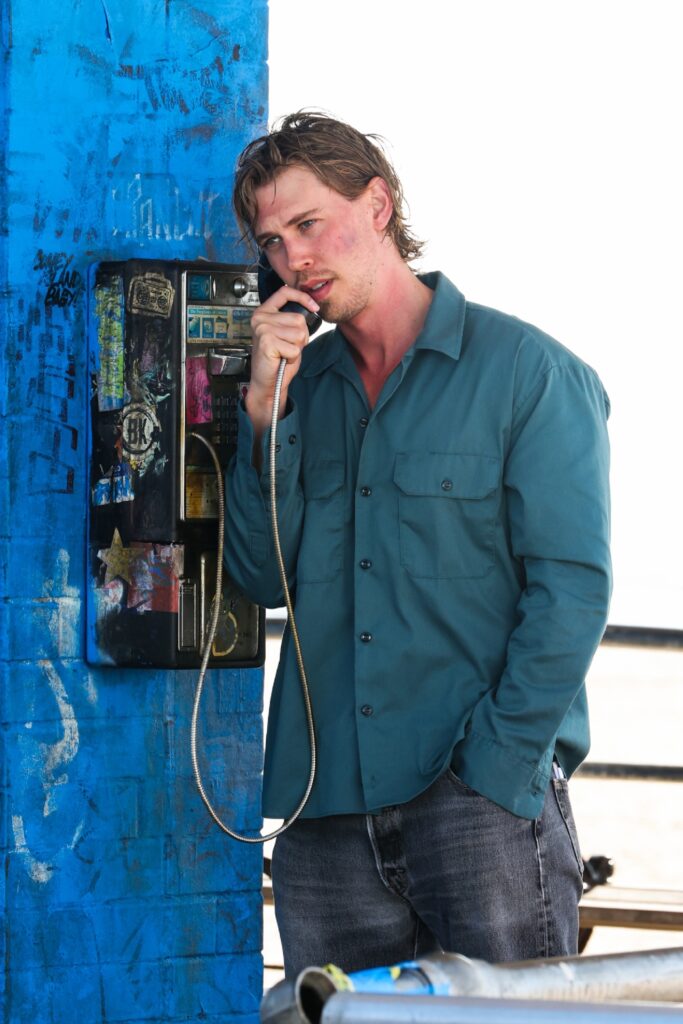
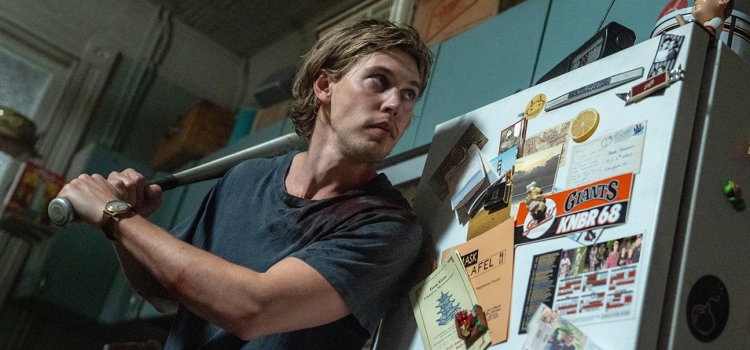
Most frustrating of all is that Aster wastes a strong collection of talent – including Austin Butler, barely making a blip as Vernon Jefferson Peak, a charismatic evangelical zealot type preaching about evil authoritarians and what he perceives to be injustices to the common man. He has amassed many followers through viral videos and in-person rallies.

One of his fans is Cross’s wife, Louise (an underused Emma Stone), who has had some sort of mental health trauma that makes assimilation into society difficult.

 She has a controlling mother who lives with them during the shutdown, interfering with their marriage and their beliefs, and spreads wack-a-doodle theories suspicious about the government. Deidre O’Connell is the meddling mom Dawn. An opportunist, her character does a 180 when it’s beneficial to her.

Pedro Pascal is measured as the popular and successful mayor, Ted Garcia, who is raising his teenage son Eric (Matt Gomez Hidaka) on his own. 

His son and his friends, eager to hang out, disobey social distancing rules and get involved in the Black Lives Matter protests. His friend Brian (Cameron Mann) is always filming on his phone for Instagram, trying to get ‘gotcha’ videos.

Garcia runs a bar, and is open to a tech company coming to his fictional tiny town of about 2500 people for future jobs.

He now must deal with a challenger, Joe, whose mayoral run is often viewed as comical and a nuisance. His two deputies, Michael (Micheal Ward) and Guy (Luke Grimes, who played the beloved Kayce Dutton on “Yellowstone”) are loyal and steadfast, and try to maintain peace. But are also directed by a boss with ulterior motives.

Then, there is this shady group of unnamed operatives that come to town with wreaking havoc on their minds. No explanation here as to who they are.

The town becomes a battleground for free speech and heightens racial tensions.

And the list of plot threads goes on, and on and on. The movie should have culminated in a never-ending shootout where the asthmatic, illness-impaired sheriff survives many automatic bullets and mayhem for a later end result that is hard to believe, but not in Aster’s world view.

Outside of a few skilled performers making good impressions in these daffy offbeat roles, this movie has little to offer if you seek a satisfying story. 

Why I maintained hope that this movie would not be a senseless bloodbath with little effect is beyond me. Enter at your own risk.

“Eddington” is a 2025 dark comedy – contemporary western directed by Ari Aster and starring Joaquin Phoenix, Pedro Pascal, Emma Stone, Austin Butler, Deirdre O’Connell, Luke Grimes, Micheal Ward, Cameron Mann and Matt Gomez Hidaka. It is rated R for strong violence, some grisly images, language, and graphic nudity. Its run time is 2 hours, 28 minutes. It opened in theatres July 18. Lynn’s Grade: D

By Lynn Venhaus

If your family is friends of Bill W., you can relate to the messy Morans in Colin McLaughlin’s humorous original play, “Pride and Joy.”

However, no matter what level of experience you have with a family of strong personalities who eagerly share their judgmental opinions, you may recognize common traits inherent to those folks related to each other in the Midnight Company world premiere.

Like so many others, they don’t really seem to be connected at times but are inextricably linked as more layers are peeled off. Hence, the similarities to typical American middle-class parental units with idiosyncrasies (don’t we all?).

St. Louis playwright McLaughlin takes a light-hearted look at the emotional and argumentative Morans, who are focused on putting the fun in dysfunctional. A top-flight ensemble takes off with the homegrown material and runs at breakneck speed with it.

Think of it in the same vein as a very special episode of a family sitcom popular in the ‘70s and ‘80s, before Dr. Phil’s “How’s that workin’ for ya?” and Dr. Drew’s Celebrity Rehab.

Director Carl Overly Jr. has cleverly framed the presentation like a television program, complete with TV theme songs playing before the show starts, With such a spry cast, he deftly sets the scene and conveys a lived-in atmosphere easily.

The youngest daughter Sam has invited the family over to her cramped apartment for an intervention, but she is not yet there when they arrive, wondering who the person in need of one is. Is it the dad, who seems to be an imbiber where it may impede his life? Is it the pot-smoking daughter Maggie?

To their surprise, it is their hostess, Sam. She has harbored this secret, and has announced she is sober for three weeks, and is working on the Alcoholics Anonymous program. All worth learning about and supporting.

In this role, newcomer Sarah Lantsberger is endearing as anxious Sam tries to maintain order, but her family isn’t good at following directions. Loud and opinionated, they make it more about themselves. Whose intervention is this, exactly?

Sharp, smart performers who are renowned for crafting authentic characters appear to have a personal history with others from the start. Mom Mary Margaret is Lavonne Byers, one of the true legends of local theater and three-time St. Louis Theater Circle winner for lead performances.

She rarely does comedy but is a master at timing and is always present in every role. You know who this mom is immediately. And of course, she is scurrying around Sam’s apartment, picking up laundry and tidying up.

She and Joe Hanrahan, who plays the rumpled, grouchy, defensive dad Mike, have worked together before, so they are comfortable in a cramped space trying to dispense wisdom to their strong-willed brood.

Hanrahan, the artistic director of The Midnight Company, has always been open to collaborating with a gifted mix of young performers, and engages well with fearless artists, often associated with SATE, ERA, and the St. Louis Fringe Festival.

Oldest daughter Maggie, a ‘type’ of new-age pot-smoker prone to pontificating, is played by seasoned veteran Alicen Moser, another flexible performer. With her family, Maggie is a tad prickly and guarded, but you sense she could contribute more to the mental health goals if applied.

Jayson Heil once again demonstrates his versatility as the jerky, self-centered brother Jay, quick to criticize others and be a disagreeable sort. You get the feeling he didn’t play well with others as a child, let alone his sisters.

Heil, recently seen in “Cabaret,” “First Date” and winner of the St. Louis Theater Circle Award for “All My Sons,” all at New Jewish, is a casual cross between a know-it-all and a slacker as Jay, forced to be somewhere he’d rather not and loathe to confront family memories.

Photo of Lavonne Byers and Joe Hanrahan by Todd Davis

With all their nutty qualities and hang-ups, you can tell there is fertile ground for the characters to dig into, especially in a 12-step program. McLaughlin’s dialogue allows them to convey a shorthand with each other. And the performers are quick verbally and physically to further color the family interactions.

As people familiar with dime-store psychology frequently do, they all talk in self-help books’ psychobabble. Mom is religious, using her faith when it’s convenient while the rest of the family dismisses her outspoken reverence for the son of God.

So, is there a point besides shining a light on a quirky family who needs to break some patterns and establish healthier practices? Hopefully, the intention is to share the universality of family enablers, personal struggles leading to self-medication, self-absorbed people having a change of heart and showing they care for each other when you don’t think they are capable of it?

And not lose sight of that handy mechanism, humor. While some of the characters exhibit traits common in a family with substance abuse issues, a few moments of levity don’t seem to fit as family members deal with their own issues and how it relates to the family dysfunctional dynamic.

So, little digs here and there are just their way of accepting – or not – their habits and excuses. They have some encouraging breakthroughs instead of denial, which leads to a sense of relief that there is hope here.

Yet, there are a few actions that negate that (Maggie’s weed consumption acceptance, dad retrieving a hidden flask…is this a joke? Has nothing changed?). Leave it at hopeful, not thinking “well, maybe not…”

This is a very personal, heartfelt show that means a lot to the playwright, director, cast and crew. It’s obvious in the work that was put into it, and the satisfaction in having it ring true to patrons.  

Photo by Kristina Schall DeYoung

Chuck Winning’s set is a cozy blend of form and function, rendering a young woman’s first apartment, and utilizing the Chapel’s performance space well, while Tony Anselmo’s lighting design suits the material well. Costume designer Liz Henning’s casual attire simply shows each character’s personality.

Art that can entertain, amuse and call people to action is joyous to behold. One doesn’t have to be preachy or melodramatic to get points across. And that’s the beauty of connecting through live theater

The fact that we can all sit in a darkened theater and laugh at the foibles we see in ourselves, and how we each can change the things we can is a powerful message.

Therefore, any opportunity to provide some helpful tools is always welcome (just as triggering messages are).

In that spirit, I would be remiss, after years of advocacy, personal tragedies, a long list of documented dire consequences for generations of alcohol and substance abuse, and much therapy for the remaining family members, not to mention that there is a genetic component that factors in understanding, communication and progress.

Public service announcement: St Louis Alcoholics Anonymous https://aastl.org/ and St Louis Al-Anon: https://www.stl-al-anon.org/

No one is ever alone.

 “God, grant me the serenity to accept the things I cannot change, the courage to change the things I can, and the wisdom to know the difference.” – Serenity Prayer

Photo of Alicen Moser and Sarah Lantsberger by Todd Davis

The Midnight Company presents the world premiere production of Colin McLaughlin’s “Pride and Joy” July 10 through July 26. Thursdays, Fridays and Saturdays at 7:30 p.m., and Sundays, July 13 and 20, at 3 p.m. at The Chapel, 6238 Alexander Drive.  For more information: midnightcompany.com

.