Lynn (Zipfel) Venhaus has had a continuous byline in St. Louis metro region publications since 1978. She writes features and news for Belleville News-Democrat and contributes to St. Louis magazine and other publications.
She is a Rotten Tomatoes-approved film critic, currently reviews films for Webster-Kirkwood Times and KTRS Radio, covers entertainment for PopLifeSTL.com and co-hosts podcast PopLifeSTL.com…Presents.
She is a member of Critics Choice Association, where she serves on the women's and marketing committees; Alliance of Women Film Journalists; and on the board of the St. Louis Film Critics Association. She is a founding and board member of the St. Louis Theater Circle.
She is retired from teaching journalism/media as an adjunct college instructor.
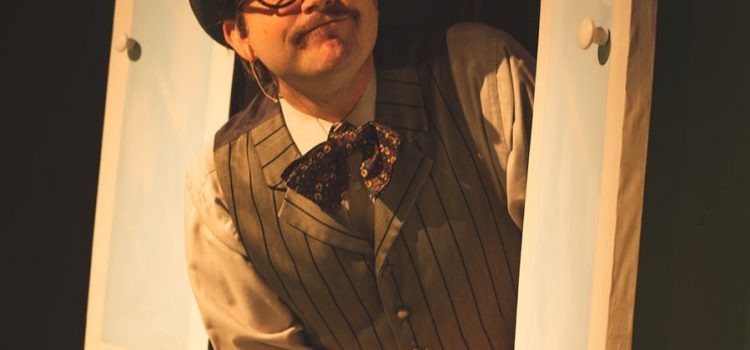
By Lynn Venhaus Filled with whimsy and good cheer, “A Year with Frog and Toad” is a delightful example of clever staging and accessible theater for multi-ages.
The innovative Fly North Theatricals is presenting this sweet, sentimental show about friendship for free to all who can show their vaccination card and matching ID at the door. No ticket needed but there is limited seating because of social distancing.
The musical continues this Friday and Saturday at 7:30 p.m. and Sunday at 2 p.m. at The Marcelle Theatre in the Grand Center Theatre District.
Colin Healy and Bradley Rohlf, two creatives who founded Fly North Theatricals in 2019, are making sensible, affordable art and have established a Theatre for All initiative as part of their mission.
In this make-believe adventure, they are doing double-duty as the two amphibious leads. Rohlf plays the popular perky Frog while Healy is the grumpy worry-wart Toad as they journey through four seasons.
They are joined in their woodland by a Snail, Turtle, Bird, Mouse, Mole and several other frogs. The young actors playing these characters sing and dance in musical numbers that recall vaudeville and merry make-believe.
The students of Fly North, who take voice and/or dance lessons, are cast members who bring a youthful energy to the production: Claudia Taylor, Trey Perlut, Ella Penico, Aislyn Morrow, Sarah Brown, Aiden Gildehaus and Julie Harris.
Earnestly directed by Alicia Like with a young audience in mind, she keeps the 85-minute show bright and breezy. Music Director Jermaine Manor smoothly kept the focus on entertaining all ages.
Their year begins in the Spring, as they wake from hibernation. They plant gardens. They swim in the Summer, rake leaves in the Fall and go sledding in the Winter.
As the two best friends celebrate their differences that make them unique and special, they learn life lessons along the way. In a non-cloying way, they tackle anxiety and fears – blissfully free of corny cheesy jokes.
The musical, based on the beloved children’s book series by Arnold Lobel, was nominated for three Tony Awards in 2003, including Best Musical. Because of its success, it was heralded as mainstreaming a children’s production as “regular” theater.
An enchanting score by brothers Robert and Willie Real is brought to life by conductor Jeremy Jacobs, also on keyboards, who leads the four -piece band with aplomb. Luke Mankovich is on reeds, Jacob Mreen on bass and Matthew Clark handles percussion.
Choreographers Angela Brandow and Carly Niehaus used a light touch in the peppy numbers to keep the show up-tempo and fun.
Stellar work is evident from light board operator Mason Hagarty and sound board operator Matthew Garrison, with fine lighting and strong sound without any difficulty.
Lauren Perry has designed the simple set with imagination in mind while costumer Sam Hayes mixed 19th and 20th century outfits and included animal accoutrements, like turtle shells, when necessary. Old-timey hats complete Frog’s and Toad’s appearances well.
An appealing romp for those young at heart who see imagination as a wide canvas, “A Year with Frog and Toad” is a good way to ease back into bringing young people to the theater. And watching such a cheerful presentation will make you smile underneath your mask!
And/or attend their VIP fundraising brunch on Sunday, Nov. 14. Doors open at 11 a.m., and each ticket comes with one reserved seat for the closing performance of “A Year with Frog and Toad.”
The brunch will include a Breakfast Taco Bar from The Fifth Wheel of the Bailey’s restaurant family, bottomless mimosas and coffee and performances from cast members. The Studio Open House will be at 3617 Grandel Square in St. Louis.
Tickets are available on their website and all proceeds go toward future productions and resources for FNT students. Single tickets are available for a $100 minimum donation.
Part of FNT’s mission of promoting education through performance is to involve the students of its private voice and dance studio on and off stage in every show. This production has students work alongside their teachers to produce something wacky, fun, formative, and memorable. For more information, visit www.flynorththeatricals.com
NOTE: In accordance with the Kranzberg Arts Foundation’s recent COVID policy update, all attendees of “A Year with Frog And Toad” must show proof of COVID-19 vaccination or a recent negative test conducted less than 72 hours prior for admittance.
Lynn (Zipfel) Venhaus has had a continuous byline in St. Louis metro region publications since 1978. She writes features and news for Belleville News-Democrat and contributes to St. Louis magazine and other publications.
She is a Rotten Tomatoes-approved film critic, currently reviews films for Webster-Kirkwood Times and KTRS Radio, covers entertainment for PopLifeSTL.com and co-hosts podcast PopLifeSTL.com…Presents.
She is a member of Critics Choice Association, where she serves on the women’s and marketing committees; Alliance of Women Film Journalists; and on the board of the St. Louis Film Critics Association. She is a founding and board member of the St. Louis Theater Circle.
She is retired from teaching journalism/media as an adjunct college instructor.
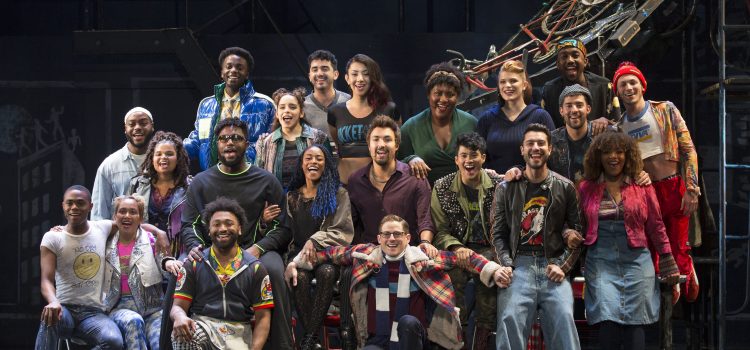
Stifel Theatre announced today that seats in the first rows of the orchestra section will be available for $23 (inclusive of facility fee) for the Wednesday, Nov. 17 performance of RENT, the Pulitzer Prize and Tony Award-winning musical.
The $23 tickets are available for in-person purchase at the Stifel Theatre Box Office, located at 1400 Market Street, on the day of the performance only, starting two hours prior to the show – 5:30 p.m. The $23 tickets are limited to two tickets per person.
The tradition of these tickets began in 1996 in New York when the show moved to Broadway after a sold-out run in a small downtown theatre. The producers of the show are committed to continuing the tradition of offering these orchestra seats in each city the show will play.
RENT performs at Stifel Theatre Wednesday, Nov. 17 at 7:30 p.m.
For general ticket information, call the Stifel Theatre Box Office at 314-499-7600. The Stifel Theatre Box Office is open on event days only. For guests wanting to purchase tickets outside of the RENT Rush offer, they may do so at the Enterprise Center Box Office Monday – Friday, 10 a.m. – 5 p.m. or .https://www.ticketmaster.com/event/06005B359474349F
Lynn (Zipfel) Venhaus has had a continuous byline in St. Louis metro region publications since 1978. She writes features and news for Belleville News-Democrat and contributes to St. Louis magazine and other publications.
She is a Rotten Tomatoes-approved film critic, currently reviews films for Webster-Kirkwood Times and KTRS Radio, covers entertainment for PopLifeSTL.com and co-hosts podcast PopLifeSTL.com…Presents.
She is a member of Critics Choice Association, where she serves on the women’s and marketing committees; Alliance of Women Film Journalists; and on the board of the St. Louis Film Critics Association. She is a founding and board member of the St. Louis Theater Circle.
She is retired from teaching journalism/media as an adjunct college instructor.
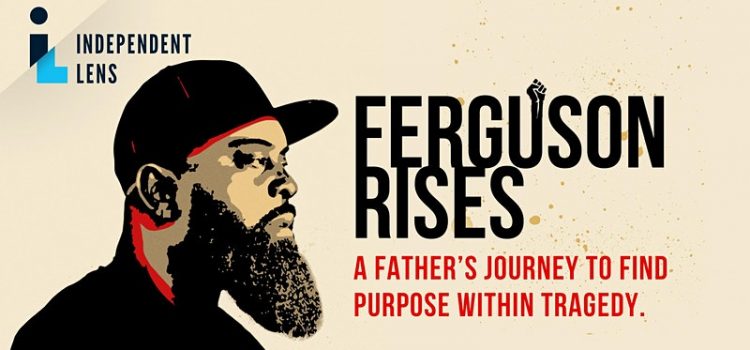
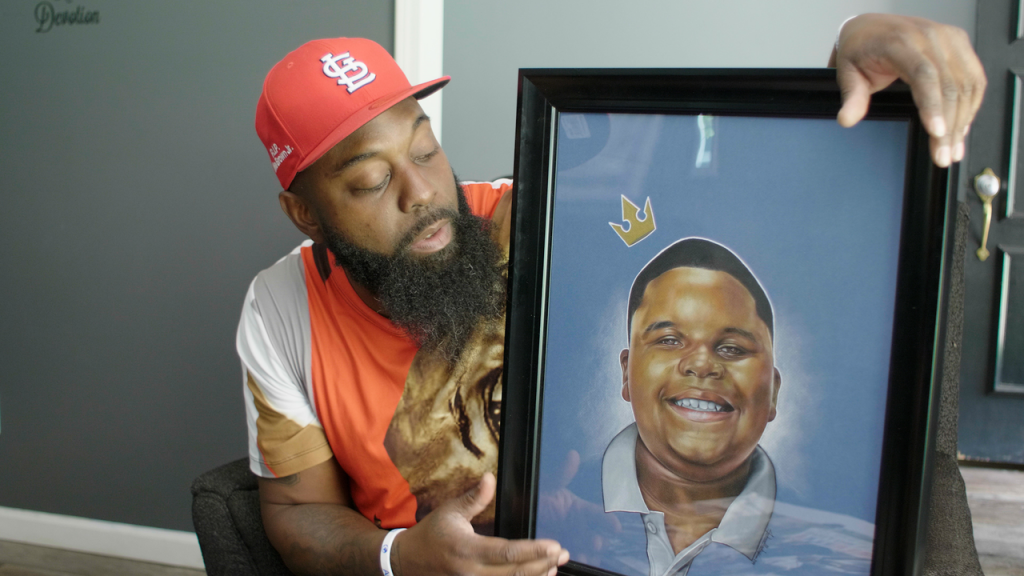
The documentary, Ferguson Rises, shines a spotlight on the town that inspired a new global civil rights movement and chronicles a father’s journey as he grapples with the pain of losing a son.
Ferguson Rises, winner of the Tribeca Film Festival Audience Award, makes its U.S. broadcast premiere on Independent Lens, November 8, at 9 pm, on Nine PBS. Viewers can join the conversation on Twitter using hashtag #FergusonRisesPBS and a virtual town hall takes place before the premiere (see details below). The film will also be available to stream free after broadcast on the PBS Video App for a limited time.
The film explores the depths of the protests following Michael Brown Jr.’s killing in August 2014 through the eyes of his father, Michael Brown Sr., and other voices in the community: residents, police officers, business owners, and activists who took to the streets in protest for more than 400 straight days.
Strikingly different perspectives come to the forefront of the film. In interviews with both opponents of the Black Lives Matter movement and the activists leading it, audiences see a glimpse of the polarizing emotions that are still ingrained in justice reform conversations today. At the center of the documentary is Michael Brown Sr., who talks about his son’s death and the ways he overcame the pain that engulfed him and his family in the years that followed.
“I hope that through the stories of Michael Brown Sr. and the community of Ferguson, we can learn not to judge things and people on a surface level. And, perhaps most importantly, I hope the film reminds America of all that they can learn from Black people when it comes to resilience, strength, and faith. With this mindset, we can then stop harping on the pathologies of Black Americans and, rather, focus on honoring their contributions,” says filmmaker Mobolaji Olambiwonnu.
Help provide a local perspective on the national conversation around this film by joining our Twitter chat during the broadcast of the film using #FergusonRisesPBS. Monday, November 8, 9 pm Watch on PBS and the PBS Video app starting at 10/9c.
Register for Virtual Town Hall before the Premiere Join Michael Brown, Sr., film director Mobolaji Olambiwonnu, and a constellation of changemakers to discuss how communities can help mend the wounds of racialized violence. Trained facilitators will share tools for communicating across differences to explore our common humanity. The virtual town hall culminates with a special appearance by Grammy-winning artist Aloe Blacc performing “Other Side,” whose single is featured in Ferguson Rises. Monday, November 8, 6–7:45 pm
he documentary Ferguson Rises charts Michael Brown, Sr.’s emotional journey to find purpose within pain after a Ferguson, Missouri police officer killed his teenage son Michael, Jr. in 2014. In the film, we witness what happens when a Black father and an entire community grapples with the hard and urgent work of seeking accountability.
Leading into the PBS premiere of Ferguson Rises on Independent Lens, join Michael Brown, Sr., film director Mobolaji Olambiwonnu, and a constellation of change makers to discuss how communities can follow Mr. Brown’s footsteps along a path toward purpose—and help mend the wounds of racialized violence along the way.
Trained facilitators will share tools for communicating across differences as we explore our common humanity and shift entrenched narratives that stoke cycles of trauma. Throughout the town hall, we’ll view scenes selected from Ferguson Rises that spark conversation around topics that include:
How can we build trust across differences?
How can documentaries shape the conversation on racial violence in America?
Getting in touch with unconscious bias as a way to limit harm
Alyssa Grinder photo
The virtual town hall culminates with a special appearance by Grammy-winning artist Aloe Blacc performing “Other Side,” his single featured in Ferguson Rises.
Register here. Instructions on how to join the virtual town hall will be emailed to you two days prior to the event.
ASL interpreters will be present during the panel discussions and film clips will be closed captioned.
Speakers:
Sherry Simpson, ITVS, Sr. Director of Engagement & Impact Innovation (moderator)
Mobolaji Olambiwonnu (filmmaker, Ferguson Rises)
Michael Brown Sr. (Chosen For Change)
Reverend Osagyefo Uhuru Sekou (Organizer)
Theopia R. Jackson, Ph.D (Past President, The Association of Black Psychologists, Inc. and Chair, Clinical Psychology Degree Program, Saybrook University)
Reverend Renita Marie Green (Former Pastor, St. John A.M.E. Church)
Special appearance by:
Aloe Blacc
Resistance Revival Chorus
The Film
Ferguson Rises explores the depths of the aftermath and protests following Michael Brown Jr.’s killing through a wide range of community members: from Black and white residents to police officers, to business owners, including those who chose to say “enough is enough” by taking to the streets for a record 400 days straight. This varied chorus of perspectives is interwoven with an intimate portrayal of a Black father’s grief and resilience that bears witness to the human capacity to find purpose within pain.
Ferguson Rises premieres on Independent Lens Monday, Nov. 8.
About Nine PBS
As an essential community institution, Nine PBS exists to enable access to information, knowledge, and learning opportunities for all. We tell stories that move us. We meet people where they are the most comfortable consuming content. Nine PBS’s platforms include four distinct broadcast channels (Nine PBS, Nine PBS KIDS®, Nine PBS World, and Nine PBS Create), ninepbs.org, social media, the free PBS Video App, streaming services, live and virtual events, and the Public Media Commons. Since 1954, Nine PBS has accepted the community’s invitation into their homes, schools, and businesses.
About Independent Lens
Independent Lens is an Emmy® Award-winning weekly series airing on PBS Monday nights. The acclaimed series, with Lois Vossen as executive producer, features documentaries united by the creative freedom, artistic achievement, and unflinching visions of independent filmmakers. Presented by ITVS, the series is funded by the Corporation for Public Broadcasting, a private corporation funded by the American people, with additional funding from PBS, Acton Family Giving, the John D. and Catherine T. MacArthur Foundation, Wyncote Foundation, and the National Endowment for the Arts. For more visit pbs.org/independentlens. Join the conversation: facebook.com/independentlens and on Twitter @IndependentLens.
Lynn (Zipfel) Venhaus has had a continuous byline in St. Louis metro region publications since 1978. She writes features and news for Belleville News-Democrat and contributes to St. Louis magazine and other publications.
She is a Rotten Tomatoes-approved film critic, currently reviews films for Webster-Kirkwood Times and KTRS Radio, covers entertainment for PopLifeSTL.com and co-hosts podcast PopLifeSTL.com…Presents.
She is a member of Critics Choice Association, where she serves on the women’s and marketing committees; Alliance of Women Film Journalists; and on the board of the St. Louis Film Critics Association. She is a founding and board member of the St. Louis Theater Circle.
She is retired from teaching journalism/media as an adjunct college instructor.
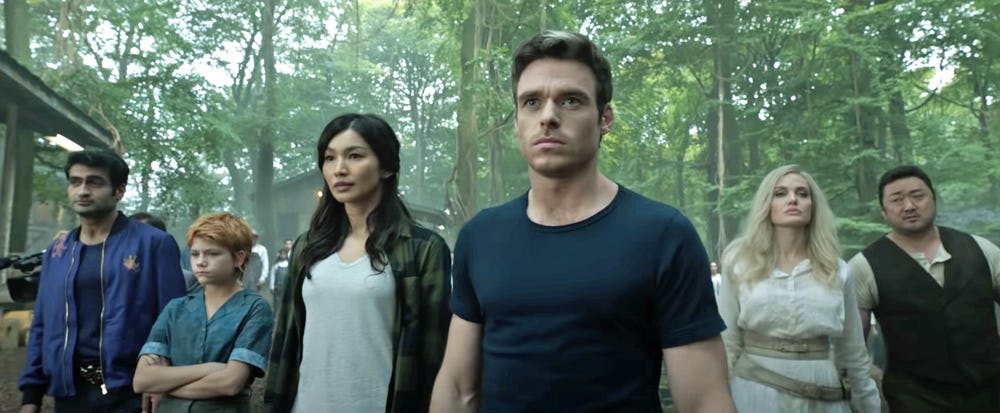
By Lynn Venhaus Trying to save the world shouldn’t be boring, but “Eternals” is one big giant yawn — and easily the worst film in the Marvel Cinematic Universe.
Eternals are immortal beings from the planet Olympia, who came to Earth 7,000 years ago, shaping history and civilizations—but are not to interfere with any conflicts or alter human events — unless it’s their nemesis, the Deviants, so says their creator, Arishem, a Celestial.
After what transpired in “Avengers: Endgame” in 2019, these ancient aliens, who have been living in secret, must come out of the shadows and reunite to battle Deviants, their ancient ferocious winged enemy that they thought was vanquished but has reappeared, more vicious than ever. The lines blur between who is good and who is evil.
A cumbersome, confusing, and unexciting plot sets up a battle for world domination, attempts to explain why this course of action is necessary and tries to assert itself in a superhero world.
Question: if they didn’t help when Thanos wreaked havoc, but name-drop Avengers, then why aren’t any of our beloved ‘other guys” there? As they zip around through time, space and continents, The Eternals explain their places and fix things, as rivalries and romances emerge. However, it’s a lot to absorb, and are we caring by now?
The story is based on comic book characters created by Jack Kirby in 1976, and follows the same trajectory of the familiar debates of destiny and free will, and is living forever a blessing or a curse – or both?
The main problem, besides this overblown spectacle feeling average, is a too-large unnecessarily complicated cast that appears based on Greek gods, with riffs on those names. Sersi not Circe, Ikaris not Icarus, Ajak not Ajax — get it?
These generic characters, in various shades of virtuousness and villainy, are created from a grab bag of qualities and mass produced in a comic book assembly line. To its credit, Marvel has assembled its most diverse cast yet, including a gay character who is in a same-sex marriage.
While the ensemble has some very talented and interesting performers – including the versatile Brian Tyree Henry as Phastos, a genius scientist, and the poorly used Barry Keogan, so creepy in his breakout role in “The Killing of a Sacred Deer,” as a very crabby Druig whose superpower is mind control, several are under-utilized.
Angelina Jolie seems like a waste of money as window dressing playing Thena, who can wield a sword and a spear very well in intense combat but has memory issues. And I couldn’t figure out Selma Hayak’s Ajak, for she is set up as the leader but mystery ensues about her intentions.
While others took on more than they could handle: Gemma Chan is one-note as omnipotent Sersi, who is desired both by her British professor boyfriend Dane (Kit Harrington aka Jon Snow in “Game of Thrones,” barely in it) and her former lover Ikaris (Richard Madden, also a “Game of Thrones” alum), who is in full swagger mode.
Nevertheless, a few charmed in their roles, including a buff Kumail Nanjiani humorous as Kingo, a Bollywood superstar and Lia McHugh as the shapeshifter Sprite. Don Lee has fun as the hulking Gilgamesh, who has turned into a skilled chef/homebody taking care of Thena.
Phastos’ son Jack is winningly played by Esai Daniel Cross, and Lauren Ridloff is pleasant as the deaf Makkari.
Despite the gifts of Oscar-winning director Chloe Zhao, known for her visual style and was so distinct in “Nomadland,” this film has an undistinguished look. Sure, there are shots of beautiful landscapes, but we’re globe-trotting so much that it begins to look like stock footage advertisers use to entice us on vacations.
She was part of the screenwriting team too, that included Patrick Burleigh and Ryan Firpo. Complex and unwieldy, the script features lots of exposition inserted in between the customary superhero banter.
The soundtrack has some unusual ‘on-the-nose’ choices, including good use of “Time” by Pink Floyd but really, Skeeter Davis’ “The End of the World”?
The computer-generated graphics are repetitive, the battles are bloated, and two hours and 37 minutes later, I could not wait for it to end (and with a Foreigner song?). But you have to stay for the obligatory revelation scene during the credits.
Filmmakers promise that the Eternals will return. I wouldn’t be so presumptuous about that.
“Eternals” is a 2021 action-adventure-sci-fi-fantasy directed by Chloe Zhao and starring Gemma Chan, Richard Madden, Brian Tyree Henry, Angelina Jolie, Barry Keogan, Kumail Nanjiani, Selma Hayak, Kit Harrington, Lia McHugh, Don Lee and Lauren Ridloff. Rated PG-13 for fantasy violence and action, some language and brief sexuality, its run time is 2 hours, 37 minutes. It opens in theaters on Nov. 5. Lynn’s Grade: D.
Lynn (Zipfel) Venhaus has had a continuous byline in St. Louis metro region publications since 1978. She writes features and news for Belleville News-Democrat and contributes to St. Louis magazine and other publications.
She is a Rotten Tomatoes-approved film critic, currently reviews films for Webster-Kirkwood Times and KTRS Radio, covers entertainment for PopLifeSTL.com and co-hosts podcast PopLifeSTL.com…Presents.
She is a member of Critics Choice Association, where she serves on the women’s and marketing committees; Alliance of Women Film Journalists; and on the board of the St. Louis Film Critics Association. She is a founding and board member of the St. Louis Theater Circle.
She is retired from teaching journalism/media as an adjunct college instructor.
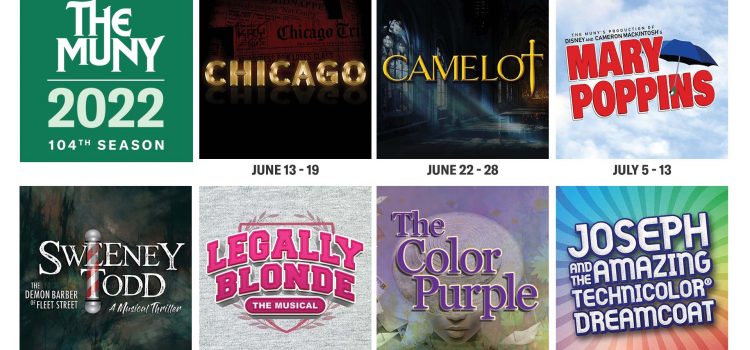
The Muny announced the exciting seven show lineup for its 104th Season in 2022 Thursday.
Joining the previously announced “Disney and Cameron Mackintosh’s “Mary Poppins” and Stephen Sondheim’s masterpiece “Sweeney Todd,” will be the 2021 show “Chicago” cut short and the second premiere, “The Color Purple,” in addition to three fan favorites.
The triumph of the 2021 season returns when six-time Tony Award-winning Chicago kicks of 2022 (June 13 – 19). The salacious turns enchanting with Lerner and Loewe’s Excalibur-sharp classic Camelot (June 22 – 28). Fulfilling two 2020 commitments to the Muny audience: all-time family favorite Disney and Cameron Mackintosh’s Mary Poppins (July 5 – 13) will finally soar over The Muny (July 5 – 13), followed by the long-awaited Muny debut of Stephen Sondheim’s spine-tingling musical masterpiece, Sweeney Todd (July 16 – 22). The fabulously fun award-winning musical Legally Blonde (July 25 – 31) bounces back to the Muny stage for its first production in 11 years. Making its Muny debut, the landmark musical The Color Purple (August 3 – 9) bears a Grammy Award-winning score and moving tale of love, faith, resilience and sisterhood. Closing out the 104th Season is Tim Rice and Andrew Lloyd Webber’s multi-colored family favorite, Joseph and the Amazing Technicolor Dreamcoat (August 12 – 18).
The seven shows are: Chicago (June 13 – 19), Camelot (June 22 – 28), Disney and Cameron Mackintosh’s Mary Poppins (July 5 – 13), Sweeney Todd (July 16 – 22), Legally Blonde (July 25 – 31), The Color Purple (August 3 – 9) and Joseph and the Amazing Technicolor Dreamcoat (August 12 – 18).
“Last summer was extraordinary for so many reasons,” said Muny Artistic Director and Executive Producer Mike Isaacson, “and now we will return with our full seven show season, and this extraordinary line-up of shows.”
“More than ever, we are so grateful to be a place where the community gathers each summer,” said Muny President and CEO-elect Kwofe Coleman. “For what will be my first season as President and CEO, I am excited for us to produce a season that reflects the breadth of musical theatre and welcomes audiences from far and wide.”
Season ticket renewals will begin in December, with new subscriptions on sale in March 2022. Muny gift cards for the 104th Season are now available online and at The Muny Box Office. For more information, visit muny.org or call (314) 361-1900.
Information about auditions for the 2022 Muny season can be found at muny.org/auditions.
Show Descriptions:
Chicago The triumph of the 2021 Muny season returns! Audiences and critics went “Whoopee!” for last season’s thrilling production of Chicago. Following an abbreviated run and early close to the 2021 season, our 2022 season opens with this encore production! Hailed as “Musical Theater Magic,” “Downright Breathtaking” and “Nothing Short of Brilliant,” Chicago was the talk of the town! So re-start the car and head to Kander and Ebb’s internationally-acclaimed, Tony Award-winning musical about fame, fortune and justice. Merry murderesses Roxie Hart and Velma Kelly await!
Camelot The Broadway legend returns for its first Muny production in 13 years! Come re-discover this powerful, moving and enchanting tale of romance and political intrigue, as we all live for “one brief shining moment.” Based upon T.H. White’s novel, Lerner and Loewe’s Camelot features a lush and Excalibur-sharp score, including “If Ever I Would Leave You,” “What Do the Simple Folk Do?” and of course, “Camelot.” With this enchanting classic tale, you are guaranteed an unforgettable (k)night at King Arthur’s Round Table.
Mary Poppins Based on one of the most popular films ever, Disney and Cameron Mackintosh’s Mary Poppins returns to The Muny with its irresistible story, unforgettable songs and breathtaking dance numbers! This Tony Award-winning stage adaptation shares the tale of the mysterious, magical nanny who arrives to give the Banks family some order – and maybe a bit of tough love. With winds in the east and mist coming in, your heart will soar for this enchanting show – and yes, Mary Poppins will fly over The Muny!
Sweeney Todd Muny premiere! The spine-tingling American musical masterpiece makes its long-awaited Muny debut. Set in 19th century London, Sweeney Todd has captivated audiences around the world with its murderous melodies and a haunting tale of love, revenge and hilarious mayhem. Considered to be one of the greatest scores in Broadway history, this eight-time Tony Award- winning musical offers both thrills and laughs and is guaranteed to be an unforgettable night at The Muny
Legally Blonde “Omigod You Guys,” Elle Woods returns! Based on the smash hit movie, Legally Blonde follows the transformation of quintessential blonde Elle Woods from sorority sister to Harvard Law graduate. Her journey of determination, self-discovery and finding true love receives its first Muny production in 11 years. Complete with a chihuahua, a bulldog and a UPS guy, The Muny is ready to “Bend and Snap” for a great time!
The Color Purple Muny premiere! Based on Alice Walker’s Pulitzer Prize-winning novel and Steven Spielberg’s landmark film, The Color Purple makes its long-awaited Muny debut! Featuring a Grammy Award-winning score infused with jazz, ragtime, gospel and African blues, this moving tale is a testament to the healing power of love, faith, resilience and sisterhood. Winner of the 2016 Tony Award for “Best Revival of a Musical,” this epic staging promises a joyous evening of courage, hope and healing.
Joseph and the Amazing Technicolor Dreamcoat Originally written by Tim Rice and Andrew Lloyd Webber as a children’s oratorio, Joseph and the Amazing Technicolor Dreamcoat has, in time, expanded to become one of the most beloved shows ever. The story of Jacob, his 12 sons, and the amazing Technicolor® adventures of Joseph features a multi-colored score of favorites including “Any Dream Will Do,” “Go, Go, Go Joseph” and “Close Every Door.” The first Muny production in a decade, audiences are guaranteed a night of big Muny family joy – with, of course, a megamix!
Muny Mission
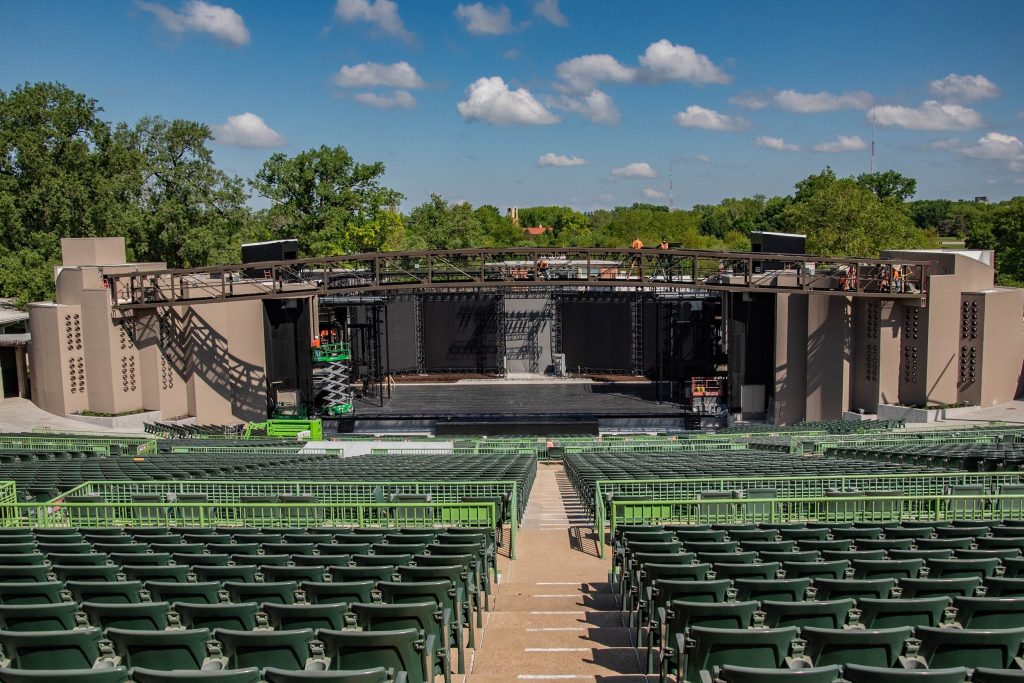
The Muny’s mission is to enrich lives by producing exceptional musical theatre, accessible to all, while continuing its remarkable tradition in Forest Park. As the nation’s largest outdoor musical theatre, we produce seven world-class musicals each year and welcome over 350,000 theatregoers over our nine-week season. Celebrating 104 seasons in St. Louis, The Muny remains one of the premier institutions in musical theatre. For more information about The Muny, visit muny.or
Lynn (Zipfel) Venhaus has had a continuous byline in St. Louis metro region publications since 1978. She writes features and news for Belleville News-Democrat and contributes to St. Louis magazine and other publications.
She is a Rotten Tomatoes-approved film critic, currently reviews films for Webster-Kirkwood Times and KTRS Radio, covers entertainment for PopLifeSTL.com and co-hosts podcast PopLifeSTL.com…Presents.
She is a member of Critics Choice Association, where she serves on the women’s and marketing committees; Alliance of Women Film Journalists; and on the board of the St. Louis Film Critics Association. She is a founding and board member of the St. Louis Theater Circle.
She is retired from teaching journalism/media as an adjunct college instructor.
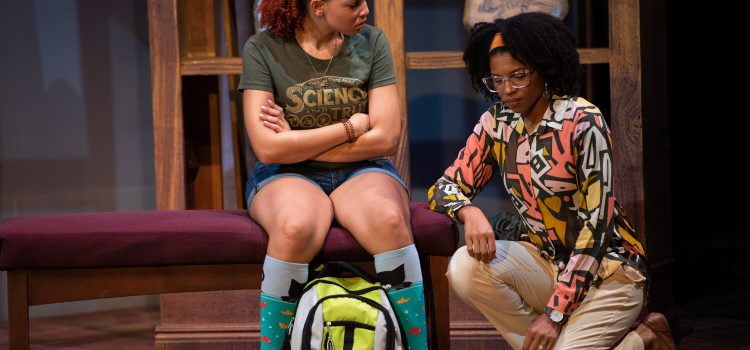
Metro Theater Company (MTC), St. Louis’s premiere professional theater for youth and families and St. Louis’ third-oldest theater company, opens its 2021/22 Season with Digging Up Dessa — a poignant, funny, and empowering family-friendly adventure that champions women in science while highlighting self-discovery in young people. Best for ages 10 and up, MTC presents Digging Up Dessa live at the Grandel Theatre, October 17 – November 7, with socially distant seating. A virtual streaming option is also available October 21 – November 7 at metroplays.org. Tickets are $20-$36 and available through MetroTix.
Digging Up Dessa, written by playwright Laura Schellhardt, had its world premiere at The Kennedy Center in 2018 as part of the Women’s Voices Theatre Festival. The Washington Post celebrated it as a “handsome, funny show,” with D.C. area critics calling it “thoughtful entertainment that is intelligent and involving” (DC Theatre Scene) and “full of heart and innovation…. a rewarding piece of theatre for young audiences” (Theatre Bloom).
Metro Theater Company’s production of Digging up Dessa is directed by MTC Artistic Director Julia Flood. The all-St. Louis four-member cast of performers includes Rae Davis as Dessa, John Katz as Nilo, Alicia Revé Like as Esther, and Lizi Watt as Mary Anning.
Dessa is a modern-day 12-year-old with no shortage of mysteries to solve and fossils to find. Her days are filled with buried treasures just waiting to be uncovered. But when her family of three unexpectedly becomes a family of two, this smart, funny young scientist struggles to overcome her grief and anger at all the changes in her world. Dessa’s unlikely comfort comes from a remarkable new friend, one only she can see and hear—Mary Anning, the 19th-century paleontologist who discovered a breakthrough dinosaur fossil at the age of 12 and became a pioneer in her field. But why is her portrait not on the museum wall alongside those of her male counterparts? Dessa decides that she’s going to fight to earn Mary the respect she deserves. With help from her new classmate and once-rival, Nilo, Dessa unearths secrets of the past and present—for Mary’s legacy and her own way forward. Digging Up Dessa is a 70-minute production with no intermission. The play is recommended for ages 10 and up. Themes of the play include comedy-drama-adventure, empowerment for girls, resilience, history, STEAM, and grief.
WHEN: October 17 – November 7, 2021Sundays at 2 p.m.: Oct. 17, 24, 31 & Nov. 7 Fridays at 7 p.m.: Oct. 22, 29 & Nov. 5 Saturdays at 4 p.m.: Oct. 23, 30 & Nov. 6Wednesdays – Fridays at 10 a.m.: School matinees available upon request for in person field trips WHERE: The Grandel Theatre, 3610 Grandel Square, St. Louis, MO 63103
School groups can enjoy live performances or virtual field trips at heavily discounted rates, with streaming tickets available for $5 or less and in-person tickets available for $10 per student.
PAY-WHAT-YOU-CAN VIEWING PERIOD: Metro Theater Company is committed to ensure that economic barriers do not prevent families from experiencing its programs. MTC is offering a three-day pay-what-you-can viewing period October 21 – 23 for both virtual streaming and in-person performances. More information at https://www.metroplays.org/dessa.
COVID-19 SAFETY: Metro Theater Company has been approved as Missouri ArtSafe Certified. MTC continues to update its policies to protect all patrons from COVID-19 exposure risks. For Digging Up Dessa, the following safety measures apply:
• Mask wearing is required for ages 2+• Guests ages 12+ must be fully vaccinated against COVID-19 and will be asked to show proof of vaccination upon arrival at The Grandel• Unvaccinated patrons ages 12+ with documented medical conditions must be able to provide a negative PCR test taken within 72 hours of the performance or a negative antigen test taken within 6 hours of the performance• A minimum of two empty seats and one empty row will separate all parties from one another in the theater For more detailed information on Metro Theater Company’s COVID health policies, please visit metroplays.org/covid.
SUPPORT: Digging Up Dessa is supported in part by Berges Family Foundation, Regional Arts Commission, Emerson, Crawford Taylor Foundation, PNC Arts Alive, The Shubert Foundation, Whitaker Foundation, Centene Charitable Trust, and Missouri Arts Council. Streaming of Digging Up Dessa is part of MTC Remote, a new virtual initiative supported by PNC Arts Alive.
About Metro Theater Company: Since 1973, Metro Theater Company has been creating productions that respect young people’s intelligence, tell compelling stories, stimulate curiosity and provoke thoughtful reflection. The Company has reached a total audience of more than two million and has a national reputation for excellence in the field of professional theater for young audiences. Institutional support for Metro Theater Company is provided Berges Family Foundation, Regional Arts Commission, Emerson, Crawford Taylor Foundation, Shubert Foundation, Whitaker Foundation, Children’s Theater Foundation of America, Missouri Arts Council, National Endowment for the Arts, and the Arts and Education Council. Metro Theater Company has received major honors and awards, both locally and nationally. The company is led by Artistic Director Julia Flood and Managing Director Joe Gfaller. For more information, visit http://metroplays.org.
Lynn (Zipfel) Venhaus has had a continuous byline in St. Louis metro region publications since 1978. She writes features and news for Belleville News-Democrat and contributes to St. Louis magazine and other publications.
She is a Rotten Tomatoes-approved film critic, currently reviews films for Webster-Kirkwood Times and KTRS Radio, covers entertainment for PopLifeSTL.com and co-hosts podcast PopLifeSTL.com…Presents.
She is a member of Critics Choice Association, where she serves on the women’s and marketing committees; Alliance of Women Film Journalists; and on the board of the St. Louis Film Critics Association. She is a founding and board member of the St. Louis Theater Circle.
She is retired from teaching journalism/media as an adjunct college instructor.
Join Her Scavenger Hunt in Her First Book, “STL Scavenger”
By Lynn Venhaus
Portions of this article were published in the Belleville News-Democrat onAug. 22, 2021.
“How far you go in life depends on your being tender with the young, compassionate with the aged, sympathetic with the striving, and tolerant of the weak and strong. Because someday in your life you will have been all of these.”
~ George Washington Carver ~ Born in Diamond Grove, Missouri
Talk to Dea Hoover for five minutes, and it’s apparent she is a one-woman tourism bureau.
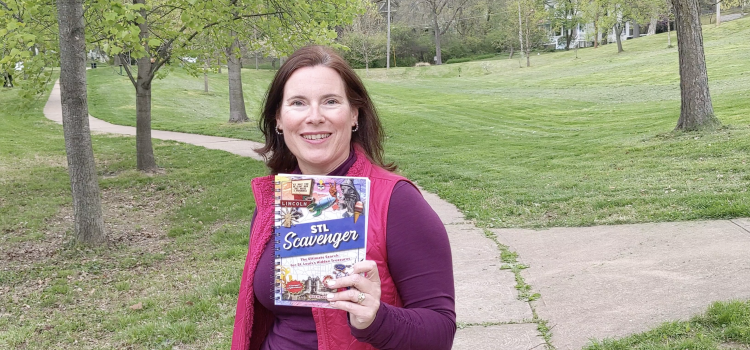
She has turned her passion for the bi-state region into operating two local tour companies and has written her first book, “STL Scavenger.”
In the spiral-bound softcover book, subtitled “The Ultimate Search for St. Louis’s Hidden Treasures,” she features 17 neighborhoods in both Missouri and Illinois areas of the St. Louis metropolitan region, providing clues and photos of buildings, businesses, statues, and architectural details for a scavenger hunt.
Hint from Hoover: look up!
“I want people to find new places that they might not have seen before,” she said. “Plan a day for each section and linger to enjoy the shops, restaurants and parks along your trail of discovery from St. Charles to Edwardsville, and many destinations in between.”
Hoover wanted to provide a one-of-a-kind experience, and with her expert eye and appreciation for the region, she used her extensive knowledge in a new way.
Reedy Press came up with the format so she could ‘gamify’ the experience – an entertaining and educational interaction with local sites. She credits Barbara Northcott, production manager of the St. Louis-based publishing company, with the concept.
“I would have been a rudderless ship without her. I am very grateful,” she said. “She made it so much better. We shortened the rhymes.”
The format allows for taking notes and multiple people participating, she said.
The book was so popular in its initial printing in May that they followed up with a second printing 13 days later, she said.
“The feedback has really made me happy,” she said. “It means something to people here.”
And while the country deals with a continuing coronavirus pandemic, she said that most neighborhoods included are known for their ‘walkability.”
Among her fun facts:
St. Louis is home to the second most free attractions after Washington D.C.
The Gateway Arch is the tallest national monument (630 feet), and the St. Louis Cardinals are the winningest team in the National League.
The St. Louis metropolitan region has 36 colleges and universities.
Join the Hunt
She has provided an incentive to answer all 366 clues – a contest, running now through Nov. 15 for submitted entries. On Dec. 1, the contest will conclude with a drawing for $500, first prize. Gift bags from STLMade.com, with tickets to local attractions and gift certificates, will be given for the second and third prizes.
For each correct answer you submit, you receive 1 point. The individual with the most correct answers will win the grand prize, and if there is a tie between multiple individuals, Hoover said they will randomly select the winner. Same goes for the local swag prize packs.
To join the hunt, submit answers and check out a bonus puzzle challenge, visit www.stlscavenger. You can submit the answers as an individual, even if you played as a group. You can’t change your answers once submitted.
You can purchase the book online for $20.95. Order at discover-stlouis.com or to pay by check, call her office at 314-522-6367 or email. Dea said $20.95 + tax puts it at about $23.
The book is also available at local bookstores and gift shops.
You can follow along on social media @STLScavenger and #stlscavenger for extra points, challenges, giveaways, scoring updates, and special events.
The book has an accessible smartphone map.
And even if you do not participate in the contest, the book makes a delightful family activity at any time of year and is a gift idea this holiday season.
With an added twist of intrigue, the book makes a staycation more fun – and is a great way to learn the way for new residents.
“Whether you are a native or just arrived, this book will lead you to new places near and far,” she said.
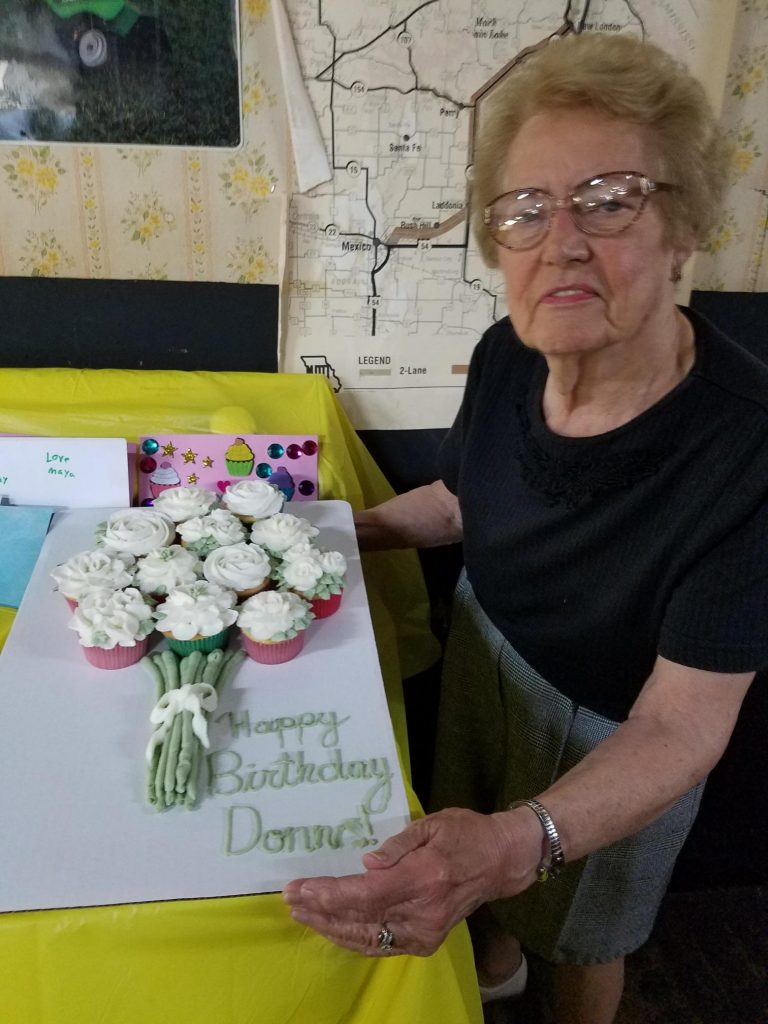
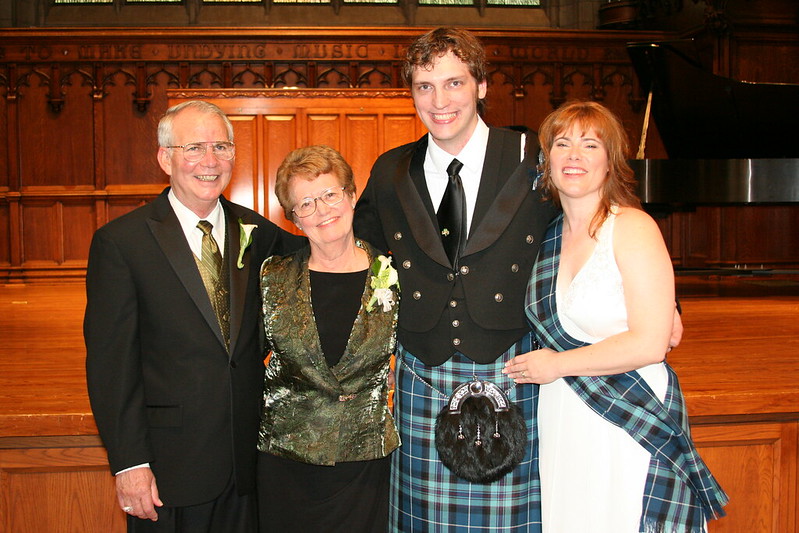
Dea’s Mom Donna
‘Never Come Back the Same Way You Came’
As a tour company operator, Hoover has spent more than 20 years sharing the world with others.
Her love of adventure began while growing up in Vandalia, a small town in Missouri. Her wanderlust blossomed while attending Washington University in St. Louis, majoring in business administration and minoring in English literature.
“I always loved going places and reading. I am always learning whenever I am traveling. It feeds my soul,” she said.
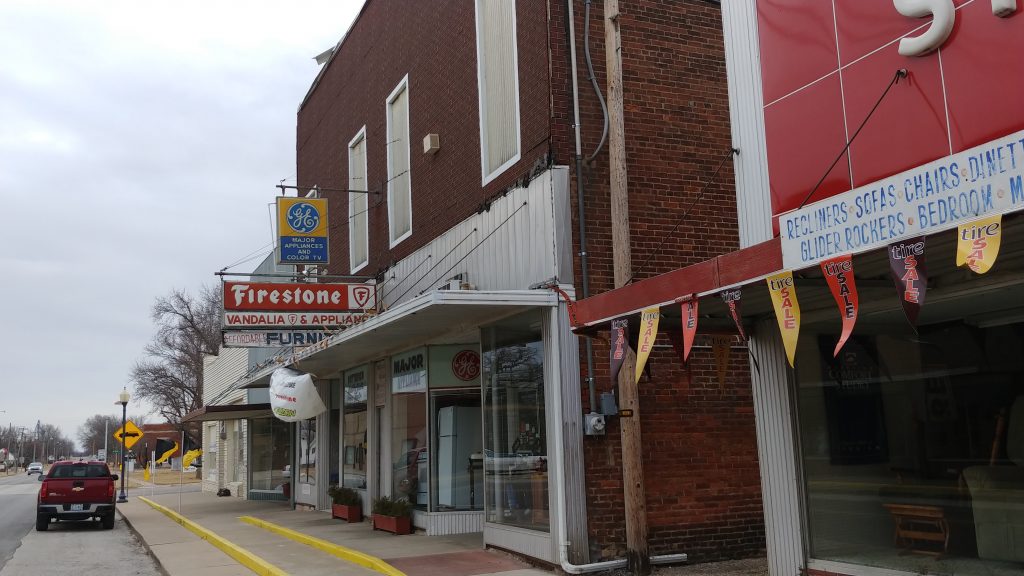
Her childhood was spent in her parents’ Main Street Firestone Tire and Appliance business, where she was involved starting at age 5. A 1965 limited edition Mustang was her pride and joy as a teenager. For Firestone fans, she says she is “gum-dipped.”
Her mother still operates the Main Street retail business; her father is deceased.
“My parents gave me a great gift. Every year, we would come to St. Louis. We’d go to a ballgame, the Zoo and Six Flags,” she said.
“Never come back the same way you came” is her mantra.
Her full-service tour company, Are We There Yet? expanded its operations in 2008 when she acquired St. Louis’s first local receptive tour operation, Discover St. Louis LLC, which was founded in 1975.
She enjoys living a whirlwind existence on the go. For instance, this summer, she was on a day trip to Grafton, and then the next morning, left for a week’s tour in Delaware.
She is past president of the St. Louis Professional Tour Guide Association and previously served on the board of the Missouri Travel Association.
Hoover teaches classes on travel and tour conducting at St. Louis Community College and is a frequent guest speaker for corporations and private organizations.
Her father enrolled her in a Dale Carnegie public speaking course at 16, and she considers that “one of the bedrocks of my success in sales and public speaking.”
She spoke about Missouri’s past in The History Channel’s documentary, “The States.”
Dea and her husband, Declan Rutan, live just across from The Hill in the Southwest Garden neighborhood. She plays on a league at the Italia-America Bocce Club weekly and is vice president of The Hill Business Association.
“Declan jokes they moved the line when they found out he was Irish,” she said.
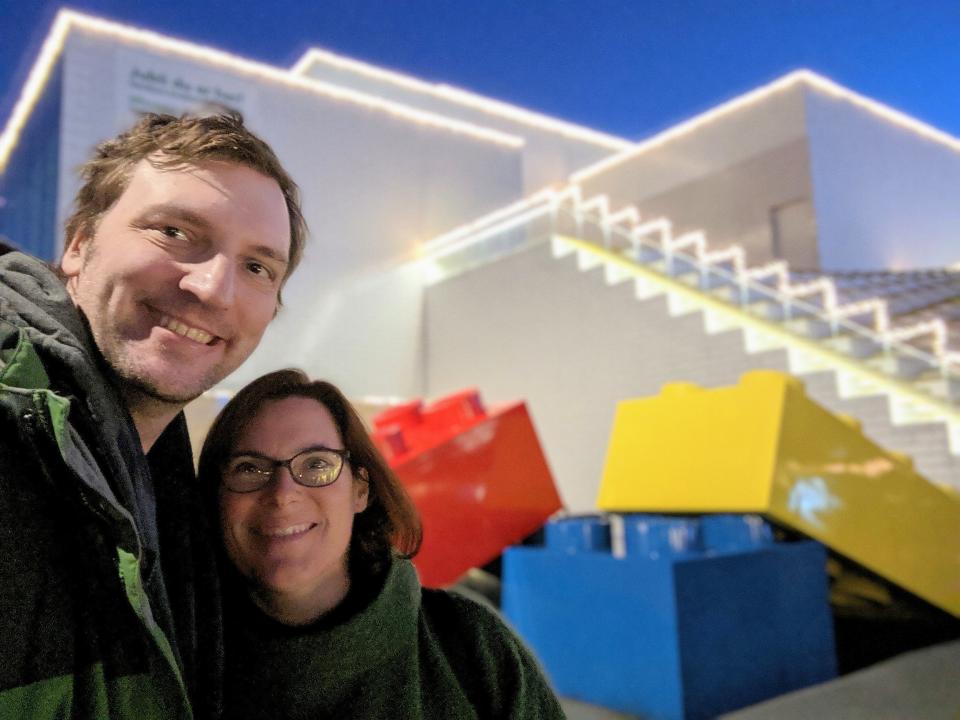
Hoover described him as her “partner in tourism and rhyme.” Together, they have visited six continents, with Antarctica next on the list.
He helped rhyme the questions.
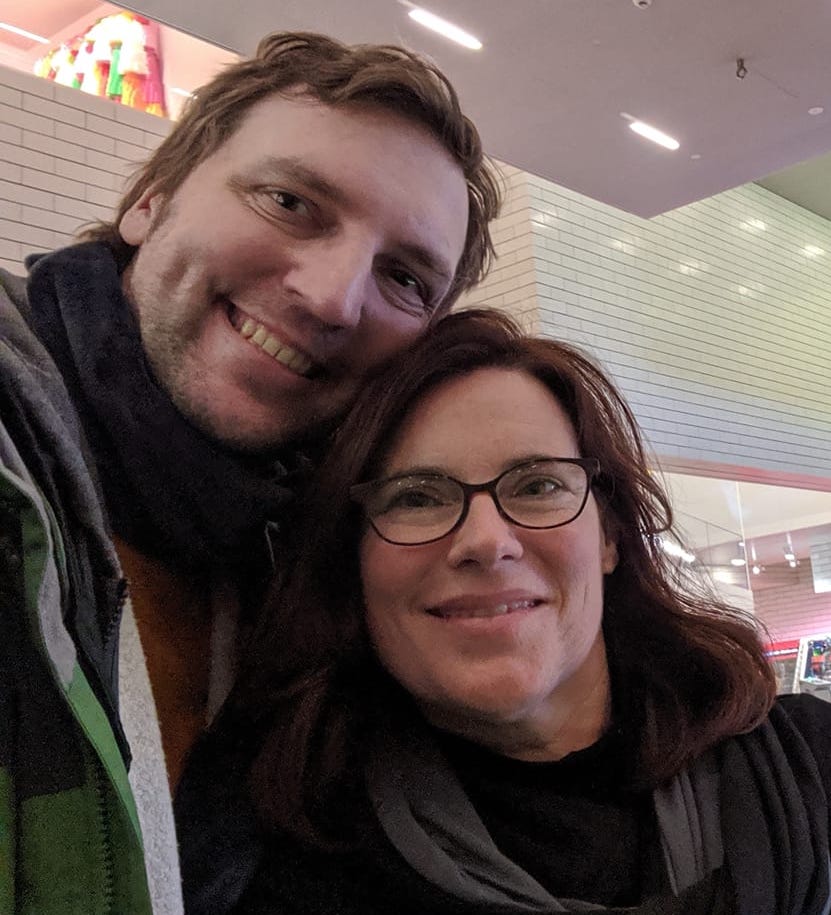
Dea and her husband, Declan
Answers to the Take Ten Questionnaire:
1. Why did you choose your profession?
“Serendipity. I was working at Saturn and a customer worked for a tour company. I realized being a tour guide might be a good fit. I started 18 months before 9/11 as an over the road tour director. It was tough to continue but it is my passion. I hunger to learn and traveling feeds that hunger. And what makes learning fun is sharing it with others. I am gregarious and love helping people. I’ve found my home.
“I love TV, movies, and live theater. I grew up in a small-town tire and appliance store. We had the first VCR in town and had the first big screen. Our movie theatre was built by two doctors who saw that there needed to be some sort of entertainment in town to keep the kids employed and occupied. As a teenager I saw two plays that I will never forget, ‘Joseph and the Amazing Technicolor Dreamcoat’ at a Washington, D.C. Dinner Theater and ‘Cabaret’ at Stephens College in Columbia, Mo. I acted in plays in high school and participated in drama competitions. I love and support live theatre, even having served on two boards!
And of course, I read. These days I listen since I can check books out of the library, and it gives my eyes a rest.
4. What is your current obsession?
“Goliath” — love Billy Bob Thornton.
Podcasts – “Terrible, Thanks for Asking” (Nora McInerny) and “Unlocking Us” (Brene Brown)
5. What would people be surprised to find out about you?
“That I love to knit.”
6. Can you share one of your most defining moments in life?
“Winning the Olin Cup Championship as a sophomore at Washington University. As a first-generation college student, Wash U. was a deep pond, more like an ocean for me. I was on a team with twin brothers who had graduated from the Illinois Math and Science Academy. I graduated from Van-Far R-I School District, which is quite a difference. When we won, we beat the seniors. They were not happy. We had a professor who had coached us through the process. It taught me that if you know someone with experience*, ask for it and use it. Dad had the foresight to send me through Dale Carnegie at 16 and that made a huge difference. He and Mom were Dale Carnegie graduates when they were selling insurance and it made a big impact on their lives. That education set me up to succeed at the Olin Cup event. It also prepared me for my life, which is public speaking every day, all day, about 60% of the year.”
When I sold cars at Saturn, my used car manager Ron Weltig taught me: “Experience is what you get right after you need it.” So true! I learned early to ask as many people as I could so I didn’t have to make every mistake in the book.
7. Who do you admire most?
Ruth Bader Ginsburg and Sandra Day O’Connor, along with all the women that paved the way for my generation.
Both of my grandmothers. They raised kids under tough circumstances and lived to their 70s and 80s. Their lived hard lives. I’m not sure I would have made it.
8. What is at the top of your bucket list?
Travel to Antarctica, my seventh and last continent.
Write 10 books before it’s all over.
9. What is your favorite thing to do in St. Louis?
Visit the Zoo.
10. What’s next?
A Walking Tour book of Hannibal, Mo., with Reedy Press
(I was born there because Vandalia, Mo., was too small to have a hospital and Dr. Dougherty had closed his office that had makeshift hospital rooms. And yes, I’m only 50. But it sounds like a pioneer childhood, doesn’t it?
The family business in Vandalia, Mo.
More about Dea (DEE-uh) Hoover
Age: 50
Birthplace: Hannibal, Mo., but my home was Vandalia, Mo., until I was 22
Current location: The Hill in St. Louis
Family: Husband – Declan Rutan and Mom – Donna Hoover, Vandalia, Mo., and proprietor of Vandalia Firestone, Appliance and Furniture at age 81!
Education: Bachelor of Science degree in Business Administration – Olin School of Business at Washington University, with a minor in English Literature.
Day job: Tour Operator
First job: Taking the mail to the post office for Vandalia Firestone. I sold Fuller Brush in high school and then was a server at restaurant.
Favorite places you have been: Ireland, Galapagos Islands and Australia. And I love NYC.
Dream vacation: A trip around the world over a year’s time.
Awards/Honors/Achievements: 2015 Groups Today Innovator of the Year
“How far you go in life depends on your being tender with the young, compassionate with the aged, sympathetic with the striving, and tolerant of the weak and strong. Because someday in your life you will have been all of these.” ~ George Washington Carver ~ Born in Diamond Grove, Missouri
And the quote earlier about experience.
A song that makes you happy: “Uptown Funk” – Mark Ronson with Bruno Mars; “Shambala” – Three Dog Night; and “Best Day Ever” – Sly and the Family Stone.
Lynn (Zipfel) Venhaus has had a continuous byline in St. Louis metro region publications since 1978. She writes features and news for Belleville News-Democrat and contributes to St. Louis magazine and other publications.
She is a Rotten Tomatoes-approved film critic, currently reviews films for Webster-Kirkwood Times and KTRS Radio, covers entertainment for PopLifeSTL.com and co-hosts podcast PopLifeSTL.com…Presents.
She is a member of Critics Choice Association, where she serves on the women’s and marketing committees; Alliance of Women Film Journalists; and on the board of the St. Louis Film Critics Association. She is a founding and board member of the St. Louis Theater Circle.
She is retired from teaching journalism/media as an adjunct college instructor.
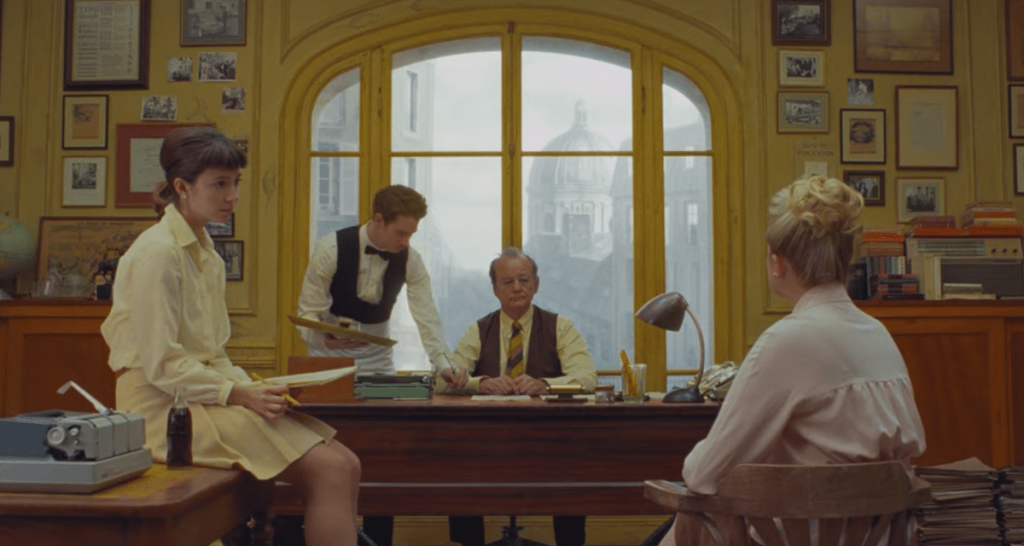
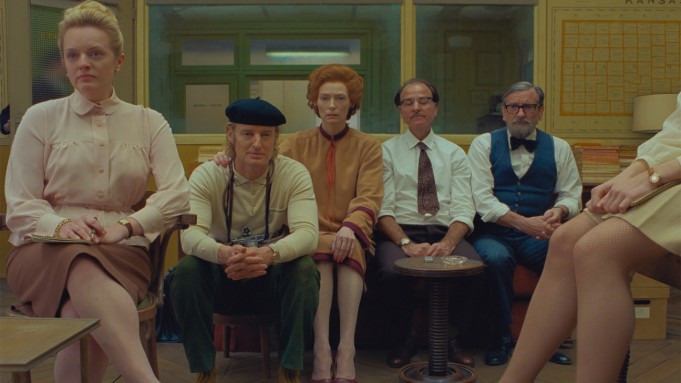
By Lynn Venhaus Think New Yorker meets Highlights for the literary geek chic. As a paean to print, “The French Dispatch” is a glorious reminder of how turning pages, enraptured in an article, can take us away to other worlds.
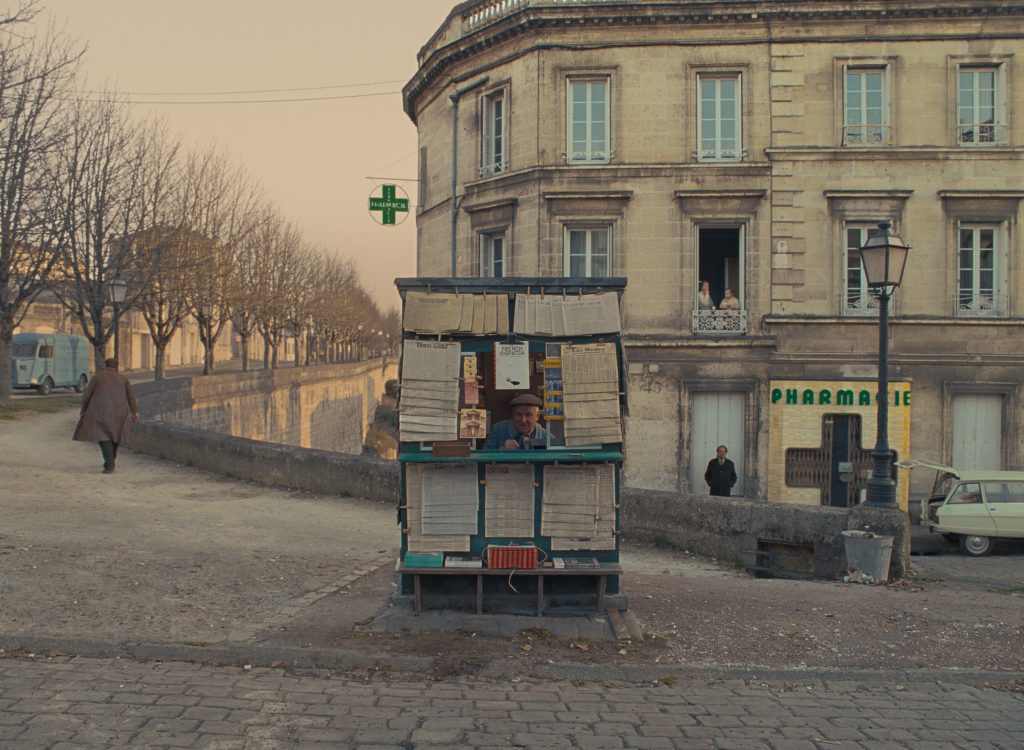
Set in an outpost of an American newspaper – the Liberty, Kansas Evening Sun — in a fictional 20th century French city. It brings to life a collection of stories published in the final edition of the newspaper empire’s Sunday magazine, following the death of the editor (Bill Murray).
Experiencing a Wes Anderson film is like being transported into an illustrated picture book with stunning artistically complex worlds both familiar and of wonder – feeling new and nostalgic at the same time.
It is always a unique event that I look forward to with great anticipation, having listed “The Royal Tenenbaums,” “Moonrise Kingdom” and “The Grand Budapest Hotel” among my favorite movies of the 21st Century. And his whimsical stop-animation features “The Fantastic Mr. Fox” and “The Isle of Dogs” (his last movie in 2018) are genius.
No matter if they connect or not, all his films of the past 30 years are painstakingly detailed works of art that offer something different – and feature wit, eccentric characters, superb music accompaniment, and striking composed visuals as common threads.
Therefore, it pains me to say that while “The French Dispatch” is a love letter to journalists and has considerable quirky charms, with dizzying fanciful techniques and the director’s distinctive symmetrical style, color palette and designs, it is at once too much and not enough.
Set in the truly inspired metropolis Ennui-sur-Blasé (which translated, means “Boredom-on-Apathy,” with a wink), this sophisticated exercise is an overstuffed toy box that melds too many concepts to be as satisfying as his top three. And despite its splendid cast, there isn’t a single character that emotionally resonates.
This anthology, running 1 hour 48 minutes, is crowded with enough content for 10 movies. Anderson’s offbeat screenplay, with a story conceived with Roman Coppola, Jason Schwartzman, and Hugo Guinness, is divided to fit the magazine’s sections: arts and artists, politics/poetry and tastes and smells, but starts and ends with the life and death of diligent editor Arthur Horowitz Jr. – played by Anderson all-star Bill Murray, just as droll as ever.
In “The Concrete Masterpiece” by J.K.L. Berensen (Tilda Swinton), which goes off the rails two-thirds in, Benicio del Toro plays Moses Rosenthaler, a psychopathic artist who paints critically acclaimed abstracts in prison, uses Simone (Lea Seydoux), a female prison guard as a nude model, and attracts the attention of Cadazio, an imperious, impatient art exhibitor played by Adrien Brody, backed by his two businessmen uncles (brief appearance by Henry Winkler and Bob Balaban).
“Revisions to a Manifesto” has student radicals protest, which leads to “The Chessboard Revolution,” with rebel leader Zeffirelli (Timothee Chalamet), who gets the attention of no-nonsense scribe Lucinda Krementz (Frances McDormand). This meanders and should have ended midway.
The third is “The Private Dining Room of the Police Commissioner,” as recounted by urbane food writer Roebuck Wright (Jeffrey Wright) in a television interview with talk show host (Liev Schreiber). This is a complex crime caper involving multiple characters, many locations, and quite a roster of talent.
At times, these short stories seem indulgent, rambling, and tedious. Sharper pacing would have helped with the storytelling, which does benefit from the gifted performers who find their rhythm and deliver crisp dialogue in the earnest manner one expects in these idiosyncratic tableaus.
Owen Wilson, who has been in eight Anderson movies, second only to Murray, is good-natured staff writer Herbsaint Sazerac, who takes us on an amusing tour of the city. Anjelica Huston, aka Mrs. Tenenbaum, capably handles narration duty this time –a lovely addition.
One of the pleasures of this film is to see such a star-studded array of repertory players, and more – among them, Saoirse Ronan, Tony Revolori, Christoph Waltz, Willem Dafoe, Edward Norton, Steve Park, Lois Wilson, Fisher Stevens, and Griffin Dunne.
The pandemic delayed this film’s release by a year, which heightened expectations and allowed a clever literary marketing campaign to enchant with graphics and snippets, modeled after venerable periodicals from days gone by. The film premiered at the Cannes Film Festival in July, where it received a nine-minute standing ovation.
Having spent nearly a half-century working at publications, the editorial office setting was the most intriguing yet the least focus — an aperitif instead of an entrée. With every bon mot that Murray tossed off as the veteran editor corralled correspondents, I wanted more of that colorful staff.
The sight of Murray taking a pencil to hard copy, as ink-stained editors once did in non-cubical newsrooms, should make journalists yearn for a grizzled authority figure to cut their long-winded prose and hand the typed papers back with gruff remarks and certain expectations. Writers may weep at the sight of a proofreader and a layout guy trying to fit linotype into a grid, for it’s part of a cherished past.
As a film, tightening those long-winded vignettes would have made a difference.
Nevertheless, the production elements are exceptional, especially from frequent Anderson cinematographer Robert D. Yeoman, flipping between black-and-white and color, and other collaborators Oscar-winning production designer Adam Stockhausen (for “Grand Budapest Hotel”) and costume designer Milena Canonero, four-time Oscar winner including “Grand Budapest Hotel,” and composer Alexander Desplat’s score.
Still, a Wes Anderson movie is like hanging out with erudite English Literature majors, some of whom are raconteurs and iconoclasts, who motivate you to add books and adventures to your to-do lists.
“The French Dispatch” is a 2021 comedy-drama directed by Wes Anderson and starring Bill Murray, Benicio del Toro, Lea Seydoux, Timothee Chalamet, Frances McDormand, Tilda Swinton, Adrien Brody, Jeffrey Wright, Owen Wilson and Elisabeth Moss. It’s run time is 1 hour, 48 minutes and is rated R for graphic nudity, some sexual references and language. In theaters Oct. 29. Lynn’s Grade: B. Portions of this review were published in the Webster-Kirkwood Times and discussed on KTRS Radio.
Lynn (Zipfel) Venhaus has had a continuous byline in St. Louis metro region publications since 1978. She writes features and news for Belleville News-Democrat and contributes to St. Louis magazine and other publications.
She is a Rotten Tomatoes-approved film critic, currently reviews films for Webster-Kirkwood Times and KTRS Radio, covers entertainment for PopLifeSTL.com and co-hosts podcast PopLifeSTL.com…Presents.
She is a member of Critics Choice Association, where she serves on the women’s and marketing committees; Alliance of Women Film Journalists; and on the board of the St. Louis Film Critics Association. She is a founding and board member of the St. Louis Theater Circle.
She is retired from teaching journalism/media as an adjunct college instructor.
Presented by the Critics Choice Association onMonday, December 6 in Los Angeles
The Critics Choice Association announced today select honorees for the annual Celebration of Black Cinema & Television, taking place on Monday, December 6 at the newly reimagined Fairmont Century Plaza Hotel. Since 2014, the Celebration of Black Cinema has honored standout achievements in Black filmmaking; this year, for the first time, the awards ceremony will also celebrate achievements in television. The event will feature 20 award categories (10 from film and 10 from television). A full list of honorees and presenters will be announced in the coming weeks.
Academy Award-winning actress Halle Berry will receive the “Career Achievement” Award as a tribute to her extraordinary roles over the years, as well as her highly anticipated directorial debut in her new film in which she also stars as the disgraced MMA fighter Jackie Justice in Netflix’s Bruised, which will release in select theaters on November 17 and globally on Netflix November 24, 2021. Berry’s career has spanned three decades, including performances in Die Another Day, Jungle Fever, Losing Isaiah, Bulworth, Swordfish, John Wick, and as legendary actress Dorothy Dandridge. She’s the first and only Black woman to win the Oscar for “Actress in a Leading Role” for her performance in Monster’s Ball in 2002.
“Berry’s iconic performances throughout her career have showcased her brilliance as an actor and blazed the trail for Black performers who have come after her. She has become the personification of excellence as she transcends from being in front of the camera to sitting in the director’s chair,” said Shawn Edwards, CCA Board Member and Executive Producer of the Celebration of Black Cinema & Television.
Emmy nominated Anthony Andersonwill receive the Producer Award for Television for his celebrated work on the critically acclaimed ABC series’ black-ish, grown-ish and mixed-ish. Anderson, who serves as an executive producer on all three series, has become a major force in Hollywood in front of and behind the camera.
Academy Award-winner Jennifer Hudson will be honored with the Actress Award for Film for her outstanding performance in the Aretha Franklin biopic, Respect. Hudson’s unique combination of singing and acting, perfectly captured the essence of the ‘Queen of Soul.’
Academy Award-winner Barry Jenkinswill receive the Director Award for Television for his critically acclaimed Amazon series The Underground Railroad, based on the Pulitzer Prize-winning novel by Colson Whitehead. The series was a transformative work of art that explored the perilous journey of an enslaved woman, Cora Randall, during her desperate bid for freedom in the antebellum South as she hopes to realize a life she never thought possible.
All Celebration of Black Cinema & Television honorees will be introduced by a prestigious group of presenters who will celebrate their work and their ongoing commitment to telling Black stories.
A portion of the proceeds will be designated to provide scholarships to students from underrepresented communities participating in the Academy of Motion Picture Arts and Sciences’ Gold Rising Program. The Academy Gold Rising Program is an industry talent development, diversity and inclusion initiative that provides individuals access and resources to achieve their career pathways in filmmaking.
The Celebration of Black Cinema & Television will be produced by Madelyn Hammond and Javier Infante of Madelyn Hammond & Associates and Swisher Productions, an event production agency specializing in live events.
About the Critics Choice Association (CCA)
The Critics Choice Association is the largest critics organization in the United States and Canada, representing almost 500 media critics and entertainment journalists. It was established in 2019 with the formal merger of the Broadcast Film Critics Association and the Broadcast Television Journalists Association, recognizing the intersection between film, television, and streaming content. For more information, visit: www.CriticsChoice.com.
Lynn (Zipfel) Venhaus has had a continuous byline in St. Louis metro region publications since 1978. She writes features and news for Belleville News-Democrat and contributes to St. Louis magazine and other publications.
She is a Rotten Tomatoes-approved film critic, currently reviews films for Webster-Kirkwood Times and KTRS Radio, covers entertainment for PopLifeSTL.com and co-hosts podcast PopLifeSTL.com…Presents.
She is a member of Critics Choice Association, where she serves on the women’s and marketing committees; Alliance of Women Film Journalists; and on the board of the St. Louis Film Critics Association. She is a founding and board member of the St. Louis Theater Circle.
She is retired from teaching journalism/media as an adjunct college instructor.
Features by two first-time documentarians, Ascension and Summer of Soul (…Or, When the Revolution Could Not Be Televised) lead this year’s nominations with six each.
Ascension is nominated for Best Documentary Feature, Jessica Kingdon for Best Director, Best First Documentary Feature, Best Cinematography, Best Editing and Best Score.
Summer of Soul (…Or, When the Revolution Could Not Be Televised) is nominated for Best Documentary Feature, Ahmir “Questlove” Thompson for Best Director, Best First Documentary Feature, Best Editing, Best Archival Documentary and Best Music Documentary.
Recognized with five nominations each are Becoming Cousteau and The Rescue.
The nominations for Becoming Cousteau are Best Documentary Feature, Liz Garbus for Best Director, Best Narration, Best Archival Documentary and Best Science/Nature Documentary.
The Rescue is nominated for Best Documentary Feature, Elizabeth Chai Vasarhelyi and Jimmy Chin for Best Director, Best Cinematography, Best Editing and Best Score.
“This has been and continues to be a fantastic year for documentary storytelling. And the number of first-time feature documentarians in the mix of nominees, alongside proven veterans, shows that nonfiction cinema continues to have a very bright future,” said Christopher Campbell, President of the Critics Choice Association Documentary Branch. “Our world, from its most amazing wonders to its greatest challenges, is being reflected back on the screen so immediately and creatively by today’s filmmakers, and it’s a tremendous honor for us to recognize all of their achievements.”
Last year at the Fifth Annual Critics Choice Documentary Awards, Dick Johnson is Dead took home the CCA’s top award for Best Documentary as well as the Best Director award for Kirsten Johnson.
My Octopus Teacher took home the awards for Best Science and Nature Documentary and Best Cinematography. The film later received many more accolades and awards, including an Academy Award for Best Documentary Feature.
In addition to the 14 award categories and one honor listed below, a most prestigious honor – The Pennebaker Award (formerly known as the Critics Choice Lifetime Achievement Award) – will be presented to esteemed documentarian R.J. Cutler. This award is named for Critics Choice Lifetime Achievement Award winner D A Pennebaker, who passed away in 2019. The award will be presented to Cutler by Pennebaker’s producing partner and wife, Chris Hegedus.
R.J. Cutler is the award-winning producer/director whose work includes some of the most acclaimed documentaries of the last thirty years. His most recent film, the Apple Original Film cinema verité documentary Billie Eilish: The World’s A Little Blurry, is nominated for Best Music Documentary.
The nominees for the Sixth Annual Critics Choice Documentary Awards Presented by National Geographic Documentary Films are:
BEST DOCUMENTARY FEATURE Ascension (MTV Documentary Films) Attica (Showtime)Becoming Cousteau (Picturehouse/National Geographic Documentary Films) The Crime of the Century (HBO Documentary Films) A Crime on the Bayou (Augusta Films/Shout! Studios) Flee (Neon)Introducing, Selma Blair (Discovery+) The Lost Leonardo (Sony Pictures Classics) My Name is Pauli Murray (Amazon Studios) Procession (Netflix) The Rescue (National Geographic Documentary Films) Summer of Soul (…Or, When the Revolution Could Not Be Televised) (Searchlight Pictures/Hulu)
BEST DIRECTOR Elizabeth Chai Vasarhelyi and Jimmy Chin – The Rescue (National Geographic Documentary Films) Liz Garbus – Becoming Cousteau (Picturehouse/National Geographic Documentary Films) Jessica Kingdon – Ascension (MTV Documentary Films) Stanley Nelson and Traci A. Curry – Attica (Showtime) Jonas Poher Rasmussen – Flee (Neon) Ahmir “Questlove” Thompson – Summer of Soul (…Or, When the Revolution Could Not Be Televised) (Searchlight Pictures/Hulu) Edgar Wright – The Sparks Brothers (Focus Features)
BEST FIRST DOCUMENTARY FEATURE Jessica Beshir – Faya Dayi (Janus Films) Rachel Fleit – Introducing, Selma Blair (Discovery+) Todd Haynes – The Velvet Underground (Apple TV+) Jessica Kingdon – Ascension (MTV Documentary Films) Kristine Stolakis – Pray Away (Netflix) Ahmir “Questlove” Thompson – Summer of Soul (…Or, When the Revolution Could Not Be Televised) (Searchlight Pictures/Hulu) Edgar Wright – The Sparks Brothers (Focus Features)
BEST CINEMATOGRAPHY Jessica Beshir – Faya Dayi (Janus Films) Jonathan Griffith, Brett Lowell and Austin Siadak – The Alpinist (Roadside Attractions) David Katznelson, Ian Seabrook and Picha Srisansanee – The Rescue(National Geographic Documentary Films) Jessica Kingdon and Nathan Truesdell – Ascension (MTV Documentary Films) Nelson Hume and Alan Jacobsen – The Loneliest Whale: The Search for 52 (Bleecker Street Media) Emiliano Villanueva – A Cop Movie (Netflix) Pete West – Puff: Wonders of the Reef (Netflix)
BEST EDITING Francisco Bello, Matthew Heineman, Gabriel Rhodes and David Zieff – The First Wave (National Geographic Documentary Films) Jeff Consiglio – LFG (HBO Max and CNN Films) Bob Eisenhardt – The Rescue (National Geographic Documentary Films) Affonso Gonçalves and Adam Kurnitz – The Velvet Underground (Apple TV+) Jessica Kingdon – Ascension (MTV Documentary Films) Joshua L. Pearson – Summer of Soul (…Or, When the Revolution Could Not Be Televised) (Searchlight Pictures/Hulu) Julian Quantrill – The Real Charlie Chaplin (Showtime)
BEST NARRATION 9/11: Inside the President’s War Room (Apple TV+) Jeff Daniels, Narrator Becoming Cousteau (Picturehouse/National Geographic Documentary Films) Vincent Cassel, Narrator Mark Monroe and Pax Wassermann, Writers The Crime of the Century (HBO Documentary Films) Alex Gibney, Narrator Alex Gibney, Writer The Neutral Ground (PBS) CJ Hunt, Narrator CJ Hunt, Writer The Real Charlie Chaplin (Showtime) Pearl Mackie, Narrator Oliver Kindeberg, Peter Middleton and James Spinney, Writers Val (Amazon Studios) Jack Kilmer, Narrator Val Kilmer, Writer The Year Earth Changed (Apple TV+) David Attenborough, Narrator
BEST SCORE Jongnic Bontemps – My Name is Pauli Murray (Amazon Studios) Dan Deacon – Ascension (MTV Documentary Films) Alex Lasarenko and David Little – The Loneliest Whale: The Search for 52 (Bleecker Street Media) Cyrus Melchor – LFG (HBO/CNN) Daniel Pemberton – The Rescue (National Geographic Documentary Films) Rachel Portman – Julia (Sony Pictures Classics) Dirac Sea – Final Account (Focus Features)
BEST ARCHIVAL DOCUMENTARY Becoming Cousteau (Picturehouse/National Geographic Documentary Films) The Real Charlie Chaplin (Showtime) The Real Right Stuff (Disney+) Street Gang: How We Got to Sesame Street (HBO Documentary Films) Summer of Soul (…Or, When the Revolution Could Not Be Televised) (Searchlight Pictures/Hulu) Val (Amazon Studios) The Velvet Underground (Apple TV+)
BEST HISTORICAL OR BIOGRAPHICAL DOCUMENTARY Attica (Showtime) A Crime on the Bayou (Augusta Films/Shout! Studios) Fauci (Magnolia Pictures/National Geographic Documentary Films) Final Account (Focus Features) Julia (Sony Pictures Classics) My Name is Pauli Murray (Amazon Studios) No Ordinary Man (Oscilloscope)Val (Amazon Studios)
BEST MUSIC DOCUMENTARY Billie Eilish: The World’s A Little Blurry (Apple TV+) Bitchin’: The Sound and Fury of Rick James (Showtime) Listening to Kenny G (HBO Documentary Films) The Sparks Brothers (Focus Features) Summer of Soul (…Or, When the Revolution Could Not Be Televised) (Searchlight Pictures/Hulu) Tina (HBO Documentary Films) The Velvet Underground (Apple TV+)
BEST POLITICAL DOCUMENTARY The Crime of the Century (HBO Documentary Films) Enemies of the State (IFC Films) Four Hours at the Capitol (HBO Documentary Films) Influence (StoryScope, EyeSteelFilm) Mayor Pete (Amazon Studios) Missing in Brooks County (Giant Pictures)Nasrin (Hulu) Not Going Quietly (Greenwich Entertainment)
BEST SCIENCE/NATURE DOCUMENTARY Becoming Cousteau (Picturehouse/National Geographic Documentary Films) Fauci (National Geographic Documentary Films) The First Wave (National Geographic Documentary Films) The Loneliest Whale: The Search for 52 (Bleecker Street Media) Playing with Sharks (National Geographic Documentary Films) Puff: Wonders of the Reef (Netflix) The Year Earth Changed (Apple TV+)
BEST SPORTS DOCUMENTARY The Alpinist (Roadside Attractions) Changing the Game (Hulu) The Day Sports Stood Still (HBO) Kevin Garnett: Anything is Possible (Showtime) LFG (HBO Max/CNN Films) Tiger (HBO)
BEST SHORT DOCUMENTARY Audible (Netflix) Borat’s American Lockdown (Amazon Studios) Camp Confidential: America’s Secret Nazis (Netflix) Day of Rage: How Trump Supporters Took the U.S. Capitol (The New York Times) The Doll (Jumping Ibex) The Last Cruise (HBO Documentary Films) The Queen of Basketball (The New York Times) Snowy(TIME Studios)
MOST COMPELLING LIVING SUBJECTS OF A DOCUMENTARY (HONOR) Ady Barkan – Not Going Quietly (Greenwich Entertainment) Selma Blair – Introducing, Selma Blair (Discovery+) Pete Buttigieg – Mayor Pete (Amazon Studios) Anthony Fauci – Fauci (Magnolia Pictures/National Geographic Documentary Films) Ben Fong-Torres – Like a Rolling Stone: The Life and Times of Ben Fong-Torres (StudioLA.TV) Val Kilmer – Val (Amazon Studios) Ron and Russell Mael – The Sparks Brothers (Focus Features) Rita Moreno – Rita Moreno: Just a Girl Who Decided to Go For It (Roadside Attractions) Valerie Taylor – Playing With Sharks: The Valerie Taylor Story (Disney+)
About the Critics Choice Awards The Critics Choice Documentary Awards are an off-shoot of The Critics Choice Awards, which are bestowed annually by CCA to honor the finest in cinematic and television achievement. Historically, the Critics Choice Awards are the most accurate predictor of the Academy Award nominations. The Critics Choice Awards ceremony will be held on January 9, 2022 at the Fairmont Century Plaza in Century City, CA and will be broadcast live on The CW.
|About the Critics Choice Association (CCA) The Critics Choice Association is the largest critics organization in the United States and Canada, representing almost 500 media critics and entertainment journalists. It was established in 2019 with the formal merger of the Broadcast Film Critics Association and the Broadcast Television Journalists Association, recognizing the intersection between film, television, and streaming content. For more information, visit: www.CriticsChoice.com.
Lynn (Zipfel) Venhaus has had a continuous byline in St. Louis metro region publications since 1978. She writes features and news for Belleville News-Democrat and contributes to St. Louis magazine and other publications.
She is a Rotten Tomatoes-approved film critic, currently reviews films for Webster-Kirkwood Times and KTRS Radio, covers entertainment for PopLifeSTL.com and co-hosts podcast PopLifeSTL.com…Presents.
She is a member of Critics Choice Association, where she serves on the women’s and marketing committees; Alliance of Women Film Journalists; and on the board of the St. Louis Film Critics Association. She is a founding and board member of the St. Louis Theater Circle.
She is retired from teaching journalism/media as an adjunct college instructor.