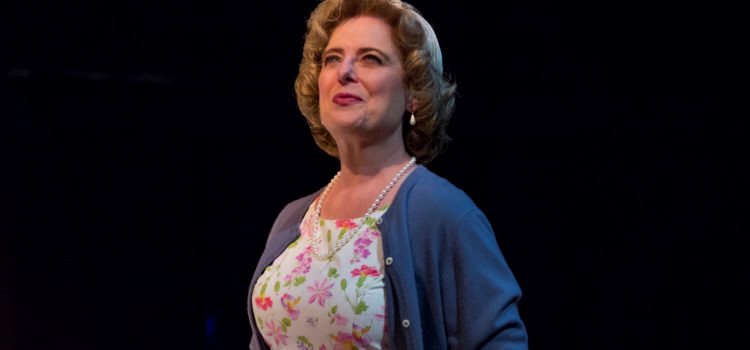
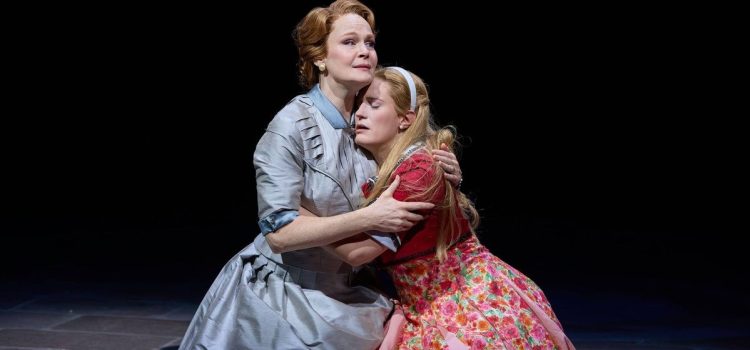
by CB Adams

Opera Theatre of Saint Louis’ production of “The Light in the Piazza” consistently achieves the atmosphere of operatic emotional depth, even if it reaches true operatic emotional danger less often.

Through soaring vocal performances, elegant visual storytelling and sustained tonal sophistication, OTSL delivers a production enveloped in cultivated romanticism and musical yearning.

Cameron Anderson’s striking set design establishes that atmosphere immediately. Sweeping stone arches dominate the stage, carrying the accumulated emotional history of Florence itself.

The arches become emotional architecture — thresholds, passages and reminders that these characters are visitors twice over: tourists moving through Italy and emotional travelers moving toward unfamiliar versions of themselves.
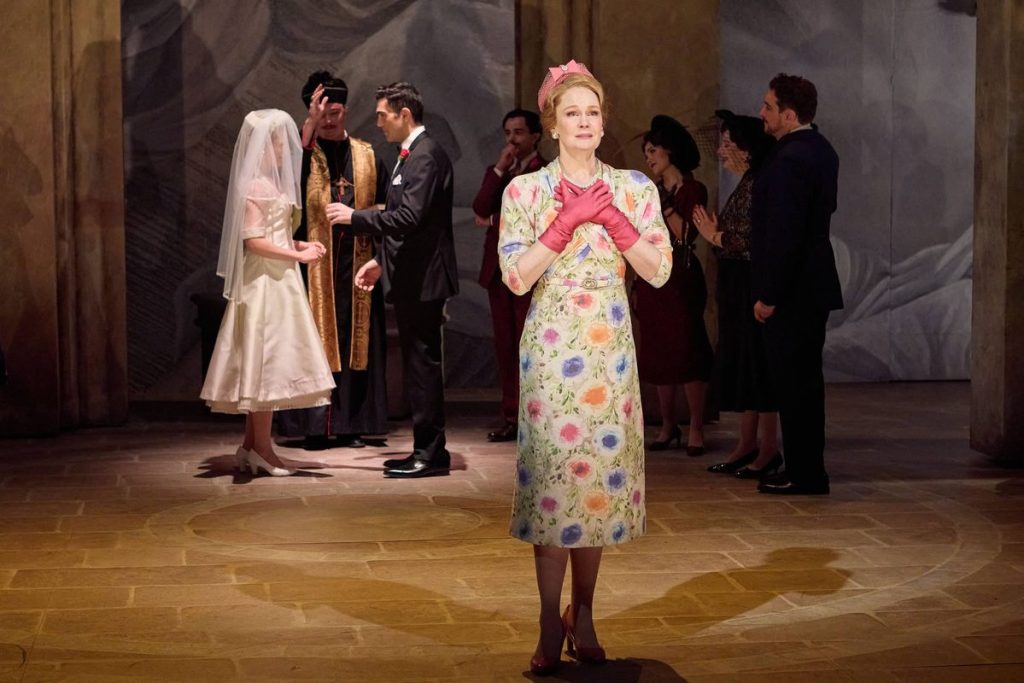
Kate Baldwin as Margaret Johnson. Photo by Eric Woolsey.

Eric Southern’s lighting deepens that visual language beautifully. A stark shaft of light isolates Clara at both the opening and near the production’s conclusion, quietly framing her as emotionally exposed and suspended between dependence and adulthood, innocence and self-determination.

Southern’s lighting and Anderson’s arches together create a visual vocabulary of passage, vulnerability and emotional crossing.

Crystal Manich directs with clarity and tonal confidence. Scene transitions flow with dreamlike fluidity, and the production sustains a remarkably cohesive emotional vocabulary from beginning to end.

The production ultimately belongs to Kate Baldwin’s Margaret Johnson.
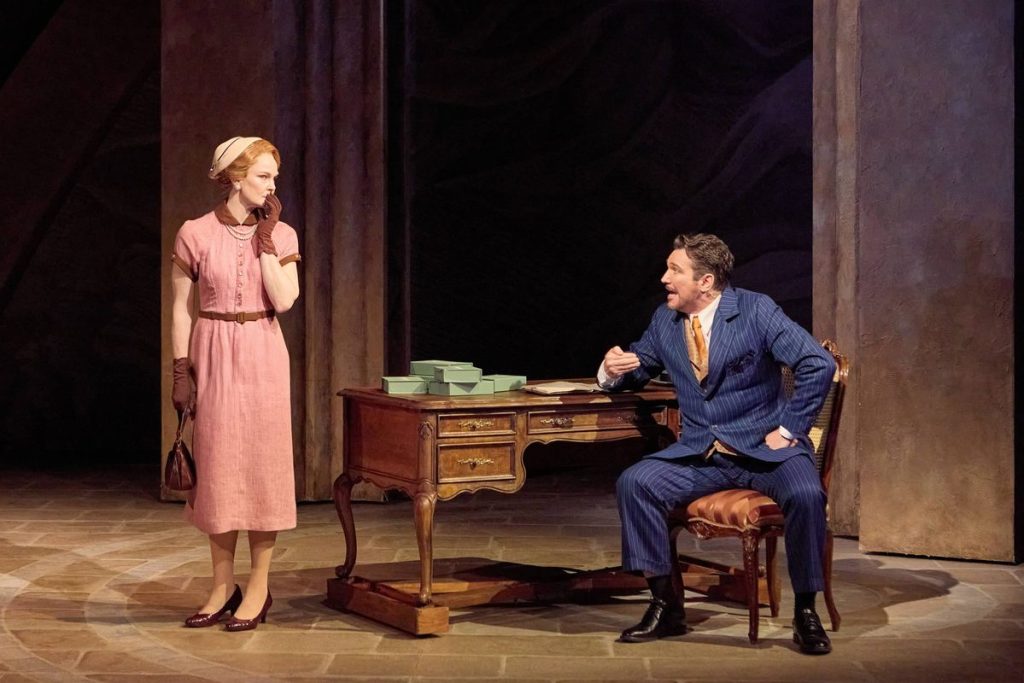
Kate Baldwin and Paolo Szot in “The Light at the Piazza.” Photo by Eric Woolsey.

Baldwin gives the evening its mature emotional intelligence, shaping Margaret as a woman who understands that love offers no guarantees, safeguards or reliable maps. Warmth, wit, restraint and quiet exhaustion coexist seamlessly in her performance.

Her richly controlled vocals navigate Adam Guettel’s harmonically restless score with remarkable ease, while her acting continually reveals the emotional calculations unfolding beneath Margaret’s composed exterior.

Though Clara’s romance initiates the story, OTSL’s production increasingly reveals itself as Margaret’s drama — a mature reckoning with love, uncertainty and the frightening necessity of release.

Roy Hage’s Fabrizio proves equally essential to the production’s success. Hage brings lyrical warmth, sincerity and earnest emotional transparency to the role, grounding the production’s refined theatricality in genuine feeling.
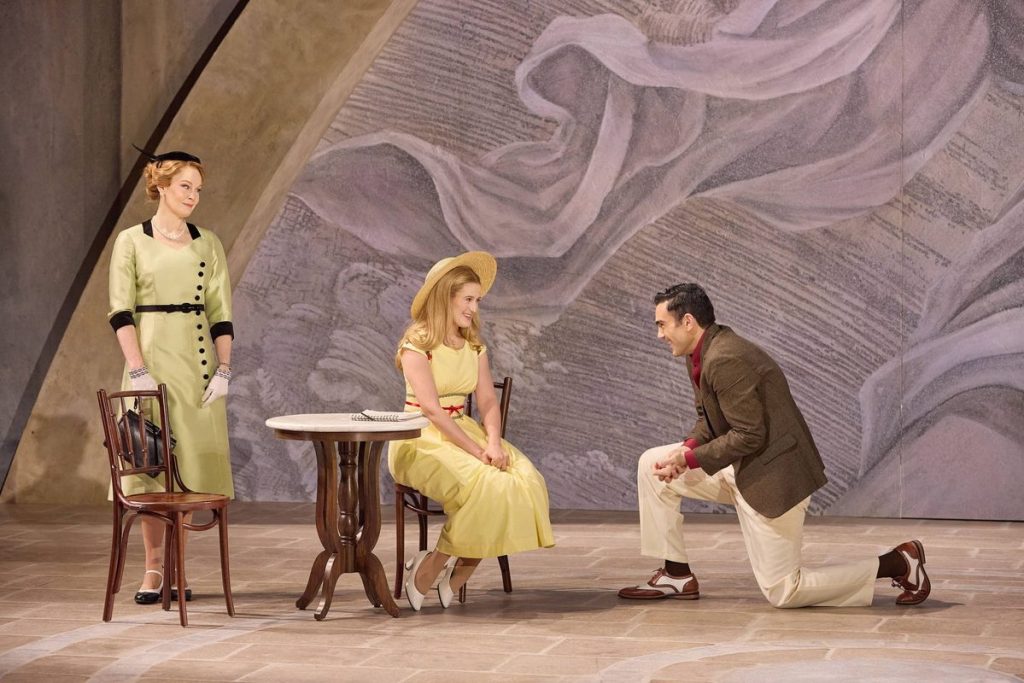
Kate Baldwin, Katrina Galka and Roy Hage in “The Light at the Piazza.” Photo by Eric Woolsey.

His chemistry with Katrina Galka’s Clara gives the romance persuasive emotional momentum even when the show’s idealism threatens to outrun practical realism.

Hage’s tenor remains consistently expressive and inviting, and his openness sustains much of the production’s emotional accessibility.

Galka delivers a thoughtful and sympathetic Clara, particularly in the later scenes where the character’s frustration with her constrained life emerges more forcefully.
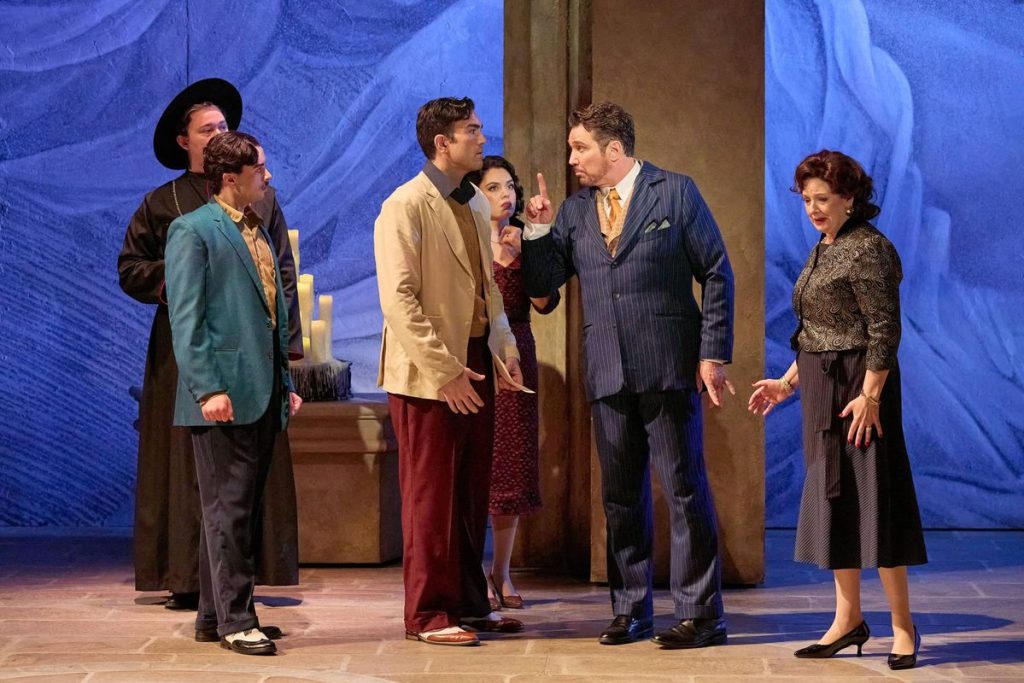
The Naccarelli family in “The Light at the Piazza.” Photo by Eric Woolsey.

Even so, the production’s emotional center of gravity gradually shifts toward Baldwin and Hage, whose performances carry greater theatrical and vocal authority.

That contrast between youthful emotional openness and the erosion of adult certainty gives the production much of its emotional texture. Clara and Fabrizio move toward love with instinctive urgency, while Margaret and Roy inhabit the lingering emotional afterlife of a marriage whose passion has cooled into habit and caution.

Under Rob Berman’s direction, the St. Louis Symphony Orchestra fully embraces Guettel’s lush, classically inflected score. The music unfolds less as a sequence of distinct songs and more as a continuous emotional current built from soaring phrases, suspended harmonies and yearning orchestral textures.
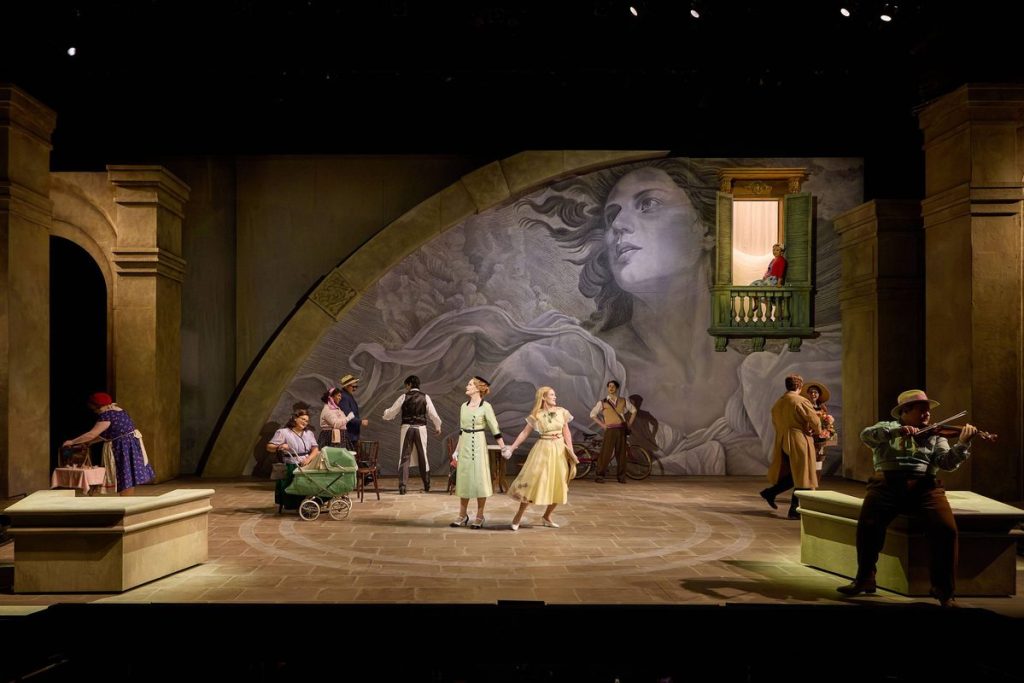
The museums of Florence. Photo by Eric Woolsey.

At times, however, that richness works against dramatic immediacy. The orchestra occasionally overwhelms dialogue, and extended untranslated passages in Italian force audiences to work harder than necessary to remain textually connected.

Those passages clearly reinforce Margaret’s outsider status within Florence’s emotional and linguistic landscape. Still, the cumulative effect creates more distance than intimacy.

Perhaps it is unfair to apply operatic standards of clarity and accessibility to a musical deliberately straddling both worlds. Yet when an opera company stages “The Light in the Piazza” with such unapologetically operatic ambition, those comparisons become inevitable.

What ultimately lingers after OTSL’s “The Light in the Piazza” is less any individual song or dramatic revelation than the production’s carefully sustained emotional and visual atmosphere. The voices, the arches, the light and the cultivated romanticism remain vividly intact —  a performance more immersive than transformative, though consistently elegant and theatrically persuasive throughout.
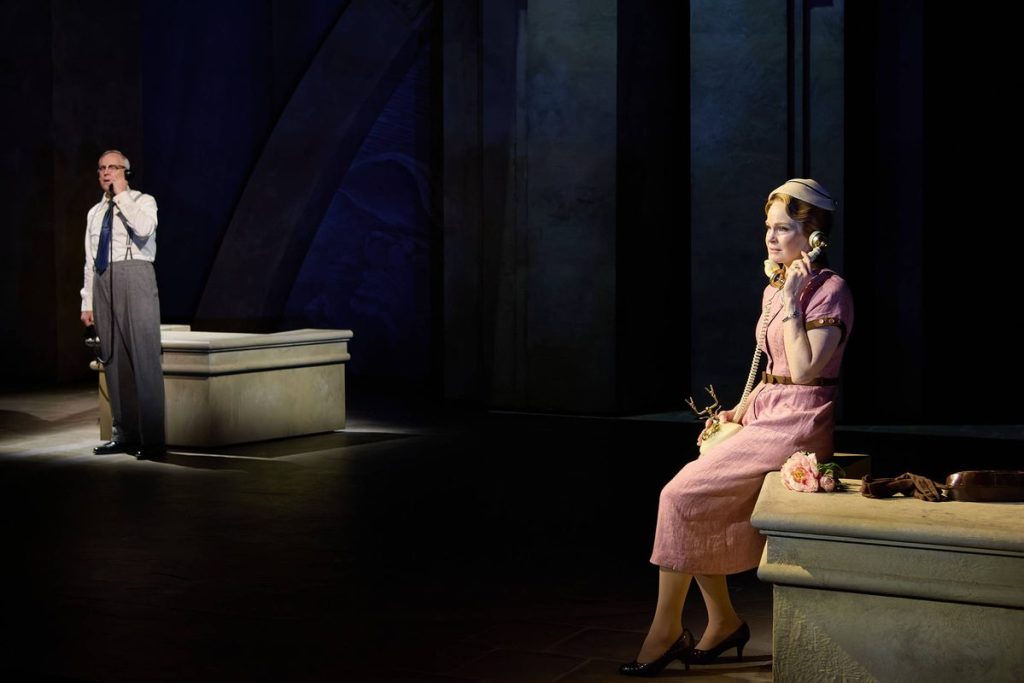
Michael James Reed and Kate Baldwin as The Johnsons in “The Light in the Piazza.” Photo by Eric Woolsey.

“The Light in the Piazza” continues through June 28 at the Loretto-Hilton Center on the Webster University campus, presented in rotating repertory as part of Opera Theatre of Saint Louis’ 2026 festival season. Ticket information, dining options and additional production details are available through the OTSL website.

By Lynn Venhaus
Managing Editor
With its lush, unusual score and seductive setting, “The Light in the Piazza” is swoon-worthy in many aspects.
Regarded as demanding to present because of its music and dramatic complexities, this intricate musical heightens realism and challenges the most confident vocalist.
Its Tony-winning neoromantic score and orchestrations by Adam Guettel, grandson of icon Richard Rodgers, have more in common with opera and classical music than traditional showtunes, without any pop references.
Nevertheless, the cast of R-S Theatrics’ production rises to master the harmonies and embrace la dolce vita. Guided by music director Sarah Nelson, whose work is exceptional, with assured stage direction from Christine Rios, they project a confident grasp of the material.

Some of the lyrics are in Italian, and silky-smooth voiced Tielere Cheatem, as Fabrizio, is impressive, particularly in his fluid renditions of “Il Mondo Era Vuoto” and “Passeggiata.” His family, the Naccarellis, speak impeccable Italian and deliver richly textured vocals – Kent Coffel as Signor, Jodi Stockton as Signora, Stephanie Merritt as Franca and Micheal Lowe as Giuseppe.
Special mention must go to Italian language coach Myriam Columbo, for it feels organic.
It’s the summer of 1953, and the well-to-do Southern matron Margaret (Kay Love) returns to Florence, Italy, where she spent her honeymoon. With her innocent 26-year-old daughter in tow, her joy is tempered by the special needs of the developmentally delayed Clara (Macia Noorman), who was hit in the head by a Shetland pony at age 10. She matured physically but not emotionally/mentally. It is more subtle than obvious, but when Clara gets upset, she behaves like a petulant child.
The melodramatic story is adapted from a novella by Elizabeth Spencer, which became a turgid 1962 movie starring Olivia de Havilland, Rossano Brazzi, Yvette Mimieux and George Hamilton (?!? as Fabrizio). The 2005 Broadway show was nominated for 11 Tony Awards and won five. It had both fans and detractors, and I was one of its sharpest critics, particularly of the book by Craig Lucas.
Not a fan of the 2007 touring production, which was swallowed in the Fox, was devoid of sympathy for the mother and did not have an ounce of nuance in what I considered a duplicitous transaction.
Not so here – surprise! – because of the performances and the interpretation, although they can’t help that the book has some issues.
Several key elements soothed my misgivings, but mainly it was because of Kay Love’s splendid performance as the Southern matron Margaret, which is the lynchpin to the whole show.
Love earns our sympathy right away – it is a virtuoso performance that highlights her outstanding vocal talent while giving her a juicy role in which to shine. You feel her dilemma, and the emotional rollercoaster she endures. Her North Carolina accent is refreshingly soft and does not overpower her character,  thanks to dialect coach Mark Kelley.
All that guilt Margaret carries is shown on Love’s face, along with the regrets of a lackluster marriage, and a life, though comfortable, spent in service to others. She’s exasperated keeping tabs on an excited Clara, who encounters a young Florentine, Fabrizio. It’s love at first sight for both.
As Clara, Macia Noorman’s accent weaves in and out. Noorman and Cheatem work well together, but she seems more tentative in the duets and went sharp or flat more often in her vocals, particularly when paired with someone. However, her “Clara’s Interlude” is quite lovely.
Rios does not make this entanglement of two star-crossed families overwrought, rather keeps focus on the complicated romance and culture clash. As Margaret wrestles with the couple’s wedding plans, she must decide if she believes in love and her daughter’s happiness. Her husband Roy (Robert Doyle) is of no help, or empathy.
In addition to their superb vocals, the actors playing the Naccarelli family stand out. Kent Coffel plays the haberdasher father with such authority that you believe he is a Florentine of stature while a winsome Jodi Stockton has a nice motherly moment explaining the proceedings to the audience.
Stephanie Merritt gives considerable oomph to the tempestuous Franca so that she is not just a caricature, and soars in her number, “The Joy You Feel.”
While Love imbues her numbers with emotion, her rendition of the finale “Fable” is stunning, all the more remarkable because it follows a fabulous “Love to Me” sung by Cheatem. Love has a sweet duet with Coffel, “Let’s Walk,” before two families join together.
The power of the cast’s voices match the character demands, and Nelson’s musical work must be recognized, for the level of difficulty is understood.
The expressive orchestra adds so much, with Terri Langerak playing a glorious harp, Emily Lane on cello, Kelly LaRussa on violin, Jacob Stergos on bass and Nelson on piano. Their expert skill provided a luxurious sound that elevated this show.
The location also prominently figures into the presentation. Florence is an alluring city of Renaissance masterpieces in the Tuscany region of Italy, with its postcard Mediterranean landscapes, ancient history, and extraordinary art, culture and cuisine. It’s also a character.
The look and feel of this show combines tantalizing adventure with a traveler’s awestruck sense of wonder, providing atmosphere along with sense of time and place.
The piazza, a town square, is where we meet a very tight ensemble, crisp in purposeful movements and welcoming in demeanor. Chris Kernan, Jason Meyers, Louisa Wimmer, Robert Doyle, Melissa Christine, Lindy Elliot, Ann Hier and Anthony Randle are a compelling chorus.
Keller Ryan’s scenic design allows for this tableau to come alive with a captivating vibrancy while Nathan Schroeder’s lighting design provides a burnished glow.
They all look marvelous, too — chic fashion choices by costume designer by Ashley Bauman enhanced the characters’ personalities.
Margaret can’t help but be swept away by the scenic views and the teeming crowd, and neither could I. The intimate staging, the strong creative aspects and the level of talent add up to a must-see production.
R-S Theatrics opens its eighth season – The Season of the Not-so-Perfect Past — with the St. Louis premiere of “The Light in the Piazza” Aug. 10 – 26, Friday and Saturday at 8 p.m. and Sunday at 7 p.m., at the Marcelle Theatre, 3310 Samuel Shepard Drive, St. Louis, 63103. Tickets can be purchased through Metrotix.com. For more information, visit r-stheatrics.org.